What’s in a name? In some languages, grammatical gender
Vivi Nastase EML Research gGmbH
Heidelberg, Germany
Marius Popescu
Department of Mathematics and Computer Science University of Bucharest, Bucharest, Romania
Abstract
This paper presents an investigation of the relation between words and their gender in two gendered languages: German and Ro-manian. Gender is an issue that has long preoccupied linguists and baffled language learners. We verify the hypothesis that gender is dictated by the general sound patterns of a language, and that it goes beyond suffixes or word endings. Exper-imental results on German and Romanian nouns show strong support for this hypoth-esis, as gender prediction can be done with high accuracy based on the form of the words.
1 Introduction
For speakers of a language whose nouns have no gender (such as modern English), making the leap to a language that does (such as German), does not come easy. With no or few rules or heuris-tics to guide him, the language learner will try to draw on the “obvious” parallel between grammat-ical and natural gender, and will be immediately baffled to learn that girl – M¨adchen – is neuter in German. Furthermore, one may refer to the same object using words with different gender: car can be called (das) Auto (neuter) or (der) Wagen (mas-culine). Imagine that after hard work, the speaker has mastered gender in German, and now wishes to proceed with a Romance language, for example Italian or Spanish. He is now confronted with the task of relearning to assign gender in these new languages, made more complex by the fact that gender does not match across languages: e.g. sun – feminine in German (die Sonne), but masculine in Spanish (el sol), Italian (il sole) and French (le soleil); moon – masculine in German (der Mond), but feminine in Spanish (la luna), Italian (la luna) and French (la lune). Gender doesn’t even match
within a single language family: travel – mascu-line in Spanish (el viage) and Italian (il viaggio), but feminine in Portuguese (a viagem).
Grammatical gender groups nouns in a lan-guage into distinct classes. There are lanlan-guages whose nouns are grouped into more or less than three classes. English for example has none, and makes no distinction based on gender, although Old English did have three genders and some traces remain (e.g. blonde, blond).
Linguists assume several sources for gender: (i) a first set of nouns which have natural gender and which have associated matching grammatical gen-der; (ii) nouns that resemble (somehow) the nouns in the first set, and acquire their grammatical gen-der through this resemblance. Italian and Roma-nian, for example, have strong and reliable phono-logical correlates (Vigliocco et al., 2004b, for Ital-ian). (Doca, 2000, for RomanItal-ian). In Romanian the majority of feminine nouns end in ˘a or e. Some rules exists for German as well (Schumann, 2006), for example nouns ending in -t¨at, -ung, -e, -enz, -ur, -keit, -in tend to be feminine. Also, when specific morphological processes apply, there are rules that dictate the gender of the newly formed word. This process explains why Frau (woman) is feminine in German, while Fr¨aulein (little woman, miss) is neuter – Fr¨aulein = Frau + lein. The ex-isting rules have exceptions, and there are numer-ous nouns in the language which are not derived, and such suffixes do not apply.
Words are names used to refer to concepts. The fact that the same concept can be referred to using names that have different gender – as is the case for car in German – indicates that at least in some cases, grammatical gender is in the name and not the concept. We test this hypothesis – that the gen-der of a noun is in its word form, and that this goes beyond word endings – using noun gender data for German and Romanian. Both Romanian and German have 3 genders: masculine, feminine and
neuter. The models built using machine learning algorithms classify test nouns into gender classes based on their form with high accuracy. These re-sults support the hypothesis that in gendered lan-guages, the word form is a strong clue for gender. This supplements the situation when some con-cepts have natural gender that matches their gram-matical gender: it allows for an explanation where there is no such match, either directly perceived, or induced through literary devices.
The present research has both theoretical and practical benefits. From a theoretical point of view, it contributes to research on phonology and gender, in particular in going a step further in un-derstating the link between the two. From a practi-cal perspective, such a connection between gender and sounds could be exploited in advertising, in particular in product naming, to build names that fit a product, and which are appealing to the de-sired customers. Studies have shown that espe-cially in the absence of meaning, the form of a word can be used to generate specific associations and stimulate the imagination of prospective cus-tomers (Sells and Gonzales, 2003; Bedgley, 2002; Botton et al., 2002).
2 Gender
What is the origin of grammatical gender and how does it relate to natural gender? Opinions are split. Historically, there were two main, opposite, views: (i) there is a semantic explanation, and natural gender motivated the category (ii) the relationship between natural and grammatical gender is arbi-trary.
Grimm (1890) considered that grammatical gender is an extension of natural gender brought on by imagination. Each gender is associated with particular adjectives or other attributes, and in some cases (such as for sun and moon) the assign-ment of gender is based on personification. Brug-mann (1889) and Bloomfield (1933) took the po-sition that the mapping of nouns into genders is arbitrary, and other phenomena – such as deriva-tions, personification – are secondary to the estab-lished agreement. Support for this second view comes also from language acquisition: children who learn a gendered language do not have a nat-ural gender attribute that they try to match onto the newly acquired words, but learn these in a sep-arate process. Any match or mapping between natural and grammatical gender is done after the natural gender “feature” is acquired itself.
Ki-larski (2007) presents a more detailed overview of currents and ideas about the origin of gender. Unterbeck (1999) contains a collection of papers that investigate grammatical gender in several lan-guages, aspects of gender acquisition and its rela-tion with grammatical number and agreement.
There may be several reasons for the polemic between these two sides. One may come from the categorization process, the other from the relation between word form and its meaning. Let us take them each in turn, and see how they influenced gender.
Grammatical gender separates the nouns in a language into disjoint classes. As such, it is a cat-egorization process. The traditional – classical – theory of categorization and concepts viewed cat-egories and concepts as defined in terms of a set of common properties that all its members should share. Recent theories of concepts have changed, and view concepts (and categories) not necessar-ily as “monolithic” and defined through rules, but rather as clusters of members that may resemble each other along different dimensions (Margolis and Laurence, 1999).
In most linguistic circles, the principle of ar-bitrariness of the association between form and meaning, formalized by de Saussure (1916) has been largely taken for granted. It seems however, that it is hard to accept such an arbitrary relation, as there have always been contestants of this prin-ciple, some more categorical than others (Jakob-son, 1937; Jespersen, 1922; Firth, 1951). It is pos-sible that the correlation we perceive between the word form and the meaning is something that has arisen after the word was coined in a language, be-ing the result of what Firth called “phonetic habit” through “an attunement of the nervous system”, and that we have come to prefer, or select, cer-tain word forms as more appropriate to the con-cept they name – “There is no denying that there are words which we feel instinctively to be ade-quate to express the ideas they stand for. ... Sound symbolism, we may say, makes some words more fit to survive” (Jespersen, 1922).
pos-sible through literary devices (personification, metaphor, metonymy). Nouns belonging to the same gender category may resemble each other because of semantic considerations, lexical deriva-tions, internal structure, perceived associations and so on. Second, the fact that we allow for the possibility that the surface form of a word may encode certain word characteristics or attributes, allows us to hypothesize that there is a surface, phonological, similarity between words grouped within the same gender category, that can supple-ment other resemblance criteria in the gender cat-egory (Zubin and K¨opcke, 1986).
Zubin and K¨opcke (1981), Zubin and K¨opcke (1986) have studied the relation between seman-tic characterisseman-tics and word form with respect to gender for German nouns. Their study was mo-tivated by two observations: Zipf (1935) showed that word length is inversely correlated with fre-quency of usage, and Brown (1958) proposed that in choosing a name for a given object we are more likely to use a term corresponding to a “basic” level concept. For example, chair, dog, apple would correspond to the basic level, while furni-ture, animal, fruit and recliner, collie, braeburn apple correspond to a more general or a more specific level, respectively. Their study of gen-der relative to these levels have shown that basic level terms have masculine, feminine, and rarely neuter genders, while the more undifferentiated categories at the superordinate level are almost ex-clusively neuter.
In psycholinguistic research, Friederici and Ja-cobsen (1999) adopt the position that a lexical entry consists of two levels: form and seman-tic and grammaseman-tical properties to study the influ-ence of gender priming – both from a form and semantic perspective – on language comprehen-sion. Vigliocco et al. (2004a) study gender prim-ing for German word production. While this re-search studies the influence of the word form on the production of nouns with the same or different grammatical gender, there is no study of the rela-tion between word forms and their corresponding gender.
In recent studies we have found on the rela-tion between word form and its associated gender, the only phonological component of a word that is considered indicative is the ending. Spalek et al. (2008) experiment on French nouns, and test whether a noun’s ending is a strong clue for gen-der for native speakers of French. Vigliocco et al.
(2004b) test cognitive aspects of grammatical gen-der of Italian nouns referring to animals.
Cucerzan and Yarowsky (2003) present a boot-strapping process to predict gender for nouns in context. They show that context gives accurate clues to gender (in particular through determiners, quantifiers, adjectives), but when the context is not useful, the algorithm can fall back successfully on the word form. Cucerzan and Yarowsky model the word form for predicting gender using suffix trie models. When a new word is encountered, the word is mapped onto the trie starting from the last letter, and it is assigned the gender that has the highest probability based on the path it matches in the trie. In context nouns appear with various in-flections – for number and case in particular. Such morphological derivations are gender specific, and as such are strong indicators for gender.
The hypothesis tested here is that gender comes from the general sound of the language, and is dis-tributed throughout the word. For this, the data used should not contain nouns with “tell tale” in-flections. The data will therefore consist of nouns in the singular form, nominative case. Some nouns are derived from verbs, adverbs or adjectives, or other nouns through morphological derivations. These derivations are regular and are identifiable through a rather small number of regular suffixes. These suffixes (when they are indicative of gen-der) and word endings will be used as baselines to compare the accuracy of prediction on the full word with the ending fragment.
3 Data
We test our gender-language sounds connection through two languages from different language families. German will be the representative of the Germanic languages, and Romanian for the Ro-mance ones. We first collect data in the two lan-guages, and then represent them through various features – letters, pronunciation, phonetic features.
3.1 Noun collections
German data For German we collect nouns and their grammatical gender from a German-English dictionary, part of the BEOLINGUS multi-lingual dictionary1. In the first step we collected the Ger-man nouns and their gender from this dictionary. In step 2, we filter out compounds. The reason for this step is that a German noun compound will
have the gender of its head, regardless of its nom-inal modifiers. For the lack of a freely available tool to detect and split noun compounds, we resort to the following algorithm:
1. initialize the list of nouns LN to the empty list;
2. take each nounnin the dictionaryD, and
(a) if∃ni ∈ LN such thatnis an end sub-string ofni, then add nto LN and re-moveni fromLN;
(b) if∃ni ∈ LN such thatni is a end sub-string ofn, skipn;
Essentially, we remove from the data all nouns that include another noun as the end part (which is the head position in German noun compounds). This does not filter examples that have suffixes added to form the feminine version of a masculine noun, for example: (der) Lehrer – (die) Lehrerin (teacher). The suffixes are used in one of the base-lines for comparison with our learning method.
We obtain noun pronunciation information from the Bavarian Archive for Speech Signals2. We fil-ter again our listLN to keep nouns for which we have pronunciation information. This allows us to compare the learning results when letter or pro-nunciation information is used.
After collecting the nouns and their pronunci-ation, we map the pronunciation onto lower level phonetic features, following the IPA encoding of sounds for the German language. The mapping between sounds and IPA features was manually encoded following IPA tables.
Romanian data We extract singular nomina-tive forms of nouns from the Romanian lexical database (Barbu, 2008). The resource contains the proper word spelling, including diacritics and special characters. Because of this and the fact that there is a straightforward mapping between spelling and pronunciation in Romanian, we can use the entire data extracted from the dictionary in our experiments, without special pronunciation dictionaries. Following the example for the Ger-man language, we encode each sound through lower level phonological features using IPA guide-lines.
As in Italian, in Romanian there are strong phonological cues for nouns, especially those hav-ing the feminine gender: they end in ˘a and e.
2http://www.phonetik.uni-muenchen.de/
Bas/
[image:4.595.314.519.167.240.2]To determine whether the connection between a word form and gender goes beyond this superfi-cial rule, we generate a dataset in which the nouns are stripped of their final letter, and their represen-tation is built based on this reduced form.
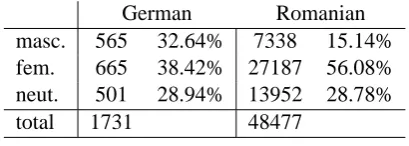
Table 1 shows the data collected and the distri-bution in the three classes.
German Romanian
masc. 565 32.64% 7338 15.14% fem. 665 38.42% 27187 56.08% neut. 501 28.94% 13952 28.78%
total 1731 48477
Table 1: Data statistics
Because for Romanian the dataset is rather large, we can afford to perform undersampling to balance our classes, and have a more straight-forward evaluation. We generate a perfectly bal-anced dataset by undersampling the feminine and the neuter classes down to the level of the mascu-line class. We work then with a dataset of 22014 instances, equally distributed among the three gen-ders.
3.2 Data representation
For each word in our collections we produce three types of representation: letters, phonemes and phonological features. Table 2 shows examples for each of these representations. The letter and phoneme representations are self-explanatory. We obtain the pronunciation corresponding to each word from a pronunciation dictionary, as men-tioned in Section 3.1, which maps a word onto a sequence of phonemes (phones). For Romanian we have no such resource, but me make without since in most part the pronunciation matches the letter representation3.
German
letter abend (m) a b e n d
phoneme a: b @ n d
Romanian
[image:4.595.331.499.593.674.2]letter sear˘a (f) s e a r ˘a
Table 2: Data representation in terms of letters and phonemes for the German and Romanian forms of the word evening. For Romanian, the letter and phoneme representation is the same.
3
Phonemes, the building blocks of the phonetic representation, can be further described in terms of phonological features – “configurations” of the vocal tract (e.g tongue and lips position), and acoustic characteristics (e.g. manner of air flow). We use IPA standards for mapping phones in German and Romanian onto these phonological features. We manually construct a map between phones and features, and then automatically binarize this representation and use it to generate a representation for each phone in each word in the data. For the word abend (de) / seara (ro) (evening) in Figure 2, the phonological feature representation for German is:
0000100000001000010000000001 0001000100000000000010000000 0000100000000100000000010001 1000000100000010000000000000 1000000100000000000010000000,
with the feature base:
< alveolar, approximant, back, bilabial, cen-tral, close, closemid, consonant, fricative, front, glottal, labiodental, long, mid, nasal, nearclose, nearopen, open, openmid, palatal, plosive, postalveolar, rounded, short, unrounded, uvular, velar, vowel>.
For Romanian, the phonological feature base is:
< accented, affricate, approximant, back, bi-labial, central, close, consonant, dental, fricative, front, glottal, labiodental, mid, nasal, open, plosive, postalveolar, rounded, trill, unrounded, velar, voiced, voiceless, vowel>,
and the phonological feature representation of the word changes accordingly.
4 Kernel Methods and String Kernels
Our hypothesis that the gender is in the name is equivalent to proposing that there are sequences of letters/sounds/phonological features that are more common among nouns that share the same gender or that can distinguish between nouns under differ-ent genders. To determine whether that is the case, we use a string kernel, which for a given string (se-quence) generates a representation that consists of all its substrings of length less than a parameterl.
The words are represented as strings with bound-aries marked with a special character (’#’). The high dimensional representation generated by the string kernel is used to find a hyperplane that sep-arates instances of different classes. In this section we present in detail the kernel we use.
Kernel-based learning algorithms work by em-bedding the data into a feature space (a Hilbert space), and searching for linear relations in that space. The embedding is performed implicitly, that is by specifying the inner product between each pair of points rather than by giving their co-ordinates explicitly.
Given an input set X (the space of examples), and an embedding vector spaceF (feature space), letφ :X → F be an embedding map called fea-ture map.
A kernel is a functionk, such that for allx, z ∈ X, k(x, z) =< φ(x), φ(z) >, where < ., . > denotes the inner product inF.
In the case of binary classification problems, kernel-based learning algorithms look for a dis-criminant function, a function that assigns+1 to examples belonging to one class and−1to exam-ples belonging to the other class. This function will be a linear function in the spaceF, that means it will have the form:
f(x) =sign(< w, φ(x)>+b),
for some weight vector w. The kernel can be exploited whenever the weight vector can be ex-pressed as a linear combination of the training
points, Pn
i=1αiφ(xi), implying that f can be
ex-pressed as follows:
f(x) =sign(
n
X
i=1
αik(xi, x) +b)
.
Various kernel methods differ in the way in which they find the vectorw (or equivalently the vectorα). Support Vector Machines (SVM) try to find the vector w that define the hyperplane that maximum separate the images in F of the train-ing examples belongtrain-ing to the two classes. Math-ematically SVMs choose thew andbthat satisfy the following optimization criterion:
min
w,b
1
n
n
X
i=1
[1−yi(< w, φ(xi)>+b)]++ν||w||2
Kernel Ridge Regression (KRR) selects the vec-tor wthat simultaneously has small empirical er-ror and small norm in Reproducing Kernel Hilbert Space generated by kernelk. The resulting mini-mization problem is:
minw n1Xn
i=1
(yi−< w, φ(xi)>)2+λ||w||2
where againyiis the label (+1/−1) of the training examplexi, andλa regularization parameter. De-tails about SVM and KRR can be found in (Taylor and Cristianini, 2004). What is important is that above optimization problems are solved in such a way that the coordinates of the embedded points are not needed, only their pairwise inner products which in turn are given by the kernel functionk.
SVM and KRR produce binary classifiers and gender classification is a multi-class classification problem. There are a lot of approaches for com-bining binary classifiers to solve multi-class prob-lems. We used one-vs-all scheme. For arguments in favor of one-vs-all see (Rifkin and Klautau, 2004).
The kernel function offers to the kernel methods the power to naturally handle input data that are not in the form of numerical vectors, for example strings. The kernel function captures the intuitive notion of similarity between objects in a specific domain and can be any function defined on the respective domain that is symmetric and positive definite. For strings, a lot of such kernel functions exist with many applications in computational bi-ology and computational linguistics (Taylor and Cristianini, 2004).
Perhaps one of the most natural ways to mea-sure the similarity of two strings is to count how many substrings of length p the two strings have in common. This give rise to thep-spectrum ker-nel. Formally, for two strings over an alphabetΣ,
s, t∈Σ∗, thep-spectrum kernel is defined as:
kp(s, t) =
X
v∈Σp
numv(s)numv(t)
where numv(s) is the number of occurrences of stringv as a substring ins4 The feature map de-fined by this kernel associate to each string a vec-tor of dimension|Σ|p containing the histogram of frequencies of all its substrings of lengthp. Taking
4
Note that the notion of substring requires contiguity. See (Taylor and Cristianini, 2004) for discussion about the am-biguity between the terms ”substring” and ”subsequence” across different traditions: biology, computer science.
into account all substrings of length less thanpit will be obtained a kernel that is called the blended spectrum kernel:
kp1(s, t) =Xp
q=1
kq(s, t)
The blended spectrum kernel will be the ker-nel that we will use in conjunction with SVM and KRR. More precisely we will use a normalized version of the kernel to allow a fair comparison of strings of different length:
ˆ
kp1(s, t) = q k1p(s, t) kp1(s, s)k1p(t, t)
5 Experiments and Results
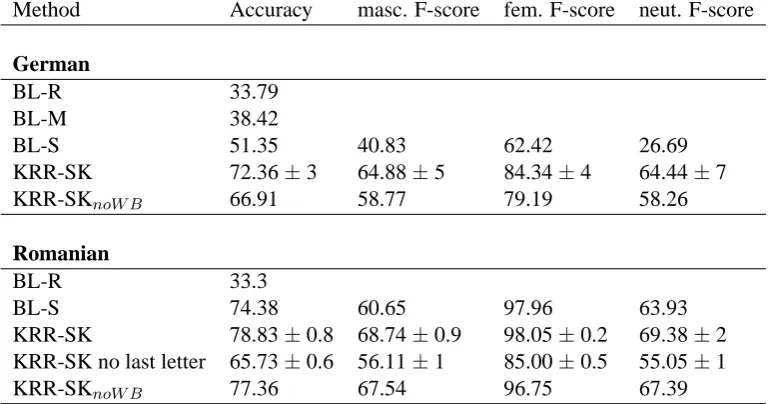
We performed 10-fold cross-validation learning experiments with kernel ridge regression and the string kernel (KRR-SK) presented in Section 4. We used several baselines to compare the results of the experiments against:
BL-R Gender is assigned following the distribu-tion of genders in the data.
BL-M Gender is assigned following the majority class (only for German, for Romanian we use balanced data).
BL-S Gender is assigned based on suffix-gender relation found in the literature. We use the following mappings:
• German (Schumann, 2006):
feminine -ade, -age, -anz, -e, -ei, -enz, ette, heit, keit, ik, in, ine, ion, -itis, -ive, -schaft, -t¨at, -tur, -ung, -ur; masculine -ant, -er, -ich, -ismus, -ling; neuter -chen, -ist, -lein, -ment, -nis, -o,
-tel, -um.
In our data set the most dominant gen-der is feminine, therefore we assign this gender to all nouns that do not match any of the previous suffixes. Table 4 shows a few suffixes for each gender, and an example noun.
Method Accuracy masc. F-score fem. F-score neut. F-score
German
BL-R 33.79
BL-M 38.42
BL-S 51.35 40.83 62.42 26.69
KRR-SK 72.36±3 64.88±5 84.34±4 64.44±7
KRR-SKnoW B 66.91 58.77 79.19 58.26
Romanian
BL-R 33.3
BL-S 74.38 60.65 97.96 63.93
KRR-SK 78.83±0.8 68.74±0.9 98.05±0.2 69.38±2 KRR-SK no last letter 65.73±0.6 56.11±1 85.00±0.5 55.05±1
[image:7.595.107.492.64.266.2]KRR-SKnoW B 77.36 67.54 96.75 67.39
Table 3: 10-fold cross-validation results – accuracy and f-scores percentages (±variation over the 10 runs) – for gender learning using string kernels
German
gender suffix example
fem. -e Ecke (corner)
-heit Freiheit (freedom) -ie Kom¨odie (comedy) masc. -er Fahrer (driver)
-ich Rettich (radish)
-ling Fr¨uhling (spring - season) neut. -chen M¨adchen (girl)
-nis Verst¨andnis (understanding) -o Auto (car)
Table 4: Gender assigning rules and examples for German
majority gender of all nouns ending in the respective letter – based on analy-sis of our data. In Table 5 we include some of the letter endings with an exam-ple noun, and a percentage that shows the precision of the ending in classify-ing the noun in the gender indicated in the table.
The results of our experiments are presented in Table 3, in terms of overall accuracy, and f-score for each gender. The performance presented corresponds to the letter-based representation of words. It is interesting to note that this represen-tation performed overall better than the phoneme or phonological feature-based ones. An
explana-Romanian
gender ending example Prec.
fem. -˘a mas˘a (table) 98.04
-e pˆaine (bread) 97.89
masc. -g sociolog (sociologist) 72.77
-r nor (cloud) 66.89
-n domn (gentleman) 58.45 neut. -m algoritm (algorithm) 90.95
-s vers (verse) 66.97
-t eveniment (event) 51.02
Table 5: Word-ending precision on classifying gender and examples for Romanian
tion may be that in both the languages we consid-ered, there is an (almost) one-to-one mapping be-tween letters and their pronunciation, making thus the pronunciation-based representation unneces-sary. As such, the letter level captures the interest-ing commonalities, without the need to go down to the phoneme-level.
[image:7.595.308.523.345.470.2]0 20 40 60 80 100
0 5 10 15 20 25
# of letters considered from end Romanian
classification accuracy word length percentages
30 35 40 45 50 55 60 65 70 75 80
0 1 2 3 4 5 6 7
accuracy
# of letters cut from end Romanian
word without last letters baseline
0 20 40 60 80 100
0 2 4 6 8 10 12 14 16 18 20
# of letters considered from end German
classification accuracy word length percentages
35 40 45 50 55 60 65 70 75
0 1 2 3 4 5 6
accuracy
# of letters cut from end German
[image:8.595.103.502.66.383.2]word without last letters baseline
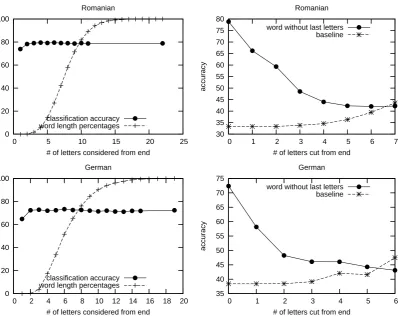
Figure 1: Gender prediction based on the last N letters, and based on the word minus the last N letters
once it is removed the performance on recogniz-ing gender should be close to the random assign-ment. This is not the case, and the improvement over the random baseline is 32% points. It is inter-esting to notice that when cutting off the last letter the class for which the gender assignment heuris-tic was clearest – the feminine class with -˘a and -e endings – the performance remains very high – 85% F-score.
To further test where the gender indicators are located, we performed two more sets of experi-ments: (i) classify words in their corresponding gender class using the word minus the last N ters; (ii) classify words based on the last N let-ters. The results of these experiments in terms of accuracy are presented in Figure 1. When con-sidering only the last N letters the performance is high for both German and Romanian, as expected if the gender indicators are concentrated at the end of the word. It is interesting though to notice the results of classification based on the word without the last N letters. The prediction accuracy mono-tonically decreases, but remains above the base-line until more than 6 letters are cut. Because as letters are cut some words completely disappear,
the baseline changes accordingly. 94.07% of the words have a length of at most 12 letters in the Romanian dataset, and 96.07% in the German one. Because gender prediction can be done with accu-racy higher than the random baseline even after 6 letters are cut from the ending of the word indicate that for more than 94% of the words considered, gender clues are spread over more than the second half of the word. Again, we remind the reader that the word forms are in nominative case, with no case or number inflections (which are strong indi-cators of gender in both Romanian and German).
no position information. The results of these ex-periments are presented in rowsKRR−SKnoW B in Table 3. The accuracy is slightly lower than the best results obtained when word boundaries are marked and the entire word form is used. How-ever, they are well above all the baselines consid-ered, without no information about word endings. For both German and Romanian, the gender that was learned best was feminine. For German part of this effect is due to the fact that the feminine class is more numerous in the data. For Roma-nian the data was perfectly balanced, so there is no such bias. Neuter and masculine nouns have lower learning performance. For Romanian, a contri-bution to this effect is the fact that neuter nouns behave as masculine nouns in their singular form (take the same articles, inflections, derivations), but as feminine in the plural, and our data consists of nouns in singular form. It would seem that from an orthographic point of view, neuter and mascu-line nouns are closer to each other than to feminine nouns.
From the reviewed related work, the one that uses the word form to determine gender is Cucerzan and Yarowsky (2003) for Romanian. There are two important differences with respect to the approach presented here. First, they con-sider words in context, which are inflected for number and case. Number and case inflections are reflected in suffixes that are gender specific. The words considered here are in singular form, nominative case – as such, with no inflections. Second, Cucerzan and Yarowsky consider two classes: feminine vs. masculine and neuter. Mas-culine and neuter nouns are harder to distinguish, as in singular form neuter nouns behave like mas-culine nouns in Romanian. While the datasets and word forms used by Cucerzan and Yarowsky are different than the one used here, the reader may be curious how well the word form distinguishes between feminine and the other two classes in the experimental set-up used here. On the full5
Romanian dataset described in Section 3, a two class classification gives 99.17% accuracy. When predicting gender for all words in their dataset, Cucerzan and Yarowsky obtain 98.25% accuracy.
6 Conclusion
When a speaker of a genderless language tries to learn a language with grammatical gender, it is
5
By “full” we mean the dataset before balancing the classes 48,477 instances (see Table 1).
very tempting to try to assign grammatical gen-der based on perceived or guessed natural gengen-der types. This does not work out well, and it only serves to confuse the learner even more, when he finds out that nouns expressing concepts with clear feminine or masculine natural gender will have the opposite or a neutral grammatical gender, or that one concept can be referred to through names that have different grammatical genders. Going with the flow of the language seems to be a better idea, and allow the sound of a word to dictate the gen-der.
In this paper we have investigated the hypothe-sis that gender is encoded in the word form, and this encoding is more than just the word endings as it is commonly believed. The results obtained show that gender assignment based on word form analysis can be done with high accuracy – 72.36% for German, and 78.83% for Romanian. Existing gender assignment rules based on word endings have lower accuracy. We have further strength-ened the point by conducting experiments on Ro-manian nouns without tell-tale word endings. The accuracy remains high, with remarkably high per-formance in terms of F-score for the feminine class (85%). This leads us to believe that gen-der information is somehow redundantly coded in a word. We plan to look closer at cases where we obtain different predictions based on the word ending and the full form of the word, and use boosting to learn weights for classifiers based on different parts of the word to see whether we can further improve the results.
As we have underlined before, word form simi-larity between words under the same gender is one criterion for gender assignment. It would be in-teresting to verify whether gender recognition can be boosted by using lexical resources that capture the semantics of the words, such as WordNets or knowledge extracted from Wikipedia, and verify whether similarities from a semantic point of view are also responsible for gender assignments in var-ious languages.
References
Ana-Maria Barbu. 2008. Romanian lexical data bases: Inflected and syllabic forms dictionar-ies. In Proceedings of the Sixth International
Language Resources and Evaluation (LREC’08).
http://www.lrec-conf.org/proceedings/lrec2008/.
Sharon Bedgley. 2002. Strawberry is
us-ing sound. http://online.wsj.com/article/ 0,,SB1030310730179474675.djm,00.html.
Leonard Bloomfield. 1933. Language. Holt, Reinhart & Winston, New York.
Marcel Botton, Jean-Jack Cegarra, and Beatrice Fer-rari. 2002. Il nome della marca: creazione e
strate-gia di naming, 3rd edition. Guerini e Associati.
Roger Brown. 1958. Words and Things. The Free Press, New York.
Karl Brugmann. 1889. Das Nominalgeschlecht in den indogermanischen Sprachen. In
Inter-nationale Zeitschrift f¨ur allgemenine Sprachwis-senschaft, pages 100–109.
S. Cucerzan and D. Yarowsky. 2003. Minimally super-vised induction of grammatical gender. In
Proceed-ings of HLT-NAACL 2003, pages 40–47.
Ferdinand de Saussure. 1916. Cours de linguistique
g´en´erale. Harrassowitz, Wiesbaden.
Gheorghe Doca Doca. 2000. Romanian language. Vol.
II: Morpho-Syntactic and Lexical Structures. Ars
Docendi, Bucharest, Romania.
John Rupert Firth. 1951. Modes and meaning. In
Papers in linguistics 1934-1951. Oxford University
Press, London.
Angela Friederici and Thomas Jacobsen. 1999. Pro-cessing grammatical gender during language com-prehension. Journal of Psychological Research,
28(5):467–484.
Jacob Grimm. 1890. Deutsche Grammatik.
Roman Jakobson. 1937. Lectures on Sound and
Mean-ing. MIT Press, Cambridge, MA.
Otto Jespersen. 1922. Language - its Nature,
Devel-opment and Origin. George Allen & Unwim Ltd.,
London.
Marcin Kilarski. 2007. On grammatical gender as an arbitrary and redundant category. In Douglas Kil-bee, editor, History of Linguistics 2005: Selected
pa-pers from the 10th International Conference on the History of Language Sciences (ICHOLS X), pages
24–36. John Benjamins, Amsterdam.
Eric Margolis and Stephen Laurence, editors. 1999.
Concepts: Core Readings. MIT Press.
Ryan Rifkin and Aldebaro Klautau. 2004. In de-fense of one-vs-all classification. Journal of
Ma-chine Learning Research, 5(January):101–141.
Johannes Schumann. 2006. Mittelstufe Deutsch. Max Hueber Verlag.
Peter Sells and Sierra Gonzales.
2003. The language of advertising. http://www.stanford.edu/class/linguist34/; in particular unit 8: ˜/Unit 08/blackberry.htm.
Katharina Spalek, Julie Franck, Herbert Schriefers, and Ulrich Frauenfelder. 2008. Phonological regulari-ties and grammatical gender retrieval in spoken word recognition and word production. Journal of
Psy-cholinguistic Research, 37(6):419–442.
John S. Taylor and Nello Cristianini. 2004. Kernel
Methods for Pattern Analysis. Cambridge
Univer-sity Press, New York, NY, USA.
Barbara Unterbeck, editor. 1999. Gender in Grammar
and Cognition. Approaches to Gender. Trends in
Linguistics. Studies and Monographs. 124. Mouton de Gruyter.
Gabriela Vigliocco, David Vinson, Peter Indefrey, Willem Levelt, and Frauke Hellwig. 2004a. Role of grammatical gender and semantics in german word production. Journal of Experimental Psychology:
Learning, Memory and Cognition, 30(2):483–497.
Gabriela Vigliocco, David Vinson, and Federica Pa-ganelli. 2004b. Grammatical gender and meaning. In Proc. of the 26th Meeting of the Cognitive Science
Society.
George Zipf. 1935. The Psychobiology of Language. Addison-Wesley.
David Zubin and Klaus-Michael K¨opcke. 1981. Gen-der: A less than arbitrary grammatical category. In R. Hendrick, C. Masek, and M. F. Miller, editors,
Papers from the seventh regional meeting, pages
439–449. Chicago Linguistic Society, Chicago.