Learning Linear Ordering Problems for Better Translation
∗Roy Tromble Google, Inc. 4720 Forbes Ave. Pittsburgh, PA 15213
Jason Eisner
Department of Computer Science Johns Hopkins University
Baltimore, MD 21218 [email protected]
Abstract
We apply machine learning to the Lin-ear Ordering Problem in order to lLin-earn sentence-specific reordering models for machine translation. We demonstrate that even when these models are used as a mere preprocessing step for German-English translation, they significantly outperform Moses’ integrated lexicalized reordering model.
Our models are trained on automatically aligned bitext. Their form is simple but novel. They assess, based on features of the input sentence, how strongly each pair of input word tokens wi, wj would like
to reverse their relative order. Combining all these pairwise preferences to find the best global reordering is NP-hard. How-ever, we present a non-trivial O(n3)
al-gorithm, based on chart parsing, that at least finds the best reordering within a cer-tain exponentially large neighborhood. We show how to iterate this reordering process within a local search algorithm, which we use in training.
1 Introduction
Machine translation is an important but difficult problem. One of the properties that makes it dif-ficult is the fact that different languages express the same concepts in different orders. A ma-chine translation system must therefore rearrange the source language concepts to produce a fluent translation in the target language.
1This work is excerpted and adapted from the first au-thor’s Ph.D. thesis (Tromble, 2009). Some of the ideas here appeared in (Eisner and Tromble, 2006) without empirical validation. The material is based in part upon work sup-ported by the National Science Foundation under Grant No. 0347822.
Phrase-based translation systems rely heavily on the target language model to ensure a fluent output order. However, a targetn-gram language model alone is known to be inadequate. Thus, translation systems should also look at how the source sentence prefers to reorder. Yet past sys-tems have traditionally used rather weak models of the reordering process. They may look only at the distance between neighboring phrases, or depend only on phrase unigrams. The decoders also rely on search error, in the form of limited reordering windows, for both efficiency and translation qual-ity.
Demonstrating the inadequacy of such ap-proaches, Al-Onaizan and Papineni (2006) showed that evengiventhe words in the reference translation, and their alignment to the source words, a decoder of this sort charged with merely rearranging them into the correct target-language order could achieve a BLEU score (Papineni et al., 2002) of at best 69%—and that only when restricted to keep most words very close to their source positions.
This paper introduces a more sophisticated model of reordering based on the Linear Order-ing Problem (LOP), itself an NP-hard permutation problem. We apply machine learning, in the form of a modified perceptron algorithm, to learn pa-rameters of a linear model that constructs a matrix of weights from each source language sentence. We train the parameters on orderings derived from automatic word alignments of parallel sentences.
The LOP model of reordering is a complete ordering model, capable of assigning a different score to every possible permutation of the source-language sentence. Unlike the target source-language model, it uses information about the relative posi-tions of the words in the source language, as well as the source words themselves and their parts of speech and contexts. It is therefore a language-pair specific model.
We apply the learned LOP model as a prepro-cessing step before both training and evaluation of a phrase-based translation system, namely Moses. Our methods for finding a good reordering un-der the NP-hard LOP are themselves of interest, adapting algorithms from natural language parsing and developing novel dynamic programs.
Our results demonstrate a significant improve-ment over translation using unreordered German. Using Moses with only distance-based reordering and a distortion limit of 6, our preprocessing im-proves BLEU from 25.27 to 26.40. Furthermore, that improvement is significantly greater than the improvement Moses achieves with its lexicalized reordering model, 25.55.
Collins et al. (2005) improved German-English translation using a statistical parser and several hand-written rules for preprocessing the German sentences. This paper presents a similar improve-ment using fully automatic methods.
2 A Linear Ordering Model
This section introduces a model of word reorder-ing for machine translation based on the Linear Ordering Problem.
2.1 Formalization
The input sentence isw = w1w2. . . wn. To
dis-tinguish duplicate tokens of the same word, we as-sume that each token is superscripted by its input position, e.g., w = die1 Katze2 hat3 die4 Frau5
gekauft6(gloss: “the cat has the woman bought”).
For a fixedw, a permutationπ =π1π2. . . πnis
any reordering of the tokens inw. The setΠn of
all such permutations has sizen!. We would like to define a scoring model that assigns a high score to the permutationπ =die4Frau5hat3gekauft6die1
Katze2 (gloss: “the woman has bought the cat”),
since that corresponds well to the desired English order.
To construct a function that scores permutations ofw, we first construct a pairwise preference ma-trixBw∈Rn×n, whose entries are
Bw[`, r] =def θ·φ(w, `, r), (1)
Here θ is a vector of weights. φ is a vector of feature functions, each considering the entire word sequencew, as well as any functions thereof, such as part of speech tags.
We will hereafter abbreviateBwasB. Its
inte-ger indices`andrare identified with the input to-kensw`andwr, and it can be helpful to write them
that way; e.g., we will sometimes writeB[2,5]as B[Katze2,Frau5].
The idea behind our reordering model is that B[Katze2,Frau5] > B[Katze5,Frau2]
ex-presses a preference to keepKatze2beforeFrau5,
whereas the opposite inequality would express a preference—other things equal—for permutations in which their order is reversed. Thus, we define1
score(π) =def X
i,j: 1≤i<j≤n
B[πi, πj] (2)
p(π) =def 1
Zexp(γ·score(π)) (3) ˆ
π = argmaxdef
π∈Πn
score(π) (4)
Note thatiandjdenote positions inπ, whereas πi,πj,`, andrdenote particular input tokens such
asKatze2andFrau5.
2.2 Discussion
To the extent that the costsB generally discour-age reordering, they will particularly discourdiscour-age long-distance movement, as it swaps more pairs of words.
We point out that our model is somewhat pecu-liar, since it does not directly consider whether the permutation π keeps die4 and Frau5 adjacent or
even close together, but only whether their order is reversed.
Of course, the model could be extended to con-sider adjacency, or more generally, the three-way cost of interposingk betweeniandj. See (Eis-ner and Tromble, 2006; Tromble, 2009) for such extensions and associated algorithms.
of German that complement existing techniques and thus improve state-of-the-art systems. Our positive results in even this situation suggest that in future, pairwise reordering costs should proba-bly be integrated into MT systems.
The probabilistic interpretation (3) of the score (2) may be useful when thus integrating our model with language models or other reordering models during translation, or simply when train-ing our model to maximize likelihood or minimize expected error. However, in the present paper we will stick to purely discriminative training and de-coding methods that simply try to maximize (2).
2.3 The Linear Ordering Problem
In the combinatorial optimization literature, the maximization problem (4) (with inputB) is known as the Linear Ordering Problem. It has numer-ous practical applications in fields including eco-nomics, sociology, graph theory, graph drawing, archaeology, and task scheduling (Gr¨otschel et al., 1984). Computational studies on real data have often used “input-output” matrices represent-ing resource flows among economic sectors (Schi-avinotto and St¨utzle, 2004).
Unfortunately, the problem is NP-hard. Further-more, it is known to be APX-complete, meaning that there is no polynomial time approximation scheme unless P=NP (Mishra and Sikdar, 2004). However, there are various heuristic procedures for approximating it (Tromble, 2009). We now give an attractive, novel procedure, which uses a CKY-parsing-like algorithm to search various sub-sets ofΠnin polynomial time.
3 Local Search
“Local search” refers to any hill-climbing proce-dure that iteratively improves a solution by mak-ing an optimal “local” change at each iteration.2 In this case, we start with the identity permutation, find a “nearby” permutation with a better score (2), and repeat until we have reached a local maximum of the scoring objective.
This section describes a local search procedure that uses a very generous definition of “local.” At each iteration, it finds the optimal permutation in a certainexponentially largeneighborhoodN(π) of the current permutationπ.
2One can introduce randomness to obtain MCMC sam-pling or simulated annealing algorithms. Our algorithms ex-tend naturally to allow this (cf. Tromble (2009)).
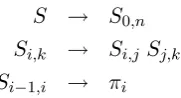
S → S0,n
Si,k → Si,jSj,k
[image:3.595.372.463.64.113.2]Si−1,i → πi
Figure 1: A grammar for a large neighborhood of permutations, given one permutationπ of length n. The Si,k rules are instantiated for each 0 ≤
i < j < k ≤ n, and the Si−1,i rules for each
0< i≤n.
We say that two permutations are neighbors iff they can be aligned by an Inversion Transduction Grammar (ITG) (Wu, 1997), which is a familiar reordering device in machine translation. Equiva-lently, π0 ∈ N(π) iff π can be transformed into
π0 by swapping various adjacent substrings ofπ,
as long as these swaps are properly nested. Zens and Ney (2003) used a normal form to show that the size of the ITG neighborhoodN(π)is a large Schr¨oder number, which grows exponentially in n. Asymptotically, the ratio between the size of the neighborhood forn+ 1and the size forn ap-proaches3 + 2√2≈5.8.
We show that equation (2) can be optimized withinN(π) inO(n3)time, using dynamic
pro-gramming. The algorithm is based on CKY pars-ing. However, a novelty is that the grammar weights must themselves be computed by O(n3)
dynamic programming.
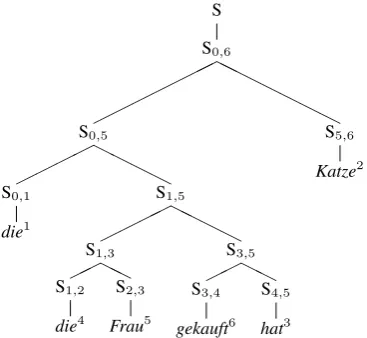
Our grammar is shown in Figure 1. Parsing the “input sentence”π with this grammar simply constructs all binary trees that yield the stringπ. There is essentially only one nonterminal,S, but we split it intoO(n2) position-specific
nontermi-nals such as Si,j, which can only yield the span
πi+1πi+2. . . πj. An example parse is shown in
Figure 2.
The important point is that we will place a score on each binary grammar rule. The score of the rule Si,k → Si,j Sj,k is max(0,∆i,j,k),
where ∆i,j,k is the benefit to swapping the
sub-stringsπi+1πi+2. . . πj andπj+1πj+2. . . πk. The
rule is considered to be a “swap rule” if its score is positive, showing that a swap will be beneficial (independent of the rest of the tree). If the parse in Figure 2 is the parse with the highest total score, and its swap rules are S0,5 → S0,1 S1,5 and S3,5 → S3,4 S4,5, then
S S0,6
H H H H H H H
S0,5 HHH
H S0,1
die1
S1,5 HHHH S1,3
HH S1,2
die4 S2,3
Frau5
S3,5 HH S3,4
gekauft6 S4,5
hat3 S5,6
[image:4.595.79.263.62.231.2]Katze2
Figure 2: One parse of the current permutationπ. In this example,π has somehow gotten the input words into alphabetical order (owing to previous hill-climbing steps). We are now trying to further improve this order.
πby two swaps.
How do we find this solution? Clearly
the benefit (positive or negative) to swapping πi+1πi+2. . . πj withπj+1πj+2. . . πkis
∆i,j,k = j
X
`=i+1 k
X
r=j+1
B[πr, π`]−B[π`, πr] (5)
We can evaluate allO(n3) possible swaps in
to-tal time O(n3), using the dynamic programming
recurrence
∆i,j,k = ∆i,j,k−1+ ∆i+1,j,k−∆i+1,j,k−1 (6)
+B[πk, πi+1]−B[πi+1, πk]
with the base case∆i,j,k = 0ifi = jorj = k.
This gives us the weights for the grammar rules, and then we can use weighted CKY parsing to find the highest-scoring (Viterbi) parse in O(n3)
time. Extracting our new and improved permuta-tionπ0 ∈N(π)from this parse is a simpleO(n
)-time algorithm.
Figure 3 gives pseudocode for our local search algorithm, showing how to compute the quan-tities (6) during parsing rather than beforehand. β[i, k] holds the weight of the best permuta-tion (in the neighborhood) of the subsequence πi+1πi+1. . . πk.3
3The use ofβis intended to suggest an analogy to inside probability—or more precisely, the Viterbi approximation to inside probability (since we are maximizing rather than sum-ming over parses).
The next two sections describe how to use our local search algorithm to discriminatively learn the weights of the parameters from Section 2, equa-tion (1).
4 Features
Our objective function (2) works only to the extent that we can derive a good pairwise preference ma-trixBw. We do this by using a rich feature set in
equation (1).
We adapt the features of McDonald et al. (2005), introduced there for dependency parsing, to the task of machine translation reordering. Be-cause both models construct features for pairs of words given the entire sentence, there is a close correspondence between the two tasks, although the output is quite different.
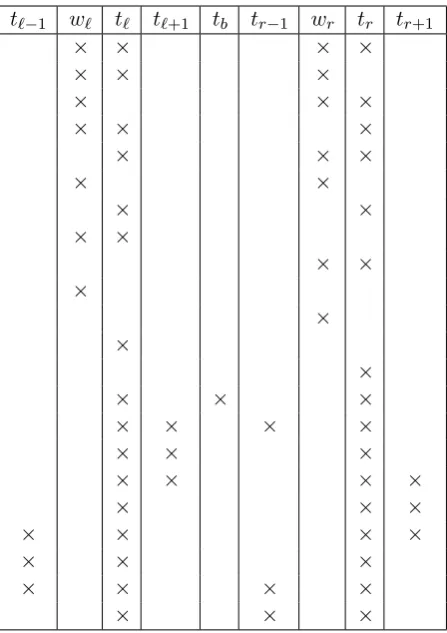
Each feature φ(w, `, r) in equation (1) is a bi-nary feature that fires when (w, `, r) has some conjunction of properties. The properties that are considered include the wordsw`andwr, the parts
of speech of{w`−1, . . . , wr+1}, and the distance
r−`. Table 1 shows the feature templates. We also tried features based on a dependency parse of the German, with the idea of using LOP features to reorder the dependents of each word, and thus model syntactic movement. This did produce better monolingual reorderings (as in Ta-ble 2), but it did not help final translation into En-glish (Table 3), so we do not report the details here.
5 Learning to Reorder
Ideally, we would have a large corpus of desir-able reorderings of source sentences—in our case, German sentences permuted into target English word order—from which to train the parameters of our model. Unfortunately, the alignments between German and English sentences are only infre-quently one-to-one. Furthermore, human-aligned parallel sentences are hard to come by, and never in the quantity we would like.
1: procedureLOCALSEARCHSTEP(B,π, n) 2: fori←0ton−1do
3: β[i, i+ 1]←0 4: fork←i+ 1tondo
5: ∆[i, i, k]←∆[i, k, k]←0
6: end for
7: end for
8: forw←2tondo
9: fori←0ton−wdo
10: k←i+w
11: β[i, k]← −∞
12: forj←i+ 1tok−1do
13: ∆[i, j, k]←∆[i, j, k−1] + ∆[i+ 1, j, k]−∆[i+ 1, j, k−1] +B[πk, πi+1]−B[πi+1, πk]
14: β[i, k]←max(β[i, k], β[i, j] +β[j, k] + max(0,∆[i, j, k]))
15: end for
16: end for
17: end for
18: returnβ[0, n]
19: end procedure
Figure 3: Pseudocode for computing the score of the best permutation in the neighborhood ofπunder the Linear Ordering Problem specified by the matrixB. Computing the best neighbor is a simple matter of keeping back pointers to the choices ofmaxand ordering them as implied.
alignments using the “grow-diag-final-and” proce-dure provided with Moses (Koehn et al., 2007).
For each of these German sentences, we derived the English-like reordering of it, which we call German0, by the following procedure. Each
Ger-man token was assigned an integer key, namely the position of the leftmost of the English tokens to which it was aligned, or 0 if it was not aligned to any English tokens. We then did a stable sort of the German tokens based on these keys, meaning that if two German tokens had the same key, their order was preserved.
This is similar to the oracle ordering used by Al-Onaizan and Papineni (2006), but differs in the handling of unaligned words. They kept unaligned words with the closest preceding aligned word.4
Having found the German0 corresponding to
each German sentence, we randomly divided the sentences into 2,000 each for development and evaluation, and the remaining approximately 747,000 for training.
We used the averaged perceptron algorithm (Freund and Schapire, 1998; Collins, 2002) to train the parameters of the model. We ran the al-gorithm multiple times over the training sentences, 4We tried two other methods for deriving English word order from word alignments. The first alternative was to align only in one direction, from English to German, with null alignments disallowed, so that every German word was aligned to a single English word. The second alternative used BerkeleyAligner (Liang et al., 2006; DeNero and Klein, 2007), which shares information between the two alignment directions to improve alignment quality. Neither alternative produced improvements in our ultimate translation quality.
measuring the quality of the learned parameters by reordering the held-out development set after each iteration. We stopped when the BLEU score on the development set failed to improve for two con-secutive iterations, which occurred after fourteen passes over the data.
Each perceptron update should compare the true German0 to the German0 that would be predicted
by the model (2). As the latter is NP-hard to find, we instead substitute the local maximum found by local search as described in Section 3, starting at the identity permutation, which corresponds to the original German word order.
During training, we iterate the local search as described earlier. However, for decoding, we only do a single step of local search, thus restricting re-orderings to the ITG neighborhood of the origi-nal German. This restriction turns out to improve performance slightly, even though it reduces the quality of our approximation to the LOP prob-lem (4). In other words, it turns out that reorder-ings found outside the ITG neighborhood tend to be poor German0even if our LOP-based objective
function thinks that they are good German0.
This is not to say that the gold standard German0
t`−1 w` t` t`+1 tb tr−1 wr tr tr+1
× × × ×
× × ×
× × ×
× × ×
× × ×
× ×
× ×
× ×
× × ×
× ×
×
× × ×
× × × ×
× × ×
× × × ×
× × ×
× × × ×
× × ×
× × × ×
[image:6.595.73.297.60.377.2]× × ×
Table 1: Feature templates forB[`, r](w`is the`th
word,t` its part of speech tag, andbmatches any
index such that ` < b < r). Each of the above is also conjoined with the distance between the words, r −`, to form an additional feature tem-plate. Distances are binned into 1, 2, 3, 4, 5,>5, and>10.
The model is initialized at the start of train-ing ustrain-ing log-odds of the parameters. LetΦm =
{(w, `, r) | φm(w, `, r) = 1}be the set of word
pairs in the training data for which featuremfires. Let→Φmbe the subset ofΦm for which the words
stay in order, and ←Φm the subset for which the
words reverse order. Then in this model,
θm= log
→
Φm+12
−log←Φm+12
. (7)
This model is equivalent to smoothed na¨ıve Bayes if converted to probabilities. The learned model significantly outperforms it on the monolingual re-ordering task.
Table 2 compares the model after perceptron training to the model at the start of training, measuring BLEU score of the predicted German0
against the observed German0. In addition to these
BLEU scores, we can measure precision and re-call of pairs of reordered words against the
ob-Ordering p2 p3 p4 BLEU
German 57.4 38.3 27.7 49.65
Log-odds 57.4 38.4 27.8 49.75
Perceptron 58.6 40.3 29.8 51.51
Table 2: Monolingual BLEU score on develop-ment data, measured against the “true” German0
ordering that was derived from automatic align-ments to known English translations. The table evaluates three candidate orderings: the original German, German reordered using the log-odds initialized model, and German reordered using the perceptron-learned model. In addition to the BLEU score, the table shows bigram, trigram, and 4-gram precisions. The unigram precisions are al-ways 100%, because the correct words are given.
served German0. On the held out test set, the
pre-dicted German0achieves a recall of only 21%, but
a precision of 64%. Thus, the learned model is too conservative, but makes moderately good de-cisions when it does reorder.
6 Reordering as Preprocessing
This section describes experiments using the model introduced in Section 2 and learned in Sec-tion 5 to preprocess German sentences for trans-lation into English. These experiments are similar to those of Collins et al. (2005).
We used the model learned in Section 5 to gen-erate a German0 ordering of the training,
develop-ment, and test sets. The training sentences are the same that the model was trained on, and the devel-opment set is the same that was used as the stop-ping criterion for the perceptron. The test set was unused in training.
We used the resulting German0 as the input to
the Moses training pipeline. That is, Moses re-computed alignments of the German0training data
to the English sentences using GIZA++, then con-structed a phrase table. Moses used the develop-ment data for minimum error-rate training (Och, 2003) of its small number of parameters. Finally, Moses translated the test sentences, and we mea-sured performance against the English reference sentences. This is the standard Moses pipeline, ex-cept German has been replaced by German0.
Table 3 shows the results of translation, both starting with unreordered German, and starting with German0, reordered using the learned Linear
[image:6.595.324.512.63.114.2]re-System Input Moses Reord. p1 p2 p3 p4 BLEU METEOR TER
baseline German Distance 59.6 31.4 18.8 11.6 25.27 54.03 60.60
(a) German Lexical 60.0 32.0 19.3 12.1 25.55 54.18 59.76
[image:7.595.83.512.63.131.2](b) German0 Distance 60.4 32.7 20.2 12.8 26.40 54.91 58.63
[image:7.595.308.512.232.426.2](a)+(b) German0 Lexical 59.9 32.4 20.0 12.8 26.44 54.61 59.23
Table 3: Machine translation performance of several systems, measured against a single English refer-ence translation. The results vary both the preprocessing—either none, or reordered using the learned Linear Ordering Problems—and the reordering model used in Moses. Performance is measured using BLEU, METEOR (Lavie et al., 2004), and TER (Snover et al., 2006). (For TER, smaller values are better.)
order whatever input that it receives, during trans-lation into English. Thus, the results in the table also vary the reordering model used in Moses, set to either a single-parameter distance-based model, or to the lexicalized bidirectional msd model. The latter model has six parameters for each phrase in the phrase table, corresponding to monotone, swapped, or discontinuous ordering relative to the previous phrase in either the source or target lan-guage.
How should we understand the results? The baseline system is Moses phrase-based translation with no preprocessing and only a simple distance-based reordering model. There are two ways to improve this: (a) ask Moses to use the lexicalized bidirectional msd reordering model that is pro-vided with Moses and is integrated with the rest of translation, or (b) keep the simple distance-based model within Moses, but preprocess its training and test data with our linear reordering model. Note that the preprocessing in (b) will obviously change the phrasal substrings that are learned by Moses, for better or for worse.
First, remarkably, (b) is significantly better than (a) on BLEU, with p < 0.0001 according to a paired permutation test.
Second, combining (a) with (b) produced no im-provement over (b) in BLEU score (the difference between 26.40 and 26.44 is not significant, even at p < 0.2, according to the same paired per-mutation test). Lexicalized reordering in Moses even degraded translation performance according to METEOR and TER. The TER change is sig-nificant according to the paired permutation test at p <0.001. (We did not perform a significance test for METEOR.)
Our word-based model surpasses the lexical-ized reordering in Moses largely because of long-distance movement. The 518 sentences (26%) in
●●
● ●●●
● ●
●● ●
● ●●
● ●●●
●● ●●
●●●
●●●●●●●●●●●●●
●●●●●● ● ● ●●
●●●●●● ●
● ●
● ●
● ●●
● ●●●
●● ●
●●●● ●●●●●●●●●
●●●●●
●●●●● ● ● ●●
0 10 20 30 40 50
−0.002
0.000
0.002
0.004
0.006
0.008
0.010
Word Pairs Reordered
Cumulativ
e BLEU Change
BLEU Improvement Aggregated by Amount of Reordering
vs. baseline vs. (a)
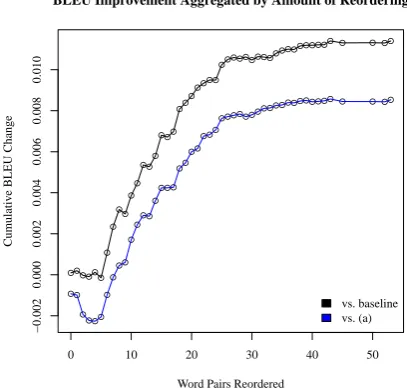
Figure 4: Cumulative change in BLEU score of (b) relative to the baseline and (a), aggregated by the number of reordered word pairs in each sen-tence. For those sentences where our model re-orders fewer than five word pairs, the BLEU score of translation degrades.
the test set for which our model moves a word more than six words away from its starting posi-tion account for more than 67% of the improve-ment in BLEU from (a) to (b).
Phrase-based decoders keep a source coverage vector with every partial translation hypothesis. That coverage vector allows us to incorporate the scores from a LOP matrixB directly. Whenever the decoder extends the hypothesis with a new source phrase, coveringwi+1wi+2. . . wj, it adds
j−1
X
`=i+1 j
X
r=`+1
B[`, r] +
j
X
`=i+1
X
r∈U
B[`, r].
The first term represents the phrase-internal score, and the second the score of putting the words in the phrase before all the remaining uncovered words
U.
7 Comparison to Prior Work
Preprocessing the source language to improve translation is a common technique. Xia and Mc-Cord (2004) improved English-French translation using syntactic rewrite rules derived from Slot Grammar parses. Collins et al. (2005) reported an improvement from 25.2% to 26.8% BLEU on German-English translation using six hand-written rules to reorder the German sentences based on automatically-generated phrase-structure trees. Our work differs from these approaches in providing an explicit model that scores all pos-sible reorderings. In this paper, our model was trained and used only for 1-best preprocessing, but it could potentially be integrated into decoding as well, where it would work together with the trans-lation model and target language model to find a congenial translation.
Costa-juss`a and Fonollosa (2006) improved Spanish-English and Chinese-English translation using a two-step process, first reordering the source language, then translating it, both using dif-ferent versions of a phrase-based translation sys-tem. Many others have proposed more explicit reordering models (Tillmann, 2004; Kumar and Byrne, 2005; Koehn et al., 2005; Al-Onaizan and Papineni, 2006). The primary advantage of our model is that it directly accounts for interactions between distant words, leading to better treatment of long-distance movement.
Xiong et al. (2006) proposed a constituent reordering model for a bracketing transduction grammar (BTG) (Wu, 1995), which predicts the probability that a pair of subconstituents will re-order when combined to form a new constituent. The features of their model look only at thefirst
source and target word of each constituent, mak-ing it somethmak-ing like a sparse version of our model. However, because of the target word features, their reordering model cannot be separated from their translation model.
8 Conclusions and Future Work
We have presented an entirely new model of re-ordering for statistical machine translation, based on the Linear Ordering Problem, and shown that it can substantially improve translation from Ger-man to English.
The model is demonstrably useful in this pre-processing setting—which means that it can be very simply added as a preprocessing step to any MT system. German-to-English is a particularly attractive use case, because the word orders are sufficiently different as to require a good reorder-ing model that requires long-distance reorderreorder-ing. Our preprocessing here gave us a BLEU gain of 0.9 point over the best Moses-based result. English-to-German would obviously be another potential win, as would translating between En-glish and Japanese, for example.
As mentioned in Section 6, our model could also be integrated into a phrase-based, or a syntax-based decoder. That possibility remains future work, but it is likely to lead to further improve-ments, because it allows the translation system to consider multiple possible reorderings under the model, as well as to tune the weight of the model relative to the other parts of the system during MERT.
Tromble (2009) covers this integration in more detail, and proposes several other ways of integrat-ing our reorderintegrat-ing model into machine translation. It also experiments with numerous other param-eter estimation procedures, including some that use the probabilistic interpretation of our model from (3). It presents numerous additional neigh-borhoods for search in the Linear Ordering Prob-lem.
words (Eisner and Tromble, 2006). This would have the disadvantage of complicating the feature space, but might be a better fit for integration with a phrase-based decoder.
Finally, we gave a novel algorithm for ap-proximately solving the Linear Ordering Prob-lem, interestingly combining dynamic program-ming with local search. Another novel contri-bution is that we showed how to parameterize a function that constructs a specific Linear Order-ing Problem instance from an input sentence w, and showed how to learn those parameters from a corpus of parallel sentences, using the percep-tron algorithm. Likelihood-based training using equation (3) would also be possible, with modifi-cations to our algorithm, notably the use of normal forms to avoid counting some permutations multi-ple times (Tromble, 2009).
It would be interesting to compare the speed and accuracy of our dynamic-programming local-search method with an exact algorithm for solving the LOP, such as integer linear programming with branch and bound (cf. Charon and Hudry (2006)). Exact solutions can generally be found in practice forn≤100.
References
Yaser Al-Onaizan and Kishore Papineni. 2006. Dis-tortion models for statistical machine translation. In
COLING-ACL, pages 529–536, Sydney, July. Ir`ene Charon and Olivier Hudry. 2006. A
branch-and-bound algorithm to solve the linear ordering problem
for weighted tournaments. Discrete Applied
Mathe-matics, 154(15):2097–2116, October.
Michael Collins, Philipp Koehn, and Ivona Kuˇcerov´a. 2005. Clause restructuring for statistical machine
translation. In ACL, pages 531–540, Ann Arbor,
Michigan, June.
Michael Collins. 2002. Discriminative training meth-ods for hidden Markov models: Theory and
ex-periments with perceptron algorithms. In EMNLP,
pages 1–8, Philadelphia, July.
Marta R. Costa-juss`a and Jos´e A. R. Fonollosa. 2006.
Statistical machine reordering. In EMNLP, pages
70–76, Sydney, July.
John DeNero and Dan Klein. 2007. Tailoring word alignments to syntactic machine translation. InACL, pages 17–24, Prague, June.
Jason Eisner and Roy W. Tromble. 2006. Local search with very large-scale neighborhoods for optimal
per-mutations in machine translation. In Workshop on
computationally hard problems and joint inference in speech and language processing, New York, June.
Yoav Freund and Robert E. Schapire. 1998. Large margin classification using the perceptron algorithm.
InCOLT, pages 209–217, New York. ACM Press.
Martin Gr¨otschel, Michael J¨unger, and Gerhard Reinelt. 1984. A cutting plane algorithm for
the linear ordering problem. Operations Research,
32(6):1195–1220, November–December.
Philipp Koehn, Amittai Axelrod, Alexandra Birch Mayne, Chris Callison-Burch, Miles Osborne, and David Talbot. 2005. Edinburgh system description for the 2005 IWSLT speech translation evaluation. InIWSLT, Pittsburgh, October.
Philipp Koehn, Hieu Hoang, Alexandra Birch, Chris Callison-Burch, Marcello Federico, Nicola Bertoldi, Brooke Cowan, Wade Shen, Christine Moran, Richard Zens, Chris Dyer, Ondrej Bojar, Alexan-dra Constantin, and Evan Herbst. 2007. Moses: Open source toolkit for statistical machine
transla-tion. InACL Demo and Poster Sessions, pages 177–
180, Prague, June.
Philipp Koehn. 2005. Europarl: A parallel corpus
for statistical machine translation. In MT Summit
X, pages 79–86, Phuket, Thailand, September.
Roland Kuhn, Denis Yuen, Michel Simard, Patrick Paul, George Foster, Eric Joanis, and Howard John-son. 2006. Segment choice models: Feature-rich models for global distortion in statistical machine
translation. In HLT-NAACL, pages 25–32, New
York, June.
Shankar Kumar and William Byrne. 2005.
Lo-cal phrase reordering models for statistiLo-cal machine
translation. InHLT-EMNLP, pages 161–168,
Van-couver, October.
Alon Lavie, Kenji Sagae, and Shyamsundar Jayara-man. 2004. The signicance of recall in automatic metrics for MT evaluation. In Robert E. Frederking
and Kathryn B. Taylor, editors, Machine
Transla-tion: From Real Users to Research, pages 134–143. AMTA, Springer, September–October.
Percy Liang, Ben Taskar, and Dan Klein. 2006.
Align-ment by agreeAlign-ment. In HLT-NAACL, pages 104–
111, New York, June.
Ryan McDonald, Koby Crammer, and Fernando Pereira. 2005. Spanning tree methods for discrim-inative training of dependency parsers. Technical Report MS-CIS-05-11, UPenn CIS.
Sounaka Mishra and Kripasindhu Sikdar. 2004. On approximability of linear ordering and related
NP-optimization problems on graphs. Discrete Applied
Franz Josef Och and Hermann Ney. 2003. A sys-tematic comparison of various statistical alignment
models. Computational Linguistics, 29(1):19–51,
March.
Franz Josef Och. 2003. Minimum error rate training in statistical machine translation. InACL, pages 160– 167, Sapporo, July.
Kishore Papineni, Salim Roukos, Todd Ward, and Wei-Jing Zhu. 2002. BLEU: a method for automatic
evaluation of machine translation. In ACL, pages
311–318, Philadelphia, July.
Tommaso Schiavinotto and Thomas St¨utzle. 2004. The linear ordering problem: Instances, search
space analysis and algorithms. Journal of
Math-ematical Modelling and Algorithms, 3(4):367–402, December.
Matthew Snover, Bonnie Dorr, Richard Schwartz, Lin-nea Micciulla, and John Makhoul. 2006. A study of translation edit rate with targeted human annotation.
InAMTA.
Christoph Tillmann. 2004. A unigram orientation
model for statistical machine translation. In
HLT-NAACL Short Papers, pages 101–104, Boston, May.
Roy Wesley Tromble. 2009. Search and Learning for
the Linear Ordering Problem with an Application to Machine Translation. Ph.D. thesis, Johns
Hop-kins University, Baltimore, April. http://nlp.
cs.jhu.edu/˜royt/
Dekai Wu. 1995. An algorithm for simultaneously bracketing parallel texts by aligning words. InACL, pages 244–251, Cambridge, Massachusetts, June. Dekai Wu. 1997. Stochastic inversion transduction
grammars and bilingual parsing of parallel corpora.
Computational Linguistics, 23(3):377–404, Septem-ber.
Fei Xia and Michael McCord. 2004. Improving a statistical MT system with automatically learned
rewrite patterns. In COLING, pages 508–514,
Geneva, August.
Deyi Xiong, Qun Liu, and Shouxun Lin. 2006. Max-imum entropy based phrase reordering model for
statistical machine translation. In COLING-ACL,
pages 521–528, Sydney, July.