Bayesian Unsupervised Topic Segmentation
Jacob Eisenstein and Regina Barzilay
Computer Science and Artificial Intelligence Laboratory Massachusetts Institute of Technology
77 Massachusetts Ave., Cambridge MA 02139
{jacobe,regina}@csail.mit.edu
Abstract
This paper describes a novel Bayesian ap-proach to unsupervised topic segmentation. Unsupervised systems for this task are driven by lexical cohesion: the tendency of well-formed segments to induce a compact and consistent lexical distribution. We show that lexical cohesion can be placed in a Bayesian context by modeling the words in each topic segment as draws from a multinomial lan-guage model associated with the segment; maximizing the observation likelihood in such a model yields a lexically-cohesive segmenta-tion. This contrasts with previous approaches, which relied on hand-crafted cohesion met-rics. The Bayesian framework provides a prin-cipled way to incorporate additional features such as cue phrases, a powerful indicator of discourse structure that has not been previ-ously used in unsupervised segmentation sys-tems. Our model yields consistent improve-ments over an array of state-of-the-art systems on both text and speech datasets. We also show that both an entropy-based analysis and a well-known previous technique can be de-rived as special cases of the Bayesian frame-work.1
1 Introduction
Topic segmentation is one of the fundamental prob-lems in discourse analysis, where the task is to divide a text into a linear sequence of topically-coherent segments. Hearst’s TEXTTILING (1994) introduced the idea that unsupervised segmentation
1
Code and materials for this work are available at http://groups.csail.mit.edu/rbg/code/ bayesseg/.
can be driven by lexical cohesion, as high-quality segmentations feature homogeneous lexical distri-butions within each topic segment. Lexical cohesion has provided the inspiration for several successful systems (e.g., Utiyama and Isahara, 2001; Galley et al.2003; Malioutov and Barzilay, 2006), and is cur-rently the dominant approach to unsupervised topic segmentation.
But despite the effectiveness of lexical cohesion for unsupervised topic segmentation, it is clear that there are other important indicators that are ignored by the current generation of unsupervised systems. For example, consider cue phrases, which are ex-plicit discourse markers such as “now” or “how-ever” (Grosz and Sidner, 1986; Hirschberg and Lit-man, 1993; Knott, 1996). Cue phrases have been shown to be a useful feature for supervised topic segmentation (Passonneau and Litman, 1993; Gal-ley et al., 2003), but cannot be incorporated by current unsupervised models. One reason for this is that existing unsupervised methods use arbitrary, hand-crafted metrics for quantifying lexical cohe-sion, such as weighted cosine similarity (Hearst, 1994; Malioutov and Barzilay, 2006). Without su-pervision, it is not possible to combine such met-rics with additional sources of information. More-over, such hand-crafted metrics may not general-ize well across multiple datasets, and often include parameters which must be tuned on development sets (Malioutov and Barzilay, 2006; Galley et al., 2003).
In this paper, we situate lexical cohesion in a Bayesian framework, allowing other sources of in-formation to be incorporated without the need for labeled data. We formalize lexical cohesion in a generative model in which the text for each
ment is produced by a distinct lexical distribution. Lexically-consistent segments are favored by this model because probability mass is conserved for a narrow subset of words. Thus, lexical cohesion arises naturally through the generative process, and other sources of information – such as cue words – can easily be incorporated as emissions from the segment boundaries.
More formally, we treat the words in each sen-tence as draws from a language model associated with the topic segment. This is related to topic-modeling methods such as latent Dirichlet allocation (LDA; Blei et al. 2003), but here the induced topics are tied to a linear discourse structure. This property enables a dynamic programming solution to find the exact maximum-likelihood segmentation. We con-sider two approaches to handling the language mod-els: estimating them explicitly, and integrating them out, using the Dirichlet Compound Multinomial tribution (also known as the multivariate Polya dis-tribution).
We model cue phrases as generated from a sep-arate multinomial that is shared across all topics and documents in the dataset; a high-likelihood model will obtain a compact set of cue phrases. The addition of cue phrases renders our dynamic programming-based inference inapplicable, so we design a sampling-based inference technique. This algorithm can learn in a completely unsupervised fashion, but it also provides a principled mechanism to improve search through the addition of declara-tive linguistic knowledge. This is achieved by bias-ing the selection of samples towards boundaries with known cue phrases; this does not change the under-lying probabilistic model, but guides search in the direction of linguistically-plausible segmentations.
We evaluate our algorithm on corpora of spoken and written language, including the benchmark ICSI meeting dataset (Janin et al., 2003) and a new tex-tual corpus constructed from the contents of a med-ical textbook. In both cases our model achieves per-formance surpassing multiple state-of-the-art base-lines. Moreover, we demonstrate that the addition of cue phrases can further improve segmentation per-formance over cohesion-based methods.
In addition to the practical advantages demon-strated by these experimental results, our model re-veals interesting theoretical properties. Other
re-searchers have observed relationships between dis-course structure and entropy (e.g., Genzel and Char-niak, 2002). We show that in a special case of our model, the segmentation objective is equal to a weighted sum of the negative entropies for each topic segment. This finding demonstrates that a re-lationship between discourse segmentation and en-tropy is a natural consequence of modeling topic structure in a generative Bayesian framework. In addition, we show that the benchmark segmentation system of Utiyama and Isahara (2001) can be viewed as another special case of our Bayesian model.
2 Related Work
Existing unsupervised cohesion-based approaches can be characterized in terms of the metric used to quantify cohesion and the search technique. Galley et al. (2003) characterize cohesion in terms of lexical chains – repetitions of a given lexical item over some fixed-length window of sentences. In their unsu-pervised model, inference is performed by selecting segmentation points at the local maxima of the cohe-sion function. Malioutov and Barzilay (2006) opti-mize a normalized minimum-cut criteria based on a variation of the cosine similarity between sentences. Most similar to our work is the approach of Utiyama and Isahara (2001), who search for segmentations with compact language models; as shown in Sec-tion 3.1.1, this can be viewed as a special case of our model. Both of these last two systems use dynamic programming to search the space of segmentations.
The relationship between discourse structure and cue phrases has been studied extensively; for an early example of computational work on this topic, see (Grosz, 1977). Passonneau and Litman (1993) were the first to investigate the relationship between cue phrases and linear segmentation. More recently, cue phrases have been applied to topic segmentation in the supervised setting. In a supervised system that is distinct from the unsupervised model described above, Galley et al. (2003) automatically identify candidate cue phrases by mining labeled data for words that are especially likely to appear at segment boundaries; the presence of cue phrases is then used as a feature in a rule-based classifier for linear topic segmentation. Elsner and Charniak (2008) specify a list of cue phrases by hand; the cue phrases are used as a feature in a maximum-entropy classifier for conversation disentanglement. Unlike these ap-proaches, we identify candidate cue phrases auto-matically from unlabeled data and incorporate them in the topic segmentation task without supervision.
3 Lexical Cohesion in a Bayesian Framework
The core idea of lexical cohesion is that topically-coherent segments demonstrate compact and con-sistent lexical distributions (Halliday and Hasan, 1976). Lexical cohesion can be placed in a prob-abilistic context by modeling the words in each topic segment as draws from a multinomial language model associated with the segment. Formally, if sen-tence t is in segment j, then the bag of words xt
is drawn from the multinomial language model θj.
This is similar in spirit to hidden topic models such as latent Dirichlet allocation (Blei et al., 2003), but rather than assigning a hidden topic to each word, we constrain the topics to yield a linear segmenta-tion of the document.
We will assume that topic breaks occur at sen-tence boundaries, and writeztto indicate the topic
assignment for sentence t. The observation likeli-hood is,
p(X|z,Θ) =
T
Y
t
p(xt|θzt), (1)
whereXis the set of allT sentences,zis the vector of segment assignments for each sentence, andΘis
the set of allKlanguage models.2 A linear segmen-tation is ensured by the additional constraint thatzt
must be equal to eitherzt−1(the previous sentence’s segment) orzt−1+ 1(the next segment).
To obtain a high likelihood, the language mod-els associated with each segment should concentrate their probability mass on a compact subset of words. Language models that spread their probability mass over a broad set of words will induce a lower likeli-hood. This is consistent with the principle of lexical cohesion.
Thus far, we have described a segmentation in terms of two parameters: the segment indicesz, and the set of language modelsΘ. For the task of seg-menting documents, we are interested only in the segment indices, and would prefer not to have to search in the space of language models as well. We consider two alternatives: taking point estimates of the language models (Section 3.1), and analytically marginalizing them out (Section 3.2).
3.1 Setting the language model to the posterior expectation
One way to handle the language models is to choose a single point estimate for each set of segmenta-tion points z. Suppose that each language model is drawn from a symmetric Dirichlet prior: θj ∼
Dir(θ0). Letnj be a vector in which each element is
the sum of the lexical counts over all the sentences in segmentj: nj,i = P{t:zt=j}mt,i, wheremt,i is the count of word i in sentence t. Assuming that eachxt ∼ θj, then the posterior distribution forθj
is Dirichlet with vector parameternj+θ0(Bernardo and Smith, 2000). The expected value of this distri-bution is the multinomial distridistri-butionθjˆ, where,
ˆ
θj,i=
nj,i+θ0 PW
i nj,i+W θ0
. (2)
In this equation,W indicates the number of words in the vocabulary. Having obtained an estimate for the language modelθjˆ, the observed data likelihood for segmentjis a product over each sentence in the segment,
2Our experiments will assume that the number of topicsK
p({xt:zt=j}|θˆj) =
Y
{t:zt=j} Y
i∈xt
ˆ
θj,i (3)
= Y
{t:zt=j}
W
Y
i
ˆ
θmt,i
j,i (4)
=
W
Y
i
ˆ
θnj,ij,i. (5)
By viewing the likelihood as a product over all terms in the vocabulary, we observe interesting con-nections with prior work on segmentation and infor-mation theory.
3.1.1 Connection to previous work
In this section, we explain how our model gen-eralizes the well-known method of Utiyama and Isahara (2001; hereafter U&I). As in our work, Utiyama and Isahara propose a probabilistic frame-work based on maximizing the compactness of the language models induced for each segment. Their likelihood equation is identical to our equations 3-5. They then define the language models for each seg-ment asθˆj,i = W+nPj,iW+1
i nj,i
,without rigorous
justifi-cation. This form is equivalent to Laplacian smooth-ing (Mannsmooth-ing and Sch¨utze, 1999), and is a special case of our equation 2, withθ0 = 1. Thus, the lan-guage models in U&I can be viewed as the expec-tation of the posterior distribution p(θj|{xt : zt = j}, θ0), in the special case that θ0 = 1. Our ap-proach generalizes U&I and provides a Bayesian justification for the language models that they ap-ply. The remainder of the paper further extends this work by marginalizing out the language model, and by adding cue phrases. We empirically demonstrate that these extensions substantially improve perfor-mance.
3.1.2 Connection to entropy
Our model also has a connection to entropy, and situates entropy-based segmentation within a Bayesian framework. Equation 1 defines the objec-tive function as a product across sentences; using equations 3-5 we can decompose this across seg-ments instead. Working in logarithms,
logp(X|z,Θ) =ˆ
T
X
t
logp(xt|θˆzt)
=
K
X
j
X
{t:zt=j}
logp(xt|θˆj)
=
K
X
j W
X
i
nj,ilog ˆθj,i (6)
The last line substitutes in the logarithm of equa-tion 5. Settingθ0 = 0and rearranging equation 2, we obtain nj,i = Njθj,iˆ , withNj = PW
i nj,i, the
total number of words in segment j. Substituting this into equation 6, we obtain
logp(X|z,Θ) =ˆ
K
X
j Nj
X
i
ˆ
θj,ilog ˆθj,i
=
K
X
j
NjH(ˆθj),
whereH(ˆθj)is the negative entropy of the
multino-mialθˆj. Thus, withθ0= 0, the log conditional prob-ability in equation 6 is optimized by a segmentation that minimizes the weighted sum of entropies per segment, where the weights are equal to the segment lengths. This result suggests intriguing connections with prior work on the relationship between entropy and discourse structure (e.g., Genzel and Charniak, 2002; Sporleder and Lapata, 2006).
3.2 Marginalizing the language model
lan-guage models:
p(X|z, θ0) =
K
Y
j
Y
{t:zt=j}
p(xt|θ0)
=
K
Y
j
Z
dθj
Y
{t:zt=j}
p(xt|θj)p(θj|θ0)
=
K
Y
j
pdcm({xt:zt=j}|θ0), (7)
wherepdcmrefers to the Dirichlet compound
nomial distribution (DCM), also known as the multi-variate Polya distribution (Johnson et al., 1997). The DCM distribution expresses the expectation over all multinomial language models, when conditioning on the Dirichlet prior θ0. When θ0 is a symmetric Dirichlet prior,
pdcm({xt:zt=j}|θ0)
= Γ(W θ0) Γ(Nj+W θ0)
W
Y
i
Γ(nj,i+W θ0)
Γ(θ0)
,
wherenj,iis the count of wordiin segmentj, and Nj = PWi nj,i, the total number of words in the
segment. The symbolΓrefers to the Gamma func-tion, an extension of the factorial function to real numbers. Using the DCM distribution, we can com-pute the data likelihood for each segment from the lexical counts over the entire segment. The overall observation likelihood is a product across the likeli-hoods for each segment.
3.3 Objective function and inference
The optimal segmentation maximizes the joint prob-ability,
p(X,z|θ0) =p(X|z, θ0)p(z).
We assume thatp(z) is a uniform distribution over valid segmentations, and assigns no probability mass to invalid segmentations. The data likelihood is defined for point estimate language models in equation 5 and for marginalized language models in equation 7. Note that equation 7 is written as a product over segments. The point estimates for the language models depend only on the counts within
each segment, so the overall likelihood for the point-estimate version also decomposes across segments.
Any objective function that can be decomposed into a product across segments can be maximized using dynamic programming. We defineB(t)as the value of the objective function for the optimal seg-mentation up to sentencet. The contribution to the objective function from a single segment between sentencest0andtis written,
b(t0, t) =p({xt0. . .xt}|zt0...t=j)
The maximum value of the objective function is then given by the recurrence relation, B(t) = maxt0<tB(t0)b(t0+ 1, t), with the base caseB(0) =
1. These values can be stored in a table of sizeT
(equal to the number of sentences); this admits a dy-namic program that performs inference in polyno-mial time.3 If the number of segments is specified in advance, the dynamic program is slightly more complex, with a table of sizeT K.
3.4 Priors
The Dirichlet compound multinomial integrates over language models, but we must still set the prior θ0. We can re-estimate this prior based on the observed data by interleaving gradient-based search in a Viterbi expectation-maximization frame-work (Gauvain and Lee, 1994). In the E-step, we estimate a segmentation ˆz of the dataset, as de-scribed in Section 3.3. In the M-step, we maxi-mize p(θ0|X,ˆz) ∝ p(X|θ0,ˆz)p(θ0). Assuming a non-informative hyperpriorp(θ0), we maximize the likelihood in Equation 7 across all documents. The maximization is performed using a gradient-based search; the gradients are dervied by Minka (2003). This procedure is iterated until convergence or a maximum of twenty iterations.
4 Cue Phrases
One of the key advantages of a Bayesian framework for topic segmentation is that it permits the prin-cipled combination of multiple data sources, even
3This assumes that the objective function for individual
without labeled data. We are especially interested in cue phrases, which are explicit markers for dis-course structure, such as “now” or “first” (Grosz and Sidner, 1986; Hirschberg and Litman, 1993; Knott, 1996). Cue phrases have previously been used in supervised topic segmentation (e.g., Gal-ley et al. 2003); we show how they can be used in an unsupervised setting.
The previous section modeled lexical cohesion by treating the bag of words in each sentence as a se-ries of draws from a multinomial language model indexed by the topic segment. To incorporate cue phrases, this generative model is modified to reflect the idea that some of the text will be topic-specific, but other terms will be topic-neutral cue phrases that express discourse structure. This idea is imple-mented by drawing the text at each topic boundary from a special language model φ, which is shared across all topics and all documents in the dataset.
For sentences that are not at segment bound-aries, the likelihood is as before: p(xt|z,Θ, φ) =
Q
i∈xtθzt,i. For sentences that immediately follow segment boundaries, we draw the first`words from
φ instead. Writingx(t`) for the` cue words in xt,
andx˜tfor the remaining words, the likelihood for a
segment-initial sentence is,
p(xt|zt6=zt−1,Θ, φ) = Y
i∈x(t`)
φi Y
i∈x˜t
θzt,i.
We drawφfrom a symmetric Dirichlet priorφ0. Fol-lowing prior work (Galley et al., 2003; Litman and Passonneau, 1995), we consider only the first word of each sentence as a potential cue phrase; thus, we set`= 1in all experiments.
4.1 Inference
To estimate or marginalize the language modelsΘ
andφ, it is necessary to maintain lexical counts for each segment and for the segment boundaries. The counts for φ are summed across every segment in the entire dataset, so shifting a boundary will af-fect the probability of every segment, not only the adjacent segments as before. Thus, the factoriza-tion that enabled dynamic programming inference in Section 3.3 is no longer applicable. Instead, we must resort to approximate inference.
Sampling-based inference is frequently used in related Bayesian models. Such approaches build
a stationary Markov chain by repeatedly sampling among the hidden variables in the model. The most commonly-used sampling-based technique is Gibbs sampling, which iteratively samples from the condi-tional distribution of each hidden variable (Bishop, 2006). However, Gibbs sampling is slow to con-verge to a stationary distribution when the hidden variables are tightly coupled. This is the case in linear topic segmentation, due to the constraint that
zt∈ {zt−1, zt−1+ 1}(see Section 3).
For this reason, we apply the more general Metropolis-Hastings algorithm, which permits sam-pling arbitrary transformations of the latent vari-ables. In our framework, such transformations cor-respond to moves through the space of possible seg-mentations. A new segmentationz0 is drawn from the previous hypothesized segmentationz based on aproposal distributionq(z0|z).4 The probability of accepting a proposed transformation depends on the ratio of the joint probabilities and a correction term for asymmetries in the proposal distribution:
paccept(z→z0) = min
1,p(X,z
0|θ 0, φ0)
p(X,z|θ0, φ0)
q(z|z0)
q(z0|z)
.
The Metropolis-Hastings algorithm guarantees that by accepting samples at this ratio, our sampling procedure will converge to the stationary distribu-tion for the hidden variables z. When cue phrases are included, the observation likelihood is written:
p(X|z,Θ, φ) = Y
{t:zt6=zt−1}
Y
i∈x(t`) φi
Y
i∈˜xt
θzt,i
× Y
{t:zt=zt−1}
Y
i∈xt
θzt,i.
As in Section 3.2, we can marginalize over the language models. We obtain a product of DCM dis-tributions: one for each segment, and one for all cue phrases in the dataset.
4.2 Proposal distribution
Metropolis-Hastings requires a proposal distribution to sample new configurations. The proposal
distri-4Because the cue phrase language modelφis used across
bution does not affect the underlying probabilistic model – Metropolis-Hastings will converge to the same underlying distribution for any non-degenerate proposal. However, a well-chosen proposal distribu-tion can substantially speed convergence.
Our basic proposal distribution selects an existing segmentation point with uniform probability, and considers a set of local moves. The proposal is con-structed so that no probability mass is allocated to moves that change the order of segment boundaries, or merge two segments; one consequence of this re-striction is that moves cannot add or remove seg-ments.5 We set the proposal distribution to decrease exponentially with the move distance, thus favoring incremental transformations to the segmentation.
More formally, letd(z → z0) >0equal the dis-tance that the selected segmentation point is moved when we transform the segmentation from z to z0. We can write the proposal distributionq(z0 | z) ∝
c(z → z0)d(z → z0)λ, where λ < 0 sets the rate of exponential decay and cis an indicator function enforcing the constraint that the moves do not reach or cross existing segmentation points.6
We can also incorporate declarative linguistic knowledge by biasing the proposal distribution in favor of moves that place boundaries near known cue phrase markers. We multiply the unnormalized chance of proposing a move to locationz→z0by a term equal to one plus the number of candidate cue phrases in the segment-initial sentences in the new configuration z0, written num-cue(z0). Formally,
qling(z0 | z0) ∝ (1 +num-cue(z0))q(z0 | z). We use a list of cue phrases identified by Hirschberg and Litman (1993). We evaluate our model with both the basic and linguistically-enhanced proposal distribu-tions.
4.3 Priors
As in section 3.4, we set the priors θ0 andφ0 us-ing gradient-based search. In this case, we perform gradient-based optimization after epochs of 1000
5
Permitting moves to change the number of segments would substantially complicate inference.
6
We setλ=− 1
max-move, wheremax-moveis the maximum
move-length, set to 5 in our experiments. These parameters af-fect the rate of convergence but are unrelated to the underly-ing probability model. In the limit of enough samples, all non-pathological settings will yield the same segmentation results.
Metropolis-Hasting steps. Interleaving sampling-based inference with direct optimization of param-eters can be considered a form of Monte Carlo Expectation-Maximization (MCEM; Wei and Tan-ner, 1990).
5 Experimental Setup
Corpora We evaluate our approach on corpora from two different domains: transcribed meetings and written text.
For multi-speaker meetings, we use the ICSI cor-pus of meeting transcripts (Janin et al., 2003), which is becoming a standard for speech segmentation (e.g., Galley et al. 2003; Purver et al. 2006). This dataset includes transcripts of 75 multi-party meet-ings, of which 25 are annotated for segment bound-aries.
For text, we introduce a dataset in which each document is a chapter selected from a medical text-book (Walker et al., 1990).7 The task is to divide each chapter into the sections indicated by the au-thor. This dataset contains 227 chapters, with 1136 sections (an average of 5.00 per chapter). Each chapter contains an average of 140 sentences, giv-ing an average of 28 sentences per segment.
Metrics All experiments are evaluated in terms of the commonly-usedPk (Beeferman et al., 1999)
and WindowDiff (WD) (Pevzner and Hearst, 2002) scores. Both metrics pass a window through the document, and assess whether the sentences on the edges of the window are properly segmented with respect to each other. WindowDiff is stricter in that it requires that the number of intervening seg-ments between the two sentences be identical in the hypothesized and the reference segmentations, whilePkonly asks whether the two sentences are in
the same segment or not. Pk and WindowDiff are penalties, so lower values indicate better segmenta-tions. We use the evaluation source code provided by Malioutov and Barzilay (2006).
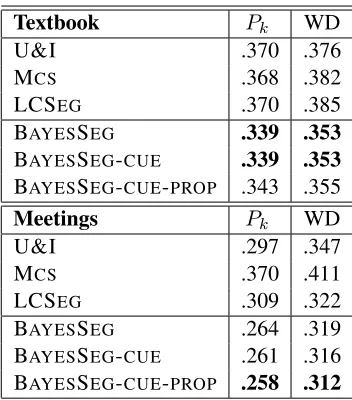
System configuration We evaluate our Bayesian approach both with and without cue phrases. With-out cue phrases, we use the dynamic programming inference described in section 3.3. This system is referred to as BAYESSEG in Table 1. When adding
7The full text of this book is available for free download at
cue phrases, we use the Metropolis-Hastings model described in 4.1. Both basic and linguistically-motivated proposal distributions are evaluated (see Section 4.2); these are referred to as BAYESSEG -CUEand BAYESSEG-CUE-PROPin the table.
For the sampling-based systems, results are av-eraged over five runs. The initial configuration is obtained from the dynamic programming inference, and then 100,000 sampling iterations are performed. The final segmentation is obtained by annealing the last 25,000 iterations to a temperature of zero. The use of annealing to obtain a maximum a posteri-ori (MAP) configuration from sampling-based in-ference is common (e.g., Finkel 2005; Goldwater 2007). The total running time of our system is on the order of three minutes per document. Due to mem-ory constraints, we divide the textbook dataset into ten parts, and perform inference in each part sepa-rately. We may achieve better results by performing inference over the entire dataset simultaneously, due to pooling counts for cue phrases across all docu-ments.
Baselines We compare against three
com-petitive alternative systems from the literature: U&I (Utiyama and Isahara, 2001); LCSEG(Galley et al., 2003); MCS(Malioutov and Barzilay, 2006). All three systems are described in the related work (Section 2). In all cases, we use the publicly avail-able executavail-ables provided by the authors.
Parameter settings For LCSEG, we use the pa-rameter values specified in the paper (Galley et al., 2003). MCSrequires parameter settings to be tuned on a development set. Our corpora do not include development sets, so tuning was performed using the lecture transcript corpus described by Malioutov and Barzilay (2006). Our system does not require pa-rameter tuning; priors are re-estimated as described in Sections 3.4 and 4.3. U&I requires no parameter tuning, and is used “out of the box.” In all exper-iments, we assume that the number of desired seg-ments is provided.
Preprocessing Standard preprocessing techniques are applied to the text for all comparisons. The Porter (1980) stemming algorithm is applied to group equivalent lexical items. A set of stop-words is also removed, using the same list originally em-ployed by several competitive systems (Choi, 2000;
Textbook Pk WD
U&I .370 .376
MCS .368 .382
LCSEG .370 .385
BAYESSEG .339 .353
BAYESSEG-CUE .339 .353
BAYESSEG-CUE-PROP .343 .355
Meetings Pk WD
U&I .297 .347
MCS .370 .411
LCSEG .309 .322
[image:8.612.338.514.55.255.2]BAYESSEG .264 .319 BAYESSEG-CUE .261 .316 BAYESSEG-CUE-PROP .258 .312
Table 1: Comparison of segmentation algorithms. Both metrics are penalties, so lower scores indicate bet-ter performance. BAYESSEG is the cohesion-only Bayesian system with marginalized language mod-els. BAYESSEG-CUE is the Bayesian system with cue phrases. BAYESSEG-CUE-PROPadds the linguistically-motivated proposal distribution.
Utiyama and Isahara, 2001; Malioutov and Barzilay, 2006).
6 Results
Table 1 presents the performance results for three instantiations of our Bayesian framework and three competitive alternative systems. As shown in the ta-ble, the Bayesian models achieve the best results on both metrics for both corpora. On the medical text-book corpus, the Bayesian systems achieve a raw performance gain of 2-3% with respect to all base-lines on both metrics. On the ICSI meeting corpus, the Bayesian systems perform 4-5% better than the best baseline on thePkmetric, and achieve smaller
improvement on the WindowDiff metric. The results on the meeting corpus also compare favorably with the topic-modeling method of Purver et al. (2006), who report aPkof .289 and a WindowDiff of .329.
Meetings Textbook okay* 234.4 the 1345.9
I 212.6 this 14.3
so* 113.4 it 4.1
um 91.7 these 4.1
and* 67.3 a 2.9
yeah 10.5 on 2.1
but* 9.4 most 2.0
[image:9.612.99.273.55.207.2]uh 4.8 heart 1.8 right 2.4 creating 1.8 agenda 1.3 hundred 1.8
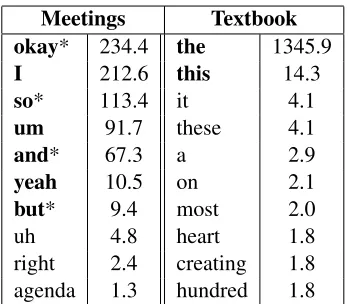
Table 2: Cue phrases selected by our unsupervised model, sorted by chi-squared. Boldface indicates that the chi-squared value is significant at the level ofp < .01. Asterisks indicate cue phrases that were extracted by the supervised procedure of Galley et al. (2003).
same time, the addition of cue phrases prevents the use of exact inference techniques, which may ex-plain the decline in results for the meetings dataset.
To investigate the quality of the cue phrases that our model extracts, we list its top ten cue phrases for each dataset in Table 2. Cue phrases are ranked by their chi-squared value, which is computed based on the number of occurrences for each word at the beginning of a hypothesized segment, as compared to the expectation. For cue phrases listed in bold, the chi-squared value is statistically significant at the level of p < .01, indicating that the frequency with which the cue phrase appears at the beginning of segments is unlikely to be a chance phenomenon.
As shown in the left column of the table, our model has identified several strong cue phrases from the meeting dataset which appear to be linguistically plausible. Galley et al. (2003) performed a simi-lar chi-squared analysis, but used the true segment boundaries in the labeled data; this can be thought of as a sort of ground truth. Four of the ten cue phrases identified by our system overlap with their analysis; these are indicated with asterisks. In con-trast to our model’s success at extracting cue phrases from the meeting dataset, only very common words are selected for the textbook dataset. This may help to explain why cue phrases improve performance for meeting transcripts, but not for the textbook.
7 Conclusions
This paper presents a novel Bayesian approach to unsupervised topic segmentation. Our algorithm is capable of incorporating both lexical cohesion and cue phrase features in a principled manner, and out-performs state-of-the-art baselines on text and tran-scribed speech corpora. We have developed exact and sampling-based inference techniques, both of which search only over the space of segmentations and marginalize out the associated language mod-els. Finally, we have shown that our model provides a theoretical framework with connections to infor-mation theory, while also generalizing and justify-ing prior work. In the future, we hope to explore the use of similar Bayesian techniques for hierarchical segmentation, and to incorporate additional features such as prosody and speaker change information.
Acknowledgments
The authors acknowledge the support of the Na-tional Science Foundation (CAREER grant IIS-0448168) and the Microsoft Research Faculty Fel-lowship. Thanks to Aaron Adler, S. R. K. Branavan, Harr Chen, Michael Collins, Randall Davis, Dan Roy, David Sontag and the anonymous reviewers for helpful comments and suggestions. We also thank Michel Galley, Igor Malioutov, and Masao Utiyama for making their topic segmentation code publically available. Any opinions, findings, and conclusions or recommendations expressed above are those of the authors and do not necessarily reflect the views of the NSF.
References
Doug Beeferman, Adam Berger, and John D. Lafferty. 1999. Statistical models for text segmentation. Ma-chine Learning, 34(1-3):177–210.
Jos´e M. Bernardo and Adrian F. M. Smith. 2000. Bayesian Theory. Wiley.
Christopher M. Bishop. 2006. Pattern Recognition and Machine Learning. Springer.
David M. Blei, Andrew Y. Ng, and Michael I. Jordan. 2003. Latent Dirichlet allocation. Journal of Machine Learning Research, 3:993–1022.
Micha Elsner and Eugene Charniak. 2008. You Talk-ing to Me? A Corpus and Algorithm for Conversation Disentanglement. InProceedings of ACL.
Jenny Rose Finkel, Trond Grenager, and Christopher Manning. 2005. Incorporating non-local information into information extraction systems by gibbs sampling. InProceedings of ACL, pages 363–370.
Michel Galley, Kathleen R. McKeown, Eric Fosler-Lussier, and Hongyan Jing. 2003. Discourse seg-mentation of multi-party conversation. Proceedings of ACL, pages 562–569.
Jean-Luc Gauvain and Chin-Hui Lee. 1994. Maximum a posteriori estimation for multivariate Gaussian mix-ture observations of Markov chains. IEEE Transac-tions on Speech and Audio Processing, 2(2):291–298. Dmitriy Genzel and Eugene Charniak. 2002. Entropy rate constancy in text. InProceedings of ACL, pages 199–206.
Sharon Goldwater and Tom Griffiths. 2007. A fully bayesian approach to unsupervised part-of-speech tag-ging. InProceedings of ACL, pages 744–751.
Barbara Grosz and Candace Sidner. 1986. Attention, intentions, and the structure of discourse. Computa-tional Linguistics, 12(3):175–204.
Barbara Grosz. 1977. The representation and use of fo-cus in dialogue understanding. Technical Report 151, Artificial Intelligence Center, SRI International. M. A. K. Halliday and Ruqaiya Hasan. 1976. Cohesion
in English. Longman.
Marti A. Hearst. 1994. Multi-paragraph segmentation of expository text. InProceedings of ACL, pages 9–16. Julia Hirschberg and Diane Litman. 1993. Empirical
studies on the disambiguation of cue phrases. Com-putational Linguistics, 19(3):501–530.
A. Janin, D. Baron, J. Edwards, D. Ellis, D. Gelbart, N. Morgan, B. Peskin, T. Pfau, E. Shriberg, A. Stol-cke, et al. 2003. The ICSI Meeting Corpus. Acous-tics, Speech, and Signal Processing, 2003. Proceed-ings.(ICASSP’03). 2003 IEEE International Confer-ence on, 1.
Norman L. Johnson, Samuel Kotz, and N. Balakrishnan. 1997.Discrete Multivariate Distributions. Wiley. Alistair Knott. 1996. A Data-Driven Methodology for
Motivating a Set of Coherence Relations. Ph.D. thesis, University of Edinburgh.
Diane J. Litman and Rebecca J. Passonneau. 1995. Com-bining multiple knowledge sources for discourse seg-mentation. InProceedings of the ACL, pages 108–115. Igor Malioutov and Regina Barzilay. 2006. Minimum cut model for spoken lecture segmentation. In Pro-ceedings of ACL, pages 25–32.
Christopher D. Manning and Hinrich Sch¨utze. 1999. Foundations of Statistical Natural Language Process-ing. The MIT Press.
Thomas P. Minka. 2003. Estimating a dirichlet distri-bution. Technical report, Massachusetts Institute of Technology.
Rebecca Passonneau and Diane Litman. 1993. Intention-based segmentation: Human reliability and correlation with linguistic cues. In Proceedings of ACL, pages 148–155.
Lev Pevzner and Marti A. Hearst. 2002. A critique and improvement of an evaluation metric for text segmen-tation.Computational Linguistics, 28(1):19–36. M. F. Porter. 1980. An algorithm for suffix stripping.
Program, 14:130–137.
M. Purver, T.L. Griffiths, K.P. K¨ording, and J.B. Tenen-baum. 2006. Unsupervised topic modelling for multi-party spoken discourse. InProceedings of ACL, pages 17–24.
Caroline Sporleder and Mirella Lapata. 2006. Broad coverage paragraph segmentation across languages and domains. ACM Transactions on Speech and Lan-guage Processing, 3(2):1–35.
Masao Utiyama and Hitoshi Isahara. 2001. A statistical model for domain-independent text segmentation. In Proceedings of ACL, pages 491–498.
H. Kenneth Walker, W. Dallas Hall, and J. Willis Hurst, editors. 1990. Clinical Methods : The History, Physi-cal, and Laboratory Examinations. Butterworths. Greg C. G. Wei and Martin A. Tanner. 1990. A