A Proposal of a Smart Access Point Allocation
Algorithm for Scalable Wireless Mesh Networks
Kanako Uemura, Nobuo Funabiki, Toru Nakanishi
∗Abstract—As a flexible, inexpensive, and exten-sive Internet access network, we have studied
WIM-NET (Wireless Internet-access Mesh WIM-NETwork)
com-posed of multiple access points (APs) as wireless mesh routers. WIMNET utilizes two types of APs to achieve the scalability with sufficient bandwidth while reducing costs. One is the expensive, programmable
smart AP (SAP)that can use plural channels for wire-less communications and has various functions for the Internet access. Another is the inexpensive, non-programmable conventional AP (CAP) that can use only one channel. To enhance the performance, the proper SAP allocation is critical, because the num-ber of SAPs is much smaller than that of CAPs. In this paper, we present the definition of the SAP al-location problem, and its algorithm of extracting the optimum solution in terms of the newly defined cost function after finding the communication route con-figuration by applying our previous algorithms. We verify the effectiveness through simulations in three network topologies using the WIMNET simulator.
Keywords: Wireless mesh network, smart access point, allocation, algorithm, communication route
1
Introduction
Recently, IEEE.802.11 wireless local area networks
(WLANs) have been extensively used as ubiquitous In-ternet access networks. The WLAN does not require the wired cable connecting a host with an access point (AP) that is a connection hub with a wired network. Thus, the WLAN has several advantages such as the low network installation cost, the easy host relocation, and the flexible communication area. As a result, the WLAN has been installed in a variety of places and institutions including governments, companies, homes, and schools. The public WLAN service has become popular in airports, stations, hotels, and even streets.
In the IEEE.802.11 WLAN, each AP can cover the
lim-ited area within approximately 100mdistance from it due
to the weak transmission signal. Thus, a single AP can-not offer the network service to the broad area, where multiple APs are necessary for the service.
Convention-∗Dept. of Communication Network Engineering, Okayama
Uni-versity, 3-1-1 Tsushimanaka, Okayama, 700-8530, Japan Email: [email protected]
ally, these APs are connected through wired cables. How-ever, the cabling cost may impair the cost advantage of the WLAN, and even the cable may not be able to be laid down in places such as outdoors and old buildings. As a way to solve this problem, the APs are allocated in mesh, and the adjacent APs are communicated with wireless links in addition to wireless communications be-tween APs and hosts. Communications bebe-tween distance APs are realized by the multihop fashion, where their in-termediate APs act as repeaters to reply packets. This
multihop WLAN is called thewireless mesh network[1].
Currently, a variety of styles have been studied for the wireless mesh network. Among them, this paper adopts the one that uses only APs as wireless mesh routers and
connects APs mainly on the MAC layer using the
wire-less distribution system (WDS). At least one AP acts as agateway (GW)to the Internet, where any host can con-nect to the Internet through a GW. For convenience, this
wireless mesh network has been calledWIMNET
(Wire-less Internet-access Mesh NETwork)in our studies [2].
When the size of WIMNET is expanded with the increas-ing number of APs and hosts, it may meet two serious
problems. One problem is the increase of
communica-tion delaydue to the bandwidth shortage at the wireless links around the GW, because increasing traffics between the Internet and WIMNET must pass through the GW, whereas the bandwidth of those links is limited. Another
problem is thedegradation of dependability and
communi-cation qualitydue to the increasing interference between wireless links. As a result, the number of APs has been limited for WDS to avoid the unacceptable interference.
In order to solve these problems, we have proposed the hierarchical structure for the large-size WIMNET, which
is composed of the GW clusters and the WDS cluster.
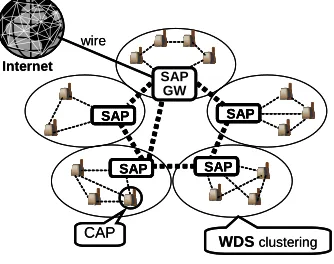
As shown in Fig. 1, one GW cluster consists of the APs sharing the same GW, and one WDS cluster con-sists of the APs exchanging the same routing informa-tion for WDS. Besides, we have proposed the use of two
types of APs, namely the expensive, programmablesmart
one channel. Then, one WDS cluster consists of one SAP
as the cluster head and multiple CAPs where its
num-ber is limited, and one GW cluster consists of multiple WDS clusters. The WDS clusters are connected through SAPs with plural channels because their traffics are usu-ally larger than those inside the WDS cluster. Then, the proper SAP allocation among APs becomes very impor-tant because it determines the performance and the cost of WIMNET.
SAP SAP
SAP SAP
Internet
WDS clustering
CAP
SAP GW
wire
SAP
SAP SAPSAP SAP SAP SAP
SAP Internet
WDS clustering
CAP
SAP GW
[image:2.595.87.254.194.326.2]wire
Figure 1: A GW cluster in WIMNET
In this paper, we define the SAP allocation problem for WIMNET, and present its algorithm. To maximize the performance of WIMNET, the minimization of the max-imum transmission time or delay per channel is signifi-cant. The transmission time can be obtained by the traf-fics among the interfered links using the same channel. Because the interfered links can be obtained only after the routing and NIC/channel assignments are fixed, the proposed algorithm applies our previous routing tree and NIC/channel assignment algorithms in [4] for any feasible SAP allocation satisfying the constraints of the problem.
Besides, themaximum estimated SAP loadis adopted to
prune undesirable SAP allocations offering unbalanced SAP loads [5] to reduce the computation time.
To evaluate our proposal, we simulate the throughput of the SAP allocation found by our algorithm, using the WIMNET simulator. As simulated network topologies, we adopt two artificial ones with small numbers of SAPs where APs are located on grids and the center AP is se-lected as the GW, and another practical one that models the JR Okayama station [6]. In addition, two different traffic patterns are prepared to each grid topology. Any simulation result indicates that the SAP allocation by our algorithm gives the maximum throughput that is similar to the all-SAP case. We conclude that using our pro-posal, a large scale WIMNET can be made up with a small number of expensive high-performance SAPs.
The rest of this paper is organized as follows: Section 2 defines the SAP allocation problem. Section 3 presents the algorithm. Section 4 shows evaluation results by sim-ulations. Section 5 concludes the paper with some future
works.
2
Definition of SAP Allocation
Problem
For the inputs to the SAP allocation problem, we assume that the AP network topology, the GW, the maximum ex-pected number of associated hosts with each AP as loads, the interference among links, the transmission speed for each link, the WDS cluster size limit, and the channel interference matrix are given. As the output, the SAP allocation with the routing tree and NIC/channel assign-ments is requested to minimize the maximum
transmis-sion time. Then, the SAP allocation problem can be
formulated as follows:
A. Input:
• the AP network topology: G= (V, E)
– the number of APs: N =|V|
– the links between APs: E
– the interference among links: D = [dijpq],
where dijpq = 1 if two links, APi → APj and
APp →APq, are interfered, and dijpq = 0
oth-erwise
– the bandwidth oflinkij: sij (Mbps)
– the maximum expected number of associated
hosts withAPi: hi
– the Internet gateway: g (∈V)
• the number of SAPs: M
• the WDS cluster size (the maximum number of
CAPs in one WDS cluster): W SIZE
• the channel interference matrix: C= [c(i, j)]
• the number of channels: P
• the maximum number of NICs per SAP:Q
B. Output: the SAP allocation with the routing tree and NIC/channel assignments
C. Constraints: The following three conditions must be satisfied in the feasible solution:
(1) The gateway must be SAP.
(2) No CAP must exist along the routing path between
the GW and any SAP.
(3) Any CAP must have at least one connectable SAP
Theconnectable SAPrepresents a SAP that exists along the shortest path between the CAP and the GW, or ex-ists within four hops from the CAP. The latter condition is necessary to increase the number of cluster head can-didates for CAPs to obtain feasible solutions.
D. Objective: The cost functionEtraf representing the
maximum transmission time should be minimized:
Etraf=max
(i,j)
tij+tji+
N ∑
p=1
dijpq=1∨djipq=1 N ∑
q=1
tpqc(yij,ypq) (1)
where tij represents the traffic along the link from
APi→APj, andyij represents its assigned channel.
3
Proposal of SAP Allocation Algorithm
3.1
SAP Allocation Algorithm
Previously, we have proposed the routing tree algorithm and the NIC/channel assignment algorithm for WIMNET [4]. The former algorithm finds the communication route between the GW and the APs for a given AP network with the fixed SAPs. The latter algorithm finds the num-ber of NICs assigned to each SAP and the channel as-signment to each NIC for a given routing tree. Then,
because the cost function Etraf in the SAP allocation
problem can be calculated only after the routing tree and the NIC/channel assignment are found, our algorithm ap-plies these algorithms to any feasible SAP allocation for a given AP network, and selects the best one that
mini-mizesEtraf. Here, to reduce the computation time, our
algorithm discards undesirable SAP allocations by
adopt-ing the maximum estimated SAP load before applying
previous algorithms. The following procedure describes the details of the SAP allocation algorithm:
(1) Calculate the lower boundNSAP
LB on the number of
SAPs, which is equal to the number of WDS clusters.
If the input number of SAPsM is smaller, then set
M=NSAP LB =
⌈ N
W SIZE
⌉
.
(2) Generate a new SAP allocation by selectingM APs
for SAPs amongN APs.
(3) Check the feasibility of the SAP allocation ofNSAP
LB
of satisfying the three constraints. If it is not feasi-ble, go to (8).
(4) Calculate the maximum estimated SAP load in
Sect. 3.2. If it is larger than the threshold there, go to (8).
(5) Apply the routing tree and NIC/channel assignment
algorithms in [4]. If no feasible solution is obtained, go to (8).
(6) Calculate the cost functionEtraf.
(7) Update the best-found solution if Etraf in (6) is
smaller than the best one.
(8) Terminate the procedure if every SAP allocation is
generated in (2). Otherwise, go to (2).
3.2
Maximum Estimated SAP Load
As the number of APs increases for a large-size WIM-NET, the number of SAP allocations increases exponen-tially. Then, the computation time becomes unaccept-ably long, where the routing tree and NIC/channel as-signment algorithms inhibitory requires the long time. To
avoid this situation, themaximum estimated SAP loadis
calculated for each SAP allocation before their applica-tions, and if the value is larger than the threshold, it is discarded because traffics are concentrated into a specific SAP that may become the bottleneck of WIMNET.
3.2.1 SAP Selection Weight by Hop Count
As the WDS cluster head of a CAP, a SAP with the smaller hop count (number of hops) has the larger pos-sibility than a SAP with the larger hop count due to the
delay. Thus, theSAP selection weightby hop count is
cal-culated for each pair of a SAP and a CAP to represent
the possibility of being the same cluster by Wk= 1/2k.
3.2.2 Procedure for Maximum Estimated SAP
Load
For each SAP in a SAP allocation, the maximum
esti-mated SAP loadis calculated by the following procedure:
(1) Find the connectable SAPs for each CAP in the SAP
allocation.
(2) Calculate the weighted average of theSAP selection
weightsamong the connectable SAPs for each CAP.
(3) Multiply the maximum expected number of
associ-ated hostshi to this weighted average for each SAP.
(4) For each SAP, sum up the values ofWkinof all the
CAPs that can select this SAP as the cluster head,
which becomes theestimated SAP load.
(5) Select the maximum value of (4) among all the SAPs
in the SAP allocation for the maximum estimated
SAP load.
[image:3.595.53.292.172.218.2]3.2.3 Example of Estimated SAP Load
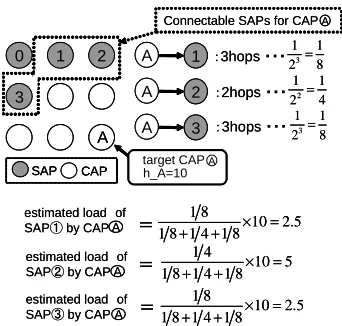
Figure 2 illustrates an example of calculating the
are connectable for CAP-A. Because the hop count from CAP-A is three, two, and three to each SAP, the corre-spondingSAP selection weightsare given by: 1/23, 1/22, 1/23. Becauseh
ifor CAP-A is 10, the estimated load for
each of the three SAPs by CAP-A is 2.5, 5, and 2.5 as
shown in Fig. 2. Then, after calculating them for every
CAP, theestimated SAP load is calculated by summing
up them for each SAP.
0 1 2 A 1
3
A
A 2
A 3
:3hops ・・・
:2hops ・・・
:3hops ・・・
SAP CAP
Connectable SAPs for CAP
3 1 1 2 =8
3 1 1 2 =8
2 1 1 2 =4
target CAP A
1 8
10 2.5 1 8 1 4 1 8+ + × =
= estimated load of
SAP①by CAP A
A
h_A=10
1 4
10 5 1 8 1 4 1 8+ + × =
=
1 8
10 2.5 1 8 1 4 1 8+ + × =
= A
A estimated load of
SAP②by CAP
estimated load of
SAP③by CAP
0 1 2 AA 11
3
A
A 2
A 2
A 3
A 3
:3hops ・・・
:2hops ・・・
:3hops ・・・
SAP CAP
SAP CAP
Connectable SAPs for CAP
3 1 1 2 =8
3 1 1 2 =8
2 1 1 2 =4
target CAP A
1 8
10 2.5 1 8 1 4 1 8+ + × =
= estimated load of
SAP①by CAP A
A
h_A=10
1 4
10 5 1 8 1 4 1 8+ + × =
=
1 8
10 2.5 1 8 1 4 1 8+ + × =
= A
A estimated load of
SAP②by CAP
estimated load of
SAP③by CAP
Figure 2: Example of estimated SAP load calculation.
3.2.4 Threshold for Traffic Concentration
Themaximum estimated SAP loadis compared with the
given thresholdT hto judge whether the SAP allocation
may cause the traffic concentration into a specific SAP or not. If it exceeds the threshold, the SAP allocation is discarded. For this threshold, the twice of the average SAP load is used:
T h=
(∑N i=1hi
M
)
×2. (2)
4
Evaluation by Simulations
In this section, we evaluate the proposed SAP alloca-tion algorithm in terms of the computaalloca-tion time and the throughput by packet transmission simulations us-ing the WIMNET simulator. For simulations, we prepare three AP network topologies with different communica-tion loads. Each simulacommunica-tion assumes that at the begin-ning, every host posses 125 packets to the GW
(Inter-net) and the GW does 1,000 packets to every host. The
bandwidth is 30M bpsfor any link between two APs and
20M bpsfor that between an AP and a host. When mul-tiple links within interference ranges try to be activated simultaneously, randomly selected one link among them is successfully activated, and the others are inserted into
waiting queues. After every packet reached the destina-tion, the throughput is calculated by dividing the total packet size with the simulation time.
4.1
Simulated Instances
topology 1 adopts the gird one in Fig. 3 that has been
often used in mesh network studies. 25(= 5×5) APs are
allocated on the grid, where the center AP is selected as the GW. Each AP can communicate wirelessly with its four neighbor APs. As network loads, two different traffic patterns are prepared, where the black circle represents
a crowded AP associating 8 hosts for pattern 1 and 10
hosts forpattern 2, and the white circle represents an AP
associating only 1 host, so that about 100 hosts totally
exist in each pattern. The WDS cluster size W SIZE is
set 8, which indicates that the lower bound on the number
of clustersNSAP
LB is 4 from
⌈25 8
⌉
= 4. Actually, we select
m= 5 because it gave the similar throughput to the case
where every AP is selected as a SAP in our preliminary experiments.
pattern1 pattern2
[image:4.595.83.254.181.344.2]pattern1 pattern2
Figure 3: Network topology and traffic patterns for
topol-ogy 1.
topology 2 adopts the same gird topology as topology 1
with increasing 49 APs, to investigate the scalability of our algorithm. The number of crowded APs (black cir-cles) is also increased, and the number of SAPs is dou-bled.
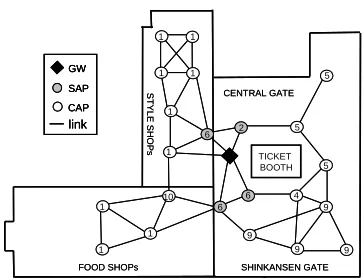
topology 3 in Fig. 4 adopts a topology that models the second floor at JR Okayama station, to consider the more practical field. The AP allocation and network loads are given by considering the floor structure and the flow of people there. We note that the number inside a circle represents the maximum expected number of hosts at the AP. The AP around the field center is selected as the GW where no host is associated.
4.2
Evaluation of Cost Function
First, we evaluate the validity of the cost function Etraf
in terms of the throughput obtained by the WIMNET simulator. For each simulation, we use the solution (the SAP allocation, the routing tree and NIC/channel as-signments) of our algorithm as the WIMNET
configura-tion. Here, the maximum number of NICs per SAP Q
is four fortopology 1andtopology 2and five fortopology
FOOD SHOPs link SAP
CAP GW
1
1
1
1
1
10 1 1
2 1 1
6 6
6
9 9
9
9 4
5
5
5
SHINKANSEN GATE CENTRAL GATE
S
T
Y
L
E
S
H
O
P
s
TICKET BOOTH
FOOD SHOPs link SAP
CAP GW
link SAP
CAP GW
1
1
1
1
1
10 1 1
2 1 1
6 6
6
9 9
9
9 4
5
5
5
SHINKANSEN GATE CENTRAL GATE
S
T
Y
L
E
S
H
O
P
s
[image:5.595.78.260.70.209.2]TICKET BOOTH
Figure 4: Network topology and traffic patterns for
topol-ogy 3.
is 120M bpsfor the first two topologies and 150M bpsfor
the last. Figures 5 and 6 show the relationship graph between the cost function and the throughput at each
traffic pattern fortopology 1, Figs. 7 and 8 do it for
topol-ogy 2, and Fig. 9 does it fortopology 3, respectively. In any graph, the throughput becomes maximum when the cost function is minimum, which supports the validity of our cost function.
0 20 40 60 80 100
0 100 200 300 400
cost function E_traf th
ro ug hp ut (M bp s)
Figure 5: Relationship between cost function and
[image:5.595.343.513.78.179.2]throughput atpattern 1fortopology 1.
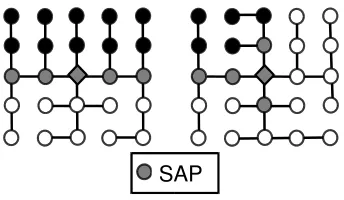
Figure 10 illustrates the SAP allocation and the routing
tree at each traffic pattern for topology 1 by our
algo-rithm. Any solution satisfies the constraints of the SAP allocation problem and balances the loads well between SAPs.
4.3
Evaluation of Maximum Estimated SAP
Load
Then, we evaluate the effectiveness of the use of the
max-imum estimated SAP load in reducing the computation time of our algorithm.
First, we verify the validity of theSAP selection weight
by hop count. Table 1 shows the relationship between the hop count and the selected rate such that a certain SAP/CAP pair is actually included in the routing tree by
0 20 40 60 80 100
0 100 200 300 400 500 cost function E_traf
th ro ug hp ut (M bp s)
Figure 6: Relationship between cost function and
throughput atpattern 2fortopology 1.
0 20 40 60 80 100
0 100 200 300 400 500
cost function E_traf th
[image:5.595.343.513.256.365.2]ro ug hp ut (M bp s)
Figure 7: Relationship between cost function and
throughput atpattern 1fortopology 2.
our algorithm. This table indicates that the selected rate
roughly becomes 1/2 every time the hop count increases
by one, which supports the validity of ourSAP selection
weight by hop count.
Then, to evaluate the effectiveness of the maximum
es-timated SAP load in terms of the computation time re-duction, we count the number of SAP allocations where the routing tree and NIC/channel assignment algorithms are applied, when each of the three constrains ((1), (2), (3)) and the maximum estimated SAP load ((4)) is
se-quentially applied. Table 2 shows that fortopology 1and
topology 3 with a fewer numbers of APs and SAPs, the
maximum estimated SAP loadreduces it into about 2/5 of
the result by the constraints, and fortopology 3, it does in
[image:5.595.86.255.392.493.2]about 1/6. Thus, the use of themaximum estimated SAP
Table 1: Relationship between hop count and SAP/CAP pair selected rate.
1 hop 2 hops 3 hops 4 hops
topol. 1, pat. 1 80.0% 38.4% 7.1% 0.0%
topol. 1, pat. 2 72.2% 33.3% 22.2% 8.3%
topol. 2, pat. 1 58.8% 30.7% 21.2% 8.3%
topol. 2, pat. 2 64.7% 31.5% 20.4% 9.6%
[image:5.595.308.548.682.757.2]0 20 40 60 80 100
0 100 200 300 400 500 600 cost function E_traf
[image:6.595.342.514.71.171.2]th ro ug hp ut (M bp s)
Figure 8: Relationship between cost function and
throughput atpattern 2fortopology 2.
0 20 40 60 80 100
0 100 200 300 400
cost function E_traf th
ro ug hp ut (M bp s)
Figure 9: Relationship between cost function and
throughput fortopology 3.
loadis very effective to reduce the computation time.
Table 3 shows the total computation time of our
algo-rithm on a PC withCore 2 Duo 2.67 GHzfor CPU,3.25
GBfor main memory, andLinux 2.6.16for OS. With the
help of themaximum estimated SAP load, our algorithm
can run within acceptable time for a large-scale WIM-NET.
5
Conclusion
This paper presented the definition of the smart access point (SAP) allocation problem for the scalable
wire-less Internet-access mesh network WIMNET and its
al-Table 2: Number of examined SAP allocations by algo-rithm.
(1) (1),(2) (1) -(3) (1)-(4)
topol. 1, pat. 1 251 243 243 147
topol. 1, pat. 2 251 243 243 107
topol. 2, pat. 1 173252 108544 33208 5384
topol. 2, pat. 2 173252 108544 33208 6513
topol. 3 229 203 203 164
Figure 10: SAP allocation and routing tree for topology
[image:6.595.86.254.78.181.2]1.
Table 3: Algorithm computation time (seconds).
topol. 1 topol. 1 topol. 2 topol. 2 topol. 3 pat. 1 pat. 2 pat. 1 pat. 2
22 18 4692 4941 20
gorithm adopting the maximum estimated SAP loadfor
the computation time reduction. The effectiveness of our proposal was verified through simulations in three net-work topologies using the WIMNET simulator. Our fu-ture works may include extensions of the SAP allocation algorithm to dynamic changes of network loads and net-work configurations by failures of links or access points, and evaluations in the real network after the SAP imple-mentation.
References
[1] Akyildiz, I. F., Wang, X., Wang, W., ”Wireless mesh
networks: a survey,”Comput. Network, vol. 47, no.
4, pp. 445-487, March 2005.
[2] Farag, T., Funabiki, N., Nakanishi, T., ”An access point allocation algorithm for indoor environments
in wireless mesh networks”, IEICE Trans.
Com-mun., vol. E92-B, no. 3, pp. 784-739, March 2009.
[3] Hirakata, K., Horiuchi, T., Funabiki, N., Nakanishi, T., ”A construction of the smart access point for
practical wireless mesh networks,”IEICE Tech.
Re-port, vol. NS2008-99, pp. 63-68, Nov. 2008.
[4] Uemura, K., Funabiki, N., Nakanishi, T., ”A com-munication route optimization algorithm for scalable
wireless mesh networks,”IEICE Trans. B, vol.
J92-B, no. 9, Sep. 2009.
[5] Hsiao, P.-H., Hwang, A., Kung, H. T., Vlah, D., ”Load-balancing routing for wireless access
net-works,”Proc. IEEE INFOCOM, vol. 2, pp. 986-995,
April 2001.
[6] JR Okayama Station,
[image:6.595.85.255.257.355.2]