A Cascade Method for Detecting Hedges and their Scope in Natural
Language Text
Buzhou Tang, Xiaolong Wang, Xuan Wang, Bo Yuan, Shixi Fan Key Laboratory of Network Oriented Intelligent Computation
Harbin Institute of Technology Shenzhen Graduate School Shenzhen, Guangdong, China
{tangbuzhou,yuanbo.hitsz}@gmail.com
{wangxl,wangxuan,fanshixi}@insun.hit.edu.cn
Abstract
Detecting hedges and their scope in nat-ural language text is very important for information inference. In this paper, we present a system based on a cascade method for the CoNLL-2010 shared task. The system composes of two components: one for detecting hedges and another one for detecting their scope. For detecting hedges, we build a cascade subsystem. Firstly, a conditional random field (CRF) model and a large margin-based model are trained respectively. Then, we train an-other CRF model using the result of the first phase. For detecting the scope of hedges, a CRF model is trained according to the result of the first subtask. The ex-periments show that our system achieves 86.36% F-measure on biological corpus and 55.05% F-measure on Wikipedia cor-pus for hedge detection, and 49.95% F-measure on biological corpus for hedge scope detection. Among them, 86.36% is the best result on biological corpus for hedge detection.
1 Introduction
Hedge cues are very common in natural language text. Vincze et al. (2008) report that 17.70% of the sentences in the abstract section and 19.94% of sentences in the full paper section contain hedges on BioScope corpus. As Vincze et al. (2008) suggest that information that falls in the scope of hedges can not be presented as factual in-formation. Detecting hedges and their scope in natural language text is very important for in-formation inference. Recently, relative research has received considerable interest in the biomed-ical NLP community, including detecting hedges and their in-sentence scope in biomedical texts
(Morante and Daelemans, 2009). The CoNLL-2010 has launched a shared task for exploiting the hedge scope annotated in the BioScope (Vincze et al., 2008) and publicly available Wikipedia (Gan-ter and Strube, 2009) weasel annotations. The shared task contains two subtasks (Farkas et al., 2010): 1. learning to detect hedges in sentences on BioScope and Wikipedia; 2. learning to detect the in-sentence scope of these hedges on BioScope.
In this paper, we present a system based on a cascade method for the CoNLL-2010 shared task. The system composes of two components: one for detecting hedges and another one for detect-ing their scope. For detectdetect-ing hedges, we build a cascade subsystem. Firstly, conditional ran-dom field (CRF) model and a large margin-based model are trained respectively. Then, we train another CRF model using the result of the first phase. For detecting the scope of hedges, a CRF model is trained according to the result of the first subtask. The experiments show that our system achieves 86.36% F-measure on biological corpus and 55.05% F-measure on Wikipedia corpus for hedge detection, and 49.95% F-measure on bio-logical corpus for hedge scope detection. Among them, 86.36% is the best result on biological cor-pus for hedge detection.
2 System Description
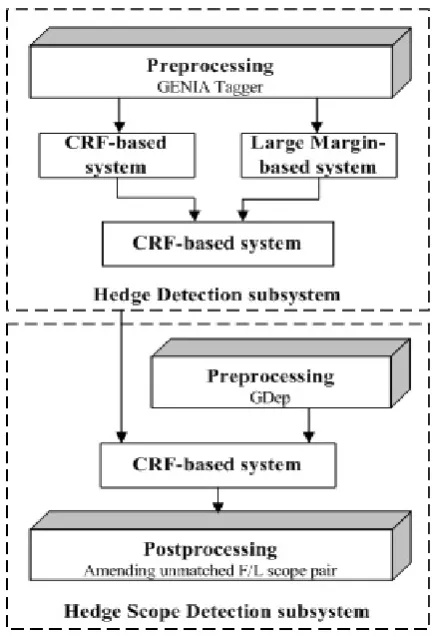
As there are two subtasks, we present a system based on a cascade supervised machine learning methods for the CoNLL-2010 shared task. The ar-chitecture of our system is shown in Figure 1.
The system composes of two subsystems for two subtasks respectively, and the first subsystem is a two-layer cascaded classifier.
2.1 Hedge Detection
The hedges are represented by indicating whether a token is in a hedge and its position in the CoNLL-2010 shared task. Three tags are used for
Figure 1: System architecture
this scheme, where O cue indicates a token out-side of a hedge, B cue indicates a token at the beginning of a hedge and I cue indicates a to-ken inside of a hedge. In this subsystem, we do preprocessing by GENIA Tagger (version 3.0.1)1
at first, which does lemma extraction, part-of-speech (POS), chunking and named entity recog-nition (NER) for feature extraction. For the out-put of GENIA Tagger, we convert the first char of a lemma into lower case and BIO chunk tag into BIOS chunk tag, where S indicates a token is a chunk, B indicates a token at the beginning of a chunk, I indicates a token inside of a chunk, and O indicates a token outside of a chunk. Then a two-layer cascaded classifier is built for pre-diction. There are a CRF classifier and a large margin-based classifier in the first layer and a CRF classifier in the second layer.
In the first layer, the following features are used in our system:
• Word and Word Shape of the lemma: we used
the similar scheme as shown in (Tsai et al., 2005).
1http://www-tsujii.is.s.u-tokyo.ac.jp/GENIA/tagger/
• Prefix and Suffix with length 3-5.
• Context of the lemma, POS and the chunk in
the window [-2,2].
• Combined features including L0C0, LiP0
andLiC0, where−1 ≤i ≤1Ldenotes the
lemma of a word, P denotes a POS and C
denotes a chunk tag.
• The type of a chunk; the lemma and POS se-quences of it.
• Whether a token is a part of the pairs ”neither
... nor” and ”either ... or” as both tokens of a pair are always labeled with the same tag.
• Whether a token can possibly be classified
into B cue, I cue or O cue; its lemma, POS and chunk tag for each possible case: these features are extracted according to a dictio-nary extracted from training corpus, which lists all possible hedge tag for each word in the training corpus.
In the second layer, we used some features about the result of the last layer besides those men-tioned above. They are listed as follow:
• The lemma and POS sequences of the hedge
predicted by each classifier.
• The times of a token classified into B cue, I cue and O cue by the first two classifiers.
• Whether a token is the last token of the hedge predicted by each classifier.
2.2 Hedge Scope Detection
We follow the way of Morante and Daelemans (2009) to represent the scope of a hedge, where F scope indicates a token at the beginning of a scope sequence, L scope indicates a token at the last of a scope sequence, and NONE indicates others. In this phase, we do preprocessing by GDep Tagger (version beta1)2at first, which does
lemma extraction, part-of-speech (POS), chunk-ing, named entity recognition (NER) and depen-dency parse for feature extraction. For the out-put of GDep Tagger, we deal with the lemma and chunk tag using the same way mentioned in the last section. Then, a CRF classifier is built for pre-diction, which uses the following features:
• Word.
• Context of the lemma, POS, the chunk, the hedge and the dependency relation in the window [-2,2].
• Combined features including L0C0,
L0H0, L0D0, LiP0, PiC0,PiH0, CiH0,
PiD0,CiD0, where −1 ≤ i ≤ 1 Ldenotes
the lemma of a word, P denotes a POS, C
denotes a chunk tag,H denotes a hedge tag
andDdenotes a dependency relation tag.
• The type of a chunk; the lemma and POS se-quences of it.
• The type of a hedge; the lemma, POS and
chunk sequences of it.
• The lemma, POS, chunk, hedge and
depen-dency relation sequences of1stand2nd de-pendency relation edges; the lemma, POS, chunk, hedge and dependency relation se-quences of the path from a token to the root.
• Whether there are hedges in the1st,2nd de-pendency relation edges or path from a token to the root.
• The location of a token relative to the
nega-tion signal: previous the first hedge, in the first hedge, between two hedge cues, in the last hedge, post the last hedge.
At last, we provided a postprocessing system for the output of the classifier to build the com-plete sequence of tokens that constitute the scope. We applied the following postprocessing:
• If a hedge is bracketed by a F scope and a
L scope, its scope is formed by the tokens be-tween them.
• If a hedge is only bracketed by a F scope, and
there is no L scope in the sentence, we search the first possible word from the end of the sentence according to a dictionary, which ex-tracted from the training corpus, and assign it as L scope. The scope of the hedge is formed by the tokens between them.
• If a hedge is only bracketed by a F scope, and there are at least one L scope in the sentence, we think the last L scope is the L scope of the hedge, and its scope is formed by the tokens between them.
• If a hedge is only bracketed by a L scope, and there is no F scope in the sentence, we search the first possible word from the begin-ning of the sentence to the hedge according to the dictionary, and assign it as F scope. The scope of the hedge is formed by the tokens between them.
• If a hedge is only bracketed by a L scope, and there are at least one F scope in the sen-tence, we search the first possible word from the hedge to the beginning of the sentence ac-cording to the dictionary, and think it as the F scope of the hedge. The scope of the hedge is formed by the tokens between them.
• If a hedge is bracketed by neither of them, we remove it.
3 Experiments and Results
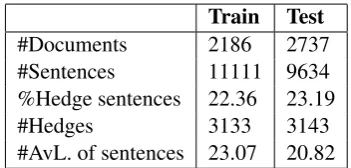
Two annotated corpus: BioScope and Wikipedia are supplied for the CoNLL-2010 shared task. The BioScope corpus consists of two parts: biological paper abstracts and biological full papers, and it is used for two subtasks. The Wikipedia corpus is only used for hedge detection. The detailed infor-mation of these two corpora is shown in Table 1 and Table 2, respectively.
Abstracts Papers Test
[image:3.595.305.529.442.541.2]#Documents 1273 9 15 #Sentences 11871 2670 5003 %Hedge sent. 17.70 19.44 15.75 #Hedges 2694 682 1043 #AvL. of sent. 30.43 27.95 31.30 #AvL. of scopes 17.27 14.17 17.51
Table 1: The detailed information of BioScope corpus. ”AvL.” stands for average length.
Train Test
#Documents 2186 2737 #Sentences 11111 9634 %Hedge sentences 22.36 23.19 #Hedges 3133 3143 #AvL. of sentences 23.07 20.82
Table 2: The detail information of Wikipedia cor-pus. ”AvL.” stands for average length.
In our experiments, CRF++-0.533
[image:3.595.328.504.599.683.2]tation is employed to CRF, and svm hmm 3.104
implementation is employed to the large margin method. All parameters are default except C (the trade-off between training error and margin, C=8000, for selecting C, the training corpus is par-titioned into three parts, two of them are used for training and the left one is used as a development dataset) in svm hmm. Both of them are state-of-the-art toolkits for the sequence labeling problem.
3.1 Hedge Detection
[image:4.595.318.514.63.106.2]We first compare the performance of each single classifier with the cascaded system on two corpora in domain, respectively. Each model is trained by whole corpus, and the performance of them was evaluated by the official tool of the CoNLL-2010 shared task. There were two kinds of measure: one for sentence-level performance and another one for cue-match performance. Here, we only focused on the first one, and the results shown in Table 3.
Corpus System Prec. Recall F1
CRF 87.12 86.46 86.79 BioScope LM 85.24 87.72 86.46 CAS 85.03 87.72 86.36 CRF 86.10 35.77 50.54 Wikipedia LM 82.28 41.36 55.05 CAS 82.28 41.36 55.05
Table 3: In-sentence performance of the hedge detection subsystem for in-domain test. ”Prec.” stands for precision, ”LM” stands for large mar-gin, and ”CAS” stands for cascaded system.
From Table 3, we can see that the cascaded sys-tem is not better than other two single classifiers and the single CRF classifier achieves the best per-formance with F-measure 86.79%. The reason for selecting this cascaded system for our final sub-mission is that the cascaded system achieved the best performance on the two training corpus when we partition each one into three parts: two of them are used for training and the left one is used for testing.
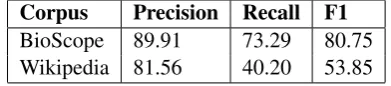
For cross-domain test, we train a cascaded clas-sifier using BioScope+Wikipedia cropus. Table 4 shows the results.
As shown in Table 5, the performance of cross-domain test is worse than that of in-cross-domain test.
4http://www.cs.cornell.edu/People/tj/svm
light/svm-hmm.html
Corpus Precision Recall F1
BioScope 89.91 73.29 80.75 Wikipedia 81.56 40.20 53.85
Table 4: Results of the hedge detection for cross-domain test. ”LM” stands for large margin, and ”CAS” stands for cascaded system.
3.2 Hedge Scope Detection
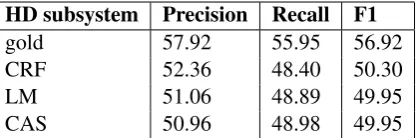
For test the affect of postprocessing for hedge scope detection, we test our system using two eval-uation tools: one for scope tag and the other one for sentence-level scope (the official tool). In or-der to evaluate our system comprehensively, four results are used for comparison. The ”gold” is the performance using golden hedge tags for test, the ”CRF” is the performance using the hedge tags prediction of single CRF for test, the ”LM” is the performance using the hedge tag prediction of sin-gle large margin for test, and ”CAS” is the per-formance of using the hedge tag prediction of cas-caded subsystem for test. The results of scope tag and scope sentence-level are listed in Table 5 and Table 6, respectively. Here, we should notice that the result listed here is different with that submit-ted to the CoNLL-2010 shared task because some errors for feature extraction in the previous system are revised here.
HD tag Precision Recall F1
F scope 92.06 78.83 84.94 gold L scope 80.56 68.67 74.14 NONE 99.68 99.86 99.77 F scope 78.83 66.89 72.37 CRF L scope 72.52 60.50 65.97 NONE 99.56 99.75 99.65 F scope 77.25 67.57 72.09 LM L scope 72.33 61.41 66.42 NONE 99.56 99.73 99.31 F scope 77.32 67.86 72.29 CAS L scope 72.00 61.29 66.22 NONE 99.57 99.73 99.65
Table 5: Results of the hedge scope tag. ”HD” stands for hedge detection subsystem we used, ”LM” stands for large margin, and ”CAS” stands for cascaded system.
[image:4.595.72.290.357.455.2]HD subsystem Precision Recall F1
[image:5.595.79.289.62.131.2]gold 57.92 55.95 56.92 CRF 52.36 48.40 50.30 LM 51.06 48.89 49.95 CAS 50.96 48.98 49.95
Table 6: Results of the hedge scope in-sentence. ”HD” stands for hedge detection subsystem we used, ”LM” stands for large margin, and ”CAS” stands for cascaded system.
how to improve the prediction performance of L scope. Moreover, compared the performance shown in Table 5 and 6, about 15% (F1 of L scope in Table 5 - F1 in Table 6) scope labels are mis-matched. An efficient postprocessing is needed to do F-L scope pair match.
As ”CRF” hedge detection subsystem is bet-ter than the other two subsystems, our system achieves the best performance with F-measure 50.30% when using the ”CRF” subsystem.
4 Conclusions
This paper presents a cascaded system for the CoNLL-2010 shared task, which contains two subsystems: one for detecting hedges and an-other one for detecting their scope. Although the best performance of hedge detection subsys-tem achieves F-measure 86.79%, the best per-formance of the whole system only achieves F-measure 50.30%. How to improve it, we think some complex features such as context free gram-mar may be effective for detecting hedge scope. In addition, the postprocessing can be further im-proved.
Acknowledgments
We wish to thank the organizers of the CoNLL-2010 shared task for preparing the datasets and organizing the challenge shared tasks. We also wish to thank all authors supply-ing the toolkits used in this paper. This research has been partially supported by the National Natural Science Foundation of China (No.60435020 and No.90612005), National 863 Program of China (No.2007AA01Z194) and the Goal-oriented Lessons from the National 863 Pro-gram of China (No.2006AA01Z197).
References
Rich´ard Farkas, Veronika Vincze, Gy¨orgy M´ora, J´anos Csirik, Gy¨orgy Szarvas. 2010. The CoNLL-2010 Shared Task: Learning to Detect Hedges and their
Scope in Natural Language Text. InProceedings of
the Fourteenth Conference on Computational Nat-ural Language Learning (CoNLL-2010): Shared
Task, pages 1–12, Uppsala, Sweden, July.
Associ-ation for ComputAssoci-ational Linguistics.
Viola Ganter and Michael Strube. 2009. Finding hedges by chasing weasels: Hedge detection using wikipedia tags and shallow linguistic features. In
Proceedings of the ACL-IJCNLP 2009 Conference Short Papers, pages 173–176, Suntec, Singapore, August. Association for Computational Linguistics. Roser Morante and Walter Daelemans. 2009. Learning the scope of hedge cues in biomedical texts. In Pro-ceedings of the BioNLP 2009 Workshop, pages 28– 36, Boulder, Colorado, June. Association for Com-putational Linguistics.
Tzong-Han Tsai, Chia-Wei Wu, and Wen-Lian Hsu. 2005. Using Maximum Entropy to Extract
Biomed-ical Named Entities without Dictionaries. In
Sec-ond International Joint Conference on Natural Lan-guage Processing, pages 268–273.