Abstract —This paper proposes a fast wavelet-based macro-block mode selection algorithm for H.264/AVC video codec system. The proposed algorithm makes use of the two-dimensional wavelet transform to estimate the sub-band energy of each macro-block in a given video frame. Then the sub-band energy can be applied to the macro-block mode decision as a primary parameter. To prevent the over segmentation of a macro-block, a secondary parameter called PSNR threshold is used in the mode decision procedure. Various experimental results show that the proposed algorithm can effectively make a macro-block mode decision under a given PSNR value. Furthermore, the execution time of the proposed wavelet-based multi-block selection algorithm is faster 1~4 times than that of the traditional algorithm with the similar macro-block mode decision results.
Index Terms— H.264 video codec, macro-block selection, wavelet transform
I. INTRODUCTION
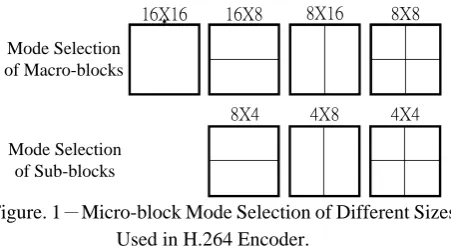
H.264/AVC is the recently developed video coding standard [1] and has been shown that it outperforms previous standards such as MPEG-4 and H.263 in terms of coding efficiency [2]. The basic encoding algorithm of H.264 is very similar to H.26x or MPEG-x except that integer 4×4 discrete cosine transform (DCT) is used instead of the traditional 8×8 DCT. In addition, H.264 adopts several new coding tools, such as quarter-pixel-accuracy motion estimation (ME), multiple reference frames, loop filter, variable block size (VBS), and etc. [1-3]. These new coding tools enable H.264 to achieve higher coding efficiency than previous video coding standards. However, the encoder complexity increases tremendously. In general, most of the computational time is consumed in the mode decision stage where the variable block size ME is employed [4]. Various block size ME can reduce the residual of motion compensation (MC) to improve the compression ratio. In H.264, there are seven different block sizes (16×16, 16×8, 8×16, 8×8, 8×4, 4×8 and 4×4) as shown in Figure 1 that can be used in inter mode coding.
To achieve the highest coding efficiency, the H.264 encoder will test all of the possible modes and then chooses the best one in terms of least rate-distortion (RD) cost.
However, such a “try and error” method will cost high computational complexity and limit the use of H.264 encoders in real-time applications [4].
16X16
4X4 4X8
8X4
8X8 8X16
16X8
Mode Selection of Macro-blocks
[image:1.595.320.546.223.346.2]Mode Selection of Sub-blocks
Figure. 1-Micro-block Mode Selection of Different Sizes Used in H.264 Encoder.
Therefore, many approaches have been proposed to reduce the H.264 encoder complexity [5-7]. Yin et al. [5] propose a monotonic error surface based algorithm to optimize mode decision. Their ME algorithm consists of two steps. First, an integer-pixel ME is performed based on the enhanced prediction zonal search (EPZS). Then, using the result of the integer-pixel ME, sub-pixel ME is carried out within some limited areas. For faster macro block mode selection, this method simply examines limited modes, i.e., 16×16, 8×8, and 4×4. In [6], the mean absolute frame difference of the current frame and mean absolute difference of the current MB from the previous frame are used to determine whether the current MB belongs to homogeneous regions or not. Therefore, it only needs to check 16×16, 16×8 and 8×16 modes. L. Yang et al. [7] proposed a variable block size best motion detection (VBBMD) algorithm to check the predicted motion vector (PMV) for different block sizes. If the RD cost with the PMV is less than a given threshold, the ME of this block size can be early stopped. In this algorithm, a set of principal thresholds is determined experimentally based on test sequence.
This paper proposes a new fast wavelet-based macro-block mode selection algorithm for H.264 encoding system. The proposed algorithm first calculates the sub-band energy by using two-dimensional wavelet transform. The wavelet transform is applied to pre-analysis the macro-block characteristic in a video frame. Then the proposed algorithm will derive a primary parameter for macro-block mode decision from the sub-band energy. To prevent the over segmentation of a macro-block, a secondary parameter called PSNR threshold is used in the mode decision procedure. Various experimental results show that the proposed algorithm can effectively select a macro-block mode decision under a given PSNR value. Furthermore, the decision time of the proposed algorithm is faster 1 to 4 times than that of the traditional multi-block selection method with the similar Shi-Huang Chen, Chung-Hsien Chang, and Shih-Yin Yu
Fast Wavelet-based Macro-block Selection
Algorithm for H.264 Video Codec
This work was supported in part by the National Science Council under Grant NSC 96-2221-E-214-004 and NSC 96-2221-E-366-011. Shi-Huang Chen*, Chung-Hsien Chang, and Shih-Yin Yu are with the Department of Computer Science Information Engineering, Shu-Te University, Kaohsiung, 824, Taiwan. (*Corresponding author, Tel: +886-7-6158000 ext. 4607, Fax: +886-7-6158000 ext. 4699, e-mail:
macro-block mode decision results.
The rest of this paper is organized as fallows. In Section II the traditional algorithm of macro-block mode estimation is given. Section III describes the proposed macro-block mode selection algorithm and Section IV shows the experimental results with comparison with the traditional macro-block mode algorithm. Finally, Selection V concludes this paper.
II. THE TRADITIONAL ALGORITHM OF MACRO-BLOCK
SELECTION
The macro-block ME/MC is adopted in H.264 to reduce the residual between the original video frame and the predicted frame and that can increase the accuracy of prediction. The macro-block mainly is used in the edge of moving object in the frame and its default size is 16×16. However, in some cases, it is not enough to describe the moving of the macro-block using only one motion vector. Therefore, it is more fit for MC/ME based on smaller block to get the better block matching. In the ME procedure, the cost function or the mean absolute difference (MAD) is used to determine the similarity of the current and reference macro-blocks. The definition of MAD is given by
∑∑
− =−
=
−
=
10 1
0 2
1
Ni N
j
ij ij
R
C
N
MAD
(1)
where Cij and Rij are the pixels being compared in current macro-block and reference marc-block, N is the side of macro-block. In addition, the peak-signal-to-noise-ratio (PSNR) of 8 bits gray image is given in Eq. 2 where MSE is abbreviation of mean square error. The PSNR can evaluate the quality of the motion compensated image that is created by using motion vectors and macro blocks from reference frame.
( )
⎥
⎦
⎤
⎢
⎣
⎡
=
MSE
Log
PSNR
2
10
255
10
(2)
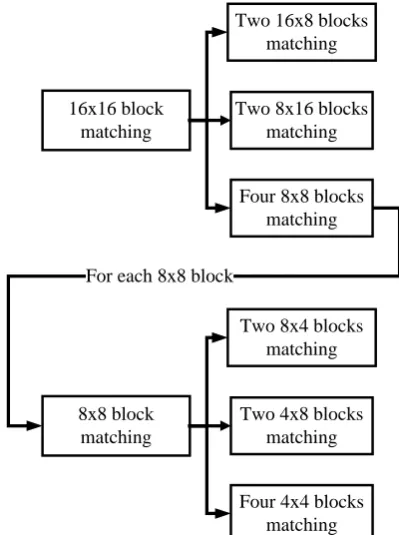
In the traditional algorithm of macro-block selection, it sets a threshold to restrict the PSNR. If the PSNR calculated by a macro-blocks motion estimation using assigned mode is greater than the threshold, one can reserve this mode and perform motion compensation. Otherwise, one needs to further segment the macro-block to reach the PSNR threshold. The flowchart of the traditional macro-block selection algorithm is shown in Figure 2. When a macro-block gets into this flowchart, the algorithm will carry out motion estimation and calculate the PSNR. If the PSNR is greater than threshold value, it will then execute motion compensation using this mode. On the other hand, it needs to segment the macro-block to smaller size and perform motion estimation again. The flowchart of macro-block segmentation is shown in Figure 3. Finally, the traditional algorithm will select the best PSNR and decide the segmentation mode. It goes without saying that such a “try and error” algorithm will cost high computational
Calculates motion vector and PSNR after motion compensation by the NxN
Macro-Block.
If the PSNR < threshold
Yes
The PSNR by two (N/2)xN segmentation is
maximum
The PSNR by two Nx(N/2) segmentation is
maximum
No
No
No
Let NxN Marco-block divided into four (N/2)x(N/2) and keep
segment. Let N = N/2
If N = 8 No Lets the
segmentation mode be two (N/2)xN
Macro-Blocks
Lets the segmentation mode
be two Nx(N/2) Macro-Blocks
Lets the segmentation mode be four (N/2)x(N/2) Macro-Blocks
Yes Yes Yes
START N = 16 Input: The NxN
Macro-Block
Calculates Motion vector and PSNR after motion compensation by each one NxN
Marco-Block, two Nx(N/2) Macro-Block, two (N/2)xN Macro-Blocks and four (N/2)x(N/2) Macro-Blocks
No END
Do motion compensation by this segmentation
mode
The PSNR by NxN segmentation is maximum
Lets the segmentation mode be one NxN
Macro-Block
[image:2.595.309.547.63.422.2]No Yes
Figure. 2-The flowchart of the traditional algorithm of macro-block selection.
16x16 block matching
Two 16x8 blocks matching
For each 8x8 block
Two 8x16 blocks matching
Four 8x8 blocks matching
8x8 block matching
Two 8x4 blocks matching
Two 4x8 blocks matching
Four 4x4 blocks matching
[image:2.595.312.512.470.738.2]III. MACRO-BLOCK MODE SELECTION ALGORITHM USING
WAVELET TRANSFORM
To reduce the computational cost of the traditional macro-block selection algorithm, this paper proposes a fast algorithm using wavelet transform for macro-block mode selection. The proposed algorithm uses two-dimensional wavelet transform to pre-decide the segmentation of macro-blocks for reducing the decision time. Using the characteristic of two-dimensional wavelet transform, the proposed algorithm can analyze the sub-band energy of a micro-block. The filter architecture of two-dimensional wavelet transform is shown in Figure 4.
(m n)
Wϕ ,
(m n)
WD , ψ
(m n)
WV , ψ
(m n)
WH , ψ
(mn)
Wϕ ,
↓ 2 ↓ 2 ↓ 2 ↓ 2 ↓ 2
( )n
hψ −
( )n hϕ −
( )m hψ −
( )m
hϕ−
( )m hψ −
( )m
hϕ−
↓
[image:3.595.349.507.51.141.2]2
Figure. 4-The filter architecture of two-dimensional wavelet transform.
In figure 4, the index n is the column of image, m is the row of image, Wϕ is the sub-band image of low pass approximation, H
WΨ is the sub-band image of vertical detail,
V
[image:3.595.55.284.211.335.2]WΨ is the sub-band image of horizontal detail, and WΨD is the sub-band image of diagonal detail. Figure 5 is an example of wavelet transform of a video frame selected from “Susie” sequence. In what follows the wavelet filter function used in this paper is Haar wavelet [8].
Figure. 5-Sub-band images: Wφ, WΨH, WΨV, WΨD of
two-dimensional of wavelet transform.
Next, one can calculate the sum of characteristic energy in the sub-band image of vertical detail, horizontal detail and the diagonal detail, respectively. These characteristic wavelet sub-band energy functions are given in Eqs. (3)~(5)
( )
(
)
∑ ∑
− = − = = 1 2 0 1 2 0 2 , N i N j V j i W EnergyV ψ (3)( )
(
)
∑ ∑
− = − = = 1 2 0 1 2 0 2 , N i N j H j i WEnergyH ψ (4)
( )
(
)
∑ ∑
− = − = = 1 2 0 1 2 0 2 , N i N jH i j
W
EnergyD ψ (5)
where EnergyV is the sum of characteristic energy in the sub-band image of vertical detail, EnergyH is the sum of characteristic energy in the sub-band image of horizontal detail and EnergyD is the sum of characteristic energy in the sub-band image of diagonal detail. If the EnergyV is the maximum of the characteristic energy, more horizontal information will be contained in the image. Similarly, if the
EnergyH is the maximum, more vertical information will be contained in the image. Finally, if EnergyD has the maximum value, more diagonal information will be contained in the image. These sub-band energies, called the primary parameter in this paper, derived from the two-dimensional wavelet transform are applied to predict the macro-blocks selection.
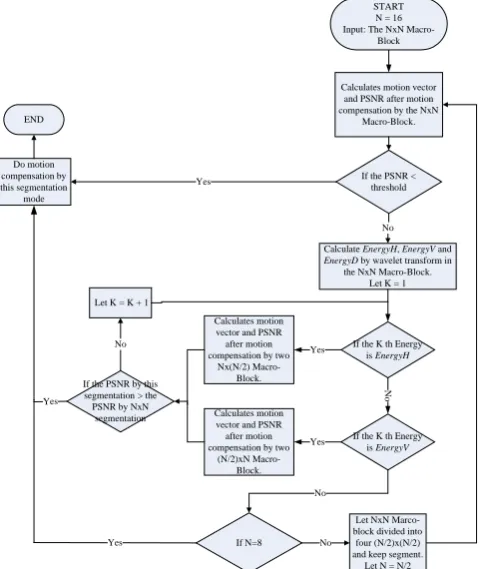
[image:3.595.308.549.448.733.2]The flowchart of the proposed algorithm is shown in Figure 6. It follows from this flowchart that the proposed algorithm will analyze macro-block characteristic of video frame using wavelet transform. It will select a sub-band whose energy is maximal from EnergyH, EnergyV, and
EnergyD and select a corresponding macro-block mode. If the current selection has met the requirement of the second parameter, i.e., a PSNR value defined by user, the proposed algorithm will stop. Otherwise it will keep on the segmentation procedure.
Calculates motion vector and PSNR after motion compensation by the NxN
Macro-Block.
If the PSNR < threshold Yes
No
Let NxN Marco-block divided into
four (N/2)x(N/2) and keep segment. Let N = N/2
If N=8 No
Yes
Calculate EnergyH, EnergyV and EnergyD by wavelet transform in
the NxN Macro-Block. Let K = 1
If the K th Energy is EnergyH Calculates motion
vector and PSNR after motion compensation by two
Nx(N/2) Macro-Block.
If the K th Energy is EnergyV Calculates motion
vector and PSNR after motion compensation by two
(N/2)xN Macro-Block.
No
Yes
Yes If the PSNR by this
segmentation > the PSNR by NxN
segmentation Yes
Let K = K + 1
No
No
START N = 16 Input: The NxN
Macro-Block END Do motion compensation by this segmentation mode
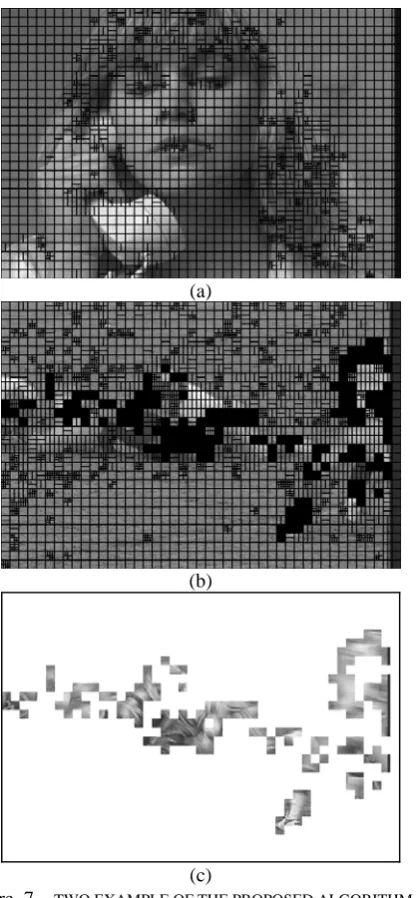
[image:3.595.78.260.492.633.2]Figure 7 illustrates two example of the proposed algorithm on video frames selected from “Susie” and “football” sequences. In Figure 7(a), one can find that the areas of eyes, hair, and the megaphone are more complex than other regions. Therefore, these areas have more detailed segmentations. The similar results can also be found in Figure 7(b). Meanwhile the black blocks shown in Figure 7(b) mean that they cannot finally meet the given PSNR threshold value via the proposed algorithm and have to be processed with INTRA-MODE. Figure 7(c) shows the contents of these INTRA-MODE blocks.
(a)
(b)
[image:4.595.68.277.187.637.2](c)
Figure. 7-TWO EXAMPLE OF THE PROPOSED ALGORITHM ON VIDEO FRAMES SELECTED FROM “SUSIE” AND “FOOTBALL”
SEQUENCES.
VI. EXPERIMENTAL RESULT
In this paper, three CIF video sequences, namely “Susie”, “Football”, and “Mall” are selected to demonstrate the results of the proposed algorithm. Each video sequence contains 30 frames and only gray frames are considered in this paper. All of the experimental results are performed on a PC with Pentium-4 2.4GHz CPU and Matlab simulation program.
The first video frame is encoded as I frame, and the remaining frames are encoded as P frame. To decrease the variable factor of experiments, both the proposed algorithm and the traditional algorithm use full search method with ±16 search range and half-pixel accuracy in ME.
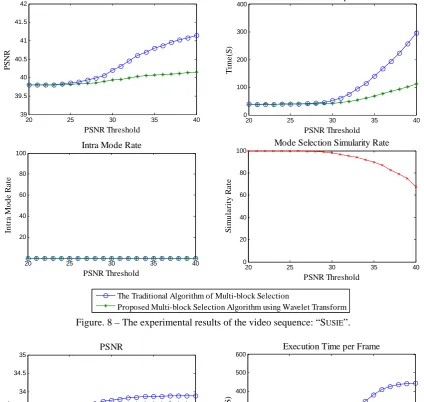
Figures 8, 9, 10 are the experimental results of the proposed wavelet-based macro-block selection algorithm compared with the traditional algorithm on “Susie”, “Football”, and “Mall”, respectively. The evaluation items include PSNR, execution time, intra mode rate, and mode selection similarity. One can find that the proposed algorithm can achieve similar macro-block mode selection result as well as intra mode rate to the traditional algorithm. Although the PSNR values of the proposed algorithm are somewhat lower than those of the traditional algorithm, it is worth to note that the execution time of the proposed algorithm is faster than that of the traditional algorithm. Table 1 lists the summary of the experimental results. It follows from Table 1 that the proposed algorithm can reduces computational cost by 1 to 4 times.
V. CONCLUSIONS
In this paper, a new wavelet-based macro-block selection algorithm for H.264/AVC video coding system is proposed. The first step of the proposed algorithm is to make use of two-dimensional wavelet transform to estimate the sub-band energy of each macro-block. Then by the use of the primary parameter, i.e., sub-band energy, and the secondary parameter, i.e., PSNR threshold, the proposed algorithm can achieve macro-block mode selection results. It follows from various experimental results that the execution time of the proposed algorithm is faster 1~4 times than that of the traditional multi-block selection method with the similar macro-block mode decision results.
REFERENCES
[1] Advanced Video Coding for Generic Audiovisual Services, ISO/IEC 14496-10:2005(E) ITU-T Rec. H.264(E), Mar. 2005.
[2] J. Ostermann, J. Bormans, P. List, and D. Marpe et al., “Video Coding with H.264/AVC: Tools, Performance, and Complexity,” IEEE Circuits Syst. Mag., vol. 4, no. 1, pp. 7–28, 2004.
[3] T. Wiegand and G. J. Sullivan, “Overview of the H.264/AVC Video Coding Standard," IEEE Trans. Circuits Syst. Video Technol., vol. 13, pp. 560-576, July 2003. [4] Hanli Wang, Sam Kwong, Chi-Wah Kok, “An Efficient
Mode Decision Algorithm for H.264/AVC Encoding Optimization,” IEEE Transactions on Multimedia, vol 9, no. 4, pp. 882-888, June 2007.
[5] P. Yin, H. C. Tourapis, A. M. Tourapis, and J. Boyce, “Fast mode decision and motion estimation for JVT/H.264,” in Proc. IEEE ICIP’03, Sept. 2003, vol. 3, pp. 853–856. [6] X. Jing and L. P. Chau, “Fast approach for H.264 inter mode
decision,” Electron. Lett., vol. 40, no. 17, pp. 1051–1052, Aug. 2004.
[7] L. Yang, K. Yu, J. Li, and S. Li, “An effective variable block-size early termination algorithm for H.264 video coding,” IEEE Trans. Circuits Syst. Video Technol., vol. 15, no. 6, pp. 784–788, Jun. 2005.
[8] C. Sidney Burrus, Ramesh A. Gopinath and Haitao Guo,
20 25 30 35 40 39
39.5 40 40.5 41 41.5
42 PSNR
PSNR Threshold
PS
N
R
The Traditional Algorithm of Multi-block Selection
Proposed Multi-block Selection Algorithm using Wavelet Transform
20 25 30 35 40
0 100 200 300 400
PSNR Threshold
Ti
m
e
(S
)
Execution Time per Frame
20 25 30 35 40
20 40 60 80 100
PSNR Threshold
In
tra
M
o
d
e
R
a
te
Intra Mode Rate
20 25 30 35 40
0 20 40 60 80 100
PSNR Threshold
S
im
u
la
rity
R
a
te
[image:5.595.84.509.83.485.2]Mode Selection Simularity Rate
Figure. 8 – The experimental results of the video sequence: “SUSIE”.
20 25 30 35 40
32 32.5 33 33.5 34 34.5
35 PSNR
PSNR Threshold
PSN
R
The Traditional Algorithm of Multi-block Selection
Proposed Multi-block Selection Algorithm using Wavelet Transform
20 25 30 35 40
0 100 200 300 400 500 600
PSNR Threshold
Ti
m
e
(S
)
Execution Time per Frame
20 25 30 35 40
0 20 40 60 80 100
PSNR Threshold
In
tra
M
o
d
e
R
a
te
Intra Mode Rate
20 25 30 35 40
0 20 40 60 80 100
PSNR Threshold
S
im
u
la
ri
ty
R
a
te
[image:5.595.86.509.385.744.2]Mode Selection Simularity Rate
20 25 30 35 40 34
34.5 35 35.5 36 36.5 37 37.5
PSNR
PSNR Threshold
PS
N
R
The Traditional Algorithm of Multi-block Selection
Proposed Multi-block Selection Algorithm using Wavelet Transform
20 25 30 35 40
0 100 200 300 400 500 600
PSNR Threshold
Ti
m
e
(S
)
Execution Time per Frame
20 25 30 35 40
0 20 40 60 80 100
PSNR Threshold
In
tra
M
o
d
e
R
a
te
Intra Mode Rate
20 25 30 35 40
0 20 40 60 80 100
PSNR Threshold
S
im
u
la
rity
R
a
te
[image:6.595.88.505.52.371.2]Mode Selection Simularity Rate
Figure. 10 – The experimental results of the video sequence: “MALL”.
Table. 1 The summary of the experimental results of the proposed and the traditional algorithms. The Traditional Algorithm of
Multi-block Selection
Proposed Multi-block Selection Algorithm using Wavelet Transform Video
Sequence
Threshold (dB)
PSNR(dB) Execution Time
(Second) PSNR(dB)
Execution Time (Second)
PSNR Diff.
Speed up Ratio
20 39.801 38.969 39.801 38.898 0 1.001
30 40.196 51.445 39.941 42.422 -0.255 1.212
SUSIE
40 41.147 296.79 40.149 112.04 -0.998 2.648
20 32.352 109.03 33.212 49.672 0.860 2.194
30 33.744 241.48 33.686 68.216 -0.058 3.539
FOOTBALL
40 33.895 444.64 33.69 146.23 -0.205 3.040
20 34.349 47.258 34.542 37.956 0.193 1.245
30 36.814 151.27 35.294 50.401 -1.520 3.001
MALL
[image:6.595.57.541.439.608.2]