ISSN Online: 2327-5227 ISSN Print: 2327-5219
DOI: 10.4236/jcc.2019.712014 Dec. 27, 2019 152 Journal of Computer and Communications
A Framework for Improving the
Location-Based Service Using Casandra
Technology
B. Temuujin, Jaewon Park, Eui-In Choi
Department of Computer Engineering, Hannam University, Daejeon, Korea
Abstract
Recently, many researches on positioning technology using LBS (Loca-tion-Based Services) have been conducted with the development of wearable devices. In addition, the data used in these devices is helping to perform LBS using Big data technology. And the existing method of finding a specific loca-tion is not suitable for collecting and processing all the data [1] [2] [3] [4]. Therefore, in order to process all streaming data in real time, it is necessary to use Big data processing technology. In this paper, we use NoSQL technology to solve this problem. We propose a framework for improving the perfor-mance of LBS using NoSQL.
Keywords
Big Data, NoSQL, Cassandra, LBS
1. Introduction
For LBS, most companies use wireless communication-based technology to pro-vide related services. The basic method is technology such as LDT (Location Determination Technology). The GPS (Global Positioning System) and IPS (In-door Positioning System) information used here is calculated and provided in real time [5] [6]. GPS is often used to cover large areas of satellite or mobile base stations as a whole. IPS is mainly used in confined spaces (local).
For example, in parks or inside buildings that use ZigBee, RFID, CSS, UWB, Bluetooth and Wi-Fi environments. In particular, IPS uses Wi-Fi and sensors built into devices such as smartphones to improve accuracy [7] [8]. For example, it indicates where your current location is. This information must be sorted and stored through the information collector. In addition, the commands must be performed quickly while the information is sent to the location server. However, How to cite this paper: Temuujin, B., Park,
J. and Choi, E.-I. (2019) A Framework for Improving the Location-Based Service Using Casandra Technology. Journal of Computer and Communications, 7, 152-157.
https://doi.org/10.4236/jcc.2019.712014
DOI:10.4236/jcc.2019.712014 153 Journal of Computer and Communications
it is difficult to implement a smooth LBS due to complicated operations [9]. Therefore, big data processing technology is required for the processing of data collected from indoor and outdoor communication infrastructures. NoSQL can solve this problem.
Between real-time data analysis and big data processing, the NoSQL database provides a storage and processing mechanism for data streaming. Cassandra, in particular, supports complex stream processing with scalability and high availa-bility without compromising performance on the open source approach. In this paper, we propose a framework for improving the performance of LBS with NoSQL, in particular Cassandra, using NoSQL system architecture.
2. Related Works
2.1. Positioning Services
Now we are living in the one of the great flow of technological change, Internet of Things. These techniques have been developed for identification of objects and its location. And it is being used to remote control and product marketing [5] [10].
2.1.1. Beacon
Beacon is a short-range transmission technology that sends signals to smart-phones or wearable devices, using low energy Bluetooth. In particular, beacons can tell all the details of the local area to indoor GPS less than 5 cm from indoor or outdoor locations.
2.1.2. IZat
IZat is Qualcomm’s IPS like a child with a Bluetooth beacon-based service has almost similar features and services. IZat is kind of IPS, has Qualcomm’s plat-form called Gimbal.
2.2. NoSQL
NoSQL uses a method other than the tabular relationships used in relational da-tabases. Use it to store and retrieve modeled data. This method includes control over design simplicity, horizontal scaling and availability. NoSQL data structures (such as key-values, graphs, or documents) are different from RDBMSs. There-fore, some tasks are processed faster in NoSQL than in some RDBMSs [11]. NoSQL satisfies two of the CAP theorems. First, consistency means that all nodes see the same data at the same time. Secondly, availability ensures that every request gets a response, whether it is a success or a failure. Finally, parti-tion tolerance means that the system will continue to operate in case of any message loss or error. NoSQL is suitable for tasks that require high scalability to store and process the generated stream data [12].
2.2.1. Key-Value Store
be-DOI: 10.4236/jcc.2019.712014 154 Journal of Computer and Communications
cause it provides only API, it is easy to use. The disadvantage is that you cannot query using the contents of the key. Therefore, the user has to read the value us-ing a key and then deal with it at the application level.
Key-value storage is where data is stored in key and value pairs. Here keys are used to access values, and values are used to store some form of data.. Key-value can be prior for data search by a single key and it provides the availability of in-formation regardless of any platform.
2.2.2. Column Store
Column stores also as a kind of key-value store, each record is independent. When the query pattern is subset of the whole record, it is possible to form col-umn families in the same way. Cassandra can be applied. It made based on dis-tributed architecture called Dynamo. It is to solve this problem that when the existing head node is down, the entire system also down. It can be stored more data no matter what data format. In addition, Distributed processing make it loss SPOF (Single Point of Failure) and prevent data loss.
2.2.3. Document Store
The document store is a special type of key-value store. In document-oriented databases, it is used to store, retrieve, and manage document-oriented informa-tion. Therefore, this requires semi-structured data. Document-oriented databas-es can be thought of as a category of NoSQL databasdatabas-es. All of the document re-positories contain documents that encapsulate and encode in standard format or encoded data. Common coding uses binary formats such as XML, YAML, JSON, and BSON. Documents in a document repository are almost like object-oriented programming concepts. Therefore, there is no need to comply with the standard schema.
2.3. Cassandra
DOI:10.4236/jcc.2019.712014 155 Journal of Computer and Communications
memory cost in p2p networks by spreading position data which coming from a variety of sources process on a large scale. This environment provides superior LBS performance consequentially [14] [15]. Another benefit provided by Cas-sandra is the authority to decide what data will be copied or how much will be. The entire row in Cassandra is recognized by the unique keys and there is no size limit on those key.
Secondly, Cassandra instance is taking a table, defined column family by us-ers. It may be a super column by configurable infinite column. The Cassandra’s basic philosophy of the error handling, data distribution and replication as fol-lows. Data distribution is based on order preserving hash and consistent hashing through nodes in the cluster basically. Cluster membership can be maintained by gossip algorithms and monitor the error of each node using actual style failure detector [13].
3. Proposed Framework
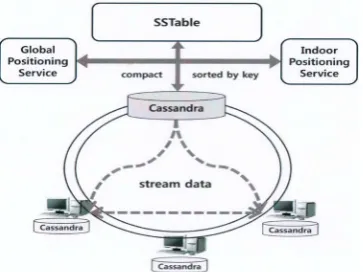
Figure 1 shows a framework using Cassandra to process LBS streaming data. Stream data processing components are provided to ease the development of various LBSs. It shows the overall system structure, consisting of key spaces, column families, and columns. Cassandra’s SSTable (Sorted String Table) is a file of key/value string pairs sorted by key. Each SSTable has a bloom filter that Cas-sandra needs to check before disk scanning. You can also freely query for keys that rarely exist.
[image:4.595.284.466.568.704.2]Cassandra uses bloom filters to save IO when performing a key lookup. Com-pact facility is also useful. Since data files accumulate over time periodically data files are merged sorted into a new file and creates new index [16]. This frame-work based on Cassandra configures clustering structure using numerous nodes. Each node is operating independently without a separate master server. Further, Cassandra support the column compressed store file format called ORC file. It is processing streaming data, one of kind complex event processing (CEP). It can be applied to stream data analysis quickly without additional infrastructure. In the process of raw data stream converting for real time analysis, we can com-press its size in order to reduce the processing load.
DOI: 10.4236/jcc.2019.712014 156 Journal of Computer and Communications
4. Conclusion
Efficient LBS service requires processing of large data streams. In addition, processing delays and high computational complexity made it difficult to im-plement a variety of existing positioning techniques. This makes LBS less flexi-ble. As a result, NoSQL environments can handle large amounts of unstructured data. In particular, Cassandra is based on a larger framework such as Dynamo, which enables consistent event handling. Larger frameworks based on big table column for column-based key-value systems are also possible. Apply flexible da-ta consistency to focus on stream dada-ta processing availability. In addition, a ring structure other than the master-slave architecture is chosen to ensure reliable system operation with fault tolerance. So we expect that it will support monitor-ing stream and processmonitor-ing LBS for across in-and-out of space. By distributmonitor-ing positioning data in many paths and processing a large-scale, it can provide LBS with great performance. And as a result, we expect that is able to contribute to improving the in-and-outdoor positioning accuracy of the mobile communica-tion network. In order to compensate for the shortcomings of the current study, The following research will be developed a prototype as a data repository for monitoring, and that will be showing the proposed model to evaluate the per-formance of the a streaming data service model.
Conflicts of Interest
The authors declare no conflicts of interest regarding the publication of this paper.
References
[1] Jaejun, Y., et al. (2012) Trend of Indoor Spatial Information Standardization. TTA Journal, 144, 65-71.
[2] OMA-TP-2013 296R01-INP Indoor Location Public Safety.
http://www.openMobilealliance.org
[3] Mautz, R., et al. (2012) Indoor Positioning Technologies, Habilitation Thesis at ETH Zurich.
[4] Proposes New Indoor Requirements and Revisions to Existing E911 Rules.
http://www.fcc.gov/document/proposes-new-indoor-requirments-and-revisions-exi
sting-e911-rules
[5] Choi, H. (2003) LBS, Location-Based Services Trend Computer Software Research, Korea Electronics and Telecommunications Research Institute, No.86.
[6] Pahlavan, K., et al. (2002) Indoor Geolocation Science and Technology. IEEE Communication. Mag., 40, 112-118.
[7] Zhao, Y. (2002) Standardization of Mobile Phone Positioning for 3G Systems. IEEE Communication. Mag., 40, 108-116.
[8] Jaejun, Y., et al. (2011) Interior Space, a New Chapter in the Fusion Attention. Elec-tronics and Telecommunications Research Institute, No. 1571, 14-16.
En-DOI:10.4236/jcc.2019.712014 157 Journal of Computer and Communications gineering, 16, 853-871.
[10] Cho, Y., et al. (2013) WARP-P: Wireless Signal Acquisition with Reference Point by Using Simplified PDF-System Concept and Performance Assessment. Proc. The ION 2013 Pacific PNT Meeting, Apr.
[11] Lee, G. (2002) Development of Location Data Stream Professor for RTLS. Korea GIS Conference, No. 6, 15-20.
[12] Information on wikipedia.org/wiki/NoSQL. [13] Information on wikipedia.org/wiki/Cassandra.
[14] Maria, C. (2013) Managing Service Performance in the Cassandra Distributed Sto-rage System. IEEE 5th International Conference on Cloud Computing Technology and Science, 64-71.
[15] Elif, D., et al. (2013) An Evaluation of Cassandra for Hadoop. IEEE 6th Internation-al Conference on Cloud Computing, 494-501.
[16] Sun, G., et al. (2005) Signal Processing Techniques in Network Aided Positioning.