Potential Parallelism in Recursive Functions
Adam D. Barwell and Kevin Hammond
School of Computer Science University of St Andrews {adb23,kh8}@st-andrews.ac.uk
Abstract
Recursion schemes, such as the well-knownmap, can be used as loci of potential parallelism, where, e.g.,mapis replaced with an equivalent parallel implementation. This paper formalises a novel technique, usingprogram slicing, that automatically and statically identifies computations in recursive functions that can be lifted out of the function and potentially performed in parallel. We define a new program slicing algorithm, built a prototype implementa-tion, and demonstrated its use on 12 Haskell examples, including benchmarks from the NoFib suite and functions from the standard Haskell Prelude. In all cases, we obtain the expected results in terms of finding potential parallelism. Moreover, we have tested our pro-totype against synthetic benchmarks, demonstrating our propro-totype has quadratic time complexity. For the NoFib benchmark examples we demonstrate that relative parallel speedups can be obtained (up to 32.93×the sequential performance on 56 hyperthreaded cores). ACM Reference format:
Adam D. Barwell and Kevin Hammond. . In Search of a Map: using Program
Slicing to Discover
Potential Parallelism in Recursive Functions. InProceedings of Submitted to FHPC, Oxford, UK, 2017,12pages.
DOI:10.1145/nnnnnnn.nnnnnnn
1
Introduction
Traditional parallelisation techniques commonly consist of low-level primitives and libraries. They require the programmer to manually introduce and manage complex constructs, e.g. threads, communication, and synchronisation. This results in a tedious, dif-ficult, and often error-prone process [22]. Structured parallelisation techniques, such asalgorithmic skeletons, instead present instances of high-level composable patterns to the programmer [11]. They allow the parallel structure of a program to be expressed as an in-stance of a pattern, while abstracting over low-level primitives and libraries. Despite the simplified interface, introducing skeletons can still be a non-trivial task, particularly with large legacy appli-cations [3]. This often requires significant knowledge of the code base, language, and parallelism itself [6]. One common problem arises when control or data dependencies inhibit, orobstruct, the introduction of parallelism. This paper introduces a new technique to minimise suchobstructivedependencies usingprogram shaping, so enabling the automatic introduction of algorithmic skeletons.
Recursion schemesdescribe how data structures can be traversed or constructed [31]. In functional languages, recursion schemes are often implemented ashigher-order functionssuch asmapor foldr. Moreover, since algorithmic skeletons can be seen as paral-lel implementations of higher-order functions, it is possible to use Submitted to FHPC, Oxford, UK
. 978-x-xxxx-xxxx-x/YY/MM. . . $15.00 DOI:10.1145/nnnnnnn.nnnnnnn
recursion schemes aslociof potential parallelism [7]. For example, a call to a standardmapcan be replaced with a call to an equivalent parallel implementation, provided that all mapped computations are independent [35]. Unfortunately, there is no guarantee that higher-order functions will be used in all possible instances by the programmer, or that the best higher-order function will be used. It follows that if these higher-order functions can be otherwise discov-ered automatically, then more options for introducing parallelism become available to the programmer.
In [4], we presented a high-level description of how program slicing might be used to discovermapoperations in recursive func-tions, and demonstrated that thosemapoperations can be used as loci of potential parallelism to produce relative speedups. In this pa-per, we give a more formal presentation of the approach presented in [4], placing greater emphasis on our classification technique, and apply that technique to a wider range of examples. Moreover, we define a novelprogram slicing[34] algorithm to inspect how the values of variables change between recursive calls. As a basis for our analysis, we define a strict, uncurried, and higher-order expression language. We have implemented our approach in Er-lang, and demonstrated its use on 12 examples, including ones derived from the NoFib benchmark suite [32] and functions from the Haskell Prelude. Our prototype correctly discovers all possible mappable operations in our examples. Experimental results on some synthetic benchmarks suggest that our prototype has qua-dratic time behaviour. Moreover, we show that relative speedups are possible through the (semi-)automatic introduction of parallel mapoperations. We achieve a maximum of 32.93×speedup on a 56-core hyperthreaded experimental testbed machine.
2
Illustrative Example
We illustrate our approach using an example from the theNoFib suite,sumeuler, that calculates Euler’s totient function for a list of integers and sums the results.
1 sumeuler :: [Int] -> Int 2 sumeuler xs0@[] = 0
3 sumeuler xs0@(x:xs) = euler x + (sumeuler xs)
Here, we have unfolded (in the transformational sense) the defini-tion given in the NoFib suite for demonstradefini-tion purposes. Since this definition ofsumeuleris explicitly recursive, parallelising the func-tion definifunc-tion requires the programmer to know howsumeuler traverses its arguments. This includes understanding how the com-putations performed on the (elements of the) input list affect:i)how the input is traversed; andii)the result ofsumeuleritself. To take advantage of recursion schemes as loci of potential parallelism, the above definition ofsumeulercan be rewritten as an instance of a composition of afoldrand amap,
1
8
16
24
32
40
48
56
0
5
10
15
20
25
30
Cores
Sp
eedup
n=1000 n=5000 n=10000 n=15000 n=20000 n=25000 n=30000 n=35000 n=40000 n=45000 n=50000
Figure 1. sumeuler, speedups on corryvreckanusing reported mutator (MUT) time, dashed line shows extent of physical cores.
1 sumeuler :: [Int] -> Int
2 sumeuler xs0 = foldr (+) 0 (map euler xs0)
This simplifies the introduction of parallelism. Multiple paral-lelisations of, e.g.,map are possible. We can use, for example, parListfrom the Haskell Strategies library [37],parMapfrom the Par Monad [30], or GP Us via the Accelerate library [10]. The paral-lel map skeleton can be used to safely plug-replace any standard use ofmapprovided that all the mapped computations are independent. In the case ofsumeuler, for example, we might use the standard Haskell Strategies library,
1 sumeuler :: [Int] -> Int
2 sumeuler xs0 = foldr (+) 0 (map euler xs0)
3 `using` parList rdeepseq
where the parallel map skeleton,parList, is parameterised with rdeepseq, a nested strategy that forces each element of the result to be fully evaluated. By cleanly separating the functional defi-nition of the program from its evaluation strategy, it is easy to introduce alternative parallelisations, while still ensuring that the parallel version is functionally equivalent to the original definition. For example, the parallelisation can be further tuned to improve speedups, perhaps bychunkingxs0[7], and by taking advantage of the associativity of(+)to sum the individual chunks before returning the sum of all the chunks.
1 sumeuler :: [[Int]] -> Int
2 sumeuler xs0 = sum (map (sum . map euler) xs0)
3 `using` parList rdeepseq
4 where sum = foldr (+) 0
Fig.1shows the raw speedups that we obtain for this program for the interval[1,n]for varying sizes ofnon our 56-core hyper-threaded experimental machine,corryvreckan. We obtain a maxi-mum speedup of 30.50 forn=50000 on 48 hyperthreaded parallel cores.
In order to take advantage of skeletons, recursion schemes must be usedexplicitly. When recursion schemes areimplicit, e.g. as in sumeuler, they must first be discovered either manually or auto-matically. To automatically discover the computations that may be performed as part of amap, we inspect the application expres-sions that are not recursive calls, hereafter termedoperations, in the definition ofsumeuler. Whether an operation may be lifted into amapdepends on two things: i)how the arguments to the recursive function differ between the stages of the recursion; and ii)the structure of the arguments in the operation. We determine how the values of arguments change between recursive calls using program slicing. This is a technique that is used to extract all the program statements that, depending on the algorithm used,may influence, ormay be influenced by, a given statement from the same program, called theslicing criterion[34]. A slice is often calculated by inspecting the control and data dependencies of a program. Slic-ing the explicitly recursive definition ofsumeuler, takingxas the criterion, produces:
1 sumeuler xs0(x:_) = euler x + undefined
Both the empty-list clause and the recursive call,(sumeuler xs), are removed because they are not influenced by the value ofx. Slicing might therefore be thought of as anarrowing of focuson only those parts of the program or expression that are of interest, and with all the irrelevant parts stripped away [4]. For the purposes of our approach, we can further narrow the slice to highlight how the values of the arguments change between recursive calls. Our slice only needs to be a set of variables, where inclusion in the set indicatesuse, and an annotated inclusion in the set indicates update. For example, the slice ofsumeuler, with criterionxs0, {x,xs}, indicates that bothxandxsareused; in(euler x)and (sumeuler xs)respectively. The slice also indicates thatxs0itself isnotconsidered to beupdated. We consider a variable to beupdated, when its value issignificantly changed. For a list, we do not consider recursively traversing a list in this way a significant change. We formalise this intuition in Defns.4.1and4.3.
Given such a slice, we now need to decide whether that argument can be used within amap, where eachuseis independent of all otheruses. If the argument isusedandnot updated, e.g. as with
xs0insumeuler, then it can also occur safely in amapoperation. Conversely, if the argument isupdatedbutnot used, e.g.xin,
1 f x ys0[] = 42
2 f x ys0(y:ys) = f y ys
[image:2.612.56.296.70.322.2]bool1
Γ`true :bool
bool2
Γ`false :bool int
Γ`Z:int var
Γ∪ {x:τ} `x :τ list1
Γ`nilτ :list τ
list2
Γ`e1:τ Γ`e2:list τ
Γ`consτe1e2:list τ
case
Γ`xs:list τ1 Γ`y:τ1 Γ`ys:list τ1 Γ`e1:τ2
Γ ∪ {y:τ1,ys:list τ1} `e2:τ2
Γ`casexsof nilτ
1 →e1, consτ1(y, ys) →e2:τ2
app
Γ`e0:τ®→τm Γ` ®e :τ®
Γ`e0e®:τm
fun
Γ∪ { ®x :τ®} `e:τm
Γ`λx® →e:τ®→τm fix
Γ`e:(((τ2, . . . ,τn) →τm),τ2, . . . ,τn) →τm
[image:3.612.62.545.74.156.2]Γ`fixe:(τ2, . . . ,τn) →τm
Figure 2.Typing judgements forE, determining simple types inT.
Having determined whether each argument in our recursive function iscleanortainted, we can then determine for each op-eration in the same recursive function whether that opop-eration is independent of successive recursive calls. Such an operation is classified asunobstructivewhen none of its arguments use a tainted variable or include a recursive call. For example,sumeulerhas two operations:
1. (euler x); and
2. ((euler x) + (sumeuler xs)).
Sincexis classified asclean,(euler x)is classified to be unobstruc-tive. Conversely, since the second argument to(+)in the second operation is a recursive call, the addition operation is classified as obstructive. We can therefore lift(euler x)into amapoperation, perhaps by refactoring the original source:
1 sumeuler :: [Int] -> Int
2 sumeuler xs0 = sumeuler' (map euler xs0) 3
4 sumeuler'ys0[] = 0
5 sumeuler'ys0(y:ys) = y + ys
Heresumeuler'is functionally equivalent tosum, so our final form is:
1 sumeuler :: [Int] -> Int
2 sumeuler xs0 = sum (map euler xs0)
This can then be easily parallelised by using a parallel map skeleton, as seen above.
3
Preliminaries and Assumptions
We illustrate our approach over the simple expression language,E.
e ∈E ::= true
| false | Z | var | nilτ | consτe e
| casevarof nilτ →e, consτvar var→e | ee®
| λvar® →e | fixe
Eis a simple, strict, functional language. Its terms form a com-mon subset of functional languages: boolean constants, true and false; integer constants,z∈Z; variables,var; list constructors, nilτ and consτe e; case discrimination on lists, case varof nilτ →
e, consτvar var →e; function application,ee®; lambda expres-sions,λvar® → e; and fixpoints, fixe. Constructors are restricted here to cons-lists for simplicity and clarity of presentation, but the
defsumeuler=fixλ(f,xs0) → casexs0of
nilπ →0,
consπ(x, xs) →plus(euler(x),f(xs))
Figure 3.Definition ofsumeulerinE.
approach is extensible to other types, given a definition of vari-able update(Def.4.1) for that type. Similarly, the approach can be extended to arbitrary types, given that a definition of variable update can be derived for arbitrary constructors. Vector notation, e.g.e®, refers to a non-empty tuple:e® ≡ (e1, . . . ,en),n ≥ 1. Tuples are purely meta-syntactic, and are used for clarity of notation. In order to simplify our presentation, list constructors and case dis-criminators are annotated with the (monomorphic) type of the list elements,τ. The corresponding type language,T, is shown below.
τ∈T ::= bool
| int | listτ | τ®→τ
The typing judgements in Fig.2then determine thewell-formedness of expressions inEwith regard to their monomorphic types inT. A statement,s∈S, is an assignment.
s∈S ::= defvar=λvar® →e
| defvar=fixe
Statements appear only at the top level of a program. A variable may be bound either to a function application or to a fixpoint expression. These bindings are then in scope for the duration of the program. A programp∈Pis a series of statements.
p∈P ::= s
| s;p
Pcan be thought of as an intermediate representation to which, e.g., Haskell or Erlang are compiled, similar to Core Haskell. For example, the Haskell definition ofsumeuler,
1 sumeuler [] = 0
2 sumeuler (x:xs) = euler x + (sumeuler xs)
Where pattern matching is used, we will use as-patterns to indi-cate the implicit list variables; e.g.
1 sumeuler xs0@[] = 0
2 sumeuler xs0@(x:xs) = euler x + (sumeuler xs)
For clarity, all the variables in our examples will be consistent across function clauses. All variables are assumed to be unique underα-conversion, at both the statement and expression levels. Type environments,Γ, are defined to be a set of bindings of variables to types:
Γ ∈ {var:T}
As usual, all values in the domain ofΓare assumed to be unique, andΓ(x)denotes the typeτof a variablexinΓ, such that∃τ ∈
T,(x:τ) ∈Γ. For a given programp, theprogram environment,Γp, contains all the variables inp.
Definition 3.1(Program Environment,Γp). Given some program
pand the set of variablesX ⊆varthat occur (either freeorbound) inp, we define an environmentΓpto be a set such that∀x ∈X,∃τ ∈
T,x :τ∈Γp
The abovesumeulerdefinition, for example, has theΓp:
Γp={xs0:list int, x:int, xs:list int,
f :(list int) →int, euler:(int) →int, . . .} We omit the variables and types ofeulerfor clarity. For the rest of this paper, we will assume that for all given variablesx∈Γp.
It is useful to define the notion ofsubexpressionsinE, since subexpressions are a key element in both slicing and classification definitions.
Definition 3.2(Subexpression). Given two expressionse,e0, say thate0is a subexpression ofe(denotede0e) when
e0=e
e0e
e0e
1∨e 0e
2
e0
consτe1e2
e0e
1∨e 0e
2
e0casex of nil
τ →e1, consτx0x00→e2
∃i∈ [0,n],e0ei
e0e
0e®
e0e
e0λx® →e
e0e
e0
fixe Subexpressions form a partial order relation.
We will refer to any application that is a subexpression of a fixpoint and that is not a recursive call as anoperation. For example, the fixpoint expression in Fig.3, has two operations:plusandeuler. The application subexpression,f(xs)isnotan operation because it is a recursive call.
Functions are introduced using aλ-expression. They are always pure, are uncurried, and are never partially applied. They may, however, be higher-order. Any recursive (function) definitions are always introduced using an explicit fixpoint expression, e.g.:
fix(λ(f,xs) → f(xs)).
The form of recursion is not otherwise restricted; general recursive forms are allowed, for example.
Lists are defined to be an ordered collection of elements, where those elements are accessedviacase-expressions. As shown by the typing rules of Fig.3, case discrimination is restricted to lists of some typeτ. We assume the existence of a built-in functions (e.g.if,eq,plus) for discrimination and operations on integers and
booleans. Case-expressions can be extended to other types, given an additional check on the type of the discriminated variable in the relevant definitions. We limit case-expressions here to simplify our presentation. In the non-nil branch of a case-expression, new vari-ables are bound respectively to the first element in the list (i.e. the head) and to the remainder of the list (i.e. the tail). A corresponding Reachability Relation is defined for each case-expression. Definition 3.3(Reachability Relation). Given a programp, a pro-gram environment,Γp, and a case-expression inp,e=casexs0of
nilτ →e1, consτxs xs→e2, we say thatx/pxs0andxs/pxs0.
The transitive closure of the reachability relation is defined such thatz/+
pxs0when∃y,z/p+y∧y/pxs0. Thereflexive-transitive closure of the reachability relation is defined such thaty/∗
pxs0 when∃y,y/+
px∨y=xs0.
For example,x/pxs0,xs/pxs0, andxs0/∗pxs0all hold for the case expression insumeuler. The Reachability Relation will be used to calculate theprogram slicefor a given expression and variable. It is also useful to know when acons-expression reconstructsxs0(e.g. (x:xs)insumeuler), so thatxs0can be included in the slice. The syntactic equivalence relation for lists is used to detect such list reconstructions.
Definition 3.4(Syntactic Equivalence for Lists). Given some pro-gramp; argumentx of typelist τ, and acons-expressione = consτe0e00, we say thateis syntactically equivalent tox, denoted
e ≡x, when∃y,∃ys,e0=y∧e00≡ys∧y/px∧ys/px.
For example, wherexs0is case-split insumeulerintoxandxs,xs0 is syntactically equivalent to acons-expression withxas the first argument andxsas the second argument; i.e.xs0≡consτx xs.
4
Determining Obstructiveness
Each operation is inspected to determine whether that operation isobstructive. Anobstructiveoperation is an operation that has either:i)any arguments whose subexpressions contain a recursive call; orii)any arguments that are both used in the body of the fixpoint expression and whose value is changedsignificantlyin any recursive call. All other operations are classified asunobstructive. So, for example,(euler x)insumeuleris classified as unobstruc-tivebecauseeuleris a unary function that takes only the head of the list. Conversely, the infix addition operation insumeuleris classified asobstructivebecause it takes the result of a recursive call as an argument. Obstructiveness is defined formally in Def.4.6. The nature ofsignificanceis defined below.
4.1 Variable Usage and Update
From the intuitive definition of obstructiveness above, all variables inΓpfor some fixpoint expression,e=fixλ(f,x1, . . . ,xn) →e0, must be first inspected to classify operations ineas (un)obstructive. Each variablex∈Γpis classified asused,updated, or both, ine.
some recursive call,f (e1, . . . ,en), theithargument,ei, is not:i)a variable that is reachable fromx;ii)syntactically equivalent to
x; noriii)a cons-expression that prepends an expression tox(or its syntactic equivalent) that contains no subexpression that is a variable reachable fromx. Variables whose value is significantly changed in this way are classified asupdated.
Definition 4.1(Variable Update). Given a programp, a program environmentΓp, a fixpoint expressione=fix(λ(f,x1, . . . ,xn) →
e0)
inp, and an argumentx, wherexis theithargument tof,xis considered to be updated ine(denoted ¯x∼xe) when there exists a recursive call, f(e1, . . . ,en) e0such that¬(ei /∗
px) ∧ (ei .
x) ∧ (ei ,consτe
kel ∧el≡x∧@yek,y/∗px)
Usage is a simpler concept: a variable is consideredusedwhen it occurs as a subexpression of a fixpoint expression. There is one exception to this: when a subexpression is theithargument to a recursive call. We first define the notion ofvariable-usage escape-ment. This is to avoid theusedclassification ofx, and ultimately the membership ofx in the slice, whenei is ax itself or when prepending tox. For example, it avoids the erroneous classification ofxin:
1 f a x = if a < 5
2 then f (a+1) x
3 else f (a-1) a
Here, in Line 3,xis correctly classified as beingupdated. In Line 2,xis not updated, but also should not be considered to beused, sincexis necessary as an argument to the recursive call in order to retain the value ofx.
Definition 4.2(Variable-Usage Escapement). For some fixpoint expressione =fix(λ(f,x1, . . . ,xn) → e0),∀f(e1, . . . ,en) e0, and for somei∈ [1,n], givenx, theithargument tof, we substitute the special symbolε forei wheneverei = x orei ≡ x. When
ei =consτe
kel ∧el ≡x∧@yek,y/∗pxholds, we substituteε forel. Variable-usage escapement ofewith respect toxis denoted
e\εx.
In the above definition off, for example, thexin Line 2 would be substituted forε.
1 f a x = if a < 5 2 then f (a+1) ε
3 else f (a-1) a
We can now define variableusage.
Definition 4.3(Variable Usage). Given some fixpoint expression
e=fix(λ(f,x1, . . . ,xn) →e0), and a variablexwherexis theith argument tof, a variableyis considered to be used ine(denoted
y∼xe) wheny/∗
pxandyexists as a subexpression to the variable-usage escapede; i.e.y (e\εx).
To illustrate this, consider the following functions. 1 f a xs0@[] = a
2 f a xs0@(x:xs) = f x xs 3
4 g xs0@(x:xs) ys0@(y:ys) = g (x:xs) (x:ys) 5 g xs0 ys0 = xs0
6 7
8 h xs0@(x:xs) ys0@(y:ys) = h (y:(x:xs)) (y:(y:ys)) 9 h xs0 ys0 = xs0
Forf, the value of aisupdatedsince¬(x/∗
p a). However, the list argument isnot updatedsincexsis reachable fromxs0; i.e. xs/∗
pxs0. All variables, excludingxs0, in the program environment offare considered to beused: ais used in Line 1;xin the first argument of the recursive call; andxsin the second argument of the recursive call. Forg,xs0isnot updatedsince(x:xs)is syntactically equivalent toxs0; i.e. consτx xs≡xs0. However,ys0isupdated since(x:ys)is not syntactically equivalent toys0. All variables apart fromyandxsare considered to beuseding:xs0is used both in Line 5 and as the semantically equivalent first argument to the recursive call;xandysare used in the second argument of the recursive call. Finally, forh,xs0isnotupdated, sincey(which is not reachable fromxs0) is prepended toxs0. However,ys0is updatedsinceyis prepended toys0andyis reachable fromys0.y,
xs0, andys0are all considered to beusedinh:xs0in Line 9 and theconsin the first argument of the recursive call;ys0in thecons in the second argument of the recursive call;yin theconsof both arguments of the recursive call.
4.2 Slicing Algorithm
Intuitively, a sliceΣe|xof an expressionewith criterionxis a set of variables that indicates whether a variableyisusedineand whetherxisupdatedine, denoted by the annotation ¯x. A slice can be used to categorise variables, and ultimately to determine the obstructiveness of operations.
Definition 4.4(Slice). Given some programp, the program envi-ronmentΓp, a fixpoint expressione =fixλ(f,x1, . . . ,xn) → e0, and a variablex, wherexis theithargument tof, we say that the slice ofewith criterionx, denotedΣe|x, is the set of variables such that∀y∈Σe|x,(y∼xe) ∨ (y=x¯∧x¯∼xe).
To illustrate the slicing relation, recall the definition ofsumeuler, 1 sumeuler xs0@[] = 0
2 sumeuler xs0@(x:xs) = euler x + (sumeuler xs)
Considering each variable insumeuler: bothx∈Σsumeuler|x s0and
xs∈Σsumeuler|x s0hold since bothxandxsare reachable fromxs0 (i.e.x/∗
pxs0andxs/∗pxs0) and bothxandxsareusedin Line 2; conversely,neitherxs0∈Σsumeuler|xnorxs¯0∈Σsumeuler|x s0hold, sincexs0is not consideredused, andxs0is not consideredupdated, insumeuler. For the definition ofsum:
1 sum xys0@[] = x
2 sum xys0@(y:ys) = sum (x+y) ys
x∈Σsum|xholds sincexisusedin both Lines 1 and 2. ¯x∈Σsum|x also holds sincexisupdated in the recursive call in Line 2 by the(x+y)operation. As withsumeuler, bothy ∈ Σsum|ys0and
ys∈Σsum|ys0hold since bothyandysare considered to beusedin Line 2. Conversely,neitherys0∈Σsum|ys0norys¯0hold sinceys0is notconsidered to beusedorupdatedinsum. The slices ofsumeuler andsumcan be presented:
Σsumeuler|x s0 = {x,xs}
Σsum|x = {x,¯x}
Σsum|ys0 = {y,ys}
bool1
Γp,f,x,i`true :∅
bool2
Γp,f,x,i`false :∅ int
Γp,f,x,i`Z:∅ var1
y/∗ px
Γp,f,x,i`y:{y} var2
¬(y/∗px)
Γp,f,x,i`y:∅
lst1
Γp,f,x,i`nil :∅ lst2
consτy ys≡x
Γp,f,x,i`consτy ys:{x} lst3
Γp,f,x,i`e1:Σ1 Γp,f,x,i`e2:Σ2 consτe1e2.x
Γp,f,x,i`consτe1e2:Σ1∪Σ2
case
Γp,f,x,i`e1:Σ1 Γp,f,x,i`e2:Σ2
Γp,f,x,i`caseysof nilτ →e1, consτz zs→e2:Σ1∪Σ2
rec-app
∀j∈ [1,i) ∪ (i,n],Γp,f,x,i`ej:Σj
(((ei =x∨ei ≡x) →Σi=∅) ∨ ((ei /+px) →Σi ={ei}) ∨ ((∃ek,∃el,ei=consτe
kel∧ (@v,(vek∧v/∗px)) ∧el ≡x) →Σi=∅) ∨ (¬(ei/∗px∨ (∃ek,∃el,ei=consτekel∧ (@v,(vek∧v/∗
px)) ∧el ≡x) ∨ei ≡x) ∧Γp,f,x,i`ei :Σ→Σi={x¯} ∪Σ))
Γp,f,x,i`f(e1, . . . ,en):Ð j∈[1,n]Σj
app
∀j ∈ [0,n],Γp,f,x,i`ej :Σj e0,f
Γp,f,x,i`e0(e1, . . . ,en): Ðn
j=0Σj
fun
Γp,f,x,i`e:Σ
Γp,f,x,i`λ(y) → e:Σ fix
Γp,f,x,i`e:Σ
Γp,f,x,i`fixe:Σ
Figure 4.Inference rules to calculate the sliceΣe|xfor an expressionewith criterionx.
The sliceΣe|x is calculated using the inference rules from Fig.4. For clarity of notation, we will writeΣe|xasΣsince neitherenorx can be changed within a slicing operation; showing thatΣ=Σe|x remains future work. Judgements are in the form:
Γp,f,x,i`e:Σ
whereΓpis the environment for some programp;f is the name of the fixpoint function being sliced;xis the slicing criterion that is declared as theithargument off;eis the expression inpthat is being sliced; andΣis the resulting slice. For literal expressions and variables that are not reachable fromx,eproduces an empty slice, represented by the rules bool1, bool2, int, var2, and lst1. A variable that is reachable fromx, as a usage ofx, produces the slice containing that variable (var1). Cons-expressions that are syntactically equivalent toxproduce the slice containingxitself (lst2). All other expressions that are not recursive calls produce the union of the slices of their subexpressions, as stated in the rules lst3, case, app, fun, and fix. Finally, rec-app determines whether
xis updated in a recursive call, producing the appropriate slice. rec-app has two main premises that:i)slice all subexpressions that are passed tof, aside from theithargument; andii)determines whetherxis updated. The second premise is a disjunction of four implications:i)wheneiisxitself, or is syntactically equivalent to
x;ii)whenei is a variable that is defined via case-discrimination onx;iii)whenxis prepended by some expressione
kthat does not contain a subexpression that is a variable reachable fromx; and otherwiseiv)whenxis consideredupdated. In the first case, the slice,Σi, for theithargument tof,ei, is the empty set since the argument preserves the value ofxfor the next recursive call. In the second case,Σi is the singleton set containingeiitself since the value ofxis changed, and a case-derived variable isused, butxis not considered to beupdated. In the third case,Σiis the slice of the subexpression that is prepended tox. Finally, in the fourth case,Σi is the slice ofei andxis considered to beupdated.
We conjecture that the slicing algorithm in Fig.4is sound with respect to the slicing definition, Def.4.4, such that our algorithm produces a slice whose members are only those variables that are considered to beusedorupdatedinewith respect tox. Similarly,
we conjecture that slices are unique for eacheandx. We defer the proofs of soundness and uniqueness to future work.
4.3 Classifying Variables
Variables can be classified as:global,clean, ortainted. Global vari-ables are those that are in scope ine, but which are declared and bound outside ofe. They may beused, but cannot beupdated during the evaluation ofe; they are therefore treated as literals. Variables that are classified as eithercleanortaintedare ones that are either defined in the fixpoint function (i.e.x1, . . . ,xn), or in case-subexpressions ofe0, where whenever∀v,w∈Γpsuch thatv/+
pw, it follows thatvhas the same classification asw.
Definition 4.5(Variable Taint). Given a programp, program envi-ronmentΓp, a fixpoint expressione=fix(λ(f,x1, . . . ,xn) → e0) inp, a variablex, and a sliceΣe|x ofewith criterionx, thenxis classified as tainted when ¯x ∈ Σe|x∧x ∈ Σe|x. The variable is classified as clean, otherwise.
4.4 Classifying Operations
Once all the arguments ofeare classified asglobal,clean, ortainted, we can proceed to classify those non-recursive application subex-pressions ofe, i.e. theoperationsine. Thoseoperationsthat take one or more variables that are classified astaintedare themselves classified asobstructive. All otheroperationsare classified as unob-structive.
Definition 4.6(Operation Obstructiveness). Given some program
p, some program environmentΓp, and some fixpoint expression
e =fix(λ(f,x1, . . . ,xn) →e0)inp, an operationд(e1, . . . ,em)
e0, whenд
,f, is classified asobstructivewhen∃i∈ [1,m]such thatf (®e
f) ei∨∃y,yei whereyis classified astainted. The operation is classified asunobstructiveotherwise.
5
Examples
Example RFs Ops RCs Args
Unobstructive Ops Obstructive Ops Time σ Actual Found Actual Found (µs) (µs)
Data.List 18 22 20 31 5 5 17 17 6797.22 409.14
elem 1 2 1 2 1 1 1 1 176.28 26.51
list-ackermann 1 0 3 2 0 0 0 0 196.46 20.65
gcd 1 3 1 2 0 0 3 3 178.46 48.93
hanoi 1 5 1 1 0 0 5 5 156.16 39.50
k-means 4 15 5 14 4 4 11 11 646.30 60.90
quicksort 3 6 5 5 2 2 4 4 350.94 17.98
swaterman 2 10 2 10 0 0 10 10 420.92 18.44
sumeuler 14 47 14 25 16 16 31 31 2171.36 63.95
matmult 8 23 7 16 6 6 17 17 1195.62 63.23
queens 2 11 2 6 2 2 9 9 487.04 24.48
[image:7.612.111.500.71.237.2]sudoku 5 9 5 8 3 3 6 6 519.66 38.68
Figure 5.Examples run through prototype implementation. Times are an average of 50 runs.
athttps://adb23.host.cs.st-andrews.ac.uk/fhpc17-parallel.zip. Our results show that our approach can discover map operations that lead to real performance improvements. Speedups are an average of five runs oncorryvreckan, a 2.6GHz Intel Xeon E5-2690 v4 ma-chine with 28 physical cores and 256GB of RAM. This mama-chine allowsturbo boostup to 3.6GHz, and supports automatic dynamic frequency scaling between 1.2–3.6GHz. Speedups use reported mutatortime, i.e. the amount of time spent solely on executing the program. This gives an indication of real parallel performance. Where we usecorryvreckanfor parallel speedup results, we use a separate, standard desktop machine,neptune, to test our prototype implementation.neptuneis a 2.7GHz Intel Core i5 machine with 8GB of RAM, running Mac OS X 10.11.6 and Erlang 19.2.3. The par-allel speedup results, including speedup graphs in Figs.1,7, and8 are reiterated from [4], where we expand upon the results reported here.sumeuler,queens, andmatmulthave all been compiled using GHC 7.6.3 on Scientific Linux version 3.10.0. We compiled the exam-ples using the flags:-feager-blackholing,-threaded,-rtsopts, and-O. We found these gave the best general parallel performance. We have implemented our inference system in Fig.4in Erlang, providing a parser for our expression language and a classifier for operations. For a given programp, we first produce the environ-ment. Then for each fix expressione =fixλ(f,x®) → e0inp, we sliceewith respect to each argumentx ∈ ®x. Eachxis classified as eithercleanortainted. This is then used to classify each operation ineeitherobstructiveorunobstructive. Our implementation can be found athttp://adb23.host.cs.st-andrews.ac.uk/fhpc17-artefact.zip. The NoFib benchmarks have all been translated from Haskell; if-expressions have been translated as application expressions, and so count as operations. Our other examples, including the 18 functions from the Haskell PreludeData.Listlibrary, may not all benefit from parallelisation, but serve as a demonstration of our approach. The 18 examples chosen fromData.Listare: and,or,append,foldl,foldr,init,intersperse,last,length, map,maximum,replicate,reverse,scan,heads,subsequences, tailsandtranspose. These are a representative subset of the functions in the library; the remaining functions are similar to these. All our (translated) example code can be found athttps: //adb23.host.cs.st-andrews.ac.uk/fhpc17-examples.zip.
9 18 27 36 45 54 63 72 81 90 0
5 10 15 20 25 30 35
Program Size (No. Operations,×102)
Time
(
s
)
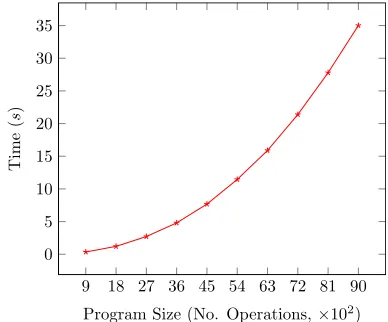
Figure 6.Prototype execution times for a program with varying sizes of input. Our implementation is quadratic.
We give an overview of our results in Fig.5, wheregcdrefers to the greatest common denominator function,hanoirefers to the Towers of Hanoi puzzle, andswatermanrefers to the Smith-Waterman algorithm. Thelist-ackermannexample is a reimple-mentation of the standard Ackermann function that traverses lists.
1 list-ackermann as0@[] bs0 = (1:bs0) 2 list-ackermann as0@(a:as) bs0@[] = 3 list-ackermann as [1]
4 list-ackermann as0@(a:as) bs0@(b:bs) = 5 list-ackermann as (list-ackermann a bs)
Our results show that all operations are correctly classified. For each example, we give: the number of recursive functions that it contains (RFs), the total number of operations (Ops), the total number of recursive calls (RCs), the total number of arguments to all recursive functions (Args), the expected number of obstructive and unobstructive operations (Actual), those that are found by our prototype (Found), the average execution time for our prototype of 50 runs onneptunefor that example (Time), and standard deviation (σ) of those times.
[image:7.612.341.535.272.433.2]As a synthetic benchmark, we have also applied our prototype to programs with varying input sizes, measured in the number of operations, by duplicating the translatedSumEulermodulemtimes. As the translatedSumEulerhas 9 operations, the total number of operations isn=m×9. Fig.6shows the average time taken of five runs, in seconds, by our prototype onneptune. Our classifier takes a minimum of 0.35sforn=900, with a standard deviation of 0.03s, and a maximum of 35.02sforn=9000, with a standard deviation of 0.58s. Our prototype implementation runs in quadratic time with respect ton. The total time taken to classify each of our examples onneptuneare all low, as shown in Fig.5. The longest our prototype takes to classify one of the examples in Fig.5is 6.80ms. 5.1 Sumeuler
Recall thatsumeulerapplies Euler’s totient function to a list of integers and sums the result.
1 sumeuler xs0@[] = 0
2 sumeuler xs0@(x:xs) = euler x + (sumeuler xs)
We first slicesumeulerfor its only argument,xs0,Σsumeuler|x s0= {x,xs}. As before,xs0is classified ascleansince both case-split variables ofxs0(xandxs) are used in the body ofsumeuler, and
xs0itself is not updated. Two operations exist as subexpressions tosumeuler: (euler x) and the application of(+)in Line 2. (euler x)takes a single clean argument, i.e.x, and is classified asunobstructive. Conversely,(+)takes two arguments, where the second argument comprises a recursive call, and is classified asobstructive.(euler x)can be lifted into amapoperation, and sumeuleris rewritten to introduce chunking and parallelism using the Strategies library. We are also able to take advantage of the associativity of(+), summing each chunk before summing the result of all chunks.
In [4] we executedsumeulerforn=1,000 and between 5,000 and 50,000 at intervals of 5,000, with a chunk size of 500. Fig.1 gives the speedups forsumeulerusing mutator time. We achieve maximum speedups of 30.50 forn = 50000 on 48 virtual cores. Sequentially, whenn=50000sumeulerhas an average runtime of 154.33s(σ = 0.25s). We achieve good speedups in all cases. Moreover,sumeulerdemonstrates good scalability asnincreases. Fig.1shows that for varyingn, speedups reach a limit, likely due to lack of work.
Our translation of the NoFib example code comprises 14 re-cursive functions over three Haskell modules. Within those 14 recursive functions, there are a total of 47 operations, 16 of which are classifiedunobstructiveand 31 of which are classified as ob-structive. As with all the NoFib benchmarks, the high number of recursive functions are representative of the original duplication in the underlying Haskell modules.
5.2 Matrix Multiplication
The NoFib benchmark uses the following implementation of matrix multiplication.
1 matmult m1 m2 = multMatricesTr m1 (transpose m2)) 2
3 multMatricesTr [] m2 = [] 4 multMatricesTr (r:rs) m2 = 5 f m2 r : multMatricesTr rs m2 6
1
8
16
24
32
40
48
56
0
5
10
15
20
25
30
35
Cores
Sp
eedup
[image:8.612.320.560.70.300.2]n=1500 n=2000 n=2500 n=3000 n=3500 n=4000 n=4500 n=5000
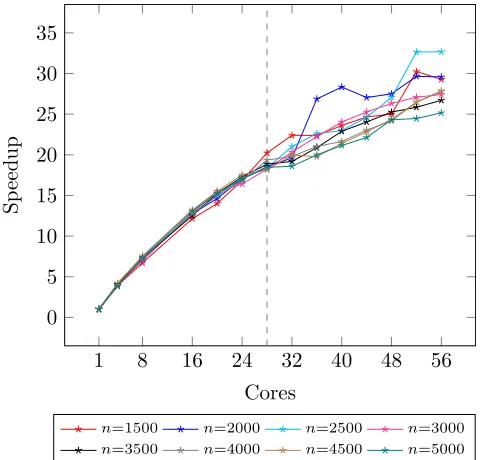
Figure 7.matmult, speedups oncorryvreckanusing reported mu-tator (MUT) time, dashed line shows extent of physical cores.
7 f cs0@[] row = []
8 f cs0@(c:cs) row = prodEscalar2 row c : f cs row Here,transposetransposes a matrix andprodEscalar2calculates the dot product of two lists. Sincematmultis not a fix expression, we slice for all the arguments tomultMatricesTr.
ΣmultMatricesTr|r s0={r,rs} ΣmultMatricesTr|m2={mt}
As with our other examples, both of the arguments are used but not updated and are therefore classified asclean. The sole operation, (f m2 r), is classified asunobstructive. Slicing for all arguments off,
Σf|cs0={c,cs} Σf|row={row}
we can see the same pattern: all the arguments are classifiedclean, and the sole operation,(prodEscalar2 row c), is classified as un-obstructive. BothmultMatricesTr, andfcan be rewritten asmap operations. Parallelism can be introduced inmatmultby applying a custom strategy to the call tomultMatricesTrthat chunks ma-trices into blocks, rather than along rows or columns. In [4] we executedmatmultfornbetween 1000 and 5000 at intervals of 500, with the chunk size set to 20. Fig.7gives speedups formatmult using mutator time, achieving maximum a speedup of 32.93 for
n=2500 on 52 hyper-threaded cores. Sequentially, whenn=2500 matmulttakes an average of 226.58s, with a standard deviation of 7.49s.matmultscales well for bothnand number of cores. On hy-perthreaded cores we observe some erratic behaviour with curious superlinear speedups. This is possibly due to caching effects.
Interestingly, the definition offmight be unfolded (in the trans-formational sense) inmultMatricesTr; e.g.
1 multMatricesTr xs0@[] r m2 = 2 []
3 multMatricesTr xs0@(x:xs) rr@[] m2 =
5 multMatricesTr xs0@(x:xs) rr m2 =
6 prodEscalar2 rr x : multMatricesTr xs rr m2
Here,multMatricesTris now a fix-expression, case-splitting on its first argument,xs0. Slicing for its arguments, gives
ΣmultMatricesTr|x s0 = {x,xs,xs¯0}
ΣmultMatricesTr|r r = {rr,rr¯}
ΣmultMatricesTr|m2 = {m2}
Whilexs0is considered to be updated, due tom2being passed as the first argument in the recursive call in line Line 4, bothxs0 andm2are considered to beclean. Conversely,rris considered to betainted. (prodEscalar2 rr x), now the sole operation, is therefore classifiedobstructive, meaning nomapoperations can be introduced.
This is a correct result sincemultMatricesTrtraversestwolists, where both the lists are passed as the first argument. The standard definition ofmap, for example, does not allow this behaviour, and any attempt at introducing a map operation would result in a func-tion that is not funcfunc-tionally equivalent tomultMatricesTr. This limitation arises again inqueenswith fused mutually recursive functions. Amapis only discoverable when the inspected function recurses over one or more data structures and where at least one argument is structurally smaller for each recursive call.
Our translation of the NoFib benchmark code comprises 8 recur-sive functions over 2 Haskell modules. Within those 8 recurrecur-sive functions there are 23 operations, of which 6 are classified as unob-structiveand 17 are classified asobstructive.
5.3 N-Queens
We use the following implementation of thequeensproblem, 1 queens nq = gen 0 []
2
3 gen nq n b 4 | n >= nq = [b]
5 | otherwise = genloop nq n (gennext [b])
6
7 genloop nq n bs0@[] = [] 8 genloop nq n bs0@(b:bs) =
9 gen nq (n+1) b ++ genloop nq n bs
wherenqis the number of queens andgennextcalculates the posi-tion of a queen on a board. We slice for all arguments ofgenloop.
Σqueens|nq=
{nq} Σqueens|n={n} Σqueens|bs0={b,bs}
All three arguments,nq,n, andbs0, are classified ascleansince bothnqandnareusedbut notupdated; and bothbandbsare usedbutbs0is neitherusednorupdated.genloophas three subex-pressions:i)(n+1)in the call togen;ii)(gen nq (n+1) b)in the first argument to(++); andiii)the top-level(++). Both(n+1)and (gen nq (n+1) b)are classified asunobstructivesince onlyclean variables occur the expressions passed to(+)andgenrespectively. We additionally note that(gen nq (n+1) b)contains the unob-structiveoperation(n+1)as a subexpression. Hypothetically, if (n+1)had been classified asobstructive, then(gen nq (n+1) b) must also be classified asobstructive. While notaintedvariables occur in the arguments to the append operation, its second argu-ment is a recursive call, which results in anobstructive classifica-tion. Although it is possible to lift eitherunobstructiveoperations
1
8
16
24
32
40
48
56
0
5
10
15
20
25
Cores
Sp
eedup
[image:9.612.320.559.69.302.2]n=11 n=12 n=13 n=14 n=15 n=16
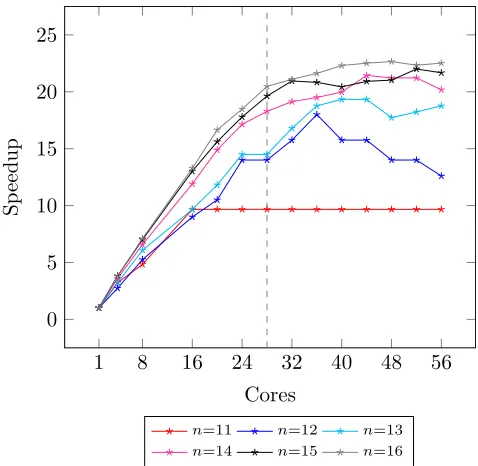
Figure 8.queens, speedups oncorryvreckanusing reported muta-tor (MUT) time, dashed line shows extent of physical cores.
into amapoperation, we choose to lift the operation which does not occur as a subexpression of anyunobstructiveoperation, i.e. (gen nq (n+1) b), to maximise the amount of work done in par-allel.
1 genloop nq n bs0 =
2 genloop' nq n (map (gen nq (n+1)) bs0) 3
4 genloop' cs0@[] = []
5 genloop' cs0@(c:cs) = c ++ genloop' cs
Similar tofandmultMatricesTrinmatmult, we observe thatgen andgenloopcould be merged into a single definition.
1 gen 0 b xs0@[] = [b] 2 gen n b xs0@[] = [] 3 gen n b xs0@(x:xs) =
4 (gen (n-1) x (gennext [x])) ++ (gen n b xs)
This definition eliminates the mutual recursion ofgenandgenloop, wherexs0traverses two different lists andnacts as an additional bound on the recursion. As before, our technique will (correctly) classify all operations asobstructive. In this example, it is the recur-sive call in the first argument to(++)that introduces an update to all variables.
Our translation of thequeensNoFib implementation comprises two recursive functions with 11 operations, and 2 recursive calls. Despite the number of operations inqueens, there are only two unobstructive operations in the translation. The majority of opera-tions are found in the definition ofsafe.
1 safe x d ys0@[] = True 2 safe x d ys0@(q:l) =
3 x /= q && x /= q+d && x /= q-d && safe x (d+1) l
Slicingsafefor all arguments,
Σsafe|x={x} Σsafe|d={d,¯d} Σsafe|ys0={q,l}
we classifyxandys0ascleananddastainted. Here, thetainted classification ofdresults inobstructiveclassifications of all but one infix inequality operations. Hypothetically, ifdhad been classified asclean, we observe that how the infix(&&)operations are compiled can affect the classifications of operations insafe. Parsing(&&) as either left- or right-associative can produce different numbers ofobstructiveoperations. Here, parsing(&&)as left-associative minimisesthe number ofobstructiveoperations; i.e. when,
1 (x /= q && x /= q+d) && (x /= q-d && safe x (d+1) l)
only the topmost(&&)and its second argument are classified as ob-structive. Conversely, parsing(&&)as right-associativemaximises the number ofobstructiveoperations; i.e. when,
1 x /= q && (x /= q+d && (x /= q-d && safe x (d+1) l))
all(&&)operations are classified asobstructive.
Thequeensexample is parallelised by applying a strategy from the Strategies library to the map. To ensure that parallelism is worthwhile, the specific strategy used (parallel or sequential) is passed in as an argument. A threshold argument is then added to gento control the depth to which themapoperation is performed in parallel. We executedqueensfornranging from 11 to 16, with a threshold depth of 2. Fig.8show speedups forqueensin terms of mutator time. We achieve maximum speedups of 22.65 forn=16 on 48 hyperthreaded cores. Sequentially, whenn =16,queens takes an average of 717.66s(σ =0.25s). Whenn=11, speedups plateau before the physical cores are exhausted, likely due to a lack of work as insumeuler. When 14 ≤n≤16,queensscales well until 28 cores; when hyperthreading is enabled, we see some further improvement in speedup, albeit at reduced rate when compared with physical cores. Forn=13 andn=14, we see intermediate scalability continue between 28 and 40 hyperthreaded cores. This may be due to the lack of chunking ofbs0, resulting in inefficient use of cores up to 28 cores, with hyperthreading enabling saturation of the hardware. Forn=13 andn=14, we observe a similar effect ton=11 but at a higher level due to increased availability of work. 5.4 Smith-Waterman
The Smith-Waterman algorithm compares the similarity of two strings. The algorithm was originally designed for the comparison of nucleotides [36]. It has two stages: populating a matrix, and backtracking over the matrix to find the shortest ‘distance’ between the two strings. The code below concerns part of the matrix pop-ulation stage. It traverses the matrixm, updating each cell with the result ofh, whereh(implementation omitted) calculates the maximum similarity score between the two stringsaandbfor the current rowrand columncand updates the cell with that score. 1 tcs r c a b m =
2 if c > (length m) 3 then m
4 else tcs r (c+1) a b (h r c a b m) 5
6 trs r c a b m = if r > (length m)
7 then m
8 else trs (r+1) c a b (tcs r c a b m)
9
10 traverse m a b = trs 1 1 a b m
As before, we calculate a slice for each argument to each function, classifying those arguments using the slice.
tcs:
Σtcs|r = {r} (clean)
Σtcs|c = {c,c¯} ( tainted)
Σtcs|a = {a} (clean)
Σtcs|b = {b} (clean)
Σtcs|m = {m,m¯} ( tainted) trs:
Σtrs|r = {r,r}¯ (tainted)
Σtrs|c = {c} (
clean)
Σtrs|a = {a} (clean)
Σtrs|b = {b} (clean)
Σtrs|m = {m,m¯} ( tainted)
Using these classifications, we can classify the operations within the recursive functions.
tcs: As bothcandmare classifiedtainted, all operations intcs (i.e.length, and the less-than and addition operators) are classified to beobstructive.
trs: Analogous totcs, and as bothrandmare classifiedtainted, all operations intrsare classified to beobstructive. No refactoring can be applied to the Smith-Waterman implemen-tation. However, the Smith-Waterman algorithm is an example of wavefront parallelismwhereby cells of the matrix are divided into groups which can be calculated in parallel. As our classification looks only for independence across an entire data structure, at present this goes undetected, but is part of future work.
6
Related Work
is some superficial similarity with our technique, such that if an input can be used at most once within a recursive function then it follows that all operations that use that input can be performed independently of successive recursive calls. Single-threadedness shares a similar goal, but places greater emphasis on exposing mu-tation to state without sacrificing referential transparency. Again, this is superficially similar to our approach in the exposition of how an input changes between two points. However both of these approaches require a specific language or system to function. In contrast, our approach is fully generic. We additionally note that our system allows a weaker sense of usage (in that an input can be used more than once) whilst still enabling us to reason about the independence of operations.
Structured parallelism approaches, such as those used here, have been shown to be an effective means to introduce and manipulate parallelism [9,15,16,25,29]. Pattern discovery for parallelism has primarily focussed on approaches for imperative programs by analysing dependencies and machine learning techniques [1,6,14,
21]. The polyhedral model, in particular, uses control and data de-pendencies to reorder statements in code. One limitation of the poly-hedral model is that it requires the AST to be translated into a spe-cific linear-algebraic form, and not all statements can be translated to this form [5]. Alternative automatic approaches derive parallel implementations from small programs or specifications, commonly exploiting the Bird Meertens formalism [13,17,19,24,26]. These approaches use algorithmic structures, e.g.list homomorphisms[18] andhylomorphisms[9], which are amenable todivide-and-conquer skeletons. These approaches require operations to be translated into specific types which can be easily parallelised [13,26]. Similar to our own approach, Hu, Takeichi, and Iwasaki’s Diffusion [24] uses program transformation techniques to rewrite explicitly recur-sive functions into compositions of recursion schemes. Instead of using slicing to determine operations that can be lifted into scheme fixpoint functions, Hu et al. use the the Bird Meertens formalisms to systematically reason about the behaviour of the function. This approach has been shown to extend to types other than lists, and schemes other than maps. While our approach can in principle be extended to other schemes, the slicing approach requires that the schemes are encoded in terms of variable usage and update. The diffusion approach is however, reliant on external normali-sation processes that must be proven sound, and which can be a limiting factor. Another limiting factor can be found in the applica-bility of the language to which diffusion is applied: since it relies upon the Bird Meertens formalism, it may be difficult to extend the approach, including the necessary normalisation processes, to languages such as C++. Our approach may prove simpler to extend to such languages, providing that state is explicit and variable usage and update are defined. One exception to the program calculation approaches is Cook’s approach, which useshigher-order unification to discover and introduce common sequential patterns [12]. This approach is, however, limited in that it uses a proof assistant as an intermediate representation, and further requires that functions have a structure that mirrors the structure of the pattern to be discovered. More generally, program calculation and unification approaches are limited by the information that they are able to infer from code.Program shapingapproaches [3] that include pattern discovery techniques can potentially find more patterns by refactor-ing code prior to pattern discovery. Developed from early work on a fold/unfold transformation system by Burstall and Darlington [8],
refactoring techniques change the structure of a program while pre-serving functional equivalence [7]. Refactoring tools automate this transformation process and exist for many languages [7,28] and IDEs [23]. Recent work on refactoring for parallelism has demon-strated that a refactoring approach can aid in the introduction of skeletons, but also that refactorings canenablethe introduction of parallelism [2,3,6,7]. While these approaches can take advantage of programmer knowledge, e.g. associativity of operations, they also require the programmer to know when and where to apply the refactorings. The approach presented here places no restriction or requirement on the structure of recursive functions, and can be included as part of a program shaping workflow to guide the application of refactorings. Moreover, our approach also allows the programmer to apply transformations that would be unreachable in fully automatic approaches, such as those described above.
7
Conclusions and Future Work
In this paper, we have investigated the use of program slicing to discover mappable, and by extension potentially parallelisable, com-putations in recursive functions. We have defined a novel program slicing algorithm that inspects how the value of a variable is used and changes across recursive calls. We have provided formal defi-nitions for all our concepts. We have implemented our approach in Erlang, producing a parser and prototype classifier. We have applied our prototype to 12 examples, including benchmarks from the NoFib suite and functions from the Haskell Prelude. Our proto-type successfully discovers all the maps in our examples. We have also applied our prototype to synthetic benchmarks, showing that our prototype has quadratic time complexity. We have provided speedup results for three of our examples:sumeuler,matrix multi-plication, andn-queens. We achieve speedups of up to 32.93 on our 56-core hyperthreaded experimental machine, so demonstrating effectiveness of usingmapoperations as loci of potential parallelism. For future work, we intend to address the main limitations of our approach, including discoveringmapoperations in functions that traverse multiple data structures of different types. Relatedly, we also intend to expand our technique to inspect how inputs can be divided into sub-groups of inputs that can be performed in parallel, as in, e.g., wavefront parallelism. We intend to expand our property checking to other parallel structures, e.g. divide-and-conquer and feedback patterns [9]. Relatedly, as our technique requires any new pattern to be encoded in terms of how values of variables change between recursive calls, we intend to consider how this translation might be simplified. Similarly, we intend to develop the means to translate from full languages, such as Haskell or Erlang, to our expression language. Finally, since our technique is, in principle, language-independent, we also intend to adapt and apply our technique to imperative languages; such as C++ or Java.
References
[1] Joonseon Ahn and Taisook Han. 2000. An Analytical Method for Parallelization of Recursive Functions.Parallel Processing Letters10, 1 (2000), 87–98. [2] Adam D. Barwell, Christopher Brown, David Castro, and Kevin Hammond. 2016.
Towards Semi-automatic Data-type Translation for Parallelism in Erlang. In Proceedings of the 15th International Workshop on Erlang (Erlang 2016). 60–61. [3] Adam D. Barwell, Christopher Brown, Kevin Hammond, Wojciech Turek, and
Aleksander Byrski. 2016. Using Program Shaping and Algorithmic Skeletons to Parallelise an Evolutionary Multi-Agent System in Erlang.Computing and Informatics35, 4 (2016), 792–818.
[5] Cedric Bastoul. 2004. Code Generation in the Polyhedral Model Is Easier Than You Think. InProc. of the 13th Intl. Conf. on Parallel Architectures and Compilation Techniques (PACT ’04). 7–16.
[6] Istv ´an Boz ´o, Viktoria Ford ´os, Zolt ´an Horvath, Melinda T ´oth, D ´aniel Horp ´acsi, Tam ´as Kozsik, Judit K ¨oszegi, Adam Barwell, Christopher Brown, and Kevin Hammond. 2014. Discovering Parallel Pattern Candidates in Erlang. InProc. of the 13th ACM SIGPLAN Workshop on Erlang (Erlang ’14). 13–23.
[7] Christopher Brown, Marco Danelutto, Kevin Hammond, Peter Kilpatrick, and Archibald Elliott. 2013. Cost-Directed Refactoring for Parallel Erlang Programs. International Journal of Parallel Programming(2013), 1–19.
[8] R. M. Burstall and John Darlington. 1977. A Transformation System for Devel-oping Recursive Programs.J. ACM24, 1 (Jan. 1977), 44–67.
[9] David Castro, Kevin Hammond, and Susmit Sarkar. 2016. Farms, Pipes, Streams and Reforestation: Reasoning About Structured Parallel Processes Using Types and Hylomorphisms. InProceedings of the 21st ACM SIGPLAN International Conference on Functional Programming (ICFP 2016). 4–17.
[10] Manuel M.T. Chakravarty, Gabriele Keller, Sean Lee, Trevor L. McDonell, and Vinod Grover. 2011. Accelerating Haskell Array Codes with Multicore GP Us. In Proc. of the 6th Workshop on Declarative Aspects of Multicore Programming. 3–14. [11] Murray I. Cole. 1988.Algorithmic Skeletons: A Structured Approach to the
Man-agement of Parallel Computation. Ph.D. Dissertation.
[12] A. Cook, A. Ireland, G. Michaelson, and N. Scaife. 2005. Discovering Applications of Higher Order Functions Through Proof Planning.Form. Asp. Comput.17, 1 (May 2005), 38–57.
[13] Michael Dever and G. W. Hamilton. 2014. AutoPar: Automatic Parallelization of Functional Programs. In2014 4th Int. Valentin Turchin Workshop on Metacompu-tation (META 2014). 11–25.
[14] R. Ferenc, A. Beszedes, L. Fulop, and J. Lele. 2005. Design pattern mining enhanced by machine learning. In21st IEEE International Conference on Software Maintenance (ICSM’05). 295–304.
[15] F. Gava and F. Loulergue. 2005. A static analysis for Bulk Synchronous Parallel ML to avoid parallel nesting.Future Generation Computer Systems21, 5 (2005), 665 – 671.
[16] Louis Gesbert, Frdric Gava, Frdric Loulergue, and Frdric Dabrowski. 2010. Bulk synchronous parallel ML with exceptions.Future Generation Computer Systems 26, 3 (2010), 486 – 490.
[17] Alfons Geser and Sergei Gorlatch. 1999. Parallelizing Functional Programs by Generalization.J. Functional Programming9, 06 (1999), 649–673.
[18] Jeremy Gibbons. 1996. The Third Homomorphism Theorem.Journal of Functional Programming (JFP)6, 4 (1996), 657–665.
[19] Sergei Gorlatch. 1999. Extracting and Implementing List Homomorphisms in Parallel Program Development.Science of Computer Programming33, 1 (1999). [20] J. C. Guzman and P. Hudak. 1990. Single-threaded polymorphic lambda calculus.
InLogic in Computer Science. 333–343.
[21] Clemens Hammacher, Kevin Streit, Sebastian Hack, and Andreas Zeller. 2009. Profiling Java Programs for Parallelism. InProceedings of the 2009 ICSE Workshop on Multicore Software Engineering (IWMSE ’09). 49–55.
[22] Kevin Hammond, Marco Aldinucci, Christopher Brown, Francesco Cesarini, Marco Danelutto,Horacio Gonz ´alez-V ´elez,Peter Kilpatrick,Rainer Keller, Michael Rossbory, and Gilad Shainer. 2013.The ParaPhrase Project: Parallel Patterns for Adaptive Heterogeneous Multicore Systems. InFormal Methods for Components and Objects. Lecture Notes in Computer Science, Vol. 7542. Springer Berlin Heidelberg, 218–236.
[23] Steve Holzner. 2004.Eclipse: A Java Developer’s Guide. O’Reilly & Associates, Inc., Sebastopol, CA, USA.
[24] Zhenjiang Hu, Masato Takeichi, and Hideya Iwasaki. 1999. Diffusion: Calculating Efficient Parallel Programs. InProc. PEPM’99. 85–94.
[25] V. Janjic, C. Brown, and K. Hammond. 2016. Lapedo:Hybrid Skeletons for Programming Heterogeneous Multicore Machines in Erlang. InProc. ParCo 2015: Intl. Conf. on Parallel Computing. 181–195.
[26] Venkatesh Kannan and Geoff W. Hamilton. 2016. Program Transformation to Identify Parallel Skeletons. In24th Euromicro International Conference on Parallel, Distributed, and Network-Based Processing, PDP 2016, Heraklion, Crete, Greece, February 17-19, 2016. 486–494.
[27] Huiqing Li and Simon Thompson. 2015. Safe Concurrency Introduction Through Slicing. InPEPM ’15. 103–113.
[28] Huiqing Li, Simon J. Thompson, George Or ¨osz, and Melinda T ´oth. 2008. Refac-toring with wrangler, updated: data and process refacRefac-torings, and integration with eclipse. InProc. of the 7th ACM SIGPLAN Workshop on Erlang. 61–72. [29] Simon Marlow, Patrick Maier, Hans-Wolfgang Loidl, Mustafa K. Aswad, and Phil
Trinder. 2010. Seq No More: Better Strategies for Parallel Haskell. InProc. of the 3rd ACM Haskell Symp. on Haskell (Haskell ’10). 91–102.
[30] Simon Marlow, Ryan Newton, and Simon Peyton Jones. 2011. A Monad for Deterministic Parallelism. InProc. of the 4th ACM Symposium on Haskell (Haskell ’11). 71–82.
[31] Erik Meijer, Maarten Fokkinga, and Ross Paterson. 1991. Functional Program-ming with Bananas, Lenses, Envelopes and Barbed Wire. InProceedings of the 5th ACM Conference on Functional Programming Languages and Computer Archi-tecture. 124–144.
[32] Will Partain. 1993. The nofib Benchmark Suite of Haskell Programs. InProc. of the 1992 Glasgow Workshop on Functional Programming, John Launchbury and
Patrick Sansom (Eds.).
[33] Benjamin C. Pierce. 2004.Advanced Topics in Types and Programming Languages. The MIT Press.
[34] Martin P. Robillard. 2008. Topology Analysis of Software Dependencies.ACM Trans. Softw. Eng. Methodol.17, 4, Article 18 (Aug. 2008), 36 pages.
[35] Norman Scaife, Susumi Horiguchi, Greg Michaelson, and Paul Bristow. 2005. A parallel SML compiler based on algorithmic skeletons.Journal of Functional Programming15, 4 (2005), 615–650.
[36] Temple F Smith and Michael S Waterman. 1981. Identification of common molecular subsequences.Journal of molecular biology147, 1 (1981), 195–197. [37] P. W. Trinder, K. Hammond, H.-W. Loidl, and S. L. Peyton Jones. 1998. Algorithm
+ Strategy = Parallelism.J. Funct. Program.8, 1 (Jan. 1998), 23–60.
[38] Mark Weiser. 1981. Program Slicing. InProc. of the 5th Intl. Conf. on Software Engineering (ICSE ’81). 439–449.
![Fig. 1 shows the raw speedups that we obtain for this programfor the interval [1,n] for varying sizes of n on our 56-core hyper-threaded experimental machine, corryvreckan](https://thumb-us.123doks.com/thumbv2/123dok_us/8743229.388499/2.612.56.296.70.322/speedups-programfor-interval-varying-threaded-experimental-machine-corryvreckan.webp)