doi:10.4236/cn.2009.12014 Published Online November 2009 (http://www.scirp.org/journal/cn).
Joint Detection for Image Transmission Based on Schur
Algorithm over Wireless Sensor Network
*
Yanjun HU
Key Laboratory of Intelligent Computing and Signal Processing, Ministry of Education, Anhui University, Hefei, China
E-mail: [email protected]
Received August 3, 2009; accepted September 1, 2009
Abstract
To achieve much efficient multimedia transmission over an error-prone wireless network, there are still some problem must to be solved, especially in energy limited wireless sensor network. In this paper, we propose a joint detection based on Schur Algorithm for image wireless transmission over wireless sensor network. To eliminate error transmissions and save transmission energy, we combine Schur algorithm with joint dynamic detection for wireless transmission of JPEG 2000 encoded image which we proposed in [1]. Schur algorithm is used to computing the decomposition of system matrix to decrease the computational complexity. We de-scribe our transmission protocol, and report on its performance evaluation using a simulation testbed we have designed for this purpose. Our results clearly indicate that our method could approach efficient images transmission in wireless sensor network and the transmission errors are significantly reduced when compared to regular transmissions.
Keywords:Joint Detection, Image Wireless Transmission, Schur Algorithm, Sensor Network
1. Introduction
In recent years, wireless multimedia communication systems have become increasingly popular as an inex-pensive and promising means for ubiquitous and wireless communications. The demand of Multimedia services is growing for wireless units. The wireless imaging is ex-pected to become a breakthrough application for the successful commercial development of wireless commu-nication systems. In order to be suitable for wireless multimedia applications, Wireless multimedia sensor networks are concerned more and more. However, to achieve much efficient multimedia transmission over an error-prone wireless network, there are still some prob-lem must to be solved, especially in energy limited wire-less sensor network. Wirewire-less sensor networks are an enabling technology for many future applications, but still some challenges in wireless sensor network [2].
JPEG recently developed a new kind of technology which referred to as JPEG 2000 Wireless (JPWL) [3,4] to achieve efficient transmission of JPEG 2000 images over an error-prone wireless transmission environment. More specifically, JPWL extends the elements in the core coding system with mechanisms for error protection
and correction. It supports a set of tools for error protec-tion and correcprotec-tion including Forward Error Correcting codes, Unequal Error Protection, data partitioning and interleaving, turbo codes, and robust arithmetic coding. Examples of tools envisioned to be supported by JPWL include the techniques presented in [5–15]. However, JPWL is not linked to a specific network or transport protocol. It merely provides a generic solution for the robust transmission of JPEG 2000 images over er-ror-prone networks. It is open to users and manufacturers. Especially in wireless sensor network, there are still some problems need to explore. There are a few of re-search about the application of JPEG2000 in wireless sensor. Reference [16] proposed an energy efficient JPEG 2000 image transmission system over point-to- point wireless sensor networks. Reference [17] proposed a scheme of multiple bitstream image transmission over wireless sensor networks, it used multiple bitstream im-ages encoding to achieve error robust transmission and small fragment burst transmission to achieve efficient transmission. References [18,19] gives different method of distributed JPEG2000 Image Compression for Sensor Networks. Most research concerning wireless image transmission has not considered the physical properties of wireless channels such as multipath propagation, mul-tiple-access interference, etc. Therefore, in Reference [1], considering the properties of wireless channel, we have
92 Y. J. HU
proposed a joint dynamic detection method for receiver from the view of physical layer.
The Schur algorithm is more amendable to a fine- grained parallel implementation with systolic processor arrays in computing of system matrix. Only Reference [20] derives a generalized Schur algorithm for joint-detection in TD-CDMA mobile radio systems. To eliminate error transmissions and save transmission energy, we combine Schur algorithm with a joint dynamic detection for wire-less transmission of JPEG 2000 encoded image which we proposed in [1]. Schur algorithm is used to comput-ing the decomposition of system matrix to decrease the computational complexity. A joint detection method for image wireless transmission based on Schur Algorithm over wireless sensor network is proposed. We describe our transmission protocol, and report on its performance evaluation using a simulation testbed we have designed for this purpose. Our results clearly indicate that our method could approach efficient images transmission in wireless sensor network and the transmission errors are significantly reduced when compared to regular trans-missions.
This paper is organized as follows: in Section 2 we provide the model of wireless transmission system. In Section 3, we propose a joint detection based on Schur algorithm. Simulation results are showed in Section 4.
2. Image Wireless Transmission System Model
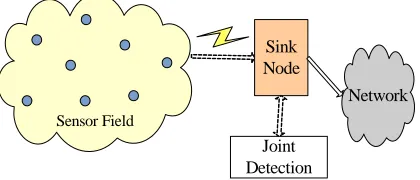
In sensor field of wireless sensor network, data collected by sensors are transmitted to a sink, as showed in Figure 1. The data collection sensors are typically subjected to strict energy constraints. The data collection nodes col-lect data on a physical phenomenon that is of interest and communicate them to the sink node over a wireless link which performs required joint processing. The low-cost sensors only are responsible for images collection. The sink node is responsible for the image gathering and er-ror detection. The sink node is less energy-constrained compared to the sensing nodes. It does not have any en-ergy constrains attached to it. Most of the complex proc-essing is thus carried out at the sink node resulting in better energy efficiency at the energy constrained sensor node level.
Sensor Field
Network Sink
Node
[image:2.595.68.278.600.690.2]Joint Detection
Figure 1. Wireless sensor networks transmission ar-chitecture.
The system model is shown in Figure 2. In the trans-mitter sensor, the image signals are first compressed and farmed into a certain number of layers by a general JPEG2000 encoder. Then the compressed data is jointly coded. After the carrier has been modulated, the data is transmitted through wireless channels. In the receiver, the signal is first demodulated. Then joint detection is used to reduce interferences and noise based schur algo-rithm before JPEG2000 decompression. After joint de-tection, the image data could be decompressed to redis-play in the sink receiver or send to other network di-rectly.
The sink node performs periodic polling of data col-lection nodes, at any given time the sink node itself may request simultaneous data transmissions from a set of chosen nodes.
3. Joint Detection Based on Schur Algorithm
Considering the physical properties of wireless commu-nication channels, either interference cancellation or multiuser detection is applied at the receiver side so as to reduce the load for error correction and control. Interfer-ence cancellation and error recovery are jointly consid-ered.
We assume that there are N transmitting sensor nodes and each has bits to transmit. All sending signals could be written as vector form , after modulation, the
i b
T N N1 (b1,b2b ) b
N
N diagon-allized vector multiplies with modulation signal . The output signal of transmitter is denoted with vector matrix
) N ,
(b b b
diag 1 2
N N
C
TN
a
2 1 a N
A 1 a .
The sending signal is transmitted through wireless channel, the input signal of sink receiver is represented as DN1
1
N
D =
TN d d
d1 2 =AN1 +nN1 (1)
where
n
N1 is noise vector.In asynchronous cause, the elements of above received signal matrix only simply are shifted according to different delay correspondingly before are summed.
1
N
A
The output of demodulator is:
Y=CKNDN1=CKNAN1
zk1 (2) where zk1 =CKNnN1It can also be written in vector form as (3)
Z RWb
Y (3) where R is channel crosscorrelation matrix vector, and W
is signal power matrix. Let W normalized to diagonal unit matrix, then we have
Z Rb
Transm itter node 1
M odulater
Error Recovery D em odulater JPEG 2000
encoder
JPEG 2000 Decoder
. . .
no
ises
SINK receiver
Error Protection
Joint Encoder
Interfence and Noise Cancelling Based on Schur Algorithm
Network
Transm itter node n
Error Protection Joint Encoder
M odulater
JPEG 2000 encoder
fa
din
g
Jo
int Det
ec
[image:3.595.73.522.77.257.2]tion
Figure 2. Proposed system model of image wireless transmission.
Decomposing the matrix
R
UT
,U
is N
N ma-trix with orthogonal column, andT
is an upper trian-gular matrix. Then the receiving signal be written asthe performance of the proposed method. A set of spread-spectrum Gold sequences of length 127 is chosen
η
U
Y
Tb
Y
~
H (5)where
U
HZ
.We can solve the sending signal for bottom to up one by one according to the upper triangular characteristic of coefficient matrix. It can be used to find the vector
that minimizes
1 N
b
y
Hb
22 by solving thetri-angular system of equations
Rb
U
Hy
. (a) Original image (b)Wavelet compressionTo obtain rapid matrix solution, the Schur algorithm is
be used to decomposing
R
UT
. The Schur algorithm is a way to efficiently compute the UT decomposition of a Toeplitz structured matrix.In order to realize our method of joint error detection, we used same structure and joint method which we pro-posed in Reference [1], and combine it with Schur algo-rithm. It preserves the same codestream structure as the one defined by the JPEG2000 core coding standard. Hence, even if the decoder has no knowledge of encode embedding, the resulting codestream can also be decoded using the decoderof JPEG2000 core coding system and conforms to the JPEG2000. Namely, the bit stream is compatible with JPEG2000.
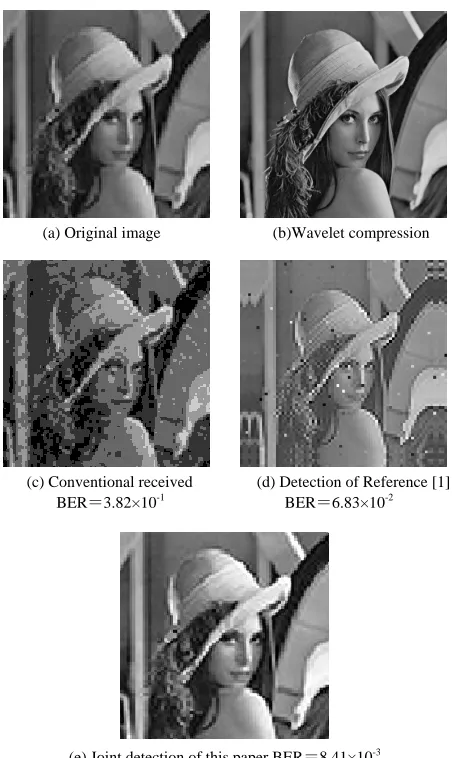
(c) Conventional received (d) Detection of Reference [1] BER=3.82×10⁻¹ BER=6.83×10⁻²
4. Simulation Results
Based on the method of joint detection that described as above, we made simulation experiment on microcom-puter system. There are 20 collection sensors in the clus-ter, and one is image collection node, others are data collection nodes. DS-CDMA base-band model is em- ployed as a wireless transmission system in evaluating
(e) Joint detection of this paper BER=8.41×10⁻³
[image:3.595.311.537.317.696.2]94 Y. J. HU
and an ideal power controlled environment with a two paths Rayleigh multipath fading channel is assumed. The signal-to-noise ratio (SNR) can be variable in the simula-tion. In our simulating experiments, the size of the image is 256×256 pixels, while the gray level is 8 bits/pixels, when compressed by the JPEG2000 verification model.
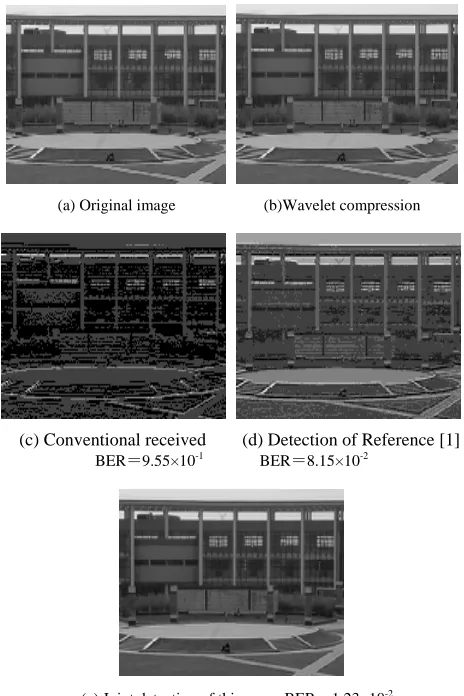
Performance can be evaluated by comparing simula-tion results. In Figures 3,4, we report the results we have obtained with 10 and 20 users in the system and SNR equal to 6dB and 4 dB respectively. Figure 3(a) and Figure 4(a) are the original JPEG image in the trans-mitter respectively. Figure 3(b) and Figure 4(b) are the JPEG2000 coded images with wavelet compression; Figure 3(c) and Figure 4(c) are the decompression im-ages in the receiver without joint detection. As you can see, the pictures are not particularly clear. This is mainly due to the noise and interference that wireless communication experiences. Figure 3(d) and Figure 4 (d) show the results we obtained for the decompression images at the sink receiver where the joint detection which we proposed in Reference [1] is used. Figure 3(e) and Figure 4(e) show the results we obtained for the
(a) Original image (b)Wavelet compression
(c) Conventional received (d) Detection of Reference [1] BER=9.55×10⁻¹ BER=8.15×10⁻²
(e) Joint detection of this paper BER=1.23×10⁻²
Figure 4. Image transmitted (example 2: SNR= -5dB, user number=20).
-2 -1 0 1 2 3 4 5 6 7 8 10-4
10-3 10-2 10-1 100
SNR (dB)
BE
R
Conventional Reference [1] This paper
Figure 5. Given user number K=20, the bit error rates with different SNR.
[image:4.595.315.533.76.253.2]decompression images at the receiver where the joint detection which proposed in this paper is used. As we can see, the quality of the images is better than that seen in Figure 3(d) and Figure 4(d). The error prob-ability comparisons with different SNR are showed in Figure 5. As shown, our method decreased the error probability and increased the image quality compare to the method of reference, particularly in noise channel with low signal and noise ratio.
The results prove that using joint detection we can ob-tain higher image quality. Interference and transmission errors are significantly reduced.
5. Conclusions
The proposed method of joint detection based on Schur Algorithm for image wireless transmission over wireless sensor network has been described above. It protects encoded images against error and improves the perform-ance of wireless image transmission. Simulation results show that our method could approach efficient images transmission in wireless sensor network and the trans-mission errors are significantly reduced when compared to regular transmissions.
In the future, we plan to extend our simulation ex-periment, and further investigate our transmission scheme for wireless multimedia sensor network based applications. Further extension is under study.
6. References
[image:4.595.56.288.341.689.2][2] I. F. Akyildiz, W. Su, Y. Sankarasubramaniam, and E. Cayirci, “A survey on sensor networks,” IEEE Commu-nications Magazine, pp. 102–114, August 2002.
[3] A. Skodras, C. Christopoulos, and T. Ebrahimi, “The JPEG 2000 still image compression standard,” IEEE Signal Processing Magazine, Vol. 18, No. 5, pp. 36–58, September 2001.
[4] “JPEG 2000 image coding system-Part 11: Wireless JPEG 2000-working draft version 3.1,” ISO/IEC JTC1/ SC29/WG1 WG1N3294, April, 2004.
[5] A. Natu and D. Taubman, “Unequal protection of JPEG 2000 codestreams in wireless channels,” in IEEE Pro-ceedings Globecom’02, Taipei, Taiwan, Vol. 1, pp. 534–538, November 2002,.
[6] D. Nicholson, C. Lamy-Begot, X. Naturel, and C. Poulliat, “JPEG 2000 backward compatible error protection with Reed-Solomon codes,” IEEE Transactions on Consumer Electronics, Vol. 49, No. 4, pp. 855–860, November 2003. [7] F. Frescura, M. Giorni, C. Feci, and S. Cacopardi, “JPEG
2000 and MJPEG 2000 transmission in 802.11 wireless local area networks,” IEEE Transactions on Consumer Electronics, Vol. 49, No. 4, pp. 861–871, November 2003.
[8] M. Grangetto, E. Magli, and G. Olmo, “Error sensitivity data structures and retransmission strategies for robust JPEG 2000 wireless imaging,” IEEE Transactions on Consumer Electronics, Vol. 49, No. 4, pp. 872–882, November 2003. [9] K. Munadi, M. Kurosaki, K. Nishikawa, and H. Kiya,
“Error protection for JPEG2000 encoded images and its evaluation over OFDM channel, ISCAS’03,” Proceedings of the 2003 International Symposium on Circuits and Systems, Vol. 2, pp. II-432-II-435, May 2003.
[10] K. Munadi, M. Kurosaki, K. Nishikawa, and H. Kiya, “A robust error protection technique for JPEG2000 codestream and its evaluation in CDMA environment,APCC 2003,” The 9th Asia-Pacific Conference on Communications, Vol. 2, pp. 654–658, September 21–24, 2003.
[11] V. Chande and N. Farvardin, “Progressive transmission of images over memoryless noisy channels,” IEEE Jour-nal on Selected Areas in Communications, Special Issue on Error Resilient Coding, Vol. 18, No. 6, pp. 850–861, June 2000.
[12] A. E. Mohr, E. A. Riskin, and R. E. Ladner, “Unequal loss protection: Graceful degradation of image quality over packet erasure channels through forward error
cor-rection,” IEEE Journal on Selected Areas in Communica-tions, Vol. 18, No. 7, pp. 819–828, 2000.
[13] Y. Charfi, R. Hamzaoui, and D. Saupe, “Model-based real-time progressive transmission of images over noisy channels,” IEEE Wireless Communications and Net-working, WCNC 2003, Vol. 2, pp. 784–789, March 2003.
[14] Sanchez and Mandal, “Robust transmission of Jpeg2000 images over noisy channels,” IEEE Transactions on Con-sumer Electronics, Vol. 48, No. 3, pp. 451–456, August 2002.
[15] A. Boukerche and Y. J. Hu, “QoS-based JPEG images transmission protocol for wireless CDMA communica-tion systems, internacommunica-tional workshop on modeling analy-sis and simulation of wireless and mobile systems,” Pro-ceedings of the 1st ACM Workshop on Wireless Multi-media Networking and Performance Modeling, pp. 38– 45, Montreal, Quebec, Canada, 2005.
[16] W. Yu, Z. F. Sahinoglu, and A. Vetro, “Energy efficient JPEG 2000 image transmission over wireless sensor net-works,” IEEE Global Telecommunications Conference (GLOBECOM), Dallas, Tex, Vol. 5, pp. 2738–2743, USA.
[17] M. Wu and C. W. Chen, “Multiple bitstream image transmission over wireless sensor networks,” Proceedings of IEEE Sensors 2003, Second IEEE International Con-ference on Sensors, Vol. 2, pp. 727–731, Toronto, Can-ada, October 22–24, 2003.
[18] H. Wu and A. A. Abouzeid, “Energy efficient distributed JPEG2000 image compression in multihop wireless net-works,” Proceedings of the 4thWorkshop on Applications and Services in Wireless Networks (ASWN’04), Boston, Mass,USA, pp. 152–160, August 2004.
[19] R. Wagner, R. Nowak, and R. Baraniuk, “Distributed image compression for sensor networks using correspon-dence analysis and super-resolution,” Proceedings of the IEEE International Conference on Image Processing (ICIP’03), Barcelona, Spain, Vol. 1, pp. 597–600, Sep-tember 2003.