Spending by primary care practices
—
does it
show what we expect?
Marilyn James1* and Elizabeth Stokes2 1
Sociology and Social Policy, University of Nottingham, Nottingham, UK 2
Health Economics Research Centre in the Department of Public Health, University of Oxford, Oxford, UK
SUMMARY
Background Over recent years, a number of policies andfinancial incentives in primary care have been proposed to tackle issues such as deprivation and health outcomes. This article investigates the association between healthcare spending, deprivation and outcomes. It argues that individual practice data are analysed before blanket application and acceptance that one sizefits all in a local area.
Methods Financial data were analysed alongside key outcome data, including quality and outcomes framework (QOF) indicators for a large urban primary care trust (PCT) in the UK. The PCT had a large population and number of practices, including single-handed practices and an average list size in excess of 5000. The PCT will remain anonymous. Results There was no relationship between primary care investment and the practices’ deprivation score. There was a strong statistically significant negative correlation between QOF payments and deprivation, (correlation = 0.46,p<0.001). There were only weak links between primary care investment and health outcomes. There was no relationship between high emergency spending and health outcome.
Conclusions The data presented suggest that one size does not necessarilyfit all—in terms of providing the appropriate incentives in primary care, nor do national incentives and policies always have the desired effect. © 2013 The Authors.International Journal of Health Planning and Managementpublished by John Wiley & Sons, Ltd.
KEY WORDS: primary care policy; investment; outcome; QOF indicators; deprivation
INTRODUCTION
Expenditure on healthcare continues to grow, but the actual growth in real terms is slowing to around 1% in the UK. At the same time, life expectancy in Western Europe has increased (Mackenbachet al., 2013). Although this paper is written from the perspective of the English health system, health is undoubtedly a challenge for all governments. There are a number of common factors across all health services that make the findings of this paper relevant across Europe, Australasia, Asia and
*Correspondence to: M. James, Sociology and Social Policy, University of Nottingham, Nottingham. UK. E-mail: [email protected]
Professor James contributed to the design and analysis and wrote the text for the article. Ms Stokes under-took statistical analysis of the raw data, prepared the graphs and made some revisions to the draft article.
© 2013 The Authors.International Journal of Health Planning and Management
published by John Wiley & Sons, Ltd.
Int J Health Plann Mgmt2014;29: 244–259.
America. More than ever, the purchasers of healthcare seek to obtain the most in terms of healthcare benefits from limited healthcare resources, especially when such resources are stretched by growing population numbers both in the developed and in the less developed world (United Nations Population Division, 2010).
The publicallyfinanced UK National Health Service (NHS) is based on a strong primary care system and relies on the primary care physician in terms of providing healthcare and in acting as a gatekeeper for secondary care. This paper was written using data from an English primary care trust (PCT). PCTs were the forerunner to the present clinical commissioning groups (CCGs) in England. PCTs were responsi-ble for managing general practice (GP) services within the area and commissioning secondary care on their behalf. By 2006, there were 152 PCTs across England. The new CCGs that have replaced PCTs were designed to bring healthcare closer to the patient, empowering smaller geographical zones of GPs to provide primary care services and commission secondary care services for their population. Although the original plan was to have over 500 CCGs across England, the current number stands at 211(NHS England, 2013a). These vary considerably in terms of the size of the population they serve.
The reforms to the NHS in the government White Paper of 2010 (DH, 2010) and the establishment of CCGs (DH, 2011) make it crucial that GPs fully understand the relationship between their investment in healthcare and patient outcomes. To maxi-mise investment return, a GP consortia needs to understand the relationship between their current spending and outcomes.
Primary care is becoming an increasingly important theme across nations. It is argued that health outcomes are better in countries with a strong primary care system (Kringos et al., 2013). Australia published its first national primary healthcare strategy in 2010 (Australian Government Department of Age and Aging, 2010), with key components including regional integration, finance and performance, better management of chronic conditions and equity and equality. Moore (Mooreet al., 2013) argues that healthcare costs in the USA could be reduced by some 30%, and better management of chronic diseases is one way, he states, this could be achieved. Phillips (Phillips and Bazemore, 2010) also argued that the USA could actually re-duce overall healthcare spending if it doubled primary care investment to 10–12% of total healthcare spending. Rechel (Rechel and McKee, 2009) highlights the central European nations’efforts to strengthen primary healthcare and the special attention they give towards emulating the British system of primary care.
Clinical commissioning groups are essentially a devolved manager of primary care services for the central government. This theme of decentralisation is common across the world. It is embedded in the American state system; it is central within the Australian system, common across Europe (Hacker, 2009; Mackenbachet al., 2013), popular in Asia (Singh, 2008) and Latin America (Bossertet al., 2003), and Pavolini (Pavolini and Vicarelli, 2012) argues that it is the cornerstone of the Italian health reforms. Unfortunately, decentralisation can lead to geographical inequalities (Rechel and McKee, 2009; Gelorminoet al., 2011; Pavolini and Vicarelli, 2012).
maximise their net present value (NPV) from investment. They will set investment rules on this basis in terms of economic efficiency. In this case, this would require the PCT or CCG to put the funds where the return is greatest in terms of healthcare return. This may be in stark contrast to where the greatest need occurs in each of the wards within its domain. A PCT/CCG driven by needs assessment may wish to invest their capital somewhat differently than the NPV rule. In 2004, an allocation formula was introduced into primary care in England and Wales, which was further modified to enable PCTs to pay practices more or less money to correct for historical inequities and address areas of need. (DH, 2002)
In the last 10 years, a number of policies have been introduced to incentivise the primary care purchasing function to achieve efficiency and to improve health outcomes for the population in England and Wales. These include the recent White Paper (DH, 2010); the Darzi report‘High Quality Care For All’(DH, 2008); quality, innovation, productivity and prevention (Appleby et al., 2010); quality and out-comes framework (QOF) (DH, 2004a); payment by results (PbR) (DH, 2004b) and the new general medical services (GMS) contract (DH, 2003a, 2003b), as well as the implementation of numerous local initiatives. The question is do these initiatives work and are primary care practices achieving outcomes from these initiatives that policy makers desired? The aforementioned policies clearly show that repeated gov-ernments are wedded to quality and efficiency making a difference to the health of the nation. The White Paper promised to increase healthcare spending and ensure it provides equality to all; Darzi emphasised high quality locally led care; quality, in-novation, productivity and prevention also talks of quality of care whilst seeking to re-invest the planned efficiency savings back into patient care; payment by results, by removing price competition and gaming, hopes to drive each hospital towards
ef-ficiency and move towards products differentiated in terms of their quality, and the GMS contract puts emphasis on choice, productivity and now public health (NHS England, 2013b).
The QOF is used as a key indicator in this work. The QOF, introduced in 2004, is a set of key quality indicators of health and disease management in areas such as coronary heart disease (CHD) and diabetes. The primary care practice is incentivised to deliver healthcare in these areas and rewardedfinancially for achieving targets— for example, obtaining blood pressure and cholesterol within defined limits for those at risk. The more the practice achieves the set targets, the greater thefinancial reward for the practice. Although some targets have been in place since the inception of QOF, others change depending on current health needs and priorities. The targets chosen for this analysis have remained important throughout. QOF seeks to achieve positive health outcomes whilst at the same time providing incentives and income for the primary care practice. In a review article in 2010, Steel and Willems (Steel and Willems, 2010) felt that the evidence base surrounding the impact of QOF was sketchy, and further research was necessary to inform changes in QOF to achieve equity and improvements in health. They argue,‘Most studies show little relationship between QOF achievement and health service activity or health outcomes.’This work aims to further investigate this relationship.
investment received per person. The aforementioned is a gross oversimplification of the health service policy. Set amidst all these national policies however, it is easy to see why a CCG would think that investment and achievement of QOF targets and the linked payments should improve the health of their population.
This paper used detailed data from a PCT to examine some commonly held beliefs about primary care spending, and whether it resulted in the outcomes decision makers desired. It poses some beliefs held by the PCT and policy makers and seeks to establish whether they are true.
The commonly held beliefs under examination are
• practices with a high level of deprivation receive a high investment in primary care, • high QOF payments or high investment payments relate to good outcomes and • high emergency care spending and secondary care spending indicate poor patient
outcomes
The analysis presented in this paper is based on detailed data from onefinancial year from a single, anonymous PCT. Although audited accounts and public health indicators are freely available, the level of data used in this analysis by primary care practice would not be available to the general public and was used with permission from the PCT. Thefindings of this research work are potentially controversial and may be detrimental if taken out of context for any single employee of the PCT in question. Therefore to preserve anonymity of all the employed PCT staff and to enable full and frank publication of the full result set, with the consent of the PCT’s staff and senior management, the identity of the PCT will not be published. The mes-sages are key for any CCG (DH, 2011) trying to understand its relationship between primary care spending and outcomes. The issues will be shared by many primary care commissioners, and therefore it is important that suchfindings should be in the public domain to assist the thinking and decision making processes of commissioners.
METHODS
The population is urban and deprived with an average index of multiple deprivation score in 2007 of around 50. It has in the order of 100 practices including a number of single-handed practices. The PCT has a large population of around half a million and a large number of practices with an average list size in excess of 5000. The analysis was undertaken using data forfinancial year 2007/2008. The period was chosen for the quality of the data in that financial year and its completeness. The data and analysis examined investment from the PCT and allowances for QOF payments. Each practice’s spending and outcomes were considered.
Secondary care expenditure was obtained, broken down into accident and emergency, daycase, elective and non-elective inpatients and new and follow-up outpatient appointments, which allows us to split spending into elective and emer-gency secondary care spending. Pharmacy expenditure was also obtained. Elements of expenditure for each practice were divided by the list size, to calculate average expenditures per person, so that comparisons between practices could be made.
Practice characteristics andfinancial data were linked to a number of quality indi-cators from the QOF standards that reflected both the high disease mortality and morbidity areas for the PCT and within the UK. The QOF indicators chosen came from the following diseases: diabetes, CHD, stroke and chronic obstructive pulmo-nary disease (COPD). These indicators were chosen on discussion with specialists in public health as representing a number of key indicators and disease areas. Their validity was further discussed with officers from thefinance department. The follow-ing lists the QOF targets chosen for detailed analysis.
• Stroke—the percentage of people with BP 150/90 or below. • CHD—the percentage of people with total cholesterol 5 or below. • Diabetes—the percentage of people with HbA1c 7.5 or below.
• Emergency admissions—exacerbation of COPD per 1000 practice population (DH 2004a)
Many of the indicators are useful for a number of diseases and do not relate solely to a single disease. Together, these were used to assess whether investment was linked to the quality of service provided by the GP practices. The paper explores the evidence around investment and outcome and examines whether some commonly held beliefs (outlined in the previous texts) surrounding investment and outcome hold.
All practices in the PCT were included in the analysis; hence, any outliers were included. This was a naturalistic data-set, and the analysis aimed to present the PCT with findings that wholly reflected the real world situation. Sufficient time had elapsed from the submission of returns such that missing data did not occur because of time lags. Data were analysed using theSPSSstatistical package.
RESULTS
The following sections present the results under the headings of each of the three hypotheses under investigation, to determine whether the evidence supported the assertions that were made.
Practices with a high level of deprivation receive a high investment in primary care
The belief that high deprivation is associated with high investment did not hold true as illustrated by Figure 1.
There is no discernable relationship between practice investment per person and the practices’ deprivation score. Practices with high and low investment had high deprivation scores (correlation = 0.16,p= 0.13).
Although no relationship was found between investment and deprivation, there is a strong statistically significant negative correlation between QOF payments per person and deprivation, (correlation = 0.46,p<0.001). This showed that the more deprived the location, the less QOF money the practice received per person. It there-fore implies that practices in the most deprived locations were least able to reach their QOF targets and as such yield good patient outcomes. Thisfinding is perhaps not surprising and represents an area PCTs may wish to address.
High quality and outcomes framework payments or high investment payments relate to good outcomes
There were only a few weak links between primary care investment and specific outcomes. Although we did not examine every single outcome or QOF target, the key QOF targets and high disease prevalence groups were examined as defined by the PCT. Weak positive relationships were found between primary care investment and CHD, the percentage of people with total cholesterol of 5 mmol/l or below, and diabetes, the percentage of people with HbA1c of 7.5 or below. An example can be found in Figure 2.
Index of Multiple Deprivation 2007 Score
A
vera
g
e
in
vestment per per
s
on (£)
110
100
90
80
70
60
50
[image:6.465.89.380.218.453.2]20 30 40 50 60 70 80
Weak positive relationships were also found between QOF payments and CHD, the percentage of people with total cholesterol of 5 mmol/l or below, and stroke, the percentage of people with BP 150/90 or below. A weak negative correlation was found between QOF payments and emergency admissions for exacerbations of COPD per 1000 population. Hence practices receiving more QOF money per person were also those with fewer emergency admissions for COPD; this implies that better control in primary care was preventing unnecessary accident and emergency admissions.
There is therefore a trend towards QOF payments being related to better patient outcomes, but this relationship is only weak and requires further monitoring. The clear relationship that was anticipated between QOF payments and outcomes did not exist. All thesefindings should be interpreted with caution as there are a number of outliers that could have influenced thefindings.
High emergency care spending and secondary care spending indicate poor patient outcomes
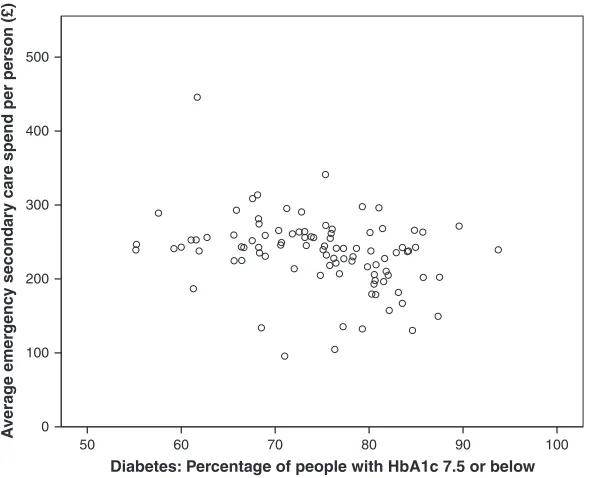
A commonly held belief is that high emergency care spending is synonymous with poor population health and health outcome. The analysis showed that this relation-ship did not hold. In one of the indicators, diabetes: the percentage of people with HbA1c 7.5 or below, there was a weak negative relationship with emergency secondary care spend (correlation = 0.31, p= 0.002). This showed that the better controlled the diabetes, the less was spent on emergency care. It was encouraging to observe thisfinding. This is shown in Figure 3.
CHD: Percentage of people with total cholesterol 5mmol/l or below 50
50 75 100 125 150
60 70 80 90 100
A
vera
g
e
in
vestment per per
[image:7.465.88.380.50.289.2]son (£)
Surprisingly and in conflict with thefinding in the previous texts, there was a weak positive relationship between emergency secondary care spending and emergency admi-ssions for exacerbations of COPD per 1000 population (correlation = 0.50,p<0.001). There was no relationship between emergency secondary care spending and CHD, the percentage of people with total cholesterol of 5 mmol/l or below, or stroke, the percentage of people with BP 150/90 or below.
It is worth exploring further the proportion of spending on emergency care within secondary care spending in general. Approximately 62% of secondary care spending was on emergency care, and 38% on elective care. There was strong statistically significant positive correlation between elective and emergency secondary care spend (correlation = 0.51, p<0.001). This indicates that those practices that spend highly on emergency secondary care also spend highly on elective care. Similarly, there was strong statistically significant positive correla-tion between pharmacy spend and total secondary care spend (correlacorrela-tion = 0.54,
p<0.001); as well as between pharmacy spend and both elective and emergency secondary care spend. In terms of pharmacy and secondary care spend; therefore, those who spend highly in one area tend to spend highly in other areas. Hence the assumption that spending on emergency care may be a result of underspending on elective or pharmaceutical care does not hold true. Similarly, no relationship was found between primary care spending and secondary care spending. Those practices that have a high primary care spend, for example, did not have compensatory low spend in secondary care.
Diabetes: Percentage of people with HbA1c 7.5 or below
A
vera
g
e
emer
g
enc
y secondar
y care spend per per
son (£) 500
400
300
200
100
0
[image:8.465.88.383.56.295.2]50 60 70 80 90 100
DISCUSSION
As health service managers, decision makers and policy makers, the incentive is to deliver health policy based on what seem to be logical premises and indeed the com-monly held beliefs listed at the start of this paper; however, this may be a dangerous pathway to take when the data do not support such policies. The evidence presented in this paper suggests that none of the commonly held beliefs under discussion could be supported by the data.
Although the study was conducted in a large urban environment, thefindings and the commonly held beliefs could apply to a large number of areas across the UK and beyond. Firstly, the study has a primary focus on investment and outcome. Many CCGs may assume that increasing investment will likely bring about improvements in outcome. The relationship shown here was not a simple one and signalled it is important to compare theory with evidence in practice. Whatever the geographical location, policy should be based on data and evidence. Although thefindings of this work may be less applicable to remote rural settings, much of the UK, Europe and indeed the developing world is becoming increasingly urbanised, and thefindings of this work could be easily transferable to a large number of city settings and urban conurbations.
Discussing investment in healthcare or the public sector is complicated and fraught with difficulties. The select committee of 2006 (House of Commons Health Committee, 2006) argues that three key difficulties are:
• the funding formula itself, • poor central management and • poor local management.
It is not surprising therefore that the relationship between investment and outcome seems less than perfect. Although this paper makes no judgement on the quality of management either centrally or locally, it does examine how data around funding translates to outcomes.
Richardson (Richardson, 1998) argues in the case of public sector investment that the NPV rule may not apply and other conditions such as politics may be equally important drivers. Equally, Arrow and Lind (Arrow and Lind, 1970) argue that public investment should carry a different discount rate to private investment. It follows therefore that public investment may not follow the same rules as private investment and may not be judged in the same way.
A weak agency Baxter further argues can lead to issues of‘creeping commissioning’ and ideas rolling forward without conscious decision making and hospitals driving the priorities and decisions made by CCGs. With the advent of CCGs, at least one element of this complex agency relationship is removed. Hence the contractual relationship between PCT and GPs is removed as the GPs, in terms of the CCGs, become direct commissioners.
The results did not support the hypothesis that practices with a high level of deprivation receive a high investment in primary care. Tudor Hart in his seminal paper in the Lancet (Tudor Hart, 1971) argued that‘the availability of good medical or social care tends to vary inversely with the need of the population served.’The hypothesis tested in this research does not look directly at availability but uses proxy measures such as access to investment and ability to meet QOF targets. In terms of investment, the results show that there is no relationship between the practices’level of investment and deprivation. Although not directly supporting Tudor Hart’s asser-tion, it does illustrate that areas of most need do not receive the extra investment that may enable them to improve their populations’health. Tudor Hart argues that‘The force that creates and maintains the inverse care law is the operation of the market.’ Hence Tudor Hart himself indicates that the problem is not just about access but the existing capital stock of the area such as poor premises and equipment and a shortage of staff. Capital as such is an area that could be addressed by further investment.
Asthana in the Select Committee Report on Health Care Deficits (House of Commons Health Committee, 2006) argued that basing resource allocation on current access isflawed. The baseline level of access she argued may be too high or too low originally for the disease pool it represents. Similarly, she claimed that there was an inverse relationship between deficits and high levels of deprivation. Asthana argued that the likelihood of deficits in affluent areas suggested that either wealthier groups use healthcare services more than is necessary, or that inadequate levels of funding are provided for these areas. Although some may argue that affluent areas tend to be in deficit, because wealthier people demand more healthcare services, Asthana found that the average service use in deprived areas is significantly greater than that in less deprived areas, for a range of measures.
Watt in his 2002 follow-up article (Watt, 2002) suggests that even if investment to less deprived practices increases, the problem itself may not diminish. He uses the anal-ogy of a swimming pool.‘Family doctors in affluent areas are standing in the shallow end with their feet on the bottom, whereas those in deprived areas are treading water in the deep end, receiving deprivation payments for their trouble.’Hence they may indeed be receiving investment, but this investment is dwarfed by the underlying problem of the disease pool. Interestingly, Watt moves away from the traditional public health focus of concentrating on hard to evaluate or unevaluated interventions but instead argues for better targeted delivery of clinical interventions, with proven effectiveness. Such interventions, for example bariatric surgery, may not be sufficiently reflected by the achievement of QOF targets and subsequent payments.
same logic, old and ageing populations in deprived areas would suffer the most. Hence, the argument is that not only is outcome linked to deprivation but also to demography.
This limited evidence is supported by earlyfindings from Ashworth (Ashworth
et al., 2007) and Sahota (Sahotaet al., 2008) in Walsall. Thefindings presented here and the work of Ashworth (Ashworthet al., 2007) and Sahota (Sahotaet al., 2008) would suggest that there is not a simple relationship between the level of deprivation within a practice and the amount of investment it receives. It would appear that insufficient investment is detrimental to a practice achieving its QOF targets. This result is supported by thefindings from Ashworth and Armstrong (Ashworth and Armstrong, 2006).
The evidence that high QOF payments or high investment payments bring about good patient outcomes is somewhat weak. It is supported in this work by thefindings relating to CHD and diabetes and in terms of the reduced admissions to secondary care for COPD. The findings regarding COPD of practices receiving more QOF money per person, were also those with fewer emergency admissions for COPD, are consistent with thefindings of Downing (Downinget al., 2007). Downing also showed that fewer emergency admissions were related to achieving QOF targets in this area. This message is further echoed in Cooper’s work on waiting lists (Cooper
et al., 2009)‘between 1997 and 2007, waiting times for elective knee replacements, hip replacements, and cataract repairs dropped significantly and equity, measured as the variation in waiting times according to socioeconomic status, improved.’This gives some degree of hope that government targets and incentives can move not only efficiency in the right direction but at the same time improve equity.
It can be argued that other factors such as practice size influence patient outcome more directly than QOF payments; however, a paper by Tahrani (Tahrani et al., 2008) showed that the differences observed between patient outcome and practice size disappeared following the introduction of QOF. Morgan, in early work on prac-tice payments (Morgan and Beerstecher, 2006), found that smaller investments per patient were related to better quality scores than higher investments per patient. This evidence would point to the importance of historical artefacts and the time they take to work through the system (Asthana, 2011).
payments are cost effective, there is no relationship between the size of payment and the size of the health gain. In short, as to whether the QOF has improved, the population health Gillam (Gillam and Steel, 2013) concludes‘we don’t know,’and recommends that the proportion of GP income commanded by the QOF be reduced.
Throughout the last decades of health service policy, there has been a growing tension between equity and efficiency. Sassi and Le Grand (Sassi and Le Grand, 2001) argued that there was a‘failure to strike an acceptable balance between the policy goals of equity and efficiency when these conflict.’It could be argued that the policies examined here focus on efficiency, whilst forgetting the underlying problem that equity and deprivation can play in the ability to achieve the goal of efficiency, or indeed the CCGs desire to pursue the goal of efficiency over equity. Oliver (Oliveret al., 2002) in a comment inThe Lancetargues that it is not only national policy that is important in addressing inequality but that local policy must also play a role. This paper illustrates the use of national policy whilst allowing for local policy adjustments in investment. The effects however of both policies appeared to be somewhat random and inconsistent.
The results showed that high spending in one area, for example, pharmacy, tended to be associated with high spending in another area such as elective care. Other than in COPD, no evidence could be found that high primary care spending resulted in less emergency care spending. This relationship requires further investigation. It implies that potentially where low spending occurs in primary care, then demand for emergency care is also low, a substitution relationship is therefore not present but the services are instead complementary. Where for example people utilise considerable primary care resources, the implication is again spend on pharmacy and emergency care is also high, again implying a complementary relationship between pharmaceutical care, primary care, secondary care and emergency care. Others have also found this complementary relationship. In a study offive developed countries (including the UK and USA), Wilton (Wilton and Smith, 2002) found that growth in expenditure per capita on community physician services was significantly positively correlated with growth in expenditure per capita on inpatient care. This is also consistent with work on areas of high utilisation and where patients frequently attend for care. Heywood (Heywoodet al., 1998) found that the top 3% of frequent attenders consumefive times as many prescriptions and hospital contacts compared with less frequent attenders. This would be consistent with the assertion that high consumption in one area, is accompanied by high consumption in another area, in this case of medical goods and services.
The data presented here showed that there is wide variation in terms of practice spend and outcome. Thisfinding is supported in the work of Wennberg (Wennberg, 2011), who reported widespread variation between practices. It would seem that the variation could as likely be an artefact of historical spending and individual practice characteristics as of any patient level characteristics. Gray in the NHS Atlas of Variation (Gray and Da Silva, 2010) argues that it is imperative that such unneces-sary variation be tackled.
which is the effect. Time series data would have enabled us to look at whether trends were changing over time, and whether for example the influence of historical payments was reducing over time or not.
Although the new GMS contract of 2004 was supposed to improve local resource allocation, it would seem from evidence presented here that there is not a direct link between the local allocation of resources, investment and outcome. This situation could be made worse by the advent of CCGs. The population served by a CCGs, is much smaller than a PCT and may be small enough to bring aboutfinancial insta-bility (Asthana and Gibson, 2011) as population numbers in a CCG are not large enough to enable the risk pooling required to allow such a system to operate effi -ciently (Asthanaet al., 2011). The analysis by Rhys (Rhyset al., 2010) suggested that changes to the resource allocation system did not improve equitable monetary allocation for equal need; he further highlighted that current funding depends more on historical funding patterns than specific changes to the capitation formula. Rhys argued that a needs-based formula is preferable over Carr-Hill’s utilisation-based formula. Determining how to allocate healthcare resources is a problem that is not going away. The NHS Commissioning Board has for now rejected the introduction of the new allocation formula designed and commissioned from the Nuffield Trust that shows accurate person-based data in predicting costs (Lacobucci, 2012). The is-sue seems to be that equity and need may suffer. Ironically, this effects either end of the spectrum—the wealthy that does not access health services because of private care and the poorer groups who delay. It could be argued that such concerns are mir-rored by thefindings of this paper.
Buyx (Buyx et al., 2011) suggests an alternative to the current allocation and recording system by maintaining that it is not rationing by cost effectiveness that should be the driver, but clinical effectiveness, at the same time excluding those procedures that yield minimal effective care, perhaps as such reducing variation, tackling efficiency rather than equality. However, in the work presented here, there are only weak positive relationships between QOF payments and outcomes, which would lessen the argument for allocation by effectiveness alone.
Hawkes (Hawkes, 2009) commenting on the proposed changes from the Advisory Committee on Resource Allocation (ACRA), using work from Brunel University reported that it is impossible to combine need and inequality. The new resource allocation formula is to be used in parallel with a separate formula for health inequalities using disability adjusted life years. Although the north of the country gained from this complex model, the model he reported may beflawed in that the weight attached to inequality is set by politicians and the rate of moving to the need and equality target is undetermined. Hawkes is clear however that resource allocation is a jungle ‘man-eating statisticians, steeped in the lore of the jungle and ready to pounce at the sound of a breaking twig. Wizards uttering incantations dance around a cooking pot stocked with tasty data, brewing up heaven knows what. The light is dim, and understanding is even dimmer.’ (Hawkes, 2009).
and targeting lead to greater efficiency in the management of resources and reduction in inequalities (Pavolini and Vicarelli, 2012). The appropriate use of data is something that would be echoed in the works of this paper and the recognition that not only do different localities require different treatment in resource allocation, but also do different wards within those localities. The importance of managing decentralised systems is one that is as important for less-developed countries as the developed world in terms of national growth and a fair political regime.
CONCLUSIONS
The key message from this work is that thefindings of the analysis did not support the commonly held beliefs. The analysis presented suggests that investment in primary care and practice spend is not closely related to the outcomes of the service provided or any of the practice characteristics explored. Investment appears to relate most closely to historical payments. A key message to PCTs and commis-sioning bodies may be that financial spending on primary care alone does not improve patient outcomes. The picture here presented is a useful starting point for commissioners to undertake further analysis and highlights some potentially fruitful avenues for further research. Any commissioner wishing to understand its investment budget and how this relates to patient outcome would be well advised to take thefirst exploratory steps towards understanding their spending, leastwise not to make non-evidence-based assumptions around spending and outcome but to examine the real outcomes in practice. It is likely thatfinancial incentives need to relate more closely to individual practice characteristics and patterns of behaviour. Gray (Gray and Da Silva, 2010) stresses that awareness is the first step towards addressing variations in practice; the work presented here echoes such sentiments and exhorts PCTs and their successors to determine where variation lies without making assumptions around its cause and the policy solu-tions. Health systems (Rechel and McKee, 2009) need to respond to the needs of their populations.
ACKNOWLEDGEMENTS
The authors would like to thank the staff and officers of the PCT that provided the data and guidance for this paper.
All authors have completed the Unified Competing Interest form at http://www.icmje.org/coi_disclosure.pdf (available on request from the correspond-ing author), and there was no specificfinancial support from the PCT concerned nor no
REFERENCES
Appleby J, Ham C, Imison C, Jennings M. 2010. Improv-ing NHS productivity more with the same not more of the same. The King’s Fund.
Arrow KJ, Lind R.1970. Uncertainty and evaluation of public investment decisions. Amer Econ Rev 60: 364–378.
Ashworth M, Armstrong D. 2006. The relationship be-tween general practice characteristics and quality of care: a national survey using indicators from the UK Quality and Outcomes Framework 2004-2005.BMC Fam Pract57: 441–8.
Ashworth M, Seed P, Armstrong D, Durbaba S, Jones R. 2007. The relationship between social deprivation and the quality of primary care: a national survey using in-dicators from the UK Quality and Outcomes Frame-work.Br J Gen Pract7: 68–75.
Asthana S. 2011. Liberating the NHS? A commentary on the Lansley White Paper,“Equity and Excellence”. Soc Sci Med72: 815–820.
Asthana S, Gibson A. 2008. Deprivation, demography, and the distribution of general practice: challenging the conventional wisdom of inverse care.Br J of Gen Prac58: 720–728.
Asthana S, Gibson A. 2011. Setting health care capita-tions through diagnosis-based risk adjustment: a suit-able model for the English NHS?Health Policy101: 133–139.
Asthana S, Gibson A, Hewson P, Bailey T, Dibben C. 2011. General practitioner commissioning consortia and budgetary risk: evidence from the modelling of
‘fair share’practice budgets for mental health.J Health Serv Res & Policy16(2): 95–101.
Australian Government Department of Age and Aging. 2010. Building a 21st century primary health care system Australia’sfirst national primary health care strategy. Commonwealth of Australia. ISBN: 978-1-74241-224-5. 1–44.
Baxter K, Weiss M, Le Grand J. 2008. The dynamics of commissioning across organisational and clinical boundaries.J Health Organ Manag22(2): 111–128. Bossert T, Larranaga O, Giedion U. 2003.
Decentraliza-tion and equity from resource allocaDecentraliza-tion: evidence from Colombia and Chile.Bull World Health Organ
81(1): 95–100.
Buyx A, Friedrich D, Schone-Seifert B. 2011. Rationing by clinical effectiveness.BMJ342: 531–533. Cooper ZN, McGuire A, Jones S, Le Grand J. 2009.
Equity, waiting times, and NHS reforms: retrospective studyBMJ339: 1–7.
Department of Health. 2002. Health service circular. Pri-mary Care Trusts Revenue Resource Limits 2003/2004, 2004/5 & 2005/2006. pp. 1–13 Available at http://
webarchive.nationalarchives.gov.uk/20130107105354/ http://www.dh.gov.uk/prod_consum_dh/groups/ dh_digitalassets/@dh/@en/documents/digitalasset/ dh_4012296.pdf, Accessed 14 October 2013. Department of Health. 2003a. Investing in general
practice: the new general medical services contract. London. Available at http://www.nhsemployers.org/ SiteCollectionDocuments/gms_
contract_cd_130209.pdf, Accessed 23 May 2013. Department of Health. 2003b. Delivering investment in general practice: implementing the new GMS contract. London. Available at http://webarchive. nationalarchives.gov.uk/20130107105354/http:// www.dh.gov.uk/prod_consum_dh/groups/dh_-digitalassets/@dh/@en/documents/digitalasset/dh_ 4070231.pdf, Accessed 15 October 2013. Department of Health. 2004a. Quality and Outcomes
Frame-work. Summary of Indicators. London. Available at http://www.dhsspsni.gov.uk/qof-indicators.pdf, Accessed 20 January 2012.
Department of Health. 2004b. Implementing payment by results technical guidance 2005/06. London. Department of Health. 2008. High quality care for all.
NHS next stage reviewfinal report. Cm7432. London. Department of Health. 2010. NHS white paper: equity and excellence: liberating the NHS. Cm7881. London. Department of Health. 2011. Developing clinical
commission-ing groups: towards authorisation. London. Available at https://www.gov.uk/government/ uploads/system/up-loads/attachment_data/file/213725/dh_130318.pdf, Accessed 15 October 2013.
Downing A, Rudge G, Cheng Y, Tu YK, Keen J, Gilthorpe MS. 2007. Do the UK government’s new quality and outcomes framework scores adequately measure primary care performance? a cross-sectional survey of routine healthcare data.BMC Health Serv Res7: 166–172. Dusheiko M, Gravelle H, Martin S, Rice N, Smith PC.
2011. Does better disease management in primary care reduce hospital costs? Evidence from English primary care.J Health Econ30(5): 919–932.
Fleetcroft R, Parekh-Bhurke S, Howe A, Cookson R, Swift L, Steel N. 2010. The UK pay-for-performance programme in primary care: estimation of population mortality reduction.Br J Gen Pract60: 345–352. Gelormino E, Bambra C, Spadea T, Bellini S, Costa G.
2011. The effects of health care reforms on health inequalities: a review and analysis of the European evidence base.Int Jnl Health Serv41(2): 209–230. Gillam S, Steel N. 2013. The quality and outcomes framework
—where next?BMJ346: 1–6.
rightcare.nhs.uk/atlas/index.html, Accessed 20 January 2012.
Hacker B. 2009. Hybridization instead of clustering: trans-formation processes of welfare policies in central and Eastern Europe.Soc Pol Admin43(2): 152–169. Hawkes R. 2009. Resource allocation—it’s a jungle out
there. Who wins and who loses under the NHS’s new scheme for awarding cash to primary care trusts? BMJ338: 139 b77.
Heywood PL, Blackie GC, Cameron IH, Dowell AC. 1998. An assessment of the attributes of frequent at-tenders to general practice.Fam Pract15: 198–204. House of Commons Health Committee. 2006. Health
Deficits First Report of Session 2006–07 Volume 1. London HMSO. 1–97.
Kringos DS, Boerma W, van der Zee J, Groenewegen P. 2013. Europe’s strong primary care systems are linked to better population health but also to higher health spending.Health Aff32(4): 686–694.
Lacobucci G. 2012. Commissioning board looks for funding formula that will reduce health inequalities.BMJ345(2): 1. Mackenbach JP, Karanikolos M, McKee M. 2013. The unequal health of Europeans: successes and failures of policies.The Lancet381: 1125–1134.
Moore K, Eyestone K, Coddington D. March 2013. The healthcare cost curve can be bent.Healthcare Fin Mang67(3): 78–84.
Morgan CL, Beerstecher HJ. 2006. Primary care funding, contract status and outcomes: an observational study. Br J Gen Pract56: 825–829.
NHS England. 2013a. CCG maps. March. 1-2. Available at http://www.england.nhs.uk/resources/ccg-maps/, Accessed September 2013.
NHS England. 2013b. 2013/14 Guidance and audit requirements for new and amended enhanced services version 1. April: 1–41.
Oliver A, Healey A, Le Grand J. 2002. Addressing health inequalities.The Lancet360: 565–567.
Pavolini E, Vicarelli G. 2012. Is decentralization good for your health? Transformations in the Italian NHS. Current Sociology60(4): 472–488.
Phillips RL, Jr, Bazemore AW. 2010. Primary care and why it matters for U.S. health system reform.Health Aff29(5): 806–810.
Rechel B, McKee M. 2009. Health reform in central and eastern Europe and the former Soviet Union. The Lancet374: 1186–1195.
Rhys G, Beerstecher HJ, Morgan CL. 2010. Primary care capitation payments in the UK. An observational study.BMC Health Serv Res10: 156. Available at http://www.biomedcentral.com/1472-6963/10/156.
Richardson R. 1998. The effect of public versus private decision environment on the use of the net present value investment criterion. J Public Budg Acc Finance Manage10(1): 21–52.
Sahota N, Hood A, Shankar A, Watt B, Ramaiah S. 2008. Developing performance: indicators for pri-mary care: Walsalls experience.Br J Gen Pract58: 856–861.
Sassi F, Le Grand J. 2001. Equity versus efficiency: a dilemma for the NHS.BMJ323: 762–763. Shohet C, Yelloly J, Bingham P, Lyratzopoulos G. 2007.
The association between the quality of epilepsy man-agement in primary care, general practice population deprivation status and epilepsy-related emergency hospitalisations.Seizure16: 351–355.
Singh N. 2008. Decentralization and public delivery of healthcare services in India.Health Aff 27(4): 991–1001.
Smith PC. 2008. Resource allocation and purchasing in the health sector: the English experience. B World Health Organ86(11): 884–888.
Stalebrink OJ, Sacco JF. 2006. Public sector investment failures: theoretical contributions from new institu-tional and Austrian economic theory.J Public Budg Acc Finance Manage18(3): 351–375.
Steel N, Willems S. 2010. Research learning from the UK quality and outcomes framework: a review of existing research.Qual Prim Care18: 117–125.
Tahrani AA, McCarthy M, Godson J,et al. 2008. Impact of practice size on the delivery of diabetes care before and after the Quality and Outcome Framework imple-mentation.Br J Gen Pract58: 576–579.
Tudor Hart J. 1971. The inverse care law.The Lancet297: 405–412.
United Nations Population Division. 2010. World Popula-tion Prospects: The 2010 Revision, medium variant (2011). Available at http://www.prb.org/Publications/ Datasheets/2012/world-population-data-sheet/fact-sheet-world-population.aspx, Accessed March 2013. Walker S, Mason AR, Claxton K, Cookson R, Fenwick E,
Fleetcroft R. 2010. Value for money and the quality and outcomes framework in primary care in the UK NHS.Br J Gen Pract60: 213–220.
Watt G. 2002. The inverse care law today.The Lancet
360: 252–254.
Wennberg J. 2011. Time to tackle unwarranted variations in practice.BMJ342: 687–690.