A Modified Particle Swarm Optimization Algorithm
Ai-Qin Mu1,2, De-Xin Cao1, Xiao-Hua Wang21College of Science, China University of Mining & Technology, XuZhou, Chin 2Foundation Departments, Xuzhou Air Force Academy, XuZhou, China
Received 17 August 2009; revised 28 August 2009; accepted 30 August 2009.
ABSTRACT
Particle Swarm Optimization (PSO) is a new optimization algorithm, which is applied in many fields widely. But the original PSO is likely to cause the local optimization with premature convergence phenomenon. By using the idea of simulated annealing algo-rithm, we propose a modified algorithm which makes the most optimal particle of every time of iteration evolving continu-ously, and assign the worst particle with a new value to increase its disturbance. By the testing of three classic testing functions, we conclude the modified PSO algorithm has the better performance of convergence and global searching than the original PSO.
Keywords: PSO; Simulated Annealing Algorithm; Global Searching
1. INTRODUCTION
PSO algorithm is a new intelligent optimization algo-rithm intimating the bird swarm behaviors, which was proposed by psychologist Kennedy and Dr. Eberhart in 1995 [1]. Compared with other optimization algorithms, the PSO is more objective and easily to perform well, it is applied in many fields such as the function optimiza-tion, the neural network training, the fuzzy system con-trol, etc.
In PSO algorithm, each individual is called “particle”, which represents a potential solution. The algorithm achieves the best solution by the variability of some par-ticles in the tracing space. The parpar-ticles search in the solution space following the best particle by changing their positions and the fitness frequently, the flying di-rection and velocity are determined by the objective function.
For improving the convergence performance of PSO,
the inertia factor
w
is used by Shi and Eberhart [2]tocontrol the impact on current particle by former parti-cle’s velocity. PSO algorithm has preferred global
searching ability when
w
is relatively large. On thecon-trary, its local searching ability becomes better when
w
is smaller. Now the PSO algorithm with inertiaweight factor was called standard PSO.
However, in PSO algorithm, particles would lost the ability to explore new domains when they are searching in solution space, that is to say it will entrap in local op-timization and causes the premature phenomenon. Therefore, it is very import for PSO algorithm to be guaranteed to converge to the global optimal solution, and many modify PSO algorithms were researched in recent ten years. For example, linearly decreasing inertia weight technique was studied in [3].
In order to solve the premature phenomenon, many modified algorithms based on Simulated Annealing Al-gorithm are proposed. For example, the new location of all particles is selected according to the probability [4, 5]; the PSO and simulated annealing algorithm are iterated alternatively [6,7]; Gao Ying and Xie Shengli [8] add hybridization and Gaussian mutation to alternative itera-tions; in [9] particles are divided into two groups, PSO and simulated annealing algorithm are iterated to them respectively and then mixed two algorithms. This paper proposed a new modify PSO algorithm. The arrange-ment of this paper is as follows. In section 2, the princi-ple of standard PSO is introduced. In section 3, the modified PSO algorithm is described. In section 4, three benchmark functions are used to evaluate the perform-ance of algorithm, and the conclusions are given in sec-tion 5.
2. STANDARD PSO ALGORITHM
Assuming Xi ( ,x xi1 i2, , xiD) is the position of i-th particle in D-dimension, Vi ( ,v vi1 i2, , viD) is its ve-locity which represents its direction of searching. In it-eration process, each particle keeps the best position pbest found by itself, besides, it also knows the best
po-sition gbest searched by the group particles, and changes
formula of PSO is as follow: 1
1 1( ) 2 2( )
k k k k
id id id id gd id
v wv c r p x c r p x (1)
1 1
k k k
id id id
x x v (2)
In which: i1, 2,N; N-the population of the group
particles; d 1, 2, , D;
k
-the maximum number ofiteration; r1,r2-the random values between [0,1], which
are used to keep the diversity of the group particles;
1
c,c2-the learning coefficients, also are called
accelera-tion coefficients; k
id
v -the number d component of the
velocity of particle i in k-th iterating; k
id
x -the number d
component of the position of particle i in k-th iterating;
id
p -the number d component of the best position
parti-cle i has ever found; pgd-the number d component of
the best position the group particles have ever found. The procedure of standard PSO is as following: 1) Initialize the original position and velocity of parti-cle swarm;
2) Calculate the fitness value of each particle;
3) For each particle, compare the fitness value with
the fitness value of pbest, if current value is better, then
renew the position with current position, and update the fitness value simultaneously;
4) Determine the best particle of group with the best fitness value, if the fitness value is better than the fitness
value of gbest, then update the gbest and its fitness value
with the position;
5) Check the finalizing criterion, if it has been satis-fied, quit the iteration; otherwise, return to step 2).
3. THE MODIFIED PSO
In standard PSO, because the particle has the ability to know the best position of the group particles have been searched, we need one particle to find the global best position rather than all particles to find it, and other par-ticles should search more domains to make sure the best position is global best position not the local one. Based on these ideas, we propose some modifications with the standard PSO algorithm. Firstly, the modified algorithm chooses the particle with maximum fitness when it is
iterating, initializes its position randomly for increasing the chaos ability of particles. By this means, the particle can search more domains. Secondly, by referring to ideas of the simulated annealing algorithm and using neigh- borhoods to achieve the guaranteed convergence PSO in [10], it is hoped that the fitness of the particle which has the best value in last iteration would be smaller than last times, and it is acceptable the fitness is worse in a
lim-ited extent . We calculate the change of fitness value of
two positionsf , and accept the new position iff is smaller
than . Otherwise, a new position is assigned to the
par-ticle randomly from its neighborhood with radius r. The procedure of modified PSO is as following: 1) Initialize the position and velocity of each particle; 2) Calculate the fitness of each particle;
3) Concern the particle with the biggest fitness value, reinitialize its position; and evaluate the particle with the smallest fitness value whether its new position is ac-ceptable, if the answer is yes, update its position, other-wise, a new position is assigned to the particle randomly in its neighborhood with radius r; then renew the
posi-tion and velocity of other particles according to
For-mula (1) and (2);
4) For each particle, compare its current fitness value
with the fitness of its pbest, if the current value is better,
then update pbest and its fitness value;
5) Determine the best particle of group with the best fitness value, if the current fitness value is better than the
fitness value of gbest, then update the gbest and its
fit-ness value with the position;
6) Check the finalizing criterion, if it has been
satis-fied, quit the iteration; otherwise, return to step 3).
4. NUMERICAL SIMULATION
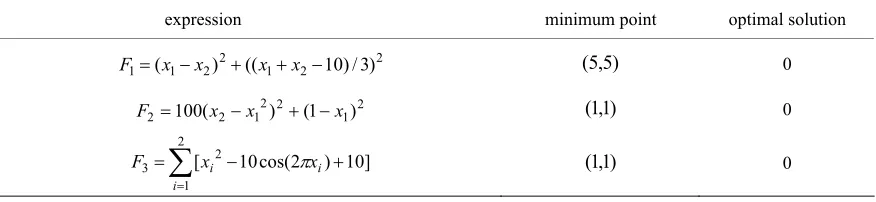
For investigating the modified PSO’s convergence and searching performance, three benchmark functions are used to compare with standard PSO in this section. The
basic information of three functions is described in
Ta-ble 1.
[image:2.595.79.517.622.723.2]Benchmark function 1 is non-linear single-peak func-tion. It is relatively simple, and mainly used to test the accuracy of searching optimization.
Table 1. Benchmark functions used in experiment.
expression minimum point optimal solution
2 2
1 2 2 1
1(x x ) ((x x 10)/3)
F (5,5) 0
2 1 2 2 1 2
2 100(x x ) (1 x)
F (1,1) 0
2 1
2
3 [ 10cos(2 ) 10]
i
i
i x
x
Table 2. Results of experiment.
Benchmark
function Algorithm Total number of iterations Mean of optimal solution Minimum of optimal solution Minimum times of iteration
standard PSO 20795 4.3708e-6 6.9446e-9 130
1
F
modified PSO 10595 2.1498e-6 1.26e-9 68 standard PSO 23836 1.7674e-4 1.9403e-8 205
2 F
modified PSO 21989 8.8366e-6 2.52012e-8 350 standard PSO 24990 0.0667 8.9467e-8 237
3
F
modified PSO 29611 7.7294e-6 9.5000e-9 853
Benchmark function 2 is typical pathological quad-ratic function which is difficult to be minimized. There is a narrow valley between its global optimum and the reachable local optimum, the chance of finding the global optimal point is hardly. It is typically used to evaluate the implementation of the performance optimi-zation.
Base on sphere function, benchmark function 3 uses cosine function to produce a mounts of local minimum, it is a typical complex multi-peak function which has the massive local optimal point. This function is very easy to make the algorithm into a local optimum not the global optimal solution.
In experiment, the population of group particle is 40;
1
candc2are set to 2; the maximum time of iteration is
10000. It is acceptable if the difference between the best solution obtained by the optimization algorithm and the true solution is less then 1e-6. In standard PSO and modified PSO, the inertia weight is linear decreasing inertia all, which is determined by the following equa-tion:
max min max
max
w w
w w k
iter
Figure 1. Path of standard PSO’s particle.
Where wmax is the start of inertia weight which is set
to 0.9, andwmin, the end of inertia weight, is set to 0.05.
max
iter is the maximum times of iteration; k is the
cur-rent iteration times. In order to reflect the equity of ex-periment, two algorithms all use the same original posi-tion and velocity randomly generated.
Parameter which represents the acceptable
lim-ited extent of the fitness value is set to 0.5 in modified PSO. For using less parameter, the dynamic
neighbor-hood is used and its radius is set tow. Each experiment
is Executed 30 times, and takes their total iteration times
and mean optimal solution for comparing. Table 2
pre-sents the results of experiment.
From Table 2, it is easy to find that the modified PSO
takes half time as standard PSO to achieve the best solu-tion of funcsolu-tion 1. Although the modified PSO has not remarkable improvement in convergence rate from func-tion 2, its mean optimal solufunc-tion is better than standard PSO, which implies the modified PSO has the better performance in global searching, the conclusion is proved in function 3. Though the total number of itera-tion of standard PSO is less than modified PSO, but its mean optimal solution is 0.0667, that indicate the rapid convergence of standard PSO is built on running into local optimal. On the contrary, the modified PSO can jump from local optimal successfully, that enhances the stability of algorithm greatly. Observe the results of modified PSO concretely; it can be found that the worst optimal solution of all iterations is 8.5442e-5, which indicates the convergence rate is 100%. The details of 30 loops will no longer run them out.
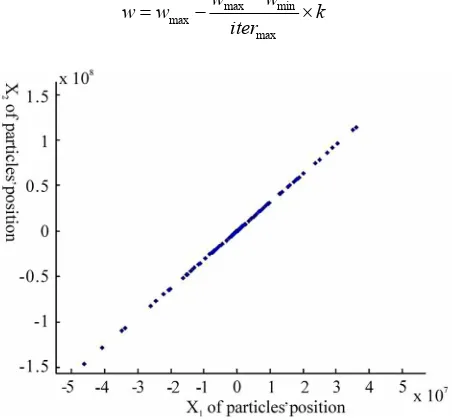
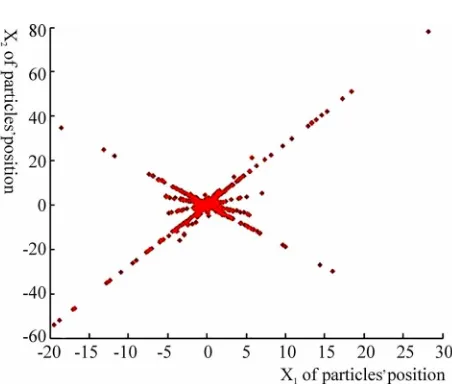
For observing the movement of particles from bench-mark function 3, the standard PSO and the modified PSO are run again by giving the same position and ve-locity of each particle initialized randomly. The result is that standard PSO has iterated 800 times for the optimal solution to be 1.3781e-6, and the modified PSO has iter-ated 1216 times for the optimal solution to be 6.3346e-7.
A particle is randomly chosen to observe its trace.
[image:3.595.59.286.493.703.2]Figure 2. Path of modified PSO’s particle.
From Figure 1 and Figure 2, it is easily to find out
that the particle of standard PSO was vibrating nearby the optimal position until converging at the optimal po-sition, otherwise, the particle of modified PSO has searched more domains then jumped from the local op-timal solution, which ensured the algorithm to converge to the global optimal solution stably.
Generally, the improvement of the modified PSO based on simulated annealing algorithm is applied to all particles. In order to compare the performance of algo-rithms, we proposed the second improvement to all par-ticles based on the ideas that mentioned before in this article, the main idea is that it is acceptable for all
parti-cles when their fitness would be worse in a limited
ex-tent at the next iteration, otherwise, new positions
are assigned to the particles randomly from their neighborhood with radius r.
[image:4.595.53.539.473.583.2]Next, the total iteration times and mean optimal solu-tion are compared between modified PSO and the sec-ond improvement from three benchmark functions. The parameters are set as following: the original velocity is 0; other parameters are just same as former case. The ex-periment is executed 100 times and same original set-tings are assigned randomly. The results are shown in
Table 3. If the maximum and minimum velocity of
par-ticles are limited to 1 and -1, Table 4 shows the results.
From Table 3 and Table 4, it is obviously that both
modified PSO and the second improvement can jump from local optimal convergence, which means they have the better global searching performance. For function 2 and function 3, the convergence rate of modified PSO is faster than the second improvement. It implied that al-though the modified PSO do some modifications to two particles’ movement, the results is not worse than do the same modifications to all particles’, sometimes, it has the better convergence performance. For function 1, when the velocity of particle is not limited, the perform-ance of modified PSO can not compare with the second improvement, but they have the same performance when
max
V and Vminare limited. If compare vertically, it can
be found that whether the modified PSO or the second improvement have better convergence rate when the velocity of particles is limited. Especially, the second improvement has half times iteration of the modified
Table 3. Performance comparison between modified PSO and the second improvement without limited velocity.
benchmark function total iteration times mean optimal solution
modified PSO second improvement modified PSO second improvement
1
F 33036 13063 4.3640e-6 1.5878e-6
2
F 72438 86025 1.3661e-5 2.3398e-5
3
[image:4.595.54.538.616.723.2]F 93506 155573 1.1128e-5 2.7690e-4
Table 4. Performance comparison between modified PSO and the second improvement with limited velocity.
benchmark function total iteration times mean optimal solution
modified PSO second improvement modified PSO second improvement
1
F 12381 12034 1.7625e-6 9.1580e-7
2
F 37917 60139 8.1302e-6 9.1149e-5
3
PSO. This proved that it is important for PSO to limit the velocity of particles.
5. CONCLUSIONS
In this paper, a modified PSO is proposed based on the simulated annealing algorithm. Through the results achieved in experiments, we can draw following conclu-sions:
1) The modified PSO has a better performance in sta-bility and global convergence; it is the most important conclusion.
2) Although the modified PSO do some modifications to two particles’ position and velocity, but its conver-gence rate for the multi-peak function is much faster as compared with the second improvement.
3) In modified PSO, the maximum and minimum ve-locity of particles have obvious impact on the conver-gence rate. How to choose the appropriate velocity limi-tation is the next step in our research.
REFERENCES
[1] Kennedy, J. and Eberhart, R.C. (1995) Particle swarm optimization. IEEE International Conference on Neural Network, 1942-1948.
[2] Shi, Y. and Eberhart, R.C. (1998) A modified particle swarm optimizer. Proceedings of Congress on Evolu-tionary Computation, 79-73.
[3] Shi, Y. and Eberhart, R.C. (1999) Empirical study of particle swarm optimization. Proceedings of the 1999 Congress on Evolutionary Computation, 1945-1950. [4] Wang, L.Z. (2006) Optimization of the solution to the
problems simulated annealing to improve particle swarm algorithm. Journal of Liuzhou Teachers College, 21(3), 101-103.
[5] Gao, S., Yang, J.Y., Wu, X.J. and Liu, T.M. (2005) Parti-cle swarm optimization based on the ideal of simulated annealing algorithm. Computer Applications and Soft-ware, 22(1), 103-104.
[6] Wang, Z.S., Li, L.C. and Li, B. (2008) Reactive power optimization based on particle swarm optimization and simulated annealing cooperative algorithm. Journal of Shandong University (Engineering Science),38(6),15-20. [7] Wang, L.G., Hong, Y., Zhao, F.Q. and Yu, D.M. (2008) A hybrid algorithm of simulated annealing and particle swarm optimization. Computer Simulation, 25(11), 179- 182.
[8] Gao, Y. and Xie, S.L. (2004) Particle swarm optimization algorithms based on simulated annealing. Computer En-gineering and Applications,40(1), 47-50.
[9] Pan, Q.K., Wang, W.H. and Zhu, J.Y. (2006) Effective hybrid heuristics based on particle swarm optimization and simulated annealing algorithm for job shop schedul-ing. Chinese Journal of Mechanical Engineering, 17(10), 1044-1046.