University of Warwick institutional repository: http://go.warwick.ac.uk/wrap
A Thesis Submitted for the Degree of PhD at the University of Warwick
http://go.warwick.ac.uk/wrap/49669
This thesis is made available online and is protected by original copyright. Please scroll down to view the document itself.
‘Early-years teaching of Science in Cyprus:
Appreciation of Young Children’s
Preconceptions
KAMBOURI MARIA
“Thesis submitted for the qualification of
PhD in Education”
University of Warwick
Institute of Education
2
Contents Pages
* List of tables and Figures ……….... 8 - 9
* List of Terms ……….. 9 - 10
1. Acknowledgements ... 10
2. Abstract ... 11
3. Introduction ... 12 - 13
4. Literature Review
4. 1. The context for the research ... 14 - 17
4. 1. 1. Educational System in Cyprus ... 17 - 18
4. 1. 1. a. Pre-primary and Primary Education in Cyprus ... 18 - 19
4. 1. 1. b. Secondary Education in Cyprus ... 20 - 21
4. 1. 1. c. Higher Education ... 21 - 22
4. 1. 1. d. Qualification in Cyprus ... 22 - 23
4. 1. 2. Cyprus’ National Curriculum ... 23 - 24
4. 1. 2. a. Cyprus’ National Curriculum throughout the years ... 24 - 26
4. 1. 2. b. Cyprus’ National Curriculum Today ... 26 - 28
4. 1. 2. c. Cyprus’ National Curriculum for Natural Sciences ... 28 - 29 4. 2. Children’s Learning ... 29
4. 2. 1. Constructivism ... 29 - 33
3 4. 2. 1. b. Social Constructivism ... 37
4. 2. 1. c. Lev Vygotsky ... 37 - 39
4. 3. Children’s Understanding of Science ... 39 - 41
4. 3. 1. Children’s Acquisition of Concepts ... 41 - 44
4. 3. 2. Examples of Children’s ‘Incorrect’ Concepts ... 44 - 47
4. 3. 3. Specific Research Examples ... 47 – 53
4. 3. 4. Labelling ‘Incorrect’ Concepts ... 53 – 57
4. 3. 5. How Preconceptions can be formed ... 57 – 59 4. 4. Teachers’ Role in Natural Sciences’ Teaching ... 60 – 63
4. 4. 1. Early-years teacher and constructivism ... 63 – 70
4. 4. 2. Previous Research Focusing on Teachers ………... 70 - 75
5. Research Questions
5. 1. Why Research in this Field is needed ... 76 - 77
5. 2. Research Questions ... 77 - 78
6. Research Methodology
6. 1. Educational Research Methods ... 79 - 80
6. 1. 1. Investigating Qualitative and Quantitative Methods ... 80 - 82
6. 1. 2. Mixed Methods Research ... 82 - 83
6. 1. 3. The Selected Research Methodology ... 83 - 84 6. 2. The Nature of this Case Study ... 84 - 88
4 6. 2. 1. a. Triangulation ... 90 - 91
6. 2. 1. b. Reliability and Validity ... 91 - 96
6. 2. 1. c. Sample and Participants ... 96 – 100 6. 3. Choice of Instruments ... 100 - 101 First Phase of Data Collection:
6. 3. 1. The Use of Questionnaires ... 102 - 104
6. 3. 1. a. Designing the Questionnaire ... 104 - 106
6. 3. 1. b. Piloting the Questionnaire ... 106 - 108
6. 3. 2. Key Informants’ Interviews ... 108 - 110 Second Phase of Data Collection:
6. 3. 3. Observations ... 110 - 111
6. 3. 3. a. Designing and Piloting the Observation Schedule ... 111- 116
6. 3. 3. b. Conducting the Observations ... 116 - 120
6. 3. 4. Interviews ... 120 - 125
6. 3. 4. a. Piloting the Interviews ... 125 - 127
6. 3. 4. b. Conducting the Interviews ... 127 - 128
6. 3. 5. Focus Groups ... 128 - 132
6. 3. 5. a. Piloting the Focus Groups ... 132 - 133
6. 3. 5. b. Conducting the Focus Groups ... 134
6. 3. 6. Document Analysis ... 135
6. 3. 6. a. Conducting the Document Analysis ... 135 - 137 6. 4. Ethical Issues ... 137
6. 4. 1. Informed Consent ... 137 – 139
5 6. 4. 3. Privacy, Anonymity and Confidentiality ... 140 – 146
6. 4. 4. Special Issues for Children ... 146 - 147
7. Analysis of data and Results
7. 1. First Phase of Analysis and the Results ... 148
7. 1. 1. Questionnaire Analysis and Results ... 148 - 150
7. 1. 1. a. Results deriving from the Questionnaires First Part ... 151 - 154
7. 1. 1. b. Results deriving from the Questionnaires Second Part 154 - 157
7. 1. 1. c. Results deriving from the Questionnaires’ Third Part .. 157 - 162
7. 1. 2. Analysis and Results based on the Key Informants’ Interviews ………... 162 - 163
7. 1. 2. a. Main Themes deriving from the Key Informants’ Interviews ………... 163 - 174
7. 1. 3. Main Results deriving from the first phase of Analysis ... 175
7. 1. 3. a. Main Results deriving from the Questionnaires ... 175 - 177
7. 1. 3. b. Main Results deriving from the Key Informants’ Interviews 177 7. 2. Second phase of Analysis and the Results ... 178
7. 2. 1. Analysis of Teachers’ Interviews and Focus Groups ... 178 - 180
7. 2. 1. a. Main Themes Deriving from Interviews and Focus Groups ....………... 181 - 182 7. 2. 1. b. Results based on the Free Nodes ... 183 - 194
7. 2. 1. c. Results based on the Tree Nodes ... 194 - 196
7. 2. 1. c. 1. Teaching Methods ... 196 - 199
6 7. 2. 1. c. 3. Teachers’ Topic Preferences ... 218 - 221
7. 2. 1. c. 4. Time devoted to Natural Sciences ... 221 - 225
7. 2. 2. Observations’ Analysis and Results ... 225 - 235
7. 2. 3. Document Analysis and Results ... 235 - 238
7. 2. 4. Main Results deriving from the Second Phase of Analysis ... 238
7. 1. 4. a. Main Results based on the Interviews and the Focus Groups ....………... 238 - 241
7. 2. 4. b. Main Results based on the Observations ... 241 - 242
7. 2. 4. c. Main Results based on the Document Analysis ... 242 - 243
8. Discussion and Suggestions ... 244
8. 1. Teachers’ Identification of Children’s Preconceptions ... 244 - 249
8. 2. Teachers’ Reaction to Children’s Preconceptions ... 250 – 252
8. 3.Teachers’ Training about Natural Sciences and Preconceptions ... 252 - 257
8. 4.Teachers’ Response to Children’s Preconceptions ... 257 - 266
8. 5. Resources and Equipment for Natural Sciences teaching .... 266 - 269 8. 6. Teachers’ Attitude and Knowledge towards Natural Sciences
... 269 - 270
8. 7. Teachers’ Familiarity with Children’s Preconceptions ... 270 - 272
8. 8. Children’s Common Preconceptions ... 272 - 274
8. 9. Teachers’ Opinion about how Preconceptions are created ... 274 - 277
7 8. 11. Main Differences between Private and Public School Teachers ... 279 - 281
8. 12. General Suggestions deriving from this Case Study ... 281 – 286
9. Limitations of the Study ... 287 - 288
10. Conclusion ... 289- 291
11. References ...292 - 311
12. Appendices
12. 1. The Questionnaire ... 312 - 318
12. 2. Questions for Key Informants Interviews... 319 - 322
12. 3. Observation Schedule ... 323 - 327
12. 4. Information Sheet for Observations ... 328 - 329
12. 5. Questions for Semi-Structured Interviews ... 330 - 331
12. 6. Questions for Focus Groups ... 332 - 333
12. 7. Table with the values of ‘p’ and ‘r’ based on the questionnaire ... 334 -335
12. 8. Children’s drawings... 336 -337
12. 9. Children’s worksheets ... 338 - 339
12. 10. Example of poster for ‘Weather’... 340
8
List of Tables and Figures
1: The Development of Cyprus’ National Curriculums through the years 2: Constructivist’s View Vs Objectivist’s View
3: Piaget’s Stages of Cognitive Development
4: Zone of Proximal Development according to Vygotsky 5: Topics and examples of ‘incorrect’ concepts
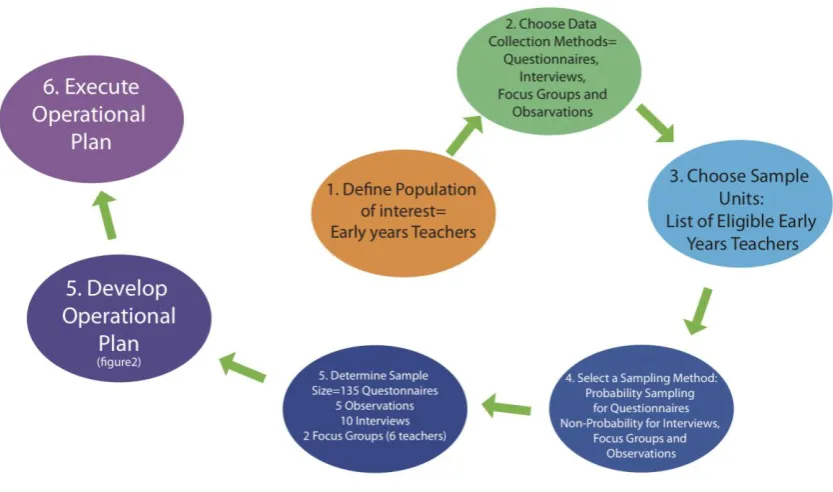
6: Terminology of preconceptions and alternative concepts for this study 7: Steps Followed in Developing the Sample Plan
8: The subsample selection for the questionnaire of this study 9: The subsample selection for this study
10: Factor Analysis: The graph below shows the Screen Plot when all questions of questionnaire are included.
11: Teachers’ Teaching Experience based on the Questionnaires 12: Teachers’ Place of Study based on the Questionnaires
13: Compare Means for each question for Public and Private school teachers 14: Themes deriving from teachers’ responses
15: Main Themes deriving from Key Informants’ Interviews 16: Information on teachers’ portrait
17: Free nodes: The main themes deriving from the interviews and the focus groups
18: The main themes deriving from the interviews and the focus groups are hierarchically presented
9 21: The topics that teachers feel confident to teach/ teach more often/ avoid teaching.
22: Information on teachers’ portrait
23: The main methods used during each lesson and a quick summary of each lesson and the activities.
24: Information for each lesson with focus on children’s preconceptions.
List of Terms
1: Concept: The term ‘concept’ is used throughout the thesis to refer to all the different ideas that children might have about science. This term includes the correct as well as the wrong ideas.
10 4: Misconceptions: This term is used to describe incorrect ideas that learners establish about scientific ideas after being taught those areas. This term was not used throughout the thesis; it was replaced with the term ‘alternative concepts’ to avoid connecting children’s ideas with the negative connotation that this term has.
1. Acknowledgements
I would like to thank the following persons who helped me for the completion of this research. Firstly, it would be an omission not to thank the teachers who willingly participated in my study and gave their consent to be recorded during the interviews. This gave me the opportunity to collect the necessary data for my study.
I am also thankful and I greatly acknowledge the advice and support of my supervisors, Dr Michael Cassidy and Mary Briggs, whose help and support was precious. I would not be able to complete my thesis without them. I really appreciate their patience and continuous guidance on my work.
It is also important to mention the help provided by friends and family who guided and supported me during the whole procedure and encouraged me with their helpful ideas. These would be my sisters Anna Armeni Kambouri and Nikoletta Kontou Kambouri and my friends Giorgos Yiakoupis, Irene Mardapitta, Achilleas Livadhiotis, Aristos Chrysanthou and Marilena Panayiotou.
11
2. Abstract
12
3. Introduction
It is no longer necessary to argue about whether or not children already have some knowledge and scientific concepts, before entering formal education, which will affect their school learning of science (Black & Lucas, 1993). It is generally accepted that children do not come to school as a “tabula rasa”, which means that they do not arrive to teachers as empty books waiting from them to fill them in with information (Pine, Messer & John, 2001). The same happens with the subject of Natural Sciences1. The science education community generally accepts the idea that students enter the classroom with their own understanding of the world (Henriques, 2002).
Some of the children’s everyday activities enable them to learn some science even before entering pre-school education (Bradley, 1996). The difference is made when the child attends kindergarten for the first time, where he meets science as organised knowledge instead of unstructured and random activities that can happen outside school. Thus, it can be acceptable to start from the premises where each child has established different concepts which are often inconsistently applied and, most importantly, which are remarkably resistant to change (Black & Lucas, 1993). Therefore, investigating the children’s preconceptions is necessary as it may provide guidance for future and in-service teachers on response to the children’s initial concepts.
This research is part of the sustained effort to better understand the nature of educational phenomena. Hitchcock and Hughes stated that research is the collection and analysis of information that will help to understand and explain the
1 Science for early years’ in Cyprus is labelled and known as ‘Natural Sciences’. For that, each
13 world better. Research refers to the process of collecting and analysing data and information and it usually derives from an inquiry that is characterised by sets of principles and guidelines for procedures, and any research is subject to evaluation in terms of criteria such as validity, reliability and representativeness. Gregory (2003) defined research as: a) the action or an instance of searching carefully for a specific thing or person, b) an investigation undertaken to discover facts and reach new conclusions by the critical study of a subject or by a course of scientific inquiry and c) the systematic investigation into a study of materials or sources to establish facts and collect information
The guiding philosophy involved in this research and which will define the basic characteristics of this research was chosen by me – the researcher- as the most suitable. This research is expected to provide useful information and guidance to teachers and policy makers. Despite the huge number of educational research conducted over the past decades, “there are few areas which have yielded a corpus of research evidence regarded as scientifically sound and as a worthwhile resource to guide professional action” (Psillos et al, 2003, p4).
14
4. Literature Review
4. 1. The context for the research
As this study is specifically interested in Cypriot teachers’ appreciation of young children’s preconceptions in Natural Sciences, it is considered necessary to make a reference specifically to Cyprus at first and then to Cyprus’ educational system and National Curriculum. The long continuity of historical and cultural tradition interacts with recent political and economic commitments in regard to its recent entrance to the European Union (Zembylas, 2002). According to Zembylas (2002), Cyprus can be considered as a developing post-colonial country that struggles to discover a balance between local traditions and global influences.
Cyprus has always had an adventurous history, mainly because of its geographical position - at the juncture of three continents - which indirectly affected the current situation with education in Cyprus. More precisely, over the past five centuries, Cyprus was conquered by the Ottomans (1571- 1870) and then passed to the British Empire which ruled until 1960, when it was declared an independent republic (Papadakis, 2008). The solution of independence failed to satisfy the expectations of the Greek majority of the island demanding union with the cultural motherland, Greece. In 1974, Turkey invaded the island and occupied approximately 40% of the total territory of the Republic.
15 education. In 2004, Cyprus entered the European Union and this development along with the globalisation on both economic and cultural levels created new needs to modernise science education in Cyprus (Zembylas, 2002).
Since 2010, the school year in Cyprus is divided into two terms; each term lasts for four months and includes several holidays for religious and cultural occasions. The first term starts in September and ends in January. Then, children have a four-day break. The second term starts just in February and ends in May. After that, the children have to prepare for their exams which end by the end of May / beginning of June. Early-year and primary school children do not have any exams and finish school at the beginning of June. Since temperatures are very high during summer, the break lasts almost three months as it would not be practical for children to attend classes during the summer (Cyprus life education, 2007- 2011).
16 children but it happens more often in secondary level (Cyprus life education, 2007- 2011).
It is also worth mentioning that the University of Cyprus was established in 1989, and before that the Pedagogical Academy of the Ministry of Education was the only institute which trained kindergarten and primary school teachers. To be able to study for free at the university of Cyprus students need to be accepted, after success at competitive entrance examinations at national level. Another option would be to study at one of the private universities in Cyprus or study abroad (e.g. Greece or Britain). The teacher training qualification is a four (4) year course and teachers are required to complete two (2) modules in regard to Natural Sciences. Qualified teachers that would like to work at a public school in Cyprus have to visit the Ministry of Education in Cyprus and register on a catalogue. At the moment there are two thousand and six hundred teachers on the specific catalogue waiting for their ‘turn’ to work in a pre-primary school within the public sector. Teachers might have to wait more than fifteen (15) years before they are given the opportunity to teach at a public school. Of course those teachers who want are free to find a teaching job at a private pre-primary school teach in these environment.
17 December, which is considered to be a rainy season in Cyprus. Thus, the context of the interviews and the lessons were not irrelevant with the children’s everyday experience at that period of time.
The hot climate and the continuous drought of the last two years have confronted Cyprus with the problem of water shortage. Cyprus faces serious problems of water shortage and this leads to the need of raising the public awareness and asking for their collaboration. Media is the main means used to inform the public and it is likely that the children have, to some extent, been informed about the particular matter. Teachers are free to use any handbooks, teaching materials and resources that they find useful. Their main reference when planning and teaching a Natural Sciences lesson though seems to be a reference book which was published in 2004 by the Ministry of Education (title: Natural Science in the Kindergarten – A reference book for the Early-years Teacher). The specific reference book includes examples of Natural Sciences lessons and is available to all pre-primary teachers (Nicolaou & Kiriakidou, 2004).
4. 1. 1. Educational System in Cyprus
18 undergraduate studies in subjects other than the ones taught in Cyprus institutions had to be pursued abroad.
The constitution of 1960 assigned responsibility for education to the Greek Cypriot and Turkish Cypriot communal chambers. After withdrawal of the Turkish Cypriots from all state institutions, the government proceeded with the establishment of the Ministry of Education and Culture (Ministry of Education) in 1965. Under this ministry, the education system evolved its present structure: one to two and a half years of pre-primary schooling for children aged from three (3) to five and a half years (5,5); six years of primary school for children aged from five and a half (5,5) to eleven and a half years (11,5); six years of secondary schooling, followed by two to three years of higher education for those who do not go for studies abroad (Solsten, 1991). Following, more details on these stages will be provided.
4. 1. 1. a. Pre-primary and Primary Education in Cyprus
19 educational opportunities across economic groups, and enable more mothers to secure gainful employment. The 1980s saw a further expansion of public education of this kind (Zembylas, 2002). Pre-primary institutions include public, private, and community-based nursery schools, day-care centres, and kindergartens.
The nursery schools are certified and supervised by the Ministry of Education whereas the day-care centres by the Department of Social Welfare and Services. A uniform curriculum is provided for the nursery school experience, promoting integrated development and preparation for citizenship. The Pancyprian School for Parents serves as a primary agency for parental education in Cyprus.
20
4. 1. 1. b. Secondary Education in Cyprus
Secondary education, which is also free, just like pre-primary and primary education, is open to all children who complete primary schooling without examination. Secondary education extends over six years (from twelve to eighteen). It is divided in two cycles, each consisting of three grades: the lower or gymnasium (from twelve to fifteen) and the upper or Lyceum (from fifteen to eighteen). Education in Cyprus is compulsory up to the age of fifteen and almost a hundred per cent of the students reach this level because education in Cyprus is a high priority in all social groups. During the first stage, the gymnasium, all students are taught the same general subjects, with a special emphasis on humanities. The second stage consists of either the lyceum, which offers five main fields of specialisation (classical studies, science, economics, business, and languages), or a vocational-technical course (Solsten, 1991).
21 courses, about one-fifth percent chose scientific courses and one-fifth percent, vocational-technical courses (Solsten, 1991).
Today, lyceum students are taught some main subjects which are compulsory for everyone but they also have to choose a number of subjects that they want to study in depth. Schools of the second category aim at providing industry with technicians and craftsmen. Vocational schools train many students for work in the country's important tourist industry; technical schools emphasised on mathematics, science, and training in various technologies. The above information is important for this study as it suggests that not all students are taught science during their secondary education; if they have not chosen science as one of their main subjects, it means that they were only taught science about one hour per week.
4. 1. 1. c. Higher Education
22 university level, 29 percent, was among the highest in the world. During the 1970s and 1980s, an average of more than ten thousand (10,000) Cypriots studied abroad annually. During the 1970s, more than half of these students were in Greece, and about one-fifth were in Britain. In the 1980s, the United States became an important destination for students going abroad, generally surpassing Britain. The number of women studying abroad increased markedly during the 1970s and 1980s, going from 24 percent in 1970 to 40 percent in 1987 (Solsten, 1991).
4. 1. 1. d. Teacher Qualification in Cyprus
23 As a result, in-service pre-primary teachers today may have graduated from the University of Cyprus or from the Pedagogical Academy of the Ministry of Education. They may also have studied at one of the recently qualified private universities of Cyprus or may have studied abroad mainly in Greece and Britain. This implies that in-service, as well as pre-service teachers, receive different kinds of training which can be difficult to identify. However, it is important to note that pre-primary and primary student teachers receive more or less the same training during their studies.
4. 1. 2. Cyprus’ National Curriculum
Cyprus has had a national curriculum in science since its independence from the British in 1960 with reviews being undertaken since then (a periodic review of 15 years or more) compared to other countries in the European Union (e.g. Germany, the Netherlands, Italy, Portugal) or in Korea and New Zealand in which the curriculum is reviewed every six (6) to ten (10) years (Zembylas, 2002). In Cyprus, the third and latest curriculum was completed in 1994 including the curriculum for Natural Sciences as well (Ministry of Education, 1996).
24 geography and social issues (Zembylas, 2002). An example of the strong ties between Cyprus and Greece is that until 1994 Cypriot teachers used Greek science textbooks because there were no science textbooks written in Cyprus or teachers’ support material to teach science. The preparation of school textbooks was the responsibility of committees of teachers and administrators, working in close cooperation with the educational authorities in Greece. Some instructional material for both primary and secondary education was donated by the Greek government (Solsten, 1991). Greece also provided the schools in Cyprus with modern teaching equipment.
4. 1. 2. a. Cyprus’ National Curriculum throughout the years
Tables & Figures 1: The Development of Cyprus’ National Curriculums through
the years
1935 The curriculum of 1935 includes natural history and rural science, euphemism for gardening, which replace ordinary science.
1960 Science curriculum writers in Cyprus face the task of developing a curriculum which takes into account modern global values.
1991 An American curriculum expert from Texas is invited to Cyprus to evaluate the situation and her observations reveal the problematic state of elementary science education.
25 As shown in the above table, in 1935 the main component of the colonial government’s policy was agricultural education because the government felt that the local socioeconomic conditions in Cyprus justified an emphasis on rural training. Thus, the curriculum of 1935 included natural history and rural science, euphemism for gardening, which replaced ordinary science. The British colonial administration seemed to believe that the training of elementary school children in the school gardens and the teaching of rural science were, under the circumstances, effective substitutes for proper agricultural education. Later, in 1960, science curriculum writers in Cyprus had to develop a curriculum that would take into account modern global values, including colonial ones, without destroying traditional ones (Papadakis, 2008).
Further on, in 1991, Stone, an American curriculum expert from Texas was invited to Cyprus to evaluate the situation and her observations regarding the problematic elementary science education were hardly surprising. According to Zembylas (2002), Stone’s report indicated that the time allotted for Natural Sciences was the minimum and teachers were not properly prepared to teach most topics in Natural Sciences. In addition, she noticed that instruction was achieved through reading texts and answering fact-oriented worksheets whereas limited Natural Sciences’ material and equipment, if any, were only available at schools for those teachers who wished to utilize activities in their lessons.
As Stone (1991:4) specifically highlighted: ‘there should be a multi-year plan from writing, piloting, modifying, and implementing a complete science
curriculum for all primary grades. The curriculum should be specific enough to
26
instructional strategies, yet flexible enough to allow for individual teaching
differences/skills among teachers’ (cited in Zembylas, 2002).
The latest curriculum development in 1994 was a natural consequence of numerous concerns expressed by teachers, administrators and the Ministry of Education, as evidence like the above accumulated over the years and indicated that Natural Sciences’ teaching was problematic. The administrators and the ministry officials received Stone’s observations positively and efforts began for the revision of the elementary science curriculum which affected the early-year’s curriculum as well (Zembylas, 2002). These efforts became synonymous with the development of new instructional materials and mainly new textbooks and teacher’s guides (which never existed before).
4. 1. 2. b. Cyprus’ National Curriculum Today
As a result, today we have a National Curriculum which was last revised in 1996 (Ministry of Education, 1996). It covers pre-primary and primary education as well. The main underlying theoretical perspective was formed by a) Stone, b) the inspector committees and c) the Department of Curriculum Development for Science. This ended up in writing the textbooks and the teachers’ guides. Moreover, professors teaching at the Pedagogical Institute and the Department of Education and a number of in-service teachers identified as enthusiastic about science contributed to these efforts (Zembylas, 2002).
27 emphasises the engagement of students in discovering scientific concepts for themselves. The students are guided to the desired objectives and conclusions with careful planning and direction. The policy statements on Natural Sciences, on the role of the teacher, and on Natural Sciences learning reflect this view and show the emphasis of the new philosophy on both the acquisition of scientific facts and principles and the implementation of scientific methods and skills. The objectives of the curriculum are concerned with providing the children with the scientific skills for the investigation and the understanding of Natural Sciences (Zembylas, 2002).
The curriculum revolves around thirteen (13) major themes or topics, which are structured in a ‘spiral’ way, so that they are taught over a period of several years, beginning with concrete experiences and moving to more abstract and in depth analyses. The scientific knowledge, skills, and attitudes to be learnt are stated in broad terms but provide enough guidance to teachers as to ‘what to teach and when’ (Zembylas, 2002). Especially the teachers’ guide (reference book), as the basic tool for guiding the teachers, has lessons that are analysed in detail so that the teachers are helped as they prepare to teach the material (Nicolaou & Kiriakidou, 2004).
28 based on the activities each lesson requires, to help teachers evaluate their teaching and to help the students understand and assimilate basic concepts and to acquire and develop scientific skills and right attitudes towards the teaching of Natural Sciences (Zembylas, 2002).
4. 1. 2. c. Cyprus’ National Curriculum for Natural Sciences
According to the Cypriot National Curriculum, children have a natural curiosity which makes them want to investigate and comprehend the world around them and how it works. School is considered to be responsible to strengthen the curiosity that children already have and guide them through their journey to improve their investigating skills, problem solving skills and enrich their scientific knowledge. The Cyprus’ National Curriculum recognises that Natural Sciences lessons should be connected to the children’s everyday experiences in order to enable the children develop their scientific perceptions (Ministry of Education, 1996).
29 and derive conclusions which also help the children develop scientific skills and have beneficial repercussions in the whole learning procedure (Ministry of Education, 1996).
4. 2. Children’s Learning
Children’s learning in science is about understanding the world around them (Guest, 2003). Thus, theories of learning deal with the ways a child learns, whereas, theories of teaching deal with the ways with which a teacher influences a child to learn. There is a close relationship between what a child learns and the variables that influence learning. As a result, once they have found out how children learn, teachers can help them learn better (Ausubel, 1968).
4. 2. 1. Constructivism
The opinion that ‘...knowledge is not transmitted directly from one knower
30 presupposes that the primary role of the learner is to assimilate whatever the teacher presents (Atherton, 2009).
Constructivism sees all knowledge to be instrumental (von Glasersfeld, 2002). Its central idea is that children’s learning is constructed and learners build new knowledge upon the foundation of previous learning. Thus, the learner is much more actively involved in a joint enterprise with the teacher constructing new concepts and learning is not thought as a passive transmission of information from one individual to another (Atherton, 2009; Hoover, 1996; Jaworski, 1993). The emphasis is on the learner as an active ‘maker of meanings’. It is the learner who interacts with the environment and, thus, gains an understanding of its characteristics in order to construct conceptualisations and find solutions to problems; this will lead to autonomy and independence (Thalasoulas, n.d). Distinctions can be made between ‘cognitive/personal constructivism’ and ‘social constructivism’ which share many common perspectives about teaching and learning even if they are different in emphasis.
31 grow out of social encounters. From this point of view, the knowledge-construction process comes through the learners being en-cultured into scientific discourses (Driver et al., 1994). In practice, this suggests that children should be involved in group activities that will enable scientific practices.
Constructivist learning environments have some main characteristics even if there is a range of processes by which knowledge construction takes place (Driver et al., 1994). For example, constructivist learning environment provides multiple representations of the reality, which avoid oversimplification and represent the complexity of the real world. They also give emphasis on knowledge construction and not on knowledge reproduction, and they provide learning environments such as real-world setting or case-based learning instead of predetermined sequences of instruction. These kinds of environments are ones that encourage thoughtful reflection on experiences and support collaborative construction of knowledge through social negotiation rather than through competition among learners for recognition. Finally, constructivist learning environments emphasize authentic tasks in a meaningful context rather than abstract instruction out of context (Jonassen, 1994 cited in Chen, 2007).
32
Tables & Figures 2: Constructivist’s View Vs Objectivist’s View
Objectivist’s View Constructivist’s View
Knowledge exists outside individuals and can be transferred from teachers to children.
Knowledge has personal meaning. It is created by individual children.
Children learn what they hear and what they read. If a teacher explains abstract concepts well, students will learn those concepts.
Learners construct their own knowledge by looking for meaning and order; they interpret what they hear, read, and see, based on their previous learning and habits. Children who do not have appropriate backgrounds will be unable to accurately “hear” or “see” what is before them.
Learning is successful when children can repeat what has been taught.
Learning is successful when children can demonstrate conceptual understanding.
33 Constructivism in science considers children to be ‘novice researchers’, instead of just ‘scientists’, as the first one gives a better appraisal of the learning situation as a (re)construction of knowledge. The view of ‘the child as the scientist’ has been criticised as it is difficult to oppose the view that children by themselves cannot construct all scientific knowledge. It is a mistake to think that children are practising scientists working in frontier domains (Psillos et al., 2003). A constructivist’s approach for Natural Sciences learning means that the children develop their conceptual understanding and learn more about the scientific opportunity and support reflection.
4. 2. 1. a. Jean Piaget
Piaget was the first to put forward the notion that children construct their own knowledge which is different from that of an adult (Black & Lucas, 1993). Although Jean Piaget (1896-1980) was a biologist, he moved into the study of the development of the children's understanding through observing them, talking and listening to them while they worked on exercises he set. For Piaget, a child’s view of the environment and the way that it operates is different in nature as well as degree of sophistication from that of an adult (Driver & Easley, 1978).
34 personal cognitive schemes which evolve through a process of adaption to more complex experiences and new schemes come into being by modifying old ones. He also believed that social interaction can play an important role in promoting cognitive development; however, he characterised equilibration at the individual level as essential (Driver et al., 1994).
Tables & Figures 3: Piaget’s Stages of Cognitive Development (Atherton, 2009)
Stage Characterised by
Sensori-motor
(Birth - 2 years)
Differentiates self from objects
Recognises self as agent of action and begins to act intentionally: e.g. pulls a string to set mobile in motion or shakes a rattle to make a noise
Achieves object permanence: realises that things continue to exist even when no longer present to the sense
Pre-operational
(2 - 7 years)
Learns to use language and to represent objects by images
and words
Thinking is still egocentric: has difficulty taking the view point of others
35
Concrete
operational
(7 - 11 years)
Can think logically about objects and events
Achieves conservation of number (age 6), mass (age 7), and weight (age 9)
Classifies objects according to several features and can order them in series along a single dimension such as size.
Formal
operational
(11 years and up)
Can think logically about abstract propositions and
test hypotheses systematically
Becomes concerned with the hypothetical, the future, and ideological problems
36 many other original investigators, his importance comes from his overall vision (Atherton, 2009).
Piaget’s constructivism is premised on his view of the psychological development of children. According to his theory, the basis of learning is discovery and understanding which are built up step by step through active participation and involvement (Thanasoulas, n.d). For him, this is necessary for a child in order to be capable of being productive and creative and not simply repeating other people’s ideas. Research into the children’s preconceptions has at least one important characteristic in common with Piaget’s work which is that “it takes the child’s view of the world seriously” (Black & Lucas, 1993, p.20). For Piaget, the child constructs his own logical concepts rather than discover them. Since concepts do not exist ‘out there’, they just cannot be discovered simply by being exposed. Within this framework, it is possible that some of the activities performed in nursery schools have to be devoted to the systematic initiation of science and phenomena (Ravanis & Bagakis, 1998).
37 maturity and cognitive development and this maturation could be similar to the stages identified by Piaget (Guest, 2003).
4. 2. 1. b. Social Constructivism
Socialconstructivism is more about how meanings and understandings grow out of social encounters in contrast to cognitive constructivism which is about how the individual learner understands things, in terms of developmental stages and learning styles (Atherton, 2009). Chen (2007) noted that there is a great deal of overlap between cognitive constructivism and social constructivism theory. Social constructivism emphasises more on the role that the teacher has and it gives much more room for an active, involved teacher. Culture is considered to give the child the cognitive tools needed for development. The type and quality of those tools establish the pattern and rate of development to a much greater extent than they do in Piaget's theory. Adults such as parents and teachers are conduits for the tools of the culture, including language. The tools the culture provides a child with include cultural history, social context, and language. Today they can also include electronic forms of information access (Chen, 2007).
4. 2. 1. c. Lev Vygotsky
38 teachers and older or more experienced children play a very important role in the children’s learning (Chen, 2007). From this perspective, a person with more experience can support a less experienced one to perform tasks and internalise processes since knowledge constructs through social engagement and dialogic activities (Driver et al. 1994).
Lev Vygotsky pioneered research in learning sciences and made a strong argument for the need the children have to demonstrate their knowledge by creating explanations and interpreting their work for others (Carvin, n. d). Vygotsky’s basic theory is the ‘Zone of Proximal Development’ (ZPD). In the ‘constructing skills’ check lists, it is common to have ‘cannot do yet’, ‘can do with help’, and ‘can do alone’ as possible answers. The ZPD is about ‘can do with help’ not as a permanent state but rather as a stage towards being able to do something on your own. Vygotsky's view was that instruction created within the Zone of Proximal Development (picture 1.1) stimulates development. From this point of view, instruction cannot be identified as development, but properly organised instruction can result in the child's intellectual development, can bring into being an entire series of such developmental processes, which would not be possible without instruction (Leat & Nichols, 1997).
Tables & Figures 4: Zone of Proximal Development according to Vygotsky
39 Vygotsky also observed that when children were tested on tasks on their own, they rarely did as well as when working in collaboration with an adult. The case was not that the adult was teaching them how to perform the task, but that the process of engagement with the adult enabled them to refine their thinking or their performance to make it more effective (Atherton, 2009). To Vygotsky, teachers served as mediators who coached and encouraged children to formulate their own level of understanding. Each child has a base level of knowledge, but they can increase it by practicing what they know well and adding onto it. The social interaction between the child, the teacher and other children reinforces their increase of knowledge (Carvin, n.d).
4. 3. Children’s Understanding of Science
40 McGinn (1998) said that science is part of the children’s life from the very beginning through television science programmes, visits to science museums etc. Guest (2003) explains that the children can be influenced by folklore (that eating carrots helps you see better during night time), or the media (that spaceships explode with sound).
Bradley (1996) further explains that the children’s innate understanding of science is acquired by physically using scientific principles in their play long before facing formal education. For instance, when children use a see-saw, they experience that by pushing up one end of the see-saw, the other end will go down, even if they may not be able to verbalise their understanding in terms of physics. Even bath time can be a stimulus for children since while playing with bath toys, they can experience sinking and floating (when they push bath toys under the water some of them will sink and some others will come back up). As a result, from the moment of birth (and some might say from the moment of conception) the children’s physical and social experiences through their personal exploration can lead them to develop their scientific understanding about the world around them (Johnston, 2005).
41 in order to help the children develop scientific concepts, skills and attitudes in the world of teaching. Nevertheless, it is helpful to be aware and know not only the children’s experiences but also our own experiences and alternative concepts as teachers (Johnston, 2005).
In regard to the children’s concepts, Johnston (2005) divided those concepts into 3 different categories. The first category, “factual knowledge”, refers to those concepts that children adopt through first-hand experience or secondary sources like television and books. The second category, “fictional knowledge or myths”, refers to secondary sources of knowledge like tales and stories. This is the reason why children are not always able to differentiate fact from fiction (Johnston, 2005). The third and last category is called “inferred knowledge” and it is about the children’s concepts that result from an interaction between their practical experiences and the existing concepts that they hold. These concepts may be inaccurate and can have a profound influence on further conceptual development (Johnston, 2005).
4. 3. 1. Children’s Acquisition of Concepts
42 to accept that the learning of concepts and conceptual change is in the centre of Natural Sciences learning for young children (Nussbaum, 1989).
‘The acquisition of concepts is what makes learning possible’ (Osborne & Gilbert, 1980). Thus, it is significant for science education research to understand how the children’s concepts are formulated. Accepting this view signifies the desire to investigate the children’s understanding of basic concepts as it informs teachers for the need to be aware of the possible perspectives children may bring to and difficulties children may have in Natural Sciences lessons (Osborne & Gilbert, 1980). Concepts can be thought of as “ideas or general notions of the attributes that are common to a class of objects or events” (Bradley, 1996, p.43). According to Bradley’s definition, the concept of “cat” would encompass all the essential qualities that are the same for all cats (four legs, tail, meat eater, facial whiskers etc), but would also apply to the big cats (lion, tiger etc).
43 On the other hand, while criticising Vygotsky’s work, Daniel (2002) realised that for Vygotsky scientific concepts are characterised by a high degree of generality and their relationship to objects is mediated through other concepts. Vygotsky divided concepts into ‘scientific concepts’, which are the ones introduced in a school by a teacher, and ‘spontaneous concepts’, which are those acquired by the child’s outside contexts in which explicit instruction is in place (Daniel, 2002). He added that for Vygotsky the most important concept is the one of “mediation” which opens the way for the development of a “non-deterministic” account in which the individual acts upon and is acted upon by social, cultural and historical factors” (Daniel, 2002, p.14). In all cases, the theoretical structure of the concepts, the attributes of the concept, the relationship between the concept and other concepts and the various contents associated with the concept, all need to be considered (Osborne & Gilbert, 1980). The children’s concepts affect the way that children understand a variety of scientific concepts like, for example, the fact that some students know that the Earth is round but they believe that Earth is a planet somewhere in the sky but not the planet they live on (Eaton, Anderson and Smith, 1984).
44 It is important to note that there are cases the child may not understand the concept in the way it was intended in the communication or the child might understand the intended concept but the particular context may suggest a different interpretation of the concept. This refers to the child’s understanding of a particular communication (e.g. via a teacher or a textbook). On the other hand, there are cases in which the concept is clearly specified through a given formal statement or definition which is accepted by the child as a definition that can be understood in the children’s actual domain of understanding of a particular concept (Daniel, 2002). As a result, apart from the problems a child faces when not understating a concept, these additional obstacles can create hidden difficulties.
4. 3. 2. Examples of Children’s ‘Incorrect’ Concepts
Children’s conceptions are strongly supported by personal experience and socialisation into a ‘commonsense’ view. According to Driver et al. (1994), a worldwide research has shown that the children’s informal science concepts are not completely different for each individual. There are common informal ways of modelling and understanding phenomena that are found among children from different countries, cultures, educational systems and languages. For example, children in different countries share the concepts that matter can appear and disappear or that gases do not have weight (ibid, 1994).
45 1995). As an example, Bradley refers to a four-year-old child and his explanation about why it rains. The child said “It rains because the sun shines on the top of the clouds and pushes the rain out and it rains down to us” (Bradley, 1996, p.3). A further example refers to the children’s confusion about shadows: “I think a shadow is a reflection from the Sun. Sometimes, when you look in a pond, you see a reflection. When you go somewhere where it can reflect, you see your shadow” (Russell & Watt 1992 p.81). Examples like these can be found in all areas that are taught in Natural Sciences. The topics taught in Cypriot early-year public schools are shown in Table 1.3 along with one example for each one of them.
Tables & Figures 5: Topics and examples of ‘incorrect’ concepts
Plants and Animals
Plants take their food in through the roots and then store it in their leaves.
Human body
The eye is the only organ for sight; the brain is only for thinking.
Weather – Earth - Space
The earth is sitting on something.
Ecology Plants only give off oxygen.
Matter Gases are not matter because most are invisible. Magnets All metals are attracted to a magnet.
Light
Light is associated only with either a source or its effects. Light is not considered to exist independently in space; and
46 (Ministry of Education in Cyprus, 1996; American Institute of Physics, 1998; Missouri Department of Elementary and Secondary Education (M.D.E.S.E), 2005)
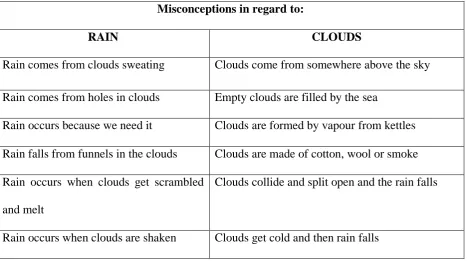
Some studies, like the ones carried out by the American Institute of Physics, have managed to design lists with the children’s common ‘incorrect’ concepts. The following list is a mixture of such ‘incorrect’ concepts in regard to ‘water cycle’, as this is the target topic for this study.
Rain comes from holes in clouds. Rain comes from clouds sweating. Rain occurs because we need it. Rain falls from funnels in the clouds.
Rain occurs when clouds get scrambled and melt. Rain occurs when clouds are shaken.
Clouds come from somewhere above the sky. Empty clouds are filled by the sea.
Clouds are formed by vapour from kettles. The sun boils the sea to create water vapour. Clouds are made of cotton, wool or smoke.
Rain falls from clouds when they collide and split open. Sound
Human voice sounds are produced by a large number of vocal chords.
47 Rain falls when clouds get cold.
When water evaporates, it just disappears and ceases to exist.
When water evaporates, it immediately goes up to the clouds or into the sun. Students have a difficult time accepting the concept of invisible particles of water in the air. (American Institute of Physics, 1998; M.D.E.S.E, 2005).
The above list is an example of how many different concepts children can have in regard to one specific topic. The problem though is that children develop these concepts which can then persist despite instruction. There are cases in which children were exposed to formal models or theories and had assimilated them incorrectly (Driver & Easley, 1978). This might suggest that children relate new knowledge to existing knowledge and, thus, when the existing knowledge is ‘incorrect’, it might lead to making wrong connections.
4. 3. 3. Specific Research Examples
Systematic researches into children’s concepts in science began in the late 1970s and most of them focused on secondary level. The main work at the primary level began with ground-breaking studies in New Zealand in the 1980s, and the SPACE2 project in the UK which studies the children’s concepts across the full range of the curriculum for children aged five to eleven years (Harlen & Qualter, 2004). Since then, researchers have been aware that the children’s conceptions, regarding Natural Sciences, are sometimes different from scientific conceptions (Eaton, Anderson and Smith, 1984). Treagust (1988) explains that most researchers followed Piaget’s approach to probing children’s thinking
48 through individual students’ interviews. During the last two decades there has been considerable research in this area and, according to Eaton, Anderson and Smith (1984), this research has demonstrated that students use their knowledge of the world to comprehend and their comprehension usually results from preconceptions or alternative concepts inadequacies (an explanation on these terms will be given later) in their background knowledge.
Eaton, Anderson and Smith (1984) aimed at finding out if the student’s alternative concepts interfered with science learning. The study is part of the Elementary Science Project and it focuses on the teaching of science of fourteen teachers, five of whom taught about light and nine about photosynthesis. As the researchers report, the teachers were selected because they were within driving distance and because they taught regularly. The data were collected through observations and audio-recordered lessons on the unit of light (Eaton, Anderson and Smith, 1984). It is worth mentioning that before the light and seeing unit was taught, children took a test which they took again after the unit had been taught. The results showed that students had difficulties in learning about light because neither their text nor their teachers dealt with their alternative concepts adequately. Specifically, they wrote that “experiences and common sense can sometimes lead to inaccurate or incomplete conceptions that can prevent a student from learning” (Eaton, Anderson and Smith, 1984, p.1).
49 melting of ice. Their investigation was based on the clinical interview technique. Forty-three children from eight to seventeen years old were individually interviewed using a series of events which involved ice melting, water boiling, evaporating, and condensing. For each of these events, the children were asked to describe what they saw happening and explain what had happened. Each interview lasted thirty minutes and was audio-taped; finally, the tapes were transcribed and analysed (Osborne and Cosgrove, 1983).
The sample of children for Osborne and Cosgrove’s (1983) research was selected from a range of classrooms with each classroom teacher selecting the child in order to establish the range of views held by children of average to slightly above average scholastic ability. The analysis of the interviews showed that children bring strongly held views in relation to their experiences to science lessons and these views appear to them as logical and sensible. For example, children have concepts about the changes in the state of water but these concepts are quite different from the views of scientists. Another important result of their research was that the concepts children have can sometimes be influenced by science teaching in unintended ways (Osborne & Cosgrove, 1983).
50 children between seven and eleven year-olds talk about primary sources almost four times more than they talk about secondary sources of light (Driver et al., 2001, p.128). The same research studied the children’s representations of light and it found that almost all children drew the light around sources by using short lines while the extensive number of lines linking the source with the object was limited. A few children did not use any representation and for others the representation was limited to simple lines surrounding the source (Driver, et al., 2001, p.128). The above research example suggests that children hold some ‘incorrect’ concepts which may affect their acquisition of new concepts in negative ways.
Another research example is the one of Valanides, Gritsi, Kampeza & Ravanis (2000) which is interesting as it was conducted in Greece with early-years children and focused on changing pre-school children’s conceptions of the day / night cycle. A sample of thirty three (33) children (twenty-five (25) girls and eight (8) boys) whose mean age was five point five (5.5) years was interviewed in order to identify the children’s concepts about the shapes of the Sun and the Earth as well as the cause of the day / night cycle. The sample of the children was randomly selected from the total number of five- (5) to six- (6) year-old children in three (3) kindergartens and none of the children had already received any formal or informal instruction concerning the respective topics. The selected kindergartens were in an urban area with a population of mixed socio-economic status.
51 teaching intervention took place with groups of six (6) or seven (7) children, lasted for approximately thirty (30) minutes and one researcher was teaching while the second one was assisting. The effectiveness of the intervention was evaluated two (2) weeks later using an interview similar to the one used prior to the intervention (Valanides et al., 2000).
According to Valanides et al. (2000), the results of the study indicated that the majority of children easily accepted that the Sun and the Earth are different spherical objects, but fewer children attributed the day / night cycle to the Earth’s rotation on its axis. Most children seemed puzzled by the simultaneous movements of the Earth around the Sun and around its axis. The results of this research support the view that children do not passively absorb information. They bring their own views of the world to any teaching learning situation. For the specific study, the range of the preconceptions about the shapes of the Earth and the Sun as well as the cause of day / night cycle are the outcomes of a personal construction process showing that individuals construct their own meanings from sensory inputs. This is even more important when there is a sequence in which concepts are acquired on a conceptual domain (Valanides et al., 2000).
52 well. According to Ravanis and Bagakis (1998), the sample of the research was taken at a Greek kindergarten. The sample consisted of forty-nine (49) randomly selected children with an average age of five and a half years old (5.5) and their parents had no specific education in science.
Ravanis and Bagakis (1998) used a pre-test and a post-test which included semi-structured interviews that were reordered, and a teaching intervention half-way the interview. During the pre-test and the post-test a small plate with a small quantity of water was placed on a camping-gas stove and the children were asked to predict what would happen if the water was heated for a long time. During and after the experiment, a discussion about the phenomenon took place.
The teaching intervention took place a month after the pre-test and aimed at helping the children understand and be able to describe how the transformation from the liquid to the gas state was done. The activity was done by each child individually in a specially designed space in the school, outside the classroom. Ravanis and Bagakis (1998) pointed out that their strategy had a socio-piagetian approach based on the student - teacher interaction. It included the comments of a series of pictures with the gasification and liquefaction phenomenon and the observation and comments of the gasification and liquefaction process in a simple transparent distillation apparatus. Although the liquefaction process was not included in the objectives of the teaching intervention, it was used since the observation of an elementary water cycle was thought to be helpful for children to relate water vapour to water (Ravanis & Bagakis, 1998).
53 phenomenon (during the pre-test) and their answers were strongly influenced by their everyday experiences. Additionally, when the children were asked ‘where does the water go?’, some of them gave efficient answers (in the air, it becomes vapour and leaves upwards), some others made hypotheses and gave answers based on the experimental apparatus (the water went into the bottle of the camping-gas, it was sucked by the desk, it went to the soil) and some did not give an answer (Ravanis & Bagakis, 1998). It is worth mentioning that the number of correct answers was bigger after the teaching intervention (pre-test: 3-4 correct answers, post-test: 43-44 correct answers). This might indicate that the socio-cognitive perspective of the teaching interaction and the student-teacher interaction can help children overcome their cognitive obstacles. However, teachers are not always able to have one-to-one sessions with their students like the specific researchers did.
4. 3. 4. Labelling ‘Incorrect’ Concepts
54 al. (cited in Treagust, 1988) labelled them as ‘children’s science’ (Driver, 1981). Other authors used labels such us ‘alternative conceptions’, ‘intuitive theory’, ‘non-scientific ideas’ and ‘children’s ideas’ (Guest, 2003; Hamza & Wickman, 2007).
In 2007, with a search on ERIC, Hamza & Wickman found three hundred and twenty-eight (328) hits for “misconceptions” AND science between the years 2000 and 2006, whereas a search for science AND “alternative conception”, “alternative framework” or “intuitive theory” gave forty two (42) hits altogether. Today, with a search on ERIC, more than 2000 hits are found for “misconceptions” AND science, whereas a search for science AND ‘alternative concepts’, ‘alternative frameworks’, ‘intuitive theory’, ‘preconceptions’ or ‘non-scientific ideas’ gives fewer than 700 hits altogether. This is a remarkable difference which proves that the term “misconceptions” is the one most widely used in the literature. However, this cannot be taken as evidence that ‘misconception’ is the correct term for the purposes of this research. This is why a distinction needs to be made between some of the terms that have been used by authors in order to choose the most appropriate one to use in this study.
55 use to understand and make predictions about the world” (p.303). They reported that such knowledge is based on the students’ experience which explains how the world works, but in an incorrect way (Andre & Ding, 1991). It seems that, in most cases, the term ‘misconception’ is used to describe the children’s concepts that have the characteristics of incorrect models or theories.
56 with accepted physical theory. Clement, Brown and Zietsman (1989, p.555) referred to these as ‘anchoring conceptions’, or else, ‘anchors’ which are ‘an intuitive knowledge structure that is in rough agreement with accepted physical theory’.
57
Tables & Figures 6: Terminology of preconceptions and alternative concepts for this study
Preconceptions Alternative concepts
Age range From birth – 7 years old 8+ years old and adults
Learners’
Education
Limited or no exposure to science teaching
Repeated exposure to science teaching
Characteristics Resistant to change Resistant to change
4. 3. 5. How Preconceptions can be formed
Preconceptions like the ones mentioned above can be formed in various ways and they are often passed on by one person to the other and usually people who hold such concepts are not aware that their concepts are not correct (Hanuscin, 2007). This is why, when they are told that what they believe is incorrect, they find it difficult to overcome their beliefs, especially if they have had them for a long time (Hanuscin, 2007). This is very important because, as it has already been said, knowledge is constructed by building new understandings on previous conceptions and, if the previous conceptions are incorrect, the impact on learning is very serious. It is also important to mention that children who hold such incorrect concepts can convince others in a group to believe them (Snyder & Sullivan, 1995).
58 1994). Commonsense explanations have their role, as well, since they differ from the knowledge accepted by the scientific community since commonsense reasoning is usually free of rules in contrast to scientific reasoning (ibid, 1994). Language is another source of preconceptions since common words, which are also used in everyday life but do not have the same meaning when used in Natural Sciences, can confuse children and lead to preconceptions (Hanuscin, 2007).
Cohen and Kagan (1979) and Hanuscin (2007) agree and add that preconceptions can arise when two or more learnt concepts get mixed up. An example that Hanuscin (2007) gave when explaining this is that while it is acceptable to say “the toast burnt” in an everyday conversation, it is highly unlikely that a chemist would agree with this observation. Cohen and Kagan (1979) characterise this as verbal confusion and believe that it is the most common way to form a preconception which might lead to an alternative framework. We could say that preconceptions and alternative concepts arise from both verbal and conceptual confusion (ibid, 1979).