University of Warwick institutional repository: http://go.warwick.ac.uk/wrap A Thesis Submitted for the Degree of PhD at the University of Warwick
http://go.warwick.ac.uk/wrap/51338
This thesis is made available online and is protected by original copyright. Please scroll down to view the document itself.
Simulation and Artificial Intelligence for understanding and
improving decision making in an operations system
By
Thanos Alifantis BSc (Lancaster)
A thesis submitted in partial fulfilment of the requirements for the degree of
Doctor of Philosophy in Industrial and Business Studies
Operational Research and Information Systems Group
University of Warwick, Warwick Business School
Knowledge Based Improvement: Contents
Contents
Chapter 1. Introduction ... 1
1.1 The foundations of simulation modelling ... 1
1.2 Motivation and aim of the research ... 2
1.3 Overview and outline of the research ... 4
Chapter 2. Current approaches for modelling decision making in simulation ... 6
2.1 The process involved in the use of simulation for improving decision making: an overview of the challenge ... 6
2.2 Knowledge elicitation techniques ... 8
2.2.1 VIS for knowledge elicitation ... 8
2.2.2 Alternative knowledge elicitation techniques ... 15
2.2.3 Discussion: knowledge elicitation techniques ... 19
2.3 Knowledge modelling: techniques for modelling decision making using data collected from a simulation ... 20
2.3 .1 Quantitative knowledge modelling techniques ... 20
2.3.2 Qualitative knowledge modelling ... 27
2.3.3 Discussion: techniques for modelling decision making strategies ... 28
2.4 Techniques for representing and linking decision making models with simulation 28 2.4.1 Agent technology and object orientation ... 29
2.4.2 Remote expert controller ... 31
2.4.3 Integration with third party applications ... 32
2.4.4 Discussion: representing and linking decision making models with simulation 32 2.5 Current methodologies for modelling human decision making in simulation ... 33
2.5.1 Nature of decision making ... 34
2.5.2 Motivation of modelling ... 35
2.5.3 Psychological content ... ~ ... 37
2.5.4 Contextual Content ... 39
2.5.5 Type of knowledge ... 41
2.5.6 Summary of methodologies ... 41
2.7 Conclusion ... 4.5 Chapter 3. Research programme design ... 4 7
3.1 Aim, objectives and research questions ... 47
3.2 Research programme ... 49
3.2.1 Research methods ... 49
3.2.2 Research strategy ... 50
3.2.3 Validation strategy ... 51
3.3 Research boundaries and limitations ... 51
3.4 Conclusion ... 53
Chapter 4. Formation of the Knowledge Based Improvement methodology ... 54
4.1 The theoretical foundations of KBI. ... 54
4.2 Required stages ... 55
4.3 Outline of the KBI methodology ... 56
4.3 .1 Stage 1: Understanding the decision making process ... 57
4.3.2 Stage 2: Data collection ... 59
4.3.3 Stage 3: Determining the experts' decision making strategies ... 60
4.3.4 Stage 4: Determining the consequences of the decision making strategies ... 61
4.3.5 Stage 5: Seeking improvements ... 62
4.4 Conclusion ... 63
Chapter 5. Evaluation of stage 1 of the Knowledge Based Improvement methodology .. 64
5.1 Steps of stage 1 ofthe KBI methodology ... 64
5 .2 Preliminary investigation ... 65
5.3 Pilot data collections ... 67
5.3 .1 The first pilot data collection ... 68
5.3 .2 The second pilot data collection ... 71
5.3 .3 The third pilot data collection ... 73
5.3.4 The fourth pilot data collection ... 78
5.3.5 Conclusion from the pilot data collections ... 81
5.4 Problem definition ... 82
5.5 Conceptual model ... 88
Knowledge Based Improvement: Contents
5.5.2 Conceptual model expressed ... 90
5.6 Data requirements ... 92
5.7 Evaluation and analysis ... 93
5.8 Conclusion ... , ... 95
Chapter 6. Evaluation of stage 2 of the Knowledge Based Improvement methodology .. 96
6.1 Steps of the data collection process ... 96
6.2 Simulation based data collection: System development ... 96
6.2.1 Requirements specification ... 97
6.2.2 Functionality and architecture ... 99
6.2.3 Decision Situation Generator ... 100
6.2.4 Decision Situation Filter ... 103
6.2.5 Data collector ... 104
6.3 Data collection ... 106
6.3 .1 Decision situations generation process ... 106
6.3 .2 Decision capturing process ... 109
6.4 Evaluation and analysis: Towards a simulation-based knowledge elicitation approach ... 112
6.5 Conclusion ... 115
Chapter 7. Evaluation of stage 3 of the Knowledge Based Improvement methodology 116 7.1 Dimensions reduction ... 116
7.2 Method of analysis ... 119
7.3 Rule induction ... 120
7.3 .1 Model calibration with automatic rule induction ... 121
7.3.2 Model calibration with semi-automatic rule induction ... 124
7.4 Evaluation and analysis ... 127
7.5 Conclusion ... 130
Chapter 8. Evaluation of stages 4 & 5 of the Knowledge Based Improvement methodology ... 131
8.1 Representation of the decision making process in the simulation model.. ... 131
8.2 Experimental design ... 135
8.2.2 Decision scenarios and their inter-arrival times during the simulation run ... 136
8.2.3 Decision attributes ... 137
8.3 Simulation results ... 138
8.4 Statistical validation ... 140
8.5 KBI Stage 5: Seeking improvements ... 143
8.6 Evaluation and analysis ... 144
8.7 Conclusion ... 145
Chapter 9. Discussion and refinements of the KBI methodology ... 146
9.1 KBI stages 1 and 2 ... 146
9.1.1 Testing KBI stage 1 ... 147
9.1.2 Testing KBI stage 2 ... 148
9 .1.3 Evaluation of stage 1 and 2 ... 150
9.2 KBI stage 3 ... 152
9.2.1 Testing KBI stage 3 ... 152
9.2.2 Evaluation ofKBI stage 3 ... 153
9.3 KBI stages 4 and 5 ... 154
9.3.1 Testing KBI stages 4 and 5 ... 155
9.3.2 Evaluation ofKBI stages 4 and 5 ... 155
9.4 Scope and limitations of KBI ... 156
9.5 Conclusion ... 159
Chapter 10. Conclusion ... 160
10.1 Summary ofthe research ... 160
10.2 Aim, objectives and research questions- what has been achieved ... 161
10.3 Key findings ... 163
10.4 Contribution to knowledge ... 163
10.5 Limitations ... 164
10.6 Future research ... 165
References ... 167
Appendix 1: Decision Trees ... 176
Appendix 2: Visual Basic interface for linking Witness with XpertRule ... 183
Knowledge Based Improvement: Figures and Tables
Figures and Tables
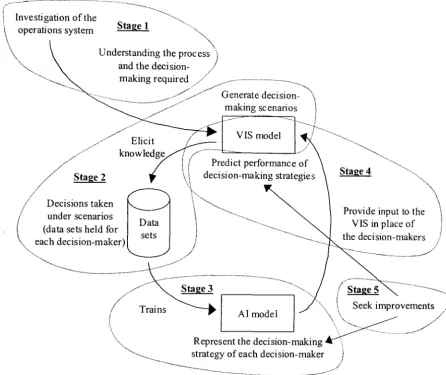
Figure 4.1: KBI stages and process - Robinson et al 2005 ... 57
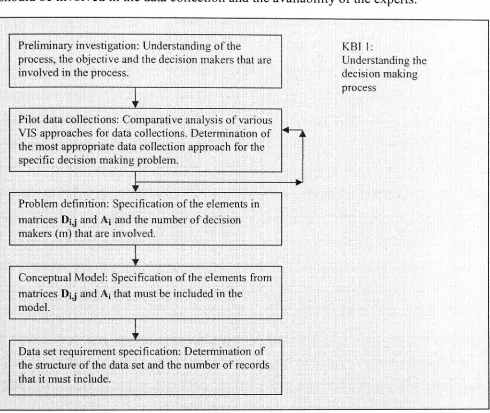
Figure 5.1: Understanding the decision making process (KBI Stage 1 ) ... 65
Figure 5.2: Structure of the first pilot data collection ... 70
Figure 5.3: Second pilot data collection ... 72
Figure 5.4: Third pilot data collection ... 74
Figure 5.5: Structure of the third pilot data collection ... 76
Figure 5.6: Structure of the fourth pilot data collection ... 80
Figure 5.7: Decision-making process ... 82
Figure 6.1: Simulation-based data collection process (KBI Stage 2) ... 96
Figure 6.2: Architecture of the data collection system ... 100
Figure 6.3: Decision situation generator- Front end ... 103
Figure 6.4: Decision situation filter- cluster chart ... 104
Figure 6.5: Data collector- Decision maker's ID form ... 105
Figure 6.6: Data collector - Decision situation & Decision input forms ... 105
Figure 6.7: Decision situations- simulated population (top) and sample (bottom) ... 108
Figure 7.1: Branches from the trees tDM/ & tDM/ ... 123
Figure 7.2: Inverted rule in tDMI s ... 126
Figure 8.1 Model representation of the by-passing process ... 133
Figure 8.2: Witness XpertRule link ... 135
Figure 8.3: Simulation prediction- throughput levels under different decision making policies ... 139
A1.1 tDM/: Decision tree generated with automatic ID3 that represents strategy DMI. 177 Al.2 lDM/: Decision tree generated with automatic ID3 that represents strategy DM2. 178 A1.3 tDM/: Decision tree generated with automatic ID3 that represents strategy DM3. 179 A1.4 tDM/: Decision tree generated with semi-automatic ID3 that represents strategy DM1 . ... 180
Al.6 lDM/: Decision tree generated with semi-automatic ID3 that represents strategy
DM3 ... 182
Figure A2.1: Communication interface to collect attribute information ... 183
Figure A2.2: Communication interface to invoke and control XpertRule ... 183
Figure A2.3: Communication interface for passing the decision to Witness ... 183
Figure A2.4: Communication interface for passing control to the simulation ... 183
Table 2.1: Types of VIS for knowledge elicitation ... 10
Table 2.2: Current approaches for modelling decision making in simulations ... 42
Table 5.1: Decision attributes ... 88
Table 6.1: Range of attribute values ... 107
Table 6.2: Fields in the data set ... : ... Ill Table 8.1: Simulation prediction - mean daily throughput and standard deviation ... 139
Table 8.2:% of Stand by versus Repair Immediately decisions ... 140
Table 8.3: 98.33% paired-t confidence intervals for differences in daily throughput between each decision making strategy ... 141
PAGE
MISSING
IN
Acknowledgements
I am indebted to a number of people who have offered help and encouragement during the course of this research.
Firstly, I would like to thank my supervisor Professor Stewart Robinson for his initial idea, his time, his encouragement and for offering me the opportunity to work as a research student in the EPSRC project GRJM72876.
Secondly, I would like to thank my second supervisor Dr Robert Hurrion for his comments during the early stages of this work and for inspiring me by being the originator of the Visual Interactive Simulation.
Thirdly, I would like to thank John Edwards (Aston University), John Ladbrook (Ford), Tony Waller (Larmer Group) and Peter Walton for their useful comments and for
providing the information and the support that contributed to the validation of this research.
Also thanks go to the Group Leaders and production managers in the Ford engine plant at Bridgend for their involvement in this research and for contributing to its validation.
The research would not have been possible without financial support. The Engineering and Physical Research Council, Ford and the Lanner group provided the funding.
Finally, on a personal note, I would like to express my appreciation to my parents and to all my colleagues and consultants at AEA Technology Rail in London for their
Knowledge Based Improvement: Abstract
Abstract
The thesis investigates the possibility of using simulation for understanding and
improving the design of decision making in a real context. The approach is based on the problem of representing decision making behaviour in Discrete Event Simulation.
An investigation of existing techniques led to the design of a methodology known as Knowledge Based Improvement (KBI). The KBI covers the key stages of the process of using simulation for understanding and improving the design of decision making. Using a research strategy that involves a case study in Ford, the research tests each stage of KBI.
The thesis explains how simulation can be used for understanding real decision making problems and for collecting the data required for modelling individual decision making strategies. The thesis demonstrates the possibility of a simulation based knowledge elicitation in a real context and it investigates the practical difficulties involved in this process.
The research tests the process of understanding decision making policies by modelling specific decision makers using Artificial Intelligence. It tests the use of simulation for assessing the decision making strategies and it shows that simulation can be used for identifying efficient strategies and for improving the design of decision making practices.
The thesis reports the degree of success of the approach in relation to the data that were collected and it describes the validation checks that were undertaken. In addition, it reports the lessons learned from the application of the KBI methodology, the overall success of the approach and the main limitations that were identified during the implementation.
KBI OR
Simulation VIS
VIM AI WES ID3 UI DM ERT
Abbreviations
Knowledge Based Improvement Operational Research
Discrete Event Simulation Visual Interactive Simulation Visual Interactive Modelling Artificial Intelligence
Warwick Expert Simulator Iterative Dichotomiser 3 User interface
Decision Maker
Chapter 1: Introduction
Chapter 1
Introduction
1. 1 The foundations of simulation modelling
Discrete Event Simulation (Simulation) is one of the most commonly applied techniques in Operational Research (OR) (Jeffrey & Seaton 1995, Fildes & Ranyard 1997, Clark
1999, Robinson 2005). Simulation involves the development and analysis of computer based models that simulate systems which exist or are going to exist in the future. Amongst other things, those models can be used for cost effective and safe
experimentation and as a tool for understanding the behaviour of real systems.
Simulation started to emerge in the early fifties, but it was formally introduced by Tocher (1963). Tocher's seminal book set the foundations which underlined the rationality of using simulation for solving real world problems. In his book, Tocher assumed that systems are collections of subsystems that interact with each other. This interaction generates an emerging dynamic behaviour which cannot be captured with mathematical representations. In an effort to predict the effect of a change in the configuration of the system, Tocher (1963) proposed to model systems by developing computer based simulations.
Almost 40 years after Tocher's original contribution, the use of simulation modelling has been expanded and now accounts for a major percentage of the OR applications (Fildes &
Ranyard 1997). A significant contribution towards making Simulation a mainstream approach and for expanding its scope was Hurrion's (1976) development of Visual Interactive Simulation (VIS). The development of VIS made the use of simulation relevant for a wide variety of applications. Hurrion's contribution to the simulation community is summarised by Bell & O'Keefe (1994) who comment:
animation and run time interaction with a simulation model of an operational system in his 1976 PhD thesis and reported this in subsequent papers"
Hurrion ( 1978) & Hurrion ( 1980) report applications of running simulations of operating
rules for a job shop scheduling problem. In these papers, which form the first journal-based published research in VIS, it was found that the human scheduler was using rules that were difficult to embed in the simulation model. To resolve this problem an
interactive simulation model was developed and the control was passed to the human scheduler at various points in time. To provide the necessary information about the status of the system which the scheduler required in order to make a scheduling decision, an iconic visual display was used.
With this problem-solving approach, Hurrion created a new paradigm. The VIS paradigm which, soon after the appearance of the above publications, was generalised to produce a package for programming VIS called Vision, led to the development of See Why (Fiddy et al 1981) and made VIS commercially available. This was the beginning of a new era in simulation. VIS software became a simulation standard and attention in simulation research and practice was diverted towards a different methodological approach that involved the use of the new tool. In subsequent years, Hurrion' s VIS approach became so popular that now, apart from its application in quantitative modelling, it is also used as a tool for interpretative modelling. The reason for this, as explained by Bell and O'Keefe (1994), is that it can be used for problem-structuring purposes since the visual model can act as problem-definer tool, a vehicle for the decision maker and the modeller to learn from the problem together.
1.2 Motivation and aim of the research
Today, with Hurrion's ideas to underline and shape the simulation modelling practice, simulation packages are available and are used for modelling virtually any type of operations systems. As described by Robinson (2004 ), an operations system is a
Chapter 1: introduction
systems usually involve a significant element of human- machine interaction (Williams 1996) where human decision makers are involved in decisions that have a significant impact on the performance of the systems. The operations of manufacturing plants include production and maintenance scheduling that may involve human decision making
(Proudlove et al 1998). In the service sector, service operations systems may include personnel who may be involved in a decision making process as they interact with the rest of the system. For example, in transportation systems such as railway networks and
airports where simulation modelling is extensively applied (Robinson & Stanger 1998),
decision makers such as signallers and air traffic controllers are usually involved in a number of scheduling activities which very often require decision making.
Although the modelling and representation of the human decision making process is essential for understanding and improving decision making using simulation, the latter usually overlooks the effect of human decision making or it adopts a very simplistic approach towards modelling it. This is probably because modelling human decision making in simulation presents a number of challenges. Most simulation tools do not provide a full set of functions which would be useful for modelling human decision making (Williams 1996). A more fundamental challenge is that of representing human decision makers with individual characteristics and behaviour. This would require an understanding of what the decision making process involves and how the decision makers reach decisions. In addition, if the purpose of the simulation exercise is to identify and assess good decision making practices, then this would require a methodology for assessing decision making strategies using simulation.
The extensive use and potential of simulation, combined with developments in related disciplines such as computer science and artificial intelligence (Doukidis 1987), have motivated a number of authors, including Flitman & Hurrion (1987), to propose
approaches which attempt to identify and model complex entities with ill-defined
applications in which human decision making entities are involved, the decision making strategies are either excluded or modelled simplistically. Motivated by the absence of substantive empirical evidence to justify and demonstrate the feasibility, the difficulties and the benefits of modelling human decision making in simulation, the aim of the research (section 3.1) is:
To develop and test the use of simulation for understanding and improving the design of decision making policies in a real context.
1.3 Overview and outline of the research
The aim of the research (section 3.1) is derived through a review ofthe literature (Chapter 2). In order to achieve the research aim a number of objectives are identified. Based on these objectives the research forms and evaluates a methodology for capturing efficient decision making.
The research is applied and tested on an engine assembly line at a Ford Motor Company (Ford) plant in Wales. In the engine assembly, engines are passed through a series of automated and manual processes. From time to time the automated machines break down and require repair. It is the decisions surrounding what happens when a machine fails that are the focus of the research.
An existing simulation model of the engine assembly line is adopted to form a prototype that is used throughout the research. Originally developed for production planning and bottleneck detection, the existing model represents machine breakdowns and maintenance that involves immediate machine repairs. However, it does not reflect the decision making process that takes place in the real system.
Chapter 1: introduction
Chapter 2 describes the methodologies and the techniques that have been used in the past for modelling decision making in simulation. It explains how the current research is related to previous work and it concludes by identifying a number of potential research areas. Chapter 3 describes the research questions and the research design. It justifies the methodological approach and provides an overview of its limitations. Based on theoretical developments by previous authors, Chapter 4 forms a methodology for capturing efficient decision making using simulation. Chapters 5, 6, 7 and 8 test and evaluate the stages of this methodology. Chapter 9 discusses the findings of this research and concludes with the main lessons that were learned. Finally, in Chapter 10 the main conclusions and the
Chapter 2
Current approaches for modelling decision making in
simulation
Introduced in Chapter 1 the motive of the research is to develop and test the use of
simulation for understanding and improving decision making. To provide an overview of the relevant techniques and to formulate the research problem this chapter will address the following questions:
• What process is involved in the use of simulation for understanding and improving decision making and what general stages are involved in this process?
• What techniques have been used or proposed for each of the above stages and what techniques have been considered for related applications?
• What methodologies have been developed for the process involved in the use of simulation for understanding and improving decision making and in what context they have been applied?
The answers to these questions form the basis of the research aim, the research questions and the research strategy developed in Chapter 3. They also contribute to the development of the conceptual methodology discussed in Chapter 4.
2.1 The process involved in the use of simulation for improving
decision making: an overview of the challenge
The use of simulation for understanding and improving decision making involves the modelling of decision making in simulation (Curram 1997, Williams 1996, Liang et al 1992, Robinson et al 1998, Flitman & Hurrion 1987, Mason & Moffat 2000). Introduced
Chapter 2 Current approaches
Flitman & Hurrion 1987, Mason & Moffat 2000) the problem can be described as a
process that involves three generic stages. The first stage, known as knowledge elicitation, includes all those tasks required for gathering the information and the data that are
required for modelling decision making (Williams 1996, Robinson et al 1998 & 2003 ). In
addition to the problem structuring process, this stage might involve data collection aimed at facilitating the development and calibration of decision making models (Checkland
1981, Liang et al 1992). The second stage, termed knowledge modelling, involves the development of quantitative or qualitative models for representing the decision making process (Curram 1997, Perry & Moffat 1997, Mason & Moffat 2000). By developing
models of decision making, this stage focuses on the identification of the decision making strategies required to represent decision making. The third stage, known as knowledge representation, involves the process oflinking the decision making models with the other entities of the simulation (Flitman & Hurrion 1987, O'Keefe 1986, Mason & Moffat
2000, Robinson et al 2003b ). This is the stage where the simulation can be used in order to assess the impact of representing decision making (Flitman & Hurrion 1987).
In the past 25 years, a number of different approaches have been proposed for
implementing each of the three stages of the process of modelling decision making in simulation (Hurrion 1978, Flitman & Hurrion 1987, Curram 1997, Perry & Moffat 1997,
Mason & Moffat 2000). Among the elements which differentiate the approaches are the
techniques which have been employed for each of the three stages above (Curram 1997). The approaches also differ on how they use the techniques, on what they try to achieve, on what they define as decision making and on the environment and the knowledge that they use to develop the models (Perry & Moffat 1997). Given this diversity, in order to
simulation as well as techniques that have been used for eliciting knowledge required for representing optimal decision making in simulation. The knowledge modelling section will cover AI and qualitative techniques which have been used or proposed as part of the process of modelling decision making in simulation. Finally, the knowledge
representation section will cover techniques that have been used for implementing and linking decision making models with simulation.
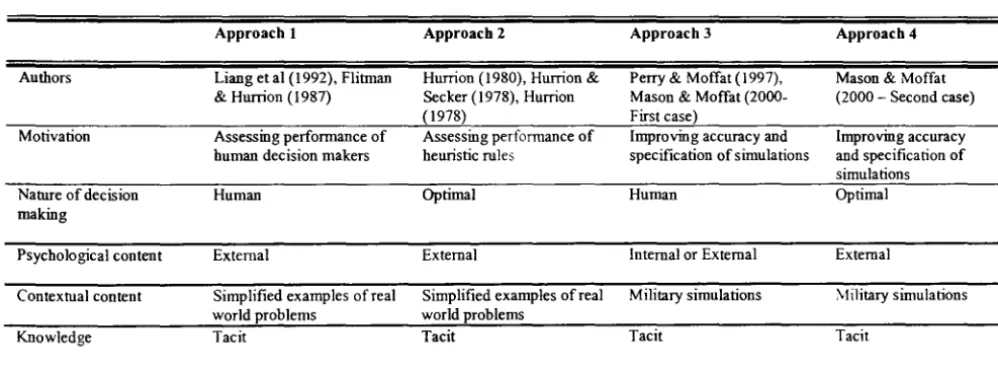
Having reviewed the literature in terms of the techniques that are employed for each stage in section five, five characteristics which vary significantly across the proposed
approaches are identified and are used in order to organise the research into categories with common characteristics. Based on these categorisations, the types of methodologies that are available for modelling decision making in simulation are identified. Section seven discusses potential research areas and section eight concludes by summarising the current research issues associated with the process of modelling decision making in simulation.
2.2 Knowledge elicitation techniques
Given that VIS (defined in Chapter 1) appears to be one of the most commonly applied quantitative knowledge elicitation techniques in the literature in modelling decision
making (Liang et al 1992, Flitman & Hurrion 1987, Perry & Moffat 1997), the first part of
this section describes various quantitative, VIS-based knowledge elicitation approaches. In the second part of this section, alternative knowledge elicitation techniques are
described.
2.2.1 VIS for knowledge elicitation
VIS is a special case of Visual Interactive Modelling (VIM - Hurrion 1986). VIM is a well-established knowledge elicitation technique in the literature on modelling decision making in simulation (Hurrion 1986). The capabilities ofVIM to establish a dialogue between the human expert and the computer system and the fact that it is usually
Chapter 2: Current approaches
Hurrion ( 1986) defines a VIM methodology as one where an OR analyst builds a model of some problem situation. The model has a graphics component, so that the user
commissioning the study can observe in a suitable animated form the dynamics of the model. The user is then able to use his/her own expert knowledge and judgment of the original problem domain in order to interact with the model. In addition, Hurrion (1991) comments that one of the major modelling techniques used within the generic VIM framework is simulation.
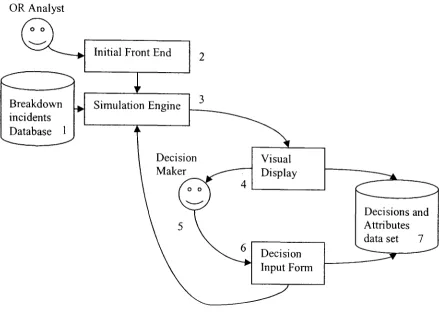
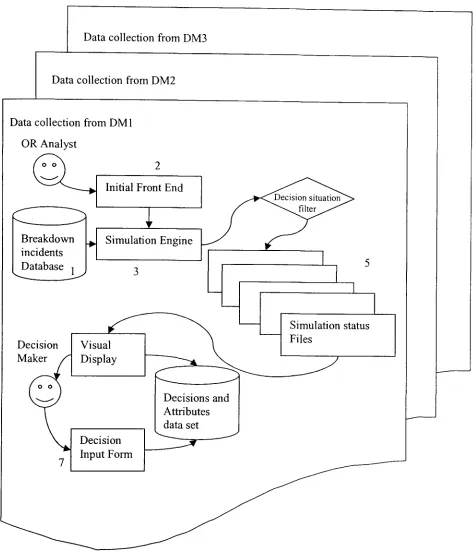
VIS for knowledge elicitation involves the development of a simulation model where, initially, the representation of decision making rules requires the involvement of the user (Bell & O'Keefe 1994). This means that during the simulation when a decision point is
reached, the simulation stops and the user, based on information about the status of the system reported through the visual display, must decide which of the decision options is the most appropriate. In some of the applications that have been reported (Liang et al 1992, Flitman & Hurrion 1987, Perry & Moffat 1997), the functionality of the computer model not only allows the user to input decisions which are taken into account in the next events of the simulation but also automatically creates a record of the decision and the attributes in a database.
Based on the above generic approach, a number of specific techniques have been
developed and tested using full scale applications or simplified case studies that represent typical problems (such as the general job shop scheduling problem). According to
O'Keefe & Pitt (1991), Perry & Moffat (1997), Hurrion (1986), Liang et al (1992) and
Curram (1997), some of the key elements which differentiate the various VIS (for quantitative knowledge elicitation) approaches are the following:
• The type of visual display that is used.
• The type of decision makers who are involved in the knowledge elicitation process and the level of their experience.
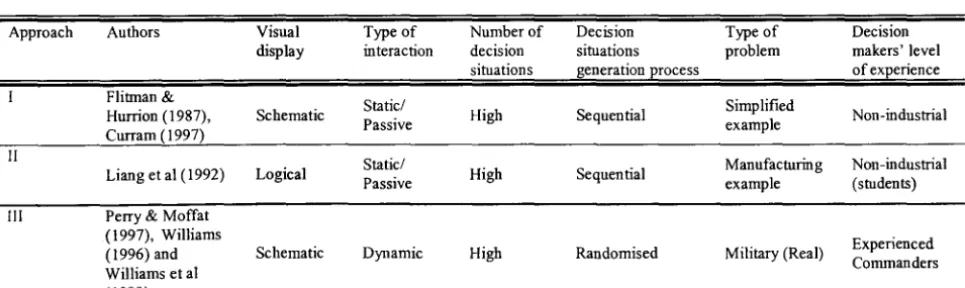
As is shown in table 2.1, based on these characteristics it is possible to identify at least three different VIS-based knowledge elicitation techniques (Flitman & Hurrion 1987,
Liang et al 1992, Perry & Moffat 1997). Approaches I and II have been developed with
the involvement of non-industrial experts (Curram 1997, Liang et al 1992, Flitman & '
Hurrion 1987). The main difference between the two lies in the type of visual display that is used. In the first approach, the representation of the system has the form of a diagram which represents the layout of the system (Curram 1997, Flitman & Hurrion 1987). In the
second approach, the system attributes are visualised using logical diagrams such as
charts and figures (Liang et al 1992). The third approach (Perry & Moffat 1997), shown in
table 2.1, is quite different from the previous two. Apart from the involvement of real experts, a key difference between this approach and the previous two is the type of interaction. Unlike approaches I and II, in the third approach each time that a decision is required, besides the standard facilities that are provided to the user in order to input a decision, there is some extra functionality which allows the decision maker to request extra information, which is available only upon request. This creates a dynamic dialogue, which provides a more realistic simulation environment since it represents the fact that, in the real world, the user might need to find additional information before he makes a
decision. Having identified three different variants of VIS for knowledge elicitation, the following paragraphs provide details about applications in which each VIS approach is employed.
Approach Authors Visual Type of Number of Decision Type of Decision display interaction decision situations problem makers' level
situations generation process of experience
Flitman & Static/ Simplified
Hurrion ( !987), Schematic Passive High Sequential example Non-industrial Curram ( 1997)
II Static/ Manufacturing Non-industrial
Liang et al ( 1992) Logical Passive High Sequential example (students) III Perry & Moffat
(1997), Williams Experienced
(1996) and Schematic Dynamic High Randomised Military (Real) Commanders Williams et al
[image:22.657.71.554.678.822.2](1989
Chapter 2: Current approaches
Approach 1: Visual schematic run time interactive simulation model with incomplete
sequential dialogue and multi-participation of non-industrial decision makers
O'Keefe & Pitt (1991) and Flitman & Hurrion (1987) describe a visual interactiYe
methodology for knowledge elicitation that is based on the use of a VIS. The simulations that model the operations of a simplified example of a coal depot (the same typical
problem is analysed in both studies), are used to collect data on resource allocation
decisions which depend on queue lengths. The models have been deYeloped in Pascal and Prolog using the libraries Pascal_SIM (Davies & O'Keefe 1988) and WES (Warwick Expert Simulator, Hurrion 1991 ). During the data collection process (Flitman & Hurrion
1987) the model simulates the system, including the length of each queue. The
appropriate facilities are provided to enable the human decision maker to interact at run time with the model and to alter the allocation of resource levels, taking into account the queue lengths that are simulated and dynamically displayed in schematic form in the computer model. Each time that a resource allocation decision is made, the decision and the corresponding attributes are recorded. The decision situations that are presented to the decision makers are generated sequentially (subsequent decision points: non-random sampling) from a short simulation run. As a consequence, the data set is not exhaustive and some decision situations are not presented to the decision makers, resulting in
knowledge gaps. According to Hurrion's (1986) classification of interactive models, this dialogue is characterised as passive or incomplete due to the limited interaction with the model. In this knowledge elicitation experiment (Flitman & Hurrion 1987), five non-industrial decision makers participate during the knowledge elicitation process. In order to enable direct comparison of their efficiency, each of them is exposed to the same decision situations. Clearly, from the type of interaction and the type of visual display that is used, this work is an example of VIS for knowledge elicitation which represents Approach I (table 2.1 ).
of the system. Based on a pilot data collection that was conducted to investigate the range of possible situations and to address practical issues of the data collection process, a knowledge elicitation experiment was designed. During the design, the situations that were chosen to be presented to the decision maker were carefully specified to allow a structure to be imposed on the data collection. The aim was to achieve a good spread of situations given the limited number of scenarios. In view of the simplicity of the case study, no provision was needed to ensure that the scenarios generated did not fall into the same decision category and that extreme situations were presented. By simply applying common sense, it was easy to predict the extreme cases of a queue length in a bank branch and to develop a distribution of the frequency of each queue length. In order to collect the data a visual schematic display was used with passive interaction, where the user has to input a decision but is unable to interact dynamically with the system or request additional information about the status of the system.
Approach II: Visual logical run time interactive simulation model with incomplete sequential dialogue and multi-participation of non-industrial experts
Liang et al' s ( 1992) work, which according to Bell and 0 'Keefe ( 1994) is one the most extensive investigations of intelligent VIS, describes a knowledge elicitation approach that is based on the use of a VIS model of a manufacturing facility. The model simulates a manufacturing process where materials have to be submerged in chemicals for specific times but go bad if left in a tank for too long. There is only one resource that may be used to move jobs from one tank of chemical to the next and the decision maker has to decide on the order in which material should be moved from one tank to the others. The aim of the scheduling decision making problem is to avoid under- or over-processing of each manufacturing item since this would spoil it. The knowledge elicitation process involves the use of that VIS which simulates the operations of the system and reports the value of various attributes of the system, using a bar chart display which is updated each time that the simulation reaches a decision point. When a decision is required, the model stops and the intervention of the user is required. Once a decision is taken it is recorded in a
Chapter 2: Current approaches
significant number of decisions (a total of 2125 decisions, 215 per person) can be collected using the VIS model but, as the authors comment, it raises issues associated with the fact that non-industrial experts were involved. It also raises issues associated
with the fact that the decision situations that were selected might not be a representative sample, since no experimental design was undertaken. According to Hurrion's (1986) classification of visualisation, the visualisation approach that is used by Liang et al (1992) can be classified as logical, since charts and diagrams are used for displaying the
information which the decision maker takes into account in order to make a decision. In addition, the type interactive dialogue can be classified as passive, since the decision makers could not define new decision actions or request information about additional attributes that were not reported in the logical display.
Approach III: Visual schematic run time interactive simulation with incomplete stratified
scenarios and multi-participation of military decision makers.
Perry & Moffat (1997), Williams (1996) and Williams et al (1989) are perhaps the only
full scale applications of VIS-based knowledge elicitation.
Williams (1996) and Williams et al (1989) describe a knowledge elicitation approach in which a VIS is used for collecting examples of scheduling decisions that involve
prioritisation of replenishment. The author comments that, in their third VIS experiment, pre-prepared situations were presented to experienced commanders. Although specific details about the preparation of the decision situations are not given, it is clear that a stratified approach was employed in order to ensure that a representative data set was collected. In the methodology applied, apart from the decisions that were recorded automatically in the system, additional information was collected manually during the data collection. The situations were presented to the decision makers using electronic maps and therefore a schematic VIS approach is employed (Hurrion 1986). In addition,
Perry & Moffat ( 1997) describe a VIS approach for collecting decision data about military
decisions which depend on various attributes, formed from information that the real decision makers were able to request from the interactive model each time that a decision was required during the simulation run. The decision makers who participated in the study commissioned by Perry & Moffat ( 1997) were very senior acting or recently retired naval
officers. The model is an interactive maritime stochastic event driven simulation at task force level, which can be interrupted by the player to probe for information or alter the simulation by inserting orders to the force. The decision situations and outcomes presented to the participants were generated by charting a reasonable course of events based on earlier decisions made and simulation adjudications. These events led to a single critical decision situation that was then presented to the user. Based on Hurrion's (1986) classification of interaction, the type of interaction used by Perry & Moffat ( 1997) is
classified as active or dynamic, since the interactive dialogues which are used enable the user to retrieve information upon request and to input non-standard decisions that were not initially in the list of the anticipated decision options (this was achieved by proposing new emerging decision options that were later hard coded in the system). Moreover, the fact that additional information was available upon request supports the identification of emerging attributes, when initially it was not expected that they might support the
decision making process. To make the experiment even more robust, in each of the ten experimental sessions that were conducted, a wide range of situations was presented to the decision makers with the aim of avoiding stereotyped responses. The decision option
'the situation is totally infeasible and there is no reasonable way forward' was also
Chapter 2: Current approaches
2.2.2 Alternative knowledge elicitation techniques
Apart from VIS for quantitative knowledge elicitation, a number of alternative knowledge elicitation techniques exist which, under certain circumstances, can be used for the first stage of the process of modelling decision making in simulation (Angelides & Paul1999,
Hurrion 1980, Carvalho et al 1998, Liang et al 1992, Pierreval & Ralambondrainy 1990).
Some of those techniques have been proposed by previous authors and are explained in the following paragraphs.
Historical data for quantitative knowledge elicitation
As is explained by Liang et al (1992), historical data of decisions and attributes can be a useful source of knowledge which can be used for modelling human decision making in simulations. It is an efficient knowledge elicitation technique, which does not require the
development of knowledge elicitation systems or considerable involvement of human experts. In the methodologies that have been developed for modelling human decision
making, historical data are not used as much as might be expected. One of the main reasons is the lack of historical data records, on which Liang et al (1992) comment that "most research is based on the assumption that training data are available and are error free. In some problem domains expert decisions are difficult to obtain or need to be collected on real time basis. When however historical data are available they can be used for developing models of decision making".
Mason & Moffat (2000) provide the most notable example where historical data on
Questionnaires for knowledge about people
If the decision situations can be described in a questionnaire (Deslandres & Pierreval
1997), the use of questionnaires is a knowledge elicitation technique that can be used as part of the process of modelling decision making in simulation. Baines et al (2000) use questionnaires to collect data that are used in combination with data-driven modelling techniques to represent in simulation how individual characteristics and environmental conditions affect human performance in manufacturing environments. The questionnaires are designed to collect information about the personality of the individual and about how certain environmental conditions affect the time that they spend doing certain tasks or time that they spend on rework.
Optimal data sets derived from simulation experiments for quantitative knowledge elicitation
When the purpose of the modelling exercise is to represent optimal decision making, a technique that has been used in the past (Pierreval & Ralambondrainy 1990) involves the
use of simulation for deriving a set of optimal decisions through simulation
experimentation. For example, Pierreval & Ralambondrainy (1990) describe a technique
in which simulation is used to generate a data set in which the decision instances are optimal and have been derived from exhaustive simulation optimisation experiments. In addition, Alifantis & Robinson (2002) propose the use of optimal decisions derived from
exhaustive experimentation with simulation to develop a scheduling advisor.
Artificially generated data sets for quantitative knowledge elicitation
If the knowledge elicitation stage of the process of modelling decision making in simulation involves investigation about which technique is the most appropriate to be adopted, then artificially generated data sets can be used (Curram 1997, Carvalho et al 1998). Artificially generated data sets are used for testing the capabilities of
Chapter 2: Current approaches
by controlling assumptions that are required by certain techniques and models. Generally, artificially generated data sets are used as a preliminary stage in the process of
investigating the performance and efficiency of various techniques under different conditions. In those cases, knowledge elicitation consists of finding which is the most appropriate technique to be used for modelling a specific situation. Curram ( 1997) describes a process that involves the use of artificially generated data to investigate the performance of stochastic neural networks models. Carvalho et al ( 1998) describe a
process that involves the use of simulated data to undertake a comparative analysis of two data-driven modelling techniques (logistic regression and neural networks).
Visual interactive simulation and gaming for qualitative knowledge elicitation
Earlier in this section, VIS was described as a technique which can support the process of collecting quantitative data sets of decisions and attributes. However, when the purpose of knowledge elicitation is to collect qualitative information about the decision making
process, VIS can also support qualitative knowledge elicitations. Hurrion & Seeker
(1978), Hurrion (1978) and Hurrion (1980) are the first published research studies (after Hurrion's PhD Thesis 1976) in which VIS is used as an aid to the decision maker. They are also examples of qualitative knowledge elicitation processes in which VIS is not used simply for collecting a data set of decision instances. As with recent investigations in gaming simulation environments (Angeli des & Paul 1999), the purpose of those papers is
to illustrate that if the user can see how the model is progressing, conditional on the decisions that are made, then he/she is in a knowledgeable position to learn from the progress of the model and from the interactive decisions that he/she makes. In these applications, the elicited knowledge is formed by understanding the responsiveness of the system in the decisions that are made during the interactive run and, therefore, VIS is used as a tool for knowledge elicitation.
Verbal protocol analysis for qualitative knowledge elicitation
A method that is usually applied for qualitative knowledge elicitation and sometimes supports data collection sessions is the observation of the decision maker in his working environment (Deslandres & Pierreval 1997). According to Deslandres & Pierreval (1997)
applied in the problem-solving knowledge domain and is described as follows: "Verbal protocol analysis is a direct observation method of the expert's problem solving process.
It consists of observing and noticing the experts' behaviour during their work, taking
notes of everything that is done or said." The method is composed of two phases: syntactic analysis and semantic analysis. Syntactic analysis aims to identify operators, operands and the sequences of operations which can be observed during the verbal protocol of the experts. Semantic analysis involves exploring the reasoning by giving a succession of interpretations from the previous analysis. From the actions proposed by the expert the underlying purposes are identified, then an interpretation of the situation is given and, finally, the knowledge involved in this interpretation is characterised.
According to Williams et al ( 1989), it is a time-consuming technique and the protocols collected do not always cover every situation.
Problem structuring as a qualitative knowledge elicitation technique
When optimisation and decision support tools are used during the decision making process then the knowledge elicitation process focuses on understanding how
optimisation techniques can be used for representing the decision making process. For example, Mason & Moffat (2000) model decision making about deliberate planning using
game theory. In this model it is assumed that when the commanders are not under pressure they use analytical techniques and not their experience to make rational
decisions. In this case, the knowledge elicitation process focuses on understanding how game theory is used as a decision making tool. Emphasis is placed on the process of understanding what decision options are available, what are the enemies' decision options and what is the main objective. Clearly, the knowledge elicitation process is similar to the problem structuring process that would be applied for formulating an optimisation
problem.
Structured interviews and knowledge acquisition grids for qualitative knowledge elicitation
Structured interviews supported by knowledge acquisition grids (questionnaires) are an alternative knowledge elicitation technique that is usually applied in qualitative
Chapter 2: Current approaches
applications structured interviews are appropriate for eliciting practical knowledge from foremen and operators, who are usually good at expressing individual considerations on the question of manufacturing constraints. In their research, know ledge acquisition grids are used. The purpose of the questionnaire given to the decision makers was to investigate the quality controls that certain manufacturing products need to pass. Williams et al
(1989) comment that interviews as a technique are efficient in terms of time but require a generally accepted expert. In their research, interviews supported by VIS are employed in order to elicit quantitative decision making knowledge about replenishment decisions.
Action research
Action research can also be used for knowledge elicitation. When action research is used the modeller is involved in the decision making process. This enables him to understand what types of data are required and how the data can be collected (Hindle et al 1995).
2.2.3 Discussion: knowledge elicitation techniques
Having described a number of different techniques in the previous paragraphs of this section, the above review has shown that a number of different knowledge elicitation techniques exist and many of them have been used as part of the process of modelling decision making in simulation. In simulation literature VIS appears with great frequency, with a number of authors reporting experiments where VIS is used for quantitative and qualitative knowledge elicitation (Liang et al 1992, Flitman & Hurrion 1987, Perry &
Moffat 1997, Curram 1997, Hurrion 1980). From the above review, it is clear that there are some areas related to the knowledge elicitation process that have not been fully
investigated in the current literature. The current knowledge elicitation literature is based mainly on non-industrial applications, nor does it address the issues associated with the process of minimising the risk of collecting a data set which may be highly biased and essentially the product of the data collection process (Liang et al 1992, Curram 1997). This conclusion, which follows the general current trend in OR research (Pidd & Lewis
addressed by the current literature (Curram 1997). Finally, it calls attention to the need for applied research and emphasises the importance and the benefits from research based on industrial applications (Curram 1997).
2.3 Knowledge modelling: techniques for modelling decision
making using data collected from a simulation
Having reviewed the main approaches that have been proposed for collecting data for modelling decision making, the main quantitative and qualitative modelling techniques that have been used to develop models of decision making for simulations are now described.
2.3.1 Quantitative knowledge modelling techniques
The quantitative knowledge modelling techniques which are described first in the
following paragraphs usually require the calibration of a mathematical model (Liang et al 1992, Curram 1997, 0 'Keefe 1986). The calibration involves optimising the ability of the model to predict the decisions that are included in the data set. Sometimes knowledge modelling techniques, instead of calibrating the parameters of an equation, involve the development of a database (Flitman & Hurrion 1987, Mason and Moffat 2000, Liao
2000). This database is used as a look-up table to predict decisions for a given set of attributes (Mason and Moffat 2000). If the attributes are not in the look-up table, an approximation algorithm is used to find the attributes in the data set which are closest to those in the new decision situation. The following paragraphs review specific quantitative knowledge modelling techniques which have been used to model decision making in simulation.
Pattern matching case-based reasoning
In pattern matching case-based reasoning, a database with historical decisions and
attributes is used in order to determine what decision should be taken for a new situation (Flitman & Hurrion 1987, Mason and Moffat 2000, Liao 2000). When a decision is
Chapter 2: Current approaches
database of stored decision and attribute pairs. This database is used to retrieve the most
~
appropriate decision for a current situation. In order to find the most appropriate decision, a search takes place to match the current situation with the situations that are available in the database. Various algorithms have been applied for matching the current situation with those that are in the database (Flitman & Hurrion 1987, Mason and Moffat 2000).
Flitman & Hurrion ( 1987) and Hurrion ( 1991) describe a pattern matching
implementation which is used to model human decision making in a simulation model. In one of the case studies (Flitman & Hurrion 1987) which they describe, they model
decision making in a simulation by developing a database of decision and attributes instances. In the pattern matching implementation described in those papers, a separate database is used for each decision maker. The database is linked with the simulation model and, when a decision is required, a search algorithm is used to find the attribute pattern in the database which matches the attribute pattern in the current state of the simulation model. Once a pattern that is close enough to the one in the simulation is found, the database is queried for the decision that corresponds to the relevant pattern. The decision is then incorporated in the simulation, which continues the run until the next decision. Applying a similar matching approach but with a different pattern identification algorithm, Mason and Moffat (2000) model human decision makers in a military
simulation model.
Adaptive case-based reasoning
The second case-based approach not only involves the use of an attributes-decision
assessed, based on certain criteria. The best of these forms the decision for the current situation. If the decision is very different from the decisions which have been stored in the database, then the new decision with the corresponding attributes is added in the database.
Liao (2000) describes a case-based decision support system which models military
command and control decision making. It contains five independent modules: case search,
heuristic solution search, decision making, execution and learning. A current situation is passed from the situation board to the case search and heuristic search which
independently produce possible strategic decisions, though these are not directly
applicable. The solution search module then adopts those general strategic solutions and produces detailed solutions which are assessed by the decision making module on the basis of time, risk and reward criteria. The best then forms the solution for the current situation. If this decision is very different from that which is already in the case database, the decision and the situation attributes are appended in the database.
Neural Networks
Non-symbolic artificial intelligence in general and neural networks in particular have been used as a data driven technique for solving business problems and for modelling decision making in simulation (Wong 2000, Curram 1997). Unlike the pattern matching and case-based reasoning approaches, where the model is a database of decisions
embedded in the simulation (Flitman & Hurrion 1987, Mason and Moffat 2000), neural
networks are mathematical models which are calibrated using a database of attributes and decisions (Liang et al 1992, Curram 1997). Conceptually similar to regression models (Verbos 1994, Haykin 1999 ), the purpose of a neural network is to identify a causal relationship between input and output variables that can classify discrete or continuous output variables into distinct categories. For the classification, the inputs are used as predictors in the model. Technically, in a neural network model this is achieved using a heuristic such as Backpropagation (Verbos 1994), which iteratively adjusts the parameters of the model in order to minimise the total classification error between the model
Chapter 2: Current approaches
enables the use of neural networks for universal approximation of any function
(McClelland & Rumelhart 1988, Haykin 1999). The following paragraphs describe some
examples in which neural networks have been used to model human decision making in simulation.
Liang et al (1992) describe a case study in which neural networks are employed to model scheduling decision making. Data sets with scheduling decisions and attributes (collected using a VIS - section 2.2) are used to calibrate the models. The efficiency of each decision making model is then assessed using simulation. The efficiency of the recorded decisions from each individual decision maker is also assessed using the same simulation model. Comparing the efficiency of the models with the actual decisions, the authors report that the neural network models are less efficient. However, when the neural networks are retrained by removing inconsistencies and inaccuracies from the dataset, the new models are reported to perform better than the actual human decision makers, whose performance was evaluated using the database with the recorded decisions.
given the limited data set, but qualitative checks were performed to make sure that the model was sensible.
Probability distributions conditional on attribute values
Probability distributions conditional on attribute values is perhaps the simplest and one of the most commonly applied techniques for controlling logic and for modelling decision making in simulation (O'Keefe 1986, Curram 1997, Pidd 1998, Robinson 2004). The technique involves the development of statistical or empirical distribution models which are calibrated using observed data sets.
The technique is usually applied when it is observed that a specific type of decision is almost always taken when a real valued attribute variable which follows a statistical
distribution is less than a benchmark value (Perry & Moffat 1997). The implementation of
this type of model in the simulation involves sampling a number from a statistical or empirical distribution that represents the current attribute value. The decision is then determined by comparing the sample with a benchmark value. The accuracy of this type of model depends on how consistently the rule is applied in the real system (Perry &
Moffat 1997).
Perry & Moffat (1997) describe various experiments which involve representing decision
making using statistical distributions. In their model, a statistical distribution is
constructed about which type of information is more frequently required when a certain type of decision is taken. Using this concept, a number of experiments were undertaken in order to model decision making based on frequency of request for certain information. In their research, the authors report that the empirical data do not support the hypothesis that decisions are related to the information that the naval commanders request. As an
extension of the above approach, Moffat & Witty (2002) present a preliminary
Chapter 2: Current approaches
Decision trees and rule induction
Symbolic artificial intelligence in general and decision trees in particular have also been used to model decision making knowledge in simulation (O'Keefe 1986, Flitman &
Hurrion 1987). A decision tree, which can also be seen as a set of nested 'if-then' rules is
'
a logical model in which the attribute values are used sequentially to predict a decision. The most common decision tree derivation algorithm, known as Iterative Dichotomiser 3 (ID3 - Quinlan 1979, Quinlan 1983 ), is a data driven technique where the parameters for the conditional statements in the nested 'if -then' logical model are calibrated to fit the attributes and decisions in the dataset. The decision variable is divided into categories, each of which contains decisions of the same class. Each of the attributes is then divided into classes, based on their ability to predict the class of the decisions in the data set. The process is terminated when all the attributes have been used or all the decisions have been correctly classified. Each time that a new attribute is used, a new level in the tree is
created. The attributes chosen first are those which can predict the class of the greatest number of decisions first. The following are some examples where decision trees are employed to model decision making knowledge.
O'Keefe (1986), in his taxonomy of expert systems, describes how the Quinlan ID3
( 1979) algorithm could be used to generate rules from a data set to model decision making in simulations. Welbank (1983) appears less optimistic about the use of rule induction and reports that in his experiment it was not possible to generate a sufficiently complete case library of decisions for each possible decision situation.
Pierreval & Ralambondrainy ( 1990) describe a decision making problem of a simplified
manufacturing environment, in which a decision is needed about which of the items queuing in front of two machines should be processed first on each occasion that a machine becomes available. An ID3 type decision tree is used to model the decision making process. The ID3 decision tree is calibrated using optimal decisions and observed attributes which are obtained from simulation experiments with a model of the
loads of between 5 and 20 items. The decision maker is a loading supervisor who has to make a decision about which bay should be allocated to a lorry which has just arrived. To illustrate the feasibility of representing decision making in simulation using decision trees, one of the authors in this research acted as a human expert. A data set of attributes and decisions which was collected from a VIS-based data collection session was used to develop an ID3 decision tree that was later linked with the simulation model. Mingers ( 1986) uses decision trees to model the decision making process that is involved during development of a regression equation. In this model, regression analysis output
diagnostics are used as attributes to decide which independent variables must be included in the regression model. Williams et al (1989) use decision trees in order to model
decision making about replenishment. In this case study, a decision making model is developed and is used in order to prioritise and schedule replenishment requests. In this model, decisions about what type of ship should be sent to implement the replenishment and when it should do so are predicted by taking into account who requests replenishment and where.
Fuzzy Logic
Fuzzy logic has also been proposed by a number of authors (Mundermann 1993 and Zadeh 1973) as an approach which can be used to model human decision making
knowledge in simulation. Fuzzy logic can be used when the representation of uncertainty is required and when a number of conflicting rules need to be combined (Curram 1997). When fuzzy logic is employed the model, instead of predicting a specific decision for a set of attributes, predicts a fuzzy set for a number of fuzzy sets that represent the
attributes. The fuzzy set that is predicted as an output of the model represents in a non-probabilistic way the likelihood of a decision to be of a specific type. Predicting fuzzy sets rather than specific decisions, the models allow for the representation of partial membership and statements with a linguistic nature such as maybe or probably. With this approach, fuzzy logic enables the representation of the fact that two individuals are tall but also to distinguish between one person who is taller than the other (Math Works 1999).
In fuzzy logic, fuzzy sets and rules are inputs in the modelling process. This allows the
Chapter 2: Current approaches
assumed that the decision makers are able to express the rules which they apply when they make decisions. As an example, Mundermann (1993) describes an experiment where fuzzy logic is used to represent agents of autonomous mobile vehicles in a highway
simulation.
Problem Enumeration
Optimisation has been used to model human decision making when there is evidence that in the real system the decision makers apply optimisation techniques in order to make decisions (Curram 1997). Mason & Moffat (2000) use optimisation to represent human
decision making. They use game theory to model planned decision making. They assume that, given sufficient time, the decision makers use all the available information to make rational decisions. Based on this assumption game theory is applied to represent the fact that all the possible decision options are considered and assessed in order to identify the decision option with the lowest risk.
2.3.2 Qualitative knowledge modelling
Analysis of Influence
Analysis of influence is one of the qualitative techniques which has been used to model decision making knowledge (Perry & Moffat 1997). It involves asking the decision
makers to explain how each of the attributes affects each of their decisions (negatively or positively). With this process, the most influential attributes can be identified. Perry &
Moffat (1997) use analysis of influence to model maritime decision making. The focus of the analysis in the second part of their work (in which analysis of influence is used) is on how the decisions are taken and how each decision maker is influenced by each attribute when he makes a decision. They are concerned about the individual human decision makers and how the attributes of the system are associated with their decisions. They also report that, in the specific application, the comparative analysis between analysis of influence and statistical distributions revealed that analysis of influence is more
using analysis of influence (and influence diagrams) it was possible to represent how the decisions are taken by identifying how each attribute influences the decision maker (positively or negatively).
2.3.3 Discussion: techniques for modelling decision making
strategies
Following the description of a series of different applications in the previous paragraphs of this section, it is clear that a number of different knowledge modelling techniques have been used as part of the process of modelling decision making in simulation (Perry &
Moffat 1997, Flitman & Hurrion 1987, Liao 2000, Curram 1997). Pattern matching
appears to be one of the most frequently applied, with a number of authors reporting full-scale applications where pattern matching is employed in knowledge modelling (Perry &
Moffat 1997). From the above review, it can be concluded that in the literature the choice of the knowledge modelling technique is often arbitrary. This conclusion is based on the fact that there is not enough evidence to support the idea that the choice of the modelling technique is based on a comparative analysis of the performance of the alternative
techniques. It indicates that, empirically, the pros and cons of the alternative knowledge
modelling techniques have not been fully investigated by the current literature and further research is required. In addition, in the above review statistical modelling appears to be one of the less popular techniques, since there are very few examples where statistical modelling is used as part of the process of modelling decision making in simulation. This conclusion indicates that modelling decision making in simulation is a research area that is rather biased towards AI oriented techniques. This is consistent with what a number of authors (O'Keefe 1986, Doukidis 1987) have observed in the past and, although it is justified by the similarities that can be observed between AI and simulation, it indicates that further research is necessary in order to investigate the potential of statistical
modelling.
2.4 Techniques for representing and linking decision making
models with simulation
Chapter 2 · Current approaches
the decision making models with the simulation (Williams 1996, Flitman & Hurrion
1987, Robinson et al 2003b ). The implementation of this stage depends on the degree of success of the decision making models and on the motivation of the modelling exercise (Perry & Moffat 1997 - quite often, when the motivation of modelling is to understand the
decision making process, the third stage is not implemented since the objective has been achieved before the completion of the exercise).
In the literature, the approach which is frequently chosen to represent the model in the simulation is related to the nature of the technique that is chosen to model the decision making (Mason & Moffat 2000, Flitman & Hurrion 1987, Robinson et al 2003b ).
Depending on the development environment that is used to build the simulation, various techniques have been used to represent and link the decision making models with the simulation. The following paragraphs describe some of the most popular approaches that have been proposed.
2.4.1 Agent technology and object orientation
In the literature, agents are sometimes described as a knowledge modelling technique Schimidt (2000). Based on the agent definition given by Mason & Moffat (2000) and
Moffat (2000), in this review agents are seen as a technique for representing and linking decision making models in simulation. Consistent with the Mason & Moffat (2000)
approach, our decision to classify agent technology as a technique for knowledge representation has been taken on the grounds that an agent is a means of organising a decision making model. An agent can be seen as software architecture for representing a model of a human decision maker in simulation. It interacts with other entities of the
simulation and with other agents if multi-level or multi-unit decision making is modelled.