warwick.ac.uk/lib-publications
A Thesis Submitted for the Degree of PhD at the University of Warwick
Permanent WRAP URL:
http://wrap.warwick.ac.uk/107574/
Copyright and reuse:
This thesis is made available online and is protected by original copyright.
Please scroll down to view the document itself.
Please refer to the repository record for this item for information to help you to cite it.
Our policy information is available from the repository home page.
University o f W arwick
Department o f Engineering
Application of Definitive Scripts to
Computer Aided Conceptual Design
Alan John Cartwright
MSc CEng MIMechEA thesis submitted in compliance with the regulations for the award of the degree of Doctor of Philosophy at The University of Warwick This work was carried out in the Department o f Engineering under the supervision of
A pplication o f
Definitive Scripts
to
C o m p u te r A id e d
C onceptual D esign
Summary
The creative phases of design are based upon the human ability to conceptualise or abstract ideas from physical observations of the real world. That ability comes from experience, based on experiment: discerning patterns of behaviour in particular sets of observations. In this work it is shown that the process of identification, experiment and abstraction may be modelled accurately on a computer by definitive, or agent-oriented, programming, so forming a powerful aid to conceptual design
A new computer modelling language, called EdenLisp, has been developed by the author around Definitive Notations and interfaced to a commercial Computer Aided Design package. It provides a tool whereby computer models of systems can be originated that have state and on which state change can be made, not only by the designer but also by other autonomous agents of change
Experiments with the language are described that show that scripts of definitions can have characteristics that permit the design to proceed as if there were an engineering prototype of the physical system being designed The explicit representation of state at the lowest levels permits experimentation, observation of properties and addition of further observations
The interactive construction of EdenLisp is analogous to the conceptual design process It is used to illustrate and test design meta-theories for modelling conceptual design. It is shown to have potential for concurrent or multi-agent design, and is also an excellent vehicle for design education
Contents
Acknowledgements vii
Glossary of Term s viii
1. A Modelling Method for Experiments in Design 1
1.1 Introduction: Design as an experimental activity l
1.2 A New Modelling Method 3
1.3 Thesis: Design Prototyping with Definitive Scripts 5
1.4 Overview 6
2. Design as Experiment 8
2.1 Design and the Designer 8
2.2 Symbol and Content ¡2
2.3 Design and Observation 16
2.4 Models and Prototypes 19
2.5 Concurrent Design 22
3. Computational Modelling for Design 25
3.1 Object and Process Models for Design 25
3.11 Background
3.12 Intelligent Integration of Models
3.2 State and Computer Programming 30
3.21 Automata
3.22 Functional Programming 3.23 Logic Programming 3.24 Procedural Programming
3.3 State in higher level Programming 35
3.31 Data Modelling and Rule Based Systems .3.32 Object oriented Programming
3.4 A new Programming Paradigm for State 40
3.41 Background to Definitive Notations 3.42 State in Definitive Notations
4 5
4. Computation as Experiment
4.1 Definition-based Geometrical Modelling 45
4.11 APT 4.12 PADL-2 4.13 Paramctrics 4.14 Design View
4.2 Definitive Notations for Geometrical Modelling 54
4.21 Comparison with Other Systems 4.22 Representation of Shape
4.23 Operations on Definitive Shape Types
4.3 Extending Interaction 60
4.31 Hierarchies in Design 4.32 Indirect Interaction 4.33 Animation
4.4 A Computational Experiment 66
4.41 Background 4.32 Method of Approach 4.33 Implementation 4.44 Results
5. Computer Aids to Design Prototyping 72
5.1 Design Environments 72
5.11 Specification
S. 12 Approaches to Process Support 5.13 Agent Oriented Approaches
5 2 Evolving a Prototyping System 79
5.21 Definitive Notations and EDEN 5.22 Development of EdcnLisp specification
5.3 Characteristics of EdenLisp 04
5.31 The Language
5.32 Defining Abstract Objects 5.33 Operations on Sorts
5.4 State and State Change, 97
6. EdenLisp 100
6.1 Introduction to AutoLisp 100
6 2 The EdenLisp Compiler 103
6.21 The Lexical Analxscr 6.22 The Parser
6 3 Definitive interpreter and symbol table 100
6.31 Identification of Statements 6.32 T)pc Checking
6.33 Symbol Records 6.34 Evaluation
6.4 Environment 113
6.41 Window Environment 6.42 Programming environment 6.43 CAD Environment 6.44 Actions
6.5 Discussion 122
7. Experiments in EdenUsp 123
7.1 Parametric Studies 123
7.11 Tumbler-Mixer Machine 7.12 Four-Bar Linkage 7.13 Drawing Frame 7.14 Precision Balance
7.2 Patterns in Design 131
7.21 Analytical Graph Plotting 7.22 A Denture Design Aid 7.23 Using Actions
8. Design Management
8.1 The Design Team 142
K. 11 Development of Design Management ». 12 Agents in the Design Process
8 2 An Agent Oriented Approach to Design Management ¡48
142
9. Design Education 152
9.1 The Educational Context o f Design 152
9 .11 Historical Background 9.12 Learning the Design Process
9.2 Learning to Design 156
9.12 Hierarchical Decomposition 9.22 Design Folio
9.3 Parametric Studies 159
9.31 Sensitivity Study 9.32 Parametric design
9.4 Self-Teaching 164
9.41 Animation 9.42 Authoring
10 Discussion 167
10.1 The Thesis 167
10.11 Understanding Conceptual Design
10.12 Computational Experiment: The place of EdenLisp
10.2 Achievements 172
10.21 Interaction
10.22 EdenLisp CAD Environment 10.23 EdenLisp Implementation
10.3 Comparisons 175
10.31 Conventional Approaches 10.32 Other Definitive Methods
10.4 The Future 178
10.41 User interface 10.42 Actions
10.43 Multi-Agent systems and Concurrency
10.5 Conclusions 181
References 183
Appendix A Formal Language Definitions for EdenLisp 190
Appendix B EdenLisp Programs 193
Appendix C Conference Papers 207
Acknowledgements
Interaction, intelligence and integration are siren words for Intelligent CAD systems. They also represent an accurate description of the way that the research group led by Meurig Beynon has helped to develop creative thinking and thoughtful insights that have contributed to this work. I owe an incalculable debt to Meurig and gladly acknowledge all his patience and support over six long years.
Supervision of prima donna academic staff is somewhat difficult, especially with an arcane subject, so I have appreciated Professor David Whitehouse's gentle encouragement and helpful guidance.
Any work of this magnitude takes a slice out of one's life, so I am most grateful for the support and encouragement of my wife Christine, and children Simon and Rebecca who have had their family life dominated by "definitive notations" I am thankful to God, the Great Designer, for the beauty of the world that is His design, and for His care and concern for His children
Glossary
* indicates a term that is also in this glossary
Abstract Definitive Machine (ADM) A method o f structuring a definitive program* into different scripts* each of which can be under the control o f an agent; (agents may be acting concurrently). The ADM divides definitive statements into three
• those that the agent can unconditionally redefine*, • those that the agent can redefine conditionally,
• those on which the agent imposes conditions on the ability of other agents to redefine.
CAD and CAD/CAM Computer Aided Design / Computer Aided Manufacture.
Design is often a misnomer in commercial CAD systems that are actually
Draughting systems. CAM usually implies a system for producing Numerical
Control (NC) data to drive machine tools.
CADNO A Definitive Notation for graphics, like DoNaLD* but extended to 3-D.
Chunk A unit o f integrated knowledge in long term memory. See also Percept*
Complex, Frame Terms used in this thesis for collections of labels arranged in ways that resemble topological nets and graphs Nodes and the edges connecting those nodes are associated respectively with labels and the ways that the labels are grouped by means o f parentheses.
Computational State In this work the state o f a computation is what may be observed if a computation is suspended at any moment. The significant observations relate to the intention o f the program that is running. A static state or statelessness refers to the condition where no observations can be made that were not preconceived by the programmer
Connectivity The ability of labels to be connected by means of "edges" like nodes in a topological graph. Edges are not geometrically defined, they simply indicate connection. See also complex*
Content The content of a symbol is whatever may be suggested by that symbol by any person looking at it. Content is always greater than that for which a symbol is used
Declarative Programming A style o f programming where statements attempt to express the desired outcome o f the program in terms of "what is" knowledge rather than the "how to" knowledge of procedural programming*. Example arc functional languages (Miranda. Lisp) and relational languages (Prolog)
Declarative Knowledge Knowledge about facts.
Definitive Programming (Definitive Notation) A method of programming where program statements take the form of definitions that are to be interpreted in their entirety without regard to their order. When a program, otherwise called a script* o f definitions, is input to an Evaluator all the definitions are scanned and evaluated in the manner of a spreadsheet. Addition of further definitions, or redefinition of existing definition immediately trigger the evaluator; the whole script is scanned and re-evaluated as necessary.
Definitions take the form va r i a b l e = statement
where v a r i ables are conventional computer variables and
s tatements may be values, formulae or functions, o r calls to procedures.
DoNaLD is the Definitive Notation for Line Drawing, a notation that permits line based graphics. It translates a script* into EDEN* notation that must then be evaluated by EDEN. CADNO* and SCOUT* are other notations that translate into EDEN.
DXF, IGES, STEP, XBF Intermediate (neutral) codes used to transfer graphical
data between different systems, especially between CAD* systems.
EDEN The Evaluator for DEfinitive Notations. A script* submitted to EDEN is evaluated in the form of a generalised spreadsheet.
EdenLisp The definitive evaluator written in AutoLisp, a superset o f Lisp, and interfaced with AutoCAD.
Form A symbol used in mathematics or computer programming has an intended meaning in the context where it is used. This is the form of the symbol. Other meanings may be ascribed to the same symbol that were unintended and not in the scope of the application. The latter is the content*.
Frame See complex* or percept*.
GKS, PH1GS Programming software libraries for producing and displaying graphics
Heuristic A rule for problem solving that is based on the semantic characteristics of the problem rather than its abstract characteristics. It is essentially a search based rather than an algorithmic rule
ICAD Intelligent Computer Aided Design.
III-CAD The name used by the Dutch CAD research group for Intelligent, Interactive, Integrated CAD systems.
Instantiations are particular instances or examples o f an abstract form that arc worked out to a more concrete or observable form
Instantiations are particular instances or examples of an abstract form that are worked out to a more concrete or observable form.
L atent states A definitive script* exists in a particular state (the state of the dialogue*) after it has been evaluated. A change in any definition will change that state. The set of possible redefinitions is infinite but if related to the physical interpretation that set represents all possible or latent states of the model represented by the script.
M eta-theory The prefix meta implies a generalisation. A meta-theory is a theory about theories: principles that apply to all theories.
Monotonic reasoning means progressing incrementally from one step to the next by reference to the starting conditions only.
Non-monotonic reasoning is making only one logical step at a time, reflecting on the outcome on the basis of real world observation before proceeding. The result may be a revision of the starting conditions at each step.
O O P = Object Oriented Programming. A style of programming in which programming objects are created that have local state because they have encapsulated or hidden variables. Neither those variables nor their values are directly accessible by other objects or procedures. At its simplest such an object may consist of a single procedure. Inputs and outputs connected with the object are of a specific kind allowing standardised linking of objects. An example language is Smalltalk.
Percepts are consistent and lasting ways of grouping observations made by humans on the basis of behaviours that link those observations in ways that seem to be predictable. In the Artificial Intelligence world, percepts are sometimes called frames. Frames* are also used in a different way in this thesis.
Procedural Programming A method of computer programming by means of a recipe or set of instructions for obtaining an output from given inputs. Examples are Fortran, Pascal, C.
Procedural Knowledge Knowledge about procedures.
Prototype A prototype in an engineering context is a physical object that is
manufactured as the first of the complete product of the design process. It is used to check the performance of the product against the specification.
In computer science a prototype is a computer model that is used to check
particular aspects of the software.
In this work it is used more in the engineering sense.
Redefinition If a definition within a definitive script is revised and resubmitted to the Definitive Evaluator then the whole script is re-evaluated. Redefinition may
mean changing its value or totally re-writing it. Provided the redefinition is consistent with the declared types of the variables used any alteration is legal.
Rule-based Systems are often called Expert Systems. Input is referred to an inference engine a computer program that causes the input to be tested against the knowledge and rules in the data or knowledge base. The output is a set of hypotheses (preferably of size one) representing a "desirable" outcome.
SCOUT A definitive notation* for interfacing with the Graphical system under X- windows.
Script, (Definitive Script) A set of definitive* statements, roughly corresponding to a conventional computer program.
State "An object is said to have state if its behaviour is influenced by its history. We can characterise an object's state by state variables, which among them maintain enough information about history to determine the object's current behaviour." [Abelson et al, 19851.
State of the dialogue When using a definitive evaluator the script* is scanned and evaluated after each definition is entered. The display and/or the internal representation reflects the state reached after the last definition was entered. This is called the state of the dialogue.
SDRC I-DEAS A commercial CAD/CAM system for mechanical design - a suite of programs based around a geometrical solid modeller.
TIFF A bitmap coding for transferring graphics data between graphics programs.
Virtual prototype A term used to describe the analogy between a physical prototype* and the computational model of the intended engineering design, that model consisting of a set of definitive scripts*, related according to the rules of the ADM*.
1
A Modelling Method
for
Experiments in Design
l.I Introduction: Design as an experimental activity
Design presupposes a designer. That argument for a Creator is philosophically attractive. It is also an argument that suggests that engineering design cannot be automated to the exclusion of the human designer.
The link between design and designer is choice. Given the myriad possibilities o f building the desired product from the synthesis of ideas with intransigent physical reality, decisions have to be made. The conceptual stage o f the design process cannot be reduced to methodical procedures, despite some attempts to generalise methods that were devised to deal with certain routine tasks. One must carefully distinguish routine tasks from non-routine. Failure to do so leads to the belief that it is possible to automate design totally. Roth, following the German tradition for methodical procedures, thought that within ten years, methodical design would dominate and pure intuition become the exception. [Roth, 1981], His interest lay in automating tasks that are well de-fined and for which solutions may be formulated that enable speedy choice of a relatively few options But, as David Pye of the Royal College of Art put it
"It is said that by the aid of computers we can arrive at the correct solution . with certainty. They are clever, these computers! They are going to show us the cheaper answer. But if they think their clients are going to be satisfied with that, they are not so clever as they think." [Pye 1983],
are defined by Piela et al, as "ill-defined, because they involve incomplete task descriptions and non-deterministic solution paths." They also support the notion that human interaction is essential to design: "Because non-routine design requires on-going human intervention, facilitating designers in this work will depend crucially on how well systems support use" [Piela, 1992], Piela's work is significant in highlighting the experimental nature of conceptualisation. In the days before computer models replaced the difficult and expensive process of physical prototyping it was well understood that the nature o f the physical world is such that frequently more could be extracted from a physical model than might be anticipated when the model is conceived. The act of building the model may reveal hidden manufacturing or feasibility problems, or simpler ways of achieving the same functionality.
In this work a design philosophy is developed that shows that designs are built on the designer's perception and experience o f the physical universe. By experiment those perceptions are changed and improved. Thus they are based upon observation, both personally acquired and passed on.
The number o f observations of the physical universe that can be made is infinite, both in category and within category. Thus one speaks o f "design space", or "search space", by analogy with linear programming, (see, e.g. [Starkey, 1992]) by which attempts are made by specification to make limits within which the search for a feasible solution can be investigated in the design time allowed. In pre- computer days the design space was ofien narrowed to the extent o f allowing only one solution: the first one that could be done that looked feasible. Despite that the environment for the search was still experimental. Indeed the word "search" well illustrates the experimental flavour of design. The search may not be done according to a preconceived specification but may be modified in the light of each finding. As the observation base grows so the problem definition evolves and with it the product. A client comes to a designer wanting a wall for his garden and goes away happy with a hawthorn hedge because the designer probed the reasons for the wall rather than merely discussing the type of wall.
or the agency may be built into the design itself. For example a simple 4-bar linkage may have alterations made to its geometry by the designer: however a change in the angle of the driving lever will cause the whole mechanism to change its state by virtue of the connectivities of the bars. Agents often have choices: a warning light can be disregarded, constraints can be violated or redefined. Indeed these choices often provide the way that design progresses. Ways need to be found for coping with that level o f interaction. In particular the issues o f simultaneous and conflicting interactions are crucial in cases where there is a number of independent agents.
This thesis is concerned with the experimental aspects o f conceptual design and how to support observation and experiment on computer-based systems. It is argued that any attempt to create such design support systems must provide an environment with the following properties.
• It is able to record observations o f the real world.
• Computer models can be set up with attributes of physical prototypes, i.e. they
have states that can be manipulated in infinitely many ways.
• It puts no constraint upon invention, particularly in the early stages.
• It allows interaction with the design by different agents acting concurrently.
On the other hand, in experimental investigations on how designers do design, it was observed that there is constant alternation between searching for a solution and fixing a solution; fixing the solution proceeds rapidly from success in the search for a solution [Ehrlenspiel & Dylla, 1989] Access to standardised or automated procedures becomes advantageous at the point of fixing solutions, so methodical approaches need to be integrated. The assertion that the attempt to automate design is futile does not invalidate advances in methodical design The two areas are complementary. The scope o f the thesis is the conceptual stage of design.
1.2 A New Modelling Method
appropriate computer-languages for design tasks, but also expose deficiencies in programming methods. For example, the modelling o f state and state change is an
important aspect of design but a traditional computer program describes state
rather than itself being thought o f as having state.
In this work a new programming language has been developed by the author to support the central thesis that computer models to help design should be situated in reality rather than being abstracted away from reality. Current programming techniques rely upon pre-selection o f a set o f observations with their own logical integrity in order to create modelling methods to aid the designer. Those methods mean that the designer effectively enters a logically predictable world where autonomous agents (such as, for example, those that are familiarised by the phrase "Murphy's Law") do not operate. In contrast, I created the language EdenLisp to permit a more realistic design world. It is developed from a programming method (paradigm) called the Definitive Programming framework, first developed at Warwick University. Using this method, it is possible to make a computational model as a metaphor o f physical reality that allows one to examine that real world as one might by experiment and observation.
The definitive programming concept may be introduced by reference to one of the
antecedent languages o f EdenLisp developed by [Beynon & Yung, 1987] called
EDEN.
"The key idea behind definitive program m ing is the representation o f com putational state by a set o f definitions o f variables and o f a transition between states by a set o f redefinitions. A sim ple application o f this principle underlies the spreadsheet. By w ay o f illustration (when augmented by definitions o f voltage etc.)the set o f definitions
resistance = resistance_of_lamp + cable_lenqth * coeff_of_resistance
current = if s w i t c h o n then voltage / resistance else 0
light_on = switch_on and current >= threshold
switch_on = false
can be interpreted as describing the state o f a simple electrical circuit. In this context an appropriate transition m ight involve th e redefinition
switch_on = true.”
| Beynon, 1990]
when they all have values is the definition evaluated. If any variable acquires a new value at any time the definition is immediately re-evaluated. That point is significant. In conceptual design an object may be an instantiation of an idea defined initially in very abstract terms and only at the last "put into flesh". The definitive method allows such an approach. An object can be defined initially by formulae using labels that have no current values, nor even references to values. Nevertheless the formulae are binding and remain so when other definitions are made which build on them. In principle one could build up design specifications without needing to give values to important features, merely referring to them by labels: indeed one can construct a veritable algebra o f labels in which ideas gradually attain substance.
As the definitive method was applied to design it is shown that it has the outstanding feature of being the means o f creating computational objects that are each a kind o f metaphor o f a physical prototype. States defined by a set (or script)
o f definitions can be examined as one might physical states of real objects: no definitive statement is merely an adjunct to the computation. A redefinition is akin to changing a feature o f a physical prototype or its state
For the interpretation and evaluation o f definitive statements the techniques common to creating new languages are used. The original Evaluator o f DEfinitive Notations (EDEN) was created by Beynon and Yung [Yung, 1987], and a number o f derivatives o f Eden were also developed. These definitive methods were the starting points for developing the main ideas described in this thesis, ideas that underlie the tools that are proposed for supporting design. For the engineering designer, a tool that uses Definitive methods would have little application without
access to geometrical modelling: so EdenLisp was conceived EdenLisp is a
definitive CAD notation containing the basic Eden engine, but considerably enhanced with geometric extensions. As the name suggests, it is written in Lisp It is specified by identifying an underlying algebra o f sorts and operators to describe many different structural aspects of a geometric object.
Engineering design problems using EdenLisp show that the properties of the definitive method are indeed analogous to Engineering Design prototyping. Engineering models written in EdenLisp can be manipulated in a similar way to parametric models that sit on top of most existing CAD systems The difference is that because it is a language approach there is no point at which the parametric
A MODELLING METHOD FOR EXPERIMENTS IN DESIGN 6 concept breaks down: it is definitive all the way down! Indeed it is conceivable that eventually all computation can be expressed using definitive scripts.
With that introduction the main "thesis” of this work may now be stated.
1.3 Thesis: Design Prototyping with Definitive Scripts
The process o f engineering design, defined as a synthesis o f physical observations and deductions with incremental refinement, may be modelled accurately on a computer by definitive, or agent-oriented, programming.
The author's Definitive Script interpreter EdenLisp provides a computer-based approach whereby models of systems can be originated that have state and on which state change can be made by independent agents
Computer models produced that way can have state that is characteristic of engineering prototype designs o f physical systems. The explicit representation of state at the lowest levels permits experimentation, observation of properties and addition o f further observations. Development o f the design exploits interactions, constrains certain directions and allows concurrent agents o f change.
The interactive construction o f definitive scripts is analogous to the conceptual design process. It may be used to illustrate and test design meta-theories for modelling conceptual design. It is also an excellent vehicle for design education.
1.4 Overview
The ordering of the chapters following reflects the intertwining strands of design and computation. First, the experimental nature o f conceptual design is considered, highlighting the modem requirement for rapid prototyping of products and hence the need for design product models that exhibit state and state change behaviour similar to physical prototypes. Trends in concurrent engineering and the growing interaction o f non-engineering experts are examined The aim is to identify the kind of computer-based tools that can cope with very different kinds o f interaction on the same design.
for coping with multi-agent systems are still emerging but promising progress is described.
Definitive tools for graphical interaction are described next, defining the requirements for design in terms o f abstract object definition. An algebra based upon these abstractions is developed out of which grew EdenLisp. The design philosophy and structure o f the language o f EdenLisp are described. The link with the CAD system AutoCAD® illustrates the flexibility o f the method in accommodating traditional programming styles whilst exploiting the power of prototyping. In contrast experiments using definitive notations developed by others in the research group are reported to reinforce particular issues in prototyping and to show the generality o f the method.
In the next two chapters the implementation of, and experiments in EdenLisp are described in detail. EdenLisp is implemented as a strongly typed language that is easily extended as new operators are introduced. The lexical analyser, parser and type checker are described, together with the evaluator. The environments for dealing with geometrical objects are then described. Finally programming examples are used to show the input style and possible user environments.
Design Management is very much the issue when there are design teams consisting o f people with very different skills The idea of definitive scripts is readily adapted to prototype definitive designs that have multi user, multi task design scenarios The possibilities are explored in that chapter.
Applications o f definitive methods in design education are very attractive Parametric design, optimal design, animation and self-teaching are each illustrated with examples that show the power of the method
The work is completed with a discussion of the topics dealt with, evaluating the thesis from the perspective of likely developments and future research
2
Design
as
Experiment
A significant feature of the definitive method of computer modelling is the
experimental nature of the interactions made b y a user. It is that which
makes it potentially attractive to the conceptual designer. In this chapter
the idea of design as experiment is developed in order to draw out
particular conceptual differences between the design process and the
computational pmcess. The aim is to explore what is required in principle
to aid the conceptual designer and so provide the underpinning reasons
for developing the definitive tools for design
2.1 Design and the Designer
Anyone attempting to give computer-based aids to design had better try to understand design and the role o f the designer. These arc formidable tasks. Even their definitions are unclear and virtually all writers on the subject seem obliged to formulate their own. Contrast the following examples: the academic Michael French; the industrial practitioner, Coplin o f Rolls Royce; and David Ullman “a designer all my life”
“ D esign is all the processes o f conception, invention, visualisation, calculation, m arshalling, refinem ent and specifying details th a t determ ine the form o f an engineering product.” [French, 1985],
DESIGN A S EXPERIMENT 9 “The only way to leam design is to do it. A design process that results in a quality product can be learned, provided there is sufficient ability and experience to generate ideas and enough experience and training to evaluate them.” [Ullman, 1992]
In these definitions design indicates purposeful activity, directed towards an end. Indeed some prefer the narrower definition o f ‘product realisation’ as more accurately defining the task o f the engineering designer The phrase draws attention to the distinction between the process of designing, and the product of the process, whereas ‘design’ is used to describe both activity and result. Both French and Coplin imply that the process o f design may be identified independently of the designer Ullman is more sanguine. He sees all three, the designer, the design process and the resulting product, as closely bound up with one another.
We need to examine the relationship among these three: the product, the design process and the designer. Is the designer central to design? In an automated design system what is the role o f the designer? Can we automate the process o f design to the extent o f excluding the human designer, or must the computer be a design support system with the designer in charge? If the computer and the designer are agents in the design process, how do they cooperate, and what if there are many agents, as in a concurrent design approach?
We consider first the relationship between the designer and the designed product The ability to design is often thought o f as arising from our human propensity to see order and pattern in the universe. Conversely where we perceive pattern we tend to regard it as somehow pointing to a designer Indeed observing design and pattern in the universe as a whole, people from engineers to artists, physicists to theologians, speak o f a “designer universe”. Paul Davies, a professor of mathematical physics, writes the following
“The natural world is not just any old concoction of entities and forces, but a marvellously ingenious and unified mathematical scheme. Note, words like “ingenious" and “clever” are undeniably human qualities, yet one cannot help attributing them to nature too.
According to Christian tradition, the deeper explanation is that God has designed nature with considerable ingenuity and skill . so as to permit life and consciousness to emerge. Our own existence in the universe formed a central part of God's plan .” [Davies, 1992]
DESIGN A S EXPERIMENT 10
At first sight we may consider that demanding such a strong link between the design and the designer is unnecessarily restrictive. Even given a designer, may there not be a distancing o f designer and product? Cannot parts o f the design process be independent o f the designer? For example, the more routine components o f French’s description of the design process are amenable to standardised approaches, even where the task is new. The correct specification of such “ standard” problems quickly yields answers, as Roth’s recent work shows [Roth, 1989], Within a narrower definition o f design, or perhaps downstream of the conceptual stage there will indeed be standard components and processes, but that begs the question o f the need for a designer since those standard components must at one time have been conceived. Producing variants o f existing designs is an extremely useful annex to the design process but can it claim to be ‘design’?
The question centres on conception, invention and visualisation. If those could be independent o f the designer then it should be possible to construct a computational system in which designs could be inferred. In that case a computational model, consisting essentially o f symbols could create truly novel designs, i.e. designs that make new relationships and new patterns on observable data. There is little doubt that certain new relationships can be formed, but genuinely new pattern recognition requires a data base that is considerably larger than the biggest data system yet devised. The reason for that is in the contrast between the form of symbols and their ‘content’. Cantwell Smith, in a paper entitled ‘Two lessons from logic’ [Smith, 1987], argues the ‘irreducibility o f content to form’ By this he means that there are two factors to be considered in any symbol system The first factor involves the shapes o f symbols, how they can be put together and the behaviour or operations defined over the systems That would typically relate to operations in a computer based system. The second factor has to do with what symbols mean, what they are about: in other words their content
DESIGN A S EXPERIMENT 11
“Why does this sentence remind me o f Agatha Christie?”
There is no reason for that sentence to bring to mind the whole fictional world of Agatha Christie, yet it does! ‘Reference outstrips causality’ is how Smith defines it.
Reference o f that sort, or ‘content’ is a human thing. It depends upon memories, experiences, knowledge, understanding. These may be buried in the sub- consciousness, but ready to be triggered at a word, a smell, a picture, a sound. The “content” o f a symbol may be huge, spreading its web o f connections ever more tenuously to include perhaps one's whole personal experience. The connection may be rational, it may be intuitive. It will also differ, depending upon the person.
Yet, it might still be argued, a ‘content’ may be large, but it can be regarded as finite in relation to a circumscribed model addressing a particular function. Is it not possible to construct a symbolic system that holds all that one might need for representing that model so that it has a one-to-one correspondence with the real world? The difficulty is in deciding whether one has ‘all’ that one needs. One cannot inspect that possibility, for one then comes up against what is called in computability theory the Halting Problem.
“It is the question of whether there exists any computer program that can inspect other computer programs before they run and reliably predict whether or not they will go into infinite loops. The answer turns out to be "Definitely not" ... With that result there is no finite mechanism that can detect all patterns, patterns of patterns, patterns of patterns of patterns ...” On the seeming Paradox o f Mechanising Creativity [Hofstadter, 1979]
Any given logical system has to have a system outside; and that ‘outside system’ has to have a system outside it, and so on, to infinity. Whatever system one might construct to model the design process, its form must be limited - its content always connected to the real world by us as humans. It seems that ‘agents are what matter’ [Smith, op fit.].
DESIGN A S EXPERIMENT 12
2.2 Symbol and Content
The richness o f ‘content’ in a symbol is illustrated in the widespread use of 2D CAD systems. While a rectangle might represent itself, it may be perceived, de pending on the context, as a shaft, a box, a window, a zero symbol, a button or an information block. In other contexts it may be a kitchen cupboard, a tile, a sink; in yet another: a house, hotel or shop in plan view. The content is limited only by the imagination. A 2D CAD system permits the user to use imagination to its fullest: content is added by the user. The difficulty then is communicating the content to others: a difficulty that becomes acute in a multi-agent or con-current design. The traditional way out has been to have agreed conventions for interpretation such as BS308 Drawing Office Practice. It is well known that an engineering drawing conveys much more than that which is actually on the drawing For example the presence o f a fine-machining symbol on a dimension implies that the particular shape feature dimensioned is highly significant to the function o f that object and drawing attention to it in a way that merely obeying the symbol to the letter may not be adequate Another example is the tolerance on a hole position. That is specified in a way that cannot ever be measured: the centre o f the hole is machined away; all you have is the rather inaccurate form of the circumference from which to infer the probable centre.
Despite the richness o f possible content in a symbol the context of a symbol may provide certain avenues for exploring it in a rational way. Notwithstanding the intuitive connections, rational or experiential connections between symbol and content can be made by listing rules and relationships. It is the enumeration o f finite groups o f possibilities that underlies the taxonomic and the methodical approaches to Design. Characteristic o f that is the recent abundance of research into feature editors. In mechanical engineering applications, for example, feature editors have libraries of features, such as holes, bosses, slots and pockets, that the user simply calls and assembles on the screen It is claimed that all geometrical modelling could be based on such taxonomies, since other attributes can be added to standard features as required, and products designed that way can be readily linked with manufacturing activities. (See for example [Gu, et al, 1989], [Krause.
et al, 1989], [Mantyla, 1990], The latter gives a useful summary of feature editors).
DESIGN A S EXPERIMENT 13
There appears to be an important concept here. Roger Trigg, a philosopher at Warwick University, writes:
“Language must be understood to be about one world open to public inspection. Plato makes it clear that it is a precondition of language that the world has a certain stability. ... We must have the assurance that when we pick things out and draw other people’s attention to them, they too can identify what we are referring to.” [Trigg, 1973]
Trigg is appealing to the lowest common denominator o f all languages: an understanding of the world that is common to all humankind. That understanding is in turn fed by a common set of basic conceptions o f the world. So if one can isolate and classify such experiences there is a possibility that the taxonomic approach has some merit.
The problem o f classifying these "basic experiences" and common language is that o f disentangling the common from the other content. One only has to listen to politicians to see that the same words can denote very different things! And ‘features’ identified at one time suddenly invert and become the opposite (black on white rather than white on black for example).
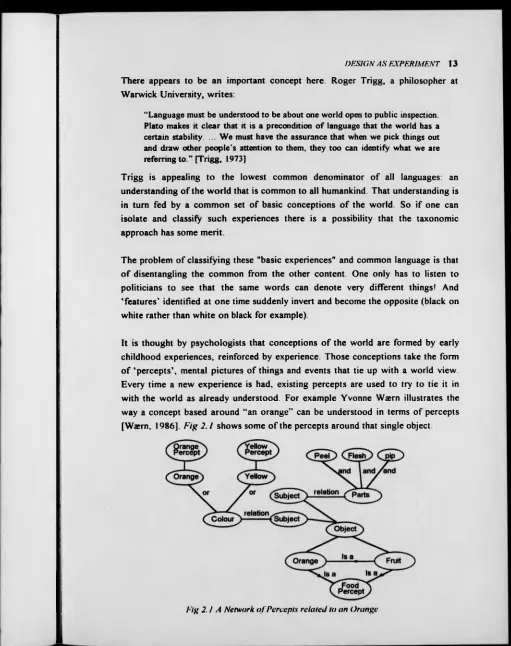
It is thought by psychologists that conceptions o f the world are formed by early childhood experiences, reinforced by experience Those conceptions take the form o f ‘percepts’, mental pictures o f things and events that tie up with a world view. Every time a new experience is had, existing percepts are used to try to tie it in with the world as already understood. For example Yvonne Waern illustrates the way a concept based around “an orange” can be understood in terms of percepts
[image:25.556.17.528.19.665.2][Waern, 1986] Fig 2 .1 shows some o f the percepts around that single object
DESIGN A S EXPERIMENT 14
Percepts that are frequently used become reinforced and refined, and become “long-term memory”; less frequent or recent percepts are easily modified or displaced. The Swedish psychologist Professor Sandstrom made this observation of animals.
‘The learning curve is not characterised by sudden leaps, revealing flashes of insight; learning takes place successively. When the animal has acquired a concept it becomes to a remarkable degree capable of altering the response pattern and adapting itself to the requirements of the situation.
A so-called perceptive solution of a problem is here rather the result o f extensive and versatile experience’ [Sandstrom, 1968].
Sandstrom says that while this does not necessarily apply to human (as opposed to animal) insight, there does appear to be some evidence that percepts become the starting points for linking new experience.
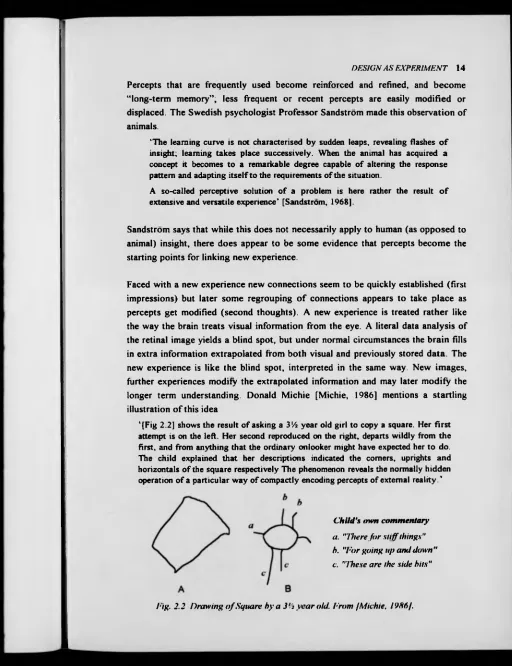
Faced with a new experience new connections seem to be quickly established (first impressions) but later some regrouping o f connections appears to take place as percepts get modified (second thoughts). A new experience is treated rather like the way the brain treats visual information from the eye. A literal data analysis of the retinal image yields a blind spot, but under normal circumstances the brain fills in extra information extrapolated from both visual and previously stored data. The new experience is like the blind spot, interpreted in the same way. New images, further experiences modify the extrapolated information and may later modify the longer term understanding. Donald Michie [Michie, 1986] mentions a startling illustration o f this idea
‘[Fig 2.2] shows the result of asking a VA year old girl to copy a square. Her first attempt is on the left. Her second reproduced on the right, departs wildly from the first, and from anything that the ordinary onlooker might have expected her to do. The child explained that her descriptions indicated the comers, uprights and horizontals of the square respectively The phenomenon reveals the normally hidden operation of a particular way of compactly encoding percepts of external reality.’
Child's own commentary
a. "There for stiff things" h. "For going up and down " c. "These are the side hits"
[image:26.559.13.525.14.680.2]DESIGN A S EXPERIMENT 15
Marvin Minsky, an Artificial Intelligence specialist at MIT, uses the word frame
for what appears to be the same idea described by percept. He uses fiames as a basis for understanding visual perception, mainly for natural language dialogues.
‘When one encounters a new situation (or makes a substantial change in one’s view of the present problem), one selects from memory a structure called a
frame. This is a remembered framework to be adapted to fit reality by changing details as necessary.' [Minsky, 1981],
According to this theory, frames are formed in the brain with default assignments, the details of which may not be warranted by a particular situation but are useful generalisations sometimes by-passing ‘logic’. Defaults are easily displaced by new items that fit better. So a hierarchy o f frames is formed that becomes more stable with increasing experience, with interconnections that form a kind o f relational database. This view appears to reinforce the idea that it may be possible to capture these percepts or frames in a knowledge base that can be used in forming a design
support system that is independent o f the user. Minsky’s idea o f frames
(introduced in 1975) as a basis for Artificial Intelligence was very popular in the ’70s and early '80s where, by analogy, a ‘frame’ was defined as a cluster o f procedures and data referring to the same topic that could be moved around as one piece. [See discussion in Ritchie & Thompson, 1984]. Using that idea a number o f attempts were made at ‘frame languages’ for natural language parsing, even the word ‘percept’ being used in [Sobolewski, 1988]. In the latter it is argued that functions and relationships do not exist; rather only attributes and values, as atomic conceptual primitives, and attribute paths (slots) that have the value of the most recent value Percepts here are built up from the set of slots. The attempts have had mixed success.
We are still faced with several problems. Given a new situation, how do we locate a percept to represent it? Second, what is the content o f that percept9 Does there
have to be a set of percepts that is common to everyone? Minsky I ibid. I says, ‘We
DESIGN A S EXPERIMENT 16
example many experiences are so common that they are rarely explicitly referred to; hence the famous conundrum ‘Does a falling tree make a noise if there is no- one to hear it?’, or the assumption that the hidden side o f a cube is actually there and of an expected shape. Those assumed percepts could become micro-universes that have an agreed content. Even so that cannot mean that such percepts could be normative. World views do not remain unchanged in the light o f increasing knowledge: compare the world views o f Archimedes and Galileo, Newton and Einstein!
Content still outstrips symbol. If we could define a percept, its content would be impossible to limit. That is why ‘natural language’ is so often used in defining symbols. Readers o f the symbol can interpret it with their own percepts. Symbols may be deliberately labelled in a system so that ‘content’ is appealed to that is not explicit in the system. Realism is implied, but is actually user defined. To refer back to the previous example, PLANE17 is a symbol in a system. It could easily be labelled ZIBKRLGI7 and still do the same job, but without the same content implied by the word PLANE. In expert systems real-world vocabulary is commonly used although the system does not assign any ‘meaning’, merely the ability to access it according to some database management system. The advice “ Sell your shirt to buy this computer”, from an expert system for assessing computer systems, is simply an output pre-programmed to occur with certain input values. It could equally be programmed as “The probability o f uptake for this computer is 0.95 ”, the result o f a probability calculation from the same input values. Neither really expresses the real-world situation, where the expert might perhaps ask questions that depend as much on the customer’s personality as the specified requirement, using assumed experiences o f the client to guide the level o f questioning Again, agents and processing cannot be ignored.
2.3 Design and Observation
The content o f an event or situation is an interpretation in the universe according to personal experience. In that sense significance is not innate - it is in the mind of the beholder. Minsky suggests the following process for dealing with new situations in terms of frames (with my numbering).
1. EXPECTATION: How to select an initial frame to meet some given conditions. 2. ELABORATION: How to select and assign subframes to represent additional
DESIGN A S EXPERIMENT 17
3. ALTERATION: How to find a frame to replace one that does not fit well enough.
4. NOVELTY: What to do if no acceptable frame can be found. Can we modify an old frame or must we build a new one?
5. LEARNING: What frames should be stored, or modified, as result of the experience? [Minsky, 1981, op cit.]
What is interesting is the kind o f ordering process that is going on: very akin to the
design process. Replace the word frame with design and the connection is
apparent. Contrast that with a General Design Theory suggested by Tomiyama & Yoshikawa. and developed in [Veerkamp, 1993]. Their basic idea is given as follows. From the given functional specifications a candidate for the design solution is selected (c f Minsky, step 1) and refined in a stepwise manner until a complete solution is obtained. (2 & 3) The process is evolutionary, transferring the design object from one state to another to give a more detailed description. (3 & 4) To evaluate the state of the design various interpretations need to be derived to see if specifications are met. (Step S).
Comparing some o f the presentations at a 1988 Design Theory Workshop conducted by Sandra Newsome, Spillers and Susan Finger, further formalisations appear Spillers and Newsome point out that conceptual design contains a cognitive, heuristic component. On that basis many theories can be developed around the design of products, but they claim that what is needed is a kind of principle that would apply to all design theories. That ‘meta-theory' about design has as its starting points
- a high level o f ambiguity
- a partially ordered structure o f ideas
A partial ordering lists ideas with links that are hierarchical. Operations over a partial ordering are therefore those of a hierarchical tree structure, with weights to indicate relative importance. Typical operations are simple search: to calculate the role or effect of special components by examination o f the linking elements o f the tree structure; imposing a structure; and representation of the system by partially ordered subsets [Spillers & Newsome, 1989]
design-DESIGN A S EXPERIMENT 18
designer problem. We have already seen that the number o f possible observations is infinite and so content is infinitely variable. We have also seen that there are sets of observations that change very rarely (hence learned) or not at all (hence instinctive). Those settled observations are clearly the most easy to put into formal representations. Even so there remains the possibility that the representation may limit the implied content and so stultify creativity. What is required is that symbol and content be linked more directly by the user so that language and modelling are not treated differently.
One way that designers can get out o f the difficulties of opinion and ambiguity is to make a physical prototype o f the product. In [Pugh & Morley, 1988] the following conversation with an R&D director is recorded about the kinds o f models used.
‘Director So we would then make a feasibility, and what we mean there is that
we’ve identified the broad product concept and approach. But now we’ve got to see in technical terms. Can it achieve cost objectives and time objectives, and can it meet marketing and performance requirements? For example, if we want the product to operate in a particular way, can the technology achieve it? So there must be compatibility in achieving the requirements.
Interviewer: You do more engineering there?
Director Yes, there’s engineering at this stage. For example, the type of feasibility items that came out of this is some very crude model .. nothing necessarily to do with our business - it’s simply got the right technology in it. We pull out modules and start writing software and doing some tests
Interviewer: It’s literally a bit of kit lashed together?
Director Sometimes yes; the aim is to quickly demonstrate functional
possibility in areas of high risk. We also prepare industrial design models - because we have to sell.
Interviewer So the bread-boards, lego models, prototypes, whatever you’re doing here - you’re learning from it to refine the spec.?
Director Yes.
DESIGN A S EXPERIMENT 19
The conclusion is that the design process is best served in the same way as the original perception or cognitive process is, by the designer having direct contact with the real world, being able to make observations experimentally. That way the ‘content’ or significance is made immediately relevant to the observer
2.4 Models and Prototypes
‘Experiments’ in conceptual design may be thought of as the tests made by designers on possible solutions that they have constructed on the basis o f experience, using the initial specification. But experiment may have a deeper sense: the casting around for the idea itself can be thought of as experiments on alternative realities That spinning out of ideas has a similar motivation to that at Minsky’s ‘Expectation’ stage o f perception: trying to match the specification with a possible reality In that respect the ability to try out things is important As the new reality - the new design - begins to take shape then aspects of the problem become apparent. This is the process of partial ordering and breaking up o f the problem into smaller entities At that stage modelling becomes useful.
Modelling a problem is not normally an attempt to replicate the design - rather it is to simplify aspects o f it for closer examination Consider the following definition o f ‘model’.
“ Model /n / 1. A representation, usually on a smaller scale, of a device, structure, etc.; 2. A representative form, style, or pattern.”
(Collms Concise English Dictionary)
While representation has the connotation of equivalence, it could alternatively
suggest some selectivity. A model may have salient features that symbolise the represented design while other features of the model may be irrelevant or even misleading (Materials used in a physical model are often highly inappropriate to what is modelled, chosen more for ease and speed o f manufacture ) ‘Smaller scale’ may mean smaller in scope or content rather than size The reduction in scope could be quite drastic, as in a mathematical model In that case the model is at the extreme end of the modelling spectrum having virtually nothing innate in the symbolism other than a mapping of perceived relationships Such symbolic models are deceptive as one can confound the model for the thing itself, or else think the model is actually better than reality The latter is akin to the Platonic idea of Forms
DESIGN A S EXPERIMENT 20
things, we say there is corresponding to each set a single, unique Form that we call an "absolute” reality. .. And we say that the particular are objects of sight but not of intelligence, while the Forms are the objects of intelligence but not of sight.” [Plato, Republic. VII,6]
That idea can lead us into real difficulty if we think of the model as somehow representing the Form rather than the substance. For example, mathematics itself has been regarded as a fundamental Form. Platonists have opined that mathematics is discovered, not invented. Galileo declared “The book o f Nature is written in mathematical language”. In that case which is the real “reality”? An abstraction of a triangle models but one aspect o f three sticks fixed together at their ends, but we can think of the three sticks as a not only a representation o f the abstraction but with an infinite other ‘content’.
These are the hard questions o f artificial intelligence, a major source o f ideas for implementing designer support systems. Bound up with modelling in AI is the idea that ‘modelling by Turing machines can be taken to be “free” in that the model of X is interchangeable with X itse lf [Smith, op cit.]. That agrees with the Platonist but rather goes against all we have discussed up to now. If we accept the Platonist view we get stuck with a Universal Turing machine as a model of the universe itself, a suggestion refuted by the self-reference argument already rehearsed. Despite the philosophical problems of parallel universes and alternative realities the ‘safest’ approach is to take the universe as it appears and to make observations as near first-hand as possible. We have seen earlier that that is the conclusion taken as obvious by those nearest the problems o f design.
The kind of reality one can have seems to be in the mind o f the designer when sketching out ideas. One only has to watch a designer sketch a line, pause, delete the line and then redraw the line in the same place to realise a pattern o f thought has occurred that says this line is quite different from that line and a whole ‘content’ is implicit in that one line. The line represents the intention o f the designer The thought is well explained by Takala
“In philosophical terms, the implicit requirements [of a design) are called
intensional descriptions of the product, whereas explicit models of the product are extensional. Designing proceeds in two opposite directions: top-down,
DESIGNAS EXPERIMENT 21
The ability to record or model intensionai ideas is essential if we wish to construct support systems that help designers to design the way that they actually design. For despite many attempts to codify design methods the process is still implicit, cognitive and abstract; it is still perhaps best described by the design folio: a logbook o f ideas, sketches, half thought out concepts, back o f envelope calculations that follows the designer’s progress towards solutions. That folio tends to reflect a ‘three steps forward, two steps back’ movement rather any kind of block diagram stages o f progress beloved o f text-book authors o f design.
A considerable number o f approaches have been tried to deal with intensionai ideas. The simplest is not to attempt to record them, but to leave them entirely with the designer. As indicated earlier the 2D draughting system is a suitable tool to do that and its continued popularity is witness to the success of that approach. Constraint based methods go to the opposite extreme, being pursued to give fully logical synthesis of the intention, [e.g. Chan & Paulson, 1987, El Dahshan & Barthes, 1989], Although numeric constraint solvers are well suited to problems amenable to analytic formulations, they severely limit human intervention and often prove to be unnecessarily global. In an effort to model such human intervention the expert system approach is invoked so that constraints can be written as rules. Such systems are only currently able to cope with fully constrained problems and both approaches are computationally expensive. The latter two approaches can
sometimes by found as tools within bigger packages, (e.g. Pro-Engineer)
Another approach is to encourage the designer to record what intentions are around a given line or geometrical object. This was in part the idea behind Object- Oriented Programming - recording the purpose as well as the geometry of parts. The computer model is built up from the descriptions given by the user, forming objects with ‘meaning’ in the real world that have real-world connections. The difficulties in principle o f doing that are apparent from our discussion Practical difficulties will be discussed in the next chapter. What is important here is the idea o f modelling real life relationships explicitly when such models are intended to convey implicit or intensionai ideas.
DESIGN A S EXPERIMENT 22 idea. It is that which gives the prototype its superiority over other modelling methods. Properties o f the prototype remain to be discovered. Also amendments and additions can be made to the prototype using features not in the original specification. (The industrial designer’s ideas o f colour are difficult to conceptualise, but a prototype in a different environment might suggest a very different colour. Successive bridges on the M6 motorway were painted in different colours because the wife o f the architect suggested it would reduce boredom of motorists, a factor quite remote from the function or form o f the bridge in its own locale.)
2.5 Concurrent Design
Many tasks in design overlap or can be done concurrently. This was well understood in the West at one time but forgotten, probably due to the high degree o f specialisation and differentiation in job functions. In recent times the automating o f certain separate functions gave rise to 'islands o f automation' that were difficult to connect together let alone permit concurrency.
The Japanese never had that particular problem since they were used to multi disciplinary teams with very high levels o f communication. The difficulties o f that communication are identified by Daniel Whitney in his seminar on Japanese methodologies.
‘Success at product-process integration requires identifying just what information the downstream process designers will need from the upstream product designers, and vice-versa. In the absence of a structure for this data exchange, integration degrades into arguments and confusion.
The research community has barely recognised this issue. Potential approaches include information analysis of design processes, cost structure analysis of fabrication and assembly and modularization methods for products' [Whitney,
1992]
[Wilson & Greaves, 1989] discussed very much the same issues on a broader front, coining the phrase ‘Forward Engineering’ for the activity based upon early manufacturing involvement, the management of technological uncertainty, quality function deployment, design for manufacture, and assembly and process control
Forward Engineering demands cross-functional teams representing these
![Fig. 4. / Geometry of Program Component [from Koren 1983]](https://thumb-us.123doks.com/thumbv2/123dok_us/9861419.487327/59.557.21.528.13.701/fig-geometry-program-component-koren.webp)