“The interaction between human crowding, colour
temperature lighting and shopping motivation on
consumer responses and perceptions in a retail
environment”
FACULTY OF BEHAVIOURAL SCIENCE
MASTER COMMUNICATION STUDIES
SPECIALIZATION: MARKETING
Ruud van Manen
S1492381
Supervisors:
Dr. M. Galetzka
Prof. Dr. A. Pruyn
Abstract
Little research is done on the effects of lighting on crowding perceptions in retail environments. This study proposes a theory where crowding perceptions can be reduced by using the correct colour temperature lighting while taking two shopping motivations in consideration. 204 respondents participated in this online study which let them experience a 3D virtual retail environment. The study uses a 2 x 2 x 2 between-subjects experimental design. Two levels of crowding (High vs. Low), two levels of colour temperature lighting (High vs. Low) and two shopping motivations (Fun vs. Run) were tested on the effect of multiple consumer responses and perceptions. The findings in this study revealed significant main effects of human crowding and colour temperature lighting on multiple different consumer responses and perceptions. For instance, a retail environment with low human crowding was perceived as more pleasant than a retail environment with high human crowding. To add on, an interaction effect of colour temperature lighting and shopping motivation on store attractiveness was noticed as run shoppers perceive a retail environment with low (reddish) colour temperature lighting as more attractive than fun shoppers. Concluding, these findings are discussed together with technical limitations and promising implications for retailers.
Table of Contents
1. Introduction ... 4
2.Theoretical Framework ... 7
2.1. Retail Atmospherics ... 7
2.1.1 Consumer responses ... 7
2.1.2 Consumer perceptions ... 8
2.2 Retail crowding ... 9
2.3 In-store lighting ... 11
2.4 Interaction between human crowding and colour temperature lighting ... 14
2.5 Shopping motivation ... 15
2.6 Interaction between human crowding and shopping motivation ... 16
2.7 Interaction between colour temperature lighting and shopping motivation ... 17
2.8 Interaction between human crowding, colour temperature lighting and shopping .motivation ... 18
3. Methodology ... 20
3.1 Research Context ... 20
3.2 Participants ... 20
3.3 Stimulus material ... 21
3.3.1 Measurement pre-test ... 24
3.3.2 Pre-test results ... 24
3.4 Procedure ... 25
3.5 Measurements ... 26
3.5.1 Consumer responses ... 26
3.3.2 Consumer perceptions ... 27
4. Results ... 28
4.1 Main effects ... 31
4.2 Interaction effects ... 33
4.3 Overview of the results ... 35
5.Discussion ... 37
5.1 Conclusions ... 37
5.2 Limitations ... 40
5.3 Practical implications ... 41
Reference list ... 43
Appendices ... 50
A. Survey Questions ... 50
4
1. Introduction
In recent years, altering the atmosphere of a retail setting has become an important success factor for retailers as it is widely recognized that consumers’ responses and perceptions are evidently responsive towards numerous modified atmospheric stimuli (Areni & Kim, 1994; Baum & Valins, 1977; Eroglu & Machleit, 1990; Kotler, 1973; Michon, Chebat, & Turley, 2005; Turley & Milliman, 2000; Van Rompay, Galetzka, Pruyn, & Garcia, 2008). One ambient factor that has received great research attention is social density―the number of individuals in a given setting (e.g., Dion, 2004; Eroglu & Harrell, 1986; Eroglu & Machleit, 1990; Eroglu, Machleit, & Chebat, 2005; Harrell, Hutt, & Anderson, 1980; Hui & Bateson, 1991; Machleit, Eroglu, & Mantel, 2000; Pons, Laroche & Mourali, 2006; Van Rompay, Galetzka, Pruyn, & Garcia, 2008). Social density provides retail managers an interesting dilemma. For instance, a retailer will likely desire a busy retail environment as more customers will possibly lead to higher sales. On the other hand, high social density may lead to undesirable outcomes for customers as it could lead to feelings of confinement and lack of privacy resulting in increasing perceptions of being crowded (Machleit, Eroglu, & Mantel, 2000). Crowding affects consumer responses such as time spent in store, amount purchased and satisfaction (Machleit, Kellaris, Eroglu, 1994) and consists of human and spatial crowding. This study focuses on a retail environment where human crowding is the main element. Still, this research covers some spatial crowding as the experiment takes place in narrow non-perishable aisles instead of the perishable part of a retail environment as shoppers feel less opportunity to change the environment in this area of a supermarket (Machleit, Eroglu, & Mantel, 2000).
in a retail environment can actually contribute to a more enjoyable experience (Holt, 1995; Hui & Bateson, 1991; Machleit et al., 2000). Even though there is a general agreement that density has both positive and negative effects on consumers’ behaviour in retail environments, scientific understanding on this topic still remains far from complete.
Literature suggests that lighting can influence atmosphere as well as spatial impressions, although the findings have only been reported in a hand full of studies (e.g., Clusters, De Kort, IJsselstein, & De Kruiff; Flynn, 1992; Park & Farr, 2007). Park and Farr (2007) recreated a retail environment in an experimental laboratory setting demonstrating the effects of lighting on arousal, pleasure and approach/avoidance behaviour in a retail environment. Results by Park and Farr (2007) showed that an environment with low light temperature lighting is perceived as less arousing than with high light temperature lighting. Low light temperature lighting emits a warm yellowish red light and high light temperature lighting typically emits a cool white light. As this experiment has been held online, the effects of altering the light temperature in a virtual retail environment can potentially differ from the findings in a physical setting. Yet, in a digital game world, Knez and Niedental (2008) obtained data that pointed towards an identical effect of the colour of light in a non-physical world as in the real world on psychological processes of affect and cognition.
6 The present study aims to explore the effect of two atmospheric stimuli and consumer’s motivational orientation in retail environments. Specifically, this study will focus on the interaction between human crowding, colour temperature lighting and shopping motivation on consumer’s responses and perceptions in a retail environment. This paper should provide new insights to support retailers in obtaining positive consumer responses. To conduct this experiment, realistic 3D visualization video simulations of a fictional supermarket were employed to resemble the scene.
7
2. Theoretical Framework
2.1 Retail atmospherics
Altering a store’s atmosphere to increase staff productivity and customer satisfaction is increasingly gaining more recognition by service and retailing organizations (Yalch & Spangenberg, 2000). Although the first to introduce the term ‘atmospherics’ was Kotler (1973), the definition of the term has later been broadened to refer to: “… the tailoring of the designed environment to enhance the likelihood of desired effects of outcomes” (Greenland & McGoldrick, 1994). Research by Bitner (1990) and Harrell, Hutt, and Anderson (1980) suggested that the customers’ satisfaction with the service may also be controlled by the physical setting of a retail environment. In addition, Summers and Hebert (1999) state that the atmosphere of the retailing outlet can be of greater effect than the product itself in the purchase decision.
Turley and Milliman (2000) noted in a review of 60 experiments that manipulated fragments of a store’s complicated atmosphere demonstrated a statistically significant link between shopping behaviour and atmospherics. Accordingly, Turley and Milliman (2000) conclude that the effect of the retail environment on consumer behaviour is both robust and strong, and that it can be used to raise the likelihood of evoking certain behaviours from shoppers. Individual forms and elements of atmospherics like lighting, colours, music, scents, and visual communications are able to induce shoppers’ emotions and to control shopping behaviour (Machleit & Mantel, 2001; Levy & Weitz, 2004).
2.1.1 Consumer responses
To understand consumer responses, Mehrabian and Russell (1974) created an environmental psychology model which is the underlying basis of most research in consumer behaviour in retail environments of today. The Mehrabian-Russell model is based on the S-O-R (stimulus – organism – response) paradigm, which clarifies that environmental stimuli (S) induce an internal emotional response of people (O) which in turn affects consumers’ behavioural response to the environment (R). The Mehrabian-Russell model is shown below in Figure 1.
8
1
2
Figure 1: The Mehrabian-Russell model
In the retail context, the stimuli paradigm consists of different individual atmospheric aspects, such as lighting, colour, store layout and music. Mehrabian and Russell (1974) stated that various atmospheric stimuli have numerous functions in impacting the subjective experience of consumers, notably their emotional states, i.e. pleasure, arousal and dominance.
The organism paradigm relates to the affective reactions evoked by the stimuli. Emotions experienced whilst shopping have proven to influence a mixture of reactions such as, spending levels (Donovan & Rossiter, 1982), approach behaviour (Hui, Kim, & Laroche, 1997), retail preference and choice (Dawson, Block, & Ridgway, 1990), shopping satisfaction, (Machleit & Eroglu, 2000), and willingness to buy (Baker, Levy, & Grewal, 1992). Mehrabian and Russell (1974) recognized three dimensions of affective response: pleasure, arousal, and dominance. These three dimensions provide a generally accepted explanation of emotions.
According to the Mehrabian-Russell model, the response paradigm is mediated by the consumers’ emotional state which can be either approach or avoidance. Approach behaviour is all the positive behaviours evoked by the servicescape, such as exploring the area, willingness to return to the store, and willingness to remain in the store. Avoidance behaviour, on the other hand, is all the negative behaviours evoked by the environment, such as looking at a few number of products, desire to leave the store, and the willingness to not return to the store.
2.1.2 Consumer perceptions
customers’ perception and influence spatial impressions (Custers, De Kort, IJselsteijn, & De Kruiff, 2010), and also influences room attractiveness (Park & Farr, 2007). In a similar manner, Eroglu and Machleit (1990) argue that retail density also affects consumer perceptions of the shopping experience. Therefore, it is reasonable to believe that atmospheric stimuli (i.e., density and lighting), may be able to affect consumer’s perceptions.
2.2 Retail crowding
Retail crowding is a complex phenomenon where consumers react to human density which is influenced by many factors such as expectations, shopping motivation, tolerance for crowding, and personal factors (Eroglu, Machleit, & Barr, 2005). Feelings of crowding are being experienced when the surroundings are being considered as flawed dense (Eroglu & Harrell, 1986). Eroglu and Harrell (1986) created a theoretical model which proposed that higher levels of crowding will conclude in less satisfaction with the overall shopping experience. Machleit, Kellaris and Eroglu (1994) claimed that crowding can be seen as a multidimensional residing of two dimensions. The first dimension, human crowding, arises from the number of individuals and the amount of social interactions between customers in a retail setting (Byun & Mann, 2011). The second dimension presented is spatial crowding and consists on the basis of the amount of fixtures and merchandise as well as their placement within the store.
10 remove spatial elements. To add on, most stores do not have the luxury to limit consumer traffic in the store opposed to high end stores without negatively influencing their sales.
Early research showed that crowding is likely to induce some psychological stress and increase arousal on shoppers who experience a restraint in freedom (Brehm, 1966) and a loss of their personal space (Stokols, 1972). Milgram’s (1970) system overload theory explained the effect of perceived crowding on cognition. Customers experience an overload of stimuli under high human-density conditions. For instance, they have limited time to process atmospheric cues (Harrell, Hutt, & Anderson, 1980). Eroglu, Machleit, and Chebat (2005) argue that among numerous other elements of retail environments studied, crowding due to high density has been shown to be notably significant in influencing customer responses in both positive and negative manners.
Recent findings have substantially refined the conditions of research on the effect of density in service and retail environments (Pan & Siemens, 2011; Pons, Mourali, & Giroux, 2014; Van Rompay, Galetzka, Pruyn, & Moreno Garcia, 2008; Uhrich, 2011). These studies have displayed possible mediators (i.e., perceived control) in the density-satisfaction relationship. Considering the fact that perceived control is a part of the general environment of the store, it is a relevant element of shopping satisfaction (Eroglu & Machleit, 1990; Machleit et al., 1994). People tend to behave and feel more positively when a feeling of control is perceived (Ittelson, Proshanksy, Rivlin, & Winkel, 1974) which is in line with findings by Hui & Bateson (1991) stating that perceived crowding can induce an unpleasant feeling when it is experienced by an individual. To add on, in a bank setting, Hui & Bateson (1991) demonstrated that high human density negatively influences perceived control, thereby lowering the experienced pleasure and, in turn, approach behaviour.
service providers (Baumgarten and Hensel, 1987) and supports consumers with categorizing service firms (Ward, Bitner, & Barnes, 1992). To add on, Zeithaml (1988) argued that shopping experience costs, which involves consumers’ time and effort in gathering products, along with the psychological cost of shopping (e.g., discomfort caused by crowding) have been implied as possible determinants of merchandise value.
As argued above, crowding will most likely increase arousal which in returns negatively effects consumer responses and consumer perceptions in a retail environment. To test this effect, the following hypothesis is formed:
H1: A retail setting with high human crowding conditions will lead to more (a) arousal, but less (b) pleasure, (c) perceived control, (d) approach behaviour, (e) spaciousness, (f) store attractiveness, (g) merchandise quality evaluation, and (h) merchandise value evaluation opposed to a retail setting with low human crowding conditions.
2.3 In-store lighting
12 Lamp life, colour rendition, and cost are crucial elements when selecting a retail store lighting system (Rea, 1999). Fluorescent lamps are most generally utilized in stores because of their energy efficiency and longer life (Park & Farr, 2007). Yet, with the increasing availability of LED lighting, retailers are thriving towards LED lighting in stores (Freyssinier & Rea, 2010). To evaluate the effects of lighting, one can use different measurements like lux, colour rendering index (CRI) and correlated colour temperature (CCT). Lux measures the perceived intensity of light, colour rendering index is used as a quantitative measure to report the ability of a light source to display an objects absolute colours and correlated colour temperature describes the colour appearance of a light source.
Typically, the colour a light source with low colour temperature emits is yellowish/red and is often described to as warmer colours, whereas a light source with high light temperature emits a bluish/white light and is generally referred to as cooler colours (Areni & Kim, 1994; Boray, Gifford, & Rosenblood, 1989; Park & Farr, 2007; Rea, 1999; Veitch & McColl, 2001). Research by Park & Farr (2007) showed significant effects of colour temperature on consumer responses such as arousal, pleasure, and approach behaviour. For example, in a retail environment a light source with low colour temperature will have a positive effect on pleasure opposed to a lighting source with high colour temperature.
As Mehrabian stated in 1996, lighting is a prime factor in the environment’s impact on people because “brightly lit rooms are more arousing than dimly lit ones”. Research by Park and Farr (2009) confirms these findings as they showed that cool lighting appeared to be more arousing than warm lighting. Van Hagen (2011), in his study on virtual train stations, found that blue lighting positively affects dominance. Appropriate lighting will produce arousal, pleasure and dominance and so contributes to consumer approach (Areni & Kim, 1994; Mehrabian, 1976; Summers & Hebert, 2001; Van Hagen, 2011).
consumers’ examination of merchandise in a wine store showed that brighter in-store lighting affected shoppers to handle and examine more products in the wine store. Contrary to these findings, Baker, Grewal, & Parasuraman, (1994) argue that a retail environment with low-level lighting may influence consumers to infer that the retailer sells high quality merchandise and thus influence their price perception. However, research by Boray, Gifford, and Rosenblood (1989), Kolanowski (1990), and Veitch and McColl (2001) showed little to no effect of colour temperature on participant mood.
Research on the effects of lighting on shoppers still remains inconclusive. A room with high colour temperature lighting will likely be perceived as more arousing opposed to a room with low colour temperature lighting (Vogels, Sekulovski, Clout, & Moors, 2009). This suggests that bluish toned lighting will be more arousing than its alternative. Yet, research also suggests that the colour red can be linked to excitement as it is perceived as an arousing colour (Belizzi et al., 1983). A scenario study by Babin, Hardesty and Suter (2003) stated that the colour of an environment also plays a vital part in determining the effect of lighting as a brightly lit room had a greater adverse effects than a softly lit blue room. An explanation for these results could be that lighting is situation-specific (Rea, 1999). Because of these diverse findings it is important to test the effect of colour temperature lighting in a retail environment. Therefore, the following hypothesis is presented:
H2: A retail setting with high colour temperature (blueish) lighting conditions will lead to more (a) arousal, (b) pleasure, (c) perceived control, (d) approach behaviour, (e) spaciousness, (f) store attractiveness, (g) merchandise quality, and (h) merchandise value opposed to a retail setting with low colour temperature (reddish) lighting conditions.
14 As stated above, both human crowding and colour temperature lighting have the ability to influence consumers’ emotional, behavioural responses and consumers’ perceptions. Research by Kaltcheva and Weitz (2006) showed that pleasantness has a generally positive effect on shopping behaviour. Perceived crowding can induce an unpleasant feeling when it is experienced by an individual (Hui & Bateson, 1991). Yet, choosing the correct in-store lighting might limit the negative effects of crowding on shopper’s pleasure in a retail environment as environmental cues (e.g., lighting and music) are positively connected to enthusiasm and/or motive to stay at a mall. To add on, a crowded environment can lead to a decrease of control and in turn increase a sense of stress. Thus, having a bright view is of extreme importance which in turn requires a high level of lighting (Van Bommel & Van den Beld, 2004). Park and Farr (2009) demonstrated that high colour temperature lighting positively influences visual clarity indicating that consumers in a retail environment with high levels of human crowding will prefer higher levels of colour temperature lighting opposed to low levels.
Park and Farr (2009) also demonstrated that colour temperature has an effect on room attractiveness. Participants rated an environment with a warm light source to be more attractive than an environment with a cold light source. Shoppers generally use plain, easy accessible social cues (e.g., crowding) to help them draw conclusions about possible missing information (e.g., quality, price) by using bits of information they can gather (Wakefield & Baker, 1998). To conclude, it remains uncertain how human crowding and colour temperature lighting will interact. Presumably human crowding and colour temperature lighting will strengthen or weaken each other. As discussed previously, a retailer has little to no control over human density. Therefore, it is suggested that modifying the in-store lighting will positively limit the negative consumer responses, behaviours and perceptions evoked by human crowding. To test this effect, the following hypothesis is formed:
(e) store spaciousness, (f) store attractiveness, (g) merchandise quality evaluation, and (h) merchandise value evaluation than low colour temperature (reddish) lighting.
H3b: Under conditions of high human crowding, high colour temperature (blueish) lighting will lead to less (a) arousal but more (b) pleasure, (c) perceived control, (d) approach behaviour, (e) store spaciousness, (f) store attractiveness, (g) merchandise quality evaluation, and (h) merchandise value evaluation than low colour temperature (reddish) lighting.
2.5 Shopping motivation
Early research showed a variety of shopping motives (Stone, 1954; Tauber, 1972). Two fundamental motivational orientations were recognized as most significant; task-oriented motivational orientation (in this study often referred to as run shopping) and recreational motivational orientation (in this study often referred to as fun shopping). Run shoppers have a need to obtain the needed products, services, or information with minor or no fundamental satisfaction gained from the shopping experience itself. Fun shoppers on the other hand involve consumers engaging in shopping with a need to gain satisfaction from the shopping experience itself. These findings are consistent with literature identified in psychology by Apter (1982), and Deci and Ryan (1985).
16 atmospherics on consumer responses, behaviour and perception of shoppers will vary based on their shopping motivation. This leads to the following hypothesis:
H4: The impact of retail atmospherics on (a) arousal, (b) pleasure, (c) perceived control, (d) approach behaviour, (e) store spaciousness, (f) store attractiveness, (g) merchandise quality evaluation, and (h) merchandise value evaluation is mediated by shopping motivation.
2.6 Interaction between human crowding and shopping motivation
Motivational orientation (run versus fun) has shown to affect perceived crowding (Eroglu & Harrell, 1986). Research suggests that perceived crowding causes more negative responses in a utilitarian setting (Hui & Bateson, 1991; Noone & Mattila, 2009). Research by Baker & Wakefield (1998) and Eroglu et al., (2005) indicated that shopping motivations is one of several factors to moderate the impact of perceived density on consumers’ responses. To add on, density tends to have an effect on shopping pleasure and approach behaviour but varies with shoppers’ affiliation needs (Van Rompay, Krooshoop, Verhoeven & Pruyn, 2011). Negative effects were only noticeable for shoppers with a low desire for affiliation.
Shoppers with a recreational shopping motivation prefer high stimuli environments which they can engage in as it enriches the shopping experience opposed to a retail environment low on stimuli. On the contrary, shoppers with a task-oriented shopping motivation prefer retail environments low on stimuli as this hinders there shopping task completion. To test the different effects of the arousing stimuli human crowding in retail environments on both shopping motivations, the following hypotheses are formed:
H5b: With a recreational-oriented shopping motivation, a retail environment with high human crowding conditions will lead to more (a) arousal (b) pleasure, (c) perceived control, (d) approach behaviour, (e) store spaciousness, (f) store attractiveness, (g) merchandise quality evaluation, and (h) merchandise value evaluation opposed to a retail environment with low human crowding conditions.
2.7 Interaction between colour temperature lighting and shopping motivation
Rea (1999) suggested that pleasant lighting quality is achieved when the established mood is consistent with the function of every space, when lighting promotes productivity, and when it maintains spatial clarity. Lighting professionals and researchers recognize that various colour qualities and light patterns benefit different subjective responses and appear to influence task performance (Flynn & Spencer, 1977; Knez, 2001; Narendran, Vasconez, Boyce, & Eklund; 2000; Quellman & Boyce, 2002; Steffy, 2002). Kaltcheva and Weitz (2003) argue that a retailer might use a softer lighting in the weekdays, because the shoppers are more extrinsically motivated during these days and more intense lighting in the weekends because the shoppers are more likely to be intrinsically motivated.
Similar to the hypotheses formed for the interaction effect between shopping motivation and human crowding, research indicates that arousing stimuli (e.g., lighting) has a different effect on consumer responses and perceptions based on shopping motivations. Therefore, research suggests that lighting and motivational orientation have a interaction effect on consumer’s responses and perceptions resulting in the following hypotheses:
H6a: With a task-oriented shopping motivation, a retail environment with high colour temperature (blueish) lighting will lead to more (a) arousal, (b) pleasure, (c) perceived control, (d) approach behaviour, (e) store spaciousness, (f) store attractiveness, (g) merchandise quality evaluation, and (h) merchandise value evaluation opposed to a retail environment with low colour temperature (reddish) lighting.
18 control, (d) approach behaviour, (e) store spaciousness, (f) store attractiveness, (g) merchandise quality evaluation, and (h) merchandise value evaluation opposed to a retail environment with low colour temperature (reddish) lighting.
2.8 Interaction between human crowding, colour temperature lighting and shopping motivation
Furthermore, it remains uncertain how lighting and crowding will interact with consumer motivation in influencing consumers’ responses and perceptions in a retail environment. Presumably crowding and lighting will strengthen or weaken each other. For instance, a shopper in a retail environment with high human crowding and low colour temperature lighting might perceive the shopping experience more negatively in contrary to a shopper in a retail environment with high human crowding and high colour temperature lighting. However, a different shopping motivation might be able to mediate this effect. Consequently, a research question concerning the three-way interaction is created:
RQ: To what extent does the interaction of human crowding, colour temperature lighting and shopping motivation impact consumer’s responses and perceptions in a retail environment?
The conceptual framework of this study is as follows:
Human crowding:
High vs. Low
Colour temperature
lighting:
High vs. Low
Consumers’ responses: Arousal
Pleasure Perceived control Approach/avoidance Consumers’ perceptions:
Spaciousness Store attractiveness
Figure 2: Research model.
Shopping motivation:
20
3. Methodology
3.1 Research context
To test the hypotheses, a 2 (Colour Temperature Lighting: High vs. Low) x 2 (Human Crowding: High vs. Low) x 2 (Shopping motivation: Run vs. Fun) between-subjects experiment was conducted. Colour temperature lighting and human crowding were the independent variables. These independent variables were expected to be moderated by motivational orientation. The dependent variables in this study were arousal, pleasure, perceived control, approach/avoidance, spaciousness, store attractiveness, merchandise value evaluation and merchandise quality evaluation.
For the creation of the stimulus material, four different virtual 3D models of supermarkets were created in Google Sketch up. All models had the exact same layout, yet all of them demonstrated different conditions. The variation in conditions was created by using diverse lighting and crowding conditions. More detailed information about the different conditions can be found in paragraph 3.3. The distinction between shopping motivation was created by a small text which participants were asked to carefully read before starting the survey. This text was created to manipulate the participants into a recreational shopping motivation (fun-shopping) or into a task-oriented shopping motivation (run-shopping). Then, the effects of colour temperature lighting, human crowding and shopping motivation on the dependent variables were examined by means of an experiment. The first part of the experiment consisted of a tour through a virtual 3D retail environment. Bateson and Hui (1992) stated that a video protocol has ecological validity, which indicates that a video clip can resemble a real-life setting and demonstrate the real behaviour as in the field study. The last part was a questionnaire. More detailed information about the questionnaire will be discussed in paragraph 3.5.
3.2 Participants
of responses for each condition was set at 20 participants. A total of 204 valid questionnaires were filled in.
3.3 Stimulus material
A virtual 3D model of a retail environment was created to conduct the experiment. The idea was to model a general retail environment with which the participants, like in their own environment, were familiar with. Yet, recreating a Dutch supermarket of companies like Albert Heijn or Jumbo could lead to brand bias of participants. For that reason, a foreign, and so less familiar, existing retail environment was used as an example to develop the virtual 3D model. In this case, English retail company Sainsbury’s was used as an example to recreate the virtual setting. The virtual 3D model was created in Google’s Sketch up software. Google Sketch up supports the creation of high quality environments, allows the virtual environment to be exported into a video, and is capable of loading in additional add-ons. This last criterion was especially helpful to load in an external lighting add-on called LightUp. LightUp has the option to alter artificial temperature lighting sources in the 3D model.
A total of four different virtual 3D models were created. Each model was modified to match the independent variables’ conditions. A low level of human crowding was created by displaying only one other shopper per shopping aisle, whereas a high level of human crowding was demonstrated by having up to 8 people in a single aisle. Lighting was manipulated by exposing the participants to either a retail environment with a reddish coloured filter, resembling low colour temperature lighting or a retail environment with a blueish one, resembling high colour temperature lighting. Examples are given below in Image 1a and Image 1b.
22 Image 1b. Low density conditions with high (left) and low (right) in-store colour temperature lighting.
The 3D virtual retail environment was exported into a video to present all the participants the same experience. The videos were cut into three different fragments to be able to add the different merchandise value and quality items in-between. A storyboard of a full video is shown below in Image 2. The video started with a general shot of the exterior of the Sainsbury’s supermarket. The video then zooms in towards the front of the supermarket, after which the participant enters the store (still 1 to 3). The participant then virtually walks around in the store (still 4), being exposed to either a crowded or non-crowded setting, with either low colour temperature (warm) in-store lighting or high colour temperature (cold) in-store lighting. The walking stops when the participant reaches the “Werther’s Original” shelf (still 5). The video then zooms in on the shelf as can be seen in still 6 (Image 2a).
The second video continues with the participant progressing towards the second aisle. The video then rotates towards the shelves on the back wall of the virtual retail environment. The video zooms in on the “Martini Rosso” shelf (see Image 2b).
Image 2b. Storyboard of the second video. This video displays a crowded setting with warm in-store lighting.
Finally, the third video shows movement through the second aisle. The moving stops when it reaches the “Taft Gel” shelf (see Image 2c). Full story boards of all 4 videos can be found in Appendix B.
24 3.3.1 Measurement pre-test
To ensure if the manipulations were successful, multiple stimuli were tested in a pre-test questionnaire. First, the simulated colour temperature lighting of the virtual 3D retail environment was tested. The participants were exposed to pictures showing the retail environment with a somewhat orange coloured filter, resembling low colour temperature lighting and pictures with a somewhat bluish tone, resembling high colour temperature lighting. A 7-point scale was used to check if the participants perceived the pictures as warm or cold. The second part of the questionnaire was to measure the perceived crowding. Here, participants were asked to look at two photos displaying either a crowded aisle or a non-crowded aisle and were asked how crowded these aisles looked, on a 7-point scale (crowded – non-crowded).
To test the motivational orientation scenario manipulation, two items from the Motivational Orientation Scale from Kaltcheva and Weitz (2006) were used. The participants were randomly assigned to either a scenario manipulation about a task-oriented (run-shopping) motivation or a scenario manipulating a recreational (fun-shopping) motivation. The run-shopping scenario was measured by the item: “This scenario indicates that I have a clear task to accomplish”. And as for the fun-shopping scenario it was measured by the item: “This scenario indicates that I visit the store to look around”.
3.3.2 Pre-test results
3.4 Procedure
Participants were approached online. First people from the author’s own network (about 70%
of the participants) were approached. Then the survey was posted on Facebook to gain the last 30% of
the responses. The participants were presented a brief introduction about the nature and purpose of the
study. The brief introduction also mentioned the anonymity and voluntariness of the survey. After
agreeing with the terms and conditions of the experiment, participants were randomly assigned to one
of the existing eight conditions. The following page showed the respondents a small text. The meaning
of this text was to either manipulate the respondents into a task-oriented motivational shopping
orientation or a recreational motivational shopping orientation. Participants were then randomly
assigned to one of the four different video scenarios. This was a video showing a 3D virtual supermarket
with either high or low human crowding and with either low colour temperature (reddish) or high colour
temperature (blueish) in-store lighting. The video was cut into three episodes because at the end of every
episode a product was presented to the participants followed by a couple of questions regarding their
perceived value and quality of the merchandise. To continue, the participants were then asked to fill in
the rest of the questionnaire. The questionnaire continued with six more constructs that indicated their
26
3.5 Measurements
Measurement scales from existing research and literature were used to measure the constructs. Prior research has demonstrated the reliability of those scales yet all items were tested on reliability after the surveys were conducted. The results of the reliability tests of the different measurements are discussed below.
3.5.1 Consumer responses
Pleasure. Pleasure was measured by the use of the dimensions of emotions PAD-scale created by Mehrabian and Russell (1974). The scale started with the statement “In this store I feel…:” followed by 6 items on a 7-point semantic differential scale. The scale contained the items happy/unhappy,
pleased/annoyed, satisfied/unsatisfied, contented/melancholic, hopeful/despairing, and relaxed/bored. Alpha reliability for this scale was α = .89.
Arousal. Mehrabian and Russell’s (1974) dimensions of emotions PAD-scale was also used to measure arousal. This scale also started with the statement “In this store I feel…:” followed by the following 6 items on a 7-point semantic differential scale: stimulated/relaxed, excited/calm, frenzied/sluggish, jittery/dull, wide awake/sleepy, and aroused/unaroused. However, because the reliability of this scale turned out fairly low (α = .62) the decision was made to remove two items (awake/sleepy and aroused/unaroused) to increase the reliability to α = .70.
Perceived control. Following, perceived control was measured by a scale created by van Rompay,
Galetzka, Pruyn, and Moreno Garcia (2008). The three items were “In this store, I feel in control over
the situation”, “In this store, I can easily find what I am looking for”, and “I could buy in this store what
I like”. The variables were measured with a 7-point scale, ranging from “strongly disagree” to “strongly agree”. The reliability of the scale turned out fairly low (α = .60), yet deleting any items would not increase the reliability of this scale.
Approach-avoidance. A 6 item scale based on Donovan and Rossiter’s (1982) study was used to assess
to buy things at the store,” “I would like to return to the store sometime,” and “I would be willing to recommend the store to my friends.” The variables were measured with a 7-point scale, ranging from “strongly disagree” to “strongly agree”. The alpha reliability for this scale was α = .91.
3.5.2 Consumer perceptions
Spaciousness. Spaciousness was measured with a 7-point scale from Okken, van Rompay and Pruyn (2013) containing 4 different items. The items used were “I had sufficient freedom of movement inside this store”, “I would feel confined in this store”, “I would feel constricted inside this store” and, “I would feel suffocated inside this store”. The scale was reliable (α = .87). These questions were also measured on a 7-point scale ranging from “strongly disagree” to “strongly agree”.
Store attractiveness. Store attractiveness was measured by 4 items. The scale started with the statement “I find this store:” followed by 4 items on a 7-point semantic differential scale. The scale contained the
items very ugly/very pretty, very relaxed/very stimulating, very attractive/very unattractive, very
interesting/very uninteresting. To increase the reliability on this scale the item “very relaxed/very
stimulating” was removed which resulted in a reliability of α = .73.
Merchandise value. This measurement consisted out of same 3 items, each one presented after the 3 different segmented products forming an overall merchandise value construct. The items were based on the 7-point scale of Chaudhuri & Ligas (2012). The item used for the measurement of merchandise value was “This product is of good value”. The answers were measured on a 7-point scale ranging from “strongly disagree” to “strongly agree”. The alpha reliability measurement for this scale was α = .62.
28
4. Results
To measure the effects of the independent variables human crowding, colour temperature lighting and shopping motivation on the dependent variables arousal, pleasure, perceived control, approach/avoidance behaviour, spaciousness, store attractiveness, merchandise value evaluation and merchandise quality evaluation a three-way between-subjects multivariate analysis of variance (MANOVA) was performed.
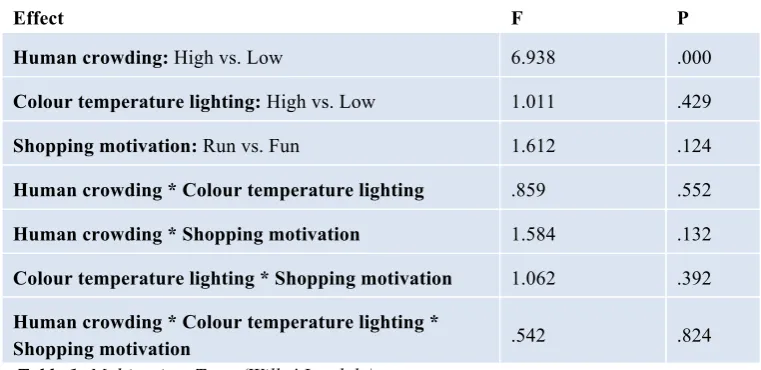
Wilks’ Lambda demonstrated significant results of the independent variable human crowding on the dependent variables. In addition, Wilk’s Lambda showed no other significant main or interaction effects on the dependent variables. Wilk’s Lambda results can be found below in table 1.
Effect F P
Human crowding: High vs. Low 6.938 .000
Colour temperature lighting: High vs. Low 1.011 .429
Shopping motivation: Run vs. Fun 1.612 .124
Human crowding * Colour temperature lighting .859 .552
Human crowding * Shopping motivation 1.584 .132
Colour temperature lighting * Shopping motivation 1.062 .392
Human crowding * Colour temperature lighting *
[image:28.595.99.480.364.549.2]Shopping motivation .542 .824
Table 1: Multivariate Tests (Wilks’ Lambda)
Independent variables
df F p η²Human crowding
Arousal 1 16.924 .000** .080 Pleasure 1 5.604 .019* .028 Perceived control 1 8.944 .003** .044 Approach behaviour 1 6.455 .012* .032 Spaciousness 1 44.750 .000** .187 Store attractiveness 1 2.792 .096 .014 Merchandise quality evaluation 1 .006 .938 .000 Merchandise value evaluation 1 1.981 .161 .010
Colour temperature lighting
Arousal 1 .123 .727 .001
Pleasure 1 3.804 .050* .019 Perceived control 1 2.073 .152 .011 Approach behaviour 1 5.773 .017* .029 Spaciousness 1 1.382 .241 .007 Store attractiveness 1 3.248 .073 .016 Merchandise quality evaluation 1 2.496 .116 .013 Merchandise value evaluation 1 .373 .542 .002
Shopping motivation
Arousal 1 2.626 .107 .013
Pleasure 1 .016 .899 .000
Perceived control 1 .996 .319 .005 Approach behaviour 1 .861 .355 .004 Spaciousness 1 .233 .630 .001 Store attractiveness 1 .279 .598 .001 Merchandise quality evaluation 1 .323 .571 .002 Merchandise value evaluation 1 2.395 .123 .012
Human crowding * Colour temperature lighting
Arousal 1 .091 .763 .000
Pleasure 1 1.496 .223 .008
Perceived control 1 .636 .426 .003 Approach behaviour 1 1.809 .180 .009 Spaciousness 1 .068 .795 .000 Store attractiveness 1 6.210 .014* .031 Merchandise quality evaluation 1 .379 .539 .002 Merchandise value evaluation 1 .063 .802 .000
Human crowding * Shopping motivation
Arousal 1 .006 .936 .000
Pleasure 1 2.454 .119 .012
Perceived control 1 2.689 .103 .014 Approach behaviour 1 1.558 .214 .008 Spaciousness 1 .695 .406 .004 Store attractiveness 1 .265 .607 .001 Merchandise quality evaluation 1 .396 .530 .002 Merchandise value evaluation 1 .046 .830 .000
Colour temperature lighting * Shopping motivation
Arousal 1 1.532 .217 .008
Pleasure 1 .712 .400 .004
30
Table 2: Effects of independent variables * p<.05, ** p<.005
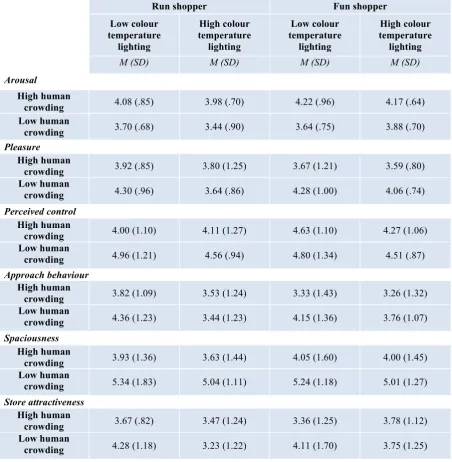
Run shopper Fun shopper Low colour temperature lighting High colour temperature lighting Low colour temperature lighting High colour temperature lighting
M (SD) M (SD) M (SD) M (SD)
Arousal
High human
crowding 4.08 (.85) 3.98 (.70) 4.22 (.96) 4.17 (.64) Low human
crowding 3.70 (.68) 3.44 (.90) 3.64 (.75) 3.88 (.70)
Pleasure
High human
crowding 3.92 (.85) 3.80 (1.25) 3.67 (1.21) 3.59 (.80) Low human
crowding 4.30 (.96) 3.64 (.86) 4.28 (1.00) 4.06 (.74)
Perceived control
High human
crowding 4.00 (1.10) 4.11 (1.27) 4.63 (1.10) 4.27 (1.06) Low human
crowding 4.96 (1.21) 4.56 (.94) 4.80 (1.34) 4.51 (.87)
Approach behaviour
High human
crowding 3.82 (1.09) 3.53 (1.24) 3.33 (1.43) 3.26 (1.32) Low human
crowding 4.36 (1.23) 3.44 (1.23) 4.15 (1.36) 3.76 (1.07)
Spaciousness
High human
crowding 3.93 (1.36) 3.63 (1.44) 4.05 (1.60) 4.00 (1.45) Low human
crowding 5.34 (1.83) 5.04 (1.11) 5.24 (1.18) 5.01 (1.27)
Store attractiveness
High human
crowding 3.67 (.82) 3.47 (1.24) 3.36 (1.25) 3.78 (1.12) Low human
crowding 4.28 (1.18) 3.23 (1.22) 4.11 (1.70) 3.75 (1.25)
Human Crowding * Colour temperature lighting * Shopping motivation
Arousal 1 1.006 .317 .005
Pleasure 1 .534 .466 .003
Perceived control 1 .992 .321 .005
Approach behaviour 1 .214 .644 .001
Spaciousness 1 .059 .808 .000
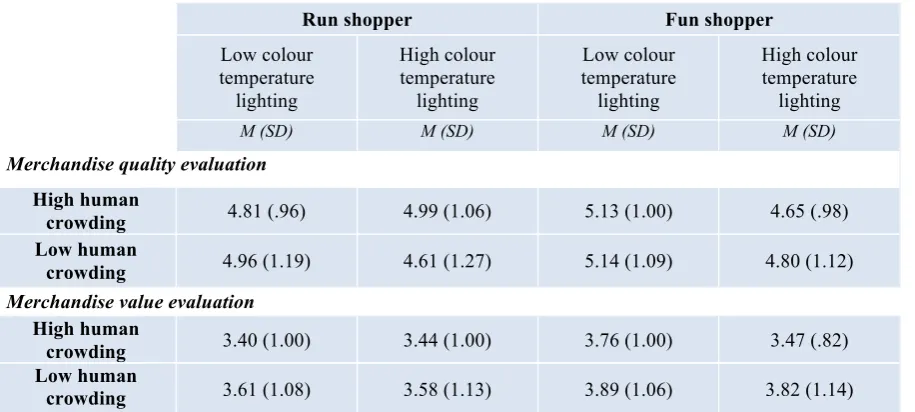
Run shopper Fun shopper Low colour temperature lighting High colour temperature lighting Low colour temperature lighting High colour temperature lighting
M (SD) M (SD) M (SD) M (SD)
Merchandise quality evaluation
High human
crowding 4.81 (.96) 4.99 (1.06) 5.13 (1.00) 4.65 (.98) Low human
crowding 4.96 (1.19) 4.61 (1.27) 5.14 (1.09) 4.80 (1.12)
Merchandise value evaluation
High human
crowding 3.40 (1.00) 3.44 (1.00) 3.76 (1.00) 3.47 (.82) Low human
[image:31.595.74.532.70.276.2]crowding 3.61 (1.08) 3.58 (1.13) 3.89 (1.06) 3.82 (1.14)
Table 3. Means and standard deviations per condition.
4.1 Main effects
Human crowding
32 main effect on perceived spaciousness (F (1,201) =45.225, p < .001). Participants exposed to a retail environment with a high level of human crowding have a significantly lower score on perceived spaciousness (M=3.91, SD=1.45) opposed to the participants exposed to a retail environment with a low level of human crowding (M=5.15, SD=1.80).
No significant main effects of human crowding on store attractiveness, merchandise quality evaluation and merchandise quality evaluation were found. Yet, it might be worth mentioning that marginally trends towards effects of human crowding on store attractiveness (F (1,201) =2.458, p=.11) and merchandise quality evaluation (F (1,202) =1,936, p= .11) were found. Hypotheses 1 will partly be accepted as human crowding showed significant effects on 5 out of the 8 tested dependent variables.
Colour temperature lighting
The multivariate analysis variance (Wilks’ Lambda) showed no significant results for an effect of simulated colour temperature on the dependent variables. Yet, data in table 2 indicates that colour temperature lighting has a main effect on pleasure, approach behaviour and possibly on store attractiveness. An effect of colour temperature lighting on pleasure was found (F (1,201) =3.804, p=.05). Contrary to hypothesis 2, a retail environment with low (warm) colour temperature lighting was rated as more pleasant (M=4.05, SD=1.03) opposed to a retail environment with high (cold) colour temperature lighting (M=3.78, SD=0.93). Further, a main effect of colour temperature lighting on approach behaviour was found (F (1,201) =5.773, p=.017). Also contrary to hypothesis 2, a retail setting with low (warm) colour temperature lighting was rated as more approachable (M=3.90, SD=1.33) opposed to a retail setting with high (cold) colour temperature lighting (M=3.5, SD=1.19). A trend towards a marginally significant main effect of SCT lighting on store attractiveness (F (1,201) =3.419, p=.06) and overall product quality (F (1,201) =2.654, p=.10) was noticeable. No main effects were found for the spaciousness and overall product quality variables. All means and standard deviations for the independent variables are presented in Table 3.
No significant main effect of shopping motivation on the dependent variables was found. Only a marginally trend towards a main effect of shopping motivation on arousal (F (1,201) =2.626, p=.10 and merchandise value evaluation (F (1,201)=2.395, p=.12 was noticed.
4.2 Interaction effects
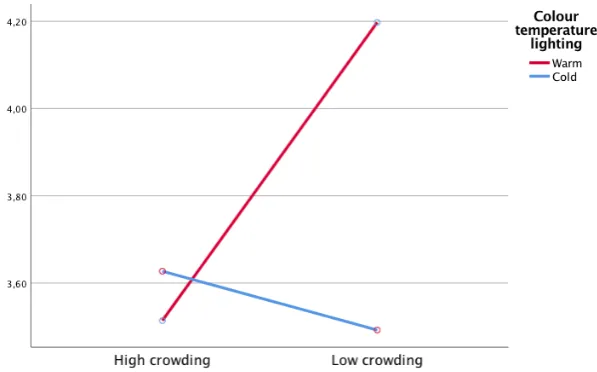
A significant interaction effect of human crowding and colour temperature lighting on store attractiveness was found (F (1,201) =6.210, p<.05). Under conditions of low (warm) colour temperature lighting, a retail environment with low human crowding (M=4.20, SD=1.17) will significantly be perceived as more attractive than a retail environment with high human crowding conditions (M=3.51, SD=1.06) (Figure 3). Under conditions of high (cold) colour temperature lighting these effects were not significant. A retail environment with high human crowding (M=3.63, SD=1.17) was not significantly perceived as more attractive than a retail environment with low human crowding conditions (M=3.50, SD=1.25).
[image:33.595.159.458.517.703.2]Store attractiveness
Figure 3. Interaction
effect between human
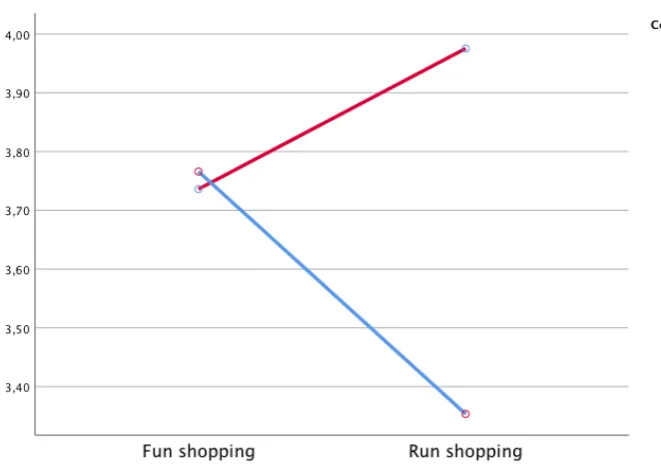
34 Another significant interaction effect on store attractiveness was found. Particularly, the MANOVA revealed an interaction effect of colour temperature lighting and shopping motivation on store attractiveness. Under conditions of low (warm) colour temperature lighting, a fun shopper will perceive the retail environment (M=3.74, SD=1.26) as less attractive than a run shopper (M=4.00, SD=1.07). On the other hand, under conditions of high (cold) colour temperature lighting, a fun shopper will perceive the retail setting (M=3.77, SD=1.18) as more attractive than a run shopper (M=3.35, SD=1.22). The results indicate that the interaction effect of colour temperature lighting on shopping motivation is most significant for run shoppers as experience a retail environment with low (warm) colour temperature lighting (M=4.00, SD=1.07) as more attractive than a retail environment with high (cold) colour temperature lighting (M=3.35, SD=1.22).
[image:34.595.108.439.365.602.2]Store attractiveness
4.3 Overview of the results
The main focus of this study was to test to what extent human crowding, colour temperature lighting and shopping motivation affects the consumer responses and consumer perceptions in a retail environment. The results of this experiment showed that human crowding has effect on arousal, pleasure, perceived control, approach/avoidance and perceived spaciousness in a retail environment. To add on, the results show an effect of colour temperature lighting on pleasure and approach/avoidance behaviour. An interaction effect between human crowding and colour temperature lighting was found on store attractiveness and the results also showed an effect of shopping motivation and colour temperature lighting on store attractiveness. Though, in both cases Wilks’ lambda value indicated no significant interaction effects. No other effects were present in this study. An overview of hypotheses is presented in Table 4.
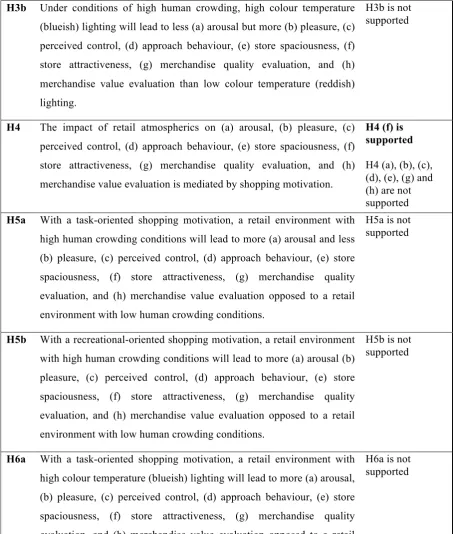
H# Hypotheses Result
H1 A retail setting with high human crowding conditions will lead to more (a) arousal, but less (b) pleasure, (c) perceived control, (d) approach behaviour, (e) spaciousness, (f) store attractiveness, (g) merchandise quality evaluation, and (h) merchandise value evaluation opposed to a retail setting with low human crowding conditions.
H1 (a), (b), (c), (d) and (e) are supported.
H1 (f), (g), and (h) are not supported
H2 A retail setting with high colour temperature (blueish) lighting conditions will lead to more (a) arousal, (b) pleasure, (c) perceived control, (d) approach behaviour, (e) spaciousness, (f) store attractiveness, (g) merchandise quality, and (h) merchandise value opposed to a retail setting with low colour temperature (reddish) lighting conditions.
H2 is not supported
H3a Under conditions of low human crowding, high colour temperature (blueish) lighting will lead to less (a) arousal (b) pleasure, (c) perceived control, (d) approach behaviour, (e) store spaciousness, (f) store attractiveness, (g) merchandise quality evaluation, and (h) merchandise value evaluation than low colour temperature (reddish) lighting.
H3a (f) is supported
36 H3b Under conditions of high human crowding, high colour temperature
(blueish) lighting will lead to less (a) arousal but more (b) pleasure, (c) perceived control, (d) approach behaviour, (e) store spaciousness, (f) store attractiveness, (g) merchandise quality evaluation, and (h) merchandise value evaluation than low colour temperature (reddish) lighting.
H3b is not supported
H4 The impact of retail atmospherics on (a) arousal, (b) pleasure, (c) perceived control, (d) approach behaviour, (e) store spaciousness, (f) store attractiveness, (g) merchandise quality evaluation, and (h) merchandise value evaluation is mediated by shopping motivation.
H4 (f) is supported
H4 (a), (b), (c), (d), (e), (g) and (h) are not supported H5a With a task-oriented shopping motivation, a retail environment with
high human crowding conditions will lead to more (a) arousal and less (b) pleasure, (c) perceived control, (d) approach behaviour, (e) store spaciousness, (f) store attractiveness, (g) merchandise quality evaluation, and (h) merchandise value evaluation opposed to a retail environment with low human crowding conditions.
H5a is not supported
H5b With a recreational-oriented shopping motivation, a retail environment with high human crowding conditions will lead to more (a) arousal (b) pleasure, (c) perceived control, (d) approach behaviour, (e) store spaciousness, (f) store attractiveness, (g) merchandise quality evaluation, and (h) merchandise value evaluation opposed to a retail environment with low human crowding conditions.
H5b is not supported
H6a With a task-oriented shopping motivation, a retail environment with high colour temperature (blueish) lighting will lead to more (a) arousal, (b) pleasure, (c) perceived control, (d) approach behaviour, (e) store spaciousness, (f) store attractiveness, (g) merchandise quality evaluation, and (h) merchandise value evaluation opposed to a retail environment with low colour temperature (reddish) lighting.
H6a is not supported
H6b With a recreational shopping motivation, a retail environment with high colour temperature (blueish) lighting will lead to more (a) arousal, (b) pleasure, (c) perceived control, (d) approach behaviour, (e) store spaciousness, (f) store attractiveness, (g) merchandise quality evaluation, and (h) merchandise value evaluation opposed to a retail environment with low colour temperature (reddish) lighting.
[image:36.595.71.525.71.606.2]H6b is not supported
5. Discussion
This research attempts to give more insight in how human crowding and colour temperature lighting interact and whether they influence consumer’s responses and perceptions in a retail environment, taking into consideration consumer’s shopping motivation. The effects of these two atmospheric variables and shopping motivation on consumers’ responses and perceptions have not been investigated together in a retail setting previously. Through this research some recommendations can be made concerning the use of the correct in-store colour temperature lighting in crowded versus non-crowded retail environments while taking consumer’s shopping motivations into consideration.
5.1 Conclusions
Main effects
38 To add on, human crowding also showed a main effect on a consumer perception variable. Human crowding has shown to have a significant effect on perceived spaciousness. A retail environment with low human crowding was significantly perceived as more spacious opposed to a retail environment with high human crowding. These findings are in line with research by Nasar (1984) and Machleit, Kellaris & Eroglu (1994) and show that crowding is a significant antecedent of spaciousness perceptions. To add on, Van Rompay, Tanja-Dijkstra, Verhoeven & Van Es (2011) argue that a spacious store layout is likely to reduce negative affect of task-oriented shoppers and so having a spacious retail environment is of importance in creating a positive shopping environment. Yet, this research shows no significant effect towards such theory.
In regard to colour temperature lighting, it was hypothesized that high colour temperature lighting (cold lighting) would be perceived as more pleasurable and more approachable than low correlated colour temperature (warm lighting). Yet, in this study, a retail environment with low correlated colour temperature lighting (warm lighting) is perceived as more pleasurable and more approachable. These results agree with earlier findings stating that appropriate lighting will produce arousal and pleasure and so contribute to consumer approach behaviour (Areni & Kim, 1994; Mehrabian, 1976; Summers & Hebert, 2001) but are somewhat contradictory to findings by Park and Farr (2009). Park and Farr (2009) indicate that arousal is more likely to be related to approach behaviour opposed to pleasure. Though, this study shows that low colour temperature (warm) lighting has the same positive effect on pleasure and approach behaviour and therefore indicate that pleasure contribute to consumer approach behaviour.
Interaction effects
Two interaction effects were found. Under conditions of low (warm) colour temperature lighting, a retail environment with low human crowding was perceived as more attractive than a retail environment with high human crowding. Shoppers generally use plain, easy accessible social cues (e.g., crowding) to help them draw conclusions about possible missing information. A crowded retail environment could indicate a popular store and thus creating an attractive store image. To add on, a room with low colour temperature lighting is perceived as more attractive opposed to a room with high colour temperature lighting (Park and Farr, 2007).
Secondly, an interaction effect of colour temperature lighting and shopping motivation on store attractiveness was found. Run shoppers perceived a retail environment with low (warm) colour temperature lighting as more attractive than a retail environment with high (cool) colour temperature lighting. An explanation for this effect could be that high (blue) colour temperature lighting is too arousing for run shoppers and therefore is a store perceived as less attractive than low (warm) colour temperature lighting, yet research showed no interaction effect of colour temperature lighting and shopping motivation on arousal. High (cool) colour temperature lighting might be too confronting for run shoppers as clear bright light might stress the obstacles a shopper must face in a store to complete its task, making it less attractive to engage in.
40 5.2 Limitations
This research on human crowding, colour temperature lighting and shopping motivation has some limitations regarding the online survey, the stimulus material and the independent variable colour temperature. The limitations will be explained.
First, the respondents participated in an online experiment and experienced the retail environment through a video. The participants observed a motionless camera angle sliding through the retail environment with a static route. This did not allow the participants to move freely throughout the store and could not be fully representative of how they would move in a real store. For that reason, an interactive 3D setting where the participants are free to move, to look and to spend as much time in the store as they want would be a more effective method to use for future research.
Even better would be considering conducting future research in an actual physical retail environment as this study was conducted in an online virtual setting. The online virtual retail environment could be perceived as tedious and less realistic since there was no social interaction among the (few) people present in the store. Furthermore, the results of colour temperature lighting on participants in an actual physical store setting could differ in the results from this study. Using actual light sources could be more representative opposed to artificial lighting in a virtual 3D setting.
To add on, the manipulation of the motivational orientation variable could be a possible limitation in this study. As above mentioned, the survey was distributed online to the respondents and prior in engaging in the survey, the participants were asked to read a text. This text asked the participants to operate in a different mood state of which they were already in. For some participants this enacting could be quite difficult and therefore distort the results. Perhaps distributing a survey shortly after the participants did their groceries in a physical retail environment would therefore might give more accurate results.
correlated colour temperatures could be included. Beside correlated colour temperature there are more lighting measurements to investigate. For instance, colour rendering index (CRI) showed an effect on pleasure in a retail environment (Park and Farr, 2007)
Finally, during the study some participants stated that they experienced the survey as monotonous. The first part of the survey was recognized as pleasing and fun to do by the participants. This was due to the fact that the first part of the survey existed of 3 different videos followed by a few questions. The following part was received as boring and repetitive. Perhaps limiting the measurements of the study and shortening the survey could help. Yet, this would limit the outcomes of this study.
5.3 Practical implications
The practical implications are formulated for retail managers and retail organizations. Correlated colour temperature lighting is a relatively unexplored field of research on consumer behaviour in retail environments. For that reason, there is a need for research in the area of the effect of correlated colour temperature on consumer behaviour and perceptions in a retail environment.
When creating a retail brand experience environment based on entertainment and pleasure, the use of correct correlated colour temperature can be of importance. In this study, CCT has shown to positively affect consumer’s pleasure in a retail environment. Also, CCT has shown to be able to influence approach/avoidance behaviour. By choosing the correct CCT for a retail environment it can be able to pull customers towards the retail environment.
Reference List
1. Altman, I. (1975). The Environment and Social Behavior: Privacy, Personal Space, Territory, and Crowding.
2. Apter, M. J. (1982). The experience of motivation: The theory of psychological reversals. Academic Pr.
3. Areni, C. S., & Kim, D. (1994). The influence of in-store lighting on consumers' examination of merchandise in a wine store. International Journal of Research in Marketing, 11(2), 117-125.
4. Babin, B. J., Hardesty, D. M., & Suter, T. A. (2003). Color and shopping intentions: The intervening effect of price fairness and perceived affect. Journal of business research, 56(7), 541-551.
5. Baker, J., Grewal, D., & Parasuraman, A. (1994). The influence of store environment on quality inferences and store image. Journal of the Academy of Marketing Science, 22(4), 328-339.
6. Baker, J., Levy, M., & Grewal, D. (1992). An experimental approach to making retail store environmental decisions. Journal of Retailing, 68(4), 445.
7. Bateson, J. E., & Hui, M. K. (1992). The ecological validity of photographic slides and videotapes in simulating the service setting. Journal of Consumer Research, 19(2), 271-281.
8. Baum, A., & Valins, S. (1977). Architecture and social behavior: psychological study of social density.
9. Baumgarten, S. A., & Hensel, J. S. (1987). Enhancing the perceived quality of medical service delivery systems. Add Value to Your Service, Carol Surprenant, ed. Chicago: American Marketing Association, 105(10).
10. Bellizzi, J. A., Crowley, A. E., & Hasty, R. W. (1983). The effects of color in store design. Journal of retailing.
11. Bitner, M. J. (1990). Evaluating service encounters: the effects of physical surroundings and employee responses. the Journal of Marketing, 69-82.
12. Boray, P. F., Gifford, R., & Rosenblood, L. (1989). Effects of warm white, cool white and full-spectrum fluorescent lighting on simple cognitive performance, mood and ratings of others. Journal of Environmental Psychology, 9(4), 297-307.
44 14. Byun, S. E., & Mann, M. (2011). The influence of others: The impact of perceived human
crowding on perceived competition, emotions, and hedonic shopping value. Clothing and Textiles Research Journal, 29(4), 284-297.
15. Coutinho, E., & Cangelosi, A. (2011). Musical emotions: predicting second-by-second subjective feelings of emotion from low-level psychoacoustic features and physiological measurements. Emotion, 11(4), 921.
16. Custers, P. J., De Kort, Y. A. W., IJsselsteijn, W. A., & De Kruiff, M. E. (2010). Lighting in retail environments: Atmosphere perception in the real world. Lighting Research &
Technology, 42(3), 331-343.
17. Dawson, S., Bloch, P. H., & Ridgway, N. M. (1990). Shopping motives, emotional states, and retail outcomes. Journal of Retailing, 66(4), 408.
18. Deci, E. L., & Ryan, R. M. (1985). The general causality orientations scale: Self-determination in personality. Journal of Research in Personality, 19(2), 109-134.
19. Donovan, R. J., & Rossiter, J. R. (1982). Store atmosphere: an environmental psychology approach. Journal of Retailing, 58(1), 34-57.
20. Donovan, R. J., Rossiter, J. R., Marcoolyn, G., & Nesdale, A. (1994). Store atmosphere and purchasing behavior. Journal of Retailing, 70(3), 283-294.
21. Doucé, L., & Janssens, W. (2013). The presence of a pleasant ambient scent in a fashion store: The moderating role of shopping motivation and affect intensity. Environment and
Behavior, 45(2), 215-238.
22. Dion, D. (2004). Personal control and coping with retail crowding. International Journal of Service Industry Management, 15(3), 250-263.
23. Eroglu, S., & Harrell, G. D. (1986). Retail crowding: Theoretical and strategic implications. Journal of Retailing, (62), 347-363.
24. Eroglu, S. A., & Machleit, K. A. (1990). An empirical study of retail crowding: antecedents and consequences. Journal of Retailing, 66(2), 201.
25. Eroglu, S. A., Machleit, K., & Barr, T. F. (2005). Perceived retail crowding and shopping satisfaction: the role of shopping values. Journal of Business Research, 58(8), 1146-1153.