http://wrap.warwick.ac.uk
Original citation:
Laine, T.H., Sutinen, E., Nygren, E. and Joy, Mike (2011) Rapid improvement of
technology integration in context-aware learning spaces. In: IEEE Africon 2011,
Livingstone, Zambia, 13-15 Sep 2011. Published in: AFRICON, 2011 pp. 1-6.
Permanent WRAP url:
http://wrap.warwick.ac.uk/45675
Copyright and reuse:
The Warwick Research Archive Portal (WRAP) makes this work by researchers of the
University of Warwick available open access under the following conditions. Copyright ©
and all moral rights to the version of the paper presented here belong to the individual
author(s) and/or other copyright owners. To the extent reasonable and practicable the
material made available in WRAP has been checked for eligibility before being made
available.
Copies of full items can be used for personal research or study, educational, or not-for
profit purposes without prior permission or charge. Provided that the authors, title and
full bibliographic details are credited, a hyperlink and/or URL is given for the original
metadata page and the content is not changed in any way.
Copyright statement:
“© 2011 IEEE. Personal use of this material is permitted. Permission from IEEE must be
obtained for all other uses, in any current or future media, including reprinting
/republishing this material for advertising or promotional purposes, creating new
collective works, for resale or redistribution to servers or lists, or reuse of any
copyrighted component of this work in other works.”
A note on versions:
The version presented here may differ from the published version or, version of record, if
you wish to cite this item you are advised to consult the publisher’s version. Please see
the ‘permanent WRAP url’ above for details on accessing the published version and note
that access may require a subscription.
Rapid improving of technology integration in
context-aware learning spaces
Author A., Author B., Author C.
Department A. Affiliation A. Address, country Email: [email protected]
Author D.
Department B. Affiliation B. Address, country Email: [email protected]
Abstract—Context-aware learning spaces (CALSs) utilise re-sources of the surrounding context in the learning process. UFractions is a CALS combining a storytelling game on a mobile phone and fraction rods for learning mathematics at middle schools. Technology integration is the process by which a technology is introduced to a pedagogical setting with an aim to use it effectively for teaching or learning. We proposed a tool for rapid improvement of technology integration in CALSs and used the tool to evaluate UFractions from the learner’s perspective in the Mozambican context. As results we identified 22 disturbance factors and made a comparison to a previous study which was conducted in South Africa and in Finland with instruments that were not meant for assessing technology integration. The results indicate that the proposed tool yields more accurate results with a significantly smaller data set than the previous study. Furthermore, the identified disturbance factors guide the improvement process of UFractions.
I. INTRODUCTION
Context-aware learning spaces (CALSs) are technology-enhanced learning environments which are typically con-structed to support informal learning in contexts such as museums, parks, festivals, cities and galleries. Specifically, CALSs combine the contextual resources in the real world with the virtual world so as to motivate and engage the learners to explore the environment in an interactive way. A CALS utilises context-aware technologies (e.g. sensors, positioning) to provide the learner with content based on for example the learner’s location, time of the day, nearby people and the learner’s previous activities. Failing to integrate the technologies into a CALS leads to disruption of the learning experience by the technologies.
Technology integration refers to the process by which a technology is introduced to a classroom so that the teacher and the students can use it effectively for pedagogical purposes [1]. We have previously established a model of technology integra-tion for CALSs [2]. The technology integraintegra-tion model provides the CALS designers with a tool to plan technology integration based on various requirements set by the context, pedagogy and design goals.
In a previous study we evaluated technology integration of UFractions, a game-based CALS for learning fractions. In UFractions the players interact with leopards through story-telling and solve fraction challenges so as to assist a mother leopard to raise her cub. The previous evaluation of UFractions
conducted in South Africa and in Finland revealeddisturbance factorsthat guide how to improve technology integration [3]. However, the evaluation design was not created for measuring technology integration but for investigating how a reverse technology transfer works (i.e. from South Africa to Finland). Thus we hypothesise that with a proper evaluation tool the results could be deepened.
In this paper we present a tool for evaluating technology integration in CALSs. The evaluation tool is grounded on the technology integration model and a literature analysis on technology integration in classroom-based education. After presenting the tool, we use it to evaluate UFractions in the Mozambican context. Then, through discussion, we analyse the results of the evaluation so as to determine the tool’s suitability for evaluating technology integration in CALSs.
There are two reasons as to why the proposed tool is justified. Firstly, in the context of formal education at schools, technology integration, its evaluation, reasons for its high failure rates and how the process could be improved have been researched abundantly (e.g. [1][4][5][6][7][8]) but technol-ogy integration in informal contexts has not received similar attention. As the importance of informal learning contexts is increasing due to the latest developments of mobile and context-aware technologies, it is clear that the need for tech-nology integration and its evaluation in these contexts is also increasing. Secondly, the previous technology evaluation of UFractions was not designed for measuring technology integration, hence calling for a dedicated tool for a deeper evaluation.
II. BACKGROUND
A. Context-aware learning spaces (CALSs)
define contextual resources as context-dependent entities that can be detected by context-aware technologies. In contrast,
context-free resources are not dependent on a given context (e.g. a theory or general knowledge of the topic).
Context-aware learning is a subset of m-learning which integrates the contextual resources into virtual learning con-tent. This means that the learner traverses a specific context while interacting with the surrounding environment. A mobile handset delivers context-sensitive instructions and tasks to the learner, and provides feedback based on the learner’s actions. Context-sensitiveness is achieved by context-aware technologies which include for example sensors and smart tags. A technical environment which enables and facilitates context-aware learning is called a context-aware learning space (CALS). Typically such an environment comprises a number of mobile devices (clients), wireless connectivity, a server, and a set of context-aware technologies.
B. Technology integration model for CALSs
The term technology integration refers to the process by which a technology is introduced to a classroom so that the teacher and the students can use it effectively for pedagogical purposes [1]. Technology integration is also important for CALSs as the designers may not have the needed technical know-how to choose and integrate technologies. The CALS development process is context-dependent and unique for each CALS instance, thus reflecting also on the technology integration process as the same set of technologies may require different approaches for different CALSs. We have previously created a technology integration model for CALSs which contains three categories of requirements that should be considered in the technology integration process [2]: context requirements, pedagogical requirements and design require-ments. Each category has a critical factor which has a major impact on the category. These critical factors are availability of resources for the context requirements, unobtrusiveness of technology for the pedagogical requirements and context-awarenessfor the design requirements.
Technology integration in CALSs can be divided intoactive
andpassive integration depending on the role of the technol-ogy in the process [3]. In active integration the technology integratescontextual and context-free resources into the CALS and makes the system adaptive to the changing context, including its users. In passive integration the technology is integrated into the CALS (and therefore into the context) so that it becomes unobtrusive to the learner and to the context.
III. RESEARCH DESIGN
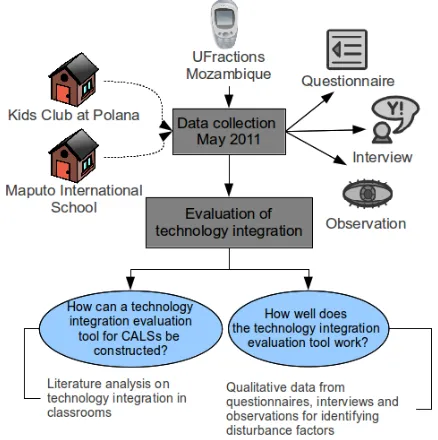
The research design of this study is illustrated in Figure 1. The following sections present research questions, research setting and research methods.
A. Research questions
[image:3.612.328.547.58.278.2]The first research question (RQ1) of this study is “How can a technology integration evaluation tool for CALSs be constructed?” and it aims at creating a tool that can be
Fig. 1. Research design
used by CALSs developers and users to evaluate the success of technology integration in a CALS. The second research question (RQ2) is “How well does the technology integration evaluation tool work?” and it aims at validating the tool for its intended use. These questions are answered by using the methods described in Section III-C.
B. Research setting
Fig. 2. UFractions challenge for calculating distance to a new shelter
The technology of UFractions consists of client software installed on mobile phones (Nokia N95 and N80 in the tests) supporting J2ME MIDP 2.0, a Java-based server software on a PC, a website, fraction rods, and a wireless connectivity over a WLAN or a 3G network. The content is sent from the server to the clients in real time so it is necessary to have a reliable connection in between. During the tests we set up a WLAN access point to ensure smooth connectivity. The fraction rods are wooden and their lengths correlate with their colours. Each rod has been marked with a colour code (e.g. ’B’ for Blue) which are used in the game content.
2) Participants and the procedure: Evaluation data was collected in May 2011 at two locations in Maputo, Mozam-bique. First location was a Kids Club at Polana Secondary School (Polana). In a Kids Club the children are provided with an opportunity to apply and create novel information and communication technologies for learning [11]. All participants at Polana were Mozambicans thus Portuguese language was used. Three of the Kids Club instructors participated to the test as well. The second location was English speaking Maputo International School (MIS). We chose MIS so as to get a wider range of cultural backgrounds.
The test participants (16 from Polana, 54 from MIS) filled in a questionnaire before and after the test. The pre-test part of the questionnaire collected demographics, mobile phone ownership and usage habits, as well as perceptions of games and mathematics. The post-test part consisted of five open questions and a series multiple choice questions with Likert scale or similar options. Open questions collected data on likes and dislikes, difficulties, surprising elements and sugges-tions for improvements. Multiple choice quessugges-tions measured features and activities of the game, motivation, usability and clarity of the user interface, context-awareness (i.e. suitability of the CALS to the participant and to the context), availability of resources and overall experience.
One to three participants from each group were interviewed by the researcher (11 in total). Interview questions gathered the participants’ opinions on game experiences, learning, advantages/disadvantages, likes and dislikes of the game’s features, applicability of the game outside the classroom, use of fraction rods, technology’s role in the game, technical problems, suitability of the game for the Mozambican context,
and ideas for future development. In addition to questionnaires and interviews, the researcher observed the participants during the game play and made notes on relevant events.
C. Research methods
1) Methods for answering RQ1: The technology integration evaluation tool is based on the technology integration model which in turn was created based on a literature analysis and an artefact analysis [2]. A literature analysis was used to establish theoretical foundations for the technology integration model. In artefact analysis, with a goal of reaching a deeper understanding about an artefact and its usage than would be possible by mere direct observation, we explored several CALSs in various contexts to find out how they were designed and how they were used. Once the technology integration model was established it became clear that a technology integration evaluation tool is needed. Hence, we performed a literature analysis on technology integration in education and combined the results with the technology integration model. Data for the analysis were collected by searching articles related to technology integration in the classroom.
2) Methods for answering RQ2: The evaluation of technol-ogy integration is based on tests with the UFractions game. The tests involve participants aged 10-32 (average 13). We intentionally selected a broader range of participants than 8th graders so as to measure perceptions from different age groups. The evaluation tool utilises a mixed method approach but in this paper qualitative data categorisation and analysis were the key methods for finding disturbance factors for technology integration in UFractions. In categorisation we coded negative responses that the participants gave in open questions and interviews. Observations were also regarded. The coding was then used to identify the disturbance factors and to assign them to experience groups.
IV. TECHNOLOGY INTEGRATION EVALUATION TOOL
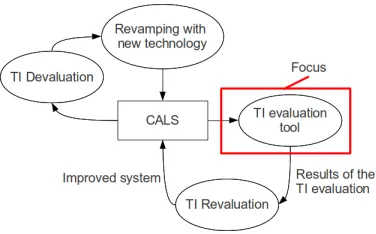
A CALS can be seen as a constantly evolving system. The iterative process of CALS development is illustrated in Figure 3. The idea is that the first version of a CALS is placed under technology integration evaluation with the tool presented in this paper. The results of the evaluation inform the revaluation process which, by eliminating the problems discovered in the evaluation, increases the pedagogical and motivational value of the CALS. The resulting improved version of the CALS may become subject to devaluation
which could happen for example when a technology breaks or becomes outdated. Devaluation is solved by revamping the CALS with a new technology, which in turn prompts a new evaluation.
Fig. 3. CALS development as a high-level iterative process
technologies have specific affordancesandconstraints in the integration process [6]. Affordances are enabling features of an object or an environment that allow an individual to perform an action [12]. Constraints, on the other hand, are a limiting force, setting restrictions to the use of technology.
Critical factors of the technology integration model, affor-dances and constraints can be observed from the viewpoints of the learner, the educator and the context. Based on these components we have formed relevant evaluative questions of which the questions for the learner’s viewpoint are presented in Table I. We cover here only the learner’s viewpoint because the evaluation section of this paper concentrates on the learners. These questions are to be used as a starting point for creating data collection instruments. For example, the question “How do the learners perceive the technology?” could be answered by asking the learners’ opinions on and experiences with the technology (e.g. mobile devices) as part the CALS.
TABLE I
LEARNER’S ROLE IN THE EVALUATION TOOL
Learner
Unobtru-siveness of technology
Howgood is the user experience of the CALS? Doesany of the used technologies distract the learner? How do the learners perceive the technology? (or do they perceive it at all?)
Availability of resources
Dothe learners afford using the system (if not free)? How does the CALS take into account the learner’s available time resources?
Arethe learners able to use the technology efficiently? Whatkind of connections can the CALS create between the learning content and previous experiences of the learners?
Context-awareness
How does the CALS take into account the learner’s personal context (e.g. location in a room, previous knowledge, preferences)?
Howdoes the CALS take into account the social context of the user (e.g. other learners)?
How does context-awareness take into account the learner’s cultural background?
Affordances Howdo the features of the CALS facilitate learning? Constraints Howdo the features of the CALS restrict/prevent
learn-ing?
The evaluation tool also measures general perceptions of the CALS. This data includes likes, dislikes, suggestions for improvements, motivation and applicability to other contexts. These aspects can be used to evaluate the attractiveness of the CALS as a learning tool both from the learner’s and the
educator’s perspectives.
V. EVALUATION
Although the evaluation tool covers the roles of the learner, the educator and the context, in this study we only eval-uate UFractions from the learner’s viewpoint. Furthermore, we report only the results regarding to disturbance factors which were acquired by analysing the qualitative data from questionnaires, interviews and observations. Table II presents the identified disturbance factors (22) with indications that map the representative evidence to the factors. The factors relate either to active (A) or passive (P) integration and they are grouped by the learner’s areas of experience which are affected by the disturbance factors. The term ZPD refers to Vygotsky’s Zone of Proximal Development [13].
VI. DISCUSSION
Technology integration has been a widely discussed topic in the domain of formal classroom-based learning but in the domain of informal learning, particularly in context-aware learning, the issue has not received similar attention. Context-aware learning spaces provide new ways of learning by combining contextual resources with learning content. While a CALS can provide highly interactive and engaging learning experiences, the technical complexity might lead to issues of badly integrated technology. To alleviate the challenges with technology integration we have previously established a technology integration model and in this study we proposed an evaluation tool based on the model. Both the model and the evaluation tool are novel approaches to scrutinise technology integration in CALSs from a holistic perspective.
If we compared the results of this study (22 disturbance factors) to those of the previous evaluation (16 disturbance factors) [3], we can find all but one previously identified factors in the current results. The size of the data sets used in this study (70) was significantly smaller than the combined data set used in the previous study in South Africa and Finland (209), thus we had less qualitative data to work with. Further-more, the participants in South Africa and in Finland were strictly 8th graders whereas in Mozambique the game was played by 6th and 8th graders as well as Kids Club members, thus making the data set more heterogeneous (in addition to a variety of nationalities). There was also a high number (75) of significant correlations (equal to or above 0.5) between quantitative statements of the questionnaire in Mozambique. This informs us of the good quality (triangulation) and the depth of the data. In contrast, in the South African data set the number of significant correlations was 8 and in the Finnish data set it was 29. These results indicate that the proposed tool yielded more accurate results with a smaller data set, thus suggesting that less time is needed for improving a CALS with the tool.
TABLE II
DISTURBANCE FACTORS IDENTIFIED BY THE EVALUATION TOOL
Area of ex-perience
Disturbance factor
Indication I Evidence
Temporal ex-perience
Too long game
References to a long game or a suggestion to make it shorter
A “The game is very big. It must have been a bit shorter” (Male, 13, Indian)
Too short game
References to a short game or a suggestion to make it longer
A “I thought they could have a bit...maybe a bit longer the game.” (Male, 12, Mozambican)
Learning ex-perience
Beyond ZPD References to difficulty of challenges
A “There were some fractions that were difficult to solve.” (Male, 13, Mozambican)
Below ZPD References to easiness of challenges
A “For learning purpose maybe you should make it a little harder but as a game it is ok.”, (Male, 12, Indian)
Wrong age group
Suggestion to use the game for younger play-ers
A “Maybe it would be better for younger kids because it’s this story of two leopards, so it would be from 8 to 11.” (Female, 13, Indian)
Lack of scaf-folding
References to getting stuck
A “Sometimes when you were doing a question and you keep on not understanding I think there should be like where you can go to the next question if you can.” (Male, 11, Mozambican)
Conflicting content
Conflict between own idea and game’s idea
A “I was surprised because I had some answers that I was sure were correct but somehow they were wrong” (Male, 11, English)
Immersion experience
Too much story
References to too long story or too much read-ing
A “Too much reading and after a while it gets boring” (Female, 13, Mozambican)
Monotony References to repeti-tion or monotony of the content
A “A part that I didn’t like was that it was always about leopards. If we had lots of settings with maybe gorilla and rhino we could all learn the lives of lots of animals which shows you lots of different fact. (Male, 11, Irish) Too
educational
References to the game being too pedagogical
A “It was nice but the thing is like it’s not something I wanna do on a weekend or something. Maybe if you’re bored...” (Male, 12, Indian) Social
expe-rience
Harassment Group members dis-turbed game play
A “The thing was that two people would play it so one person would just take the phone and the other person will take it. The other person would have taken it and I couldn’t have read so that was sort of a disadvantage. (Female, 11, Korean)
Lack of peer support
References to lack of support from peers
A “Disadvantage is that maybe no one would be there to explain to you” (Female, 13, Indian)
Emotional experience
Disturbing content
References to shocking or disturbing events in the content
A “The story of Senatla is not very good because the father of Senatla did not care for Senatla. Senatla was living with her mother...” (Female, 17, Mozambican)
Punishment References to dislike on getting questions wrong
A “[I disliked] When we got questions incorrect” (Male, 11, Mozambican)
Cognitive experience
Lack of ani-mation
References of lack of animation or sugges-tions to add them
P “I’d just say more animations into the story, kind of hide the fact that it’s about fractions. [. . . ] (Male, 12, Indian)
Inappropriate graphics
References to poor graphics or suggestions to improve them
P “The screen was a bit too...all the colours around it and...it kind of...not too many colours but all the colours around it were kind of distracting. It could be one plain colour maybe.” (Male, 11, Irish”)
Inappropriate sounds
References to poor sounds or suggestions to improve them
P “Make it more lively with sound” (Male, 13, Mozambican)
“If you’re gonna improve it, maybe you should like...let’s say if someone has troubles reading it you should have voice over” (Male, 12, Indian) Contextual
experience
Inconvenient interaction with rods
References to negative experience of using the rods
P “I wouldn’t advise to use them because sometimes they make it compli-cated.” (Female, 15, Mozambican)
User experi-ence
Inconvenient interaction with phone
References to negative experience of physical handling of or proper-ties of the phone
P “One thing that I really didn’t find that much interesting was using the phone. That wasn’t that much fun but I think that’s all really.[...] There were buttons and everything. I think it would be easier if you use something like maybe a calculator or something.” (Male, 11, Mozambican)
Technical faults
References to technical problems during play-ing
P “Once it turned down...it quit by itself but then we were on track again.” (Male, 11, Irish)
Small screen References to small screen size or difficulty to see the content
P “The phone’s screen was a bit too small so I couldn’t see.” (Female, 11, Korean)
Unclear instructions
References to unclear tasks or difficulty of understanding them
adequately for evaluating technology integration from the learner’s perspective. We have prepared qualitative instruments for interviewing teachers and school representatives in order to complete the evaluation of technology integration but these will be applied in a future study. Based on this study we have useful information on how the game could be improved to meet the expectations of the learners. The next step is to perform a technology integration revaluation (see Figure 5) in which the identified disturbances will be diminished. It may be impossible to completely eliminate the disturbances because of the heterogeneity of the learner population. A set of methods for the revaluation process is yet to be established and it is out of scope of this study.
After applying the evaluation tool successfully to UFrac-tions, the big question is: how does the tool support evaluation of other CALSs in other contexts? The evaluation tool was designed to be generic in terms of viewpoints (learner, educa-tor and context) as each informal/formal learning experience has a set of learners who are the primary users of the system, an educator who is responsible of the pedagogical goals, approaches and possibly the content, and the context itself which may have various resources to be utilised by the CALS. Furthermore, the questions presented in Table I are generic as well, thus being applicable to any learning situation. Data collection instruments of this study can be applied with minor modifications to other CALSs but the parts related to features, context and subject matter should be changed to correspond the target CALS. Finally, it is only through performing evaluations on other CALSs that we can verify the effectiveness of the evaluation tool in a larger scale.
VII. CONCLUSION
We have introduced a tool for evaluating technology integra-tion in context-aware learning spaces. The roles on which the tool is based cover viewpoints of the learners, the educators and the context. We consider the role division mandatory as influences of the technology may be perceived in different ways from different perspectives. Additionally, the role divi-sion grants us the possibility to prioritise the evaluation work and this is exactly what we have done in this paper – only the learner’s perspective was targeted in the evaluation of the UFractions game. The results of the evaluation proposed two major findings: (i) there are various disturbances, related to both active and passive technology integration, in UFractions when applied to the Mozambican context; (ii) the evaluation tool provides deeper results with a smaller data set than an evaluation done in South Africa and in Finland with other instruments. The appropriateness of the evaluation tool is based on the following facts: it considers all major roles who/which are affected by or who/which affect a CALS; it revealed more disturbance factors with a significantly smaller qualitative data set than the previous study; there is a higher number of evaluation metrics aimed at measuring technology integration than in the previous study; high number of signif-icant correlations between the statements of quantitative data indicates interdependency links and triangulation of the data.
We have now reached one milestone in the process of creating a comprehensive set of tools for the entire technol-ogy integration process. Technoltechnol-ogy integration model, which was established before, is used in the planning, design and implementation phases of a CALS, and the evaluation tool is then applied to evaluate the effects of the technology, both in active and passive roles. The evaluation informs the CALS developer which aspects of the CALS need to be improved. The next part of our long term research agenda is to validate the evaluation tool’s generalisability against other CALSs in various contexts and then derive revaluation instruments to diminish the identified disturbances. Even before a revaluation method is established, the CALS developers can start a revalu-ation process by in case-by-case manner. The outcome should then be tested with another round of technology integration evaluation to ensure the desired results.
ACKNOWLEDGMENT
Anonymous acknowledgements REFERENCES
[1] P. Ertmer, “Addressing first- and second-order barriers to change: strategies for technology integration,”Educational Technology Research and Development, vol. 47, no. 4, pp. 47 – 61, 1999.
[2] T. H. Laine, C. Islas Sedano, M. Joy, and E. Sutinen, “Critical factors for technology integration in game-based pervasive learning spaces,”IEEE Transactions on Learning Technologies, vol. 3, no. 4, pp. 294 – 306, 2010.
[3] T. Laine, E. Sutinen, M. Joy, and N. E., “Technology integration in context-aware learning spaces,” Manuscript in preparation, pp. 655 – 657, 2011.
[4] T. Levine and R. Wadmany, “Teachers’ views on factors affecting effective integration of information technology in the classroom: De-velopmental scenery,”Journal of Technology and Teacher Education, vol. 16, pp. 233–263, 2008.
[5] N. Strudler and K. Wetzel, “Lessons from exemplary colleges of educa-tion: Factors affecting technology integration in preservice programs,”
Educational Technology Research and Development, vol. 47, pp. 63–81. [6] M. Koehler and P. Mishra, Introducing Technological Pedagogical Knowledge, ser. The Handbook of Technological Pedagogical Content Knowledge for Educators. Routledge, 2008.
[7] H. Becker, “How exemplary computer-using teachers differ from other teachers: Implications for realizing the potential of computers in schools,”Journal of Research on Computing in Education, vol. 26, pp. 291–321, 1994.
[8] A. Staples, M. Pugach, and D. Himes, “Rethinking the technology integration challenge: Cases from three urban elementary schools,”
Journal of Research on Technology in Education, vol. 37, pp. 285–311, 2005.
[9] B. Eschenbrenner and F.-H. Nah, “Mobile technology in education: uses and benefits,”IJMLO - International Journal of Mobile Learning and Organisation, vol. 1, pp. 159 – 183, 2007.
[10] E. Turtiainen, S. Blignaut, C. Els, T. H. Laine, and E. Sutinen, “Story-based ufractions mobile game in south africa: Contextualization process and multidimensional playing experiences,” inProceedings of the Sec-ond Workshop of Story Telling and Educational Games, 2009. [11] P. J. Eronen, I. Jormanainen, E. Sutinen, and M. Virnes, “Kids’ Club
Reborn: Evolution of Activities,” inProceedings of ICALT 2005 Con-ference. Kaohsiung, Taiwan: IEEE Computer Society, July 2005, pp. 545–547.
[12] Wikipedia, “Affordance,” http://en.wikipedia.org/wiki/Affordance. [13] L. Vygotsky,Mind in Society: The Development of Higher Psychological