Checkpoint 4
The figure shows two large, parallel, nonconducting sheets with identical (posi-tive) uniform surface charge densities, and a sphere with a uniform (posi(posi-tive) volume charge density. Rank the four numbered points according to the
magni-+ + + + + + + + + + + + d d d d d + 1 2 3 4
Gauss’ Law Gauss’ lawand Coulomb’s law are different ways of describing the relation between charge and electric field in static situations. Gauss’ law is
´0! "qenc (Gauss’ law), (23-6)
in which qencis the net charge inside an imaginary closed surface (a Gaussian surface) and !is the net fluxof the electric field through the surface:
(23-4) Coulomb’s law can be derived from Gauss’ law.
Applications of Gauss’ Law Using Gauss’ law and, in some cases, symmetry arguments, we can derive several important results in electrostatic situations.Among these are:
1. An excess charge on an isolated conductoris located entirely on the outer surface of the conductor.
2. The external electric field near the surface of a charged conductor is perpendicular to the surface and has a magnitude that depends on the surface charge density s:
(conducting surface). (23-11)
Within the conductor,E"0.
3. The electric field at any point due to an infinite line of charge E" s
´0
(electric flux through a Gaussian surface). ! "
!
E:!dA:Review & Summary
with uniform linear charge density lis perpendicular to the line of charge and has magnitude
(line of charge), (23-12)
whereris the perpendicular distance from the line of charge to the point.
4. The electric field due to an infinite nonconducting sheet with uniform surface charge density sis perpendicular to the plane of the sheet and has magnitude
(sheet of charge). (23-13)
5.The electric field outside a spherical shell of chargewith radius R and total charge qis directed radially and has magnitude
(spherical shell, for r#R). (23-15)
Hereris the distance from the center of the shell to the point at whichEis measured. (The charge behaves, for external points, as if it were all located at the center of the sphere.) The field insidea uniform spherical shell of charge is exactly zero:
E"0 (spherical shell, for r$R). (23-16) 6. The electric field inside a uniform sphere of chargeis directed
radially and has magnitude
(23-20) E"
"
q 4p´0R3#
r. E" 1 4p´0 q r2 E" s 2´0 E" l 2p´0r tude of the net electric field there, greatest first.Questions
1 A surface has the area vector What is the
flux of a uniform electric field through the area if the field is
(a) and (b)
2 Figure 23-22 shows, in cross section, three solid cylinders, each of lengthLand uniform charge Q.Concentric with each cylinder is a cylindrical Gaussian surface, with all three surfaces having the same radius. Rank the Gaussian surfaces according to the electric field at any point on the surface, greatest first.
4kˆ N/C? E:" E:"4iˆ N/C A:"(2iˆ%3jˆ) m2. Figure 23-22 Question 2. (a) (b) (c) Gaussian surface Cylinder
3 Figure 23-23 shows, in cross section, a central metal ball, two spherical metal shells, and three spherical Gaussian surfaces of radii R, 2R, and 3R, all with the same center. The uniform charges on the three objects are: ball,Q; smaller shell, 3Q; larger shell, 5Q. Rank the Gaussian surfaces according to the magnitude of the electric field at any point on the surface, greatest first.
Figure 23-23 Question 3. 3R 2R R Shell Gaussian surface
Figure 23-26 Question 7. (a) (b) (c) (d) +3 +2 –2 –3 –2 +2 +8 +5 +8 –6 +5 –6 +2 –4 –4 +2 E S1 S2 S3 S4 C A 1 B 2 3 Figure 23-28 Question 11. Figure 23-29 Question 12. 4 Figure 23-24 shows, in cross
sec-tion, two Gaussian spheres and two Gaussian cubes that are centered on a positively charged particle. (a) Rank the net flux through the four Gaussian surfaces, greatest first. (b) Rank the magnitudes of the electric fields on the surfaces, greatest first, and indicate whether the magnitudes are uniform or variable along each surface.
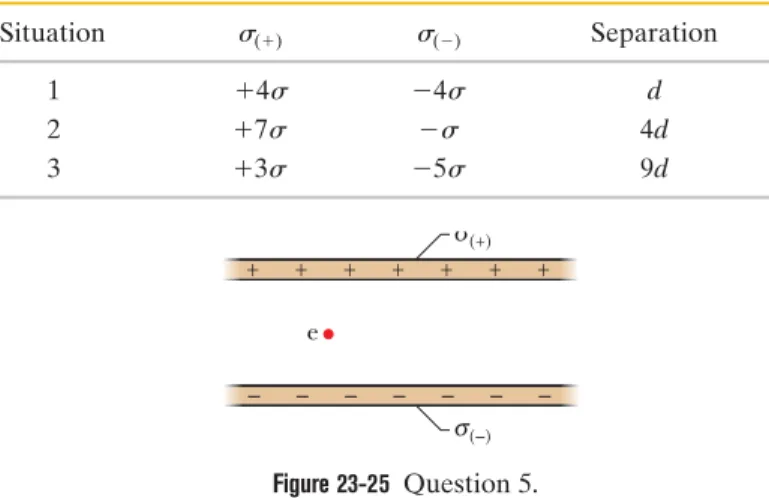
5 In Fig. 23-25, an electron is released
between two infinite nonconducting sheets that are horizontal and have uniform surface charge densities s(%)ands(&), as indicated.The electron is subjected to the following three situations involving surface charge densities and sheet separations. Rank the magnitudes of the electron’s acceleration,greatest first.
Situation s(%) s(&) Separation
1 %4s &4s d 2 %7s &s 4d 3 %3s &5s 9d Figure 23-24 Question 4. a b c d +q + + + + + + + – – – – – – – e (–) σ (+) σ Figure 23-25 Question 5.
6 Three infinite nonconducting sheets, with uniform positive sur-face charge densities s, 2s, and 3s, are arranged to be parallel like the two sheets in Fig. 23-19a. What is their order, from left to right, if the electric field produced by the arrangement has mag-nitudeE"0 in one region and E"2s/´0in another region? 7 Figure 23-26 shows four situations in which four very long rods extend into and out of the page (we see only their cross sec-tions). The value below each cross section gives that particular rod’s uniform charge density in microcoulombs per meter. The rods are separated by either dor 2das drawn, and a central point is shown midway between the inner rods. Rank the situations ac-cording to the magnitude of the net electric field at that central point, greatest first.
E:
8 Figure 23-27 shows four solid spheres, each with charge Quniformly distributed through its volume. (a) Rank the spheres according to their volume charge density, greatest first. The figure also shows a point Pfor each sphere, all at the same distance from the center of the sphere. (b) Rank the spheres according to the mag-nitude of the electric field they produce at point P, greatest first.
(a) (b) (c) (d)
P P P P
Figure 23-27 Question 8.
9 A small charged ball lies within the hollow of a metallic spher-ical shell of radius R. For three situations, the net charges on the ball and shell, respectively, are (1) %4q, 0; (2) &6q, %10q; (3) %16q,&12q. Rank the situations according to the charge on (a) the inner surface of the shell and (b) the outer surface, most positive first.
10 Rank the situations of Question 9 according to the magnitude of the electric field (a) halfway through the shell and (b) at a point 2Rfrom the center of the shell, greatest first.
11 Figure 23-28 shows a section of three long charged cylinders centered on the same axis. Central cylinder Ahas a uniform charge qA" %3q0. What uniform charges qBandqCshould be on cylinders
BandCso that (if possible) the net electric field is zero at (a) point 1, (b) point 2, and (c) point 3?
12 Figure 23-29 shows four Gaussian surfaces consisting of identical cylindrical midsections but different end caps. The surfaces are in a uniform electric field that is directed parallel to the central axis of each cylindrical midsection. The end caps have these shapes:S1, con-vex hemispheres;S2, concave hemispheres;S3, cones;S4, flat disks. Rank the surfaces according to (a) the net electric flux through them and (b) the electric flux through the top end caps, greatest first.
are (c) !and (d) qencif
••10 Figure 23-34 shows a closed Gaussian surface in the shape of a cube of edge length 2.00 m. It lies in a region where the nonuni-form electric field is given by
withxin meters. What is the net charge contained by the cube?
••11 Figure 23-35 shows a closed Gaussian surface in the shape of a cube of edge length 2.00 m, with one corner at x1 5.00 m,y1 4.00 m.The cube lies in a region where the electric field vector is given by
withyin meters.What is the net charge contained by the cube?
E:" &3.00iˆ&4.00y2jˆ%3.00kˆ N/C, " " 7.00kˆ N/C, % 6.00jˆ % 4.00)iˆ % (3.00x " E: (6.00%3.00y)jˆ] N/C? E : "[&4.00iˆ%
with edge length 1.40 m. What are (a) the net flux ! through the surface and (b) the net charge qencenclosed by the surface if
with y in meters? What E:
"(3.00yjˆ) N/C,
and on the bottom face it is Determine the net charge contained within the cube.
•7 A particle of charge 1.8mC is at the center of a Gaussian cube 55 cm on edge.What is the net electric flux through the surface? ••8 When a shower is turned on in a closed bathroom, the splashing of the water on the bare tub can fill the room’s air with negatively charged ions and produce an electric field in the air as great as 1000 N/C. Consider a bathroom with dimensions 2.5 m'
3.0 m'2.0 m. Along the ceiling, floor, and four walls, approximate the electric field in the air as being directed perpendicular to the sur-face and as having a uniform magnitude of 600 N/C.Also, treat those surfaces as forming a closed Gaussian surface around the room’s air. What are (a) the volume charge density rand (b) the number of excess elementary charges eper cubic meter in the room’s air? ••9 ILW Fig. 23-31 shows a Gaussian surface in the shape of a cube
E:
" %20kˆ N/C.
E:
" &34kˆ N/C,
Module 23-1 Electric Flux
•1 The square surface shown
in Fig. 23-30 measures 3.2 mm on each side. It is immersed in a uni-form electric field with magnitude E"1800 N/C and with field lines at an angle of u"35° with a normal to the surface, as shown. Take that normal to be directed “outward,” as though the surface were one face of a box. Calculate the electric flux through the surface.
••2 An electric field given by pierces a Gaussian cube of edge length 2.0 m and positioned as shown in Fig. 23-7. (The magnitude E is in newtons per coulomb and the position xis in me-ters.) What is the electric flux through the (a) top face, (b) bottom face, (c) left face, and (d) back face? (e) What is the net electric flux through the cube? ••3 The cube in Fig. 23-31 has edge length 1.40 m and is oriented as shown in a region of uniform electric field. Find the electric flux through the right face if
the electric field, in newtons per coulomb, is given by (a) (b) and (c) (d) What is the total flux through the cube for each field?
Module 23-2 Gauss’ Law
•4 In Fig. 23-32, a butterfly net is in a uniform electric field of magni-tudeE"3.0 mN/C. The rim, a
cir-cle of radius a"11 cm, is aligned perpendicular to the field. The net contains no net charge. Find the electric flux through the netting. •5 In Fig. 23-33, a proton is a
dis-tanced/2 directly above the center of a square of side d. What is the magnitude of the electric flux through the square? (Hint:Think of the square as one face of a cube with edge d.)
&3.00iˆ%4.00kˆ. &2.00jˆ,
6.00iˆ,
E:"4.0iˆ&3.0(y2%2.0)jˆ
SSM
Tutoring problem available (at instructor’s discretion) in WileyPLUSand WebAssign SSM Worked-out solution available in Student Solutions Manual
•–••• Number of dots indicates level of problem difficulty
Additional information available in The Flying Circus of Physicsand at flyingcircusofphysics.com WWW Worked-out solution is at
ILW Interactive solution is at http://www.wiley.com/college/halliday
Problems
Normal θ Figure 23-30 Problem 1. z y x Figure 23-31 Problems 3, 6, and 9. a Figure 23-32 Problem 4. d/2 d d + Figure 23-33 Problem 5. x y z Figure 23-34 Problem 10. Figure 23-35 Problem 11. x y z x1 y1••12 Figure 23-36 shows two non-conducting spherical shells fixed in place. Shell 1 has uniform surface charge density %6.0 mC/m2 on its outer surface and radius 3.0 cm; shell 2 has uniform surface charge density %4.0mC/m2 on its outer surface and radius 2.0 cm; the shell centers are separated by L"10 cm. In unit-vector notation, what is the net electric field at x"2.0 cm?
Shell 1 Shell 2 y x L Figure 23-36 Problem 12. •6 At each point on the surface of the cube shown in Fig. 23-31,
the electric field is parallel to the zaxis. The length of each edge of the cube is 3.0 m. On the top face of the cube the field is
y x z z1 z2 z1 z2 x2 y2 x2 x1 Figure 23-38 Problem 16. A B Φ (10 5 N • m 2/C) (a) (b) – 0 Φ r s Φs –2Φs Figure 23-39 Problem 20. Es 0 –Es E (10 3 N/C) 1 2 3 r (cm) 4 5 6 (a) (b) Figure 23-41 Problem 26. ••13 The electric field in a certain region of Earth’s
atmo-sphere is directed vertically down. At an altitude of 300 m the field has magnitude 60.0 N/C; at an altitude of 200 m, the magnitude is 100 N/C. Find the net amount of charge contained in a cube 100 m on edge, with horizontal faces at altitudes of 200 and 300 m. ••14 Flux and nonconducting shells.A charged particle is sus-pended at the center of two concentric spherical shells that are very thin and made of nonconducting material. Figure 23-37a shows a cross section. Figure 23-37bgives the net flux !through a Gaussian sphere centered on the particle, as a function of the ra-diusrof the sphere. The scale of the vertical axis is set by !s"
5.0'105N?m2/C. (a) What is the charge of the central particle? What are the net charges of (b) shell Aand (c) shell B?
SSM
••15 A particle of charge %qis placed at one corner of a Gaussian cube. What multiple of q/´0gives the flux through (a) each cube face forming that corner and (b) each of the other cube faces?
•••16 The box-like Gaussian surface shown in Fig. 23-38 en-closes a net charge of 24.0´0C and lies in an electric field given
by with xand zin
me-ters and ba constant.The bottom face is in the xzplane; the top face is in the horizontal plane passing through y2"1.00 m. For x1" 1.00 m,x2"4.00 m,z1"1.00 m, and z2"3.00 m, what is b?
E:"[(10.0%2.00x)iˆ&3.00jˆ %bzkˆ] N/C, %
•20 Flux and conducting shells.A charged particle is held at the center of two concentric conducting spherical shells. Figure 23-39a shows a cross section. Figure 23-39bgives the net flux !through a Gaussian sphere centered on the particle, as a function of the radius r of the sphere. The scale of the vertical axis is set by !s"5.0'
105N?m2/C. What are (a) the charge of the central particle and the net charges of (b) shell Aand (c) shell B?
••21 An isolated conductor has net charge %10'10&6C and a cav-ity with a particle of charge q" %3.0'10&6C.What is the charge on (a) the cavity wall and (b) the outer surface?
Module 23-4 Applying Gauss’ Law: Cylindrical Symmetry
•22 An electron is released 9.0 cm from a very long nonconduct-ing rod with a uniform 6.0mC/m. What is the magnitude of the electron’s initial acceleration?
•23 (a) The drum of a photocopying machine has a length of 42 cm and a diameter of 12 cm.The electric field just above the drum’s sur-face is 2.3 '105N/C. What is the total charge on the drum? (b) The
manufacturer wishes to produce a desktop version of the machine. This requires reducing the drum length to 28 cm and the diameter to 8.0 cm. The electric field at the drum surface must not change. What must be the charge on this new drum?
Figure 23-37 Problem 14. Φs –Φs 0 Φ (10 5 N • m 2/C) r A B (a) (b)
••26 Figure 23-41ashows a narrow charged solid cylinder that is coaxial with a larger charged cylindrical shell. Both are noncon-Module 23-3 A Charged Isolated Conductor
•17 A uniformly charged conducting sphere of 1.2 m diam-eter has surface charge density 8.1mC/m2. Find (a) the net charge on the sphere and (b) the total electric flux leaving the surface. •18 The electric field just above the surface of the charged con-ducting drum of a photocopying machine has a magnitude Eof 2.3'105N/C. What is the surface charge density on the drum? •19 Space vehicles traveling through Earth’s radiation belts can intercept a significant number of electrons. The resulting charge buildup can damage electronic components and disrupt operations. Suppose a spherical metal satellite 1.3 m in diameter accumulates 2.4mC of charge in one orbital revolution. (a) Find the resulting sur-face charge density. (b) Calculate the magnitude of the electric field just outside the surface of the satellite, due to the surface charge.
SSM R + + + + + + + + + + + + + + + + ++ + + + + + + Figure 23-40 Problem 24. •24 Figure 23-40 shows a section of a
long, thin-walled metal tube of radius R"3.00 cm, with a charge per unit length of l"2.00'10&8C/m. What is the magnitude Eof the electric field at radial distance (a) r"R/2.00 and (b) r"2.00R? (c) Graph E versusr for the range r"0 to 2.00R.
•25 SSM An infinite line of charge produces a field of magnitude 4.5'
104N/C at distance 2.0 m. Find the linear charge density.
•35 Figure 23-46ashows three plastic sheets that are large, paral-lel, and uniformly charged. Figure 23-46bgives the component of the net electric field along an xaxis through the sheets. The scale of the vertical axis is set by Es"6.0'105N/C.What is the ratio of the charge
density on sheet 3 to that on sheet 2? ducting and thin and have uniform surface charge densities on
their outer surfaces. Figure 23-41bgives the radial component Eof the electric field versus radial distance r from the common axis, andEs"3.0'103N/C.What is the shell’s linear charge density?
••27 A long, straight wire has fixed negative charge with a lin-ear charge density of magnitude 3.6 nC/m. The wire is to be en-closed by a coaxial, thin-walled nonconducting cylindrical shell of radius 1.5 cm.The shell is to have positive charge on its outside sur-face with a sursur-face charge density sthat makes the net external electric field zero. Calculate s.
••28 A charge of uniform linear density 2.0 nC/m is distributed along a long, thin, nonconducting rod. The rod is coaxial with a long conducting cylindrical shell (inner radius"5.0 cm, outer radius"
10 cm). The net charge on the shell is zero. (a) What is the magni-tude of the electric field 15 cm from the axis of the shell? What is the surface charge density on the (b) inner and (c) outer surface of the shell?
••29 SSM WWW Figure 23-42 is
the plates have excess surface charge densities of opposite signs and magnitude 7.00'10&22C/m2. In unit-vector notation, what is the electric field at points (a) to the left of the plates, (b) to the right of them, and (c) between them?
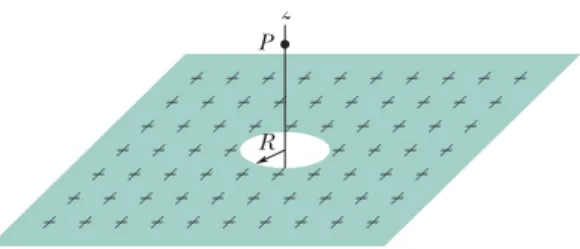
•34 In Fig. 23-45, a small circular hole of radius R"1.80 cm has been cut in the middle of an infinite, flat, nonconducting surface that has uniform charge density s"4.50 pC/m2. A zaxis, with its origin at the hole’s center, is perpendicular to the surface. In unit-vector notation, what is the electric field at point Patz"2.56 cm? (Hint:See Eq. 22-26 and use superposition.)
•36 Figure 23-47 shows cross sec-tions through two large, parallel, non-conducting sheets with identical distri-butions of positive charge with surface charge density s"1.77'10&22C/m2. In unit-vector notation, what is at points (a) above the sheets, (b) be-tween them, and (c) below them?
•37 SSM WWW A square metal plate of edge length 8.0 cm and E:
a section of a conducting rod of ra-diusR1"1.30 mm and length L" 11.00 m inside a thin-walled coax-ial conducting cylindrical shell of radiusR2"10.0R1 and the (same) lengthL. The net charge on the rod is Q1" %3.40'10&12C; that on the shell is Q2" &2.00Q1. What are the (a) magnitude Eand (b) di-rection (radially inward or out-ward) of the electric field at radial
R1 R2
Q1 Q2
Figure 23-42 Problem 29. distancer"2.00R2? What are (c) Eand (d) the direction at r" 5.00R1? What is the charge on the (e) interior and (f) exterior sur-face of the shell?
••30 In Fig. 23-43, short sections of two very long parallel lines of charge are shown, fixed in place, separated by L"8.0 cm. The uni-form linear charge densities are
%6.0mC/m for line 1 and &2.0 mC/m for line 2. Where along the x axis shown is the net electric field from the two lines zero?
••31 Two long, charged,
thin-walled, concentric cylindrical shells have radii of 3.0 and 6.0 cm. The charge per unit length is 5.0'10&6C/m on the inner shell and &7.0'10&6C/m on the outer shell. What are the (a) magnitudeEand (b) direction (radially inward or outward) of the electric field at radial distance r"4.0 cm? What are (c) Eand (d) the direction at r"8.0 cm?
•••32 A long, nonconducting, solid cylinder of radius 4.0 cm has a nonuniform volume charge density rthat is a function of radial dis-tancerfrom the cylinder axis:r"
Ar2. For A"2.5mC/m5, what is the magnitude of the electric field at (a) r"3.0 cm and (b) r"5.0 cm? Module 23-5 Applying Gauss’ Law: Planar Symmetry
•33 In Fig. 23-44, two large, thin metal plates are parallel and close to each other. On their inner faces,
ILW Figure 23-43 Problem 30. Line 1 Line 2 x y L/2 L/2 – – – – – – – – – + + + + + + + + + x Figure 23-44 Problem 33.
+ + + + + + + + + +
+ + + + + + + + + +
+ + + + + + + + + +
+ + + +
+ + + +
+ + + + + + + + + +
+ + + + + + + + + +
+ + + + + + + + + +
P z R Figure 23-45 Problem 34. (a) (b) x x Es 0 E (10 5 N/C) 1 2 3 Figure 23-46 Problem 35. + + + + + + + + + + + + + + + + + + + + + + y x Figure 23-47 Problem 36. negligible thickness has a total charge of 6.0'10&6C. (a) Estimate the magnitude Eof the electric field just off the center of the plate (at, say, a distance of 0.50 mm from the center) by assuming that the charge is spread uniformly over the two faces of the plate. (b) EstimateEat a distance of 30 m (large relative to the plate size) by as-suming that the plate is a charged particle.E (10 7 N/C) Es 0 1 2 r (cm) 3 4 5 Figure 23-53 Problem 48. a b c Figure 23-54 Problem 49. ••38 In Fig. 23-48a, an electron is shot directly away from a uni- Module 23-6 Applying Gauss’ Law: Spherical Symmetry
•44 Figure 23-52 gives the magni-tude of the electric field inside and outside a sphere with a positive charge distributed uniformly throughout its volume.The scale of the vertical axis is set by Es"5.0'107N/C. What is the
charge on the sphere?
•45 Two charged concentric
spher-ical shells have radii 10.0 cm and 15.0 cm. The charge on the inner shell is 4.00'10&8C, and that on the outer shell is 2.00'10&8C. Find the electric field (a) at r"12.0 cm and (b) at r"20.0 cm. •46 Assume that a ball of charged particles has a uniformly distributed negative charge density except for a narrow radial tunnel through its center, from the surface on one side to the surface on the opposite side. Also assume that we can position a proton anywhere along the tunnel or outside the ball. Let FRbe
the magnitude of the electrostatic force on the proton when it is located at the ball’s surface, at radius R. As a multiple of R, how far from the surface is there a point where the force magnitude is 0.50FRif we move the proton (a) away from the ball and (b) into
the tunnel?
•47 An unknown charge sits on a conducting solid sphere of radius 10 cm. If the electric field 15 cm from the center of the sphere has the magnitude 3.0'103N/C and is directed radially in-ward, what is the net charge on the sphere?
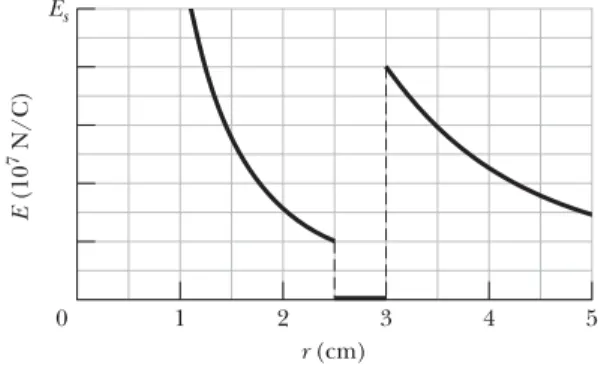
••48 A charged particle is held at the center of a spherical shell. Figure 23-53 gives the magnitude Eof the electric field ver-sus radial distance r. The scale of the vertical axis is set by Es"
10.0 ' 107 N/C. Approximately, what is the net charge on the shell?
SSM
Both are fixed in place. If d"0.200 m, at what (a) positive and (b) negative coordinate on the xaxis (other than in-finity) is the net electric field E: of
net 3 6 t (ps) 9 12 vs 0 –vs v (10 5 m/s) + + + + + + + + –e (a) (b)
••49 In Fig. 23-54, a solid sphere of radiusa"2.00 cm is concentric with a spherical conducting shell of inner ra-diusb"2.00a and outer radius c"
2.40a. The sphere has a net uniform chargeq1" %5.00 fC; the shell has a net charge q2" &q1.What is the mag-nitude of the electric field at radial distances (a) r"0, (b) r"a/2.00, (c) r"a, (d) r"1.50a, (e)r"2.30a, and (f)r"3.50a? What is the net charge on the (g) inner and (h) outer surface of the shell?
Figure 23-48 Problem 38.
formly charged plastic sheet, at speed vs"2.0'105m/s.The sheet is
nonconducting, flat, and very large. Figure 23-48bgives the electron’s vertical velocity component vversus time tuntil the return to the launch point.What is the sheet’s surface charge density?
••39 SSM In Fig. 23-49, a small, nonconducting + + + + + + + + + + + + + m, q θ σ Figure 23-49 Problem 39. ball of mass m"1.0 mg and charge q"2.0'
10&8C (distributed uniformly through its vol-ume) hangs from an insulating thread that makes an angle u"30° with a vertical, uniformly charged nonconducting sheet (shown in cross sec-tion). Considering the gravitational force on the ball and assuming the sheet extends far vertically and into and out of the page, calculate the surface charge density sof the sheet.
••40 Figure 23-50 shows a very large nonconduct-ing sheet that has a uniform surface charge density of s" &2.00mC/m2; it also shows a particle of chargeQ"6.00mC, at distance dfrom the sheet.
y x Q σ d Figure 23-50 Problem 40. the sheet and particle zero? (c) If d"
0.800 m, at what coordinate on the x axis is
••41 An electron is shot directly toward the center of a large metal
E:net"0?
plate that has surface charge density &2.0'10&6C/m2. If the initial kinetic energy of the electron is 1.60'10&17J and if the electron is to stop (due to electrostatic repulsion from the plate) just as it reaches the plate, how far from the plate must the launch point be?
••42 Two large metal plates of area 1.0 m2face each other, 5.0 cm apart, with equal charge magnitudes but opposite signs. The field magnitude Ebetween them (neglect fringing) is 55 N/C. Find .
•••43 Figure 23-51 shows a cross sec-tion through a very large nonconducting slab of thickness d"9.40 mm and uni-form volume charge density r"5.80 fC/m3. The origin of an xaxis is at the slab’s center. What is the magnitude of the slab’s electric field at an x coordi-nate of (a) 0, (b) 2.00 mm, (c) 4.70 mm, and (d) 26.0 mm? $q$ $q$ d/2 d x 0 Figure 23-51 Problem 43. E (10 7 N/C) Es 2 0 r(cm) 4 Figure 23-52 Problem 44.
••50 Figure 23-55 shows two non-conducting spherical shells fixed in place on an xaxis. Shell 1 has uniform surface charge density %4.0mC/m2 on its outer surface and radius 0.50 cm, and shell 2 has uniform surface charge density &2.0mC/m2 on its outer surface and radius 2.0 cm; the centers are separated by L"6.0 cm.
57 A thin-walled metal spherical shell has radius 25.0 cm and charge 2.00'10&7C. Find Efor a point (a) inside the shell, (b) just outside it, and (c) 3.00 m from the center.
58 A uniform surface charge of density 8.0 nC/m2is distributed over the entire xy plane. What is the electric flux through a spherical Gaussian surface centered on the origin and having a radius of 5.0 cm? 59 Charge of uniform volume density r"1.2 nC/m3fills an infi-nite slab between x" &5.0 cm and x" %5.0 cm. What is the mag-nitude of the electric field at any point with the coordinate (a) x"
4.0 cm and (b) x"6.0 cm?
60 The chocolate crumb mystery. Explosions ignited by electrostatic discharges (sparks) constitute a serious danger in fa-cilities handling grain or powder. Such an explosion occurred in chocolate crumb powder at a biscuit factory in the 1970s. Workers usually emptied newly delivered sacks of the powder into a loading bin, from which it was blown through electrically grounded plastic pipes to a silo for storage. Somewhere along this route, two condi-tions for an explosion were met: (1) The magnitude of an electric field became 3.0'106N/C or greater, so that electrical break-down and thus sparking could occur. (2) The energy of a spark was 150 mJ or greater so that it could ignite the powder explosively. Let us check for the first condition in the powder flow through the plastic pipes.
Suppose a stream of negatively charged powder was blown through a cylindrical pipe of radius R"5.0 cm. Assume that the powder and its charge were spread uniformly through the pipe with a volume charge density r. (a) Using Gauss’ law, find an ex-pression for the magnitude of the electric field in the pipe as a function of radial distance rfrom the pipe center. (b) Does E crease or decrease with increasing r? (c) Is directed radially in-ward or outin-ward? (d) For r"1.1'10&3C/m3(a typical value at the factory), find the maximum Eand determine where that maxi-mum field occurs. (e) Could sparking occur, and if so, where? (The story continues with Problem 70 in Chapter 24.)
61 A thin-walled metal spherical shell of radius ahas a charge qa. Concentric with it is a thin-walled metal spherical shell of radius
b(aand charge qb. Find the electric field at points a distance rfrom
the common center, where (a) r$a, (b) a$r$b, and (c) r(b. (d) Discuss the criterion you would use to determine how the charges are distributed on the inner and outer surfaces of the shells.
62 A particle of charge q"1.0'10&7C is at the center of a spherical cavity of radius 3.0 cm in a chunk of metal. Find the electric field (a) 1.5 cm from the cavity center and (b) anyplace in the metal. 63 A proton at speed v"3.00'105m/s orbits at radius r"1.00 cm outside a charged sphere. Find the sphere’s charge.
64 Equation 23-11 (E"s/´0) gives the electric field at points near a charged conducting surface. Apply this equation to a conducting sphere of radius rand charge q, and show that the electric field outside the sphere is the same as the field of a charged particle located at the center of the sphere.
65 ChargeQis uniformly distributed in a sphere of radius R. (a) What fraction of the charge is contained within the radius r"R/2.00? (b) What is the ratio of the electric field magnitude at r"R/2.00 to that on the surface of the sphere?
66 A charged particle causes an electric flux of &750 N?m2/C to pass through a spherical Gaussian surface of 10.0 cm radius cen-tered on the charge. (a) If the radius of the Gaussian surface were
SSM
E:
E:
Other than at x" ), where on the x axis is the net electric field equal to zero?
••51 In Fig. 23-56, a
nonconducting spherical shell of in-ner radius a"2.00 cm and outer ra-diusb"2.40 cm has (within its thick-ness) a positive volume charge densityr"A/r, where Ais a constant andris the distance from the center of the shell. In addition, a small ball of chargeq"45.0 fC is located at that center. What value should Ahave if
WWW SSM x Shell 1 Shell 2 y L Figure 23-55 Problem 50. b a q+ Figure 23-56 Problem 51. a b + + + + + + + + + + + + + + + + + + + + + + + + + + + + + + + + + + + + + + + + + + + + + + + + + + + + + + + + + + + + + + + + + + + Figure 23-57 Problem 52. of radius R"5.60 cm varies with radial distance ras given by r"
(14.1 pC/m3)r/R. (a) What is the sphere’s total charge? What is the field magnitude Eat (b) r"0, (c) r"R/2.00, and (d) r"R? (e) the electric field in the shell (a*r*
b) is to be uniform?
••52 Figure 23-57 shows a spheri-cal shell with uniform volume charge density r"1.84 nC/m3, inner radius a"10.0 cm, and outer radius b"
2.00a. What is the magnitude of the electric field at radial distances (a) r"
0; (b) r"a/2.00, (c) r"a, (d) r"
1.50a,(e) r"b,and (f) r"3.00b? •••53 The volume charge den-sity of a solid nonconducting sphere
ILW R R P 1 2 Figure 23-58 Problem 54. GraphEversusr.
•••54 Figure 23-58 shows, in cross section, two solid spheres with uni-formly distributed charge through-out their volumes. Each has radius R. Point Plies on a line connecting the centers of the spheres, at radial
distanceR/2.00 from the center of sphere 1. If the net electric field at point Pis zero, what is the ratio q2/q1of the total charges? •••55 A charge distribution that is spherically symmetric but not uniform radially produces an electric field of magnitude E"Kr4, directed radially outward from the center of the sphere. Here ris the radial distance from that center, and Kis a constant. What is the volume density rof the charge distribution?
Additional Problems
56 The electric field in a particular space is N/C, withxin meters. Consider a cylindrical Gaussian surface of radius 20 cm that is coaxial with the xaxis. One end of the cylinder is at x"0. (a) What is the magnitude of the electric flux through the other end of the cylinder at x"2.0 m? (b) What net charge is en-closed within the cylinder?
doubled, how much flux would pass through the surface? (b) What is the charge of the particle?
67 The electric field at point Pjust outside the outer sur-face of a hollow spherical conductor of inner radius 10 cm and outer radius 20 cm has magnitude 450 N/C and is directed outward. When a particle of unknown charge Qis introduced into the center of the sphere, the electric field at Pis still directed outward but is now 180 N/C. (a) What was the net charge enclosed by the outer surface before Qwas introduced? (b) What is charge Q? After Qis introduced, what is the charge on the (c) inner and (d) outer sur-face of the conductor?
68 The net electric flux through each face of a die (singular of dice) has a magnitude in units of 103N?m2/C that is exactly equal to the number of spots Non the face (1 through 6). The flux is in-ward for Nodd and outward for Neven. What is the net charge in-side the die?
69 Figure 23-59 shows, in cross section, three infinitely large nonconducting sheets on which charge is uniformly spread. The surface charge densities are s1" %2.00
mC/m2, s
2" %4.00mC/m2, and s3" &5.00mC/m2, and distanceL"1.50 cm. In unit-vector notation,what is the net electric field at point P? 70 Charge of uniform
vol-ume density r"3.2mC/m3fills a nonconducting solid sphere of radius 5.0 cm. What is the magnitude of the electric field (a) 3.5 cm and (b) 8.0 cm from the sphere’s center?
71 A Gaussian surface in the form of a hemisphere of radius R"
5.68 cm lies in a uniform electric field of magnitude E"2.50 N/C. The surface encloses no net charge. At the (flat) base of the sur-face, the field is perpendicular to the surface and directed into the surface. What is the flux through (a) the base and (b) the curved portion of the surface?
72 What net charge is enclosed by the Gaussian cube of Problem 2?
73 A nonconducting solid sphere has a uni-form volume charge density r. Let be the vector from the center of the sphere to a gen-eral point Pwithin the sphere. (a) Show that the electric field at Pis given by
(Note that the result is independent of the ra-dius of the sphere.) (b) A spherical cavity is hollowed out of the sphere, as shown in Fig. 23-60. Using superposition concepts, show that the electric field at all points within the cavity
is uniform and equal to where is the position vector from the center of the sphere to the center of the cavity.
74 A uniform charge density of 500 nC/m3is distributed through-out a spherical volume of radius 6.00 cm. Consider a cubical Gaussian surface with its center at the center of the sphere. What is the electric flux through this cubical surface if its edge length is (a) 4.00 cm and (b) 14.0 cm?
75 Figure 23-61 shows a Geiger counter, a device used to detect ionizing radiation, which causes ionization of atoms. A thin,
posi-a: E:"ra:/3´ 0, E:"rr:/3´ 0. r : SSM
tively charged central wire is sur-rounded by a concentric, circular, con-ducting cylindrical shell with an equal negative charge, creating a strong ra-dial electric field. The shell contains a low-pressure inert gas. A particle of ra-diation entering the device through the shell wall ionizes a few of the gas atoms. The resulting free electrons (e) are drawn to the positive wire. However, the electric field is so intense that, between collisions with gas atoms, the free electrons gain energy sufficient to ionize these atoms also. More free electrons are thereby cre-ated, and the process is repeated until the electrons reach the wire. The re-sulting “avalanche” of electrons is
col-lected by the wire, generating a signal that is used to record the passage of the original particle of radiation. Suppose that the ra-dius of the central wire is 25mm, the inner radius of the shell 1.4 cm, and the length of the shell 16 cm. If the electric field at the shell’s inner wall is 2.9'104N/C, what is the total positive charge
on the central wire?
76 Charge is distributed uniformly throughout the volume of an in-finitely long solid cylinder of radius R. (a) Show that, at a distance r$
Rfrom the cylinder axis,
whereris the volume charge density. (b) Write an expression for E whenr(R.
77 A spherical conducting shell has a charge of &14mC on its outer surface and a charged particle in its hollow. If the net charge on the shell is &10mC, what is the charge (a) on the inner surface of the shell and (b) of the particle?
78 A charge of 6.00 pC is spread uniformly throughout the volume of a sphere of radius r"4.00 cm.What is the magnitude of the electric field at a radial distance of (a) 6.00 cm and (b) 3.00 cm?
79 Water in an irrigation ditch of width w"3.22 m and depth d"
1.04 m flows with a speed of 0.207 m/s. The mass fluxof the flowing water through an imaginary surface is the product of the water’s density (1000 kg/m3) and its volume flux through that surface. Find the mass flux through the following imaginary surfaces: (a) a sur-face of area wd, entirely in the water, perpendicular to the flow; (b) a surface with area 3wd/2, of which wdis in the water, perpendi-cular to the flow; (c) a surface of area wd/2, entirely in the water, per-pendicular to the flow; (d) a surface of area wd, half in the water and half out, perpendicular to the flow; (e) a surface of area wd, entirely in the water, with its normal 34.0° from the direction of flow.
80 Charge of uniform surface density 8.00 nC/m2 is distributed over an entire xyplane; charge of uniform surface density 3.00 nC/m2 is distributed over the parallel plane defined by z"2.00 m. Determine the magnitude of the electric field at any point having a z coordinate of (a) 1.00 m and (b) 3.00 m.
81 A spherical ball of charged particles has a uniform charge density. In terms of the ball’s radius R, at what radial distances (a) inside and (b) outside the ball is the magnitude of the ball’s electric field equal to of the maximum magnitude of that field?1
4 SSM E" rr 2´0, 2L L/2 L P σ3 σ2 σ1 y x Figure 23-59 Problem 69. a Figure 23-60 Problem 73. + + + + + + + + + + + + Signal Particle Charged cylindrical shell e Charged wire –– –– –– –– –– –– –– – –– –– –– – –– –– –– – Figure 23-61 Problem 75.