eScholarship provides open access, scholarly publishing services to the University of California and delivers a dynamic research platform to scholars worldwide.
Electronic Thesis and Dissertations UCLA Peer Reviewed
Title:
Tears and More Tears: The Humanitarian Path to Citizenship Author:
Lakhani, Sarah Morando Acceptance Date: 2013
Series:
UCLA Electronic Theses and Dissertations Degree:
Ph.D., Sociology 0867UCLA Advisor(s):
Timmermans, Stefan, Waldinger, Roger Committee:
Hernández-León, Rubén, Motomura, Hiroshi Permalink:
http://escholarship.org/uc/item/10w4h9sb Abstract:
Copyright Information:
All rights reserved unless otherwise indicated. Contact the author or original publisher for any necessary permissions. eScholarship is not the copyright owner for deposited works. Learn more at http://www.escholarship.org/help_copyright.html#reuse
UNIVERSITY OF CALIFORNIA Los Angeles
Tears and More Tears: The Humanitarian Path to Citizenship
A dissertation submitted in partial satisfaction of the requirements for the degree Doctor of Philosophy
in Sociology
by
Sarah Morando Lakhani
Copyright by Sarah Morando Lakhani
ABSTRACT OF THE DISSERTATION
Tears and More Tears: The Humanitarian Path to Citizenship
by
Sarah Morando Lakhani Doctor of Philosophy in Sociology University of California, Los Angeles, 2013
Professor Stefan Timmermans, Co-Chair Professor Roger Waldinger, Co-Chair
This dissertation analyzes the legalization process as experienced by immigrant crime victims and their attorneys in Los Angeles, California. Drawing on over three years of ethnographic and qualitative research, I chart the process from the time undocumented immigrants decide they want to regularize their status through a humanitarian remedy and contact attorneys at legal non-profit organizations; through the case development phase, when immigrants collaborate with attorneys to produce compelling petitions for legal standing; to the period of application results and beyond, documenting the consequences of approvals and rejections for immigrants and their families. I also consider immigration lawyers’ paths into their profession and examine how their career motivations shape their legal practice. Empirically, I focus on the experiences of female Latin American immigrants as they pursue U Visa status and the attorneys they collaborate with. Created in 2000 through the Victims of Trafficking and Violence Protection Act, the U Visa is a
temporary legal status for immigrant victims of violent crime that offers a path to permanent residency and U.S. citizenship.
This project makes three interrelated contributions to research on immigration, legal mobilization, and legal decision-making. First, I advance scholarship on international migration and immigration policy by building on conceptualizations of immigration control that center on policy interpretation and implementation by mid-level actors and institutions (Armenta, 2011; Gilboy, 1991; Marrow, 2009). By analyzing how lawyers broker between immigrants and the state and between immigrants and other mid-level intermediaries such as police officers, employers, and social services providers, I configure immigration attorneys as both agents and critics of law who simultaneously reinforce and challenge official and unofficial legal notions (Coutin, 2000). In drawing attention to attorneys’ complex roles in the application of
immigration policies, I show how exclusionary aspects of control characteristic of the
contemporary immigration legal regime can filter into efforts intended to benefit immigrants. Second, this dissertation demonstrates critical ways in which law shapes immigrants’ lives. Research has examined undocumented immigrants’ attempts to acquire socioeconomic resources from a position outside the law (Abrego, 2008; Gleeson, 2009), but I further this agenda by exploring immigrants’ endeavors to access benefits associated with legal standing. By analyzing the signaling mechanism involved in converting a legal identity to concrete resources, I illustrate how a political and social climate of migration control combined with a legal context
characterized by the multiplication of anomalous statuses between citizen and foreigner produces stratification. Lastly, this dissertation extends the law in action paradigm (Pound, 1910). While most studies of law in action have analyzed how legal actors tailor idiosyncratic details of
discrete cases to existing precedents, I consider how law emerges within a confining legal framework that is at the same time not completely institutionalized.
The dissertation of Sarah Morando Lakhani is approved. Rubén Hernández-León
Hiroshi Motomura
Stefan Timmermans, Committee Co-Chair Roger Waldinger, Committee Co-Chair
University of California, Los Angeles 2013
Table of Contents
List of Tables………viii
List of Images……….ix
Acknowledgements………..x
Vita………xiv
Chapter One: Introduction………...1
Chapter Two: Immigrant Screening on the Legal Frontlines………35
Chapter Three: The Legal Translation and Documentation of Immigrant Abuse……….83
Chapter Four: Producing Immigrant Victims’ “Right” to Legal Status and the Management of Legal Uncertainty……….107
Chapter Five: Trajectories and Manifestations of Legal Idealism………...144
Chapter Six: Legitimacy Within Limits………...180
Chapter Seven: Conclusion………..213
Methodological Appendix………...218
List of Tables
Table 1. U Visa Applications, Approvals, and Denials, Fiscal Years 2009-2012
8
List of Images
ACKNOWLEDGEMENTS
I try to make sure my academic and personal mentors always know how much I appreciate them, but I welcome the opportunity to thank them in a more public way too.
I would like to express gratitude to Tomás Jiménezand April Linton for cultivating my interest in immigration as an undergraduate at UC San Diego, and for encouraging me to a pursue a Ph.D. in sociology.
Next, I would like to thank my advisors at UCLA. Stefan Timmermans supported my dissertation research from its inception. His sociological prowess enhanced my approach to ethnographic fieldwork and data analysis, and improved my ability to theorize about what I was observing. Roger Waldinger elevated the quality of my scholarship and my confidence in it through his immigration insights and continuous support. Both Stefan and Roger
enthusiastically read and re-read parts of this dissertation and other work over the years,
significantly sharpening my end products. Rubén Hernández-León had faith in my abilities from the very first month of graduate school and helped launch my Master’s research in Dalton. Hiroshi Motomura reminded me of the importance of asking (and being able to answer) the “So What?” question, preventing me from losing the forest for the trees. He was always available to answer my immigration law questions and ensured that the legal aspects of my work made sense.
I would also like to thank the individuals who participated in my dissertation research and graciously shared their personal and professional lives with me. Their trust facilitated this
project.
The UCLA Department of Sociology provided excellent substantive and methodological training. I am particularly appreciative of the Program for International Migration, which organized engaging talks and discussions and served as a vibrant intellectual
community-within-a-community for those of us at UCLA working on immigration issues. I also appreciate the faculty, fellows, associated graduate students, and staff at the American Bar Foundation for providing an academic home and a stimulating intellectual environment during the final stages of writing.
I was honored and encouraged by the institutions that saw promise in my research and provided generous financial support, including the American Association of University Women, the American Bar Foundation, the Employment Instability, Family Well-Being, and Social Policy Network at the University of Chicago’s School of Social Service Administration, the University of California Institute for Mexico and the United States, the UCLA Center for the Study of Women, the UCLA Graduate Division, the UCLA Institute of American Cultures and Chicano Studies Research Center, and the UCLA Institute for Research on Labor and
Employment.
In the last few years, I have been fortunate to expand my mentor network beyond the UCLA Department of Sociology. After meeting me only briefly in 2012, both Cecilia Menjívar and Leisy Abrego were receptive to my interest in collaborating with them. Working with Cecilia and Leisy enriched my academic life during the final year of dissertation writing and was a source of intellectual inspiration. Susan Bibler Coutin, whose work itself was an incredible resource throughout the dissertation research and writing process, personally responded to my requests for advice in 2010 as I was grappling with ethical issues in fieldwork, and again in 2011, when I began writing the dissertation. She formally became a mentor through my
fellowship at the American Bar Foundation in 2012. During the 2012-2013 academic year, she read chapter drafts and offered smart critiques. Carol Heimer’s mentorship at the American Bar Foundation was instrumental in improving chapter 4 of this dissertation as I prepared it for
publication in Law & Social Inquiry. While finishing the dissertation from Chicago, my friends and UCLA colleagues Hyeyoung Oh and Pamela Prickett encouraged me with promises of frozen yogurt upon my return to Los Angeles for graduation. Special thanks also to Amada Armenta, whose friendship and mentorship in graduate school was invaluable.
I am eternally grateful to my family for their intellectual and emotional support of my graduate school endeavors. They cheered me on through each step, sharing in my joy at the completion of every milestone. My sisters, Amanda and Hannah Morando, never went too long without a visit, lifting my spirits and recharging my batteries. My father, James Morando, listened patiently as I described my research and ensured that I had good wine to drink. My father, David Faigman, mentored me immensely throughout graduate school. He read my papers, conference submissions, and funding applications, reaffirming during dodgy moments that I was cut out for academic ventures.
My mother, Lisa Faigman, deserves several trophies for the depth of support she provided during graduate school and that she has always given me. Growing up, my mother taught me that it was wonderful to be intellectually curious about all sorts of things, even if that made you a nonconformist. As a single parent of three daughters, she entered law school at age 37 in order to support her family and pursue a long-standing, as yet unrequited interest in the intersection of law and science. While she could have taken any job to earn a living, she wanted to set an example for my sisters and me that chasing one’s dream is always worthwhile, despite perceived barriers of money, time, or age. My mother has always pushed me to live the life I want to have and to follow my bliss. She was my Editor in Chief during graduate school, and spent countless hours improving my written work when she had plenty of her own to do.
The Lakhani family, including Manmohan, Jayshree, Chirag, and Dhara, welcomed me with open arms during the last couple of years and took an interest in my work and academic achievements.
Last but definitely not least, I am grateful to my husband, Amit Lakhani. Our separate paths crossed just two months after I started graduate school, and it seems fitting that they should join at the same time as I complete my degree. His endless patience in all aspects of life
reminded me that the Ph.D. was a marathon, not a sprint, and that I should try to enjoy the run. Amit’s faith in me helped me to have faith in myself, and his steadiness sustained me through the ups and downs of the past six years.
VITA
2009 M.A., Sociology; University of California, Los Angeles 2006 B.A., Sociology; University of California, San Diego
ACADEMIC EMPLOYMENT
2012-2014 Law and Social Science Fellow, American Bar Foundation; Chicago, Illinois PUBLICATIONS
Hernández-León, Rubén and Sarah Morando Lakhani. (Forthcoming). “Gender, Bilingualism, and the Early Occupational Careers of Second-Generation Mexicans in the South.” Social Forces.
Morando, Sarah J. (Forthcoming). “Paths to Mobility: The Mexican Second Generation at Work in a New Destination.” The Sociological Quarterly.
2013. Lakhani, Sarah Morando. “Producing Immigrant Victims’ ‘Right’ to Legal Status and the Management of Legal Uncertainty.” Law and Social Inquiry 38 (2): 442-473.
2013. Morando, Sarah J. Review of Eastman, Cari Lee Skogberg, Shaping the Immigration Debate: Contending Civil Societies on the US-Mexico Border (2012), First Forum Press.
Ethnic and Racial Studies 36 (5): 928-929.
SELECT PRESENTATIONS
Morando, Sarah J. (August 20, 2012). “Producing Immigrant Victims’ ‘Right’ to Legal Status and the Management of Legal Uncertainty.” American Sociological Association Annual Meeting; Denver, CO.
Morando, Sarah J. (June 7, 2012). “The Green Card Waiting Game: Families Anticipating the Arrival of Secure Legal Status.” Law and Society Association Annual Meeting; Honolulu, HI.
Morando, Sarah J. (June 4, 2011). “From Problems of Living to Problems of Law: Diagnosing the Legal Cases of Immigrant Crime Victims.” Law and Society Association Annual Meeting; San Francisco, CA.
FELLOWSHIPS AND GRANTS
2012 American Association of University Women American Dissertation Fellowship American Bar Foundation Law and Social Science Dissertation Fellowship and
Mentoring Program
Employment Instability, Family Well-Being, and Social Policy Network Small Grant (University of Chicago, School of Social Service Administration) Ford Foundation Doctoral Dissertation Fellowship, Honorable Mention
University of California Institute for Mexico and the United States Dissertation Research Grant
2011 UCLA Institute of American Cultures (Chicano Studies Research Center) Research Grant 2010 UCLA Center for the Study of Women Paula Stone Legal Research Fellowship
UCLA Graduate Summer Research Mentorship
UCLA Institute for Research on Labor and Employment Graduate Student Mini-Grant 2009 UCLA Graduate Research Mentorship
UCLA Institute of American Cultures (Chicano Studies Research Center) Research Grant UCLA Institute for Research on Labor and Employment Graduate Student Mini-Grant 2008 UCLA Graduate Summer Research Mentorship
CHAPTER ONE: INTRODUCTION
Yesenia sat in her lawyer’s office in Los Angeles staring down toward her lap, her hands busy knitting. Having lived in the United States for 24 years outside of the law, she recalled feeling “wonderful” in 2008 upon learning the news that her U Visa application had been approved. She was optimistic about the life ahead of her, referring to her newfound legalization as a “good step.” Yesenia, an undocumented1
mother of six from Mexico living in Compton, had suffered domestic violence for decades by the time she finally received U Visa standing, a temporary legal status for victims of violent crime that currently provides a path to permanent residency and U.S. citizenship. Yesenia’s U Visa status conferred various benefits on her, including permission to work, eligibility for public benefits, and the ability to qualify for some sources of financial aid for educational opportunities. As a result, Yesenia expected her circumstances to improve dramatically. Three years later, however, her expectations had gone largely unmet. Reflecting on how U Visa status had affected her life, Yesenia explained, “When someone is a ‘wetback,’ the way they call us here, doors are closed to you a lot… [If things continue] like this, I will never come out of poverty. I don’t have a bank account. I don’t have a job. I’m not completely O.K. I’m not legally O.K!” To her dismay, U Visa standing had not provided her with the “papers” - in this case the legendary “green card” associated with lawful permanent residency status - that she needed to be consistently recognized and treated as the legal member of society she had become.
Yesenia’s experiences exemplify the precariousness of the legal and social realities faced by the millions of immigrants in the United States who are legally present yet not permanent
1
I utilize the terms “undocumented” and “unauthorized” interchangeably throughout this dissertation to refer to immigrants who lack legal permission from the U.S. government to be present in the territory.
residents or U.S. citizens. Despite her legal legitimacy, Yesenia’s U Visa standing had not translated into social legitimacy in key transactions that impacted her daily life and long-term integration in this country. Yesenia’s case, one of many that inform this dissertation, reveals that there is no simple dichotomy between being documented and undocumented.
Recent scholarship has highlighted the effects of immigration law on various aspects of immigrants’ lives, noting the deeply divergent courses that legal status can configure as it
channels immigrants to educational and job opportunities and to public services, or leads them to exclusion and marginalization (Portes & Rumbaut, 2001; Portes & Zhou, 1993). This body of work has pointed to the impact that the legal regime, through the legal categories it creates, can have on immediate aspects of life, such as employment (Calavita, 2005; Takei, Saenz, & Li, 2009), welfare benefits (Capps, Castañeda, Chaudry, & Santos, 2007), health care (Menjívar, 2002), housing (McConnell & Marcelli, 2007; van Meeteren, 2010), and education (Gonzales, 2011; Menjívar, 2008), as well as long-term consequences that affect the prospects of
immigrants in the host society (Marquardt, Steigenga, Williams, & Vásquez, 2011; Menjívar & Abrego, 2012; van Meeteren, 2010). Scholarship has also demonstrated how the enforcement of immigration law can influence behaviors and everyday practices in transformative ways, deeply shaping subjective understandings of the self (Gonzales & Chavez, 2012; Menjívar & Abrego, 2012; Menjívar & Morando Lakhani, n.d.). Therefore, it has been well established that the legal context that receives immigrants, through the legal classifications it establishes and the
implementation tactics it employs, can shape life for immigrants in profound ways (Abrego, 2011; Donato & Armenta, 2011; Dreby, 2010; Menjívar, 2006; Takei, et al., 2009; see also Kasinitz, 2012).
Less attention has been given to the legalization process itself, including immigrants’ experiences petitioning for legal opportunities and the intermediary social actors that are involved in those endeavors. As immigrants come into contact with U.S. immigration law through entering the country, applications for regularization, detentions and/or deportations, and the institutions and bureaucracies through which immigration policies are implemented, they internalize their position vis-à-vis the law, becoming aware of who they are and who they need to become in the eyes of the law. This awareness arises from dealing with a varied cast of players in the U.S. immigration system—from attorneys and notaries to bureaucrats and enforcement agents—during interactions ranging from the collaborative to those more
adversarial in nature. It also comes from individuals’ own knowledge of the power of the law cultivated in ordinary, informal settings (see Menjívar, 2011), and that contribute to immigrants’ “legal consciousness,” the way they understand and use the law (Merry, 1990).
This dissertation analyzes the legalization process as experienced by immigrant crime victims and their attorneys in Los Angeles, California. Drawing on over three years of ethnographic and qualitative research, I chart the process from the time undocumented immigrants decide they want to regularize their status through a victim-based remedy and contact attorneys and legal non-profit organizations; through the case development phase, when migrants collaborate with attorneys to produce compelling petitions for legal standing; to the period of application results and beyond, documenting the consequences of approvals and rejections for immigrants and their families. I also consider how non-profit immigration lawyers’ idealism affects their career trajectories and the way they practice law. Empirically, I focus on the experiences of Latin American female immigrants in Los Angeles as they pursue U Visa status, and the attorneys they collaborate with.
Blood, Sweat, and Tears
Whether beginning their legalization journeys from abroad or within U.S. borders, the process that immigrants undergo to obtain legal status in the United States varies depending on the application avenue they pursue. There are three such avenues respectively marked by blood,
sweat, or tears. When potential migrants have blood ties to U.S. citizens or permanent resident family members, the citizens or residents assert a right for their kin to join them on U.S. soil. When potential migrants possess unique and valuable skills demonstrable through the literal or proverbial sweat of their brows, U.S. employers assert a right to bring such individuals into the country in order to hire them. But immigrant crime victims, those who have suffered persecution and shed tears in or outside of American territory, lack an equivalent U.S. ally to assert a
comparable right for them to enter the polity. Such migrants must apply for a form of what the US government calls “humanitarian” legal status without the backing and credibility associated with having a family member or employer vouching for them (Services, 2011).
Although the United States has enacted federal immigration law and promulgated policies that aim to protect migrants who are victimized within U.S. territory and abroad, immigrants’ “right” to residence in the United States is not asserted in the same way as that of family-based or employment-based migrant petitioners, nor are their petitions subject to the same adjudicatory vetting process. Instead, the claims of victim-based petitioners are frequently produced and validated by lawyers working in close collaboration with the migrants and in concert with legal and political institutions of the U.S. state. While migrants may petition for a humanitarian-based status without the aid of attorneys, legal representation has been shown to significantly increase individuals’ odds of receiving approvals (Ramji-Nogales, Schoenholtz, & Schrag, 2009; see also Heeren, 2011).
All immigrants petitioning for U.S. legal status face a legal system that, compared to other forms of U.S. law, has been characterized as particularly chaotic legislatively as well as inconsistent when it comes to adjudication of petitions (Cox, 2009; Legomsky, 2010; Wadhia, 2010). The rules of U.S. immigration law and associated provisions are often unclear, creating confusion for all players in the system: migrant applicants appealing to them, lawyers trying to utilize them on behalf of migrant clients, and the decision makers tasked with approving or denying petitioners’ legal requests. Substantive and procedural immigration law is known for being, alongside tax law, the most complicated—and, in some areas, the most ambiguous—kind of law on the books (Einhorn, 2009; Legomsky, 2010). Its complexity is due in large measure to the ever-changing quality of immigration legal regulations that are subject to frequent
modification by legal authorities, as well as the variable interpretations of individual decision makers as they apply regulations to cases. Even when the rules and provisions of immigration law are fairly straightforward, they frequently force adjudicators at the United States Citizenship and Immigration Services (USCIS) and judges in Immigration Courts2 to exercise discretion in applying broadly worded statutory or regulatory language to individualized facts, making outcomes unpredictable. These legal challenges are heightened when players are confronted with substantively and procedurally new forms of legal relief. In this scenario, petitioners, their attorneys, and immigration decision makers have minimal legal precedents on which to rely when determining how to proceed.
2
Since 2003 the primary immigration adjudicatory agency in the United States has been USCIS, the adjudicative branch of the Department of Homeland Security (DHS). Immigration Customs and Enforcement (ICE) is the enforcement branch of DHS. Prior to 2003, Immigration and Naturalization Services (INS) was responsible for immigration adjudication and enforcement under the Department of Justice. The Executive Office for Immigration Review (EOIR), which includes the US Immigration Courts where judges oversee removal proceedings and the Board of Immigration Appeals, has been part of the Department of Justice since 1983.
U Visa Status
One of few avenues to legalization available to unauthorized migrants3 in the United States today4, the U Visa provides temporary status to crime victims who assist law enforcement in the investigation and prosecution of the crimes they experienced. Recipients of U Visa status, created in 2000 through the Victims of Trafficking and Violence Protection Act (VTVPA), are given work permits and are eligible for certain federal benefits programs for four years. In some U.S. states, including California, U Visa holders are eligible for state and local government benefits and social services programs (Kinoshita, Bowyer, Farb, & Seitz, 2012, pp. 3-40). Despite recently becoming eligible for California state financial aid to attend college5, U Visa holders are not eligible for federal financial aid to attend college.
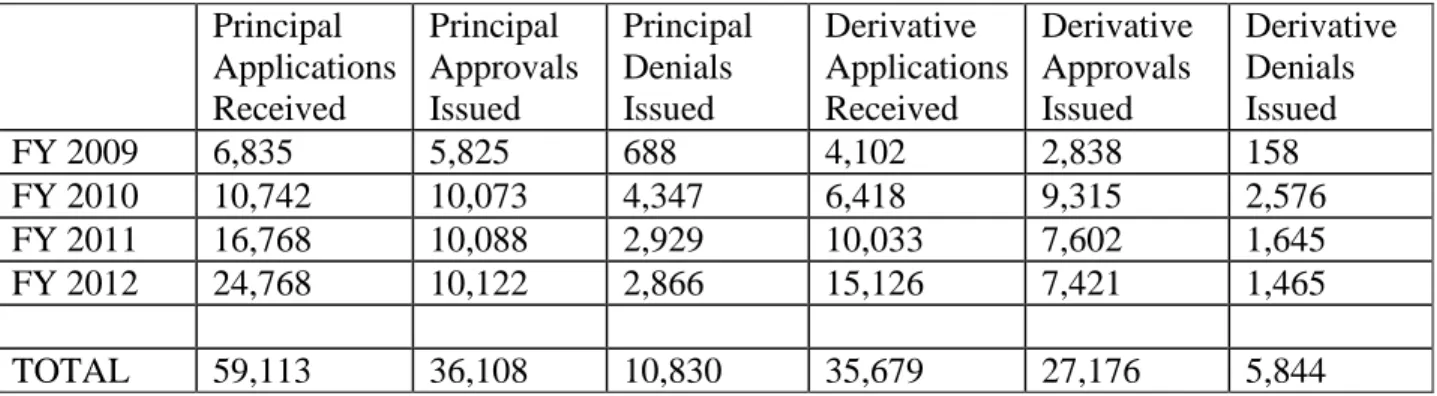
After three years as U Visa holders, migrants may apply for permanent residency. Congress currently limits U Visa status approvals to 10,000 per year, with an unlimited number of “derivative” U Visa status grants available for certain immediate relatives of the primary, “principal” victim applicants. The U Visa has grown in popularity with every year of its existence. While 5,825 principal U Visas were approved in fiscal year 2009, the first full fiscal
3
Immigrants who hold other temporary standings are also eligible to apply for U Visa status, but based on my fieldwork, most applicants are undocumented.
4
There are minimal opportunities for undocumented immigrants in the United States to legalize their standing. See, e.g.,
http://www.immigrationpolicy.org/sites/default/files/docs/whydonttheygetinline.pdf, accessed March 15, 2013.
5
As of January 1, 2013, California law AB 1899 (“Postsecondary Education Benefits for Crime Victims”) conferred U and T Visa holders with eligibility for the same state financial aid and non-resident tuition exemption as undocumented AB 540 students (see Abrego, 2008), including in-state tuition, scholarships, and financial aid at California community colleges, within the California State University and University of California systems, at private state colleges and universities, and at vocational and technical schools. See
year of its availability6, all 10,000 available principal U Visas were issued in fiscal years 2010, 2011, and 2012 (Services, 2012). Through fiscal year 2012, 36,108 principal and 27,176 derivative U Visa applicants have been approved.
6
Adjudicative regulations implementing the U Visa were not issued until 2007-2009, before which bona fide U Visa status was not available. Current regulations remain interim and subject to change.
Table 17. U Visa Applications, Approvals, and Denials, Fiscal Years* (FY) 2009-2012 Principal Applications Received Principal Approvals Issued Principal Denials Issued Derivative Applications Received Derivative Approvals Issued Derivative Denials Issued FY 2009 6,835 5,825 688 4,102 2,838 158 FY 2010 10,742 10,073 4,347 6,418 9,315 2,576 FY 2011 16,768 10,088 2,929 10,033 7,602 1,645 FY 2012 24,768 10,122 2,866 15,126 7,421 1,465 TOTAL 59,113 36,108 10,830 35,679 27,176 5,844
*Fiscal years run from Oct. 1 of the previous year to Sept. 30 of the year listed. Source: Services, 2012
7
Note that the numbers in Table 1 for approvals plus denials in each fiscal year do not add up to the applications received. During FYs 2009 and 2010, individuals who had previously received U Visa interim status (a deferred-action standing issued starting in October 2007 to those who could provide prima facie evidence of their likely eligibility for U Visas while USCIS was developing the adjudicative regulations) were filing the remaining components of their U Visa applications and may not have been counted in numerical totals for new applications received those years. In addition, each application that USCIS receives in a given fiscal year is not necessarily approved or denied that same year, making it difficult to establish definitive grant rates. Adjudicators may hold immigrants’ applications indefinitely while waiting for applicants to respond to evidence requests or for other reasons, as they are under no obligation to issue timely decisions. At the end of FY 2012, there were 19,899 principal and 15,592 derivative U Visa applications pending. In 2010, when the 10,000 cap for principal U Visa status approvals was first reached, all other applications were held until the start of the new fiscal year, when they rolled over and could be adjudicated with a renewed cap.
As success in the U Visa context yields valuable rewards, immigrants who believe they could be eligible for the remedy have a high incentive to pursue it. However, like all
humanitarian immigration benefits, U Visa standing is granted on a discretionary basis.
Therefore, immigrants pursuing U Visa status must demonstrate not only that they qualifyfor the relief from a rules standpoint but also that they deserve the status from a social and moral
standpoint. In efforts to do so, petitioners may rely on attorneys to broker information and resources between them and the legal authorities with power to advance or deter their objectives. But in the first years of the full implementation and availability of the remedy, it is not
completely clear to legal professionals or migrant petitioners how to facilitate the success of U Visa applications.
The U Visa regulations suggest that in order to be deemed eligible for and deserving of U Visa status, migrants must demonstrate that (1) they suffered at least one qualifying U Visa crime;8 (2) they endured substantial physical or mental harm from the crimes; (3) they cooperated in any resulting investigations and prosecutions; and (4) in light of their civic engagement, it would be in the public interest for any inadmissibilities9 to be pardoned and for
8
The crimes include “rape; torture; trafficking; incest; domestic violence; sexual assault; abusive sexual contact; prostitution; sexual exploitation; female genital mutilation; being held hostage; peonage; involuntary servitude; slave trade; kidnapping; abduction; unlawful criminal restraint; false imprisonment; blackmail; extortion; manslaughter; murder; felonious assault; witness tampering; obstruction of justice; perjury; or attempt, conspiracy, or solicitation to commit any of the above.” See http://www.uscis.gov/files/form/i-918instr.pdf, accessed February 1, 2013.
9
Applicants for the U Visa must demonstrate that they are admissible by showing that they do not fall under any of the grounds for inadmissibility at Immigration and Nationality Act (INA) §212(a) or that, if they do, they qualify for the waiver available under INA §212(d)(14). Some of the more common inadmissibility grounds include immigration violations, such as being present in the United States without permission or parole (also known as “entering without inspection”), failure to attend removal proceedings, and misrepresentation or fraud for an immigration benefit; communicable diseases; physical or mental disorders that may pose a
them to be legally incorporated into American society.10 Meeting these grounds may be
complicated for several reasons. While qualifying U Visa crimes are delineated in the VTVPA, whether victims endured one or more of them is often not plainly evident. The classification of a crime as one that qualifies for U Visa standing may reflect the subjective interpretations,
statements, or opinions of victims, perpetrators, police, or victims’ lawyers rather than any “correct” categorization11. In addition, while U Visa hopefuls must have suffered “substantial”
harm to qualify, no single factor is determinative or a prerequisite of this “substantial” bar. Furthermore, while applicants must be able to show their helpfulness in criminal investigations and prosecutions, the types and amount of evidence indicating collaboration are not enumerated in the U Visa statute or regulations. This situation is not especially unusual, as legal statutes and regulations in and outside of immigration law usually do not specify precisely how they should be applied to individual cases or how decision makers should adjudicate individual cases (Heimer, 1995; Sarat & Felstiner, 1995).
Negotiating Standing and Benefits Along the Legal Status Spectrum
U.S. immigration law has a profound impact on immigrants’ lives regardless of whether it deters them from migrating. Once migrants are inside the state, their ascribed legal status
threat; drug abuse or drug addiction; and criminal acts involving moral turpitude or drug
convictions. This list is not exhaustive.
10
In order to have a ground of inadmissibility waived, the applicant must show that granting the waiver is in the “public or national interest” (Kinoshita, et al., 2012, pp. 2-21). The regulations do not outline any specific requirements for demonstrating public or national interest, but USCIS officials have noted that each waiver application should include a statement explaining the discretionary grounds for granting the waiver, details of the victimization, migrants’ personal reasons and circumstances (“equities”) for needing the waiver, and any supporting
documentation.
11
This epistemological dilemma is germane to any form of categorization (see Timmermans & Epstein, 2011).
determines which rights they may exercise and the resources they may obtain. Immigrants who are naturalized citizens are formal equals to native-born citizens, enfranchised with a complete set of civic, political, and social rights. In contrast, all categories other than naturalized citizen entail some material exclusion or limitation (Bosniak, 2006; Brubaker, 1992). Therefore, while formal equality exists among citizens, formal inequality characterizes the relationship between citizens and non-citizens, and among non-citizens themselves.
Non-citizens are differentiated from each other by their particular legal standing, which determines their position along a continuum extending from undocumentedto Lawful Permanent Residency (LPR) status, with a number of anomalous temporary statures in between. Migrants’ spot along this continuum, which corresponds to a sliding scale of entitlements and privileges, dictates the rights they may assert. Most status-derived rights are inaccessible to unauthorized migrants. Progressively more rights are available to individuals with temporary legal standings, including U Visa status. Permanent residents are endowed with the most rights of any non-citizen group.
Considerable research has underscored the importance of legal status to migrants’ education, employment, familial well-being, health, and housing, among other outcomes (see, e.g., Abrego 2006; Gonzales, 2011; Massey, Durand, & Malone, 2002; Menjívar, 2002; Menjívar & Abrego, 2012; Reitz, 1998; Willen, 2011). Nonetheless, some scholars insist that immigrants’ formal legal status may be largely irrelevant to daily activities in a period of “post-national membership,” when non-citizens in liberal democracies are sometimes able to acquire benefits traditionally reserved for citizens (Sassen, 1996; Soysal, 1994). However, in recent years, researchers have begun to challenge this model by pointing out that large-scale restructurings of the immigration enforcement regime after the terrorist attacks of September 11, 2001 have made
the distinctions between and among citizens and non-citizen groups more important than before (Coutin, 2011b; Kasinitz, 2012; Menjívar & Abrego, 2012). While the eligibility criteria for formal citizen and non-citizen legal statuses are delineated in written legislation and regulations, the acquisition of legal standing and the mobilization of corresponding rights may be less clear, particularly where there is any room for interpretation or discretion in the process.
Legal scholars and social scientists have highlighted the power of law to delimit individuals’ claims in immigration as well as other legal areas, constricting the platforms from and identities with which individuals may mobilize law (Coutin, 2000; Gleeson, 2012; J. M. Hagan, 1994; Kanstroom, 2007; Motomura, 2010; Villalón, 2010). Studies have examined how, in calling on law’s authority, individuals may emphasize certain pre-existing aspects of their personalities or life histories that they believe square with legal norms or conventions that will enable them to achieve the results they desire (Berger, 2009b; Kim, 2011; Lakhani, 2013; Merry, 2003; Nicholls, 2011). Research on lawyers and clients often discusses the “framing” (Gitlin, 1980; Goffman, 1974), or “scripting” (Heimer & Staffen, 1998, p. 5) performed by attorneys to compel their clients’ legal goals, molding and reshaping individuals’ accounts into a
“papereality” (Dery, 1998) aimed to appease legal decision-makers (Coutin, 2000; Mertz, 1994). This discursive process sometimes also includes lawyers explaining to clients how legal
proceedings may unfold and of ways the law could be advantageously used so that clients can offer beneficial information (Coutin, 2000; McKinley, 1997). In turn, research has explored the “transformation” (Mather & Yngvesson, 1980-1981) and “negotiation” (Katz, 1982, p. 23) involved in legal complaints and disputes in how they change in form or content as a result of the interaction and involvement of participants in the legal process itself (Felstiner, Abel, & Sarat, 1980-1981).
Insofar as acquiring rights, empirical studies have highlighted the advantages of migrants who are naturalized citizens or hold the enduring and socially recognizable status of residency (Robertson, 2009; Sadiq, 2008; see also Kim 2011). Others have emphasized disadvantages that non-citizens who are undocumented migrants face when they transition from the classroom to the workforce and must “learn to be illegal” as they realize they lack important membership markers that facilitate a successful adulthood, such as social security numbers (Gonzales, 2011; see also Gleeson and Gonzales 2012). And recent examinations of migrants in Temporary Protected Status (TPS), a terminal legal position offering very few benefits, have portrayed the plights of migrants in “liminal legality” (Menjívar, 2006). In this dissertation, I extend these lines of research by investigating how immigrants transition from a position outside the law to a standing between undocumented status and permanent residency, and by showcasing the
limitations migrants confront while possessing temporary standings that provide access to significant privileges and may lead to permanent residency and citizenship.
Millions of immigrants in the United States hold temporary legal statuses, occupying a liminal space in the legal “twilight” (Martin, 2005)12
. These standings, what I call “twilight statuses” in this dissertation, may be acquired via family ties to immigrants in the United States, employment skills, travel to or study in the United States, circumstances warranting
12
Martin (2005, p. 2) calculated that within the population of 8 to 11 million undocumented immigrants in the United States, an estimated 1-1.5 million actually had “a kind of twilight status, partially recognized but not yet counting as full lawful residence”. These individuals included (1) persons with legally recognized claims to eventual legal status, such as relatives of permanent residents; and (2) persons who hold legally recognized temporary statuses. Martin’s numerical estimate (2005) included only relatives of permanent residents and migrants in TPS, the two most numerically significant classes of migrants falling in his conceptual category of “twilight status.” However, Martin suggested that the group could be expanded to include immigrants in other humanitarian categories, including the U Visa and other humanitarian statuses, without significantly altering his approximate count (2005, p. 9).
humanitarian intervention, or other means.13 Apart from their quantitative significance, the case of twilight statuses provides a strategic research site, ideally situated to illuminate the
stratification produced by migration control policies enacted since the mid-1990s and
particularly since 2001, the corresponding proliferation of formal legal statuses, the differences among them, and the ways in which a regime of “papers” limits migrants’ ability to claim rights to which they may be entitled, however limited in scope.
This dissertation examines immigrants’ experiences as they transition through the legalization process. My analyses center on the U Visa, one of a number of humanitarian twilight standings in existence today14. Legal intermediaries, among them attorneys, often facilitate immigrants’ movement across statuses. Thus, I also investigate lawyers’ involvement in the immigration legal process, including the constraints that shape attorneys’ selection of immigrants as legal clients, how lawyers facilitate migrants’ legalization goals, and how
immigration lawyers’ motivations for their professional decisions affect their career trajectories and the way they practice law on migrants’ behalf.
Dissertation Goals and Contributions
This dissertation contributes to the social science and legal scholarship on international migration and immigration policy, including the literature on the convergence of immigration and criminal law (Chacon, 2009; Kanstroom, 2007; Menjívar & Abrego, 2012; Stumpf, 2006).
13
See:
http://www.uscis.gov/portal/site/uscis/menuitem.5af9bb95919f35e66f614176543f6d1a/?vgnexto id=6ef88fa29935f010VgnVCM1000000ecd190aRCRD&vgnextchannel=b328194d3e88d010Vg nVCM10000048f3d6a1RCRD, accessed November 14, 2012.
14
For more information about the kinds of twilight statuses that exist, see:
http://www.uscis.gov/portal/site/uscis/menuitem.eb1d4c2a3e5b9ac89243c6a7543f6d1a/?vgnextc hannel=92f23e4d77d73210VgnVCM100000082ca60aRCRD&vgnextoid=92f23e4d77d73210Vg nVCM100000082ca60aRCRD, accessed March 18, 2013.
Scholars have analyzed the creation of national immigration laws and policies (Freeman, 1995; Joppke, 1998b; Soysal, 1994; Tichenor, 2002), conceptualizing resulting policies at the state and local level as mechanisms of control (Kubrin, Zatz, & Martinez, 2012; Varsanyi, 2010).
Countering that perspective, work on the implementation of immigration policy effectively argues that the mechanisms of control are not merely the policies themselves, but how these policies are implemented. This is an important distinction because research shows that bureaucrats face constraints in their ability to carry out their immigration control mandates (Armenta, 2011; Ellermann, 2009; Wells, 2004). My work goes one step further and argues that we should broaden our conceptualization of immigration control to include other mid-level actors and institutions that interpret and apply national policies.
Scholarship has examined actors involved in the implementation of immigration policies, including those in law enforcement and courts, immigration inspectors at airports, consular staff, social services and medical providers, and teachers, counselors, and administrators in schools (Armenta, 2011; Gilboy, 1991; Gleeson, 2012; Jones-Correa, 2008; Marrow, 2009; Maynard-Moody & Musheno, 2003). I build on this research by analyzing how lawyers act as brokers both between immigrants and the state and between immigrants and other mid-level
intermediaries such as police, employers, social services providers, and financial aid officers. My analysis configures immigration attorneys both as “agents and critics of law” (Coutin, 2000, p. 104) who, in efforts to facilitate immigrants’ mobilization of the law, simultaneously reinforce and challenge both official and unofficial legal notions. Immigration lawyers are “agents of law” in how their brokering work at base involves interpreting and applying existing legal statutes and regulations of the state to immigrants’ lives. Indeed, lawyers’ capacity to facilitate the legal inclusion of undocumented immigrants resides in their very alignment with the American state,
as professionals trained in its rules. And yet in the act of implementing those rules, by strategically laboring to enfranchise those who are not state members, lawyers can also be conceptualized as “critics of law.”
In drawing attention to the myriad and sometimes seemingly incongruous roles attorney may have in the application of immigration policies, I expand what we conceptualize as
immigration control beyond law enforcement actions, which has characterized much of the research in this area. Furthermore, I complicate our understanding of mechanisms of
immigration control by showing how exclusionary aspects of restriction can filter into efforts apparently intended to benefit immigrants.
My dissertation draws attention to critical ways in which immigration law shapes individuals’ lives. Research has examined how undocumented migrants contest immigration restrictions (Coutin, 2000; Ryo, 2006) and are punished by the law (Dow, 2004), but this study joins researchers exploring how immigrants attempt to work with the law. Scholars have investigated the efforts of undocumented immigrants to access legal benefits from a position outside the law (Abrego, 2008; Berger, 2009b; Bhuyan, 2008; Gleeson, 2010; Kim, 2011;
Menjívar & Morando Lakhani, n.d.; Nicholls, 2011). Chapters 3 and 4 contribute to this research agenda by examining how undocumented immigrants collaborate with lawyers to prepare
convincing U Visa claims. However, my dissertation goes a step beyond in chapter 6, where I examine immigrants’ efforts to access resources entitled to them once they become legal members of American society. In revealing the signaling mechanism involved in converting a legal status identity to concrete social resources, I illustrate how a political and social climate of migration control combined with a legal context characterized by the multiplication of
In revealing the relevance of immigrants’ ongoing “alien” standing even while occupying a position of legality (Bosniak, 2006), my dissertation expands the “legal violence” lens
(Menjívar & Abrego, 2012), which has been applied primarily to undocumented immigrants (but see Abrego & Lakhani, n.d.). While Menjívar and Abrego (2012) demonstrated how
unauthorized immigrants are harmed in physical, structural, and symbolic ways by current immigration laws, my dissertation shows that even when individuals are legally present in the country, widespread misinformation and the practices of the contemporary multi-layered, restrictive immigration regime continue to make them targets of legal violence.
This project is also in dialogue with the law and society canon, in its focus on the distinction between the static “law in books” and the evolving “law in action” (Pound, 1910). Under circumstances of legal and bureaucratic uncertainty, I demonstrate how attorneys help fashion immigrants’ lives into compelling cases for U Visa standing by mirroring apparent yet unstable norms they perceive to exist, but also by imbuing petitions with elements of uniqueness that make immigrant clients appear credible. While most studies of “law in action” have
analyzed how legal actors tailor the idiosyncratic details of discrete cases to match existing precedents, I examine how law emerges within a confining legal framework that is at the same time not completely institutionalized. In doing so, I extend the “law in action” paradigm.
Dissertation Data and Methods
This dissertation examines legal mobilization, legal decision-making, and discretion in the context of Los Angeles legal non-profit organizations, as immigrant crime victims work with attorneys to compel legal standings and associated benefits. Los Angeles is an appropriate context in which to study the legalization experiences of immigrants who have survived violence or persecution, as the city has historically been a major US destination for migrants seeking
humanitarian forms of relief (Batalova & Terrazas, 2010). Aiming to examine various stages of the legalization process including individuals’ transition from undocumented to temporary legal status, a Los Angeles study was also fitting since California is home to the largest population of unauthorized immigrants in the country (approximately 2.6 million), with Los Angeles County accommodating the largest number in the state (approximately one million), the majority of Mexican origin (Johnson, 2010). California was also the top destination for political asylees and refugees in 2010 (Martin, 2011).
My dissertation analyses draw on four sources of data, the primary source being participant observation at Equal Justice of Los Angeles.
Participant Observation within Equal Justice of Los Angeles
I conducted three years of ethnographic participant observation research within Equal Justice of Los Angeles (EJLA, or “Equal Justice”)15
between January 2009 and December 2011. Equal Justice, a non-profit organization in Los Angeles, California, provides free legal and social services to low-income16 city and county residents with varying needs. The organization’s immigration services focus on humanitarian-based forms of relief for individuals who have experienced violent crimes and forms of persecution in their countries of origin and in the United States. To maintain its confidentiality, I will not elaborate further on the organization’s structure except for in chapter 2, where I discuss its funding sources. I also discuss Equal Justice in the methodological appendix, where I describe my entry to the organization, ethical issues I
15
“Equal Justice of Los Angeles” is a pseudonym used to protect the confidentiality of the actual legal organization, employees, and migrant clients.
16
In 2010, the most recent year for which organizational data was available, over 80 of EJLA clients earned below 125 percent of the federal poverty level for their household size.
encountered during research, how my study focus evolved in the course of data collection, and the researcher standpoints I occupied vis-à-vis immigrants and attorneys at EJLA.
Volunteering several days each week as a law clerk, I helped immigration lawyers and migrant petitioners apply for various victim-based forms of immigration legal relief. I primarily worked on U Visa cases, the reasons for which I detail in the methodological appendix.
However, I was also involved with cases on behalf of immigrants seeking deferred action status through the Violence Against Women Act (VAWA)17, political asylum18, and T Visa status19, as well as permanent residency, citizenship, and reunification petitions for family members still abroad20. Immigrants soliciting legal status within the context of EJLA were women, men, and children from parts of Africa, Asia, Latin America, and the Middle East. The majority of clients
17
Battered spouses, children, and parents of U.S. citizens or permanent legal residents may file for immigration benefits without their abuser’s knowledge by self-petitioning via VAWA, legislation initially passed as part of the Violent Crime Control and Law Enforcement Act of 1994. See
http://www.uscis.gov/portal/site/uscis/menuitem.eb1d4c2a3e5b9ac89243c6a7543f6d1a/?vgnexto id=b85c3e4d77d73210VgnVCM100000082ca60aRCRD&vgnextchannel=b85c3e4d77d73210V gnVCM100000082ca60aRCRD, accessed September 21, 2012.
18
Individuals who are “unable or unwilling to return to their country of nationality because of persecution or a well-founded fear of persecution on account of race, religion, nationality, membership in a particular social group, or political opinion” may be granted asylum in the United States. See
http://www.uscis.gov/portal/site/uscis/menuitem.eb1d4c2a3e5b9ac89243c6a7543f6d1a/?vgnexto id=f39d3e4d77d73210VgnVCM100000082ca60aRCRD&vgnextchannel=f39d3e4d77d73210Vg nVCM100000082ca60aRCRD, accessed March 24, 2013.
19
T Visa status is designated for victims of human trafficking and allows victims to remain in the United States to assist in an investigation or prosecution of human trafficking. See
http://www.uscis.gov/portal/site/uscis/menuitem.eb1d4c2a3e5b9ac89243c6a7543f6d1a/?vgnexto id=02ed3e4d77d73210VgnVCM100000082ca60aRCRD&vgnextchannel=02ed3e4d77d73210V gnVCM100000082ca60aRCRD, accessed March 24, 2013.
20
I interacted with at Equal Justice spoke English as their second language, and some spoke no English at all.
This dissertation centers on the legalization experiences of female adult migrants from Latin America who qualified for U Visa status after surviving severe domestic violence and/or other intimate partner violence21, particularly sexual assault. I focus on female U Visa applicants and holders not because men are excluded from the legal opportunity, but rather because during the three years of my research, I only had the opportunity to observe five in-progress U Visa cases for male applicants22. Men are eligible for standing through the U Visa remedy and do succeed at acquiring the status23. Furthermore, U Visa standing is available to victims of a wide variety of crimes other than domestic violence, but the majority of the cases I was able to observe and work on were for domestic violence and related crimes. Many of the immigrants whose cases I worked on were mothers who headed mixed-status families that included one or more U.S. citizen children.
Most immigration lawyers at EJLA and their paralegal counterparts (who handled their own legal cases, under attorneys’ direction) were middle-class, ethnic minority women who spoke two or more languages. Several were immigrants themselves, having moved to the United States as children or adults; many others were children of immigrants.
21
“Intimate partner violence” describes physical, sexual, or psychological harm by a current or former partner or spouse. See, e.g.,
http://www.cdc.gov/violenceprevention/intimatepartnerviolence/, accessed April 4, 2013.
22
These were cases that I observed outside of Equal Justice and did not work on myself as a volunteer. Therefore, my observations of how gender affected the U Visa application process and migrants’ experiences in the standing are limited.
23
Statistics on the gender of U Visa recipients are unavailable, but I am aware of men receiving U Visa standing based on my research in Los Angeles legal non-profit organizations.
As an Equal Justice volunteer, I performed clerical legal work, including taking and editing legal declarations, composing cover letters and other documents, and completing forms to submit with migrants’ applications to USCIS. As a researcher, I took detailed field notes about interactions and meetings in which I participated, sometimes taping and transcribing sessions when I was able to obtain permission from all individuals present. I recorded observations primarily in a “stepwise fashion,” making mental and jotted notes that I expanded into detailed, typed narratives after exiting the field (Snow & Anderson, 1987, p. 1344). I accumulated an estimated 1,09224 pages of single-spaced field notes based on observations at Equal Justice and in related sites that I elaborate on below.
In an effort to acquire a grounded understanding of the legalization process within Equal Justice, I followed attorneys and staff through their daily work routines, listening not only to what they told me as a researcher but also to what they told other attorneys and staff members, immigrant clients, and me as an office volunteer. Although my researcher and volunteer roles sometimes blended into one another, I was able to secure both “perspectives in action” as well as “perspectives of action” (Gould, Walker, Crane, & Lidz, 1974, pp. xxiv-xxvi), contributing to a dynamic data collection process.
During my three years of fieldwork at Equal Justice, I estimate that I was involved with 150 U Visa cases and a collection of 50 other cases of the types mentioned above. I worked on cases at Equal Justice for days, weeks, or months at a time, including some that lasted from the start of fieldwork to its conclusion. My sustained presence at the organization helped me to
24
I came to this approximation by estimating that I wrote seven pages of single-spaced field notes on average per week during three years of fieldwork. Some weeks I definitely wrote more than 7 pages of notes, and other weeks less.
capture attorneys’ and migrants’ responses to difficulties, roadblocks, and successes encountered in the legalization process.
In addition to my casework, I interpreted for Spanish-speaking Equal Justice clients during interviews with adjudicators in USCIS field offices, observed case proceedings in Los Angeles’ Immigration Court, and participated in clinics aiding permanent residents interested in becoming US citizens. I attended monthly meetings of Equal Justice’s immigration lawyers and paralegals about case challenges and organizational concerns, and Equal Justice sponsored events and retreats. I was also given an email account at the organization during my volunteer work, which meant that I was included on communications between immigration lawyers and paralegals discussing legal questions and strategies, case wins and losses, and other topics. All of these organizational activities complemented my casework as informative data sources.
Network Meetings
In the course of working on Equal Justice attorneys’ immigration cases, I was invited to attend bimonthly “Network” meetings of EJLA and other non-profit attorneys in Los Angeles who represented immigrants applying for regularization through the U Visa remedy and the Violence Against Women Act. The Network convened to discuss and strategize surrounding challenges in their casework, including the factors that constrained their selection of U Visa cases (see chapter 2), U Visa certification (see chapter 3), and subsequent petition preparation (see chapter 4). I attended Network meetings between September 2009 and November 2011, listening as lawyers exchanged information, learning from one another as well as reinforcing shared notions about what made certain immigrants desirable or undesirable legal clients. By participating in these meetings, I accumulated a rich set of ethnographic data about how lawyers
representing immigrant victims in Los Angeles understood various legal issues and client-specific concerns at particular points in time.
Observations of Initial Case Consultations at EJLA, VIDA, and AYUDA
From June to December 2011, I observed a total of 55 intake consultations (“intakes”) between immigrants hoping to apply for forms of legal relief and attorneys at Equal Justice and two other organizations whose lawyers attended Network meetings. I undertook these
observations in order to examine lawyers’ case selection in more depth (see chapter 2), and to investigate how lawyers advised immigrants to approach law enforcement during the U Visa certification stage of their applications (see chapter 3). Lawyers at VIDA and AYUDA25 handled similar types of immigration legal cases as attorneys at Equal Justice, although daily operations differed somewhat in that AYUDA charged immigrants modest flat fees depending on the immigration benefits they were applying for. VIDA, like EJLA, did not charge immigrants for legal services. Lawyers at all three organizations considered themselves “non-profit” or “public interest” lawyers because of their commitment to providing accessible legal services to indigent immigrants.
Intakes were structured similarly across the three organizations during the period of observation, such that attorneys met with immigrants searching for legal representation because they believed they qualified for a benefit that attorneys could assist them in obtaining. During intakes, lawyers listened to immigrants’ narratives about circumstances they endured and their legal requests, reviewing paper documents and asking relevant follow-up questions. Before the conclusion of intakes, lawyers provided a preliminary assessment of immigrants’ eligibility for legal remedies and their willingness to represent migrants as their legal clients. It appeared
25
likely that 47 of the 55 immigrants whose consults I observed would become legal clients. The immigrants who allowed me to observe their consultations were from countries in Africa, Asia, Latin America, and the Middle East, and were interested in applying for various victim-based remedies as well as permanent residency, citizenship, proof of citizenship, and legal status for family members. In all, I observed 24 consultations at AYUDA (performed by three attorneys), 19 at EJLA (performed by four attorneys and one paralegal), and 12 at VIDA (performed by 3 attorneys).
Of these 55 total intakes, 40 were for immigrants who hoped to apply for U Visa status and who appeared to qualify for the remedy because they and/or family members suffered domestic violence (n = 22), sexual assault (n = 7), armed robbery (n = 3), murder (n = 3), felonious assault (n = 3), or attempted murder (n = 1); in one consultation, it was not clear what crime the individual experienced. The majority of these immigrants were from Mexico (n = 29), but others were from El Salvador (n = 5), Guatemala (n = 3), Nicaragua (n = 2), and one from an unspecified Latin American country. Most were women (n = 35). The U Visa intake
consultations, which were free at EJLA and VIDA and cost $25 at AYUDA, lasted between 30 minutes and two hours. Thirty-six were conducted in Spanish and four in English. I examine this set of intakes in chapters 2 and 3.
Apart from the content of the actual consultations, the “dead time” during intakes - when attorneys stepped out of the room to make copies of migrants’ paperwork or to complete other tasks - was useful because it gave me the opportunity to talk with immigrants about their experiences. Between intakes, I asked lawyers about consultations, gaining insight into how attorneys selected U Visa cases and their perceptions about immigrants’ likelihood of obtaining U Visa certification (see chapter 3).
In-depth Interviews
Between August 2010 and March 2012, I completed a total of 88 formal in-depth interviews for this project. Interviews were semi-structured and addressed various subject matters.
Immigrant Interviews
I interviewed 40 immigrant clients of Equal Justice, including 25 U Visa recipients, 11 asylees, and 4 immigrants who held deferred action through VAWA. Demographic and legal information about immigrant interviewees is included in Table 2.
Table 2. Demographic and Legal Characteristics of Immigrant Interviewees (Rounded Percentages in Parentheses)
VAWA (n = 4) Asylum (n = 11) U Visa (n = 25)
Women / Men 4 / 0 6 / 5 25 / 0
Region of Origin
(Africa/Asia/Latin America/Middle East)
0 / 0 / 4 / 0 5 / 3 / 3 / 0 0 / 0 / 25 / 0
Interviews focused on immigrants’ experiences before, during, and after the legalization process, specifically around their legal status or lack thereof. Core topics included how immigrants learned of regularization opportunities for which they believed they qualified and how they located attorneys, the “easy” and “difficult” aspects of applying for legal standing, how acquiring legal status (or not) affected their lives, and whether they hoped or intended to pursue other legalization avenues and why. These interviews often touched on related subject matters as respondents raised them, including migration history, family composition and the legal standing of children, parents, and relatives, educational and work experiences in their countries of origin and the United States, and physical and mental health. All interviews were semi-structured, providing the flexibility to alter and ask clarifying questions based on the interviewee’s response (Weiss, 1994).
Immigrants were assured that their decision to participate in interviews would not affect the services they were receiving at EJLA. Informants chose the location of the interviews, and most took place in Equal Justice offices, before or after appointments with their lawyers. Some interviews were conducted over the phone, if more convenient for respondents. Twenty-seven interviews were conducted in Spanish, and 13 in English, each lasting between thirty minutes and two hours. With informants’ consent, interviews were audio recorded and subsequently transcribed. Interviews conducted in Spanish were transcribed in Spanish. I translated respondent statements from Spanish to English for the purpose of this dissertation. Migrants’ narratives were sometimes slightly altered to protect their confidentiality.
Recruiting immigrants for formal interviews proved challenging. Some I approached were not interested in interviews; others expressed interest but did not return my phone calls to arrange dates and times. Although I had hoped to interview a larger sample of immigrants about
their legalization experiences, in reviewing my field notes, I counted hundreds of relevant conversations that occurred informally. These exchanges, which took place organically during my work on their legal cases, included a sample of 85 conversations with U Visa applicants and U Visa holders that I analyze in chapter 6.
Attorney and Legal Staff Interviews
I completed a total of 48 interviews with 22 EJLA, VIDA, AYUDA, and other Network immigration lawyers (14 of the 36 total attorney interviews were re-interviews26) and 12 legal staff. “Staff” included paralegals (n = 6) and law student interns (n = 6). Including Equal Justice, the lawyers and legal staff I interviewed were employed at nine legal non-profit organizations in the greater Los Angeles area27. Interviews with attorneys and legal staff
investigated their career trajectories and goals, day-to-day casework activities, and “challenging” and “rewarding” cases and other aspects of their jobs. Legal staff prepared immigration legal petitions from start to finish under the supervision of attorneys, who signed off on their work as the attorneys of record before submitting immigrants’ applications. Given that lawyers and legal staff conducted much of the same work in the non-profit organizations in this study, and given the small sample of staff I interviewed, I do not analyze differences in attorneys’ and staff members’ experiences in this dissertation even while acknowledging the two groups’ distinct legal training.
26
I conducted these additional interviews for an in-progress project that addresses DNA testing and medical examinations in the immigration legal process.
27
Two lawyers were professors at Los Angeles law schools who directed Immigration Law Clinics in which they supervised students as they prepared immigration legal cases. Both professors had worked at immigration non-profit organizations before assuming those positions, and drew on those as well as law school clinical experiences in interviews.
Informants chose the location of interviews, with nearly all interviews being completed at attorneys’ and staff members’ workplaces. All interviews were conducted in English and lasted between forty-five minutes and two hours. With informants’ permission, all interviews except for one were audio recorded and subsequently transcribed. In-depth interviews with attorneys and legal staff helped to clarify, and in some cases expand upon, instances I noted in my ethnographic research and more informal conversations with them.
In the chapters that follow, I utilize pseudonyms for the immigrant clients, lawyers, and legal staff discussed in this dissertation. In efforts to further protect subjects' confidentiality, I purposefully use different pseudonyms for research participants in each chapter even if the same individuals appear across chapters.
Data Analysis
I analyzed dissertation data in a modified grounded theory and analytical-induction tradition (Timmermans & Tavory, 2007), systematically coding ethnographic and interview material in dialogue with a close reading of salient themes in the international migration and law and society literatures. I began analysis early in the project and verified the emerging coding scheme with later data to make sure that my analysis captured the full spectrum of empirical manifestations. Initial coding of ethnographic data was organized by the various stages of the legalization process that I was able to observe, as follows:
1. Initial consultation: Immigrants present their basic situations and experiences to lawyers, who assess immigrants’ apparent qualification for forms of legal recourse.
2. Case diagnosis and preliminary work: Attorneys agree to represent immigrants, and lawyers perform a more complete evaluation of migrants’ eligibility for forms of relief. They decide which statuses and/or benefits to apply for. Lawyers advise immigrant clients of any