Applying
the
ISCED
‐
97
to
the
German
educational
qualifications
Silke L. Schneider1
This chapter describes the educational system in Germany and examines how the ISCED‐97 is applied to German data.
The current main topics of debate concerning the German educational system touch on all different levels of education: Increasing provision of child‐care and its development towards early education; the question of prolonging primary educa‐ tion to grade 6; the unsatisfactory performance of 15‐year‐olds in the PISA‐studies (OECD, 2001; 2004); the shortage of apprenticeship places; the implementation of Bachelor and Master degrees in higher education; and the introduction of fees to counter the chronic underfunding of universities (Statistisches Bundesamt, 2006).
1
Historical and legal background of education in Germany
The most substantial changes in the educational system in Germany since World War II affected five of the six current eastern federal states (Thuringia, Saxony, Saxony‐Anhalt, Brandenburg and Mecklenburg‐Western Pomerania) and East Ber‐ lin,2 with the establishment of and later break‐up of the German Democratic Re‐ public (GDR) and its own educational system. Compared to some other European countries, the system only changed very gradually in West Berlin and the ten west‐ ern federal states (Bavaria, Baden‐Württemberg, Hesse, Saarland, Rhineland‐ Palatinate, North Rhine‐Westphalia, Lower Saxony, Schleswig Holstein, Hamburg and Bremen) that made up the Federal Republic of Germany (FRG) during the dec‐ ades of partition.The structure of the educational system of the GDR was centrally organized in ac‐ cordance with Soviet ideals, and in stark contrast to the system effective in West Germany. From 1945 onwards, a unitary educational system developed in the GDR. The state had the monopoly in education matters, so that apart from a few church‐ related pre‐primary institutions, there was no private education. Elementary school was called polytechnic secondary school (Polytechnische Oberschule) and was com‐ pulsory for all children between age 6 and 16. It had a specific focus on science and technology, but another important aim of basic schooling in the GDR was the edu‐ 1
I would like to thank Jördis Kummerländer for providing an early version of this chapter for elaboration.
2
The re‐united Berlin makes the 6th eastern German federal state of today’s FRG. Like Hamburg, it is a city state.
cation of the “socialist personality”. Thus there were also strong links between schooling and the world of work (especially production) on the one hand and be‐ tween schooling and the military on the other. From grade 5 onward, pupils learnt Russian. Very bright students could attend extended secondary school (Erweiterte
Oberschule) afterwards and obtain a higher education entry certificate after 2 years, at the age of 18. This however also relied on conditions other than prior aca‐ demic achievement, which were also political (e.g. the parents’ occupation and membership in the Socialist Unity Party of Germany, SED; a working‐class origin; the pupils’ commitment to prolonged service in the army or specific career aspira‐ tions). Moreover, only the very best students could choose their course of studies, while the others were allocated to professions as required by the planned econ‐ omy.
After reunification, with the beginning of the school year 1992/93, the educational system of East Germany was assimilated to that of West Germany. Today, the sys‐ tems of education in the eastern and western states can be said to be at least for‐ mally equal.
After WW II, the western allied forces guided the establishment of the FRG as a federal republic, with state jurisdiction over formal education. According to the Ba‐ sic Constitutional Law, today’s sixteen federal states have the sovereignty in most matters related to education. This federal structure is due to the long federal tradi‐ tion in Germany as well as to the double experience of totalitarianism: The western allied forces strongly favoured a state with limited power. The “new” federal states of Eastern Germany thus each developed their own specificities, partly modelling their system on one of the western federal states (e.g. the system in Saxony is rela‐ tively close to that of Bavaria).
With the exception of tertiary education, educational finance and the supervision of schools is mainly in the hands of the Ministry of Education (Kultusministerium)3 of each federal state. Since this federal structure requires a minimum of co‐ ordination, a Standing Conference of Ministers of Education (Kultusministerkonfe‐
renz, KMK) regularly meets for the purpose of collaboration in educational matters. The educational systems of the federal states are in most respects similar, but there are also numerous exceptions and peculiarities. However, all school‐leaving and vocational training certificates as well as university degrees are recognized throughout Germany.
Over the course of the last decades, there have been many attempts to reform the (West‐) German educational system. But in contrast to many other countries, the traditional three‐tiered system of secondary education remained basically un‐
3
Formally, the ministries are actually called differently in different federal states, depend‐ ing on the other responsibilities they assume in addition to school education, e.g. youth, sports, culture, science, continuing training or women.
changed (Brauns and Steinmann, 1999). The following section is restricted to a de‐ scription of the basic structure of the current educational system, reflecting only the most important historical developments and differences between federal states. A very detailed description of the German educational system can be found in the documentation to be found in the Information Database on Education Sys‐ tems in Europe (fort the German report, see European Commission, 2007); voca‐ tional training in Germany is also presented in detail in Hippach‐Schneider et al. (2007).
2
The structure of the German educational system
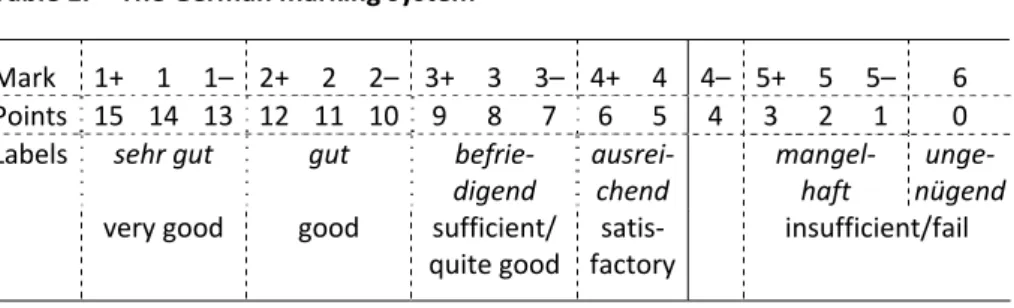
Laws concerning the duration of compulsory full‐time schooling differ across fed‐ eral states: some require students to complete 10 grades (e.g. Berlin and North‐ Rhine Westphalia), whereas others require only 9 years of general basic education. In approximately half of the federal states, there are additional part‐time schooling requirements up to age 18, when students have to attend at least a part‐time voca‐ tional school. The marking system in Germany comprises six marks (5 in the former GDR), with ‘+’ or a decimal expression (e.g. 1.7 for 2+) and ‘–’ or a decimal expression (e.g. 2.3 for 2–) being used for differentiation between two marks. Everything below a 4 is a fail, including 4–. These marks do not refer to the ranking within a class, as is usual in English‐speaking countries (e.g. ‘A’ for the top 10%), but rather to the degree to which a pupil’s performance meets the task requirements. Since 1972, marks are translated into points in general upper secondary education, from which the (weighted) final score is calculated.
Table 1. The German marking system
Mark 1+ 1 1– 2+ 2 2– 3+ 3 3– 4+ 4 4– 5+ 5 5– 6 Points 15 14 13 12 11 10 9 8 7 6 5 4 3 2 1 0 Labels sehr gut gut befrie‐
digend ausrei‐ chend mangel‐ haft unge‐ nügend very good good sufficient/
quite good satis‐ factory insufficient/fail Grade progression is not automatic in most German schools: Although the rules dif‐ fer over time, federal state, and type of secondary school, a ‘6’ on the yearly school report usually means that a grade must be repeated. A ‘5’ can often be compen‐ sated for with ‘2s’ and ‘3s’ in other subjects, particularly if it’s not a core subject (German, English, Maths). Parents and pupils get a warning letter (the so‐called ‘blue letter’) a few months before the end of the school year if grade progression is
at risk. It is being discussed to abolish this system and replace it by one where pu‐ pils with bad marks are supported more individually. The opposite of repeating a grade, namely skipping one, is possible, too, but certainly less common.
Children with special needs are usually educated in special schools. In 2004, they made up 4.4% of the general school population (Statistisches Bundesamt, 2006: 55).
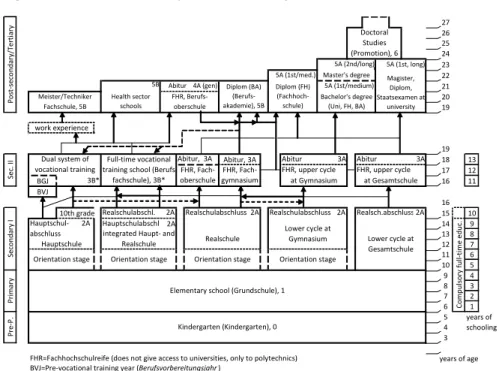
Figure 1 shows the current educational system of the FRG in a schematic way. The individual school types and certificates shown will be described in the following sections. Figure 1. The educational system in Germany 27 26 25 24 23 22 5B 21 20 19 19 Abitur, 3A Abitur, 3A 18 13 17 12 BGJ 16 11 BVJ 16
10th grade Realschulabschl. 2A Realschulabschluss 2A Realsch.abschluss 2A 15 10
Hauptschulabschl 2A 14 9 13 8 12 7 11 6 10 5 9 4 8 3 7 2 6 1 5 years of 4 schooling 3
FHR=Fachhochschulreife (does not give access to universities, only to polytechnics) years of age BVJ=Pre‐vocational training year (Berufsvorbereitungsjahr)
BGJ=Basic vocational training year; optional first year without a specific employer (Berufsgrundbildungsjahr)
* Classified 4A (voc) if vocational training follows a 3A qualification (Abitur, Fachhochschulreife) and 4B if it follows vocational training for a different occupation
Not shown: one‐year health sector schools (einjährige Schulen des Gesundheitswesens). Their position would be similar to Berufsfachschule.
Pri
m
ary
Elementary school (Grundschule), 1
Pre ‐ P. Kindergarten (Kindergarten), 0 Lower cycle at Gesamtschule Co m p ul so ry ful l ‐ ti me educ .
integrated Haupt‐ and
Realschule Realschule
Orientation stage Orientation stage Orientation stage
Se co nda ry I Hauptschul‐ 2A Realschulabschluss 2A
abschluss Lower cycle at
Gymnasium Hauptschule Orientation stage FHR, Fach‐ oberschule FHR, Fach‐ gymnasium
FHR, upper cycle FHR, upper cycle at Gymnasium at Gesamtschule Abitur 3A Abitur 3A work experience Se c. II Dual system of vocational training
Full‐time vocational training school (Berufs‐
fachschule), 3B* 3B*
5A (1st/medium) Meister/Techniker Health sector
schools
FHR, Berufs‐ Bachelor's degree
(Uni, FH, BA) Fachschule, 5B oberschule Pos t ‐ se co nda ry /T er ti ary Doctoral Studies (Promotion), 6 5A (2nd/long) 5A (1st, long) 5A (1st/med.) Master's degree Magister,
Diplom, Staatsexamen at
university Abitur 4A (gen) Diplom (BA)
(Berufs‐ akademie), 5B Diplom (FH) (Fachhoch‐ schule) Note: Not all tracks and types of schools exist in all parts of Germany. There is much variation between federal states.
2.1 Pre‐primary education
Pre‐primary education in Germany usually takes place in the Kindergarten (nursery school), which is actually not considered part of the educational system. It thus has the character of childcare rather than early education (but following the results of
the PISA studies (OECD, 2001; 2004) there are ambitions to change this). This was different in the former GDR, since the state tried to exert an ideological influence on children from early on. Children can go to Kindergarten from age 3 until they enrol in primary school. The last year is also referred to as Vorschule (pre‐school). Institutions that are not restricted to the standard morning hours are called Kin‐
dertagesstätte (day‐care centre), and institutions for under three‐year‐olds Kin‐
derkrippe (Crèche). Kinderkrippen, Kindergärten and Kindertagesstätten are run by the local authorities and private organisations, which are often church‐related, or voluntary associations with the active involvement of parents. Bigger companies sometimes also offer childcare for the children of their employees (Betriebskinder‐
garten).
2.2 Primary education
Schooling is generally compulsory from age six, but the specific cut‐off dates differ over federal states (in most cases it is the 30th of June though). A child’s individual development becomes more and more important with respect to the decision to enter school in a certain year, so that more and more children enter school at the age of five (5.3% in 2004) or seven (5.7%, Statistisches Bundesamt, 2006: 52f.). The first type of school children attend is primary school, nowadays called Grundschule
in Germany, which lasts four years (age 6–10; Berlin and Brandenburg: six years, age 6–12). It is the only truly comprehensive school type in Germany, where chil‐ dren from all social and ethnic backgrounds learn together since its introduction in 1920. Primary schools generally have specific catchment areas, but in North‐Rhine Westphalia, parents will be free to choose a primary school for their children from 2008 onwards, which is criticised for increasing social segregation in schools. The main subjects in primary schools are reading, writing, basic arithmetic and so‐ cial studies (Sachkunde). The class teacher keeps one class for at least two (but of‐ ten all four) years. The school report does not contain marks in the first couple of years, but verbal reports of the pupils’ achievements and behaviour. Most primary schools operate on a half‐day basis, but limited care facilities for the afternoons are sometimes available. All‐day schools are currently being expanded.
2.3 The transition to secondary education
After four (or, in Berlin and Brandenburg, six) years of primary education, students are selected into one of the three secondary school tracks: (1) Hauptschule, (2) Re‐
alschule, or (3) Gymnasium (Gesamtschule is a school that integrates the three oth‐ ers in one, but is less common). The selection procedures and criteria differ mark‐ edly across federal states, and they allow for different degrees of parental influ‐ ence. In some federal states (e.g. Baden‐Württemberg and Bavaria), students can only enter Realschule or Gymnasium after receiving a teachers’ recommendation
or, alternatively, after passing an entrance examination. In other federal states (e.g. Hamburg and Hesse), the teachers’ recommendation is only a guideline for parents (which is usually followed though).
Irrespective of school type, the first two years (i.e., grades 5 and 6) at secondary school “represent a phase of particular promotion, supervision and orientation with regard to the pupil’s future educational path and its particular direction” (European Commission, 2007: 28). This so‐called orientation stage (Orientierungs‐
stufe) has been implemented to allow for a prolonged time of orientation before the students are finally selected into tracks, and thus to allow the correction of suboptimal initial placements. If they fulfil certain requirements, students can switch to a different school type at the end of grade 6. A few federal states pro‐ vide(d) special institutions for grades 5 and 6.
It is being discussed to prolong the duration of primary education to six years in all federal states (or even comprehensive schooling up to grade 9/10) in order to postpone track selection and decrease the rather stark social and ethnic inequali‐ ties in education in Germany. The Standing Conference of Ministers of Education however did not take action in this direction, and this cannot be expected to hap‐ pen in the near future: The Gymnasium has a many and strong supporters.
2.4 Secondary education
Secondary education is divided into two cycles in Germany: Secondary level I (Se‐
kundarstufe I) and secondary level II (Sekundarstufe II). The former starts at the end of primary school up to the end of compulsory schooling (including grade 10, unless part of a twelve‐year Gymnasium).4 The latter comprises grades 10/11–12/13 in Gymnasium and Gesamtschule as well as all vocational upper secondary schools. As general and vocational education are relatively detached systems in Germany, vo‐ cational education will be dealt with separately (see section 2.5).
(1) Hauptschule5 is the lowest tier of lower secondary education and open to eve‐ rybody after primary school. It nowadays lasts five or six years (grades 5 to 9/10); its predecessor Volksschule, effective from the late 18th century until the 1960s, was an eight year programme, integrating primary and lower secondary education (grades 1 to 8). Whereas Volksschule and the early Hauptschule catered for the populace, today’s Hauptschule is only attended by low achieving pupils.6 Teaching is mainly aimed at basic general education, and a practical preparation to life and
4
Some Gymnasia currently take 8, some 9 years after Grundschule. This is transitional, as the duration is being decreased from 13 to 12 years of education in all federal states.
5
Translation is very difficult here – the word literally means „main school“.
6
However, the actual level of ability depends also on the size of the Hauptschul‐sector in different federal states and areas (i.e. how negatively selected the pupils actually are).
work. Students who successfully (i.e. with sufficient marks) complete Hauptschule at age 15 attain the leaving certificate (Hauptschulabschluss) or, previously, Volkss‐
chulabschluss at age 14, which give access to vocational training in the dual system (see section 2.5).
Today, in Bavaria, Hesse, Mecklenburg‐Western Pomerania, Saxony, Saxony‐Anhalt, and Thuringia, students can attain a qualifying Hauptschulabschluss (Qualifizieren‐
der Hauptschulabschluss) that requires the passing of (additional) final examina‐ tions (this is obligatory in North‐Rhine Westphalia, Hesse and Lower Saxony). In some federal states (e.g. Lower Saxony), these are centrally administered and thus standardised. Additionally, most federal states offer an extended Hauptschulab‐
schluss (Erweiterter Hauptschulabschluss or Fachoberschulreife) to students who successfully complete the optional tenth grade. This extended Hauptschulabschluss is in many federal states comparable to the intermediate general qualification (Mittlere Reife or Realschulabschluss, see below) and does open access to general education at the upper secondary level (illustrated by a dashed arrow in Figure 1). If somebody left polytechnische Oberschule after grade 9 in the former GDR, this is recognised as being equivalent to the Hauptschulabschluss. When pupils at Real‐
schule or Gymnasium transfer between grades 9 and 10, this usually also includes automatic attainment of the Hauptschulabschluss.
Enrolment in Hauptschule has been decreasing for decades, although this decrease has weakened over the last ten years. In 2004, 23% of all seventh‐graders in Ger‐ many went to Hauptschule (Statistisches Bundesamt, 2006: 54). The legitimacy of the current Hauptschule is highly debated nowadays, because of its segregated and stigmatising character, higher levels of school violence and the lack of perspectives its graduates usually have to face.7 In many areas, Hauptschule has the reputation of only catering for “the rest”, as its pupils are exclusively negatively selected. (2) The intermediate track used to be called Mittelschule (middle school) until the educational reforms in the 1960 and is now generally known as Realschule. In 2004, nearly 27% of all grade seven pupils in Germany went to Realschule (Statistisches Bundesamt, 2006: 54). In order to continue to Realschule after primary school, a pupil needs average school marks generally speaking (around mark 3). Teaching is meant to convey an extended basic education. The Realschule is supposed to pre‐ pare mainly practically and theoretically oriented students for vocational training in trade, technical and administrative professions. The intermediate general qualifica‐ tion (Mittlerer Schulabschluss, including Mittlere Reife, Realschulabschluss or Fachoberschulreife, depending on state and awarding institution) is usually ob‐ tained after attending six (or four in federal states with six years of primary educa‐
7
This however differs significantly over states and between urban and rural areas, with the southern states and rural areas having a less negatively selected proportion of chil‐
tion) years of Realschule, i.e. after the 10th grade. Since the recent introduction of national educational standards (which however are very general and implemented in different ways by the states), state‐wide, centrally administered examinations in the main subjects also have to be passed (at Gymnasium however, Realschulab‐ schluss is usually attained simply by getting transferred from grade 10 to 11). In addition to access to apprenticeships and other forms of vocational training, stu‐ dents with this qualification and sufficient marks are permitted to continue to gen‐ eral upper secondary education at Fachoberschule, Fachgymnasium, Gymnasium or Gesamtschule. The certificate awarded at the end of polytechnische Oberschule in the former GDR is acknowledged as an equivalent qualification.
There is a recent trend of integrating Hauptschule and Realschule in a new type of school, often driven by demographic change and thus insufficient numbers of pu‐ pils for Hauptschule in rural areas, which makes three separate school tracks un‐ economical.8 In Saarland, Hauptschule and Realschule were integrated into the so‐ called extended intermediate school (erweiterte Realschule), which has track dif‐ ferentiation within schools (Hauptschul‐ and Realschulzweig). Rhineland‐Palatinate and Hamburg plan to abolish Hauptschule, too. In most of the ‘new federal states’, Hauptschule and Realschule have not been introduced after the German re‐ unification to start with,9 and the non‐Gymnasium secondary schools effective there bear different names: middle school (Mittelschule) in Saxony, upper school (Oberschule) in Brandenburg, regular school (Regelschule) in Thuringia, regional school (Regionalschule) in Mecklenburg‐Western Pomerania (also in place in Rhine‐ land‐Palatinate in the west), or simply secondary school (Sekundarschule) in Saxony‐Anhalt (and Bremen in the west since 2005).10 All these schools are obliged to provide both leaving certificates, Haupt‐ and Realschulabschluss. The permeabil‐ ity between the two tracks within schools is supposed to be higher than between the traditional, separate schools, and track differentiation also starts later and can differ for different subjects. The precise design of within‐school‐tracking in such semi‐integrated schools differs over the different federal states. In 2004, 6.8% of all pupils in grade seven went to such a semi‐integrated school (Statistisches Bundes‐ amt, 2006: 54).
(3) At the Gymnasium, students are prepared for the Abitur, which opens access to higher education institutions and is the highest general education certificate in Ger‐
8
This actually seems to be the only argument capable of convincing conservative politi‐ cians in Germany to reduce tracking between schools.
9
The population however insisted on the introduction of Gymnasia, so that the compre‐ hensive system in place in the GDR could not be upheld.
10
As all of this shows, in educational matters, there is a high degree of provincialism in Germany: Education is one of the major battlefields between federal states and the fed‐ eration, where the federal states want to maintain their near‐exclusive power, which they have already lost in many other policy areas.
many. Depending on the educational laws of the federal states, this track can com‐ prise either 8 or 9 years of schooling after primary school, divided into Sekundar‐
stufe I (lower secondary, until grade 9/10), and Sekundarstufe II/gymnasiale Ober‐
stufe (grade 10/11–12/13). Therefore, by the time of graduation, Gymnasium‐ students are typically 18 or 19 years old. In the former GDR, Abitur was attained at the extended secondary school (Erweiterte Oberschule) after 12 years of schooling. The substantive focus that pupils take in the qualification phase, which covers the last two years of the gymnasiale Oberstufe (in two to three specialised courses – Leistungskurse), formally does not have any impact on which fields they can apply to at university, as many other subjects remain part of the curriculum (eight to ten basic courses – Grundkurse). Also, the choice of four two five subjects for the Abi‐
tur‐examinations is regulated, as one has to cover one language, one science course, and one of the social sciences. Therefore the Abitur is more formally also called Allgemeine Hochschulreife (general university entrance qualification). The written parts of the maturity examination, which makes up around 20% of the final average mark of the Abitur, is administered (but not marked) centrally in nearly all the federal states since 2005 (before, this was only the case in a few states). The proportion of an age cohort reaching the Abitur has been increasing; however it is still lower than in many other countries for comparable certificates. Nearly 34% of all pupils in grade seven in Germany went to Gymnasium in 2004 (Statistisches Bundesamt, 2006: 54).
Pupils can choose to leave the Gymnasium one year before the Abitur. In that case, they acquire the certificate of Fachhochschulreife, which was introduced in the late 1960s and gives access to universities of applied science/polytechnics (see section 2.6), but not traditional universities.
There are specific adult education institutions for acquiring Abitur or Fach‐
hochschulreife in second‐chance education: Abendgymnasium (evening Gymna‐ sium), which offers lessons for employed people, and Kollegs, which are full‐time Gymnasia for adults. Courses take 2 (for the Fachhochschulreife) to 3 (for Abitur) years. Because of the double burden of work and schooling for such an extended period of time, only a minority of those who enrol in evening gymnasia actually complete it.
In comprehensive school (Gesamtschule), which was experimentally introduced as an alternative to the three‐tiered system in the 1970s, all three school tracks and all certificates are offered in one institution. They are still in place in most federal states. Sometimes internal differentiation is according to subjects (integrative Ge‐
samtschule), sometimes to tracks (kooperative Gesamtschule). In comprehensive schools, grade progression is usually independent of marks in the school report. As Gesamtschulen compete for pupils with the other three school types, their socially integrative impact has been very restricted so far, and their level of achievement is much lower than that at Gymnasium. This is because most pupils with a teacher
recommendation for Gymnasium would not choose Gesamtschule. The replace‐ ment of the three‐tiered system by comprehensive schools in North‐Rhine West‐ phalia in 1978 was impeded by strong opposition by the conservative party, the churches as well as teacher and parent organisations, ensuing massive demonstra‐ tions. Since then, the introduction of comprehensive schooling used to be a politi‐ cal no‐go area in Germany. Only since the PISA studies, there are some signs of change (e.g. the integration of Haupt‐ and Realschule in some states). Most mem‐ bers of the conservative party (Christian Democratic Union, CDU) however remain strongly opposed. In 2004, 8.9% of pupils in the seventh grade went to an integra‐
tive Gesamtschule (Statistisches Bundesamt, 2006: 54).
A special type of comprehensive school is the private Waldorfschule (Rudolf Steiner schools). It prepares for the Waldorfschulabschluss in 12 years, which is considered to be equivalent to Realschulabschluss (but not formally recognised), and Fach‐
hochschulreife and Abitur in 13 years. Teaching and school life at Waldorfschule put a particular emphasis on artistic, practical and social skills. A foreign language is taught from grade 1 onwards. Sometimes they offer apprenticeships alongside Abi‐
tur, and several internships are compulsory. Grade retention is not practiced, and pupils are not divided into ability groups until the end of compulsory education. There are also no marks until grade 9 or 10. The proportion of pupils in grade seven who went to Waldorfschule in 2004 was 0.7% (Statistisches Bundesamt, 2006: 54). With respect to permeability between school types, there are two ways of chang‐ ing tracks, the “downgrade” from Gymnasium to Realschule or from Realschule to Hauptschule being the more common one. If grade progression fails twice within a schooling cycle, the pupil usually has to leave the school and go to the next lower type of school. “Upgrading” is most common after grade 6 (at the end of Orien‐
tierungsstufe), or after grade 10, where a transfer from Realschule to Gymnasium is possible if the results in the Realschulabschluss are sufficient (this is indicated as a “note of qualification”, Qualifikationsvermerk, in the certificate).
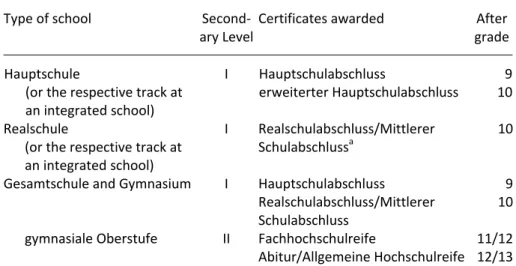
Table 2 gives an overview of the different secondary school types in Germany, to‐ gether with the certificates awarded and the respective school grades. Table 3 shows which subsequent educational programmes the different certificates give access to.
Table 2. Current general school types and certificates awarded Type of school Second‐ ary Level Certificates awarded After grade Hauptschulabschluss 9 Hauptschule (or the respective track at an integrated school) I erweiterter Hauptschulabschluss 10 Realschule (or the respective track at an integrated school) I Realschulabschluss/Mittlerer Schulabschlussa 10
Gesamtschule and Gymnasium I Hauptschulabschluss 9
Realschulabschluss/Mittlerer
Schulabschluss
10 gymnasiale Oberstufe II Fachhochschulreife 11/12
Abitur/Allgemeine Hochschulreife 12/13
a
Equivalent certificates with different names awarded in different federal states or different institutions are: Realschulabschluss, Mittlere Reife, Fachoberschulreife,
qualifizierter Sekundarabschluss, erweiterter Sekundarabschluss. Erweiterter Haup‐
tschulabschluss after grade 10 is usually regarded as equivalent, too.
Table 3. Certificates and which programmes they maximally give access to
Certificate Access to Additional
requirements Hauptschulabschluss Vocational training in the dual system Apprenticeship mar‐ ket situation Mittlerer Schulabschluss (Realschulabschluss, Mittlere Reife, Fachoberschulreife) Fachoberschule, Berufsfachschule, Beruf‐ skolleg Average mark Mittlerer Schulabschluss with qualification note gymnasiale Oberstufe at Gesamtschule or Gymna‐ sium Mittlerer Schulabschluss + Apprenticeship certificate Berufsoberschule Fachhochschulreife Berufsakademie, Fach‐ hochschule Average mark Allgemeine Hochschulreife Hochschule, Universität Average mark
2.5 Vocational training at the upper secondary level
A general feature of the German occupational system is that access to many occu‐ pations and positions requires formal certification. This has many consequences for the educational system, which is often closely linked to the labour market. The consequence for the system of social stratification is that the association between educational attainment and occupational attainment are rather close.
For most occupations (thus not only the classical crafts), vocational training (Berufs‐
ausbildung) takes place in form of the “dual system” (duales Berufsausbildungssys‐
tem) of combined apprenticeship at the workplace and vocational and general schooling in part‐time vocational schools (Berufsschule), which is relatively unique and largely restricted to German‐speaking countries. This is often simply referred to as Ausbildung or Lehre. Vocational training of this kind typically takes three years. The Chamber of Crafts or the Chamber of Industry and Commerce, employ‐ ers and the publicly run vocational schools co‐operate closely, which makes the transition from school to work comparably smooth in Germany (see Shavit and Müller, 1998; Scherer, 2001). Apprentices have a training contract with an em‐ ployer (which can be a large company, but also a civil service office or a profes‐ sional), and are remunerated at a rate fixed by collective labour agreements. The regulation of training in the company is actually one of the few areas of education where the Federal government has the right to take legislative action, which is cov‐ ered in the vocational training act (Berufsbildungsgesetz). For one or two days a week (around 10 hours, depending on the occupation and year of training), the ap‐ prentice goes to school rather than the workplace. For some (particularly rare) oc‐ cupations however, schooling is only offered in a certain period of the year.
There are also some skilled occupations (e.g. in the health and social sector as well as technical and commercial/trade assistants) for which training exclusively takes place in full‐time vocational schools (Berufsfachschulen and Berufskollegs). These vocational schools also offer programmes for occupations that are usually covered in the dual system, which youth who did not get a place in the dual system enrol in.11 This is much less popular than apprenticeships though. At Berufsfachschulen
and Berufskollegs, students can achieve vocational skills and knowledge and at the same time acquire general education certificates (this possibility of second‐ chance/upgrading of school leaving certificates was introduced in the 1970s and is widely used). While one or two year courses impart basic vocational knowledge (Berufliche Grundbildung),12 some two and all three‐year programmes provide full vocational qualifications and are considered equivalent to vocational training in the
11
There are again many regional particularities to be found, which won’t be discussed here.
12
These years are credited as part of vocational training in case of getting place in the dual system later.
dual system. Berufsfachschulen and the dual system confer titles like ‘staatlich an‐
erkannter …’, which means ‘state‐approved (+ title of the vocation)’.
Vocational training is popular and well regarded in Germany, in contrast to many other countries: 53% of an age cohort held a formal vocational training certificate in 2004 (Uhly et al., 2006: 24). Although there are no formal entry requirements for apprenticeships (Hippach‐Schneider et al., 2007: 26), not only graduates from the lower secondary schools opt for an apprenticeship, but it is also an attractive op‐ tion for holders of the Abitur. For many occupations (e.g. in the banking and insur‐ ance sector), Abitur is practically a requirement today. Therefore, the level of gen‐ eral education is important in the actual chances of getting an apprenticeship place in the preferred occupation: With a Hauptschulabschluss, choice is more or less re‐ stricted to manufacturing, crafts and sales occupations, and nowadays there is the increasing problem that many teenagers with Hauptschulabschluss do not get a place in the “apprenticeship market” at all, as the demand for apprentices de‐ creased considerably over the last decades, particularly in the areas open to Haup‐
tschul‐graduates. This is partly due to the general tendency to reduce jobs on the side of employers, but also to technological change, increasing skill demands and a deteriorating reputation of the Hauptschulabschluss. Whereas in 1970, 80% of those starting vocational training in the dual system had no or a Hauptschul‐ certificate, this number is down to 37.8% in 2004 (Uhly et al., 2006: 51). Compared to 1% in 1970, 16.5% of starters in the dual system had a higher education entrance qualification (it has to be kept in mind though that the distribution of these general school leaving certificates shifted upwards as well).
For those youth who were unsuccessful in obtaining an apprenticeship contract, two possibilities were created. First, a pre‐vocational training year, called Berufsvorbereitungsjahr, at the end of which early school leavers are given a sec‐ ond chance to achieve the Hauptschulabschluss in order to enhance their chances with employers. The second option is to enrol in a basic vocational training year (Berufsgrundbildungsjahr), which is more suitable for Realschul‐graduates who did not get an apprenticeship position. This is credited as the first year of vocational training in a specific field of occupations, so that a subsequent apprenticeship in such an occupation would be one year shorter. For students under the age of 18 who did not find an apprenticeship position, a Berufsvorbereitungsjahr or a Berufsgrundbildungsjahr is obligatory in most federal states in order to comply with the requirement of part‐time compulsory education up to age 18.
There are moreover some vocational schools that, despite their belonging to the vocational education sector, confer general education certificates only. For theo‐ retically oriented students who did not opt for, or who were not admitted to tracks that lead to higher education at the earlier stages of their educational careers, Fachoberschulen (FOS) and Berufsoberschulen (BOS) have been implemented in the 1970s to prepare for examinations for the necessary entrance certificates in two‐
or three‐year courses. Precondition for enrolment in the Fachoberschule is the pos‐ session of the intermediate general qualification (Mittlerer Schulabschluss); for the Berufsoberschule the additional condition is the completion of an apprenticeship or a vocational training programme at a vocational school. Whereas most FOS do not offer a 13th grade for acquiring Abitur, BOS do. Both also prepare for the Fach‐
hochschulreife. Teaching involves different vocational subject areas (technology, design, administration…) in addition to general subjects. Moreover, there are Fach‐ or Berufsgymnasien (vocational Gymnasia), which specialise e.g. in technology, economics, health etc. They prepare for the Abitur and can be accessed with an intermediated general qualification. Here vocational and general qualifications can sometimes be combined.
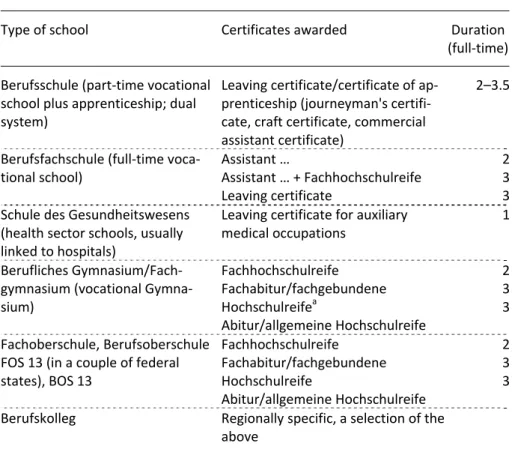
Table 4. Current vocational school types, course duration and certificates
awarded
Type of school Certificates awarded Duration
(full‐time) Berufsschule (part‐time vocational school plus apprenticeship; dual system) Leaving certificate/certificate of ap‐ prenticeship (journeyman's certifi‐ cate, craft certificate, commercial assistant certificate) 2–3.5 Berufsfachschule (full‐time voca‐ tional school) Assistant … Assistant … + Fachhochschulreife Leaving certificate 2 3 3 Schule des Gesundheitswesens (health sector schools, usually linked to hospitals) Leaving certificate for auxiliary medical occupations 1 Berufliches Gymnasium/Fach‐ gymnasium (vocational Gymna‐ sium) Fachhochschulreife Fachabitur/fachgebundene Hochschulreifea Abitur/allgemeine Hochschulreife 2 3 3 Fachoberschule, Berufsoberschule FOS 13 (in a couple of federal states), BOS 13 Fachhochschulreife Fachabitur/fachgebundene Hochschulreife Abitur/allgemeine Hochschulreife 2 3 3 Berufskolleg Regionally specific, a selection of the above Notes: All these institutions belong to the upper secondary level (Sekundarstufe II). a The Abitur requires certification of knowledge of two foreign languages, whereas the Fachabitur does not. The latter only gives access to certain subjects at universi‐ ties.
2.6 Vocational and academic tertiary education
As the provision of vocational education works well at the upper secondary level, (vocational) education at the tertiary level is not prominent in Germany by interna‐ tional standards, which is probably the main reason why the proportion of higher education graduates is lower in Germany than in countries with less successful vo‐ cational training systems, which consequently need to provide advanced practical skills at the tertiary level and where secondary school graduates have less “quality” choice at age 16 and thus need to go to higher education in order to achieve an ac‐ ceptable qualification at all.
Advanced vocational training is offered at technical colleges (Fachschulen) and vo‐ cational academies (Berufsakademien). These institutions award the highest voca‐ tional qualifications available in Germany and are internationally considered as ter‐ tiary. The former are usually only open to those who have completed an appren‐ ticeship or hold a certificate of a Berufsfachschule and have several years of work experience. Students can extend and refine their vocational skills attending full‐ time or part‐time classes. Successful Fachschul‐graduates e.g. receive the title “state‐approved technician” (staatlich geprüfter Techniker) or the master crafts‐ man’s diploma, known as Meisterbrief. The latter can also be obtained on the basis of several years of work experience (without attending Fachschule) after passing detailed examinations supervised by the respective Chamber. It ensures that its holder is able to lead his/her own company and to instruct trainees on an adequate level.
Vocational academies (Berufsakademien) only exist in a few federal states. Some‐ what like the dual system of vocational training, the Berufsakademie combines practical in‐company training with academic education. Enrolment in a Berufs‐
akademie however requires Fachhochschulreife or Abitur, depending on the federal state. Traditionally, the Berufsakademie confers the state‐approved Diplom (BA); but since 2006, all Berufsakademien confer the title Bachelor. However the possibil‐ ity of subsequent master and doctoral studies is currently only provided in Baden‐ Württemberg – elsewhere the university applied to will decide on admission of graduates of the Berufsakademie.
The German higher education sector is two‐tiered, consisting of traditional re‐ search‐oriented universities and more practically oriented polytechnics or universi‐ ties of applied science13 (Fachhochschulen) introduced in the 1970s.14 While univer‐
13
See the chapter on the Finnish educational system for the problematic nature of the translation of the term „Fachhochschule“: In Finland it was actually decided to stick to the term „polytechnics“, as „university of applied science“ suggests university status.
14
The so‐called comprehensive universities (Gesamthochschulen) were also implemented in the 1970s, but almost exclusively in North Rhine‐Westphalia. All comprehensive uni‐ versities were transformed into either universities or Fachhochschulen since 2003.
sity programmes (Universität or Hochschule, including high‐ranking technical uni‐ versities) are basically and essentially theoretical and academic, programmes at Fachhochschule are more vocationally oriented towards the application of knowl‐ edge in professional life. Art colleges and conservatoires belong to the university tier. The minimum entrance requirement for the Universität is the Allgemeine
Hochschulreife or the fachgebundene Hochschulreife; for the Fachhochschule it is the Fachhochschulreife.15 There is a numerus clausus for university entrance in many subjects. Typical fields of study at Fachhochschulen are engineering, social work, economics, and ICT. Studies at Fachhochschule usually take four years, and most students actually graduate after four years, too. Studies at the university for‐ mally take four and a half years (nine semesters) in most subjects, but graduation actually takes place much later in many cases: the average time to graduation can go up to 16 semesters, i.e. eight years, in some subjects at some universities. Rea‐ sons for this are that many students work part‐time while they study, but also that study conditions are often unsatisfactory due to the chronic underfunding of the universities. Furthermore, many students have to repeat examinations because of failures in particularly difficult courses, and the organisation of studies is largely up to the student and thus requires determination and time‐management skills. A specific type of polytechnics are the colleges of public administration (Fach‐
hochschulen für öffentliche Verwaltung), which are run by the federal states and the Federation. They prepare civil servants for the medium‐level non‐technical ca‐ reer in the judiciary, customs, tax offices, police, penal system, local administration etc. (but not teachers and social workers).
The traditional degree awarded at Fachhochschule and colleges of public admini‐ stration was the Diplom (FH), which did not usually give access to university stud‐ ies. It is otherwise regarded as equivalent with a Bachelor honours available in other countries. At universities, there used to be three types of qualifications: Mag‐
ister Artium is the standard degree for the humanities and social sciences, Diplom
for engineering, the sciences and social sciences, and the non‐degree first Staats‐
examen (examination organised by the federal states) for teaching degrees, medi‐ cine, pharmaceutics and law. The latter qualifications are thus not the exclusive re‐ sponsibility of the universities, but regulated by the state (as are the respective professions) to ensure high quality standards. The first state examination is usually followed by a period of practical training (Referendariat), which concludes with the second state examination.
All studies apart from those for civil service used to be divided into two cycles, the first (Grundstudium) consisting of the first two years and concluding with an inter‐ mediate examination or Vordiplom, and the second cycle (Hauptstudium) consist‐
15
Table 5. Tertiary education institutions and certificates in Germany
Type of institution Entrance requirement Certificates awarded Duration Schule des Gesund‐ heitswesens (health sector schools, usually linked to hospitals) Qualification for medi‐ cal auxiliary occupa‐ tions or apprenticeship certificate Leaving certificate for medical assistants Leaving certificate for nurses, midwives 2 3 Fachschule, Fachakademie (part‐ or full‐time advanced vo‐ cational schools) Apprenticeship certifi‐ cate and work experi‐ ence in the respective occupation Fachhochschulreife Fachschulabschluss 2 2 Berufsakademie (voca‐ tional academy) Abitur/allgemeine Hochschulreife, em‐ ployment with a com‐ pany Bachelor Diplom (BA) 3 Hochschule für öf‐ fentliche Verwaltung (college of public ad‐ ministration) Fachhochschulreife, plus usually appoint‐ ment by the respective public authority Diplom (FH) 3–4 Fachhochschule Fachhochschulreife, plus often a relevant internship Bachelor Master Diplom (FH) 3–4 1–2 4 University, HochschuleaAbitur/allgemeine Hochschulreife Bachelor Master Diplom Magister Artium 1. Staatsexamen (state examination) 3–4 1–2 4–5b 4.5 4.5 Notes: a
These cover the Technische Hochschulen (technical universities), Pädagogische
Hochschulen (colleges of education), Musik‐ and Kunsthochschulen (conservatoires and art colleges). The duration of studies at the latter institutions can be slightly longer than at universities.
b
The durations of study at university vary a lot in practice. The eight to ten semes‐ ters indicated here refer to the Regelstudienzeit (regular study time), which is usu‐ ally considerably shorter than the average.
ing of two to three more years and concluding with written and oral exams as well as a thesis. All types of university diplomas give access to PhD studies. With the Bo‐ logna reforms, Bachelor (3–4 years) and Master (1–2 years) degrees are currently being implemented at universities and Fachhochschulen throughout Germany. It is
hoped that this will reduce the average amount of time students spend in higher education: the maximum duration of studies was fixed to five years (3+2 or 4+1). Both types of degrees are not distinguished according to the type of institution at‐ tended any more, and graduates from Fachhochschule should be able to proceed to a Masters or even doctorate at a university. However, since post‐graduate pro‐ grammes usually have competitive entry requirements, the practical meaning of this remains to be seen.
The Master’s degree opens up the opportunity to continue with doctoral studies. Under exceptional circumstances, Bachelor graduates can be directly admitted to PhD studies at certain universities in some federal states. Doctoral studies consist in writing a thesis (called Dissertation), an oral examination (Rigorosum or Disputa‐
tion) and the Promotion, the formal conferment of the doctor’s degree. In Ger‐ many, the title ‘Dr.’ can usually only be held after publication of the thesis. The ‘cu‐ mulative dissertation’, by which the publication of a specified number of peer‐ reviewed articles builds the Dissertation, is sometimes practiced (particularly in the sciences).
There are no traditional elite universities in Germany, but the federal government tries to enforce competitiveness among universities and gives additional funding to specific universities through a recent “Excellence Initiative”. Reputation so far var‐ ies between the two tiers, and additionally along departmental rather than univer‐ sity lines.
3
The application of the ISCED‐97 in Germany
Two slightly differing ways of coding the ISCED‐97 for Germany have been pro‐ posed: The OECD mapping constitutes the official solution supported by the Ger‐ man Statistical Office (Statistisches Bundesamt) and is largely focused on enrolment statistics. The German Microdata Lab (GML) at the Centre for Survey Research and Methodology (ZUMA) in Mannheim has prepared detailed documentation of how to code the ISCED‐97 for the German Mikrozensus (Schroedter et al., 2006) and, partly because the authors dealt with both enrolment and attainment data, some‐ times deviates from the ‘official’ mappings.
The pre‐primary level (ISCED 0) covers Kindergarten and Vorschule (i.e. usually chil‐ dren from three to six years of age). When measuring educational attainment, re‐ spondents with incomplete primary education would also be classified here. The primary level (ISCED 1) comprises all children who go to Grundschule. Furthermore, Schroedter et al. (2006) suggest using this level for people who leave the educa‐ tional system without any certificate, and differentiate ISCED level 1 into 1A (peo‐ ple in Grundschule) and 1B (people without qualifications), deliberately deviating from the UNESCO’s definitions, as these do not include any information on how to classify drop‐outs or people without qualification that finished Grundschule or even
compulsory education. This makes sense, since they include people of all age groups (including primary school pupils) in their sample and thus find a mix of edu‐ cational enrolment and attainment data. As we are rather looking at attainment only, this distinction is not important here: in adult samples, everybody in ISCED level 1 would be in their new category ISCED 1B. We could thus stick to ISCED level 1 for simplicity, which in attainment terms covers respondents who finished pri‐ mary education, but did neither achieve any formal qualification from secondary school nor vocational training. However, as is suggested in the chapter for the UK as well, it would be desirable to distinguish dropouts from lower secondary school, who would certainly be coded ISCED 1, from individuals who completed compul‐ sory education, but did not achieve any school certificate. Those could be classified as ISCED 2C (otherwise empty, see below), as those individuals have barely any chance of obtaining upper secondary education. If however the ISCED is imple‐ mented in a way that does not allow a distinction between ISCED 2A and 2C (as e.g. in the EU‐LFS), it would be preferable to code both as ISCED level 1.
The lower secondary level of education (ISCED 2) contains graduates of the Se‐
kundarstufe I at all school types and thus all respective school‐leaving certificates (Hauptschulabschluss, the old Volksschulabschluss, Realschulabschluss), even if they are achieved at vocational schools that in principle operate at the upper sec‐ ondary level (e.g. Berufsfachschule). The OECD mappings do not differentiate be‐ tween the two kinds of certificates, although graduates from Haupt‐ and Realschule have different options for upper secondary education: A Realschulabschluss ‘with note of qualification’ gives access to general upper secondary education (gymna‐
siale Oberstufe, ISCED 3A), whereas Hauptschul‐ and Realschulabschluss without this note do not. However, as vocational training is currently coded as ISCED 3B by the OECD (see below) and ISCED 2A is used for programmes that prepare for ISCED 3A or B (UNESCO, 2006: 25), there is no way to reflect this important difference without deviating from the official ISCED‐criteria. Schroedter et al. (2006) opted in favour of such a deviation: They classify graduates of Realschule16 and Polytech‐
nische Oberschule as ISCED 2A, and people with Hauptschul‐ or Volksschul‐leaving certificate as ISCED 2B.
Furthermore, they include respondents who have at least completed the pre‐ vocational training year, an Anlernausbildung (shorter than vocational training in the dual system and outdated) or an internship as ISCED level 2, with 2B if there is no general school certificate or a Hauptschulabschluss, and 2A if there is also a Re‐
alschulabschluss (or equivalent). The decision for the latter could be disputed on the grounds that some (even very low) vocational training after Realschulabschluss still rather prepares for the labour market than for continuation in upper secondary general education, which is why I would rather code all of these very low vocational
16
The ‚note of qualification’ is usually not reflected in the data, so that the proposed solu‐ tion is a pragmatic compromise.
qualifications as ISCED 2B (unless the highest general school certificate achieved is a university entrance qualification).
At the upper secondary level, individuals who completed vocational training in the dual system or any equally vocationally qualifying vocational training programme at a full‐time upper secondary vocational school are officially classified as ISCED 3B.17 However, as the respective programmes are primarily designed to prepare for the labour market, ISCED 3C would be more suitable.18 Particularly for one‐year health sector schools, the assignment of ISCED 3B in the OECD mappings is debatable. However, they cannot be separated from Berufsfachschul‐qualifications in the data. The current official classification is due to the fact that initial vocational training in Germany in most cases gives access to advanced vocational training, e.g. to a Fachschule after some years of work experience, or to two‐ to three‐year health sector schools, which are both classified as ISCED 5B (see below). The UNESCO’s documentation of the ISCED‐97 however states that ISCED level 3B is “designed to provide direct access to ISCED 5B” (UNESCO, 2006 [1997]: 29, italics added). This is clearly not the case with vocational training and access to Fachschule, which always requires several years of work experience. With respect to health sector schools, it could be argued that the completion of the one‐year course cannot count as ISCED level 3 completion, as the programme is considerably shorter than a standard 3A programme. Therefore, unless this definition is slightly changed to include indirect access to ISCED 5B, vocational training qualifications would have to be re‐classified as ISCED 3C. Then the classification of Volks‐ and Hauptschulabschluss as ISCED 2B actually becomes not only reasonable, but necessary.
ISCED 3A contains all cases with higher education entrance certificates (i.e., Abi‐
tur/allgemeine Hochschulreife, fachgebundene Hochschulreife, or Fachhochschul‐
reife), independent of which certificate the individual actually holds. However, as Fachhochschulreife does not give access to university studies, these qualifications are not actually equivalent with the Abitur – a difference that is hidden in the ISCED.
Individuals who complete vocational training in the dual system or an equivalent programme at a vocational school and the Abitur or Fachhochschulreife (no matter in which order) are classified as ISCED 4A. These people are all qualified to enter universities or polytechnics, which is why the official coding is 4A. However, if the
17
The OECD mappings also mention the basic vocational training year as being classified as ISCED 3B. As this does not give any vocationally qualifying certificate, this only makes sense for enrolment, but certainly not for attainment statistics. Therefore, in the latter case, the basic vocational training year should be ignored (which is usually the case al‐ ready in the data collection process).
18
Training for intermediate civil service (Vorbereitungsdienst für die mittlere Beamtenlauf‐ bahn) was recently officially classified as ISCED 3C. This will be reflected in official Ger‐ man statistics from the 2007 data collection onwards.
destination the most recent qualification is ‘designed to prepare for’ is taken into account, those who did Abitur/Fachhochschulreife first and vocational training af‐ terwards are mainly prepared for direct entry into the labour market. In contrast, those who finished vocational training first and then went to Fachoberschule or Berufsoberschule or evening classes to get the Abitur/Fachhochschulreife could be said to be mainly prepared for entry into higher education. It could thus be argued that the former should be classified as ISCED 4B (UNESCO) or 4C (OECD) and the latter only as ISCED 4A. The national data however usually do not allow a distinc‐ tion between the two paths. Following the same logic, people with two certificates of vocational training (3B) should be classified as ISCED 4A (UNESCO) or 4B (OECD). Again, this cannot be traced back in the data, and will be included in category 3B. Cases with advanced vocational qualifications, i.e. a Meisterbrief or some other di‐ ploma from a Fachschule, a two or three‐year health sector school, a college of public administration, the “BA‐Diplom” from a Berufsakademie or the Fachschule of the GDR are all classified as ISCED 5B. Those programmes at this level that do not require a higher education entrance qualification, but rather a 3B qualification plus work experience, would have to be re‐classified to ISCED level 4B (UNESCO) or 4C (OECD) if these 3B‐qualifications were re‐classified to ISCED 3C, as suggested above, unless an indirect path from 3C to 5B via several years of work experience was allowed. This is currently not explicitly mentioned in the ISCED documentation. As these qualifications are substantially more advanced than ISCED level 3 and take at least two years, I would however tend to leave them at ISCED 5B, and accept the lacking provision of an indirect path from ISCED 3C to 5B.
However, the assignment to ISCED level 5B looks indeed problematic for the two‐ to three‐year health sector schools: The OECD mappings note ISCED level 2 as the minimum entrance requirement, which is at odds with the design of the ISCED‐97, as ISCED level 3 cannot be skipped. The reason for their assignment to ISCED level 5B is that ISCED 2 is not the only entrance requirement, but work experience and/or a preceding vocational qualification (either two years of vocational training or the one‐year health sector school qualification mentioned above) is required, both of which are currently classified at level 3B. Moreover, they are nationally considered to be tertiary, and by state regulation approximately two thirds of their contents are theoretical, while the other third is devoted to practical training in hospitals and other health care institutions. There is actually a debate about re‐ forming these qualifications by incorporating them into either Berufsschulen (thus ISCED level 3) or Fachhochschulen (ISCED level 5). It seems that health sector quali‐ fications have a somewhat unclear status in Germany. As these qualifications un‐ fortunately are mixed with Fachschulabschlüssen in the data collection process, they currently cannot be singled out anyway; otherwise they would have to be classified as ISCED 3C (because completion of the one‐year health sector schools cannot be counted as ISCED level 3 completion, which is required for entry into ISCED level 4).