Master’s Degree Project in Knowledge-Based Entrepreneurship
Customer creation in new markets
A multiple case study of using eWOM to create new customersJohanna Jansson
Supervisor: Ryan Rumble Master Degree Project 2019 Graduate School
I
Abstract
In this paper we have looked to give clarity into how early adopters creates customers through the use of eWOM in new markets. To answer this question a qualitative multiple case study was made, collecting data through eight interviews divided across two contrasting cases. Our findings showed that depending on the level of public visibility and the customer’s commitment level to a product or service the reliance on eWOM would differ. People looking into purchasing products or services with low public visibility and high commitment level were found to use more eWOM sources before making their decision to purchase the product/service as a way to reduce their felt risk of doing said purchase. In contrast people interested in products or services with high public visibility and low commitment level would barely use any eWOM sources. From the findings of this study a model for eWOM reliance for products and services in new markets could be drafted. To create a complete model future research is suggested to cover more products of varying levels of public visibility and customer commitment.
II
Acknowledgements
First, I would like to thank my supervisor, Ryan Rumble, for his help and guidance throughout every stage of this master thesis. Also, I want to thank all the interviewees who shared their precious time to participate in my interviews. Lastly, I would like to thank my partner who has supported me, both practically, by recommending potential interviewees, and emotionally throughout the entire process of this study.
III
Table of content
ABSTRACT ... I ACKNOWLEDGEMENTS ... II TABLE OF CONTENT ... III
1. INTRODUCTION ... 1
1.1 Aim and Objective ... 2
1.2 Research Question ... 2
2. LITERATURE REVIEW ... 3
2.1 Customer creation ... 3
2.1.1 Creating customers rather than serving ... 3
2.1.2 Early adopters’ influence on creating new customers ... 3
2.2 eWOM as a tool for creating customers ... 4
2.2.1 From WOM to eWOM ... 4
2.2.2 eWOM’s influence on customers’ decision making ... 5
3. METHODOLOGY ... 7
3.1 Research Method ... 7
3.2 Research Design ... 8
3.2.1 Case selection ... 8
3.2.2 Case Presentation ... 10
3.3 Data Collection Method ... 11
3.3.1 Interviewee selection ... 12
3.4 Data Analysis Method ... 13
4. FINDINGS ... 14
4.1 First Contact ... 14
4.2 Information Collection ... 15
4.2.1 Gathering information about Google Home ... 16
4.2.2 Gathering information about VOI ... 19
4.3 Making the decision ... 20
4.3.1 Deciding to buy a Google Home ... 20
4.3.2 Deciding to try VOI ... 21
IV
5.1 Google Home and the usage of eWOM and WOM sources ... 23
5.2 VOI and the usage of eWOM and WOM sources ... 25
5.3 Comparing the case of Google Home and VOI ... 27
5.4 eWOM reliance for products in new markets ... 28
6. CONCLUSION ... 31 6.1 Theoretical contribution ... 31 6.2 Future research ... 31 6.3 Limitations ... 32 REFERENCES ... 33 APPENDIX ... 37
A.1 Interviewee information ... 37
A.2 Interview guide – Case 1 Google Home ... 37
1
1. Introduction
Today entrepreneurs create new ventures all the time. In 2016 over 600 000 new ventures were started in the UK (StartUp Britain, n.d) and in the US the same year just under 2 million people applied for an Employer Identification Number (United States Census Bureau, 2018a) of which 1.2 million were predicted to be likely to become new businesses (United States Census Bureau, 2018b). In the old school literature of entrepreneurship, it is often said that before any entrepreneurial activity can start there must first exist a market filled with several opportunities waiting to be explored and exploited, and that it is the entrepreneur’s job to identify those opportunities. Once the entrepreneur discovers one of these waiting opportunities a new venture can be created and brought to the market (Alvarez & Barney, 2007; Shane & Venkataraman, 2000). However, in recent years a new approach to entrepreneurial opportunities and market exploitation has begun appearing in the research. Rather than viewing entrepreneurial opportunities as something that is discovered in an existing market, this new approach looks at markets as something that can be created. The new research suggest that markets are not something that just exists, but instead are the outcomes of a socio-relational process involving co-production and co-consumption, networks, identity, lifestyles etc. (Gaddefors & Anderson, 2009; Sarasvathy & Dew, 2005; Teubal, et al., 1991). Though a lot of research has been done in the realm of new market creation since its emergence as a research area, there still are many gaps to be filled in the research. Much of the existing research have been focused on how opportunities are created (Gaddefors & Anderson, 2009), the new market creation process (O'Connor & Rice, 2013), and on the importance of networks and certain stakeholders, like governments, suppliers and investors in the market creation process (Humphreys, 2010; Sarasvathy & Dew, 2005; Teubal, et al., 1991). However, though a lot of research has been done on new market creation and the influence of different stakeholders, one stakeholder seems to have been left out in much of the literature; the customer. When looking into research in other fields, there have been several studies related to relationships between customers, the new venture, demand and attracting customers. In the marketing field one aspect that has gained a lot of attention in recent literature is electronic-Word-of-Mouth (eWOM).
2 Several researchers have studied the effects eWOM has on a venture’s acquisition of new customers, customers’ attitudes towards brands and their relationship with a brand or venture (East, et al., 2008; Wangenheim & Bayón, 2007; Wu & Wang, 2011). For a venture that is looking into creating a new market for their innovation, it will be important to create customers that wants the innovation. eWOM could potentially be used as a tool for this purpose, however, research related to this usage of eWOM is scarce, making it hard to know how effective using it would be in creating new customers for a new market.
1.1 Aim and Objective
The objective of this study is to explore what influence early adopters have on creating new customers in a new market that is being created. This will be researched by looking specifically into how the early adopters’ use of eWOM influences people from the early majority in the innovation diffusion process to become customers.
1.2 Research Question
3
2. Literature Review
2.1 Customer creation
2.1.1 Creating customers rather than serving
There has been a wide debate among scholars around how firms should view and handle customers and innovation. This debate has been especially active in the strategic management literature and has created a clear divide between the scholars. In this field, the divide is between those who believe in a philosophy of identifying customer needs and creating solutions based on these needs, in the literature often called market (or customer) orientation, and those who believe the most important part for a firm is to innovate and create superior products or services and bring these before the customers, known as an innovation orientation. In the debate some have argued that in order to create a customer there must first exist an innovation. It has been said that a customer’s imagination and mind is the source for creating new needs, innovations can therefore change the behaviour of customers as they precede needs. By presenting customers to an innovation they are enabled to imagine and dream, which allows new needs to be realised and so will create a new customer with a new need. Creating customers in this way is not only good for a firm short term, but also long term. In today’s competitive markets firms may not be able to survive through only serving the needs that exists today. As competition grows, so does the number of and development of existing products, eventually making it difficult for firms to differentiate. In order to be able to survive long-term it therefore becomes important to not only serve the initial needs of consumers, but also innovate to ensure that the firm creates new customers and products that will be able to satisfy their future needs (Berthon, et al., 1999).
2.1.2 Early adopters’ influence on creating new customers
When a new product or innovation is first presented to a new market it is seldom adopted by the whole market in an instant but is rather gradually adopted. In order to explain this adoption process innovation diffusion models have been created. Among these models, some are using adopter categories to explain who adopts new products and innovations in what order and for what reason. These models most commonly divide markets into five adopter categories; Innovators, Early Adopters, Early Majority, Late Majority and
4 Laggards. Of these the early and late majority make up the biggest portion of a market, being calculated to account for 68 percent of a market (Rogers, 1983).
Of the adopter categories the early majority has been said to be one of the most important ones in the diffusion process due to their placement between the early adopters and late majority. Reaching these people is an important step in the diffusion of a new product. The early majority has been characterised as being deliberative and allocate time for thinking before adopting a new product. They do not want to be first to try a new product, but also do not want to be the last, making them more of a follower than a leader in the diffusion process (Rogers, 1983).
Because the early majority do not want to lead the adoption of a new product, there must be someone else before them to take the lead. This task of bringing the new product to the early majority therefore falls on the early adopters. The early adopter is often seen as the role model whom others will seek opinions and advice from before adopting a new product. The main mission of these people is to adopt the new product and communicate their opinion of said product to their peers. By adopting the product and giving their opinions the early majority has someone they can follow and acquire information from so they can decide whether to adopt the product or not (Rogers, 1983).
2.2 eWOM as a tool for creating customers
2.2.1 From WOM to eWOMWord-of-Mouth (WOM) has long been thought of as a way of conveying information about products, services, brands etc. to people. The most common definition of WOM is that it is,
“…oral, person-to-person communication between a receiver and a communicator whom the receiver perceives as non-commercial, concerning a
brand, a product, or a service”(Arndt, 1967a, p. 3)
WOM has for a long time been an important factor in a customer’s decision process before buying a product and some are saying that WOM accounts for up towards 50 percent of the purchases made (Bughin, et al., 2010). Though WOM may lead the receiver of it to purchase a product, the WOM in and of itself is not a means to persuade a person into
5 making the purchase, but rather should be seen as just the exchange of opinions (Arndt, 1967b).
With the introduction of the Internet new channels that could be used for spreading information between consumers about products and services were opened, creating a new type of WOM; eWOM (electronic Word-of-Mouth). Since the emergence of eWOM, there have been several definitions of this new type of WOM. However, the most commonly used definition of eWOM was made by Hennig-Thurau et. Al who defines it as,
“any positive or negative statement made by potential, actual, or former
customers about a product or company, which is made available to a multitude of people and institutions via the Internet.”(Hennig-Thurau, et al., 2004, p. 39)
Though the introduction of eWOM opened up new ways of spreading information about products and services, WOM was still considered to be superior. However, as more research on eWOM has been done some are pointing out that in certain cases eWOM could have a larger impact. One such case that has been found is that of lesser known or niche products, where information is scarce. The low amount of information makes the comments or reviews online about the product hit harder (Zhu & Zhang, 2010). Furthermore, first-time buyers and those buying expensive products have been said to be more influence by eWOM as these buyers often will look for more information and opinions (Bughin, et al., 2010).
2.2.2 eWOM’s influence on customers’ decision making
Several studies have been made to find how different online platforms are used in eWOM, what influence they have on people and what factors leads a person to make a purchase. However, though much research has been done, many have found contradicting results. Many have found that eWOM has a positive impact on customer acquisition, however, they do not always agree on what part of eWOM is the main factor for this. Duan, et al.(2008) has argued that a customer giving a high rating in online reviews is not what drives a person to make a purchase, but rather that it is the volume of eWOM that will impact it. According to them a high number of posts or reviews, even if they do not give
6 the best rating, is more likely to cause a person to make the purchase. In contrast to this, others have found that the nuance of the online communication is what impacts a person’s decision to purchase a product, arguing that positive comments will lead to more people purchasing the product while negative comments leads to a decline in purchases (Garrett, et al., 2011; Chevalier & Mayzlin, 2006). There have also been cases where the power of online reviews has been taken one step further and has been argued that it is not only the reviews of the product in question that affects the sales, but the reviews of related products as well (Chen, et al., 2017).
As eWOM has grown, questions of whether WOM and eWOM have the same influence on people has surged. Some say that WOM has a higher influence on customers in certain aspects like trust or attitude towards a company (Meuter, et al., 2013), and it has been found that customers acquired through WOM are more likely to bring in even more customers. In a study by Villanueva, et al.(2008) they tested and compared customer acquisition through WOM and marketing-induced acquisition and found that acquiring customers through WOM result in a higher customer growth than the marketing-induced acquisition would. Their study showed that a customer that had been acquired through WOM was expected to bring a higher number of new customers than a customer acquired through marketing-induced acquisition would, with a WOM customer being expected to bring 3.64 new customers and a marketing-induced customer 1.77. This finding they argue supports the notion that customers have an influence over other customers, and that WOM today will generate more WOM also in the future.
7
3. Methodology
3.1 Research Method
The purpose of this study has been to answer the research question How does the eWOM of early adopters create customers for new markets? and the methods used were based on this question. The choice of focusing on early adopters’ influence came from their importance to the early majority as role models and opinion givers. They are an essential existence to the early majority in the deliberation of whether to try a new product or not, and so we assumed this group of people to be an important stakeholder in the creation of new customers.
In this study an inductive approach and qualitative research method has been applied. As has been argued by Bryman and Bell (2015) an inductive approach is appropriate when the availability of literature and research is scarce, focuses on generating theory from observations and is often associated with qualitative research. In the case of this study, literature related to customer creation, especially customer creation combined with early adopters’ influence through eWOM, is hard to find, and little research has been done combining these aspects, supporting the choice of an inductive approach. Furthermore, the nature of this study is not to test an existing theory to see if it holds true, but rather is focused on exploring how early adaptors influence new customers through eWOM. This focus on exploring further supports the usage of a qualitative research method. Bryman and Bell (2015) have listed several attributes of qualitative research, and apart from being exploratory also lists it as theory forming, explaining through words, and being in-depth small or single sample research. In order to better understand how early adopters’ eWOM influence the creation of new customers, an in-depth study of a small sample of these customers were chosen as an appropriate approach. This would allow for a better understanding of what parts of the early adopters’ eWOM is affecting people and turning them into new customers. This approach therefore goes well along with Bryman and Bell’s (2015) explanation of qualitative research.
Though a qualitative strategy can be considered a good fit for this study, it comes with a few drawbacks. One such drawback is time. Rahman (2017) mentions that qualitative research often requires much more time to execute in comparison to quantitative research.
8 As this study was limited to 4 months, using a research strategy that is less time consuming could have been beneficial. Furthermore, Bryman and Bell (2015) explains that qualitative research is often critiqued for having low replicability and generalizability, as it is very subjective and is lacking in transparency. However, though there are disadvantages to using a qualitative research strategy it is important weigh them against the advantages. No research design is without drawbacks therefore weighing the advantages against the disadvantages we believe is an important task for the researcher. In the case of this study, what has dictated which strategy would be best was the nature of the study and research question. There were several attributes of the qualitative strategy that coincide with the research question and objective of our study, and we regarded these attributes, as well as the advantages, of the qualitative research method to outweigh the disadvantages.
3.2 Research Design
For this study a multiple case study (by some called comparative (Bryman & Bell, 2015)) was chosen for the research design. According to Yin (2009) case studies are appropriate when the research question starts with “How”, focus on contemporary events and the researcher is unable to or does not have the need to control behavioral events. In the case of this study all three of these conditions were fulfilled, supporting the use of a case study design. The choice of using multiple cases was based on the disadvantages regarding generalization that comes with using a qualitative research approach. By replicating the same result over several cases, the findings become more robust and also better shows that they are generalizable (Yin, 2009). In this study we studied two contrasting cases as a way to see if our findings were generalizable. If two very different cases would produce the same results, one would be able to argue that the result would be the same for most other cases as well, showing that our result is generalizable. If the cases on the other hand would generate different results we would be able to open up questions of what may be causing the differing results and recommend where to take this research next.
3.2.1 Case selection
For this study two contrasting cases were chosen to be studied. To make sure the cases would be contrasting a few requirements were set for each case. First, we assumed that for a product or service that has high public visibility, like a product/service that is used
9 outside in a public space, new customers will be less likely to turn to eWOM for information and will instead either rely on WOM or what they can see. Contrasting with this, we assumed that for a product or service with low public visibility, like those you mainly use in a private space such as one’s home, potential customers will be more likely to look for information online and turn to eWOM. With these assumptions, it was decided that one case should be a product or service with low public visibility and to contrast the second case should be one that has high public visibility.
In order to make sure the cases would be able to give valuable data in line with the research question they were chosen based on four criteria. First, to narrow down the scope of possible products and services a limit was set to products and services that has been released in Sweden. Due to the time limit of the study and the location of the researcher being in Sweden, using Swedish cases would make finding interviewees and holding interviews more time efficient.
The second criterion was that the cases should be products or services that are new and does not yet have a market in Sweden. Furthermore, the product or service should be innovative in such a way that a new customer will have to develop new habits in order to use the product or service. This means that products such as a smartphone developer’s new smartphone does not count as creating a new market, as the market for smartphones already exists and the features of the smartphone does not indulge the customer in developing new habits. However, the release of the first smartphone would fulfil the criteria as it created a new market in the mobile phone industry and changed the way customers used their phones.
The third criterion was that the cases chosen should be products or services that are transitioning from the early adopters to early majority phase of its diffusion process. When this transition happens, however, is hard to tell as there is an overlap between the two phases and because the phases could have different lengths for different products. This means that when choosing a case for this study each case had to be individually evaluated to see where in the diffusion process they were. Several aspects were considered when evaluating the diffusion phase of products and services. The two most important ones being how long the product/service had been available to consumers and
10 how well-known the products/services were. Products and services that had been available to consumers for less than a year were thought to be more likely to be in one of the earlier stages of the diffusion process. To evaluate how well-known the products/services were, the researcher based the evaluation on their own network looking into how much people knew about the products/services, who were the most knowledgeable and how many that had bought or tried them. Depending on a combination of these three aspects the researcher could make assumptions regarding whether the product/service was shifting from the early adaptor phase to early majority phase or not. Looking only at cases that are shifting between these two phases served an important purpose for the study. By limiting the cases to only those that fulfil this criterion it would become easier to find interviewees and assure that the influence they have received in regard to the products or services has been from the early adopters. As the purpose of this study is to look into the influence of early adopters on new customer creation it is critical to limit the different influences the interviewees could have gotten.
In order to help with finding cases that are transitioning between the early adopters and early majority phases a fourth criterion was added. This criterion was for the cases to have products or services that had been released in the past year on the Swedish market. This limitation was set to narrow down the number of possible cases, in order to make the search for cases more efficient.
3.2.2 Case Presentation Google Home
Google Home is a digital assistant controlled through voice commands. The device was developed by Google and first released in the US on November 4th in 2016. Until the beginning of 2018 the device only supported a limited number of languages, however, during the second half of the year the language support was expanded to allow more users to use their native languages when using the device (Fox, 2018). A Swedish version of Google Home was released on October 24th 2018, now allowing users in Sweden to speak Swedish to the device (Ottsjö, 2018). Until this point there had been no official Swedish device sold on the Swedish market.
11 VOI
In 2017 two firms, Lime and Bird, were the first to launch their rental electric kick scooters in the US (Hawkins, 2018). The rental services let its users rent electric kick scooters for a low price. Once a user has found an available scooter it can be unlocked through the services’ apps and used to travel shorter distances.
Since the introduction of the electronic kick scooter rental services the market has grown, and the electric scooters can now be found in several countries all over the world. In Sweden the first electric kick scooter rental service was launched in August 2018 by the Swedish firm VOI (Björkman, 2018). They started their service in Stockholm and later in November of the same year expanded their service to Gothenburg (Björkman, 2018; Wikman, 2018). After the launch of VOI in Gothenburg more firms have launched their services in the city. As of the writing of this paper there are three firms operating in Gothenburg; VOI, Lime and Tier (Risenfors, 2019; Hultgren, 2019).
3.3 Data Collection Method
Bryman and Bell (2015) mentions four types of qualitative data collection methods; Observation, interviews, focus group and documents. For this study data was mainly collected through interviews. One of the advantages of using interviews is that they allow for a deeper look into the interviewee’s thoughts and beliefs, which is important when conducting qualitative studies where the goal is to do an in-depth research of a phenomenon.
Interviews can be done in several different ways and Bryman and Bell (2015) lists three types of interviews that a researcher can conduct; unstructured, semi-structured and structured interviews. Structured interviews are mostly associated with quantitative research methods as all questions to be asked have been decided before the interview takes place and leaves little room for the interviewee to elaborate on their answers. Due to the limited possibility for the interviewees to freely talk about their experiences in this interview style, structured interviews were not suitable for the purpose of this study. In contrast to a structured interview, both unstructured and semi-structured interviews give the interviewee room to elaborate on their answers with little interference from the interviewer. Furthermore, unlike the structured interview, these two interview styles also give the interviewer the possibility to pursue sidetracks they find interesting and valuable
12 or further question and dive deeper into certain answers the interviewee gives. This makes it possible to discover new information or factors that the researcher never anticipated to be valuable to the research. The biggest difference between the two styles is that in the semi-structured interview the interviewer has prepared an interview guide with topics and some questions that they need or want to make sure to cover during the interview, while an unstructured interview uses no guide (Bryman & Bell, 2015). Between these two interview styles, the semi-structured one was chosen as the best choice for this study as it allows the interviewee to elaborate on their answers while also keeping the interview on track, making sure every important topic was covered.
Once the interview style had been decided an interview guide, see appendix, with three distinct topics was created and used for all interviews. The three topics were First contact, Information collection and Making the decision. The topics were based on the assumed stages a customer goes through until a purchase is made. It was assumed that customers will first come in contact with the product or service in some way before moving on to collecting the information they need to make a decision regarding whether to purchase or not.
3.3.1 Interviewee selection
The focus of this study is on how a new customer is created through the influence of early adopters’ eWOM. In order to understand how these customers are created it was important to gain insight from such customers. Therefore, all the interviewees were people who had bought the product or used the service of the two cases in this study.
Eight people were interviewed, four for each case. The average length of the interviews was 23 minutes, and all but two interviews were done over the phone. The ages of the interviewees spanned from 25 to 31 years old. Information on each individual interview can be found in the appendix. During all interviews notes were taken.
To get data that would be easier to generalize and have less variables that could affect the collected data, the interviewees were chosen based on a few limits. In both cases an age limit for all interviewees was set as between the ages of 25 to 35 years. The interviewees were also limited to residents in Gothenburg, who have lived here for at least 1 year. The age limitation was set to create a sample where differences between different generations
13 would not need to be considered in the analysis, making the research easier to generalize. The limit to Gothenburg residents had two purposes. First, it would limit external variables that could affect the data, such as differing release dates for the product, making sure the interviewees would have access to the same information from the day of the products or service release. Special consideration was given to the VOI case as it did not have a universal launch across the Swedish cities that it has been launched in. By the time VOI was launched in Gothenburg it had already been available in Stockholm for a few months. The users of VOI in Stockholm and Gothenburg could therefore have had different access to information depending on how low after the launch in each city they tried VOI. By focusing the sample to Gothenburg, such variables would not need to be considered in the analysis of the data. The second reason for the geographical limitation was ease of access to a network of potential interviewees, as the researcher was based in Gothenburg.
3.4 Data Analysis Method
To analyse the collected data from the interviews, thematic analysis was used. According to Bryman and Bell (2015) thematic analysis is one of the most commonly used analysis methods for analysing qualitative data. However, unlike other analysis methods, thematic analysis has yet to be clearly defined in terms of analysis techniques. Still, the main outline of the process of thematic analysis has been developed. The thematic analysis focuses on identifying different themes in the qualitative data that are related to the research questions.
In this study the interviews were analysed mainly by looking for repetitions in and across interviews and, differences and similarities between interviewees’ statements and usage of words and language. Once the interview material had been collected the next stage was to identify patterns in the interviews. Words and expressions that seemed relevant were first marked and then assigned to the most relevant topic of the three topics; First contact, Information collection and Making the decision. Once this had been done patterns among the marked words and expressions where identified and eventually turned into themes. Some of the identified themes were later used to form the basis of a model that could explain a certain phenomenon identified during the analysis.
14
4. Findings
Data was collected in three regards; The first contact the interviewee had with Google Home/VOI, how and from where they gathered further information regarding Google Home/VOI and finally how they made the decision to buy a Google Home/use VOI.
4.1 First Contact
Before any of the interviewees started to look for information about Google Home and VOI they all had to first hear about it from somewhere or someone. Table 1 shows from what sources the interviewees first heard about Google Home/VOI.
GOOGLE HOME VOI
ONLINE ADVERTISEMENT 1 -
YOUTUBE 1 -
ONLINE ARTICLES 2 1
SAW IT - 3
Table 1. Sources for the first contact the interviewees had with the Google Home/VOI
In the case of Google Home, all interviewees first heard about it from online sources. Interviewee B first saw an advertisement for the Google Home online, but it was not until some of her friends started getting them that she started to look into it more. Interviewee A reads a lot of tech news and eventually read an article about Google Home. Just like Interviewee A, Interviewee D also reads tech news and saw an article about Google Home, but at the time he was not very interested in it. He later read an article about Google Home having an official release in Sweden. At this point he had seen more and more people use Google Home on the internet and thought he should look into it more now that it would be released in Sweden. Interviewee C first heard about Google Home from a YouTube video where it was used for a sketch.
In the case of VOI, all but one of the interviewees stated that the first time they heard about VOI was when they had seen the electric scooters scattered around Gothenburg one day. All of these interviewees expressed feeling a sense of curiosity after suddenly seeing the scooters just appear on the streets and would wonder what the scooters were and why they all of a sudden were there.
The only interviewee in the VOI case who had read about the electric scooters first, rather than seeing them on the streets first, was interviewee E, who said he often reads news
15 articles about new technology and knew about the electrical scooters before they came to Gothenburg.
4.2 Information Collection
Before any interviewee made any decisions regarding purchasing a Google Home/using a VOI, they all got further information about the product/service. Most interviewees got information from several different sources, some from which they actively looked for more information and some that they did not specifically look for information from. As an example, interviewee G were in several discussions regarding VOI with her family but did not use these to gather any specific information to help her decide whether to use a VOI or not, while interviewee A searched for YouTube videos in order to gain specific information regarding the Google Home and its functions.
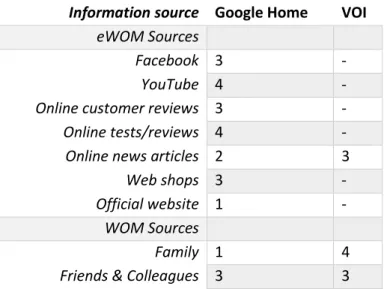
The sources that were used by the interviewees can also be divided into eWOM sources and WOM sources. eWOM sources includes sources that are based online, such as YouTube and online news articles, while the WOM sources are limited to those that are offline, like talking with a family member in person. Table 4 shows how many interviewees of each case got information from a certain source. Notice that the table does not take into consideration whether the interviewees used them to actively look for information or not. Facebook includes any interaction with Facebook groups and friends such as reading posts and comments or participating in discussions, that relates to the case in any way. YouTube includes the viewing of any video and reading of video comments that are related to the case. Online customer reviews are customer reviews from either product review sites, such as PriceRunner or Prisjakt, or customer reviews available on the product pages in online stores, like Elgiganten. Online test/review includes online articles that specifically tests or reviews the product/service of the cases. Online news articles include posts and articles (excluding those that are either tests or reviews of the case product/service) published in online newspapers, such as Aftonbladet, Feber etc. Web shops includes reading the product pages of Google Home in a web shop (not applicable to VOI). Official website includes reading any of the pages on the official website of the cases. Family and Friends & Colleagues includes any offline interaction with family members, friends and colleagues regarding the cases.
16
Information source Google Home VOI
eWOM Sources
Facebook 3 -
YouTube 4 -
Online customer reviews 3 -
Online tests/reviews 4 -
Online news articles 2 3
Web shops 3 -
Official website 1 -
WOM Sources
Family 1 4
Friends & Colleagues 3 3
Table 2. Information sources used by interviewees 4.2.1 Gathering information about Google Home
As can be seen in Table 2, the interviewees of the Google Home case used a wide variety of eWOM sources, and all interviewees used more than one eWOM source to gather information. On average a Google Home interviewee got information from five eWOM sources (Table 3).
NUMBER OF EWOM SOURCES USED INTERVIEWEE A 6
INTERVIEWEE B 4 INTERVIEWEE C 6 INTERVIEWEE D 4
Table 3. Number of eWOM sources used by each interviewee
The information the interviewees sought from each source differed depending on the sources. The official website and web shops were mainly visited to find information about the technical specifications and prices of Google Home, while YouTube and Online tests/reviews were used to find out more about the product features and how well they work. Three of the interviewees watched YouTube videos specifically to get more information about Google Home, and all three specified that they mainly looked at “Unboxing videos” as these, according to them, gives a good overview of what is included when you buy the Google Home and includes a short first impression review of the most basic functions and features. Interviewee A said that he especially focused on one particular aspect of the Goole Home when he looked at YouTube videos, which was how good the AI was. The YouTube videos according to him does a good job at showing
17 exactly how good the Google Home understands and picks up voice commands, which to him was one of the most important aspects for him to even consider buying the Google Home. The other interviewees had similar concerns regarding the Google Home’s ability to understand voice commands, and both interviewee B and D, similarly to Interviewee B, had some focus on this aspect when looking for information.
While YouTube, online tests/reviews, web shops and official websites were mainly used for gathering product information like technical specifications and features, Facebook and online customer reviews were used more for finding out others’ opinions of Google Home. Three of the interviewees were part of Facebook groups where smart products were often discussed, and some of the members of the groups would buy and use Google Home to hook up their smart products to. Interviewee A and D would both use Facebook to actively get information and they would often read the posts in the Facebook groups relating to Google Home. As Interviewee D have some smart products at home himself, he would often read posts related to hooking up the Google Home to different products. To him it was important that he would be able to hook up the Google Home to the products he had at home, and the Facebook group was a good source for finding out what others had hooked up to their Google Home, how easy it was to hook up and how well they thought it worked. He said that;
“The [Facebook group] members are very trustworthy, and they know a lot
about different products.”– Interviewee D
Interviewee A would mostly use the Facebook group for reading about what the members’ thoughts were about Google Home.
Apart from getting others’ opinions regarding Google Home from the Facebook groups, there could also be instances where members of the groups would share links to articles, tests/reviews and web shops, something Interviewee A appreciated as it helped him find tests and reviews that he felt he could trust. Interviewee D on the other hand liked when other members wrote about where one could get the Google Home for a good price and shared links to those sites, as it saved him the time to look for the best price.
Interviewee C, though she got information about Google Home from the Facebook group, specified that she would not actively go there to look for information. She does not use
18 Facebook a lot, but would occasionally read posts from the Facebook group, and sometimes the posts would just happen to be about Google Home. She further specified that when she wanted information about what others thought about Google Home she would read the customer reviews on web shops. Similarly, Interviewee B said she would use the Google search engine to search for reviews and check review websites to find others’ opinions about Google Home.
Of the interviewed, two used online articles to look for information, however, they both stated that the main reason they looked up online articles was to read about what products one can hook up to a Google Home. Interviewee D in particular stated that he had read several articles about this, as he wanted to know if he would be able to hook up some of the smart products he had at home to a Google Home if he bought one.
When it comes to WOM sources only three of the interviewees had gotten information about Google Home from such sources. Interviewee B and C both had friends who had Google Homes, while Interviewee A had both a family member and friends who had them. However, though all of them knew people who had Google Homes, none of the interviewees would talk much to them about Google Home. The only time Interviewee C talked to her friend about Google Home was shortly after the friend had gotten it, and the conversation about it was kept short. They mostly talked about what her friend thought about it and if her friend was happy with it. When asked if she would speak to her friend when making the decision of whether to buy the Google Home or not she answered that she rather looked up reviews online, as she wanted to know as many peoples’ opinions as possible. However, she would think back to the times she and her friend had talked about the friend’s Google Home as well;
“I never asked her about it before I bought mine, but I mean, I remember what she has said about it, so I already knew what her opinion was. It’s just unnecessary to ask again.” – Interviewee C
Interviewee A would mostly talk about Google Home with his brother who had gotten one a few months before he bought his own, though he specified that they did not talk about it very often or very much. They would sometimes talk about it when Interviewee A visited his brother, but the conversations would not be very long. Most of the time they
19 would talk about what other products his brother had it hooked up to, if he had found any new or interesting functions, and if it worked well. He further specified that he did not feel a need to talk more to his brother before he made the decision of getting the Google Home, as he felt like he already had all the information he needed. Interviewee B, though she had friends with Google Homes, said she barely spoke to anyone about them, and never asked them for any information about Google Home except for asking them if they liked their Google Home.
4.2.2 Gathering information about VOI
In the case of VOI the interviewees only used one eWOM source (Table 2). While they did not use many eWOM sources all of them used WOM sources, and all but one interviewee got information regarding VOI from both family members and friends and/or colleagues. However, in most cases where WOM sources were used by these interviewees, the interviewees were not actively looking for specific information regarding VOI. Interviewee F noted that in most of the discussions he was in were with colleagues that had not tried VOI themselves. Interviewee H would also talk with a friend of hers that had not tried VOI. In both interviews the interviewees mentioned that the discussions they would have with these people would mostly be about the negative aspects of VOI, such as people destroying them or that people use them recklessly.
“There have been quite a few discussions at my work about them [the VOI scooters]. Most have a very negative attitude towards them. Those who
haven’t tried them usually are the most negative ones.”– Interviewee F
Interviewee G would also have discussions about VOI but depending on with whom she had them the content of the discussion would differ. When she talked with her family, where no one had tried VOI, the discussions would usually be about the negative aspects of VOI, while discussions with her colleagues that had tried VOI would be more focused on their experiences with VOI, like what they thought about them, if they liked using them etc. During all three of these interviewees’ interviews they would bring up different topics that they would discuss in their discussions, and in several cases, they would mention topics related to the business idea of VOI and how the business idea could be improved. Interviewee G would bring up several times in her interview that in her
20 discussions most people would be positive towards the general business idea of VOI, but that the execution of it was bad and needed to be improved.
In the case of Interviewee E she would mostly talk about VOI with her partner that had used them a lot and, like Interviewee G, would have conversations that focused on his experience with them. Interviewee F also noted in his interview that he felt that if he was with someone and happened to see a VOI it was very easy to start talking about them. In these cases, the conversation would mostly be about whether they were interested in trying it, or if they had already tried it, and what they think about VOI in general.
Three of the interviewees had, apart from talking with friends and family, read news articles about VOI. In all three cases the interviewees had read articles that reported on the negative aspects of VOI and said that these articles would often be what would later start the discussions they had with their colleagues, friends or family. Interviewee F pointed out in his interview that though many of the articles he read spoke negatively about VOI, this did not discourage him from trying them out, however they did lower his expectations of VOI.
4.3 Making the decision
4.3.1 Deciding to buy a Google Home
After gathering information about Google Home, the interviewees all had to make a decision of whether to buy one or not. All but one interviewee had taken some time to think about what to do, while Interviewee A stated in his interview that for him the purchase had ended up more of an impulse purchase. This had been because a friend of his had found Google Home Mini to a very low price and had asked if Interviewee A wanted him to buy one for him as well. Interviewee A specified that, though the purchase itself was an impulse one, he had already decided before that he would like to get one. However, to him the price had been a big deciding factor, as it had also been for interviewee B and C, who both specified that they felt Google Home Mini was more affordable than the normal version. Apart from the price, Interviewee A specified that a lot of the information he had gotten from different reviews, tests and YouTube videos had given him a picture of Google Home as a product that was mostly a fun gadget rather than a product with a practical function. One of the tests that he read, he said, had labelled Google Home as “mostly useful as an egg timer”;
21 “One of the [Facebook group] members once mentioned an article where he
had reviewed it [Google Home]. It was on a tech site and he wrote about ‘Is it worth getting this?’. […] In the end, he wrote that it [Google Home] is mostly
useful as an egg timer.” – Interviewee A
Because of reviews like this, Interviewee A put a lot of time into looking up information about what you could do with a Google Home, and said that this information had been very important for him in deciding if he really wanted to buy a Google Home or not. As Google Home to him mostly seemed like a fun gadget he said he had already decided he did not want to buy the normal version, as it felt too expensive. However, the Google Home Mini that his friend found which was cheaper he thought was more affordable for the purpose of only getting as a “fun gadget to play around with”. Similarly, Interviewee B and C also talked about the Google Home as something they thought would be a fun product to have or try out, and neither of them specified wanting it for any other particular purpose. In contrast, Interviewee D stated that he got a Google Home for the purpose of hooking up his smart products at home. To him, the most important aspect of Google Home was that he should be able to control his lights, Bluetooth speakers etc. with voice commands. With this purpose he stated that to him the Facebook group he was part of and the online articles he had read had been important sources for information, as these had information about products that work with Google Home. He stated that had he found that he would not be able to hook up most of the products he wanted to connect, he would have moved on and looked for some other product instead of Google Home.
The three interviewees that said they had talked some with friends and family about Google Home clearly stated that this interaction had not been very important for their decision of whether to buy a Google Home or not. However, at the same time all three mentioned in their interviews seeing their friends/family get a Google Home made them also want one. In the case of Interviewee A and B, they talked about wanting a Google Home more than they had before, while Interviewee C said that seeing her friend get one made her want one too.
4.3.2 Deciding to try VOI
In all four interviews of the VOI case, the interviewees said that their decision to try VOI had been spontaneous and not something they had put much thought into. Interviewee E
22 said that the initiative to try the VOI had not been hers, but her partner’s. Her partner, who had already tried VOI at that time, had thought it would be a fun thing to do and had argued that taking a VOI would take them home faster than if they walked.
“It was my partner’s initiative to try the VOI. After work he had just said ‘Come on let’s try it’. He said it would be fun and efficient and apparently get us home faster.”– Interviewee E
In the case of both Interviewee F and H the main reason for them to try a VOI had been because the trams they were supposed to take at the time had been cancelled, and instead of waiting for the next one they had taken a VOI. Interviewee H had seen a VOI parked close to the tram stop, which had thought that she might just as well try it out since it would be some time before the next tram would come. Interviewee F had downloaded the app for a different time he was supposed to try VOI, but never did, and while waiting for the tram saw in the app that there was a VOI parked close by and decided to take that instead of continue waiting for the tram. To him the reasoning for taking the VOI instead had been that it would be more time efficient and be a fun experience. Interviewee G had been recommended by a colleague to take a VOI one day when she needed to go back and forth between her workplace and a party. Because the route did not have any public transportation for a large portion of the route, she thought taking a VOI would let her go between her destination and workplace faster, and therefore decided to try one.
23
5. Analysis
5.1 Google Home and the usage of eWOM and WOM sources
From our findings we can see that people buying a Google Home use many different eWOM source, however, depending on what information you want to gather regarding Google Home the sources a person chooses to rely on seem to differ. Those who are concerned about how the Google Home works in practice seem to be likely to look up YouTube videos that show someone using the product. Since Google Home deals with voice commands and an important aspect of the product seemingly being that it will understand what you say, it is possible that a person will find a video more useful than a written review. This is because a video can give the viewer information that is hard to convey in written text. Just like interviewee B said, one of her concerns were if the Google Home would be able to understand her even with her accent. Though a written review could include information such as the reviewer’s spoken language, dialect, speech defects and other aspects of the person’s speech, it could potentially still be hard for a reader to get a good perception of, for example, how much of a dialect the person has and speaks with. Furthermore, it could also be possible that the review does not mention that the reviewer spoke with a certain dialect, which could mean a person with a different dialect would get a different experience from using the product. Based on this logic it would not be surprising that a person who is concerned about the language aspect or even just how well the Google Home can understand voice commands would rather watch a YouTube video, as you would be able to hear exactly how the person speaks and can compare it to your own speech.
When it comes to Facebook as a source for information, the interviewees of this study only used one aspect of Facebook to gather information; Facebook groups. Though, only this one aspect was used, it seems it was an important and beneficial source of information for the interviewees. Based on the interviews the Facebook groups could be viewed as a collection of both information and information sources related to certain themes or communities. The people in these groups posts a variety of information, as seen in the interviews of this study, ranging from personal opinions and experiences of different products to link sharing of outside sources that are thought to be of interest to the group members. These outside sources can be all kinds of sources; YouTube videos, reviews,
24 articles, tests, web shops etc. For two of the interviewees in this study that where part of such Facebook groups, this collection of information seems to have been thought of as very beneficial as it saved them time of search the web themselves for certain information.
Something that became clear as the interviews of this study progressed was that the information acquired from the different sources seemed to shape how a person perceived the product that the information was given for. Three of the interviewees mentioned viewing Google Home as a “fun gadget”, which seems to be due to the information they got from certain sources. Reading or viewing a source that says a product has little practical use, like the tests and reviews mentioned by Interviewee A, would be likely to change the reader’s perception of the product, just like it did for Interviewee A. However, while Interviewee A found Google Home having no real practical use, Interviewee D seemed to have gotten a different perception of the product. He seemed to have found several sources going through the practical uses of Google Home, letting him form a perception of Google Home as a product that would be useful for him. One reason for the two interviewees getting such different perceptions and contradicting information about Google Home, could be their initial purpose for looking into the product. Interviewee A did not have a specific purpose for what he wanted to do with the Google Home, should he get one, but was just generally curious about what one could do with it. In contrast, Interviewee D had already from the beginning a clear purpose for what he wanted to use the Google Home for; connecting it to his smart products so he could control them with voice commands. Due to this purpose, Interviewee D seem to have focused his search for information around that which concerned Google Home’s ability to connect to different devices. Since he wanted it to work with the devices he already owned it is possible that he has found more sources giving a more positive view of Google Home, and giving more examples of what it could be used for, than what Interviewee A would find.
An interesting aspect touched upon by the interviewees who viewed the Google Home as a fun gadget, was that all three showed some concern related to the price of the device. While these three showed a reluctance towards buying a Google Home due them feeling it was somewhat expensive, the last interviewee did not express any such concern. A reason for this difference could be because of how the interviewees perceived the Google Home. A person who only wants it because it seems like a fun thing to have might not
25 plan to use the product regularly after the purchase, and in such a case it can be understandable that one would not want to spend much money on it. In contrast, if you are like Interviewee D and can see a potential and use for the product, the price may not feel as expensive as it might match the expectations of that person better.
All the interviewees in the Google Home case seemed to rely on eWOM sources for getting information to aid in their decision of whether to get a Google Home or not and would barely rely on WOM sources. To them speaking with friends or family did not seem to be important for them to be able to make a decision. This was most likely due to them using such a wide variety of eWOM sources that the information they were able to gather from those sources were enough to provide them with the information they needed to make their decision. However, though they themselves felt like WOM sources provided them with little information, it seems these sources still did serve a purpose; making the Google Home desirable. For all the interviewees who talked with people they knew that also owned a Google Home, seeing people they know get and use the Google Home made them want one more. This suggests that WOM sources’ main contribution in the process towards a purchase is the creation of further motivations for buying a Google Home.
These findings seem to suggest that for the people buying Google Home, eWOM sources are the most important sources as these provides them a wider variety of information and a larger amount of information that is easily accessible, whereas WOM sources only adds a few more opinions to the pool of other peoples’ opinions of the product.
5.2 VOI and the usage of eWOM and WOM sources
As is seen from the interviews, the VOI users mainly used WOM sources, with the only eWOM source being online articles, which was something the interviewees in most cases did not seem to actively look for, but just happened to find. Furthermore, the information from these articles appear to have been mostly used as conversation and discussion starters. Based on this it would seem as people trying VOI have little interest in doing research on VOI before making the decision and are more concerned with having discussions with people around them. The reason behind this low effort to gain more information about VOI appear to be twofold. First, in the case of the interviewees of this study, no one had planned to take a VOI until moments before trying it. For most the choice was spontaneous based on the circumstances around them at that moment. In all
26 cases this circumstance was the lack of public transportation, be it no connection being available at all or just cancelled trams. Since the choice was spontaneous, and the need to take a VOI was at that moment, it would be likely that there was no time to do any research on VOI in that moment. Second, people were getting information without putting effort into looking for it. In most of the interviews, the interviewees would talk about having several discussions with different people around them, indicating they would get a lot of opinions on VOI even without looking for it online. Even when they were not discussing VOI with others they could get visible information about VOI from just walking outside. In all interviews the interviewee had seen the electric scooters parked or used around the Gothenburg area, which gives them information about them even without looking for it.
Though the interviewees of this have had a low interest of researching VOI before trying it, their decision to try it have not been completely unbiased. For two of the interviewees, a big reason for trying VOI was due to the recommendation from someone they knew, indicating that this kind of recommendation could be very effective for getting someone to try a VOI even without them having looked up much information beforehand.
An interesting aspect of the VOI case is that the interviewees chose to try VOI even though their discussions before trying had mostly been focused on negative aspects of VOI. A reason for this could be the public visibility of VOI. The interviewees mention thinking that using a VOI looked fun, and even expressed some desire to try. This constant exposure to VOI, be it discussions of the negative aspects of the business idea or seeing people riding them in town, could be expected to make the brand and product very memorable, something that is very useful when the need for a certain product or service appears unexpectedly, like in the cases for the interviewees of this study. At the point when the interviewees found themselves in need of a transportation method it would not be surprising if VOI was one of the first alternatives they would have thought about. Furthermore, some of the interviewees expressed themselves like they did not have much to lose from just trying VOI out, which would mean that even with the negative information they had on VOI, the resistance to trying it could be expected to be low.
It is apparent from the interviews of this study that WOM sources seem to have had the biggest impact on people before their choice of trying VOI. And furthermore, that the
27 public visibility of VOI has impacted peoples’ need for information in such a way that they feel content with just what they can see and what they get from discussions.
5.3 Comparing the case of Google Home and VOI
One of the biggest differences between these two cases is the public visibility of the product/service, something that appear to have had an impact on peoples’ information gathering. While people looking to try VOI can easily get information from just walking outside, allowing them to see the parked electric scooters or people riding them, people who are interested in Google Home need to rely more on eWOM sources to gather information. One reason for this is that, due to Google Home being a product people mainly use in their homes, one of the only chances for one to see them in use offline is if you know someone who already owns one. With such limited public visibility, the best option for getting to know more about Google Home would seem to be to look it up online. Furthermore, Google Home is a product that can be used for different reasons and purposes and has many different functions to accompany this. This means that depending on why you want a Google Home, the information one is interested in may vary making eWOM sources more beneficial as you can find most information from these sources. Like in the case of Interviewee D, even if he would have known someone with a Google Home, that would not mean that person would have been able to give Interviewee D information about every device that can be hooked up to Google Home. In contrast, VOI does not have many functions and its main purpose is to transport people from one point to another. This means that most people who has tried one would be able to give most of the information that one would want before trying it yourself, or in many cases just seeing someone else use one could provide enough information.
Another different factor between the two cases that seem to affect peoples’ need for information is the commitment level. In the case of VOI, the commitment level seems to have been low, as the interviewees expressed that they felt they would not lose much from just trying it. However, in the case of Google Home the price of the device was very important for the interviewees in their decision of whether to buy one or not. The information they got about the product would form their perception of not only the product itself, but also how much they felt the product was worth. As in the case of Interviewee A, after finding out that Google Home might not be very useful, he felt the
28 need to gather more information to find out if it was worth the price listed or not. Because of these different commitment levels of the two cases the people interested in each product could be expected to require different amounts of information. As was seen in the VOI case, people did not feel any need to look for information about the electric scooters as their loss for trying it would be low anyway, while the people of the Google Home case felt like they needed more information in order to make sure they do not buy a product that will end up a loss for them. Another way to put it would be that in the Google Home case people sought more information as a way to reduce the perceived risk that comes with buying one.
Though eWOM was barely relied on in the VOI case, it seems unlikely that it would have had the same impact on a person as it had in the case of Google Home. In the rare instances that the interviewees used eWOM sources it was evident that it did not have any impact on their choices of whether to try a VOI or not. In the Google Home case, the opinions and information given in online articles changed how they perceived the product and its worth, whereas in the VOI case the negative articles that the interviewees had read did not seem to particularly change their perception of VOI as a service. It is possible that because the interviewees perceived the risks of trying a VOI as very low, online opinions would not have as big an impact as in the Google Home case. If one has little to lose when trying a product or service, it would not be strange to find someone buying or testing it out even after hearing negative opinions about the product/service.
5.4 eWOM reliance for products in new markets
Our findings and analysis so far show that there are some factors of a new product or service that seem to be affecting how much reliance a person has on eWOM sources before purchasing said product or service. By analysing our two cases we have identified two important factors; Public Visibility and Commitment Level. In order to explain the relationship between these factors and a person’s reliance on eWOM sources, we created the eWOM reliance for products and services in new markets model, seen in Figure 1.
29 P ubli c Visi bil ity High Low eWOM reliance Low High eWOM reliance Low High Commitment Level Figure 1. eWOM reliance for products and services in new markets
In this model Public Visibility refers to how visible the product or service is publicly. High public visibility indicates that the product or service can be easily seen and used by anyone in a certain public space, while products or services with low visibility are rarely seen in public spaces. Low public visibility could be caused by usage being limited to a private space, such as in one’s home.
Commitment Level refers to how high the potential loss the person might have related to the product or service after purchase. The Commitment Level could also be seen as the perceived risk one associates with the purchase of a product or service. A high commitment level indicates that once the purchase has been made the customer or user could be subject to a great loss, if a loss were to occur. Factors that dictate the potentially felt loss could be product prices or the possibility to cancel usage. A product or service with a perceived high price, difficult service cancellation or difficulty of stopping usage once it has started would be examples of products or services that impose a high Commitment Level for the customer or user. Products or services that are cheap or easy to end are examples of low Commitment Level products/services.
What our analysis of our two cases suggests is that, as can be seen in Figure 1, people who are considering purchasing products or services with high public visibility and low commitment level have a low reliance on eWOM for collecting information in before their decision. In contrast, products and services with low public visibility and high
30 commitment level are causing potential new customers to rely more on eWOM sources for information before they make the purchase.