ISBN: 978-1-5108-5869-5
15th International Symposium on
Management (INSYMA 2018)
Chongburi, Thailand
1 March 2018
Editors:
Werner R. Murhadi
Dudi Anandya
Erna Andajani
Advances in Social Science, Education and Humanities
Research Volume 186
Printed from e-media with permission by:
Curran Associates, Inc. 57 Morehouse Lane Red Hook, NY 12571
Some format issues inherent in the e-media version may also appear in this print version.
Copyright© (2018) by Atlantis Press All rights reserved.
https://www.atlantis-press.com/proceedings/insyma-18 Printed by Curran Associates, Inc. (2018)
For permission requests, please contact the publisher:
Atlantis Press Amsterdam / Paris
Email: [email protected]
Additional copies of this publication are available from:
Curran Associates, Inc. 57 Morehouse Lane Red Hook, NY 12571 USA Phone: 845-758-0400 Fax: 845-758-2633
Email: [email protected] Web: www.proceedings.com
TABLE OF CONTENTS
SESSION: CROSS-CULTURE MANAGEMENT
FACE-TO-FACE IS THE MOST EFFECTIVE MEDIA FOR COMMUNICATION OVER SOCIAL
MEDIA... 1
Svenja Arabella Hallerberg, Madawala Liyanage Duminda Jayaranjan, Sumaia Farzana
CROSS CULTURAL MANAGEMENT IN THE HIGHER EDUCATIONAL INSTITUTIONS... 6
Tony S. Kuo
CULTURAL SUSTAINABILITY AND KINDSHIP MODE OF PRODUCTION AMIDST GLOBAL
ECONOMY... 9
Levita Duhaylungsod
DEVELOPING A CAUSAL MODEL OF GAME ADDICTION AND STEALING BEHAVIOR
AMONG UNDERGRADUATE STUDENTS... 14
Thitiwat Numkhan, Waiphot Kulachai
SESSION: ENTREPRENUERSHIP
SOCIAL CAPITAL, TIERED ENTREPRENEURSHIP TRAINING, AND AGROTOURISM
DEVELOPMENT MODEL OF KAMPUNG SALAK BOJONEGORO... 19
Noviaty Kresna Darmasetiawan
THE KEY CHALLENGES TO UTILIZE INNOVATIVE OPPORTUNITIES OF SMALL AND
MEDIUM SIZED ENTERPRISES IN SURABAYA, INDONESIA... 22
Prita Ayu Kusumawardhany
SESSION: FINANCE
FINANCIAL PERFORMANCE, CORPORATE GOVERNANCE, AND FINANCIAL DISTRESS... 26
Endang Ernawati, Samantha Elysia Handojo, Werner R. Murhadi
THE IMPACT OF HEURISTICS AND BIASES IN THE APPLICATION OF PROFESSIONAL
JUDGEMENT BY INTERNAL AUDITORS IN THE STAGE OF FIELDWORK... 31
Jonathan Tanone, Senny Harindahyani
JAVANESE LUNAR CALENDAR EFFECT (PRIMBON) ON ABNORMAL RETURN... 36
Sidarta Hermin, Putu Anom Mahadwartha
TEST OF FAMA & FRENCH FIVE FACTOR-MODEL ON INDONESIAN STOCK MARKET... 40
Liliana Inggrit Wijaya, Randy Kennardi Irawan, Putu Anom Mahadwartha
FACTORS IN TAXATION POLICIES ISSUANCES... 43
Norbertus Purnomolastu, Werner R. Murhadi
SOFT LOAN PROGRAM FOR CREDIT UNION: A FRUITFUL OR A USELESS PROGRAM?... 47
Ria Sandra Alimbudiono
STOCK INVESTMENT ANALYSIS, IDIOSYNCRATIC RISK AND ABNORMAL RETURN... 51
Suyanto, Florens Natalia Handayani Sibarani
THE EFFECT OF CORPORATE GOVERNANCE ON THE CAPITAL STRUCTURE: AN
INDONESIAN CASE... 55
Arif Herlambang, Werner R. Murhadi, Giovani Anggasta Susanto
INTERDEPENDENCY BETWEEN INTERNATIONALIZATION, FIRM PERFORMANCE, AND
CORPORATE GOVERNANCE... 59
Allan Muliyanto, Deddy Marciano
THE INFLUENCE OF INTELLECTUAL CAPITAL ON FINANCIAL PERFORMANCE IN
SHARIA BANKING COMPANIES... 63
Eka Nuraini Rachmawati, Restu Hayati, Fitra Yulandi
ANALYSIS OF WORKING CAPITAL MANAGEMENT OF INDUSTRY PRACTICES IN
INDONESIA... 67
FACTORS DETERMINANT OF BANK CAPITAL BUFFER: EMPIRICAL STUDY ON ISLAMIC
RURAL BANKING IN INDONESIA... 72
Sutrisno
THE IMPORTANCE OF CORPORATE GOVERNANCE... 76
Mudji Utami, Bertha Silvia Sutejo
INFLUENCE OF FINANCIAL ATTITUDE, FINANCIAL BEHAVIOR, FINANCIAL CAPABILITY
ON FINANCIAL SATISFACTION... 80
Agus Zainul Arifin
ANALYSIS OF OPTIMAL HEDGE RATIO AND HEDGING EFFECTIVENESS IN TAIWAN
STOCK EXCHANGE CAPITALIZATION WEIGHTED STOCK INDEX (TAIEX) FUTURES... 84
Jason Aditya Jahja, Ika Yanuarti Loebiantoro
MANAGERIAL OVERCONFIDENT AND FIRM FINANCING DECISION: AN INDONESIAN
CASE... 89
Werner Ria Murhadi
DEMOGRAPHY FACTORS, FINANCIAL RISK TOLERANCE, AND RETAIL INVESTORS... 94
Bertha Silvia Sutejo, Yohanes Kokoh Natan Pranata, Putu Anom Mahadwartha
MANAGEMENT'S CHINESE ZODIAC AND OWNERSHIP TO FIRM PERFORMANCE... 98
Rico Tedyono, Putu Anom Mahadwartha
"STILL ME": HUMAN INVOLVEMENT IN MANAGEMENT ACCOUNTING... 102
Riesanti Edie Wijaya
DOES FEMALE CEO AND FEMALE DIRECTORS AFFECT DIVIDEND POLICY?... 106
Fitri Ismiyanti, Ari Prasetyo, Indri Agestya Cania
THE INFLUENCE OF GOOD CORPORATE GOVERNANCE (GCG) ON FINANCIAL DISTRESS... 109
Werner Ria Murhadi, Felicia Tanugara, Bertha Silvia Sutejo
SESSION: HUMAN RESOURCES
INVESTIGATING THE CORRELATION BETWEEN COMMITMENT, SPIRITUALITY AND
PERFORMANCE IN WORKPLACE... 113
Utik Bidayati, Adi Hardianto
THE EXISTENCE OF HUMAN RESOURCES EMPLOYABILITY TO ENERGIZE THE POWER
OF COMPETITIVE ADVANTAGE OF AQIQAH NURUL HAYAT SURABAYA... 117
Johny Rusdiyanto, Elsye Tandelilin
COMMUNICATION STRATEGIES IN IMPROVING AGRICULTURAL SOCIETY'S VALUE
AND PARTICIPATION... 120
Noviaty Kresna Darmasetiawan, Lanny Kusuma Widjaja, Huang Lijie
EXPLORATION OF INTENTION TO TURNOVER: CASE STUDY OF HOSPITAL IT
EMPLOYEES... 124
Siska Ariani, Didik Setyawan, Rudi Januar, Budi Setyanta
THE INFLUENCE OF INTRINSIC AND EXTRINSIC FACTORS ON THE JOB SATISFACTION
OF THE INTERNAL AUDITORS OF THE STATE ISLAMIC UNIVERSITIES IN INDONESIA... 127
Suhartono, Gagaring Pagalung, Grace T. Pontoh
INTERNAL COMMUNICATION, EMPLOYEE PARTICIPATION, JOB SATISFACTION, AND
EMPLOYEE PERFORMANCE... 131
Waiphot Kulachai, Piya Narkwatchara, Pralong Siripool, Kasisorn Vilailert
SESSION: MARKETING MANAGEMENT
DEVELOPING A DESTINATION BRAND IN THE CONTEXT OF REGIONAL AND NATIONAL BRANDING STRATEGIES: A CASE STUDY OF BRAND DEVELOPMENT OF SLEMAN
DISTRICT, YOGYAKARTA SPECIAL PROVINCE, INDONESIA... 136
Ike Janita Dewi
BUILDING LOCAL FASHION BRAND EQUITY FOR YOUNG CONSUMERS... 141
Mega Melina Dewi, Dudi Anandya, Christina Rahardja Honantha
A MESSAGE BEHIND A SMILE: HOW FACIAL EXPRESSION SUPPORTS COMMUNICATION
IN MARKETING... 145
Andhy Setyawan, Dudi Anandya, Farenza Renada Fulongga
USABILITY, CUSTOMER SATISFACTION, SERVICE, AND TRUST TOWARDS MOBILE
BANKING USER LOYALTY... 149
THE EFFECT OF SERVICE QUALITY TO CUSTOMER SATISFACTION AND LOYALTY IN
SHARIA BANK... 153
Gito Suseno, Muchsin Muthohar
A STUDY OF DRINKING BEHAVIOR AMONG UNDERGRADUATE STUDENTS IN
CHONBURI... 158
Pornrapee Torsak, Waiphot Kulachai
PRODUCT TYPES IN MODERATING THE PROCESS OF BUYING STREET FOODS... 162
Budhi Haryanto, Djoko Purwanto, Amina Sukma Dewi
CONSUMER'S RESPONSE TO E-MAIL ADVERTISEMENT FROM TOUR AND TRAVEL
AGENCY IN INDONESIA... 167
Jonathan Kurniawan Halim, Silvia Margaretha, Christina Rahardja Honantha
INDONESIAN TOURISM MARKETING COMMUNICATION STRATEGY THROUGH
LIONMAG IN-FLIGHT MAGAZINE... 171
Adi P. Tedjakusuma, Hayuning P. Dewi
THE EFFECT OF ECO-FRIENDLY PRACTICES ON GREEN IMAGE AND CUSTOMER
ATTITUDES... 175
Christina Rahardja Honantha, Dudi Anandya, Andhy Setyawan
THE INFLUENCE OF HALLYU, PACKAGING AND SUBJECTIVE NORMS TOWARDS
BUYING INTENTION ON CULTURE ADAPTATION IN ETUDE HOUSE... 179
Yuco Aldelina, Jony Oktavian Haryanto
DARK TOURISM MARKETING THROUGH EXPERIENCE VISIT AT EAST JAVA... 184
Erna Andajani
A STUDY OF THE IMPACT AND EFFECTIVENESS OF SCENT USED FOR PROMOTION OF
PRODUCTS AND SERVICES WITH LOW OLFACTORY AFFINITY... 187
Jun Kumamoto, Adi P. Tedjakusuma
"WONDERFUL INDONESIA" COUNTRY MARKETING CAMPAIGN - HOW VISIBLE
INDONESIA AS A TOURISM DESTINATION FOR EUROPEANS... 191
Slavomir Rudenko, Adi P. Tedjakusuma
SESSION: OPERATION MANAGEMENT
MODEL ANALYSIS OF SERVICE SATISFACTION AS THE MODULATOR BETWEEN
SERVICE QUALITY AND DECISION-MAKING BEHAVIOR IN USING LOW-COST AIRLINES... 195
Sumalee Ramanust, Tikhamporn Punluekdej, Yaowalak Nakvichien
THE ANALYSIS OF LOGISTICS AT MCDONALD'S RESTAURANT DENPASAR BALI... 199
Anna Putri Andari, Stefanus Budy Widjaja Subali, Juliani Dyah Trisnawati
SESSION: OTHER RELEVANT BUSINESS TOPICS
FACTORS INFLUENCING TRAVEL TO ISLAMIC DESTINATIONS: AN EMPIRICAL
ANALYSIS OF SUNAN AMPEL RELIGIOUS TOURISM AREA SURABAYA... 204
Siti Rahayu
EDUCATIONAL TOURISM AS THE CONCEPTUAL AGE IN THE UNIVERSITY OF
SURABAYA... 208
Veny Megawati
INFLUENCE OF DESTINATION ATTRIBUTES ON DESTINATION IMAGE OF SURABAYA
CITY ACCORDING TO DOMESTIC MICE PARTICIPANTS... 212
Fitri Novika Widjaja
FACTORS INFLUENCING ACCOUNTING STUDENTS IN ACCEPTANCE OF E-LEARNING... 216
Adhicipta Raharja Wirawan
GUEST SUPPLIES PRESSURES TO ENVIRONMENT: A HOTEL CASE STUDY... 220
Ida Bagus Made Wiyasha, I. Nyoman Sudiksa
DO LOCAL SUPPLIERS AND LOCAL BUYERS BENEFIT FROM FOREIGN DIRECT
INVESTMENT?: EVIDENCE FROM INDONESIA... 224
SESSION: SERVICE MANAGEMENT
SERVICE QUALITY OF PUBLIC TERMINAL USERS IN UPT-LLAJ EAST JAVA... 228
Sukesi, Rahma S.Muliasari
SESSION: STRATEGIC MANAGEMENT
RESOURCE ORCHESTRATION TO IMPROVE COMMUNICATION WITH CUSTOMERS:
"CASE STUDY: MSME FOOTWEAR IN EAST JAVA"... 232
Juliani Dyah Trisnawati, Muhammad Rosiawan
CYCLING: DO THE HEALTH BENEFITS OF CYCLING OUTWEIGH THE RISKS IN
BANGKOK?... 236
David Saele
CORPORATE COMMUNICATION AND STRATEGIC MANAGEMENT: HISTORY,
OPERATIONAL CONCEPT AND INTEGRATION... 239
Bachtiar Mohamad, Hassan Abu Bakar
BUSINESS STRATEGY: A STUDY ON COST STICKINESS BEHAVIOR... 244
Permata Ayu Widyasari
A STUDY ON THE IMPACTS OF SMARTPHONE ADDICTION... 248
Napassphol Sinsomsack, Waiphot Kulachai
DEVELOPING HO CHI MINH CITY TO BE THE CITY OF AFFECTION, MODERNIZED, AND
QUALITY LIVING... 253
Phan Thi Hong Xuan
1 INTRODUCTION
Technological advancements tighten the competition in the globalization era. Various information can be accessed anytime and anywhere via the internet. A variety of needs and transactions that used to be done only manually can now be done digitally even from home without the need for face-to-face interaction or going to a service provider. In order to deal with these technological advancements, a company should uti-lize the information technology in order to reach more consumers and meet the needs and demands without time and space constraints.
One of the rapid growing services with increasing users and transaction is mobile banking. According to investopedia.com, mobile banking is defined as “the use of a smart phone or other mobile devices to per-form online banking tasks while away from your home computer, such as monitoring account bal-ances, transferring funds between accounts, bill pay-ments and locating an ATM”.
There is no significant difference between internet banking and mobile banking. Mobile banking uses applications provided by banks through platforms or media such as iOS and Android. Meanwhile, internet banking is generally still accessible through a partic-ular website address with multiple securities and usu-ally accompanied by a companion tool or device that is the key used for transaction.
Yet, internet banking can also be accessed via mobile phone or tablet computer.
This research was conducted to examine the influ-ence of usability, customer satisfaction, customer ser-vice, and trust to mobile banking user loyalty in Su-rabaya. Based on several previous studies examined, there is a research gap related to the influence of trust towards loyalty.
Thakur (2014) shows trust does not significantly affect the loyalty of mobile banking users. While pre-vious studies (Mukherjee & Nath 2003, Schaupp & Belanger 2005) show the contrary result. Moreover, some researches in Indonesia by Maharsi & Fenny (2006) demonstrate that trust and sense of security af-fect customer loyalty.
2 LITERATURE REVIEW
The effect of usability on customer satisfaction Thakur (2014) states that "Ease of use or usability is one of the most important factors for determining the quality of a web site and therefore, it influences the levels of customer satisfaction". H1: Usability has a direct and positive effect on satisfaction in m-banking business.
The effect of customer service on customer satisfaction Thakur (2014) stated in his research "cus-tomer service affects cus"cus-tomer satisfaction positively and significantly. H2: Customer service has a direct
Usability, customer satisfaction, service, and trust towards mobile
banking user loyalty
Victoria Detra Johannes, Indarini, & Silvia Margaretha
University of Surabaya, Surabaya, Indonesia
ABSTRACT: The purpose of this research is to analyze the influence of usability, customer satisfaction, cus-tomer service and trust towards mobile banking user loyalty in Surabaya. The data used in this research were primary data obtained from questionnaires. Respondents of the study were 200 respondents who live in Sura-baya and use mobile banking facility from BCA, BNI or Bank Mandiri over the past 6 months. Data processing was conducted using SPSS 18 for Windows and Amos Graphic 21 for Windows. Non-probability sampling with purposive sampling type was applied as the sampling technique. The result of this research showed there is a positive influence between usability, customer satisfaction, customer service and trust towards loyalty.
Keywords: trust, customer satisfaction, customer service, trust, loyalty, mobile banking
144 Copyright © 2018, the Authors. Published by Atlantis Press.
This is an open access article under the CC BY-NC license (http://creativecommons.org/licenses/by-nc/4.0/).
Advances in Social Science, Education and Humanities Research (ASSEHR), volume 186
and positive impact on customer satisfaction in m-banking business.
The effect of usability on customer service, Takhur (2014) argues that a good interface display and ease of use will make customers feel positive about cus-tomer service. If the consumer is provided with infor-mation on how to use the application, the customer will likely have a positive evaluation of the service.
Based on research conducted by Floh & Treiblmaier (2006), "Usability has been found to be an antecedent of customerservice". H3: Usability has a direct and positive effect on customer service on m-banking business.
The effect of customer service to trust, based on a study conducted by Zhou (2012) usability has a sig-nificant effect on trust. While Yeh & Li (2009) whose research was conducted in Taiwan stated that, "Un-like previous the results indicated that interactivity and responsiveness did not lead to trust develop-ment." Thus, the positive influence of usability and customer service on trusts should be investigated”. H4: Customer service has a direct and positive impact on customer trust in m-banking business.
The effect of usability to trust, based on a study on the adoption of m-banking users in four areas conducted by Zhou (2012) in China stated that, "Besides structural assurance, both ubiquity and perceived ease of use have significant effects on trust." There fore ease of use or usability have a significant influence on trust, and refers to the results of research Darmasetiawan et al. (2013) that trust underlay cooperation between one another. H5: Usability has a direct and positive effect on customer trust in m-banking business.
The effect of customer satisfaction on loyalty Thakur (2014) has proposed that the intention to con-tinue to use a service is influenced by the satisfaction of the online application itself. In accordance with the existing literature that users who are not satisfied with the services of a company will seek satisfaction else-where (O'Malley & Tynan 2000, Lin & Wang 2006). Other marketing literature also states that the higher the level of satisfaction will tend to increase one's loy-alty level (Anderson 1994, Gangguli & Roy 2011, Hallowell 1996, Yoon & Kim 2000). H6: Customer satisfaction has a direct and positive impact on cus-tomer loyalty in m-banking business.
The effect of trust on loyalty in addition to cus-tomer satisfaction, a study conducted by Lin & Wang (2006) mentions that trust has an influence on cus-tomer loyalty. Reducing the risk of online transac-tions and maintaining transaction trusts are key to at-tracting and retaining customers (Lee & Chung 2009, Luo et al. 2010). H7: Customer trust has a direct and positive impact on customer loyalty in m-banking business.
3 RESULT METHODS
This research uses primary data and information. The data obtained through questionnaire distribution to the respondents with specified targets and character-istics. This questionnaire contains a list of written statements about the responses of respondents to the usability, customer satisfaction, trust, customer ser-vice and loyalty of mobile banking users of Bank BCA, Bank BNI and Bank Mandiri.
The target population of this study is customers who registered and used mobile banking facilities over the past 6 months. The characteristics of the pop-ulation are: (1) customers registering and using mo-bile banking facilities from Bank BCA, Bank BNI or Bank Mandiri over the past 6 months; (2) Aged over 19 years; (3) having minimum education level of Sen-ior High School/Vocational School; and (4) domi-ciled in Surabaya. These respondents are expected to provide the required information which match with the research purposes. The measurement scale of this study uses interval measurement scale with a numer-ical scale of 1 to 7.
4 RESULT AND DISCUSSION
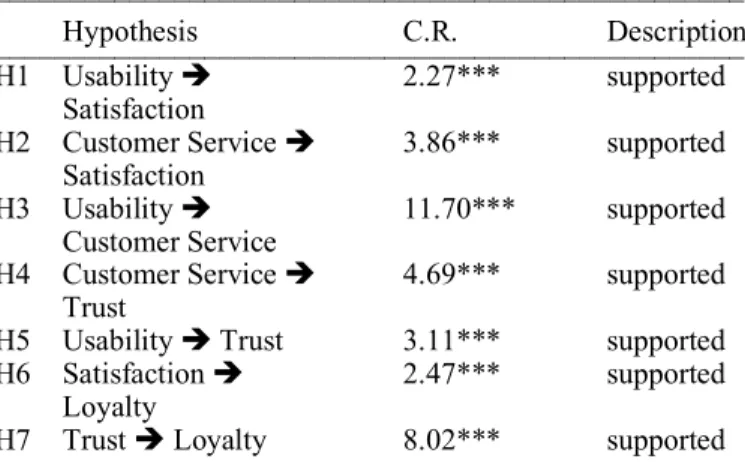
Using the questionnaire distribution, data processing will be done to obtain the result of hypothesis proof. Measurement model result shows that each indicator has standardized loadings > 0.5 and generated AVE is > 0.5 which demonstrate that indicator of all re-search variables namely usability, customer service, customer satisfaction, trust, and loyalty have shown good measurements. Construct reliability values gen-erated in each variable is > 0.7 which indicates that these indicators have good reliability. Amos software was used to test the measurement and structural model which then followed by hypothesis analysis that explains the acceptance or rejection of a hypoth-esis. The result can be seen in table 1:
Table 1. Analysis of the coefficient of determination of a mul-tiple linear regression.
__________________________________________________ Hypothesis C.R. Description __________________________________________________ H1 Usability è 2.27*** supported Satisfaction
H2 Customer Service è 3.86*** supported Satisfaction
H3 Usability è 11.70*** supported Customer Service
H4 Customer Service è 4.69*** supported Trust
H5 UsabilityèTrust 3.11*** supported H6 Satisfaction è 2.47*** supported
Loyalty
H7 Trust è Loyalty 8.02*** supported __________________________________________________
*** significant as p-value <0.1% or 0.001.
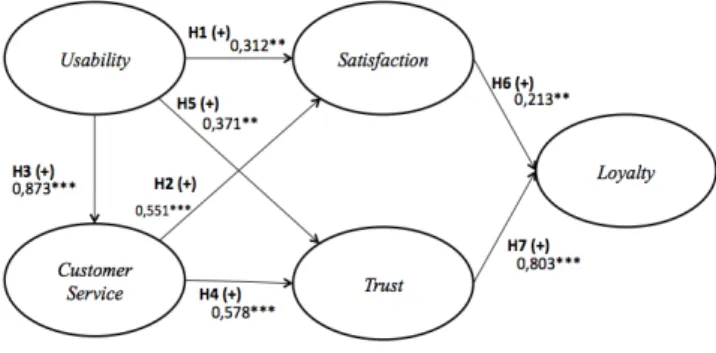
Based on the result of hypothesis testing, it can be
145
described the result of new research models with the result of numbers entered into research variables (see figure 1):
Figure 1. Overall Structural Model.
The result of this study indicates that usability has a positive influence on customer satisfaction of mo-bile banking user in Surabaya. Thereby, it can be said that better display or interface and easier use of mo-bile banking will increase customer satisfaction.
Customer service positively affects customer sat-isfaction of mobile banking user in Surabaya. This signifies that better customer service of mobile bank-ing provider will also increase customer satisfaction. Usability has a positive influence on customer ser-vice of mobile banking user in Surabaya. Thus, it can be said that better display or interface and easier use of mobile banking will be an antecedent to customer service.
The result shows that customer service has a posi-tive influence on trust of mobile banking users in Su-rabaya. It can be concluded that the better the cus-tomer service, the higher the level of trust given by customers to mobile banking services would be.
Usability has a positive effect on trust of mobile banking users in Surabaya. It can be concluded that the better the display or interface and the more user friendly the mobile banking, the higher the level of trust given by the customer would be.
Customer satisfaction variable positively influ-ences the loyalty of mobile banking users in Sura-baya. This signifies that the greater the level of cus-tomer satisfaction, the greater the loyalty level of mobile banking users in Surabaya would be. The re-sult shows that trust positively affects loyalty of mo-bile banking users in Surabaya. Thus, it can be said that the greater the level of customer confidence in mobile banking, the higher the customer loyalty in us-ing mobile bankus-ing would be.
5 CONCLUSION
Based on the research and test results, it can be con-cluded that all 7 hypotheses that have been tested us-ing Structural Equation Modelus-ing (SEM) with AMOS
21 for Windows program are supported. Here is the explanation: There is a positive influence of usability, customer service on customer satisfaction of mobile banking users in Surabaya. There is a positive influ-ence of usability on customer service of mobile bank-ing users in Surabaya. There is a positive effect of customer service on trust of mobile banking users in Surabaya. There is a positive influence of usability to trust of mobile banking users in Surabaya. There is a positive influence of satisfaction on loyalty of mobile banking users in Surabaya. There is a positive influ-ence of trust on loyalty of mobile banking users in Surabaya.
From the research results, it is known that trust has the biggest influence on loyalty of mobile banking user. Therefore, banking companies must continue to maintain customer trust by providing services that are always keeping up with the needs of current custom-ers such as the addition of The Indonesian National Health Insurance (BPJS) payment transaction feature and water utilities (PDAM) which is currently limited to mobile banking services.
Mobile banking service providers must also pro-vide reliable customer service and able to solve the problems experienced by customers in a correct and prompt manner.
This can be achieved through regular employee training on product knowledge of existing services on mobile banking and how to deal with customers who complain or need assistance appropriately.
In addition, mobile banking service providers also need to conduct further research to the active mobile banking users on what should be improved in terms of application display also difficulties experienced when using the service. Through the following things, it is expected to create an overall customer satisfac-tion that leads to increased customer loyalty in using mobile banking.
REFERENCES
Anderson, E.W., Fornell, C., & Lehmann, D.R. 1994. Customer satisfaction, market share, and profitability: findings from Sweden. Journal of Marketing 58(3): 53-66.
Darmasetiawan, N.K., M.S. Idrus, E.A. Troena, & U. Salim. 2013. Application concept of social capital theory and social exchange theory on organizational trust, willingness to share, membership involvement, and knowledge obtaining dimensions in industry cluster. International Journal of Business and Behavioral Sciences 3(2): 15-33.
Floh, A. & Treiblmaier, H. 2006. What keeps the e-banking cus-tomer loyal? a multigroup analysis of the moderating role of consumer characteristics on e-loyalty in the financial service industry. Journal of Electronic Commerce Research 7(2): 97-110.
Gangguli, S. & Roy, S.K. 2011. Generic technology-based ser-vice quality dimensions in banking. International Journal of Bank Marketing 2011: 168-189.
Hallowell, R. 1996. The relationships of customer satisfaction, customer loyalty, and profitability: an empirical study. Inter-national Journal of Service Industry Management 7(4):
27-146
42.
Lee, K.C. & Chung, N. 2009. Understanding factors affecting trust in and satisfaction with mobile banking in Korea: a modified DeLone and McLean’s model perspective. Inter-acting with Computers 21(5): 385-392.
Lin, H.-H. & Wang, Y.S. 2006. An examination of the determi-nants of customer loyalty in mobile commerce contexts. In-formation & Management 43(3): 271-282.
Luo, X., Li, H., Zhang, J., & Shim, J.P. 2010. Examining multi-dimensional trust and multi- faceted risk in initial acceptance of emerging technologies: an empirical study of mobile banking services. Decision Support Systems 49(2): 222-234. Maharsi, S. & Fenny. 2006. Analisa faktor-faktor yang
mem-pengaruhi kepercayaan dan pengaruh kepercayaan ter-hadap loyalitas penguna internet banking d Surabaya. (Unpublished thesis). Universitas Kristen Petra. Surabaya. Mukherjee, A. & Nath, P. 2003. A model of trust in online
relationship banking. International Journal of Bank Market-ing 21: 5-15.
O’Malley, L. & Tynan, C. 2000. Relationship marketing in con-sumer markets – rhetoric or reality? European Journal of Marketing 34(7): 797-815.
Schaupp, L.C. & Belanger, F. 2005. A conjoint analysis online consumer satisfaction. Journal of Electric Commerce Re-search 6: 95-111
Thakur, R.. 2014. What keeps mobile banking customers loyal?
International Journal of Bank Marketing 32(Iss 7): 628-646. Yeh, Y.S., & Li, Y.-M. 2009. Building trust in m-commerce: contributions from quality and satisfaction. Online Infor-mation Review 33(6): 1066-1086.
Yoon, S.J. & Kim, J.H. 2000. An empirical validation of a loy-alty model based on expectation disconfirmation. Journal of Consumer Marketing 17(2): 120-136.
Zhou, T. 2012. Examining mobile banking user adoption from the perspectives of trust and flow experience. Information Technology and Management 13(1): 27-37.
147