PACIS 2018 Proceedings
Pacific Asia Conference on Information Systems
(PACIS)
6-26-2018
Antecedents of Trust in the Ridesharing Service:
The Moderating Effect of User Experience
Zhen Shao
Harbin Institute of Technology, [email protected]
Follow this and additional works at:
https://aisel.aisnet.org/pacis2018
This material is brought to you by the Pacific Asia Conference on Information Systems (PACIS) at AIS Electronic Library (AISeL). It has been accepted for inclusion in PACIS 2018 Proceedings by an authorized administrator of AIS Electronic Library (AISeL). For more information, please [email protected].
Recommended Citation
Shao, Zhen, "Antecedents of Trust in the Ridesharing Service: The Moderating Effect of User Experience" (2018).PACIS 2018 Proceedings. 7.
Antecedents of Trust in the Ridesharing Service:
The Moderating Effect of User Experience
Completed Research Paper
Zhen Shao
Harbin Institute of Technology
Harbin, China
[email protected]
Abstract
Trust has been recognized as a significant factor in the sharing economy. However, there is still a lack of research that empirically examines the critical antecedents of trust in the ridesharing service, especially in China. Drawing upon Zucker (1986)’s trust building framework, this study develops a theoretical model to examine four antecedents, regarding structural assurance, government support, platform reputation and disposition to trust, on users’ trust beliefs and continuance intention of ridesharing. 307 valid data was collected in one of the largest ridesharing platforms in China, and structural equation modelling method was used to examine the research model. Empirical results suggest that platform reputation is the most significant antecedent of trust, followed by government support, structural assurance and disposition to trust. Specifically, user experience positively moderates the impact of structural assurance on trust, while negatively moderates the influences of government support and platform reputation on trust. Theoretical and practical implications are discussed in the final section.
Keywords: Trust; Continuance Intention; Ridesharing; User Experience
Introduction
In the past few years, sharing economy has popularized all over the world with the development of mobile communication technology (Botsman and Rogers, 2010; Böckmann, 2013; Hawlitschek et al., 2016). Consumers are showing an appetite for the sharing-based economy when renting homes, sharing cars or serving up knowledge and skills in exchange for access or money (PWC, 2015). In China, numerous digital sharing platforms such as DiDi, Mobike, Tujia, ZBJ and Lufax have emerged in the fields of accommodation, transportation, knowledge skill and financial service. According to a report published by the State Information Center, the total market transaction volume of sharing economy in China has reached 3,425 billion RMB, and more than 60 million people have participated in the activities of sharing economy in the year of 2016. It was expected that the sharing economy in China will generate revenues up to 5.7 trillion RMB (around 915 billion dollars) in 2017, and will account for over 20 percent of China’s GDP by the year of 2025 (SIC, 2017).
Because of the large volume of traffic demands in China, ridesharing has become one of the most popular service in the sharing economy. More and more people select ridesharing service in their daily travel because of its convenience and economics. DiDi, the leading ridesharing platform in China, has provided service for more than 300 million customers, and created job opportunities for more than 17.5 million drivers in the year of 2017 (SIC, 2017). However, despite the rapid development of ridesharing service in China, the amount of customer participation is still low compared with the traditional travelling scheme. Since customers not only get in touch with the drivers online but also contact with
them offline, there exists potential monetary or physical loss in case of illegal and opportunistic behavior, which may impede individuals’ continuance participation (Mittendorf, 2016; Yang et al., 2016). Thus how to build customers’ trust and reduce the potential risks in the ridesharing service has become an important research topic confronting both researchers and practitioners.
In the past few years, IS scholars began to explore the critical factors that promote customers’ trust in the ridesharing service. Specifically, Kamal and Chen (2016) reported that system assurance such as security certificate and safety insurance is beneficial to promote trust in the third-party platform. Mittendorf (2017) found that customers’ familiarity with Uber and disposition to trust are significant antecedents of trust in the ridesharing platform. In a recent study, Shao et al. (2018) indicated that feedback mechanism, surge pricing, payment security, driver certification and social influence are significant antecedents in building customers’ trust. Although previous research provided us a theoretical foundation for studying customers’ trust in the context of ridesharing, to our knowledge, most of the extant literatures focused on one specific source of influence in building trust. There is still a lack of studies that empirically examine the primary institution-based, process-based and characteristic-based antecedents engendering customers’ trust. Compared with traditional transactions in the e-commerce, building trust in the sharing economy is more complex since most of the transactions are one-off among unfamiliar individuals (Hawlitschek et al. 2016; Möhlmann 2016). Thus it is important to refine the existing trust building framework in the new research context to obtain several new research findings.
The remaining open question drives the research objective of this study. Drawing upon Zucker (1986)’s trust building framework, this study aims to examine the joint influences of institutional-based, process-based and characteristics-process-based antecedents, specifically structural assurance, government support, platform reputation and disposition to trust, on individuals’ trust formulation and continuance intention in the ridesharing service. Based on elaboration-likelihood model, this study further considered user experience as a significant moderator in the research framework, in order to examine if there exists behavioral differences between high-experienced and low-experienced users.
Literature Review
Trust Building Framework
The concept of trust originated from social psychology, and it refers to an individual’s willingness to be vulnerable to another party based on specific layer structures in ability, benevolence and integrity (McKnight et al., 2002, Gefen, 2000). The construct of trust has been defined and applied in various research contexts in the past decades. In the context of e-commerce, trust was conceptualized as a psychological state that allows a person to accept vulnerability based upon positive expectations of the intentions or behavior of others (Chang et al., 2013). It was found that trust is a significant stimulus of behavioral intention in consumer-marketer relationships in uncertain environments, and is beneficial to provide consumers with high expectations of satisfying exchange relationships (Fang et al., 2014; Lee et al., 2015).
Zucker (1986) posited that there are three primary mechanisms by which trust engenders in a social and economic environment, regarding institution-based trust, process-based trust and characteristic-based trust. Institution-based trust refers to third-party assurance that provide certification, escrow or legal rules. Process-based trust reflects past exchanges obtained indirectly by reputation or directly from positive experience in previous exchanges. While characteristic-based trust refers to personal characteristics such as gender, age, nationality and psychological dispositions (Chang et al., 2013). In the past decades, Zucker (1986)’s theoretical framework has been widely applied in the context of e-commerce to examine the effectiveness of various trust building mechanisms in affecting individuals’ behavioral intention (Mcknight et al., 2002; Pavlou and Gefen, 2004; Chang et al., 2013).
Elaboration-likelihood model
Originated from social psychology, elaboration-likelihood model (ELM) was recognized as an important theoretical framework to understand the influence processes in IT acceptance and usage
(Bhattacherjee and Sanford, 2006). ELM suggests that individuals’ attitude change is caused by two “routes” of influence: the central route and the peripheral route. The two routes differ in the amount of information processing and effort involvement (Petty and Cacioppo, 1986). The central route requires individuals to think carefully about informational arguments and scrutinize the relevance of those arguments to form attitudes and behaviors. While the peripheral route requires less cognitive effort and depends on peripheral cues such as reputation and identification with the sources in attitude and behavior formulation (Bhattacherjee and Sanford, 2006; Zhou et al., 2016).
Drawing upon the elaboration-likelihood model, a common influence process may result in different responses across individuals with different characteristics, and whether user attitude changes through the central route or the peripheral route will be determined by the elaboration likelihood factors. User experience was identified as a significant elaboration likelihood factor that moderates the influences of central route and peripheral route on individuals’ attitude formulation and behavior intention of information technologies (Bhattacherjee and Sanford, 2006).
Research Model and Hypotheses
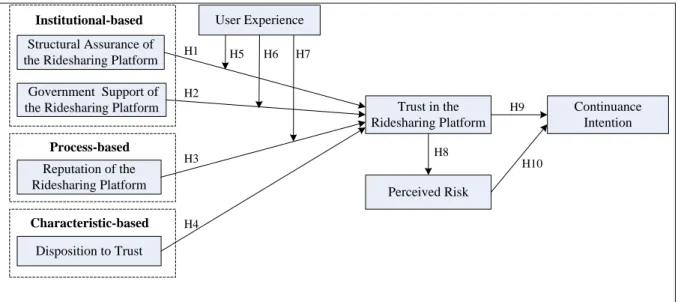
Drawing upon Zucker (1986)’s trust building framework, this study develops a research model to examine three sources of influence on customers’ trust and continuance intention in the ridesharing service (Mcknight et al., 2002; Pavlou and Gefen, 2004; Chang et al., 2013). In particular, user experience is included in the research framework as a contingency factor based on elaboration-likelihood model. The research model is illustrated in Figure 1, and the theoretical logic of each research hypotheses will be described in the next section.
Reputation of the Ridesharing Platform Government Support of
the Ridesharing Platform Trust in the
Ridesharing Platform
Continuance Intention Structural Assurance of
the Ridesharing Platform
Perceived Risk Disposition to Trust User Experience H1 H2 H3 H4 H5 H6 H7 H8 H10 H9 Institutional-based Process-based Characteristic-based
Figure 1. Research Model
Influence of Structural Assurance
Structural assurance refers to the protective legal technological structures such as encryption mechanism and identity authentication that safeguard online transactions (McKnight and Chervany, 2001; McKnight et al., 2002). Structural assurance was identified as a significant antecedent that facilitates trusting beliefs and willingness to transact online. Customers are more likely to depend on the web vendor operating in a secure environment if they believe that online transactions will not lead to personal information disclosure (McKnight et al., 2002).
Previous literatures have examined the relationship between structural assurance and trust beliefs in the context of e-commerce. Pavlou and Gefen (2004) found that credit card guarantee has a positive influence on customers’ trust in the community of sellers. Kim et al. (2008) indicated that online payment security is critical in developing and maintaining consumers’ trust in the online transaction
platform. In a recent study, Hoffmann et al. (2014) reported a positive relationship between platform reputation and customers’ trust beliefs.
In the context of sharing economy, structural assurance is also recognized as an important antecedent in building customers’ trust (Kamal and Chen, 2016). The security and reliability of the third party platform are critical in developing and maintaining consumers’ trust in the online transaction procedure. If consumers find effective security features and protection mechanisms in the platform, their trust will be enhanced accordingly (Yang et al., 2016). The above analysis leads to the following hypothesis:
H1: Structural assurance is positively associated with trust in the platform.
Influence of Government Support
The legitimacy issues have been discussed since the conception of sharing economy was proposed. Most scholars agreed that government decision on the sharing economy platform has a direct impact on individuals’ adoption and usage of the new emerging application in the local market (Posen, 2015; Rauch & Schleicher, 2015). Thus a regulatory policy framework is required to assure that the platform adequately addresses and considers the rights of consumers when they provide the sharing service to them (Heinrichs, 2013; Benjaafar et al., 2015; Rauch& Schleicher, 2015).
Prior studies have examined the influence of institutional power in affecting individuals’ behaviors in different research contexts. For example, Liang et al. (2007) conducted an empirical study in the organizational context and found that coercive power from the government is a significant source of influence that promotes the assimilation of enterprise systems within the organization. In the context of location-based services (LBS), Cuijpers and Koops (2010) reported that users’ privacy concern will be decreased if the government provides more support and legislation in protecting their privacy.
The administration and support from the government also plays a significant role in the context of sharing economy. With the emergence and popularity of ridesharing applications in China, Chinese government has established specific policies that support the establishment and development of third-party platforms such as DiDi, China Auto Rental and Yidao in the transportation fields (SIC, 2017). The commitment and support from the government is a significant signal that guarantees the legitimacy of the ridesharing service (IResearch, 2017). This is beneficial to improve individuals’ trust beliefs and promote their usage of the new travelling service. Thus we propose the following hypothesis:
H2: Government Support is positively associated with trust in the platform.
Influence of Platform Reputation
Reputation refers to a social process based on past interactions between customers and the service providers in the platform (Sharif et al., 2005; Kim et al., 2008; Ert et al., 2015). Because of information asymmetry in the online transactions, consumers often have insufficient information about the goods and services offered by the service providers. The service provider, on the other hand, knows exactly what he gets, as long as he is paid in money. This leaves the consumer in a vulnerable position by accepting the risk of poor service. The inefficiencies resulting from this information asymmetry can be mitigated through reputation (Josang et al., 2007).
Reputation was recognized as one of the most important factors affecting customers’ trust beliefs in the online transactions, especially when the customers do not have much personal experience with the service providers (McKnight et al., 2002). Positive word-of-mouth can help alleviate customers’ perceived risk and insecurity when interacting with the service providers, and enhance their willingness to rely on the vendors in the e-commerce transactions (Chang et al., 2013; Yang et al., 2016). Consumers are more likely to transact with the product or service providers if they believe in the reputation of the third-party platforms, such as the case of Tmall and JD in China.
In the context of sharing economy, the influence of reputation has aroused the attention of scholars in recent years. If the platform has accumulated positive word-of-mouth from the previous transactions, customers are more likely to believe that the service providers are honest and concerned about their requirements, thus can provide good service to them. Contrarily, negative word-of-mouth may impede
customers from using the service on the platform. In the ridesharing platform of DiDi, the accumulated positive comments from the platform and recommendation from related communities is a signal of good service, which is beneficial to enhance customers’ trust beliefs in the platform (Kamal and Chen, 2016; Yang et al., 2016). The above analysis leads to the following hypothesis:
H3: Reputation of the platform is positively associated with trust in the platform.
Influence of Disposition to Trust
Disposition to trust is a personality construct that reflects the extent to which a person demonstrates ‘‘a consistent tendency to be willing to depend on others across a broad spectrum of situations and persons’’ (McKnight et al., 1998). In other words, if someone has a high disposition to trust, he or she is more likely to believe in the goodness of human beings and is more willing to trust others in an initial interaction.
Previous studies have examined the significant influence of customers’ disposition to trust on their cognitive beliefs and behavioral intention in the online transactions (Salam et al., 2005). Gefen (2000) posited that people of high disposition to trust are more credulous or naïve, and are more likely to trust in e-vendors who make efforts to address consumers’ perceptions of privacy, security and integrity issues. Pavlou and Gefen (2004) also reported that trust propensity is positively associated with customers’ trust in the community of sellers in the online marketplaces.
In the context of sharing economy, disposition to trust is recognized as a significant characteristic-based antecedent that builds customers’ trust in the third-party platform. Mittendorf (2017) posited that trust in the sharing platform is determined by a general trusting disposition, and individuals of high trust disposition are more inclined to frame positive interactions with an unfamiliar party. Kamal and Chen (2016) also suggested that individuals of high trust propensity are more likely to participate in the sharing economy. The above analysis leads to the following hypothesis:
H4: Disposition to trust is positively associated with trust in the platform.
The Moderating Influence of User Experience
User experience refers to an individual’s passage of time from the initial use of an information technology. The moderating effect of user experience has been examined within the extant literatures, and empirical research findings suggest that individuals will change their beliefs and behaviors regarding the use of a target technology across different time frames (Venkatesh et al., 2003; Venkatesh et al., 2012). If individuals possess high experiences of the new information technology, they are more likely to elaborate or take a logical and rational route in processing the arguments on the platform (Petty and Cacioppo, 1986; Bhattacherjee and Sanford, 2006; Lowry et al., 2012). On the contrary, if individuals have low experiences and not familiar with the information technology, they are less likely to elaborate on the presented arguments. Instead, they prefer to take a peripheral processing route when making decisions and depend on the environmental cues and surrounding evidence unrelated to the central route of the arguments (Petty and Cacioppo, 1986; Bhattacherjee and Sanford, 2006; Lowry et al., 2012).
In the context of ridesharing, structural assurance is identified as a significant central route in the research model. Since the protective technological structures (encryption mechanism and identity authentication) represent informational arguments that safeguard online transactions, it requires individuals to devote cognitive efforts to carefully evaluate the message when making decisions on the platform (Mcknight et al., 2002). Compared with users with low experience, high-experience users are more likely to seek for the presented messages and arguments of technological structures to guarantee that their online payment process is secure (Bhattacherjee & Sanford, 2006). Empirical studies also found that individuals’ sense of privacy assurance is a significant central route that influences their attitudes and behaviors (Lowry et al., 2012). The above analysis leads to the following hypothesis:
H5: User experience positively moderates the relationship between structural assurance and trust in the platform.
Drawing upon the elaboration likelihood model, when users have fewer experiences of the technology, they cannot take a rational central route in processing the arguments of the technology structures. Instead, they are more likely to take a peripheral processing route by replying on the surrounding peripheral routes to assure the security of the online transactions (Zhou et al., 2017). In this study, government support are platform reputation are identified as significant peripheral routes that influence individuals’ trust beliefs and behavioral intention. In the context of ridesharing, government support can be considered as a legitimacy signal of the third-party platform. Customers would prefer to depend on the regulatory policies for identification of sources if they have fewer use experiences of the ridesharing service (IResearch, 2017). While reputation represents the word-of-mouth and second-hand information from others (Bhattacherjee and Sanford, 2006; Zhou, 2017). Previous literatures suggested that users would prefer to depend on the second hand information and peer recommendations to understand the latest technologies if they are unable to keep up with the rapid rate of technological change (Sussman and Siegel, 2003; Bhattacherjee and Sanford, 2006). The above analysis leads to the following hypotheses:
H6: User experience negatively moderates the relationship between government support and trust in the platform.
H7: User experience negatively moderates the relationship between platform reputation and trust in the platform.
Trust, Perceived Risk and Continuance Intention
The relationship among trust, perceived risk and continuance intention has been largely examined within the previous literatures (Jarvenpaa et al., 2000; Gefen and Pavlou, 2012). Pavlou and Gefen (2004) reported that customers’ trusting beliefs in the vendors is beneficial to reduce their perceived risk caused by information asymmetry, which can result in a favorable impact on transactional behaviors in the online markets.
In the context of ridesharing service, there exists a potential probability regarding online financial loss or offline physical harm in the transactions (Mittendorf, 2017). If the customer believes that it is insecure to use the ridesharing service for travelling and negative consequences may occur if using the service, they will discontinue using it. On the contrary, if the customer believe that the platform can protect customers’ benefits with great competence, benevolence and integrity, their negative expectations towards the ridesharing service will decrease, which in turn increase their continuance intention of the service. The above analysis leads to the following hypothesis:
H8: Trust in the platform is negatively associated with perceived risk.
H9: Trust in the platform is positively associated with continuance Intention.
H10: Perceived risk is negatively associated with continuance Intention.
Research Methodology
Construct Operationalization
This study refers to the previous literatures to operationalize the constructs, and all items were measured using 7-point likert scale ranging from “strongly disagree” (1) to “strongly agree” (7). Specifically, items for structural assurance and reputation were designed based on McKnight et al. (2002)’s study, and items for government support was adapted from Lewis et al. (2003)’s study. Trust and perceived risk were operationalized drawing upon Pavlou et al. (2004)’s study. Continuance intention and disposition to trust were operationalized based on Bhattacherjee (2001)’s and Gefen (2000)’s study respectively. While user experience was measured using an individual’s use frequency of the ridesharing service in months, as suggested in the previous literatures (Venkatesh et al., 2003; Lu & Lee, 2012). Several items were adjusted to better adapt to the research context of ridesharing service in China.
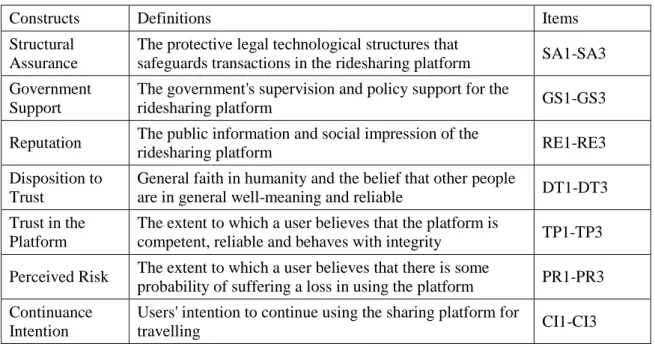
A pilot study was conducted before the final data collection. A total of 152 of DiDi users were invited to complete the questionnaires, and 105 valid questionnaires were received. We deleted a few items with factor loadings lower than 0.7 to improve the validity of the constructs (Chin et al., 2003). The definition for each construct and the corresponding measurement items are illustrated in Table 1.
Table 1. Constructs and Items
Constructs Definitions Items
Structural Assurance
The protective legal technological structures that
safeguards transactions in the ridesharing platform SA1-SA3 Government
Support
The government's supervision and policy support for the
ridesharing platform GS1-GS3 Reputation The public information and social impression of the
ridesharing platform RE1-RE3 Disposition to
Trust
General faith in humanity and the belief that other people
are in general well-meaning and reliable DT1-DT3 Trust in the
Platform
The extent to which a user believes that the platform is
competent, reliable and behaves with integrity TP1-TP3 Perceived Risk The extent to which a user believes that there is some
probability of suffering a loss in using the platform PR1-PR3 Continuance
Intention
Users' intention to continue using the sharing platform for
travelling CI1-CI3
Data Collection
The final data collection was conducted during January to March in the year of 2017. DiDi was selected as a major research site since it is one of the largest sharing platforms for travelling in China, and it has more than 450 million users. An online survey was conducted using an electronic questionnaire website of www.sojump.com, and snowball sampling method was used to collect data. We firstly invited several users who have usage experiences of DiDi to complete the questionnaires using mobile phones, then we asked the respondents to share the survey in the “WeChat Moments”, which is a popular mobile social community in China. Totally 351 questionnaires were collected from DiDi users from more than 15 cities in China. We deleted the incomplete questionnaires and finally got 307 valid datasets for analysis. The demographic characteristics of the data is described in Table 2.
Table 2. Sample Characteristics
Items Types Numbers Percentage
Gender Male 159 52% Female 148 48% Age 18-24 114 37% 25-30 95 31% 31-40 87 28% >40 11 4% Education
Senior high school and under 36 12%
Bachelor 192 62%
Master 48 16%
PhD 31 10%
Use Frequency per Month 1-10 130 42%
>20 99 32%
As illustrated in Table 2, male users are slightly more than female users without big differences. Regarding the distribution of age and education background, the statistics suggests that most of the respondents are young people aged between 18 and 30, and 88% of the respondents possess a bachelor degree or above. In terms of use frequency, the statistics demonstrates that there is an average distribution between high-experience and low-experience users, with 58% respondents use the ridesharing service more than 10 time per month, and 42% respondents use the service less than 10 times per month.
Structural equation modeling analysis
Structural equation modelling technique was used to examine the research model. SmartPLS was selected as a primary statistical tool for data analysis since it is more suited for theory exploration and prediction (Gefen et al., 2000; Chin et al., 2003). Following a two-step analysis procedure, we first examined the measurement model and then examined the structural model.
Measurement model analysis
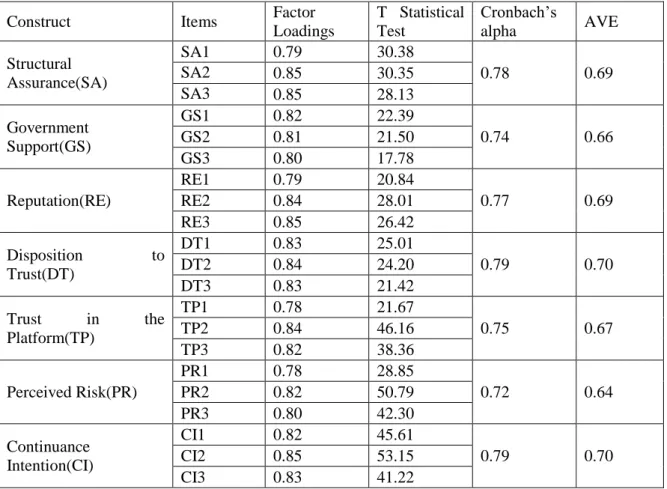
The measurement model was examined to analyze the reliability and convergent validity of the constructs. As illustrated in Table 3, each construct’s Cronbach’s alpha has exceeded 0.7, thus demonstrates an internal consistency of the items. In addition, the item loadings of all the constructs have exceeded 0.75, and the average variance extracted (AVE) for each construct is greater than 0.5, indicating an adequate support for convergent validity (Chin et al., 2003).
Table 3. Construct Reliability and Validity Analysis
Construct Items Factor Loadings T Statistical Test Cronbach’s alpha AVE Structural Assurance(SA) SA1 0.79 30.38 0.78 0.69 SA2 0.85 30.35 SA3 0.85 28.13 Government Support(GS) GS1 0.82 22.39 0.74 0.66 GS2 0.81 21.50 GS3 0.80 17.78 Reputation(RE) RE1 0.79 20.84 0.77 0.69 RE2 0.84 28.01 RE3 0.85 26.42 Disposition to Trust(DT) DT1 0.83 25.01 0.79 0.70 DT2 0.84 24.20 DT3 0.83 21.42 Trust in the Platform(TP) TP1 0.78 21.67 0.75 0.67 TP2 0.84 46.16 TP3 0.82 38.36 Perceived Risk(PR) PR1 0.78 28.85 0.72 0.64 PR2 0.82 50.79 PR3 0.80 42.30 Continuance Intention(CI) CI1 0.82 45.61 0.79 0.70 CI2 0.85 53.15 CI3 0.83 41.22
Note: T test are significant at: *P<0.05, **P < 0.01
Discriminant validity assesses if a construct is different from other constructs. Following Chin et al. (2003)’s procedure, this study conducted a correlation analysis. As described in Table 4, the square root
of the AVE for each construct (the values on the diagonal) is higher than that construct’s correlation with other constructs, suggesting a good discriminant validity of the constructs.
Table 4. Correlation Analysis
SA GS RE DT TP PR CI SA 0.83 GS 0.67 0.81 RE 0.66 0.67 0.83 DT 0.54 0.60 0.59 0.84 TP 0.64 0.65 0.71 0.57 0.82 PR -0.55 -0.50 -0.51 -0.53 -0.52 0.8 CI 0.56 0.51 0.63 0.56 0.62 -0.51 0.84
Note: The diagonal values represent the square roots of AVE of each construct
Structural model analysis
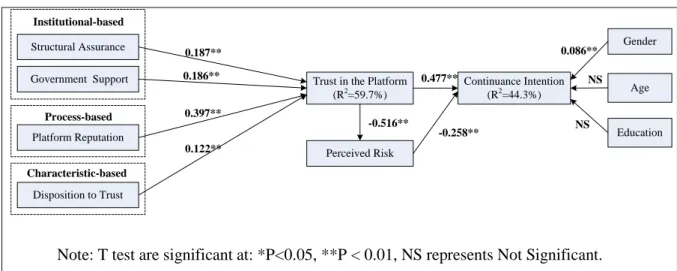
Structural modelling analysis was conducted to examine the path relationship between each two constructs and the explained variance of the endogenous variables. In order to derive valid standard errors and t-values, bootstrapping procedure method was used to calculate the statistical significance of the parameter estimates (Temme et al., 2006). The structural model was firstly analyzed to examine the direct influences of institutional-based, process-based and characteristic-based antecedents on trust formulation without adding the moderator of user experience. Individuals’ gender, age and education background were added as control variables in the research model, as suggested in the previous literatures. The analysis results are described in Figure 2.
Platform Reputation
Government Support Trust in the Platform
(R2=59.7%) Continuance Intention (R2=44.3%) Structural Assurance Perceived Risk Disposition to Trust 0.187** Institutional-based Process-based Characteristic-based 0.397** 0.186** 0.122** -0.516** 0.477** -0.258** Gender Age Education 0.086** NS NS
Note: T test are significant at: *P<0.05, **P < 0.01, NS represents Not Significant.
Figure 2. Structural model analysis
As illustrated in Figure 2, institutional-based antecedents of structural assurance and government support are positively associated with trust (β1=0.187, p<0.01; β2=0.186, p<0.01). The results can
support hypothesis H1 and H2, suggesting that warranty of the third-party platform and institutional power from government are beneficial to formulate customers’ trust in the ridesharing service. On the one hand, regulatory policies are required to guarantee the legitimacy of the ridesharing platform. On the other hand, protective institutional and technological structures are also needed to assure the security of the transactions on the platform.
Figure 2 indicates that process-based antecedent of reputation has a strong influence on trust in the platform (β=0.397, p<0.01), thus supports hypothesis H3. The result suggests that platform reputation accumulated through positive word-of-mouth is an effective market signal to engender in customers’ trust beliefs by reducing information asymmetry between customers and service providers. As hypothesized in H4, customer’s disposition to trust is positively associated with trust in the platform (β=0.122, p<0.01), indicating that characteristics-based antecedent is also a significant mechanism that promote trust in the ridesharing service.
As noted in Figure 2, trust in the platform is negatively related with perceived risk and positively associated with continuance intention (β1=-0.516, β2=0.477, p<0.01), thus support hypotheses H8 and
H9. In addition, perceived risk is negatively related with continuance intention (β=-0.258, p<0.01), supporting hypothesis H10. The analysis results are consistent with the previous research findings. Regarding the influences of control variables, gender is positively related with continuance intention, indicating that there exists differences between males and females regarding the continuance usage behaviors of ridesharing service. While age and educational background have no significant influences on continuance intention. In addition, Figure 2 suggests that the R2 value of trust in the platform and
continuance intention are 59.7% and 44.3% respectively. The results demonstrate a good explanatory power of the research model.
Moderating Test
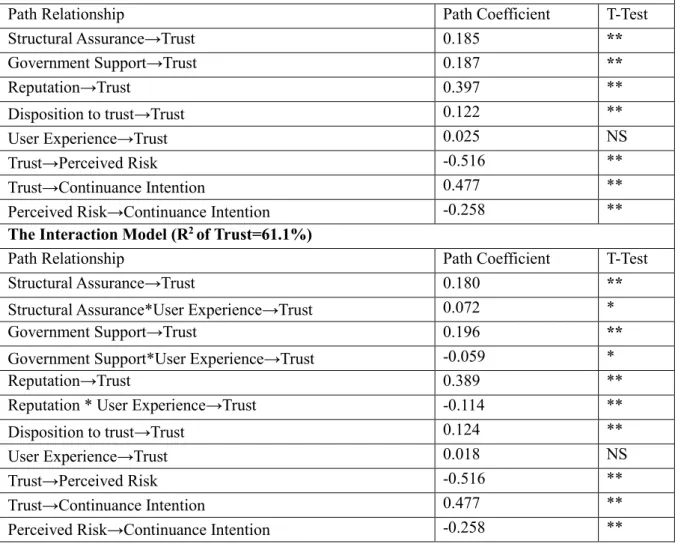
We then added user experience as a moderator in the research model to examine its moderating effect on the relationship between the three antecedents and trust, as hypothesized in H5, H6 and H7. The main effect model was firstly analyzed without adding the interaction constructs. The result suggests that user experiences is not positively associated with trust. Following Chin et al. (2003)’s procedure, we then calculated interaction constructs by multiplying the standardized antecedents and the moderator (user experience) in SmartPLS. The moderating effects are supported if the interaction constructs have significant influences on trust (Chin et al., 2003; Xu et al., 2012). The analysis results of the main effect model and the interaction model are described in Table 5.
Table 5. Moderating Effect Analysis in SmartPLS The Main Effect Model (R2 of Trust=59.7%)
Path Relationship Path Coefficient T-Test Structural Assurance→Trust 0.185 ** Government Support→Trust 0.187 ** Reputation→Trust 0.397 ** Disposition to trust→Trust 0.122 ** User Experience→Trust 0.025 NS Trust→Perceived Risk -0.516 ** Trust→Continuance Intention 0.477 ** Perceived Risk→Continuance Intention -0.258 **
The Interaction Model (R2 of Trust=61.1%)
Path Relationship Path Coefficient T-Test Structural Assurance→Trust 0.180 **
Structural Assurance*User Experience→Trust 0.072 * Government Support→Trust 0.196 **
Government Support*User Experience→Trust -0.059 *
Reputation→Trust 0.389 **
Reputation * User Experience→Trust -0.114 ** Disposition to trust→Trust 0.124 **
User Experience→Trust 0.018 NS
Trust→Perceived Risk -0.516 **
Trust→Continuance Intention 0.477 ** Perceived Risk→Continuance Intention -0.258 **
As noted in Table 5, the interaction construct of structural assurance*user experience is positively associated with trust in the platform (β1=0.072, p<0.05), thus supports hypotheses H5. The result
indicates that the influence of structural assurance on trust is stronger for high-experienced users compared with low-experienced users. Table 5 also indicates that reputation*user experience and government support*user experience are negatively associated with trust in the platform (β1=-0.114,
p<0.01; β2=-0.059, p<0.05), thus provides support for hypotheses H6 and H7. The results are consistent
with our arguments, demonstrating that low-experienced users prefer to rely on the peripheral route of platform reputation and government support when making transaction decisions on the ridesharing platform.
Theoretical and Practical Implications
For theoretical implications, this study makes at least two major contributions to the extant literatures. Firstly, this study adopted Zucker (1986)’s trust framework in the context of ridesharing to examine the joint influences of institution-based, process-based and characteristic-based antecedents on customers’ trust. Specifically, structural assurance and government support were identified as significant institution-based mechanisms, reputation was identified as a significant process-based mechanism, and disposition to trust was identified as a significant characteristic-based mechanism in building customers’ trust. To our knowledge, this is one of the few studies that empirically examine the trust-building mechanisms in the ridesharing service. The empirical findings can refine and enrich the extant literatures of trust in the new research context. Secondly, this study applied elaboration-likelihood model (ELM) from social psychology in the context of ridesharing to examine the moderating effect of user experience on the three sources of influence. Specifically, we argue that the three trust-building mechanisms may result in different reactions across customers with different use experiences. The empirical results indicated that when evaluating the credibility of the ridesharing platform, customers with less usage experiences are more likely to depend on the peripheral routes of government support and platform reputation, while customers with more usage experiences are more likely to rely on the central route of structural assurance to make transaction decisions. The research findings can further refine the boundary condition of the proposed theoretical model.
For practical implications, this study can provide theoretical guidelines to the administrators of the ridesharing platform. Firstly, the administrators must recognize that platform reputation is the most significant antecedent in building customers’ trust. Customers prefer to rely on the second-hand information from others when making decisions, especially when they have few usage experiences. Thus developing an effective mechanism to accumulate positive word-of-mouth from experienced users is important, such as the case of DiDi. Secondly, the administrators need also pay attention to the structural assurance of the platform, and set up effective authentication and protection mechanisms in the ridesharing platform. This is beneficial to assure the security of the transactions when customers register, log in and complete the payment process on the platform. Thirdly, this study can also provide guidelines to the policy makers of the government. The policy makers need recognize the importance of government support in building customers’ trust and establish regulatory policies that support the operation of the ridesharing platform. The support from the government can be considered as an important signal that guarantees the legitimacy of the ridesharing service and regulate the operation of the third-party platforms. Last but not least, the moderating effects of user experience in the research model suggest that the platform administrators can use different market strategies for attracting new entrants and keeping veterans in the ridesharing service. Specifically, when users are in the early stages of using the ridesharing service, they rely more on peripheral route of source credibility to facilitate trust beliefs and continuance intention. Thus reputation and government support play a more significant role in attracting the attention of this group of customers. While for users who possess more experience, the central route of structural assurance play a more significant role in promoting customers’ trust beliefs and continuance intention. Thus establishing a secure encryption and safeguard mechanism is more effective to retain this group of customers in the ridesharing service.
Conclusions
This study draws upon Zucker (1986)’s trust building framework to examine the influences of institutional-based, process-based and characteristic-based antecedents in building customers’ trust in the context of ridesharing service. A survey was conducted and 307 data was collected from users of DiDi, which is one of the largest ridesharing platforms in China. Structural equation modelling analysis was used to examine the research model and corresponding hypotheses. The empirical results suggest that platform reputation, government support, structural assurance and disposition to trust are positively associated with trust, which in turn decrease customers’ perceived risk and increase their continuance intention. Specifically, user experience negatively moderates the influences of government support and platform reputation on trust, while positively moderates the influence of structural assurance on trust. This study has several limitations that leave open future research directions. Firstly, this study used cross-sectional data to test the theoretical model and all data was collected at the same time point. Future research can conduct a longitudinal study to examine if the path relationship between each two constructs changes over time. Secondly, this study collected data from DiDi users in China, which may limit the generalization of the empirical research findings. Future studies can collect empirical data from other ridesharing platforms, such as the platform of Uber, to examine if there exists cultural differences of the proposed theoretical model.
Acknowledgements
This research was supported by the National Natural Science Foundation of China (71771064) and the Ministry of Education of Humanities and Social Science Project (17YJC630118). We thank the respondents for their participation in the investigations. We also thank the associate editor and the reviewers for their constructive suggestions.
References
Benjaafar, S., Kong, G., Li, X., & Courcoubetis, C. 2015. “Peer-to-peer product sharing: implications for ownership, usage and social welfare in the sharing economy,” Social Science Electronic Publishing.
Böckmann, M. 2013. “The sharing economy: It is time to start caring about sharing; value creating factors in the sharing economy,” 1st IBA Bachelor Thesis Conference, June 27th, Enschede, The Netherlands.
Botsman, R. & Rogers, R. 2011. What‘s mine is yours: the rise of collaborative consumption. New York: Harper Collins Publishers.
Bhattacherjee, A., & Sanford, C. 2006. “Influence processes for information technology acceptance: an elaboration likelihood model,” MIS Quarterly (30:4), pp. 805-825.
Chang, M. K., Cheung, W., & Tang, M. 2013. “Building trust online: interactions among trust building mechanisms.” Information & Management (50:7), pp. 439-445.
Chin, W. W., Marcolin, B. L., & Newsted, P. R. 2003. “A partial least squares latent variable modeling approach for measuring interaction effects: results from a monte carlo simulation study and an electronic-mail emotion adoption study,” Information Systems Research (14:2), pp. 189-217. Cuijpers, C., & Koops, B. J. 2010. “How fragmentation in european law undermines consumer
protection: the case of location-based services.” Social Science Electronic Publishing, (33:6), pp. 880-898.
Ert E, Fleischer A, Magen N. 2015. “Trust and reputation in the sharing economy: The role of personal photos in Airbnb.” Tourism Management, (55), pp. 62-73.
Fang, Y., Qureshi, I., Sun, H., Mccole, P., Ramsey, E., & Lim, K. H. 2014. “Trust, satisfaction, and online repurchase intention: the moderating role of perceived effectiveness of e-commerce institutional mechanisms.” MIS Quarterly, (38:2), pp.407-427.
Gefen, D. 2000. “E-commerce: The role of familiarity and trust.” Omega, (28:5), pp. 725–737.
Gefen, D., & Pavlou, P.A. 2012. “The boundaries of trust and risk: the quadratic moderating role of institutional structures.” Information Systems Research, (23:3), pp. 940-959.
Hoffmann, C. P., Lutz, C., & Meckel, M. 2014. “Digital natives or digital immigrants? the impact of user characteristics on online trust.” Journal of Management Information Systems, (31:3), pp. 138-171.
Hawlitschek, F., Teubner,T. and Weinhardt, C. 2016. “Trust in the sharing economy.” Swiss Journal of Business Research and Practice, (70:1), pp. 26-44.
Heinrichs, H. 2013. “Sharing economy: a potential new pathway to sustainability.” Gaia, (22:4), pp. 228.
IResearch. 2017. “The development of sharing economy in China and user research report.” Online: http://www.iresearch.com.cn/report/3036.html.
Jarvenpaa, S.L., Tractinsky, N., & Vitale, M. 2000. “Consumer trust in an Internet store.” Information Technology Management, (1:12), pp. 45–71.
Josang, Audun and Ismail, Roslan and Boyd, Colin A. 2007. “A survey of trust and reputation systems for online service provision.” Decision Support Systems, (43:2), pp. 618-644.
Kamal, P., Chen, J.Q. 2016. Trust in sharing economy. The 20th Pacific Asia Conference on Information Systems, June 27th, Chiayi, Taiwan.
Kim, D., Ferrin, D., & Rao, R. 2008. “A trust-based consumer decision-making model in electronic commerce.” Decision Support Systems, (44:2), pp. 544-564.
Lee, J., Lee, J. N., & Tan, B. C. Y. 2015. “Antecedents of cognitive trust and affective distrust and their mediating roles in building customer loyalty.” Information Systems Frontiers, (17:1), pp.159-175. Lewis, W., Agarwal, R., & Sambamurthy, V. 2003. “Sources of influence on beliefs about information
technology use: An empirical study of knowledge workers.” MIS quarterly, (27:4), pp. 657-678. Lu, H. P. & Lee, M. R. 2012. “Experience differences and continuance intention of blog sharing.”
Behaviour & Information Technology, (31:11), pp. 1081-1095.
Lowry, P. B., Moody, G., Vance, A., Jensen, M., Jenkins, J., & Wells, T. 2012. “Using an elaboration likelihood approach to better understand the persuasiveness of website privacy assurance cues for online consumers.” Journal of the Association for Information Science & Technology, (63:4), pp. 755–776.
Möhlmann, M. 2016. Sharing economy: Building trust in P2P online marketplaces, New York Computer Science and Economics Day, New York.
McKnight, D.H., Cummings, L.L., Chervany, N.L. 1998. “Initial trust formation in new organizational relationships.” Academy of Management Review (23:3), pp. 473–490.
McKnight, D.H., Chervany, N.L. 2001. “What trust means in e-commerce customer relationships: an interdisciplinary conceptual typology.” International Journal of Electronic Commerce, (6:2), pp. 35–59.
Mcknight, D. H., Choudhury, V., & Kacmar, C. 2002. “The impact of initial consumer trust on intentions to transact with a web site: a trust building model.” Journal of Strategic Information Systems, (11:4), pp. 297-323.
Mittendorf, C. 2017. “The implications of trust in the sharing economy–an empirical analysis of uber.”
Proceedings of the 50th Hawaii International Conference on System Sciences. January 4th, Hawaii. Pavlou, P. A. & Gefen, D. 2004. “Building effective online marketplaces with institution-based trust.”
Information Systems Research, (15:1), pp. 37-59.
Pricewaterhouse Coopers (PWC). 2015. The Sharing Economy. Consumer Intelligence Series. Posen, H. A. 2015. “Ridesharing in the sharing economy: should regulators impose Uber regulations
on Uber?” Iowa Law Review, (101:1), pp. 405-433.
Petty, R.E., & Cacioppo, J.T. 1986. Communication and Persuasion: Central and Peripheral Routes to Attitude Change, SpringerVerlag, New York.
Rauch, D. E., & Schleicher, D. 2015. “Like Uber, but for local governmental policy: the future of local regulation of the 'sharing economy'.” Social Science Electronic Publishing, (58:2), pp. 613-627. State Information Center(SIC). 2017. Development report of sharing economy in China. Available at:
http://www.sic.gov.cn/News/250/7737.htm.(accessed 27 November 2017)
Salam, A. F., Iyer, L., Palvia, P., & Singh, R. 2005. “Trust in e-commerce.” Communications of the ACM, (48:2), pp. 72-77.
Sussman, S. W., and Siegel, W. S. 2003. “Informational influence in organizations: an integrated approach to knowledge adoption,” Information Systems Research, (14:1), pp. 47-65.
Sharif, K.J., Kalafatis, S.P. & Samouel, P. 2005. “Cognitive and behavioral determinants of trust in small and medium-sized enterprises,” Journal of Small Business and Enterprise Development,
(12:3), pp. 409–421.
Shao, Z., and Yin, H. 2018. “Trust Building in the Car-Sharing Platform: An Empirical Study in China”.
The 11th International Conference on Information Resources Management, June 4th, Ningbo, China.
Temme, D., H. Kreis, and L. Hildebrandt. 2006. PLS Path Modeling-A Software Review. Berlin: Humboldt-University Berlin.
Venkatesh, V., Morris, M.G., Davis, G.B., & Davis, F.D. 2003. “User acceptance of information technology: toward a unified view.” MIS Quarterly, (27:3), pp. 425-478.
Venkatesh, V., Thong, J. Y. L., & Xu, X. 2012. “Consumer acceptance and use of information technology: extending the unified theory of acceptance and use of technology.” MIS Quarterly, 36(1), 157-178.
Xu, H., Teo, H. H., Tan, B. C. Y., & Agarwal, R. 2012. “Research note---effects of individual self-protection, industry self-regulation, and government regulation on privacy concerns: a study of location-based services.” Information Systems Research, (23:4), pp. 1342-1363.
Yang, S. B., Lee, K., Lee, H., Chung, N., & Koo, C. 2016. “Trust breakthrough in the sharing economy: an empirical study of Airbnb.” The 20th Pacific Asia Conference on Information Systems. June 27th, Chiayi, Taiwan.
Zhou, T., Lu, Y., & Wang, B. 2016. Examining online consumers' initial trust building from an elaboration likelihood model perspective. Kluwer Academic Publishers.
Zhou, T. 2017. “Understanding location-based services users’ privacy concern: an elaboration likelihood model perspective.” Internet Research, (27:3), pp. 506-519.
Zucker, Lynne. 1986. “Production of trust: Institutional sources of economic structure,1840-1920.”