ANY OPINIONS EXPRESSED ARE THOSE OF THE AUTHOR(S) AND NOT NECESSARILY THOSE OF
Optimal Collusion with Internal Contracting
Gea Myoung Lee
February 2008
Optimal Collusion with Internal Contracting
This draft: February 2008
Gea M. Lee∗
School of Economics and Social Sciences Singapore Management University 90 Stamford Road, Singapore 178903
[email protected] Tel: 65-6828-0857 Fax: 65-6828-0833
Abstract
In this paper, we develop a model of collusion in which two firms play an infi
nitely-repeated Bertrand game when eachfirm has a privately-informed agent. The colludingfirms,
fixing prices, allocate market shares based on the agent’s information as to cost types. We
emphasize that the presence of privately-informed agents may provide firms with a
strate-gic opportunity to exploit an interaction between internal contracting and market-sharing
arrangement: the contracts with agents may be used to induce firms’ truthful
communica-tion in their collusion, and collusive market-share allocacommunica-tion may act to reduce the agents’ information rents.
Journal of Literature Classification numbers: C73, L13, L14.
Keywords: Optimal collusion, internal contract, privately-informed agents, price-fixing.
∗I am indebted to Kyle Bagwell, Levent Kockesen and Michael Riordan for their guidance and help. I
also thank Atila Abdulkadiroglu, Eslyn Jean-Baptiste, Isabelle Brocas, Raphael Thomadsen, and seminar participants at Columbia University, Singapore Management University, and Far Eastern Meeting of the Econometric Society for their helpful comments. The usual disclaimer applies.
1. Introduction
Collusions in practice are often characterized by price-fixing and market-share allocation.1 Along with such actual features, recent theoretical work has shed light on diverse aspects of collusion in prices and quantities. An important feature in recent theoretical work is that the state of firms’ production costs is regarded as private information. Aoyagi (2003), Athey and Bagwell (2001, 2006), Athey et al. (2004) and Skrzypacz and Hopenhayn (2004) develop models of this kind, where firms play a repeated Bertrand pricing game or repeated procurement auctions.2 Despite their rich analyses of collusion, those theoretical models have given no attention to the possibility that thelocation private information is the hired agents who producefirms’ outputs. By contrast, private information, held by agents, as to the state of production has received extensive attention in the literature, and in practice, productions are often accomplished by agents on a contractual basis. In this paper, building on recent work on theory of collusion, we investigate how the presence of privately-informed agents affects a commonly observed collusive behavior, price-fixing with market-share allocation.
Our paper develops a model of collusion in which twofirms play an infinitely-repeated Bertrand game, and uses work by Athey and Bagwell (2001) and Athey et al. (2004) as a benchmark. Following their models, we consider the environment in whichfirm actions are publicly observed. A novelty of our model is that each firm has a privately-informed agent: private information is held by the agent who produces output for thefirm. Employing Perfect Public Equilibrium (PPE), we establish two different classes of equilibria, asymmetric and symmetric PPE, to describe the features that would not be observed without the presence of privately-informed agents.
There is a two-tier relationship in our model: each firm writes to its agent a law-enforced contract and makes a self-enforced agreement with its rival firm. In each period, each agent privately observes its cost type. The cost type is high or low and i.i.d. across agents and time.3 Each agent makes a report of cost type to itsfirm. Thefirm then makes a cost announcement to its rivalfirm, sets prices and allocates market shares. In an ideal collusive scheme, setting high prices,
firms would allocate market shares by the criterion of productive efficiency, whereby all production is assigned to the agent(s) with the lowest production cost. Given the two types of relationship, a major difficulty with finding an optimal collusion is to establish a two-tier revelation mechanism that induces agents to make truthful reports and firms to make truthful announcements.
We firstly analyze an asymmetric PPE (APPE), and show how the presence of
privately-1
Whinston (2006) surveys theoretical and empirical literature on price-fixing collusions, and Harrington (2006) provides patterns of price and market allocation in real cartels.
2Some recent literature explores self-enforcing trade agreements among privately-informed countries. See, e.g., Bagwell and Staiger (2005), Lee (2007) and Martin and Vergote (2007).
3Private information in our model is transitory. If private information is persistent, then the analysis will be more complicated; a fim’s action may signal its information and affect its rival’s belief. For related recent work, see Athey and Bagwell (2006).
informed agents affects the APPE-value set whenfirm strategies are unrestricted (possibly asym-metric). Colludingfirms would intend to communicate truthfully to allocate market shares by the criterion of productive efficiency. To achieve productive efficiency, the firm that announces high cost must give up its market share when the rival announces low cost. There are contrasting incen-tive problems in the model. At the inter-firm level, a high-costfirm has an incentive tounderstate
the reported high cost in the hope of increasing its market share, given that each firm privately observes its agent’s report. To elicit the high-cost firm’s truthfulness today, a high continuation value (as future reward) is afforded to the firm that reports high cost.4 At the intra-firm level, a low-cost agent has an incentive to overstate the observed low cost in the hope of receiving the greater transfer payment for a given level of production. To elicit the low-cost agent’s truthful reports, internal contract grants information rents to the agent who reports low cost.5
Interestingly, these contrasting incentives can work to the colludingfirms’ advantage.6 Consider
first the effect of collusion on internal contract. If colluding firms coordinate to allocate market shares by the criterion of productive efficiency, then a low-cost agent who reports high cost will be paid nothing (because of no production) when the otherfirm announces low cost. Market-allocation collusion may thus soften the low-cost agent’s incentive to overstate the observed cost type and make it less costly to induce the agent’s truthfulness in terms of information rents. Consider next the effect of internal contract on collusion. If an internal contract specifies that a high-cost agent receives a large payment when the agent produces more than a predetermined level of output, then the contract acts to soften the high-costfirm’s current-period incentive to understate the reported cost type and thus reduce the corresponding continuation-value (future) reward.7
Our analysis of APPE, building on the “no-agent” model by Athey and Bagwell (2001), has the following distinct features. We show that the existence of privately-informed agents may significantly affect the APPE-value set. As in their paper, we establish a Pareto-frontier line
4
In practice, the cartels prosecuted by the U.S. Antitrust Division are found to use rather sophisticated schemes. For instance, many cartels have used “future markets” as a channel of exchanging direct side-payments. They used a compensation scheme, whereby anyfirm that had sold more than its allotted share was required in the following budget period to purchase the excess from an underbudgetfirm that had not reached its allocation target in the preceding period (Business Week, July 27, 1998).
5The internal incentive problem is not new; a similar and more generalized incentive problem is widely found in the mechanism design literature (e.g., Fudenberg and Tirole, 1991) and in the extensive “transfer pricing” literature. For a classic evidence on agent’s overstating behavior, see Schiffand Lewin (1970), and for agent’s cost-padding behavior, see Laffont and Tirole (1993).
6
The contrasting incentives between informed and uninformed parties differ from the “countervailing incentives” faced only by an informed party, as seen in Lewis and Sappington (1989), Spiegel and Spulber (1997) and others.
7Continuation values in our paper play the role of side-payments in a legalized cartel. The models with legalized cartel (e.g., Roberts, 1985; Cramton and Palfrey, 1990; Kihlstrom and Vives, 1992) show that communication helps
firms to identify the most efficientfirm, and side-payments providefirms with truth-telling incentives. Our analysis, in its relation to literature on repeated procurement auctions, may describe the case in which (i) two collusive bidders play a knockout auction, prior to actual bidding, tofind who will be a lowest-cost supplier (e.g., McAfee and McMillan, 1992), and (ii) each bidder suffers some costs of distorting information, were it to lie.
segment of APPE values. Construction of the line segment is possible only when the segment is sufficiently long, so that a high-cost firm is persuaded to be truthful today by a sufficiently high continuation value drawn within the segment even if thefirm may end up with zero market share.8 In the model, agents hold private information and firms deliver it following the agents’ report. Having an incentive to distort the agents’ private information, firms use the internal contract and endogenize the level of costs a high-costfirm suffers when it falsifies its agent’s report. As argued above, such a contractual arrangement reduces the continuation-value reward that is necessary to induce the high-cost firms’ current-period truthfulness, which relaxes the constraint that the segment must be sufficiently long. In this way, the internal contract acts as a commitment device that elicits the firm’s truthfulness. As a result, an interaction between collusion and internal contracting can be exploited: a contractual arrangement is used to achieve productive efficiency in market-allocation collusion, and productive efficiency in market allocation, in turn, enhances the contractual efficiency by reducing information rents for agents. This interaction also applies to the analysis of a symmetric PPE.
We secondly analyze a symmetric PPE (SPPE), and investigate how the presence of privately-informed agents affects the SPPE-value set when there is a symmetry restriction onfirm strategies. Symmetry here means that current-period prices and market-share allocations must be symmetric across firms for all histories. The corresponding value set is then restricted to the 45-degree line, and the Pareto frontier is reduced to a point, not a line segment. In the APPE we construct, a continuation-value loss for onefirm implies a continuation-value gain for another along the Pareto-frontier segment; continuation-value transfers do not cause inefficiency along the segment. In any SPPE, by contrast, continuation-value variations entail some waste of values for allfirms together; continuation-value transfers are wasteful on the 45-degree line.
We construct an SPPE in which to prevent the high-cost firm’s understatement today, a low continuation value (as future penalty) is given to thefirms that announce low cost together. In our model, a simple commitment device of contract is used so that a high-costfirm gains nothing today when it lies and increases its market share above the predetermined level. It then becomes unneces-sary to penalize the low-costfirms with the low-continuation value. Thus, with a simple contractual arrangement, firms are induced to be truthful without depending on wasteful continuation-value transfers. This finding shows that the symmetry restriction affects characteristics of SPPE diff er-ently between our model and the no-agent model: SPPE suffers a waste of equilibrium values in the no-agent model, but it can approximate the optimal monopoly profit despite the symmetry restriction in our model.
Our analysis of APPE and SPPE is based on the assumption that information as to the state of production cost is asymmetrically held by agents. Iffirms can observe their agents’ cost types at no cost, then our model becomes the no-agent model. Iffirms can observe their agents’ cost types
8We establish a self-generating set of APPE values, following the recursive structure explored by Abreu et al. (1986, 1990), whereby after any history, the set of continuation values are always equal to the equilibrium value set.
only after incurring informational costs, then our findings imply that colludingfirms may find it beneficial to deliberately restrict their own observability of agents’ cost types until signing the internal contract. At a broad level, our paper predicts that in the presence of privately-informed agents,firms mayfind it relatively easy to achieve an optimal APPE and save a potential waste of optimal SPPE values.9 In the literature, firms own private information. Firms there can observe and distort private information at no extra costs. In this paper, agents hold private information andfirms deliver it. The contractual arrangement in this paper captures the circumstance in which
firms deliberately reduce the degree to which they control of private information; their incentive to distort the agents’ private information is bounded by the contract with agents. We find that a simple contractual arrangement that reduces the firms’ incentive to distort the agents’ private information makes it possible to establish a sufficiently long Pareto-frontier segment in APPE and avoid wasteful continuation-value transfers in SPPE.
Our model also contrasts with the no-agent model by Athey et al. (2004) in which cost types are continuously distributed. They predict that when the distribution of cost types is log-concave, opti-mal SPPE is characterized by a pooling equilibrium in which market shares are constant regardless of cost types; firms sacrifice productive efficiency and instead save informational costs that would be necessary to deter higher-cost firms from mimicking lower-cost firms. In our two-type model,
firms achieve productive efficiency in market allocation, which, in turn, reduces informational costs. Ourfindings provide a new perspective on collusive behavior: the presence of privately-informed agents may provide firms with a strategic opportunity to exploit the interaction between internal contracting and market-sharing arrangement. A variety of strategic contracting devices have been highlighted by the literature.10 There is a broad analogy between our analysis and the work done by Fershtman and Judd (1987) or by Fershtman et al. (1991). They show that afirm may compete more effectively in a Cournot oligopoly game, or collude more effectively with the otherfirm, if its manager enters this game and is bounded by a wage contract. Likewise, we show thatfirms may collude more effectively when they are bounded by a strategic use of internal contract.
The rest of this paper is organized as follows. Section 2 introduces the basic model, and describes the approach we use in the paper. Section 3 describes the constraints that equilibrium strategies must satisfy. Section 4 characterizes an APPE, where firm strategies are unrestricted. Section 5 describes an SPPE, where firm strategies are restricted to be symmetric. Section 6 discusses possible extensions of the model. Section 7 provides conclusions.
9
Related theme is found in the literature. Using an principal-agent setting, Dewatripont and Maskin (1995) show that the contracting parties mayfind it desirable to deliberately restrict the observability of principal. Lee (2003) argues that the scope of intertemporal price discrimination may diminish if a monopolist has more information as to consumers’ past purchasing history.
1 0Vickers (1985), Fershtman and Judd (1987), Katz (1991), Reitman (1993), Sklivas (1987), Spagnolo (2000), and Kockesen and Ok (2004) show that incentive contracts with delegated agents can serve as a strategic commitment device.
2. The Model
There are two ex ante identicalfirms. A novel feature in our model is that eachfirm has a privately-informed agent: private information is held by the agent who produces output for thefirm. Prices and quantities are publicly observed, but unit costs are privately observed by the agent. In each period, costs are independently drawn from the identical common-knowledge distribution with discrete support {θL, θH}. A cost type θL (θH) is drawn with probability µ (probability 1−µ). For notational simplicity, define the cost differential as 4≡θH−θL>0 and denote the discrete support as{L, H}.The main purpose of our analysis is to highlight how the presence of privately-informed agents affects a commonly observed collusive behavior, price-fixing with market-share allocation. To this end, we assume that there is a unit mass of homogeneous consumers whose valuation of the good is ρ. This assumption greatly simplifies our analysis, since the problem of
finding an optimal collusion can be reduced to that offinding market-share allocations, given that patientfirms will not undercut the optimal fixed price ρ,which is assumed to be higher than θH.
2.1. Optimal Values
In this subsection, as a motivating benchmark, we consider a contracting game in which a monop-olist offers a contract to two privately-informed agents. Our later analysis will show that colluding
firms may be able to replicate the monopolist’s optimal behavior. The timing of the game is as follows: (i) each agent i privately observes its cost type θi ∈ {L, H}, (ii) the monopolist offers a single-period contract to each agent, (iii) each agent i makes a report ri ∈ {L, H} to the firm, (iv) the monopolist determines a production level for each agent, qi, and each agent produces the quantity and (v) the monetary transfers requested by the contract are enforced.
The firm determines the level of output subsequent to the agents’ report. The production level assigned for agent i, qi, is conditional on the agents’ report. Thus, the production level is determined by a production-allocation scheme, qi : {L, H} × {L, H} → Q, where Q ≡ [0,1]. The contract for agent i is a pair, ©ti, qiª, where ti is the payment for agent i. A type-θj agent has utility ti −θjqi if the agent produces qi and receives monetary transfer ti, and any type of agent gets zero utility if the agent refuses the contract. In a pair of cost types (θj, θk), θj is agent 1’s cost type and θk is agent 2’s cost type. The pair (θj, θk) is hereafter indexed by (j, k) ∈ {(L, L),(L, H),(H, L),(H, H)}. Let pjk represent the price selected for state (j, k) and let tijk and qjki represent the transfer for agent i in (j, k) and the quantity produced by agent i in (j, k), respectively. Following these notations, we can denote the contracts for agents by
{(t1jk, q1jk),(t2jk, qjk2 )}. For later use, letting µL ≡ µ and µH ≡ 1−µ, we define the expected quantities: q1j ≡ X k∈{L,H} µkqjk1 and q2k≡ X j∈{L,H} µjq2jk. We now find an optimal contract of the monopolist.
Monopolist’s Problem: The optimal prices are fixed,pjk=ρ∀(j, k).The monopolist finds the contract{(t1jk, qjk1 ),(t2jk, qjk2 )} that maximizes the expected profit
X j∈{L,H} X k∈{L,H} µjµk£ρ·(qjk1 +qjk2 )−t1jk−t2jk¤ (1) subject to:
(i) Incentive Compatibility for agent 1: ∀k∈{L, H},
t1Lk−θLqLk1 ≥t1Hk−θLqHk1 (IC1 Lk) t1Hk−θHq1Hk≥t1Lk−θHqLk1 (IC1Hk) (ii) Individual Rationality for agent 1:
X k∈{L,H} µk¡t1Lk−θLqLk1 ¢ ≥ 0 (IR1 L) X k∈{L,H} µk¡t1Hk−θHqLk1 ¢ ≥ 0 (IR1H) (iii) IC2jL,IC2jH,IR2L and IR2H for agent 2.
Note that we use dominant-strategy incentive constraints to find the optimal contract. In this context, however, the contract can be equivalently implemented in Bayesian or in dominant strategy if the expected output decreases in cost type (qiL > qiH), this being satisfied in the solution.11 Hence, there is no loss of generality in looking for the optimal contract within the set of dominant-strategy implementation. It is implied by optimality that incentive compatibility for “low-cost” agents, IC1Lk,and individual rationality for “high-cost” agents, IR1H, are binding. Observing that there is some freedom in the choice oft1HL andt1HH,we canfind many transfer schemes that satisfy these binding constraints. One candidate is that fork∈{L, H},high-cost agents participate in all states of nature,t1Hk =θHqHk1 ,and low-cost agents receivetLk1 =θLqLk1 +4·q1Hk.The corresponding candidate for agent 2 is that for j ∈ {L, H}, t2jH = θHq2jH and t2jL = θLqjL2 +4 ·q2jH. Thus, a low-cost agent iis induced to be truthful by the expected information rent 4 ·qiH.
Given that all the candidates derive the same expected profit, the Monopolist’s Problem now looks for the production-allocation scheme,{(q1
jk, qjk2 )},that maximizes X j∈{L,H} X k∈{L,H} µjµk£ρ·(q1jk+qjk2 )−Cjq1jk−Ckqjk2 ¤ , (2)
whereCL andCH represent the virtual (unit) costs associated with productions of low- and high-cost agents:
CL≡θL andCH ≡θH+ µ
1−µ4. (3)
1 1The use of dominant-strategy implementation is due to Mookherjee and Reichelstein (1992). They show that the equivalence between Bayesian and dominant-strategy implementations holds if the agents’ cost functions satisfy a generalized single crossing property. This property trivially holds in our model.
The virtual costs include informational costs of eliciting the agents’ truthfulness, which are reflected in the additional terms1−µµ4in (3). It follows that the optimal solution satisfies (i)q1LH =q2HL= 1, (ii) q1LL+qLL2 = 1, and (iii) qHH1 +qHH2 = 1 if ρ ≥ CH, and q1HH+q2HH = 0 otherwise. In this paper, we say thatproductive efficiency is achieved if these three conditions hold. The conditions mean that all production is assigned to the agent(s) with the lowest production cost: in (L, H) or (H, L), the lowest-cost agent alone produces the output, and in (L, L) or (H, H), agents may together produce the total output. In the parameter rangeρ < CH,informational costs of eliciting the agents’ truthfulness make the production in (H, H) unprofitable.
There is a striking benefit of achieving productive efficiency: production is carried out only by the lowest-cost agent(s), and further, productive efficiency enhances contractual efficiency by reducing information rents. Under productive efficiency, the virtual costs in(L, L),(L, H)or(H, L) are only production costs θL; the virtual cost gap between the high- and low-cost agent is then CH−CL=4+1−µµ4,which is more than the gap between cost types,θH−θL=4.The virtual costs are higher than production costs only in (H, H), and thus the expected information rents are reduced to (1−µ)2(CH−θH) = µ(1−µ)4 ·(qHH1 +qHH2 ). The overall expected costs are [1−(1−µ)2]θL+ (1−µ)2CH =E(θ)if ρ≥CH,and[1−(1−µ)2]θL otherwise.
Lemma 1. The optimal monopoly profit is
πm ≡
½
ρ−E(θ) if ρ≥CH
[1−(1−µ)2](ρ−θL) otherwise. (4)
Thefirst-best profit isπf ≡ρ−[1−(1−µ)2]θL−(1−µ)2θH,which is what thefirm could earn if it were able to observe the agents’ cost types. In the presence of privately-informed agents,πf > πm. Ifρ≥CH,the profit differential is the information rents: πf−πm =µ(1−µ)4. Ifρ < CH,thefirm incurs no information rents but sacrifices the profit in (H, H): πf −πm = (1−µ)2(ρ−θH).12 In this paper, we say thatfirms achieve an optimal collusion if they earnπm as their per-period joint profit. For later use, we define a value set Vm ≡ {(u1, u2) : u1+u2 = 1π−mδ},where δ is common discount factor.
We lastly clarify the assumptions that we have made to derive Lemma 1. The first assumption is that there is no side-contracting collusion between agents; agents across firms cannot form a cartel to make collusive reports using side-payments.13 The second assumption is that the firm can make an ex ante commitment to production schedules. Under ρ < CH, before the agent’s report, the virtual cost of producingq1HH+qHH2 = 1 is CH,which is too high. After the agents’
1 2
The assumption, ρ > θH, ensures that πf > πm. If θL < ρ ≤ θH, then πm = πf. We ignore the parameter
rangeθL< ρ≤θH,where our analysis becomes trivially simple, given that a high-costfirm has no incentive to produce
any output and mimic a low-cost type.
1 3Our paper does not allow any form of side-payment acrossfirms or across agents. Laffont and Martimort (1997, 2000) characterize optimal collusion-proof mechanisms when privately-informed agents are collusive in their side-contracting games. In related work, Che and Kim (2007) and Dequiedt (2007) study collusion-proof mechanisms in auction.
report of (H, H), however, the firm may be tempted to produce qHH1 +q2HH = 1 if the contract is renegotiable.14 In later analysis, production schedule in any state is achieved by a self-enforced agreement.
2.2. Nash-Equilibrium Values
In this subsection, we look for the Nash-equilibrium values. There are two firms. Each firm now has a privately-informed agent. Departing from the monopoly model, we introduce a new notation for the payment scheme for each agent. The payment function for agenti is a mapping, ti :{L, H} ×Q→ R. A typical payment for agent iis denoted by ti(qi, ri) when agent imakes a report of ri ∈{L, H} and producesqi∈[0,1].
Tofind Nash-equilibrium values, we proceed with two steps. First, suppose that eachfirm knows its agent’s cost at no information rents. A high-cost firm charges price atθH,and a low-cost firm mixes, earning the expected profit (1−µ)4 by slightly undercutting the high-cost firm’s price. The ex ante expected profit for eachfirm is thenµ(1−µ)4.Second, we specify the contract that elicits agent’s truthfulness. If agent i reports low cost and produces qi, then the agent receives ti(qi, L) =θLqi+(1−2µ)4,and if agentireports high cost and produces qi,then the agent receives ti(qi, H) = θHqi. We now confirm that agents’ incentive compatibility holds. Consider incentive compatibility of a low-cost agent. Given that market shares in states (L, H), (H, L) and (H, H) are determined by prices, qLH1 =q2HL = 1and qHH1 =qHH2 = 12,a low-cost agent is induced to be truthful by the expected information rent (1−2µ)4 =4 ·qiH.Consider next incentive compatibility of a high-cost agent. If a high-cost agent i mimics a low-cost type, then the agent will get the expected information rents (1−2µ)4 =4 ·qiH but suffer an increase of the expected production cost
4 ·qi
L.It follows that4 ·qiL≥4 ·qiH,since the monotonicity,qiL≥qiH,holds forany realization of qLLi under the mixed prices of two low-costfirms. We now find the ex ante expected profit of each
firm. The ex ante expected information rents are µ(1−2µ)4, and thus the ex ante expected profit, net of such information rents, is πn ≡ µ(1−µ)4
2 . For the punishment phase in the repeated game below, we define the set of Nash-equilibrium values asVn≡{(u1, u2) :u1 =u2 =v≡ 1π−nδ}.
2.3. The Repeated Game
In this subsection, we describe the stage game and the repeated game. Our analysis hereafter is based on the following assumptions: (i) firms do not exchange side-payments in the form of monetary transfers across firms, (ii) agents across firms do not form a cartel to make collusive reports using their side-payments and (iii) no firm secretly renegotiates the contract (collude) with its agent. The model thus addresses a stringent environment for collusive side-contracting
1 4The ex post production in (H, H) is possible only if the contract is renegotiable; under ρ < C
H, the ex ante
optimal contract specifies payments only for low-cost agents,ti
jk=θLqijkfor relevant(j, k). The optimal
behaviors. Note also that the contract with agent lasts for only one period.15
Consider the stage game. The timing of the stage game is as follows: (i) each agent iprivately observes its cost typeθi ∈{L, H},(ii) each firm ioffers a single-period contractxi to each agent, (iii) each agentimakes a report ri∈{L, H} to thefirm, (iv) each firmimakes an announcement ai ∈ {L, H} to its rival firm j 6= i, (v) eachfirm i chooses a price pi and makes a market-share proposal qi and (vi) each agent iproduces the quantity requested by thefirm. Market shares are realized and the contracts are enforced.
The stage game is designed to reflect an environment in which equally priced firms, subsequent to the agents’ report, communicate with each other to allocate market shares in a state-dependent way, and each agent, following firms’ selection of market allocations, produces the corresponding quantity (market share). Each agent i observes θi ∈ {L, H} and reports ri ∈ {L, H} under a contract xi. Each firm then announces ai ∈ {L, H} and sets price pi and makes market-share proposalqi.Given that each agent accepts the contract, the vectors, p≡(p1, p2) andq≡(q1, q2), jointly determine market share for firm i, mi. If pi > ρ, then mi = 0, and if pi < pj ≤ ρ, then mi = 1.Ifp1 =p2 ≤ρ,thenmi = 12 ifq1+q2 6= 1,andmi=qi otherwise. We canfind that market-share proposals matter only for equally priced firms; if prices are different, then the lowest-priced
firm captures the entire market for a relevant price range.
To simplify the exposition, we now follow two steps: we first describe the inter-firm game for a given internal contract xi,and then describe the contract. Then, in the interim stage that follows the agent’s reportri ∈{L, H},firm ihas afinite strategy set:16
Si =©eai |eai :{L, H}→{L, H}ª×©pei |pei :{L, H} × {L, H}→Rª
שeqi |qei :{L, H} × {L, H}→Qª.
Announcement function, eai,is conditional on the agent i’s report, and pricing and market-share functions,pei andqei,are conditional on the agenti’s report and its rival’s announcement. A typical stage-game strategy for firm i6=j is
si¡ri, aj¢≡©eai¡ri¢,pei¡ri, aj¢,eqi¡ri, aj¢ª.
The associated vector is denoted by s(r) ≡ (s1(r1, a2), s2(r2, a1)), where r is the vector of the agent reports, r ≡ (r1, r2). A strategy vector s provides an interim stage-game payoff, Πi(s) = Erj
£
πi(s,r)¤,whereπi(s,r)represents the realized profit given the strategies. An ex ante expected stage-game payoffis Πi(s) =Eri
£
Πi(s)¤.
1 5An example of such environment might be the one in which agents play a one-shot game when eachfirm, having replaceable potential agents, can easily detect side-contracting behaviors. It is beyond the scope of the present paper to analyze a contracting scheme when each agent has future prospects in various multi-period contractual relationships. In the extension section, however, we will present the case in which agents have future prospects.
1 6Note that it is not ensured for now that agents make truthful report (ri = θi) and firms make truthful
Consider the repeated game. For solution concept, we employPerfect Public Equilibrium (PPE), where strategies are conditional on the publicly observed history of realized choices (Fudenberg et al., 1994). Upon entering a period, eachfirm publicly observes the realized choices. Eachfirm also privately observes its current cost type, the history of the cost types it had and the choice functions it used in previous periods. Thus, afirm does not observe its rivalfirm’s current or past cost types and does not observe its rivalfirm’s current or past choice functions. Leta≡(a1, a2)represent the vectors offirm announcements. Upon entering a periodτ, each firm observes the public history of realized choices,hτ ={at,pt,qt}tτ=1−1 andh1 =∅.A strategy offirm iin period τ ,denoted byσiτ, is a mapping from the set of potential public histories Hτ to the set of stage-game strategiesSi. A strategy profile in each periodτ is then defined byστ ≡(σ1τ, σ2τ). Each historyhτ provides the per-period expected payoffΠi(στ(hτ)).Each strategy involves a probability distribution, and thus entails the expected payoffE[P∞τ=1δτ−1Πi(στ(hτ))].
Wefinally describe the contractxi. As in most of the existing literature that studies a strategic device of contract, we assume that contracts are observed by colluding firms.17 A one-period contract is chosen from a set of payment schemes, xi ∈ {eti | eti : {L, H} ×Q → R}. A typical payment for agentiis denoted byti(qi, ri)when agentimakes a report ofri ∈{L, H}and produces qi. This quantity qi is conditional on the two firms’ announcement, qi : {L, H} × {L, H} → Q. In this paper, we restrict attention to the contracts in which compensations to agents are at least as high as production costs, ti(qi, L) ≥ θLqi and ti(qi, H) ≥θHqi,which ensures that each agent produces the requested quantity if the agent accepts any one-period contract.
In an ideal collusive scheme,firms would communicate with each other to allocate market shares by the criterion of productive efficiency, whereby all production is assigned to the agent(s) with the lowest production cost. Because of the two-tier communication channels, such market-allocation collusions may pose a challenging problem in regard tofinding enforceable contracts. For example, we invoke the payment scheme that we used above underρ≥CH:
ti¡qi, L¢=θLqi+4 ·qiH andti(qi, H) =θHqi.
In this payment scheme, although the termqion the RHS is conditional on the twofirms’ announce-ments, it is the “actual” quantity that agentiproduces, and thus is verifiable. The information-rent term 4 ·qiH is, however, determined by the expected quantity that agent i would produce if the agent reported high cost. This quantity is not conditional on the agent’s current cost type (low cost) and associated production. Hence, the paymentti(qi, L)∀iis verifiable only if low-cost agents are able to verify what would be the market-allocation schemes in (H, L), (L, H) and(H, H). In this sense, the notation ti(qi, ri) is overly simplified. Another problem with finding enforceable contracts is that agents mayfind it difficult to verify whetherfirms truthfully announce what they have reported. If firms have an incentive to falsify the agents’ reported information, it may not
1 7In a recent study of strategic delegation, Kockesen and Ok (2004) show that even unobservable contracts may serve as a commitment device.
be ensured that agents make truthful reports of their cost types. Complication thus arises; the payment to an agent (ti)is determined by the agent’s report (ri) and thefirms’ market-allocation schemes that are conditional on firms’ external announcements (ai and aj). For now, we simply avoid these difficulties by making the following assumption:
Assumption 1. Each agent is able to verify bothfirms’ announcements and their market-allocation schedules.
This assumption is very restrictive. However, after we find a payment scheme that is enforceable only under the assumption, we will establish an alternative scheme that is enforceablein the absence of Assumption 1. In the alternative scheme, the payment to agent iwill be dependent solely on the real quantity qi that the agent produces. With this in mind, we use the notationti(qi, ri) for now, despite its oversimplification.
2.4. Two-Tier Mechanism Design
In this subsection, we describe how the repeated game and internal contract are pulled together. A major difficulty with finding an optimal collusion is to establish a two-tier revelation mechanism: ri = θi (agent i’s truthful report to firm i) and ai = ri (firm i’s truthful announcement to firm j 6= i).Our approach involves two steps. Broadly speaking, in Step 1, we assume that each firm knows its agent’s typefor a given contract,andfind collusive market-share schedules, and in Step 2, wefind an internal contract such that market-share allocation achieves productive efficiency. This subsection is organized as follows. Wefirst describe Step 1 and introduce a dynamic programming tool developed by Abreu et al. (1986, 1990). Following this tool, eachfirm’s PPE payoffis factored into two components, current-period profit and (discounted) expected continuation values that are conditional on current-period actions, and after any history, the set of continuation values is equal to the equilibrium-value set. We next follow Athey and Bagwell (2001) and Athey et al. (2004), who show that existing tools from (static) mechanism design theory can be used tofind the solution of the factored program. Wefinally establish a two-tier mechanism design program.
Step 1 (Factored Program): Assume that for a given contract, eachfirm knows its agent’s cost type (or equivalently each agent makes truthful report (ri =θi)). The program chooses current-period strategies s ∈ S and continuation-value function υ : {L, H} × {L, H} ×R4 → co(V) to maximize
ui=Eθi
£
Πi(s) +δυi(s(θ))¤ subject to: for firmsiandj, and any deviation bsi = (bai,pbi,qbi)∈Si,
Eθi
£
Πi(s) +δυi(s(θ))¤≥Eθi
£
Πi¡bsi, sj¢+δυi¡bsi(θi,aej(θj)), sj(θj,bai(θi))¢¤.
Note that continuation-value function υ is conditional on two firms’ announcement and current-period strategies(p,q).
We next adopt the work by Athey and Bagwell (2001) and Athey et al. (2004), who show that the self-generating set (in the spirit of Abreu et al.) can be found by using existing tools from the (static) mechanism design literature. Let the vector z ≡(p,q,v) represent the equilibrium-path strategy vector for prices, quantities and continuation values. Tofind the equilibrium-path payoffs, suppose thatfirm 1 announces cost typeˆwhen it knows that its agent draws cost typej,and that if (ˆ, k) is realized as a result of the stage game, then the firm receives the current-period payoff
π1(p1ˆk, q1ˆk, j)and continuation valuevk1ˆ .It then follows that iffirm 1, knowing that its agent’s cost type isj,announces cost typeˆ,then it receives the interim current-period payoffand continuation value: Π1(ˆ, j)≡ X k∈{L,H} µkπ1(p1kˆ , qkˆ1 , j) andv1ˆ ≡ X k∈{L,H} µkvˆk1.
We express the equilibrium-path interim payoffforfirm iin a “direct” form: Πi(ˆ, j) +δviˆ.
Two-Tier Program:
Step 1 (Mechanism Design Program): Assume that for a given contract, eachfirm knows its agent’s cost type (each agent makes truthful report (ri =θi)). The program chooses current-period strategies (p,q) :{L, H} × {L, H} → R4 and continuation-value function v :{L, H} × {L, H} × R4→co(V) to maximize the ex ante expected payoff
ui(z) = X j∈{L,H}
µj£Πi(j, j) +δvij¤ subject to:
(i) On-Schedule Constraints: ∀ˆ6=j, viˆk ∈co(V),
Πi(j, j) +δvij ≥Πi(ˆ, j) +δviˆ. (On-ICij) (ii) Off-Schedule Constraints: ∀(pcjk,qcjk)∈/ {(pijk, qjki )},bv∈co(V),
πi¡pijk, qjki , j¢+δvijk≥πi(pcjk,qcjk, j) +δv.b (Off-ICijk) (iii) Off-Schedule Constraints: ∀(pckˆ ,qckˆ )∈/ {(p1jk, qjk1 )},bv∈co(V),
Π1(j, j) +δv1j ≥ X k{L,H} µk£π1(pckˆ ,qcˆk, j) +δbv ¤ . (Off-m-IC1 j)
The constraint Off-m-IC2 is analogous.
Step 2 (Choice of Contract): Letting ui(z(xi)) represent the ex ante expected payoffunder a contractxi,wefind a contract xi that satisfies
(i) Agent’s Truthful Reports: ri =θi.
(ii) Optimality Condition: for any alternative contractx, ub i(z(xi))≥ui(z(bx)).
The mechanism design program chooses current-period strategies(p,q)conditional on twofirms’ announcement, and chooses continuation-value functionvconditional on twofirms’ announcement
and current-period (p,q). The vector z ≡ (p,q,v) is chosen to satisfy feasibility and incentive-compatibility constraints. Feasibility constraint means that continuation values are drawn from the equilibrium-value set. Incentive compatibility consists of two parts: (i) the “on-schedule” (truth-telling) incentive compatibility that eachfirm truthfully announces its cost and (ii) the “off -schedule” (non-deviating) incentive compatibility that each firm cannot gain by choosing a price or market share that is not specified for any cost type. An on-schedule deviation is not detected as a deviation to the rival firm, since it follows the equilibrium vector, whereas an off-schedule deviation is observed. The repeated play of the (noncooperative) Nash equilibrium is always an equilibrium of the repeated game; thus, whenfirms are sufficiently patient, the Nash reversion can be used as the punishment that follows any off-schedule deviation.
There are two types of off-schedule deviations: (i) a deviation from the vector (p,q) after the announcement (Off-ICijk), and (ii) a “misrepresentation” at the announcement and a subsequent deviation from the vector (Off-m-ICi
j).18 The first type of deviation is realized by a firm that slightly undercuts the price (say, pjkc =pijk−ε) and captures the entire market (qjkc = 1) after the announcement(j, k).The second type of deviation is realized by afirm that misrepresents its type, aiming to undercut the price subsequently. For example, if the price at the announcement (ˆ, k), pk,ˆ is higher than in other announcements, thenfirm 1, knowing that its agent’s type is j,may be tempted to announceˆ6=j, aiming to undercut the high price (pckˆ =pˆk−ε).In the section that follows, we will argue that the second type of deviation can be ignored at a price-fixing collusion. In Step 1, we adopt the work by Athey and Bagwell (2001), whereby the PPE-value set in the Factored Program (say, it is V∗) can be equally established by vectors z = (p,q,v) that satisfy
feasibility and incentive-compatibility constraints in the Mechanism Design Program.19 To be precise, define the set of incentive compatible vectors, where continuation values are drawn from co(V):
ZIC(V)≡©z:On-ICij, Off-ICijk and Off-m-ICji hold, and (v1jk, v2jk)∈co(V) ∀i, j,(j, k)ª. Athey and Bagwell show that a value set, generated by these vectors, together with the punishment-value set (Vn) is equal to the PPE-value set:
©¡
u1, u2¢:∃z∈ZIC(V)ª∪Vn =V∗.
This means that for any PPE values (u1, u2)∈V,there existsz∈ZIC(V) such thatui=ui(z). In Step 2, we build on this result and select a contract xi that induces the agent’s truthfulness and maximizes the expected profit. In the following section, we will argue that the role of contract is not only a mechanism for agents’ truthfulness but also a strategic device for an optimal collusion.
1 8The on-schedule constraints imply that firms in the announcement stage are truthful along the equilibrium-path (incentive compatible) vectorz.Hence, afirm lies at the announcement stage only for a subsequent off-schedule deviation.
3. Incentive Compatibility with Contract
In this section, we demonstrate that there is an interaction between contractual form for agents’ truthfulness and incentive-compatibility constraints for firms. Among other alternatives, we con-sider a contract that is enforceable only under Assumption 1: when agent 1 reports low cost and producesq1,then the agent receives
t1¡q1, L¢=θLq1+4 ·q1H, (5) and when agent 1 reports high cost and produces q1,then the agent receives
t1(q1, H) =
(
θHq1 ifq1=qHk1 θHq1+α(ρ−θH) (qL1 −q1H) ifq1=qLk1 ,
(6)
where 0≤α≤1.The contract for agent 2 is analogous.
Note that the compensation to agent i is conditional on the actual quantity qi that agent i produces and other expected quantities, qiH andqiL−qiH,that are not conditional on the agent’s current report of cost type. Given that market-share allocations are monotone (qi
L > qiH), this contract contains a commitment device that induces thefirm’s truthfulness: when a high-cost agent produces a large quantity that is assigned for a low-cost agent, the agent receives an extra payment. If an agent reports high cost but thefirm lies and announces low cost (understates) to increase its market share, then thefirm will have the expected gain(ρ−θH) (qiL−qiH) but suffer the expected expense α(ρ−θH) (qLi −qiH). The contractual form for agent i seen in (5) and (6) is hereafter denoted byxi(α).20 The level of αis used to represent a contractual parameter that captures how stronglyfirms are bounded to truthfulness by the contractual formxi(α).In the previous literature,
firms own private information; they can observe and distort private information at no extra costs. In our model, agents hold private information and firms deliver it following the agents’ report. Having an incentive to distort the agents’ private information, firms use the internal contract and endogenize the level of costs a high-costfirm suffers when it falsifies its agent’s report. The level of αreflects the level of costs that a high-costfirm incurs to falsify its agent’s report. The contractual arrangement captures the circumstance in whichfirms deliberately reduce the degree to which they control of private information; their incentive to distort the agents’ private information is bounded by the contract with agents.21
2 0
The qualitative results would be unaffected by a different commitment device, ti(qi;H) = θHqi+α, where
α > 0 if firm i lies, and zero otherwise. Our analysis also does not resort to an immediate solution, where α
is a very large number, in order to show that a contract of this nature can be easily modified to a more realistic contract in later analysis.
2 1In relation to the previous literature, our analysis can be extended to the model in which firms hold private information but face some costs to distort it; a higher level of falsification costs may reflect a lower degree of private information. A similar falsification cost is found in the principal-agent model by Maggi and Rodríguez-Clare (1995), where the agent can distort its private information at some costs.
The contractxi(α)has important features under the monotonicity,qiL> qiH. First, the contract has a direct commitment effect and yet is enforceable only under Assumption 1. Second, the two-tier revelation problems are closely intertwined: agents’ truthful reports are ensured if and only if
firms do not lie. Iffirms are truthful, then agents are truthful under the contract. If high-costfirms do lie (understate the reported cost types), then low-cost agents have an incentive to overstate their cost types. If a low-cost agentilies and reports high cost andfirmiunderstates it, then the agent receives ti(qi, H) =θHqi+α(ρ−θH) (qiL−qiH)as in (6). This agent will then have the expected net gain:
(θH−θL)qiH−4 ·qiH+α(ρ−θH) (qiL−qiH)>0.
The low-cost agent who lies can get the expected cost saving in production (first term) but lose the information rents (second term) that the agent could earn without overstatement. The first two terms cancel each other out. Third, iffirms are truthful, then they can optimally allocate market shares by the criterion of productive efficiency, which enhances contractual efficiency; firms can reduce information rents by mitigating the low-cost agent’s incentive to overstate the cost type. Information rents will be realized for two low-cost agents in (L, L),and for one low-cost agent in (H, L) or (L, H).Letting Ii ≡4 ·qi
H, the overall expected information rents will be the same as in the optimal monopoly contracting:
µ2(I1+I2) +µ(1−µ)(I1+I2) =µ(1−µ)4 ·(qHH1 +qHH2 ).
At this point, it is worthwhile to present an overview of how the contract acts as a commitment device in later analysis. First, we will establish a Pareto-frontier line segment of APPE values. Construction of the line segment is possible only when the segment is sufficiently long, so that a high-cost firm is persuaded to be truthful today by a sufficiently high continuation value drawn within the segment even if the firm may end up with zero market share. If the contract xi(α) is selected such that a high-cost firm suffers some falsification costs when it lies, then the high-cost
firm can be induced to be honest today by a reduced continuation-value reward, which relaxes the restriction that the segment must be sufficiently long. In this way, the internal contract acts as a commitment device that elicits the firm’s truthfulness. Second, we will characterize an optimal SPPE, wherein to prevent the high-costfirm’s understatement today, a low continuation value (as future penalty) is given to thefirms that report low cost together. If the contractxi(α)is selected such that a high-cost firm gains nothing by telling a lie today (because αis high enough) today, then it becomes unnecessary to penalize the firms that report low cost together tomorrow. The contract then acts to avoid the equilibrium-path penalization that would otherwise follow a pair of low-cost announcement.
We now fully express incentive-compatibility constraints for a given contract xi(α). Suppose that prices are fixed at ρ, and market-share schedules are monotone, qiL > qiH. Both conditions hold in equilibrium. If the internal contract has a commitment device as in (5) and (6), then the
current-period profit forfirm 1 is Π1(ˆ, j) = X k∈{L,H} µkπ1¡ρ, q1ˆk, j¢ = X k∈{L,H} µk£ρq1ˆk−t1¡q1ˆk, j¢¤.
To represent the interim-stage profits in a direct form, let Ui(ˆ, j) ≡ Πi(ˆ, j) +δviˆ.22 The on-schedule constraints are then given by
Ui(H, H) ≥ Ui(L, H) (On-ICi H) Ui(L, L) ≥ Ui(H, L). (On-ICiL) Our analysis focuses on the binding downward incentive constraint (On-ICiH), based on the follow-ing Lemma.
Lemma 2. Assume that prices arefixed at ρand that qiL> qHi .Under a contract xi(α),if On-ICiH is binding, then On-ICiL is slack.
The proof is in the Appendix. The binding On-ICiH is assumed, given that a high-cost firm has an incentive to mimic a low-cost type that has a higher market share. The relevant incentive problem is how to dissuade a high-cost firm from mimicking a low-cost type.23
We next find the expected profit function when On-ICiH is binding. Under a contractxi(α),if a high-costfirm is truthful, then it earns
Ui(H, H) =Πi(H, H) +δviH, and if a high-costfirm lies, then it earns
Ui(L, H) =Πi(H, H) + (1−α)(ρ−θH)¡qiL−qiH¢+δviL. The binding On-ICiH means
δ(viH−viL) = (1−α)(ρ−θH)
¡
qiL−qiH¢. (7) The binding On-ICiH thus indicates the balance between the expected current-period gain from understatement (RHS) and the expected continuation-value loss that afirm will suffer from telling a lie (LHS). It then follows that the interim profit for a low-cost firm is
Ui(L, L) =Ui(H, H) +4 ·¡qiL−qHi ¢+α(ρ−θH)¡qiL−qiH¢.
2 2All the interim-stage profits are provided by the proof of Lemma 2 in the Appendix.
2 3As will be seen below, there is a constraint that a Pareto-frontier line segment must be sufficiently long for it to exist. The assumption that On-ICi
H is binding provides the minimum length of the segment that satisfies
It is immediate to derive this equation fromUi(H, H) = Ui(L, H).The second term on the RHS represents information rents, and the last term is the extra costs that a high-cost firm will incur when it lies. Thus, for a given contractxi(α),if On-ICiH is binding, then the expected equilibrium payoff,ui(z(α)) =PjµjUi(j, j), is given by ui(z(α)) = (ρ−θH)qiH+δviH+µ4 · ¡ qiL−qiH¢+αµ(ρ−θH) ¡ qiL−qiH¢. (8) As mentioned above, there are two types of off-schedule deviations: (i) a firm can slightly undercut the price and capture the entire market after the communication with the other firm, and (ii) afirm can overstate or understateat the communication and then undercut the price. No
firms will gain by undertaking the first type of deviation if∀j, k,(j, k) δ¡v1jk−v¢ ≥ ρ−θj − ¡ ρqjk1 −t1(qjk1 , j)¢ (Off-IC1 jk) δ¡v2jk−v¢ ≥ ρ−θk− ¡ ρqjk2 −t2(qjk2 , k)¢. (Off-IC2jk) The Nash-equilibrium value, denoted byv,is used as the punishment that follows any off-schedule deviation. The RHS represents the current-period gain that firm i can have by undercutting slightly the priceρin state(j, k),whereas the LHS represents the loss thatfirmiwill suffer in the future. Note that ρ−θj is the highest current-period payoffthat firm iof type j can get for any payment schemeti(qi, j) ≥θjqi.We can show that since a misrepresentation has no cost savings in terms of payments to the agent underxi(α),the constraint for the second deviation (Off-m-ICi
j) is redundant in a price-fixing collusion; Off-m-ICij holds whenever other constraints are satisfied. For instance, consider Off-m-IC1L.Firm 1 of a low-cost type has its interim payoffunderxi(α):
U1(L, L) = X k∈{L,H} µk£(ρ−θL)qLk1 +δvLk1 −4 ·q1H ¤ ≥ X k∈{L,H} µk[(ρ−θL) +δv].
The RHS represents the highest expected payoffthat a low-costfirm can get when it misrepresents its cost type for a subsequent deviation. The inequality is given by Off-IC1Lk.
4. Optimal APPE
In this section, we establish the existence of an optimal APPE as follows. In regard to the existence, we show that a contract xi(α) can be designed such that there exists a value setV(α) generated by incentive compatible vectors z(α)∈ZIC(V(α))under the contract:
V(α) =©(u1, u2) :∃z(α)∈ZIC(V(α))such that ui =ui(z(α))∀iª.
Agents’ truthful reports are ensured under xi(α) by firms’ incentive compatibility under z(α). In regard to the optimality, given that a contract xi(α) provides a value set V(α), we choose the contract such that values in V(α) achieve the optimal monopoly values: V(α) ⊂ Vm, where Vm ≡ {(u1, u2) : u1 +u2 = 1π−mδ}. Then, we say that there exists a set V(α) ⊂ Vm such that V(α)∪Vn is a self-generating set of PPE values. For the base model, we preserve Assumption 1 together with the assumption,µ > 12.These assumptions will be relaxed.
4.1. Contractual Range
To establish an optimal APPE-value set V(α), we find a contract xi(α) (a range of α in (6)), wherein for any (u1, u2)∈ V(α), there exists a vectorz(α)∈ ZIC(V(α))such that ui =ui(z(α)) ∀i. Since the setVm has slope dudu21 =−1,any optimal value setV(α)⊂Vm is a line segment with
slope −1.The line segment is defined as V(α) = [(u, u),(u, u)],where u > uand u+u= 1π−mδ.As is standard, we first explore only the on-schedule constraints, assuming that firms are sufficiently patient so that off-schedule constraints hold.
Consider first the parameter range ρ ≥ CH ≡ θH + 1−µµ4 in which qHH1 +qHH2 = 1 in an optimal collusion, as seen in Lemma 1. It follows from the optimality that price isfixed at ρ, and market shares in states (L, H) and (H, L) are fixed at qLH1 = q2HL = 1. Each point in V(α) is therefore established by varying market shares in ties, qLLi andqHHi .At an endpoint (u, u) of the line segmentV(α),for example, firm 1 receives the smallest valueu by being assigned to the least favored market shares such that qLL1 and qHH1 are close or equal to zero. Attention is thus on how to elicit a firm’s truthfulness at its “disadvantaged” position, where thefirm draws high cost and thus may have zero market share. A high continuation value v1HL (as future reward) is afforded to
firm 1, in order to induce its truthfulness today at the least favored endpoint. The level of such future reward is determined by the binding On-ICi
H in (7): vHL1 −vLH1 = (1−α) (ρ−θH)
δ . (9)
The equation is derived by adding up both sides of the binding On-ICiH:24 2 X i=1 δ(viH−viL) = 2 X i=1 (1−α)(ρ−θH) ¡ qiL−qiH¢. (10) The equation (9) implies that if a line segmentV(α)⊂Vmexists, then its width must be sufficiently long: the value u must exceedu by at least the RHS of (9).25 Only then is it feasible to reward a high-costfirm with a high continuation valuev1HLdrawn from the segment. Thus, the on-schedule constraints imply that there is an “additional” constraint:
u−u≥ (1−α) (ρ−θH)
δ . (Add-IC)
We now establish that there exists a vector z(α) that satisfies the binding On-ICiH and Add-IC if for anyδ,
α≥α∗(δ)≡ 1−δ+δ(2µ−1) (1−µγ)
1−δ+δ2µ2 ,
where γrepresents the ratio ρ−4θ
H.
To clarify the exposition, consider the case where α=α∗(δ) for any δ.26 Define a vectorz(α)
2 4The derivation of (9) is included in the proof of Lemma 3 in the Appendix.
2 5The length given by the RHS of (9) satisfies the required length for the segment to exist. If On-ICi H is not
binding (say, slack), then the width on the RHS is not long enough. 2 6In the Appendix, we show that forany α
such that (i) prices are fixed at ρ, (ii) market shares are allocated by the criterion of productive efficiency withqLL1 =q1HH = 0and (iii) continuation values arev1LH =vHH1 =u,
vHL1 = vLH1 +(1−α)(ρ−θH) δ =u+ (1−α)(ρ−θH) δ v1LL = u+2µ−1 µ · (1−α)(ρ−θH) δ ,
together with the condition,vij1+vij2 =u+u∀(j, k).Given the price and productive efficiencies, this vector z(α) achieves optimality. To see this, using the equilibrium payoff in (8), let u1(z(α)) =u andu2(z(α)) =u.The vectorz(α) then obtains the values at the endpoint:
u = ¡ µ−µ2α¢(ρ−θH) +µ(1−µ)4 1−δ (11) u = ¡ 1−µ+µ2α¢(ρ−θH) +µ24 1−δ . (12)
Note thatu decreases in αwhereasu increases in α,and that ∀α u+u= ρ−E(θ)
1−δ =
πm 1−δ.
The defined vector indicates thatfirm 1, at the end point(u, u),receives the least favored market shares in ties, and produces zero output in (H, L).Given the vector, the binding On-ICiH in (9) implies thatfirm 1 receives a high continuation valuev1HL=u+(1−α)(ρ−θH)
δ .This continuation-value reward will be delivered when firm 1 takes more favored market shares in ties in the future after the realization of (H, L). We confirm that this vector z(α) is (on-schedule) incentive compatible. The value vLL1 is chosen to satisfy the binding On-IC1
H, and the value vHL1 is chosen to satisfy the equation (10), given the other values. Because of the binding On-IC1H and the equation (10), On-IC2H is also binding. It follows from Lemma 2 that ∀i if On-ICiH is binding, then On-ICiL is slack. We still need to confirm that Add-IC holds. The level ofα=α∗(δ) is determined to satisfy
the binding Add-IC: u−u= (1−α)(ρ−θH)
δ .Lastly, we verify that the continuations are drawn from the value set[(u, u),(u, u)].If Add-IC holds, then u < v1HL≤u,and if µ > 12,then u < v1LL< u.27 Hence,vi
jk ∈V(α) ∀i,(j, k).
We next construct the other endpoint (u, u) of V(α). If there exists an incentive compatible vector z(α) that establishes an endpoint (u, u), then there exists an analogous vector z0(α) that establishes the other endpoint (u, u).Then, the remainder of the segment can be constructed by a convex combination of two vectors. The reason is that given the fixed price ρ, firms’ payoffs and the on-schedule constraints are linear in terms of market shares and continuation values, for a given level ofα.
We also emphasize that the contract xi(α) can be used tolengthen the width ofV(α).Observe that the gap u−u increases in α. To investigate how the equilibrium payoff in (8) changes with
the end point(u,u¯).This result and the arguments that follow are detailed by the proof of Lemma 3 in the Appendix. 2 7Note that the assumptionµ >1
α, suppose that α rises. Then, the payoff of firm 2 (u) increases. The last term in (8) αµ(ρ− θH)(q2L−q2H)rises withα, and this positive effect is maximized, because of the most favored market shares,q2LL=q2HH = 1,given the continuation values, vLH2 =vHH2 =uunderz(α).28 Whenαrises, however, the payoffoffirm 1 (u)falls. The positive effect through the last term is minimized forfirm 1, because of the least favored market shares, q1
LL =q1HH = 0, and the continuation-value reward vHL1 = vLH1 + (1−α)(ρ−θH)
δ falls, given v1LH = u under z(α). To see how the width is lengthened, consider an alternative contract xi(αb), where αb =αb(δ) > α∗(δ) for any δ. The associated vector
z(bα) is defined such that productive efficiency is achieved withq1
LL =qHH1 = 0,and continuation values are similar to those inz(α)except thatbαreplacesαinvHL1 andvLL1 .We can then construct a value set V(αb) whose width is longer than that of V(α) under α = α∗(δ). Since the RHS of Add-IC decreases inα, Add-IC is slack under the alternative contract.
Our argument can be summarized as follows. It is highly beneficial thatfirms allocate market shares by productive efficiency. Variations of continuation values are necessary to induce firms’ current-period truthfulness. These continuation-value transfers are delivered in the form of market-share favors in ties (in terms of favored location on the segment). Construction of the optimal APPE-value set is possible only when the frontier of value set is long enough. The frontier can be sufficiently lengthened by the contractual device such that the least favoredfirm is persuaded to be truthful by a continuation-value reward drawn from the segment. Given the recursive structure of the model, any collusive scheme is designed to elicit firms’ truthfulness in each period, regardless of their previous cost reports. Even after a history of 10 consecutive draws of(H, L),for example,
firm 1 is induced to be truthful today by the promise of the most favored market shares tomorrow, if it is patient enough to endure asymmetric market-share arrangements in ties.29
Lemma 3. Assume that µ > 12 and ρ≥CH,and that firms are sufficiently patient. If α≥α∗(δ),
there exists a set
V(α) =©(u1, u2) :∃z(α)∈ZIC(V(α))such that ui =ui(z(α))∀iª⊂Vm.
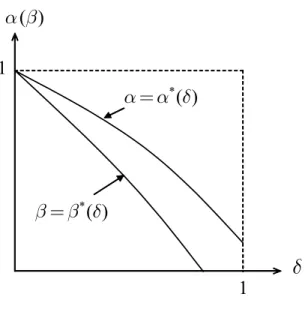
A detailed proof is provided in the Appendix. An example of the locusα=α∗(δ) is in Fig. 1. Note thatα∗(δ)is decreasing inδ.Ifδ rises, the gapu−urises but the RHS of Add-IC falls. Thus, if δ is higher, then Add-IC may hold for a lowerα. Intuitively, when firms are more patient and thus more willing to wait for future reward than to capture the current-period gain by understating their cost types, they may depend on a lower level of contractual commitment. Note also that the level of α∗(δ) is decreasing in the ratio γ = ρ−4θ
H. Intuitively, when 4 is higher, high-cost firms
are more willing to wait for the continuation-value reward; when the continuation-value reward is delivered in terms of market-share favors (e.g., qiLL = qHHi = 1),the payoff will increase more
2 8Letting market shares in tiesq2
LL=q2HH=qT2,the last term in (8) becomesαµ(ρ−θH)[(2µ−1)q2T+(1−µ)],which
rises inq2
T ifµ > 12.
2 9If firms are not sufficiently patient, some inefficiency begins to have an effect on the APPE-value set as is detailed by Athey and Bagwell (2001).
δ
*( )
β β δ
=
*( )
α α δ
=
( )
α β
1
1
Figure 1: Example ofα=α∗(δ) andβ=β∗(δ).
significantly for a higher 4. Firms may then need a lower level of contractual commitment. On the other hand, when the marginρ−θH is higher, high-costfirms are more tempted to capture the current-period gain, and thus their incentives should be more strongly bounded by the contract.
Consider next the parameter range ρ < CH in which qHH1 +q2HH = 0 in an optimal collusion. The contractxi(β) that corresponds to (5) and (6) becomes
ti¡qi, L¢ = θLqi and (13) ti¡qi, H¢ = θHqi+β(ρ−θH)qi, (14) where0≤β ≤1.A high-costfirm is assigned to zero output in an optimal collusion. Any positive production is accomplished by either a low-cost firm or a high-costfirm that surely lies. If a high-cost firm lies and ever producesqi >0,it has gain(ρ−θ
H)qi but suffers costs β(ρ−θH)qi.Note that there is no information-rent term in the payment. The binding On-ICiH implies that
v1HL−vLH1 = (1−β)(2−µ)(ρ−θH)
δ . (15)
Thus, if a line segment V(β)⊂Vm exists, then its width must be sufficiently long: u−u≥ (1−β)(2−µ)(ρ−θH)
δ . (Add-IC)
There is a vectorz(β) that satisfies the binding On-ICi
H and Add-IC if for any δ, β ≥β∗(δ)≡max ½ (2−µ) (1−δ+µδ)−µ2δγ 2−µ+ (3µ−2)δ , 0 ¾ . Following the same arguments as above, we can obtain the following result.30