The Challenge of Predicting Financial Crises:
Modelling and Evaluating Early Warning Systems
by
Mary Hany A.K. Dawood
Dissertation submitted to University of Birmingham
for the degree of Doctor of Philosophy
Department of Economics University of Birmingham April 2016
University of Birmingham Research Archive
e-theses repository
This unpublished thesis/dissertation is copyright of the author and/or third parties. The intellectual property rights of the author or third parties in respect of this work are as defined by The Copyright Designs and Patents Act 1988 or as modified by any successor legislation.
Any use made of information contained in this thesis/dissertation must be in accordance with that legislation and must be properly acknowledged. Further distribution or reproduction in any format is prohibited without the permission of the copyright holder.
Dedication
Acknowledgements
I would like to express my sincere appreciation to Mr. Nicholas Horsewood, my venerable supervisor whose expertise, understanding, constant support, and invaluable comments added considerably to my experience during every step of this research.
I would also like to thank Dr. Frank Strobel, my supervisor and grand supporter during my application process to the university, and for his helpful and educating academic views and comments throughout the whole research.
Furthermore, my profound appreciation goes to the Egyptian Ministry of Higher Ed-ucation for their financial sponsorship during my study at the University of Birmingham. I am also very grateful to Dr. Charles Rahal for his great advice and continuous help in numerous occasions, especially with respect to the development of the dynamic-recursive forecasting technique.
Finally, I would like to express my deep gratitude to the lady and the man who were the reason behind this work and all what I have managed to achieve so far, my Mother and Father. Your everlasting encouragement and heartening support has instilled in me personality and confidence to set up high goals and pursue them passionately. To them and to my family I would like to say thank you for always being there.
Last, but definitely not the least, to my best friends who were and remain a source of inspiration for me. I cannot adequately express how thankful I am for your great emotional support that helped me get to this day.
Abstract
The main purpose of constructing ”Early Warning Systems” (EWSs) for financial crises is to provide policy makers with some lead time to take pre-emptive actions that would help avoid, or at least mitigate, the damages of an approaching crisis. Accordingly, this study empirically evaluates and compares the effectiveness of the econometric models developed so far to construct EWSs. In addition, a more accurate (dynamic-recursive) forecasting technique is developed to generate better out-of-sample warning signals for currency, banking, and sovereign debt crises in the different regions of the world.
The empirical analysis shows that the predictive performance of the EWS is signifi-cantly improved when using simple pooled models that account for the heterogeneity of the signalling indicators across the different regions. Moreover, including the entire crisis period in the sample outperforms the more common practice of dropping post-crisis-onset periods or using a multinomial specification of the crisis variable. In addition, the findings reveal that our dynamic-recursive technique provides more accurate out-of-sample fore-casts for logit models. Finally, the dynamic signal extraction approach is recommended for policy makers who value avoiding financial crises at all costs, while the binomial logit model is more suitable for less conservative policy makers who consider the economic and social costs of false alarms.
Keywords: financial crisis, early warning, binomial logit, multinomial logit, dynamic signal extraction, dynamic-recursive forecasting
Contents
1 Introduction 1
1.1 The Stimulus for Early Warning Systems . . . 2
1.2 The Renewed Challenge . . . 4
1.3 Research Objectives and Key Contributions . . . 5
2 Literature Review 9 2.1 Interdependencies and Sequencing of Financial Crises . . . 10
2.2 Defining Financial Crises . . . 12
2.2.1 Currency Crisis . . . 12
2.2.2 Banking Crisis . . . 15
2.2.3 Sovereign Debt Crisis . . . 17
2.3 Crises Causes and Leading Indicators . . . 18
2.3.1 Currency Crisis Indicators . . . 18
2.3.2 Banking Crisis Indicators. . . 25
2.3.3 Sovereign Debt Crisis Indicators . . . 30
2.4 Statistical Methods . . . 32
2.4.1 Signal Extraction Approach . . . 34
2.4.2 Discrete-Dependent-Variable Models . . . 35
2.4.3 Other Methods . . . 38
3 Econometric Methods and Evaluation Criteria 41 3.1 Dynamic Signal Extraction Approach . . . 42
3.2 Binary Logit Model . . . 46
3.3 Multinomial Logit Model . . . 49
3.4 EWS Evaluation Criteria . . . 51
4 Modelling EWSs: The Case of Currency Crises 55 4.1 Sample Data. . . 56
4.2 Currency Crisis Definition . . . 56
4.3 Signalling Indicators of Currency Crises . . . 61
4.3.1 External Competitiveness . . . 61
4.3.2 Real and Public Sector . . . 63
4.3.3 Financial Sector . . . 64
4.3.4 Measures of Contagion . . . 65
4.4 Descriptive Statistics and Event Study . . . 66
4.5 Dynamic Signal Extraction Approach . . . 70
4.5.1 Performance of Single Indicators . . . 71
4.6 Binary Logit Estimation . . . 79
4.6.1 The Setup . . . 79
4.6.2 Estimation Results . . . 82
4.6.3 In-Sample Forecasts . . . 87
4.6.4 Out-of-Sample Forecasts . . . 90
4.7 Multinomial Logit Estimation . . . 93
4.7.1 Estimation Results . . . 94
4.7.2 Forecasting Performance . . . 99
4.8 Evaluation of EWS Methods . . . 102
5 Modelling EWSs: The Case of Banking Crises 107 5.1 Sample Data. . . 107
5.2 Systemic and Non-Systemic Banking Crises. . . 109
5.3 Signalling Indicators of Banking Crises . . . 111
5.3.1 Financial Variables . . . 111
5.3.2 Macroeconomic Indicators . . . 114
5.3.3 Spillover Effect . . . 115
5.4 Descriptive Statistics and Event Study . . . 115
5.5 Dynamic Signal Extraction Approach . . . 119
5.5.1 Individual Indicators and Composite Index . . . 120
5.5.2 Predictive Power . . . 124
5.6 Binary Logit Model . . . 128
5.6.1 Regional Heterogeneity . . . 129
5.6.2 Simplicity vs. Complexity . . . 134
5.6.3 Predictive Performance . . . 136
5.7 Multinomial Logit Model . . . 138
5.7.1 Estimation Results . . . 138
5.7.2 Predictive Performance . . . 143
5.8 EWS Evaluation and Conclusion . . . 145
6 Modelling EWSs: The Case of Sovereign Debt Crises 149 6.1 Sample Data. . . 150
6.2 Defining Sovereign Defaults . . . 151
6.3 Signalling Indicators . . . 152
6.4 Descriptive Statistics and Event Study . . . 157
6.5 Dynamic Signal Extraction Approach . . . 161
6.5.1 Performance of the Signalling Indicators . . . 162
6.5.2 Performance of the Composite Index . . . 165
6.6 Binary Logit Model . . . 170
6.6.1 Fitting Estimation Models . . . 171
6.6.2 Assessing Predictive Power . . . 177
6.7 Multinomial Logit Model . . . 180
6.7.1 Estimation Results . . . 181
6.7.2 Forecasting Accuracy . . . 186
7 Summary, Conclusions and Recommendations 193
7.1 Contributions to EWS Literature . . . 195
7.1.1 Main Contributions . . . 195
7.1.2 More Specific Contributions in Each Crisis Type . . . 198
7.2 Key Results on Crises Signalling Indicators . . . 202
7.2.1 Signalling Indicators of Currency Crises. . . 202
7.2.2 Signalling Indicators of Banking Crises . . . 204
7.2.3 Signalling Indicators of Sovereign Debt Crises . . . 206
7.3 Evaluation of EWS Predictive Power . . . 208
7.3.1 Regional Heterogeneity . . . 208
7.3.2 Simplicity vs. Complexity . . . 210
7.3.3 Dynamic-Recursive Forecasting Technique . . . 217
7.3.4 The Final Verdict . . . 218
7.4 Recommendations . . . 221
7.4.1 Signalling Indicators . . . 222
7.4.2 Econometric Technique . . . 223
Appendix A List of Currency Crisis Neighbours 225
Appendix B Episodes of Banking Crises 227
Appendix C Debt Crisis Episodes 235
List of Tables
2.1 Review of Financial Crises Signalling Indicators . . . 33
4.1 Currency Crises Dates by Country . . . 60
4.2 Currency Crisis Signalling Indicators . . . 62
4.3 Quantitative Analysis of Currency Crisis Indicators . . . 67
4.4 Performance of Single Indicators using Optimal Thresholds . . . 72
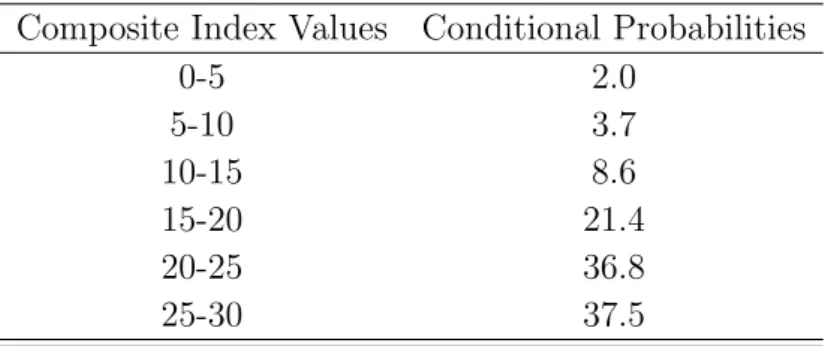
4.5 Conditional Probabilities of the Composite Index . . . 75
4.6 Currency Crisis Forecasts using Dynamic Signal Approach . . . 77
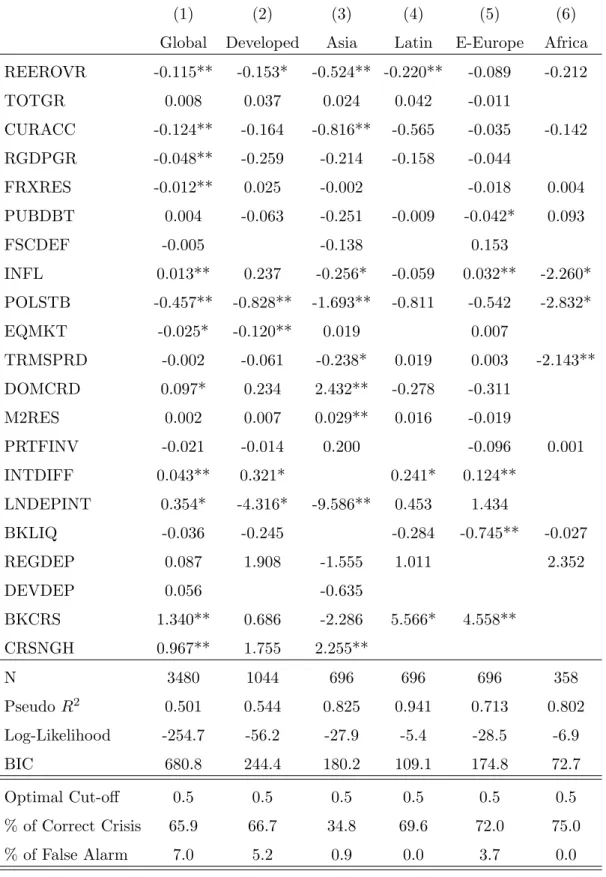
4.7 Binomial Logit Estimation of Currency Crises using 1 Lag . . . 83
4.8 Binomial Logit Estimation of Currency Crises using 3 & 6 Lags . . . 84
4.9 Binomial Logit Estimation of Currency Crises using Panel FE . . . 85
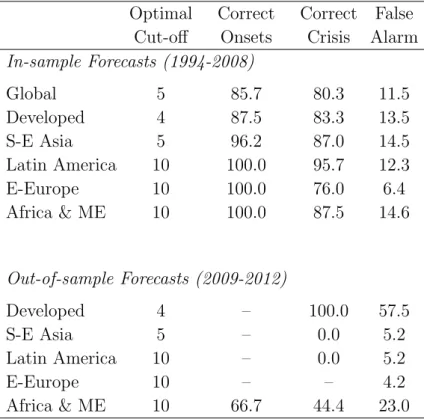
4.10 In-Sample Currency Crisis Forecasts using Logit . . . 88
4.11 Out-of-Sample 2009-2012 Currency Crisis Forecasts using Logit . . . 92
4.12 Multinomial Logit Estimation of Currency Crises using 1 Lag . . . 95
4.13 Multinomial Logit Estimation of Currency Crises using 3 & 6 Lags . . . . 96
4.14 In-Sample Currency Crisis Forecasts using MLogit . . . 100
4.15 Out-of-Sample Currency Crisis Forecasts using MLogit . . . 101
4.16 Evaluating In-Sample Performance of Currency Crises EWSs . . . 103
4.17 Evaluating Out-Of-Sample Performance of Currency Crises EWSs . . . 104
5.1 Candidate Indicators of Banking Crisis . . . 112
5.2 Quantitative Analysis of Banking Crisis Indicators . . . 116
5.3 Results of Grid Search on Individual Indicators . . . 121
5.4 Conditional Probabilities of the Composite Index . . . 123
5.5 Banking Crisis Forecasts using Dynamic Signal Approach . . . 124
5.6 Binary Logit Regression of Banking Crises using 1 Lag . . . 130
5.7 Binary Logit Regression of Banking Crises using 2 Lags . . . 131
5.8 Binary Logit Regression of Banking Crises using Fixed / Random Effects . 132 5.9 Out-of-sample 2008-2012 Banking Crisis Forecasts . . . 137
5.10 Multinomial Logit Regression of Banking Crises using 1 Lag . . . 140
5.11 Multinomial Logit Regression of Banking Crises using 2 Lags . . . 141
5.12 Forecasting Performance of Multinomial Logit EWSs for Banking Crises . 144 5.13 Evaluating the Performance of Banking Crises EWSs . . . 146
6.1 Sovereign Defaults 1980-2012 . . . 153
6.2 Signalling Indicators of Sovereign Debt Crises . . . 155
6.3 Quantitative Analysis of Debt Crisis Indicators . . . 158
6.4 Results of Grid Search on Individual Indicators . . . 163
6.6 Sovereign Debt Crisis Forecasts using DSA . . . 168 6.7 Binary Logit Regression of Sovereign Defaults using 1 Year Lag . . . 172 6.8 Binary Logit Regression of Sovereign Defaults using 2 Years Lag . . . 173 6.9 Binary Panel Logit Regression of Sovereign Defaults using FE and RE. . . 174 6.10 Out-of-sample 2006-2012 Debt Crisis Forecasts . . . 179 6.11 Multinomial Logit Regression of Sovereign Defaults using 1-Year Lag . . . 182 6.12 Multinomial Logit Regression of Sovereign Defaults using 2-Years Lag . . . 183 6.13 Forecasting Performance of Multinomial Logit EWSs for Debt Crises . . . 186 6.14 Evaluating the Performance of Debt Crises EWSs . . . 189 7.1 Summary Statistics of the Financial Development Index and its Components214 7.2 Results of the Discriminant Analysis . . . 216
List of Figures
4.1 Exchange Market Pressure Index and Crisis Thresholds . . . 59
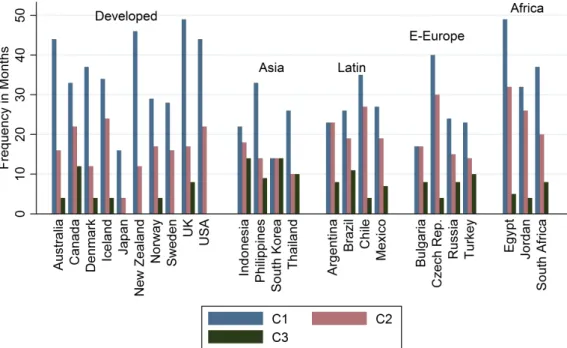
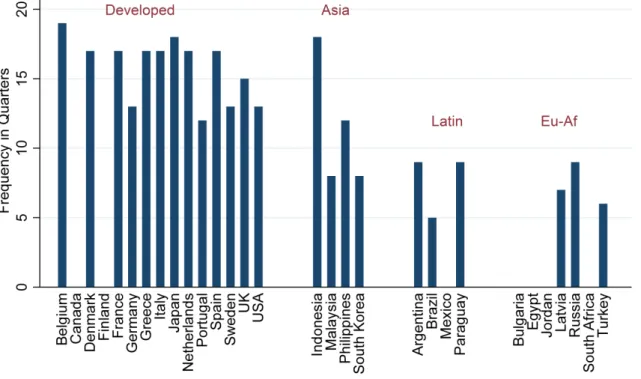
4.2 Number of Months Spent in Currency Crisis . . . 61
4.3 Behaviour of Candidate Variables around Currency Crisis Episodes . . . . 69
4.4 Conditional Probabilities vs. Crisis Incidents . . . 76
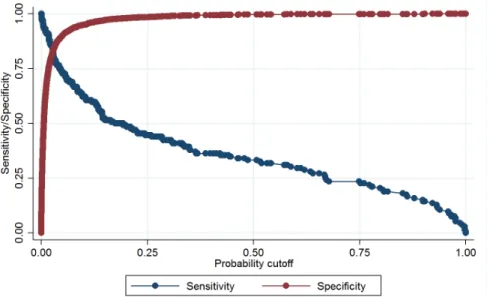
4.5 Optimal Probability Cut-off Point for Currency Crises. . . 89
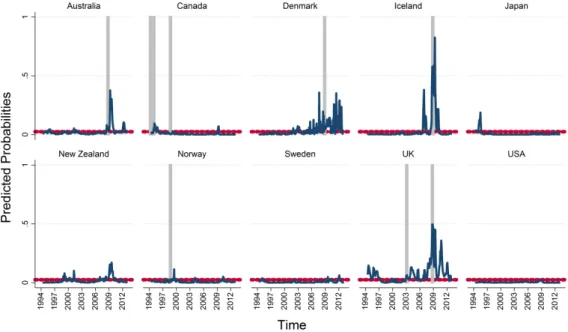
4.6 Predicted Probabilities in Developed Countries using a 6-month Lag . . . . 105
5.1 Systemic and Non-systemic Banking Crises . . . 110
5.2 Behaviour of Candidate Variables around Banking Crisis Episodes . . . 118
5.3 Conditional Probabilities vs. Crisis Incidents . . . 125
5.4 Optimal Probability Cut-off Point for Banking Crises . . . 135
5.5 Predicted Probabilities of BC in Developed Countries . . . 148
6.1 Years in Sovereign Debt Crisis . . . 154
6.2 Behaviour of Candidate Variables around Debt Crisis Episodes . . . 160
6.3 Conditional Probabilities vs. Crisis Incidents . . . 167
6.4 Conditional Probabilities vs. Crisis Incidents . . . 170
6.5 Optimal Probability Cut-off Point for Sovereign Defaults . . . 175
7.1 Financial Development Index by Country Region . . . 212
Chapter 1
Introduction
The renowned economist, Frederic Mishkin, noted the following about the anatomy of financial crises:
“A healthy and vibrant economy requires a financial system that moves funds to economic agents who have the most productive investments opportuni-ties. . . Financial crises interfere with this process because they can drive the economy away from an equilibrium with high output in which financial mar-kets perform well to one in which output declines sharply because the financial system is unable to channel funds to those with the best investment opportu-nities.” (Mishkin, 1992, p. 115)
The 1990s have witnessed the outbreak of a number of financial crises. Due to the pro-gressively integrated nature of financial markets around the world and global capital flows, most of these crises were not confined to the individual country in which they originated, but spread to other economies, near and far, in a so-called contagion or “domino effect”. During this decade, the most salient crises in terms of severity and social and economic repercussions are mainly: the Japanese banking crisis at the start of the decade, the Euro-pean currency crisis in 1991/93, the collapse of the Mexican peso in 1994, the tsunami-like Asian financial crisis of 1997/98, the Russian “flu” in 1998, the Latin American crisis at the end of 1999, and the twin crisis in Turkey at the start of the new millennium.
1.1
The Stimulus for Early Warning Systems
The costs of a financial crisis can be severe in terms of losses in international reserves, out-put declining and worsening standards of living, real exchange rate deterioration, credit crunch due to increasing number of non-performing loans, massive capital flight, disrup-tions in the payments system, and general loss of confidence. For example, the amount of capital flight out of the East Asian region in the aftermath of the 1997 crisis was estimated at $100 billion. During the currency crisis in 1992, the European countries lost a total of $200 billion in international reserves (Bhattacharyay et al., 2009), whereas the Mexican crisis of 1994 cost the economy a 20% loss in its aggregate output (Davis and Karim,
2008b). In addition, Kaminsky (1999) reported that the fiscal costs of resolving banking crises in Chile and Argentina amounted to over 40% of their GDP, and that central banks tend to lose up to 25% of their foreign exchange reserves when resolving twin crises in general.
Therefore, by the second half of the 1990s, great concern arose in most economies regarding the soundness of their financial and real sectors. Furthermore, the International Monetary Fund (IMF) started to encourage both advanced and emerging countries to improve the transparency, frequency and quality of their statistical data to be able to detect the build-up of financial turmoil in their economies. As a result of such stimulus and startled at how detrimental financial crises could be to an individual, regional and even the world economy, several attempts were devoted to the construction of what came to be known as an “Early Warning System” (hereafter EWS). That is, a financial monitoring tool that applies econometric methods to generate predictions of the likelihood of an approaching financial crisis over a given time horizon (Cheang, 2009). This system aims to provide warning signals of underlying financial or real sector weaknesses and fragility that could put an economy on the verge of a probable crisis, with the purpose of giving policy makers a lead time to adopt pre-emptive measures to prevent, or at least mitigate, such damage to the economy.
To the extent that the “Lucas critique” applies to the study of modelling EWSs for financial crises, a reliable set of early warning indicators that were identified empirically may become less effective if policy makers would henceforth change their behaviour in response to such signals than they did in the past; thereby transforming these variables into early warning indicators of corrective policy actions rather than of financial crises. While this feedback effect of the indicators on crisis prevention has not yet impaired the predictive power of EWSs, as there is still no solid and generally agreed upon EWS that is widely used, there is no guarantee that this feedback effect will not be stronger in the future. This possibility requires the continuous evaluation of the efficiency of existing EWSs as new systemic threats emerge. Furthermore, it triggers the need to investigate the economic, social, and political value of the warning signals once they become public. That is, whether and how they affect the behaviour and the decision-making process of (domestic and international) investors, government officials, and policy makers.
Of the earliest and most influential efforts made in this context are those of Frankel and Rose (1996), representing the primary contribution of academics to the construction of EWSs using a probit regression. A couple of years later, the IMF came up with an-other original approach, whenKaminskyet al.(1998) developed a non-parametric method to model EWSs –namely the “Signal Extraction Approach”, while Demirguc-Kunt and Detragiache(1998) suggested the estimation of a multivariate logit regression to predict fi-nancial crises. Thereafter, several central banks, such as the U.S. Federal Reserve (Kamin et al.,2001) and the Bank of Finland (Komulainen and Lukkarila, 2003), and other aca-demic researchers (Mariano et al., 2002) have also attempted to develop EWSs. These early models were primarily concerned with identifying the most relevant macroeconomic and financial indicators that are likely to provide warning signals of a vulnerable position from a theoretical and empirical point of view.
1.2
The Renewed Challenge
Notwithstanding the collective efforts of researchers and policy institutions in developing a warning system for crises,Davis and Karim(2008a) argued that the current global finan-cial crisis of 2007/08 “came as a surprise not only to most finanfinan-cial market participants but also in some degree to the policy community”. None of the financial stability reports of the IMF, the European Central Bank or the Bank for International Settlements for the beginning of 2007 was able to foresee the severity or international span of the crisis that emanated from the U.S. sub-prime market, let alone the outburst of the deepest financial and economic crisis to hit the global economy since the Great Depression of the 1930s. Moreover, Rose and Spiegel (2009) and Candelon et al. (2014) demonstrated that the existing EWSs and the commonly used indicators were unable to provide warning signals of the crisis. This was mainly attributed to ignoring the possibility of cross-country con-tagion and spillover from other domestic markets (e.g. real estate, external debt), and pooling developed and developing countries together.
This crisis that originated in the U.S. mortgage market in 2006, and started to hit the entire U.S. financial system in 2007, reached the rest of the world by the second half of 2008. A report by Kelleher et al. (2012) declared that the crisis had a cost tag of $12.8 trillion in terms of output loss in the U.S. alone. In particular, they reported that the actual GDP loss is estimated at $7.6 trillion, calculated as the difference between the potential GDP had the financial crisis not occurred and the actual GDP as reported by the government for the period 2008-2012. The additional $5.2 trillion is labelled as the avoided output loss that was prevented by the immense fiscal and monetary interventions of the U.S. Treasury and the Fed.
Essentially, almost all the industrialised countries were affected, as well as a large number of developing economies, where stock markets have fallen and large financial institutions have either collapsed or been bought out. Therefore, the renewed challenge manifested by the outburst of the 2008 global financial crisis has posed several questions as
to the quality and the effectiveness of the EWSs that were developed thus far in predicting the current crisis as well as any future crises. Despite the numerous efforts to find reliable leading indicators and construct a credible model, “the existing EWSs are not accurate enough and should only be used complementary to other vulnerability indicators” (Lang,
2013, p. 4).
In the April 2009 London Summit, the G20 countries called for the establishment of a new Financial Stability Board that is to “collaborate with the IMF to provide early warning of macroeconomic and financial risks and the actions needed to address them”1.
Accordingly, further efforts are still required to find new macro-prudential indicators and develop improved methods in an attempt to effectively forewarn the build-up of vulnerabilities and give way to undertaking pre-emptive measures that would mitigate (or ideally avoid) the possible damages to the world economy.
1.3
Research Objectives and Key Contributions
As illustrated in detail in Chapter2, most authors were mainly concerned with developing or improving on a certain type of econometric technique and comparing its early warning performance to the other standard methods. Others focused on applying these methods to different situations and circumstances, whether of a group of countries or a specific economy, by changing the particular crisis definition or the signalling indicators used to predict crises incidents. As a result, several modified econometric methods were recently introduced in the literature, which were found to outperform the traditional techniques in forecasting a specific type of financial crisis or crises in a specific type of economy.
However, thus far no study has attempted to cross-check the modified statistical meth-ods or to evaluate their performance in forewarning each of the three major types of fi-nancial crises (currency, banking, sovereign debt) in the different country regions of the
world. Only Lestano et al. (2003) investigated the construction of EWSs for each of the three types of crises in East Asia using a binomial logit regression.
Furthermore, studies attempted to model EWSs in either developed or emerging coun-tries separately, or to pool them together into one dataset. However, no study investigated the possible differences between the different types of economies in terms of the signalling indicators or the most appropriate method to predict crisis periods. This came as a rec-ommendation of Davis and Karim (2008a) after having pooled both types of economies together and getting zero forecasting results. In fact, Gourinchas and Obstfeld (2012) considered a separate model for each type of economy when investigating banking and currency crises, but they examined a limited number of explanatory variables, used annual data, and estimated only binomial logit regressions.
Consequently, this study attempts to close these gaps in the literature. In particular, the contribution to the literature of constructing EWSs for financial crises is three-fold. First, this research investigates the possibility of signalling indicator differences between developed and developing countries, given their inherent distinctiveness with respect to the structure of the economy, vulnerability to shocks, extent of integration into the global financial system, degree of dependence on other economies, institutional effectiveness and policy responses. Furthermore, the investigation goes even deeper to identify the most significant determinants of each type of financial crisis (currency, banking, sovereign debt) in the different country regions1.
The second contribution entails evaluating and comparing the effectiveness of the re-cently developed econometric methods to construct EWSs for financial crises in predicting the current global financial crisis, as well as any future crisis. This objective extends to cross-checking the different techniques developed and tested on a particular type of crises or a particular type of economy on the other types. More specifically, the research ex-amines the performance of binary vs. multinomial logit regression models in predicting 1Regional models are only considered by Kamin et al. (2001), Burkarta and Coudert (2002) and Candelon et al.(2012) in the case of currency crises. They found some parameter heterogeneity across the different subsets of the emerging market countries.
currency, banking, and sovereign debt crises in both developed and developing coun-try regions. The use of multinomial logit models was originally suggested by Bussiere and Fratzscher (2006), who examined their predictive performance on currency crises in emerging markets only. Furthermore, our research evaluates the effectiveness of the EWS developed byCasuet al.(2012), who proposed a dynamic signal extraction approach (the indicators’ thresholds are determined on a dynamic basis as opposed to the traditional static method that depends on the sample distribution) to generate forewarning signals of banking crises in developed countries.
Finally, a more powerful forecasting technique (the dynamic-recursive technique) is proposed, developed and tested to generate more accurate out-of-sample warning signals for currency, banking, and sovereign debt crises in the different country regions of the world. The predictive performance of all econometric and forecasting techniques are compared using a number of evaluation criteria that are applied for both the in-sample as well as the less frequently reported, though more important and policy-relevant, out-of-sample periods. In addition, we utilise two more commonly used model evaluation criteria, namely the quadratic probability score and the area under the receiver operating characteristic (ROC) curve.
It is important to note, that our research follows the suggestion of Frankel and Sar-avelos (2012) to overcome the problem of indicators’ selection bias. They questioned the usefulness of the ‘forewarning’ indicators that are selected after the crisis has occurred, thus having the benefit of hindsight into its causes and symptoms. Therefore, they chose their variables based on underlying economic reasoning, and complemented that with a broad review of the empirical literature to specify the indicators that were consistently found to be statistically significant over time, country and crisis. On that account, this research applies the same line of criteria to select the candidate indicators for each type of financial crises.
Research Plan: The remainder of the study is organised as follows: Chapter2 sur-veys the previous studies that attempted to construct EWSs before and after the current global financial crisis. It details the way they quantified crisis episodes, the methods they applied, and the findings of their studies. The methodologies applied to construct an EWS for the various types of financial crises, as well as the criteria used to compare and evaluate their performance, are outlined in Chapter 3. Then, the sample data, cri-sis definitions and the results of the constructed EWSs for currency crises are presented in Chapter 4, while Chapter 5 is dedicated to investigating banking crises, and Chap-ter 6 focuses on sovereign debt crisis incidents. Finally, the summary of results and the concluding remarks are given in Chapter 7.
Chapter 2
Literature Review
It is well noted in the literature that the construction of EWSs undergoes three main steps. First, it is important to find a proper and precise definition of a financial crisis. That is, to distinguish between what is considered as a crisis and what could be labelled under “usual fluctuations”. The second step entails identifying the probable causes of the crisis (from both the theory and the empirics), and thus extracting the financial, economic or any other variables that can act as signalling indicators for an upcoming crisis. Finally, deciding on the statistical method to be used to estimate the probability of an impending crisis and to test the statistical and economic significance of the proposed models on both in-sample and out-of-sample data is a crucial matter.
As unpretentious and straightforward as the first two steps may seem, there are nearly as many differences among the researchers regarding these issues as there are with respect to the proposed methods used in prediction. Most importantly, Casu et al.(2012) partly attributed the inability of the pre-2008-crisis EWSs to raise an alarm as to the devastation of the crisis to the misspecification of the crisis definition and the warning indicators used (i.e. their response and explanatory variables).
Consequently, this chapter is devoted to surveying the paths undertaken by the dif-ferent previous studies, theoretical and empirical, in tackling the issue of constructing an effective EWS.
2.1
Interdependencies and Sequencing of Financial
Crises
In the context of financial crises, three varieties can be distinguished: currency crises, banking crises, and sovereign debt crises. Each of these crises may occur independently of the others; however, recent analyses have evidenced their interconnection and the causality or complementarity that may arise between them.
In particular, Kaminsky and Reinhart (1999) detected that a banking-currency twin crisis has occurred more frequently in the aftermath of the liberalisation of financial mar-kets in several emerging economies in the late 1980s. Their paper evidenced that“knowing that a banking crisis was underway helps predict a future currency crisis . . . the collapse of the currency deepens the banking crisis, activating a vicious spiral”. Consequently, more recent studies tend to include a dummy for banking crises as an explanatory variable when analysing currency crises, such asKomulainen and Lukkarila(2003), or at least use a variable like bank deposits as a proxy for the possibility of bank runs (for example refer toBussiere and Fratzscher,2006;Lin et al.,2008).
A variety of theoretical models attempted to explain this phenomenon of currency-banking twin crises. For example, Velasco (1987) and Calvo (1998) stressed that when central banks print money to bailout distressed financial institutions, a currency collapse can be triggered by excessive money creation according to the traditional model of cur-rency crises (discussed below). On the other hand,Stoker (1995) pointed to the opposite causal direction, where foreign exchange market problems give rise to banking crisis. He developed a model in which an increase in foreign interest rates, while the monetary au-thority is committed to a fixed parity, results in the loss of foreign reserves, as the central bank is forced to sell foreign for domestic currency to increase the domestic interest rates. If this is not sterilised by an increase in the money supply, the high interest rate will lead to a credit crunch, increased bankruptcies, and eventually a banking crisis. Moreover,
Mishkin(1996), and laterGoldstein (2005), referred to the mismatch between banks’ for-eign liabilities and domestic assets, which makes the banking sector exposed to exchange rate risks. That is, a speculative attack that puts pressure to devalue the domestic cur-rency weakens the position of banks if a large share of their liabilities is denominated in a foreign currency. This induces foreign creditors to withdraw their money and possibly induce a run on the banks. Foreign currency withdrawals indirectly reduce the amount of reserves held by the government, making it even more difficult to defend the domestic currency. This yields a vicious cycle between the two types of crises.
A third family of models assert that currency and banking crises can have common causes. An example of these can be found in McKinnon and Pill (1996), who model an initial economic boom that is fuelled by a marked cumulative appreciation of the real exchange rate. If the increase in the demand for imports is financed by borrowing abroad, the current account deficit worsens and triggers an attack on the domestic currency. Since the boom is usually financed by an expansion in bank credit using foreign borrowings, the capital outflows caused by the speculative attack leads to the collapse of the banking system as well.
With respect to banking-debt twin crises,Babeckyet al.(2014) andBalteanu and Erce
(2014) maintained that the rescue plans (bailout money, government deposits, liquidity injections by the central bank) initiated to support a failing banking sector may impair the sustainability of government debt, especially if the authorities decide to offer explicit deposit insurance to prevent bank runs. Furthermore, the credit crunch that usually accompanies a banking crisis can deepen the recession and lead to further falls in public revenues, which increases the probability of sovereign defaults. On the other hand, the reverse loop running from debt to banking crises can also be triggered as governments, in the face of an external debt problem, default on their bank-held bonds, which in turn may lead to large capital losses and threaten the solvency of banks. Therefore, it is not straightforward to put the bi-directional relationship between banking and debt crises in the context of causality.
Finally, currency-debt twin crises may occur because currency crashes could lead to a sovereign debt crisis if public debt is mostly denominated in foreign currency, as they com-promise the ability of public authorities to service and repay their obligations (Babecky et al., 2014). On the other hand, sovereign defaults tend to trigger capital outflows, which can put serious pressure on the domestic currency and induce speculative attacks (Balteanu and Erce, 2014).
Despite these arguments and findings, Lang (2013) cited that no research thus far has considered the possibility of constructing an EWS for “triple crises” by analysing the interdependencies between currency, banking, and sovereign debt crises. Therefore, we attempt to address this issue by including relevant variables from both the fiscal and the banking sectors (i.e. crisis dummies and variables that reflect sector vulnerability), as well as indicators of external competitiveness, as explanatory variables in the EWS of each of the three types of financial crises.
2.2
Defining Financial Crises
The first pivotal step in designing an EWS for any type of financial crisis is, ordinarily, to define what is meant by a crisis event. Since crises are a state of economy rather than a variable with a universally agreed-on measure, it is essential to find a quantitative means of measurement of what can be defined as a state of financial crisis before we can hope to construct a model to forecast such events.
2.2.1
Currency Crisis
With respect to currency crises, most studies concurred on a common quantitative def-inition that accounts for the build-up of pressure on the domestic currency, namely the “Exchange Market Pressure” index (hereafter EMP). This index, which is originally de-veloped in a series of papers by Eichengreen, Rose and Wyplosz in the 1990s (as cited in
exchange rate, the interest rate, and the international reserves. The intuition behind these three index components is to capture both successful (currency devalued) and unsuccess-ful (currency defended by running down foreign reserves or increasing the interest rate to attract foreign capital) attacks on the domestic currency (Fratzscher, 2003; Su et al.,
2010). Accordingly, a crisis episode is identified when this index crosses a pre-specified threshold level.
However, despite agreeing on this common definition, several differences are still no-ticeable among the various researchers that employed this index as their currency crisis variable. For example, some authors used the real exchange rate and the real interest rate to account for the differences in inflation rates across countries and over time (Bussiere and Fratzscher, 2006; Ari and Dagtekin, 2007), while others used the nominal rates or the changes in the spread between the country’s interest rate and that of the U.S. (Lin et al.,2008). Furthermore, Kaminsky and Reinhart(1999),Heun and Schlink(2004) and
Arias and Erlandsson (2005) dropped the interest rate differentials from the EMP index altogether due to data availability issues. In addition, the time frequency considered for the data was also subject to differences. Edison (2003), Bussiere and Fratzscher (2006) and Ari and Dagtekin (2007) used monthly intervals, while Andreou et al. (2009) and
Wonget al. (2010) used quarterly periods, and Frankel and Saravelos(2012) and Kamin et al.(2001) used annual data.
To the extent that the full version of the EMP index captures both successful and unsuccessful attacks on the domestic currency, some authors argued that only the suc-cessful attacks should be considered as a currency crisis. Therefore, they used a different dependent variable in their forecasting models. An example would be Frankel and Rose
(1996) andLestanoet al.(2003) who defined another variable, the “currency crash” index, which signifies a crisis event as a nominal depreciation of the domestic currency by more than 25% that is accompanied by at least a 10% increase in the rate of depreciation.
domestic interest rates will rise in the period leading up to the devaluation to compensate domestic-currency bond holders for the impending devaluation. Immediately following the devaluation, however, domestic interest rates will fall back to foreign levels. Reserves, which flowed out of the domestic country before the crisis due to reduced money demand, will flow back to satisfy increased money demand. Consequently, the changes in interna-tional reserves and interest rates may cancel out some of the change in the exchange rate, resulting in the generation of no signal for a crisis that is actually taking place. Therefore,
Zhang suggested the decomposition of the EMP index into its individual components, so that a crisis signal would be generated if any of the three EMP components crossed their pre-determined threshold levels.
However, when Candelon et al. (2012) compared the performance of the EMP index to that of the index suggested by Zhang, they concluded that both tend to generate quite similar results (i.e. crisis dates). Furthermore, Lestano et al. (2003) experimented with four different dating schemes for currency crises and found that the definitions of Eichengreen, Rose and Wyplosz, and Kaminsky and Reinhart are superior to those of
Frankel and Rose, and Zhang in terms of the in-sample forecasts.
Another area of discrepancy lies in the specification of the threshold level for the crisis index. A common practice is to define a binary variable that would assume the value of unity if the EMP index is above its country average by a certain multiple of standard deviations, and is zero otherwise. However, significant differences can be found in the specification of the multiple of standard deviations, where several studies used two standard deviations (Komulainen and Lukkarila, 2003; Krznar, 2004; Bussiere and Fratzscher, 2006; Ari and Dagtekin, 2007), while others used 1.5 (Su et al., 2010; Lang,
2013), 2.5 (Edison,2003), three (Kaminskyet al.,1998;Zhang,2001; Linet al.,2008), or even a peculiar 1.75 (Kamin et al., 2001) and 0.75 (Andreou et al., 2009). The choice of the threshold level is mostly arbitrary, while in some cases the authors attempted different thresholds and ended up with the one that fitted best.
2.2.2
Banking Crisis
Although the early study conducted byKaminsky and Reinhart (1999) identified 26 cur-rency crises and only 3 banking crises during the 1970s,Davis and Karim (2008b) showed that after the financial liberalisation undertaken by a large set of developing countries during the 1980s and the early 1990s and the development of securitised financial markets in more advanced economies, the number of banking crises has more than quadrupled after the start of the new millennium. Nevertheless, until very recently, less attention is given to the investigation and prediction of banking crises than of currency crises. One possible reason for this paradox could be that it is very difficult to find an unambiguous definition for a banking crisis. In fact, it is the most debatable definition of all three types of financial crises.
Davis and Karim (2008b) mention that a banking crisis can be defined as “the occur-rence of severely impaired ability of banks to perform their intermediary role”. However, this definition is too general as it may include bank runs, closure or mergers of major fi-nancial institutions, bank failures that amount to a considerable percent of the country’s GDP, increases in non-performing assets, etc. Therefore, researchers usually adopted a number of proxies to signal the solvency condition of banks and their general soundness. For example, Casu et al.(2012) identified a banking crisis situation if the capitalisation of the banking sector decreased by some base points, or if the net income of the banks as a percentage of their average balance sheet fell below some threshold.
On different grounds, when Simpson (2010) studied the 2008 global financial crisis, he used the variance of a country’s banking sector stock price index to capture the vul-nerability of its banking system relative to the regional or the world indices. Another recent paper bySingh (2011) criticised the use of event-based crisis dating as it can lead to delayed identification of a crisis, and it fails to account for the severity of the crisis. Instead, the author proposed the construction of a “bank fragility index”, which does not requirea priori knowledge of banking system events and has the advantage of using
monthly time series in preference to the usual annual, or at best quarterly, basis related to event timings. This index is defined as the weighted average of six variables related to liquidity risk, credit risk and interest rate risk, and was adopted to study banking crisis in India.
Alternatively, two distinct papers by Lestano et al. (2003) and by Davis and Karim
(2008b) cited a number of studies with respect to their definition of a banking crisis episode, and summarised these definitions in the following events: substantial decrease in bank capital; considerable decrease in bank deposits signifying bank runs; closures, mergers or takeovers of large banks or financial institutions; massive government inter-vention in the banking sector; increase in the ratio of non-performing loans to total bank assets; large scale bank nationalisation. They also observed that the introduction of de-posit insurance schemes in recent years has significantly decreased the contribution of bank liabilities to the episode of banking crises, as it became very difficult to track the occurrence of bank runs. Therefore, the focus of interest has recently shifted to the assets side of banks’ balance sheets to date a banking crisis, where special attention is given to the percentage of non-performing bank assets or to changes in real estate prices (which affects banks engaging in mortgage loans).
However, a more recent study byBarrell et al. (2010) criticised this line of thought in defining a banking crisis on the basis that it is unable to identify the true start and end dates of the crisis, as the criteria variables used may take a while after the crisis breaks out or ends to start revealing its onset or termination, respectively. On this ground, they relied on the IMF financial crisis episodes database to extract the timing of systemic banking crises, whereas for the non-systemic crises they used the World Bank database of banking crises (discussed in more detail in 5.2).
Finally, before turning to the definition of the third type of financial crises, it is noteworthy to shed some light on how the literature defined a joint dependent variable for a twin crisis. In this respect, Ari and Dagtekin(2007) defined a composite twin crisis indicator in an attempt to model an EWS for the 2000/2001 Turkish financial crisis. This
indicator consists of two parts, where the first is more or less a usual EMP index, with its real exchange rate, real interest rate and international reserves components. The second part is set out to measure the vulnerability of the banking system, which also comprises three components, namely the amount of bank credit extended to the private sector, the total foreign exchange liabilities and the total amount of deposits held by the domestic banking system.
2.2.3
Sovereign Debt Crisis
In contrast to the efforts dedicated to the construction of forewarning systems for both currency and banking crises, very little work was devoted to the prediction of sovereign debt crises. Therefore, the debate on the possible definition of a debt crisis is almost absent. One of the most prominent papers that addressed this type of financial turmoil is that of Manasseet al. (2003), who considered a definition for debt crises that captures both actual and potential defaults on sovereign debt. In particular, according to their definition, a country is said to be facing a debt crisis either if it is rated by Standard & Poor’s as being in default (i.e. is failing to meet its external obligations on the principal or interest payments) or if it receives a loan from the IMF Finance Department in excess of 100% of its quota as an extensive financial rescue scheme.
The exact same definition is later applied byFioramanti(2008),Manasse and Roubini
(2009),Savona and Vezzoli(2015) andJedidi(2013), whileCiarlone and Trebeschi(2005) extended the definition further to include other events as well. In addition to the ones mentioned above, they defined a country to be in crisis if the amount of overdue interest or principal payments is more than 5% of its outstanding external debt, or if it engaged into some sort of debt restructuring or rescheduling schemes. On the other hand,Lestano et al.(2003) and Lausevet al.(2011) restricted the debt crisis scenario to the event that a country requests the rescheduling of its sovereign debt, or if it engages into debt-equity swaps or voluntary buybacks. Another suggestion was made byPescatori and Sy (2007) to take into account the turbulence in sovereign bond markets in order to capture possible
debt-servicing difficulties. They argued that as more and more emerging economies gained access to sovereign bond markets, they tend to rely less on bank loan debts. Therefore, their debt crisis event was defined as either the usual Standard & Poor’s sovereign default rating or a sovereign bond spread of more than 1000 basis points above the U.S. Treasury bill.
2.3
Crises Causes and Leading Indicators
Defining the dependent variable that is intended to capture the incidents of financial crises is the first step in modelling an EWS for each type of crisis. The following step entails identifying the indicators that could be used to generate warning signals of such crises. These are mainly drawn from financial economic theory and the empirics regarding the probable causes of financial turmoil. Because different types of crises can have many different sorts of causes across the various countries of the world and over decades of time, a wide range of economic and financial variables should be considered (Frankel and Saravelos, 2012). Accordingly, this section traces the pioneering and path-breaking theoretical literature that attempted to present explanations for the occurrence of financial crises. In addition, it outlines the variety of signalling indicators applied and tested by previous empirical studies and their findings with respect to the most statistically significant ones. A summary of the most commonly used indicators is provided inTable 2.1 on page33.
2.3.1
Currency Crisis Indicators
The theoretical literature identifies three generations of models that explain the causes and determinants of currency crises. Each of these models emphasises a set of economic and financial variables that can be used as leading indicators of approaching currency crises. The different theoretical models, and hence the suggested indicators, provide a comprehensive view of the various possible threats on the domestic currency.
First-Generation Models
Initially, the earliest traditional approach focused on the role of the weak economic fun-damentals in explaining currency crises. The seminal work by Krugman (1979), later refined by Flood and Garber (1984)1, shows that, under a fixed exchange-rate regime2,
expansionary monetary policy (i.e. expansion of money supply in excess of the demand for the domestic currency) to finance persistent fiscal budget deficits will result in a grad-ual loss of international reserves, as market participants sell the excess liquidity and buy foreign currency. To maintain the peg, the central bank sells its foreign reserves, which gradually deplete at a rate equal to the growth of the money supply. As the reserves reach a critical level, a speculative attack is induced on the currency, which exhausts the remaining foreign reserves and forces the authorities to abandon the parity, resulting in currency devaluation.
A number of papers extended Krugman’s basic model in various directions, considering other factors that may force the government to abandon the peg. For example, Agenor et al. (1992) suggested that a direct result of the expansionary policies is a deterioration of the trade and current account balances due to increased import demand. Moreover, since the expansionary policies lead to increased aggregate demand, an indirect result would be a rise in the price levels. All these would lead to the overvaluation of the real exchange rate, and eventually to a speculative attack. On different grounds, Ozkan and Sutherland (1995) argued that the authorities tend to trade off between internal (preserving a target level of output) and external (fixed exchange rate) policy objectives. Therefore, an increase in the foreign interest rate that puts an upward pressure on the domestic one, will raise the cost of keeping the peg, as it negatively affects the output level (due to reduced investments). Once the cost of keeping the exchange rate fixed surpasses the benefits, the authorities will abandon the peg.
1Flood and Garber(1984) constructed a linear model that simplified Krugman’s account and extended
it to a stochastic environment.
Accordingly, the first-generation models highlight a variety of variables that could be useful for predicting currency crises, namely growing fiscal budget and current account deficits, money supply growth, exchange rate overvaluation, depletion of the foreign re-serves, inflation, movements in the level of output, as well as the evolution of domestic and foreign interest rates. These and a set of more economic fundamentals were tested empirically to assess their predictive power in real situations.
Starting with the earliest studies in this field, Kaminsky et al. (1998) (depicted in Table 2.1under KLR98) categorised the variables they applied into six broad groups which cover every aspect of the economy. Specifically, they examined 15 possible indicators to construct their EWS for currency crises in 15 developing and five developed countries over the period 1970-1995. These variables ranged from the financial sector, the real macro-economy, and the external sector (including current account and capital account variables) to the public finances, some political indicators, and several institutional variables. Their findings signified the importance of a decelerating growth rate, a sharp decrease in exports, a positive deviation of the real exchange rate from its trend, the depletion of international reserves, and a rapid increase in the ratio of domestic credit to GDP (denouncing a lending boom) as possible stimulus for currency crises. On average, these indicators were able to correctly predict 70% of the currency crisis episodes using their proposed signal approach. The same indicators were later used by Edison (2003), who replicated their method but extended the time period to 1998.
Comparable results were depicted by Frankel and Rose (1996) (FR96) who applied a probit regression model on 105 emerging economies over the period 1971-1992. They further highlighted the contribution of foreign direct investment (FDI) outflows in in-creasing the probability of currency crises in developing countries. In fact, they identified that a decrease in FDI inflows by 1% raises the probability of crises by 0.3%. On different grounds, when examining the causes of the Asian financial crisis in 1997, Dodd (2000) argued that financial derivatives, in the form of foreign exchange forwards and swaps, have played a major role in the formation, spread, and severity of the crisis. The use of
derivatives tends to increase the risk-to-capital ratios through leveraging and by dodging prudential regulatory safeguards, thus making the economy more vulnerable to a financial crisis. Furthermore, once the crisis was approaching, they helped quicken and deepen the financial distress.
A very recent and extensive review of the possible currency crisis indicators was con-ducted byFrankel and Saravelos(2012), who surveyed more than 80 articles that studied crisis episodes from the 1950s to the beginning of the millennium using a variety of esti-mation techniques, crisis definitions, and country coverage. By summarising the number of times a particular indicator was found to be statistically significant in these articles, they were able to rank the most important signalling indicators. The results of their meta-analysis manifested the prominence of international reserves, real exchange rate, credit growth, GDP growth, and the current account balance. In addition, their own examination of the 2008 financial crisis evidenced the significance of bank liquidity and the level of short-term external debt, which signifies the possibility of spillover from a weak banking sector and sovereign debt distress.
Returning to the signal approach,Andreouet al.(2009) investigated the performance of eight forewarning indicators in six individual countries. They were able to identify the most important indicator for each country separately. However, on average, they signified the role of real exchange rate and commercial bank deposits, while the performance of the money supply (as measured by M2) was found to be unsatisfactory. In contrast to these result, a more recent study by El-Shazly (2011), using logit and probit regression analyses to investigate currency crisis incidents in Egypt, showed that the ratio of M2 to international reserves is the most significant leading indicator, followed by the domestic real interest rate and the percentage change in the stock price index. Similar results also were found byKomulainen and Lukkarila(2003) (KL03), who examined 31 emerging markets during the period 1980-2001 using a probit model. In particular, the probability of currency crises was detected to be greatly affected by the M2 to reserves ratio, domestic credit growth, inflation rate, and changes in the stock price index. They also verified the
significant effect of public debt and banking sector indicators on the crisis probability, which confirms the findings of Frankel and Saravelos (2012).
Second-Generation Models
The first-generation models, which focused on weak macroeconomic fundamentals and policies as explanatory variables for financial crises, were insufficient in explaining the European Monetary System crisis in 1991-1993. The countries in Western Europe had sound fundamentals in terms of adequate foreign reserves, manageable money growth, and non-monetised fiscal deficits. This motivated a new strand of literature, the so called second-generation models, which added the features of self-fulfilling attacks and the role of investors’ expectations in explaining currency crises.
Second-generation models were developed by Obstfeld (1994, 1996) on the basis that government policies are not predetermined, but they respond to changes in the economy, while investors base their expectations about the state of the economy on the behaviour of the policy makers. This circularity between policies and investors’ expectations may give rise to multiple equilibria and generate self-fulfilling crises. The term “multiple equilibria” refers to the fact that the economy can move from one equilibrium state to another without noticeable changes in the fundamentals, but rather due to abrupt shifts in investors’ confidence. Thus, the economy may be initially in a state of equilibrium consistent with a fixed exchange-rate regime but a sudden worsening of economic prospects may lead to changes in policies that result in abandoning the peg, thereby validating investors’ expectations. Calvo (1998) explained the latter case as follows: “If investors deem you unworthy, no funds will be forthcoming and, thus, unworthy you will be”.
In this framework, Obstfeld(1994) developed a model where devaluation expectations induce investors to sell their holdings of the domestic currency. This leads to higher inter-est rates as the monetary authorities attempt to maintain the peg. However, eventually, the higher interest rates might trigger the authorities to abandon the peg out of concern for the increased expenses of servicing public debt. Furthermore, the models suggested by
Velasco(1987) and Obstfeld (1996) indicate that higher interest rates could also weaken the banking sector through moral hazard and adverse selection problems, increasing the probability of banking distress. The authorities, in this case, may prefer to devalue than to suffer the associated fiscal costs of a bailout. On different grounds, Drazen (2000) showed that political factors have a strong impact on the expectations of a country’s eco-nomic status, where continued political instability leads to prospects of persistent budget deficit, high external debt, an ineffective tax system, and low growth rates. Investors seeking refuge in foreign currency will trigger a self-fulfilling currency crisis.
According to this class of models, leading indicators of currency crises should include such variables that reflect banking problems, political stability, public debt, and investors’ expectations. Examples of research in this area include Ari and Dagtekin (2007), Son et al.(2009), andCandelonet al.(2012) who used variables, such as interest rate spreads, the term spread, and stock market prices, which have a forward-looking dimension as explanatory variables to measure the shifts in investors’ expectations and confidence.
Third-Generation Models
The outbreak of the Asian financial crisis in 1997 led to a reorientation of modelling cur-rency crises, since the economic fundamentals of the affected countries were rather sound prior to the crisis and there were no abrupt shifts in investors’ confidence. In fact, the crisis was marked by problems in the financial sector following the liberalisation of capital markets under inadequate prudential supervision. Therefore the new third generation of theoretical models highlight the adverse effect of the financial sector’s vulnerability and the possibility of contagion –the transmission of crises through different channels from one country to another.
With respect to the dynamic feedback between banking problems and currency crises (originally suggested by Velasco, 1987), Chang and Velasco (2000) and Pesenti and Tille
(2000) stress the adverse consequences of moral hazard practises in the banking system under inadequate supervision and explicit or implicit government guarantees, which
re-sult in excessive credit expansion and a large share of high-risk loans in bank portfolios. That is, the liberalisation of the capital market usually leads to more competition across banks, which in turn leads some banks to extend riskier loans in the hope of raising their profitability. Furthermore, the anticipation of a government bailout in case of trouble reinforces the engagement of banks in excessively risky projects and heavy dependence on foreign financing. Consequently, even a small shock in the financial assets market may cause significant deterioration in bank portfolios, leading to a liquidity crunch due to lower confidence in the banking system. The authorities are forced to intervene through inflationary policies in order to save the banking sector, which imposes severe burdens on the public sector and may lead to a currency crisis.
As for the other part of this generation of theoretical currency crisis models, Masson
(1998) suggested three possible channels for crises to spread from one country to another. First, in the global shock model, a common external shock (e.g. fluctuations in world interest rates or changes of oil prices) could trigger crises in different countries. Second, the spillover model shows that currency devaluation in one country leads its trading partners to devalue so as to avoid a loss of competitiveness and the deterioration of their trade balance. In addition, crises may also spread due to financial interdependence between countries, where a country with credit exposure or equity stakes in a neighbouring country facing a currency crisis would be adversely affected, causing weakness in its financial sector. Third, pure contagion may be caused by shifts in market sentiments and the herding behaviour of investors. Montiel and Reinhart (2001) showed that the resulting sudden stop, and possibly reversal, of capital inflows are more abrupt when they are in the form of portfolio flows or short-term capital movements rather than FDI.
Given the models suggested in the third generation, the growth of domestic credit, changes in assets prices, and crises in neighbouring countries can serve as leading indica-tors of currency crises. Empirically, a number of articles (e.g. Zhang, 2001; Fratzscher,
con-sidered the possibility of financial contagion and spillover effects through trade links and capital flows among closely integrated countries.
In this respect, a study by Kamin et al. (2001) estimated a probit regression on 26 developing countries to investigate whether fixed or flexible exchange-rate regimes are more suitable for emerging economies in terms of making them less vulnerable to currency crises. Their results emphasised that, although domestic factors (such as GDP growth, fiscal deficit and the ratio of M2 to international reserves) may be the main impetus of the underlying vulnerability of an economy, it is in fact the adverse fluctuations of the external factors, including capital and trade flows, terms of trade, U.S. interest rates, and output growth in advanced economies, that tend to push the emerging economies into financial crises. They thus suggested that, in general, a flexible exchange rate may be more appropriate for emerging markets as it can act as a “cushion” against the severe spillover effects of external shocks and imbalances.
2.3.2
Banking Crisis Indicators
Turning to the theory on banking crises, Breuer (2004) showed that it is usually cate-gorised according to four generations. The first-generation models, initially suggested by
Mishkin(1978), propose that poor macroeconomic conditions that adversely affect banks’ borrowers may result in business failures and consumer defaults, leading to banking prob-lems. The deterioration in the quality of the portfolio of bank assets may trigger a run on the bank, as depositors rush to withdraw their funds before the bank declares bankruptcy. Runs on banks ultimately forces the closure of financial institutions as banks fail to meet all cash withdrawals.
Similar to the currency crisis models, the second generation of banking distress relate crises to self-fulfilling attacks on bank deposits which are not related to downturns in the business cycle or banking conditions, but rather to depositors’ expectations regarding policies and future prospects. Diamond and Dybvig (1983) focused on the role of the
loss of confidence and arbitrary shifts in depositors’ expectations in precipitating runs on banks, regardless their underlying financial position. If depositors believe that other depositors are withdrawing their funds even in the absence of an initial deterioration in the banks’ balance sheets, the resulting run on the banks weakens the entire banking system and raises the possibility of a self-fulfilling crisis.
The seminal work by Kiyotaki and Moore (1997) formed the basis for the third gener-ation of banking crisis models, called the “credit cycle model”. Within the framework of this boom-bust cycle model of bank lending, banking distress arises on the asset side of the banks’ balance sheets due to excessive lending against asset collateral. Particularly, during economic boom times, the value of assets (especially real estates) increases rapidly and banks become more willing to extend larger loans against the increased value of col-lateral. However, the excess lending and the pervasive exposure of banks to the real estate market makes them more vulnerable when asset bubbles burst. As the bust ensues, the resulting depreciation of collateral value as asset prices fall impedes the banks’ lending ability. A credit crunch develops leading to further economic slowdown and making it more likely that borrowers’ defaults will increase and a crisis will break out.
Finally, the most recent fourth-generation models consider the institutional factors that cause the build-up of macroeconomic imbalances (refer for example to Hall and Jones, 1999), which in turn increase the likelihood of banking problems. These models emphasise the role of economic and financial regulations, the legal framework, corporate governance, and political variables that may give rise to poor fundamentals, inconsistent government policies, excessive lending, and self-fulfilling attacks. For example, George (as cited in Davis and Karim, 2008b) suggested a model in which high correlations be-tween banks’ idiosyncratic risks and counter-party claims bebe-tween banks via interbank transactions can lead to high systemic risks and widespread failures if one (big) bank fails. Moreover, Demirguc-Kunt and Detragiache (1998) argued that financial liberalisa-tion, which gives rise to higher real interest rates, that is not accompanied by adequate prudential regulations and supervision can lead to increased credit risk, as bank managers
compete over borrowers. On the other hand, the model developed byStiglitz and Weiss
(1981) shows that higher interest rates can also give rise to credit rationing, where (high-risk) borrowers are willing to pay the high rate, but lenders are not willing to lend out of concern for adverse selection. This situation can further lead to a credit crunch and thus to recession.
In the light of these models, one could expect pre-crisis periods to be characterised by: rapid domestic credit growth (which captures credit risk), low GDP growth (which captures cyclical downturns), low bank liquidity, profitability and capitalisation (which capture liquidity risk), runs on bank deposits (which capture self-fulfilling attacks), high rates of non-performing loans (which capture deteriorating bank assets quality), high real interest rates (which capture interest rate risk), high inflation rates (which cause higher nominal interest rates), falling asset prices (which capture default risk), fiscal budget and current account imbalances (which capture poor fundamentals), among others.
With respect to the empirical findings and attempts at constructing EWSs for bank-ing crises, Demirguc-Kunt and Detragiache (1998) (DD98), who applied a pooled logit regression to estimate the probability of banking crises in both developed and emerg-ing economies over the period 1980-1994, were able to forecast about 70% of the crisis episodes. Alongside the other usual indicators of international reserves, credit growth, GDP growth rate and inflation rate, they depicted an important positive relation be-tween adopting an explicit deposit insurance scheme and the probability of a banking crisis, which signifies the extent of excessive risk-taking and moral hazard exercised by bank managers as a result of reduced risk of bank runs. Notwithstanding, more recent papers that examined later periods evidenced that the widespread use of such deposit insurance schemes have greatly diminished their role as crisis indicators, as they can no longer distinguish between distressed and healthy banking systems (refer for example to
Davis and Karim, 2008a;Barrell et al.,2010).
problems. They also confirmed the results ofDemirguc-Kunt and Detragiache(1998) that banking crises are usually preceded by rapid credit growth within a time-frame of two years. Furthermore, they found evidence for some spillover effects from banking distress in neighbouring economies due to mutual dependencies. For this purpose, they used the sum of neighbouring economies recently suffering a banking crisis as an explanatory variable.
Ari and Dagtekin (2007) (AD07) pointed out the liberalisation of the financial mar-ket as a key driver of the Turkish financial crisis in 2000/01, as it creates uncontrollable volatility of massive inflows and sudden withdrawals of capital out of the economy. Fur-thermore, they highlighted the significance of current account imbalances, the ratios of short-term debt and M2 to international reserves, the rise in domestic credit and public sector borrowing relative to the economy’s GDP, and the shortfall of bank reserves to total bank assets to the occurrence of banking crises. On the other hand, focusing on developed countries and using a logit model to construct a warning system for banking crises, Barrell et al. (2010) demonstrated the prominence of several bank balance-sheet variables, such as the leverage ratio and the liquidity ratio, in addition to the growth rate of house prices, as determinants of banking crises in OECD countries. They lag all variables by one period, apart from house price growth which has a longer lag to reflect potential lending problems that frequently develop as a consequence of a house price bub-ble. Prolonged periods of risky mortgage lending by banks are expected to increase the possibility of borrower defaults. This result was later confirmed for low-income coun-tries, as well, by Caggiano et al. (2014) who applied a multinomial logit regression on 35 Sub-Sahara African countries.
Another recent study byCasuet al.(2012) (CCS12), which applied a modified version of the signal approach to study banking crises in 30 OECD countries over the period 1980-2009, reported the significance of several other variables. Specifically, they used the growth in pension funds as a proxy for liquidity bubbles, arguing that pension funds are large liquidity providers; therefore the growth of their assets could result in more
funds poured into the stock markets and real estate, which may contribute to crises by bubble development. Furthermore, they used the reduction in equity market dividends as an indicator of corporate ability to service their debts, since firms usually distribute dividends from their free cash flows after paying their obligations to creditors. They also found a positive relation between the growth in the banking sector assets, the formation of house price bubbles, and the reduction in the liquidity of banks on one side and the vulnerability of the economy to banking crises on the other side.
On different grounds, instead of using aggregated data for the whole banking system, a study byBongini et al.(2002) investigated the probability of distress for more than 200 individual banks in South-East Asia. They investigated the predictive power of several micro-level variables, including 5 different accounting ratios, agents credit rating and the cost of deposit insurance. Using some ad hoc assessment to identify crisis timings for the individual banks, they found that none of the micro-level variables are significant once the macroeconomic indicators are controlled for.
With respect to the signalling indicators for twin crises, studies byKaminsky (1999),