INTRODUCTION TO
PROJECT MANAGEMENT
PRESENTED BY TECHNOLOGY EXTENSION DIVISION, VERMONT TECHNICAL COLLEGE
Trainer: Allan Rodgers
Allan Rodgers, MBA, M.Ed., is an Associate Professor of Business at Vermont Technical College (VTC) , teaching courses in entrepreneurship, organizational behavior, business ethics, operations, and project management. Prior to teaching, Allan was President of VTC for six years and was CEO and founder of an automotive products manufacturing company, a VP of Product Development, project manager, and a business consultant.
He can be reached at [email protected].
Contents copyrighted 2009, 2010.
Agenda
• Welcome & Introductions
• Training Overview
• Intro to Project Management Concepts
• Success Project Managers
• Comparing & Selecting Projects
• Five Project Stages
• Tools for Each Project Stage
• Taking Best Practices Home
Introductions
•
Name?
•
Where are you from?
•
Where do you work?
•
What do you do?
•
Hobbies, interests?
•
What experiences do you have in PM?
Training Objectives
Upon success completion, you will be able to…
1. Describe the characteristics of effective project managers
2. Indentify the five project stages
3. Explain the phases of teamwork
4. Begin to use the most important project management tools
5. Describe the benefits of project software
6. Indentify best practices in project management
7. Explain how project management techniques could benefit you in your workplace
What this training is not…
This training is
not
a…
•
Magic bullet for insufficient project resources
•
Cure for having inappropriate team resources
•
Supernatural spell for a current project with
scope creep
But, this training can help make your next project
more successful…and to diagnose and help what
is happening with your current projects.
The Tools We Plan to Review…
some in more detail.
1 in PRE-INITITIATING
Weighted Scoring4 in INTITIATING
Scope statement Business case Shareholder Analysis Project Charter8 in PLANNING
Team Contract RACI Team Stages WBS…PLANNING, cont.
Critical Path Risk Analysis Gantt Chart Cost Baseline3 in CONTROL & MEASURE
Earned Value Report Revised Schedule
Performance Reports
2 in CLOSURE
Lessons Learned Plan Closing Checklist
Agenda
• Welcome & Introductions
• Training Overview
Intro to Project Management Concepts
• Successful Project Managers
• Comparing & Selecting Projects
• Five Project Stages
• Tools for Each Project Stage
• Taking Best Practices Home
•
A
project
is “a temporary endeavor
undertaken to create a unique product,
service, or result.”*
•
Projects end when their objectives have
been reached or the project has been
terminated.
What Is a Project?
*Project Management Institute, Inc., A Guide to the Project Management Body of Knowledge (PMBOK® Guide, Third Edition) (2004), p. 5.
•
A project:
–
Has a unique purpose.
–
Is temporary.
–
Is developed using progressive elaboration or in
an iterative fashion.
–
Requires resources, often from various areas.
–
Should have a primary customer or sponsor.
–
Involves uncertainty.
• A young couple hires a firm to design and build them a new house.
• A college campus upgrades its
technology infrastructure to provide wireless Internet access.
• A pharmaceutical company launches a
new drug.
• A television network develops a
system to allow viewers to vote for contestants and provide other
feedback on programs.
• A government group develops a
program to track child immunizations.
The Concept of Project Tools
Not every project needs every tool.
Some projects need special tools.
The wrong tool used correctly can cause problems.
PM Terms & Tools
•
PMI = Project Management Institute
•
PMP = Project Management Professional
•
PMBOK = Project Management Body of Knowledge
•
There are 44 process tools in PMBOK
•
Small, simple projects may only need a few PM tools
•
How is project success measured?
–
The project met scope, time, and cost goals.
–
The project satisfied the customer/sponsor.
–
The project produced the desired results.
Time
ScopeCost
Other
Projects
Quality
Project
Managers
•
Every project is constrained in different ways by its:
– Scope: What work will be done as part of the project? What unique product, service, or result does the sponsor expect from the project?
– Time: How long should it take to complete the project? What is the project’s schedule?
– Cost: What should it cost to complete the project? What is the project’s budget?
•
It is the project manager’s duty to balance these
three often competing goals.
Exterminators-R-Us Corporation
You are assigned the project to build a better mousetrap.
Having just completed a project management course, you ask your boss for the triple constraints for the project. She
responds, “I’m not sure what you mean…just give me
something better to sell… we need a new product to stay ahead of the competition…”
You know that you should establish the constraints in order to manage the project.
What should you do?
•
Project management
is “the application of
knowledge, skills, tools, and techniques to
project activities to meet project
requirements.”*
What is Project Management?
*Project Management Institute, Inc., A Guide to the Project Management Body of Knowledge (PMBOK® Guide, Third Edition) (2004), p. 8.
Nine Knowledge Areas
Integration Cost Time Scope HR Comm Risk Procure ment Quality Think of a knowledge area as a set of management skills, disciplines, and tools.Nine Knowledge Areas
Integration Cost Time Scope HR Comm Risk Procure ment QualityObjectives
Methods
Summary 1
1. A project is a unique, temporary activity that requires
specific resources.
2. There are many project management tools
3. You should select the tool(s) that are appropriate for
the job (project).
4. There are different ways to define project success:
The project met scope, time, and cost goals
The project satisfied the customer/sponsor
The project produced the desired results
5. There is always a trade off among the triple constraints.
6. There are nine knowledge areas (aka, management
disciplines) in project management: scope, time, cost,
quality, hr, communications, risk, procurement, and
integration.
Agenda
• Welcome & Introductions
• Training Overview
• Intro to Project Management Concepts
Successful Project Managers
• Comparing & Selecting Projects
• Five Project Stages
• Tools for Each Project Stage
• Taking Best Practices Home
Discussion
•
Think about what characteristics are important for
project managers and list them here.
•
In pairs, compare your notes and select the top three
•
Alpha project manager is in
the top
two percent
of
project managers in terms
of performance, as rated by
their customers, senior
managers, and team
members
•
Based on a survey of
surveyed 860 project
managers
Best Practices of Alpha Project
Managers
How the Alpha PMs Differed Most
•
They
enjoy
their work more.
•
They believe they have
more authority
.
•
They believe they can have a
personal impact
on project success.
•
They think it is important for the project
manager to be a hands-on manager and a
domain expert.
•
Alpha PMs spend
twice
as much time in
planning.
Best Practices of Alpha PMs
• They talk to stakeholders very early in the project and tailor communication to
meet their needs.
• They create a
communication schedule and stick to it.
• They communicate their messages quickly in a clear and concise manner.
• They create an open
communication channel and talk with stakeholders
regularly.
• They know that on many projects, communication is the only deliverable
stakeholders will receive until the product or service is completed.
• Alpha project managers send fewer e-mails per day and spend less time in
meetings than the non-alphas!
Summary 2
1. Project Management requires a
combination of
technical
,
personal
, and
organizational
skills
2. Better project managers spend
more time
planning
3. Better project managers develop a
communications plan… and stick to it
Agenda
• Welcome & Introductions
• Training Overview
• Intro to Project Management Concepts
• Success Project Managers
Comparing & Selecting Projects
• Five Project Stages
• Tools for Each Project Stage
• Taking Best Practices Home
Organizing, Comparing
& Selecting Projects
1 goose = 1 project
A
Strategic Planning
Overall organizational strategy should
guide the project selection process
and management of those projects.
Strategic planning
involves
•
determining long-term objectives
•
analyzing the strengths and
weaknesses of an organization
•
studying opportunities and threats
•
predicting future trends
•
projecting the need for new products
and services
Methods for Selecting Projects
•
Focus on competitive strategy and broad
organizational needs.
•
Perform net present value analysis or other
financial projections.
•
Implement a balanced scorecard.
•
Address problems, opportunities, and directives.
•
Consider project time frame.
•
Consider project priority.
Weighted Scoring Models
•
A
weighted scoring model
is a tool that provides a
systematic process for selecting projects based on many
criteria.
•
To create a weighted scoring model:
1. Identify criteria important to the project selection process.
2. Assign a weight to each criterion (so they add up to 100 percent).
3. Assign numerical scores to each criterion for each project. 4. Calculate the weighted scores by multiplying the weight
for each criterion by its score and adding the resulting values.
Comparing & Selecting Projects
CHAMPLAIN Properties is a real estate development business located in Burlington, VT.
Champlain specializes in multi-unit rental housing for students
living off campus. Recently, they have entered into the market for low income and elderly
tenants, which tend to be larger, but with fewer amenities.
Which Project?
You are the Projecct Manager and have been asked to
prioritize Champlain’s possible projects.
Project A
: 10 units of student housing
Champlain Project Information
Project A
•10 units
•Tl Cost = $1,000,000
•Unit rental revenue = $14,000/yr
•Expected occupancy = 90 %
•Annual maintenance = $100,000
•City population = 35,000
•Growth rate = 13%
•Competition = moderate
•Local property tax = 14% of list
•Labor market = strong
•Distance from your office = 120 miles
•Payback = 8 years
•Similar to 75% of previous projects
Projects B •12 units •Tl cost 1,100,000 •Unit rental = $ 16,000/ yr •Expected occupancy = 85% •Annual maintenance = $75,000 •City population = 76,000 •Growth rate = 3%
•Competition = very low
•Local property tax = 12% of list
•Labor market = moderate
•Distance from your office = 300 miles
•Payback = 10 years
Criteria TOTAL SCORE Weight→ Project↓ Project A Project B
Compare the two projects as if this were your business: 1. Select the criteria
2. Assign a weight so that total weights = 100 3. Rank the projects (5 = best, 1 = worst) 4. Multiple weight times rank
Criteria Taxes Labor Market X X TOTAL SCORE Weight→ 40 20 xx xx Project↓ Project A 5 350 4 120 X X Project B 4 280 3 90 X X
•
A
program
is:
–
“a group of related projects managed in a coordinated
way to obtain benefits and control not available from
managing them individually.”*
A
program manager
provides leadership and direction
for the project managers heading the projects within
the program.
What is a Program?
*Project Management Institute, Inc., A Guide to the Project Management Body of Knowledge (PMBOK® Guide, Third Edition) (2004), p. 8.
Example Reasons for a Construction Firm to
Create Housing Programs
•
Save money
: A construction firm can purchase
materials, obtain services, and hire workers for less
money if it is managing the construction of 100
houses instead of just one house.
•
Save time
: One person or group can be responsible
for similar work, such as obtaining all the permits
for all the houses.
•
Increase authority
: The program manager can use
authority in multiple situations, such as negotiating
better prices with suppliers and obtaining better
•
Project portfolio management
is a business
strategy in which organizations group and
manage projects and programs as a portfolio of
investments
that contribute to the entire
enterprise’s success.
Projects, Programs, Portfolios
StudentHousing
Low Income Housing
Summary 3
1. Projects can be organized as individual
projects, as a program,
and
as part of a
portfolio
2. Prioritizing and selecting projects can be based
on a number of methods and criteria, but
should fit the strategies of the organization
3. A
weighted scoring model
can be a useful tool
in comparing projects and can be customized
to include criteria specific to the organization
Agenda
• Welcome & Introductions
• Training Overview
• Intro to Project Management Concepts
• Success Project Managers
• Comparing & Selecting Projects
Five Project Stages (Process Groups)
• Tools for Each Project Stage
• Taking Best Practices Home
Project Management Process Groups
•
A
process
is a series of actions directed toward
a particular result.
•
Project management process groups
progress
from initiating activities to planning activities,
executing activities, monitoring and controlling
activities, and closing activities.
Description of Process Groups
1.
Initiating
processes - actions to begin projects and project phases.2.
Planning
processes - devising and maintaining aworkable scheme to ensure that the project meets its scope, time, and cost goals as well as organizational needs.
3.
Executing
processes - coordinating people and other resources to carry out the project plans and produce the deliverables of the project or phase. A deliverable is a product or service produced or provided as part of a project.4.
Monitoring
andcontrolling
processes measure progress toward achieving project goals, monitordeviation from plans, and take corrective action to match progress with plans and customer expectations.
5.
Closing
processes - formalizing acceptance of the project or phase and bringing it to an orderly end.Sequential Stages
Concurrent Stages
Integra tion Cost Time Scope HR Comm Risk Procur ement Qual ity There are 44 PMBOK tools for
these areas of project management.
Integra tion Cost Time Scope HR Comm Risk Procur ement Qual ity Initiation Planning Execution Control Close
Summary 4
1. There are 5 process groups (stages) of project
management: initiating, planning, executing,
controlling & monitoring, and closing
2. The process groups can run sequentially or
concurrently. Concurrent projects can be
shorter in time, but are more complex to
manage
3. There are (at least) 44 PM tools that can be
used to help manage projects
Integra tion Cost Time Scope HR Comm Risk Procur ement Qual ity Initiation
Planning
Execution Control CloseInitiating Projects
•
You have been given the task to launch the
student housing project.
•
What kinds of activities might you engage in
to help
launch
this project (this is before any
construction related activities)?
Initiation Tools
Stop
and
reconsider
, if you don’t have
this…
Scope Statement
Proceed with
caution
without these …
Business Case
Stakeholder Analysis
Developing a Scope Statement
• Scope = what is included, and what is not included in the project
• A scope statement is a document used to develop and confirm a common understanding of the project scope.
• It describes in detail the work to be accomplished and is an
important tool for preventing
scope creep—the tendency for project scope to continually
increase.
In the scope
Scope Statement
“A good scope statement will keep you out of … or get you out of ‘jail’.”
Contents of a Scope Statement
•
Contents and length will vary based on the
project.
•
Typical contents include:
–
The product or service
requirements
and
characteristics
–
A summary of all
deliverables
–
The project
success criteria
How a Scope Statement Helps
•
Improve the accuracy of time,
cost, and resource estimates.
•
Define a baseline for performance
measurement and project control.
•
Aid in communicating clear work
responsibilities.
•
Manages
scope creep
Big Hints
Hint 1:
Deliverables
should
be tangible items that
you can fit in a box
(maybe a large box, but,
in a box).
Hint 2:
Success Criteria
should be measures that
are in 100% control of
the project team if
Poor, Good, Best?
Project Deliverable … does
it fit in a box?
A 3,000 sf two story house
A warm and happy home
Capacity for customers to order online
Computer code on CD for a single web page link that allows secure order
transactions
Project Success Criteria…
does the team control
the results?
Improve employee morale over three years
Increase sales in one year by 25%
Project stakeholders happy with results
A random survey of 25
potential users indicating at least 80% satisfaction with prototype performance
Practice
•
Develop some
deliverables
and
success
criteria
for the student housing project
Deliverables: Success Criteria:Preparing a Business Case for the Project
•
A
business case
is a document that provides
Contents of a Business Case
1. Introduction/Background
2. Business Objective
3. Current Situation and Problem/Opportunity
Statement
4. Critical Assumptions and Constraints
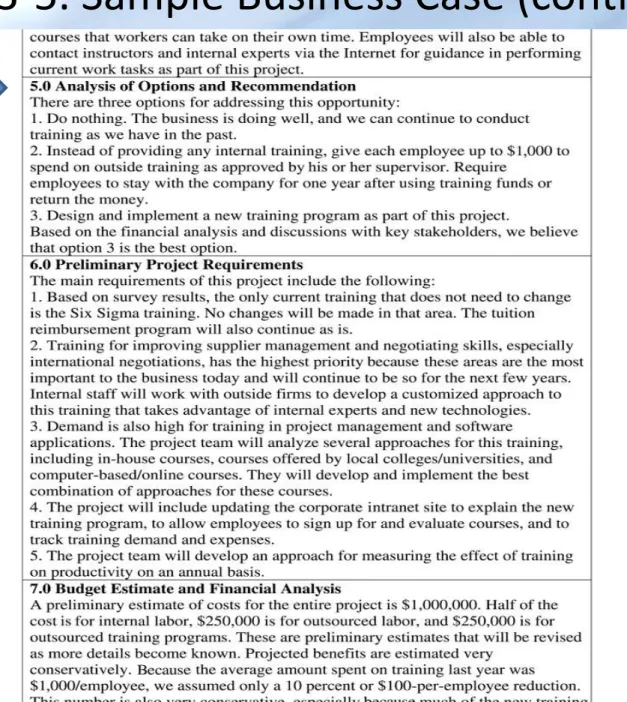
5. Analysis of Options and Recommendation
6. Preliminary Project Requirements
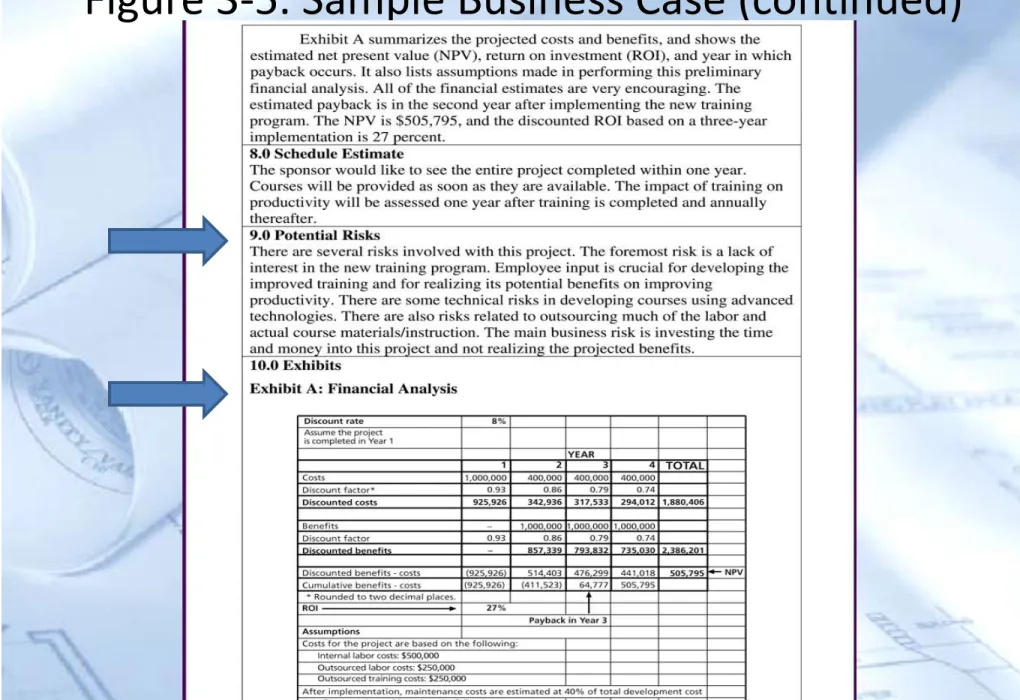
7. Budget Estimate and Financial Analysis
8. Schedule Estimate
9. Potential Risks
10.Exhibits
Identifying and Understanding Project
Stakeholders
•
Project stakeholders
are the people involved in
or affected by project activities.
–
Internal project stakeholders may include project
sponsor, project team, support staff, and internal
customers for the project, top management, other
functional managers, and other project managers.
–
External project stakeholders may include the
project’s customers, competitors, suppliers,
government officials and concerned citizens.
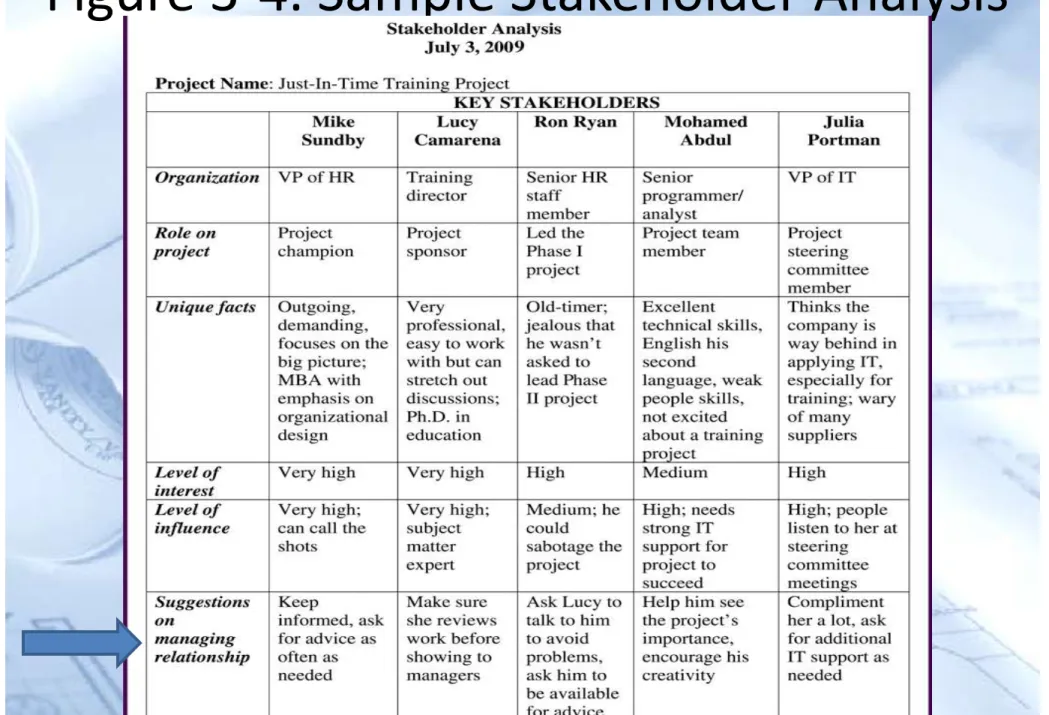
Stakeholder Analysis
• A stakeholder analysis provides information about key stakeholders to help manage relationships with them.
– Names and organizations of key stakeholders
– Their roles on the project
– Unique facts about each stakeholder
– Their levels of interest in the project
– Their influence on the project
– Suggestions for managing relationships with each stakeholder
• A stakeholder analysis often includes sensitive information –
it should not be part of the official project plans, which are normally available for all stakeholders to review.
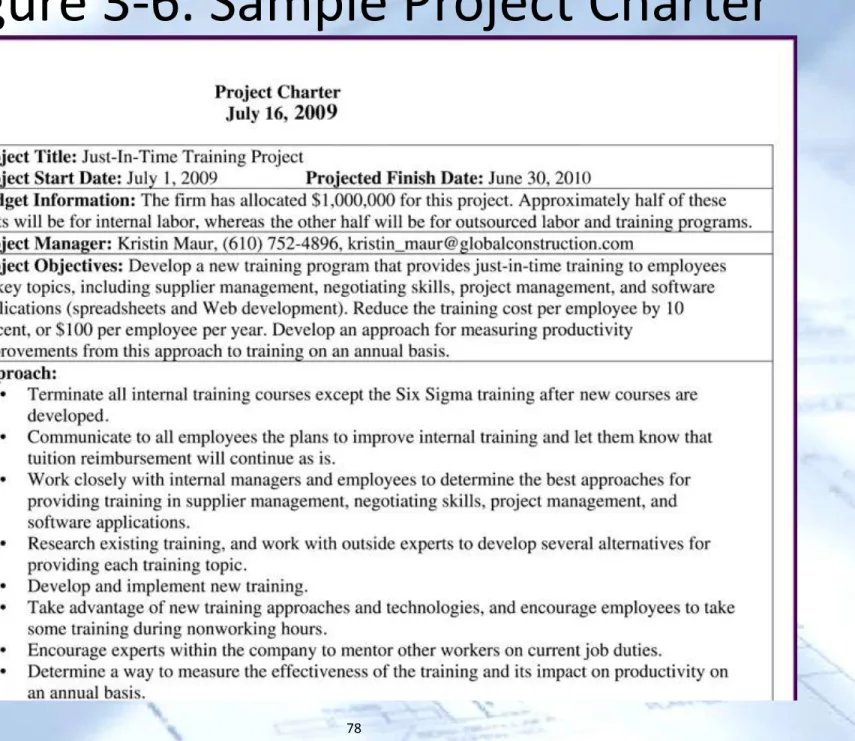
Creating a Project Charter
• A project charter formally recognizes the existence of a project and provides a summary of the project’s objectives and management.
• It authorizes the project manager to use organizational resources to complete the project.
• Ideally, the project manager will play a major role in developing the project charter.
• Instead of project charters, some organizations initiate projects using a simple letter of agreement or formal contract.
Contents of a Project Charter
•
Project Title and Date of Authorization
•
Project Start Date
•
Project Finish Date
•
Other Schedule Information
•
Budget Information
•
Project Manager
•
Project Objectives
•
Approach
•
Roles and Responsibilities
•
Sign-off
Rank
the following tools for your
organizational environment…
Which might help? Why?
Rank
(1=Most Helpful)•
Scope statement
_____
•
Business case
_____
•
Shareholder analysis
_____
•
Project Charter
_____
Discussion
Project ManagerSummary 5
1. Initiating projects is the first process group
2. Initiating involves ensuring that the scope is
clear and that the team has permission to
begin the project
3. Tools in the initiation phase include a
scope
statement, charter, stakeholder analysis,
and
business case
4. The scope statement is the “get out of jail” tool
of project management, but only if
Integra tion Cost Time Scope HR Comm Risk Procur ement Qual ity Initiation
Planning
Execution Control ClosePlanning Projects
The “big task” in the planning phase is aligning
People
Tasks
Schedules
Costs
Planning Projects
Area to Align
Tools that Can Help
People
Team Contract; RACI
Tasks
WBS / Critical Path / Risks
Schedules
Gantt Chart
Costs
Cost Baseline
Discussion
•
What are your best experiences in working on
project team?
•
What are your worst?
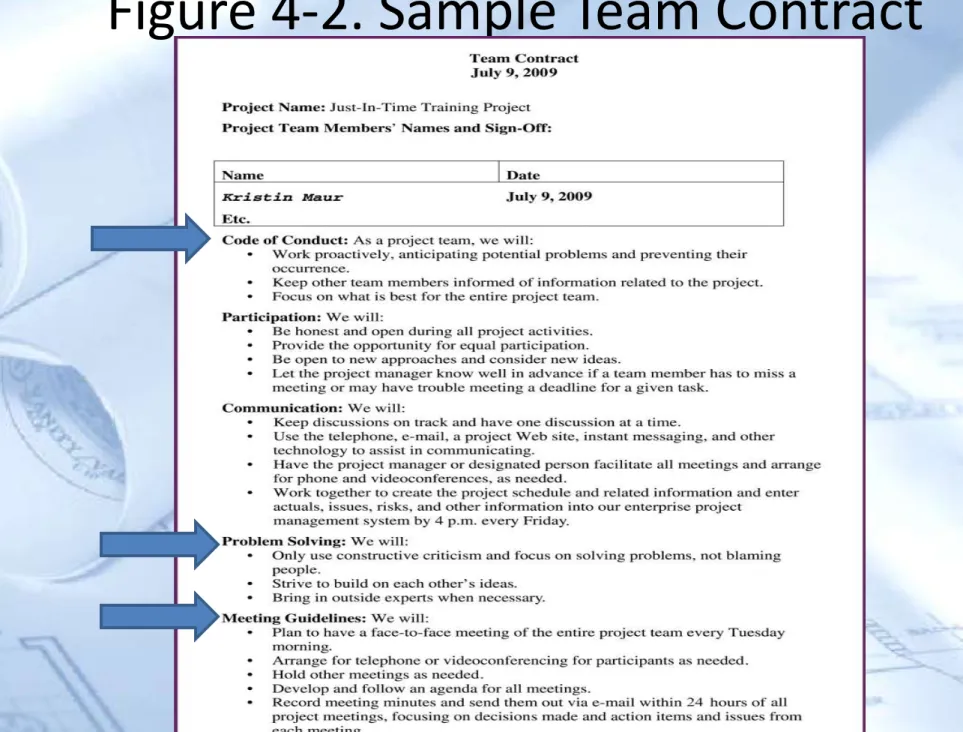
Team Contracts
•
Team contracts
promote teamwork and clarify
communications
•
Everyone involved in creating the team contract
should sign it, and as new project team members are
added, the project manager should review ground
rules with them and have them read and sign the
contract as well.
Topics Covered in a Team Contract
•
Code of conduct
•
Participation
•
Communication
•
Problem solving
•
Meeting guidelines
Responsibility Assignment Matrices
RACI
charts show
•
R
esponsibility (who does the task),
•
A
ccountability (who signs off on the task or
has authority for it),
•
C
onsultation (who has information necessary
to complete the task), and
•
I
nformed (who needs to be notified of task
status/results) roles for project stakeholders.
Starting Your Task List
•
The
work breakdown structure (WBS)
is a
document that breaks
all the work
required
for the project into discrete tasks, and groups
those tasks into a logical hierarchy.
•
Often shown in two different forms:
–
Chart form
My Vacation WBS
Vacation finish report reservations air hotel me wife & kids work prep packing Out of town Email message clothes clubs security prescriptions Stop mail Stop Aisle seatsLet’s Create a Visual WBS
•
Using flip charts, create a WBS for the student
housing project.
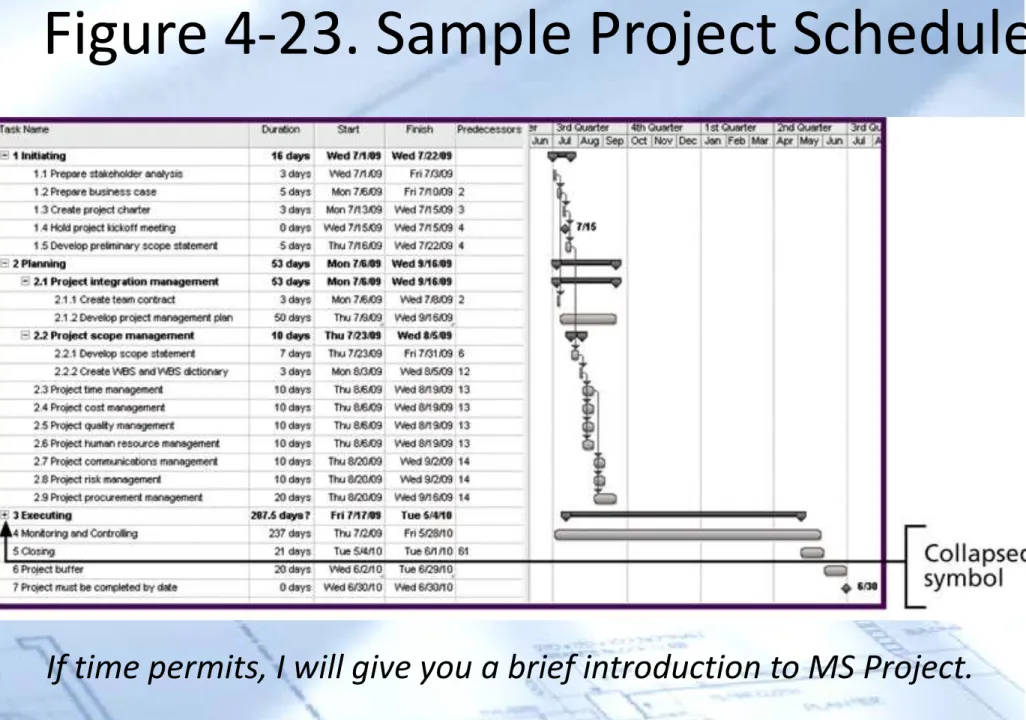
Figure 4-23. Sample Project Schedule
Practice
Using your WBS as a starting point, develop a simple Gantt Chart for the student housing project.
Time Period (X = Scheduled Time)
Task
Week
1 2 3
Permits XXXXX XXXXX
Practice
Using your WBS as a starting point, develop a simple Gantt Chart for the student housing project.
Time Period (X = Scheduled Time) Task
Critical Path Analysis
• Critical path method (CPM)—also called critical path
analysis—is a network diagramming technique used to predict total project duration.
• A critical path for a project is the series of activities that determine the earliest time by which the project can be
completed. It is the longest path through the network diagram and has the least amount of slack or float.
– Slack or float is the amount of time an activity may be delayed without delaying a succeeding activity or the project finish date.
• The longest path or the path containing the critical tasks is what is driving the completion date for the project.
What Does the Critical Path Really Mean?
•
The critical path shows the shortest time in
which a project can be completed
.
•
If one or more of the activities on the critical
path takes longer than planned, the
whole
project schedule will slip
unless
the project
manager takes corrective action.
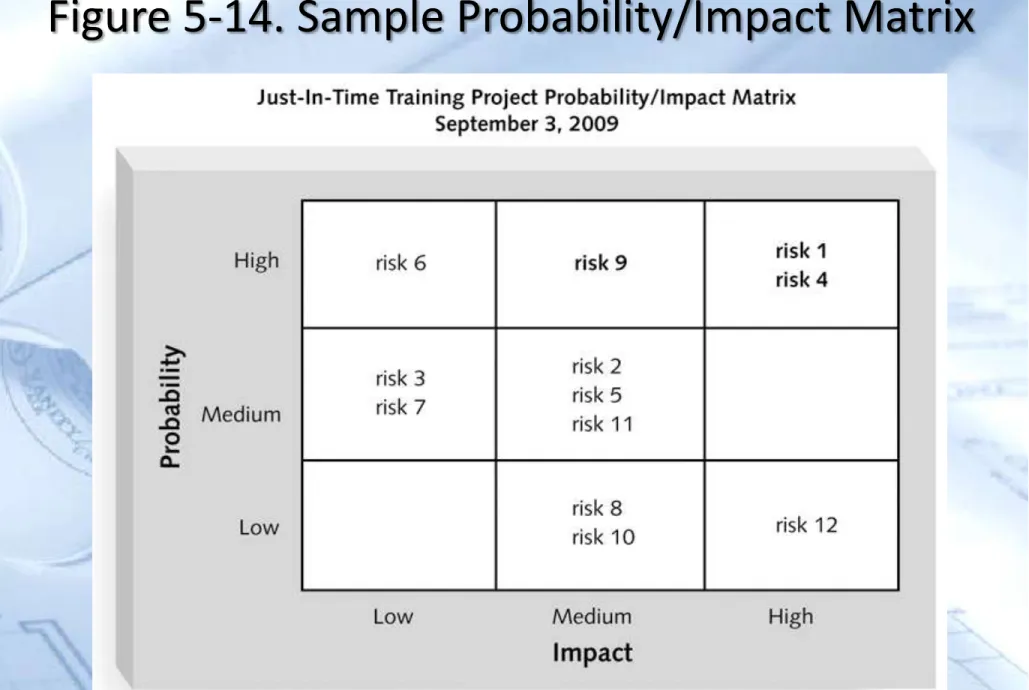
Risk Probability/Impact Matrices
•
Risk events
refer to specific, uncertain events that may
occur to the detriment or enhancement of the project.
– Negative risk events include the performance failure of a product produced as part of a project, delays in completing work as scheduled, increases in estimated costs, supply
shortages, litigation against the company, and strikes.
– Positive risk events include completing work sooner than planned or at an unexpectedly reduced cost, collaborating with suppliers to produce better products, and obtaining good publicity from the project.
– You can chart the probability and impact of risk events on a matrix.
Practice
Risk Probability (5 = high) Impact (5=high) Probability X Impact RankLet’s do a risk impact/probability matrix on a special event - an outdoor wedding and reception for 200 guests!
Summary 6
1. Best practice project managers spend more
time in
planning
2. Planning projects involves
aligning
people,
tasks, costs, and time
3. There are specific tools (processes) which help
plan people, tasks, costs, and schedules.
4. Risk management involves identifying and
ranking potential project risks, and then
developing
contingency actions
Integra tion Cost Time Scope HR Comm Risk Procur ement Qual ity Initiation
Planning
Execution Control Close Most noticed Most resources1.
Doing the work
2.
Recording
information
3.
Communicating
progress
4.
Identifying & Solving
Problems
1. The project sponsor and/or other senior managers are not very
supportive of the project. 2. Project stakeholders, such as
people who would use the
products and services the project is attempting to create, are not sufficiently involved in project decision-making.
3. The project manager is
inexperienced in managing people, working in a particular organization, or understanding the application area of the
project.
Are Any of These Familiar?
4. The project objectives/scope are unclear.
5. Estimates for time and cost goals are unreliable or unrealistic.
6. Business needs/technology changes have impacted the project.
7. People working on the project are incompetent or unmotivated. 8. There are poor
conflict-management procedures. 9. Communications are poor.
10. Suppliers are not delivering as promised.
Stage 1: FORMING / ORIENTATION
Members try to determine their place in the group along with the procedures and rules of the group.
Stage 2: STORMING / DISSATISFACTION
Conflict begins to arise as members resist the influence of the group and rebel against accomplishing the task.
Stage 3: NORMING / RESOLUTION
The group establishes cohesion and commitment, discovering new ways to work together and setting norms for appropriate behavior
Stage 4: PERFORMING / PRODUCTION
The group develops proficiency in achieving its goals and becomes more flexible in its patterns of working together.
Stage 5: ADJOURNING / CLOSURE
The group celebrates its accomplishments and recognizes areas for future
Things to Remember about Teams
1. One “misbehaving” person can stop team
effectiveness
2. When one person leaves or joins the team,
the team reverts to the
forming
stage
3. “Practiced” teams achieve the performing
stage faster
4. It’s often good practice to use a team
facilitator, especially for new PM’s
Summary 7
1. The execution phase of the project is the
most
noticed
of the phases, and typically uses the
most resources
2. The primary project management activities
include
doing the work and solving problems
3. Problems can be
technical
or about
people
4. Recognizing that a project team goes through
phases
can help avoid, diagnose and solve
team problems
Integra tion Cost Time Scope HR Comm Risk Procur ement Qual ity Initiation
Planning
Execution Control & Monitor CloseControlling & Monitoring
•
Monitoring and controlling involves
regularly measuring
progress
to ensure that the project is meeting its
objectives and addressing current business needs.
•
The project manager and other staff monitor progress
against plans and take
corrective action
when necessary.
Earned Value Report
Revised Schedule
EV Report Example
Month 1 Month 2 Month 3 Month 4 Month 5 Month 6 TOTAL to Month 3
Planned Value (Cost) Planned spending in the period $ 5,000.00 $ 5,000.00 $ 5,000.00 $ 5,000.00 $ 5,000.00 $ 2,500.00 $ 15,000.00 Actual Cost (AC) Actual spending in the period $ 5,000.00 $ 5,000.00 $ 6,000.00 $ 16,000.00
Cost Variance (CV) Actual less planned cost $ - $ - $ (1,000.00) $ (1,000.00) Earned Value (EV) Estimate of work completed 20% 18% 20% 58% Planned Value (PV) Expected work to have been completed 20% 20% 20% 20% 10% 10% 60% Rate of Performance (RP) Earned value versus planned work 100% 90% 100% 97%
EV Report Example
Month 1 Month 2 Month 3 Month 4 Month 5 Month 6 TOTAL to Month 3
Planned Value (Cost) Planned spending in the period $ 5,000.00 $ 5,000.00 $ 5,000.00 $ 5,000.00 $ 5,000.00 $ 2,500.00 $ 15,000.00 Actual Cost (AC) Actual spending in the period $ 5,000.00 $ 5,000.00 $ 6,000.00 $ 16,000.00
Cost Variance (CV) Actual less planned cost $ - $ - $ (1,000.00) $ (1,000.00) Earned Value (EV) Estimate of work completed 20% 18% 20% 58% Planned Value (PV) Expected work to have been completed 20% 20% 20% 20% 10% 10% 60% Rate of Performance (RP) Earned value versus planned work 100% 90% 100% 97%
•
In general,
negative numbers for cost and
schedule variance indicate problems in those
areas
.
•
Negative numbers mean the project is costing
more than planned or taking longer than
planned.
•
Likewise,
CPI and SPI less than one or less than
100 percent indicate problems
.
•
Performance reporting keeps stakeholders
informed about how resources are being used
to achieve project objectives.
–
Status reports
describe where the project stands
at a specific point in time.
–
Progress reports
describe what the project team
has accomplished during a certain period.
–
Forecasts
predict future project status and
progress based on past information and trends.
Summary 8
1. The controlling phase involves measuring
progress and taking corrective actions
2. It is best to establish your measurement plans
during the planning phase
Integra tion Cost Time Scope HR Comm Risk Procur ement Qual ity Initiation
Planning
Execution Control & Monitor CloseClosing Projects
Project closure may include:
•
Customer acceptance of the final products &
services
•
Verifying that all deliverables are complete
•
Planning transition of products /services into the
organization
•
Preparing a final presentation and report
•
what can be learned to improve future projects
Lessons Learned Plan
Final Project Checklist Acceptance criteria have been met.
Final technical and management review of deliverables is complete. Final deliverables have been presented and turned over to the customer.
The Engagement Team and customer both agree that the
deliverables meet or exceed expectations and that the engagement is complete.
All outstanding issues have been determined.
All unresolved issues have been assigned to relevant resources. All outstanding issues have been documented.
All resolved issues have been documented.
Project Closure Meeting Project Closure Meeting held.
What went well discussed.
What could have been done differently discussed. Conclusions and recommendations documented. Success celebrated.
Post-Project Assessment Project assessment executed.
Final Customer Sign-Off Service plan to customer provided.
Final sign-off obtained.
Business operations informed that project is ready to be closed. Project Team Member Evaluations
Team member performances documented.
Team member evaluations reviewed with each team member. Team supervisor provided with copies of each evaluation.
Personal Evaluations Team member evaluation obtained.
Sponsor/senior team member evaluation obtained. Client evaluation obtained.
Hint:
Build this checklist as the project is being planned, executed and monitored for items that you “don’t want to forget…”Summary 8
1. The controlling phase involves delivering the
final product
2. Good closure practice also includes a review of
lessons learned
1.
Determine how project, program, and portfolio
management will work best in your own organization.
2.
Involve key stakeholders—including shareholders,
customers, and employees—in making major decisions.
3.
Develop and follow a formal project selection process
to ensure projects support business needs.
4.
Lay the groundwork for projects before they officially
start.
5.
Separate projects by phases, such as a study phase
project, when it makes sense to do so.
6.
Designate a project champion to provide high-level
support and participate in key meetings.
7.
Assign a project manager from operations to lead
projects that affect operations.
8.
Form a steering committee with key managers from
various departments for projects that will cause major
organizational change.
9.
Provide mentoring and training for project managers
and other stakeholders.
10.
Document action items at meetings, and set the next
meeting time.
11.
Document meeting minutes, focusing on key decisions
and action items, and send them out quickly.
12.
Use more than one approach for creating cost
estimates.
13.
Use formal supplier evaluation procedures to help select sellers.14.
Include a detailed statement of work and schedule in contracts.15.
Develop and follow a formal change-control process.16.
Work with suppliers to ensure that deliverables are produced properly.17.
Follow a deliverable acceptance process to verify project scope.18.
Be clear and honest in communicating project status information, and share the responsibility for project communications with the entire project team.19.
Formally close projects, and share lessons learned.Summary 9
Best of best practices include
•
Dividing projects into phases
•
Spending adequate time in the planning phase
•
Having clear, SMART deliverables & success
criteria
•
Recognizing team stages and developing a
strong working team
•
Conduct a lessons learned meeting to enhance
future projects
The Tools We Covered
PRE-INITITIATING
Weighted ScoringINTITIATING
Scope statement Business case Shareholder Analysis Project CharterPLANNING
Team Contract RACI Team Stages WBSPLANNING, cont.
Critical Path Risk Analysis Gantt Chart Cost BaselineCONTROL & MEASURE
Earned Value Report Revised Schedule
Performance Reports
CLOSURE
Lessons Learned Plan Closing Checklist
What Can You Use?
Soon, you’ll be back in the office…
What one or two tools, practices, or ideas will make the biggest impact on improving project management?
1. 2. 3.
Training Objectives
Upon success completion, you will be able to…
Describe the characteristics of effective project managers
Indentify the five project stages
Explain the importance the phases of teamwork
Begin to use the most important project management tools
Describe the benefits of project software
Indentify best practices in project management
Explain how project management techniques could benefit you in your workplace
http://www.pmi.org/
PMP Certification
HS Diploma + 5 years + 7,500 hours leading + 35 hours
education
- Or –
4 Year Degree + 4,500 hours leading + 35 hours education
Plus
-4 Hour Exam with 200 Questions
Mock Exam:
http://www.tutorialspoint.com/pmp-exams/pmp_mock_exams.htm