Table of Contents
i
OBD2 & 1
INTRODUCTION
WHAT IS OBD? ... 1
YOU CAN DO IT! ... 2
SAFETY PRECAUTIONS SAFETY FIRST! ... 3
ABOUT THE TOOL BATTERY INSTALLATION / REPLACEMENT ... 5
ADJUSTMENTS/SETTINGS AND DTC LIBRARY ... 5
TOOL CONTROLS CONTROLS AND INDICATORS ... 9
DISPLAY FUNCTIONS ... 11
VIEWING DTCs IN THE TOOL’S MEMORY ... 13
PREPARATION FOR TESTING PRELIMINARY VEHICLE DIAGNOSTIC WORKSHEET ... 14
BEFORE YOU BEGIN ... 17
VEHICLE SERVICE MANUALS ... 18
GENERAL CODE RETRIEVAL PROCEDURES OBD1 SYSTEMS ... 19
OBD2 SYSTEMS ... 19
OBD2 SYSTEMS VEHICLES COVERED ... 20
DIAGNOSTIC TROUBLE CODES (DTCs) ... 21
CODE RETRIEVAL PROCEDURE ... 23
VIEWING ENHANCED DATA ... 29
VIEWING VEHICLE INFORMATION ... 38
ERASING DIAGNOSTIC TROUBLE CODES (DTCs)... 39
I/M READINESS TESTING ... 41
CHRYSLER/JEEP OBD1 SYSTEMS CHRYSLER/JEEP OBD1 SYSTEMS ... 47
VEHICLES COVERED ... 48
INSTRUMENT PANEL INDICATOR LIGHTS ... 48
DATA LINK CONNECTOR (DLC) ... 48
CODE RETRIEVAL PROCEDURE ... 49
FORD OBD1 SYSTEMS FORD COMPUTER SYSTEM OVERVIEW ... 52
VEHICLES COVERED ... 52
TEST CONNECTORS ... 55
CONNECTING THE TOOL ... 56
DIAGNOSTIC TROUBLE CODES (DTCs) ... 56
CODE RETRIEVAL PROCEDURES ... 57
ADDITIONAL TESTS FOR EEC-IV SYSTEMS ... 65
GM OBD1 SYSTEMS YOUR VEHICLE'S COMPUTER SYSTEM ... 73
VEHICLES COVERED ... 73
ABOUT THE TOOL ... 74
DATA LINK CONNECTOR (DLC) ... 74
MALFUNCTION INDICATOR LIGHT (MIL) ... 74
DIAGNOSTIC TROUBLE CODES (DTC's) ... 74
CODE RETRIEVAL PROCEDURE ... 75
TOYOTA/LEXUS OBD1 SYSTEMS ON-BOARD VEHICLE DIAGNOSTICS (OBD1) ... 79
VEHICLES COVERED ... 79
DATA LINK CONNECTOR (DLC) ... 82
MALFUNCTION INDICATOR LIGHT (MIL) ... 82
DIAGNOSTIC TROUBLE CODES ... 83
CODE RETRIEVAL PROCEDURE ... 83
SERVICING DTCS SERVICING DTCs - OBD I ... 86
ERASING DTCS ERASING DTCs (OBD I SYSTEMS) ... 88
GLOSSARY GLOSSARY OF TERMS AND ABBREVIATIONS... 90
WARRANTY AND SERVICING LIMITED ONE YEAR WARRANTY ... 93
OBD2 & 1
1
WHAT IS OBD?
The Enhanced OBD2 & 1 Tool is designed to work on most Chrysler, Ford, GM and Toyota OBD1 systems and all OBD2
compliant vehicles. One of the most exciting improvements in the automobile industry was the addition of on-board diagnostics (OBD) on vehicles, or in more basic terms, the computer that activates the vehicle’s “CHECK ENGINE” light. OBD1 was designed to monitor manufacturer-specific systems on vehicles built from 1981 to 1995. Then came the development of OBD2, which is
on all 1996 cars and light trucks sold in the United States. These systems are part of a government mandate to lower vehicle emissions. The sophisticated programs in the vehicle’s on-board computer system are designed to detect failures in a range of vehicle systems. Diagnostic information can be accessed through a Data Link Connector test port specifically designed for this purpose. For all OBD systems, if a problem is found, the computer turns on the “CHECK ENGINE” light to warn the driver, and sets a Diagnostic Trouble Code (DTC) to identify where the problem occurred. A special diagnostic tool, such as the Enhanced OBD2 & 1 Tool, is required to retrieve these codes, which consumers and professionals use as a starting point for repairs.
The Enhanced OBD2 & 1 Tool provides the additional ability to retrieve
enhanced DTCs from most Chrysler/Jeep, General Motors, Ford, Mazda
and Isuzu vehicles. The types of enhanced data available depends on the vehicle make.
You Can Do It!
EASY TO USE – EASY TO VIEW – EASY TO DEFINE
2
OBD2 & 1
Easy To Use . . . .
Connect the Tool to the vehicle’s test connector.
Turn the ignition key "On.” Press the POWER/LINK button.
Easy To View . . . .
The Tool retrieves stored codes, as well as Freeze Frame data and I/M Readiness status (OBD2 systems only). Codes, I/M Readiness status and
Freeze Frame data are displayed on the Tool’s LCD display screen. System status is indicated by LED indicators.
Easy To Define . . . .
Read code definitions from the Tool’s LCD display.
View Freeze Frame data (OBD2 systems only).
OBD2 & 1
3
SAFETY FIRST!
This manual describes common test procedures used by experienced service technicians. Many test procedures require precautions to avoid accidents that can result in personal injury, and/or damage to your vehicle or test equipment. Always read your vehicle's service manual and follow its safety precautions before and during any test or service procedure. ALWAYS observe the following general safety precautions:
When an engine is running, it produces carbon monoxide, a toxic and poisonous gas. To prevent serious injury or death from carbon monoxide poisoning, operate the vehicle ONLY in a well-ventilated area.
To protect your eyes from propelled objects as well as hot or caustic liquids, always wear approved safety eye protection.
When an engine is running, many parts (such as the coolant fan, pulleys, fan belt etc.) turn at high speed. To avoid serious injury, always be aware of moving parts. Keep a safe distance from these parts as well as other potentially moving objects.
Engine parts become very hot when the engine is running. To prevent severe burns, avoid contact with hot engine parts.
Before starting an engine for testing or troubleshooting, make sure the parking brake is engaged. Put the transmission in park (for automatic transmission) or
neutral (for manual transmission). Block the drive wheels
with suitable blocks.
Connecting or disconnecting test equipment when the ignition is ON can damage test equipment and the vehicle's electronic components. Turn the ignition OFF before connecting the Code Reader to or disconnecting the Code Reader from the vehicle’s Data Link Connector (DLC).
To avoid personal injury, instrument damage and/or damage to your vehicle; do not use the OBD2 Code Reader
before reading this manual.
N L
D
R
Safety Precautions
SAFETY FIRST!4
OBD2 & 1
To prevent damage to the on-board computer when taking vehicle electrical measurements, always use a digital multimeter with at least 10 MegOhms of impedance. Fuel and battery vapors are highly flammable. To prevent an explosion, keep all sparks, heated items and open flames away from the battery and fuel / fuel vapors. DO NOT SMOKE NEAR THE VEHICLE DURING TESTING. Don't wear loose clothing or jewelry when working on an engine. Loose clothing can become caught in the fan, pulleys, belts, etc. Jewelry is highly conductive, and can cause a severe burn if it makes contact between a power source and ground.
OBD2 & 1
5
BATTERY INSTALLATION / REPLACEMENT
Replace batteries when the battery symbol is visible on display and/or the 3 LEDS are all lit and no other data is visible on screen. 1. Locate the battery cover on the back of the Tool.
2. Slide the battery cover off (use your fingers).
3. Replace batteries with three AA-size batteries (for longer life, use Alkaline-type batteries).
4. Reinstall the battery cover on the back of the Tool. Language Selection After Battery Installation
The first time the unit is turned on , you must select the desired display language (English, French or Spanish) as follows: 1. Press and hold the POWER/LINK
button for approximately 3 seconds to turn the Tool “ON.”
The Select Language screen dis-plays.
2. Use the UP and DOWN buttons, as necessary, to highlight the desired display language.
3. When the desired display language is selected, press the
ENTER/FF button to confirm your selection.
After the initial language selection is performed, it, as well as other settings, can be changed as desired. Proceed to “ADJUSTMENTS/SETTINGS AND DTC LIBRARY” below for further instructions.
ADJUSTMENTS/SETTINGS AND DTC LIBRARY
The OBD2 & 1 Tool lets you make several adjustments and settings to configure the tool to your particular needs. It also contains an OBD2 DTC Library that allows you to search for DTC definitions. The following functions, adjustments and settings can be performed when the OBD2 & 1 Tool is in “MENU Mode”:
Adjust Brightness: Adjusts the brightness of the LCD display
screen.
DTC Library: Lets you search the library of OBD2 DTC definitions.
Select Language: Sets the display language for the Tool to English,
About the Tool
ADJUSTMENTS/SETTINGS AND DTC LIBRARY
6
OBD2 & 1
Unit of Measurement: Sets the Unit of Measurement for the Tool’s
display to USA or Metric.
Adjustments and settings can be made only when the Tool is NOT connected to a vehicle.
To enter the MENU Mode:
1. With the Tool OFF, press and hold the UP button, then press and release
the POWER/LINK button.
The adjustments and setting MENU displays.
2. Release the UP button.
DO NOT release the UP button until the adjustments and
settings MENU is visible on the display.
3. Make adjustments and settings as described in the following paragraphs.
Adjusting Display Brightness
1. Use the UP and DOWN buttons, as necessary, to highlight Adjust
Brightness in the MENU, then press
the ENTER/FF button.
The Adjust Brightness screen dis-plays.
The Brightness field shows the
cur-rent brightness setting, from 0 to 43. 2. Press the UP button to decrease the
brightness of the LCD display (make the display darker).
3. Press the DOWN button to increase the brightness of the LCD display (make the display lighter).
4. When the desired brightness is obtained, press the ENTER/FF button to save your changes and return to the MENU.
Searching for a DTC Definition Using the DTC Library (applicable to OBD2 systems only)
1. Use the UP and DOWN buttons, as necessary, to highlight DTC Library in the MENU, then press the ENTER/FF
OBD2 & 1
7
The Enter DTC screen displays. The screen shows the code “P0001”, with the “P” flashing.
2. Use the UP and DOWN buttons, as necessary, to scroll to the desired DTC type (P=Powertrain, U=Network, B=Body, C=Chassis), then press the
DTC SCROLL button.
The selected character displays “solid”, and the next character begins flashing.
3. Select the remaining characters in the DTC in the same way, pressing the DTC SCROLL button to confirm each character. When you have selected all the DTC characters, press the
ENTER/FF button to view the DTC definition.
If you entered a “Generic” DTC (DTCs that start with “P0”, “P2” and some “P3”):
- The selected DTC and DTC definition (if available), show on the Scan Tool’s LCD display. If you entered a
“Manufacturer-Specific” DTC (DTCs that start with “P1” and some “P3”):
- The “Select Manufacturer” screen displays.
- Use the UP and DOWN buttons, as necessary, to high-light the appropriate manufacturer, then press the ENTER/FF button to display the correct DTC for your vehicle.
If a definition for the DTC you entered is not available, an advisory message shows on the CanOBD2&1 Tool’s display.
4. If you wish to view definitions for additional DTCs, press the ENTER/FF
button to return to the DTC Library screen, and repeat steps 2 and 3.
5. When all desired DTCs have been viewed, press the ERASE button to exit the DTC Library.
About the Tool
ADJUSTMENTS/SETTINGS AND DTC LIBRARY
8
OBD2 & 1
Selecting the Display Language
1. Use the UP and DOWN buttons, as necessary, to highlight
Select Language in the MENU, then press the ENTER/FF
button.
The Select Language screen dis-plays.
The currently selected display
Language is highlighted.
2. Press the UP or DOWN button, as necessary, to highlight the desired display language.
3. When the desired display language is highlighted, press the ENTER/FF button to save your changes and return to the MENU (shown in the selected display language).
Setting the Unit of Measurement
1. Use the UP and DOWN buttons, as necessary, to highlight Unit of
Measurement in the MENU, then press
the ENTER/FF button.
2. Press the UP or DOWN button, as necessary, to highlight the desired
Unit of Measurement.
3. When the desired Unit of Measurement value is selected, press the ENTER/FF button to save your changes.
Exiting the MENU Mode
1. Use the UP and DOWN buttons, as necessary, to highlight
Menu Exit in the MENU, then press the ENTER/FF button.
The LCD display returns to the DTC screen (if data is currently stored in the Tool’s memory) or the “To Link” screen (if no data is stored).
OBD2 & 1
9
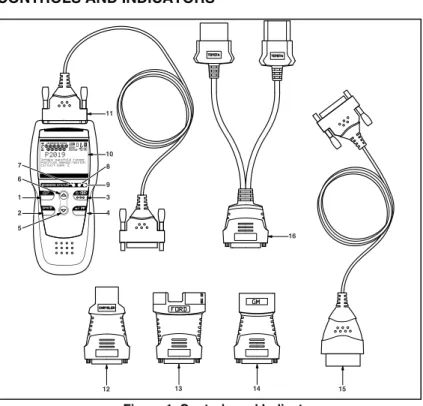
1 2 5 3 9 4 16 11 12 13 14 15 6 7 8 10CONTROLS AND INDICATORS
Figure 1. Controls and Indicators See Figure 1 for the locations of items 1 through 16, below.
1. ERASE button - Erases Diagnostic Trouble Codes (DTCs), and
“Freeze Frame” data from your vehicle’s computer, and resets Monitor status. (“Freeze Frame” data and Monitor status are applicable to OBD2 systems only.)
2. DTC SCROLL button - Displays the DTC View screen and/or
scrolls the LCD display to view DTCs when more than one DTC is present.
3. POWER/LINK button - When the Tool IS NOT connected to a
vehicle, turns the Tool “On” and “Off”. When the Tool is connected to a vehicle, links the Tool to the vehicle’s PCM to retrieve diagnostic data from the computer’s memory. (The LINK function is applicable to OBD2 systems only.)
To turn the Tool "On", you must press and hold the
Tool Controls
CONTROLS AND INDICATORS10
OBD2 & 1
4. ENTER/FREEZE FRAME button - When in MENU mode,
confirms the selected option or value. When retrieving and viewing DTCs, displays Freeze Frame data for the highest priority code. (The Freeze Frame function is applicable to OBD2 systems only.)
5. DOWN button - When in MENU mode, scrolls DOWN through
the menu and submenu selection options. When retrieving and viewing DTCs, scrolls down through the current display screen to display any additional data.
6. UP button - When in MENU mode, scrolls UP through the menu
and submenu selection options. When retrieving and viewing DTCs, scrolls ups through the current display screen to display any additional data.
7. GREEN LED - Indicates that all engine systems are running
normally (all Monitors on the vehicle are active and performing their diagnostic testing, and no DTCs are present). (Monitors are applicable to OBD2 systems only.)
8. YELLOW LED - Indicates there is a possible problem. A “Pending”
or a history DTC is present and/or some of the vehicle’s emission monitors have not run their diagnostic testing. (Monitors and pending DTCs are applicable to OBD2 systems only.)
9. RED LED - Indicates there is a problem in one or more of the
vehicle’s systems. The red LED is also used to show that DTC(s) are present. DTCs are shown on the Tool’s LCD display. In this case, the Malfunction Indicator (“Check Engine”) lamp on the vehicle’s instrument panel will light steady on.
10.LCD Display - Displays settings Menu and submenus, test results,
Tool functions and Monitor status information. See DISPLAY
FUNCTIONS, on next page, for more details. (Monitors are
applicable to OBD2 systems only.)
11.Cable - Connects the Tool to the vehicle’s Data Link Connector
(DLC) when retrieving codes from OBD1 systems (used with items 12, 13, 14 and 16).
12.CHRYSLER Connector Cable Adaptor - Installs on cable (item 11)
when connecting to a Chrysler OBD1 Data Link Connector.
13.FORD Connector Cable Adaptor - Installs on cable (item 11) when
connecting to a Ford OBD1 Data Link Connector.
14.GM Connector Cable Adaptor - Installs on cable (item 11) when
connecting to a GM OBD1 Data Link Connector.
15.OBD II Cable - Connects the Tool to the vehicle's Data Link
Connector (DLC) when retrieving codes from OBD2 systems.
16.TOYOTA Connector Cable Adaptor - Installs on cable (item 11)
OBD2 & 1
11
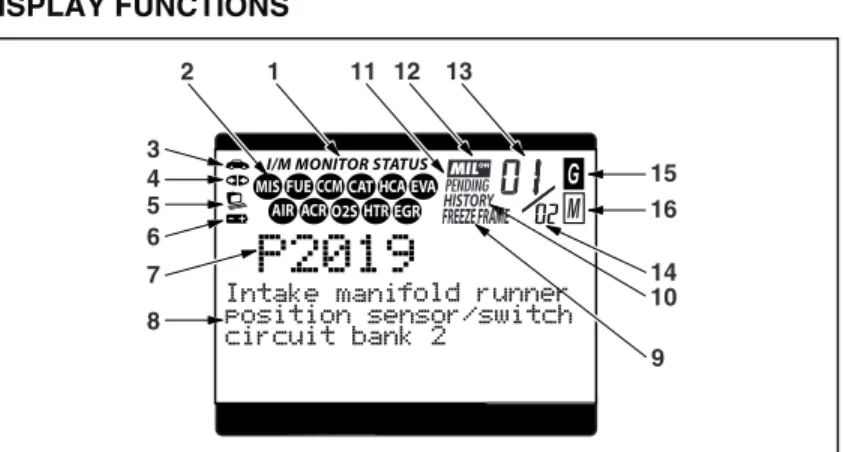
4 3 2 1 11 12 13 5 8 9 14 10 16 15 6 7DISPLAY FUNCTIONS
Figure 2. Display Functions See Figure 2 for the locations of items 1 through 16, below.
1. I/M MONITOR STATUS field - Identifies the I/M Monitor status area.
(This function is applicable to OBD2 systems only.)
2. Monitor icons - Indicate which Monitors are supported by the
vehicle under test, and whether or not the associated Monitor has run its diagnostic testing (Monitor status). When a Monitor icon is solid, it indicates that the associated Monitor has completed its diagnostic testing. When a Monitor icon is flashing, it indicates that the vehicle supports the associated Monitor, but the Monitor has not yet run its diagnostic testing. (This function is applicable to OBD2 systems only.)
3. Vehicle icon - Indicates whether or not the Tool is being
properly powered through the vehicle’s Data Link Connector (DLC). A visible icon indicates that the Tool is being powered through the vehicle’s DLC connector.
4. Link icon - Indicates whether or not the Tool is communicating
(linked) with the vehicle’s on-board computer. When visible, the Tool is communicating with the computer. If the Link icon is not visible, the Tool is not communicating with the computer.
5. Computer icon - When this icon is visible it indicates that the
Tool is linked to a personal computer. An optional “PC Link Kit” is available that makes it possible to upload retrieved data to a personal computer.
6. Tool Internal Battery icon - When visible, indicates the Tool
batteries are “low” and should be replaced. If the batteries are not replaced when the battery symbol is "on", all 3 LEDs will light up as a last resort indicator to warn you that the batteries need replacement. No data will be displayed on screen when all 3 LEDs are lit.
Tool Controls
DISPLAY FUNCTIONS12
OBD2 & 1
7. DTC Display Area - Displays the Diagnostic Trouble Code (DTC)
number. Each fault is assigned a code number that is specific to that fault.
8. Test Data Display Area - Displays DTC definitions, Freeze Frame
data, and other pertinent test information messages.
9. MIL icon - Indicates the status of the Malfunction Indicator Lamp
(MIL). The MIL icon is visible only when a DTC has commanded the MIL on the vehicle’s dashboard to light.
10.HISTORY icon – Indicates the currently displayed DTC is a
“History” code.
11.CODE icon - Identifies the Code Number Sequence display area.
12.PENDING icon - Indicates the currently displayed DTC is a
“Pending” code. (This function is applicable to OBD2 systems only.)
13.Code Number Sequence - The Tool assigns a sequence number to
each DTC that is present in the computer’s memory, starting with “01.” This number indicates which code is currently displayed. Code number “01” is always the highest priority code, and the one for which “Freeze Frame” data has been stored. (Freeze Frame data is applicable to OBD2 systems only.)
If “01” is a “Pending” code, there may or may not be “Freeze Frame” data stored in memory.
14.Code Enumerator - Indicates the total number of codes retrieved
from the vehicle’s computer.
15. Generic DTC icon - When visible, indicates that the currently
displayed DTC is a “Generic” or “Universal” code. (This function is applicable to OBD2 systems only.)
16. Manufacturer Specific DTC icon - When visible, indicates that
the currently displayed DTC is a Manufacturer Specific Code. (This function is applicable to OBD2 systems only.)
OBD2 & 1
13
VIEWING DTCs IN THE TOOL’S MEMORY
To view DTC’s and other diagnostic data stored in the Tool’s memory, do the following:
1. With no DLC cable connected to the Tool, press the POWER/LINK button to turn the Tool “on”. 2. Press the ENTER/FF button. 3. Use the and keys to highlight
and select your vehicle’s OBD system (OBD1 or OBD2). Press the ENTER/FF
button to continue.
Select “Back” if you wish to return to the Main Menu.
4. If DTCs are present in the Tool’s memory, the first stored DTC will display on the screen.
If more than one DTC is present, use the DTC SCROLL button to scroll through the DTC’s.
5. “For OBD2 systems only” - Saved Freeze Frame data and Monitor status
are also available (press the
ENTER/FF button to view Freeze
Frame data).
6. If no DTCs are in the Tool’s memory, a “No DTC’s are presently stored in the Tool’s memory” message displays.
Preparation for Testing
PRELIMINARY VEHICLE DIAGNOSTIC WORKSHEET
14
OBD2 & 1
PRELIMINARY VEHICLE DIAGNOSTIC WORKSHEET
The purpose of this form is to help you gather preliminary information on your vehicle before you retrieve codes. By having a complete account of your vehicle's current problem(s), you will be able to systematically pinpoint the problem(s) by comparing your answers to the fault codes you retrieve. You can also provide this information to your mechanic to assist in diagnosis and help avoid costly and unnecessary repairs. It is important for you to complete this form to help you and/or your mechanic have a clear understanding of your vehicle's problems.
NAME: DATE: VIN*: YEAR: MAKE: MODEL: ENGINE SIZE: VEHICLE MILEAGE:
*VIN: Vehicle Identification Number, found at the base of the windshield on a metallic plate, or at the driver door latch area (consult your vehicle owner's manual for location).
TRANSMISSION: Automatic Manual
Please check all applicable items in each category. DESCRIBE THE PROBLEM:
OBD2 & 1
15
WHEN DID YOU FIRST NOTICE THE PROBLEM: Just Started
Started Last Week Started Last Month Other:
m
LIST ANY REPAIRS DONE IN THE PAST SIX MONTHS:PROBLEMS STARTING No symptoms Will not crank
Cranks, but will not start Starts, but takes a long
time ENGINE QUITS OR STALLS
No symptoms Right after starting When shifting into gear During steady-speed
driving
Right after vehicle comes to a stop While idling During acceleration When parking IDLING CONDITIONS No symptoms Is too slow at all times Is too fast
Is sometimes too fast or too slow
Is rough or uneven Fluctuates up and down RUNNING CONDITIONS
No symptoms Runs rough Lacks power Bucks and jerks Poor fuel economy Hesitates or stumbles on
accelerations
Backfires
Misfires or cuts out Engine knocks, pings or
rattles Surges
Preparation for Testing
PRELIMINARY VEHICLE DIAGNOSTIC WORKSHEET
16
OBD2 & 1
AUTOMATIC TRANSMISSION PROBLEMS (if applicable) No symptoms
Shifts too early or too late Changes gear incorrectly
Vehicle does not move when in gear
Jerks or bucks PROBLEM OCCURS
Morning Afternoon Anytime ENGINE TEMPERATURE WHEN PROBLEM OCCURS
Cold Warm Hot
DRIVING CONDITIONS WHEN PROBLEM OCCURS Short - less than 2 miles
2 - 10 miles
Long - more than 10 miles Stop and go
While turning While braking At gear engagement With A/C operating
With headlights on During acceleration Mostly driving downhill Mostly driving uphill Mostly driving level Mostly driving curvy
roads
Mostly driving rough roads
DRIVING HABITS Mostly city driving Highway
Park vehicle inside Park vehicle outside
Drive less than 10 miles per day Drive 10 to 50 miles per day Drive more than 50 miles per
day GASOLINE USED
87 Octane 89 Octane
91 Octane
More than 91 Octane WEATHER CONDITIONS WHEN PROBLEM OCCURS
32 - 55° F (0 - 13° C) Below freezing (32° F / 0° C)
Above 55° F (13° C)
CHECK ENGINE LIGHT / DASH WARNING LIGHT
Sometimes ON Always ON Never ON PECULIAR SMELLS
"Hot"
Sulfur ("rotten egg") Burning rubber Gasoline Burning oil Electrical STRANGE NOISES Rattle Knock Squeak Other
OBD2 & 1
17
BEFORE YOU BEGIN
The Enhanced OBD2 & 1 Tool aids in monitoring electronic- and emissions-related faults in your vehicle and retrieving fault codes related to malfunctions in these systems. Mechanical problems such as low oil level or
damaged hoses, wiring or electrical connectors can cause poor engine performance and may also cause a fault code to set. Fix any known mechanical problems before performing any test. See your vehicle’s service manual or a mechanic for more information.
Check the following areas before starting any test:
Check the engine oil, power steering fluid, transmission fluid (if applicable), engine coolant and other fluids for proper levels. Top off low fluid levels if needed.
Make sure the air filter is clean and in good condition. Make sure all air filter ducts are properly connected. Check the air filter ducts for holes, rips or cracks.
Make sure all engine belts are in good condition. Check for cracked, torn, brittle, loose or missing belts.
Make sure mechanical linkages to engine sensors (throttle, gearshift position, transmission, etc.) are secure and properly connected. See your vehicle’s service manual for locations.
Check all rubber hoses (radiator) and steel hoses (vacuum/fuel) for leaks, cracks, blockage or other damage. Make sure all hoses are routed and connected properly.
Make sure all spark plugs are clean and in good condition. Check for damaged, loose, disconnected or missing spark plug wires. Make sure the battery terminals are clean and tight. Check for
corro-sion or broken connections. Check for proper battery and charging system voltages.
Check all electrical wiring and harnesses for proper connection. Make sure wire insulation is in good condition, and there are no bare wires.
Make sure the engine is mechanically sound. If needed, perform a compression check, engine vacuum check, timing check (if applica-ble), etc.
Preparation for Testing
VEHICLE SERVICE MANUALS18
OBD2 & 1
VEHICLE SERVICE MANUALS
Always refer to the manufacturer’s service manual for your vehicle before performing any test or repair procedures. Contact your local car dealership, auto parts store or bookstore for availability of these manuals. The following companies publish valuable repair manuals:
Haynes Publications
861 Lawrence Drive
Newbury Park, California 91320 Phone: 800-442-9637 Web: www.haynes.com Mitchell 1 14145 Danielson Street Poway, California 92064 Phone: 888-724-6742 Web: www.m1products.com Motor Publications
5600 Crooks Road, Suite 200 Troy, Michigan 48098 Phone: 800-426-6867 Web: www.motor.com FACTORY SOURCES
Ford, GM, Chrysler, Honda, Isuzu, Hyundai and Subaru Service Manuals
Helm Inc.
14310 Hamilton Avenue Highland Park, Michigan 48203 Phone: 800-782-4356
OBD2 & 1
19
Procedures for Retrieving Diagnostic Trouble Codes from OBD1 systems are vehicle manufacturer specific. Each manufacturer uses their own procedure.
Procedures for retrieving Diagnostic Trouble Codes from OBD2 systems are generic, and apply to all vehicles equipped with OBD2 systems. From the following list, select the procedure that applies to your vehicle’s OBD system, and proceed to appropriate section for detailed code retrieval procedures.
OBD1 SYSTEMS
Most cars and light trucks (under 8500 GW) sold in the U.S. from early 1980’s to 1995 are equipped with what is known as the first generation of On-Board Diagnostics or “OBD1”.
If your Chrysler/Jeep, Ford, GM or Toyota vehicle, (1995 and older) is equipped with an ‘OBD1 System”, proceed to the proper section as indicated below, for a detailed application list and code retrieval procedures: CHRYSLER/JEEP ... page 47 FORD ... page 52 GM ... page 73 TOYOTA ... page 79
OBD2 SYSTEMS
ALL 1996 and newer cars and light trucks (under 8500 GW) sold in the U.S. are equipped with what is known as the second generation of On-Board Diagnostics or “OBD2”.
If your vehicle (1996 and newer) is equipped with an “OBD2 System”, proceed to the “OBD2 SYSTEMS” section on page 19 for a detailed application list, code retrieval procedures, Monitor status, and Freeze Frame data information.
OBD2 Systems
VEHICLES COVERED20
OBD2 & 1
VEHICLE EMISSION CONTROL INFORMATION
VEHICLE
MANUFACTURER
OBD II CERTIFIED ENGINE FAMILY EFN2.6YBT2BA
DISPLACEMENT 2.6L
THIS VEHICLE CONFORMS TO U.S. EPA AND STATE OF CALIFORNIA REGULATIONS APPLICABLE TO 1999 MODEL YEAR NEW TLEV PASSENGER CARS. REFER TO SERVICE MANUAL FOR ADDITIONAL INFORMATION TUNE-UP CONDITIONS: NORMAL OPERATING ENGINE TEMPERATURE, ACCESSORIES OFF, COOLING FAN OFF, TRANSMISSION IN NEUTRAL
SPARK PLUG TYPE NGK BPRE-11
GAP: 1.1MM CATALYST
EXHAUST EMISSIONS STANDARDS STANDARD CATEGORY CERTIFICATION IN-USE TLEV TLEV INTERMEDIATE
OBD II
CERTIFIED
VEHICLES COVERED
The Enhanced OBD2 & 1 Tool is designed to work on all OBD2 compliant vehicles. All 1996 and newer vehicles (cars and light trucks) sold in the United States are OBD2 compliant.
Federal law requires that all 1996 and newer cars and light trucks sold in the United States must be OBD2 compliant; this includes all Domestic, Asian and European vehicles.
Some 1994 and 1995 vehicles are OBD2 compliant. To find out if a 1994 or 1995 vehicle is OBD2 compliant, check the following:
1. The Vehicle Emissions Control Information (VECI) Label. This
label is located under the hood or by the radiator of most vehicles. If the vehicle is OBD2 compliant, the label will state “OBD II
Certified.”
2. Government Regulations require that all OBD2 compliant vehicles must have a “common” sixteen-pin Data Link
Connector (DLC).
Some 1994 and 1995 vehicles have 16-pin connectors but are not OBD2 compliant. Only those vehicles with a Vehicle Emissions Control Label stating “OBD II Certified” are OBD2 compliant.
Data Link Connector (DLC) Location The 16-pin DLC is usually located under the instrument panel (dash), within 12 inches (300 mm) of center of the panel, on the driver’s side of most vehicles. It should be easily accessible and visible from a kneeling position outside the vehicle with the door open.
1 2 3 4 5 6 7 8 9 10111213141516 NEAR CENTER OF DASH BEHIND ASHTRAY LEFT CORNER OF DASH
OBD2 & 1
21
On some Asian and European vehicles the DLC is located behind the “ashtray” (the ashtray must be removed to access it) or on the far left corner of the dash. If the DLC cannot be located, consult the vehicle’s service manual for the location.
DIAGNOSTIC TROUBLE CODES (DTCs)
Diagnostic Trouble Codes (DTCs) are meant to guide you to the proper service procedure in the vehicle’s service manual. DO NOT replace parts based only on DTCs without first consulting the vehicle’s service manual for proper testing
procedures for that particular system, circuit or component.
DTCs are alphanumeric codes that are used to identify a problem that is present in any of the systems that are monitored by the on-board computer (PCM). Each trouble code has an assigned message that identifies the circuit, component or system area where the problem was found.
OBD2 diagnostic trouble codes are made up of five characters:
The 1st character is a letter. It identifies the “main system” where the fault occurred (Body, Chassis, Powertrain, or Network).
The 2nd character is a numeric digit. It identifies the “type” of code (Generic or Manufacturer-Specific).
Generic DTCs are codes that are used by all vehicle
manufacturers. The standards for generic DTCs, as well as their definitions, are set by the Society of Automotive Engineers (SAE).
Manufacturer-Specific DTCs are codes that are controlled by
the vehicle manufacturers. The Federal Government does not require vehicle manufacturers to go beyond the standardized generic DTCs in order to comply with the new OBD2 emissions standards. However, manufacturers are free to expand beyond the standardized codes to make their systems easier to diagnose.
The 3rd character is a numeric digit. It identifies the specific system or sub-system where the problem is located.
The 4th and 5th characters are numeric digits. They identify the section of the system that is malfunctioning.
Diagnostic Trouble Codes (DTCs) are codes that identify a specific problem area.
OBD2 Systems
DIAGNOSTIC TROUBLE CODES (DTCs)
22
OBD2 & 1
P 0 2 0 1
B C P U -Body Chassis Powertrain Network -Generic Manufacturer Specific GenericIncludes both Generic and Manufacturer Specific Codes
0 1 2 3
Identifies what section of the system is malfunctioning
Identifies the system where the problem is located: 1 2 3 4 5 6 7 8
-Fuel and Air Metering
Fuel and Air Metering (injector circuit malfunction only)
Ignition System or Misfire Auxiliary Emission Control System Vehicle Speed Control and Idle Control System
Computer Output Circuits Transmission
Transmission
OBD2 DTC EXAMPLE
P0201 - Injector Circuit Malfunction, Cylinder 1DTCs and MIL Status
When the vehicle’s on-board computer detects a failure in an emissions-related component or system, the computer’s internal diagnostic program assigns a diagnostic trouble code (DTC) that points to the system (and subsystem) where the fault was found. The diagnostic program saves the code in the computer’s memory. It records a “Freeze Frame” of
conditions present when the fault was found, and lights the Malfunction Indicator Lamp (MIL). Some faults require detection for two trips in a row before the MIL is turned on.
The “Malfunction Indicator Lamp” (MIL) is the accepted term used to describe the lamp on the dashboard that lights to warn the driver that an emissions-related fault has been found. Some manufacturers may still call this lamp a “Check Engine” or “Service Engine Soon” light.
OBD2 & 1
23
CODE RETRIEVAL PROCEDURE
Never replace a part based only on the DTC definition.
Each DTC has a set of testing procedures, instructions and flow charts that must be followed to confirm the location of the problem. This information is found in the vehicle's service manual. Always refer to the vehicle's service manual for detailed testing instructions.
Check your vehicle thoroughly before performing any test. See BEFORE YOU BEGIN on page 17 for details.
ALWAYS observe safety precautions whenever working on a
vehicle. See Safety Precautions on page 3 for more information.
1. Turn the ignition OFF.
2. Locate the vehicle's 16-pin Data Link Connector (DLC). See page 20 for connector location.
Some DLCs have a plastic cover that must be removed before connecting the Tool cable connector.
If the Tool is ON, turn it OFF by
pressing the POWER/LINK
button BEFORE connecting the Tool to the DLC.
3. Connect the OBD II Cable to the Tool, then connect to the vehicle’s DLC.
If you have problems connecting the cable connector to the DLC, rotate the connector 180° and try again.
If you still have problems, check the pins on the Tool’s DLC and on the vehicle’s DLC.
4. When the Tool’s cable connector is properly connected to the vehicle’s DLC, the unit automatically turns ON, and the LCD display shows instructions for linking to the vehicle’s on-board computer.
If the unit does not power on automatically when connected to the vehicle’s DLC connector, it usually indicates there is no power present at the vehicle’s DLC connector. Check your fuse panel and replace any burned-out fuses.
Retrieving and using Diagnostic Trouble Codes (DTCs) for troubleshooting vehicle operation is only one part of an
OBD2 Systems
CODE RETRIEVAL PROCEDURE24
OBD2 & 1
If replacing the fuse(s) does not correct the problem, consult your vehicle’s repair manual to identify the proper computer (PCM) fuse/circuit, and perform any necessary repairs before proceeding.
5. Turn the ignition on. DO NOT start the engine.
6. Press and release the Tool’s POWER/LINK button. The Tool will automatically start a
check of the vehicle’s computer to determine which type of communi-cation protocol it is using. When the Tool identifies the computer’s com-munication protocol, a communica-tion link is established. The protocol type used by the vehicle’s computer is shown on the LCD display.
A PROTOCOL is a set of rules and procedures for regulating data transmission between computers, and between testing equipment and computers. As of this writing, five different types of protocols (ISO 9141, Keyword 2000, J1850 PWM, J1850 VPW and CAN) are in use by vehicle manufacturers. The Tool automatically identifies the protocol type and establishes a communication link with the vehicle’s computer.
7. After approximately 10~60 seconds, the Tool will retrieve and
display any Diagnostic Trouble Codes, Monitor Status and Freeze
Frame Data retrieved from the vehicle’s computer memory. If the Tool fails to link to the
vehicle’s computer a “Linking Failed” message shows on the Tool’s LCD display.
- Verify the connection at the DLC and verify the ignition is ON. - Turn the ignition OFF, wait 5
seconds, then turn back ON to reset the computer.
- Ensure your vehicle is OBD2 compliant. See VEHICLES COVERED on page 20 for vehicle compliance verification information.
The Tool will automatically re-link to the vehicle’s computer every 30 seconds to refresh the data being retrieved. When data is being re-freshed, the message “One moment Auto – link in progress” is shown on the LCD display. This action repeats as long as the Tool is communicat-ing with the vehicle’s computer.
OBD2 & 1
25
The Tool will display a code only if codes are present in the vehicle’s computer memory. If no codes are present, a “No DTC’s are presently stored in the vehicle’s computer” message is displayed.
The Tool is capable of retrieving and storing up to 32 codes in memory, for immediate or later viewing. 8. To read the display:
Refer to DISPLAY FUNCTIONS on page 11 for a
description of LCD display elements.
A visible icon indicates that the Tool is being powered through the vehicle’s DLC connector.
A visible icon indicates that the Tool is linked to (commu-nicating with) the vehicle’s computer.
The I/M Monitor Status icons indicate the type and number of Monitors the vehicle supports, and provides indications of the current status of the vehicle’s Monitors. A solid Monitor icon indicates the associated Monitor has run and completed its testing. A blinking Monitor icon indicates the associated Monitor
has not run and completed its testing.
The upper right hand corner of the display shows the number of the code currently being displayed, the total number of codes retrieved, the type of code (G = Generic; M = Manufacturer Specific), and whether or not the displayed code com-manded the MIL on. If the code being displayed is a PENDING code, the PENDING icon is shown.
The Diagnostic Trouble Code (DTC) and related code definition are shown in the lower section of the LCD display.
In the case of long code definitions, or when viewing Freeze Frame data, a small arrow is shown in the upper/lower right-hand corner of the code display area to indicate the presence of additional information. Use
the and buttons, as necessary, to view the
additional information.
If a definition for the currently displayed code is not available, an advisory message shows on the Tool’s display.
9. Read and interpret Diagnostic Trouble Codes/system condition using the LCD display and the green, yellow and red LEDs.
OBD2 Systems
CODE RETRIEVAL PROCEDURE26
OBD2 & 1
The green, yellow and red LEDs are used (with the LCD display) as visual aids to make it easier to determine engine system conditions.
Green LED – Indicates that all
engine systems are “OK” and operating normally. All monitors supported by the vehicle have run and performed their diagnostic testing, and no trouble codes are present. A zero will show on the Tool’s LCD display, and all Monitor icons will be solid.
Yellow LED – Indicates one of the following conditions:
A. A PENDING CODE IS PRESENT – If the yellow LED is illuminated, it may indicate a Pending code is present. Check the Tool’s LCD display for confirmation. A Pending code is confirmed by the presence of a numeric code and the word PENDING on the Tool’s LCD display. B. MONITOR NOT RUN STATUS – If the Tool’s LCD display shows a zero (indicating there are no DTC’s present in the vehicle’s computer memory), but the yellow LED is illuminated, it may be an indication that some of the Monitors supported by the vehicle have not yet run and completed their diagnostic testing. Check the Tool’s LCD display for
confirma-tion. All Monitor icons that are blinking have not yet run and completed their diagnostic testing; all Monitor icons that are solid have run and completed their diagnostic testing.
Red LED – Indicates there is a
problem with one or more of the vehicle’s systems. The red LED is also used to indicate that DTC(s) are present (displayed on the Tool’s screen). In this case, the Multifunction Indicator (Check Engine) lamp on the vehicle’s instrument panel will be illuminated.
DTC’s that start with “P0”, “P2” and some “P3” are considered Generic (Universal). All Generic DTC definitions are the same on all OBD2 equipped vehicles. The Tool automatically displays the code definitions for Generic DTC’s.
OBD2 & 1
27
DTC’s that start with “P1” and some “P3” are Manufacturer Specific codes and their code definitions vary with each vehicle manufacturer. When a Manufacturer Specific DTC is retrieved, the LCD display shows a list of vehicle manufacturers. Use the UP and DOWN buttons,
as necessary, to highlight the appropriate manufacturer, then press the ENTER/FF button to display the correct code definition for your vehicle.
If the manufacturer for your vehicle is not listed, use the
UP and DOWN buttons, as necessary, to select
Other manufacturer and press the ENTER/FF button
for additional DTC information. If the Manufacturer Specific definition for the currently displayed code is not available, an advisory message shows on the Tool’s LCD display.
10.If more than one code was retrieved press the DTC SCROLL button, as necessary, to display additional codes one at a time.
Whenever the Scroll function is used to view additional codes, the Tool’s communication link with the vehicle’s computer disconnects. To re-establish communication, press the LINK button again.
11.Freeze Frame Data (if available) can be viewed at any time (except MENU mode) by pressing the ENTER/FF button.
In OBD2 systems, when an emissions-related engine malfunction occurs that causes a DTC to set, a record or snapshot of engine conditions at the time that the malfunction occurred is also saved in the vehicle’s computer memory. The record saved is called Freeze Frame data. Saved engine conditions
include, but are not limited to: engine speed, open or closed loop operation, fuel system commands, coolant temperature, calculated load value, fuel pressure, vehicle speed, air flow rate, and intake manifold pressure.
OBD2 Systems
CODE RETRIEVAL PROCEDURE28
OBD2 & 1
If more than one malfunction is present that causes more than one DTC to be set, only the code with the highest priority will contain Freeze Frame data. The code
designated “01” on the Tool display is referred to as the
PRIORITY code, and Freeze Frame data always refers to this code. The priority code is also the one that has commanded the MIL on.
If Freeze Frame data is not available for the code shown on the LCD display when the
ENTER/FF button is
pressed, an advisory message shows on the LCD display.
Press the DTC SCROLL
button to return to the previous code display.
Retrieved information can be uploaded to a Personal Computer (PC) with the use of an optional “PC Link Kit.” See instructions included with PC-Link program for more information.
12.When the last retrieved DTC has been displayed and the DTC
SCROLL button is pressed, the Tool enters the “enhanced”
mode.
See VIEWING ENHANCED DATA on page 29 to view enhanced DTCs and/or vehicle information for your vehicle.
If you do not wish to view enhanced DTCs, press the DTC
SCROLL button to return to the OBD2 DTC screen.
13.Determine engine system(s) condition by viewing the Tool’s LCD display for any retrieved Diagnostic Trouble Codes, code definitions, Freeze Frame data and interpreting the green, yellow and red LEDs. If DTC’s were retrieved and you are going to perform the repairs yourself, proceed by consulting the Vehicle’s Service Repair Manual for testing instructions, testing procedures, and flow charts related to retrieved code(s).
If you plan to take the vehicle to a professional to have it serviced, complete the PRELIMINARY VEHICLE DIAGNOSTIC WORKSHEETon page 14 and take it together with the retrieved codes, freeze frame data and LED information to aid in the troubleshooting procedure.
To prolong battery life, the Tool automatically shuts “Off” approximately three minutes after it is disconnected from the vehicle. The DTCs retrieved, Monitor Status and Freeze Frame data (if any) will remain in the Tool’s memory, and may be viewed at any time by turning the unit “On”. If the Tool’s batteries are removed, or if the Tool is re-linked to a vehicle to retrieve codes/data, any prior codes/data in its memory are automatically cleared.
OBD2 & 1
29
VIEWING ENHANCED DATA
Following the code retrieval procedure (see CODE RETRIEVAL PROCEDURE on page 23), when the last retrieved DTC has been displayed and the DTC SCROLL button is pressed, the Tool enters the “enhanced” mode. The “enhanced” mode provides the ability to retrieve enhanced DTCs from most Chrysler/Jeep, Ford/Mazda, GM/Isuzu, Honda/Acura and Toyota/Lexus vehicles. The types of enhanced data available depends on the vehicle make.
You can also view vehicle information, which includes the vehicle’s VIN number, calibration ID(s) and other related information, as well as a list of available modules for the vehicle.
Vehicle information is available for model year 2000 and newer OBD2-compliant vehicles only.
The screen shown when the Tool enters the “enhanced” mode depends on the type(s) of DTC(s) returned during the code retrieval process: If no DTCs were retrieved, or only generic
DTCs were retrieved, the Enhanced Menu displays. Use the UP and DOWN buttons, as necessary, to highlight the desired option, then press
the ENTER/FF button to view the
selected information, or, press the DTC
SCROLL button to return to the
OBD2 DTC screen.
- When View Enhanced DTCs is selected, the Select Manufacturer screen displays. Use the UP and DOWN buttons, as necessary, to highlight the appropriate manufac-turer, then press the ENTER/FF button to view enhanced DTCs.
If the manufacturer of the vehicle from which codes were
retrieved is not listed, highlight Exit and press the
ENTER/FF button to return to the Enhanced Menu
screen. Enhanced DTCs are not available for your vehicle.
If a Manufacturer specific DTC was retrieved, and the manufacturer selected for the code was Chrysler, Jeep, Ford, Mazda, General Motors, Isuzu, Honda, Acura, Toyota or Lexus, the Select Data menu displays. Use the UP and DOWN buttons, as necessary, to highlight the desired option, then press
the ENTER/FF button to view the selected information, or, press
OBD2 Systems
VIEWING ENHANCED DATA30
OBD2 & 1
If a Manufacturer specific DTC was retrieved, and the manufacturer selected for the code was not Chrysler, Jeep, Ford, Mazda, General Motors, Isuzu, Honda, Acura, Toyota or Lexus, the View Vehicle Information confirmation message displays. Press the ENTER/FF button to view vehicle information, or, press the DTC
SCROLL button to return to the OBD2 DTC screen.
Refer to the appropriate paragraph to view enhanced data for your vehicle:
Chrysler/Jeep Enhanced DTCs ...page 30 Ford/Mazda Enhanced DTCs ...page 32 GM/Isuzu Enhanced DTCs ...page 33 Honda/Acura Enhanced DTCs ...page 35 Toyota/Lexus Enhanced DTCs...page 36
Refer to VIEWING VEHICLE INFORMATION on page 38 to view vehicle information for your vehicle.
If vehicle information is not supported by the vehicle under test, an advisory message shows on the Tool’s display. Press the
ENTER/FF button to exit.
Chrysler/Jeep Enhanced DTCs
When Chrysler/Jeep is selected from the Enhanced DTCs Main menu, the Chrysler Enhanced menu displays. You may view either “Engine DTCs” or “Transmission DTCs.”
1. Use the UP and DOWN buttons, as necessary, to highlight the desired option, then press the ENTER/FF button.
Transmission DTCs are not
sup-ported on most Chrysler/Jeep ve-hicles manufactured prior to 2002.
A “One moment please” message displays while the Tool retrieves the selected DTCs.
If the Tool fails to link to the vehicle’s computer, a “Linking Failed” message shows on the Tool’s display.
- Verify the ignition is ON, then press the ENTER/FF button to continue.
OBD2 & 1
31
2. To read the display:
Refer to DISPLAY FUNCTIONS on page 11 for a description of LCD display elements.
A visible icon indicates that the Tool is being powered through the vehicle’s DLC connector.
A visible icon indicates that the Tool is linked to (communicating with) the vehicle’s computer.
The upper right hand corner of the display shows the number of the code currently being displayed, the total number of codes retrieved. The Diagnostic Trouble Code (DTC)
and related code definition are shown in the lower section of the LCD display.
I/M MONITOR STATUS icons are not displayed when viewing enhanced DTCs.
In the case of long code definitions, or when viewing Freeze Frame data, a small arrow is shown in the upper/lower right-hand corner of the code display area to indicate the presence of additional information. Use
the and buttons, as necessary, to view the
additional information.
The Tool will display a code only if codes are present in the vehicle’s computer memory. If no codes are present, a “No Enhanced DTC’s are presently stored in the vehicle’s computer” is displayed. Press the
ENTER/FF button to return to the
Chrysler Enhanced menu.
3. If more than one code was retrieved press the DTC SCROLL button, as necessary, to display additional codes one at a time. Whenever the Scroll function is used to view additional codes, the
Tool’s communication link with the vehicle’s computer disconnects. To re-establish communication, press the LINK button again. 4. When the last retrieved DTC has been displayed and the DTC
SCROLL button is pressed, the Tool returns to the Chrysler
Enhanced menu.
To view additional enhanced DTCs, repeat steps 1 through 4, above. To exit the enhanced mode, use the UP and DOWN
buttons, as necessary, to select Exit from the Chrysler Enhanced menu, then press the ENTER/FF button. The Tool returns to the OBD2 DTC screen.
OBD2 Systems
VIEWING ENHANCED DATA32
OBD2 & 1
Ford/Mazda Enhanced DTCs
Mazda Enhanced DTCs are available for Mazda-branded
Ford vehicles only.
When Ford/Mazda is selected from the Enhanced DTCs Main menu, the Ford/Mazda Enhanced menu displays. You may view DTCs for either the “Continuous Memory Test”, “KOEO (Key On Engine Off) Test” or “KOER (Key On Engine Running) Test.”
1. Use the UP and DOWN buttons, as necessary, to highlight the desired op-tion, then press the ENTER/FF button.
When choosing to view KOER
Test DTCs, start the vehicle’s
engine before making your selection.
A “One moment please” message displays, while the Tool retrieves the selected DTCs.
If the Tool fails to link to the vehicle’s computer, a “Linking Failed” message shows on the Tool’s Display.
- Verify the ignition is ON, then press the ENTER/FF button to continue.
If the KOER Test was selected, and the vehicle’s engine is not
running, an advisory message shows on the Tool’s display. - Start the vehicle’s engine, then
press the ENTER/FF button to continue.
2. To read the display:
Refer to DISPLAY FUNCTIONS on page 11 for a description of LCD display elements.
A visible icon indicates that the
Tool is being powered through the vehicle’s DLC connector. A visible icon indicates that the Tool is linked to
(communicating with) the vehicle’s computer. The upper right hand corner of the
display shows the number of the code currently being displayed, the total number of codes retrieved. The Diagnostic Trouble Code (DTC)
and related code definition are shown in the lower section of the LCD display.
OBD2 & 1
33
I/M MONITOR STATUS icons are not displayed when viewing enhanced DTCs.
In the case of long code definitions, or when viewing Freeze Frame data, a small arrow is shown in the upper/lower right-hand corner of the code display area to indicate the presence of additional information. Use
the and buttons, as necessary, to view the
additional information.
The Tool will display a code only if codes are present in the vehicle’s computer memory. If no codes are present, a “No Enhanced DTC’s are presently stored in the vehicle’s computer” is displayed. Press the
ENTER/FF button to return to
the Ford/Mazda Enhanced menu.
3. If more than one code was retrieved press the DTC SCROLL button, as necessary, to display additional codes one at a time. Whenever the Scroll function is used to view additional codes,
the Tool’s communication link with the vehicle’s computer disconnects. To re-establish communication, press the LINK button again.
4. When the last retrieved DTC has been displayed and the DTC
SCROLL button is pressed, the Tool returns to the Ford/Mazda
Enhanced menu.
To view additional enhanced DTCs, repeat steps 1 through 4, above.
To exit the enhanced mode, use the UP and DOWN buttons, as necessary, to select Exit from the Ford/Mazda Enhanced menu, then press the ENTER/FF button. The Tool returns to the OBD2 DTC screen.
General Motors/Isuzu Enhanced DTCs
When GM/Isuzu is selected from the Enhanced DTCs Main menu, the GM/Isuzu Enhanced menu displays. You may view the “MIL DTC”, “Current DTC”, “Fail Since Clear DTC” or “History DTC.”
1. Use the UP and DOWN buttons, as necessary, to highlight the desired option, then press the ENTER/FF button.
A “One moment please” message displays while the Tool retrieves the selected DTCs.
OBD2 Systems
VIEWING ENHANCED DATA34
OBD2 & 1
If the Tool fails to link to the vehicle’s computer, a “Linking Failed” message shows on the Tool’s display.
- Verify the ignition is ON, then press the ENTER/FF button to continue.
2. To read the display:
Refer to DISPLAY FUNCTIONS on page 11 for a description of LCD display elements.
A visible icon indicates that the Tool is being powered through the vehicle’s DLC connector.
A visible icon indicates that the Tool is linked to (communicating with) the vehicle’s computer.
The upper right hand corner of the display shows the number of the code currently being displayed, the total number of codes retrieved. The Diagnostic Trouble Code (DTC)
and related code definition are shown in the lower section of the LCD display.
I/M MONITOR STATUS icons are not displayed when viewing enhanced DTCs.
In the case of long code definitions, or when viewing Freeze Frame data, a small arrow is shown in the upper/lower right-hand corner of the code display area to indicate the presence of additional information. Use
the and buttons, as necessary, to view the
additional information.
The Tool will display a code only if codes are present in the vehicle’s computer memory. If no codes are present, a “No Enhanced DTC’s are presently stored in the vehicle’s computer” is displayed. Press the
ENTER/FF button to return to
the GM Enhanced menu.
3. If more than one code was retrieved press the DTC SCROLL button, as necessary, to display additional codes one at a time. Whenever the Scroll function is used to view additional codes,
the Tool’s communication link with the vehicle’s computer disconnects. To re-establish communication, press the LINK button again.
OBD2 & 1
35
4. When the last retrieved DTC has been displayed and the DTC
SCROLL button is pressed, the Tool returns to the GM/Isuzu
Enhanced menu.
To view additional enhanced DTCs, repeat steps 1 through 4, above. To exit the enhanced mode, use the UP and DOWN
buttons, as necessary, to select Exit from the GM/Isuzu Enhanced menu, then press the ENTER/FF button. The Tool returns to the OBD2 DTC screen.
Honda/Acura Enhanced DTCs
When Honda/Acura is selected from the Enhanced DTCs Main menu, the Honda/Acura Enhanced menu displays. Depending on the protocol used to communicate with your vehicle, the Honda/Acura Enhanced menu provides options to view:
Permanent DTCs or Temporary DTCs Confirmed DTCs or History DTCs 1. Use the UP and DOWN buttons,
as necessary, to highlight the desired option, then press the ENTER/FF button.
A “One moment please” message displays while the Tool retrieves the selected DTCs.
If the Tool fails to link to the vehicle’s computer, a “Linking Failed” message shows on the Tool’s display.
- Verify the ignition is ON, then press the ENTER/FF button to continue.
2. To read the display:
Refer to DISPLAY FUNCTIONS on page 11 for a description of LCD display elements.
A visible icon indicates that the Tool is being powered through the vehicle’s DLC connector.
A visible icon indicates that the Tool is linked to (communicating with) the vehicle’s computer.
The upper right hand corner of the display shows the number of the code currently being displayed, the total number of codes retrieved.
OBD2 Systems
VIEWING ENHANCED DATA36
OBD2 & 1
The Diagnostic Trouble Code (DTC) and related code definition are shown in the lower section of the LCD display.
I/M MONITOR STATUS icons are not displayed when viewing enhanced DTCs.
In the case of long code definitions, or when viewing Freeze Frame data, a small arrow is shown in the upper/lower right-hand corner of the code display area to indicate the presence of additional information. Use
the and buttons, as necessary, to view the
additional information.
The Tool will display a code only if codes are present in the vehicle’s computer memory. If no codes are present, a “No Enhanced DTC’s are presently stored in the vehicle’s computer” is displayed. Press the
ENTER/FF button to return to the
Honda/Acura Enhanced menu.
3. If more than one code was retrieved press the DTC SCROLL button, as necessary, to display additional codes one at a time. Whenever the Scroll function is used to view additional codes,
the Tool’s communication link with the vehicle’s computer disconnects. To re-establish communication, press the LINK button again.
4. When the last retrieved DTC has been displayed and the DTC
SCROLL button is pressed, the Tool returns to the Honda/Acura
Enhanced menu.
To view additional enhanced DTCs, repeat steps 1 through 4, above. To exit the enhanced mode, use the UP and DOWN
buttons, as necessary, to select Exit from the Honda/Acura Enhanced menu, then press the ENTER/FF button. The Tool returns to the OBD2 DTC screen.
Toyota/Lexus Enhanced DTCs
When Toyota/Lexus is selected from the Enhanced DTCs Main menu, the Toyota/Lexus Enhanced menu displays. Depending on the protocol used to communicate with your vehicle, the Toyota/Lexus Enhanced menu provides options to view:
OBD2 & 1
37
Current DTCs or History DTCs
Current DTCs, Historical DTCs or Readiness DTCs
1. Use the UP and DOWN buttons, as necessary, to highlight the desired option, then press the ENTER/FF button.
A “One moment please” message displays, while the Tool retrieves the selected DTCs.
If the Tool fails to link to the vehicle’s computer, a “Linking Failed” message shows on the Tool’s Display.
- Verify the ignition is ON, then press the ENTER/FF button to continue.
2. To read the display:
Refer to DISPLAY FUNCTIONS on page 11 for a description of LCD display elements.
A visible icon indicates that the Tool is being powered through the vehicle’s DLC connector.
A visible icon indicates that the Tool is linked to (communicating with) the vehicle’s computer.
The upper right hand corner of the display shows the number of the code currently being displayed, the total number of codes retrieved. The Diagnostic Trouble Code (DTC)
and related code definition are shown in the lower section of the LCD display.
I/M MONITOR STATUS icons are not displayed when viewing enhanced DTCs.
In the case of long code definitions, or when viewing Freeze Frame data, a small arrow is shown in the upper/lower right-hand corner of the code display area to indicate the presence of additional information. Use
the and buttons, as necessary, to view the
additional information.
The Tool will display a code only if codes are present in the vehicle’s computer memory. If no codes are present, a “No Enhanced DTC’s are presently stored in the vehicle’s computer” is displayed. Press the
ENTER/FF button to return to