Date of publication xxxx 00, 0000, date of current version xxxx 00, 0000. Digital Object Identifier 10.1109/ACCESS.2017.DOI
Dual Encoder-Decoder based Generative
Adversarial Networks for Disentangled
Facial Representation Learning
CONG HU1,2,3, ZHEN-HUA FENG4,5, (Member, IEEE), XIAO-JUN WU1,2,
AND JOSEF KITTLER5, (Life Member, IEEE)
1School of Artificial Intelligence and Computer Science, Jiangnan University, Wuxi 214122, China
2Jiangsu Provincial Engineering Laboratory of Pattern Recognition and Computational Intelligence, Jiangnan University, Wuxi 214122, China 3Fujian Provincial Key Laboratory of Information Processing and Intelligent Control (Minjiang University), Fuzhou 350121, China 4Department of Computer Science, University of Surrey, Guildford GU2 7XH, UK
5Centre for Vision, Speech and Signal Processing, University of Surrey, Guildford GU2 7XH, UK
Corresponding author: Xiao-Jun Wu (e-mail: [email protected]).
This work is supported in part by the EPSRC Programme Grant (FACER2VM) EP/N007743/1, the National Natural Science Foundation of China {U1836218, 61672265, 61876072, 61902153}, the 111 Project of Chinese Ministry of Education {B12018} and the Open Fund Project of Fujian Provincial Key Laboratory of Information Processing and Intelligent Control (Minjiang University)
{MJUKF-IPIC202002}.
ABSTRACT To learn disentangled representations of facial images, we present a Dual Encoder-Decoder based Generative Adversarial Network (DED-GAN). In the proposed method, both the generator and discriminator are designed with deep encoder-decoder architectures as their backbones. To be more specific, the encoder-decoder structured generator is used to learn a pose disentangled face representation, and the encoder-decoder structured discriminator is tasked to perform real/fake classification, face reconstruction, determining identity and estimating face pose. We further improve the proposed network architecture by minimizing the additional pixel-wise loss defined by the Wasserstein distance at the output of the discriminator so that the adversarial framework can be better trained. Additionally, we consider face pose variation to be continuous, rather than discrete in existing literature, to inject richer pose information into our model. The pose estimation task is formulated as a regression problem, which helps to disentangle identity information from pose variations. The proposed network is evaluated on the tasks of pose-invariant face recognition (PIFR) and face synthesis across poses. An extensive quantitative and qualitative evaluation carried out on several controlled and in-the-wild benchmarking datasets demonstrates the superiority of the proposed DED-GAN method over the state-of-the-art approaches.
INDEX TERMS Disentangled representation learning, encoder-decoder, generative adversarial networks, face synthesis, pose invariant face recognition.
I. INTRODUCTION
B
ENEFITING from the rapid development of deep learn-ing and the easy access to a large number of annotated face images, face recognition [1]–[4] has advanced signifi-cantly in recent years. Although impressive performance has been achieved on several benchmarking databases, pose vari-ation is still one of the crucial bottlenecks for many practical applications [5], [6]. Facial appearance variations caused by poses are even larger than those caused by different identi-ties [7]. To mitigate this difficulty, many approaches have been proposed for pose-invariant face recognition (PIFR). Existing PIFR methods can be divided into three categories.One approach is to remap non-frontal faces to frontal ones, and then extract facial features from frontalised faces for better face representation [8]–[12]. The second one is to learn pose-invariant representations directly from non-frontal faces [13]–[16]. The last category aims to learn disentangled facial representations so that identity-preserving features can be disentangled from pose variation [17], [18]. Our proposed method belongs to the last category.
The consensus regarding desirable properties of good rep-resentations of data has recently been established in [19]– [22]. Disentanglement, one of the properties of good repre-sentation, is a kind of distributed feature representation in
which disjoint dimensions of a latent code reflect different high-level generative factors of data. The disentanglement is also often described as statistical independence; each inde-pendent factor is expected to be semantically well aligned with the human intuition regarding the data generative fac-tors. Specifically, the disentangled representation can sep-arate explanatory factors that interact non-linearly in real-world data, such as object shapes, material properties, light sources and so on. A representation distilling each important factor of data into a single independent direction is hard to learn, but it is highly valuable for many other downstream tasks like PIFR and face synthesis across views [23]–[26].
Deep generative models facilitate learning disentangled representations. It is a methodology that enables learning of the probability distribution of data and generating new samples according to control codes in a latent space. By learning the appropriate parameters, deep generative models can generate new data mimicking the distribution of the target data. Once a disentangled representation is learned, the disjoint dimensions of the hidden code model the data generative factors separately. These underlying factors have the potential to explain the major variations in the data. When only one factor varies but all others are fixed, the generated sequence of samples can show an interpretable change to human beings. For example, when we generate a hand-written digit, a component of the code may be associated with the stroke width. When its value is changed, only the stroke width of the generated digit becomes smaller, while other factors on the images (e.g. class, shape, color) stay the same. In recent years, Variational Auto-Encoder (VAE) [27] and Generative Adversarial Networks (GAN) [28] based methods as two notable branches of deep generative model have successfully been used in the disentangled representa-tion learning. For instance,β-VAE [29] learns disentangled latent codes by encouraging the latent distribution to be close to the standard normal distribution, in which each random variable is independent. DC-IGN [30] is another VAE-based generative model for disentangled representation learning. However, DC-IGN may not apply to unstructured in-the-wild images, since it achieves disentanglement by provid-ing batch trainprovid-ing samples with one attribute beprovid-ing fixed. InfoGAN [31] also uses statistical independence, which is motivated by the principle of maximization of mutual in-formation. The Disentangled Representation learning GAN (DR-GAN) [18] learns generative and discriminative facial representations, which disentangle the face identity from pose so that it can better handle cross-pose recognition. DR-GAN is also similar to the prior work [10] in which joint representation learning and face rotation are explored with a multi-task CNN. In summary, most of the existing works disentangle the factors by using statistical independence of a prior distribution.
Although DR-GAN has achieved impressive performance in face synthesis across poses and PIFR, it has some prob-lems: 1) The process of training of DR-GAN is not stable. In a few stable cases, a mode collapse often occurs, producing
degenerate images; 2) The pose variations are categorized into several distinct classes by a one-hot vector. Conse-quently, although it is a strong prior, the pose information is insufficient for disentangled facial representation learn-ing. To improve the training stability of GAN, the encoder-decoder structured discriminator has been successfully used in EBGAN [32] and BEGAN [33], which is also used as a backbone network in our method. To achieve stable model training, an equilibrium enforcing method was proposed in BEGAN, in which a hyper-parameter is introduced to balance the generator and discriminator during the model training. Different from the classical GANs, BEGAN aims to match the auto-encoder loss distributions, not between sample dis-tributions. We also introduce an equilibrium enforcing strat-egy in our method. However, in contrast to BEGAN, our method not only matches the distributions between samples like in typical GANs, but also the distributions of the recon-struction losses of samples, which is conducive to better rep-resentation learning. Accordingly, pixel-wise reconstruction error is used as another loss function, aside identity loss and pose estimation in our GAN model.
DR-GAN codes the pose into several classes with a one-hot vector, incurring information loss in the process. Pose changes continuously, non-linearly but smoothly. For this reason, we represent pose code by a continuous variable rather than in a discrete form. This also allows estimating the pose by regression rather than classification.
This paper addresses the problem of learning a generative model for disentangled facial representation extraction. By combining the advanced techniques of GAN-based represen-tation learning methods, we propose to learn disentangled pose-robust features by modeling the complex non-linear transform between face images with different poses through a dual encoder-decoder structured deep neural network in an adversarial way, namely Dual Encoder-Decoder based Gen-erative Adversarial Networks (DED-GAN). The proposed network is evaluated in terms of the quality of face synthesis of different views on the one hand and pose-invariant face recognition (PIFR) on the other hand. Our contributions are summarised as follows:
• A new GAN architecture with fast and stable conver-gence is proposed for disentangled facial representation learning.
• Our proposed method can generate a face with arbitrary pose variations.
• The proposed method learns identity-preserving fea-tures simultaneously.
• To the best of our knowledge, this is the first attempt to use pose regression for disentangled face representation. The proposed continuous pose variation model provides more detailed information about the pose. It is used explicitly to control the manifold of identity-preserving face synthesis.
• Experiments in PIFR and face synthesis across poses demonstrate the advantage of our method on multiple benchmarking databases.
The rest of the paper is organised as follows: We first overview the existing literature related to the proposed method in Section II. Then we present the proposed DED-GAN in Section III and introduce the implementation details in Section IV. An ablation study and experimental results are reported in Section V. Last, the conclusion is drawn in Section VI.
II. RELATED WORK
A. GENERATIVE ADVERSARIAL NETWORK
Recently, the state-of-the-art in deep generative models, es-pecially in VAE [27] and GAN [28], have advanced sig-nificantly. As one of the most promising deep neural net-works, GAN has attracted widespread attention from the computer vision and machine learning communities. It pro-vides a simple, yet powerful way to estimate data distribution and generate realistic samples by the zero-sum two-player game [34]. Through modeling a real sample distribution, a GAN can encourage the generated samples to move towards the true image manifold, and thus generate photo-realistic images with plausible high-frequency details. However, the classical GAN suffers from computational problems,e.g.the inferior performance caused by unbalanced training of the generator without comparable attention given to updating the discriminator. A collapsed generator will lose the capacity to fit the target data distribution. To address the aforementioned model collapse issue, some improved GAN architectures have been proposed. For example, Zhaoet al. [32] proposed energy-based GAN (EBGAN) that considers the generator and discriminator as energy functions. Salimans et al.[35] introduced a bag of tricks to address GAN training strategies and achieved great performance on semi-supervised learning. Karraset al.[36] used a strategy of progressively growing the generator and discriminator of a GAN for improved image generation quality, stability and variation. Further, Arjovsky
et al.[37] presented Wasserstein GAN (WGAN) using the earth mover’s distance. They proved that WGAN is able to avoid the mode collapse problem to a certain extent.
Existing GAN models can handle most of the challenging cases, in which the pose, illumination and expression of faces are unconstrained. For example, Radford et al. [38] designed DC-GAN that evaluates a set of constraints on the architectural topology of convolutional GANs, which make the model stable to train. Huanget al.[39] focused on the local patches that have some semantic meaning and proposed TP-GAN. Li et al. [40] focused on the missing parts of the face and came up with a novel two adversarial losses as well as a semantic parsing loss to complete the faces. Heet al.[41] edited the face images with desired attributes while preserving other details by encoder-decoder structured GAN. Both [42] and [43] applied an extension of GAN to a conditional setting and showed their utility in many tasks, including image in-painting [44], super-resolution [45], style transfer [46], face attribute manipulation [47] and even data augmentation for classification models [48], [49]. The Vari-GAN model was proposed by Zhao et al. [50] to solve
the problem of generating multi-view images from a single viewpoint. Tran et al. [51] put forward DR-GAN, which fuses the pose information and can take one or multiple face images with yaw angles as input to achieve pose in-variant facial representation learning. Similarly, Antipov et al. [52] concentrated on improving face synthesis in cross-age scenarios. Considering scene structure and context, Yang
et al. [53] presented LR-GAN that learns generated image background and foreground separately and recursively to produce a completely natural or face image.
These successful GANs provide a strong motivation to learn disentangled facial representation and to develop a method for different view synthesis. However, there are several crucial issues with GANs such as training being unstable and a quantitative evaluation proving difficult. The previous work either focuses on the stability of training, the task of synthesising images, or using the features in the discriminator for image recognition. In contrast, we pro-pose an innovative method for constructing the generator for disentangled representation learning, which is stable. The proposed DED-GAN method is also quantitatively evaluated for pose invariant face recognition.
B. POSE INVARIANT REPRESENTATION LEARNING
In conventional face recognition methods, local descrip-tors [54]–[57] and metric learning [58], [59] are often used to tackle the effect of pose variation. In contrast, deep learning methods handle pose variation through building pose-specific or pose-agnostic models with specific loss functions [60], [61]. For instance, the DeepFace [62] model uses a deep CNN coupled with 3D face alignment. The inception architecture, utilised in FaceNet [15], is used in DeepID2+ [63] and DeepID3 [64] where multi-task learning and metric learning are performed simultaneously. However, such data-driven methods heavily rely on well-annotated data. Collecting la-beled data covering all variations is time-consuming and labor-intensive. Our proposed Dual Encoder-Decoder based GAN (DED-GAN) presents an idea similar to Disentangled Representation learning GAN (DR-GAN) [18], which con-siders both face rotation and representation learning in a unified network. However, our proposed model differs from DR-GAN in the following aspects: 1) we use a continuous pose code for disentangling face representation in DED-GAN, as it provides more detailed information about the pose as a strong prior for training, and 2) DR-GAN suffers from poor generalisation and from optimisation difficulties, which limit its effectiveness in face synthesis and face recognition. In contrast, our DED-GAN overcomes these issues by disen-tangling the pose utilizing pose regression and adding face reconstruction as a side task.
III. THE PROPOSED APPROACH
Our Dual Encoder-Decoder based GAN (DED-GAN) model learns two tasks simultaneously: synthesis of different face poses and pose-invariant face recognition. The encoder-decoder structured generator is used for face rotation and
untangling the identity from pose variation. The encoder-decoder structured discriminator is used for facial reconstruc-tion, pose estimareconstruc-tion, identity classification and real/fake adversarial learning. The architecture of our DED-GAN is shown in Fig. 1d. We also show different architectures of earlier GANs such as Vanilla GAN, Auxiliary Classifier GAN and DR-GAN for comparison in Fig. 1a, Fig. 1b and Fig. 1c. In contrast to DR-GAN, we add a decoder to the discriminator, which is optimised for pixel-wise loss defined in terms of the Wasserstein distance, to balance the generator and discriminator. We also code the pose using a continuous variate instead of the discrete variate commonly specified by a one-hot vector. As a result, the task of pose disentangle-ment in the discriminator can be formulated as one of pose regression instead of classification, which further benefits the learning process.
It should be noted that the Encoder-Decoder structured dis-criminator has also been successfully used in BEGAN [33], to match the pixel-wise loss distributions of reconstructed real and synthesised samples. Our method also incorporates an Encoder-Decoder as the backbone of the discriminator to achieve a balanced learning behavior as part of weakly adversarial learning. Different from previous GANs, includ-ing BEGAN, our method not only sets out to match data distributions but also attempts to match image reconstruction loss distributions. This is achieved by using a typical GAN objective combined with an additional equilibrium term. To provide a detailed description of our approach, we start by introducing the original GAN, followed by our proposed DED-GAN method.
A. GENERATIVE ADVERSARIAL NETWORK
A typical GAN model consists of two networks pitted against one another in a two-player game: a generative model,G, is trained to synthesise images resembling the real data distribu-tion and a discriminative model,D, is trained to distinguish the samples synthesised byGand real ones from the training data. The generator generates unlabelled realistic samples from the latent variable model to improve the discriminative ability of the discriminator. To learn the generator’s distribu-tionpgover datax, we define a prior on input noise variables pz(z). The mapping G(z;θg) of z into the data space is achieved by a neural network with parametersθg, whereG is a differentiable function. A second neural network with parameters θd is defined by D(x;θd) that outputs a single scalar. D(x) represents the probability that x comes from the real data, pd, rather than pg. We train D to maximize the probability of assigning the correct label to both training examples and samples fromG. We simultaneously trainGto minimiselog(1−D(G(z))). In other words, the generator and discriminator are fighting against each other, which can be formulated as:
min
G maxD L=Ex∼pd(x)[logD(x)]+ Ez∼pz(z)[log(1−D(G(z)))],
(1)
where z denotes a random noise, typically sampling from a Gaussian normal distribution, pz.G(z)denotes a sample synthesised by the generator andpd denotes the distribution of real data. It is proved in the original GAN [28] that this minimax game has a global optimum when the distribution pg of the synthetic samples converges to the distributionpd of the real samples. At the beginning of training, the samples generated byGare extremely poor and thus they are rejected byDwith high confidence. This minimax game theoretically has a global optimum forpg =pd.GandD are trained to alternatively optimise the following objectives:
max D L=Ex∼pd(x)[logD(x)]+ Ez∼pz(z)[log(1−D(G(z)))], (2) min G L=Ez∼pz(z)[log(1−D(G(z)))]. (3) After several steps of the optimisation process, the generator and discriminator will reach the point at which neither can improve because pg = pd. The discriminator is unable to differentiate between the two distributions,i.e.D(x) = 1/2.
B. DUAL ENCODER-DECODER BASED GAN
Our DED-GAN explicitly disentangles face imaging factors to obtain an interpretable face representation for PIFR and face synthesis across poses. The backbone of DED-GAN consists of an decoder based generator and encoder-decoder based discriminator, as depicted in Fig. 1d. It learns the representation of a face by using the generator, where the encoded output of the generator is the identity-preserving representation. The representation is one part of the input to the decoder to synthesise various faces of the same sub-ject with different attributes, i.e., by virtually rotating the facial pose code. We not only match the distribution of face images by using classical real/fake adversarial learning, but also the distributions of the reconstruction error of samples reconstructed from the representation by using pixel-wise adversarial learning. As numerous variations manifest in face images such as pose, illumination and expression influence face recognition even more than changes in identity, it is desirable to prevent the generator from generating different facial representations for the same person with different face poses. In this work, we focus on pose variations and disentangle the pose information as an explicit variation. This facilitates learning a truly discriminative face representation.
1) Problem Formulation
Our method aims to train a generative adversarial model conditioned on the real face image x and specified pose code c. Given a face image xwith labely = {ya, yd, yc}, whereya,ydandycrepresent the labels for real/fake, identity and pose. There are two tasks in our learning method: to learn a disentangled identity representation for PIFR and to synthesise faces across poses with different pose codec.
Different from the discriminator in the original GAN, our discriminator could be seen as a multi-task CNN consisting
Random noise D
G Real/Fake
(a)Vanilla GAN
Random noise D
G Real/Fake Identification
Identity
(b)Auxiliary Classifier GAN
Random noise Pose code D Genc Gdec Pose classification Real/Fake Identification Rotated face (c)DR-GAN Random noise Pose code Denc Ddec Genc Gdec Pose regression Real/Fake Identification Rotated face Reconstructed face (d)DED-GAN FIGURE 1:Comparison of previous GANs architecture and our proposed DED-GAN.
of four components: D = [Da, Dd, Dc, Dr], whereDa ∈
R1is for classical real/fake adversarial learning,Dd ∈RN d
is for identity classification withNd as the total number of subjects in the training set, Dr ∈
RN c∗Nw∗Nh is for face reconstruction andDc∈ RN 1
is for pose regression.
For the pose regression task, we first obtain the pose coefficients of all the training images. To obtain the pose of an image, we use the MTCNN method to extract 5 facial landmarks for each face image [65]. Then we transform face landmarks to the pose code using a statistical shape model [66]. Mathematically, we can express the face shape with a base shape s0 plus a linear combination of nshape eigenvectorssias: s=s0+ n X i=1 cisi, (4)
wheres0is the mean shape,si is theith shape eigenvector by applying principal component analysis to all the training shapes andciis the corresponding coefficient. In general, the first shape eigenvector controls pose variations of the model thus we usec1as the pose codec.
The discriminator aims to classify the face imagexas real or fake, to maximize the gap between the reconstruction error of real image and that of the synthetic image, and to estimate its identity and pose. Given an input imagex, a random pose code c and a random noise z, the generator G generates a synthesised face image G(x, c, z). The discriminator D
attempts to classify the image using the following objectives: LDadv=Ex,y∼pd(x,y)[−logDa(x)]+
Ex,y∼pd(x,y),z∼pz(z),c∼pc(c)[−log(1−D
a(G(x, c, z)))], (5)
LDid =Ex,y∼pd(x,y)[−logD
d
yd(x)], (6)
LDpos=Ex,y∼pd(x,y)|D
c
yc(x)|, (7)
LDpixel=Ex∼pd(x),z∼pz(z),c∼pc(c)
|Dr(x)−k·Dr(G(x, c, z))|. (8) wherekis a trade-off parameter to balance the distribution of reconstruction error of real faces and that of synthetic faces. For clarity, we eliminate all subscripts for expected value notation, as all random variables are sampled from their respected distributions (x, y) ∼ pd(x, y), z ∼ pz(z), c ∼
pc(c).Ddis used for identity classification. It should be noted that pose regressionDc is used here rather than pose classi-fication. The final objective for training D is the weighted average of all objectives:
minLD=λaLDadv+λdLDid+λcLDpos+λrLDpixel, (9) whereλa,λd,λcandλrdenote the weights of the four losses. The generator G consists of an encoder Genc and a de-coderGdec, whereGencaims to learn an identity-preserving
representationf(x) = Genc(x)from a face imagex,Gdec is tasked to synthesise a face image Gdec(f(x), c, z) with identityydand a target pose specified byc, andz∈RNz is a noise variable, modelling other variations besides identity or pose. The pose codec∈R1is of continuous value. The goal ofGis to foolDto classifyG(x, c, z)to the identity of input xand estimate the target pose with the following objectives:
LGadv=Ex,y∼pd(x,y),z∼pz(z),c∼pc(c)[−logD
a
(G(x, c, z))], (10)
LGid=Ex,y∼pd(x,y)[−logD
d
yd(G(x, c, z))], (11)
LGpos=Ex,y∼pd(x,y)|Dycc(G(x, c, z))|, (12)
LGpixel=Ex∼pd(x),z∼pz(z),c∼pc(c)|D
r
(G(x, c, z))|. (13) Similarly, the final objective for training the generatorGis the weighted average of each objective:
minLG=µaLGadv+µdLGid+µcLGpos+µrLGpixel. (14) whereµa,µd,µcandµrdenote the weights of the four losses.
2) Pixel-wise loss
While classical GANs try to match data distributions directly with Ladv, our method additionally aims to match auto-encoder loss distributions using a pixel-wise loss Lpixel based on Wasserstein distance. Firstly, we introduce the auto-encoder loss, and then we compute a lower bound to the Wasserstein distance between the auto-encoder loss distribu-tions of real and generated samples.
LetL: RNx 7→ R+, denote the loss for training a
pixel-wise auto-encoder defined as:
L(x) =|x−D(x)|η (15) whereD : RNx 7→RNx is the auto-encoder,η ∈ {1,2}is
the target norm, andx∈RNx is a sample of dimensionN
x. Furthermore, let µ1,2 be two distributions of auto-encoder losses, and Γ(µ1, µ2)be the set all of couplings ofµ1 and
µ2, whose respective means arem1,2 ∈R. The Wasserstein distance can be expressed as:
W1(µ1, µ2) = inf
γ∈Γ(µ1,µ2)
E(x1,x2)∼γ[|x1, x2|] (16) Using Jensen’s inequality, we can derive a lower bound to W1(µ1, µ2):
infE[|x1, x2|]≥inf|E[x1−x2]|=|m1−m2| (17) We design the discriminator to maximise |m1 − m2| by forcing m1 → 0, m2 → ∞. Given the discriminator and generator parameters θD and θG, each to be updated by minimising the losses LDpixel and LGpixel, we express the
optimisation problem in terms of a pixel-wise loss function: LDpixel=L(x)−kt·L(G(x)) (18)
LGpixel=L(G(x)) (19) kt+1=kt+λk(βL(x)−L(G(x))) (20) where kt controls how much emphasis is put onL(G(x)) during gradient descent, λk is the learning rate fork.β is diversity ratio as a hyper-parameter to balance L(x) and L(G(x)).
IV. IMPLEMENTATION DETAILS
The proposed Dual Encoder-Decoder based GAN (DED-GAN) is composed of a generatorGand a discriminatorD. Both are based on deep encoder-decoder networks. We fol-low the design for makingGin the DR-GAN. The modified CASIA Net [67] is used as the backbone network. It consists of five convolution blocks, including one double-convolution block and four triple-convolution blocks, followed by an average pooling (AvePool) layer for feature extraction.
The generator G is composed of an encoder Genc and a decoder Gdec,i.e., G = [Genc, Gdec]. Given a face im-age x, the encoder’s output code e = Genc(x) ∈ RNe from the AvePool layer is concatenated with a pose code c ∈ RNc and a noisez ∈ RNz to form [e, c, z], which is
used as the input of Gdec.Gdec is a de-convolution neural network that transforms [e, c, z] to a decoded face image,
i.e., xˆ = Gdec([e, c, z]).Da andDr are used to force the distributions of both synthesised samples and their auto-encoder losses to match those of real samples. The discrim-inator D is composed of an encoder Denc and a decoder Ddec, i.e., D = [Denc, Ddec]. Same as the generator, the backbone of the discriminator is also an encoder-decoder network where face reconstruction isDr, aiming to increase the divergence of the auto-encoder loss distributions between real and synthesised samples. The code layer of the auto-encoder is followed by Da, Dc andDd whereDa(x)is for real-fake classification,Dc(x)is for pose regression andDd is for identity prediction. In Algorithm 1, we summarise the learning procedure of the proposed DED-GAN model. We use the Adam optimiser [68] for network training.
All the experiments were performed with the following settings. All face images were aligned to a canonical view of 100 ×100 in size. Randomly sampled regions of size
96 ×96 pixels selected from 96×96 each aligned face were cropped for data augmentation. The image intensity was linearly scaled to the range of [-1,1]. All weights in the networks were initialized by a normal distribution with 0 mean and standard deviation of 0.02. We set the diversity ratio, β, to 0.9. kt ∈ [0,1] controls how much emphasis is put on L(G(x)) during the network optimisation. We initialisek0= 0and updatekin each training step.λkis the learning rate for k. We set λk to 0.001 in our experiments. We define the trade-off between the respective components of the loss function by setting λa = 1,λd = 1,λc = 0.1,
Algorithm 1The DED-GAN training algorithm
Input:Training dataset X and label Y. X =
{x1, x2, ..., xN}. Y includes the pose label and identity label: Y = {(ypos1 , yid1),(y2pos, yid2 ), ...,(yNpos, yNid)}. Initialise all the parameters θ = {θg, θd} in generator and discriminator, trade-off hyper-parameters λa, λd, λc, λr, µa, µd, µc, µr and Adam hyper-parameter α. The number of iteration t←0.
Output:θ={θg, θd}
1:whileθgdoes not converge do. 2: t←t+1.
3: Sample noisy dataZ and pose codeCand compute the cost ofLt(D)byLt(D) ←λ aLD t adv(X) +λdLD t id (X) + λcLDt pos(X) +λrLD t
pixel(X, Z, C)using equations (5)-(9). 4: Compute the back propagation error to optimise dis-criminatorΘt
d←Adam(∇θt dL
t(D), α).
5: Sample noisy dataZand pose codeCand generate data Xg={G(x1, z1, c1), G(x2, z2, c2), ..., G(xN, zN, cN)}. 6: Compute the cost ofLt(G)byLt(G)←µ
aLG t adv(X) + µdLG t id(X)+µcLG t pos(X)+µrLG t
pixel(X, Z, C)using equa-tions (10)-(14).
7: Fix the discriminator parameter Θt
d and compute the back propagation error to optimise generator Θt
g ← Adam(∇θt gL t(G), α). 8:end while λr = 10, µa = 1, µd = 1, µc = 0.1 and µr = 10
through numerous experiments. All experiments were run on a NVIDIA GeForce GTX Titan Xp card with CUDA 8.0 and cuDNN 6.0, implemented in Pytorch.
V. EXPERIMENTS
A. EXPERIMENTAL SETTINGS AND DATASETS
We evaluate DED-GAN qualitatively and quantitatively un-der both constrained and unconstrained scenarios for face synthesis across poses and PIFR. Our models were trained separately on the Multi-PIE [69] and CASIA [67] datasets. For the qualitative evaluation, we show visualised results of face synthesis on Multi-PIE, CASIA and CFP [70]. For the quantitative evaluation, we measure face recognition performance using the learned facial representations with a cosine distance metric on the Multi-PIE, CFP and LFW [71] datasets.
The Multi-PIE database is the largest multi-view face recognition benchmark in the constrained scenario. It con-tains more than 750,000 images of 337 identities recorded in five months. Each identity has images captured under 15 poses and 20 illuminations. These images were captured in four sessions during different periods. Like the previous methods, we evaluate our algorithm on a subset of the Multi-PIE database, where each identity has images from all the four sessions under nine poses from yaw angles −60◦ to
+60◦. For a fair comparison, we follow the setting used in DR-GAN [18]. We evaluate our method on the Multi-PIE
dataset setting 2. The first 200 subjects are used for training and the remaining 137 subjects are used for testing. Different from DR-GAN in which the supervised pose information is used, we use MTCNN to extract five landmarks and then transform the landmarks to a pose label. In testing, one frontal view with neural illumination is used as the gallery image and other images are used as probes. Therefore, we have Nd = 200 for identity classification, Np = 1 for pose regression, Na = 1 for real/fake classification and Nr = 3×96×96for colour image reconstruction. We set the dimension of the embedding feature and uncompressed noise toNf = 320andNz= 50respectively.
TheCASIAdatabase offers 494,414 in-the-wild face im-ages of 10,575 subjects. It is a widely used large-scale database for face recognition. We train our model on this dataset to evaluate the performance of our model on a re-alistic dataset. We haveNd= 10,575,Np= 1.NfandNz are set as for Multi-PIE. We also evaluate the performance of our model in terms of the quality of synthesised face poses.
TheCFPdatabase contains 7,000 images of 500 subjects, where each subject has 10 frontal and 4 profile face images. The data are randomly organized into 10 splits, each con-taining an equal number of frontal to frontal and frontal to profile pairs, with 350 intra pairs and 350 non-matching pairs, respectively. We evaluate the face verification performance in terms of front-to-front and profile-to-front matching. We also evaluate the performance of our model on its ability to synthesise faces across pose variations.
TheLFWdatabase contains 13,233 face images of 5,749 identities. The images were obtained by trawling the internet followed by face centering, scaling, and cropping based on the bounding boxes provided by an automatic face detector. The LFW data have large in-the-wild variability, e.g., in-plane rotations, non-frontal poses, non-frontal illumination, varying expressions and so on. The verification set consists of 10 folders, each with 300 matching pairs and 300 non-matching pairs. We measure the face verification perfor-mance and compare it with existing methods.
B. ABLATION STUDY
Our discriminator is designed as a multi-task CNN with four components, namelyDa,Dc,Dd andDrfor real/fake classification, pose regression, identification and face recon-struction respectively. While Dd surely plays a significant role in assisting the model to preserve the face identity, it is instructive to understand the role of the remaining components. In this subsection, the effect of the four loss functions on the recognition performance is investigated. The results are presented in Tab. 1 which reports the recognition performance of DED-GAN partial variants with each ofD components removed. While the variant without adversarial lossDaexhibits a slight performance drop, the models with-out face reconstruction Dr and pose regression Dc losses are degraded more severely. When removingDc, there is no pose label to supervise the face discrimination, especially for the profile faces. The average accuracy of DED-GAN partial
TABLE 1:DED-GAN and its partial variants performance comparison.
Model 0◦ ±15◦ ±30◦ ±45◦ ±60◦ Average DED-GAN(-Dc) 99.62 98.20 95.78 92.04 86.11 93.47 DED-GAN(-Dr) 99.33 98.62 96.86 92.39 86.20 93.92 DED-GAN(-Da) 99.48 99.04 97.47 93.47 85.65 94.36 DED-GAN(using pose classification) 99.72 99.15 97.76 94.12 84.96 94.64 DED-GAN* 99.95 99.45 98.02 94.88 87.82 95.75 D_loss G_loss Epoch Lo ss 0 5 10 15 20 25 30 35 40 0 2 4 6 8 D_loss G_loss Epoch Lo ss 0 5 10 15 20 25 30 35 40 0 2 4 6 8 D_loss G_loss Epoch Lo ss 0 5 10 15 20 25 30 35 40 0 2 4 6 8 D_loss G_loss Epoch Lo ss 0 5 10 15 20 25 30 35 40 0 2 4 6 8
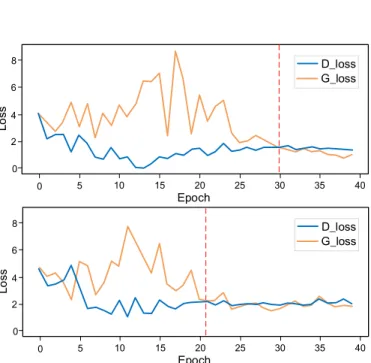
FIGURE 2:Comparison of training loss of DED-GAN without (top) and with (bottom) pixel-wise loss on Multi-PIE (The top shows that training losses of generator and discriminator of DED-GAN without pixel-wise loss (DED-GAN (−Dr)); The bottom shows that training losses of generator and discrim-inator of DED-GAN with pixel-wise loss (DED-GAN∗)).
variants without pose estimation reduces from 95.75% to 93.47%. This can be attributed to the pose information being entangled with identity in the feature representation.
Tab. 1 also presents the performance of our model without face reconstruction Dr. The average accuracy drops from 95.75%to 93.92%. This shows that facial reconstruction is almost equally important to pose estimation. This suggests that the encoder-decoder structured discriminator success-fully balances the training of the two players in GAN.
To gauge the impact of using pose regression, rather than pose classification, we train separate DED-GAN models using the respective formulations. The results show that the performance of the model based on pose classification is lower by about 1%. Thus continuous pose variation used for regression benefits for preserving more information about the pose.
The pixel-wise loss could effectively balance the generator and discriminator and get a fast convergence of training. To evaluate whether the pixel-wise loss could boost the conver-gence performance of DED-GAN, we compare the GAN loss with and without reconstruction task. Fig. 2 shows that
DED-Epoch 5 10 15 20 25 30 35 40 0 Acc ura cy 0.9 0.8 0.7 0.6 0.5 0.4 0.3 DED-GAN(-Dr) DED-GAN
FIGURE 3:Comparison of test accuracy of DED-GAN without (blue) and with (red) pixel-wise loss on Multi-PIE.
Epoch
5 10 15 20 25 30 35 40 0
DED-GAN(-Dr)
DED-GAN
FIGURE 4:Comparison of some synthesised faces of DED-GAN without (top) and with (bottom) pixel-wise loss on Multi-PIE.
GAN without pixel-wise loss almost achieves convergence after 30 epochs. However, DED-GAN with pixel-wise loss gets a balance between generator and discriminator after about 20 epochs. The additional reconstruction task with pixel-wise loss suggests a fast and stable training manner between the generator and the discriminator of GAN. We also compare the performance of DED-GAN with and without pixel-wise loss on the test accuracy and synthesised faces. As shown in Fig. 3, the DED-GAN with pixel-wise loss almost gets a stable test accuracy after 20 epochs training, while the DED-GAN without pixel-wise loss gets a stable accuracy at about 30 epochs. Fig. 4 shows the synthesised faces of DED-GAN with and without pixel-wise loss every five epochs during training. The result also shows that DED-GAN with pixel-wise loss could boost the quality of synthesised faces during training.
FIGURE 5: Comparison of DR-GAN and DED-GAN gener-ated images on Multi-PIE. Given three input images (the left column), the first, fourth and seventh rows shows the faces synthesised by the DR-GAN; the second, fifth and eighth rows show the faces synthesised by DED-GAN; the third, sixth and ninth rows show the ground truth of nine poses within the degree from−60◦to60◦.
C. FACE SYNTHESIS
To verify the performance of our method in terms of the quality of face synthesis across poses, several experiments are conducted on Multi-PIE, CASIA and CFP datasets. In the first experiment, we compared the synthesised faces with different poses between DR-GAN and our method on Multi-PIE. The synthesised faces are verified on the test set of the Setting 2. Hence, there is no overlap of subjects between the training and test datasets. Given a random input face, we generate synthesised faces within a pose range of±60◦. The experimental results are shown in Fig. 5. We can see that the pose estimation capability helps to generate faces across poses and successfully disentangle pose variation from the feature vector in both methods. However, the quality of the faces synthesised by our method appears to be better than that of those output by the DR-GAN in texture, shape, as well as identity preserving characteristics.
For an objective evaluation of the relative quality of faces generated by the two types of GANs, we use the Fre´chet Inception Distance (FID) [72]. For a feature functionφ(by default, the Inception network’s convolutional feature), FID modelsφ(pd)andφ(pg)as Gaussian random variables with empirical means µd,µg and empirical covariance Σd,Σg. FID is expressed asF ID(pd, pg) =||µd−µg||+T r(Σd+
Σg−2(ΣdΣg)1/2), which is the Fréchet distance between the two Gaussian distributions. Tab. 2 compares the FID scores between DR-GAN and DED-GAN. DED-GAN achieves a lower FID score than DR-GAN, which means that the faces synthesised by DED-GAN are more similar to real ones than
TABLE 2:Comparison of FID score. Model FID score DR-GAN 71.25 DED-GAN 57.03
those produced by DR-GAN.
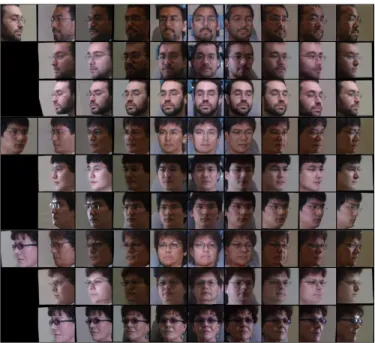
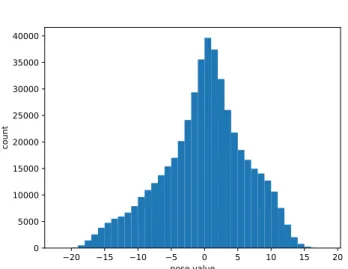
To further demonstrate the ability to disentangle the pose generative factor from other face attributes, we also evaluate the performance of our model on face synthesis across poses on another two uncontrolled datasets CASIA and CFP. We use MTCNN to extract five facial landmarks for each face and then transform the landmarks to pose label by a statistical shape model. The CASIA facial distribution across poses is illustrated in Fig. 7 where the value zero denotes the frontal face. Note that, different from the previous methods, DED-GAN can rotate an input face to any pose controlled explicitly by the pose code. Hence, DED-GAN can synthesise both frontal and profile faces. Fig. 6 shows the pose manifold of generated faces by changing the value of the pose code. Every row denotes the faces with the same identity. The first column is the input face and the other columns show the manifold of the synthesised faces with a smoothly changing value of the pose code from -17 to 17. We can see that our model preserves the identity well as we change the pose code. It also shows that the pose variation is explicitly untangled from the other face attributes including identity.
We also test the face frontalisation performance for unseen faces on the CFP dataset as shown in Fig. 8. Every column shows the faces of the same identity. Given an input profile face, we separately generate the frontal faces by DR-GAN and our method. The up and down rows show the input profile faces and paired real frontal faces separately. The second and third rows show the synthesised frontal faces by setting the pose code to zero. We can see that both methods can untangle the face representation from pose variation and generate frontal faces. However, the faces synthesised by our method appear better in terms of texture detail and in preserving the face identity.
D. FACE RECOGNITION
One motivation for disentangled face representation learn-ing is to see, whether the untangled representation helps to preserve the identity information, and thus boost the perfor-mance in face recognition. To verify this, we also show quan-titative results obtained in PIFR experiments. We evaluate our method on Multi-PIE, CFP and LFW for identification and verification tasks. The features are extracted fromGenc in all the experiments. The cosine distance between two representations is used for face recognition in the test step.
1) Face Identification on the Multi-PIE Database
In the first experiment in PIFR, we evaluate the performance of DED-GAN on the Multi-PIE dataset. We compare our method with other state-of-the-art face recognition methods.
FIGURE 6:Face manifold across poses on the CASIA database (Input is at the first column, the faces from the 2nd column to the last one are the manifold of synthesised faces with the same identity by changing the value of pose code from -17 to 17).
TABLE 3:Rank-1 recognition rates (%) across views, illuminations and sessions under Multi-PIE. Model 0◦ ±15◦ ±30◦ ±45◦ ±60◦ Average Zhuet al.[73] 95.70 92.80 83.70 72.90 60.10 79.30 Yimet al.[10] 99.50 95.00 88.50 79.90 61.90 83.30 DR-GAN [51] 97.00 94.00 90.10 86.20 83.20 89.20 DR-GANam[18] 98.10 95.00 91.30 88.00 85.80 90.80 FF-GAN [74] - 94.60 92.50 89.70 85.20 -Light CNN [75] - 98.59 97.38 92.13 62.09 -DED-GAN* 99.95 99.45 98.02 94.88 87.82 95.75 −20 −15 −10 −5 0 5 10 15 20 pose value 0 5000 10000 15000 20000 25000 30000 35000 40000 count
FIGURE 7: Face distribution across poses on the CASIA database.
Our model achieves the best accuracy in different pose cate-gories, with the most significant improvement noted for the profile faces as shown in Tab. 3. It shows that our method can
FIGURE 8: Some face frontalisation results comparison on CFP database (from top to bottom: input images, DR-GAN frontalised faces, our frontalised faces, real frontal faces).
remove the effects of the pose and retain the intrinsic face shape and structure information of identity.
2) Face Verification on the CFP Database
To further demonstrate the advantages of our method in PIFR, we evaluate it on an uncontrolled dataset. For the in-the-wild setting, we train our model on CASIA and test it on the CFP database. The experiments performed on the CFP dataset aim to compare the capacity of the face verifica-tion approaches across diverse poses. More specifically, the matching is performed between the frontal view (yaw angle
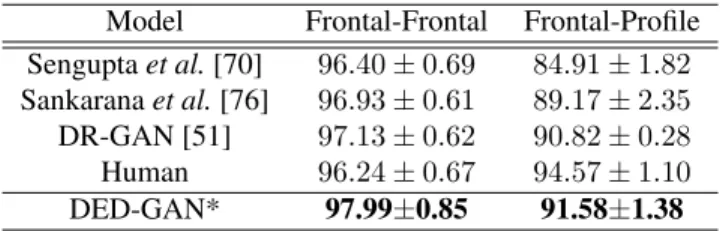
TABLE 4: Face verification accuracy(%) comparison on on CFP.
Model Frontal-Frontal Frontal-Profile Senguptaet al.[70] 96.40±0.69 84.91±1.82
Sankaranaet al.[76] 96.93±0.61 89.17±2.35
DR-GAN [51] 97.13±0.62 90.82±0.28
Human 96.24±0.67 94.57±1.10
DED-GAN* 97.99±0.85 91.58±1.38 TABLE 5:Face verification accuracy (%) comparison on LFW.
Model Accuracy (%) LFW-3D [8] 93.62 LFW-HPEN [77] 96.25 FF-GAN [74] 96.42 DED-GAN* 97.52
<10◦) and profile view (yaw angle>60◦). The evaluation reports the mean and standard deviation of accuracy, over 10 splits, for both frontal to frontal and frontal to profile face ver-ification settings. The verver-ification results are shown in Tab. 4. Our method again yields better verification performance on both frontal-frontal and frontal-profile matching sub-tasks. Thanks to the more stable training structure and more de-tailed pose information injected into our method, DED-GAN achieves about a one percent performance improvement over DR-GAN.
3) Face Verification on the LFW Database
To evaluate the performance on the in-the-wild dataset fur-ther, we test the models described in the previous subsection on the LFW database. Tab. 5 shows the accuracy achieved by different methods. As expected, our method DED-GAN delivers the best accuracy, namely 97.52%, which is com-parable with other state-of-the-art methods. Although DED-GAN is not trained on the LFW dataset, the untangled discriminative representation generalises to other datasets, including in-the-wild datasets.
VI. CONCLUSION
We propose a new GAN-based model (DED-GAN) for dis-entangled representation learning to address the challeng-ing problem of pose-invariant face recognition and photo-realistic face synthesis across poses. To the best of our knowledge, this is the first time that a dual encoder-decoder structured GAN has been used to learn disentangled face rep-resentation. The encoder-decoder structured generator is used for face rotation and learning disentangled face representa-tion. The encoder-decoder structured discriminator is used for facial reconstruction and for predicting identity, as well as for estimating the pose. The Encoder-decoder structured discriminator with the additional pixel-wise loss improves the training efficiency and stability of our GAN. A contin-uous pose encoding provides more detail pose information and benefits the discriminative representation by untangling
the identity and pose. Extensive quantitative and qualitative experimental results show that our method is competitive compared to state-of-the-art approaches to PIFR and to face synthesis across poses. In the future, we plan to incorporate more discriminative information into the design of DED-GAN by extending the network to deal explicitly with other image generative factors, including illumination, expression, age and occlusion.
REFERENCES
[1] J. Deng, J. Guo, N. Xue, and S. Zafeiriou, “Arcface: Additive angular mar-gin loss for deep face recognition,” in Proceedings of the IEEE Conference on Computer Vision and Pattern Recognition, 2019, pp. 4690–4699. [2] Z. An, W. Deng, J. Hu, Y. Zhong, and Y. Zhao, “Apa: Adaptive pose
alignment for pose-invariant face recognition,” IEEE Access, vol. 7, pp. 14 653–14 670, 2019.
[3] J. Kong, M. Chen, M. Jiang, J. Sun, and J. Hou, “Face recognition based on csgf (2d) 2 pcanet,” IEEE Access, vol. 6, pp. 45 153–45 165, 2018. [4] G. Hu, Y. Yang, D. Yi, J. Kittler, W. Christmas, S. Z. Li, and T. Hospedales,
“When face recognition meets with deep learning: an evaluation of convo-lutional neural networks for face recognition,” in Proceedings of the IEEE international conference on computer vision workshops, 2015, pp. 142– 150.
[5] X. Song, Z.-H. Feng, G. Hu, J. Kittler, and X.-J. Wu, “Dictionary inte-gration using 3d morphable face models for pose-invariant collaborative-representation-based classification,” IEEE Transactions on Information Forensics and Security, vol. 13, no. 11, pp. 2734–2745, 2018.
[6] W. Wang, X. Chen, S. Zheng, and H. Li, “Fast head pose estimation via rotation-adaptive facial landmark detection for video edge computation,” IEEE Access, vol. 8, pp. 45 023–45 032, 2020.
[7] M. Kan, S. Shan, H. Chang, and X. Chen, “Stacked progressive auto-encoders (spae) for face recognition across poses,” in Proceedings of the IEEE Conference on Computer Vision and Pattern Recognition, 2014, pp. 1883–1890.
[8] T. Hassner, S. Harel, E. Paz, and R. Enbar, “Effective face frontalization in unconstrained images,” in Proceedings of the IEEE Conference on Computer Vision and Pattern Recognition, 2015, pp. 4295–4304. [9] C. Sagonas, Y. Panagakis, S. Zafeiriou, and M. Pantic, “Robust statistical
face frontalization,” in Proceedings of the IEEE international conference on computer vision, 2015, pp. 3871–3879.
[10] J. Yim, H. Jung, B. Yoo, C. Choi, D. Park, and J. Kim, “Rotating your face using multi-task deep neural network,” in Proceedings of the IEEE Conference on Computer Vision and Pattern Recognition, 2015, pp. 676– 684.
[11] J. Kittler, P. Huber, Z.-H. Feng, G. Hu, and W. Christmas, “3d morphable face models and their applications,” in International Conference on Artic-ulated Motion and Deformable Objects. Springer, 2016, pp. 185–206. [12] P. Koppen, Z.-H. Feng, J. Kittler, M. Awais, W. Christmas, X.-J. Wu,
and H.-F. Yin, “Gaussian mixture 3d morphable face model,” Pattern Recognition, vol. 74, pp. 617–628, 2018.
[13] J.-S. Chan, G.-S. J. Hsu, H.-C. Shie, and Y.-X. Chen, “Face recognition by facial attribute assisted network,” in 2017 IEEE International Conference on Image Processing (ICIP). IEEE, 2017, pp. 3825–3829.
[14] I. Masi, S. Rawls, G. Medioni, and P. Natarajan, “Pose-aware face recog-nition in the wild,” in Proceedings of the IEEE conference on computer vision and pattern recognition, 2016, pp. 4838–4846.
[15] F. Schroff, D. Kalenichenko, and J. Philbin, “Facenet: A unified embed-ding for face recognition and clustering,” in Proceeembed-dings of the IEEE conference on computer vision and pattern recognition, 2015, pp. 815– 823.
[16] Z.-H. Feng, J. Kittler, W. Christmas, and X.-J. Wu, “A unified tensor-based active appearance face model,” arXiv preprint arXiv:1612.09548, 2016. [17] X. Peng, X. Yu, K. Sohn, D. N. Metaxas, and M. Chandraker,
“Reconstruction-based disentanglement for pose-invariant face recogni-tion,” in Proceedings of the IEEE international conference on computer vision, 2017, pp. 1623–1632.
[18] L. Q. Tran, X. Yin, and X. Liu, “Representation learning by rotating your faces,” IEEE transactions on pattern analysis and machine intelligence, 2018.
[19] Y. Bengio, A. Courville, and P. Vincent, “Representation learning: A review and new perspectives,” IEEE transactions on pattern analysis and machine intelligence, vol. 35, no. 8, pp. 1798–1828, 2013.
[20] B. M. Lake, T. D. Ullman, J. B. Tenenbaum, and S. J. Gershman, “Building machines that learn and think like people,” Behavioral and brain sciences, vol. 40, 2017.
[21] C. Hu, X.-j. Wu, and J. Kittler, “Semi-supervised learning based on gan with mean and variance feature matching,” IEEE Transactions on Cognitive and Developmental Systems, 2018.
[22] C. Hu, X.-J. Wu, and Z.-Q. Shu, “Discriminative feature learning via sparse autoencoders with label consistency constraints,” Neural Processing Letters, pp. 1–13, 2018.
[23] K. Ridgeway, “A survey of inductive biases for factorial representation-learning,” arXiv preprint arXiv:1612.05299, 2016.
[24] I. Higgins, N. Sonnerat, L. Matthey, A. Pal, C. P. Burgess, M. Bosn-jak, M. Shanahan, M. Botvinick, D. Hassabis, and A. Lerchner, “Scan: Learning hierarchical compositional visual concepts,” arXiv preprint arXiv:1707.03389, 2017.
[25] Z. Tang, J. Yang, Z. Pei, X. Song, and B. Ge, “Multi-process training gan for identity-preserving face synthesis,” IEEE Access, vol. 7, pp. 97 641– 97 652, 2019.
[26] X. Luan, H. Geng, L. Liu, W. Li, Y. Zhao, and M. Ren, “Geometry structure preserving based gan for multi-pose face frontalization and recognition,” IEEE Access, 2020.
[27] D. P. Kingma and M. Welling, “Auto-encoding variational bayes,” arXiv preprint arXiv:1312.6114, 2013.
[28] I. Goodfellow, J. Pouget-Abadie, M. Mirza, B. Xu, D. Warde-Farley, S. Ozair, A. Courville, and Y. Bengio, “Generative adversarial nets,” in Advances in neural information processing systems, 2014, pp. 2672–2680. [29] I. Higgins, L. Matthey, A. Pal, C. Burgess, X. Glorot, M. Botvinick, S. Mohamed, and A. Lerchner, “beta-vae: Learning basic visual concepts with a constrained variational framework,” in International Conference on Learning Representations, vol. 3, 2017.
[30] T. D. Kulkarni, W. F. Whitney, P. Kohli, and J. Tenenbaum, “Deep con-volutional inverse graphics network,” in Advances in neural information processing systems, 2015, pp. 2539–2547.
[31] X. Chen, Y. Duan, R. Houthooft, J. Schulman, I. Sutskever, and P. Abbeel, “Infogan: Interpretable representation learning by information maximizing generative adversarial nets,” in Advances in neural information processing systems, 2016, pp. 2172–2180.
[32] J. Zhao, M. Mathieu, and Y. LeCun, “Energy-based generative adversarial network,” arXiv preprint arXiv:1609.03126, 2016.
[33] D. Berthelot, T. Schumm, and L. Metz, “Began: Boundary equilibrium generative adversarial networks,” arXiv preprint arXiv:1703.10717, 2017. [34] E. L. Denton, S. Chintala, R. Fergus et al., “Deep generative image models using a laplacian pyramid of adversarial networks,” in Advances in neural information processing systems, 2015, pp. 1486–1494.
[35] T. Salimans, I. Goodfellow, W. Zaremba, V. Cheung, A. Radford, and X. Chen, “Improved techniques for training gans,” in Advances in neural information processing systems, 2016, pp. 2234–2242.
[36] T. Karras, T. Aila, S. Laine, and J. Lehtinen, “Progressive growing of gans for improved quality, stability, and variation,” arXiv preprint arXiv:1710.10196, 2017.
[37] M. Arjovsky, S. Chintala, and L. Bottou, “Wasserstein gan,” arXiv preprint arXiv:1701.07875, 2017.
[38] A. Radford, L. Metz, and S. Chintala, “Unsupervised representation learning with deep convolutional generative adversarial networks,” arXiv preprint arXiv:1511.06434, 2015.
[39] R. Huang, S. Zhang, T. Li, and R. He, “Beyond face rotation: Global and local perception gan for photorealistic and identity preserving frontal view synthesis,” in Proceedings of the IEEE International Conference on Computer Vision, 2017, pp. 2439–2448.
[40] Y. Li, S. Liu, J. Yang, and M.-H. Yang, “Generative face completion,” in The IEEE Conference on Computer Vision and Pattern Recognition (CVPR), vol. 1, no. 2, 2017, p. 3.
[41] Z. He, W. Zuo, M. Kan, S. Shan, and X. Chen, “Attgan: Facial attribute editing by only changing what you want,” IEEE Transactions on Image Processing, 2019.
[42] J. Gauthier, “Conditional generative adversarial nets for convolutional face generation,” Class Project for Stanford CS231N: Convolutional Neural Networks for Visual Recognition, Winter semester, vol. 2014, no. 5, p. 2, 2014.
[43] Y. Lu, Y.-W. Tai, and C.-K. Tang, “Conditional cyclegan for attribute guided face image generation,” arXiv preprint arXiv:1705.09966, 2017.
[44] D. Pathak, P. Krahenbuhl, J. Donahue, T. Darrell, and A. A. Efros, “Context encoders: Feature learning by inpainting,” in Proceedings of the IEEE conference on computer vision and pattern recognition, 2016, pp. 2536–2544.
[45] C. Ledig, L. Theis, F. Huszár, J. Caballero, A. Cunningham, A. Acosta, A. Aitken, A. Tejani, J. Totz, Z. Wang et al., “Photo-realistic single image super-resolution using a generative adversarial network,” in Proceedings of the IEEE conference on computer vision and pattern recognition, 2017, pp. 4681–4690.
[46] C. Li and M. Wand, “Combining markov random fields and convolutional neural networks for image synthesis,” in Proceedings of the IEEE Confer-ence on Computer Vision and Pattern Recognition, 2016, pp. 2479–2486. [47] W. Shen and R. Liu, “Learning residual images for face attribute manipu-lation,” in Proceedings of the IEEE Conference on Computer Vision and Pattern Recognition, 2017, pp. 4030–4038.
[48] A. Shrivastava, T. Pfister, O. Tuzel, J. Susskind, W. Wang, and R. Webb, “Learning from simulated and unsupervised images through adversarial training,” in Proceedings of the IEEE Conference on Computer Vision and Pattern Recognition, 2017, pp. 2107–2116.
[49] Z. Zheng, L. Zheng, and Y. Yang, “Unlabeled samples generated by gan improve the person re-identification baseline in vitro,” in Proceedings of the IEEE International Conference on Computer Vision, 2017, pp. 3754– 3762.
[50] B. Zhao, X. Wu, Z.-Q. Cheng, H. Liu, Z. Jie, and J. Feng, “Multi-view image generation from a single-view,” arXiv preprint arXiv:1704.04886, 2017.
[51] L. Tran, X. Yin, and X. Liu, “Disentangled representation learning gan for pose-invariant face recognition,” in CVPR, vol. 3, no. 6, 2017, p. 7. [52] G. Antipov, M. Baccouche, and J.-L. Dugelay, “Face aging with
condi-tional generative adversarial networks,” in Image Processing (ICIP), 2017 IEEE International Conference on. IEEE, 2017, pp. 2089–2093. [53] J. Yang, A. Kannan, D. Batra, and D. Parikh, “Lr-gan: Layered recursive
generative adversarial networks for image generation,” arXiv preprint arXiv:1703.01560, 2017.
[54] C. H. Chan, M. A. Tahir, J. Kittler, and M. Pietikäinen, “Multiscale local phase quantization for robust component-based face recognition using kernel fusion of multiple descriptors,” IEEE Transactions on Pattern Analysis and Machine Intelligence, vol. 35, no. 5, pp. 1164–1177, 2013. [55] J. G. Daugman, “Uncertainty relation for resolution in space, spatial
frequency, and orientation optimized by two-dimensional visual cortical filters,” JOSA A, vol. 2, no. 7, pp. 1160–1169, 1985.
[56] T. Ahonen, A. Hadid, and M. Pietikainen, “Face description with local binary patterns: Application to face recognition,” IEEE Transactions on Pattern Analysis & Machine Intelligence, no. 12, pp. 2037–2041, 2006. [57] N. Dalal and B. Triggs, “Histograms of oriented gradients for human
detection,” in international Conference on computer vision & Pattern Recognition (CVPR’05), vol. 1. IEEE Computer Society, 2005, pp. 886– 893.
[58] D. Chen, X. Cao, F. Wen, and J. Sun, “Blessing of dimensionality: High-dimensional feature and its efficient compression for face verification,” in Proceedings of the IEEE Conference on Computer Vision and Pattern Recognition, 2013, pp. 3025–3032.
[59] K. Q. Weinberger and L. K. Saul, “Distance metric learning for large margin nearest neighbor classification,” Journal of Machine Learning Research, vol. 10, no. Feb, pp. 207–244, 2009.
[60] W. Chen, T.-Y. Liu, Y. Lan, Z.-M. Ma, and H. Li, “Ranking measures and loss functions in learning to rank,” in Advances in Neural Information Processing Systems, 2009, pp. 315–323.
[61] Y. Wen, K. Zhang, Z. Li, and Y. Qiao, “A discriminative feature learning approach for deep face recognition,” in European conference on computer vision. Springer, 2016, pp. 499–515.
[62] Y. Taigman, M. Yang, M. Ranzato, and L. Wolf, “Deepface: Closing the gap to human-level performance in face verification,” in Proceedings of the IEEE conference on computer vision and pattern recognition, 2014, pp. 1701–1708.
[63] Y. Sun, X. Wang, and X. Tang, “Deeply learned face representations are sparse, selective, and robust,” in Proceedings of the IEEE conference on computer vision and pattern recognition, 2015, pp. 2892–2900. [64] Y. Sun, D. Liang, X. Wang, and X. Tang, “Deepid3: Face recognition with
very deep neural networks,” arXiv preprint arXiv:1502.00873, 2015. [65] K. Zhang, Z. Zhang, Z. Li, and Y. Qiao, “Joint face detection and
alignment using multitask cascaded convolutional networks,” IEEE Signal Processing Letters, vol. 23, no. 10, pp. 1499–1503, 2016.
[66] I. Matthews and S. Baker, “Active appearance models revisited,” Interna-tional journal of computer vision, vol. 60, no. 2, pp. 135–164, 2004. [67] D. Yi, Z. Lei, S. Liao, and S. Z. Li, “Learning face representation from
scratch,” arXiv preprint arXiv:1411.7923, 2014.
[68] D. P. Kingma and J. Ba, “Adam: A method for stochastic optimization,” arXiv preprint arXiv:1412.6980, 2014.
[69] R. Gross, I. Matthews, J. Cohn, T. Kanade, and S. Baker, “Multi-pie,” Image and Vision Computing, vol. 28, no. 5, pp. 807–813, 2010. [70] S. Sengupta, J.-C. Chen, C. Castillo, V. M. Patel, R. Chellappa, and D. W.
Jacobs, “Frontal to profile face verification in the wild,” in 2016 IEEE Winter Conference on Applications of Computer Vision (WACV). IEEE, 2016, pp. 1–9.
[71] G. B. Huang, M. Mattar, T. Berg, and E. Learned-Miller, “Labeled faces in the wild: A database forstudying face recognition in unconstrained environments,” in Workshop on faces in’Real-Life’Images: detection, alignment, and recognition, 2008.
[72] M. Heusel, H. Ramsauer, T. Unterthiner, B. Nessler, and S. Hochreiter, “Gans trained by a two time-scale update rule converge to a local nash equilibrium,” in Advances in Neural Information Processing Systems, 2017, pp. 6626–6637.
[73] Z. Zhu, P. Luo, X. Wang, and X. Tang, “Multi-view perceptron: a deep model for learning face identity and view representations,” in Advances in Neural Information Processing Systems, 2014, pp. 217–225.
[74] X. Yin, X. Yu, K. Sohn, X. Liu, and M. Chandraker, “Towards large-pose face frontalization in the wild,” in Proc. ICCV, 2017, pp. 1–10. [75] X. Wu, R. He, Z. Sun, and T. Tan, “A light cnn for deep face
representa-tion with noisy labels,” IEEE Transacrepresenta-tions on Informarepresenta-tion Forensics and Security, vol. 13, no. 11, pp. 2884–2896, 2018.
[76] S. Sankaranarayanan, A. Alavi, C. D. Castillo, and R. Chellappa, “Triplet probabilistic embedding for face verification and clustering,” in 2016 IEEE 8th international conference on biometrics theory, applications and systems (BTAS). IEEE, 2016, pp. 1–8.
[77] X. Zhu, Z. Lei, J. Yan, D. Yi, and S. Z. Li, “High-fidelity pose and expression normalization for face recognition in the wild,” in Proceedings of the IEEE Conference on Computer Vision and Pattern Recognition, 2015, pp. 787–796.
CONG HUreceived the Ph.D. degree from Jiang-nan University, Wuxi, China, in 2019. He is cur-rently a Lecturer with the School of Artificial Intelligence and Computer Science, Jiangnan Uni-versity. He was a visiting PhD student from July 2018 to July 2019 with the Centre for Vision, Speech and Signal Processing, University of Sur-rey, Guildford GU2 7XH, UK. His research inter-ests include pattern recognition, deep learning and computer vision.
ZHEN-HUA FENG (S’13-M’16) received the Ph.D. degree from the Centre for Vision, Speech and Signal Processing, University of Surrey, Guildford, U.K., in 2016. He is currently a Lec-turer at the Department of Computer Science, University of Surrey. His research interests in-clude pattern recognition, machine learning and computer vision. He has published more than 40 scientific papers in top-ranking conferences and journals such as CVPR, ICCV, IJCAI, IJCV, TIP, TIFS, TCSVT etc. He received the European Biometrics Industry Award from the European Association for Biometrics in 2017.
XIAO-JUN WU received the B.Sc. degree in mathematics from Nanjing Normal University, Nanjing, China, in 1991. He received the M.S. degree and the Ph.D. degree in pattern recognition and intelligent systems from Nanjing University of Science and Technology, Nanjing, China, in 1996 and 2002, respectively. He is currently a Professor in artificial intelligent and pattern recognition at Jiangnan University, Wuxi, China. His current re-search interests include pattern recognition, com-puter vision, fuzzy systems, neural networks and intelligent systems.
JOSEF KITTLER (M’74-LM’12) received the B.A., Ph.D., and D.Sc. degrees from the Uni-versity of Cambridge, in 1971, 1974, and 1991, respectively. He is a distinguished Professor of Machine Intelligence at the Centre for Vision, Speech and Signal Processing, University of Sur-rey, Guildford, U.K. He conducts research in bio-metrics, video and image database retrieval, med-ical image analysis, and cognitive vision. He pub-lished the textbook Pattern Recognition: A Statis-tical Approach and over 700 scientific papers. His publications have been cited more than 68,000 times (Google Scholar).
He is series editor of Springer Lecture Notes on Computer Science. He currently serves on the Editorial Boards of Pattern Recognition Letters, Pattern Recognition and Artificial Intelligence, Pattern Analysis and Ap-plications. He also served as a member of the Editorial Board of IEEE Transactions on Pattern Analysis and Machine Intelligence during 1982-1985. He served on the Governing Board of the International Association for Pattern Recognition (IAPR) as one of the two British representatives during the period 1982-2005, President of the IAPR during 1994-1996.