Japan Advanced Institute of Science and Technology
JAIST Repository
https://dspace.jaist.ac.jp/
Title
Simple Certificateless Signature with Smart Cards
Author(s)
Omote, Kazumasa; Miyaji, Atsuko; Kato, Kazuhiko
Citation
IEEE/IFIP International Conference on Embedded
and Ubiquitous Computing, 2008. EUC '08.: 431-436
Issue Date
2008-12
Type
Conference Paper
Text version
publisher
URL
http://hdl.handle.net/10119/8491
Rights
Copyright (C) 2008 IEEE. Reprinted from IEEE/IFIP
International Conference on Embedded and
Ubiquitous Computing, 2008. EUC '08., 431-436.
This material is posted here with permission of
the IEEE. Such permission of the IEEE does not in
any way imply IEEE endorsement of any of JAIST's
products or services. Internal or personal use of
this material is permitted. However, permission
to reprint/republish this material for
advertising or promotional purposes or for
creating new collective works for resale or
redistribution must be obtained from the IEEE by
writing to [email protected]. By choosing
to view this document, you agree to all
provisions of the copyright laws protecting it.
Description
Simple Certificateless Signature with Smart Cards
Kazumasa Omote and Atsuko Miyaji
School of Information Science,
Japan Advanced Institute of
Science and Technology (JAIST)
Email:
{
omote,miyaji
}
@jaist.ac.jp
Kazuhiko Kato
Department of Computer Science,
Graduate School of ISE,
University of Tsukuba
Email: [email protected]
Abstract
A certificateless public key cryptosystem (CL-PKC) was proposed for the first time in 2003, and since then it has been attracted. But in fact most CL-PKC is implemented using the pairing technique. So it is difficult so far to ap-ply CL-PKC to an existing encryption system that uses the conventional encryption method such as RSA. Needless to say, it is also difficult in even the system with smart cards. In this paper we propose the signature scheme with the RSA based smart card in the simple CL-PKC. Our scheme does not have user’s public key certificate as well as the ID-based cryptography. Also, it has some advantages that there is no escrow problem which occurs in the ID-based cryptog-raphy, and that even the manager cannot generate user’s falsified signature without changing user’s public key.
1. Introduction
The public key cryptosystem is used by various scenes such as the Internet. In a general public key cryptosystem, it is necessary to confirm whether or not the public key is legitimate. The public key certificate is used to verify the validity of the public key. Such a mechanism is called PKI. However, it is pointed out that the management of the public key certificate may become complex in the PKI.
On the other hand, as the first method that does not use the public key certificate, the ID-based public key cryp-tosystem (ID-PKC) was proposed by Shamir in 1985 [1]. In the ID-PKC the public key need not be verified because user’s public key is the public information that specifies the user individuals such as the mail address and the telephone number. The private key used with ID-PKC is generated and safely distributed to each user by the private key gener-ator (PKG). But in ID-PKC the escrow problem is pointed out. This is a problem that PKG can personate all users be-cause PKG knows all private keys of users. Of course, a conventional public key cryptosystem does not have such
an escrow problem.
A certificateless public key cryptosystem (CL-PKC) was proposed for the first time by Al-Riyami and Paterson in 2003 [2] to solve the above-mentioned escrow problem in ID-PKC. The CL-PKC does not have the public key cer-tificate as well as the ID-PKC. The key generation cen-ter (KGC) generates user’s partial private key. In addition, user’s private key is made by adding user’s confidential in-formation to a partial private key of each user. Therefore the escrow problem is solved in CL-PKC because user’s private key is not known to KGC. Hence it is said that CL-PKC is the middle scheme of conventional PKC and ID-PKC.
Recently, a lot of papers about CL-PKC have been pro-posed and in fact most CL-PKC is implemented using the pairing technique. However the public key cryptosystem applied with a lot of systems is still conventional method such as RSA. So it is difficult so far to apply CL-PKC to an existing encryption system. Needless to say, it is also difficult in even the system with smart cards.
In this paper we propose the signature scheme of the sim-ple CL-PKC with the RSA based smart card. Concretely, as the signature method in CL-PKC, we combine the RSA signature using smart cards and Shamir’s ID-based signa-ture. Our scheme does not have user’s public key certificate. Also, it has some advantages that there is no escrow prob-lem which occurs in the ID-based cryptography, and that even the manager cannot generate user’s falsified signature without changing user’s public key.
The organization of this paper is as follows. In the next section we organize related works. After this we state our building blocks in Section 3, our scheme in detail in Sec-tion 4 and the experiment of our scheme in SecSec-tion 5. We discuss our scheme in Section 6 and finally summarize this paper in Section 7.
2. Related work
As the public key cryptosystem that doesn’t use the pub-lic key certificate, there are a lot of papers such as the 2008 IEEE/IFIP International Conference on Embedded and Ubiquitous Computing
978-0-7695-3492-3/08 $25.00 © 2008 IEEE DOI 10.1109/EUC.2008.162
431
2008 IEEE/IFIP International Conference on Embedded and Ubiquitous Computing
978-0-7695-3492-3/08 $25.00 © 2008 IEEE DOI 10.1109/EUC.2008.162
431
2008 IEEE/IFIP International Conference on Embedded and Ubiquitous Computing
978-0-7695-3492-3/08 $25.00 © 2008 IEEE DOI 10.1109/EUC.2008.162
431
ID-based public key cryptosystem (ID-PKC), certificateless public key cryptography (CL-PKC), certificate based en-cryption and self-certified key.
In 1985, ID-PKC was proposed for the first time by Shamir [1]. This is RSA based ID-PKC. Because ID-PKC uses the ID instead of the public key, it needs not use the public key certificate that guarantees the link of the public key and user’s ID. There are a lot of papers about ID-PKC, especially recently, most ID-PKC is implemented using the pairing technique. In the other RSA based ID-PKC, there are Guillou-Quisquater signature [3] and Mediated RSA scheme [4].
On the other hand, CL-PKC was published for the first time in 2003 [2]. This cryptosystem does not have the es-crow problem though it does not use the public key certifi-cate. Concretely, the escrow problem is solved by intro-ducing user’s partial secret information. Hence it is said that this is the middle method of conventional PKC and ID-PKC. A CL-PKC is mainly composed of Certificateless En-cryption (CLE) and Certificateless Signature (CLS). There are a lot of papers about CL-PKC [2][5][6][7][8][9][10], es-pecially recently, most CL-PKC is implemented using the pairing technique in the same way of ID-PKC. Some CL-PKC schemes are implemented based on the discrete loga-rithm problem without the paring technique [9][10]. Also, there are the papers about the attack that replace user’s pub-lic key [11] and about discussing the cheating in the master key generation phase of KGC [12].
The self-certified key has been proposed as a similar re-search of CL-PKC since 1991 [13][14]. In this method any-one can compute user’s public key from the public infor-mation of the system. In [14] the trusted third party com-putes to link user’s public key with the user’s ID. Further-more, the self-certificated signature [15] is proposed as an applied research of a self-certificated key. This certificate based method can calculate user’s public key from the pub-lic information of the system when the signature is verified. Besides, the certificate based encryption [16] was pro-posed in 2003 as a related research of CL-PKC. In this method the concept is similar to CL-PKC though it seems to be opposite to CL-PKC judging from the name. The public key certificate used here is treated as one of the private keys, and is different from the conventional public key certificate.
3. Building Blocks
3.1. Notations
The notations used in this paper are as follows.
3.2. Shamir-IBS Scheme
Here, we briefly explain Shamir-IBS (Identity-Based Signature) [1]. Shamir-IBS is an application of the RSA scheme, and the signature scheme to regard user’s ID as a public key.
1. PKG (used as a trusted third party in ID-PKC) com-putes each private keyki = h(IDi)d (modn)based
onIDi and transferski toUi in the secure channel.
Note thatIDi is public information that specifies the
user individuals such as the mail address or the tele-phone number, andd∈Zφ∗(n)is a private key of PKG. 2. Ui generates a random numberri ∈ Zn∗, and
calcu-lates the following signature(Yi, Zi)to the message
m. Note thath(·)is a hash function that PKG opens to the public.
Yi = rei (modn)
Zi = ki·rih(Yi||m) (modn)
3. The verifier can verify the signature(Yi, Zi)by using
IDi,(e, n),mandh(·)as follows.
Zie=? h(IDi)·Yh(Yi||m)
i (modn)
3.3. Signature System with eLWISE Card
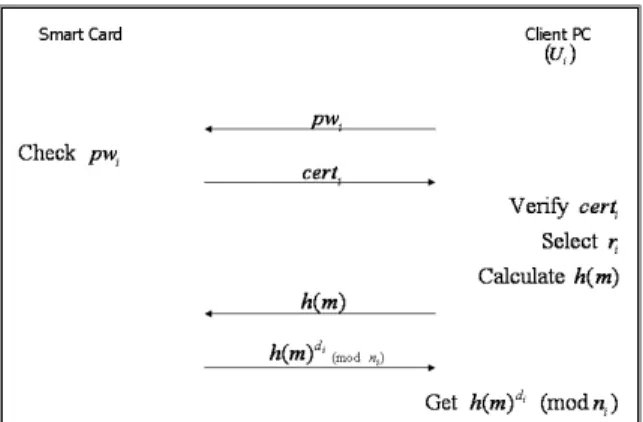
The eLWISE card is a smart card (IC card) made in NTT communications Ltd. In the signature with contact-type eL-WISE card, we can use the RSA signature, the DSA sig-nature, and the ECDSA signature. In this paper we use the RSA signature from these, whose padding method is RSASSA-PKCS1-v1 5. The RSA key is computed in the smart card. One example of the signature system with eL-WISE card is shown as follows (refer to Fig. 1).432
432 432
Figure 1. Example of signature system with eLWISE card (RSA method)
1. Ui inputs the access password to the smart card on
client PC. When the smart card confirms that this given password is legitimate, it transmits user’s certificate certito the client PC.
2. After the smart card confirms that the certificatecerti is legitimate, the client PC transmits the hash value of a message to the smart card and acquires the RSA signa-ture of the message. Note that the client PC is assumed to have the root certificate and the revocation list. The smart card is tamper resistant. So it is possible to safely store some confidential information into the smart card. Also, even the trusted third party cannot extract the secret keydiof RSA from the smart card. However, there
are the following some drawbacks in the system which uses the certificate. We set user’s RSA key and user’s public key certificate into each smart card. So the trusted third party must issue public key certificates only of the number of users, and manage them. She also needs to newly gen-erate the public key certificate every time the user changes own public key. In addition, the size of one public key cer-tificate is about 1KB in our system, and we confirmed that it took a few seconds to transmit the certificate between a smart card and a client PC.
4. Our scheme
4.1. Problems to Solve
A conventional public key cryptosystem has a problem that the management of the public key certificate becomes complex in the system. Of course, it includes the system with eLWISE card with the certificate. On the other hand, the ID-based public key cryptosystem like Shamir’s method
has an escrow problem that the manager can make a forged signature though it has an advantage not to use a certifi-cate. In our scheme we solve above two problems at the same time, and develop the certificateless public cryptosys-tem by combining the RSA signature using smart cards and based signature. We use Shamir-IBS as one of the ID-based RSA signature.
4.2. Premise
The premise of our scheme is as follows.
1. The smart card is tamper resistant, and the confidential information is not stolen from the smart card itself or while it is being transferred between the smart card and the client PC.
2. The calculation algorithm (e.g., signature generation) in the smart card is not falsified.
3. Nobody can read user’s RSA private key in the smart card.
4. Only the person who knows the access password of the smart card can read the confidential information except for the RSA private key stored in the smart card. 5. The access password of the smart card is not cracked
because the smart card is locked when a user inputs a wrong password more than the predetermined fre-quency.
6. We do not put the confidential information about the key in the client PC because the client PC is not safe.
4.3. Adversary Model
In [2], two kinds of attacks (Type I / Type II) are as-sumed. Type I adversary can replace the public key of an arbitrary user with another public key though he does not know the master key of KGC. On the other hand, Type II adversary can use the master key though he does not replace the public key of an arbitrary user with another. In this pa-per we assume these two kinds of attacks as well as [2]. Hence we do not assume the adversary who both replaces user’s public keys with another and knows the master key.
4.4. Our Protocol
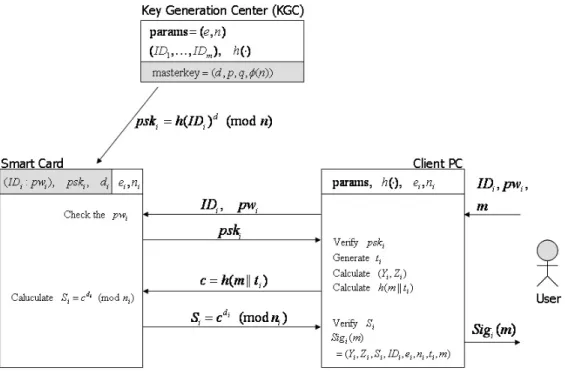
We concretely show details of the protocol according to the procedure of a certificateless signature. We also show the whole figure of protocol in Fig. 2. Note that the part of the shadow in this figure means the area secretly pre-served. In our protocol we newly set the ”Change-User-Keys” phase.
433
433 433
Figure 2. Flow of our protocol
[Setup]KGC selects large primespandq, computesn = pqand computes(e, d)which satisfiesed= 1 (modφ(n)). Then KGC publishes params = (e, n) as the public pa-rameter and keeps master keymasterkey= (d, p, q, φ(n))
secretly. He also publishes all users’ ID and hash functions.
[Partial-Secret-Key-Extract] KGC calculates pski = h(IDi)d(modn)by using her own parameters(d, n), and
thenUistorespskiin his smart card by a safe means.
[Set-Secret-Value]Ui generates RSA keys (ei, di, ni) us-ing his smart card and preserves these keys in his smart card, sets bothIDiandpwi, and then copies his public keys
(ei, ni)to the client PC.
[Set-Secret-Key]Uisetsski= (pski, di)as secret keys.
[Set-Public-Key] Ui sets pki = (IDi, ei, ni) as public
keys.
[Sign]At first,Ui getspski from his smart card under the
following procedure.Uiinputs bothIDiandpwion user’s
client PC. After confirming thatIDiandpwiare legitimate
in his smart card,pskiis transferred from his smart card to the client PC. ThenUi verifiespskiby usingparamsand the hash function on the client PC as follows.
pskie=? h(IDi) (modn)
Secondly,Uigenerates the signature using his smart card
under the following procedure.Uigenerates a ticketti. The
ticket is similar to information described in the public key certificate (e.g. the signature issuer and the date of issue). Uicalculates(Yi, Zi)as Shamir-IBS on the client PC. It is a
signature to the value which joins(ei, ni)withti.
Further-more,Uigenerates the RSA signatureSito the hash value
which joinsmandti by using his smart card. Hence the
signature ofUiis as follows. Sigi(m) = (Yi, Zi, Si, IDi, ei, ni, ti, m) Yi = rie (modn) Zi = pski·rh(Yi||ei||ni||ti) i (modn) Si = h(m||ti)di (modni)
[Verify]The verifier can verifySigi(m)usingparamsand
hash function as follows.
Zie =? h(IDi)·Yh(Yi||ei||ni||ti) (modn)
Sei
i
?
= h(m||ti) (modni)
[Change-User-Keys] WhenUi wants to change his own
public key, he generates new RSA keys (ei, di, ni)in his smart card and overwrites the old RSA keys.
5. Experiment
5.1. Purpose
Our scheme uses a smart card with a low processing abil-ity. So the processing time that the smart card executes might become large. Especially, we worry about the influ-ence on both data transfer time from smart card to the client
434
434 434
PC and the processing time of the RSA signature. We there-fore implemented our scheme and measured both the trans-fer time and the processing time in order to confirm that the smart card can complete the processing within a reasonable time.
5.2. Circumstances
We used as the client PC a ThinkPad X60 (CPU: Core 2 Duo 2GHz, Memory: 1GB), used as the smart card an eL-WISE (NTT Communications), and used as the smart card reader an AES drive IIIE (Athena Smartcard Solutions). This smart card is equipped with a CPU, RAM and ROM and corresponds to PKCS#11. The software we used was the OS Linux Fedora Core 6, a smart card library group, the encryption library OpenSSL 0.9.8b, the multiple-precision arithmetic library GMP 4.1.4-9.
5.3. Measurement Items
In the generation of the signature using the smart card, we measured the transfer time and the processing time for the six items in Table 1. Note that we measured items 1 and 2 by using the scheme with a certificate in order to compare with our scheme. Items 1, 3 and 6 were executed in the smart card, and the others were executed in the client PC.
5.4. Results
Each of the times for the items listed in Table 1 is the average of five measurements. The measurement was con-ducted by inserting the gettimeofday function in the source code. Especially large values of the measurement results were items 1, 3 and 6 as we expected, and all these items were processed in the smart card. The measurement time of certi transfer was longest among them. Note that we adopted a mail address as user’s ID and used information about the signature issuer, affiliation, signature date and us-age as a ticket. The results of the measurement items 1 and 3 were the transfer time from the smart card to the client PC. On the other hand, the result of measurement item 6 con-tains not only time of the generation of RSA signature but also the processing transfer time of the signature data. We can guess that the calculation processing time of the RSA signature with the smart card would become approximately 100ms because the size of RSA signature is the same as the size ofpski (i.e. 420−321 100). Therefore, we
un-derstood that the data transfer between smart card and the client PC made more significant impact on the time of entire processing than the signature calculation in this smart card. Also, we confirmed that the entire processing time was able to be shortened by not usingcertibecause the transfer time ofcerti is larger thanpski. Hence we were able to
Table 1. Experimental Results
Measurement times Time
1. Transfer ofcerti 2140 ms
2. Verification ofcerti 19.4 ms
3. Transfer ofpski 321 ms
4. Verification ofpski 0.222 ms
5. Calculation of(Yi, Zi) 2.20 ms
6. Generation of RSA Signature 420 ms
show the effectiveness of our scheme that does not usecerti
.
6. Discussion
6.1. Certificateless
The certificateless in CL-PKC stands for an implicit pub-lic key certificate. Of course, it is not defined as an exppub-licit public key certificate in the system. The public key certifi-cate is a signature to the predefined format data such as ID, the public key and the expiration date. It is generated by the trusted third party. We can regardpskias an implicit public
key certificate in our scheme becausepskiis the signature
which is generated by the trusted third party. Also, we can regard(Yi, Zi)as a self-generated public key certificate
be-cause(Yi, Zi)is the signature to his public key byUi.
6.2. Escrow Problems
The escrow problem is the problem that the trusted third party can personate all users since she knows all users’ se-cret keys. As for sese-cret keyski = (pski, di)in our scheme,
the trusted third party andUigeneratespskianddi,
respec-tively. As a result, our scheme can solve the escrow prob-lem because the trusted third party does not know one of ski, that is,di.
6.3. Attacks
Two kinds of attacks (Type I / Type II) are assumed in this paper as described in section 4.3. First of all, Type I attack is discussed. This attack is also introduced as a key replacement attack in [11]. Type I adversary attempts to generate a forged signature by replacing user’s public key to the advantageous value without knowing user’s partial secret key. When the adversary replaces Ui’s public key
ni in our scheme, it is necessary to calculate new(Yi, Zi) toni. To compute new(Yi, Zi)the adversary has to use pski. However, Type I adversary does not know user’spski.
435
435 435
Hence we can say that our scheme is resistant to Type I at-tack (the key replacement atat-tack) because Type I adversary cannot makeUi’s forged signature.
On the other hand, Type II adversary attempts to gener-ate a forged signature using a master key without replacing user’s public key to another. Type II adversary has to know not onlypskibut alsoUi’s secret keydiin order to generate Ui’s forged signature. However, it is difficult for Type II ad-versary to knowdidue to the difficulty of the factorization on prime numbers ofni. Hence we can say that our scheme is resistant to Type II attack because Type II adversary can-not generateUi’s forged signature.
Therefore, we can say that our scheme is resistant to two kinds of attacks (Type I / Type II).
6.4. Change of User’s Key
When user wants to change his key in a conventional public key cryptosystem, it is necessary to make a new pub-lic key certificate. In our scheme the user can freely alter user’s keys(ei, di, ni). ConcretelyUiwho wants to change his keys generates new keys(ei, di, ni)and has only to re-place(ei, di, ni)with(ei, di, ni)in his smart card. Then Uihas only to execute the ”Set-Secret-Value” phase in our scheme. As a result, the certificate reissue procedure be-comes unnecessary.
7. Summary
In this paper we proposed a simple certificateless signa-ture scheme that combined the ID base signasigna-ture and the RSA signature. This method is appropriate for an existing RSA based smart card. We described that our scheme does not have an escrow problem, and is resistant to two kinds of attacks (Type I / Type II). As a future work we would like to prevent user’s secret keypskifrom getting out of the smart card.
References
[1] A. Shamir, “Identity-based cryptosystems and signature schemes,” Advances in Cryptology – CRYPTO’84, LNCS 0196, pp.47–53, Springer-Verlag, 1984.
[2] S.S. Al-Riyami and K. Paterson, “Certificateless pub-lic key cryptography,” Advances in Cryptology – ASIACRYPT’03, LNCS 2894, pp.452–473, Springer-Verlag, 2003.
[3] L.C. Guillou and J.J. Quisquatar, “A paradoxical identity-based signature scheme resulting from zero-knowledge,” Advances in Cryptology – CRYPTO’88, LNCS 403, pp.216–231, Springer-Verlag, 1988.
[4] X. Ding and G. Tsudik, “Simple identity-based en-cryption with mediated RSA,” Proc. RSA Confer-ence’03, 2003.
[5] B. Libert and J.J. Quisquater, “On constructing cer-tificateless cryptosystems from identity based en-cryption,” Proc. PKC’06, LNCS 3958, pp.474–490, Springer-Verlag, 2006.
[6] J.K. Liu, M.H. Au and W. Susilo, “Self-Generated-Certificate Public Key Cryptography and Certifi-cateless Signature/Encryption Scheme in the Stan-dard Model,” Proc. ASIACCS’07, pp.273–283, ACM, 2007.
[7] W.S. Yap, S.H. Heng and B.M. Goi, “An efficient certificateless signature scheme,” Proc. EUC Work-shops’06, LNCS 4097, pp.322–331, Springer-Verlag, 2006.
[8] M.C. Gorantla and A. Saxena, “An efficient cer-tificateless signature scheme,” Proc. CIS’05, LNCS 3802, pp.104–109, Springer-Verlag, 2005.
[9] J. Lai and K. Kou, “Self-generated-certificate public key encryption without pairing,” Proc. PKC’07, LNCS 4450, pp.476–4890, Springer-Verlag, 2007.
[10] J. Baek, R. Safavi-Naini and W. Susilo, “Certificate-less Public Key Encryption without Pairing,” Proc. ISC’05, LNCS 3650, pp.134–148, Springer-Verlag, 2005.
[11] B.C. Hu, D.S. Wong, Z. Zhang and X. Deng, “Key re-placement attack against a generic construction of cer-tificateless signature,” Proc. ACISP’06, LNCS 4058, pp.235–246, Springer-Verlag, 2006.
[12] M.H. Au, Y. Mu, J. Chen, D.S. Wong J.K. Liu and G. Yang, “Malicious KGC attack in certificate-less cryptography,” Proc. ASIACCS’07, pp.302 - 311, ACM, 2007.
[13] M. Girault, “Self-certified public keys,” Advances in Cryptology – EUROCRYPT’91, LNCS 0547, pp.491-497, Springer-Verlag, 1991.
[14] H. Petersen and P. Horster, “Self-certified keys con-cepts and applications,” Proc. CMS’97, pp.102–116, 1997.
[15] B. Lee and K. Kim, “Self-certified Signatures,” Progress in Cryptology – INDOCRYPT’02, LNCS 2551, pp.199–214, Springer-Verlag, 2002.
[16] C. Gentry, “Certificate-based encryption and the cer-tificate revocation problem,” Advances in Cryptol-ogy – EUROCRYPT’03, LNCS 2656, pp.272–293, Springer-Verlag, 2003.
436
436 436