WhiTepAper Survey
Web 2.0 and Sales
Process Management
by Dennis D. McDonald, Ph.D.
INTRODUCTION
Web 2.0 and
Sales Process Management
how can Web 2.0 systems and applications support
management of sales processes?
TAbLe Of CONTeNTS Introduction ... 2 findings ... 2 Discussion ... 7 Challenges ... 7 Conclusions ... 9 Appendix A ... 11 Appendix b ... 11 Appendix C ... 12 Appendix D ... 13 Appendix e... 14 Appendix - fig. 1... 15
ThIS RePORT DISCUSSeS hOW Web 2.0 SySTeMS AND APPLICATIONS CAN SUPPORT MANAgeMeNT Of SALeS PROCeSSeS.
instead of focusing on specific technologies such as social networking, blogs, wikis, or other technologies, it focuses on business processes and addresses the following questions:
1. how satisfied are sales managers with the different processes currently involved in locating, managing, and closing sales?
2. What can this tell us about where Web 2.0 applications would provide the most benefit to the overall sales process?
input to this report was provided by a special online survey (Appendix A) and by telephone interviews
(Appendix b). Appendix C explains the project’s organizing concepts. Appendix D provides defini tions for “sales processes” and “Web 2.0.” To see the Overview of findings from this project Appendix e.
Findings:
SUMMARy Of fINDINgS
1. The most immediate perceived benefits of applying Web 2.0 techniques to sales are pro vided by improving the outcomes of prospect ing and customer qualification.
2. When addressing Web 2.0 support for sales-related communication and collaboration, it’s important to distinguish whether participants or processes being considered are internal or external to the sales team’s organization. For
example, while involvement with the social and professional communities surrounding business prospects may improve market intelligence about business prospects, such communica tions are not as controllable as traditional one-to-one communications between buyer and sellers. internally, collaboration that cuts across organizational boundaries might be impacted by existing organizational rivalries.
3. Some within-sales-force collaboration may be resisted by sales people if this raises fears of reduced competitiveness or shared commis sions. To promote such collaboration it may be necessary to modify compensation plans to reward certain types of collaboration.
4. Sales process maturity may strongly influence adoption of Web 2.0 techniques. Well-defined and formalized processes, such as those that occur closer to the end of the sales cycle, ben efit differently than activities that are less struc tured or performed independently by members of the sales team.
5. The lengthier and more complex the sales process, the more participants will be involved as the process evolves. Making information gathered at one stage available to other partici pants “downstream” will help ensure a smooth transition from sales to delivery and servicing of the customer. Organizational or departmental barriers that restrict collaboration across groups should not be allowed to disrupt the sales pro cess and satisfaction of the customer.
fINDINgS
OVeRALL SATISfACTION WITh SALeS PROCeSSeS in the online survey we asked respondents to rate their overall satisfaction with how well their sales team performs the processes of:
prospecting, Qualifying, pricing, proposing, Negotiating, Closing, Delivering, and Servicing. The purpose of this question was to identify
potential areas of opportunity for the application of “web 2.0” based tools. Figure 2
Of the 299 respondents who answered this question, the average satisfaction rating ranged from a low average of 2.95 (for prospecting) to a high average of 3.78 (for Delivering). Figure 2 also shows that the three sales processes that have the lowest average satisfaction rating are prospecting, Qualifying, and Closing. The highest average ratings occur for Delivering and Servicing.
This point, when discussed with sales managers in the telephone interviews, was not surprising. One interviewed manager said, “My sales peo ple are always complaining about the quality of the leads they’re given to go after!”
Another manager, when asked about the influ ence of the size of the sales team on satisfaction, said that, “theoretically at least, the larger sales team might have better support and as a result might be more likely to pursue higher quality leads which would lead to higher satis faction with prospecting and qualifying.”
Another manager commented that, “You always want to close more of your prospects no mat ter how many you get,” and that this might explain why “closing” received a relatively lower score.
When commenting on the higher ratings for Deliv ering and Servicing, one manager said, “That’s to be expected. In our company the processes for doing these are very defined and structured. Our people are really good at doing these once the sales are closed.”
exploring this point further, this manager specu lated “That sales teams—even larger sales teams—tend to operate quite independently when prospecting and qualifying and that the processes and methods followed may vary widely by salesperson.”
The opposite was true for another sales manager asked about qualifying. “I’m very detailed with my salespeople about how to do qualifying. That’s probably the area that’s spelled out in
most detail in our training and our processes.”
Still, he agreed with the overall lower satisfaction with prospecting and qualifying and that these were areas that would generally be thought of as needing support.
“Respondents are,
on average, more
satisfied with how their
sales team actually
delivers products or
services to customers
than they are with how
well the critical process
of prospecting is
being performed.”
Fig. 2
Overall Satisfaction With Sales Processes
PROSPeCTINg 2.95 QUALIfyINg 3.16 PRICINg 3.48 PROPOSINg 3.45 NegOTIATINg 3.37 CLOSINg 3.15 DeLIVeRINg 3.78 SeRVICINg 3.72 0 .05 1.0 1.5 2.0 2.5 3.0 3.5 4.0
Based on this we conclude that these respon dents are, on average, more satisfied with how their sales team actually delivers products or ser vices to customers than they are with how well the critical process of prospecting is being performed.
fINDINgS
“Do these results
mean that sales
team size does not
have an impact on
how satisfied sales
managers are with
how their sales
team operates?”
IMPACT Of SIze Of SALeS TeAM ON SALeS PROCeSS SATISfACTION
The overall satisfaction scores from the online survey were examined by size of the sales team. The results were not conclusive as to the impact of sales team size on satisfaction with sales processes.
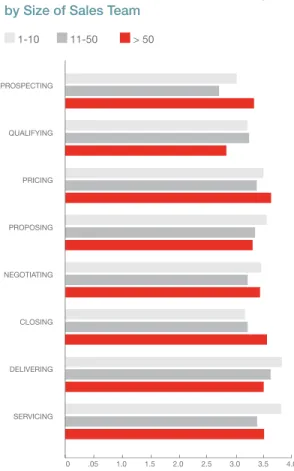
Figure 3 displays the average satisfaction ratings for sales processes overall subdivided into three sales team size categories: 1-10 (79.3 %), 11-50 (12.7%), and over 50 (6 %). While the number of survey respondents with larger sales teams than 10 is relatively small, based on an examination of Figure 3’s data it does not appear that there is a consistent relationship in the survey between the size of a sales team and sales managers’ satis faction with the sales team’s performance of key sales processes.
Do these results mean that sales team size does not have an impact on how satisfied sales man agers are with how their sales team operates? Not necessarily. it’s possible that other factors impact satisfaction and these were explored in the interviews. possible “intervening variables” were discussed in the telephone interviews. One manager wondered upon examining the chart in Figure 3 in detail, “if smaller sales teams tended to be more reliant upon their own efforts for prospecting and sales, while larger sales teams were more likely to be supported by organized research or market ing departments.”
While the questioning in the survey was not detailed enough to evaluate this, this type of distinction may be an important one for sales managers considering the use of Web 2.0 based support for the sales team. This point is also addressed in more detail in the “Discussion” por tion of this report.
Fig. 3
Overall Satisfaction with Sales Processes, by Size of Sales Team
1-10 11-50 > 50 PROSPeCTINg QUALIfyINg PRICINg PROPOSINg NegOTIATINg CLOSINg DeLIVeRINg SeRVICINg 0 .05 1.0 1.5 2.0 2.5 3.0 3.5 4.0 INDUSTRy
Figure 4 shows that the top three specified indus try categories in which sales teams spend most of their time were reported to be Consulting and pro fessional Services (23.2 %), Media and publishing (12.4 %), and Software (10.7 %). Together these three categories alone accounted for almost a half (46.4 %) of all online survey respondents.
Given the manner in which this survey was publicized it is possible that:
a.respondents in these categories are “over represented” in comparison with the general population of sales managers and;
fINDINgS
Fig. 4
b. these particular industry respondents have a Industry Focus: Which one of the following
relatively higher rate of awareness concerning categories best describes the industry your sales force spends most of its time with?
the topics covered by this survey.
IMPACT Of SATISfACTION WITh hOW INfORMA- answer Options Response Frequency Response Count
Association &
TION CONTeNT, COLLAbORATION AND
COMMUNI-Nonprofit
CATION CONTeNT, SUPPORT The SALeS PROCeSS
Chemical
The survey asked three additional questions Consulting &
(Figure 5 and 6): Professional Services
finance & Insurance
how satisfied are you with how well your sales government
team creates and manages information Content health & Medical
in support of each of these sales processes? Manufacturing
how satisfied are you with how well your sales Nonprofit
team Collaborates in support of each of these Media & Publishing
sales processes? Retail
how satisfied are you with how well your sales Software team Communicates in support of each of Telecommunications these sales processes?
Travel & Transportation
Note along the bottom of Figure 5 how simi- energy & Utilities
lar the average satisfaction ratings are for: Other
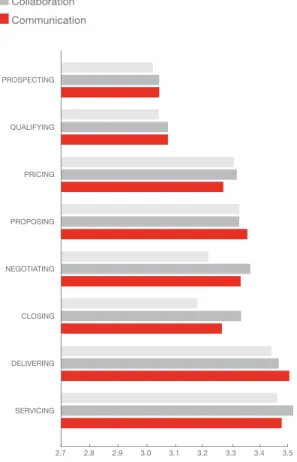
information Content (3.24) Collaboration (3.30) Communication (3.29)
Fig. 5
1.7% 0.9% 23.2% 6.4% 3.0% 3.0% 6.9% 2.6% 12.4% 6.9% 10.7% 3.9% 3.0% 0.4% 15.0% answered Question Skipped QuestionKeeping in mind that a score of 3 indicates Satisfaction with Sales Team Information
“Could this mean
“Neither Satisfied nor Dissatisfied” and 4 Content, Collaboration, and Communicationthat improving how
“Somewhat Satisfied,” it appears that, for the‘information-content’-
online survey’s group of sales managers at least,related processes are
these three functions are performing similarly PROSPECTINGhandled is potentially
within their sales teams, with informationSales Process with Information Satisfaction Content Satisfaction with Collaboration Satisfaction with Communication QUaLIFYING
a more immediate
Content satisfaction scores being somewhatPRICING
sales process
lower for six of the eight functions.PROPOSING
application than
either collaboration
Could this mean that improving how “information NEGOTIaTINGor communication?”
content” related processes are handled is poten- CLOSINGtially a more immediate sales process application
DELIVERING than either collaboration or communication?
SERVICING One manager commented “how inefficient email Responses
is for content related applications during the average
sales process.” 3.02 3.04 3.30 3.32 3.21 3.17 3.43 3.45 263 3.24 3.04 3.07 3.31 3.32 3.36 3.33 3.46 3.51 248 3.30 4 2 54 15 7 7 16 6 29 16 25 9 7 1 35 233 72 3.04 3.07 3.27 3.35 3.33 3.26 3.50 3.47 242 3.29
fINDINgS
his own organization uses prospect-specific wikis for tracking communication with customers over time.
he mentioned “how a wiki was particularly useful when, while working through the differ ent steps of the sales process, and as more people became involved in the sale, the wiki was especially useful for getting new staff (e.g., technical or engineering staff) “up to speed.” This is something, he thought, that sole reliance on email was very inefficient”.
This is similar to what the author found in another research project that examined the use of blogs as project management tools; email was consis tently cited as being an inefficient way to com municate content documents among a group of people sharing a common goal.
Figure 6 also shows an increase in sales man ager satisfaction as we move from the left side to the right side.
Considering that the defined sales processes discussed in the survey follow a traditional “fun
“Email was
consistently cited
as being an
inefficient way
to communicate
content documents
among a group of
people sharing a
common goal.”
nel” model, two interpretations of these data are the following:
1. Sales managers tend to be more satisfied with “post-sales” processes than they are with “pre
sales” processes.
2. Sales managers don’t make extremely strong satisfaction distinctions based on general Web 2.0 concepts and functions such as content creation, collaboration, and communication.
Fig. 6
Satisfaction with Sales Team Information Content, Collaboration, and Communication, by Sales Process Information Content Collaboration Communication PROSPeCTINg QUALIfyINg PRICINg PROPOSINg NegOTIATINg CLOSINg DeLIVeRINg SeRVICINg 2.7 2.8 2.9 3.0 3.1 3.2 3.3 3.4 3.5
DISCUSSION
“By giving system
users more
responsibility and
freedom, those most
directly in contact
with customers and
decision makers
can manage the
sale process more
responsively and
profitably.”
Discussion:
OPPORTUNITIeS
Web 2.0 technologies and processes offer the fol lowing types of opportunities:
Content can be easily created, copied, distrib uted, modified, or changed.
A mix of textual, graphic, numeric, audio, and video information can be managed and exchanged. Networked collaboration technologies can reduce the inefficiencies of relying solely on email and face to face meetings for information exchange and collaboration.
Web 2.0 related technologies make it possible to retrieve and manipulate sales-relevant content from existing corporate and public databases without direct involvement of programmers and technical support staff.
Small groups can be formed, perform work collaboratively, and disbanded at will. Web 2.0 tools that support such “community building” are readily available, easy to use, and capable of supporting collaboration across existing geographic and organizational barriers. Sales people can engage with potential cus tomers in professional and social networking settings that promote trust and the open shar ing of information.
Communication can take place in public or in a group situation where many different people have access to the same message.
Many Web 2.0 tools offer the ability to generate “information feeds” that web users can sub
scribe to. These feeds provide a quick way for sales people to remain abreast of databases or web pages that change frequently.
Challenges:
gAININg COLLAbORATION
One way to look at Web 2.0 approaches to managing information content is that they can shift more responsibility and control to users for creating and communicating the information needed to get sales-related work done collaboratively. By giving system users more responsibility and freedom, those most directly in contact with customers and decision makers can manage the sale process more responsively and profitably. The theory behind this is sound: When sales
people can pick and choose what information they want to see and subscribe to on a regular basis, whether it’s from their parent company’s CRM system, from a local area network data base, from a commercial subscription service, or from the public “cloud,” they can use Web 2.0 tools to select the information that makes the most sense to them and the tasks at hand.
The likelihood that this “self management of information content” will occur consistently might be in question, based on some of the interviews conducted for this project.
For example, corporate support will be needed to set up and maintain specialized feeds.
This is where larger organizations may have an advantage in consistently applying Web 2.0 solu tions than smaller ones when a variety of different systems exist that contain information of potential value to the sales person.
One manager was candid when asked about the value of such features for improving prospecting and qualification: “I know about this stuff and how useful it can be,” he said, “But it’s on the edge of what concerns me most. I’d have to take time out to put together custom feeds and
DISCUSSION
“Salespeople
need the skills,
time, motivation,
and support to
customize and/
or use Web 2.0
technologies.”
the like. How likely is it that busy salespeople will do that on their own when I’m flogging them to make appointments?”
Another manager acknowledged that:
”Salespeople can be a competitive, feisty bunch. Despite the value of “collaborating” in order to better understand and respond to a cus tomer’s needs, for example, many sales people are reluctant to share information about a sale with their peers if they think they might lose competitive advantage—or a potential commission—in the process. You really need to modify how sales commis sions are awarded and shared in order to reward collaboration.
he commented, “They didn’t like it when I convened a weekly meeting to report prog ress. It wasn’t till we started rewarding them for collaborating and helping each other that they changed.”
PROVIDINg The TeChNOLOgy
in other words, providing the technology that supports collaboration is not sufficient. Salespeo ple need the skills, time, motivation, and support to customize and/or use Web 2.0 technologies. OPeNINg UP The SALeS PROCeSS
Sales management may also have some con cerns about “opening up” the sales process since that may also expose—they think—infor mation that could provide competitive advan tage to competitors. in public online forums surrounding product support, for example, negative as well as positive information can be spread easily about a product or service. Such a “lack of control” over some aspects of the sales
process may cause some company executives (and sales people) to resist applying web 2.0 based systems and techniques.
yet, it can be these same public systems that can provide the “market intelligence” that is so valu able to effective prospecting; this is one reason, for example, that services are emerging to mine public systems such as Twitter for market intelli gence based on what people are communicating. One of the interviewed managers provided an interesting perspective discussing communica tion via online systems in the context of selling to government agencies; “In reality,” he said, “making all procurement related information more accessible to vendors in a solicitation is good. But it’s also possible to use formal systems to keep vendors at arms length.”
When asked to explain this he said, “If you and all the other vendors are forced to submit questions and answers openly, that should, theoretically, level the playing field. But it also gives the agency the ability to not quite answer every question and be followed up.”
he then emphasized, “There’s no substitute for being able to sit across from a prospect, ask direct questions about the project bud get, and watch their body language as they answer—or don’t answer.”
The ReSULT?
This sales manager seemed to be saying that the same online technologies that can be used to collaborate and share information can also, ironically, be used to reduce the amount and type of information that is actually conveyed to the sales person.
That shouldn’t surprise anyone, since technologies can be used in many different ways, even sys tems that are designed to support collaboration and information sharing. But it does point out the importance of the issue of “control” that inevitably arises when discussing Web 2.0 technologies.
CONCLUSIONS
“It is this ‘front end’ of
the sales process that
provides significant
opportunities for
employing Web
2.0 technologies
for forming
and managing
relationships.”
A detailed discussion of the control issue is beyond the scope of this report, but it is certainly relevant to how Web 2.0 applications are used in support of the sales process.
One of the interviewed managers put this into perspective, explaining that, ”as you move through the “sales funnel,” the processes you follow become more and more defined and structured as you move towards a formally priced offer and delivery arrangements. Sometimes this formalization can be sup ported technologically, as when pricing templates, work flow management, and scheduling software are applied to trigger individual or collaborative messaging or tasks. at other times, formalization may be more dif ficult to apply, especially early in the process when relationships and requirements are still being discovered, formed, and managed.
Not coincidentally, it is this “front end” of the sales process that provides significant oppor tunities for employing Web 2.0 technologies for forming and managing relationships with sales influencers and prospects as a direct input to prospecting and qualifying operations.
Conclusions:
We didn’t specifically ask in the online survey about “control” issues. We did attempt to seg ment the responses by potential influencing factors such as size of sales team and industry. These two factors did not seem to consistently
influence either (a) satisfaction or dissatisfaction with parts of the sales process, or (b) how these factors might influence satisfaction with content creation, collaboration, or communication. The following do, however, appear to be true:
1. There is more satisfaction with “back end” processes (such as Delivering and Servicing) than with “front end” sales processes (such as prospecting and Qualifying).
2. There is some evidence that there is less sales management satisfaction overall with how con tent is created and shared, irrespective of where in the sales process that occurs, than with how communication and collaboration occur.
What can we then say about how “Web 2.0” based services can improve the sales process?
heRe ARe ThIS AUThOR’S CONCLUSIONS: When points such as sales team size, process formalization, and control are discussed in telephone interviews with sales managers, it became clear that where communication and collaboration take place—internally or externally—is an important factor to consider when implementing Web 2.0-based services. Systems will need to support this distinction. This distinction has been incorporated explicitly
in Fig. 1’s Overview of Findings.
Salespeople are willing to share information— and collaborate—with other members of the broadly defined “sales team” if they are not convinced that doing so will harm their earning potential. For example, technology-based ser vices such as collaboration networks, social bookmarking, or social tagging of public or private information will not be willingly adopted by sales people if collaboration is viewed by them as harmful. They need to be rewarded for collaborating.
prospecting and qualifying is helped when better information is made available to sales people about the sales prospect’s business strategy, business requirements, organizational structure, market position, purchasing history,
CONCLUSIONS
and purchasing plans. While Web 2.0 services pants “downstream” will help ensure a smooth can be used to improve access to such infor- transition from sales to delivery and servicing of mation both from internal and external sources, the customer. Organizational or departmental sales people will need help in configuring and barriers that restrict collaboration across groups maintaining such services for them to be used should not be allowed to disrupt the sales pro-on a cpro-onsistent and beneficial basis. cess and satisfaction of the customer. The lengthier and more complex the sales
process, the more participants will be involved
Dennis D. McDonald, ph.D.
as the process evolves. Making information Alexandria, virginiagathered at one stage available to other partici- www.ddmcd.com
AbOUT The AUThOR:
Dennis D. McDonald, Ph.D., is an alexandria, Virginia-based management consultant.
Dr. McDonald’s experience includes information policy and survey research, management of software and database product development, strategic planning for corporate iT services, business development and sales, and consulting company ownership and management. he can be reached by telephone at 703-549-1030 or by email at [email protected]. his Twitter iD is @ddmcd. his website is located at
APPeNDIX
Appendix A:
ONLINe SURVeyThe online survey was conducted using the SurveyMonkey service. The web address for the survey was released to the public and announced on February 10, 2009 and publicized through a combina tion of website announcements (Social Media Today, The Customer Collective, Dennis McDonald’s
Website, Twitter, postings on selected Linkedin groups related to sales and marketing), and emails
distributed by Social Media Today LLC to its own distribution lists.
A total of 305 respondents answered at least one question in the survey. The survey was closed on Feb. 20, 2009 after 233 completed responses were received to all questions (actual response varied by question).
Since the survey was voluntary, responses may be skewed towards sales managers who are more experienced with using online tools. readers of this report should take this potential source of bias into account when relating the findings to their own situations.
email addresses were received as part of the survey from 160 respondents asking for further informa tion about the survey’s findings.
Appendix B:
TeLePhONe INTeRVIeWS
Telephone interviews ranging from 45 minutes to 1.5 hours were conducted in March, 2009 with the following sales and marketing managers; all were provided access to the definitions and the online survey results in advance:
1. peter Sashin, DuPont 2. Carlo ross, New Target 3. ryan Nichols, Appirio 4. S. David Wright, UTStarcom
5. Douglas Brockway, Overture Technologies
APPeNDIX
Appendix C:
ORgANIzINg CONCePTS
Figure C-1 displays how concepts addressed in the project were organized. Blue text indicates concepts addressed primarily in the survey. red text indicates concepts addressed primarily in the interviews and via the author’s own experience.
Fig. C-1
Organizing Concepts Participation Location Sales Process Web 2.0 Support PROSPECTING QUaLIFYING PRICING PROPOSING NEGOTIaTING CLOSING DELIVERING SERVICING Large Designated Support Sales Force Small everybody else INTERNaL Web 2.0 & SALeSMANAgeMeNT ExTERNaL prospects and Customers
industry
From internal sources About the product From external sources About the prospect
CONTENT From internal sources COMMUNICaTION From external sources COLLaBORaTION
APPeNDIX
Appendix D:
SALeS PROCeSSeS“Sales processes” were defined as follows in traditional “sales funnel” fashion; interviewed sales man agers all agreed with the relevance of these general definitions even though they differed with details of how they implemented the processes within their own organizations:
Prospecting: prospecting for customers.
Qualifying: Determining if prospects are qualified to be customers.
Pricing: Developing a price for the products or services being sold.
Proposing: presenting an offer and pricing to the prospective customer.
Negotiating: Negotiating terms of the offer.
Closing: Agreeing with the customer on final terms of the offer.
Delivering: Delivering the products or services to the customer.
Servicing: Servicing the customer following the sale Web 2.0
“Web 2.0” was defined as the application of modern web based techniques to simplify content cre ation, collaboration, and communication by users such as sales people and sales managers. These functional definitions were used since the survey was not designed as a study of technology but as a study of the processes and functions within an organization that can be supported by technology. The survey did not ask specific questions about blogs, wikis, social media, or social networking but
focused on processes and functions associated with managing the sales process. individual sales managers did, however, mention instances where tools such as blogs and wikis were used in support of the sales process.
The following definitions were used in the survey and were made available to those interviewed:
Content is information created and transmitted via various media during the sales process. This includes letters, presentations, documentation, proposals, pricing sheets, sales collateral, adver tisements, and all other media, published or private, that support the sales cycle from prospecting through the closing of a sales and its subsequent delivery and support.
Collaboration means that different people involved in the sales cycle work together to achieve a common purpose. This includes sales people, sales managers and executives, technical support personnel assigned to the sales process, as well as customers and customer decision makers. Communication occurs when information is exchanged among the different participants in the sales process. Sometimes communication occurs on a one-way or broadcast fashion, as with advertising distributed via traditional media. Communication also occurs interactively and/or in real time via face to face meetings, emails, interactive websites, voicemails, text messages, and telephone conversations.
All those interviewed about these definitions mentioned the need to distinguish between participants and communications as occurring either inside or outside the organization; this distinction has been incorporated into this report where appropriate.
APPeNDIX
Appendix e:
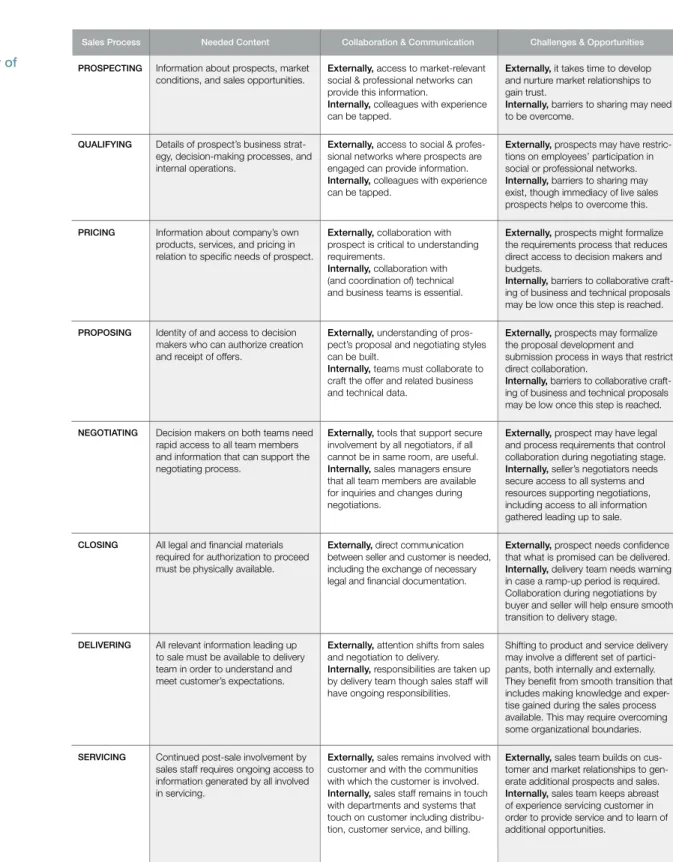
OVeRVIeW Of fINDINgSFigure 1 shows an overview of the project’s findings, divided by sales process (rows) and Web 2.0 implications (columns).
“Needed Content” in Column 2 describes examples of some of the information content that is created or needed at that particular point in the sales process. For example, for “prospecting,” this includes “information about prospects, market conditions, and sales opportunities.”
“Collaboration and Communication” in Column 3 provides examples of the different activities per formed at that point in the sales cycle that involve people sending and receiving information and working together. These activities (and the associated information content) differ by whether com munication and collaboration occur externally within the sales team’s company, or externally with the sales prospect and the sales prospect’s own communities. Figure 1 also shows that collaboration and communication differ across the different sales processes, as do the types of information content that are relevant for each process.
Column 4, “Challenges & Opportunities,” suggests some implications for managing each sales process in terms of both information content and the way that collaboration and communication can occur. Web 2.0 based systems have relevance for these processes since they impact how information is created and exchanged. Web 2.0 based systems also can support the formation of personal and professional relationships that can directly support the sales-related communication and collaboration that occur both internally and externally to the sales team’s company.
Significantly, though, there are challenges that occur. These challenges, as suggested in Column 4, tend to be more related to business process changes than to specific uses of technology. For exam ple, if there are organizational rivalries within a company that impact the ease and spontaneity with which collaboration across organizational or departmental boundaries occurs, providing easy to use networks for building relationships or for collaborating and exchanging information may be insufficient to overcome such rivalries.
Also, reading down through Figure 1, we see examples where benefits occur to sharing informa tion over time as more or different groups become involved in the sales process. For example, those responsible for planning and delivering the products or services that are sold by the sales team can benefit significantly from accessing detailed information that is gathered throughout the sales process. One can argue that a system that makes it possible for people to locate, develop relationships with, and talk with people with specialized knowledge, no matter where they are located within a company, can provide significant sales related benefits, even if those sources have no officially designated sales responsibilities.
APPeNDIX
Fig. 1
Sales Process Needed Content Collaboration & Communication Challenges & Opportunities Overview of PROSPECTINGFindings information about prospects, market conditions, and sales opportunities.
Externally, access to market-relevant social & professional networks can provide this information.
Internally, colleagues with experience can be tapped.
Externally, it takes time to develop and nurture market relationships to gain trust.
Internally, barriers to sharing may need to be overcome.
QUaLIFYING Details of prospect’s business strat egy, decision-making processes, and internal operations.
Externally, access to social & profes sional networks where prospects are engaged can provide information. Internally, colleagues with experience can be tapped.
Externally, prospects may have restric tions on employees’ participation in social or professional networks. Internally, barriers to sharing may exist, though immediacy of live sales prospects helps to overcome this. PRICING information about company’s own
products, services, and pricing in relation to specific needs of prospect.
Externally, collaboration with Externally, prospects might formalize prospect is critical to understanding the requirements process that reduces requirements. direct access to decision makers and Internally, collaboration with budgets.
(and coordination of) technical Internally, barriers to collaborative craft-and business teams is essential. ing of business and technical proposals may be low once this step is reached. PROPOSING identity of and access to decision
makers who can authorize creation and receipt of offers.
Externally, understanding of pros- Externally, prospects may formalize pect’s proposal and negotiating styles the proposal development and can be built. submission process in ways that restrict Internally, teams must collaborate to direct collaboration.
craft the offer and related business Internally, barriers to collaborative craft-and technical data. ing of business and technical proposals may be low once this step is reached. NEGOTIaTING Decision makers on both teams need
rapid access to all team members and information that can support the negotiating process.
Externally, tools that support secure involvement by all negotiators, if all cannot be in same room, are useful. Internally, sales managers ensure that all team members are available for inquiries and changes during negotiations.
Externally, prospect may have legal and process requirements that control collaboration during negotiating stage. Internally, seller’s negotiators needs secure access to all systems and resources supporting negotiations, including access to all information gathered leading up to sale. CLOSING All legal and financial materials
required for authorization to proceed must be physically available.
Externally, direct communication between seller and customer is needed, including the exchange of necessary legal and financial documentation.
Externally, prospect needs confidence that what is promised can be delivered. Internally, delivery team needs warning in case a ramp-up period is required. Collaboration during negotiations by buyer and seller will help ensure smooth transition to delivery stage.
DELIVERING All relevant information leading up Externally, attention shifts from sales to sale must be available to delivery and negotiation to delivery.
team in order to understand and Internally, responsibilities are taken up meet customer’s expectations. by delivery team though sales staff will
have ongoing responsibilities.
Shifting to product and service delivery may involve a different set of partici pants, both internally and externally. They benefit from smooth transition that includes making knowledge and exper tise gained during the sales process available. This may require overcoming some organizational boundaries. SERVICING Continued post-sale involvement by
sales staff requires ongoing access to information generated by all involved in servicing.
Externally, sales remains involved with Externally, sales team builds on cus customer and with the communities tomer and market relationships to gen with which the customer is involved. erate additional prospects and sales. Internally, sales staff remains in touch Internally, sales team keeps abreast with departments and systems that of experience servicing customer in touch on customer including distribu order to provide service and to learn of tion, customer service, and billing. additional opportunities.