Spatio-temporal Database Management Systems
Martin Breunig1, Can T¨urker2, Michael H. B¨ohlen5, Stefan Dieker4, Ralf Hartmut G¨uting4, Christian S. Jensen5, Lukas Relly3,
Philippe Rigaux6, Hans-J¨org Schek2, and Michel Scholl6 1
Uni Vechta, Germany 2
ETH Z¨urich, Switzerland 3
UBS AG Z¨urich, Switzerland 4
FernUniversit¨at Hagen, Germany 5
Aalborg University, Denmark 6
CNAM, Paris, France
7.1
Introduction
This chapter is devoted to architectural and implementation aspects of spatio-temporal database management systems. It starts with a general introduction into architectures and commercial approaches to extending databases by spatio-temporal features. Thereafter, the prototype systems Concert, Secondo, Dedale, Tiger, and GeoToolKit are presented. As we will see, the focus of these systems is on different concepts and implementation aspects of spatial, temporal, and spatio-temporal databases, e.g. generic indexing, design of spatial, temporal, and spatio-temporal data types and operations, constraint modeling, temporal database management, and 3D/4D database support. A comparison of the prototype systems and a brief r´esum´e conclude the chapter.
7.2
Architectural Aspects
To support spatio-temporal applications, the adequate design of a system archi-tecture for a spatio-temporal database management system (STDBMS) is cru-cial. Spatio-temporal applications have many special requirements. They deal with complex objects, for example objects with complex boundaries such as clouds and moving points through the 3D space, large objects such as remote sensing data, or large time series data. These complex objects are manipulated in even more complex ways. Analysis and evaluation programs draw conclusions combining many different data sources.
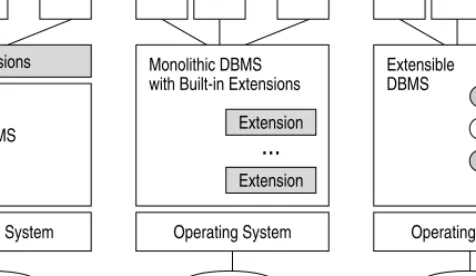
To build an STDBMS, the traditional DBMS architecture and functionality have to be extended. Managing temporal data requires providing spatio-temporal data types and operations, extensions to the query and data manipu-lation language, and index support for spatio-temporal data. Such issues arise not only in a spatio-temporal context but also when building spatial only or temporal only systems. Over the recent years we witnessed three base variants of extending system architectures (see Figure 7.1):
T. Sellis et al. (Eds.): Spatio-temporal Databases, LNCS 2520, pp. 263–318, 2003. c
Database Database Database AP AP
...
AP DBMS Extensions Layered Architecture Operating System AP AP...
APwith Built-in Extensions
Extension
...
Monolithic DBMS Extension Monolithic Architecture Operating System DBMS Extensible AP AP...
AP...
Extension Extension Extensible Architecture Operating SystemFig. 7.1.Comparison of system architectures
1. The layered approach uses an off-the-shelf database system and extends it by implementing the missing functionality on top of the database system as application programs.
2. In the monolithic approach, the database manufacturer integrates all the necessary application-specific extensions into the database system.
3. The extensible approach provides a database system which allows to plug user-defined extensions into the database system.
The following subsections present these variants in more detail. 7.2.1 The Layered Architecture
A traditional way of designing an information system for advanced data types and operations is to use an off-the-shelf DBMS and to implement a layer on top providing data types and services for the specific application domain require-ments. The DBMS with such a generic component is then used by different ap-plications having similar data type and operation requirements. Such enhanced DBMSs exploit the standard data types and data model — often the relational model — as a basis. They define new data types and possibly a new layer in-cluding data definition and query language, query processing and optimization, indexing, and transaction management specialized for the application domain. The new data types are often mapped to low-level data storage containers usu-ally referred as binary large objects of the underlying DBMS. Applications are written against the extended interface. Data definition, queries, and update op-erations are transformed from the application language to the underlying DBMS interface.
Many of the layered architecture systems have originally been designed as stand-alone applications directly using the operating system as their underlying
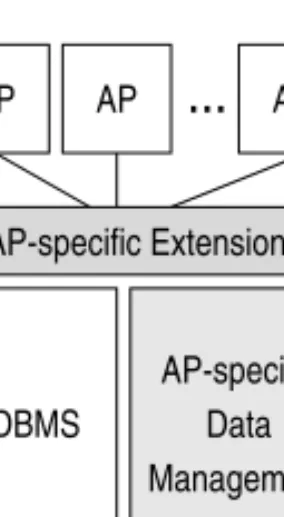
storage system. In order to exploit generic database services such as transaction management, their low-level storage system has been replaced by an off-the-shelf database system. Since most of these systems supported only a few standard data types, the layered architecture systems have to use the operating system’s file system to store the application-specific data types while using the DBMS to store the standard data types. This architecture is also called the dual architecture (see Figure 7.2). Todays advanced DBMSs support binary large objects, and thus get rid of the need to store a part of the data directly in the operating system bypassing the DBMS.
Database AP AP
...
AP Operating System AP-specific Extensions Management Data AP-specific DBMSFig. 7.2. The dual system architecture
The layered approach has the advantage of using standard off-the-shelf compo-nents reusing generic data management code. There is a clear separation of re-sponsibilities: application-specific development can be performed and supported independently of the DBMS development. Improvements in one component are directly available in the whole system with almost no additional effort. On the other hand, the flexibility is limited. Development not foreseen in the standard component has to be implemented bypassing the DBMS. The more effort is put into such an application-specific data management extension, the more difficult it gets to change the system and to take advantage of DBMS improvements.
Transaction management is only provided for the standard data types han-dled by the DBMS. Transactional guarantees for advanced data types as well as application-specific transaction management have to be provided by the applica-tion-specific extension. Query processing and optimization has to be performed on two independent levels. Standard query processing and optimization can be handled by the DBMS while spatio-temporal query processing has to take place in the extension. Because system-internal statistics and optimization information are only available inside the DBMS, global query processing and optimization of combined queries is hard to implement. Indexing of standard data types takes
place inside the DBMS while indexing spatio-temporal data has to be dealt with in the extension. Therefore, combined index processing cannot be used.
7.2.2 The Monolithic Architecture
As in the layered architecture, many systems using a monolithic architecture have originally been designed as stand-alone applications. In contrast to the layered architecture, the monolithic architecture extends an application system with DBMS functionality instead of porting it to a standard DBMS. In this way, specialized DBMSs with query functionality, transaction management, and multi-user capabilities are created. The data management aspects traditionally associated with DBMS and the application-specific functionality are integrated into one component.
Because of the tight integration of the general data management aspects and the application-specific functionality, monolithic systems can be optimized for the specific application domain. This generally results in good performance. Standard and specialized index structures can be combined for best results. Transaction management can be provided in a uniform way for standard as well as for advanced data types. However, implementing an integrated system becomes increasingly difficult, the more aspects of an ever-growing application domain have to be taken into account. It might be possible — even though it has proven difficult — to build a monolithic system for a spatial only or a temporal only database. Combining spatial and temporal data management adds another dimension of complexity such that is very difficult to provide a satisfactory solution using the monolithic approach.
7.2.3 The Extensible Architecture
The layered as well as the monolithic architecture do not support an easy adap-tation of the DBMS to new requirements of advanced applications. The user, however, should be able to “taylor” the DBMS flexibly according to his spe-cific requirements. Extensible database systems provide a generic system capa-ble of being extended internally by application-specific modules. New data types and functionality required for specialized applications is integrated as close as possible into the DBMS. Traditional DBMS functionality like indexing, query optimization, and transaction management is supported for user-defined data types and functions in a seamless fashion. In this way, an extensible architecture takes the advantage of the monolithic architecture while avoiding its deficiencies. It thus provides the basis for an easy integration of advanced spatio-temporal data types, operations, and access methods which can be used by the DBMS analogously to its standard data types and access methods.
The first extensible system prototypes have been developed to support es-pecially non-standard DBMS applications like geographical or engineering in-formation systems. Research on extensible systems has been carried out in several projects, e.g. Ingres [57], DASDBS [69,68], STARBURST [40], POST-GRES [74,75], OMS [10], Gral [35], Volcano [29,30], and PREDATOR [70]. These
projects addressed, among other, data model extensions, storage and indexing of complex objects as well as transaction management and query optimization in the presence of complex objects.
Another way to provide extensible database systems are database toolkits. Toolkits do not prescribe any data model, but rather identify and implement a common subset of functionality which all database systems for whatever data model must provide, e.g., transaction management, concurrency control, recov-ery, and query optimization. Key projects of that category are GENESIS [5], EXODUS [18], and SHORE [19].
While toolkits are very generic and can be used for the implementation of many different data models, they leave too much expenditure at the implementor to be accepted as a suitable means for fast system implementation. Extensible systems, on the other hand, pre-implement as much functionality as possible at the expense of flexibility, since they usually prescribe a specific data model, e.g., an object-relational model.
The SQL99 standard [48] specifies new data types and type constructors in order to better support advanced applications. As we will see in the next section, commercially leading database vendors already support the development of generic extensions — even though not in its full beauty. These extensible relational systems are referred asobject-relational systems.
7.2.4 Commercial Approaches to Spatial-temporal Extensions In the following, we briefly sketch the commercial approaches of Informix, Ora-cle, and IBM DB2, which exploit extensible, object-relational database technol-ogy to provide spatio-temporal extensions. Also, we briefly sketch commercial approaches in the field of geographic information systems.
Informix Datablades. The Informix Dynamic Server can by extended by dat-ablades [47]. Datablades are modules containing data type extensions and rou-tines specifying the behavior of the data and extending the query language. New data types can be implemented using built-in data types, collection types like
SET,LIST, orMULTISET, or large unstructured data types likeBLOB. User-defined functions encapsulated in the datablades determine the behavior and function-ality of new data types.
A new access method must create anoperator class containing both a set of strategy functions and a set of support functions. The strategy functions are used for decisions of the optimizer to build execution plans. The support functions are needed to build, maintain, and access the index. Access methods are used by the database server every time an operator in the filter of a query matches one of the strategy functions and results in lower execution costs than other access methods.
The datablade development requires expendable implementation work and a deep understanding of the internals of the system. Therefore, the creation of new access methods and their integration into the optimizer is mostly done
by companies offering commercial products like the text indexing and retrieval datablade of Excalibur [43].
The InformixGeodeticdatablade [44] extends the server with spatio-temporal data types like GeoPoint, GeoLineseg,GeoPolygon, GeoEllipse, GeoCircle, andGeoBox, and associated operators likeIntersect,Beyond,Inside,Outside, andWithin. An R-tree [39] is provided to index spatio-temporal data. A special-ized operation class, calledGeoObject ops, is available, which associates several operators to the R-tree access method. An R-tree index for a spatio-temporal attribute is defined as follows:
CREATE INDEX index name
ON table name(column name GeoObject ops) USING RTREE;
Informix also provides theSpatial datablade [45] as well as theTimeSeries dat-ablade [46] to extend the server with data types and functions referring to spatial data only and to temporal data only, respectively.
Oracle Cartridges. The Oracle8 server can be extended by cartridges [60]. These modules add new data types and functionality to the database server. As in Informix with datablades, data types and functions can easily be implemented within a cartridge but the integration of indexes into the query optimizer needs deep knowledge of the database server. In addition, access method extensions and their integration into the query optimizer are limited to a small amount of simple query constructions.
Based on the built-in data types, array type, reference type, and large object types, new data types can be implemented within a cartridge. The complexity of data types is limited and not all data types can be combined orthogonally. An index structure is defined within the cartridge. In contrast to Informix, index maintenance – insertion, deletion, and update – must be implemented within the cartridge; no genericity is provided here. The usage of new index structures can be plugged into the optimizer by user-defined functions returning information about execution costs, statistics information, and selectivity of the index for a given predicate. This allows the cost-based optimizer to use new indexes and to build alternative execution plans.
To deal with spatial data, the Oracle Spatial cartridge [58] is available. This cartridge extends the database server with data types representing two-dimensional points, lines, or polygons. Based on these primitive data types, composite geometric data types like point cluster and polygons with holes are provided. A linear quad-tree [26] is provided for spatial indexing. A spatial index on a column of typeMDSYS.SDO GEOMETRYis defined as follows:
CREATE INDEX index name ON table name(column name)
This index is then exploited when executing geometry-specific operations like
RELATE,SDO INTERSECTION,SDO Difference, andSDO UNION.
TheOracle Time Series cartridge [59] is provided for temporal data. This cartridge extends the server with calendar and time series data types.
IBM DB2 Extenders. IBM’s modules which extend the DB2 server with abstract data types are called extenders. Extenders can be implemented using built-in data types, reference types, and large object types.
Spatial data is supported by IBM’s DB2 Spatial extender. This module extends the DB2 server with spatial data types like Point, Linestring, and
Polygonand a rich repertoire of operations likeContains,Intersects,Overlap,
Within,Disjoint, Touch, and Cross. A grid file [55] is used as spatial index. Such a spatial index is defined as follows:
CREATE INDEX index name ON table name(column name) USING spatial index;
The database server is then aware of the existence of this index and the query optimizer takes the advantage of the index when accessing and manipulating spatial data. In addition to specifying the costs of a user-defined function, the user can indicate whether or not the function can be taken as predicate in the where clause.
A DB2 Time Series extender, which provides similar functionality as its Informix and Oracle counterparts, is offered by a Swedish company [25].
Geographical Information Systems. Geographical Information Systems (GIS) have also been designed according to the different architecture variants discussed in the previous subsections. ARC/INFO [2], for example, is a repre-sentative of the dual architecture, whereas ARC/INFO’s spatial database engine and SMALLWORLD GIS [72] have a monolithic system architecture. However, hitherto there are no commercial GIS that allow an extension of their database kernel.
As GIS have originally been developed to support the construction of digital maps, they have made much more progress in handling spatial data than tem-poral data. The key issue with GIS during the last years has been the combined handling of spatial and non-spatial data [54]. Database support for dynamic maps, however, is still a research topic. To the best of our knowledge, there is no efficient support for the handling and processing of temporal data in to-day’s commercial GIS. These systems have not been designed for temporal data support and currently are not easily extensible for temporal data management. A prototype module for the management of temporal data on the basis of a commercial GIS has been proposed by [50].
7.3
The Concert Prototype System
7.3.1 IntroductionConcert[9,65,64] is a database kernel system based on an extensible architec-ture. However,Concertpropagates a new paradigm called “exporting database functionality” as a departure from traditional thinking in the field of databases. Traditionally, all data is loaded into and owned by the database in a format determined by the database, whereas according to the new paradigm data is viewed as abstract objects with only a few central object methods known to the database system. The data may even reside outside the database in exter-nal repositories or archives. Nevertheless, database functioexter-nality, such as query processing and indexing, is provided. The new approach is extremely useful for spatio-temporal environments, as there is no single most useful data format to represent spatio-temporal data. Rather, many different spatio-temporal data formats coexist. The new paradigm presented in Concert allows them to be viewed in a uniform manner.
While traditional indexing is based on data types — an integer data type can be indexed by a B-tree, a polygon data type can be indexed by an R-tree — Concert’s indexing is based on the conceptual behavior of the data to be indexed: data that is associated with an ordering can be indexed by a B-tree. Data implementing spatial properties (such as overlaps and covers predicates) can be indexed by an R-tree. Concert uses four classes of behavior, SCALAR,
RECORD,LIST, andSPATIAL, covering all relevant concepts that are the basis of today’s indexing techniques.
With these classes conceptual behavior of data is described in contrast to type dependent properties like in GiST [41]. On top of the Concert classes, arbitrary indexing structures can be build which are valid for a variety of data types. New indexing structures are implemented for concepts and use concept typical operations. In this way, indexing techniques of the Concert approach are independent of the concrete implementation of the data types — in particular it is not limited to tree structures alone. This is the major difference between GiSTand the indexing framework provided byConcert.
7.3.2 Architecture
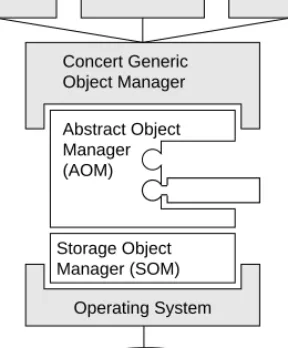
Following the extensible system architecture,Concertconsists of a kernel sys-tem for low-level data management and query processing as well as an object manager providing advanced query functionality. The kernel is responsible for the management of individual objects within collections, resource and storage man-agement, and low-level transaction management. The object manager combines different collections adding join capability to the kernel collections. Figure 7.3 shows an overview of theConcertarchitecture.
TheConcert kernel system consists of two components, the Storage Ob-ject Manager (SOM) and the Abstract ObOb-ject Manager (AOM). The SOM pro-vides DBMS base services such as segment management, buffer management,
Application Object Manager Application Operating System Database Concert Generic Manager (SOM) Storage Object (AOM) Abstract Object Manager Application
Fig. 7.3.Concertsystem architecture
and management of objects on database pages. It is tightly integrated into the underlying operating system exploiting multi-threading and multi-processing. It uses a hardware-supported buffer management exploiting the operating sys-tem’s virtual memory management by implementing a memory-mapped buffer [8]. Details of theConcert SOM can be found in [63].
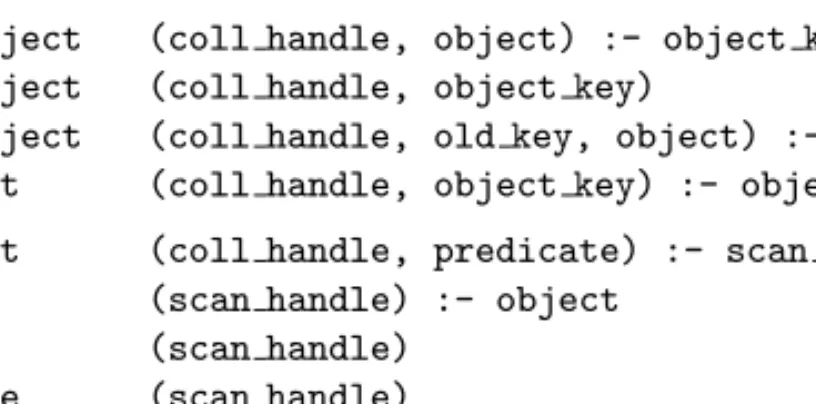
The AOM provides the core functionality for extending the kernel with appli-cation-specific code. It implements a fundamental framework for the manage-ment of collections. It uses the individual objects handled internally by the SOM or, through its interoperability capability, by an external storage system, com-bining them into collections. The AOM collection interface defines operations to insert, delete, and update individual objects. Retrieval of objects is performed through direct object access or through collection scans. Scans are initiated us-ing an optional predicate filterus-ing the qualifyus-ing objects. Figure 7.4 shows the (simplified) collection interface definition.
Indexes are treated similar to base collections. From the AOM’s perspective, they are collections of objects containing the index entry (the attribute to be indexed on) and the object key of the base collection. Accessing data using an index is performed by an index scan identifying all qualifying object keys that are subsequently used to retrieve the objects themselves. Depending on the kind of the index and the query, the objects retrieved might have to be filtered further performing a false drops elimination.
On object insertion, the object is inserted into the base collection first. The insertion operation of the base collection returns an object key that can be used for the index entry. Because the index uses the same interface as the base collection, hierarchies of indexes can be built easily. This allows, for example, an
createInstance (coll description) :- coll handle deleteInstance (coll handle)
insertObject (coll handle, object) :- object key deleteObject (coll handle, object key)
updateObject (coll handle, old key, object) :- new key getObject (coll handle, object key) :- object scanStart (coll handle, predicate) :- scan handle scanGet (scan handle) :- object
scanNext (scan handle) scanClose (scan handle)
Fig. 7.4.(Simplified) AOM collection interface
inverted file index to be indexed itself by a B-tree index. The conceptual equality of base collections of objects and the index collections of their keys enables the components to be combined in many different ways providing a powerful tool that goes far beyond simple indexing and includes things such as constraint validation and trigger mechanisms.
A special aspect of theConcert approach is the fact that indexing is per-formed for abstract data types. Obviously it is not possible to index completely unknown objects. Some knowledge of the user-defined objects has to be available to the storage system. A small set of concepts is identified to be sufficient to allow most physical design decisions for spatio-temporal DBMS. The next subsection introduces an R-tree like generic index framework with minimal restrictions to the flexibility of external objects.
7.3.3 Spatio-temporal Extensions
To explainConcert’s database extensibility idea, let us look at a standard B-tree index [21], as it is implemented in most database systems. A B-B-tree stores keys of objects ordered by their values. The ordering operation is chosen depend-ing on the data type of the key value: for data typeNUMBER, standard ordering over numbers is used whereas STRINGdata types are lexicographically ordered. Another ordering operation is used forDATEdata types. Much more data types are possible but the central aspect when data is indexed by a B-tree is that there is an attribute which can be ordered [73]. On the other hand, data types which cannot be ordered cannot be indexed by a B-tree.
The generalization of this observation is the basis of theabstract object stor-age type concept inConcert: The knowledge about the type of the data is not needed to manage it but its conceptual behavior and theconcept typical opera-tions associated with these concepts must be known. These operations have to be provided by the user to allowConcert to interpret a given abstract object storage type. Four concepts can be identified:
• SCALAR: A data type belongs to the SCALARconcept if there is an ordering operation. All data types behaving like aSCALARcan be indexed, for instance, by a B-tree.
• LIST: A data type belongs to the LIST concept if it consists of a set of components over which an iterator is defined. A data type behaving like a LIST might be a list of keywords, forming the inverted index of a text document. The concept typical operations areFIRSTandNEXT.
• RECORD: A data type belongs to theRECORD concept if it is an ordered catenation of components which themselves are arbitrary concepts. The con-cept typical operation is theSUB OBJECToperation returning a component of theRECORD. ARECORDimplements object partitioning.
• SPATIAL: A data type belongs to theSPATIALconcept if it is extended in an arbitrary data space and can be indexed with respect to its spatial proper-ties. This is the most important concept in the context of spatio-temporal data and will be explained in detail in the next subsection. Note that this concept is not limited to geometric or time space alone. The concept typi-cal operationsOVERLAPS,SPLIT,COMPOSE, andAPPROXare explained in the following.
The user has to implement extensions by plugging new data types into the existing framework. Spatio-temporal indexing structures can be implemented and plugged intoConcertindependent of the data type indexed by just using theSPATIALconcept typical operations.
In traditional systems, the class of space covering objects is predefined by the index method provided and thus “hard-wired” in the system, e.g., a space covering rectangle in the R-tree. Therefore, the classes of application objects and query objects also have to be predefined by the DBMS requiring the user to convert his data into the DBMS format. This clearly is not desirable in the context of extensible systems. Concert addresses this problem. Rather than predefining spatial index objects and thereby forcing the data structure of user objects and user queries, it allows the user to implement not only the applica-tion and query objects but also corresponding index objects. The spatial index algorithm is written in a generic way only exploiting the spatial space-subspace relationships through method invocation.
These spatial1 relationships define the concept typical operations of the
SPATIALconcept as follows:
• The operation OVERLAPS checks for spatial overlap of two objects or data spaces. It is used by index tree navigation to prune the search space. It also helps finding the appropriate leaf node on index insertion. Therefore it is not defined as a simple predicate operation, but rather as an operation returning 1
Note that the spatial concept is not restricted to objects of the geometric space. The spatial conceptcan also be used to model object of the temporal space as well as other data spaces whose objects exhibit similar behavior as geometric objects, e.g., supports inclusion and overlapping predicates as well as split and compose operations.
an integer value indicating the degree of overlap. Negative values are used as a measure for indicating the distance between two objects2. Finally, the
OVERLAPSoperation is used to approximate spatial and temporal overlaps,
intersects, and covers predicates.
• TheSPLIToperation divides a spatial object into several spatial objects. This operation can be used to a priori divide large user objects into smaller ones before inserting them or while reorganizing the search tree. It is also used to split index nodes when they become too large. The question “when nodes are split” and “which concrete spatial object is returned” is determined by the implementation of theSPLIToperation of the associated data type following theSPATIALconcept. In this way, a split operation can return a simple set of rectangles resulting from splitting a “large” rectangle (like in R+-trees) but also a set of complex polygons or spheres.
Here the terms small and large are used in two contexts. Large objects can be objects occupying a lot of storage space, as well as objects covering a large data space. In both cases, it might be beneficial to divide a large object into several smaller ones. In the first case, memory allocation and buffering is easier. In the second case, the data space in index nodes is smaller allowing a better pruning in the index structure. The behavior depends on the implementation of theSPLIToperation.
• TheCOMPOSEoperation recombines spatial objects that have previously been split to an “overall” spatial object. This operation is used for the reconstruc-tion of large data objects which have been split on inserreconstruc-tion, as well as for index node description objects when index nodes are merged. Note that we make no assumption about the implementation of the operations for a given data type. We only consider the conceptual behavior of the data. The
COMPOSEoperation is the inverse of theSPLIToperation, which means that ifO is an object of conceptSPATIALthen O=COMPOSE(SPLIT(O)) holds. • Finally, theAPPROXoperation approximates a spatial object or a set of spatial
objects with a new spatial object. This new spatial object is a representative of the data space covered by the objects to be approximated. The typical and most common approximation is the n-dimensional bounding rectangle. However, theAPPROXoperation is not restricted to the bounding rectangle. Arbitrary operations can be used as long as they satisfy the condition of dominating predicates [77]. In our context, this means that, for example, if the approximations of two objects do not overlap, the two original object must not overlap. Figure 7.5 summarizes these four concept typical opera-tions of theSPATIALconcept.
The user implements these four operations for an application, query and index objects and registers them to the Concertkernel system.
2
Note that there is no restriction about the implementation of these operations. Programmers might decide to only distinguish two values — overlapping and non-overlapping — for theOVERLAPSoperation. The concepts described here will work in the same way. However, the optimizations described are not possible.
CONCEPTSPATIAL
Operation Parameter Result
OVERLAPS spatial object1, spatial object2SCALAR
SPLIT spatial object {spatial object}
COMPOSE {spatial object} spatial object
APPROX {spatial object} spatial object
Fig. 7.5. Typical operations of theSPATIALconcept
7.3.4 Implementation Details
Concertcan deal with each data type belonging to one of the concepts for which the necessary management and concept typical operations are implemented, in-dependently of the concrete implementation of the data types. Indexing and query processing in the DBMS kernel is performed based on these operations only. For more information about the concepts, the operations, and the Con-certsystem in general see [63,66,65,9]. In the following, we describe how spatio-temporal indexes can be plugged intoConcertby using a framework for generic spatio-temporal data indexing.
Although the well-known R-tree [39] may not be optimal for indexing spatio-temporal objects (particularly for spatio-temporal indexes; see [67] for more informa-tion), its simple and well-understood structure is useful to explain the extensi-bility aspects. The R-tree is implemented and generalized within theConcert framework. Abstracting from the R-tree approach results in an index structure which is generic in the sense of data because it is based only on the “behavior” of the concept it belongs to. It is also generic in the sense of algorithms because of the use of generic heuristic functions which determine the tree-internal pro-cesses (varying the heuristics can change the R-tree like behavior into an R+-tree or another derivation). Finally, it is also generic in the sense of nodes covering search spaces because of the use of spatial objects to approximate the space of subtrees and no fixed spatial shapes.
Whereas the R-tree is restricted to store rectangular data objects, the Con-cert approach allows any objects conforming to the SPATIAL concept to be stored in the generic spatio-temporal tree. TheConcert low-level storage ca-pabilities provides an efficient multi-page storage system. Therefore, the generic spatio-temporal tree does not need to have a fixed node size. Nodes can be enlarged dynamically to virtually unlimited3 size using a multi-page secondary storage allocation scheme [8]. The R-tree nodes have minimal bounding rectan-gles associated with them, whereas the generic spatio-temporal tree uses abstract spatial objects instead (e.g. spheres, convex polygons, or just rectangles). These spatial objects are usually computed using the APPROXoperation. The only as-sumption made here, which is implicit given by the SPATIAL concept, is the existence of anAPPROXoperation which can be evaluated on node objects.
3
There is a hard limit of 4 GByte per node. However, in order to be efficient, inner nodes should not become larger than about 1 MByte.
7.3.5 Case Studies
In the following we describe how a generic spatio-temporal tree can be used in Concert with its typical operations of object-lookup, insertion with splitting of a node and deletion including the reorganization of the tree.
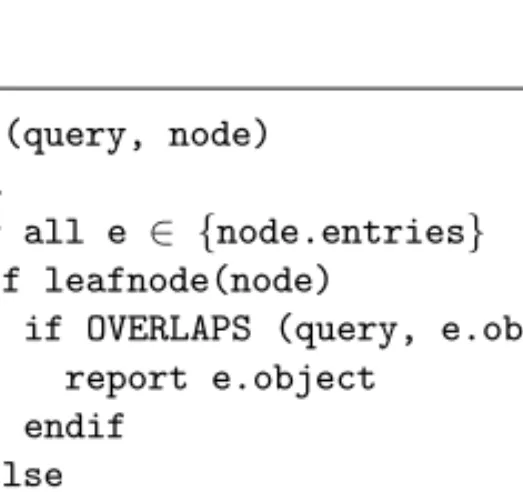
Object Lookup. The generic spatio-temporal tree uses aSPATIALobject to de-scribe the data space of the query window, or more generally, the arbitrary query space. With this knowledge the R-Tree algorithms as given in [39] can be extended to a generic algorithm using theSPATIALconcept and its concept typical operation OVERLAPS, as shown in Figure 7.6. Such algorithms can be incorporated easily into theConcertsystem.
find (query, node) begin
for all e ∈ {node.entries}
if leafnode(node)
if OVERLAPS (query, e.object) report e.object
endif else
if OVERLAPS (query, e.region) find (query, e)
endif endif endfor end
Fig. 7.6.Lookup in a generic spatial index
The concept typical operation for spatial index lookup is theOVERLAPSoperation. Note that the Concert spatial index is much more flexible than any given tree variant. If the abstract objects stored in the nodes are minimum bounding rectangles, and query objects are rectangles as well, the algorithm depicted in Figure 7.6 behaves exactly as the R-tree lookup. SinceConcertmakes almost no assumption about the objects in the tree, the algorithm works the same way also for arbitrary n-dimensional spatial objects, as long as the subtrees form hierarchies of data spaces. Certain applications might prefer to use overlapping convex polygons to partition the data space or a sphere, if the Euclidean distance is important like in nearest neighbor queries for point data.
If the objects contain, beside the spatial, a temporal dimension, the algorithm can directly be used for spatio-temporal objects. Note that it is the responsibility of the user implementing the OVERLAPS operation to distinguish between the spatial and the temporal dimension.
Splitting a Node. One of the important issues often discussed for R-trees in the context of spatio-temporal applications is the problem of dead space in the rectangles. The larger the rectangles are with respect to the data space covered by the objects contained in the node, the less efficient the R-tree becomes. Our generic tree provides an easy and flexible solution to this problem.
Index nodes as well as data objects stored in the index are spatially extended objects implementing the operations of the SPATIAL concept. Therefore, large objects can be split into several (smaller) ones by using the concept typical operation SPLIT. This operation can be called many times until the resulting objects have a good size from an application point of view. It is not the database system and its index structure that determines the split granularity or the split boundaries. If, from an application point of view, there is no point in splitting an object further, theSPLIToperation just returns the unchanged object.
Note that theSPLIToperation is much more powerful than just splitting a rectangle into many others. TheSPLIToperation needs an object of an arbitrary data type following the SPATIALconcept and returns a set of objects. The only requirement is that the resulting objects follow the SPATIALconcept. Such ob-jects might be, for instance, rectangles as in R-trees or spheres as in M-trees. The exact behavior of aSPLIToperation is determined by its implementation.
As discussed earlier,Concert has virtually no size restriction for its index nodes. Using theOVERLAPSoperation, the spatial index code can therefore han-dle arbitrary large objects — it just might not be very efficient, if the SPLIT
operation is not actually splitting the objects. In any case, splitting is done by exploiting application semantics rather than following a node-space constraint.
Splitting is possible in different situations. One important situation is the a priori splitting of objects at insertion or update time. Such approaches are included in R-tree derived trees. By using the concept typical SPLIToperation these well-studied split procedures are generalized. The concrete implementa-tion of the operaimplementa-tion can determine different applicaimplementa-tion dependent heuristics adapted to the requirements.
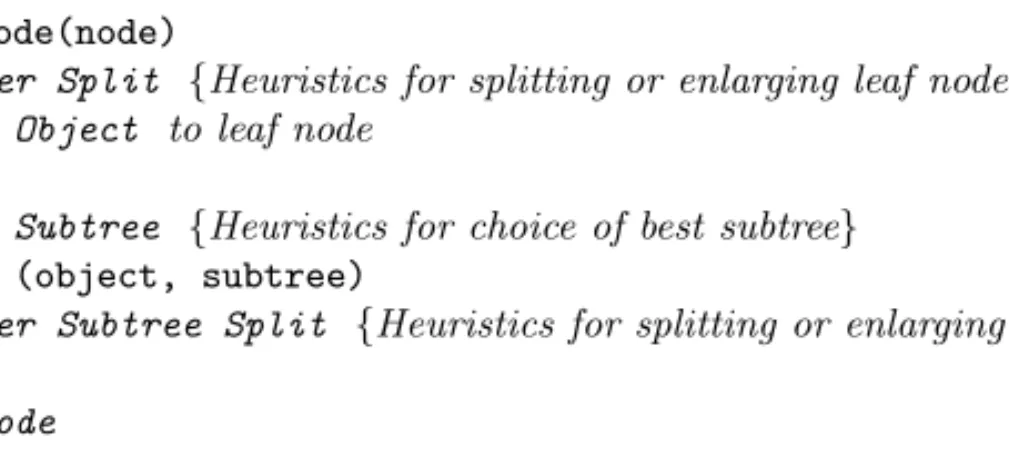
Insertion of Objects. In contrast to [41], we develop our algorithm based on the concept typical operations and the tree typical operations adapt to the concept driven approach whereas GiST follows a tree structure driven approach, general-izing operations in the context of tree management. Figure 7.7 shows the generic insertion procedure for our index.
Although similar to its outline, the generic spatial index has some important differences to the R-tree. Whereas in the R-tree nodes are of fixed size and, hence, a node has to be split according to application requirements, the generic index is more flexible. The operationConsider Split can implement a flexible splitting heuristics considering not only the size of the node but also the spatial extension of the objects and the amount of dead space in the node. In this way, the concrete choice of a heuristic determines the behavior of the tree such that it behaves like an R-tree, an R+-tree, or any other indexing tree for spatial data. The splitting itself is also more flexible. It can be performed not only by distributing the entries among the nodes (using an arbitrary splitting strategy
insert (object, node) begin
if leafnode(node)
Consider Split {Heuristics for splitting or enlarging leaf node}
Insert Object to leaf node
else
Choose Subtree {Heuristics for choice of best subtree}
insert (object, subtree)
Consider Subtree Split {Heuristics for splitting or enlarging inner node}
endif Adjust Node end
Fig. 7.7.Insertion into a generic spatial index
such as one of the strategies discussed in [39]) but also by splitting large objects using the concept typical operation SPLITreducing the dead space further. In this way, the implementation of SPLITcontrols a part of the behavior of our indexing framework.
Even the insertion of an object in a subtree is more flexible than in a con-crete tree implementation. The insertion is handled by recursively passing the object down the tree. At each non-leaf node, an appropriate subtree has to be chosen for the recursion. This is done by the operationChoose Subtree. In the standard R-tree algorithm, the subtree is chosen based on the least enlargement of the bounding rectangle necessary. In the generic spatial index, the concept typical operation OVERLAPSis used. In order to optimize the choice for a sub-tree,OVERLAPSis not defined as a simple predicate but rather returns an integer value indicating the amount of overlap. In addition to the amount of overlap, the current size of the subtree and the amount of free space in the subtree can also be considered.
The additional flexibility over fixed multi-dimensional indexing trees gained with the operationsChoose Subtree,Consider Split andConsider Subtree Split together with the mechanism avoiding dead space using the concept typ-ical operation SPLITmakes the Concert approach a useful framework of an R-tree like index for spatio-temporal applications.
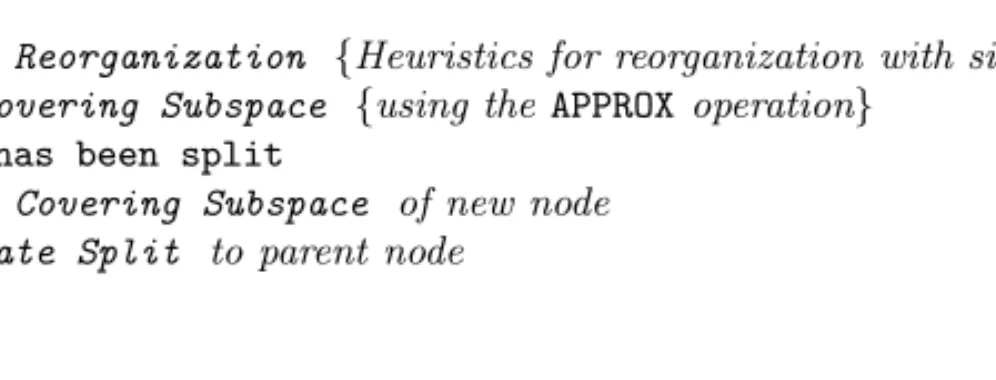
Reorganizing the Tree. After insertion, nodes have to be adjusted using the
AdjustNodeoperation as shown in Figure 7.8. Insertion into the generic spatial tree can bring the tree out of balance. This can be avoided by reorganizing the nodes by moving some of its entries to sibling nodes. However, such a reorgani-zation can be very expensive. Therefore, a complete reorganireorgani-zation is performed at given points in time when the tree gets too much out of balance.
Remembering that each node has a covering subspace object associated with it which follows the SPATIALconcept (e.g. a bounding rectangle in R-trees), this object has to be adjusted on insertion using operationAPPROXif reorganization is necessary. Whether a node has to be adjusted is determined by theConsider
adjust node (node) begin
Consider Reorganization {Heuristics for reorganization with sibling nodes}
Adjust Covering Subspace {using the APPROXoperation}
if node has been split
Create Covering Subspace of new node
Propagate Split to parent node
endif end
Fig. 7.8. Adjust an index node
Reorganization operation which implements the desired heuristic. If the node has been split, the APPROX operation has to be calculated for both nodes and the split has to be propagated to the parent node. If the root node is split, the tree grows by one level.
Deletion of Objects. For object deletion, two strategies can be followed. It is always possible to recompute the spatial extent of each node using theAPPROX
operation. This keeps the space covered by each node minimal, but it requires substantial overhead each time an object is deleted.
Alternatively, the spatial extent of the nodes is left unchanged. Deletion is more efficient since no deletion or adjustment of inner nodes is necessary. If a node becomes too small, it is merged with one of its siblings. This keeps the overhead of reorganizing the tree low, but at the same time decreases the efficiency of the index due to possible dead space in the covering objects of a node.
TheConcertprototype has been tested, among others, with an application from photogrammetry targeting raster image management [65]. The focus has been on physical database design and query processing for raster image man-agement.
7.4
The Secondo Prototype System
7.4.1 IntroductionSecondo is a data-model independent environment for the implementation of non-standard database systems. Its goal is to offer the advantages of both the extensible system and the toolkits approach (see Section 7.2.3) while avoiding their disadvantages.
The core component ofSecondois a generic “database system frame” that can be filled with implementations of a wide range of data models, including, for example, relational, object-oriented, graph-oriented, sequence-oriented, or spatio-temporal database models.4The key strategy to achieve this is the
separa-4
Some of the goals of Secondo and Concert are similar. A comparison of the two
tion of the data model independent components and mechanisms in a DBMS (the system frame) from the data-model dependent parts. Nevertheless, the frame and the “contents” have to work together closely. With respect to the different levels of query languages in a DBMS, we have to describe the system frame:
• thedescriptive algebra, defining a data model and query language,
• theexecutable algebra, specifying a collection of data structures and oper-ations capable of representing the data model and implementing the query language, and
• therules to enable a query optimizer to map descriptive algebra terms to executable algebra terms, also calledquery plans orevaluation plans. A general formalism serving all these purposes has been developed earlier, called second-order signature (SOS) [36]. It is reviewed in Section 7.4.2.
On top of the descriptive algebra level there may be some syntactically sug-ared language, e.g., in an SQL-like style. We assume that the top-level language and the descriptive algebra are entirely equivalent in expressive power; only the former may be more user-friendly whereas the latter is structured according to the SOS formalism. A compiler transforming the top-level language to descrip-tive algebra can be written reladescrip-tively easily using compiler generation tools, since it just has to perform a one-to-one mapping to the corresponding data definitions and operations.
At the system level, definitions and implementations of type constructors and operators of the executable algebra are arranged into algebra modules, in-teracting with the system frame through a small number of well-defined support functions for manipulation of types and objects as well as operator invocation. Those algebra support functions dealing with type expressions will be created automatically from the corresponding SOS specification.
7.4.2 Second-Order Signature
Since theSecondosystem implements the framework of second-order signature (SOS) [36], it is necessary to recall the essential concepts here. The basic idea of SOS is to use two coupled signatures to describe a data model as well as an algebra over that data model. To distinguish the two levels of signature, we call the first type signature and the secondvalue signature. A signature in general hassorts andoperators and defines a set ofterms.
Specifying a Descriptive Algebra. The type signature has so-calledkinds as sorts and type constructors as operators. The terms of the type signature are called types. In the sequel, we show example specifications for the relational model and a relational execution system. Although the purpose of Secondo is not to reimplement relational systems, it makes no sense to explain an unknown formalism using examples from an unknown data model. The structural part of the relational model can be described by the following signature:
kindsIDENT, DATA, TUPLE, REL type constructors
→ DATA int,real,string,bool (IDENT×DATA)+ → TUPLE tuple
TUPLE → REL rel
Here int, real, string, and bool are type constructors without arguments, or constant type constructors, of a result kind called DATA. A kind stands for the set of types (terms) for which it is the result kind. For DATA this set is finite, namely DATA ={int,real,string,bool}. In contrast, there are infinitely many types of kind TUPLE or REL. For example,
tuple([(name,string), (age,int)]) rel(tuple([(name,string), (age,int)]))
are types of kind TUPLE and REL, respectively. The definition of the tuple type constructor uses a few simple extensions of the basic concept of signature that are present in the SOS framework. For example, ifs1, . . . , snare sorts, then (s1× · · ·×sn) is also a sort (product sort), and ifsis a sort, thens+is a sort (list sort). The term (t1, . . . , tn) belongs to a product sort (s1× · · · ×sn) if and only if eachtiis a term of sortsi; the term [t1, . . . , tm], form≥1, is a term of sorts+if and only if eachtiis a term of sorts. The kind IDENT is predefined (and treated in a special way in the implementation inSecondo). Its type constructors are drawn from some infinite domain of “identifiers”. Hence they can be used as attribute names here.
The notion of a relationschema has been replaced by a relation type, and “relation” is not considered to be a single type, but a type constructor. Hence operations like selection or join are viewed as polymorphic operations. Note that the choice of kinds and type constructors is completely left to the designer of a data model. In contrast to the Concertapproach, we are not offering a toolbox with a fixed set of constructors such astuple,list,set, etc., but instead a framework where new constructors can be defined. Hence theSecondosystem frame as such knows nothing about rel or tuple constructors, in contrast to Concertwhere, for instance, the record concept requires to provide component access.5 In summary, the terms of the type signature of an SOS specification define a type system, which within the descriptive algebra is equivalent to a DBMS data model.
Now the value signature is used to define operations on the types generated by the type signature. Whereas a signature normally has only a small, finite number of sorts, the second level of signature in SOS generally has to deal with infinitely many sorts. Because of this, we write signature specifications. The basic tool is quantification over kinds. We define a few example operations for the relational model above:
5
The only predefined kinds and type constructors in Secondoare IDENT with its “type constructors” and the type constructorstreamwhich plays a special role in query evaluation.
operators
∀ data in DATA.
data×data → bool =,6=, <,≤, >,≥
Here,datais a type variable ranging over the types in kind DATA. Hence, it can be bound to any of these types which is then substituted in the second line of the specification. So, we obtain comparison operators on two integers, two reals, etc. Relational selection is specified as follows:pipes
∀ rel:rel(tuple) in REL.
rel ×(tuple →bool) → rel select
Here,rel(tuple) is apattern in the quantification which is used to bind the two type variablesrel andtuple simultaneously. Hence, the first argument toselect is a relation of some type rel, and the second argument is a function from its tuple type to bool, that is, a predicate on this tuple type. The result has the same type as the first argument. The second argument ofselectis based on the following extension of the concept of signature defined in SOS: If, for n ≥ 0, s1, . . . , sn and s are sorts, then (s1× · · · ×sn → s) is a sort (function sort). Furthermore,
fun(x1:s1, . . . , xn:sn)t
is a term of sort (s1× · · · ×sn→s) if and only iftis a term of sortswith free variablesx1, . . . , xn of sortss1, . . . , sn, respectively.
An operatorattrallows us to access attribute values in tuples: ∀ tuple:tuple(list) in TUPLE,attrname in IDENT,member(attrname,
attrtype,list). tuple ×attrname → attrtype attr
Here, member is a type predicate that checks whether a pair (x, y) with x = attrname occurs in thelist making up the tuple type definition. If so, it binds attrtype to y. Hence, attris an operation that for a given tuple and attribute name returns a value of the data type associated with that attribute name. Type predicates are implemented “outside” the formalism in a programming language. Precisely the same formalism (although we have not yet seen all of it) can be used to define anexecutable algebra, thereby specifying an execution system for some data model. In this case, type constructors represent data structures and operators represent query processing algorithms implemented in the system. Commands. In the SOS framework, a database is a pair (T, O), where T is a finite set of named types and O is a finite set of named objects. A named type is a pair, consisting of an identifier and a type of the current (descriptive or executable) algebra. A named object is a pair, consisting of an identifier and a value of some type of the current algebra. SOS defines six basic commands to manipulate a database, regardless of the data model:
type<identifier>=<type expression> delete type<identifier>
create<identifier>:<type expression> update<identifier>:=<value expression> delete<identifier>
query<value expression>
A command can be given at the level of descriptive or executable algebra. In the first case, it is subject to optimization before execution; in the second, it is executed directly. In these commands, atype expression is a type of the current type signature, possibly containing names of (previously defined) types in the database. Avalue expression is a term of the current value signature, which may also contain constants and names of objects in the database. Thetypecommand adds a new named type, delete type removes an existing type. The create command creates a new object of the given type; its value is yet undefined. The update command assigns a value resulting from the value expression which must be of the type of the object. The delete command removes an object from the database. The query command returns a value resulting from the value expression to the user interface or application. Here are some example commands at the executable algebra level:
typecity =tuple([(name,string), (pop, int), (country,string)]) typecity rel =srel(city)
createcities: city rel
updatecities :={enter values into the cities relation, omitted here} querycitiesfeed filter[fun(c: city) attr(c, pop)>1000000]consume More details about the SOS framework can be found in [36]. In [6], a descriptive algebra has been defined for GraphDB [37], an object-oriented data model that integrates a treatment of graphs, which shows that the framework is powerful enough to describe complex, advanced data models.
7.4.3 Architecture
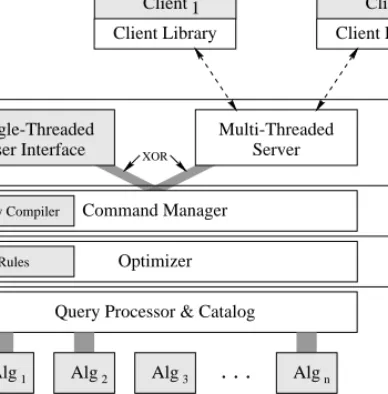
Second-order signature is the formal basis for specifying data models and query languages. In this section, we present the Secondo system frame, providing a clean extensible architecture, implementing all data-model independent func-tionality for managing SOS type constructors and operators, and supporting persistent object representations. Extending the frame with algebra modules results in a full-fledged DBMS. In addition to the basic commands, Secondo provides several other commands, e.g., for transaction management, system con-figuration, administration of multiple databases, and file input and output. Overview. Figure 7.9 shows a coarse architecture overview of the Secondo system. We discuss it level-wise from bottom to top. White boxes are part of the fixedsystem frame, which is independent of the currently implemented data model. Gray-shaded boxes represent the extensible part of theSecondosystem. Their contents differ with specific database implementations.
(3) (1) (6) (5) (4) (2) . . . Descriptive Algebra DDL & Query Language
Executable Algebra Query Processor & Catalog
Single-Threaded Server XOR Multi-Threaded User Interface Optimizer Rules
. . .
Alg2 Alg3 Algn
Alg1 Tools m Client User Interface 1 Client User Interface
Operating System & Storage Manager Query Compiler
Client Library Client Library
Command Manager
Fig. 7.9.TheSecondo architecture
The system is built on top of the Solaris operating system. Since we want to offer a full-fledged DBMS using a storage manager for dealing with persistent data is essential. In fact, we use the storage manager component of SHORE [19]. At level 1 of theSecondoarchitecture, we find a variety of tools, for instance: • Nested lists, a library of functions for easy handling of nested lists, the generic
format to pass values as well as type descriptions.
• SecondoSMI, a simplified storage manager interface to the SHORE functions used most often. It can be used together with original SHORE function calls whenever the simplified functionality is not sufficient.
• Catalog tools for easy creation of system catalogs and algebra-specific cata-logs.
• TheTuple Manager is an efficient implementation for handling tuples with embedded large objects.
• TheSOS Parser transforms an SOS term to the generic nested list format used in the system.
• TheSOS specification compiler creates the source code for the TypeCheck
and TransformTypealgebra support functions from a valid SOS
specifica-tion.
Level 2 is the algebra module level. To some extent, an algebra module of Sec-ondois similar to ADTs of PREDATOR [71] or Informix datablades [47]. Using the tools of level 1, a Secondo algebra module defines and implements type constructors and operators of an executable query algebra.Secondoallows for
implementations in C++, Modula-2, and C. To be able to use a module’s types and operators in queries, the module must be registered with the system frame, thereby enabling modules in upper levels to call specific support functions pro-vided by the module. In Figure 7.9, modules 1, 2, andn are active since they are connected to the frame, while module 3 is inactive. C++modules are acti-vated by linking them to the system frame. In addition, the activation of C and Modula-2 modules requires insertion of some standardized lines into the body of a predefined startup function.
Level 3 contains the query processor, the system catalog of types and objects (remember that a database is just a set of named types and named objects), and the mechanism for module registration. During query execution, the query processor controls which support functions of active algebra modules are exe-cuted at which point of time. Input to the query processor is a query plan, i.e. a term of the executable algebra defined by active algebra modules. A detailed description of query processing techniques inSecondo, including the powerful stream concept, can be found in [22] and, on a more technical level, in [38].
The query optimizer depicted at level 4 transforms a descriptive query into an efficient evaluation plan for the query processor by means of transformation rules. For each algebra module, the database implementor provides a corresponding set of rules as well as algebra support functions supplying information on estimated query execution costs.
The command manager at level 5 provides a procedural interface to the functionality of the lower levels. Depending on the command level, the query (or other command) is passed either to the query compiler, provided by the database implementor, to the optimizer or to the query processor.
At level 6 we find the front end of a Secondo installation, providing the user interface. In general, there are two mutually exclusive alternatives: either the user interface is linked with the frame and active algebra modules to a self-contained program, or the Secondo process is made a server process serving requests of an arbitrary number of client processes which implement the user interfaces. In the first case, Secondo is a single-user, single-process system, while in the latter case Secondo is a multi-user capable client-server system, exploiting the multi-threaded environment offered by SHORE. To support the implementation of user clients, Secondo provides comfortable client libraries for C++and Java.
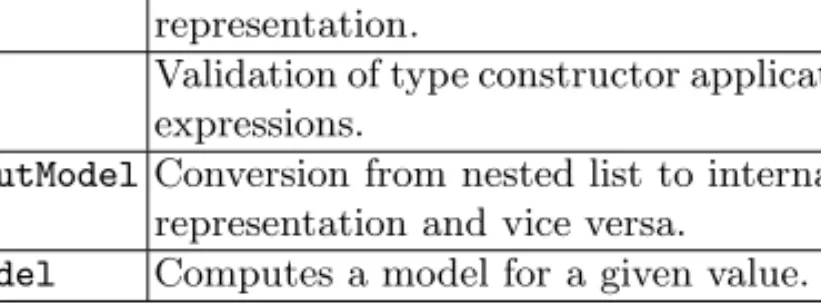
Algebra Modules. An algebra module has to implement a set of support func-tions for all of its type constructors and operators. Figure 7.10 lists all support functions for type constructors implemented in algebra modules. In addition to these functions, also the type constructor name is passed to the system frame. During query processing, the In function is used to convert an external value (in nested list form), given as part of an input file or in an interactive query command, to its corresponding internal value. The internal value typically is a catalog index essentially referencing either a main memory pointer or a persistent identifier. TheOutfunction is the reverse of theInfunction, producing external values for user interfaces or output files.
In/Out Conversion from external to internal value representation and vice versa.
Create/Delete Allocate/deallocate memory for internal value representation.
TypeCheck Validation of type constructor applications in type expressions.
InModel/OutModelConversion from nested list to internal model representation and vice versa.
ValueToModel Computes a model for a given value.
Fig. 7.10. Support functions for type constructors
TheCreate/Deletepair of support functions is used to allocate memory for a default value of the given type or to delete an object of that type, respectively. Default value creation is performed by the query processor to reserve space for single stream elements, thereby avoiding multiple allocation and deallocation of memory for stream elements of a common stream, which are never accessed simultaneously. TheDeletefunction is called later on to deallocate this default memory space as well as all intermediate results generated while processing a query.
TheTypeCheckfunction is called whenever a new database object is created to check whether its type conforms to the signature of the underlying data model. Furthermore, for each type constructor amodel may be registered which is a data structure containing summary information about a value of the type. The model is a place to keep statistical information such as expected number of tu-ples, histograms about attribute value distribution, etc. For maintaining models there are three support functions InModel, OutModel, and ValueToModel, as listed in Figure 7.10.
Figure 7.11 presents all support functions for operators. For each operator, its name and the number of Evaluatefunctions are also passed to the system frame. During query execution, the query processor calls the TransformType
function for type checking. Select is needed for the resolution of overloaded operators. The Evaluatefunction(s) do(es) the “real work” by computing an operator’s result value from its argument values.
TransformTypeComputes the operator’s result type from given argument types.
Select Selects the correct evaluation function in case of over-loading by means of the actual argument types.
Evaluate Computes the result value from input values. In case of overloading, several evaluation functions exist.
MapModel Computes the result model from argument models.
MapCost Computes the estimated cost of an operator application from argument models and costs.
Concerning cost estimation, there are two support functions called MapModel
and MapCost. For an operator application, MapModel takes the models of the
operator’s arguments and returns a model for the result. MapCost also takes the models of the operator’s arguments as well as the estimated costs for com-puting the arguments and, based on these, estimates and returns the cost for the operator application. By calling these support functions, the optimizer can estimate properties of intermediate results and the cost of query plans or sub-plans. Furthermore, there is a startup routine for each algebra module which is used to associate type constructors with the kinds containing them, to perform initializations of global arrays, etc.
The registration mechanism for support functions differs from the imple-mentation language. Registration is most comfortable in C++: For each type constructor, an instance of the predefined class TypeConstructormust be de-fined, passing operator support functions as constructor arguments. The same happens with operators and a predefined classOperator. For a complete alge-bra, an instance of a class derived from the predefined classAlgebrais defined. The constructor of this class is the startup routine of the modules.
Algebra modules need not only to cooperate with the system frame, but also with other algebra modules. Modules implement certain signatures. At the type level, kinds are the functions between different signatures. For instance, each type in kind DATA will be a valid attribute type for thetupletype constructor. Thus, a type constructorpolygonis made a type constructor for attribute types by simply addingpolygonto the type constructors for DATA.
At the implementation level, the interface between system frame and algebra modules does not impose any specific inter-module interaction conventions on the algebra implementation, but rather the algebra implementor is free to define the protocol for interaction with type constructors and operators of his algebra. For C++implementations there is a general strategy, based upon the inheritance and virtual method mechanisms provided by C++, which allows one to define generic interfaces between modules in a uniform manner as follows.
The basic observation is that the relationship between kinds and type con-structors corresponds to the relationship between base classes and derived classes. For each kind K, the algebra modulealg requiring an interface to values of types in K defines an abstract base class k base. For the implementation of opera-tors in alg, typically some support functions for dealing with values of kind K will be necessary. Just these support functions are defined as abstract vir-tual methods of k base. Whenever a class tc in any algebra module is defined to implement a type constructor in kind K, tc must be derived from k base:
class tc : public k base. For instance, the base classDatacorresponding to
kind DATA contains a virtual methodComparewhich has to be defined within all attribute data type implementations, thereby enabling the generic implemen-tation of thesortoperator of the relational algebra module.
Secondoversus Concert. A common goal ofSecondoand Concert is to sup-port an easy and efficient implementation of new application-specific data types.
In particular, both systems provide facilities for managing collections of related types, namelykinds in Secondoand concepts in Concert.
However, the facilities offered differ as follows.Secondoenables a database implementor to define arbitrary new type constructors, operators, and, through the notion ofkinds, sets of type constructors for data types with common prop-erties. The system frame does not implement any particular data model, but rather provides a generic query processor and powerful tools to implement type constructors and operators.
Concertconcepts are similar toSecondokinds in two major aspects. First, concepts group sets of data types with common properties, and second, a concept sets up a programming interface, which has to be implemented by those new data types that shall fit the concept. That way, general processing techniques are implementable for groups of data types rather than specific types only. In Concert, this is basically exploited for indexing.
As opposed toSecondokinds, Concert concepts are hardwired with the sys-tem. A database implementor is neither able to add new concepts nor to provide further implementations of concept-specific index structures and operators. On the other hand, Concert concepts already cover a broad range of requirements of new data models, and hardwired implementations are often slightly more ef-ficient than those registered through a general interface, because the adaptation to details of other modules in the system is easier.
RegardingSecondo, introducing a new kind naturally requires some effort to implement the type constructors and operators applicable to these kinds. However, with a growing number of algebra module implementations the prob-ability grows that a database implementor finds kinds with their operators and type constructors already implemented that fit pretty well the requirements of new data types.
In summary, Concert offers a higher degree of implemented functionality than Secondo. On the other hand, Secondois more flexible with respect to new data models since it does not hardwire a fixed number of concepts, but is open for arbitrary “concepts”. In fact, Secondo could be used to implement the Concert approach by defining all concepts as kinds and index structures as type constructors applicable to these kinds.
7.4.4 Implementing Spatio-temporal Algebra Modules
Because of its generality, particularly with respect to type constructor defini-tions, Secondo is very well suited to the implementation of spatio-temporal data models. In fact, the signatures given in Sections 4.3 and 4.4 (see Chapter 4) defining the abstract and the discrete data model, are genuine second-order signatures. Thus, theTypeCheck,TransformType, andSelectsupport functions can be implemented in a straightforward manner. Later on, they will even be generated automatically by the SOS specification compiler.
Apart from the type level, a database implementor has to provide opera-tor implementations as well as efficient memory representations of data type
instances. In doing so, he is supported bySecondo’s implementation tools. Im-plementors of spatial data types often encounter the problem that instances of a given type might vary in size heavily. For example, apolygon value may consist of only three vertices as well as many thousands of them.Secondo’stuple man-ager (see Section 7.4.3) can be used to handle tuples with embedded attribute values of varying size in an efficient and comfortable way. For that purpose it offers a new large object abstraction calledFLOB(Faked Large OBject). FLOBs are implemented on top of the large object abstraction of the underlying storage manager. Depending on a FLOB value’s size and access probability, it is either stored as a large object or embedded within the tuple [23].
Allowing for type constructors arbitrarily nesting other types, however, re-quires implementation techniques beyond those of basic FLOBs. Consider a data type that arises from the application of a type constructor to some other type, e.g., list(polygon). The representation of such a data type needs to organize a set of representations of values of the argument types. If the argument types employ FLOBs themselves, we immediately arrive at a tree of storage blocks which may be small or large, i.e., aFLOB tree. The generalized problem is then to determine an efficient storage layout or clustering of the tree, i.e., a par-titioning into components stored as large objects. Thus, we extended the basic FLOB functionality, offeringnestable FLOBs, so supporting a direct and elegant implementation of type constructors [24].
Due to the aspired generality of our clustering tool, we cannot exploit spe-cific schema information to decide on a good clustering. Instead, we consider a FLOB’s size and access probability, as well as the general FLOB access speed parameters of the underlying storage manager and operating system. In [24], we deduced a rank function R(C, f) that for a given clusterC and a FLOBf not yet assigned to any cluster returns a measure indicating whether it is more efficient to insertf intoC or to store it in another large object.
Our tool uses the function R in an algorithm that finds a clustering of a FLOB tree in time linear in the number of FLOBs as follows. The root FLOB starts a new cluster. Then, each son of the root either is included into the root’s cluster or starts a new cluster, according to the return value ofR. This is done recursively for the entire tree. Even though this algorithm cannot guarantee to return an optimal solution, in all tests performed in an experimental comparison with other algorithms it returned high-quality results.
mapping
const(int) const(int) const(int)
mapping
const(region) const(region)