The Advantage Survey for Construction Accidents
Knowledge Platform Built
Ching-Wu Cheng2 Chen-Chung Lin1 Sou-Sen Leu3 Chia-Chun Yu1 Wei-Fan Chen2
Abstract
For the past few years, most of the labor accident investigation in Taiwan is analyzed by using the historical labor accident data. However, along with the continuous accumulating database, related research result cannot provide more detailed distributions and patters of labor accident for the internal and external user community. Furthermore, the knowledge sharing of labor accident database depends on the result of effective analysis and also the establishment of network platform to provide a real-time assistance to every user in the construction safety field. This research adopted the occupational accident data from year 2000 to 2008 (1437 cases) to explore the potential cause-and-effect relationships and the significant factors related to the occupational accidents in the construction industry. In this study, through the Internet-based system to develop a knowledge platform to help internal and external communities for their acquisition of statistical results and potential hidden rules behind construction accident data. This value-added information will effectively assist project safety managers in the promotion of safety prevention actions.
Keywords: Construction industry, Occupational accidents, Knowledge sharing platform 1
Institute of Occupational Safety And Health, Council of Labor Affairs, Executive Yuan
2
Department of Safety Health and Environmental Engineering,
3
Department of Construction Engineering, National Taiwan University of Science and Technology
Accepted 29 September, 2010
Preface
The cause and state distribution of constru-ction accidents may be complicated and varied due to the different construction characteristics and operating environments, and the different safety awareness states of employers, contractors, and workers. In the various impact factors, how we apply the information technology (IT) (such as: internet, etc. knowledge transferring and sharing functions) to systematically organize the distribution result of the domestic major construction accidents between 2000 and 2008, and present the results will be further shown in the research. The research used the nature of domestic construction accidents and the possible occurrence state of construction acci-dents to process system analysis and design through IT. At the same time, with the establishment of a major occupational accidents knowledge platform, the related statistical method and system program are applied and written to establish occupational accident classification, casual relationship and potential trend expectations [1-3]. The safety ma-nagement technology is also combined to sum-marize an occupational accident state knowledge base. The Internet technology is applied to further implement this knowledge in the construction safety management operation, and achieve the goal of the government in reducing occupational accidents. The knowledge value of labor safety is to go through organizing the accumulated experiences, including technological documents, research re-ports, and occupational accident survey results, to provide the distribution state or concentration trend between the research analysis result and the infor-mation through statistical technology and data re-trieval functions. The system program will be
de-signed to provide the visual function in the user’s operating interface, and the analysis result will be presented in charts for users to grasp the overall picture of the even in real-time, and further apply it as the reference for safety management items and focus. The research focus mainly based on major construction accidents database to explore the users’ demands on the accident prevention or safety management focus provided by the occup-ational accident data distribution. It combined with the statistical module to provide the analysis result of occupational accident data, developed a network knowledge system, applied On-Line Analytical Processing (OLAP) to design the re-trieval function program of users’ demands, and presented the occupational accident knowledge transmission in multi dimensions. In addition, focusing on the current constructions managed by various labor inspection offices, the major occu-pational accident result distribution or trend state from the employers, business units and accident units can be compared to recognize the potential accident operation features and construction con-ditions, and further assist managers to effectively grasp the casual relationship of accident occurrence.
Data Process and Analysis Process
The occurrence of occupational accidents often follows a certain pattern, and occupational safety management also should be focused on by every industry. According to the 2009 Labor In-spection Guideline [4] announced by the Council of Labor Affairs, the vision, goal and strategy mentioned in the guideline mainly focus on how
The Situation of Reducing Domestic
Construction Accidents
According to the major occupational acci-dent death rate in workplaces that applied to the Labor Safety and Health Act in the 2009 Labor Statistics Annual Report of the Council of Labor Affairs, Executive Yuan, it was found that the overall industry labor death rate and the construc-tion industry death rate (excluding occupaconstruc-tional disease and traffic accidents) have increased, shown as Figure 1. Moreover, in the labor inspection annual report, the Council of Labor Affairs, be- mation published still provides browsing by the general public and international people, the re-lated information is also often presented in reports or simple charts. However, labor safety related research topics are still limited to primary data retrieval, and cannot provide users with the stati-stical charts presented according to situational demands. In various countries’ established occu-pational management platforms, the occuoccu-pational accident situation information content established by the Ministry of Health, Labour and Welfare, Japan (http://www.jniosh.go.jp/icpro/jicosh-old/) is more consistent with the situational retrieval framework that the research wants to implement. The overseas safety information report provided by the platform includes: safety and health laws and regulations, safety relationship, health re-lationship, industry type information, and acci-dent statistics. Conversely, the information is pre-sented in a static chart post-process result, which does not fully show the distribution comparison between real-time and different data columns. to effectively safeguard labor safety and health,
and further go through the inspection system, cooperation model and education advocacy to reach the goal of “No occupational accidents”. However, looking at the process of promoting major domestic occupational accident information technology, it is found that the process still remains in general webpage browsing, or related documents and labor inspection annual report downloads. It is not easy to tell the overall trend development or the distribution of the connections between various impact factors of the occupational acci- dents. According to the Enforcement of R&D Inno-vation Implementation Guideline No. 0930008589 promulgated by the Executive Yuan, various au-thorities shall use the authority mission to plan the future vision, set the authority goal, establish im-plementation strategy, and apply the knowledge management method to promote R&D innovation tasks [5,6]. At the same time, to cope with the e-Taiwan program, “Challenge 2008: National Development Plan”, the ministries also applied the disaster prevention information platform, etc. knowledge base provided by the Internet. For ex-ample, the Council of Labor Affairs has estab-lished an accident prevention information network platform to provide videos, pictures, and text de-scriptions of related construction safety, electrical safety and safety health, etc. operation states [7] based on labor safety.
The websites of the U.S.A., the U.K., Ireland, Canada, Japan, Singapore, Hong Kong and Inter-national Labor Organization (ILO) have provided similar Labor Safety and Health frameworks. They also still focus on presenting the historical data ( including research reports, reports and propaganda) of the information content. As the official
infor-labor organization and international certification regulations, and promote occupational safety and healthy self-management. Its purpose also helps to achieve the accident reduction goal of the Coun-cil of Labor Affairs, which is to lower the overall occupational accident death rate to less than four in the coming four years [8]. In addition to the ad-vocacy and counseling for high-risk workplaces, the related units will also implement project in-spections, and for those who do not improve safety and health according to regulations, a fine and a suspension of operation will be issued, to further enhance the overall construction business units’ and various contractors’ construction safety stan-dard and operating personnel’s safety awareness. tween 2000 and 2008, the major domestic
con-struction accident amount was 1421 people de-ceased (including fatal traffic accidents), and 1043 people deceased (excluding fatal traffic accidents). The data showed that in the active promotion of the “223 accident reducing plan” of the Council of Labor Affairs, the domestic occupational acci-dent occurrence frequency has significantly re-duced. In addition, to more specifically imple-menting a domestic occupational safety system and reducing accidents, Wang Ru-xuan, the Mi-nister of the Council of Labor Affairs, emphasized that the certification system of Taiwan’s occu-pational safety and health management system was activated in June 2008 to refer to international
Figure 1 Fatalities per 1000 persons (construction industry, all industries and else), 2000-2008 (Source: Yearbook of Labor Statistics, Taiwanese Council of Labor Affairs, 2009)
versely, the death rate decreased from 0.223 (ex-cluding fatal traffic accidents, in 2000) to 0.122 (in 2007), and 0.130 (in 2008), the results corres-pond with Figure 1.
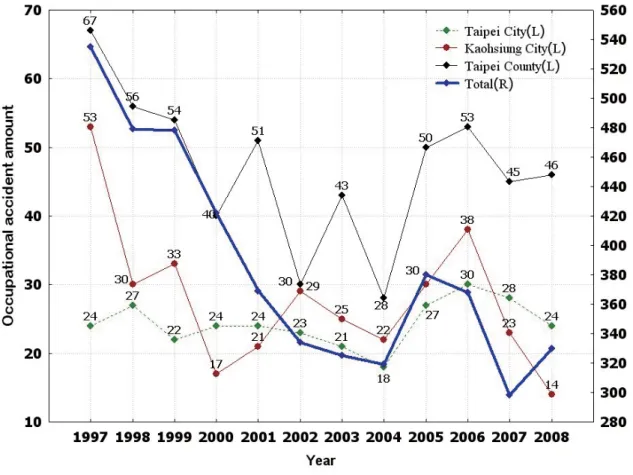
In addition, it can also be seen from the na-tional occupana-tional accident amount and nana-tional overall industry occupational accident trend that between 1999 and 2004, the overall industry occu-pational accident amount decreased significantly. However, from 2004 to 2006 and in 2008, the occu-pational accident amount increased from 319 people (in 2004) to 330 people (in 2008), it showed that the government still continued to work on domestic occupational accident management, shown as figure 2. It was found that the amount of injured people and disabled people have both increased when referring to the amount of major statistical construction accidents of the Labor Insurance Bureau between 2000 and 2008.
Con-Figure 2 The major city and county occupational accident amount distribution between 1997 and 2008 (Source: The Council of Labor Affairs)
Establishment of a Construction
Accident Knowledge Platform
The internet knowledge platform established by the research is mainly divided into two parts:1) Occupational accident information links and know-ledge analysis (including: domestic and foreign research reports, laws and regulations, propaganda media, occupational accident knowledge, and
and contingency tables through the situational de-sign of considering different users’ demands, and the systematic analysis and logistic judgment on the selected cared occupational items, to allow occupational accident cases). 2) Major domestic
occupational accident information statistical distri-bution. The real-time statistical results of major occupational accidents are presented in bar charts
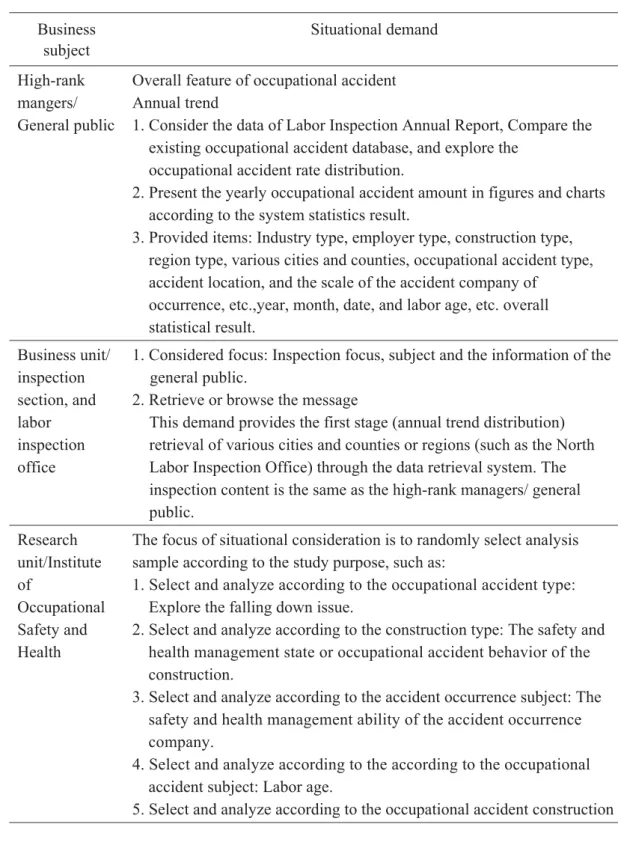
Table 1 Users’ situational demand exploration
Business subject Situational demand High-rank mangers/ General public
Overall feature of occupational accident Annual trend 1. 2. 3. Business unit/ inspection section, and labor inspection office 1. 2. Research unit/Institute of Occupational Safety and Health 1. 2. 3. 4. 5.
The focus of situational consideration is to randomly select analysis sample according to the study purpose, such as:
Select and analyze according to the occupational accident type: Explore the falling down issue.
Select and analyze according to the construction type: The safety and health management state or occupational accident behavior of the construction.
Select and analyze according to the accident occurrence subject: The safety and health management ability of the accident occurrence company.
Select and analyze according to the according to the occupational accident subject: Labor age.
Select and analyze according to the occupational accident construction Considered focus: Inspection focus, subject and the information of the general public.
Retrieve or browse the message
This demand provides the first stage (annual trend distribution) retrieval of various cities and counties or regions (such as the North Labor Inspection Office) through the data retrieval system. The inspection content is the same as the high-rank managers/ general public.
Consider the data of Labor Inspection Annual Report, Compare the existing occupational accident database, and explore the
occupational accident rate distribution.
Present the yearly occupational accident amount in figures and charts according to the system statistics result.
Provided items: Industry type, employer type, construction type, region type, various cities and counties, occupational accident type, accident location, and the scale of the accident company of occurrence, etc.,year, month, date, and labor age, etc. overall statistical result.
about in steps through the interface menu, which helps to avoid the conditions from occurring when having the wrong logistic judgment. The users’ situational demands are shown as Table 1.
2. Major construction accidents database planning
The major data collection source for domestic major occupational accident data is the labor in-spection system established by the Council of La-bor Affairs, Executive Yuan. The content is mainly designed and planned according to the response items of the workplace major occupational acci-dent report and inspection handling outlines, and provided as the description for follow-up related statistics reports, such as: major occupational acci-dent compiled charts, and labor inspection annual users to grasp the overall occupational accident
distribution state.
1. Users’ demand analysis and situation discussion
System development will be different due to different users and establishment purposes. The users of the research are mainly competent authori-ties with business demands. The research at the same time, copes with the occupational accident database content established by the user, and pro-cess data retrieval operation depending on the cared about situational condition. It analyzes the result through system calculation, and presents it in figures or charts. The system considers humanity and visual demands, and the implementation pro-cess allows users to operate the contents they care
2000-2008 construction industry major occupational accident database
Less then 1 person death More then 3 person injured
Project ownership
Project distinction Construction contract amount Project type
Level of construction job contracting
Di re ct f actor and i n di re ct fa
ctor Accident location
Action state
Work content Source of injury
Time factor
Violating laws and regulations
Acc ident t y pe In ju re d pa rt of bod y Unsafe ac ts and uns af e co ndition
Age; Gender; Worker type; Experience; …
Worker factor
…
Health and safety personnel assigned Education and training implemented Health and safety autonomous inspection implemented Health and safety autonomous Health and safety rules determined
Major contractor safety tasks: Health and safety management work
wants to analyze through certain conditions.
3. The establishment of the Entity Relationship Model (ER-Model)
The research applied the OLAP concept and referred to Japan’s (http://www.jaish.gr.jp/) data retrieval concept to design the system program. OLAP processes data analysis in a multi-dimen-sional method, it provides Roll-up, Drill-down, and Pivot to present integrative decision-making information. It is mostly used in the decision-making support system; its major function is to apply a large amount of statistical data calculation to provide a reference and support to the decision-maker. The distribution results between various selected variables can be obtained through past occupational accident occurrence states, and ac-cording to the implementation structure of OLAP, and a complete occupational accident database ER-Model can be established. However, as the current occupational accident database cannot com-reports, etc. occupational accident data distribution
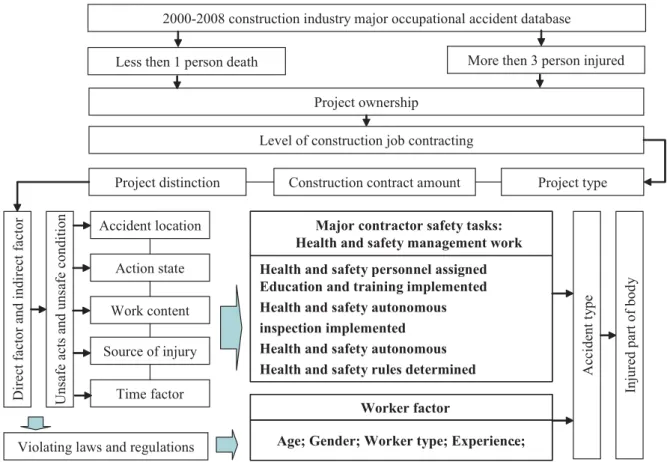
results. The research data is mainly retrieved from the major occupational accident database (including deaths and injuries) listed by the Institute of Occu-pational Safety and Health between 2000 and 2008, which has a total of 1437 files. The database classi-fication principle, in addition to referring to the accident classification regulations of the American National Standards Institute (ANSI,1995) Z.16.2-1995 [9], at the same time, also refers to the de-fined industry type of the Council of Labor Affairs, Institute of Occupational Safety and Health, DG-BAS, and the labor inspection offices. The con-nection result between the related occupational accident attributes is shown as Figure 3. The con-tent of Figure 3 describes that the attributes of the occupational accident database can provide the importance result distribution of the occupational accident occurrence information, and after being integrated with the establishment of Entity Data Model, it can search the object and result the user
Figure 4 The relationships of the occupational accident database E-R Model attributes
Worker Age Marital status Health status Insurance state Marital status
Experience Gender Entering time
Injured state
Labor-Participated construction contractor
Labor-Participated construction contractor
Work content Project type Company scale
Health and safety management work
Project distinction
Audit Labor inspection unit
Outsourcing unit Construction contract amount Project region Project type Project distinction Project type Work content Work location Accident type
Source of injury Accident times Health and safety management work Occupation accident compensation
provides the expansion and maintenance function and update for the database. Figure 5 is the frame-work of the construction knowledge platform established by the research. Through the output of the occupational accident database [10,11] and use the content that the users want to understand to select from the menu or condition, and then apply the statistical method to provide a digital-ized analysis result to understand the past occu-pational accident distribution state, and further design safety prevention measures focusing on high-risk operation content or laborers with high accident features.
5. Knowledge management system website design and establishment
The established system framework applies the content management system (CMS) of the APM framework as the overall construction of the research website and the presented platform. pletely include the occupational accident research
issues, such as the construction environment, con-struction scale, concon-struction operation content ( construction progress), construction type (structure type and area), contract type, accumulated constru-ction working hours, and labor educational level, and the corresponding occupational accident re-cords also cannot be obtained through the links of the occupational accident report or government information system. Therefore, the research used the related literature and expert interview com-ments to draw out the Entity Relationship Model structure, shown as Figure 4.
4. Knowledge platform establishment
A complete knowledge platform retrieval function must also be able to provide horizontal and vertical inquiry and the knowledge sharing purpose [5,6]. It considers the establishment of the construction accident knowledge database, and
Internal and external community group Bureau of Labor
Insurance-Council of Labor Affairs
Institute of Occupational Safety and Health Inspection Office Inspection Institutions
Server planning and establishment Volume, speed, safety,
and quality
KM platform Construction accident
prevention center
Labor Inspection Unit
External community group
Presenting content
1. Supplier safety assessment 2. Accident disposal plan 3. Information safety 4. Intellectual Property Rights 5. …
(visualization)
Search
Occupational accident statistics Occupational accident
casual relationship Manual, report, propaganda
Search
Construction industry major occupational accident database Coordinated and discussion
Column name and content Labor Inspection
Unit
Annual occupational accident amount difference Inspection
Office
Column name and content Labor Inspection
Unit
Annual occupational accident amount difference Inspection
Office
internal and external community group
Consultants Company Academic Units Construction Factory
Response/ Analysis
Internal com m unity
Accident notifies
stical module framework established in the re-search, are mainly in the situational mode of the general public, counties and cities and various districts, business units, and research personnel, etc. to assist the user to select the right parameter, and create the occupational accident statistical figure that meets the user’s situation. For users who are research personnel, it designs the inter-action interface with an easy and intuitive method to meet the situational demand. The research per-sonnel situational mode provides a large amount of options for drawing the statistical figures, to allow researchers to fully apply the major con-struction accident database established by the study for researches. The statistics figure generator mainly provides the major figure component for system program development, and presents more occupational accident data dimensional results. It applies Apache HTTP Server as the web server,
PHP language to write the webpage program, and MySQL as the database to provide various layouts with static and dynamic data. The framework is shown as Figure 6. The operation environment is divided into three functions: general browsing, professional browsing, and advanced retrieval. In data dimensional design, it used the users’ situ-ational browsing and retrieval purpose to consider the logistic concept presented by the planned layout implementation result, and meet the occupational accident database content established to unify the code design. At the same time, it considers the analysis purpose of the follow-up newly added data accumulated in the system, and during the system module establishment, it also designs the system established core as the presentation for providing related occupational accident descrip-tive statistic result charts. The occupational
stati-Figure 6 System retrieval framework
Content M anagem ent System (CM S)
The system is established with an Apache + M ySQ L + PHP operating environm ent
O ccupational accident knowledge Research report O ccupational Accident report Propaganda m edia Related links Com m only seen Violated laws and regulations D ynam ic content Static content G eneral browse O ccupational accident database System registry Professional browse Advanced browse
O ccupational accident statistic core program Statistical figure com ponent
Knowledge Platform Entity
Operation State
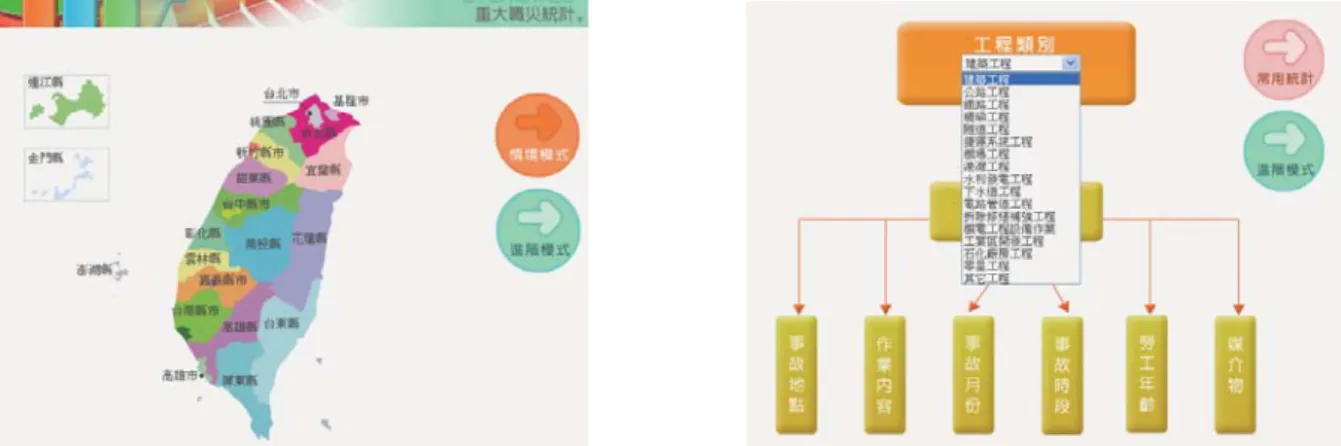
The design of the system’s operating layout mainly uses visual components and icons instead of the transferring method. It is more user-friendly and easier to operate. Figure 7 is the homepage design. Figure 8 is the operating layout of various cities and counties’ sample selection and construc-tion type analysis condiconstruc-tion.
To add value to the major construction
acci-dents application during the research period, it goes through expert interviews and refers to com-petent government unit comments to set the situ-ational retrieval of the KM platform into four levels for discussion; they are respectively the general public, counties and cities and various districts, business units, and research units. In addition, considering the occupational accident data resource difference, and the possible interpretation and cognition differences that may be caused by the statistical result, the research only applied the occu-
Figure 7 Major construction accidents knowledge platform homepage
Figure 8 Operating layout of various cities and counties’ sample selection and construction type analysis condition
and the amount published by the Council of Labor Affairs, the analysis results are also different. The different result is not the focus of the research; it will be further discussed in the occupational acci-dent data integration in the future. The research focus is to discuss the KM platform development technology and establishment effectiveness. The research core-Major occupational accident sta-tistical module will be described according to the pational accident database established from the
undertaken research programs (IOSH96-S305, IOSH96-S306, IOSH97-315, IOSH98-S312) of the Institute of Occupational Safety and Health, Council of Labor Affairs, as the analysis matrix, and further presented the system analysis statistical result in figures and charts. The statistical data of the occupational accident amount, due to the diffe-rent research purposes between the obtained data
Figure 9 The situational mode scene for the general public
The yearly distribution of all data Various accident types distribution of all data
retrieval scene operation of different users:
1. The situational mode scene for the general public
This processes the statistical figure drawing on the planned designed attributes of all data (no samples selected). In addition, it can also process statistical figure drawing according to the years ( shown as Figure 9). The X-axis items are year, month, week, hour, construction industry,
con-struction type, accident type, region, source of injure, work content, contracting level, and age distribution.
2. Labor inspection unit- regions or city and county situational mode scene
The related safety and health inspections are processed by the North, Central, South and various district inspection offices, Council of Labor Affairs, to manage the related construction accidents of
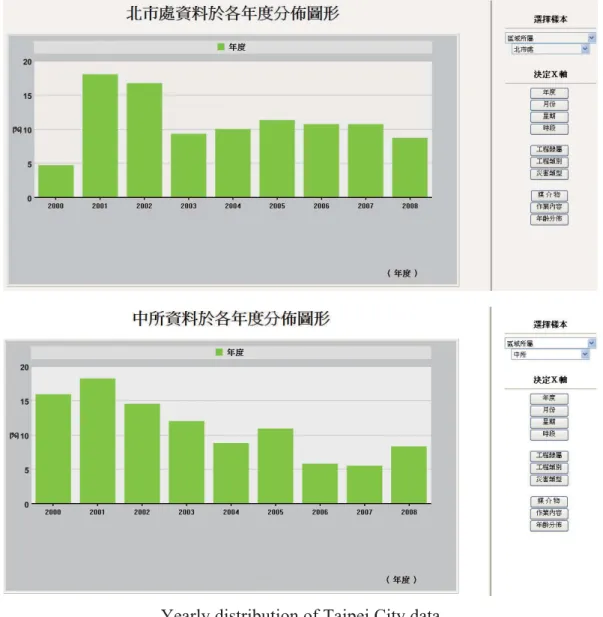
Figure 10 The distribution statistics result of the yearly occupational accident amount according to regions or districts
Yearly distribution of Taipei City data Yearly distribution of Central Taiwan data
accident items according to the district overall sample or district annual sample.
3. The situational mode scene of construction business unit
In the retrieval layout designs of the constru-ction business unit, the major scene is similar to the labor inspection unit. Their major difference is that the menu subject of this mode applies con-struction type as the main sample, such as building
Figure 11 The situational mode scene of construction business unit various districts or counties and cities. The
sta-tistical figures are used according to the cared about content in the situational mode established by the system. The X-axis items are year, month, week, hour, construction industry, construction type, accident type, region, source of injure, work content, and age distribution, shown as Figure 10. Through the options on the right of the figure, the users can also process the statistical result analysis and figure presentation of individual occupational
The distribution of bridge construction data in various accident types The distribution of building construction data in various ages
4. Research unit-institute of occupational safety and health occupational accident analysis situational mode scene
In Figure 12, the research personnel
situ-Figure 12 The situational mode scene of construction business units construction and road construction. The X-axis
items are year, month, week, hour, construction industry, accident type, source of injure, work content, and age distribution, shown as Figure 11.
The distribution of public construction data of various occupation types The distribution of public construction data of various accident locations
ational mode can process statistics according to different sample types to select different samples, and the data numbers in the statistical figure are the statistical amount of various items. The X-axis item almost includes all database columns, includ-ing construction industry, construction type, con-struction distinction, accident type, counties and cities, region, year, month, week, hour, source of injury, accident location, contracting level, ope-ration content, nationality, age, work experience, occupation type, unsafe condition, unsafe behavior, agreed upon work content, accident notification, and occurring accident company scale. The re-search personnel situational mode has a special function, which is the Z-axis data that can apply colors on the statistical figure; it is beneficial for the research analysis process. For the in-depth exploration on data meaning, Z-axis items also include most database columns: construction in-dustry, construction distinction, region, source of injury, contracting level, work experience, unsafe condition, unsafe behavior, agreed upon work content, accident notification, and occurring acci-dent company scale. In addition, considering re-search personnel may have more in-depth sta-tistical analysis demands, the “GRID” button on the top-right corner of the figure can be selected, and create a data contingency table to facilitate in analyzing other statistical software or the drawings of other figures, shown as Figure 13.
Figure 13 The statistical result of the occupational accident data contingency table distribution
Conclusion and Recommendation
A well planned knowledge platform, in a-ddition to the application value provided by the database content, also has users properly develop and apply the data source analysis result to present the true knowledge value. The knowledge plat-form established by the research, in addition to the connection or support of general knowledge, is mainly to construct the data of 1437 major con-struction accidents (2000~2008) as the core issue. In the research, after exploring the user demands, and considering the confidential conditions of information safety, different interface situational operation modes are designed to provide different community groups to use their authority to process overall or individual year related major construc-tion accidents related data attribute distribuconstruc-tion result inquiries. The functions provided by the system are different from the paper reports publish-ed by government units every year in knowlpublish-edge promotion and distribution. The knowledge plat-form established by the research mainly applies the visualization method to establish domestic and foreign construction accident information connections. The information technology is intro-duced, and after the classification and coding of the occupational accident database, it applies pro-gram design to assist community groups to obtain the latest occupational accident information, which
is beneficial for promoting domestic construction accident prevention and accident reducing. How-ever, the reunification of the occupational accident data source amount is related to the identification baseline of occupational accidents. How to unify the registry format, content name definition, and matrix source for calculating the accident rate of occupational accident cases requires the compe-tent authority to further integrate the occupational accident database.
Acknowledgement
The research thanks the Institute of Occu-pational Safety and Health for providing the o-riginal major occupational accident report for the construction industry. The related research resource is supported by the research program (IOSH96-S305, IOSH96-S306, IOSH97-315, IOSH98-S312) of the Institute of Occupational Safety and Health, Council of Labor Affairs, which allows the re-search to be processed smoothly. Their assistance was highly appreciated.
Executive Yuan, IOSH 96-S306. (Chinese) CC Lin, SS Leu, CW Cheng and CC YU. Development of Knowledge Platform Based on Analysis of Construction Accidents, Re-port of Institute of Occupational Safety and Health, Council of Labor Affairs, Executive Yuan, IOSH 97-S315. (Chinese)
Council of Labor Affairs, Executive Yuan (TW). Labor Inspection Policy. Taipei:The Insitute; 2009. (Chinese)
CY Liu. The development of enterprise for Knowledge management. Kaohsiung (TW) NSYSU Departments of Business Manage-ment; 2000. http://cm.nsysu.edu.tw/~cyliu/ paper/paper23.doc
HH Wu. The Future and the past for Know-ledge Management by Information Techno-logy. Taipei (TW):Academia Sinica; 2000. (Chinese) http://www.ascc.sinica.edu.tw/nl/ 93/2012/03.txt
Council of Labor Affairs, Executive Yuan (TW). Labor Inspection Policy. Taipei:The Insitute; 2008. (Chinese)
http://media.career.com.tw/epaper/enews/ center_news.asp?no3=35312
Lortie M, Rizzo P. The classification of acci-dent data. Safety Science 1999; 31:31-57. Zhang, JH. Tacit Knowledge Management Strategies for Knowledge Management. In-formation Science 2006; 24 (5).
LM Ding and JJ Chen. The development of Knowledge Management for MRT. MRT Technology Annual 2006; 34Ȉ131-42. [3] [4] [5] [6] [7] [8] [9] [10] [11]
Reference
CC Lin and SS Leu. Accident Analysis and Safety Risk Management of Public Constru-ction, Report of Institute of Occupational Safety and Health, Council of Labor Affairs, Executive Yuan, IOSH 96-S305. (Chinese) CC Lin and CW Cheng. Data Mining of Con-struction Accidents in Architectural Engi-neering, Report of Institute of Occupational Safety and Health, Council of Labor Affairs, [1]