Address correspondence to Carolé
Mensing, RN, MA, CDE, Joslin
Diabetes Center, One Joslin Place,
Boston, MA 02215.
Comparing the Processes: Accreditation and Recognition
Carolé Mensing, RN, MA, CDE
This article is being co-published by
the American Diabetes Association’s
Diabetes Spectrum
and the
American Association of Diabetes
Educators’
The Diabetes Educator.
Diabetes self-management
educa-tion (DSME) continues to be cited
as a cornerstone of effective diabetes
care and a crucial part of a patient’s
success in living well with diabetes.
Supporting the philosophies of the
Chronic Care Model
1,2and effective
self-management training,
3DSME
provides a forum for informing and
activating patients to manage their
illness, better interact with the
avail-able systems for diabetes care, and
ultimately achieve the best possible
outcomes. In addition, the practice
of DSME has been established as
crucial to the care and management
of people with diabetes, and
measur-able behavior change has emerged as
the unique proxy for evaluating the
impact of working with a
diabe-tes educator.
4,5DSME is formally
defined as the knowledge, skill,
and ability necessary for self-care,
through informed decision making,
problem solving, and collaboration
with the health care team to improve
clinical outcomes, health status, and
quality of life.
6Diabetes educators have become
even more accountable for both their
approaches to patient care and their
comprehensive diabetes education
programs. An educational standards
framework such as the National
Standards for Diabetes
Self-Manage-ment Education (NSDSME)
6plays
an important role in standardizing
the educational process, content, and
outcome measurement for helping
people with diabetes or at risk for
diabetes enhance their quality of life
and better manage their condition.
The National Diabetes
Advi-sory Board (NDAB) pioneered this
framework with the creation of the
National Standards for Diabetes
Self-Management Education
7in the
early 1980s. These standards were
designed to define quality diabetes
education and to assist diabetes
educators in a variety of settings in
providing evidence-based education
and facilitate optimal health
out-comes for patients with or at risk for
diabetes.
To remain current, these
stan-dards are reviewed and revised
approximately every 5 years to better
reflect the changes and dynamic
nature of the health care community.
In this decade, two sets of updated
NSDSME have been presented, first
in 2000
8and more recently in 2007.
6The 2007 revised standards
con-tinue to offer educators a program
framework of 10 standards. These
Diabetes education programs are
developed to serve the diabetes
community by offering quality
edu-cation that meets a set of standards
and is then eligible for third-party
insurance reimbursement. Three
organizations are authorized by
the U.S. Centers for Medicare and
Medicaid Services to determine
whether diabetes education
pro-grams meet required standards.
Each of the three relies on the 2007
edition of the national Standards
for Diabetes Self-Management
Education. This article
summa-rizes similarities among and unique
qualities of each of the organization’s
approaches to assuring quality.
This article is being co-published by
the American Diabetes Association’s
Diabetes Spectrum
and the American
Association of Diabetes Educators’
The Diabetes Educator
.
standards are based on the following
five evidence-based principles:
• Diabetes education is effective for
improving clinical outcomes and
quality of life, at least in the short
term.
3,9–14• DSME has evolved from
primar-ily didactic presentations to more
theoretically based empowerment
models.
10,15• There is no one “best” education
or approach; however, programs
incorporating behavioral and
psychosocial strategies
demon-strate improved outcomes.
16–18Additional studies show that
age- and culturally appropriate
programs improve outcomes
19–23and that group education is
effective.
11,13,14,24,25• Ongoing support is crucial
to sustain progress made by
participants during DSME
programs.
10,20,26,27• Behavioral goal setting is an
effective strategy to support
self-management behaviors.
28The revised NSDSME
7continue
to address the framework format
of structure, process, and outcome
guidelines for establishing or
main-taining an education program,
influencing third-party
reimburse-ment, and offering educators a
framework for quality
evidence-based program development,
implementation, and evaluation.
Participating Organizations
In 1986, the American Diabetes
Association (ADA), having partnered
with NDAB and other well-known
community organizations in
develop-ing the standards, became the first
organization to develop an
applica-tion and review process to identify
programs meeting the standards.
During the same time period, the
Indian Health Service (IHS) was
developing its own internal structure
and process based on the NSDSME
for review of diabetes education
programs in tribal communities and
provision of guidelines and technical
assistance for program improvement.
In 1997, the
federal Balanced
Budget Act passed, permitting the
U.S. Health Care Finance
Admin-istration (HCFA; now called the
Centers for Medicare and Medicaid
Services [CMS]) to provide coverage
for diabetes self-management
train-ing (DSMT). Organizations were
invited to develop and implement
systems to publicly acknowledge
those programs following the
guide-lines identified in the standards.
ADA’s Education Recognition
Program (ERP) process was well
established at this time, with 530
recognized programs, and HCFA
(now CMS) awarded the first
national accrediting status to ADA
in preparation for the final ruling on
coverage for DSMT in 2001. This
process identified programs that
would later qualify for payments
for delivering DSMT. The IHS was
approved by CMS as a national
accrediting organization in 2002. A
third organization approved in 2009
was the American Association of
Diabetes Educators (AADE)
Diabe-tes Education Accreditation Program
(DEAP). As the only organization
dedicated solely to diabetes
educa-tion, this was a natural step for
AADE.
There are not enough DSME
pro-grams available to meet the needs of
the increasing number of people with
diabetes. ADA-recognized programs
increased from 39 in 1986 to 2,038
as of October 2009, while diabetes
prevalence grew from 6.4 million in
1986 to 24 million currently. The
additional site provision in the ADA
recognition process, which allows
organizations to receive accreditation
for multiple sites, has facilitated the
expansion of programs from some of
the existing primary program sites,
for a total of 3,451 currently
recog-nized sites.
29IHS tribal and urban
Indian diabetes education programs
may apply
for IHS accreditation.
There are currently 42 IHS Diabetes
Education Recognized Programs
(IDERPs).
30As of December 2009,
programs accredited through the
AADE have also increased from 13
to 82 in 250 sites.
31Because of the increased incidence
of diabetes and increased demand for
DSME, diabetes education programs
are needed in a variety of settings
beyond hospital outpatient and
doc-tors’ office settings. Such additional
settings include pharmacies and
community centers. However,
non-traditional settings still must be held
accountable for quality, reliability,
and accuracy.
According to the ADA
Rec-ognition Program database, the
predominant practice setting with
ERP recognition remains the hospital
outpatient setting. All three
organiza-tions (AADE, ADA, and IHS) offer
program flexibility and multisite
accreditation, while continuing the
tradition of commitment to quality.
Comparing the Process: Similarities
and Differences
All three organizations (AADE,
ADA, and IHS) use the recently
published NSDSME
6and are deemed
certifying bodies by CMS and
other third-party insurers, which is
required for reimbursement. Each
certifying body has similar but
unique requirements. Two
compara-tive summaries
are offered in this
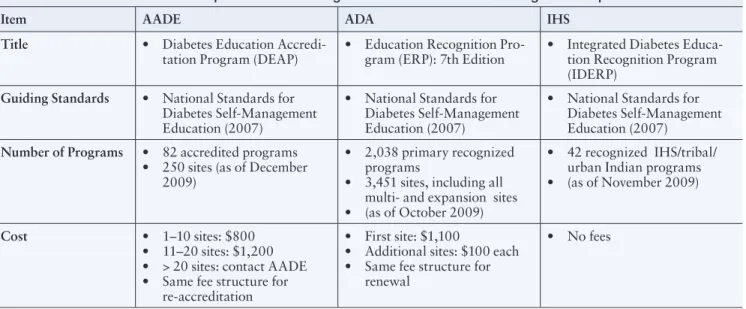
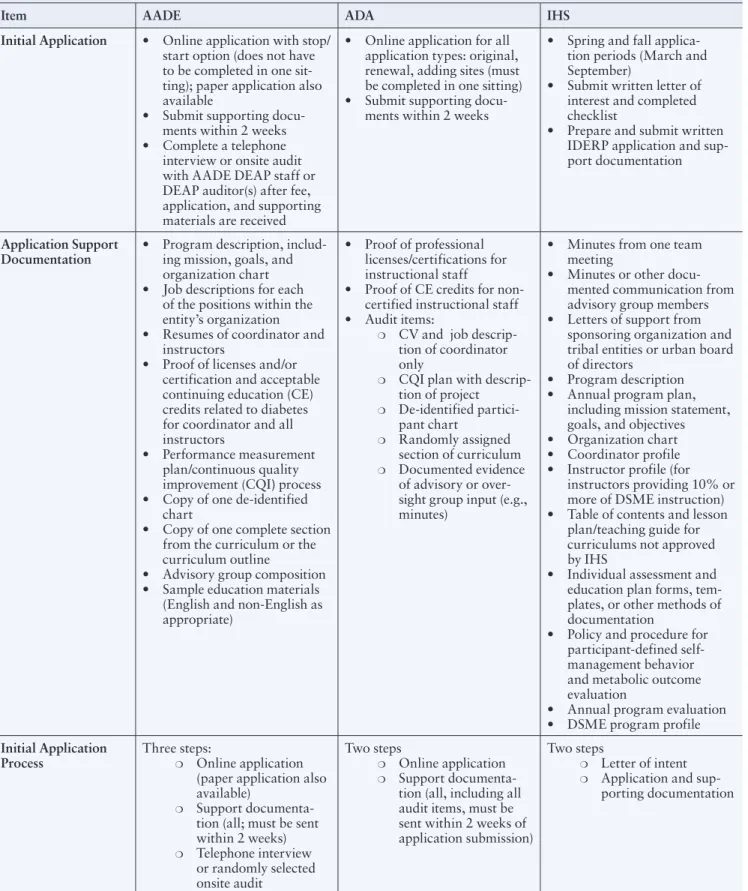
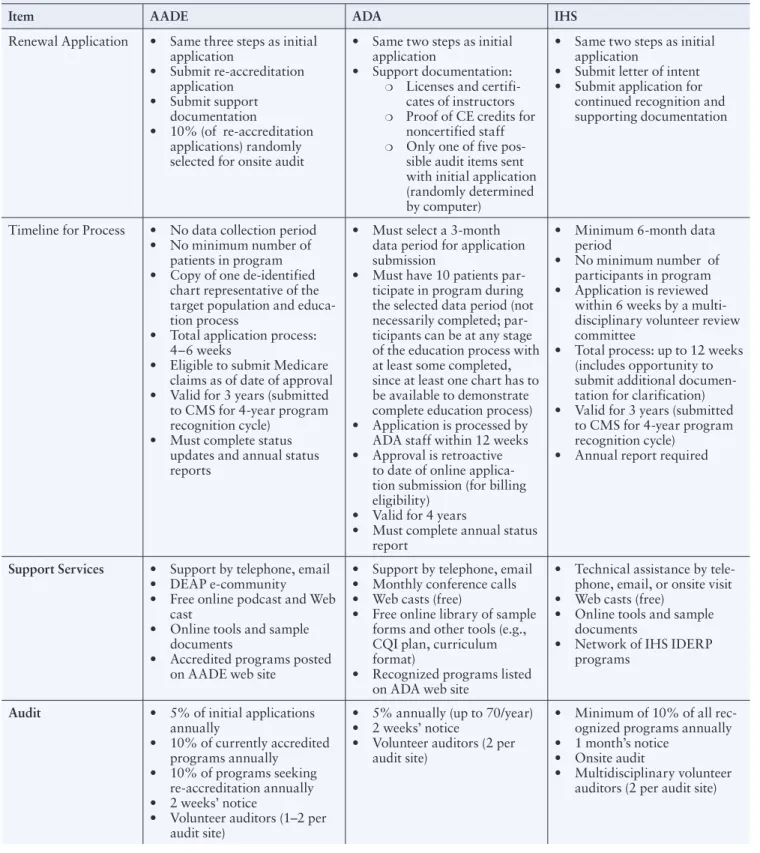
article. Table 1 (p. 68–70) offers a
structured comparison of several
of the key administrative points of
each of the three certifying bodies
(AADE’s DEAP, ADA’s ERP, and
IHS’s IDERP), including fees,
appli-cation processes, audits, and a brief
overview of standards.
Each certifying body has a formal
application process and requires
sup-porting documentation. AADE and
ADA require a fee with applications.
The certifying bodies also require
annual reports and renewals and
have a process for auditing existing
programs to ensure continued
com-pliance with accreditation criteria.
All have volunteer auditors who are
trained reviewers and conduct
ran-dom program audits.
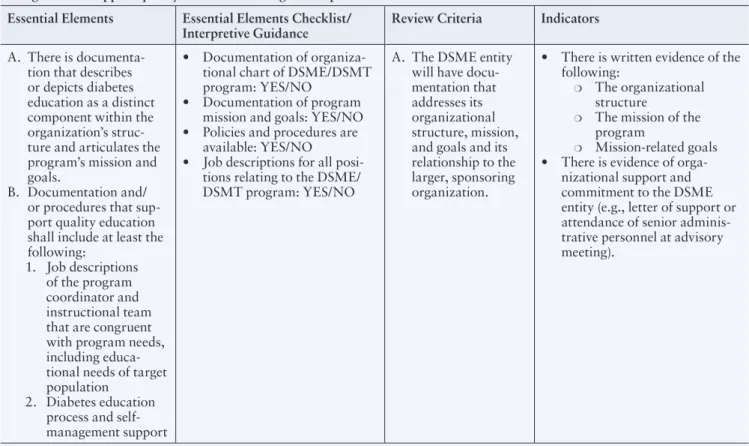
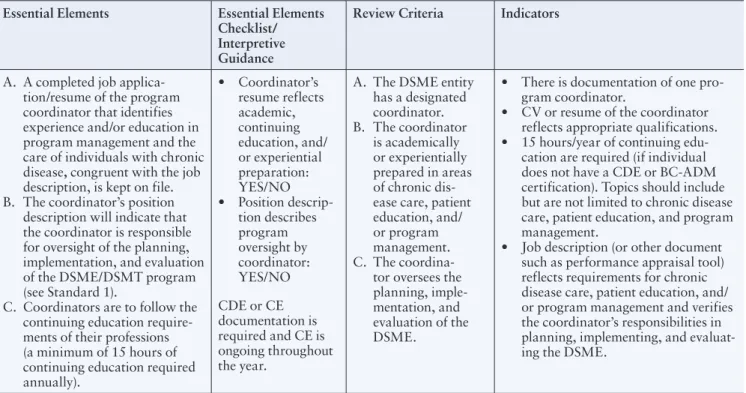
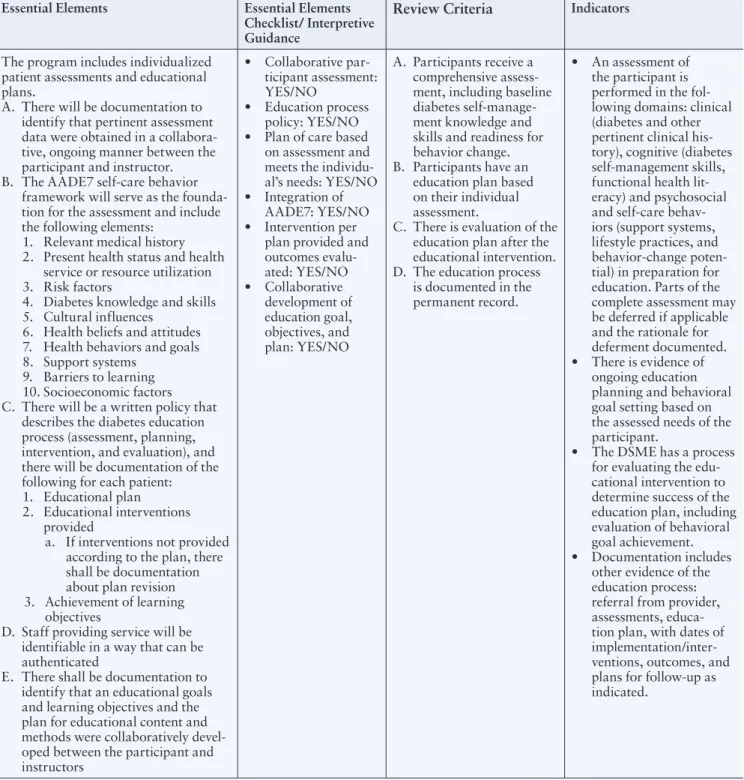
A second comparison, in Table
2 (p 71–78), offers a more detailed
review of the similarities and
differ-ences related to each of the published
standards
6between ADA and
AADE. This table details definitions
and required documents. (The IHS
program was not compared because
its requirements are specifically
designed for the unique community
it serves.)
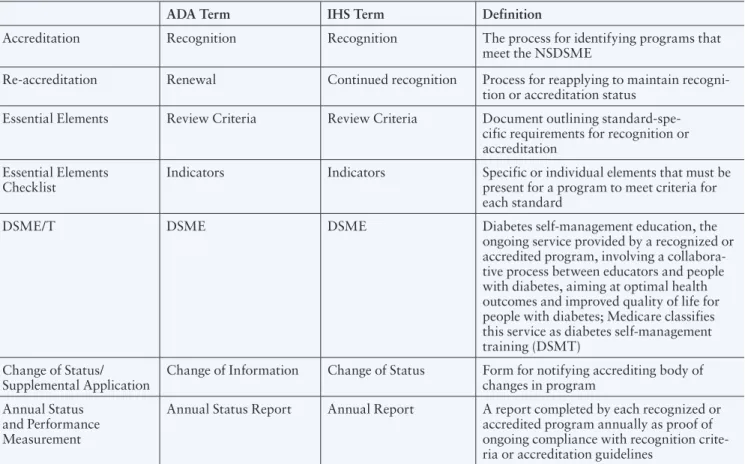
Additionally, each organization
uses similar terminology. These
terms are defined in Table 3 (p. 78).
For example, ADA and IHS use the
term “recognition,” whereas AADE
uses the term “accreditation.” Each
program is also uniquely identified
by a related acronym—DEAP, ERP,
or IDERP. Other terminology
dif-ferences noted include measurement
references to the interpretation of
the standards, such as “indicators”
(ADA and IHS) and “essential
ele-ments” (AADE). All use a yes-or-no
checklist for standards being met or
not met. Although their terminology
differs, the three programs’ content
and concepts are all based on the
NSDSME.
6Summary
There are not enough DSME
pro-grams available to meet the needs
of the increasing number of people
with diabetes; more educational
programs are needed. Educators
must be prepared to review their
practices, explore ways to expand
their services, and be willing to
meet the needs of their patients in a
variety of traditional and
nontradi-tional ways, all while maintaining
quality DSME with documented,
measurable outcomes. Accreditation/
recognition supports the provision
of quality DSME, is essential for
reimbursement, and offers public
acknowledgment of accomplishment.
Three organizations (ADA, AADE,
and HIS) have been authorized by
the U.S. Centers for Medicare and
Medicaid Services to determine
whether diabetes education
pro-grams meet required standards. Each
of these organizations supports the
NSDSME and the need for more
quality DSME programs. More
information about each organization
can be found at the following Web
sites:
• AADE: Information
avail-able online from: http://
www.diabeteseducator.org/
ProfessionalResources/accred
• ADA: Information available
online from: http://professional.
diabetes.org/recognition.
aspx?cid=57941
• IHS: Information
avail-able online from: http://
www.diabetes.ihs.gov/index.
cfm?module=programsIDERP
Acknowledgments
The individuals listed are
acknowledged for the provision of
information, review, and
prepara-tion of content, which the author
used and interpreted to develop this
article.
• Tammy L. Brown, MPH, RD,
BC-ADM, CDE, Director,
Integrated Diabetes Education
Recognition Program, Indian
Health Service Division of
Dia-betes Treatment and Prevention,
Albuquerque, N.M.
• Paulina Duker, MPH, RN,
BC-ADM, CDE, Director, Education
and Recognition Programs,
American Diabetes Association,
Alexandria, Va.
• Karen Fitzner, PhD, Chief Science
and Practice Officer, American
Association of Diabetes
Educa-tors, Chicago, Ill.
• Leslie E. Kolb,
RN, BSN, MBA,
Director, Diabetes Education
Accreditation Program, American
Association of Diabetes
Educa-tors, Chicago, Ill.
• JoAnne Lafley,
MSN, RN, CDE,
Reviewer,
Integrated Diabetes
Education Recognition Program,
Indian Health Service,
Albuquer-que, N.M.
• Melinda Maryniuk, RD, MEd,
LDN, CDE, Director, Joslin
Dia-betes Center, Boston, Mass.
• Lois Moss-Barnwell, MS, RD,
LDN, CDE, Director, Diabetes
Education Accreditation
Pro-gram, American Association of
Diabetes Educators, Chicago, Ill.
• Robin G. Thompson
,
MS,
APRN, BC-ADM, CDE, Review
Coordinator, Integrated Diabetes
Education Recognition Program,
Indian Health Service,
Albuquer-que, N.M.
References
1Ahmad U, Brooks M, Emerson S,
Korykowski K, Orchard T, Piatt G, Siminerio L, Simmons D, Thomas J: Translating the chronic care model into community: results from a randomized controlled trial of a mul-tifaceted diabetes care intervention. Diabetes Care 29:811– 827, 2006
2Siminerio L, Piatt G, Emerson S, Ruppert
J, Saul M, Solano F, Stewart A, Zigbor J: Deploying the Chronic Care Model to imple-ment and sustain diabetes self-manageimple-ment
training programs. Diabetes Educ 32:253– 260, 2006
3Norris S, Engelgau MM, Narayan V:
Effectiveness of self-management train-ing in type 2 diabetes: systematic review of randomized controlled trials. Diabetes Care
24:561–587, 2001
4Mulcahy K, Maryniuk M, Peeples M, Peyrot
M, Tomky D, Weaver T, Yarborough P: Position statement: Standards for outcomes measurement of diabetes self-management education. Diabetes Educ 29:804–816, 2003
5Austin M: Importance of self-care behaviors
in diabetes management: business briefing.
US Endocr Rev September:16–21, 2005
6Funnell M, Brown T, Childs B, Haas L,
Hosey G, Jensen B, Maryniuk M, Peyrot M, Piette J, Reader D, Siminerio L, Weinger K, Weiss M: National standards for diabetes self-management education. Diabetes Care
30:1630–1637, 2007
7National Diabetes Advisory Board: National
standards and review criteria for diabetes patient education programs: quality assur-ance for diabetes patient education. Diabetes Educ 12:286–291, 1986
8Mensing C, Boucher J, Cypress M, Weinger
K, Mulcahy K, Barta P, Hosey G, Kopher W, Lasichak A, Lamb B, Mangan M, Norman J, Tnaja J, Yauk L, Wisdom K, Adams C: National standards for diabetes self-manage-ment education. Diabetes Care 23:682–689, 2000
9Brown SA: Interventions to promote
dia-betes self-management: state of the science.
DiabetesEduc 25 (Suppl. 6):52–61, 1999
10Norris SL, Lau J, Smith SJ, Schmid CH,
Engelgau MM: Self-management education for adults with type 2 diabetes: a meta-analy-sis on the effect on glycemic control. Diabetes Care 25:1159–1171, 2002
11Norris SL: Self-management education in
type 2 diabetes. Pract Diabetol 22:713, 2003
12Gary TL, Genkinger JM, Guallar E, Peyrot
M, Brancati FL: Meta-analysis of randomized educational and behavioral interventions in type 2 diabetes. Diabetes Educ 29:488–501, 2003
13Deakin T, McShane CE, Cade JE, et al.
Review: group based education in self-man-agement strategies improves outcomes in type 2 diabetes mellitus. Cochrane Database Syst Rev CD003417, 2005
14Renders CM, Valik GD, Griffin SJ,
Wagner EH, Eijk Van JT, Assendelft WJJ: Interventions to improve the management of diabetes in primary care, outpatient, and community settings: a systematic review.
Diabetes Care 24:1821–1833, 2001
15Funnell MM, Anderson RM: Patient
empowerment: a look back, a look ahead.
DiabetesEduc 29:454–464, 2003
16Roter DL, Hall JA, Merisca R, Nordstrom
B, Cretin D, Svarstad B: Effectiveness of inter-ventions to improve patient compliance: a meta-analysis. Med Care 36:1138–1161, 1998
17Barlow J, Wright C, Sheasby J, Turner A,
Hainsworth J: Self-management approaches for people with chronic conditions: a review.
Patient Educ Couns 48:177–187, 2002
18Skinner TC, Cradock S, Arundel F, Graham
W: Lifestyle and behavior: four theories and a philosophy; self-management education for individuals newly diagnosed with type 2 diabetes. Diabetes Spectrum 16:75–80, 2003
19Brown SA, Hannis CL: Culturally
competent diabetes education for Mexican Americans: the Starr County Study. Diabetes Educ 25:226–236, 1999
20Anderson RM, Funnell MM, Nwankwo R,
Gillard ML, Oh M, Fitzgerald JT: Evaluating a problem based empowerment program for African Americans with diabetes: results of a randomized controlled trial. Ethn Dis
15:671–678, 2005
21Sarkisian CA, Brown AF, Norris CK, Wintz
RL, Mangione CM: A systematic review of diabetes self-care interventions for older, African American or Latino adults. Diabetes Educ 28:467–479, 2003
22Chodosh J, Morton SC, Mojica W,
Maglione M, Suttorp MJ, Hilton L, Rhodes S, Shekelle P: Meta-analysis: chronic disease
self-management programs for older adults. Ann Intern Med 143:427–438, 2005
23Anderson-Loftin W, Barnett S, Bunn P,
Sullivan P, Hussey J, Tavakoli A: Soul food light: culturally competent diabetes educa-tion. Diabetes Educ 31:555–563, 2005
24Mensing CR, Norris SL: Group education
in diabetes: effectiveness and implementation.
Diabetes Spectrum 16:96–103, 2003
25Rickheim PL, Weaver TK, Flader JL,
Kendall DM: Assessment of group vs individ-ual education: a randomized study. Diabetes Care 25:269–274, 2002
26Brown SA, Blozis SA, Kouzekanani K,
Garcia AA, Winchell M, Hanis CL: Dosage effects of diabetes self-management educa-tion for Mexican Americans. Diabetes Care
28:27–32, 2005
27Polonsky WH, Earles J, Smith S, Pease
DJ, Macmillan M, Christensen R, Taylor T, Dickert J, Jackson RA: Integrating medical management with diabetes self-management training: a randomized control trial of the Diabetes Outpatient Intensive Treatment Program. Diabetes Care 26:3048–3053, 2003
28Bodenheimer T, MacGregor K, Sharifi C:
Helping Patients Manage Their Chronic Conditions. Oakland, Calif., California Healthcare Foundation, 2005
29American Diabetes Association:
Recognition programs [article online]. Available from http://www.diabetes.org/ recognition.ASPX?cid=57941&typ=15. Accessed 11 December 2009
30IHS Diabetes Division of Diabetes
Treatment and Prevention: Integrated diabetes recognition program: fully accredited programs [article online]. Available from http://ihs.gov/index. cfm?module=programsIDERP. Accessed 11 December 2009
31American Association of Diabetes
Educators: Diabetes education accredita-tion program [article online]. Available from htpp://www.diabeteseducator.org/ Professional Resources/accred. Accessed 11 December 2009
Carolé Mensing, RN, MA, CDE, is
the manager for clinical and
educa-tion programs at the Joslin Diabetes
Center in Boston, Mass.
Table 1. Overview Comparison of Three Organizations’ Accreditation/Recognition Requirements
Item AADE ADA IHS
Title • Diabetes Education
Accredi-tation Program (DEAP) • Education Recognition Pro-gram (ERP): 7th Edition • Integrated Diabetes Educa-tion Recognition Program (IDERP)
Guiding Standards • National Standards for
Diabetes Self-Management Education (2007)
• National Standards for Diabetes Self-Management Education (2007)
• National Standards for Diabetes Self-Management Education (2007)
Number of Programs • 82 accredited programs
• 250 sites (as of December 2009)
• 2,038 primary recognized programs
• 3,451 sites, including all multi- and expansion sites • (as of October 2009)
• 42 recognized IHS/tribal/ urban Indian programs • (as of November 2009)
Cost • 1–10 sites: $800
• 11–20 sites: $1,200 • > 20 sites: contact AADE • Same fee structure for
re-accreditation
• First site: $1,100
• Additional sites: $100 each • Same fee structure for
renewal
• No fees
Table 1. Overview Comparison of Three Organizations’ Accreditation/Recognition Requirements
Item AADE ADA IHS
Initial Application • Online application with stop/
start option (does not have to be completed in one sit-ting); paper application also available
• Submit supporting docu-ments within 2 weeks • Complete a telephone
interview or onsite audit with AADE DEAP staff or DEAP auditor(s) after fee, application, and supporting materials are received
• Online application for all application types: original, renewal, adding sites (must be completed in one sitting) • Submit supporting
docu-ments within 2 weeks
• Spring and fall applica-tion periods (March and September)
• Submit written letter of interest and completed checklist
• Prepare and submit written IDERP application and sup-port documentation
Application Support
Documentation • Program description, includ-ing mission, goals, and
organization chart • Job descriptions for each
of the positions within the entity’s organization • Resumes of coordinator and
instructors
• Proof of licenses and/or certification and acceptable continuing education (CE) credits related to diabetes for coordinator and all instructors
• Performance measurement plan/continuous quality improvement (CQI) process • Copy of one de-identified
chart
• Copy of one complete section from the curriculum or the curriculum outline
• Advisory group composition • Sample education materials
(English and non-English as appropriate)
• Proof of professional licenses/certifications for instructional staff
• Proof of CE credits for non-certified instructional staff • Audit items:
❍ CV and job
descrip-tion of coordinator only
❍ CQI plan with
descrip-tion of project ❍ De-identified partici-pant chart ❍ Randomly assigned section of curriculum ❍ Documented evidence of advisory or over-sight group input (e.g., minutes)
• Minutes from one team meeting
• Minutes or other docu-mented communication from advisory group members • Letters of support from
sponsoring organization and tribal entities or urban board of directors
• Program description • Annual program plan,
including mission statement, goals, and objectives • Organization chart • Coordinator profile • Instructor profile (for
instructors providing 10% or more of DSME instruction) • Table of contents and lesson
plan/teaching guide for curriculums not approved by IHS
• Individual assessment and education plan forms, tem-plates, or other methods of documentation
• Policy and procedure for participant-defined self-management behavior and metabolic outcome evaluation
• Annual program evaluation • DSME program profile
Initial Application
Process Three steps: ❍ Online application
(paper application also available)
❍ Support
documenta-tion (all; must be sent within 2 weeks) ❍ Telephone interview or randomly selected onsite audit Two steps ❍ Online application ❍ Support
documenta-tion (all, including all audit items, must be sent within 2 weeks of application submission)
Two steps
❍ Letter of intent ❍ Application and
sup-porting documentation Table 1. Overview Comparison of Three Organizations’ Accreditation/Recognition Requirements, continued from p. 68
Table 1. Overview Comparison of Three Organizations’ Accreditation/Recognition Requirements
Item AADE ADA IHS
Renewal Application • Same three steps as initial application • Submit re-accreditation application • Submit support documentation • 10% (of re-accreditation applications) randomly selected for onsite audit
• Same two steps as initial application
• Support documentation:
❍ Licenses and
certifi-cates of instructors
❍ Proof of CE credits for
noncertified staff
❍ Only one of five
pos-sible audit items sent with initial application (randomly determined by computer)
• Same two steps as initial application
• Submit letter of intent • Submit application for
continued recognition and supporting documentation
Timeline for Process • No data collection period • No minimum number of
patients in program • Copy of one de-identified
chart representative of the target population and educa-tion process
• Total application process: 4–6 weeks
• Eligible to submit Medicare claims as of date of approval • Valid for 3 years (submitted to CMS for 4-year program recognition cycle)
• Must complete status updates and annual status reports
• Must select a 3-month data period for application submission
• Must have 10 patients par-ticipate in program during the selected data period (not necessarily completed; par-ticipants can be at any stage of the education process with at least some completed, since at least one chart has to be available to demonstrate complete education process) • Application is processed by ADA staff within 12 weeks • Approval is retroactive
to date of online applica-tion submission (for billing eligibility)
• Valid for 4 years
• Must complete annual status report
• Minimum 6-month data period
• No minimum number of participants in program • Application is reviewed
within 6 weeks by a multi-disciplinary volunteer review committee
• Total process: up to 12 weeks (includes opportunity to submit additional documen-tation for clarification) • Valid for 3 years (submitted
to CMS for 4-year program recognition cycle)
• Annual report required
Support Services • Support by telephone, email
• DEAP e-community
• Free online podcast and Web cast
• Online tools and sample documents
• Accredited programs posted on AADE web site
• Support by telephone, email • Monthly conference calls • Web casts (free)
• Free online library of sample forms and other tools (e.g., CQI plan, curriculum format)
• Recognized programs listed on ADA web site
• Technical assistance by tele-phone, email, or onsite visit • Web casts (free)
• Online tools and sample documents
• Network of IHS IDERP programs
Audit • 5% of initial applications
annually • 10% of currently accredited programs annually • 10% of programs seeking re-accreditation annually • 2 weeks’ notice
• Volunteer auditors (1–2 per audit site)
• 5% annually (up to 70/year) • 2 weeks’ notice
• Volunteer auditors (2 per audit site)
• Minimum of 10% of all rec-ognized programs annually • 1 month’s notice
• Onsite audit
• Multidisciplinary volunteer auditors (2 per audit site) Table 1. Overview Comparison of Three Organizations’ Accreditation/Recognition Requirements, continued from p. 69
Table 2. Comparison of AADE and ADA Programs by Standard
AADE ADA
Standard 1. The DSME entity will have documentation of its organizational structure, mission statement, and goals and will recognize and support quality DSME as an integral component of diabetes care.
Essential Elements Essential Elements Checklist/
Interpretive Guidance Review Criteria Indicators
A. There is documenta-tion that describes or depicts diabetes education as a distinct component within the organization’s struc-ture and articulates the program’s mission and goals.
B. Documentation and/ or procedures that sup-port quality education shall include at least the following:
1. Job descriptions of the program coordinator and instructional team that are congruent with program needs, including educa-tional needs of target population
2. Diabetes education process and self-management support
• Documentation of organiza-tional chart of DSME/DSMT program: YES/NO
• Documentation of program mission and goals: YES/NO • Policies and procedures are
available: YES/NO
• Job descriptions for all posi-tions relating to the DSME/ DSMT program: YES/NO
A. The DSME entity will have docu-mentation that addresses its organizational structure, mission, and goals and its relationship to the larger, sponsoring organization.
• There is written evidence of the following:
❍ The organizational
structure
❍ The mission of the
program
❍ Mission-related goals
• There is evidence of orga-nizational support and commitment to the DSME entity (e.g., letter of support or attendance of senior adminis-trative personnel at advisory meeting).
Summary of differences: There are minor differences. AADE requires a written policy and procedure relating to the program and education process. ADA does not require written policies or procedures but does require a letter of support for the program.
Standard 2. The DSME entity shall appoint an advisory group to promote program quality. The group shall include representa-tives from the health professions, people with diabetes, the community, and other stakeholders.
Essential Elements Essential Elements
Checklist/ Interpretive Guidance
Review Criteria Indicators
A. A policy that identifies the structure and pro-cess, for the program’s advisory group, will be maintained.
1. This policy will address the advi-sory group’s role in promoting quality DSME/DSMT programming. • Advisory Group Policy: YES/NO • Advisory Group Function: YES/NO AADE suggests the advisory group
includes a primary care provider,
educator, community member with
diabetes, etc. The group actively reviews and makes recommenda-tions on the DSME/ DSMT annual program plan and evaluation. The group will vary according to program size, location and scope, and complexity of services provided.
A. An advisory group is appointed that is repre-sentative of the diabetes community and includes people affected by diabe-tes, health professionals, community members, and other stakeholders. B. Activities of the advisory
group, reflecting its role as quality overseer, are docu-mented at least annually.
• A document exists (e.g., policy) that identifies members of the advisory group. At a minimum, the advisory group must include:
❍ Health professional(s) ❍ People affected by diabetes ❍ Community member(s)
• For single discipline-staffed programs, the health professional member(s) of the advisory group must belong to a second discipline (different from the discipline of the program staff; members can fulfill multiple roles).
• There shall be documentation of the activities of the committee, at least annually, that demonstrates how it contributed to the quality of the DSME entity. Members of the committee may contribute either as part of the group meetings and/ or be consulted on an individual basis (e.g., ballot, surveys, phone consults, emails).
Summary of differences: AADE requires a policy (document) to be in place to guide the advisory group. ADA requires member-ship documentation according to the standards and requires that for a program taught by a single discipline, at least a member of the other disciplines serve on the advisory group.
Standard 3. The DSME entity will determine the diabetes education needs of the target populations and identify resources necessary to meet these needs.
Essential Elements Essential Elements
Checklist/ Interpretive Guidance
Review Criteria Indicators
A. There shall be documentation of: 1. A needs
assessment for the target population 2. The availability
of resources to meet these edu-cational needs
• An identifiable process was used to assess the needs of the target population: YES/NO • Unique needs of target
population are specified: YES/NO
• Allocation of resources are specified: YES/NO
The target population/ service community is identified, and its needs are assessed and/or reas-sessed periodically.
• Documentation exists that reflects an assessment, at least annually, of the target population or service community and program resources and identifica-tion of resources to address specific needs of the target population. This document must include:
❍ Target population/service
com-munity assessment (e.g., access, demographics, cultural influ-ences, barriers to education)
❍ Assessment of program resources
relative to services provided for the target population/service community (e.g., physical space, staffing, equipment).
❍ A plan to address the identified
needs (e.g., identification of refer-ral sources for additional services, plan for options for class times). Summary of differences: There are no differences.
continued on p. 73
Standard 4. A coordinator will be designated to oversee the planning, implementation, and evaluation of diabetes self-management education. Thecoordinator will have academic or experiential preparation in chronic disease care and education and in program management.
Essential Elements Essential Elements
Checklist/ Interpretive Guidance
Review Criteria Indicators
A. A completed job applica-tion/resume of the program coordinator that identifies experience and/or education in program management and the care of individuals with chronic disease, congruent with the job description, is kept on file. B. The coordinator’s position
description will indicate that the coordinator is responsible for oversight of the planning, implementation, and evaluation of the DSME/DSMT program (see Standard 1).
C. Coordinators are to follow the continuing education require-ments of their professions (a minimum of 15 hours of continuing education required annually). • Coordinator’s resume reflects academic, continuing education, and/ or experiential preparation: YES/NO • Position descrip-tion describes program oversight by coordinator: YES/NO CDE or CE documentation is required and CE is ongoing throughout the year.
A. The DSME entity has a designated coordinator. B. The coordinator is academically or experientially prepared in areas of chronic dis-ease care, patient education, and/ or program management. C. The
coordina-tor oversees the planning, imple-mentation, and evaluation of the DSME.
• There is documentation of one pro-gram coordinator.
• CV or resume of the coordinator reflects appropriate qualifications. • 15 hours/year of continuing
edu-cation are required (if individual does not have a CDE or BC-ADM certification). Topics should include but are not limited to chronic disease care, patient education, and program management.
• Job description (or other document such as performance appraisal tool) reflects requirements for chronic disease care, patient education, and/ or program management and verifies the coordinator’s responsibilities in planning, implementing, and evaluat-ing the DSME.
Summary of differences: A slight difference is that AADE CE topic requirements are flexible based on target population needs, whereas ADA suggests topics.
Table 2. Comparison of AADE and ADA Programs by Standard, continued from p. 72
Standard 5, continued from p. 73
Essential Elements Essential Elements Checklist/
Interpretive Guidance Review Criteria Indicators
The program’s instructors are qualified and include an RN, an RD, or a pharmacist.
A. Resumes and proof of licenses, registration, and/or certifica-tion shall be maintained to verify that program staff is composed of instructor(s) who have obtained and maintained the required credentials. B. If community health workers
(CHWs) are part of the DSME/ DSMT program team, there is documentation of successful completion of a standardized training program for CHWs and additional and ongoing training related to diabetes self-management. Training includes scope of practice relative to role in DSME/DSMT.
C. If CHWs are part of the DSME/DSMT program’s team, there shall be documentation that they are directly super-vised by the named diabetes educator(s) in the program. D. Proof of continuing education
will be maintained to pro-vide epro-vidence that instructors maintain their qualifications according to the specific crite-ria below and consistent with their job description:
1. 15 hours of CE annually for all instructors
2. These hours must be from a nationally recognized accrediting group E. For programs, particularly
those that have solo instruc-tors, there shall be a policy that identifies a mechanism for ensuring that participant needs are met if those needs are outside of the instructors’ scope of practice and expertise. F. There shall be documentation
that:
1. Describes a process for ensuring that appropriate care coordination among the diabetes care team occurs
2. Team coordination/interac-tion occurs
• Instructors’ current creden-tials: YES/NO
• Instructors’ current resume: YES/NO
• 15 hours annual CE for all instructors: YES/NO • At least one of the
instruc-tors is an RN, RD, or pharmacist: YES/NO • CHW training,
continu-ing education, and name of supervisor, if applicable: YES/NO
• Mechanisms for ensuring participants’ needs are met: YES/NO
• Team coordination/ interac-tion is documented: YES/ NO
A. The DSME instructor(s) must include at least one RN OR one RD OR one pharmacist.
B. DSME instructor(s) must be qualified and provide diabetes education within each discipline’s scope of practice.
C. A mechanism must be in place to meet the needs of participants if they cannot be met within the scope of prac-tice of the instructor(s).
• At least one RN or one RD or one pharmacist is involved as an instructor in the education of the participant. • Instructor(s) must
have valid, discipline-specific licenses and/ or registrations. • Instructor(s) must be a CDE or have BC-ADM certification or accrue 20 hours/ year of continuing education credits if practicing in a single-discipline program. (CE topics must be diabetes specific, diabetes related, educational, or psy-chosocial and relevant to services provided or population[s] served.) • Instructors working in a multidisciplinary diabetes education setting (with other disciplines as part of the instructional staff) can have CDE or BC-ADM certification or accrue 15 hours/year of continuing educa-tion credits. • Guidelines (e.g., policy, procedure) must be in place for determining when patient needs are outside of the scope of practice of a single-discipline program. • Communication to referring providers must include educa-tion not provided due to content being beyond the scope of practice of the specific discipline providing education.
continued on p. 75
Table 2. Comparison of AADE and ADA Programs by Standard, continued from p. 73
Standard 5. Diabetes self-management education will be provided by one or more instructors. The instructors will have recent educational and experiential preparation in education and diabetes management or will be a certified diabetes educator. The instructor(s) will obtain regular continuing education in the field of diabetes management and education. At least one of the instructors will be a registered nurse, dietitian, or pharmacist. A mechanism must be in place to ensure that the participants’ needs are met if those needs are outside the instructors’ scope of practice and expertise.
Standard 5, continued from p. 74
Essential Elements Essential Elements Checklist/
Interpretive Guidance Review Criteria Indicators
Summary of differences: ADA has more specific criteria for programs that are taught by only one discipline; such programs must have 20 hours of CE, guidelines (such as a policy) in place for what to do if patient needs are outside of their discipline, and communication with the referring provider if needs were not met. AADE states that mechanisms must be in place for ensuring that patient needs are met related to the scope of practice. It also requires documenting of reporting and supervisory relationship of CHWs and of which staff have nontechnical, nonclinical roles. AADE requires detail on CHW training, CE, and name of instructor. ADA does not require additional documentation about training or CEs for CHWs. AADE requires proof of continu-ing education credits for all instructors includcontinu-ing those with CDE or BC-ADM. ADA requires written documentation and copies of continuing education credits for non-CDE staff. There is a difference between ADA and AADE with respect to the timing of continuing education credit acquisition. AADE requires 15 hours annually, which can be for a calendar year, and ADA requires all continuing education credits to be earned within 12 months prior to the online application date.
Standard 6: A written curriculum reflecting current evidence and practice guidelines, with criteria for evaluating outcomes, will serve as the framework for the DSME program. Assessed needs of the individual with pre-diabetes or diabetes will determine which of the content areas listed below are to be provided.
Essential Elements Essential Elements
Checklist/ Interpretive Guidance
Review Criteria Indicators
Program uses a current written curriculum.
A. A written curriculum that meets the patients’ needs will be maintained and updated as needed to reflect current evidence and prac-tice guidelines.
B. The curriculum: 1. Uses principles and
concepts of the AADE7 self-care behavior framework, including the self-care behaviors: a. Healthy eating b. Being active c. Monitoring d. Taking medications e. Healthy coping f. Problem solving g. Reducing risks 2. Includes content about
the diabetes disease pro-cess/ pathophysiology 3. Is tailored for the target
population
4. Uses primarily inter-active, collaborative, skill-based training methods and maximizes the use of interactive training methods
• A written curriculum tailored to meet the needs of the target popu-lation: YES/NO • Adopts principles of
AADE7 and includes disease content: YES/ NO
• Curriculum is kept updated reflecting current evidence and practice guidelines and is culturally appropriate: YES/NO
• Curriculum maximizes use of interactive train-ing methods: YES/NO
A. A written curriculum, with learning objectives and criteria for specify-ing methods of deliv-ery and evaluating successful learning outcomes, is the frame-work for the DSME. B. There is periodic review and revision of the cur-riculum and/ or course materials to reflect current evidence.
• Validate that the education process is guided by a reference curriculum with learning objectives, methods of deliv-ery, and criteria for evaluating learning for the populations served (including pre-diabetes, type 1 diabetes, type 2 dia-betes, gestational diadia-betes, or pregnancy complicated by diabetes) in the following nine content area:
❍ Describing the diabetes disease
process and treatment options
❍ Incorporating nutritional
manage-ment into lifestyle
❍ Incorporating physical activity
into lifestyle
❍ Using medication safely and
for maximum therapeutic effectiveness
❍ Monitoring blood glucose and
other parameters and interpreting and using the results for self-man-agement decision making
❍ Preventing, detecting, and treating
acute complications
❍ Preventing, detecting, and treating
chronic complications
❍ Developing personalized strategies
to address psychosocial issues and concerns
❍ Developing personalized strategies
to promote health and behavior change (risk reduction)
• There is documentation at least annu-ally of review and revisions as needed of the curriculum and/or course materials by DSME instructor(s) and/or advisory group. (For programs staffed from a single discipline, the advisory group must review curriculum and/or course materials at least annually).
continued on p. 76
continued on p. 77
Summary of differences: AADE supports a behavior-change focus curriculum package that includes assessment, implementa-tion, evaluation of outcomes demonstrated in the AADE7, and self-care behaviors appropriate for patient and target population. AADE requires updates utilizing current evidence and practice guidelines. ADA specifies annual review.
Standard 7. An individual assessment and education plan will be developed collaboratively by the participant and instructor(s) to direct the selection of appropriate educational interventions and self-management support strategies. This assessment and education plan and the intervention and outcomes will be documented in the education record.
Essential Elements Essential Elements
Checklist/ Interpretive Guidance
Review Criteria
IndicatorsThe program includes individualized patient assessments and educational plans.
A. There will be documentation to identify that pertinent assessment data were obtained in a collabora-tive, ongoing manner between the participant and instructor. B. The AADE7 self-care behavior
framework will serve as the founda-tion for the assessment and include the following elements:
1. Relevant medical history 2. Present health status and health
service or resource utilization 3. Risk factors
4. Diabetes knowledge and skills 5. Cultural influences
6. Health beliefs and attitudes 7. Health behaviors and goals 8. Support systems
9. Barriers to learning 10. Socioeconomic factors C. There will be a written policy that
describes the diabetes education process (assessment, planning, intervention, and evaluation), and there will be documentation of the following for each patient: 1. Educational plan
2. Educational interventions provided
a. If interventions not provided according to the plan, there shall be documentation about plan revision 3. Achievement of learning
objectives
D. Staff providing service will be identifiable in a way that can be authenticated
E. There shall be documentation to identify that an educational goals and learning objectives and the plan for educational content and methods were collaboratively devel-oped between the participant and instructors • Collaborative par-ticipant assessment: YES/NO • Education process policy: YES/NO • Plan of care based
on assessment and meets the individu-al’s needs: YES/NO • Integration of
AADE7: YES/NO • Intervention per
plan provided and outcomes evalu-ated: YES/NO • Collaborative development of education goal, objectives, and plan: YES/NO A. Participants receive a comprehensive assess-ment, including baseline diabetes self-manage-ment knowledge and skills and readiness for behavior change. B. Participants have an
education plan based on their individual assessment.
C. There is evaluation of the education plan after the educational intervention. D. The education process
is documented in the permanent record.
• An assessment of the participant is performed in the fol-lowing domains: clinical (diabetes and other pertinent clinical his-tory), cognitive (diabetes self-management skills, functional health lit-eracy) and psychosocial and self-care behav-iors (support systems, lifestyle practices, and behavior-change poten-tial) in preparation for education. Parts of the complete assessment may be deferred if applicable and the rationale for deferment documented. • There is evidence of
ongoing education planning and behavioral goal setting based on the assessed needs of the participant.
• The DSME has a process for evaluating the edu-cational intervention to determine success of the education plan, including evaluation of behavioral goal achievement. • Documentation includes
other evidence of the education process: referral from provider, assessments, educa-tion plan, with dates of implementation/inter-ventions, outcomes, and plans for follow-up as indicated.
Summary of differences: There are no significant differences. AADE requests de-identified chart, review for collaborative goal setting, and an educational process policy to ensure that a consistent process is in place. Both require documentation. ADA emphasizes demonstration of the educational process.
Standard 8. A personalized follow-up plan for ongoing self-management support will be developed collaboratively by the participant and instructor(s). The patient’s outcomes and goals and the plan for ongoing self-management support will be communicated to the referring provider.
Essential Elements Essential Elements
Checklist/ Interpretive Guidance
Review Criteria
IndicatorsA. There will be a written policy and documentation that identifies that a per-sonalized follow-up plan to ensure ongoing self-manage-ment support was developed in collaboration with the participant.
B. There shall be documenta-tion that identifies that the patient’s outcomes and goals, and the plan for diabetes self-management support, are communicated to the refer-ring physician (or qualified nonphysician practitioner). • Communication of educational services to physician/qualified non-physician practitioner: YES/NO
• Policy for personalized process and ongoing self-management sup-port strategies: YES/NO
A. Participants will have a plan for post-education self-management support for ongo-ing diabetes self-care beyond the formal self-management education process.
• There must be evidence of a personalized follow-up plan for diabetes self-management support (e.g., return to referring provider, referral to support groups, referral to community programs, etc.). • There must be evidence
of communication of the follow-up plan with the referring provider.
Summary of differences: There are no significant differences. AADE requires a written policy for personalized process and ongoing self-management support strategies to ensure that a consistent process is in place. ADA emphasizes that documentation of actual planning for support services must be in place, not just a policy.
Standard 9. The DSME entity will measure attainment of patient-defined goals and patient outcomes at regular intervals using appropriate measurement techniques to evaluate the effectiveness of the educational intervention.
A. The evaluation policy shall use the AADE7 self-care behavior frame-work (or equivalent), core outcome measures, and behavioral and clinical outcomes for each patient individu-ally and in aggregate. Outcomes will be compared to quality indica-tors to assess the effectiveness of the patients’ care plan and the education intervention.
1. Individualized and aggregate out-comes data include at a minimum, attainment of participant-defined behavior-change goals (interme-diate outcomes) and at least one post-intermediate or long-term health outcome measure. 2. There shall be evidence that
there was a critical analysis that determined the choice for the post-intermediate (clinical improvement) or long-term (health status improvement) outcome measure that will be or was tracked.
• Individual and aggregate achievement of behavior-change goals: YES/NO • Policy required that
outcomes data include appropriate measures: YES/NO
• Reason for choice of outcome measures: YES/ NO
• Effectiveness of interven-tion is based on data: YES/NO A. Attainment of goals/outcomes shall be measured regularly in order to evaluate the effectiveness of the educational intervention. • There is evidence of a collection and sum-mary of participant goals used to evaluate the effectiveness of the DSME. • There is evidence of a collection and summary of other participant outcome (clinical or other) to evaluate the effective-ness of the DSME.
Summary of differences: ADA’s indicators for this standard are concise; auditors would only look to see if there was a collec-tion and summary of behavioral goals as well as one other outcome. AADE’s requirement is to have a policy in place to ensure consistent care regardless of staff providing care. ADA emphasizes the importance of acknowledging the distinction between tracking outcomes and conducting a continuous quality improvement (CQI) process.
continued on p. 78
Standard 10. The DSME entity will measure the effectiveness of the education program and determine opportunities for improvement using a written CQI plan that describes and documents a systematic review of the programs’ process and outcome data.
Essential Elements Essential Elements Checklist/
Interpretive Guidance
Review Criteria
IndicatorsA. There is documentation that:
1. Opportunities for improvement, as indi-cated by data tracked, were identified 2. A process for
improve-ment was impleimprove-mented if feasible (or an expla-nation for why it was not)
3. CQI improvement activ-ity shall be undertaken annually
• Systematic process for implementing a CQI pro-cess/plan: YES/NO • Program improvement,
if applicable, is based on data deficiencies that have been analyzed: YES/NO • CQI results are shared
with the advisory group annually: YES/NO
A. The DSME entity has a quality improvement process and plan in place for evaluating the education process and program outcomes. B. Quality improvement
projects are developed and implemented according to the plan. C. Results are used to
make improvements in the DSME.
• There is documentation of a CQI plan/process (e.g., written policy, annual pro-gram plan, CQI meeting minutes).
• There is documenta-tion of at least one project following the qual-ity improvement plan. • There is evidence of
appli-cation of the results of the quality improvement project to the DSME upon completion.
Summary of differences: There are no significant differences. AADE specifically advises that CQI results be shared with the advisory group. ADA emphasizes the plan, process, and application.
Table 2. Comparison of AADE and ADA Programs by Standard, continued from p. 77
Table 3. Synonymous Terms Used by the DSME Recognition/Accreditation Programs of AADE, ADA, and IHS
ADA Term IHS Term Definition
Accreditation Recognition Recognition The process for identifying programs that
meet the NSDSME
Re-accreditation Renewal Continued recognition Process for reapplying to maintain recogni-tion or accreditarecogni-tion status
Essential Elements Review Criteria Review Criteria Document outlining standard-spe-cific requirements for recognition or accreditation
Essential Elements
Checklist Indicators Indicators Specific or individual elements that must be present for a program to meet criteria for each standard
DSME/T DSME DSME Diabetes self-management education, the
ongoing service provided by a recognized or accredited program, involving a collabora-tive process between educators and people with diabetes, aiming at optimal health outcomes and improved quality of life for people with diabetes; Medicare classifies this service as diabetes self-management training (DSMT)
Change of Status/
Supplemental Application Change of Information Change of Status Form for notifying accrediting body of changes in program Annual Status
and Performance Measurement
Annual Status Report Annual Report A report completed by each recognized or accredited program annually as proof of ongoing compliance with recognition crite-ria or accreditation guidelines