COMPARATIVE STUDY CONCERNING CONCRETE
PRESSURE ON FORMWORK
Julietta Domsa1, Sergiu Catinas1
1 Faculty of Civil Engineering, Technical University of Cluj-Napoca
Abstract
The purpose of this paper is to underline the links/differences between the Romanian and European normative related to the lateral loads from fresh concrete on formwork. In Romania the normative for fresh concrete pressure on formwork is NE 012-2/2010 - “Executarea lucrărilor din beton”-“Concrete Execution”[1], and in the other European countries is preponderant utilized [2] DIN 18218 -“Frischbetondruck auf lotrechte Schalungen” [3,4,5] and CIRIA - “Concrete pressure on formwork” [6,7]. However due to a great variety of domestic and imported technology used for formwork a better uniformed normative is required for the design of formwork.
Concrete pressure on formwork is influenced by many parameters with different importance: construction element (the section cast, lift height, form, and tightness), concrete formwork (rigidity and permeability), admixture and properties of concrete (type of cement/additives/aggregates, workability, concrete weight, and mix proportion) and placing of the concrete (rate of placing, vibration, concrete discharge impact, placing method and concrete temperature). The methodology used in this paper is by presenting a comparative study for most important horizontal loading using the methods from the norms specified above, when the height of poured concrete is over 3.00 meters and the most important parameters varies. Key words
Fresh concrete; vertical formwork; normative comparative study; maximum fresh concrete pressure
To cite this paper: Domsa, J., Catinas, S. (2014), Comparative Study Concerning Concrete Pressure on Formwork, In conference proceedings of People, Buildings and Environment 2014, an international scientific conference, Kroměříž, Czech Republic, pp. 144-151, ISSN: 1805-6784.
*Corresponding author: Tel.: +40-721-261-224, Fax: +40-264-592055 E-mail address: [email protected]
1 INTRODUCTION
Due to the market needs there is a strong demand of high, fast and reliable way to estimate the fresh concrete pressure over the formwork in order to build sustainable concrete forms. Nowadays there are two well known normative in Europe: DIN 18218 -“Frischbetondruck auf
lotrechte Schalungen” [3, 4, and 5] and CIRIA - “Concrete pressure on formwork” [6, 7] that help
engineers to calculate and design these concrete forms. Besides the normative mentioned above, in Romania, there is applicable the national code, NE 012-2/2010 - “Executarea lucrărilor din beton”-“Concrete Execution” [1]. This code involves the calculation of horizontal maximum fresh concrete pressure over vertical formwork using different calculation formulas. The calculus of this pressure according to Romanian normative can lead to substantially different results comparative with the other applicable normative that are available in Europe. The present paper work shows some of the important differences in terms of most important factors, and over estimation of the maximum fresh concrete pressure on vertical formwork over 3.00 meters height.
2 LITERATURE REVIEW
The current literature and practice shows that pressure that appears on the vertical formworks when the concrete is poured depends on a lot of parameters. The most important parameters are rate of placing, workability, height of lift, minimum dimensions of the section, concrete weight and concrete temperature.
Evaluating fresh concrete pressure on formwork has been a significant part of the work of ACI (American Concrete Institute) Committee 347, “Guide to Formwork for Concrete” [8]. The conclusion is that due to solid aggregates that are constituents of the fresh concrete it becomes at a certain pressure a solid interlocking of the aggregates, especially the solid ones. This interlocking of the solid aggregates makes the fresh concrete to behave as a non fluid at a certain pressure according to Hurd [9].
More over evaluating fresh concrete pressure on formwork has been of great interests for many researchers. Mark Talesnisk [10] concludes that methods for fresh concrete pressure testing processes should include a minimum ratio among volume of testing slump and the maximum size of aggregates from the concrete. Puente [2] states that some hypothesis about the fresh concrete pressure is considered conservative. He states that considering fresh concrete as fluid with the density of the fresh concrete is not accurate. Also the ACI committee 347 [8] not considered Barnes and Johnston’s [11] proposed formulas. However, due to simplify and easy understanding manner the method proposed by ACI was considered as appropriate.
According to Hurd [9], the most influential factor is the rate of placing as well as the height of the fresh concrete. However in the DIN 18218 -“Frischbetondruck auf lotrechte Schalungen” height is not even considered as a factor of influence for the maximum pressure of fresh concrete on formwork only as a limitation of formulas applied. Please note that in Romania a big
delivers good results as well with the note that in some cases, especially when the concrete height exceeds 3.00 meters an unnecessary overestimation of the maximum fresh concrete pressure on the formwork occurs.
3 METHODS/METHODOLOGY
The method applied in the present paper is by comparing a maximum fresh concrete pressure on formwork over 3.00 meters high with various rate of placing. A study was conducted by estimating the maximum fresh concrete pressure on formwork using CIRIA “Concrete pressure on formwork” [6, 7], DIN 18218 [3, 4, 5] and NE 012-2/2010 [1]. In all methods the model considered was a concrete formwork for a concrete wall (3.00 m, 4.00 m, 5.00 m, 6.00 m and 7.00 m high).
Due to some major differences noticed among the methods of calculation a major attention was given to the factor that is the most influential over the maximum pressure of fresh concrete on formwork. Therefore a more comprehensive study was conducted in order to analyze the factor considered the most influential parameter that influence the maximum pressure of fresh concrete on vertical formwork; witch is, according to Chidiac [12] the rate of placing for CIRIA “Concrete pressure on formwork” and for the NE 012-2/2010 (Romanian normative) [1] seems to be the height of the fresh concrete. As for the DIN 18218 [3, 4, 5] normative the most influential factors seems to be the workability and the rate of placing of the fresh concrete up to a certain height of the formwork.
As a conclusion in the search of the most influential factor for the maximum pressure of the fresh concrete on formwork is that there is no single factor that can be named as the most influential factor. That conclusion is predictable as well due to the two well known European normative, DIN 18218 [3, 4, 5] and CIRIA [6, 7] that have some different factors considered.
Maximum pressure of the fresh concrete evaluated by DIN 18218 [3, 4, 5] and CIRIA [6, 7] have no more than 15 % differences. As expected the results were substantially different for the calculus of the maximum fresh concrete pressure using NE 012-2/2010 (Romanian normative) [1]. To mention that the finite element approach has some approximations that are considered rough by Simha [13] that proposes a numerical method called “cell method” that involves stiffness matrix.
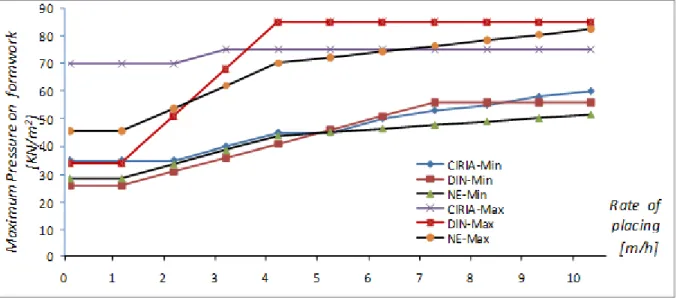
Therefore the calculus of the maximum fresh concrete pressure on the formwork using the three normative for a concrete of 3.00 meters high is reflected in Figure 1. Please note that the graphic bellow express the maximum and minimum levels of maximum fresh concrete horizontal pressure on formwork for a certain rate of placing for a concrete of 3.0 meters height. That shows comparable values for all three normative. Please also note that the initial strain/stress are conditioned according to the three normative in similar conditions and that reflects that the deformability of the formwork has to be restricted to the same limits, regardless of the code applied in order to estimate the maximum fresh concrete horizontal pressure on formwork.
Fig. 1: Values for maximum/minimum levels of maximum pressure of fresh concrete on vertical formwork for concrete of 3.00 meters height
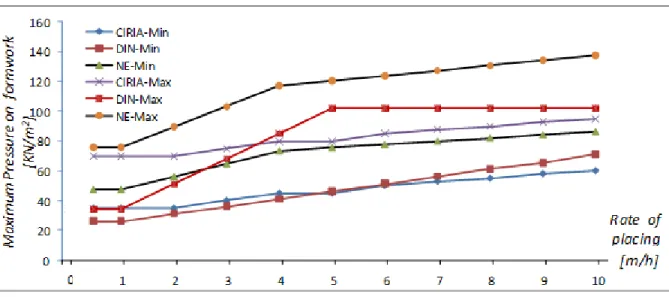
In Figure 2 a calculus for the maximum fresh concrete pressure on the formwork using the three normative for a concrete of 4.00 meters high is reflected as well. To mention that all three normative involves a standard concrete weight of 25 [KN/m3] and other weights are treated directly proportional with the standard concrete weight. Therefore in our calculus we considered the weight of fresh concrete as constant.
Fig. 2: Values for maximum/minimum levels of maximum pressure of fresh concrete on vertical formwork for concrete of 4.00 meters height
Fig. 3: Values for maximum/minimum levels of maximum pressure of fresh concrete on vertical formwork for concrete of 5.00 meters height
It is clearly from the figures above that the major differences among the three normative in evaluating the maximum pressure of the fresh concrete on formwork is growing as the height of the fresh concrete on formwork is increased. That can be seen in Figure 4 for the fresh concrete of 6.00 meters height.
Fig. 4: Values for maximum/minimum levels of maximum pressure of fresh concrete on vertical formwork for concrete of 6.00 meters height
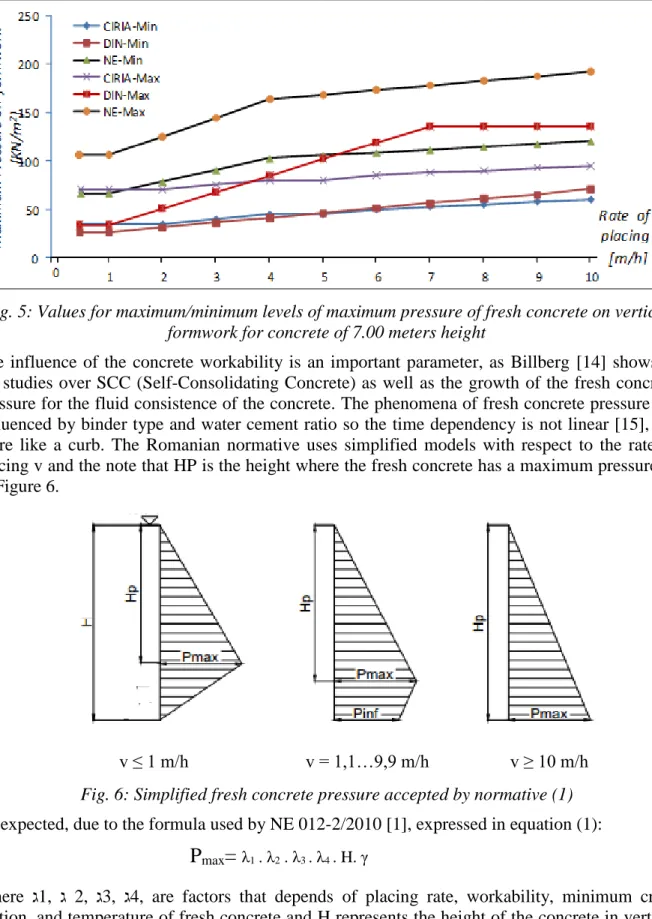
As for a fresh concrete of 7.00 meters height there are very few areas were the Romanian normative meets the other European normative.
Fig. 5: Values for maximum/minimum levels of maximum pressure of fresh concrete on vertical formwork for concrete of 7.00 meters height
The influence of the concrete workability is an important parameter, as Billberg [14] shows in his studies over SCC (Self-Consolidating Concrete) as well as the growth of the fresh concrete pressure for the fluid consistence of the concrete. The phenomena of fresh concrete pressure are influenced by binder type and water cement ratio so the time dependency is not linear [15], but more like a curb. The Romanian normative uses simplified models with respect to the rate of placing v and the note that HP is the height where the fresh concrete has a maximum pressure as in Figure 6.
v ≤ 1 m/h v = 1,1…9,9 m/h v ≥ 10 m/h
Fig. 6: Simplified fresh concrete pressure accepted by normative (1)
formwork as well as γ represents the concrete weight and no other limitation like in DIN [3, 4, 5] and CIRIA [6, 7] it is expected that after a certain point the Romanian normative gets an overestimation of the maximum fresh concrete pressure on the formwork occurs.
4 CONCLUSION
The study above reflects a difference in the manner that the maximum pressure of fresh concrete on vertical formwork is done using three normative. The CIRIA “Concrete pressure on formwork” [6, 7] and DIN 18218 -“Frischbetondruck auf lotrechte Schalungen” [3, 4, 5] proposes values for estimation of maximum pressure on formwork that are smaller comparative to NE 012-2/2010 [1] proposed values when the concrete in vertical formwork exceeds 3.00 m height. When the rate of placing is under 1 m/h and the maximum height of the concrete in formwork is less than 5 m, the three normative seems to have comparative values. Over this rate of placing and over this height, the values of the fresh concrete pressure according to Romanian normative are much greater than the values calculated with respect to other European normative. Therefore an unjustified over estimation of the formwork, along with an unnecessary use of formwork consolidation, handwork, and extra time is implied and all these are reflected in the growth of the final price. In these conditions it can be conclude that only the European normative CIRIA [6, 7] and DIN [3, 4, 5] leads to values of the fresh concrete pressure that are close to the real values.
REFERENCES
[1] NE 012-2/2010 - Normativ pentru producerea si executarea lucrarilor din beton, beton armat si beton
precomprimat, Partea 2: “Executarea lucrarilor din beton”
[2] Puente, I., Santille, A., Lopez, A. (2010). Lateral pressure over formwork on large dimension concrete blocks. Engineering Structures 32, 2010, pp. 195-206.
[3] DIN 18218/1980. Frischbetondruck auf lotrechte Schalungen. Deutsche Normen.
[4] E DIN 18218 (2008). Frishbetondruck auf lotrechte Schalungen. Deutsches Institut für Normung, 2008, 16 pp.
[5] DIN 18218/2010-01. Frishbetondruck auf lotrechte Schalungen. Deutsches Institut für Normung, Berlin, Jan. 2010, 19 pp.
[6] ACROW Concrete Hardware, (1981). Concrete pressure on formwork. By CIRIA, Jan. 1981, 27 pp.
[7] CIRIA Report 108. Construction Industry Research and Information Association, (1985). Concrete
pressure on formwork. ISBN: 086017 250 3, ISSN: 0305-408X, 32 pp.
[8] ACI Committee 347. Guide to Formwork for Concrete. ACI Standard, 2004, 32 pp.
[9] Hurd, M.K. (2007). Lateral Pressures for Formwork Design. A review of the formulas to determine
the pressure of fresh concrete, Concrete International, 29(6), June. 2007, pp. 31-33. Available at: http://www.sefindia.org/forum/files/hurd_revised_formwork_formulas_ci_june07_196.pdf
[10] Mark T., Amnon K., (2012). Construction and Building Materials. Elsevier Department of civil and
Enviromental Engineering, 34, pp 211-217
[11] Barnes JM. Johnston DW, (2003). Fresh Concrete Lateral pressure on formwork. Construction
[12] Chidiac S.E., Mahmoodzadeh F., (2009). Plastic viscosity of fresh concrete – A critical review of
predictions methods. Cement & Concrete Composites 31(8), September 2009, pp 535–544.
[13] Simha R. (1952). A treatment of the viscosity of concentrated suspensions, J. Appl. Phys. 23, 1020, 1952, pp 45-49.
[14] Billberg, P., Silfwerbrand, J. and Österberg, T., Form Pressures Generated by Self-Consolidating
Concrete. Concrete International, 27(10), Oct. 2005, pp. 35-42.
[15] Assaad J., Khayat Kh., (2005). Kinetics of formworks pressure drop of self-consolidating concrete containing various type of contents of binder. Cement concrete Res; 35:1522-30.