903
Teaching Operation Management with
GeoGebra. An example of Make-to-stock
Problem Solving
Calona Z1, Santos J2, Arcelus M 3
Abstract Improving classroom effectiveness is a major challenge for professors. Students’ abilities need to be nurtured, and integrating dynamic mathematics into teaching can enhance both professor and student performance. This paper presents GeoGebra as an alternative to solving make-to-stock problems in inventory man-agement. This model has the advantage of being interactive and user-friendly, al-lowing students to experiment with different values and draw conclusions on their own.
Keywords: Teaching Innovation, Operation Management, Inventory Manage-ment, Geogebra, Make-to-stock
1 Introduction
Professors are facing a major challenge when it comes to improving classroom ef-fectiveness, such as creating situations that will foster students’ mental abilities and making students interact with the instructor and each other to solve a problem (McKeachie, 1999). The main tools developed to create these situations (puzzles, cognitive analogies, case studies, role-playing, problem-based learning) are called Active Learning Techniques (McCarthy and Anderson, 2000).
1 Zeyda Calona
Tecnun – Universidad de Navarra. Pº Manuel Lardizábal 13, 20018 San Sebastián 2 Javier Santos García (e-mail: [email protected])
Tecnun – Universidad de Navarra. Pº Manuel Lardizábal 13, 20018 San Sebastián 3 Mikel Arcelus Alonso
904
One of the new challenges in Active Learning Techniques consists of integrat-ing the use of technology, especially when a technology allows students to dynam-ically interact in the proposing and solving of problems. Using these new tech-niques, which are usually based on computer software, students can understand topics better and learn faster, thereby improving their overall academic success.
Active Learning Techniques are useful in recapturing students’ attention when dealing with topics where what-if scenarios can be used to analyze the impact of certain variables on the results of the problems under study or when the concept explained is complex, as is the case with mathematical concepts.
At the university level, integrating dynamic mathematics into teaching can en-hance the performance of both professors and students. Moreover, professors are encouraged to use and assess technology and interactive mathematics, which con-tributes to overall classroom effectiveness.
Dynamic Mathematics Software (DMS), which supports constructions with points, lines and all conic sections, could be used as an Active Learning Tech-nique (Hohenwarter and Preiner, 2007) that provides the typical features of a Computer Algebra System (CAS), such as function plotting, root finding, deriva-tives and integrals.
The ability to represent functions dynamically is used by teachers of mathemat-ics to propose a “bottom up” approach (Llobet, 2011). This approach does not use a formal and structured methodology; instead, it proposes a visual and interactive environment where students experiment before learning the concepts.
Many DMS applications like Capri, Sketchpad, Microsoft Mathematics and GeoGebra are becoming popular among high school teachers, but they have not been deployed in management and engineering education (Soman, 2012) except for in the teaching of mathematics (Velichova, 2011), (Wurnig, 2008) or linear programming. Soman demonstrates the pedagogical use of GeoGebra in Operation Management, reporting that it helps students feel the implication of the decision they take.
This paper presents a practical case that applies GeoGebra, a free software, to Operation Management (more specifically in production planning and scheduling problems), particularly to make-to-stock strategies. In make-to-stock problems, decisions regarding the manufacturing period affect the management total cost. GeoGebra contributes to the dynamic analysis of the effect and helps determine the optimum value for the manufacturing period.
2 GeoGebra
GeoGebra emerged in 2001 as Markus Hohenwarter’s Master’s thesis (Hohen-warter and Borcherds, 2012), and since then it has become increasingly popular with teachers and researchers around the world because of its easy-to-use dynamic
905
mathematics software that combines many aspects of various mathematical pack-ages. In addition, GeoGebra is free, and due to its open-source nature an extensive user community has developed around it.
Designed specifically for educational purposes, GeoGebra can help students grasp experimental, problem-oriented and research-oriented learning in mathemat-ics, both in the classroom and at home. Therefore, GeoGebra can be used as a tool to better explain concepts and to help students understand and learn faster.
2.1 GeoGebra Applications
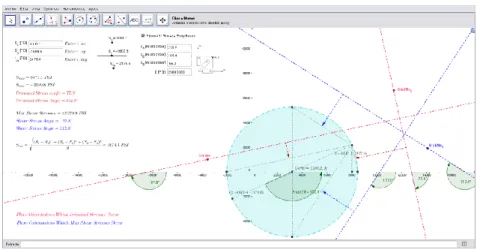
Although GeoGebra has been designed to solve algebraic and geometric problems, it offers a wide range of applications. For example, nowadays it is being used in various approaches to solving and explaining engineering problems such as Mohr’s Circle (Figure 1) and standard deviation (Figure 2).
Fig. 1 Example of the dynamic calculation of Mohr’s Cycle in GeoGebra (GeoGebra, 2013)
906
3 Make-to-stock Problems
In the Make-to-stock (MTS) strategy, a family of products must be manufactured based on demand forecasts. It can be considered push-type production, and the main objective is to determine the lot size for each product and consequently the production period for the family.
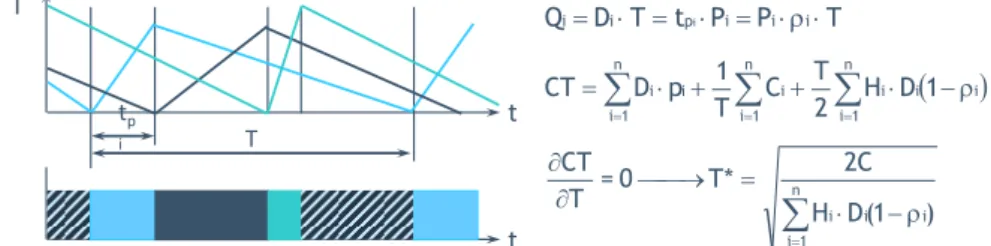
Traditional inventory management systems can be used to solve make-to-stock problems (Stevenson, 1998). According to inventory theory, the yearly demand for a product (D) can be produced in optimum batches (Q*), taking into account the resource production rate (P), production costs (p), setup costs (C) and invento-ry costs (H). Figure 3 summarizes the equations required to determine optimal cy-cle time (T*) and, consequently, optimal total cost (CT*).
Fig. 3 Optimum cycle time according to traditional inventory problem
The difference between the production cycle (T) and the production time for the product (tp) is known as idle time, and it must be minimized in order to in-crease resource effectiveness. Normally, more than one product is produced with the same set of resources, and according to the above formulas, T* will be differ-ent for each product. The challenge for Make-to-Stock strategies is to set the best cycle time for the family of products. One of the approaches to solving this prob-lem is known as the Common Cycle Approach, where the same cycle time is set for the family (Figure 4).
Fig. 4 Optimum cycle time according to the Common Cycle Approach t I T Q P - D -D tp QM ) 1 ( HD C 2 D * Q * T 2 Q H * Q D C p D * CT M P D ) 1 ( H CD 2 * Q t I T tp i t T P P t T D Qi i pi i ii
n 1 i i i i n 1 i i i n 1 i i H D1 2 T C T 1 p D CT
n 1 i i i i D(1 ) H C 2 * T 0 = T CT907
3.1 Make-to-Stock in Excel and GeoGebra
This section describes how to implement the Common Cycle Approach using Ge-oGebra. For a better understanding, an example is explained and solved using Mi-crosoft Excel and GeoGebra.
3.1.1 GeoGebra vs Microsoft Excel
Microsoft Excel is the tool that is usually employed by professors to explain mathematics or operation management. It allows them to solve formulas, interact with cell values, and combine columns. In order to add some dynamism to the worksheet, it is necessary to program using Visual Basic. Furthermore, the dynam-ic graphdynam-ical representation in Excel is limited to charts.
GeoGebra has a reduced range of formulas and spreadsheets, a clearly limited number compared to Excel. In GeoGebra it is not simple to include new rows maintaining the formula structure and looses information when detecting or mov-ing values. As a result is necessary to know in advance how to arrange tables, val-ues and formulas in the template.
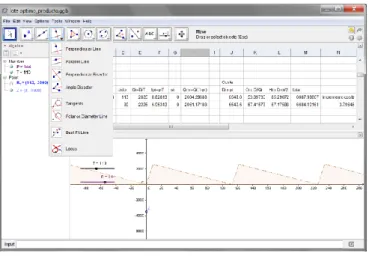
Fig. 5 GeoGebra’s Interface
However, GeoGebra offers a dynamic worksheet (Figure 5) that is more user-friendly and an easy-to-use interface. The combination of algebra, spreadsheets and graphics allows values, points and graphs to be changed dynamically. It’s as simple as dragging and dropping a variable and checking the behavior of its vari-ous values and its impact on spreadsheet cells. As a consequence it is easy to pre-pare a template to help student understanding and play dynamically with problem values and answer what-if questions in a simple way.
908
3.2 A practical example
A company produces three different products in the same facility. The compa-ny works 250 days a year, 5 days a week. Currently, it produces yearly one cycle of each product to satisfy the demand shown below. The table also provides in-formation about the production, set up and inventory cost. The task is to calculate the total cost based on the Common Cycle Approach.
Table 1 Example data
Product Di (u/year) pi(€/u) Pi(u/day) Hi(€/u year) Ci(€)
A 10000 10 200 5 1000
B 5000 40 200 20 150
C 20000 20 200 10 150
3.2.1 Microsoft Excel solution
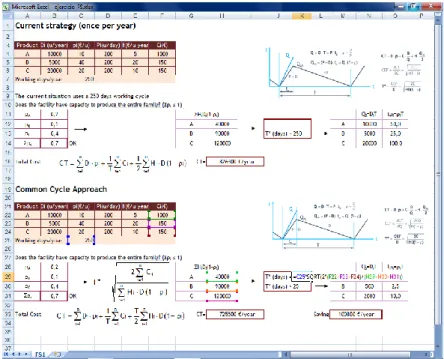
Figure 7 shows the solution using Microsoft Excel, where each cell includes a formula for solving the problem dynamically.
909
Students can interact with the Excel model, but they are limited to changing numbers or formulas. In addition, it is not possible to plot inventory levels for the products.
3.2.2 GeoGebra solution
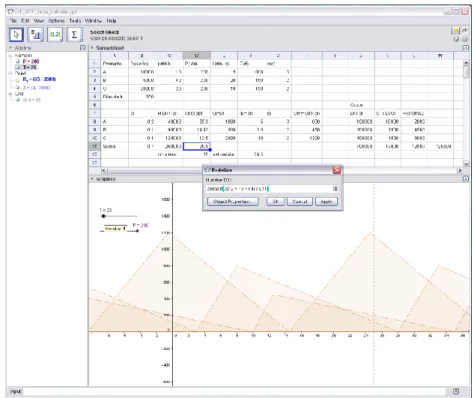
With GeoGebra (Figure 8), the user can play with the results by changing val-ues and analyzing how they affect the final solution, an approach that is clearly more dynamic.
Fig. 8 Case study solution in GeoGebra
The GeoGebra model allows interaction without programming by directly mov-ing the variable to the graphics. It is also possible to combine a variable value with the value of a cell in the spreadsheet. However, the spreadsheet in GeoGebra is more limited compared to Microsoft Excel. Figures 7 and 8 show the formula for the calculation of the optimum cycle (T*) using Excel and GeoGebra, respective-ly.
By using GeoGebra, different what-if scenarios can be easily analyzed without changing the model. Furthermore, it is possible to study the impact of an increase
910
in demand, a change in production rate, the economic impact of any change in working cycle, etc.
4 Conclusions
In this paper, a new proposal for teaching Operation Management based on Geo-Gebra is presented. The suggested alternative for Make-to-Stock problems helps students learn more efficiently by allowing them to manipulate values via a dy-namic interface. The paper’s main contributions are: (1) the integration of the new software GeoGebra in the field of operations management, not only for solving inventory problems but also for dealing with continuous improvements activities; (2) the presentation of a valuable free tool for professors, thereby improving class-room efficiency; and (3) the presentation of a valuable training methodology for students to better understand inventory concepts.
5 References
GeoGebra (2012) http://www.geogebratube.org/student/m5983 GeoGebra (2013) http://www.geogebratube.org/material/show/id/26706
Hohenwarter M., Preiner J. (2007). Multiple Representations. The Journal of Online Mathemat-ics and Its Applications, (7). Available online.
Hohenwarter, M. & Borcherds, M. (2012). Geogebra software (version 4) [software]. Available from http://www.geogebra.org/cms/
Llobet, JC. (2011). Mathematization platform in a GeoGebra environment within a didactic ap-proach “from bottom to top”. Enseñanza de las ciencias, Vol 29 (1). pp 101-114
McKeachie, W. J. (1999). Teaching tips: Strategies, research, and theory for college and univer-sity teachers. Boston: Houghton Mifflin.
Patrick, J. Anderson, L. (2000). Active Learning Techniques Versus Traditional Teaching Styles: Two Experiments from History and Political Science. Innovative Higher Education, 24 (4) Soman, CA. (2012). GeoGebra: A tool for improving operations management teaching at MBA
level. Proceedings of the 4th World Conference P&OM
Stevenson, WJ. (1998). Production Operations Management. 6th edition. Irwin Professional Pub-lishing
Velichova, D. (2011). Dynamic Tool in Mathematical Education. 14th International Conference on Interactive Collaborative Learning (ICL). pp. 24-29
Wurnig O. (2008), Some Problem Solving examples of Multiple solutions using cas and dgs, Proceedings of the Discussing Group 9 : Promoting Creativity for All Students in Mathemat-ics Education, The 11th International Congress on Mathematical Education, Monterrey, Mex-ico.