ISSN(Online): 2320-9801 ISSN (Print): 2320-9798
International Journal of Innovative Research in Computer and Communication Engineering An ISO 3297: 2007 Certified Organization Vol.3, Special Issue 5, May 2015
International Conference On Advances in Computer & Communication Engineering (ACCE - 2015)
on 5
th& 6
thMay 2015,
Organized by
Department of CSE, Vemana Institute of Technology, Bengaluru, India
A Survey on Evolution of Green Computing In
the Cloud Environment
Thanmai.C
1, Dr.K.N.Narsimaha Murthy
2, Dr S. Ambareesh
3Student, VI Semester BE, Department of CSE, Vemana IT, Visvesvaraya Technological University, Belgaum, Karnataka, India1
Professor, Department of CSE, Vemana IT, Visvesvaraya Technological University, Belgaum, Karnataka, India2 Associate Professor, Department of CSE, Vemana IT, Visvesvaraya Technological University, Belgaum, Karnataka,
India3
ABSTRACT: Energy conservation has become a major concern in modern electronic system devices. Energy wastage
in electronic devices occurs in both hardware and software components. In past a few years computer concepts and thoughts is shifted to remote data centers and the software and hardware services available on the basis of pay for use. This concept is called Cloud Computing. In which user have to pay for the services, and the cloud provides the services such as – Software as a service, Platform as a service and Infrastructure as a service. Cloud computing offers utility oriented IT services to users worldwide. It enables hosting of applications from consumer, scientific and business domains. However data centers hosting cloud computing applications consume huge amounts of energy, contributing to high costs and carbon footprints to the environment. Green computing is a research topic to address climate and energy challenges.Green Cloud computingis visioned to achieve not only efficient processing and utilization of computing environment, but also minimize the energy consumption.
KEYWORDS: Clouding computing,CO2emission, Green computing, IAAS, PAAS, SAAS, Virtualization.
I.INTRODUCTION
During the period of 1960, few experts hint the idea of cloud computing in their books. In 1970, Leonard,a chief scientist at Advanced Research Projects Agency Network (ARPANET) which seeded the Internet, said: “As of now, computer networks are still in their infancy, but as they grow up and become sophisticated, we will probably see the spread of computer utilities” [1]. This vision of computing massively transformed the entire computing industry in the 21st century whereby computing services will be readily available on demand. The users need to pay providers only when they access the computing services. The advantageous point is that the consumers no longer need to invest heavily or encounter difficulties in building and maintaining sophisticated and complex IT infrastructure environment. The cloud is the enabling technology for a radical change, driven by the power of thesocial networking, globalization of services, the replacement of PC by mobile devices, the emerging role of the Internet of Things. This system provides multiple facilities like – web data stores, huge computing resources, data processing servers etc.
Cloud computing can be classified as a new paradigm in field of computer technology. Cloud computing can be considered as a hierarchy of concepts. In industry these concepts are referred to as Infrastructure as a Service (IaaS), Platform as a Service (PaaS), and Software as a Service (SaaS) respectively. In 1999, Salesforce.com was the first to provide enterprise applications via a website [1]. This move aided the rise of cloud computing which was introduced around 2002 by Amazon. Since then other big shots in this field joined the club, which includes Google, Microsoft, Yahoo, and IBM. These firms are rapidly deploying data centers in various locations around the world to deliver Cloud services. The features of cloud computing are it is service based, Scalability and elastic, it is shareable ,it is metered by use, the use of Internet technologies, and the latest technology is always delivered.
ISSN(Online): 2320-9801 ISSN (Print): 2320-9798
International Journal of Innovative Research in Computer and Communication Engineering An ISO 3297: 2007 Certified Organization Vol.3, Special Issue 5, May 2015
International Conference On Advances in Computer & Communication Engineering (ACCE - 2015)
on 5
th& 6
thMay 2015,
Organized by
Department of CSE, Vemana Institute of Technology, Bengaluru, India
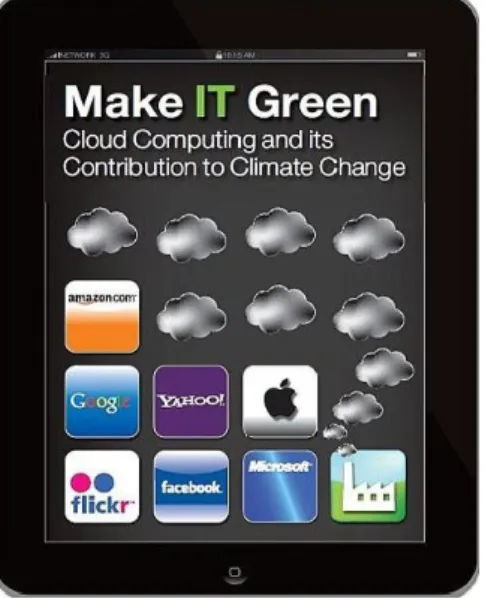
Green cloud computing found its root when the National Institute of Standards and Technology (NIST) made a point on drawback of cloud computing. According to NIST- “the major objective of cloud computing is to provide the shared resources and at the same time the disadvantage is its high infrastructure cost and the unnecessary power consumption and carbon emission”. As cloud computing becomes more common and demands on the internet grow, major companies hosting online services are using more and more energy for their data centers (Fig 1).This report looks at the contribution of cloud computing to climate change and what can be done by the ICT sector to help bring about, and benefit from, strong renewable energy policies and economy-wide emissions reductions.
Fig 1: Cloud computing and its contribution to climate changeFig 2: Cloud representation over the internet. To address this problem, datacenter resources need to be managed in an energy efficient manner to drive Green Cloud Computing. In particular, Cloud resources need to be assigned not only to satisfy the quality of service requirements specified by users, but also to reduce energy usage.
There are three general categories of cloud computing which are briefly discussed below:
Software as a Service (SaaS):
This type is the most popular way of using cloud computing. It utilizes a multitenant architecture, in which the system is built in a way that allows several customers to share software in an isolated way, without compromising the privacy and security of each customer's data. There is no need of software licensing for customers, and maintaining just one application makes the cost low for providers compared to conventional hosting.
Ex: Google Doc,Gmail.
Infrastructure as a Service (IaaS):
The IT infrastructure was rented out with pre-determined hardware configuration for a specific period of time, and the client had to pay for the configuration and time regardless of the actual use. With IaaS customer accesses the resources, IT infrastructure such as storage, processing, networking, over the Internet. HaaS is a part of IaaS.
IaaS is offered in three different models: Private, Public, and Hybrid. (Fig 2)
i) Private cloud implies that the infrastructure resides at the customer premises, and the internal cloud is based on a private network behind a firewall. That is to say, the cloud services are implemented using resources of a single organization.
ISSN(Online): 2320-9801 ISSN (Print): 2320-9798
International Journal of Innovative Research in Computer and Communication Engineering An ISO 3297: 2007 Certified Organization Vol.3, Special Issue 5, May 2015
International Conference On Advances in Computer & Communication Engineering (ACCE - 2015)
on 5
th& 6
thMay 2015,
Organized by
Department of CSE, Vemana Institute of Technology, Bengaluru, India
ii) Public cloud is located on cloud computing platform vendor's data center and provides public accessible services over the Internet, i.e. a service provider makes resources available to the public through the Internet.
iii) Hybrid cloud is a combination of the private and public cloudswith customer choosing the best of each. It allows an organization to provide and manage few of its resources in-house and has others externally.
Ex: Amazon S3 and Simple Storage Service.
Platform as a Service (PaaS):
This type of cloud computing not only deals with operation systems, but also provides a platform that you can run existing applications or develop and test new ones without hurting the internal system by allowing the customer to rent virtualized servers and associated services.
Ex: AppEngine,Bungee Connect.
II.NEED FOR GREEN COMPTING
The burning topic in computer field is the cloud computing, it has data centers which consumes more energy, which in turn leads to rise in CO2 emission. It provides computing power and resources as a service to users across the
globe.Let’s consider few survey studies to know the need for green cloud computing:
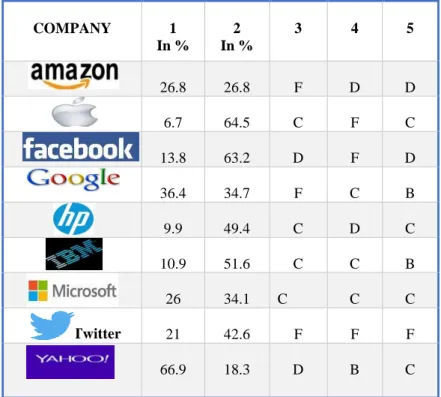
A survey on several companies shows a report „How dirty is our data‟, [4]about the energy demands of the data centers, and the sources from which energy comes from.(Fig 3)
Fig 3: “The Data centers to house the explosion of virtual information currently consume 1.5-2% of all global electricity, this is growing at a rate of 12% a year.”
COMPANY 1 In % 2 In % 3 4 5 26.8 26.8 F D D 6.7 64.5 C F C 13.8 63.2 D F D 36.4 34.7 F C B 9.9 49.4 C D C 10.9 51.6 C C B 26 34.1 C C C Twitter 21 42.6 F F F 66.9 18.3 D B C
ISSN(Online): 2320-9801 ISSN (Print): 2320-9798
International Journal of Innovative Research in Computer and Communication Engineering An ISO 3297: 2007 Certified Organization Vol.3, Special Issue 5, May 2015
International Conference On Advances in Computer & Communication Engineering (ACCE - 2015)
on 5
th& 6
thMay 2015,
Organized by
Department of CSE, Vemana Institute of Technology, Bengaluru, India
Where:
1-Clean energy index, 2-Coal intensity, 3-Transparency, 4-Infrastructure siting, 5-Mitigation strategy
A survey on Gmail (Fig 4) is an example of how cloud-based services can be much more energy efficient (up to 80 times) than locally hosted services, helping businesses cut their electricity bills.
Fig 4: Comparison of annual CO2, between locally hosted servers and Gmail.
Using resources more efficiently can help reducing energy consumption in data centers. Since energy has been a prime concern, this issue led to the importance of green cloud computing that provides techniques and algorithms to reduce energy wastage and reusing it.
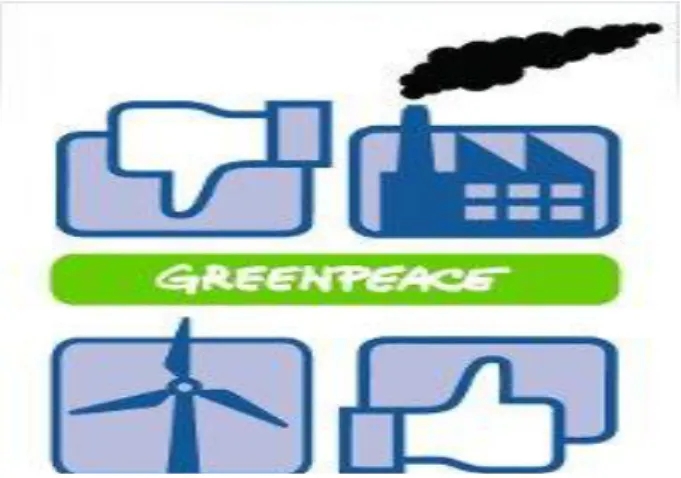
A best example for need of green computing: Greenpeace and Facebook have announced that they will collaborate on the promotion of renewable energy(Fig 5), encourage major utilities to develop renewable energy generation, and develop programs that will enable Facebook users to save energy and engage their communities in clean energy decisions[5].On December 15th,2011 „The Green Peace‟ campaign was initiated for pushing Facebook to use clean energy, which has achieved a major milestone.
ISSN(Online): 2320-9801 ISSN (Print): 2320-9798
International Journal of Innovative Research in Computer and Communication Engineering An ISO 3297: 2007 Certified Organization Vol.3, Special Issue 5, May 2015
International Conference On Advances in Computer & Communication Engineering (ACCE - 2015)
on 5
th& 6
thMay 2015,
Organized by
Department of CSE, Vemana Institute of Technology, Bengaluru, India
This campaign involved 700,000 online activists, (setting a world record for the most comments on a single Facebook post in one day: 80,000) to empower its data centers with clean energy instead of coal. “This move sets an example for
the industry to follow” said Tzepo rah Berman, Co-director of Green peace‟s International Climate and Energy Program. [5]
III.GREEN CLOUD COMPUTING
Like everything else, computing needs to be "green," meaning that we are conscious of the ways our lives and our work impact the world. Green computing, also called green technology, it is environmentally responsible and eco-friendly use of computers and their resources. This involves the implementation of energy-efficient central processing units (CPU‟s), servers and peripherals as well as reduced resource consumption and proper disposal of electronic waste (e-waste).In other terms, it is also defined as the study of designing, manufacturing, using and disposing of computing devices in a way that reduces their environmental impact. It is also the development of environment friendly products, energy efficient computers and recycling the system products. Increased power use has increased the IT costs [6]. Growing risks on climate change and desire to lessen energy use has given rise to green computing.
Main goals of green computing are to reduce the use of toxic and hazards materials and improve the energy efficiency, recycling of e-waste. Such practice includes the efficient implementation of server and other subsystems as well as reduce in the power consumption. [7]. Research continues into key areas such as making the use of computers as energy efficient as possible, and designing algorithms and systems for efficiency related computer technologies. The Energy Star label has made it easier for consumer to identify energy efficient products. So it seems the EPA (Environmental protection agency) is doing a good job in making it easier for consumers to buy electronics and computers that are both energy efficient and environmentally efficient.[11].The key features of green cloud computing are Dynamic provisioning,multi-tenancy,good server utilization and a better datacenter efficiency.
IV.ARCHITECTURE OF A GREEN CLOUD COMPUTING PLATFORM
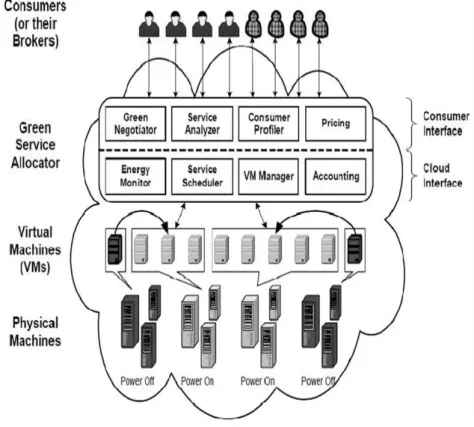
There are basically four main entities involved:
1.Consumers: This is the first layer of the architectural elements of green cloud. The consumers are responsible for the interaction between the cloud providers and the users. Consumers can request for service from anywhere in the world to the Cloud.
2.Green Resource Allocator: It acts as an interface between the Cloud environment infrastructure and the consumers. It requires the interaction of the following components for an energy-efficient resource management:
Green Negotiator: Negotiates with the consumers to finalize the SLA (Service level agreement) with specified prices and penalties for violation of SLA between the Cloud provider and consumer depending on the consumer‟s requirements and energy saving schemes.
Service Analyzer: Interprets and analyses the service requirements of a submitted request before deciding whether to accept or reject it. Hence, it needs the latest load and energy information from VM Manager and Energy Monitor respectively.
Consumer Profiler: It gathers specific characteristics of the consumers so that important consumers can be granted special privileges and prioritized over others.
Pricing: Decides how service requests are charged to manage the supply and demand of computing resources effectively.
Energy Monitor: Observes and determines which physical machines to power on/off.
Service Scheduler: Assigns requests to VMs and determines resource entitlements for allocated VMs.
VM Manager: Keeps track of the availability of VMs and their resource entitlements.
ISSN(Online): 2320-9801 ISSN (Print): 2320-9798
International Journal of Innovative Research in Computer and Communication Engineering An ISO 3297: 2007 Certified Organization Vol.3, Special Issue 5, May 2015
International Conference On Advances in Computer & Communication Engineering (ACCE - 2015)
on 5
th& 6
thMay 2015,
Organized by
Department of CSE, Vemana Institute of Technology, Bengaluru, India
3. Virtual machines (VMs): Multiple VMs can be dynamically started and stopped on a single physical machine to meet the accepted requests, hence providing maximum flexibility to configure various partitions of resources on the same physical machine to different specific requirements of service requests. Multiple VMs can also concurrently run applications based on different operating system environments on a single physical machine. [12]
4.Physical Machines: The underlying physical computing servers provide hardware infrastructure for creating virtualized resources to meet service demands.
Fig 6: The high-level architecture for supporting energy-efficient service allocation in Green Cloud computing infrastructure
V.TECHNIQUES TO GREEN COMPUTING
There are a hardware and software solutions that can be taken to significantly curb the power consumption and impact on environment. The key techniques to reduce the energy consumption, CO2 emission and its adverse effect on human
health are:
1. Using hardware with lower energy consumption:
Computer systems are made up of hardware i.e. processor onboard graphics, disk, fan, etc, these hardware should consume less power.
2. Virtualization:
Virtualization began in 1960s mainframe computers as a method of logically dividing the system resources provided by mainframes between different applications. Since then, the meaning of the term has broadened. It refers to the act of creating a virtual version not only limited to virtual computer hardware and operating system (OS), storage device, or computer network resources. It is the use of software to simulate hardware. In the data center server system replaced with virtual server that run as software on a small number of larger computer via a virtualized server we can efficiently
ISSN(Online): 2320-9801 ISSN (Print): 2320-9798
International Journal of Innovative Research in Computer and Communication Engineering An ISO 3297: 2007 Certified Organization Vol.3, Special Issue 5, May 2015
International Conference On Advances in Computer & Communication Engineering (ACCE - 2015)
on 5
th& 6
thMay 2015,
Organized by
Department of CSE, Vemana Institute of Technology, Bengaluru, India
use computer resources. Cloud installations more often use virtualization to separate the software from the physical servers, which allows for the greater optimization of servers. It is critical to cloud computing because it simplifies the delivery of services by providing a platform for optimizing complex IT resources in a scalable manner, which is what makes cloud computing so cost effective.Virtualization can be applied very broadly to everything you can imagine including memory, networks, storage, hardware, operating systems, and applications.
Virtualization has three characteristics that make it ideal for cloud computing:
Partitioning: In virtualization, you can use partitioning to support many applications and operating systems in a single physical system.
Isolation: Because each virtual machine is isolated, each machine is protected from crashes and viruses in the other machines.
Encapsulation: Encapsulation can protect each application so that it doesn‟t interfere with other applications. To manage the various aspects of virtualization in cloud computing most companies use hypervisors. Because hypervisors can load multiple operating systems, they are a very practical way of getting things virtualized quickly and efficiently.
3. Implementing efficient algorithms to optimize energy consumption:
Green IT Algorithms- New goal of energy efficiency gives rise to algorithmic problems involving optimizing/managing energy, temperature, and power as resources. New IT technology developed for energy efficiency reasons gives rise to new resource management (scheduling) problems.
Currently the range of green computing problems considered in the algorithmic literature is limited. Currently green computing algorithmic research needs problem mining more than it needs problem solving.
4. Wireless Network Sensor:
Sensor employed in different areas in a data center to determine the temperature of each area, this will tell which area need to be more cool and where to reduce cooling.
5. Recycle:
Through recycling the waste or equipment we can reduce the environmental pollution.
6. Predictive resource allocation (scheduling) models: [9] Some of the resource scheduling techniques include:
First Come First Serve (FCFS)
Round Robin Scheduling
Priority based scheduling
Temperature Based Scheduling
Work Flow Algorithm
Genetic algorithm
7. Web 2.0 and Mashup technology:
Web 2.0 is a concept that refers to the use of Web technology and Web design to enhance creativity, information sharing, and collaboration among users. Mashup is a web application that combines data from more than one source into a single integrated storage tool. Both technologies are very beneficial for cloud computing.
The work habits of computer users and businesses can be modified to minimize adverse impact on the global environment. Average computer users can employ the following general tactics to make their computing usage greener:[10]
Power-down the CPU and all peripherals during extended periods of inactivity.
Try to do computer-related tasks during contiguous, intensive blocks of time, leaving hardware off at other times.
Buy energy efficient notebook computers, instead of desktop computers
ISSN(Online): 2320-9801 ISSN (Print): 2320-9798
International Journal of Innovative Research in Computer and Communication Engineering An ISO 3297: 2007 Certified Organization Vol.3, Special Issue 5, May 2015
International Conference On Advances in Computer & Communication Engineering (ACCE - 2015)
on 5
th& 6
thMay 2015,
Organized by
Department of CSE, Vemana Institute of Technology, Bengaluru, India Use liquid-crystal-display (LCD) monitors rather than cathode-ray-tube (CRT) monitors.
Use notebook computers rather than desktop computers whenever possible.
Activate the power management features for controlling energy consumption.
Dispose of e-waste according to federal, state and local regulations.
Employ alternative energy sources for computing workstations, servers, networks and data centers.
Instead of purchasing a new computer, try refurbishing an existing device.
Government regulatory authorities also actively work to promote green computing concepts by introducing several voluntary programs and regulations for their enforcement.
VI.BENEFITS OF GREEN CLOUD COMPUTING
Co2 emission and energy consumption both are directly proportionate to each other, hence lesser the energy
consumption lesser is the Carbon emission.(Fig 7)
Green computing encourages recycling and lowering energy use by its users. A perfect example is the greenest modern computers today are MacBook‟s and MacBook Pros.
Less energy utilized to produce and use of products which in turn leads to conserving the data center resources.
Green computing can lead to cost savings. Reductions in energy costs from servers cooling and lighting.
CO2 and emission of others affect the global climate and is responsible for damage of our environment, Using
Green computing helps the environment and human health to sustain for long.
Fig 7: Environmental benefits of moving to cloud, and making cloud greener
VII.DRAWBACKS OF GREEN CLOUD COMPUTING
Green computing could actually be quite costly. For instance, Apple‟s powerful range of computers, including their iMacs, is incredibly green but also expensive.
Some computers that are green may be considerably underpowered.
In green computing not only CO2 emission and energy is the factor to be considered. But also features like Quality,
Security, etc. should also be taken into account.
According to Hulkary, The major disadvantage is that manager(server) of the system is the central point of communication so if manager will crash then whole system will fall apart ,hence then all work has to be done manually. [8]
ISSN(Online): 2320-9801 ISSN (Print): 2320-9798
International Journal of Innovative Research in Computer and Communication Engineering An ISO 3297: 2007 Certified Organization Vol.3, Special Issue 5, May 2015
International Conference On Advances in Computer & Communication Engineering (ACCE - 2015)
on 5
th& 6
thMay 2015,
Organized by
Department of CSE, Vemana Institute of Technology, Bengaluru, India
Increase in computing power and server numbers multiplies the cooling problems, since air is an inefficient media for cooling computers and empty space alone. Air conditioning and other cooling techniques are required to keep temperatures cool.
VIII.RESULTS AND COMPARISION
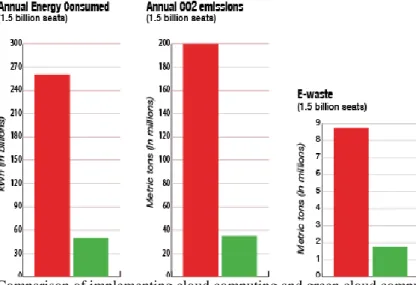
A graph depicts the comparison of the annual energy consumed, annual CO2 emission and annual E-waste of the cloud
computing and the green cloud computing in the datacenters.
Fig 8: Comparison of implementing cloud computing and green cloud computing. Where,
Red- Cloud computing Green- Green computing with Ncomputing The graph shows the results of implementing green cloud computing in the datacenters using Ncomputing devices.
Today's PCs are so powerful that we no longer need one PC per person. We can utilize the excess power by sharing it with many users. Ncomputing is a desktop virtualization company that manufactures hardware and software to create virtual desktops which enable multiple users to simultaneously share a single operating system. Ncomputing solutions save 75% on hardware, and since they draw less than 5 watts of power, energy footprint can be reduced by as much as 90% per user. It also produces practically no heat, reducing the need for more energy consumption and also energy-consuming in air conditioning, in turn leading to less Carbon emission. Hence green cloud computing is effective and more efficient.
IX. CONCLUSION
This paper gives a brief study about green computing in a cloud environment. The concept of green computing is popularized in the past few years due to the increasing need for power saving mechanisms within the cloud. There is a growing need for improvements in Cloud infrastructure, in various sectors. Currently the different data centers explore the virtual information globally. Green cloud computing is visioned to achieve not only efficient processing and utilization of computing environment, but also minimize the energy consumption. However, green computing technology needs to be further researched for a better and efficient use of cloud.
REFERENCES
[1] L. Klein rock, “A Vision for the Internet”, ST Journal of Research, 2(1):4-5, Nov, 2005.
ISSN(Online): 2320-9801 ISSN (Print): 2320-9798
International Journal of Innovative Research in Computer and Communication Engineering An ISO 3297: 2007 Certified Organization Vol.3, Special Issue 5, May 2015
International Conference On Advances in Computer & Communication Engineering (ACCE - 2015)
on 5
th& 6
thMay 2015,
Organized by
Department of CSE, Vemana Institute of Technology, Bengaluru, India
[3] N. Xiong, W. Han, A. Vandenberg “Green cloud computing schemes based on networks: a survey”.
[4] https://ict4green.files.wordpress.com/2011/02/green peacecleanpowerreportcard.jpg
[5] http://www.greenpeace.org/usa/en/media-center/news-releases/Facebook-Commits-to-Clean-Energy-Future
[6] Biswajit Saha,” Green Computing”, International Journal of Computer Trends and Technology (IJCTT) – volume 14 number 2 –
Aug 2014
[7] Archana Tahiliani, Apexa Purohit,” A Review on Energy Saving Using Green Computing System” International Journal of Engineering
Development and Research, ISSN: 2321-9939
[8] Ankita Atrey, Nikita Jain and Iyengar N.Ch.S.N,“A Study on Green Cloud Computing”, International Journal of Grid and Distributed
Computing Vol.6, No.6 (2013), pp.93-102
[9] Arshjot Kaur, Supriya Kinger, “A Survey of Resource Scheduling Algorithms in Green Computing”, International Journal of Computer