Expression Invariant 3D Face Recognition with a Morphable Model
Brian Amberg
[email protected]Reinhard Knothe
[email protected]Thomas Vetter
[email protected]Abstract
We present an expression-invariant method for face recognition by fitting an identity/expression separated 3D Morphable Model to shape data. The expression model greatly improves recognition and retrieval rates in the unco-operative setting, while achieving recognition rates on par with the best recognition algorithms in the face recognition great vendor test. The fitting is performed with a robust nonrigid ICP algorithm. It is able to perform face recogni-tion in a fully automated scenario and on noisy data. The system was evaluated on two datasets, one with a high noise level and strong expressions, and the standard UND range scan database, showing that while expression invariance in-creases recognition and retrieval performance for the ex-pression dataset, it does not decrease performance on the neutral dataset. The high recognition rates are achieved even with a purely shape based method, without taking im-age data into account.
1. Introduction
We present a system which is using shape information from a 3D scanner to perform automated face recognition. The main novelty of the system is its invariance to expres-sions. The system is tested on two public datasets. It is fully automatic and can handle the typical artifacts of 3D scan-ners, namely outliers and missing regions. Face recognition in this setting is a difficult task, and difficult tasks benefit from strong prior knowledge. To introduce the prior knowl-edge we use a 3D Morphable Model (3DMM) [4], which is a generative statistical model of 3D faces. 3DMMs have been applied successfully for face recognition on differ-ent modalities. The most challenging setting is recognition from single images under varying light and illumination. This was adressed by [5,11]. There, a 3DMM with shape, texture and illumination model was fit to probe and gallery images. As the model separates shape and albedo param-eters from pose and lighting, it enables pose and lighting-invariant recognition. We use the same idea for expression-invariant face recognition from 3D shape. We fit an iden-tity/expression separating 3DMM [2] to shape data and
nor-a) Target b) Fit c) Normalized
a) Target b) Fit c) Normalized
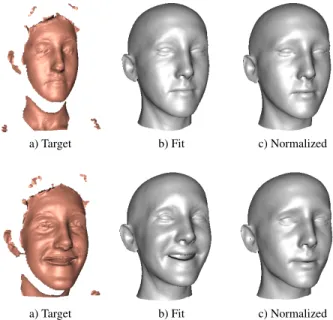
Figure 1. Expression normalisation for two scans of the same in-dividual. The robust fitting gives a good estimate (b) of the true face surface given the noisy measurement (a). It fills in holes and removes artifacts using prior knowledge from the face model. The pose and expression normalized faces (c) are used for face recog-nition.
malize the resulting face by removing the pose and expres-sion components. See Figure1for an example of expression normalization. The expression and pose normalized data al-lows then efficient and effective recognition. A 3D MM has been fitted to range data before [3] and the results were even evaluated on part of the UND database. Our approach dif-fers from this work in the fitting method employed, which is independent of the acquisition device, and in the use of an expression model to improve face recognition. Addition-ally, our method is fully automatic, while [3] needed seven manually selected landmarks.
Expression-invariant recognition for shape data was also approached in [8], where a person specific 3D Morphable Expression Model was learned for each subject in the gallery. In contrast, we are using a general 3DMM learned from an independent database of face shapes which can be applied without any relearning to a new scan. This makes
the enrollment phase trivial and the recognition phase ef-fectively constant in the size of the gallery while still being accurate. We have to fit just one model to the probe, which can then be compared efficiently to the enrolled subjects, by comparing their coefficients in the low dimensional face space. While the number of comparisions is still at most linear in the number of examples (and can be made sublin-ear with an indexing method) the time it takes to compare coefficients in face space is neglectible compared to fitting time. Model-less approaches which align the probe to each example in the database using e.g. ICP [12] suffer from the same problem as [8]. Because the probe has to be aligned with each gallery scan these methods scale linearly in the gallery size, While our model based approach needs only a single fit to the probe.
Another interesting model-less approach [6] compares surface by the distribution of geodesics, which stays con-stant for nonrigidly deforming (but not stretching or tear-ing) objects. This approach is difficult to apply in this set-ting though, as the scanning produces holes, disconnected regions and strong noise, which can best be handled by a method which uses specific information about the object class.
2. Model
A PCA model [4] built from 175 subjects was used. It was build from one neutral expression face scan per identity and 50 expression scans of a subset of the subjects. The data was registered with a modification of [1]. The identity model consists of a mean shapeµand a matrix of offset vectors Mn such that a new face instance f is generated from a vector of coefficientsαnas
f =µ+Mnαn . (1)
The model is constructed such that theαiare independently
normally distributed with zero mean and unit variance under the standard assumption of a Gaussian distribution of the data. This was done by performing PCA on the data matrix built from the mean free shape vectors. Additionally, for each of the 50 expression scans, we calculated an expres-sion vector as the difference between the expresexpres-sion scan and the corresponding neutral scan of that subject. This data is already mode-centered, if we regard the neutral expres-sion as the natural mode of expresexpres-sion data. On these offset vectors again PCA was applied to get an expression matrix
Meand expression coefficientsαe, such that the complete
expression model is f =µ+Mnαn+Meαe=µ+Mα , (2) M= Mn | Me α= αn αe . (3)
The basic assumption of this paper is, that the face and ex-pression space are linearly independent, such that each face is represented by a unique set of coefficients. While the resulting expression and identity matrices are not perfectly orthogonal, they do have little overlap, which together with the regularisation employed is sufficient for this application. We assume, that the overlap between the spaces is due to the fact that it is impossible to aquire perfectly consistent neu-tral expressions.
We use the registered scans and a mirrored version of each registered scan to increase the variability of the model. This allows us to calculate a model with more than 175 neu-tral coefficients.
3. Fitting
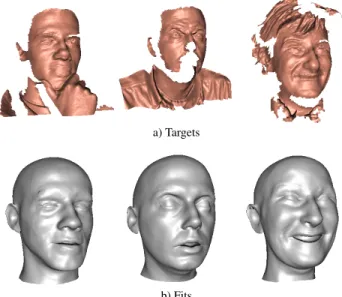
The fitting algorithm used in this paper is a variant of the nonrigid ICP work in [1]. The main difference, is that the deformation model is a statistical model and the opti-misation in each step is an iterative method, which finds the minimum of a convex function. Additionally, as it is applied on noisy data (see Figure 2), we included a more elaborate robust weighting term. Like other ICP methods, it is a local optimization method, which does not guarantee convergence to the global mimimum, but is dependent on the initialization. It consists of the following steps
• Iterate over regularization valuesθ1>· · ·> θN: – Repeat until convergence:
1. Find candidate correspondences by search-ing for the closest compatible point for each model vertex.
2. Weight the correspondences by their dis-tance using a robust estimator.
3. Fit the 3DMM to these correspondences us-ing a regularization strength ofθi.
4. Continue with the lowerθi+1if the median
change in vertex position is smaller than a threshold.
The search for the closest compatible point takes only points into account which have conforming normals, are closer than a threshold, and are not on or close to the border of the scan. This has the effect of removing many outliers. The search is sped up by organizing the target scan in a space partitioning tree made up of spheres. The correspondences are then weighted with a robust function by their residual distance. The robust function is linear for distances smaller than2mm, behaves like1/xbetween2mm and20mm, and is zero for a distance larger than 20mm. Note, that it is necessary to balance robustness and regularization, as the right balance depends on the noise characteristic of the data. Suitable values were determined manually from a few scans
a) Targets
b) Fits
Figure 2. The reconstruction (b) is robust against scans (a) with artifacts, noise, and holes.
of the GavabDB database and kept constant for all experi-ments as well on the GavaDB as on the UND database. In step 3 the 3DMM is fit to 3D-3D point correspondences. This is done with a gauss-newton least squares optimiza-tion, using an analytic Jacobian and Gauss-Newton Hes-sian approximation. Denote the correspondence points by
u=
u1, . . . ,unand the rows of the model which
corre-spond to theith vertex by subscripti, then we can write the cost function mimized in this step as
f(R,t,α) =X i kR(µi+Miα) +t−uik 2 +λkαk2 . (4) This can be minimized more efficiently by changing the di-rection of the rigid transform to
f(R,t,α) =X i kµi+Miα+t0−R0uik 2 +λkαk2 t0 =R−1t R0 =R−1 . (5) because then the Jacobian consists of a large constant part and three columns which depend on the iteration.
Fi=µi+Miα+t0−R0r1,r2,r3ui (6) ∂Fi ∂α =Mi ∂Fi ∂t0 =I3 ∂Fi ∂ri = ∂R 0 r1,r2,r3 ∂ri ui (7) J= Jc | Jd (8) Jc= M 1⊗I3 I 0 (9) Jd= (I⊗∂R0 ∂r1)u T (I⊗∂R0 ∂r2)u T (I⊗∂R0 ∂r3)u T 0 0 0 (10)
Accordingly, the Hessian can be approximated as
H= JT cJc (JTcJd)T JT cJd JTdJd . (11)
By precalculating the constant parts of the matrices we can remove most of the computation time, making step3very fast.
We initialize the registration by locating the tip of the nose with a heuristic, which assumes that the head is up-right and looking into the camera. This initialization is good enough to for a fully automatic fit, as the fitting behaves like rigid ICP in the beginning, and rigid ICP is known to have a large basin of convergence.
4. Experiments
We evaluated the system on two databases with and without the expression model. We used the GavabDB [9] database and the UND [7] database. For both databases, only the shape information was used. The GavabDB database contains 427 scans, with seven scans per ID, three neutral and four expressions. The expressions in this dataset varies considerably, including sticking out the tongue and strong facial distortions. Additionally it has strong artifacts due to facial hair, motion and the bad scanner quality. This dataset is typical for a non-cooperative environment. The UND database was used in the face recognition grand chal-lenge [10] and consists of 953 scans, with one to eight scans per ID. It is of better quality and contains only slight expres-sion variations. It represents a cooperative scenario.
The fitting was initialized by detecting the nose, and as-suming that the face is upright and looking along thez-axis. To detect the nose we first removed the spike artifacts typi-cal of range scanners by repeated min-filtering and removal of large triangles, then we detect the vertex with the small-est depth, which in its horizontal slice is sufficiently closer to the camera than the other pixels in that slice. For the UND dataset this gives us reliably a point on the tip or ridge of the nose. The heuristic worked for 939 out of 953 Scans, in the remaining 16 scans we marked the nose manually. The GavabDB database has the scans already aligned and the tip of the nose is at the origin. We used this informa-tion for the GavabDB experiments. The same regularisainforma-tion parameters were used for all experiments, even though the GavabDB data is more noisy than the UND data. The pa-rameters were set manually based on a few scans from the GavabDB Database. We used 100 principal identity com-ponents and 30 expression comcom-ponents for all experiments. In the experiments the distances between all scans were calculated, and we measured recognition and retrieval rates by treating every scan once as the probe and all other scans as the gallery. Both databases were used independently.
0.7 0.75 0.8 0.85 0.9 0.95 1 0 2 4 6 8 10 12 14 16 18 20 MNCG @x
GavabDB: Mean Normalized Cumulative Gain
neutral model expression model 0.99 0.992 0.994 0.996 0.998 1 0 2 4 6 8 10 12 14 16 18 20 MNCG @x
UND: Mean Normalized Cumulative Gain
neutral model expression model
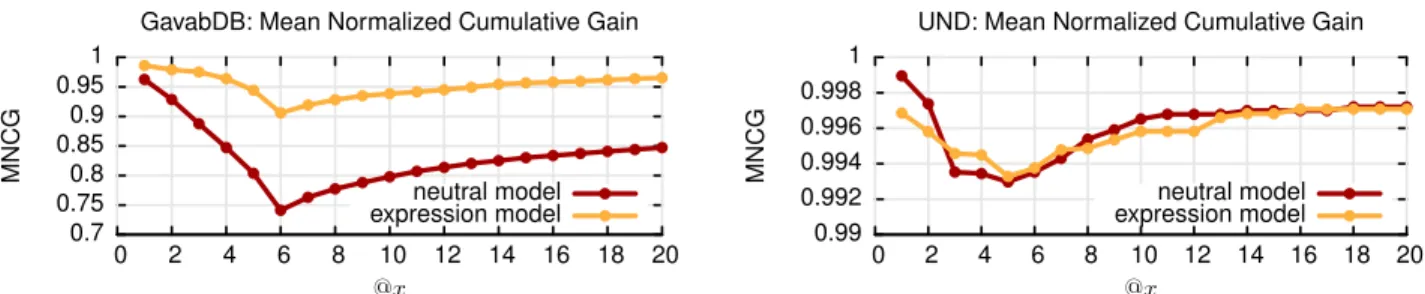
Figure 3. For the expression dataset the retrieval rate is improved by including the expression model, while for the neutral expression dataset the performance does not decrease. Plotted is the mean normalized cumulative gain, which is the number of retrieved correct answers divided by the number of possible correct answers. Note also the different scales of the MNCG curves for the two datasets. Our approach has a high accuracy on the neutral (UND) dataset.
0 0.2 0.4 0.6 0.8 1 0 0.2 0.4 0.6 0.8 1 Precision Recall
GavabDB: Precision Recall
neutral model expression model 0 0.2 0.4 0.6 0.8 1 0 0.2 0.4 0.6 0.8 1 Precision Recall UND: Precision Recall
neutral model expression model
Figure 4. Use of the expression model improves retrieval performance. Plotted are precision and recall for different retrieval depths. The lower precision of the UND database is due to the fact that some queries have no correct answers. For the UND database we achieve total recall when querying nine answers, while the maximal number of scans per individual is eight, while for the GavabDB database the expression model gives a strong improvement in recall rate but full recall can not be achieved.
4.1. Retrieval Measures
We measure similarity between faces in parameter space as the angle between the face parameters in Mahalanobis space, which has proven to have high recognition rates [5]. The distance measure is
s(α1,α2) = arccos αT 1α2 kα1kkα2k . (12) We observed that the angular measure gives slightly larger recognition rates than the Mahalanobis distance. The Maha-lanobis angle has the effect of regarding all caricatures of a face, which lie on a ray from the origin towards any identity, as the same identity. We also evaluated other measures, but found them to be consistently worse than the Mahalanobis angle.
4.2. Results
As expected, the two datasets behave differently because of the presence of expressions in the examples.
4.2.1 UND
For the UND database we have good recognition rates with the neutral model. The mean cumulative normalized gain curve in Figure 3 shows for varying retrieval depth the
number of correctly retrieved scans divided by the maxi-mal number of scans that could be retrieved at this level. From this it can be seen that the first match is always the correct match, if there is any match in the database. But for some probes no example is in the gallery. Therefore for face recognition we have to threshold the maximum al-lowed distance to be able to reject impostors. Varying the distance threshold leads to varying false acceptance rates (FAR) and false rejection rates (FRR), which are shown in Figure5. Even though we have been tuning the model to the GavabDB dataset and not the UND dataset our recogni-tion rates at any FAR rate are as good or better than the best results from the face recognition vendor test. This shows, that our basic face recognition method without expression modelling gives convincing results. Now we analyze how the expression modelling impacts recognition results on this expression-less database. If face and expression space are not orthogonal, then adding invariance towards expressions should make the recognition rates decrease. In fact, we ob-serve that the recognition results are slightly lower, but only by a marginal amount, and still on par with the results from the face recognition vendor test. Let us now turn towards the expression database, where we expect to see an increase in recognition rate due to the expression model.
0 0.01 0.02 0.03 0.04 0.05 0.06 0.07 0.08 0 0.005 0.01 0.015 0.02 0.025 0.03 FRR FAR
GavabDB: Recognition Performance neutral model expression model 0 0.01 0.02 0.03 0.04 0.05 0.06 0.07 0.08 0 0.005 0.01 0.015 0.02 0.025 0.03 FRR FAR
UND: Recognition Performance neutral model expression model
Figure 5. Impostor detection is reliable, as the minimum distance to a match is smaller than the minimum distance to a nonmatch. Note the vast increase in recognition performance with the expression model on the expression database, and the fact that the recognition rate is not decreasing on the neutral database, even though we added expression invariance. We can operate at0% false acceptance rate with less than4% false rejection rate, or less than1% FAR with less than1% FRR.
4.2.2 GavabDB
The recognition rates on the GavabDB without expression model are not quite as good as for the expression-less UND dataset, so here we hope to find some improvement by using expression normalization. And indeed, the closest point recognition rate with only the neutral model is 96.25% which can be improved to 98.36% by adding the expression model. Also the FAR/FRR values decrease considerably. The largest improvement can be seen in retrieval perfor-mance, displayed in the precision recall curves in Figure4
and mean cumulative normalized gain curves in Figure3. This is because there are multiple examples in the gallery, so finding a single match is relatively easy. But retrieving all examples from the database, even those with strong ex-pressions, is only made possible by the expression model.
5. Speed
Though the method as presented operates at only ap-proximately 40 seconds per query, it has the potential for speedup. It is possible to parallelize the closest point esti-mation and the optimisation, and more elaborate fitting al-gorithms including multiresolution schemes can be devel-oped. The speed also depends on the number of vertices and components, for the results presented here 11000 ver-tices and 100 neutral plus 30 expression components were fitted.
6. Conclusion
We have used a 3D Morphable Model with a separating expression model to develop an expression-invariant face recognition algorithm. We have shown, that the system has excellent recognition rates on difficult expression data and data taken in a cooperative environment. The introduction of expression invariance did not incur a significant loss of precision on easier neutral data. The strong prior knowledge of the 3DMM allows robust handling of noisy data and al-lowed us to build a fully automatic face recognition system.
We also introduced a relatively efficient fitting algorithm, which, as it has the potential for paralellisation, could be made even faster.
Note that, as we do establish correspondence between the model and the scans, it is trivial to add image based classification for datasets where a calibrated photo is avail-able. This can be done by comparing the rectified textures, which should result in even higher recognition rates. It is also important to note that the expression normalization de-scribed here for range data can be applied equally well to other modalities, using any of the proposed 3DMM fitting algorithms.
In the future we plan to include the additional texture cues and make the method faster, such that it is applicable in real world scenarios where a processing time of 40 sec-onds per probe is still a problem. Furthermore we would like to investigate more sophisticated fitting algorithms and a morphable model with a larger expression space.
References
[1] B. Amberg, S. Romdhani, and T. Vetter. Optimal step non-rigid ICP algorithms for surface registration. InCVPR 2007, pages 1–8, 2007.2
[2] V. Blanz, C. Basso, T. Vetter, and T. Poggio. Reanimating faces in images and video. In P. Brunet and D. W. Fellner, editors,EUROGRAPHICS 2003 (EUROGRAPHICS-3) : the European Association for Computer Graphics, 24th Annual Conference, volume 22 ofComputer Graphics Forum, pages 641–650, Granada, Spain, 2003. The Eurographics Associa-tion, Blackwell.1
[3] V. Blanz, K. Scherbaum, and H.-P. Seidel. Fitting a mor-phable model to 3D scans of faces. In Computer Vision, 2007. ICCV 2007. IEEE 11th International Conference on, pages 1–8, 2007.1
[4] V. Blanz and T. Vetter. A morphable model for the synthesis of 3D faces. InSIGGRAPH ’99, pages 187–194. ACM Press, 1999.1,2
[5] V. Blanz and T. Vetter. Face recognition based on fitting a 3D morphable model. PAMI, 25(9):1063–1074, September 2003.1,4
[6] A. Bronstein, M. Bronstein, and R. Kimmel. Three-dimensional face recognition. IJCV, 64(1):5–30, August 2005.2
[7] K. I. Chang, K. W. Bowyer, and P. J. Flynn. An evaluation of multimodal 2D+3D face biometrics. PAMI, 27(4):619–624, April 2005.3
[8] X. Lu and A. K. Jain. Deformation modeling for robust 3D face matching. InComputer Vision and Pattern Recogni-tion, 2006 IEEE Computer Society Conference on, volume 2, pages 1377–1383, 2006.1,2
[9] A. B. Moreno and A. S´anchez. GavabDB: a 3D face database. InWorkshop on Biometrics on the Internet, pages 77–85, Vigo, March 2004.3
[10] J. P. Phillips, T. W. Scruggs, A. J. O’Toole, P. J. Flynn, K. W. Bowyer, C. L. Schott, and M. Sharpe. FRVT 2006 and ICE 2006 large-scale results. Technical report, National Institute of Standards and Technology, March 2007.3
[11] S. Romdhani, J. Ho, T. Vetter, and D. J. Kriegman. Face recognition using 3-D models: Pose and illumination. Pro-ceedings of the IEEE, 94(11):1977–1999, 2006.1
[12] P. Yan and K. W. Bowyer. A fast algorithm for ICP-based 3D shape biometrics. InAutomatic Identification Advanced Technologies, 2005. Fourth IEEE Workshop on, pages 213– 218, 2005.2