Residential Versus Community Treatment
of Personality Disorders:
A Comparative Study of Three Treatment Programs
Marco Chiesa, M.D., M.R.C.Psych.
Peter Fonagy, Ph.D., F.B.A.
Jeremy Holmes, M.D., M.R.C.P.,
F.R.C.Psych.
Carla Drahorad, D.Psychol.
Objective: The aim of this study was to compare the effectiveness of three treat-ment models for personality disorder: 1) a long-term psychoanalytically oriented resi-dential specialist program, 2) a phased “step-down” specialist psychosocial pro-gram that included a briefer residential stay and an outpatient component, and 3) a general community psychiatric model. Method: One hundred forty-three pa-tients with a personality disorder diagnosis were allocated according to geographical criteria to the three treatment conditions. Outcome was prospectively evaluated at 6, 12, and 24 months through the use of a standardized battery of instruments that included measures of general symptom severity, social adaptation, assessment of mental health functioning, frequency of self-harm and suicide attempts, and rates and duration of hospital readmissions.
Results: By 24 months, patients in the step-down condition showed significant improvements on all measures. Patients in the long-term residential model showed significant improvements in symptom se-verity, social adaptation, and global func-tioning, while no changes were achieved in self-harm, attempted suicide, and read-mission rates. Patients in the general psy-chiatric group showed no improvement on any variables except self-harm and hos-pital readmissions.
Conclusions: The results of this study suggest that for personality disorders, a specialist step-down program is more ef-fective than both long-term residential treatment and general psychiatric treat-ment in the community. Replication is needed that includes a random allocation of patients to conditions to ensure that geographical factors did not account for the observed differences.
(Am J Psychiatry 2004; 161:1463–1470)
L
ong-term psychoanalytically oriented treatment forsevere personality disorders often entailed admission to a residential facility offering milieu therapy in the context of a therapeutic community (1). These units offered a combi-nation of intensive individual and group psychoanalytic psychotherapy and a vigorous program of social rehabili-tation (2). This approach, while costly, held promise in light of the pervasive developmental deficits of this group of patients that undermined their capacity to function effectively in interpersonal relationships. In the last two decades, the development of the diagnosis and under-standing of severe personality disorders (3) along with al-ternatives to hospitalization, improvements in the biolog-ical approach to severe personality disorders (4), and cost-related considerations have resulted in a clear move away from residential treatment of personality disorders.
The evaluation of long-term residential psychotherapeu-tic treatment for severe personality disorders rests on a few cohort studies, which were limited by methodological problems such as a retrospective design, diagnostic criteria not being operationalized, lack of a comparison or control condition, and unstandardized outcome measures (5, 6). At the same time, a handful of studies have produced evidence
that outpatient programs based on cognitive behavior or psychodynamic approaches are quite effective, particularly in the treatment of borderline personality disorder (7, 8). None of these alternatives provide the remedial compensa-tory environmental experience offered by the therapeutic community milieu. Since therapeutic community-based treatment has never been evaluated relative to these less in-tensive community-based treatments, there might be a risk that psychiatry will lose a possibly effective treatment mo-dality without it ever having been properly evaluated.
Here we report a comprehensive outcome comparison for two models of delivering psychotherapeutic inpatient treatment: a long-term residential psychosocial treatment approach and a “step-down” model with a shorter-term inpatient stay followed by longer-term outpatient and community treatment. Both of these models were com-pared with general psychiatric community treatment on its own without the benefit of inpatient or outpatient spe-cialist psychotherapeutic treatment.
Method
The study took place at The Cassel Hospital and North Devon Healthcare NHS Trust, England.
All patients consecutively admitted to The Cassel Hospital for specialist psychosocial treatment between 1993 and 1997 were considered for the study. Inclusion criteria were ages between 19 and 55, IQ above 80, and meeting diagnostic criteria for at least one personality disorder. Exclusion criteria were a diagnosis of schizophrenia, paranoid psychosis, or drug or alcohol addiction (but not misuse) as well as mental impairment and evidence of organic brain disorder.
Seventy-nine patients were allocated to the purely inpatient program, which consisted of an expected 12-month admission with no planned outpatient follow-up. Fifty-eight patients were assigned to the step-down program, which consisted of an ex-pected 6-month admission followed by 12–18 months of outpa-tient group analytic psychotherapy and 6–9 months of concurrent outreach nursing. The treatment allocation followed established criteria of geographical accessibility to treatment, whereby pa-tients outside the Greater London area were assigned to the inpa-tient program.
Of the 79 patients considered for the inpatient program, two (3%) did not meet criteria, and an additional 28 (35%) either re-fused consent or dropped out of the study immediately after sign-ing consent forms and havsign-ing contributed no data or after only completing the intake battery of measures. One patient (2%) of those considered for the step-down program did not meet crite-ria, and 12 patients (21%) either refused to give written consent or refused to cooperate with the study from the outset. Of the four successful suicides in the inpatient program group, two did not complete the baseline assessment, while the other two killed themselves by 6 and 12 months after admission, respectively. For these patients in the data analysis we carried over the values of the standardized measures from the last assessment point, and they were thus included in the multivariate analysis. However, they were excluded from the analysis of clinical outcome vari-ables, since we found no satisfactory way of estimating these data.
The components of the residential treatment were 1) twice-weekly individual psychoanalytically oriented psychotherapy; 2) meetings with unit staff five times a week; 3) twice-weekly com-munity meetings; 4) once-weekly small group psychotherapy; 5) a structured program of activities aimed at the acquisitions of in-terpersonal skills, resocialization, and rehabilitation; 6) and psy-chotropic medication. Patients were reviewed formally every 2 months.
The outpatient stage for the step-down program comprised 1) weekly small group analytic psychotherapy; 2) twice-weekly individual and group meetings in the community with a psychosocially trained outreach nurse; 3) active networking with primary and secondary care workers; 4) team meetings to discuss patients’ progress; and 5) meetings with a senior psychiatrist to review progress.
The general psychiatric comparison group, selected from the caseload of all the senior district clinicians during the same pe-riod in North Devon, England, comprised 130 patients 19–55 years of age who were identified as suffering from a primary per-sonality disorder diagnosis. These patients were screened with the Personality Diagnostic Questionnaire (9), which confirmed the presence of at least one axis II diagnosis in 73 patients. Four-teen (19%) of these did not wish to participate in the study, and an additional 10 (14%) could not be regularly followed up. Fifty-seven percent had been inpatients in the previous year, and all had a history of hospitalization. Inclusion and exclusion criteria were the same as those used for the specialist treatment samples. Patients received standard general psychiatric care, which in-cluded 1) psychotropic medication; 2) supportive outpatient and community contact with one or more care workers, on average at intervals of 2–4 weeks; 3) hospital admission as needed; and 4) a clinical review on average once a month. This group would
mean-ingfully reflect the outcome of expectable nonspecialist treat-ment in the United Kingdom.
After complete description of the study to all eligible patients, written informed consent was obtained.
The final study sample included 49 patients (62% of eligible) in the inpatient program, 45 (78%) in the step-down program, and 49 (67%) in the general psychiatric comparison group. All con-senting patients were assessed for presence of axis I and II diag-noses by using the Structured Clinical Interview for DSM-III-R (SCID) and the Structured Clinical Interview for DSM-III-R Per-sonality Disorders (SCID-II) (10), and thorough demographic and clinical history was obtained, recorded, and coded. Interrater re-liability testing with a second psychiatrist reviewing taped inter-views showed that kappa values calculated for each axis I diagno-sis yielded a median kappa of 0.85 (range=0.73–1.00). Reliability of axis II diagnoses varied between 0.61 for Cluster A, 0.67 for Cluster B, and 1.00 for Cluster C disorders. Intelligence quotient equivalents were obtained through administration of the Na-tional Adult Reading Test (11).
The median duration of inpatient stay was 42 weeks (mean=36, SD=19.0) and 28 weeks (mean=27, SD=6.9) for the inpatient pro-gram and step-down propro-gram patients, respectively. The median duration of outpatient treatment for the step-down program was 57 weeks (mean=44, SD=29.7). Since this was an intent-to-treat study, clinical dropouts were recalled for assessment at the agreed schedule. At the time of the 24-month assessment, all but three patients (6.7%) in the step-down program group who had their therapy extended for clinical reasons had terminated their spe-cialist treatment program. However, because of their better com-pliance and longer duration of treatment, most patients in the step-down program had been discharged from treatment only 3 months before the 24-month assessment, compared with 14 months for patients in the inpatient program. The data were ana-lyzed excluding program noncompleters, and no substantial dif-ference in the pattern of outcomes on key variables was found.
Demographic and clinical characteristics of the patients in the three treatment groups are shown in Table 1. The three groups were well matched, but significant differences were found in terms of marital status, education, and major depression status. The general psychiatric comparison group had a higher propor-tion of patients who 1) were in a stable relapropor-tionship, 2) had no col-lege education, and 3) met criteria for current major depression. Most patients (70%) met criteria for more than two personality disorders, while 83% had a concurrent axis I diagnosis. No signif-icant group differences were found in terms of personality disor-der comorbidity or axis I/axis II comorbidity.
Measures of Outcome
Psychiatric symptoms and social adaptation. The SCL-90-R (12) was used to measure the patients’ subjective experience of symptoms on a 5-point scale. The general severity index and posi-tive symptom scores were used to report changes in this dimen-sion. Interview-based measures were administered by a team of independent researchers trained to reliability criteria on all mea-sures. A subset of 35 interviews was taped and independently coded by a senior psychiatrist blind to group allocation. The inter-viewer-based version of the Social Adjustment Scale (13) provides an assessment on a 5-point scale of adjustment in the area of work, family of origin, marriage, sexual functioning, and leisure activities. A total social adjustment score is derived from the means of the subcategories. An interclass correlation coefficient (ICC) of 0.78 obtained for the total score showed a satisfactory in-terrater agreement. The Global Assessment Scale (14) was used to evaluate patients’ general outcome in accordance with their level of functioning assessed during the 4 weeks before the assessment. Good interrater reliability was found (ICC=0.79). All the measures were applied at intake, 6 months, 12 months, and 24 months.
Clinical measures. A structured interview, modeled on the Sui-cide and Self-Harm Inventory (15), was applied at intake, 12 months, and 24 months to obtain details of self-harm episodes, number and length of psychiatric inpatient episodes, and psychi-atric outpatient attendance over the year before the assessment. Each variable was operationally defined, and the interviewer was required to write details that would be checked for accuracy by a senior psychiatrist (M.C.). A random sample of the clinical vari-ables was crosschecked against the records of the patients’ gen-eral practitioners, who receive details of all medical and psychiat-ric procedures concerning their patients.
Statistical Analysis
All analyses were carried out in SPSS for Windows, version 9 (Chicago, SPSS, Inc.). The multivariate analog of the analysis of co-variance (ANCOVA) for repeated measures was applied to the in-terval data from all the main standardized measures separately, with education, marital status, and mood disorder as covariates, one repeated-measure factor (time), and a between-subjects fac-tor (group). Nonsignificant covariates were dropped from the model, and the analysis was repeated. Bonferroni tests of adjust-ments were used in pairwise contrasts to correct for risk of type I errors. Two clinical outcome variables and one service utilization variable were dichotomized as present/absent at intake, 12 months, and 24 months. Differences between groups at 12 or 24 months were examined using hierarchical logistic regressions on dichotomized clinical variables, with dichotomized group mem-berships as predictors and baseline status on the clinical variable and the demographic and mood disorder variables as covariates. The presence or absence of self-mutilation or suicide attempts or
acute psychiatric admission was predicted at 12 and 24 months in separate analyses using self-mutilation or suicidality or psychiat-ric inpatient status at intake and group membership as binary cat-egorical predictor variables.
Outcome was also evaluated as a categorical variable. Using the formula provided by Jacobson and Truax (16), we calculated a cutoff point for each standardized measure that defined the boundary of “clinically relevant change” in each group. A variable for SCL-90-R, Social Adjustment Scale, and Global Assessment Scale was computed showing the number of improved patients at each of the assessment points. Nonparametric tests were then performed to test the difference among the three groups.
Results
Psychiatric Symptoms, Social Adjustment, and Global Assessment of Functioning
The multivariate analog of the repeated-measures analy-sis of covariance, with education and mood disorder status as the significant covariates included in the model, applied to the means of the SCL-90-R general severity index re-vealed a significant time effect (Wilks’s lambda=0.82; F= 9.77, df=3, 136, p<0.001) and a significant group-by-time in-teraction (Wilks’s lambda=0.84; F=4.31, df=6, 272, p<0.001). After we controlled for mood disorder, a significant effect of time (Wilks’s lambda=0.89; F=5.69, df=3, 137, p<0.001) and a significant group-by-time interaction ( Wilks’s
TABLE 1. Demographic and Clinical Characteristics of 143 Personality Disorder Patients Assigned to One of Three Treatment Models Variable Treatment Modela Analysis Long-Term Inpatient Program (N=49) Step-Down Residential Program (N=45) Community Comparison Program (N=49)
Mean SD Mean SD Mean SD F (df=2, 141)
Age (years) 31.5 7.7 32.4 8.5 34.5 8.3 1.67
National Adult Reading Test (IQ estimate) 109.0 24.8 111.9 18.6 109.6 6.8 0.31
N % N % N % χ2 (df=2)
Female gender 38 77.6 35 77.8 32 65.3 2.52
Single, widowed, or divorced 34 69.4 32 71.1 17 34.7 7.84*
Unemployed 43 87.8 38 84.4 43 87.8 0.29
College education 36 73.5 32 71.1 12 24.5 29.98***
Early loss 25 51.0 26 57.8 29 59.2 0.75
Reported sexual abuse 23 46.9 22 48.9 30 61.2 2.39
Reported physical abuse 20 40.8 16 35.6 24 49.0 1.10
Axis I diagnosis Major depression 14 28.6 15 33.3 27 55.1 8.17** Dysthymia 5 10.2 7 15.6 4 8.2 1.36 Bulimia 19 8.4 8 17.8 3 6.1 3.84 Social phobia 13 26.5 15 33.3 9 18.4 2.76 Substance abuse 9 18.4 6 13.3 11 22.4 1.31
Personality disorder diagnosis
Paranoid 28 57.1 18 40.0 21 42.9 3.25
Borderline 36 73.5 30 66.7 33 67.3 0.63
Antisocial 2 4.1 2 4.4 4 8.2 0.63
Obsessive 16 32.7 8 17.8 11 22.4 0.23
Not otherwise specified 26 53.1 25 55.6 20 40.8 2.39
aThe long-term inpatient program was a psychoanalytically oriented residential specialist program expected to last 12 months with no planned outpatient follow-up assessment. The “step-down” residential program was an expected 6-month inpatient stay followed by 12–18 months of outpatient group analytic psychotherapy and 6–9 months of concurrent outreach nursing. In the community comparison pro-gram, patients received standard general psychiatric care.
lambda=0.85; F=3.74, df=6, 274, p<0.001) were found for positive symptom total scores. The means displayed in Table 2 indicate that both symptom severity and number of symptoms reported decreased significantly more sharply in the step-down program patients relative to lower or lack of changes in the other two groups.
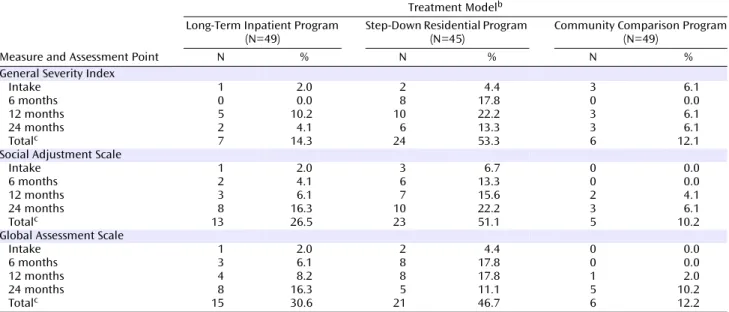
Table 3 displays the rates of clinically significant im-provement in the three groups over time. It shows that a total of 24 patients (53%) in the step-down group scored below the cutoff point for symptom severity (the criterion for a clinically relevant change) by 24 months, compared with only seven (14%) and six (12%) in the inpatient and community psychiatric groups, respectively. The differ-ence was highly significant (χ2=23.93, df=2, p<0.001).
Improvement in social adaptation as shown in total So-cial Adjustment Scale score was more marked in the two Cassel Hospital groups than in the general psychiatric group (Table 2). After we controlled for marital status and mood disorder, we found a highly significant effect of time (Wilks’s lambda=0.83; F=9.37, df=3, 136, p<0.001) and a significant interaction between group and time factors (Wilks’s lambda=0.85; F=3.92, df=6, 272, p<0.001). The difference between groups in number of patients who reached clinically significant improvement in social adap-tation was significant (χ2=26.62, df=2, p<0.001). Only five
patients (10%) in total in the general psychiatric group were improved according to criteria by 24 months com-pared with 13 (27%) in the inpatient group and 23 (51%) in the step-down group.
Results of the global assessment of mental health mea-sure showed that patients in the step-down condition achieved most marked improvements relative to the other two groups. The ANCOVA revealed a significant time fac-tor (Wilks’s lambda=0.66; F=23.42, df=3, 137, p<0.001) and a significant group-by-time interaction (Wilks’s lambda= 0.91; F=2.24, df=6, 274, p<0.05) after we controlled for mood disorder. By 24 months, a total of 21 patients (47%) in the step-down group achieved a clinically significant in-crease in global assessment of mental health score, com-pared with 15 patients (31%) in the inpatient group and six patients in the general psychiatric condition (χ2=19.98,
df=2, p<0.001).
Clinical and Service Utilization Outcomes
Table 4 shows figures concerning clinical outcomes in the three groups at the different assessment points.
The number of patients who engaged in at least one episode of self-mutilation decreased markedly by 12 and 24 months in the step-down sample, whereas it increased at 12 months in the inpatient group and marginally de-creased in the general psychiatric group by 24 months. The hierarchical logistic regression showed that the model including self-mutilation the year before intake and group status was predictive of self-mutilation at 12 months (χ2=60.48, df=3, p<0.001), with membership in the inpatient program contributing to the prediction (B= 1.91 [SE=0.59], df=1, p<0.002). Similarly, predicting self-mutilation at 24 months from the covariates and group membership yielded a highly significant model (χ2=
TABLE 2. Symptom Severity and Adjustment Over 2 Years in 143 Personality Disorder Patients Assigned to One of Three Treatment Models
Measure and Assessment Point
Treatment Modela Long-Term Inpatient Program
(N=49)
Step-Down Residential Program (N=45)
Community Comparison Program (N=49) Mean SD Adjusted Mean Mean SD Adjusted Mean Mean SD Adjusted Mean General Severity Index score
Intake 2.1 0.6 2.1 1.9 0.8 1.9 1.8 0.8 1.7
6 months 1.8 0.5 1.9 1.5 0.8 1.6 1.8 0.8 1.7
12 months 1.7 0.6 1.7 1.4 0.9 1.5 1.8 0.8 1.7
24 months 1.7 0.7 1.7 1.2 0.9 1.2 1.8 0.8 1.8
Positive symptom score
Intake 69.4 11.5 69.7 65.0 17.3 65.7 62.4 17.9 61.4
6 months 65.2 10.7 65.5 58.6 18.5 59.1 61.6 17.8 60.9
12 months 62.3 14.8 62.7 56.4 22.2 57.2 59.2 20.2 58.0
24 months 61.5 17.7 61.9 47.3 24.6 48.1 60.9 17.8 59.7
Social Adjustment Scale score
Intake 2.7 0.4 2.7 2.6 0.5 2.6 2.7 0.3 2.6
6 months 2.5 0.3 2.5 2.4 0.5 2.4 2.7 0.4 2.7
12 months 2.5 0.5 2.5 2.2 0.6 2.2 2.7 0.3 2.7
24 months 2.3 0.4 2.3 2.0 0.5 2.1 2.7 0.4 2.6
Global Assessment Scale score
Intake 46.0 7.6 45.9 46.8 6.4 46.5 45.0 6.5 45.4
6 months 49.3 7.9 49.0 53.4 9.8 42.9 46.6 8.2 47.3
12 months 51.1 9.7 50.8 58.0 14.3 57.5 48.5 7.8 49.3
24 months 54.7 13.2 54.3 60.7 14.8 59.9 50.3 7.8 51.5
aThe long-term inpatient program was a psychoanalytically oriented residential specialist program expected to last 12 months with no planned outpatient follow-up assessment. The “step-down” residential program was an expected 6-month inpatient stay followed by 12–18 months of outpatient group analytic psychotherapy and 6–9 months of concurrent outreach nursing. In the community comparison pro-gram, patients received standard general psychiatric care.
45.07, df=3, p<0.001). We found that membership in the step-down group was a significant parameter in the model (B=–1.03 [SE=0.52], df=1, p<0.05). The odds ratios revealed that patients in the step-down program were three times less likely to self-mutilate by 24 months (CI= 1.01–7.69), while membership in the inpatient program group predicted a 1.5 increase in self-mutilation (CI= 0.59–4.14). If we consider the number of self-mutilating episodes and divide the samples into no self-mutilation, occasional (1 to 5), and frequent (>5) episodes for each group separately, significant reduction relative to base-line was only found in the step-down patients by 12 months (Kendall’s W=0.22; χ2=9.94, df=1, p<0.003). By 24
months, a significant decrease was seen in both the step-down group (Kendall’s W=0.31; χ2=13.76, df=1, p<0.001)
and the general psychiatric group (Kendall’s W=0.82; χ2=
4.00, df=1, p<0.05) but not the long-term inpatient spe-cialist group (Kendall’s W=0.01; χ2=0.29, df=1, p=0.59).
The models that included suicide attempts the year be-fore intake, group status, and attempted suicide as the de-pendent variables were also highly significant at 12 and 24 months (χ2=31.54, df=3, p<0.001, and χ2=17.05, df=3,
p<0.001, respectively). Membership in the step-down pro-gram was revealed to be a significant parameter in the model both at 12 months (B=–1.80 [SE=0.58], df=1, p<0.002) and at 24 months (B=–1.19 [SE=0.55], df=1, p<0.04). Patients in the step-down program were six times (CI=18.87–1.95) and three times (CI=9.61–1.12) less likely to attempt suicide by 12 and 24 months, respectively.
In the year after expected discharge patients in the step-down program were 4 times less likely to be readmitted to
a psychiatric service (CI=12.50–1.32). The logistic regres-sion confirmed that this group was significantly different from the other two groups (B=–1.42 [SE=0.59], df=1, p<0.002). Only five patients (11%) in the step-down pro-gram required inpatient treatment compared with 21 (45%) and 16 (33%) of the patients belonging to the inpa-tient and general psychiatric groups, respectively. Length of inpatient episodes expressed as a trichotomous vari-able (no days, up to 14 days, above 14 days) showed that decrease in length of stay by 24 months for each group separately was highly significant for the step-down pa-tients (Kendall’s W=0.44; χ2=20.00, df=1, p<0.001) and for the general psychiatric sample (Kendall’s W=0.18; χ2=8.91,
df=1, p<0.005), but not for the inpatient sample (Kendall’s W=0.011; χ2=0.53, df=1, p=0.47).
With regard to living situation, by 24 months patients in the two specialist groups achieved a shift toward more in-dependent accommodation status, whereas no change was recorded in the general psychiatric group. The differ-ence between the groups was again significant (χ2=10.49,
df=4, p<0.04).
Significant group differences were also revealed in the number of outpatient (including day patient) psychiatric consultations by 24 months (χ2=16.84, df=2, p<0.001).
Pa-tients in the step-down program achieved significant re-ductions from baseline (Wilcoxon’s z=–2.85, p<0.005), whereas subjects in the inpatient specialist program and in the general psychiatric group maintained similar or higher levels of outpatient utilization (Wilcoxon’s z=1.09, p=0.28 and Wilcoxon’s z=–0.62, p=0.54, respectively).
TABLE 3. Rates of Clinically Significant Change in Symptom Severity, Social Adaptation, and Global Adjustment at Each As-sessment Interval in 143 Personality Disorder Patients Assigned to One of Three Treatment Modelsa
Measure and Assessment Point
Treatment Modelb Long-Term Inpatient Program
(N=49)
Step-Down Residential Program (N=45)
Community Comparison Program (N=49)
N % N % N %
General Severity Index
Intake 1 2.0 2 4.4 3 6.1
6 months 0 0.0 8 17.8 0 0.0
12 months 5 10.2 10 22.2 3 6.1
24 months 2 4.1 6 13.3 3 6.1
Totalc 7 14.3 24 53.3 6 12.1
Social Adjustment Scale
Intake 1 2.0 3 6.7 0 0.0
6 months 2 4.1 6 13.3 0 0.0
12 months 3 6.1 7 15.6 2 4.1
24 months 8 16.3 10 22.2 3 6.1
Totalc 13 26.5 23 51.1 5 10.2
Global Assessment Scale
Intake 1 2.0 2 4.4 0 0.0
6 months 3 6.1 8 17.8 0 0.0
12 months 4 8.2 8 17.8 1 2.0
24 months 8 16.3 5 11.1 5 10.2
Totalc 15 30.6 21 46.7 6 12.2
aFigures refer to changes that have remained stable through to 24 months.
bThe long-term inpatient program was a psychoanalytically oriented residential specialist program expected to last 12 months with no planned outpatient follow-up assessment. The “step-down” residential program was an expected 6-month inpatient stay followed by 12–18 months of outpatient group analytic psychotherapy and 6–9 months of concurrent outreach nursing. In the community comparison pro-gram, patients received standard general psychiatric care.
Discussion
We would like first to comment on the limitations of the study. Since the allocation to the study groups was not the result of randomization, the issue of the comparability of the groups needs to be addressed. It is likely that the hos-pitalized and comparison groups differed at referral for different kinds of treatment and that further bias may be introduced when compared groups are referred from dif-ferent geographical areas of the country even for the same kind of treatment. The confounding of type of treatment with participant characteristics could be a significant threat to the internal validity of the study. To mitigate this risk we found that the groups were relatively well matched on most demographic, diagnostic, and other clinical crite-ria, including severity, that were measured. Controlling for the three variables that were significantly different did not affect the observed differences in outcome. The two treat-ment samples comprised patients referred specifically for specialist psychotherapeutic treatment, so it could be
ar-gued that they were selected on the basis of their potential for responsiveness to such approach. In reality the strict funding arrangements introduced in the United Kingdom in 1993 (when recruitment for this study commenced) meant that only “meritorious” patients in terms of severity and chronicity of disturbance were funded for treatment at tertiary care centers such as the hospital under investi-gation.
The multicomponent nature of the treatment programs under scrutiny complicates assessments of effectiveness due to the complexity of the intervention. It is not clear if mere hospitalization, the nature of the hospital climate, or the treatments offered in the hospital or a combination of these was the effective component of the treatment. The relatively inclusive selection criteria, in specifying a single personality disorder diagnosis as sufficient to qualify for entry into the study, might have led to a heterogeneous patient group. All three samples were largely (80% or more) made up of individuals with at least one cluster B personality disorder diagnosis, and the average
partici-TABLE 4. Clinical Outcome and Service Utilization in 141 Personality Disorder Patients Assigned to One of Three Treatment Models
Variable
Treatment Modela Long-Term Inpatient Program
(N=47)
Step-Down Residential Program (N=45)
Community Comparison Program (N=49)
Self-harm N % N % N %
At least one episode
Intake 23 48.9 25 55.6 24 49.0
12 months 31 66.0 14 31.0 18 36.7
24 months 23 48.9 12 26.7 20 40.8
More than five episodes
Intake 21 44.7 19 42.2 22 44.9 12 months 23 48.9 11 24.4 17 34.7 24 months 15 31.9 8 17.8 12 24.5 Parasuicidal behavior Intake 21 44.7 25 55.6 20 40.8 12 months 19 40.4 6 13.3 18 36.7 24 months 13 27.7 7 15.6 15 30.6 Hospital admission Any length Intake 24 51.1 24 53.3 28 57.1 24 months 21 44.7 5 11.1 16 32.7
Longer than 14 days
Intake 20 42.6 20 44.4 24 49.0 24 months 18 38.3 4 8.9 11 22.4 Living situation Sheltered Intake 7 14.3 4 8.9 9 18.4 24 months 3 6.4 1 2.2 9 18.4
With family of origin
Intake 9 18.4 6 13.3 5 10.2
24 months 6 12.8 2 4.4 3 6.1
Independent accommodation
Intake 33 67.3 45 77.8 35 71.4
24 months 38 80.9 42 93.3 37 75.5
Median Median Median
Outpatient psychiatry visits
Intake 25 28 25
24 months 43 8 24
aThe long-term inpatient program was a psychoanalytically oriented residential specialist program expected to last 12 months with no planned outpatient follow-up assessment. The “step-down” residential program was an expected 6-month inpatient stay followed by 12–18 months of outpatient group analytic psychotherapy and 6–9 months of concurrent outreach nursing. In the community comparison pro-gram, patients received standard general psychiatric care.
pant met two to three sets of diagnostic criteria; the breadth of the original inclusion criteria did not turn out to be a problem. Further limitations of the study included the lack of raters’ blindness with regard to group alloca-tion and assessment point and the asymmetrical follow-up period, which was inevitable given the unequal length of treatment and our intention to follow the natural course of the disorder.
Bearing in mind these limitations, the results showed that a step-down program comprising a medium-term residential stay in a psychosocial therapeutic milieu fol-lowed by long-term outpatient group psychotherapy and support in the external community achieved significantly greater improvement on a number of standardized and clinical outcome measures than long-term specialist resi-dential treatment alone with no outpatient follow-up or general psychiatric management. The significant decrease in self-mutilating and parasuicidal behavior and in read-mission rates along with a sustained improvement in symptom severity and social and global adjustment in the step-down group is an indication that continuing treat-ment in the community plays an important role in helping patients make the transition between hospital and com-munity life. We suggest that providing a long-term outpa-tient specialist psychosocial aftercare program seems to protect patients from the anxieties connected with dis-charge from the hospital, which in turn enables them to better face the challenges of readapting to community life without breaking down (17). The initial phase of hospital-ization in a structured setting with multiple and intense therapeutic input may be an important component of the treatment of individuals with severe personality disorders to initiate a process of reversal of entrenched patterns of dysfunctional behavior, expressed as severe symptoms or self-destructive acting out. However, recent purely com-munity-based approaches to the treatment of personality disorders may suggest that admission to a hospital milieu could be avoided with no detriment to effectiveness (7, 8, 18). Hospital treatment for 6 months or 12 months is no longer regarded as realistic treatment options for the treat-ment of personality disorders in North America, as third-party payers regard the cost associated with inpatient ad-mission as excessive. However, we have shown that the cost of specialist inpatient admission relative to that of treatment as usual reduces health and social care cost in the year after treatment termination, and if the savings are maintained the cost of treatment would be offset within 5 years for patients in the step-down program (19). Thus, a long-term program that includes a 6-month inpatient stay might be in part justifiable in economic terms, at least in countries where socialized health care would require that these severely problematic individuals receive treatment.
In contrast, the findings concerning long-term special-ist residential treatment were mixed. Compared with the general psychiatric group, the inpatient group did gener-ally better in symptom reduction, social adaptation, and
global outcome but showed comparable results in clinical and service utilization variables. When the planned length of hospitalization is excessive, this may carry risks in the shape of regressive and iatrogenic effects, as the results in self-harming and parasuicidal behavior confirmed. In ad-dition, the lack of a planned outpatient follow-up treat-ment leaves patients to a state of continuing vulnerability to acute decompensations as shown by the unchanged rate of readmissions to psychiatric services in the year fol-lowing expected discharge.
In conclusion, this study suggests that medium-term residential psychotherapeutic treatment as part of a long-term step-down program may be an important compo-nent for the effective treatment of severe personality dis-orders, while the role of long-term inpatient stay may need redefining. Further comparative studies that include a partial hospitalization program or a specialist outpatient program are needed to ascertain that a phase of specialist residential hospitalization is in fact necessary for achiev-ing a better outcome with this group of patients.
Received Oct. 30, 2001; revisions received Oct. 8, 2002, and March 19, 2003; accepted Nov. 21, 2003. From The Cassel Hospital, Rich-mond, U.K.; and the North Devon Healthcare NHS Trust, Barnstaple, U.K. Address reprint requests to Dr. Chiesa, The Cassel Hospital, Rich-mond, TW10 7JF, U.K.; [email protected] (e-mail).
Supported by grants from the Sir Jules Thorn Charitable Trust, the Welton Foundation, and the International Psychoanalytical Associa-tion Research Advisory Board.
The authors thank the following researchers for help with data col-lection: Eduardo Iacoponi, M.D.; Alice Levinson, M.D.; Ilan Diamant, Ph.D.; Jaques China, Ph.D.; and Anna Harrison-Hall, B.Sc.
References
1. Main T: The concept of the therapeutic community: variations and vicissitudes, in The Ailment and Other Essays. Edited by Johns J. London, Free Associations Books, 1989, pp 123–141 2. Kernberg OF: Severe Personality Disorders: Psychotherapeutic
Strategies. New Haven, Conn, Yale University Press, 1984 3. Skodol AE, Siever LJ, Livesley WJ, Gunderson JG, Pfohl B, Widiger
TA: The borderline diagnosis: biology, genetics and clinical course. Biol Psychiatry 2002; 51:951–963
4. Soloff PH: Psychopharmacology of borderline personality dis-order. Psychiatr Clin North Am 2000; 23:169–192
5. Wallerstein RS: Forty-Two Lives in Treatment: A Study of Psy-choanalysis and Psychotherapy. New York, Guilford Press, 1986 6. Gabbard GO, Coyne L, Allen JG, Spohn H, Colson DB, Vary M: Evaluation of intensive inpatient treatment of patients with se-vere personality disorders. Psychiatr Serv 1999; 51:893–898 7. Linehan MM, Heard HL, Armstrong HE: Naturalistic follow-up
of a behavioral treatment for chronically parasuicidal border-line patients. Arch Gen Psychiatry 1993; 50:971–974
8. Clarkin JF, Foelsch PA, Levy KN, Hull JW, Delaney JC, Kernberg OF: The development of a psychodynamic treatment for pa-tients with borderline personality disorder: a preliminary study of behavioral change. J Personal Disord 2001; 15:487–495 9. Hyler SE: Personality Diagnostic Questionnaire 4. New York,
New York State Psychiatric Institute, 1994
10. Spitzer RL, Williams JBW, Gibbon M, First MB: Structured Clini-cal Interview for DSM-III-R Personality Disorders (SCID-II). Wash-ington, DC, American Psychiatric Press, 1990
11. Nelson HE: National Adult Reading Test (NART) Test Manual. Windsor, UK, National Foundation for Educational Research-Nelson, 1982
12. Derogatis LR: SCL-90-R: Administration, Scoring, and Proce-dures Manual, II. Towson, Md, Clinical Psychometric Research, 1983
13. Weissman MM: The assessment of social adjustment. Arch Gen Psychiatry 1975; 32:357–365
14. Endicott J, Spitzer RL, Fleiss JL, Cohen J: The Global Assessment Scale: a procedure for measuring overall severity of psychiatric disturbance. Arch Gen Psychiatry 1976; 33:766–771
15. Bateman A, Fonagy P: Effectiveness of partial hospitalization in the treatment of borderline personality disorder: a random-ized controlled trial. Am J Psychiatry 1999; 156:1563–1569
16. Jacobson N, Truax P: Clinical significance: a statistical approach to defining meaningful change in psychotherapy research. J Consult Clin Psychol 1991; 59:12–19
17. Gunderson JG: The borderline patient’s intolerance of alone-ness: insecure attachments and therapist availability. Am J Psy-chiatry 1996; 153:752–758
18. Bateman A, Fonagy P: Effectiveness for psychotherapeutic treatment of personality disorder. Br J Psychiatry 2000; 177: 138–143
19. Chiesa M, Fonagy P, Holmes J, Drahorad C, Harrison-Hall A: Health service use costs by personality disorder following spe-cialist and non-spespe-cialist treatment: a comparative study. J Per-sonal Disorders 2002; 16:160–173