<Insert Picture Here>
Lars Thalmann
Development Director, MySQL
Replication, Backup & Connectors
An API for Reading the MySQL Binary Log
Mats Kindahl
Lead Software Engineer, MySQL
Replication & Utilities
3
The following is intended to outline our general
product direction. It is intended for information
purposes only, and may not be incorporated into any
contract. It is not a commitment to deliver any
material, code, or functionality, and should not be
relied upon in making purchasing decisions.
The development, release, and timing of any
features or functionality described for Oracle’s
products remains at the sole discretion of Oracle.
4
Outline
•
Replication Architecture
•
Binary logs
•
Binary log event
•
Reading binary log
–
Connecting to server
–
Reading from files
•
Reading events
–
Queries
–
Reading rows (row-based replication)
–
Other events
5
Replication Architecture
Master
Slave(s)
C lie nt s Changes6
I/O
SQL
Databa
se
Replication Architecture
Client
Dump
Dump
Dump
Binary Log
Session
Session
Session
I/O
SQL
Databa
se
I/O
SQL
Databa
se
Master
Slave(s)
7
I/O
SQL
Databa
se
Replication Architecture
Client
Dump
Dump
Dump
Binary Log
Relay Log
Session
Session
Session
I/O
SQL
Databa
se
I/O
SQL
Database
Master
Slave(s)
8
Replication to other systems
Client
Binary Log
Dump
Session
Session
Session
Master
Relay Log I/O SQL Database Slave(s)HBase
SOLR
Full-text indexingData Mining
?
Dump
Dump
Dump
9
Transforming events
SOLR
A
PI Transformer
Se
rve
r
Fi
le
Subject of our presentation
10
Binlog API
•
Library to process replication events
•
API is ready for use
•
Goals:
–
Simple
–
Extensible
11
<Insert Picture Here>
How to capture events
Binlog API
●The replication listener
12
<Insert Picture Here>
First example
#include <cstdlib> #include <iostream> #include <binlog_api.h> int main(int argc, char *argv[]) { const char *url = “mysql://[email protected]:3360”; Binary_log binlog(create_transport(url)); binlog.connect(); Binary_log_event *event; while (true) { int result = binlog.wait_for_next_event(&event); if (result == ERR_EOF) break; cout << “ at “ << binlog.get_position() << “ event type “ << event.get_type_code() << endl; } return EXIT_SUCCESS; }13
<Insert Picture Here>
Create network transport
#include <cstdlib> #include <iostream> #include <binlog_api.h> int main(int argc, char *argv[]) { const char *url = “mysql://[email protected]:3360”; Binary_log binlog(create_transport(url)); binlog.connect(); Binary_log_event *event; while (true) { int result = binlog.wait_for_next_event(&event); if (result == ERR_EOF) break; cout << “ at “ << binlog.get_position() << “ event type “ << event.get_type_code() << endl; } return EXIT_SUCCESS; }
14
<Insert Picture Here>
… or file transport
#include <cstdlib> #include <iostream> #include <binlog_api.h> int main(int argc, char *argv[]) { const char *url = “file:///tmp/binlog.0000001”; Binary_log binlog(create_transport(url)); binlog.connect(); Binary_log_event *event; while (true) { int result = binlog.wait_for_next_event(&event); if (result == ERR_EOF) break; cout << “ at “ << binlog.get_position() << “ event type “ << event.get_type_code() << endl; } return EXIT_SUCCESS; }15
<Insert Picture Here>
Connect the transport
#include <cstdlib> #include <iostream> #include <binlog_api.h> int main(int argc, char *argv[]) { const char *url = “file:///tmp/binlog.0000001”; Binary_log binlog(create_transport(url)); binlog.connect(); Binary_log_event *event; while (true) { int result = binlog.wait_for_next_event(&event); if (result == ERR_EOF) break; cout << “ at “ << binlog.get_position() << “ event type “ << event.get_type_code() << endl; } return EXIT_SUCCESS; }
16
<Insert Picture Here>
Digression: set read position
•
Default: start at beginning
•
Set position explicitly:
if (binlog.set_position(file, pos))
{
/* Handle error */
}
17
<Insert Picture Here>
Read events
#include <cstdlib> #include <iostream> #include <binlog_api.h> int main(int argc, char *argv[]) { const char *url = “file:///tmp/binlog.0000001”; Binary_log binlog(create_transport(url)); binlog.connect(); Binary_log_event *event; while (true) { int result = binlog.wait_for_next_event(&event); if (result == ERR_EOF) break; cout << “ at “ << binlog.get_position() << “ event type “ << event>get_type_code() << endl; } return EXIT_SUCCESS; }Get event
18
Steps summary
•
Create a transport
–
create_transport
•
Connect to server
–
connect
•
Set position
–
set_position
•
Start event loop
19
<Insert Picture Here>
Reading information in events
Binlog API
●The replication listener
20
Binlog Event Structure
Post-header
Variable Part
Common Header
•
Common header
•
Generic data
•
Fixed size
•
Post-header
•
Event-specific data
•
Fixed size
•
Variable part
•
Event-specific data
•
Variable size
21
<Insert Picture Here>
Reading the header
•
Read common header
–
header()
•
Access fields
switch (event>header()>type_code) {
case QUERY_EVENT:
…
case USER_VAR_EVENT:
…
case FORMAT_DESCRIPTION_EVENT:
…
}
22
Binlog Event Common Header
19 Bytes
4 bytestimestamp
type_code
server_id
event_length
flags
next_position
•
Data common to all events
•
Next Position
– One-after-end of event
•
Timestamp
– Statement start time
•
Flags
– Binlog-in-use – Thread-specific – Suppress “use” – Artificial – Relay-log event23
Binlog Event Structure
Post-header
Variable Part
Common Header
•
Common header
•
Generic data
•
Fixed size
•
Post-header
•
Event-specific data
•
Fixed size
•
Variable part
•
Event-specific data
•
Variable size
24
Query Event
•
Most common event
•
Used for statements
•
Statement logged
literally
–
… in almost all cases
query
Common Header thread_id exec_time error_codestd::vector<uint8_t> variables
Specia
l case
: nee
d to
be de
coded
db_name
25
<Insert Picture Here>
Reading event data
•
Cast to correct event type
•
Access fields
switch (event>header()>type_code) {
case QUERY_EVENT:
Query_event *qev =
static_cast<Query_event*>(event);
cout << qev>query << endl;
break;
case USER_VAR_EVENT:
…
case FORMAT_DESCRIPTION_EVENT:
…
}
26
<Insert Picture Here>
27
<Insert Picture Here>
Event-driven API
•
Content handlers
28
Saving user-defined variables
class
Save_handler
: public Content_handler
{ … };
Save_handler::Map vars;
Save_handler save_vars(vars);
binlog.content_handler_pipeline()
>push_back(&save_vars);
29
<Insert Picture Here>
User-defined variables
class Save_handler : public Content_handler {
public:
typedef std::map<std::string, std::string> Map;
Save_handler(Map &container) : m_var(container)
{ }
Binary_log_event *
process_event(User_var_event *event) {
m_var[event>name] = event>value;
return NULL;
}
private:
Map &m_var;
};
30
Replace handler
class
Replace_vars :
public Content_handler
{
Binary_log_event *
process_event(Query_log_event *event)
{
/* Code to replace variables */
}
};
Ful
l e
xam
ple
: b
asic
-2
.cp
p
31
<Insert Picture Here>
Example two:
How to capture live row changes
Binlog API
●The replication listener
32
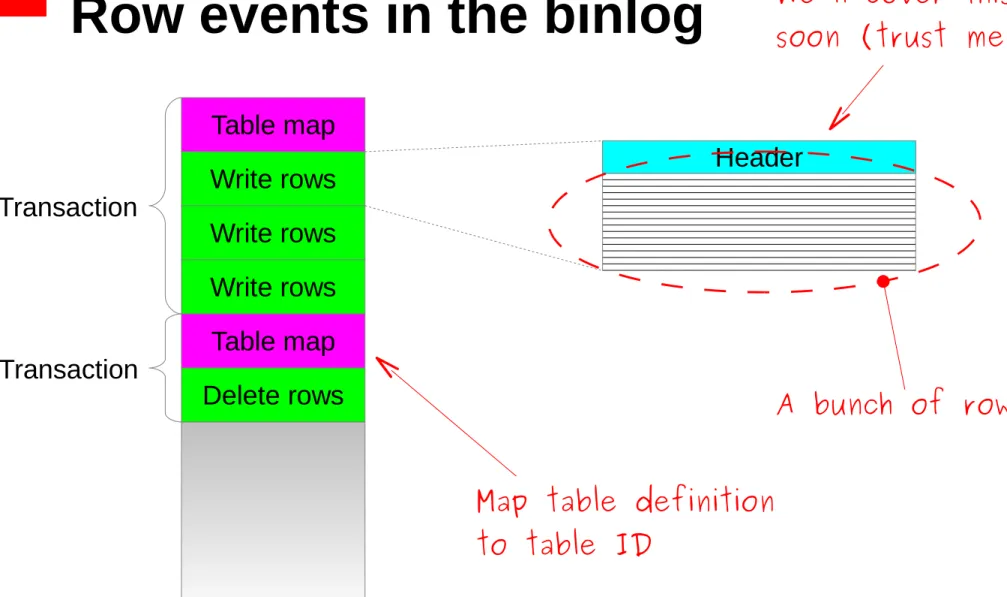
Row events in the binlog
Table map
Write rows
Write rows
Write rows
Table map
Delete rows
Transaction
Transaction
Header
Map table definition
to table ID
We'll cover this
soon (trust me)
33
Capturing row events
class
Row_event_handler :
public Content_handler
{
public:
Binary_log_event *
process_event(Row_event *event)
{
switch(ev>header()>type_code)
{
case WRITE_ROWS_EVENT:
case UPDATE_ROWS_EVENT:
case DELETE_ROWS_EVENT:
...
34
Capturing row events
•
The *_ROWS_EVENT
uint64_t table_id;
uint16_t flags;
uint64_t columns_len;
uint32_t null_bits_len;
vector<uint8_t> columns_before_image;
vector<uint8_t> used_columns;
vector<uint8_t> row;
Raw row data
Defined in the
table map event
35
Reading rows
•
Wrap raw row data in
Row_event_set
•
Iterate over rows using iterator
Row_event_set rows(row_event, table_map_event);
Row_event_set::iterator it= rows.begin();
You need to have
36
Reading fields of a row
•
Row_of_fields
to iterate fields of a row
–
Turns
row
into
row of fields
sequence
Row_event_set rows(row_event, table_map_event);
for (Row_event_set::iterator it = rows.begin() ;
it != rows.end() ;
++it)
37
Reading fields of a row
•
Iterate over fields in Row_of_fields
void table_delete (..., const Row_of_fields& fields)
{
Row_of_fields::iterator it= fields.begin();
for (int id = 0 ; it =! fields.end() ; ++it, ++id) {
std::string str;
Converter().to(str, *it);
std::cout << id << "= " << str << std::endl;
}
}
38
Decoding a field
•
Iterate over fields in Row_of_fields
void table_delete (..., const Row_of_fields& fields)
{
Row_of_fields::iterator it= fields.begin();
for (int id = 0 ; it =! fields.end() ; ++it, ++id) {
std::string str;
Converter().to(str, *it);
std::cout << id << "= " << str << std::endl;
}
}
39
Summary – what's it for?
•
Replicate to other systems
–
Hbase, SOLR, etc.
•
Triggering on specific events
–
Call the DBA when tables are dropped?
–
Monitor objects in database
•
Browsing binary logs
–
Extract subset of changes (by table, by execution time, etc.)
–
Statistics
•
Component in building other solutions
–
Point-in-time restore
40
Summary – what we've covered
•
Reading events
•
Creating content handlers
•
Processing queries
•
Processing rows
•
Reading fields
41
•
Available at labs
–
http://labs.mysql.com/
•
Source code available at launchpad
–
http://launchpad.net/mysql-replication-listener
•
MySQL High Availability
Get it as free ebook: http://oreilly.com/go/ebookrequest
Valid this week, mention event “MySQL Replication
Update”