R E S E A R C H O N M O N E Y
A N D F I N A N C E
Discussion Paper no 16
FINANCIALISATION AND CAPITALIST ACCUMULATION:
STRUCTURAL ACCOUNTS OF THE CRISIS OF 2007-9
Costas Lapavitsas
School of Oriental and African Studies, University of London
Research on Money and Finance
February 2010
Research on Money and Finance Discussion Papers
RMF invites discussion papers that may be in political economy, heterodox economics, and economic sociology. We welcome theoretical and empirical analysis without preference for particular topics. Our aim is to accumulate a body of work that provides insight into the development of contemporary capitalism. We also welcome literature reviews and critical analyses of mainstream economics provided they have a bearing on economic and social development.
Submissions are refereed by a panel of three. Publication in the RMF series does not preclude submission to journals. However, authors are encouraged independently to check journal policy.
Costas Lapavitsas, Address: Department of Economics, Soas, Thornhaugh Street, Russell Square, London, WC1H 0XG, Britain. Email: [email protected].
Research on Money and Finance is a network of political economists that have a track record in researching money and finance. It aims to generate analytical work on the development of the monetary and the financial system in recent years. A further aim is to produce synthetic work on the transformation of the capitalist economy, the rise of financialisation and the resulting intensification of crises. RMF carries research on both developed and developing countries and welcomes contributions that draw on all currents of political economy.
Research on Money and Finance Department of Economics, SOAS Thornhaugh Street, Russell Square
London, WC1H 0XG Britain www.soas.ac.uk/rmf
Abstract
The crisis of 2007-9 resulted from a financial bubble marked by weak production, expanding bank assets, and growing household indebtedness. For these reasons the crisis casts light on the financialisation of capitalist economies. The literature on financialisation generally links weak production with booming finance; according to some, causation runs from weak production to booming finance, while for others it runs in the opposite direction. This article argues that there is no direct causation between booming finance and weak production. Rather, financialisation represents systemic transformation of capitalist production and finance, which ultimately accounts for the crisis of 2007-9, and has three main features. First, less reliance of large corporations on banks; second, banks shifting their activities toward mediating in open markets and transacting with individuals; third, increasing implication of individuals in the operations of finance.
1. Introduction 1
The upheaval of 2007-9 has no historical parallel. It emanated in finance and spread to production partly through financial mechanisms. Its global character was largely due to securitisation which encouraged adoption of investment banking practices among commercial banks. Above all, its proximate causes lay in mortgage lending to the poorest sections of the US working class.
Not surprisingly, there has been a flood of writings on the crisis within radical political economy and heterodox economics. Some have relied on traditional arguments of Marxist political economy, typically emphasising over-accumulation and falling profit rates. Others have stressed the financialisation of capitalism, and therefore the exceptional role of finance in causing the crisis. These approaches are far from mutually exclusive, indeed use of the term financialisation has become increasingly commonplace. But they reveal an underlying concern that traditional explanations fare poorly in relation to this crisis.
The concept of financialisation, in contrast, holds considerable theoretical promise. It is one of a few innovative ideas to come out of radical political economy in recent years. For one thing, it seems capable of relating the unusual features of the crisis to the secular growth of finance. For another, it gives insight into the structural transformation of capitalist economies with its attendant social implications. To be sure the concept is still raw and undeveloped, as is shown by considering some of the literature below. But there is no denying its power.
In this light, section 2 of this paper offers an empirical account of the crisis that demonstrates its peculiar character, above all, with regard to finance and particularly the role of household debt. Section 3 then discusses some of the literature on financialisation and the crisis, paying attention to Marxist, post-Keynesian and other heterodox works which propose causal links between problematic production (the ‘real’ economy) and thriving finance (the financial sector). Section 4 considers theoretical and empirical problems that arise when such links are postulated. It is argued that causation between production and finance is not direct but heavily
1
This article is based on a keynote address to the annual conference of Japan Society for Political Economy (Keizairiron Gakkai), Tokyo University, November 2009. Thanks are due to several JSPE members, who have been friends to me for many years. The article also draws heavily on the work of the network Research on Money and Finance. All errors and omissions are the author’s fault.
mediated, while running in both directions. On this basis, section 5 draws on the methodological approach of classical Marxism to put forth a view of financialisation as systemic transformation of mature capitalist economies which ultimately accounts for the crisis of 2007-9. Section 6 concludes.
2. A crisis of financialisation, 2007-9
The crisis of 2007-9 is replete with peculiar characteristics due to the role of the financial sector. Its outbreak reflects the ascendancy of finance in contemporary economies or, more accurately, financialisation. Empirical analysis of the crisis is vital to navigating amidst contesting theoretical accounts of financialisation in subsequent sections of this article.
The crisis broke out in the financial sector of the USA and other leading developed countries, subsequently spreading across the world economy. 2 Consequently, analysis in this section focuses on the USA, Japan, Germany, and the UK during 2001-7, using primarily flow of funds statistics. There are problems of comparability and consistency with this data, and it should be used with caution when cross-country comparisons are attempted. But it is adequate for capturing the underlying processes leading to the crisis.
The proximate roots of the upheaval lie in the expansion of US mortgage lending after 2001:
<Fig 1 here>
Mortgage originations rose rapidly as interest rates were reduced after 2001, but peaked in 2003 as the prime market became increasingly saturated. At that time subprime mortgages began to rise steeply, thus supporting overall mortgage lending. Rapid increase was possible because up to 80% of subprime mortgages were securitised.
2
Analysis in this section focuses entirely on the domestic economy of leading capitalist countries. Needless to say, both the crisis and financialisation have prominent international dimensions, above all, capital flows from poor to rich countries, for which see Painceira (2009) and Lapavitsas (2009a). These, however, do not matter the purposes of this article.
A vast US housing bubble ensued, which had repercussions on financial institutions across the world as securitised mortgage-based assets were traded internationally. The UK had its own housing bubble during the same period, but there were no similar phenomena in Japan and Germany. Consequently, the impact on financial institutions varied considerably among the four countries, as is clear from the behaviour of commercial bank assets:
<Fig. 2 here>
Commercial banking in Japan and Germany barely grew during the period, while growth appears modest in the USA because non-bank financial institutions took the lead in the housing bubble. But securitisation created close links between the non-bank sector and US commercial non-banks, causing the ultimate downfall of the latter. A more revealing picture of the role of commercial banks is given by the UK, where assets rose enormously, reaching five times GDP.
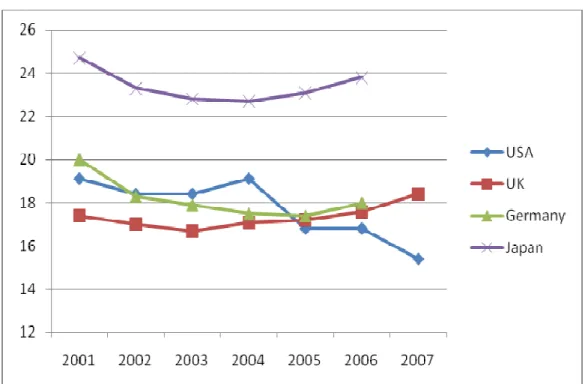
Elementary banking theory indicates that expansion of assets has to be matched by appropriate rebalancing of liabilities. In this light, consider bank leverage measured as plain equity in proportion to assets:
<Fig. 3 here>
There are significant problems of data comparability and measurement in this connection, but it is safe to state that leverage has been significantly lower among US commercial banks. This probably reflects lower holdings of government bonds (which carry a higher capital adequacy coefficient) forcing US banks to keep higher proportions of equity. German banks show no great fluctuations in this regard, in contrast to Japanese banks, which reflect the long-running turmoil in Japanese finance. British commercial banks, once again, offer a more revealing picture, also casting light on the practices of US investment banks and non-bank institutions: UK bank leverage rose steadily.
The implications are evident. Return on equity can be disaggregated as RoE =
Π / E = (Π / A) * (A / E), where Π is profit, E is equity and A is assets. The rise in leverage, A / E, supported high profitability for equity holders. Banking profits in the
UK and the USA in the 2000s depended on banks expanding assets while lowering equity. There is little evidence of skill in lending.
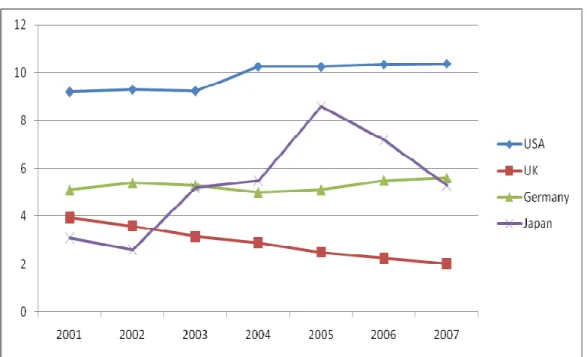
But who accumulated the debt that matched growing bank assets, thus supporting bank profits in the 2000s? The traditional site for such debt would be the corporate sector. Consider, then, the leverage of non-bank corporations, defined as debt to equity:
<Fig. 4 here>
It is apparent that indebtedness did not rise significantly within the productive sector. There is considerable variation within the four countries but, in general, indebtedness declined or remained fairly stable throughout the period. This is consistent with the evidence on investment which, as figure 5 shows, remained practically stagnant, or declined significantly in all four countries. The fall in investment was most pronounced in the USA, the country at the epicentre of the bubble:
<Fig. 5 here>
A further potential venue for debt accumulation would have been the public sector. However, as is shown in figure 6, there was no significant rise in public debt in the USA, the UK and Germany. Public debt escalated even further in Japan, but the causes were clearly associated with the country’s internal travails since the early 1990s.
<Fig. 6 here>
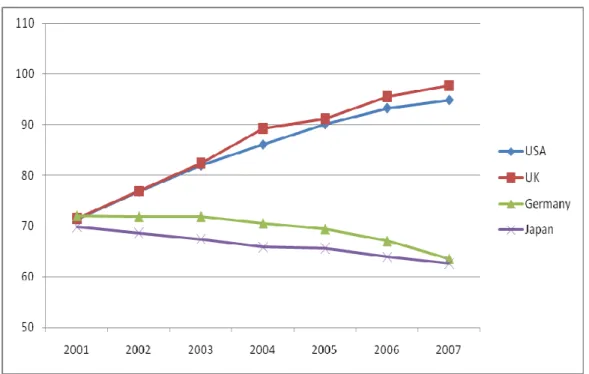
Since the relevant debt accumulation occurred neither in the corporate, nor in the public sector, inevitably household debt rose to support bank profits:
<Fig. 7 here>
The four countries present a very different picture with regard to household debt. While indebtedness among German and Japanese households fell, that among
US and UK households rose steeply. The bulk of this debt - up to 80% - was due to mortgages. Bank profitability was supported by mortgaged household incomes as workers and other social layers were caught in a housing bubble. Indeed, the weight of unsecured consumer debt fell in the late 2000s, especially in the UK. This is consistent with the performance of consumption during the bubble. Contrary to what has often been asserted in public debate, consumption relative to GDP remained at best stable, or even fell in Germany and the UK. At the root of this phenomenon lay stagnant real wages.
<Fig 8 here>
To recap, a pure financial bubble occurred in 2001-7, fed by mortgage credit and sustained by securitisation. Banks and other financial institutions grew rapidly in the USA and the UK, sustaining profitability through higher leverage. During this period the real sector performed indifferently, and investment even fell in the USA. This is a notable difference with the Japanese real estate and stock market bubble of the 1980s, during which private investment rose significantly.
Furthermore, corporate and public indebtedness did not escalate. Rather, the debt that supported bank profits was accumulated by the household sector, primarily in the USA and the UK. Much of this debt was acquired by the least creditworthy layers of the working class as subprime lending surged. When repayment difficulties materialised among the poorest workers, the bubble came to an end, and banks went prostrate. The world recession that followed in 2008-9 was in large measure induced by shrinkage of credit and collapsing demand.
It is historically unprecedented for a global crisis to be precipitated by debt default among the poorest workers. The global dimension of the crisis, moreover, is largely due to securitisation that spread problematic mortgage debt across the world. This is a further vital difference with the Japanese bubble of the 1980s, which remained a local occurrence. In these respects, the crisis reflects the transformation of mature capitalist economies in recent decades, and more specifically the advance of financialisation. Consider, therefore, some of the responses of radical political economy to the issues posed by financialisation in general, and the crisis in particular.
3. Radical approaches to financialisation and the crisis of 2007-9
3.1 Marxist political economy of financial expansion
The Marxist current of Monthly Review, guided by Sweezy and Magdoff, put forth original insights on financialisation already in the 1970s. 3 Capitalist accumulation in the twentieth century is characterised by three trends: first, slowing down of the rate of growth, second; second, rise of monopolistic multinational corporations; third, financialisation (Sweezy 1997). These trends are associated with the fundamental problem of the ‘absorption of the surplus’ that presumably characterises mature capitalism (Baran and Sweezy 1966).
Specifically, monopolies generate an ever expanding surplus, which cannot be absorbed by the sphere of production, resulting in stagnation. To relieve stagnation, unproductive consumption (including pure waste) inexorably rises in mature capitalism. It is apparent that this argument is quite different from the analysis of accumulation and falling profit rates within classical Marxism. What matters here, however, is the use to which it was put when economic turmoil took hold in the 1970s. Briefly put, as production stagnated under the weight of the surplus, capital began to seek refuge in circulation, and above all in the speculative activities of finance. Financialisation emerged as the sphere of production became inundated by the investible surplus.
It is a measure of Sweezy’s brilliance as political economist that he surmised the future weight of finance already in the 1970s, particularly in view of the relative neglect of finance in his work. But then Sweezy was one of the first Anglo-Saxon Marxist economists to have become familiar with Hilferding’s writings. Indeed, he was fully aware of the classical continental tradition on the role of finance in capitalist accumulation. The apprenticeship he had served under Schumpeter stood him in good stead in this regard.
The argument that finance has expanded because the sphere of production faces endogenous difficulties has proven very influential, even when the rest of
3
See Magdoff and Sweezy (1987). Bellamy Foster (2007, 2008) offers a clear account of the use and meaning of the term for Monthly Review. The recently published book by Foster and Magdoff (2009) places the crisis of 2007-9 in the context of the current’s approach. Note that Pollin (2004) has lauded Sweezy’s early awareness of financialisation, acknowledging his own debt to it.
Monthly Review analysis has not been accepted. Political economy explanations of the crisis of 2007-9 typically stress the contrast between troubled production and thriving finance. The underlying view is that capital has confronted problematic profitability by seeking financial profits. But at some point the potency of the financial escape declined, and crisis manifests itself.
The most sophisticated and influential variant of this argument has been offered by Brenner (2002, 2006, 2009), who has linked stagnation in the sphere of production to Marx’s theory of the tendency of the rate of profit to fall. Since the late 1960s sustained overcapacity in production has exacerbated competition, thus lowering profit rates. Incumbent enterprises have protected their positions, preventing a resurgence of profit rates, and leading to permanent, if latent, crisis in the sphere of production. Actual crisis has been evaded by palliatives, such as boosting demand through exchange rate manipulation and encouraging cheap credit. When credit creation spurred by the Federal Reserve in 2001 had run its course, the underlying reality of problematic production manifested itself and the world was plunged into crisis.
Brenner’s account of the tendency of the rate of profit to fall has little in common with Marx’s. 4 However, this has not mattered in this connection. Far more important has been that Brenner treats the upheaval fundamentally as a crisis of over-accumulation and falling profit rates. Writings by Harman (2009 and, much more succinctly, 2010) and Callinicos (2010) have shared this point, without necessarily accepting Brenner’s core theoretical analysis. For both, financial expansion and credit provision were able to create periods of prosperity, but as soon as credit growth had run its course, the underlying crisis burst out.
Harman and Callinicos are keen to defend the explanatory power of Marx’s tendency of the rate of profit to fall (or their interpretation of it) over the crisis of 2007-9. They share the strong underlying perception that unless the ‘true’ roots of the crisis were shown to lie in production, the crisis would appear to be non-systemic, possibly the result of policy errors, or speculative excesses. Unlike Brenner, however, both openly accept that financialisation is a notable trend of contemporary capitalism.
4
As was made clear by several contributors to two special issues of Historical Materialism (vol. 4, no 1, 1999, and vol. 5, no. 1, 1999) dedicated to Brenner’s original argument.
They do not offer a systematic definition of it, but superimpose financial expansion on the presumably fundamental process of over-accumulation. 5
In these respects both books are characteristic of the strand of writing that seeks to reassert the explanatory power of over-accumulation theory over the crisis. It is also notable that such writing is often laced with references to Marx’s (1981: 567) concept of fictitious capital. At core this is a technical idea amounting to net present value accounting, i.e. ideal sums of money that result through discounting streams of future payments attached to financial assets. These ideal sums correspond to financial prices, which can fluctuate independently of what has happened to the money capital originally expended to purchase a financial asset. In that obvious sense, financial prices, particularly those on the stock-market, represent fictitious capital. 6
Fictitious capital can offer insight into the operations of finance, as is shown briefly below with reference to Hilferding. But fictitious capital can also be a widow’s cruse of extraordinary arguments regarding the financial sector. The huge nominal values associated with some financial markets, for instance, could give the false impression that the state lacks the resources for effective intervention. Alternatively, and as is exemplified by Harman (2010), it is possible to think that bloated nominal values mean that the financial sector made ‘fictional’ profits during the bubble. The implication would be that general recorded profitability was exaggerated, and the ‘true’ profit rate was probably lower. The result of this argument is to divert attention from precisely the point that needs explaining, namely the existence of enormous financial profits while general profitability has been weak.
Confusion also occurs between fictitious capital and another of Marx’s (1981: Pt V) key ideas, namely interest-bearing or loanable money capital. This is a special type of capital that is available for lending and is remunerated through the payment of interest. Trading loanable capital could certainly give rise to fictitious capital, but loanable capital itself is anything but fictitious. Rather, it emerges from investment and consumption processes attached to capitalist accumulation, and initially takes the form of idle money. Loanable capital is a hard reality of the capitalist economy,
5
A side-effect of this approach is to create the impression that the crisis had been foreseen. In truth, those on the Left who appreciated the importance of financial events in the summer of 2007 were few and far between, at least in the UK.
6
Marx actually used the term to denote several distinct cases of financial price or traded value. But no generality is lost by considering fictitious capital as simply net present value.
affording to its holders direct claims to the national product. Financialisation reflects systemic changes in the mobilisation and use of loanable capital, as is shown in section 5.
3.2 Post-Keynesian analysis of financialisation
The analytical connection between troubled production and booming finance is also present in post-Keynesian analysis of financialisation. Epstein (2005), for instance, has stressed the increasing weight of financial activities in the economy as capital favours investment in finance rather than production. Unlike the Marxist approaches reviewed above, however, post-Keynesians stress the deleterious role of booming finance on production. The poor performance of the real sector has been caused in large measure by the expansion of the financial sector.
Post-Keynesian analysis of financialisation does not derive from Minsky, in whose work there is little on the long-term balance between finance and the rest of the economy, except brief references to ‘money manager capitalism’ in some very late output (Minsky 1996; Minsky and Whalen 1996). Rather, it is based on the concept of the rentier, and in particular the money lender as rentier. This is clear in several influential works, such as Crotty (1990), Pollin (2007), and Epstein (2005). The re-emergence of the rentier – partly due to neoliberal economic policy – has fostered financial at the expense of industrial profits. Thus, financialisation has induced poor performance in investment, output and growth in developed countries. Policy intervention is required to regulate finance – for instance, liquidity reserves of banks, direction of credit, limits on investment banking activities, and so on – resulting in improved output, employment, and income (Crotty 2008, 2009; Crotty and Epstein 2008, 2009).
The rentier, as is well known, is important to Keynes’ (1973: ch. 24) analysis of mature capitalism. A parasitical economic entity, the rentier extracts profits due to the scarcity of capital, and might thus depress investment and profitability. For Keynes, successful capitalism requires the ‘euthanasia of the rentier’ effected through low interest rates. The rentier makes only fleeting appearances in Marx’s writings, and there are no clear references to entire social strata of rentiers. But some of Marx’s (1981: ch. 21, 22, 23, 24) analysis of ‘monied’ capitalists is certainly reminiscent of
the rentier. ‘Monied’ capitalists are a section of the capitalist class that does not invest its capital in production but prefers to lend it to others. Thus, money capital available for loans is owned by the ‘monied’ section, but is put to use by the productive section, the latter paying a part of the resulting surplus value as interest to the former. Tension and opposition between the two are inevitable.
However, in Marx’s Capital there is a further and quite different approach to finance. 7 Namely, capital for loan is seen as emerging spontaneously through the operations of industrial (and other) capital, by taking the form of idle money in the first instance. It does not belong to ‘monied’ capitalists, and nor does receipt of interest define a distinct section within the capitalist class. Rather, the financial system is set of markets and institutions (operating as separate capitalist concerns) that mobilise loanable capital and support capitalist accumulation. This approach is naturally averse to treating financialisation as the triumph of the rentier over the productive capitalist. It also offers far richer insight into contemporary capitalism, as is shown below.
Be that as it may, post-Keynesian stress on the rentier shares common ground with some strains of Marxist theory. This is clear in the work of Crotty, but also more recent publications, for instance, Stockhammer (1994) and Orhangazi (2009). Much of this output has a strong empirical dimension, seeking to show that the rentier has a depressing effect on the real sector, typically trough constraining available investment funds and/or lowering the returns of industrial capitalists. Broad affinities between post-Keynesian and Marxist theory along similar lines are also apparent in the output of the ‘finance-led capitalism’ current (Hein, Niechoj, Spahn and Truger 2008; Evans 2009).
3.3 Other heterodox approaches to financialisation
Two other approaches to financialisation, both associated with Marxist theory, merit further mention. The first relates to Arrighi (1994), who places financialisation within an ambitious cyclical theory of the world economy since the early modern era. Hegemonic capitalist formations follow a cyclical pattern of evolution, while
7
succeeding each other. Financialisation represents autumn, that is, hegemonic power ebbs away as the hegemon’s productive powers weaken and the sphere of finance expands. Genoa, the Netherlands, Britain and the USA entered financialisation when they lost their prowess in production and trade. In decline, they became lenders, particularly to younger powers that emerged to overtake them.
From this perspective, the current crisis is another episode in the long-term decline of US hegemony. A key problem with Arrighi’s theory applied to the current era, however, is the absence of an obvious hegemonic replacement for the USA. Arrighi’s own suggestion of Japan in the Epilogue of his book was rather unfortunate, and nor is China a better bet. For, the USA has been a massive net borrower for many years, not least from Japan and China. If this is the autumn of US hegemony, it has not coincided with the US emerging as lender to the world, certainly not to China.
Nonetheless, Arrighi’s work was path-breaking in so far as it has placed financialisation within a broad historical perspective. Furthermore, it partly motivated Krippner’s (2005) innovative empirical study of US financialisation. Krippner established the rising importance of financial profits for non-financial corporations during the last five decades. Drawing attention to financial profits is a point of vital importance in analysing financialisation, as is also discussed below.
The second approach was put forth by Regulation School in the 1990s. 8 The Regulation approach to financialisation resulted partly from the long-standing interest of this School in money and finance. The presumed disintegration of Fordism has led Regulation theorists to search for a new regime of regulation, including in the sphere of finance. For Boyer (2000), the new regime of regulation has begun to be formed around financial markets, above all, the stock exchange. However, regulation through finance can have problematic effects for the performance of accumulation, including rates of growth, output and so on (Aglietta 2000; Aglietta and Breton 2001). 9
The regulationist approach has affinities with the voluminous literature on changes in corporate governance since the 1970s. ‘Shareholder value’ and the associated short-termism of corporate enterprises have attracted the interest of
8
Anglo-Saxon audiences were introduced to it largely through the journal Economy & Society particularly, but not exclusively, a seminal special issue on financialisation in 2001 (number 30).
9
For an early and balanced discussion of Regulationist analysis of financialisation see Grahl and Teague (2000).
political economists and business school writers. The widely quoted article by Lazonick and O’Sullivan (2000) demonstrated the connections between shareholder value and company downsizing as neoliberalism rose to ascendancy.
This theoretical terrain begins to overlap with the economic sociology and geography of financialisation. Economic geographers have traced the social impact of financialisation, including its implications for the spatial development of capitalism (Leyshon and Thrift 2007). Considerable work has been produced on the financialisation of individual life (Langley 2008) as well as on the cultural aspects of finance in contemporary capitalism (Pryke and Du Gay 2007).
Reviewing this literature is beyond the confines of this paper. It should be noted, however, that it is (often consciously) eclectic in its theoretical approach. Emphasis is placed on revealing key features of contemporary capitalism, almost as ‘thick description’, rather than advancing theoretical explanations. This is clearly demonstrated by the substantial and illuminating output on financialisation generated by the UK Centre for Research on Socio-Cultural Change in recent years. From early analyses of financialisation, researchers at CRESC have proceeded to discuss ‘coupon pool’ capitalism, the transformation of banking, and the emergence of new elites (Savage and Williams 2008).
4. The theoretical problem of associating weakness in production with thriving finance
Associating the rise of finance with persistent malaise of production is a source of strength for heterodox approaches to financialisation. However, difficulties emerge when causation is sought between weak production and thriving finance - whether in one direction, or the other - as tends to happen with the theories reviewed in the previous section.
Linking the performance of capitalist accumulation to the structure and performance of the financial system has a long pedigree in economic theory. The issue has been especially prominent in development economics where, in its current form, it originates with Gerschenkron (1962). Typically the debate pivots on the distinction between bank-based (or German-Japanese) versus market-based (or Anglo-American) financial systems, and their respective effectiveness in promoting
capitalist development. 10 It is indisputable that financialisation has been accompanied by gradual ascendancy and spread of market-based financial institutions and practices across the developing world.
Though this literature does not have a direct bearing on the issue of financialisation, it is notable that causation is generally taken to run from finance to real accumulation. Namely, it is assumed that, if the financial system had an appropriate design, beneficial effects would follow for economic growth. This is the basis on which the World Bank and other multilateral organisations have supported the introduction of market-based practices across the world (King and Levine 1993, Levine 1997). 11
For classical Marxist political economy, on the other hand, the relationship between finance and real accumulation is substantially more complex. For Marx, as was briefly mentioned above, the financial system in industrial capitalism comprises institutions and markets that support accumulation (Itoh and Lapavitsas 1999: ch. 4). In turn, industrial capital supports the emergence of financial capitals and structures that serve its purposes. The structure, composition, practices and operations of capitalist finance are ultimately determined by the requirements of accumulation. By the same token, the profits of financial capital arise out of surplus value generated in production. At the same time, the financial system extends and sustains accumulation in a variety of ways, such as mobilising idle money capital, creating liquidity, equalising profit rates, and so on.
In broad historical terms, for Marx, financial capital is an ancient form of economic activity, while financial processes are important to primitive accumulation. Capitalist development implies that industrial capital subordinates financial capital to its purposes, turning it into a subsidiary sector of the capitalist economy. Nonetheless, the financial system retains some of the ancient, pre-industrial character of financial capital. It can thus take a destructive, predatory stance toward real accumulation, continuing to extract returns even when surplus value creation is in difficulties. This is an important point for the analysis of financialisation.
10
The literature is very extensive and it has always had a strong political economy component. For an influential mainstream treatment see Allen and Gale (2000).
11
At a further remove, support for market-based finance has drawn on endogenous growth theory, but that is completely beyond the scope of this article.
Causation between real accumulation and finance, in other words, runs in both directions, even if the former sets the parameters for the latter. Even more important, however, is that such causation is never direct but always mediated, and heavily so. A complex set of structures, often reflecting historical, institutional, political, customary and even cultural factors, mediate the interaction between finance and real accumulation. Thus, real accumulation shapes the financial system through the trade credit customs and practices of industrial corporations, the replacement of trade by banking credit, the availability of reserves and liquidity for banks, the informational environment of inter-bank lending and so on. Finance, on the other hand, impacts on real accumulation through credit accelerating the turnover of capital, lower money reserves improving enterprise profitability, loans and information opening up new areas of profitability, and so on (Lapavitsas 2003: ch 4).
It is misleading to seek direct causation along the lines of ‘troubled production has led to growth in finance’, or ‘booming finance has led to weak production’. The real issue is to specify the mediations through which malaise in production has been associated with booming finance in recent decades. This involves establishing changes in the behaviour of industrial capital, the operations of banks, the practices of workers, the articulation of financial markets, the interventions of the state, and so on. These are also necessary steps in demonstrating the character of financialisation. The issue, in other words, is to show how industry, banks, workers, financial markets, and so on, have become ‘financialised’, individually as well as jointly. Causation between indifferently performing real accumulation and a booming financial system would then appear in its several dimensions.
It is not surprising, consequently, that problems arise for theories that seek direct causation between problematic accumulation and booming finance, particularly in view of a crisis as unusual as that of 2007-9. A distinct social layer of rentiers, for instance, is far from evident in contemporary capitalism. It is erroneous to conflate the financial system with a rentier section of the capitalist class, i.e. owners of money capital available for lending. Financial institutions are intermediaries that mobilise idle money across social classes, not a rentier social layer. The growth of bank assets and the rise in bank leverage supporting profitability during 2001-7 are not evidence of rentier activity. Furthermore, the presumed social tension between (‘bad’) rentier and (‘good’) industrialist has been far from visible in the course of the recent crisis.
Ineed, there has been remarkable commonality of response to the crisis by corporate and financial interests.
On the other hand, theories which assume that stagnating real accumulation had led to booming finance, or financialisation, find it hard to accommodate the inherent drive of capitalist production to restructure itself. This is far from theoretical nit-picking. Production has been transformed since the 1970s drawing on new technologies in information and telecommunications, as well as on deregulated labour. There has been economic growth, even if lower on average than in the 1950s and 1960s, and capitalist production has made enormous strides in poorer countries.
Even more severe problems emerge when the frequent crises of recent years, including 2007-9, are explained as outcomes of over-accumulation in production. For one thing, there is no evidence that over-accumulation took place in the USA, Japan or across Europe in the 2000s, as was shown in section 2. Similarly, no significant decline in profit rates occurred on the approach to crisis. Profitability among manufacturing and other firms appears to have held even in the depths of the recession of 2009. To be sure average profitability in developed countries has been consistently below the levels of the 1960s, despite recovering from the trough of the early 1980s. 12 But the crisis of 2007-9 has little in common with a crisis of profitability, such as 1973-5, as is apparent from the extraordinary role of credit and the indebtedness of poor workers.
Things are not much better if it is claimed that the crisis resulted from underlying over-accumulation, but it was postponed or delayed through financial expansion. Such an approach might be called the ‘crisis-in-suspension’ view of contemporary capitalism. Yet, it is very strange political economy that treats over-accumulation crises as the normal state of the capitalist economy, except that they keep being postponed through various expedients. This is, indeed, a reversal of classical Marxism, for which restructuring is an inevitable response to over-accumulation, while crises are temporary and sharp upheavals that prepare the ground for the restoration of profitability.
At a further remove, theories that seek to explain the rise of finance as the result of over-accumulation typically overlook the separate, ‘in itself’, character of
12
See Dumenil and Levy (2004, 2005). Dumenil has stated categorically at two RMF conferences (May 2008 and November 2009) that the crisis of 2007-9 is not due to falling profitability.
financial actions by industry, banks, individual workers, and others. Instead, recourse is sought to the putative drive of industrial capitalists to get rid of low profitability, which presumably leads to engagement in finance. The rise of finance appears as an escape, a last resort for capitalists drowning under the weight of funds that cannot be profitably invested in production. But financialisation is nothing of the sort. The crisis of 2007-9, as was shown in section 2, was caused by the confluence of unprecedented financial actions by banks, households, and industry. It is mere assertion to claim that these resulted from low profitability, or over-accumulation in production.
To recap, there is no doubt that the rise of finance in recent decades has been accompanied by indifferent performance of real accumulation. 13 But it is misleading – both empirically and theoretically – to seek direct causation between the two. Rather, causation is mediated by the independent financial actions of the separate entities of the capitalist economy. Analysis of financialisation requires detailed examination of the behaviour of industry, banks and workers, while focusing on the structures of the financial system in their own right. A relevant approach is summarised in the following section.
Marxist political economy, broadly understood, offers significant guidance in this regard. There is, for instance, path-breaking work on derivative markets by Bryan and Rafferty (2007), even though they interpret derivatives as a new type of money. There is also recent writing on the international political economy of the current crisis, undertaken from various standpoints, for instance, Gowan (2009), Panitch and Gindin (2009) and Wade (2008). It stresses the political dimension of financial phenomena, while remaining mostly at the international level, but nonetheless sheds light on the fundamental processes of contemporary finance.
Finally, there is Marxist work that is acutely aware of financialisation, while examining its specific financial dimensions. Blackburn (2006) has put forth several insights regarding the operations of financial markets and associated financial institutions. Above all, Chesnais (1997) has long studied financialisation, although little of his work has been translated in English. Chesnais has stressed the role of the rentier, but is also fully aware of the international aspect of financial flows.
13
5. Financialisation as systemic transformation
The approach to financialisation summarised in this section was developed after the emergence of crisis in 2007. 14 It draws on classical Marxist debates on imperialism and finance capital, particularly the methodological approach of Hilferding (1981) and Lenin (1964). In this light, financialisation represents a systemic transformation of the capitalist economy.
Summarising ruthlessly, Hilferding argued that capitalism was transformed through the rise of finance capital at the end of the nineteenth century. Finance capital was created as monopolistic corporations increasingly relied on banks for investment finance. Industrial and banking capitals were amalgamated, with banks in dominant position. The rise of finance capital led to erection of trade barriers, export of capital, militarism, and imperialism. Lenin took the core of Hilferding’s analysis, added ‘parasitical rentiers’ as well greater emphasis on monopoly, and produced the definitive Marxist theory of imperialism.
Note also that Hilferding identified a new form of profits for the capitalist class as finance capital took hold. Future profits are discounted at the rate of interest in stock markets, but capital actually invested generates the rate of profit. Since the rate of interest tends to be below the rate of profit, the price paid for shares exceeds the capital actually invested. The difference is ‘founder’s profit’, and accrues in a lump sum to those who issue share. Banks also obtain parts of it as payment for investment banking.
Financialisation has evident analogies with Hilferding’s and Lenin’s time: multinational corporations dominate the world economy; finance is on the ascendant; capital export has grown substantially; a certain type of imperialism has reasserted itself. But it is also apparent that the original theory does not fully fit present conditions: there is no fusion of banks with industrial capital; banks are not dominant over industry; there are no trade barriers corresponding to territorial empires.
Nonetheless, the methodological approach of Hilferding and Lenin remains sound. Namely, both sought deeper causes for the phenomena of their time in fundamental relations of accumulation, including credit relations among monopolistic
14
See, above all, the special issue of Historical Materialism on financialisation, particularly Lapavitsas (2009), and Dos Santos (2009).
enterprises and banks. The rise of finance capital had organisational implications, such as dense connections between finance and industry through interlocking appointments, exchange of information, and joint decision making. Trade barriers, capital export, and imperialism flowed naturally from these developments. That is, imperialism was not an arbitrary political strategy but a phenomenon with specific historical content rooted in economic processes.
In this light, the point of departure for a systemic approach to financialisation is given by molecular relations between contemporary industrial and financial capitals. Since the late 1960s the world economy has come to be dominated by large monopoly capitals (multinational corporations) in terms of both trade and foreign direct investment. 15 However, contrary to Hilferding, large corporations have been able to finance investment without relying heavily on banks. The primary mechanism has been retention of own profits, as was observed by Sweezy (1942: 267) decades ago.
External finance for large corporations, meanwhile, has been raised increasingly in open financial markets due to flexibility and low cost. Even the wage bill is frequently financed through the issuing of commercial paper. Consequently, corporations have developed skills in independent financial trading, including trade credit but also securities and foreign exchange trading. Successive waves of take-overs, furthermore, have led to corporations becoming heavily involved in bond and equity trading in stock markets. 16 In short, monopoly capitals have become ‘financialised’, i.e., they are at once more independent from banks and more heavily involved in financial activities on their own account. This fits the evidence shown in section 2: the enormous expansion of bank assets in the 2000s had little to do with lending to corporations for investment.
Consequently, banks have restructured themselves in several ways since the 1970s, two of which stand out. First, banks have turned toward households and individuals as sources of profit; second, banks have turned to financial market mediation to earn fees, commissions, and profits from trading, i.e. toward investment banking.
The turn of banks toward households is related to the financialisation of workers’ revenue, a striking aspect of the last three decades. It includes increased
15
See Morera and Rojas (2009).
16
borrowing (mortgages, general consumption, education, health, and so on) but also expanding financial assets (housing, pensions, insurance, money market funds, and so on). Financialisation of workers’ revenue is associated with real wages remaining stagnant, or rising very slowly, since the late 1970s. It is also related to public provision retreating across a range of services: housing, pensions, education, health, transport, and so on.
In that context, workers’ consumption has become increasingly privatised and mediated by the financial system. Banks and other financial institutions have been able to extraction profit directly out of wages and salaries, rather than surplus value. They have also been able to make profits out of workers’ assets, particularly as public provision of pensions has retreated, encouraging the channelling of workers’ savings to pension funds, insurance companies, money funds, and thus to the stock market.
The ‘financialisation’ of workers’ income, savings, consumption and assets characterises the current period. It also stamped the crisis of 2007-9, as was shown in section 2. But relations between banks and households are qualitatively different from relations between banks and industrial capitalists. The former involve finance that is not directly involved in generating surplus value in accumulation. Furthermore, the aim of workers, generally speaking, is to acquire use values, while financial institutions and industrial capitalists share a similar aim, i.e., profit extraction. By the same token, there are systematic differences in information as well as economic and social power between banks and workers.
The emergence of financial profits out of wages and salaries as a systematic social phenomenon has been called financial expropriation (Lapavitsas 2009). 17 Given the specific features of relations between workers and financial institutions, it is not surprising that predatory and usurious practices have proliferated, both in lending and in handling workers’ assets. 18 In these respects financialisation represents the revival of the ancient predatory stance of the financial system toward both economy and society.
The turn of banks toward investment banking, on the other hand, has been fostered by the growth of open financial markets. Investment banking typically borrows in wholesale money markets to invest in securities, thus earning profits
17
See also Dos Santos (2009) for further analysis.
18
through fees, commissions and proprietary trading. The rise of these banking activities was given formal status with the abolition of the Glass-Steagall Act in the USA in 1999, and similar legislation elsewhere. Investment banking has been fuelled by successive waves of mergers and acquisitions among monopoly capitals during the last three decades. It has also benefited from the channelling of personal savings to stock markets at the behest of the state. Finally, it has found room for growth in the new markets that have emerged in derivatives, particularly as exchange rate instability set in.
The crisis of 2007-9 represents a particularly acute combination of bank lending to individuals with investment banking, as was summed up in section 2. Large commercial banks borrowed in the money markets, used the funds to finance lending to workers for mortgages, and made profits out of trading mortgage-based securities. In effect banks ‘churned’ their capital to create off-balance sheet items, drawing profits from fees or capital gains. By implication banks came to rely on money markets to obtain liquidity, while weakening their solvency. These two effect combined to produce the most acute phenomena of the crisis. 19
The transformation of commercial banks was inevitably accompanied by profound changes in information-gathering and risk management. Dealing with individuals normally has prohibitive informational costs due to large numbers and small size of transactions. But the technological revolution in information and telecommunications in recent decades has allowed banks to adopt ‘credit scoring’ and associated statistical manipulation of risk. 20 Similarly, banks have adopted essentially investment banking techniques to manage the risk attached to their balance sheets in general. The dominant practices of Value at Risk rely on computationally-intensive statistically-based techniques, which rest on mark-to-market accounting.
In short, ‘relational’ have been replaced by ‘hard’ methods of ascertaining creditworthiness. Banks relied less on personal visits, the placement of bank employees within corporation structures, and the management of corporate accounts and monetary transactions, and more on computationally intensive statistical methods. Furthermore, due diligence on marketed loans was often been subcontracted to other institutions, such as credit rating agencies. The net result appears to have been a net
19
See Lapavitsas (2009).
20
loss of ability of banks to judge creditworthiness. This, again, was a notable feature of the crisis of 2007-9, marked by explosive growth of self-evidently problematic subprime loans.
6. Conclusion
The upheaval of 2007-9 emerged at the end of a bubble sustained by housing credit and financial innovation. It was shown in this article that a striking feature of the bubble was rapid growth of financial institutions on the back of investment banking activities. Such growth was matched by household indebtedness in the USA and the UK. Meanwhile, the bubble had a modest impact on production and even consumption in mature countries.
The crisis was thus systemic and reflected the rise of finance relative to production in recent years, a trend that political economists have increasingly captured through the term financialisation. The origins of this concept lie within Marxist political economy, but it has been deployed in different ways by post-Keynesians and other social scientists.
The literature on financialisation focuses on the concurrently occurring phenomena of expanding finance and indifferently performing production, while typically seeking causation from one to the other. It was argued in the article that there is no direct causation between finance and production, in either direction. Rather, complex mediating processes exist between the two, which have to be analysed in their own right, if the concept of financialisation is to have explanatory power.
In this light, it was shown that financialisation is a systemic transformation of capitalist economies with three distinguishing features, all of which are vital to explaining the crisis of 2007-9. First, relations between large non-financial corporations and banks have been altered, as the former have come to rely heavily on internal finance, while seeking external finance in open markets. Large corporations have acquired independent financial skills - they have become financialised.
Second, banks have consequently transformed themselves. Specifically, banks have turned toward mediating transactions in open markets, thus earning fees, commissions and trading profits. They have also turned toward individuals in terms of lending and handling financial assets. The transformation of banks has relied on
technological development, which has encouraged ‘hard’ as opposed to ‘soft’ practices of risk management.
Third, individual workers and households have been led into the financial system with regard to both borrowing and holding financial assets. The retreat of public provision in housing, health, education, pensions, and so on, has facilitated the financialisation of individual income, as have stagnant real wages. The result has been the extraction of financial profits through direct transfers of personal revenue, a process called financial expropriation.
Fig 1. Mortgage Lending, USA, % of GDP
Source: Mortgage Bankers Association, various issues
Fig. 2 Bank Assets as % of GDP
Fig. 3 Commercial Bank Equity as % of Assets
Source: Flow of funds accounts (Fed, BoJ, Bundesbank), ONS.
Fig 4 Leverage of Non-bank Corporations
Fig. 5 Aggregate investment as % of GDP
Source: Flow of funds accounts (Fed, BoJ, Bundesbank), ONS.
Fig. 6 Public debt as % of GDP
Fig 7 Household debt as % of GDP
Source: Flow of funds accounts (Fed, BoJ, Bundesbank), ONS.
Fig 8 Consumption as % of GDP
REFERENCES
Aglietta M. 2000. ‘Shareholder value and corporate governance: some tricky questions’, Economy and Society, 29 (1): 146-159.
Aglietta M. and R. Breton. 2001. ‘Financial systems, corporate control and capital accumulation’, Economy and Society, 30(4): 433-466.
Allen F. and Gale D. 2000. ‘Comparing Financial Systems’, Cambridge, Mass.: MIT Press.
Arrighi G. 1994. The Long Twentieth Century: Money, Power, and the Origins of Our Times, London and New York: Verso.
Baran P. and P. Sweezy. 1966. Monopoly Capital, New York: Monthly Review Press. Bellamy Foster J. 2007. ‘The Financialization of Capitalism’, Monthly Review, vol.
58, no 11, http://www.monthlyreview.org.
Bellamy Foster J. 2008. ‘The Financialization of Capital and the Crisis’, Monthly Review, vol. 59, no 11, http://www.monthlyreview.org.
Bellamy Foster J. and F. Magdoff. 2009. The Great Financial Crisis: Causes and Consequences, New York: Monthly Review Press.
Blackburn R. 2006. ‘Finance and the Fourth Dimension’, New Left Review, 39: 39-70. Brenner R. 2002. The Boom and the Bubble: The US in the World Economy, London:
Verso.
Brenner R. 2006. The Economics of Global Turbulence, London: Verso.
Brenner R. 2009. ‘What is Good for Goldman Sachs: The Origins of the Current Crisis’, New Introduction for (Brenner 2006),
http://www.sscnet.ucla.edu/issr/cstch/papers/BrennerCrisisTodayOctober2009. pdf
Boyer R. 2000. ‘Is a finance-led growth regime a viable alternative to Fordism? A preliminary analysis’, Economy and Society, 29(1): 111-145.
Bryan D. and M. Rafferty. 2007. ‘Financial Derivatives and the Theory of Money’, Economy and Society, 36(1): 134-158.
Callinicos A. 2010. Bonfire of Illusions, New York: John Wiley. Chesnais F. 1997. La mondalisation financière. Paris: Syros
Crotty J. 1990. ‘Owner-Manager Conflict and Financial Theory of Investment Stability: A Critical Asessment of Keynes, Tobin, and Minsky’, Journal of Post Keynesian Economics, 12 (4): 519-542.
Crotty J. 2008. ‘Structural Causes of the Global Financial Crisis: A Critical Assessment of the ’New Financial Architecture’’, Political Economy Research Institute, Working Paper 180.
Crotty J. 2009. ‘Profound Structural Flaws in the US Financial System That Helped Cause the Financial Crisis’, Economic and Political Weekly, vol. XLIV, no. 13, pp. 127-135.
Crotty J. and G. Epstein. 2008. ‘Proposals for Effectively Regulating the US Financial System to Avoid yet Another Meltdown’, Political Economy Research Institute, Working Paper 181.
Crotty J. and G. Epstein. 2009. ‘Regulating the US Financial System to Avoid Another Meltdown’, Economic and Political Weekly, vol. XLIV, no. 13, pp. 87-93.
Dos Santos P. 2009. ‘On the Content of Banking in Contemporary Capitalism’, Historical Materialism, 17.2, forthcoming.
Dumenil G. and D. Levy. 2004. Capital Resurgent: Roots of the Neoliberal Revolution, Cambridge, MA: Harvard University Press.
Dumenil G. and D. Levy. 2005. ‘The Profit Rate: Where and How Much Did It fall? Did it Recover? (USA 1948-1997)’, CEPREMAP-ENS,
http://www.jourdan.ens.fr/levy/dle2004y.pdf.
Dymski G. 2009. ‘Racial Exclusion and the Political Economy of the Sub-Prime Crisis’, Historical Materialism, 17.2, forthcoming.
Epstein J. 2005. (ed). Financialization and the World Economy, Northampton, MA: Edward Elgar.
Evans T. 2009. ‘The 2002-7 of US Economic Expansion and Limits of Finance-Led Capitalism’, Studies in Political Economy, 83: 33-59.
Gerschenkron A. 1962. Economic Backwardness in Historical Perspective: A Book of Essays. Cambridge, MA: Harvard University Press.
Gowan P. 2009. ‘Crisis in the Heartland’, New Left Review, 55: pp. 5-29.
Grahl J. and P. Teague. 2000. ‘The Régulation School, the employment relation and financialization’, Economy and Society, 29(1): 160-178.
Glyn A. 2006. Capitalism Unleashed, Oxford: Oxford University Press. Harman C. 2009. Zombie Capitalism, London: Bookmarks.
Harman C. 2010. ‘Not all Marxism is dogmatism: a reply to Michel Husson’, International Socialism Journal, 125,
http://www.isj.org.uk/index.php4?id=613&issue=125
Hein E., Niechoj T., Spahn P. and A. Truger. 2008. (eds). Finance-Led Capitalism?, Marburg: Metropolis Verlag.
Hilferding R. 1981 (1910). Finance Capital, London: Routledge & Kegan Paul. Itoh M. and Lapavitsas C. 1999, Political Economy of Money and Finance, London:
Macmillan.
Keynes J.M. 1973. (1936). The General Theory of Employment, Interest and Money, London: McMillan/Palgrave.
King R. and R. Levine. 1993. ‘Finance and Growth: Schumpeter Might Be Right’, Quarterly Journal of Economics, 108 (3), pp. 717-38.
Krippner G. 2005. ‘The financialization of the American Economy’, Socio-Economic Review, 3, 173-208.
Langley P. 2008. The Everyday Life of Global Finance, Oxford: Oxford University Press.
Lapavitsas C. 1997. ‘Two Approaches to the Concept of Interest-Bearing Capital’, International Journal of Political Economy, vol 27, no 1, Spring, pp. 85-106. Lapavitsas C. 2003. Social Foundations of Markets, Money and Credit, London:
Routledge.
Lapavitsas C. 2009a. ‘Financialisation Embroils Developing Countries’, Papeles de Europa, special issue on financialisation, 19, pp. 108-139.
Lapavitsas C. 2009b. ‘Financialised Capitalism: Crisis and Financial Expropriation’, Historical Materialism, 17.2, pp.114-148.
Lapavitsas C. and P. Dos Santos. 2008. ‘Globalization and Contemporary Banking: On the Impact of New Technology’, Contributions to Political Economy, 27: 31-56.
Lazonick W. and M. O’Sullivan. 2000. ‘Maximizing shareholder value: a new ideology for corporate governance’, Economy and Society, 29(1): 13-35. Lenin V. 1964 [1916], Imperialism, the Highest Stage of Capitalism, Collected Works,
vol. 22, Moscow: Progress.
Levine R. 1997. ‘Financial Development and Economic Growth’, Journal of Economic Literature, Vol. XXXV, No 2, pp. 688-726.
Leyshon A. and N. Thrift. 2009. ‘The Capitalization of Almost Everything: The Future of Finance and Capitalism’, Theory Culture Society, 24: 97-115. Magdoff H. and P. Sweezy. 1987. Stagnation and the Financial Explosion, New York:
Monthly Review Press.
Marx K. 1981. (1894). Capital, vol. III, London: Penguin/NLR.
Minsky H. 1996. ‘Uncertainty and the Institutional Structure of Capitalist Economies’. Working Paper 155, The Levy Economics Institute of Bard College.
Minsky H. and C. Whalen. 1996. ‘Economic Insecurity and the Institutional Prerequisites for Successful Capitalism’, Working Paper 165, The Levy Economics Institute of Bard College.
Morera C. and J.A. Rojas. 2009. ‘The globalisation of financial capital, 1997-2008’, RMF Discussion Paper, 6, http://www.soas.ac.uk/rmf.
Orhangazi, Ozgür. 2008, ‘Financialization and capital accumulation in the non-financial corporate sector: A theoretical and empirical investigation of the US economy, 1973-2004’, Cambridge Journal of Economics, 32: 863-886.
Painceira J.P. 2009. ‘Developing Countries in the Era of Financialisation: From Deficit Accumulation to Reserve Accumulation’, RMF Discussion Papers, no. 4, February.
Panitch L. and S. Gindin. 2009. ‘The Current Crisis: A Socialist Perspective’, Studies in Political Economy, 83: 7-31.
Pollin R. 2007. ‘The Resurrection of the Rentier’, New Left Review, 46, July-August, 140-153.
Pollin R. 2004. ‘Remembering Paul Sweezy’, Counterpunch, March 6/7,
http://www.counterpunch.org
Pryke M. and P DuGay (2007) ‘Take an issue: cultural economy and finance’, Economy and Society, (36) 3, pp. 339-354.
Savage M. and K. Williams. 2008. (eds). Remembering Elites, London: John Wiley and Sons.
Stockhammer E. 2004. ‘Financialization and the slowdown of accumulation’, Cambridge Journal of Economics, 28: 719-741.
Sweezy P. 1942, The Theory of Capitalist Development, New York and London: Monthly Review.
Sweezy P. 1997. ‘More (or Less) on Globalization’, Monthly Review, vol. 49, no. 4,
http://www.monthlyreview.org.