Statement of Work
Document Management System
January 18, 2012
Group 1
David Schlossman
Isolina Vargas
Document Control Sheet
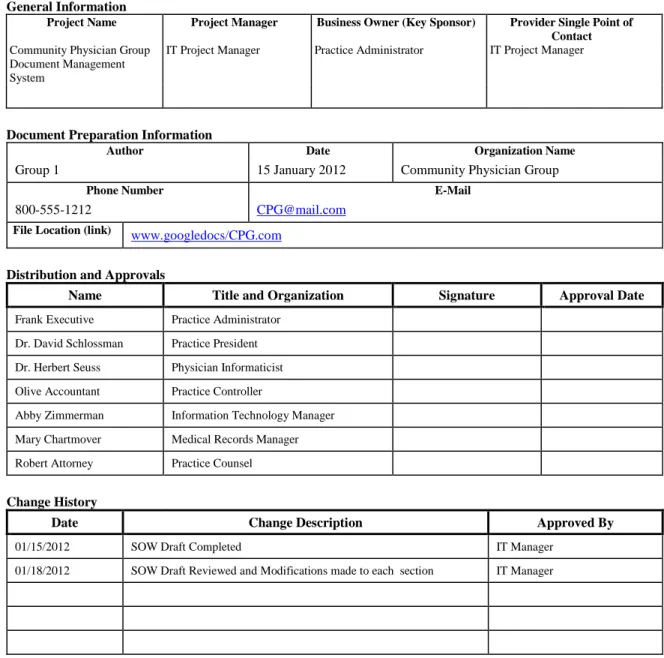
General Information Project Name Community Physician Group Document Management System
Project Manager IT Project Manager
Business Owner (Key Sponsor) Practice Administrator
Provider Single Point of Contact IT Project Manager
Document Preparation Information
Author Date Organization Name
Group 1 15 January 2012 Community Physician Group
Phone Number E-Mail
800-555-1212 [email protected]
File Location (link) www.googledocs/CPG.com Distribution and Approvals
Name Title and Organization Signature Approval Date
Frank Executive Practice Administrator Dr. David Schlossman Practice President Dr. Herbert Seuss Physician Informaticist Olive Accountant Practice Controller
Abby Zimmerman Information Technology Manager Mary Chartmover Medical Records Manager Robert Attorney Practice Counsel
Change History
Date Change Description Approved By
01/15/2012 SOW Draft Completed IT Manager
Table of Contents
1 Background ... 4 2 Project Objectives ... 6 3 Scope ... 7 4 Deliverables ... 105 Project Role Commitment ... 12
5.1 Practice President ... 12
5.2 IT Manager ... 12
5.3 Compliance Officer ... 13
6 Roles and Responsibilities ... 14
1
Background
Community Physician Group (CPG) is a 150 member multispecialty medical practice organized as a limited liability corporation owned by its physician members who elect its 10 member Board of Directors. The organization is headed by a Practice Administrator (the Chief Executive
Officer) and the Practice President, a physician elected by his colleagues to represent their interests in the administrative, legal, and business affairs of the practice. The practice is
composed of several departments, each headed by a Department Manager. These include Front Desk/Reception, Medical Records, Pharmacy, Laboratory, Clinical/Nursing, Clinical Research, Information Technology, and Business Office. The practice employs a full time Controller to manage accounting and financial affairs and has a retainer arrangement with an attorney for help with legal affairs when needed. The practice also has a physician who has a long term interest in computers and health information technology and serves informally as an informaticist. He was very active in the development and implementation of the practice’s electronic medical record (EMR) and serves as Physician Champion during the implementation and training phases of information technology projects. CPG has an excellent reputation in its service area and prides itself on delivering the highest quality, most up to date care available.
Five years ago CPG implemented an EMR system which has been fairly successful in deploying a CPOE, clinical documentation, clinical decision support, and medical alerts. One of the
original goals of the EMR implementation was to eliminate the need for physicians to utilize the paper charts. This has not been accomplished. The physicians have found that they need to retrieve data from our legacy paper charts and work with external data brought into the practice on paper much more frequently than expected. The process of working with both paper and electronic records has an adverse effect on clinician efficiency and satisfaction. The need to
retrieve and manipulate data on paper requires extra staff members and prevents the practice from deriving the full cost efficiency benefits that were predicted for the EMR. For these reasons, the practice has decided to implement an electronic document management system (DMS) to convert all legacy paper records and incoming paper documents to digital format and make them easily available to users within the EMR. The group would also eventually like to maintain all its nonmedical documents, for example business office records, in digital format so the DMS must be capable of interacting with document processing applications such as
Microsoft Word and Adobe Acrobat as well as facilitating multiuser editing of a single document.
Document management includes the meaningful indexing, annotating, archival, routing, and retrieval of electronic documents, including scanned pages, web pages, e-mail messages,
spreadsheets and word processing files (Rollins, 1998). This works in a medical setting for both entering data currently in paper charts and in keeping data electronically, eliminating the need for the paper chart, on an ongoing basis.
For documents currently in paper format, staff members are able to use a scanner to create an electronic version of the hard copy original. The original can then be sent to permanent storage while the new electronic image of the document can be manipulated/cleaned-up online (Kuwata, 2011). Additionally, optical character recognition (OCR) technology translates characters
contained in the document's image into meaningful text. Web-based DMSs are beginning to store content in the form of html which allows for better application of search capabilities such as full-text searching and stemming (PolicyStat, 2011).
Modern DMSs allow clinicians to enter information about the electronic document (e.g., title, author, creation date and key words including a patient's name, document description) for purposes of later retrieval. This information is called metadata. The system is also capable of keeping track of the different versions created by different users (history tracking). DMSs commonly provide storage, versioning, metadata, security, HIPPA compliance, as well as indexing and retrieval capabilities. By integrating a DMS into CPG’s existing EMR, the group will be able to eliminate the need for paper charts and decrease future expenses associated with paper charts.
2 Project Objectives
Community Physician Group will engage a DMS vendor to install a document management system on the group’s servers and design and install an interface between the DMS and the group’s existing EMR. The objectives of having such an integrated system are to:
Install and deploy a state-of-the-art document management system
Convert all legacy paper records to digital form and maintain the capability to convert paper records from external sources to digital form going forward
Extract and attach the metadata necessary for indexing from each paper document during the conversion process
Store the converted documents in a relational database (repository) capable of comprehensive indexing, full-text searching, and stemming.
Allow documents in the repository to be retrieved and displayed at the appropriate location in the EMR
Facilitate integration of the DMS with existing practice document processing applications including Microsoft Office and Adobe Acrobat
Provide security and confidentiality safeguards during all phases of data manipulation and transfer
Improve patient care by having all pertinent information readily accessible in the EMR Use workflow automation to support both the Medical Records department and clinicians Improve physician, nursing staff, and medical records staff productivity, resulting in
increased satisfaction and adoption of IT
Increase usage of the current EMR system by physicians to 100%
Eliminate the need for paper charts and time spent searching for paper medical records Eliminate costs associated with paper charts and realize the cost savings, of the existing
EMR
Train all CPG personnel in use of the DMS (initially and ongoing) Complete the project within six months and within budget
3 Scope
The Document Management System will transform all CPG practice locations into paperless offices, eliminating the storage, availability, staffing, and cost issues associated with paper charts. This will be completed without requiring physicians to make any major modification in the way they practice or view patient data. A single, flexible data repository, hosted by the vendor, will allow for easy storage, retrieval and use of any document. The needs of patient care activities require that all patient-related and administrative documents will be securely accessible 24/7/365 from any location with an internet connection. The system will provide 99.5% uptime
and will be designed to protect against physical damage to any single server or data center, requiring that full backup data is stored at more than one location.
The DMS Development team will install and modify its product code to meet the following technical/functional requirements:
Requirement Agreed Solution
1.0 The DMS shall scan paper documents to image files with attached metadata as necessary for storage and indexing.
A high-speed scanner capable of acquiring images at resolutions between 200 and 1200 dpi with 32-bit color depth or 16 grayscale levels. Scanner will be capable of simultaneous two-sided scanning at a rate of at least 20 pages per minute. Associated tools to allow attachment of metadata.
1.1 CPG staff users shall have the option to define metadata fields and enter metadata tags manually.
A scanner associated user interface with tools to modify metadata fields and enter data into those fields.
1.2 CPG staff users shall have the option to enter metadata by tagging documents with a barcode prior to scanning.
A scanner associated barcode reader and interface tools to retrieve fields from a patient EMR record specified by the barcode and input that data into the document metadata fields.
2.0 The DMS shall extract all documents by optical character recognition to create machine readable editable text files.
Scanner associated optical character recognition software and editing tools.
2.1 The DMS shall index the editable text files for retrieval based on content.
Automatic content based indexing engine and interface with the repository. Include content indexing tags in metadata to allow document retrieval by full text search based on keyword(s) 3.0 The DMS shall maintain and
manage a repository of digital documents capable of rapid search and retrieval functions.
Interface to industry-standard back end database product such as Microsoft SQL or Oracle running on server hardware and operating system to be specified by consultation between vendor development team and GPC IT staff. Licensed copies of the specified database product software.
3.1 The DMS shall be available 24 hours a day, 365 days per year and shall have no single point of failure liabilities.
Mirrored identical servers.
3.2 The DMS contents shall be secured against physical or
environmental damage to the servers.
Digital tape backup system or external hard drive system to make copies of the data to be stored off-site OR mirrored identical servers to be in different locations.
Requirement Agreed Solution
3.3 The DMS shall be easy to maintain and update so existing functionalities remain current and new ones can be added
Training program to allow CPG IT staff to run basic maintenance and problem solving activities. Service contract to provide vendor support for more complex problems, maintenance, and upgrade processes.
4.0 The DMS shall support retrieval of user-requested document files from the repository for display at the appropriate location in the EMR.
Network-based API to serve as the basis of an interface between the DMS and the EMR.
5.0 The DMS shall support current office document processing
applications in using the repository to store and retrieve document files.
Network-based API to serve as the basis of an interface between the DMS and document processing applications.
5.1 The DMS shall allow CPG staff to work collaboratively on a document.
Special workspace for collaborative document editing and controls to prevent two users from simultaneously accessing the same document outside of that workspace. Version controls. 6.0 The DMS shall allow printing or
electronic transmission of documents directly from the repository and from the EMR.
Network-based API to serve as the basis of an interface between the DMS and practice printing, fax, and e-mail services.
7.0 The DMS shall provide security, and data integrity as specified by HIPAA and applicable regulations.
Industry-standard strong hardware firewall protection and anti-malware software running on the servers. Off premises access to EMR and DMS by VPN only.
7.1 The DMS shall allow each user to access only the protected health information he is authorized to see.
User authentication by strong password changed every 60 days. Security training for all CPG staff members authorized to use the system. Highly granular permission controls specifying precise user access rights down to the page and even paragraph level.
7.2 The DMS shall have the capability of preserving archival copies and preventing protected health information from being altered.
DMS procedures for marking a document unalterable. Expected to be applied to all documents considered protected health information.
7.3 The DMS shall track and record all access and transfers of protected health information.
4 Deliverables
The Document Management team will deliver a DMS that is fully integrated with CPGs’ existing EMR within 6 months and within budget.
Deliverable Responsible Acceptance Criteria Due Date Approver
Project Plan CPG IT Manager Must include all project related tasks from project initiation through final acceptance.
With Proposal and 15 days after Award. Updates biweekly thereafter until final acceptance CPG Practice Administrator & President
High Level System Design Vendor Development Team Partial network diagram and report showing the location of all DMS specific hardware and its integration with the existing practice computer network and workflow.
Specification of the DMSs' API, back end database structure, and final agreed on feature set.
14 Days after award CPG IT Manager Physician Informaticist Medical Records Manager Module Design Vendor Development Team Description of logic, data flow, and algorithms for each
section of the system including scanning and data acquisition, indexing system, interface to the database, database, interface to the EMR, and interface to office applications.
30 days after award
CPG IT Manager
Code Vendor Development Team Specific program code for all modules and interfaces. If vendor will not provide source code for the primary DMS product, a copy should be placed in escrow.
60 days after award
CPG IT Manager
Module Installation and Testing Vendor Development Team CPG IT department
Test reports demonstrating each module performing to specification
75 days after award
CPG IT Manager
Interaction Testing Vendor Development Team
CPG IT department
Test reports documenting that interfaces function as designed and that modules interact properly with each other and with the EMR 90 days after award CPG IT Manager Physician Informaticist
Deliverable Responsible Acceptance Criteria Due Date Approver
Full System Testing Vendor Development Team
CPG IT department CPG beta testers
Test report documenting all system functionality operational and performing to specified requirements.
105 days after award
CPG project team and IT Manager
System Training Program Vendor Training Staff Physician Informaticist Physician Superusers CPG Department Heads
Training materials including manuals, tutorials, and web based training. Intensive training of Superusers and one to one training of all physicians and of CPG staff most involved in system use. Refresher training after 4-6 weeks of system use.
135 days after award
CPG project team
Final Usability, Effectiveness and Efficiency Testing
CPG project team CPG medical staff CPG Department Managers
Test report of an effectiveness and efficiency testing instrument. Survey of all CPG system users demonstrating user satisfaction with system usability and integration into workflow.
160 days after award
CPG project team lead
System Security Plan CPG Compliance Officer Security plan document 175 days
after award
CPG IT Manager Practice Attorney
Vendor Maintenance Plan Vendor Development Team Maintenance plan document 190 days
after award
5 Project Role Commitment
5.1 Practice President
The Practice President knows that his influence will also be vital in successfully implementing the DMS. His long history with the group, high level of respect from all the physicians, and long-standing personal relationships with many of the group’s physicians put him in a unique position to advocate for a change in the group’s culture and the transition to a fully electronic system. He has agreed to act as a Super User and cooperate with the Physician Informaticist and other Super Users in training the group’s physicians. He will also devote special effort to persuading the physicians who currently rely most heavily on paper charts to give the new system a chance. He has asked the Informaticist to design special training materials for these doctors. Physicians are often most comfortably trained and influenced by other physicians. The support of the Practice President will be critical to successfully navigate the social and cultural aspects of the change management process.
5.2 IT Manager
The IT Manager will act as a CPG project team member and primary lead for all IT staff. S/he must commit to complete the following on time and within budget:
Interaction with vendor development team. Participate in hardware selection.
Evaluate interfaces and verify compatibility with existing CPG systems. Lead system testing and rollout.
5.3 Compliance Officer
The Compliance Officer must ensure that the document management system is HIPAA compliant and all pertinent security specifications are met as outlined below:
The system shall provide, at a minimum, auditing to the level required by HIPAA and the Privacy Act
The system shall provide end-to-end data encryption. The system shall provide ID & non-displaying password.
The system shall have the capability to prohibit the reuse of passwords by users. The number of passwords that are remembered and cannot be reused will be an adjustable parameter that can be set by the administrator.
The system shall monitor multiple failed attempts to logon by triggering a system alert.
The system shall provide the capability for the administrator to set a time period for password expiration
The system shall allow users to change their password.
The system shall provide the capability to automatically log users off after a specified period of inactivity using parameters that can be set by the system administrator.
The system shall provide role-based security. Roles may be assigned by placing users in groups.
The system shall log access to patient records.
6 Roles and Responsibilities
Role Name Organization Responsibilities Time to
Project Vendor
Development Team Lead
Aaron Content DMS Vendor Leader of DMS development team. Primary responsibility for interaction with CPG project team and for project success. System design, coding, and installation. User training. 100% Vendor Development Team Members Adam Coder Betty Syntax Charles Keypad
DMS Vendor Install system hardware. Write and install code for system modules and interfaces. Interact with CPG staff and project team members. 100% Vendor Training Team Members David Teacher Emma Educator
DMS Vendor Develop training materials and teach CPG physicians and staff members to use the system.
100%
Practice Administrator
Frank Executive Community Physician Group
CPG project member and project secondary lead. Project organization and contract negotiation. Budget and Capital Equipment expenditure process. 10% Practice President Dr. David Schlossman Community Physician Group
CPG project team member. Evaluate physician usability and system impact on workflow. Super User. Advocate for adoption among physician colleagues.
10% Physician Informaticist Dr. Herbert Seuss Community Physician Group
CPG project team member. Evaluate DMS interaction with an effect on EMR. Super user. Train and advocate for adoption among physician colleagues.
10%
IT Manager Abby Zimmerman
Community Physician Group
CPG Project Manager and primary lead. First point of contact with vendor
development team. Participate in hardware selection. Evaluate interfaces and verify compatibility with existing CPG systems. Participate in system testing and rollout.
25% IT Staff Members John Apple Karl Microsoft Linda Ubuntu Community Physician Group
Assist with system installation and testing. Train with vendor development team to assume maintenance and management of the system. Point of contact for vendor to initiate installation and training for system revisions and upgrades.
25% Medical Records Manager Mary Chartmover Community Physician Group
CPG project team member. Advise vendor development team and evaluate system capability re digitizing large volumes of legacy paper chart data
Role Name Organization Responsibilities Time to Project Business Office Manager Norman Busybody Community Physician Group
Assess system support for existing practice computer applications and suitability for extending the system to digitize all business office paper documents.
5%
Controller Olive Accountant Community Physician Group
Integrate project costs into organizational budget. Track and pay vendor invoices. Track actual expenses against project budget.
10%
Compliance Officer
Isolina Vargas Community Physician Group
Advise vendor development team on and assess system for compliance with HIPAA and other applicable regulations.
10%
Practice Attorney
Robert Attorney Community Physician Group
7 References
Kuwata, S. (2011). Longitudinal analysis on utilization of medical document management system in a hospital with EPR implementation. Stud Health Technol Inform, 164, 117-21. doi:21335697 PolicyStat. (2011, November 8). Making Medical Office Policies Easier to Find With Stemming
[Article]. Retrieved January 13, 2011, from policystat.com Web site: http://
www.policystat.com/blog/2011/11/08/making-medical-office-policies-easier-to-find-with-stemming/
Rollins, R. (1998). Imaging and document management [Article]. Retrieved January 14, 2011, from physiciansnews.com Web site: http://www.physiciansnews.com/computers/898.html
Snyder, D. (1996). Document management and scanning in the physician's office. J La State Med Soc, 148(12), 533-34. doi:8990797