Policy Research Working Paper
5434
Macroprudential Stress-Testing Practices
of Central Banks in Central
and South Eastern Europe
An Overview and Challenges Ahead
Martin Melecky
Anca Maria Podpiera
The World Bank
Europe and Central Asia Region
Private & Financial Sectors Development Sector Unit
September 2010
WPS5434
Public Disclosure Authorized
Public Disclosure Authorized
Public Disclosure Authorized
Abstract
The Policy Research Working Paper Series disseminates the findings of work in progress to encourage the exchange of ideas about development issues. An objective of the series is to get the findings out quickly, even if the presentations are less than fully polished. The papers carry the names of the authors and should be cited accordingly. The findings, interpretations, and conclusions expressed in this paper are entirely those of the authors. They do not necessarily represent the views of the International Bank for Reconstruction and Development/World Bank and its affiliated organizations, or those of the Executive Directors of the World Bank or the governments they represent.
Policy Research Working Paper 5434
Stress tests are the main practical tools of
macroprudential oversight. This paper reviews the stress-testing practices of central banks in Central and South Eastern Europe (CSEECBs) and outlines the challenges in the area of stress testing going forward. The authors discuss good practice and the applied approaches by CSEECBs focusing on the main components of a typical macroprudential stress test, i.e. constructing the baseline and stress scenarios, mapping macroeconomic scenarios and microeconomic factors to risk factors, calculating risk exposures to different risk indicators, and estimating outcome indicators to inform macroprudential policy.
This paper—a product of the Private & Financial Sectors Development Sector Unit, Europe and Central Asia Region— is part of a larger effort in the department to contribute to improvements in macroprudential supervision in the client countries. Policy Research Working Papers are also posted on the Web at http://econ.worldbank.org. The authors may be contacted at [email protected] and [email protected].
The main challenges for the CSEECBs going forward involve needed improvements in data reliability, consideration of quantitative microprudential indicators in macroprudential stress tests, explicit incorporation of dynamics in stress tests to include reaction functions of banks and macroprudential policy, institutionalization of macroprudential policy responses to alarming stress-test results, use of the top-down and bottom-up stress test results in supervisory communication, cooperation of macroprudential and microprudential supervision, and information exchange for better cross-border supervision of international banking groups.
Macroprudential
Stress
Testing
Practices
of
Central
Banks
in
Central
and
South
Eastern
Europe:
An Overview and Challenges Ahead
#Martin Melecky ECSPF World Bank
Anca Maria Podpiera ECSPF World Bank
#
We thank the participants of the seminars on Advances in Stress Testing held in Prague and Thessaloniki for their valuable insights and discussions. We also thank Orsalia Kalantzopoulos and Damodaran
1.
Introduction
Central Banks in Central and South Eastern Europe (CSEECBs) are mandated to foster financial stability in the financial systems of their respective countries. The Central Banks fulfill this mandate by conducting macroprudential policy including macroprudential oversight and implementation of macroprudential policy instruments. The main practical approaches of the macroprudential oversight are monitoring of financial stability indicators and conducting stress-testing exercises. Especially the latter should be forward looking and tailored to the specifics of a given financial system. Since the financial systems in Central and South Eastern Europe are often at rather early stages of development, compared to high-income countries, traditional banking business dominates the systems. As a result, the stress-testing exercises primarily involve banks and inform the macroprudential policy makers about the needed policy adjustments which are predominantly banking sector oriented. As in the case of monetary policy, it is important that the stress tests of banking systems are sufficiently forward-looking to take into account the transmission lags of macroprudential policy and the effectiveness of its instruments.
This paper aims to review the stress-testing practices of central banks in Central and South Eastern Europe1 and outline the challenges in the area of stress testing for the respective institutions going forward.2 As the first of its kind, this review paper should help CSEECBs benchmark themselves against their peers in the region and compare their ongoing development efforts in the area of stress testing. Furthermore, this paper should also help the IFIs identify the most needed areas for technical assistance and prioritize on their development assistance in the area of stress testing across the region. In this respect we focus on components of a macroprudential stress test which typically involve constructing the baseline and stress macroeconomic scenarios, mapping the macroeconomic scenarios and other microeconomic factors to risk factors, calculating risk exposures to different risk factors, and estimating outcome indicators to inform macroprudential policy makers. We find that the main challenges for the CSEECBs underscore the need to address problems with data reliability, consideration of quantitative microprudential indicators in macroprudential stress tests, explicit incorporation of dynamics in stress test to include reaction functions of banks and macroprudential policy, institutionalization of macroprudential policy responses to alarming stress-test results and use of the top-down and bottom-up stress test results in supervisory communication, and cooperation of macroprudential and microprudential
1
The countries considered include: Albania, Austria, Bosnia & Herzegovina, Bulgaria, Croatia, Czech Republic, Hungary, Greece, Kosovo, FYR Macedonia, Montenegro, Poland, Romania, Serbia, Slovak Republic, and Slovenia.
2
The review is based on information shared by the participants of the seminars on “Advances in Stress Testing in Central and South Eastern Europe”, held in Prague and Thessaloniki in November 2009 and May 2010 respectively. The presentations included: Colakovic (2010), Csajbok (2009, 2010), Dascalescu (2010), Gersl (2009), Guttierez (2010), Huljak (2010), Ivanovic (2010), Jurca and Klacso (2009), Klacso (2010), Manolov (2010), Melecky (2010), Puhr (2009), Seidner (2010), Sekulic (2010), and Woreta (2010). Addition information has been obtained from the financial stability reports of the respective central banks and individual follow-up surveys with the country representatives in the seminars.
supervision and information exchange for better cross-border supervision of international banking groups.
The remainder of the paper is organized as follows. Section two discusses the general properties of stress tests and sets the structure for the rest of the paper. Section three then reviews the methods used by the CSEECBs to construct or generate macroeconomic scenarios in stress tests. Section four discusses the risk factors considered by CSEECBs and their modeling in the stress test. Section five then elaborates on the practices concerning the calculation of risk exposures. Section six reviews the outcome indicators of the stress tests and their usefulness for macroprudential policy adjustments. Section seven outlines the need and attempts to move from static to dynamic stress tests. Section eight reviews the challenges going forward as perceived by the CSEECBs. And, section nine concludes.
2.
General
Properties
of
Stress
Tests
Stress tests are practical tools meant to evaluate the resilience of individual financial institutions and of financial sectors to highly adverse but plausible events. They are used to quantify vulnerabilities, both from a microprudential perspective within the Supervisory Risk Assessments, where financial institutions are analyzed individually, and from a macroprudential perspective within Financial Stability Analyses, where the resilience of the entire financial sectors to adverse macroeconomic shocks is tested. Concerning the purpose of stress tests, one can talk about relative and absolute
approaches based on the reliability and interpretation of the stress test results. An absolute interpretation hinges on the ability of the analyst to construct highly precise scenarios and to capture relevant risks including their interplay and integration into final outcome indicators. By definition the stress scenarios are outlier events or black swans that could be hardly predicted or for which model-consistent scenarios could not be easily constructed. Therefore, in practice, pure absolute treatment of stress tests is and should be avoided and rather relative interpretation of the stress-test results considered. This is despite the fact that on many occasions, the stress testers strive to and are asked to come up with concrete numbers, such as absolute amounts of a bank’s and banking sector’s undercapitalization. The relative purpose of the stress tests thus follows the logic of a peer-group analysis when banks are stressed by what is considered a reasonably strong stress scenario and then bank-specific results are compared to the average of their peer group. While absolute amounts, of e.g. undercapitalization, are also estimated, they are then related to the average undercapitalization of the peer group so that a problem bank is then asked to increase its capital to the peer group average as a sound practice rather than by an absolute amount.
The macroprudential stress testing approach is traditionally a top-down procedure aiming to apply relevant and comprehensive stresses to each bank and consistently across banks. These stresses are thus not tailor-made for each bank but rather for a banking sector as a homogenous entity. It is therefore important that the top-down approach is complemented by a bottom-up approach using microprudential stress test where either banks themselves
or the microprudential supervisors construct specific stress scenarios for each individual bank based on their knowledge of the banks’ business specificities and corresponding bank specific risks. The results of the bottom-up stress tests should then be compared and discussed together with the top-down results and necessary adjustments to the top-down approach performed if bank-specific risks are way too important to be washed out at the macro level. A good cooperation among the macroprudential supervisors, microprudential supervisors and the banking sector is needed in this respect. Once it is established, stress-testing models could be an excellent communication tool between the supervisors and the banks in regards to implementation of macroprudential and microprudential policy measures and justification of their necessity.
The move from single-shock stresses to stress scenarios, which occurred in the past, is analogous to the current efforts to move from the scenario effects on a single type of risk, such as credit, market and liquidity risk, to an integrated effect of the scenarios on all types of risks and their impact on the ultimate outcome indicators of interest, e.g. effective capital or liquidity buffers. A simple summation of the stress test results for individual risks using consistent macroeconomic scenarios hence does not account adequately for the interplay among the individual risks (credit, market, liquidity and operational risk). Similarly, a summation of the stress impacts across banks does not account enough for the possible contagion effects and the overall (synergetic) systemic impact.
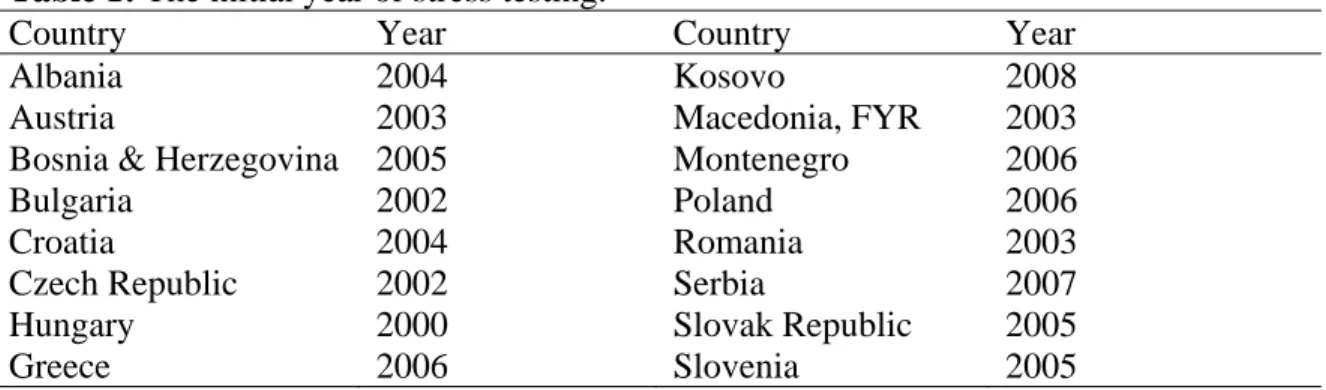
The financial stability divisions of CSEECBs have performed banking sector’s stress tests already for several years to assess the systemic vulnerability to certain risk factors. Bulgaria and the Czech Republic first tested the resilience of their banking sectors in a stress-testing framework in 2002, while Kosovo started only in 2008. The year when macroprudential stress tests were carried out for the first time is reported in Table 1 for each CSEECB. In many cases, IMF/World Bank’s Financial Sector Assessment Program (FSAP) missions were the starting point for stress-test implementation. Since 2008, through the Basel II capital adequacy framework, the importance of the stress-testing practice – both by banks and supervisory authorities – has been increasingly emphasized. Table 1: The initial year of stress testing.
Country Year Country Year
Albania 2004 Kosovo 2008
Austria 2003 Macedonia, FYR 2003
Bosnia & Herzegovina 2005 Montenegro 2006
Bulgaria 2002 Poland 2006
Croatia 2004 Romania 2003
Czech Republic 2002 Serbia 2007
Hungary 2000 Slovak Republic 2005
Greece 2006 Slovenia 2005
All CSEECBs rely on a top-down stress-test approach for the macroprudential analysis; some central banks complement their analysis with the results of a bottom-up stress-test.
In Austria, Bulgaria, the Czech Republic3, Macedonia, Montenegro, and Poland banks are provided with predefined macro scenarios and required to evaluate their impact on the credit, market, and liquidity risk indicators. In addition, Bulgarian banks are asked to define their “worst case scenario” and evaluate its impact. Either all banks or banks comprising the majority of the banking sector assets are considered in these exercises. There are countries (Hungary and Greece) that carry out a bottom-up stress test involving a survey of a limited number of banks mainly with the purpose of complementing their information and improving their estimates of certain parameters used in the top-down exercise. For instance, Hungary obtains estimation for default rates for unsecured household loans from a survey of eight banks.
Meanwhile, a substantial effort was devoted to the development of stress-testing models to help supervisory authorities gauge the potential effect of severe but plausible macroeconomic downturns on banking sectors’ resilience. As of 2010, the stress-testing models for many CSEECBs moved from simple procedures of evaluating the effects of ad-hoc shocks, to scenario-based macro models. These models are meant to capture features of the banking sector (products and portfolio characteristics) and their reaction to various macroeconomic scenarios. For some CSEECBs, the models in use are the result of several years of research in model-building (as in the cases of Austria, the Czech Republic, Hungary, Romania, and the Slovak Republic), while for other CSEECBs (Bulgaria, Croatia, Montenegro, and Serbia) the stress-test macro models are yet in an incipient form. Nevertheless, all the participating CSEECBs reported that the scenario-based stress-testing models are an ongoing work both in terms of refining the existing models to capture country- and sector-specific features and in terms of considering additional risk factors. The risks considered in the CSEECBs’ stress tests are credit risk, market risk, liquidity risk and contagion risk; however, most CSEECBs focus primarily on credit risk and market risk. Integrating concurrent effects of multiple risks remains a challenge ahead. Especially, integration of credit risk, including indirect credit risk from borrowers’ FX exposures, and liquidity risk for CSEE’s banking systems is crucial, as shown by the ramifications of the crisis.
For many CSEECBs, the limited availability of data (both current and historical), the delays involved in accessing the financial data, and the inconsistencies among various data sources reduce the scope of stress-testing approaches. The CSEECBs that are confronted the most with the problem of data availability appear to be Montenegro, Bosnia & Herzegovina, and Kosovo.
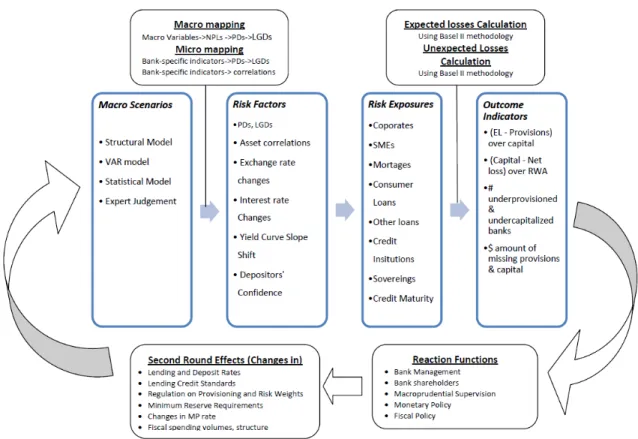
Generally, the implementation of a stress test involves the following steps: (1) constructing macroeconomic scenario(s), among which at least one contains extreme but plausible adverse events; (2) identifying and quantifying risk factors; (3) identifying and calculating risk exposures; (4) mapping macroeconomic variables to risk factors; and (5) mapping risks to outcome indicators (e.g., expected loss, capital adequacy ratio); in addition, dynamic stress-testing models would include (6) evaluating the reaction
3
The Czech National Bank introduced bottom-up stress testing exercise in 2009. The results are presented in the 2010 Financial Stability Report (see, CNB, 2010).
functions of banks and macroprudential policy to banking sector developments; (7) accounting for the feedback to the real economy and second-round effects. The general steps of a dynamic stress test are summarized in the flowchart of Figure 1.
Figure 1: Flowchart of a Dynamic Stress Test
The frequency of stress testing in the CSEECBs varies from the quarterly basis (Albania, Austria, Bulgaria, Bosnia & Herzegovina, the Czech Republic, Macedonia, and Montenegro), semi-annual (Croatia, Hungary4, Kosovo, Romania, and the Slovak Republic), and annual (Poland, Slovenia). Typically, the aggregated results are presented in the annual Financial Stability Report (FSR) or Financial Sector Bulletin (FSB).5 Table 2 provides an overview of stress test dissemination through the FSRs among CSEECBs. The extent to which the methodology and results are presented in FSRs greatly varies among countries. The stress-test results regarding individual institutions are discussed in the Bank Board meetings or other internal discussions concerning macroprudential policy.
4
Hungary plans to switch to quarterly implementation and reporting.
5
The FSRs of the Austrian Central Bank and the Czech Central Bank, publish, apart from the results of regular stress tests, expert studies meant to develop the stress test methodology.
Table 2. Dissemination of stress-test methodology and results through FSR Country Most Recent FSR that
contains a stress test*
Analyzed Risks
Albania 2008 FSR Credit and market risks
Austria 2009 FSR Credit, market, liquidity, and contagion risks
Bosnia & Herzegovina 2008 FSR Credit, market, and liquidity risks Bulgaria Does not publish FSR
Croatia 2010 FSR Credit and market risks
Czech Republic6 2010 FSR Credit, market, and liquidity risks Greece 2009 FSR Credit, market, and liquidity risks Hungary 2010 FSR Credit and liquidity risks
Kosovo 2008 FSB Credit, market, and liquidity risks Macedonia, FYR 2008 FSR Credit and market risks
Montenegro 2006 FSR Credit, market, and liquidity risks
Poland 2009 FSR Credit risk
Romania 2008 FSR Credit, market and contagion risks Serbia FSR does not present stress test
Slovak Republic 2009 FSR Credit and market risks
Slovenia 2007 FSR7 Credit, market, and liquidity risks
Note: * as of July 2010.
3.
Macro
Scenarios
Formulation
A key component of a stress-test procedure is the generation of a set of macroeconomic scenarios to which the resilience of the financial sector is analyzed. The set of scenarios considered needs to contain a baseline scenario, which reflects the current economic situation, and some adverse scenario(s), which describes the effects of extreme but plausible adverse events on macroeconomic conditions. To the extent possible, the scenarios should reflect country-specific circumstances. If short data history or data availability are an issue, international experience should serve as guidance for constructing relevant stress scenarios (Buncic and Melecky, 2010).
There are two distinctive approaches employed in the construction of scenarios: the judgmental approach and the model-consistent approach. The judgmental approach sets the relevant economic variables according to experts’ judgments. The model-consistent approach builds the macro scenario based on a model, which accounts for the interlinkages among macroeconomic variables, and eventually financial sectors’ variables. In practice, the macro scenarios used in stress-testing are often based on an intermediate combination of approaches utilizing both a macroeconomic model and expert judgments.
6
The Czech Central Bank, apart from the stress-test presentation in the annual FSR, publishes the quarterly aggregated stress-test results on the Czech National Bank’s web page.
7
The results of the 2010 EU wide stress testing exercise are published on the Slovenian Central Bank’s web page.
As regards the baseline scenario, it needs to be consistent with the macroeconomic forecasts published by the respective central bank and used for monetary policy analysis. Elaborated country-specific forecasts are also available from the International Financial Institutions or could be based on market consensus. The setup of an adverse scenario is not a straightforward task.8 Judgmental approaches proved to be too optimistic. Haldane (2009) refers to the propensity to underestimate the probability of adverse outcomes as “disaster myopia”. At the same time, macroeconomic models relying on through-the-cycle, linear relationships have a limited ability to generate stress scenarios. Nevertheless, the cross-country evidence from the recent crisis raised sufficient warnings for the judgmental crisis scenarios not be overly optimistic in future stress tests. Regarding the shortcoming of typical model-based approaches, one avenue is to consider the adverse 99 percentile of a one-year ahead dynamic forecast (Buncic and Melecky, 2010).
Foglia (2009)9, summarizing the credit risk stress-testing practices developed in selected central banks, finds that the adverse scenario is typically constructed using one of the following methodologies: (1) a structural econometric model; (2) a vector autoregressive model; or (3) a statistical approach. We add (4) a judgmental approach which is used in cases when statistical or econometric models are not capable of producing appropriate stress scenarios. This approach is also often employed by developing countries’ central banks due to the lack of historical data for estimation of macroeconomic models.
A structural econometric model appears as the first choice for building a stress scenario for the central banks that use such models for forecasts and policy analysis. The benefits of using these models stems from the consistency among the predicted macroeconomic variables. Since most of the models used for monetary policy analysis are linear models, the typical concern relates to the observation of non-linear relationships among macroeconomic and financial variables during the periods of stress, including regime switches. Another concern, expressed in Foglia (2009) and addressed in Breuer et al. (2009), is associated with the difficulty to determine the likelihood of a macroeconomic scenario.
Vector Autoregressive (VAR) models are used either because a structural model is not available or they are employed for their greater flexibility and easiness to generate a consistent set of predicted variables. Castren et al. (2008) demonstrate the advantages of using VAR models when the stress test analysis has a cross-country perspective. They utilize a global vector autoregressive (GVAR) model based on 26 VARs, corresponding to 25 countries and one specific to the euro area, for credit risk analysis in the Euro Area. In this model the domestic and foreign variables interact simultaneously.
8
Breuer et al. (2009) claim that the current practice of stress testing has no systematic and transparent way to judge the plausibility of stress scenarios.
9
The summary of other authorities’ approach to modeling the credit risk builds on Foglia (2009). She considers Bank of Canada, Bank of England, Bank of Italy, De Nederlandsche bank, Deutsche Bundesbank, ECB, French Banking Commission and Bank de France, Oesterrichische Nationalbank, Norges Bank, Sveringes Riksbank and Swiss National Bank.
A pure statistical methodology, based on the copula approach, brings in the benefits of working with marginal distributions instead of multivariate distributions and at the same time capturing the higher moments’ dependence among the macro-financial variables. Such dependence is an important feature to capture in order to adequately characterize the co-dependence among macro-financial variables in the times of stress, as the global financial crisis has shown. Although it can provide superior model forecast performance, this approach is criticized for its inability to offer a “story” and tractability for policy analysis.
The use of judgmental models or expert judgment is often subject to criticism due to arguable structural (economic) inconsistency of the constructed scenarios. However, judgmental models allow analysts the possibility to consider more robust cross-country experience in constructing stress scenarios. In particular, the analysts could make use of the experience of countries that underwent financial crises and use some of the derived crisis shocks, in terms of changes in the macroeconomic variables, to construct stress scenarios for their own country.
As regards the CSEECBs, many utilize the macroeconomic forecasts, provided by their Monetary Policy Divisions, for the baseline macroeconomic scenarios (Albania, Austria, Croatia, the Czech Republic, Greece, Hungary, Poland, Romania, the Slovak Republic, and Slovenia). In the case of Bosnia & Herzegovina and Serbia, the guidelines for the baseline scenario as well as for the adverse scenarios have been provided by the IMF. The Central Banks of Albania and Montenegro judgmentally combine the macroeconomic projections provided by their internal macroeconomic models with those provided by the IMF, both for the baseline and adverse scenarios. The Central Bank of Austria also makes use of the IMF forecasts for Austria and CSEE countries in which Austrian banks have important exposures. The Central Bank of Bulgaria constructs the baseline scenario based on the historical experience and expert judgment.
The adverse scenarios are meant to reflect the country-specific macroeconomic risks and exposures. The Czech, Hungarian, Romanian, and Slovak Central Banks build the adverse scenarios using the same models as for macroeconomic forecast and the monetary policy analysis. For the Czech Republic and the Slovak Republic, the adverse scenarios for the first part of 2010 envisaged the risk of a more protracted W-shaped recession10 (the ‘Double Dip’ scenario) and the combination of adverse financial market developments and weak economic growth relative to the baseline (the ‘Loss of Confidence’ scenario). For Hungary, the stress scenario is consistent with the EU-wide stress scenarios, and for the year of the financial crisis, it covered an external demand shock, a risk premium shock and a confidence shock. The adverse scenarios for Romania are built by mapping various country-specific adverse shocks (e.g., a sudden increase in the country risk premium due to political factors, a cease of the external financing agreements with the financial institutions, and a drop in external demand) in the semi-structural model used also for forecasting purposes. The Polish Central Bank uses two VAR models to construct the adverse scenario. One model focuses on interconnections between financial market variables, while the other covers variables of the real economy.
10
The variables connecting the two VARs are interest rates and the exchange rate. The Austrian Central Bank, in its Systemic Risk Monitor (SRM), employs for adverse scenario building a pure statistical methodology based on the copula approach. The Albanian, Croatian, Greek and Slovenian Central Banks use a judgmental approach, by expertly setting the macroeconomic variables’ deviations from the baseline scenarios. The Central Banks of Serbia and Bosnia & Herzegovina follow the IMF adverse scenarios guidelines which feature a negative GDP growth both for the EU and the country, and FX risk (Serbia) and an increase in the country risk premium (Bosnia and Herzegovina). The Bulgarian Central Bank considers two different adverse scenarios based on judgmental assessment regarding the deterioration of loan portfolios quality. The Central Banks of Kosovo and Macedonia use mainly judgmental analysis11 in their stress-testing assessments. Shocks related to developments in interest rates, exchange rates, the quality of loan portfolios and the extent of deposit withdrawals are expertly set.
4.
Risk
Factors
The second step of a stress-testing process comprises identification and quantification of risk factors. Financial sectors encounter several types of risks, namely the credit risk, the market risk, the liquidity risk, the contagion risk, the business risk12, and the operational risk13. Each central bank tends to identify and focus on country-specific risk factors. As the main and most complex risk attached to a banking sector, the credit risk is assessed by all CSEECBs. In addition, central banks in Albania, Austria, Bulgaria, Croatia, the Czech Republic, Greece, Kosovo, Macedonia, Montenegro, Romania, Serbia, and the Slovak Republic examine the market risk, in particular the effect of exchange rate and interest rate changes on a bank’s financial condition. The liquidity risk is assessed by the central banks of the Czech Republic (the model-based approach), and of Albania, Austria, Hungary, Kosovo, Macedonia, and Montenegro (the judgmental analysis approach). The contagion risk analysis is performed by the central banks of Austria, the Czech Republic, Romania, and the Slovak Republic. We discuss the risk factors for the individual types of risks next along with the mapping from the macroeconomic scenarios to the respective risk factors.
4.1. Credit Risk Factors
The credit risk is associated with the quality of loan portfolios. It is typically expressed in terms of loan performance, hence the main measures of the credit risk are: (1) the non-performing loans (NPL, LLP and respective migration rates) and (2) probabilities of default (PDs) and loss-given-default (LGDs) and correlation of asset performance for individual credit portfolio components. Under the assumption that the loan quality is sensitive to the economic cycle (Foglia, 2009) these credit risk measures are estimated through the business cycle and cross-country benchmarks are available for instance from the QIS and Moody’s (Basel Committee on Banking Supervision, 2006; Moody’s, 2009).
11
The presentations often refer to judgmental analysis as “sensitivity analysis”.
12
The business risk relates to the identification of risk factors that could affect banks market shares (for instance, product origination practices, pricing policy, and funding strategy).
13
Depending on the availability of data, credit risk factors and their correlations with macrovariables can be estimated using data on loan performance (historical NPLs, default rates, recovery rates, loan-loss provisions (LLPs) or cost of credit) or using micro-data on corporate sector from credit registries and eventually household sector micro-data (Cihak, 2007). The approaches relying on aggregate loan performance data are the most often employed, given the scarcity and delays associated with the micro-data from borrowers’ financial statements.
Typically, the credit risk models include a measure of credit risk as dependent variable and macroeconomic variables (i.e., output measures, interest rates, inflation, and the exchange rate) as explanatory variables. When the estimations are carried out by conditioning on different sectors/industry specifics, sector- or industry-specific variables are considered. As for the methods of estimations, Foglia (2009) distinguishes among VARs for aggregate data, static and dynamic panel data for bank-level data, and logit and probit regressions to account for the non-linearity between macro variables and the default rates. We elaborate on estimation techniques applied by the CSEECBs in cases of NPLs, PDs and LDGs next.
4.1.1. Mapping of Macroeconomic Variables to NPLs
One general approach well represented among CSEECB relies on estimation of the NPL regressions using either bank-specific data (Greece) or aggregated data (Croatia, Bosnia & Herzegovina, Montenegro, and Serbia). Greek Central Bank’s credit risk assessment is focused on the estimation of the NPLs in a panel data framework. The NPLs are related to macroeconomic variables (GDP growth, the unemployment rate and the real lending rate) and bank characteristics, such as performance ratios, total assets, the loans to deposits ratio, the solvency ratio, and the market power. This exercise is performed separately for corporate sector, mortgages and consumer loans.
When micro data is scarce, estimations using aggregated data are employed. The Croatian Central Bank links the evolution of the NPL ratio to GDP growth and changes in the exchange rate. The Central Banks of Albania, Serbia and Bosnia & Herzegovina adopt elasticities attached to macro variables (the GDP, the exchange rate, the risk premium, and the interest rate) from the IMF guidelines to forecast the bank-level ratio of NPLs to total loans. The Central Bank of Montenegro supplements the bottom-up stress test survey by an estimation of the NPL ratio on aggregated data, where the explanatory variables are the real GDP, real net earnings, CPI, real PPES, albeit the relatively short time series are rather prohibitive for getting reliable estimates.
The Central Banks of Poland and Slovenia use a substitute approach for estimating the NPL ratio, which involves estimating the loan loss provisions (LLPs).14 The Central Bank
14
Foglia (2009) enumerates several works that use the LLP ratio to measure credit risk (among them Deutsche Bundesbank, 2006 and Swiss National Bank, 2006). At the same time, she point out the questionability of this measure given the fact that loan loss provisioning rules can vary across jurisdictions sometimes more than NPL (overdue loans) definition. In addition, the LLPs could be relatively more affected by the effort of banks to smooth income and dividend payouts to shareholders.
of Poland predicts bank-specific LLPs in a panel framework by a model, in which the ratio of LLP to total loans is explained by macro-economic variables (changes in the real WIBOR 3M rate, the GDP growth rate, the changes in real wage fund) and banks’ characteristics (the composition of loan portfolio). The Slovenian Central Bank first estimates the evolution of different categories of loans (with the GDP as the main explanatory variable); the LLPs are then assessed based on the estimations for loans. 15
The Austrian Central Bank, in the framework of Austrian banks’ operations in the CSEE & CIS countries, includes in the stress test procedure estimations of NPL and LLP ratios based on a pooled data for CSEE & CIS countries, where the NPLs and LLPs are linked to GDP growth. Expert judgment is involved in this analysis.
4.1.2. Mapping of Macroeconomic Variables to PDs and LGDs
While the PDs are generally the output of model estimations, the practice for obtaining the LGDs so far (with the exception of the Czech Central Bank and Hungarian Central Bank) is a calibration based on expert judgment and Basel Committee’s prescriptions. The Slovak Central Bank uses the LGD ratio of 45 percent. The Bulgarian Central Bank calibrates its LGD estimates based on the bottom-up survey. Similarly, the Hungarian Central Bank uses LGDs for the corporate sector from the bottom-up survey of selected banks. For household mortgages, it estimates the LGDs using a panel regression containing as explanatory variables the loan-to-value ratio (LTV), the exchange rate, and house prices. Further, the LGD trajectories for the other sectors considered in the Hungarian Central Bank’s analysis are constructed under the assumption that their LGDs will increase in line with the LGDs for mortgages. CNB (2010) introduces LGD estimates for corporate loans, consumer credit loans and mortgage loans. Corporate LGD increases by 5 p.p. above the initial value of 45 percent for each percentage point of GDP decline vis-à-vis the baseline scenario. Similarly, consumer credit LGD increases by 5 p.p. above the initial value of 55 percent for each percentage point increase in unemployment. For mortgage loans, each percentage point of decline in property prices is directly reflected in a percentage point increase in the mortgage LGD above the initial value of 20 percent.
Owing to their importance in gauging credit risk, the estimations of PDs have attracted the largest modeling efforts so far. The PDs are typically modeled separately for various types of loan portfolios. The Austrian Central Bank focuses on ten different portfolios corresponding to ten industries. The Czech Central Bank estimates PDs for four different loan portfolios: non-financial corporations, loans to households for house purchase, consumer credit, and other loans. The Hungarian Central Bank also focuses on four loan portfolios: corporate, commercial real estate, household, and unsecured household loans. The Romanian and Slovak Central Banks model separately PDs for corporate loans and for household loans.
15
The Slovenian Central Bank also attempts to infer the evolution of NPLs by using a model estimation for corporates' credit ratings.
The Austrian Central Bank’s SRM models historical default rates separately for ten industries. The equations include relevant macroeconomic variables and industry-specific explanatory variables.16 The Czech Central Bank uses similar models for all loan portfolios considered. Namely, the dependent variable in these models is the twelve-month default rate computed as the ratio of new bad loans over the initial loan portfolio, while the explanatory variables are: real GDP growth, real interest rates (one-month and one-year PRIBOR interbank rates), the real effective exchange rate, the nominal CZK/EUR and CZK/USD rates, and the level of indebtedness of the economy (the ratio of client loans to GDP). Hungarian, Romanian, and Slovak stress tests make use of different models for different loan portfolios, owing to the specificities of considered sectors and data availability. To estimate corporate PDs, the Hungarian Central Bank links the corporate bankruptcy rate to GDP growth, inflation, the nominal effective exchange rate, BUBOR, and EURIBOR in a VAR model. The Hungarian commercial real estate loans have been riskier than the average corporate loans, therefore their PDs are assumed to be twice as high as other corporate PDs. The Central Bank of Slovakia estimates the corporate default rates separately for three sectors distinguished according to their sensitivity to the credit cycle (sensitive, less-sensitive and non-sensitive sectors) using logit models. The explanatory variables in these models are the real GDP growth, inflation rate, 3M EURIBOR as endogenous variables, and the base ECB rate and Germany’s real GDP growth as exogenous variables. The Romanian Central Bank employs a more granular approach for the corporate loans using both micro-data for individual borrowers available from the Ministry of Finance and credit-by-credit data. First, financial performance of borrowers is predicted using scoring functions and a logit model linking corporate PDs with the macroeconomic variables. Further, it is assumed that the predicted negative change in a company’s financial performance signals a negative change in the expected performance of its debt; accordingly, the debt is then reclassified into a higher risk category. Based on this, LLPs are computed.
Regarding the household PDs, the Hungarian Central Bank estimates a hazard model using a panel of banks, in which the macro explanatory variables are the unemployment rate, the exchange rate, 3M BUBOR, and EURIBOR. For the unsecured household loans, PDs are obtained from the bottom-up stress-testing exercise. The estimation of the Slovak household default rates are based on aggregated data. The explanatory variables in this model comprise GDP growth, inflation rate, interbank interest rates, and the unemployment rate. The Romanian Central Bank used to base the assessment of household credit risk on the assumption that the household sector’s LLPs had the same growth rate as the corporate LLPs, given the lack of data on disposable income and the level of indebtedness. However, the recent crisis proved this assumption to be obsolete; there is work in progress to link the household LLPs to macroeconomic variables (the
16
ANB (2009) presents an update of the ANB’s credit model. This introduces a principal component analysis in order to exploit the information in a larger macroeconomic data set (24 Austrian macroeconomic variables). In additional, the issue of potential nonlinearity in the relation between credit and business cycles is tackled through a threshold approach.
lagged GDP growth and unemployment rate) and bank-specific variables in a panel regression.
The Bulgarian and Croatian Central Banks also work on developing methodologies for gauging PDs. In the Bulgarian case, this combines model estimations, where PDs are linked to macroeconomic variables such as GDP growth, inflation, interest rates, and unemployment (for household PDs)17 with information from a bottom-up stress test. The Croatian Central Bank forms an insight about corporate sector’s PDs from transition matrixes.
4.2. Market Risk Factors
The market risk factors typically comprise changes in the exchange rate, the interest rate, security prices, and funding spreads. Interest rate and exchange rate changes ought to be considered, both as direct market risk factors and indirectly as explanatory variables in the credit risk models for evaluating NPL ratios, PDs, and LGDs.
The direct effects of changes in interest rates and exchange rates are incorporated in the stress tests of Albania Austria, Bosnia & Herzegovina, Croatia, the Czech Republic, Greece, Kosovo, Macedonia, Montenegro, Romania, Serbia, the Slovak Republic and Slovenia. In addition, the Austrian, Czech and Slovak macro stress-test models work with the risk of a decline in equity prices. The Bulgarian Central Bank, in addition to requiring banks to report the effect of a predefined direct interest rate shock, gathers information about the market risk factors from the “worst scenarios” reported by banks in a survey. The Central Bank of Slovakia generates the market risk factors using a vector error-correction model that estimates the pass-through of the key ECB interest rate into the interbank market rate, bank rates for loans and deposits, and interest rates of securities. Concerning interest rate risk, either changes in a single interest rate or a parallel shift in the yield curve are considered by the CSEECBs in the stress tests. However, recent work (see Villa et al, 2008) questions the relevance of the common approach to simulate changes in interest risk factors by a parallel shift in the yield curve. The Basel Committee on Banking Supervision (2001, 2006) guides banks to use a parallel shift in the yield curve by ±200 basis points or by the interest rate changes implied by 1st and 99th percentile of the distribution of historical changes in interest rate. However, a parallel shift in the yield curve tends to understate the actual impact on profitability during a macroeconomic distress because an adverse macro scenario usually implies flattening or inversion of the yield curve.18
4.3 Liquidity Risk Factors 17
The estimation methodology has not been finalized yet.
18
Since banks earn their profits by maturity transformation (borrowing short and lending long), the declining slope of the yield curve further lowers banks’ net interest earnings.
The liquidity risk is judged by the number of days a financial institution would be able to withstand a liquidity drain without resorting to an external liquidity support. The liquidity risk factors then include estimated time-varying degree of liquidity for individual asset classes during crises together with historical estimates of plausible confidence shocks. Basel Committee on Banking Supervision (2006) recognizes three broad liquidity risk factors: negative events, certain transactions & products, and market trends. First, negative events are any news that lead to a loss of market confidence in a bank or the banking system (such as bank rating downgrades, problems at parent bank, credit losses, or other reputation damage) and lead to a reduction in the access to unsecured borrowings (credit lines, deposits, and interbank funds), a higher required collateralization of borrowings, and a stop of funding through securitization. Second, certain products and transactions, such as derivatives and other off-balance sheet instruments, can trigger liquidity drain in distress due to their contingent liability character. And last, market trends in over-reliance on more volatile sources of funding, such as wholesale funding and brokered certificates of deposits can trigger a liquidity drain. However, in practice, the shock that is most often considered in stress tests is the deposit withdrawal.
Concerning CSEECBs, the liquidity risk is analyzed at the Czech Central Bank in a model framework19 and at Central Banks of Albania, Austria, Bosnia & Herzegovina, Greece, Hungary, Kosovo, Macedonia, Montenegro and Slovenia using a judgmental approach. The Czech model accounts for two scenarios represented by a combination of idiosyncratic and market shocks (e.g. a bank run, drawdown of credit facilities, various degrees of uncollectibility of some short-term claims, and reduction in the value of securities). The Central Bank of Austria assumes various liquidity shocks as a decrease in the value of bond and equity portfolios, a withdrawal of interbank short-term funding, and a withdrawal of deposits; in addition, a scenario that combines disruptions in the money and credit markets is considered (ANB, 2008). The liquidity stress test at the Central Bank of Hungary accounts for a simultaneous occurrence of distress in the financial markets (default at HUF interbank assets and stand-by credit cancellation), a withdrawal of deposits, and an exchange rate shock. The values of the individual shocks are set judgmentally, based on historical data and recent crisis experience. The trigger in the liquidity stress tests at the Central Banks of Albania, Bosnia & Herzegovina, Kosovo, Macedonia and Montenegro is the withdrawal of various types of deposits. In addition to deposit withdrawal, the Central Bank of Greece considers the inability to roll over 50 percent of wholesale funding. Central Bank of Slovenia analyses the effects of a cessation of funding through wholesale market as well as through debt securities issuance.
4.4. Contagion Risk and Systemic Risk Factors
19
The model is an adaptation of the Dutch Central Bank’s model for the characteristics of the Czech economy; a key feature of this model is the link between individual banks’ liquidity and the market liquidity.
Contagion risk refers to the transmission mechanism of adverse financial shocks from banks’ individual exposures to the financial system as a whole. The severity and consequences of the recent financial crisis prompted the need to analyze the contagion risk as this is at the very core of the systemic risk (see Dijkman, 2010).20
The contagion risk factors can be distinguished between idiosyncratic and common shocks. An idiosyncratic shock is a shock that affects only one element in the system, such as an isolated case of a bank failure or a loss of confidence in a bank. A common shock, for example a collapse of the exchange rate peg, affects more elements of the financial system. The initial shock can generate a second-round shock to (i) other institutions via direct cross-exposures and reactions of economic agents to the information and speculations about the shock and its effects; (ii) markets and financial infrastructure via contagion channels; and (iii) the economy via the loss of financial wealth and deteriorated access to credit, hereby producing contagion (Dijkman, 2010). The contagion risk is addressed by the Austrian, Czech, Romanian, and Slovak21 Central Banks. The triggering shocks are typically idiosyncratic. The Austrian, Romanian and Slovak Central Banks consider bank failures as triggering events; the worst-case scenario in the Romanian test considers three credit institutions facing default simultaneously. The triggers in the Czech analysis of contagion risk are banks’ expected losses from the interbank exposure that are high enough to lead to a reduction in banks’ CAR. A bank’s CAR is then used to compute its PD for its interbank liability exposures. The occurrence of losses at one bank is thus transmitted to the other banks through the interbank exposures.
5.
Risk
Exposures
The measurement of a possible impact of the risk factors identified necessitates a careful consideration of banks’ risk exposures, which are the base for eventual losses. The consideration should focus on both on- and off- balance sheet items. Note that if some risk exposures are zero the respective risk factors become irrelevant for a given bank. This is essentially the mechanism how banks manage risks – i.e. by adjusting exposures, as in general they are not able to influence risk factors.
5.1. Credit Risk Exposures
The complexity of credit risk exposures can vary with the sophistication of the financial systems, albeit the general asset classes suggested in the Basel II Accord provide general starting point. It is important that the exposures-at-default (EADs), i.e. the extent of the credit portfolio which can go bad includes not only on-balance sheet items but also off-balance sheets elements and qualitative properties such as concentration of the credit
20
Dijkman (2010) lays out a “Framework for Assessing Systemic Risk” meant to enhance the preparedness of authorities for systemic crises. This framework insists on the following activities: defining critical elements of the financial system; mapping interconnections (contagion matrix where matrix elements are institutions, markets and infrastructure); identifying information needs, and defining scaling criteria.
21
portfolio, the single borrower exposure, the large borrowers’ exposure, unhedged borrowers’ FX exposures, etc. Overall, CSEECBs quantify EADs according to the general practice, namely as the volume of the non-defaulted portfolio.
Additional indicators and/or models are used to analyze exposures to credit risk. The Slovak Central Bank constructs an indicator of credit risk exposure, “loans-at-risk”, represented by the share of loans to corporates that report losses and declines in revenues.22 The “loans-at-risk” indicator is based on micro data from a sample of companies from the Corporate Credit Register and on financial statements from the Statistical Office.23 The Czech Central Bank’s 2010 FSR (see CNB, 2010) describes an ad-hoc test of portfolio concentration. This test considers banks’ credit risk exposures related to the three largest debtors of each bank. Practically, for the period identified as the peak of the adverse phase of the credit cycle, losses from the assumed bankruptcy of the three largest debtors of each bank were added to the standard loan losses. However, the impact largely depends on the LGDs. The analysis considered two extreme LGDs, 45 percent and 100 percent. The impact of such an ad-hoc test turned out to be dramatic if LGD was 100 percent. The Central Banks of Kosovo and Montenegro also report working with simulations concerning the effects of largest debtors’ defaults.
While there are significant off-balance sheet exposures, such as preapproved credit card limits, overdrafts, and guarantees for direct cross-border loans in CSEE countries, none of the CSEECBs appears to account for these exposures in their stress tests.
5.2. Market Risk Exposures
The exposures to market risk are represented by those financial positions for which the changes in interest rates and exchange rates can generate losses. Interest rate risk changes affect the net interest income through the time-to-repricing gaps and time-to-maturity gaps. The value of financial instruments in the balance sheets is also affected by the interest rate adjustments. The exchange rate risk exposure of banks is probably the easiest to recognize and consists of net open positions in each foreign currency.
The Albanian, Austrian, Bosnia & Herzegovina, Croatian, Czech, Greek, Kosovo, Macedonia, Montenegro, Romanian, Slovak and Slovenian stress-testing models take into consideration the effect of a change in the interest rate on the net interest income and on the value of securities’ holding. The effect of changes in exchange rates on the net open foreign currency positions is also evaluated in Albania, Austria, Croatia, the Czech Republic, Greece, Montenegro, Macedonia, Romania, Serbia, and the Slovak Republic.
5.3. Liquidity Risk Exposures
The liquidity exposure is broadly defined as the obligations due during a specified number of days (usually exceeding 30 days) and is derived from liabilities and irrevocable, committed credit lines. The exposure related to liabilities is ideally calculated under the assumptions about rollover and replacement of maturing deposits
22
Similar underlying idea to the one the Romanian Central Bank uses to compute LLP.
23
and other borrowings, an increase in borrowings, and the maturity extensions of liabilities. The exposure related to committed credit lines is the sum of all upcoming loan settlements and prepayments.
The liquidity exposures considered at the Central Banks of Albania, Bosnia & Herzegovina, Greece, Kosovo, Macedonia and Montenegro are represented by different types of deposits, in particular those of the largest depositors. In addition, the Central Bank of Greece considers the wholesale funding. The Slovenian Central Bank also focuses on the interbank short-term funding. The Central Bank of Austria includes among the liquidity exposures, in addition to the interbank short-term funding and deposits, the bond and equity portfolios (ANB, 2008). Assumptions about rollovers, increases in borrowings and maturity extensions are not considered so far by these central banks. The liquidity stress-test model at the Czech Central Bank accounts for the following exposures: deposits, credit lines, short-term claims on banks and other clients, government bonds and other securities, and assets for sale prior maturity. The model assumes no transfer of funds within the banking group and no issuance of new securities, a reduced liquidity of security holdings, a higher haircut on selected collateral accepted by the central bank, and unavailability of claims on credit institutions and other clients maturing within one month (CNB, 2010). The liquidity exposures considered in the analysis at the Central Bank of Hungary are the interbank assets, central bank eligible assets and exchange rate swaps and deposits and stand-by credits. The test assumes no active liquidity management from the bank side -- that is no rollovers of maturing interbank and foreign funds (HNB, 2010).
5.4. Contagion Risk Exposures
The exposure to contagion depends on the size of cross-exposures, interconnections through settlement systems, and a substitutability of tasks performed by affected institutions. First, the size of cross-exposures represents the amount of mutual holdings of securities and deposits & loans among banks in the system. Second, the frequency and amounts of transactions in the system determines the size of exposure in terms of interconnections. Third, the exposure to contagion is also judged according to the tasks certain banks perform in the system. Should an important bank be hit, some markets may become dysfunctional (Dijkman, 2010).
The Austrian Central Bank bases the assessment of contagion risk (and implicitly of systemic risk) on a network model that accounts for banks’ net values of assets and liabilities and financial claims among the banks. This systemic model takes into consideration banks’ credit and market risk losses/gains as well as the interbank holdings. The final assessment is performed under the assumption that all interbank claims have to be set instantly.
Contagion risk exposures are also considered in the stress tests of the Czech, Romanian, and Slovak Central Banks. The analyses are based on individual banks’ net interbank exposures. In the Czech stress test, the net interbank exposures represent the EADs on interbank market while the bank-specific CARs indicate the probability of default for each bank on the respective interbank exposure. The LGD is assumed to be 100%, given
that the interbank exposures are mainly unsecured. The expected losses due to the interbank exposure are thus calculated. The “domino effect”, that is a further re-evaluation of CARs (and then consequently of interbank PDs) as a consequence of losses, is then assessed. The Romanian and Slovak Central Banks follow the effect of a bank failure on the interbank exposures of the other banks and assess whether this can triggered other banks’ failures.
6.
Computation
of
Outcome
Indicators
The outcome indicators of stress tests should be useful for macroprudential policy decisions and point to required adjustments in the appropriate policy instruments. For this, the way how the outcome indicators arise, i.e. the tractability of macroprudential stress test, thus need to be clear to policy makers. The outcome indicators could relate to credit risk and market risks, such as undercapitalization, to liquidity risk and market risk, such as a liquidity gap, or contagion, such as knock-on undercapitalization or liquidity gaps of the banking system. Since the individual risks are analyzed separately, integrating the partial outcomes of stress-test components remains a challenge. Essentially, there are three approaches: (i) simple summation which ignores integrations between individual stress-test components, (ii) integration via copulas which is computationally intensive (Puhr, 2009; Seidner, 2010), and (iii) integration through surface integrals which appears to be less computationally intensive (AIS, 2010). Currently, the common practice amongst the CSEECBs is to either use approach (i) or look at several outcome indicators from different risk stress tests. We review the typical outcome indicators that CSEECBs use next.
6.1. Expected Loss
The final output of a stress test analysis is the impact measure of a macroeconomic adverse scenario on banks’ loan portfolio in terms of credit and market losses and the assessment whether banks can cope with them. Accordingly, the expected loss is computed and compared with banks’ buffer against adverse events. The expected loss is typically computed as the product of the PD, the LGD, and the EAD variables.
Regarding banks’ buffers against expected losses, some stress-testing approaches are prudently considering only the regulatory capital including loan loss provisions, while others add to this the (expected) profit. Banks’ practical approaches show that the profit is indeed the first resort option before reducing the regulatory capital (Cihak, 2007). The general practice among CSEECBs is to count net earnings towards the buffer against possible losses.
Recent work emphasizes the drawback of considering the point estimate of expected losses instead of accounting for the entire loss distribution.24 Foglia (2009) reports that
24
The loss distribution describes the probabilities associated with various amounts of loan losses. The shape of the loss distribution is characterized by skewness and a fat right tail which signals that extreme
research projects meant to improve the stress testing along this line are under way at many authorities. Among the central banks that included a loss distribution into their stress testing is the Austrian Central Bank.25 In the Austrian stress test, an overall system-wide credit loss distribution is estimated by using a portfolio model, the Credit Risk Plus, which combines model-estimated sectoral default rates with individual borrowers’ default probabilities from the central credit register.26
An alternative approach to estimating the expected loss is the estimation of the LLPs; an increase in LLPs accordingly diminishes net earnings. The Croatian Central Bank assumes that the LLPs will have the same growth as NPLs, which are model-estimated. LLPs are also estimated by the Romanian Central Bank (bank-level LLPs) and the Polish Central Bank (aggregate level LLPs).27
6.2. Capital Adequacy Ratio (CAR)
Owing to the focus of the Basel Accords on capital adequacy, financial stability authorities express the outputs of their stress tests in terms of the number of banks with CAR under 8% (undercapitalized banks)28 and accordingly the system-wide need for recapitalization. The capital adequacy ratio has in the numerator the expected loss subtracted from the buffer of capital and eventually profit, and in the denominator the risk-weighted assets (RWA). All CSEECBs express the output of the stress testing in terms of CAR and the need of recapitalization. After the estimation of the Expected Loss or LLP, some central banks use a combination of satellite models and expert judgments to estimate (net) earnings, and risk-weighted assets (RWA) – the remaining variables needed for CAR computation.
The Hungarian Central Bank estimates the expected earnings using a model for the net interest income. Total earnings are assumed to change in the same way as the net interest income (NII), because the total earnings themselves are seen as containing “too much noise” for modeling. The model used by the Hungarian Central Bank to forecast NII relates the NII to the loan stock, the industrial production, the CPI, the exchange rate, the short term interest rate and the steepness of the yield curve in a VAR framework. The Czech Central Bank’ 2010 FSR introduces a new income model, which estimates the adjusted operating profit (AOP).29 This model relates the growth in the AOP to the change in the slope of the yield curve, growth in the volume of NPLs, average nominal GDP growth for the last six quarters and the lagged CAR. The Slovak Central Bank computes total NII as the sum of the NII from the portfolio of loans and deposits and the NII from the portfolio of securities. The expected NII from loans and deposits is based on
losses are associated with a non-zero probability. The frequency of larger losses increases during an economic downturn, which increases the tail of the loss distribution.
25
Sveriges Riksbank also considers a credit loss distribution (Foglia, 2009).
26
See Foglia (2009), for a description of other approaches and research projects meant to incorporate a loss distribution instead of a point estimate of the loss.
27
See section 4.1.
28
The general 8% minimum CAR could substituted by a respective country-specific minimum CAR, and CSEECBs often use 10% or 12% as the minimum CAR.
29
The AOP is constructed as the sum of NII, profit from fees and commissions, and dividends received less administrative and other operating expenses.
the predicted developments for loan and deposit interest rates and predicted volumes for loans and deposits.30 The NII from the securities portfolio is estimated under the assumption that the portfolio of securities will be constant during the stress period, while the future values of zero-coupon swap rates are estimated using error-correction equations. The Polish Central Bank computes the “stressed” CAR under the assumptions of a constant level and composition of banks’ assets and a decrease in the net operating income before provisions by 10%. Regarding the RWA, a typical assumption among CSEECBs is that the RWA changes in line with the total portfolio, and that it is adjusted for exchange rate changes and loan losses. The Central Bank of Austria estimates the increases in RWA based on an IRB-bank model used by the off-site supervisory unit. Hence, with the exception of the Central Bank of Austria, none of the CSEECBs uses the Basel II capital charge equation or other loss distribution-based method to compute unexpected losses and the associated RWA or the change in RWA due to stresses.
6.3 Liquidity Risk Indicators
The liquidity stress tests involve a measure of the net funding requirement, the liquidity gap, and an identification of assets that could be sold in order to finance the liquidity gap. The excess of the stressed liquidity exposure over the available liquid assets defines the liquidity gap. Depending on the particular scenario (the combination of risk factors), the gap is addressed by considering assets that could be liquidated quickly and with minimal haircuts and identifying other sources of additional funds. Banks with a sufficiently large portfolio of high quality (government) securities are more likely to withstand liquidity shocks.
The ratio of loans to deposits is often used as a liquidity risk indicator, owing to the presumed maturity mismatch between funding and lending. However, the funding structure varies across banks and thus this indicator cannot be employed universally. There are banks with a high ratio of loans to deposits and still have a relatively good liquidity position.
Among the CSEECBs, the Central Banks of Albania, Austria, Bosnia & Herzegovina, Czech Republic, Hungary, and Slovenia estimate and report liquidity risk indicators. Albania and Bosnia & Herzegovina estimate the number of days the banking system can withstand a presumed liquidity drain. The Hungarian Central Bank reports a 30-day liquidity gap31 for seven major banks. The Austrian Central Bank focuses on three
liquidity ratios – liquid assets over short-term liabilities.32 The Slovenian Central Bank also computes several liquidity indicators (deposits with the Central Bank over loans to
30
The loan and deposit rates are predicted based on an error-correction model that captures the pass-through from the money market rates to loan and deposit rates. The volumes of loans and deposits are modeled by simple autoregressive processes.
31
HNB (2010) refers to the liquidity gap as the “treasury gap”.
32
The denominators (short-term liabilities) were identical in all three ratios. In the first ratio, the numerator was defined as cash, deposits at central banks, debt instruments, listed bonds and listed equities. In the second ratio, the numerator considered, in addition to the items in the first ratio, overnight loans to banks and non-banks minus overdrafts. In the third ratio, the numerator additionally accounts for 50 percent of non-blank loans and 100 percent of interbank loans with residual maturities between two days and three months (OeNB, 2008).
the Central Bank, issued securities over loans to the Central Bank, investment in debt securities over total assets, cash and claims against banks over liabilities to banks). The
Czech Central Bank reports the computation of bank-specific liquidity gaps for two predefined scenarios. This computation accounts for the responses of banks in the form of sales of liquid securities to mitigate the impact of the initial shock on the balance-sheet liquidity of individual banks. The model also considers the increase in the reputational risk of each responding bank and the systemic risk (see CNB, 2010).
6.4 Contagion Risk Indicators
There are three types of indicators for contagion risk corresponding to the financial institutions and infrastructure, markets, and the real economy. The risk indicators in financial institutions and infrastructure focus primarily on liquidity shortage (the size of unsettled payments and transactions, deposit withdrawals & frozen credit lines, and interbank market & CDS spreads and volumes of trade), the amount of losses (write-downs and market valuation losses), and the expected profitability of financial sector. Distress in markets can be observed on market volatility index and turnovers. In the real economy, the indicators include the amount of uninsured deposits, direct and indirect losses on financial assets, credit standards, and business and consumer confidence indicators.
Among CSEECBs, the Austrian and Czech Central Banks estimate the total losses for the situation that a bank’s relatively high losses (or failure) trigger the “domino effect” of losses among banks.
7.
From
Static
to
Dynamic
Stress
Tests
The prevalent stress test methodology in use by most central banks and financial institutions is static, namely the effect of an adverse scenario is directly mapped into the banks’ financial statements and accordingly the number of undercapitalized banks and needs for re-capitalization are derived. However, this methodology does not account for several important facts: (1) some risk factors (as the direct effect of the interest rate risk or the exchange rate risk) propagate at much higher pace than other risk factors, as the credit risk ones; (2) the existence of second round effects, as the banks and the macroprudential policy react to the adverse event – banks adjust the lending and deposit rates and credit standards while the macroprudential supervision might adjust reserve and liquidity requirements, risk-weights and provisioning requirements; (3) following this reactions, there would be significant feedback effects onto the real economy (impact on credit growth, GDP growth, inflation, the exchange rate, and the risk premium). The latter will then impact on financial conditions of banks in a dynamic stress test.
The problematic fact that not all parts of financial statements react at the same time is seemingly overcome by setting a relatively long time horizon (a year or two) for the analysis. The Czech Central Bank attempts to capture the dynamics by replacing yearly with quarterly computations. Predictions of banks’ balance sheets and income statements are computed dynamically, with each quarter’s initial values based on the previous