236 The Open Cybernetics & Systemics Journal, 2015, 9, 236-242
1874-110X/15 2015 Bentham Open
Open Access
Load Balancing Algorithm of Switched Dynamic Iteration
Chen Yansheng
1,3,*, Wu Zhongkun
1and Ren Jiangtao
21Guangdong Industry Technical College, Guangzhou, China 510300; 2School of Software, Sun Yat-Sen University,
Guangzhou, China 510275; 3Kun Shan University, Tainan, Taiwan 71003
Abstract: In order to reduce business latency and packet loss rate, to improve the throughput of integration of heteroge-neous wireless network, to achieve load diversification and to improve end quality of service, while there are many prob-lems on the dropout rate of the traditional load balancing algorithm in processing throughput, delay and business, there-fore, gateway load balancing algorithm is proposed in this paper. All terminals in the access network can reflect the effec-tiveness of the average network load level of the network; this algorithm will gain weight of the load in the network of small business terminal to switch to the network load which is light. First, it defines the heterogeneous networks and net-work terminal payoff function utility functions which are used to characterize the experience and netnet-work QOS terminal load situation, and then presents the specific processes of the gateway load balancing algorithm. Finally, switching deci-sional load balancing algorithm, proposed by Yan X, etc. is compared with simulation experiments and it shows that: the proposed gateway load balancing algorithm has strong robustness to achieve network load balancing and to achieve a bal-anced use of network resource.
Keywords: Efficiency, loading differences, real-time business, switching decision.
1. INTRODUCTION
Load balancing is an important way, which makes full use of heterogeneous wireless network resources. Through the load balancing among the heterogeneous networks, the high probability of network load can be reduced, the overall utilization of network resources is improved and the block-ing probability is reduced to provide users a better QOS, so the load balancing between the networks is also an important aspect of considering the access algorithm selected [1-3].
The user can only access a kind of network at the same time with the traditional hard load balancing service, which can not satisfy differentiation of the user service, resulting in partially utilized heterogeneous network resources and higher traffic blocking ratio. Literature [4] proposes the soft load balancing algorithm, which dynamically changes the best ratio of IP flow; when the network load is heavy, each network sub-flow rate of accessing users is consistently im-prove, while when the network load is light, there is a differ-ences between the needs of users business rate and wireless resources [5-7].
The main purpose of heterogeneous networks is to achieve a variety of fast, reliable and secure exchange and transmission of information, that is, through the network to provide a wide range of high quality services, thus, business development, prosperity and evolution is the foundation and a key procedure of network development, prosperity and evolution [8-10].
This point is especially evident since 2000, which is dur-ing a commercial 3G network and the development process *Address correspondence to this author at Guangdong Industry Technical College, Guangzhou, 510300 P.R. China; Tel: 13570402086;
E-mail: [email protected]
of the Internet. As a whole, mobile communications opera-tors can provide a variety of services through a variety of networks, and fully guarantee the user in the network to en-joy a variety of services, to improve the quality of the user experience. It is an inevitable tendency of development of wireless networks [11-14].
The integration of heterogeneous networks has become the developmental direction of next-generation wireless net-works, wireless resources shared is the premier intention for the integration of heterogeneous wireless networks and rea-sonable heterogeneous network resource scheduling is a key technologies to achieve efficient radio resource sharing [15-17]. Load balancing is determined by multiple servers in a symmetrical manner to form a collection of servers, each server has the equivalent status, and it can provide service outside independently without the aid of other servers. Through some sort of load balancing technology that is to be sent to external requests which are evenly distributed to the symmetrical structure of a server, and the server receives the request independently and responds to customers’ requests [18]. Load balancing evenly gives out client requests to a server array, aiming at providing quick access to important data, to solve a large number of concurrent access to service issues. Network load balancing can effectively reduce the imbalance of resource utilization among heterogeneous net-works, rational management of network resources is one important way. In the fusion of heterogeneous wireless net-work, terminals can carry out dynamic network choices, ac-cessing and switching, to achieve load balancing of the RAN in heterogeneous radio access network (Radio access net-work, RAN), thereby improves network throughput and overall performance. Currently, the network load balancing research has focused on homogeneous network load ing between different cells and certain types of load
balanc-ing among heterogeneous networks. Depended on the im-plementation of existing research, methods can be divided into two categories: one is the accessing load balancing, the other is switched load balancing. Compared with the access-type load balancing, switching load balancing has its quick response, fast convergence advantages. However, the key premise of load balancing switch is correct assessment of each cell load. For homogeneous network, the load of each cell is available and can be stated by unified indicators. However, in heterogeneous wireless network environment, the business type, resource allocation, and the assurance ca-pabilities of service quality of the heterogeneous network, etc. are different. How to measure and compare the hetero-geneous network load becomes a problem.
LOUHA K put forward the concept of soft load balanc-ing - the downlink IP groupbalanc-ing into streams, each sub-stream accessing to different wireless network. This method can improve resource utilization in heterogeneous wireless networks. But when SON H and LOUHA K investigated the best diversion rates of in the case of specific network topol-ogy and ideal channel, the findings did not have universal applicability. Load balancing algorithm proposed by SHI Wenxiao, etc [19-22]. Presenting a method that can dynami-cally change optimal splitting ratio of IP flow; when the network load is heavy, it can constantly adjust the rate of user accessing to each network sub-flow. However, it did not consider that when the load is light, there is a difference be-tween rate requirements of user business and wireless serv-ice. Meanwhile, Sun Zhuo also pointed out that as the radio resource units were appropriately allocated to the appropriate users to better meet user QOS, it will also improve the utili-zation of radio resources [23-25].
For the above what we has discussed, a gateway load balancing algorithm is put forward, which is based on the QOS (Quality of service, QOS), and the algorithm first de-fines a generalization for payoff function of network termi-nal and the utility function of heterogeneous networks re-spectively, to characterize the quality of service and network load terminal situation. Then, in a dynamic, iterative manner, the heaviest load of the network QOS gains and lower re-source efficiency of terminal can be improved and scheduled to gain network lightest load in QOS revenue, to reduce load variation of between the networks and improve efficiency in the use of network resources.
This paper mainly made a work in the following areas expansively and innovatively:
(a) When dealing with throughput, latency and packet loss rate on business, the traditional load balancing algorithm in heterogeneous wireless network has many problems, so gateway load balancing algorithm is proposed. The QOS income of generalized users and network utility of the algorithm, which is based on the features of wireless business, are able to characterize the quality of service experience in the terminal network and network load conditions. And for a variety of heterogeneous network it is universal. Among them, the network utility’s uni-versality to heterogeneous network makes load condi-tions of each heterogeneous network comparable. TTERATIVE algorithm, by scheduling the QOS gains in the network with the heaviest load and the terminal
with the lower resource efficiency to the network that is able to improve the QOS benefit with the lightest load, which can achieve switching load balancing among het-erogeneous networks.
(b) In order to further validate the correctness and efficiency of the proposed gateway load balancing algorithm about the packet loss rate, packet delay and throughput per-formance, the author made a comparison with switching decisional algorithm proposed by Yan X for load bal-ancing, and simulation experiments evaluated its per-formance of gateway load balancing algorithm based on QOS by using OMNET + + 4.0. Setting there are two types of 802.11 and 802.16 RAN in the system, each type of RAN has 2. Both algorithms at packet loss rate of a constant rate traffic remained unchanged, but the proposed algorithm in this paper significantly reduces packet loss rate of the real-time variable rate business and packet delay; as the load increases, the proposed al-gorithm can significantly improve the whole network throughput. Experiments show that: QOS-based gateway load balancing algorithm has strong robustness, and it can significantly improve the integration of heterogene-ous network throughput, reduce business latency and packet loss rate. It can reach the effects of improving ef-ficiency of network resource utilization.
2. PROPOSED SCHEME
The core idea of algorithm is: the QOS income of termi-nal end can reflects the current level of network quality of service received, the greater the benefits is, the better the resulting quality of service is, and vice versa; the average QOS benefit of all terminals in a accessing network (herein-after defined as a network utility) can reflects the load level of the network, the larger the average gain of the terminal is, the load on the network is lighter, and vice versa. In order to achieve diversification and to increase the service quality of load terminal, the algorithm will switch small businesses with gain heavy load in the network to a lighter terminal network load.
In order to carry out the terminal to select the RAN and its access effectively and dynamically, the multimode termi-nal will experience unified management from the network side, which will be completed by the network side manage-ment entity (Network side manager, NSM). The terminal will interact with NSM through the terminal-side manage-ment entity (Terminal-side manager, TSM), dynamically achieving refactoring of switching/accessing. The interaction between NSM and TSM is completed through management control channel (Management and control channel, MCC). NSM is deployed in the core network, and is shared by a plurality of RAN. RAN will convey each context informa-tion to NSM, then NSM transfer each context informainforma-tion of RAN to the terminal for the decisions through the MCC downlink transmission. TSM of each terminal sends context information of the terminal through uplink transmission of the MCC to NSM. Based on context information of RAN and terminal, NSM uses the appropriate network selection algorithm to develop strategies and policies issued under the various terminals. Terminal then chooses according to their needs and network reconfiguration decisions and configures
to access the appropriate RAN. The paper will assume the terminal in the network / inter-cell handover fast enough, and thus, the load balancing process, due to switching delay caused by the upper risk of business disruption can be ig-nored.
2.1. QoS Revenue and RAN Utility
Different types of wireless network services have differ-ent QOS requiremdiffer-ents. Based on the characteristics of the various services, wireless services can be classified into three types of basic services, as shown in Table 1.
According to real-time requirements, the wireless busi-ness can be classified into real-time busibusi-ness (Real time, RT) and non-real-time service (Non-real time, NRT). According to whether the rate can change or not, real-time service has been divided into two types of constant rate and variable rate. Minimum service time at a constant rate min and the maximum rate requirements max are equal, that is the rate are unchanged. The variable rate real-time service is pos-sessed of the minimum and maximum rate requirements. When the waiting time of a real-time service exceeds the maximum packet delay tolerancedmax, the packet will be discarded. Non-real-time service needs not to delay, and the minimum bandwidth can become zero.
In order to characterize the obtained terminal from the current network quality of service, based on the QOS re-quirements of different business, sigmond function to construct the terminal payoff function is used. So suppose J is the set of kinds of RAN, I represents the set of terminals in the network, defining an accessing terminal i!Iof RAN
j!J QOS benefit function is as follows:
Uij= (1! 1 1+exp(!"m# dij!dij e dijmax !dij m) ).BT (1! 1 1+exp(!"m# dij!dij e dijmin !dijr) ).BRT $ % & & & & ' & & & & (1)
For real-time services, at the premise to meet the mini-mum bandwidth, using an average delay dij to measure user gains, the smaller the time delay is, the higher the gain is; for non-real-time services to the user, using average speed r of the user gains to measure, the larger the rate is, the higher the income is;
dij!dije
dijmax
!dijr
If delay for real-time services the normalized, wherein dije denotes the expectancy of average delay of real-time services:
!ij"!ije !ijmax"!ijr
As the normalization about Non-real-time services’ rate, it helps to ensure a minimum rate of non-real-time services;
!ij and !ij is constant parameters, which determines the
steepness of the curve of the function, the larger the value is, the steeper the curve changes, the higher the sensitivity to the end quality of service is. Formula (1) as defined in reve-nue function reflects QOS-awareness of terminal, the func-tion maps a plurality of QOS parameters with reasonable perception or experience for the user to QOS level, gives a measurement of the QOS of different users by using uniform quantization levels standards.
To characterize the load level of the accessing network, the wireless access network defines the utility of all the ter-minals connected to the network average of QOS benefit. Suppose at a time, a terminal can only access a RAN, then the gain RAN J!I can be expressed as:
Rij= !ijnij j"i
#
!ij J"I#
, $ij%0 I"J#
1, $ij=0 i"j#
& ' ( (( ) ( ( ( (2) wherein, !ij=1 terminaliinto RANj
0 other
" # $ %$
Obviously, the heavier network load will result in lower average QOS benefit of terminal, otherwise the terminal av-erage QOS gains will be higher. Therefore, the avav-erage QOS benefit of the terminal, namely the network load of the net-work utility can reflects the situation. Netnet-work utility is higher, indicating that the network load is lighter, otherwise it indicates the network load is heavier.
2.2. Load Balancing Algorithm Design
When the integration of heterogeneous networks presents a state of uneven load distribution, load balancing algorithm Table 1. Wireless network traffic types and their QOS requirements.
Rate of Change The Minimum Rate Maximum Rate Requirements Time Delay A Typical Business
constant rmin=rmax rmin=rmax dmax VoIP
Real-time business
variable rmin rmax dmax MPEG
based on QOS -awareness will be triggered. Network load distribution algorithm will undergoes iterative adjustments. Each iteration process can be described as:
(1) Select a heavy-duty accessing network from an entire network called upon burdens;
(2) Select offloading terminal from the accessing network, as a switch to a different accessing network of the ter-minal, called subject to switch the terminal;
(3) Select an accessing network with a lighter load from subject to switch the terminal, switched to as the pur-pose of switching the terminal accessing network, called upon subject to increasing negative network;
(4) If the selected network can be added to improve the negative terminal, the quality of service to be switched, then the switch terminal is switched to be negative to the network which is to be added into the next iteration; otherwise, the terminal remains in the burden upon the network, then offloading network is selected to be an-other terminal as a terminal to be switched and it is per-formed (3) and (4) again. If the burdens upon all termi-nals in the network choose to stay in the accessing net-work to be reduce the burden, it is considered as a more balanced distribution of network load that can no longer improve the algorithm ends.
The core of load balancing algorithm based on QOS -awareness is: Web-based utility accessing network selection to be burdens, to be based on the weighted QOS gains selec-tion of subjecting to switch terminals, terminal and network-based utility and accessibility testing negative access net-work to be increased selection.
2.2.1. Web-Based Utility Accessing Network Selection to be Burdens
In order to make load balancing rapidly converge, algo-rithms in each iteration find the heaviest load of the whole network accessing network, and select one of the appropriate terminal switch to other accessing networks.
According to the definition and analysis of the effective-ness of the network utility in the section of 3.1, it can effec-tively reflect the access network load conditions. Therefore, the algorithm selects the lowest utility network accessing network as a network to be burdens. If pending burdens net-work denoted J !I, then:
rn =arg min mj ! " # $% & ' (% j)J ri =arg min mi ! " # $% & ' (% i)I (3)
2.2.2. The Weighted Selection of Subjecting to Switch Ter-minal about QoS Benefit to be Based on
In order to make load balancing rapidly converge, algo-rithms in each iteration find the heaviest load of the whole network accessing network, and select one of the appropriate terminal switch to other accessing networks. When the ac-cessing network subject to reducing the burdens selects to
switch's terminal, it not only needs to consider the quality of service experience of terminal at the corresponding to the accessing network, namely it should choose a lower the QOS experience in order to the user expects to switch to other network medium to get improved; and it needs to consider the users’ radio resource utilization efficiency to be burdens in the accessing network, which should tend to choose the channel conditions of poor terminal to switch to other net-works, in order to terminate their treatment on resources in-efficient usage in subjecting to reducing the burdens in the accessing network channel. Considering two aspects as de-fined in the terminal i in the weighted QOS benefit function of the RAN j is as follows:
Jij*
=aij!Jij
Jij*
=(aij+Jij) (4)
Wherein the weighting factor aij reflects resource utiliza-tion efficiency of the terminal i in the radio accessing net-work j, which is defined as:
aij= Jij(eij) Jijmax eji = ! g aij
"
uij (5)Jij(eij) is the actual rate that each unit bandwidth ob-tained for the accessing terminal i to the accessing network j ; it indicates channel condition between the terminal i and accessing network j ; Rimax,j presents the maximum rate can obtain per unit of bandwidth from accessing terminal i to the accessing network j theoretically. Thus, the greater aij is, indicating that the channel conditions is better between terminals i and accessing network j the terminal i has a good utilization efficiency in the accessing network channel.
Considering the quality of service experience and radio resource utilization of terminal accessing network, algorithm selects the lowest weighted terminal of subjecting to reduc-ing the burdens based on QOS gains as a terminal to be switched. So suppose eij is the set of e
j
i, all of the access
terminals, then ei, the terminal to be switched, selected in
the offloading accessing network, is supposed to be met:
ei=arg min i!ji eij*n
{ }
.tij(e ij *n) (6)2.2.3. The Selection of the Accessing Network Subject to be Negative Growth
When the terminal to be switched eij selects
ei, the in-tending accessing network, for the purpose of switching ac-cessing networks, on the one hand, it needs to identify whether the terminal eij is within the coverage area of the
accessing network ei, and the remaining capacity of ei can
meet the minimum rate requirements of eij. That the
intend-ing accessintend-ing network ei shall meet:
ein(rn i,ei) f0 eijmax + !ij min "rij max j#i
$
% & ' ( ' (7)Among which, rijmaxrepresents the maximum network ca-pacity of accessing networks ei.
On the other hand, for the benefit of rapid convergence load balancing, you should choose a lighter network load to be switched as the intending accessing network. Thus, the algorithm for all the condition (7) of the accessing network ( except the accessing terminal subject to being switched and reducing the burdens) of a collection (referred to as eij ),
select the accessing network with highest utility network, as the purpose of the accessing network terminal to be switched, the network to be negative growth can be ex-pressed as: eij =arg max j!imin m"j # $ %& ' ( )& (8)
2.2.4. QoS-awareness Load Balancing Algorithm
Based on the above analysis, the designation of gateway load balancing algorithm process is as follows:
Initialization: Let J represents algorithm converged net-work within the scope of all the heterogeneous collection of RAN, I represents the set of all terminals in the network; / / Algorithm carries through load balancing to a certain geo-graphical area of heterogeneous converged network.
Step 1: Select (3) to satisfy the access network ei as a
network to be the network subject to reducing the burdens; eji as a collection of all terminals
ei connected, optionally
switch the terminal to be set eij
=e
! j i
.
/ / selects the heaviest accessing network, ready to be moved to another part of the load in the accessing network.
Step 2: In e!j i
, select the terminal ei
=arg min i!m
eij*
{ }
as to be switching terminals./ / selects the terminal with a lower service quality of ex-perience and resource utilization, ready to be switched to another accessing network.
Step 3: Among other accessing network options except
ei, select eij to meet (7) formula and (8) as accessing
net-work to be negative growth.
/ / selects an accessing network terminal with a lighter load to be switched as the intending accessing network.
Step 4: Switch the terminal to be switched ei to the
ac-cessing network to be negative growth eji, if
eji
feih,jh
The terminal ei switch to e j
i, then return to step 1;
oth-erwise terminal ei going back to e j
i, while the optional
ter-minal to be switch can is updated to e!j i
=eji!
{ }
ei and per-form step 5./ / If the accessing network can be increased to improve the negative terminal of the quality of service to be switched, the adjustment is successful and re-select the accessing net-work of subjecting to reducing the burdens to carry out a new round of adjustment; otherwise the terminal to be switched from the optional subject can be removed from the terminal concentrator.
Step 5: If 0
i j
e! " , then go back to step 2;
/ / From the accessing network of pending burdens to be switched of the terminal concentrator, choose optional weighted QOS benefit low end times, try to switch to an-other accessing network. Otherwise, the algorithm termi-nates.
/ / Accessing network to reduce the burden of all the ter-minals are choose to stay in the accessing network, unable to further improve the extent of the network load balancing, it can be considered that the state has achieved load balancing.
It can be seen that network utility and terminal benefits can achieve quantitative balance from the algorithm through a unified QOS revenue function designation. By choosing and switching network and terminal QOS benefit between the network utility and terminals tends to equilibrium. The cost is based on algorithm designation, need to run on the network and terminal management entity execution algo-rithm, and the corresponding QOS information and interac-tive network selection strategy. Network side and terminal side executing algorithm, network management entity, can be naturally and easily completed by heterogeneous network convergence in the framework of NSM and TSM, interaction of information and strategies can be completed by the con-textual messages of the MCC. In the current level of tech-nology, NSM and TSM itself has a powerful computing ca-pabilities, and load balancing does not require strict real-time and interactive information and data of selection strategies for QOS is a small amount, therefore the proposed algorithm can obtain improved network and terminal performance sig-nificantly at little cost.
3. EXPERIMENTAL RESULTS
By using OMNET + + 4.0, it can evaluate its perform-ance of load balancing algorithm based on QOS-awareness. Supposing that, there are two types of 802.11 and 802.20 RAN in the system, each type of RAN has 2. Simulation only consider the upstream traffic, 802.20 RAN adopts the TDD mode of single carrier, each TDD frame in the uplink and downlink frames has each half; 802.23 RAN uses DCF mode. There are 30 supposed user (terminal), each user uses only one business, each has 10 business users. Setting the density of user in 802.20 RAN, the user from the SNR to the
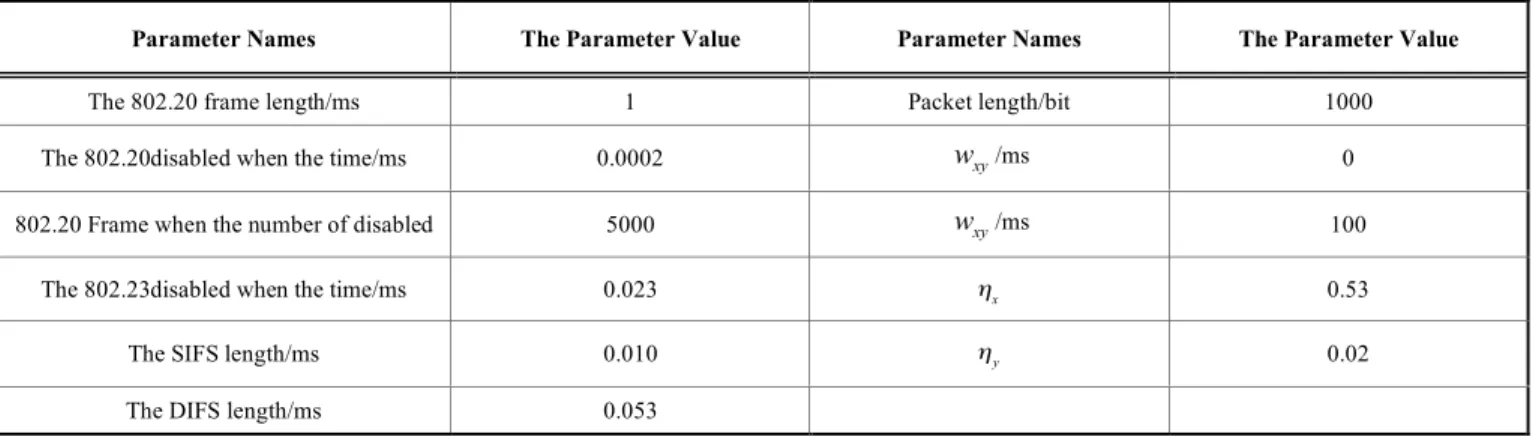
RAN randomly changed. Users can access a RAN at the same moment. Service packets arrive to Poisson distribution. The minimum rate of Variable rate services reached 1/2 of average rate. Users initially access network, whose selections are based on SINR (Signal-to-interference plus noise ratio, SINR) criterion, that is, channel conditions between the user and the various RAN, dynamically select the highest RAN of SINR to access, while according to network selection princi-ple of 802.20/802.23 converged network users to access, business users access to 802.20 networks real-timely at a constant rate. The associated parameter settings used by net-work simulation are shown in Table 2.
In order to verify the performance of the proposed gate-way load balancing algorithm, by using handover decision load balancing algorithm (Handoff decision load-balancing algorithm, HDLBA) proposed by Yan X, etc as a compared algorithm, the packet loss rate, packet delay and throughput performance were compared.
Table 3. Shows the simulation results of the comparison. Table 3 parts forReal time constant variable bit rate of packet loss and The average packet delay of time business show that the changing situation of real time constant bit rate and real time constant variable bit rate, average packet loss rate and packet delay variation when the average rate of each connection from 100Kbit /s increased to 450Kbit /s. As can be seen, the proposed gateway load balancing algorithm sig-nificantly reduces the real-time variable rate, packet loss rate and packet delay; while the average delay and packet loss rate of real-time business a constant rate in the two
algo-rithms is basically to keep unchanged. It is because the pri-orities safeguard mechanism of 802.16 networks for real-time business with a constant rate can guarantee QOS serv-ice of real-time at a constant rate, while the two algorithms, which can ensure a constant rate of real business users, al-ways stay in the 802.16 network, and get a guaranteed qual-ity of service.
Table 3 part of the throughput of whole network, shows as the load increases, the proposed gateway load balancing algorithm can significantly improve the throughput of the whole network.
Simulation results show that: QALBA algorithm can bal-ance the network load, and compared to the traditional MLB algorithm and DLBD algorithm, the average blocking rate of packet service and the throughput performance have been improved significantly, and the robustness of algorithm is really strong, which can achieve network load balancing to achieve a balanced use of network resources.
4. CONCLUSION
For the integration of heterogeneous wireless network communication scenario, the network load balancing algo-rithm was proposed based on the QOS, which is fallen into switchable load balancing algorithm. Algorithm is based on QOS gains and network utility of a generalized feature for wireless business users, and it is able to characterize the quality of service terminal network experience and network load conditions, and it is universally applicable for a variety Table 2. Experimental parameters.
Parameter Names The Parameter Value Parameter Names The Parameter Value
The 802.20 frame length/ms 1 Packet length/bit 1000
The 802.20disabled when the time/ms 0.0002 wxy/ms 0
802.20 Frame when the number of disabled 5000 wxy/ms 100
The 802.23disabled when the time/ms 0.023 !x 0.53
The SIFS length/ms 0.010 !y 0.02
The DIFS length/ms 0.053
Table 3. Simulation results.
SN 1 2 3 4 5 6 7 8
Business Flow Rate on Average (Kbit/s) 100 150 200 250 300 350 400 450
HDLBA 0 0 0 0 8.7 16 18 19
Real time constant variable bit rate
of packet loss rate (%) QALBA 0 0 0 0 0 0 5.4 5.5
HDLBA 0 0 0 0 73 82 93 102
The average packet delay of time
business (ms) QALBA 0 0 0 2 5 6 29 30
HDLBA 3.6 6.2 8 8.6 7.3 7.1 9.2 9.6
The throughput of whole network
of heterogeneous network. Among them, the universality of network utility to heterogeneous network makes heterogene-ous network load comparability comparable, able to achieve switching between heterogeneous network load balancing. Simulation results show that the proposed gateway load bal-ancing algorithm can improve integration of heterogeneous network throughput, reduce business latency and packet loss rate, with strong robustness to achieve network load balanc-ing and to achieve a balanced use of network resources.
CONFLICT OF INTEREST
The authors confirm that this article content has no con-flict of interest.
ACKNOWLEDGEMENTS
This work was financially supported by Guangdong In-dustry Technical College Foundation (KJ2013110).
REFERENCES
[1] K. Suhairi, and F.L. Gaol, “The measurement of optimization per-formance of managed service division with ITIL framework using statistical process control,” Journal of Networks, vol. 8, no. 3, pp. 518-529, 2013.
[2] Y. Guang, Y. Zhu, C. Gu, J. Fei, and X. He, “A framework for automated security proof and its application to OAEP,” Journal of Networks, vol. 8, no. 3, pp. 552-558, 2013.
[3] M.J. Mirza, and N. Anjum, “Association of moving objects across visual sensor networks,” Journal of Multimedia, vol. 7, no. 1, pp. 2-8, 2012.
[4] M. J. Mirza, and N. Anjum, “Association of moving objects across visual sensor networks,” Journal of Multimedia, vol. 7, no. 1, pp. 2-8, 2012.
[5] Z. Duan, Z. Yuan, X. Liao, W. Si, and J. Zhao, “3D tracking and positioning of surgical instruments in virtual surgery simulation,”
Journal of Multimedia, vol. 6, no. 6, 502-509, 2011.
[6] S.H. Tang, M.C. Chen, Y.S. Sun, and T. Zsehong, “A spectral effi-cient and fair user-centric spectrum allocation approach for down-link transmissions,” IEEE., Globecom., pp. 1-6, 2011.
[7] C. Xu, J.H. Lu, and Y. Zhen. "An Experiment and analysis for a boiler combustion optimization on efficiency and NOx emissions,"
Boiler Technology, vol. 37, no. 5, pp. 69-74, Oct. 2006.
[8] L.G. Liang, Y. Meng, and S.L. Wu. "Operation optimization for retrofitted 1025 t/h boiler and experimental study on its NOx emis-sion," Thermal Power Generation, vol. 42, no. 1, pp. 63-66, Jan. 2013.
[9] Z.Y. Gao, Z. Guo, J.Q. Hu, X. Wu, and X. Wang, "Multi-objective combustion optimization and flame reconstruction for W shaped boiler based on support vector regression and numerical simulation".
Proceedings of the CSEE, vol. 31, no. 5, pp. 13-19, May 2011. [10] K. Ruttik, K. Koufos, and R. Janttir, “Model for computing
aggre-gate interference from secondary cellular network in presence of correlated shadow fading,” In: IEEE, 22nd International symposium
on personal, indoor and mobile radio communications, 2011, pp. 433-437.
[11] D.L. Sun, X.N. Zhu, Z.M. Zeng, and S.H. Wan “Downlink power control in cognitive femtocell networks,” In: IEEE International conference on wireless communications and signal processing, 2011, pp. 1-5.
[12] N. Omidvar, B.H. Khalaj. “A game theoretic approach for power allocation in the downlink of cognitive radio networks,” In: IEEE 16th CAMAD, 2011, pp. 158-162.
[13] D. Xu, Z.Y. Feng, Y.Z. Li, P. Zhang, “Fair Channel allocation and power control for uplink and downlink cognitive radio networks,” In: IEEE Workshop on mobile computing and emerging communi-cation networks, 2011, pp. 591-596.
[14] W.Q. Yao, Y. Wang, and T. Wang, “Joint optimization for down-link resource allocation in cognitive radio cellular networks,” In:
IEEE 8th Annual IEEE consumer communications and networking
conference, 2011, pp. 664-668.
[15] J. Naereddine, J. Riihijarvi, and P. Mahonen. “Transmit power control for secondary use in environments with correlated shadow-ing,” In: IEEE, ICC2011 Proceedings, 2011, pp. 1-6.
[16] R. Berangi, S. Saleem, M. Faulkner, and W, Ahmed, “TDD cogni-tive radio femtocell network (CRFN) operation in FDD downlink spectrum,” In: IEEE, 22nd International Symposium on Personal,
Indoor and Mobile Radio Communications, 2011, pp. 482-486. [17] W. Ahmed, J. Gao, S. Saleem, and M. Faulkner, “An access
tech-nique for secondary network in downlink channels,” In: IEEE, 22nd
International Symposium on Personal, Indoor and Mobile Radio Communications, 2011, pp. 423-427.
[18] G. Isabel, and S. Ismael. "Variable Selection for Multivariate Statis-tical Process Control ". Journal of Quality Technology,” Milwau-kee: vol. 42, no. 3, p. 242, July 2010.
[19] R.T.S Ramakrishnan, and A.V. Thakor. "Information Reliability and a Theory of financial intermediation", The Review of Economic Studies, vol. 51, no. 3, pp. 415-432, 1984.
[20] S. Rick, "Preventive Maintenance your SPC," Journal of Quality Technology, Automated Precision Inc., vol. 49, no. 12, p. 13, Dec. 2010.
[21] R. William, and J.R. Kinney, "Information Quality Assurance and Internal Control", McGraw-Hill, USA. 2000.
[22] M. Backes, M. Berg, and D. Unruh. “A formal language for crypto-graphic pseudocode,” In: 15th International Conference on Logic for
Programming, Artificial Intelligence and Reasoning, LPAR 2008, volume 5330 of Lecture Notes in Computer Science. Springer, 2008, pp. 353-376.
[23] D. Nowak and Y. Zhang. “A calculus for game-based security proofs,” In: Provable Security - 4th International Conference,
ProvSec 2010, Malacca, Malaysia, October 13-15, 2010.
[24] G. Barthe, B.Gregoire, S.Zanella, and Beguelin, “Formal certifica-tion of code-based cryptographic proofs,” In: Proceedings of the 36th ACM Symposium on Principles of Programming Languages,
ACM Press, 2009, pp. 90-101.
[25] G Barthe, B. Gregoire, S. Heraud, S. Zanella, and Beguelin, “Com-puter-Aided Security Proofs for the Working Cryptographer,” In:
Advances in Cryptology - CRYPTO, vol. 6841 of Lecture Notes in Computer Science, Springer, 2011, pp. 71-90.
Received: September 16, 2014 Revised: December 23, 2014 Accepted: December 31, 2014
© Yansheng et al.; Licensee Bentham Open.
This is an open access article licensed under the terms of the Creative Commons Attribution Non-Commercial License (http://creativecommons.org/-licenses/by-nc/3.0/) which permits unrestricted, non-commercial use, distribution and reproduction in any medium, provided the work is properly cited.