Guidelines for Improving Software:
Release 5.0
Software: Release 5.0
Technology Transfer # 96103188A-ENG SEMATECH
October 31, 1996
Abstract: This document provides semiconductor manufacturers and equipment suppliers with a proactive, cooperative, and preemptive method for improving the reliability and overall quality of software in fabs and process tools. This approach is being developed and implemented by SEMATECH member companies and their suppliers, coordinated by SEMATECH’s Software Process Improvement (SPI) Project. The method advocates four basic elements: a management policy to support and measure software quality; functions to produce high-quality software on time and within budget; stages for building quality-enhancing functions into a software process; and partnering to facilitate and expedite organizational change to improve software quality. This SEMATECH-coordinated program is based on the Capability Maturity Model (CMM) from the Software Engineering Institute (SEI). This document supplements, but does not replace, Software
Process Improvement (SPI) Guidelines for Improving Software: Release 4.0, Technology Transfer
#95082943A-ENG.
Keywords: Equipment, Equipment Reliability, Project Management, Quality Management, Software Development, Software Development Life Cycle, Software Process Improvement, Software Reliability, Suppliers
Approvals: Ted Ziehe, Author
Harvey Wohlwend, Project Manager Gary Gettel, Director,Factory Integration
Table of Contents
1 EXECUTIVE SUMMARY...1
2 SEMICONDUCTOR MANUFACTURING NEEDS HIGH QUALITY SOFTWARE ...2
2.1 The Software Challenge ...2
2.2 Software Quality Improvement Policy ...3
2.3 Recap and Preview ...6
3 PROCESS, MATURITY, AND SOFTWARE QUALITY...7
3.1 Maturity and Software Quality ...8
3.2 Outcomes of a Mature Process ...9
3.3 Rating the Maturity of a Process ...10
3.4 Functions of a Mature Process...14
3.5 Recap and Preview ...19
4 USE “PROCESS” TO IMPROVE SOFTWARE QUALITY ...20
4.1 Stage 1: Complying with the Policy ...21
4.2 Stage 2: Software Process 101...22
4.3 Stage 3: Addressing the “Big 6” Issues ...22
4.4 Stage 4: Gaining Basic Management Control ...23
4.5 Stage 5: Establishing Your Process ...25
4.6 Stage 6: Mastering Process Measurement ...26
4.7 Stage 7: Gaining Full Process Control ...27
4.8 Recap and Preview ...28
5 USE “PARTNERING” TO REDUCE RISK AND SPEED PROGRESS ...29
5.1 Role of a SEMATECH Member Company ...31
5.2 Role of a Supplier ...31
5.3 Role of SEMI/SEMATECH...32
5.4 Role of SEMATECH’s SPI Project ...33
5.5 A Final Word ...35
6 REFERENCES ...38
APPENDIX A Complying with the Policy on Software Quality Improvement...41
A.1 Examples of Quality Indicators: All Eight Subjects...47
APPENDIX B ORGANIZING TO SUPPORT SOFTWARE QUALITY IMPROVEMENT ....49
B.1 Core Functions...49
B.2 Core Extensions...49
B.3 Support Functions...50
B.4 Improvement Functions ...50
B.5 Organizational Context...51
APPENDIX C REPORTING IMPROVEMENTS IN SOFTWARE QUALITY ...53
APPENDIX D BENEFITS OF IMPROVING SOFTWARE QUALITY...59
D.1 Reported Benefits ...59
List of Figures
Figure 1 SEMATECH Members’ Software Quality Improvement Policy...4
Figure 2 Quality Metrics from the Policy on Software Quality Improvement...6
Figure 3 Maturity Levels in the Capability Maturity Model from the SEI ...11
Figure 4 Improvement Strategy and Key Process Areas of the CMM ...13
Figure 5 Categories of Functions for Maturing a Software Process ...15
Figure 6 Materials That Constitute Software ...16
Figure 7 Key Relationships of the SPI Project...34
Figure 8 Keeping the Productivity Engine on Track ...36
Figure 9 Five Requirements for Organizational Change...37
Figure 10 Example of a Software Engineering Process Group...51
Figure 11 SSQA Module 3: Process Maturity ...54
Figure 12 Management Commitment Composite Rating ...55
List of Tables
Table 1 Software Practices in Five Member Company Fabs...2
Table 2 Characteristics of Immature Software Organizations ...7
Table 3 Definitions of Function, Process, and Maturity...8
Table 4 Characteristic Outcomes of a Mature Software Process...10
Table 5 Profiles of the Five Maturity Levels in the Capability Maturity Model ...12
Table 6 Composition of the Capability Maturity Model at Levels 2, 3, 4, and 5 ...14
Table 7 Key Process Areas and Goals for Maturity Level 2 (Stage 4) ...24
Table 8 Key Process Areas and Goals for Maturity Level 3 (Stage 5) ...26
Table 9 Key Process Areas and Goals for Maturity Level 4 (Stage 6) ...27
Table 10 Key Process Areas and Goals for Maturity Level 5 (Stage 7) ...28
Table 11 Mission and Objectives of the SPI Project ...34
Table 12 Management versus Leadership...50
Table 13 SPI Composite Index ...56
Table 14 Reported Benefits of SPI Among 13 Organizations ...59
Table 15 Assumptions Used in Assessing Software-Related Unplanned Downtime...60
Table 16 Estimated Costs of Software-Related Outages ...60
Acknowledgements
This material reflects the insights and understandings of the entire SEMATECH SPI Project staff, gained from work with more than 40 supplier companies (members of SEMI/SEMATECH). It also incorporates a perspective provided by members of the SPI Project’s Technical Advisory Board—representatives of the SEMATECH member companies, SEMI/SEMATECH, Sandia National Laboratories, and the Software Engineering Institute of Carnegie Mellon University— who serve as the project’s steering committee.
1 EXECUTIVE SUMMARY
Today’s semiconductor fabs require a lot of software: a shop floor control system, process and engineering databases with various application programs, and software embedded in the
equipment that makes, moves, measures, assembles, and tests the products the fabs manufacture. The operational reliability of this assemblage of software—estimated to be about 50 million lines of code—is very significant when calculating the productivity and profitability of a fab.
Even so, software gets little attention until it fails. Then, under severe schedule and economic pressures and with consternation, technicians must scramble to resolve problems as they arise. This document presents a proactive, cooperative, and preemptive way to improve the reliability of fab software and its overall quality. This approach is being developed and implemented by SEMATECH member companies and their suppliers, coordinated by the SEMATECH Software Process Improvement (SPI) Project. Based on the concept of a “mature” process for producing and supporting software, the approach has four elements:
1. A policy that clearly states the importance of software quality, identifies several keys to
improving it, and defines a set of metrics that measure basic policy compliance.
2. Functions that, properly implemented within a software process, regularly produce software on time and within budget, provide objective indicators of the software’s quality level, and continuously improve the level of quality achieved.
3. Stages for building these quality-enhancing functions into a software process, thereby maturing it and increasing the level of software quality delivered to customers.
4. Partnering that facilitates and expedites the change in an organization’s culture that is required to successfully improve software quality.
This SEMATECH-coordinated program is based on the Capability Maturity Model (CMM)—a comprehensive framework for guiding the work of maturing a software process and providing the staff capabilities required. The CMM, from the Software Engineering Institute (SEI), is
compatible with two other widely used maturity guides:
• Module 3 of the Standardized Supplier Quality Assessment (SSQA), the component for
software operations in an assessment tool developed and used by SEMATECH constituents.
• The ISO-9001 standard (with ISO 9000-3 for Software), developed and supported by the
International Organization for Standardization and widely used internationally.
The SEMATECH/SPI approach helps an organization use any (or all three) of these guides to establish, mature, and effectively use its software process, a process that an organization must tailor to its own particular needs and changing situation.
This document sketches the SEMATECH/SPI approach from the perspective of a “chief change agent.” Such a person is a software practitioner who has a vision for software, and uses that vision to drive the organization’s initiative to improve software quality. The chief change agent must translate the vision into a practical improvement program for his/her organization. This requires communicating about the vision and the change process with the senior manager who owns the issue of software quality, and who also sponsors and is accountable for the initiative to improve it. In addition, aspects of the vision must be shared with software practitioners, many of whom help change the software process and then take ownership of it in its improved form. The
SPI Project’s intent is for this document to help chief change agents clarify and communicate their software vision.
Readers are invited to send questions, requests for more information, and inquiries about participating in the improvement program for SEMATECH constituents to:
Harvey Wohlwend
SEMATECH Telephone: 512/356-7536
2706 Montopolis Drive FAX: 512/356-3575
Austin, Texas 78741 InterNet: [email protected]
2 SEMICONDUCTOR MANUFACTURING NEEDS HIGH QUALITY
SOFTWARE
In the semiconductor fabs of the 1990s, several hundred pieces of equipment make, move, measure, assemble, and test products—taking a product through as many as 360 process steps that use equipment from several dozen suppliers. Each piece of equipment has embedded
software—from 100,000 lines of code to more than 1 million. The embedded software is usually networked to a shop floor control system, which in turn interacts with various database managers and application programs. This complete assemblage of software is estimated to exceed
50 million lines of executable code.
2.1 The Software Challenge
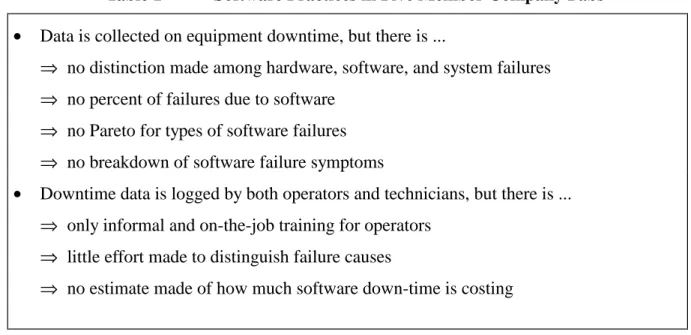
The usability and reliability of a fab’s software—all 50 million lines of it—are quite significant in calculating fab productivity and profitability [1]. But a recent study of software issues in member company fabs [2] reveals that the practices cited in Table 1 are commonplace.
Table 1 Software Practices in Five Member Company Fabs
• Data is collected on equipment downtime, but there is ...
⇒ no distinction made among hardware, software, and system failures
⇒ no percent of failures due to software
⇒ no Pareto for types of software failures
⇒ no breakdown of software failure symptoms
• Downtime data is logged by both operators and technicians, but there is ...
⇒ only informal and on-the-job training for operators
⇒ little effort made to distinguish failure causes
Clearly, using 50 million units of software effectively, coming as it does from many different suppliers, is a challenge under the best of circumstances. The practices cited above add to the challenge, and the following industry trends make it even more difficult:
• Increasing use of equipment in clusters and cells with complex control requirements
• Emerging applications of sensor technology for regulating process operations
• More frequent reconfigurations of equipment in a fab for short product runs
• Widespread use of automated material handling and mini-environments
• Automation of the total fab
Meeting these and the special requirements of individual manufacturers is causing the volume of embedded software to increase more than 25% per year. This trend is a factor in the rapidly rising cost of equipment, which in turn is driving up the cost of fabs. Now that a fab costs a billion dollars or more—70% of which is cost of the equipment—overall equipment effectiveness (OEE) and the equipment’s cost of ownership (COO) are critical. In summary, as requirements get more complex and software volumes increase, the industry’s need for increasingly reliable software—that raises OEE and lowers COO—is more critical than ever.
2.2 Software Quality Improvement Policy
In spite of this software dilemma, the business case for improving software quality is compelling [3], and SEMATECH member companies are responding with the following actions:
• Improving the quality of software their own organizations produce
• Evaluating suppliers’ product quality and software capability during procurement
• Chartering positions for software specialists who work with equipment suppliers
• Establishing strategic partnerships with key suppliers to improve product reliability
• Giving visibility to suppliers who successfully improve software quality
• Chartering and funding the SPI Project at SEMATECH
However, the SEMATECH member company drive to improve fab software reliability can
succeed only if each supplier takes ownership of and is accountable for the quality of its software—with accountability defined as follows:
• Senior management’s ongoing commitment to improve
• The improvement goals set and the level of effort invested in achieving the goals
• The staff’s competence with software metrics and continuous improvement
• The network of relationships established to improve the quality of delivered software To give the drive for improvement the focus it needs, SEMATECH members are establishing a
Policy on Improving Software Quality. It cites the high priority that members put on software
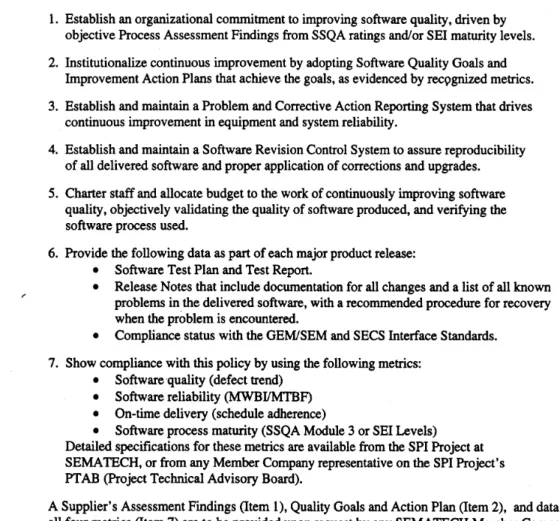
quality, provides guidance for achieving such quality, and gives criteria for evaluating policy compliance. Figure 1 contains the policy’s full text.
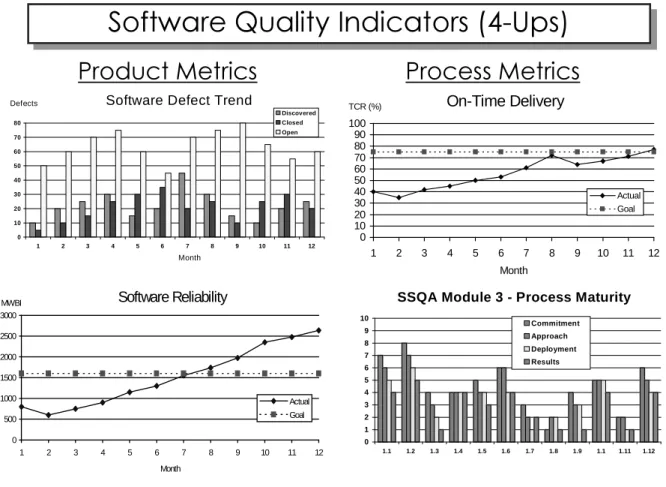
The policy is currently under review by the appropriate member company boards and councils. However, several SEMATECH members are already implementing it within their equipment and system procurement activities. Suppliers are responding by producing and putting to use the four metrics cited in Item 7, and graphically illustrated in Figure 2. Of the four metrics, the first two relate to the software itself:
• Software Quality—measured in terms of the defects detected in software after its release to
customers. The key metrics are defects discovered and defects fixed during a specific time period, and defects remaining open at the end of the time period. The key indicator includes these three data items, measured monthly, and plotted as a trend chart.
• Software Reliability—A measure of software’s ability to perform to specifications within its
operational setting without failing for a certain number of wafers (MWBI for wafer
processing equipment), or time period (MTBF for other equipment). Reliability is calculated from either test results or production operations by logging failures and then using standard methods to compute MWBI or MTBF. The key indicator is reliability calculated monthly and plotted as a trend chart.
The other two metrics relate to a supplier’s software process:
• On-Time Delivery—A measure of an organization’s ability to adhere to the schedules it sets.
Key metrics are the total number of tasks scheduled for completion during a time period and the number of tasks completed. The key indicator is the ratio of completions to total tasks, computed monthly, and plotted as a trend chart.
• Software Process Maturity—The measure of an organization’s ability to develop quality
software, on time and on budget, as defined by the SEMATECH Standardized Supplier Quality Assessment method (SSQA, Module 3–Software Quality). This method covers twelve fundamental requirements for good software development practices, rating each (using a standardized scoring matrix) on four factors: management commitment, systems approach, deployment, and results. The key indicator is a one-page summary of the four scores for each of the 12 SSQA requirements, determined annually by a self-assessment, and plotted as a bar chart. An alternative is an assessment based upon the Software Engineering
Institute Capability Maturity Model for Software (SEI/CMM). The key indicator in this case
is the organization’s satisfaction of SEI Levels 2 and 3 Key Process Areas (KPAs).
A supplier with current and historical data for all four of these metrics has taken a major step in complying with the policy. These data, objective indicators of quality, are evidence the
SEMATECH members want, but also data a supplier must have to drive its improvement initiative. See Appendix A for more discussion of policy compliance and the importance of objective quality indicators.
0ROCESS -ETRICS
0RODUCT -ETRICS
3OFTWARE 1UALITY )NDICATORS 5PS
Software Defect Trend0 10 20 30 40 50 60 70 80 1 2 3 4 5 6 7 8 9 10 11 12 Month Defects Discovered Closed Open Software Reliability 0 500 1000 1500 2000 2500 3000 1 2 3 4 5 6 7 8 9 10 11 12 Month MWBI Actual Goal On-Time Delivery 0 10 20 30 40 50 60 70 80 90 100 1 2 3 4 5 6 7 8 9 10 11 12 Month TCR (%) Actual Goal
SSQA Module 3 - Process Maturity
0 1 2 3 4 5 6 7 8 9 10 1.1 1.2 1.3 1.4 1.5 1.6 1.7 1.8 1.9 1.1 1.11 1.12 Commitment Approach Deployment Results
Figure 2 Quality Metrics from the Policy on Software Quality Improvement 2.3 Recap and Preview
SEMATECH member companies are establishing a policy on software quality improvement to say the following:
• Highly reliable software is critically important to the success of fabs.
• Each supplier is expected to provide software that meets quality standards set by its customers.
• A software release is to be accompanied by objective evidence of its quality, using indicators agreed upon with customers in advance.
• The objective indicators that are used must show, over time, increases in quality for all delivered software.
Complying with this policy requires much more than coding competence. It requires effectiveness in the broad range of organizational functions identified in Section 3. An organization’s software process—the one that it actually uses—is its institutionalized form of such functions. For a supplier’s software process to be mature, it must continuously improve the quality of the software it produces, by increasing its own level of maturity. Section 4 sketches a path for continuous improvement of the software process, a path that leads to high software quality and high process maturity. The path to quality that is sketched takes reliability as the most important attribute of quality.
As suppliers and their customers define quality and work to achieve it, there are inherent risks and the rate of progress is always an issue. Section 5 presents opportunities for partnering with customers, other suppliers, and the SPI Project at SEMATECH—partnering that reduces risks and increases the rate of progress.
3 PROCESS, MATURITY, AND SOFTWARE QUALITY
Two out of three organizations developing software today use an ad hoc, often chaotic approach [4]. Some produce good software, but always at high cost in terms of defects, late deliveries, qualification of software for production use, and work stoppages after qualification. The costs are too high in both financial and human terms (e.g., rework time, staff burnout and turnover, and lack of return on investments in tools and training). Table 2 lists some
characteristics of organizations relying on this approach.
Table 2 Characteristics of Immature Software Organizations
An organization’s software approach is immature when ...
• Software quality is unpredictable, unknown
• Projects often overrun budgets and schedules
• Testing and reviews often are skipped because of schedule pressure
• The number of defects in delivered software is high
• Management is reactionary, focused on firefighting and crises
• Success depends on individual talent and heroic efforts
• Process is ad hoc and improvised, sometimes chaotic
• Benefits from technology improvements are lost in confusion
• Personnel practices do not cultivate software talent
• Software strategy does not relate to corporate success factors
The past ten years have clarified much about “engineering” software and “maturing” the software process to increase quality—but too few organizations are applying what’s being learned. For example, this statement ...
“Software’s quality is determined by the maturity of the process that produced it.”
... is often repeated, and now is widely accepted because there is much confirming evidence [5]. But, as cited above, most organizations have not yet applied it.
In this document, that statement about quality, maturity, and process is treated as a two-step recipe for high quality software:
1. Follow a process—that is, discipline your ad hoc and chaotic activities. 2. Incorporate within your process functions that mature it.
The concept is very simple and logical, but it’s not easy to implement; so, this section and the next examine both steps. This section begins by looking at what it means to say “maturity puts
software process (step 2). Against that background, Section 4 shows why and how “process” impacts software quality (step 1), and the role of a “continuous improvement process” in producing high quality software (back to step 2 again).
Two important concepts in both steps are “process” and “function.” Table 3 provides definitions that relate them, and that distinguish a “mature” software process from software processes in general, including the prevalent “ad hoc and chaotic approach.”
Table 3 Definitions of Function, Process, and Maturity
function One of a group of related actions contributing to a larger action (or process). [from Webster’s Third New International Dictionary, Unabridged, 1986]
process The series of steps used to bring about a desired result.
[from the Concise American Heritage Dictionary, revised edition, 1987] A progressively continuing operation that consists of a series of controlled actions or movements systematically directed toward a particular result or end. [from Webster’s Third New International Dictionary, Unabridged, 1986]
software process
The set of activities, methods, practices, and transformations that people use to develop and maintain software and the associated products.
[from SEI’s 93-TR-24, p.3] [7]
A set of activities that transforms a user’s computing requirement into a program which operates within the intended user environment.
mature software process
A set of systematic activities that transforms a user’s computing requirement into a program which operates satisfactorily within the intended user
environment.
3.1 Maturity and Software Quality
If the maturity of a software process determines the quality of the software produced, then the following statements are also true:
• Immaturity lowers software quality.
• Trying to improve quality after software has been produced is a questionable strategy.
• Maturity must be put into a process before high-quality software can be expected from it. Many senior managers, unfamiliar with these quality/maturity relationships or simply not believing them, think software quality depends solely on the capabilities of their staff. Having capable people is always an advantage, but a recent study of success factors in software
engineering projects [6] put “staff competence” in seventh place, lower than factors such as the following:
• User involvement
• Executive management support
• Clear statement of requirements
Think about it: executive management support is more important to the success of software projects than the competence of practitioners who develop the software! That insight is worth noting and exploring. In fact, all four of the success factors listed above are involved in rating the maturity of a software process.
So what is a “mature” software process? What does “maturity” make possible?
Simply put, a software process is “mature” when—in addition to producing software—it
efficiently finds defects and repairs them, seeks proactively to prevent defects, produces objective indicators of the software’s quality, and uses the indicators to change the software process and improve software quality.
In terms of this definition, it can be said that a mature software process is one that is both complete and effective. To be complete, it must have four parts:
1. The first part produces software—executable code plus its associated materials. 2. A second locates and repairs defects and proactively looks for ways to prevent them. 3. Another periodically produces objective indicators of the software’s quality.
4. The fourth repeatedly identifies, plans, and makes process changes to improve quality. In addition to being complete, a mature process is also effective. Effectiveness is measured by increases in three indicators: software quality, customer satisfaction, and staff productivity. This definition gives meaning to the statement “maturity puts quality into software” by “continuously improving the software process.” Even though the statement is very simple and clear, implementing maturity is not easy (see Section 4); nor is it without risks (see Section 5). Appendix B provides information on staffing and organizing to support software quality improvement through continuous process improvement.
But before moving on to implementation, process maturity must be examined in more detail. For example, if maturity is the key to software quality:
• What are characteristic outcomes of a “mature” process?
• What is used to rate or measure the “maturity” of a software process?
• Can a “mature” process be prescribed—not hypothetically, but in a way that fits one’s particular organization and situation?
These questions are answered below.
3.2 Outcomes of a Mature Process
“What we want from our software group is executable code,” many senior managers say. And they insist on schedules, set budgets, and allocate staff and other resources in a manner that expresses that view. But a mature software process produces various materials in addition to code—and the quality of the outcomes steadily increases. Table 4 lists several of the additional outcomes—what is not produced, as well as what is. For example, producing “fewer defects” is an important result because it indicates increasing quality.
The last two outcomes listed in Table 4 are especially important. Both are used in defining process maturity. Having objective, quantified evidence of quality is important because it means you have an agreed-on definition of quality (remember, your customers help to define quality),
customers can communicate about quality clearly, simply, and accurately. The policy presented in Section 2 establishes two metrics as objective evidence of software quality, and two metrics that measure process maturity.
Objective evidence is important for a second reason; it provides a basis for continuously
improving quality. Continuous improvement is the most reliable road to high quality software— in fact, it is the only road. Quick, one-shot fixes—known as “silver bullets”—cannot solve your software problems. Continuous improvement puts a high priority on figuring out what must be done, planning the required changes, and executing the plans. This calls for energetic leadership as well as time and effort by capable and experienced staff. If either is lacking, it will not happen. Yes, a mature software process is comprehensive. If your organization’s process is not, something is missing. It is safe to say that “something is missing” for many organizations.
Table 4 Characteristic Outcomes of a Mature Software Process
In addition to executable code, a “mature” software process also ....
• Delivers software on schedule and within budget—regularly
• Keeps defects-released-to-customers and mistakes-made-with-customers low
• Locates defects, and fixes them quickly—in priority order
• Handles software baselines, evolutionary versions, and audit trails of change
• Produces the various materials that, combined with code, form useful software
• Provides objective evidence of the software’s level of quality
• Persistently identifies ways to improve the software produced and the process
3.3 Rating the Maturity of a Process
The outcomes of a process reveal much about its maturity (see above). In fact, the most
comprehensive tool yet developed for rating software process maturity uses, as its basis, outcomes (expressed as goals) along with practices that accomplish the goals. This tool is the Capability Maturity Model (CMM) for Software [7], developed and supported by the Software Engineering Institute (SEI) at Carnegie Mellon University. The SEI, a major force in the widespread
improvements being made in software engineering, “is committed to the evolution of software engineering from an ad-hoc, labor-intensive activity to a managed, technology-supported engineering discipline” [8].
The SPI Project is using the CMM as a de facto standard in improving the quality of supplier software executing in SEMATECH member company fabs. The CMM is comprehensive and very detailed, but its architecture is simple, logical, and quick to grasp. This section profiles that architecture, explains what the CMM brings to the work of improving quality, and shows how the CMM for Software relates to other improvement guides—namely, the SSQA method (Module 3) and ISO 9001 (as interpreted for software by ISO 9000-3).
The CMM for Software models process maturity in terms of the following:
• Selected areas of software activity on which the model is focused
• Specific goals to accomplish in the activity areas selected (goals = results, outcomes)
• Various practices for accomplishing the goals (producing the results or outcomes)
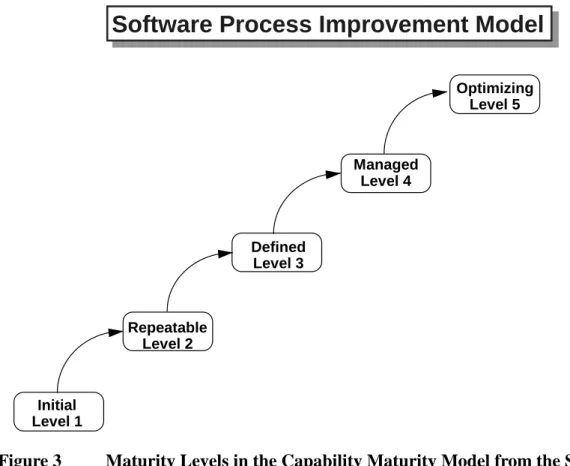
The CMM has four parts, each of which is a construct of areas, goals, and practices. One part models “full maturity.” The other three depict maturity at stages or levels leading up to “full maturity.” Figure 3 shows this progression as “five levels of maturity” with “full maturity” at Level 5, and Levels 2, 3, and 4 leading up to it. Maturity Level 1 has no areas, goals, or practices associated with it, so it represents the original or ad hoc stage.
These four parts of the CMM—used individually or as a unit—serve as templates for
determining how mature an organization’s software process is. Such a rating is the result of an objective assessment in which CMM templates are compared with evidence collected by a team of appraisers. This comparison determines which of the model-prescribed areas of activity are present within the organization’s software process, which goals it achieves on a regular basis, and which practices it uses consistently.
Software Process Improvement Model
Initial Level 1 Repeatable Level 2 Defined Level 3 Managed Level 4 Optimizing Level 5
Not only is the CMM used to rate process maturity, it also is a roadmap charting a path from low maturity to high. Named areas of activity define the scope of the model at each level of maturity; within each area, goals with practices that achieve the goals give it focus. The progression from one maturity level to the next charts the path. In Table 5, a profile of each level reveals this path and the CMM’s underlying strategy for improving software.
Table 5 Profiles of the Five Maturity Levels in the Capability Maturity Model
• Maturity Level 1: Initial
This first level of the CMM is unique; it has no model of maturity—no areas, goals, or practices. That void means that a software process which fails to qualify at any of the other four levels—those that are unpredictable and poorly controlled, even ad hoc and chaotic—are referred to as Level 1 processes.
• Maturity Level 2: Repeatable
At this level the model’s focus is on basic management control of software operations. Goals and practices in six key process areas identify what is required to repeat previously mastered tasks or projects in a way that gets similar results. For that reason, this level is referred to as “repeatable.” By effectively planning and managing each of its software projects, an organization controls this most basic level of its software process.
• Maturity Level 3: Defined
At this level, the model focuses on an established software process that is used throughout the organization. Goals and practices in seven areas clarify and characterize the entire process, making it understood and regularly used organization-wide. Once established, the process is institutionalized: it is documented, staff and managers are trained in all aspects of it, and it is verified that projects are conducted in a manner suitably consistent with it.
• Maturity Level 4: Managed
At this level, the model’s focus is on mastering techniques for measuring the software process itself, and the quality of software produced by the process. Goals and practices in two key process areas add instrumentation to the organization-wide process that was established at Level 3, allowing that process to be quantitatively
understood and controlled, and also facilitating fact-based decision-making and priority-setting by managers.
• Maturity Level 5: Optimizing
At this final level, the model’s focus is on full control of the software process, including the ongoing improvement of both software quality and process maturity. Goals and practices in three key process areas identify important aspects of defect prevention and continuous improvement. At this level, the organization’s software process routinely operates well, freeing a larger share of the effort for continuous improvement and process adaptation.
Figure 4 gives more details about the CMM. In addition to the maturity levels, this figure
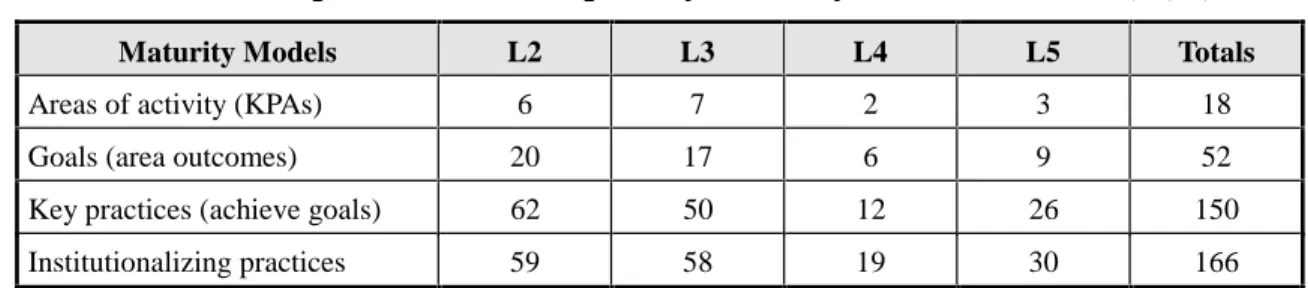
graphically shows the CMM’s underlying improvement strategy. It also names (and numbers) the Key Process Areas. They set the scope of the model at each level of maturity. The model’s four levels have a total of 18 key process areas, which in turn have a total of 52 goals (or outcomes). For the 52 goals, the CMM lists 150 key practices that accomplish the goals. The model also lists 166 practices for “institutionalizing” the key practices, i.e., ensuring that the organization uses the key practices regularly and consistently. The four types of institutionalizing practices are those that
• Commit the organization to perform the key practices
• Create an ability to perform them
• Ensure that measurement and analysis are performed
• Show diligence about verifying implementation
Software Process Improvement Model
Initial Level 1 Repeatable Level 2 Defined Level 3 Managed Level 4 Optimizing Level 5 Ad hoc and chaotic Gain basic management control Complete process definition Master process measurement Gain process control 6 Configuration Management 5 Quality Assurance 4 Subcontract Management 3 Project Tracking & Oversight 2 Project Planning 1 Requirements Management 13 Peer Reviews 12 Intergroup Coordination 11 Product Engineering 10 Integrated Management 9 Training Program
8 Organization Process Definition 7 Organization Process Focus
15 Quality Management
14 Quantitative Process Management 18 Process Change Management 17 Technology Change Management 16 Defect Prevention
Table 6 details the CMM’s makeup at each maturity level in terms of areas, goals, key practices, and institutionalizing practices. For example, achieving Maturity Level 2 requires work in six areas from which 20 outcomes (goals) are important. The model’s checklist of 62 key practices suggest ways to produce the outcomes, with 59 additional suggestions for how to bring the key practices into use. Section 4 presents an approach to implementing practices in areas of activity that accomplish improvement goals.
Table 6 Composition of the Capability Maturity Model at Levels 2, 3, 4, and 5
Maturity Models L2 L3 L4 L5 Totals
Areas of activity (KPAs) 6 7 2 3 18
Goals (area outcomes) 20 17 6 9 52
Key practices (achieve goals) 62 50 12 26 150
Institutionalizing practices 59 58 19 30 166
The CMM, as a model of progressive maturity, drives an organization to steadily raise its improvement goals and practices. It does this by guiding an organization into new areas of improvement activity as it progresses from one level of maturity to the next.
In contrast, ISO 9001 and SSQA are static standards. The former is effective in that it defines a floor of good practice below which an organization should not fall—namely, establish a software process, document it, and use it with consistency. SSQA sets the quality bar a bit higher with its unstructured list of 12 requirements. Even though the SSQA doesn’t model increasing maturity, its 12 requirements have significant overlap with the six CMM areas at level two, plus five of the seven at level three.
The SPI Project can provide more information about any of these three improvement guides. Whichever you choose, you’ll need to implement within your software process certain functions that the guide prescribes. Before answering the third question (Can a mature process be
prescribed?), it is important to consider the full range of functions involved in maturing a software process.
3.4 Functions of a Mature Process
Two out of three organizations have software processes rated at CMM Level 1. That means they are ad hoc and chaotic, with typically undisciplined uses of the following functions:
• Gather requirements (if offered)
• Create a design (if needed)
• Produce executable code (as fast as possible)
• Test code (if time permits)
• Deliver code (on the due date, even if it is incomplete)
Only extremists still regard coding as the only important function, but far too many organizations are immature software producers because they do not balance priorities, capabilities, and
schedules among the five functions listed above, and do not implement other aspects of a mature software capability.
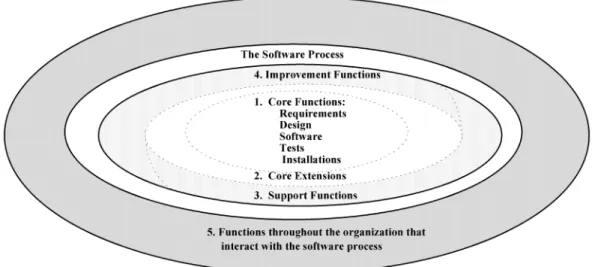
The purpose here is to contrast the limited and inadequate (but popular) approach to software indicated above with a mature software capability. This mature capability is expressed as a range of organizational functions in the five categories named in Figure 5. The various functions cited as aspects of maturity, although not explicitly named by the CMM, are implied by that de facto standard [7]. When an organization implements any of these functions, the form it takes must be suited to the particular organization, and to the function’s use and place within the software process. This is an important matter, but beyond the scope of this document.
Figure 5 Categories of Functions for Maturing a Software Process
Also, it is important to note that the listing of functions below does not define a software process; rather, these functions are components to use when building a process. Senior managers have an important role in selecting functions to implement, determining the form in which each is implemented, and deciding how to arrange implemented functions into a process. That management responsibility is touched on in Section 4.
1. Core Functions. Five functions form the core of software engineering:
• Requirements. Gather requirements and requests from customers, proactively when
necessary; when received after development has started or after software is released to customers, manage the process that determines what to implement and when, and for those that are selected, see that they impact all software materials, not just the code.
• Design. Based on requirements, create and establish an architecture and a design for the
product; maintain agreement between requirements and the architecture/design.
• Software. Produce code, and with it related materials as required, e.g., documented
requirements/designs, user training/reference materials, and release notes; maintain agreement between requirements and all software materials.
• Tests. Verify that software is free of defects, and validate that it satisfies customer
requirements, at each of several established checkpoints in the software process.
• Installations. Install, gain acceptance, and support users of the product in various customer
• Installations. Install, gain acceptance, and support users of the product in various customer
facilities.
Establishing this core means determining, for your particular setting, a workflow among the five functions that can be properly scheduled, staffed, and managed. Each function is important, and an organization must find an appropriate balance for the set of functions.
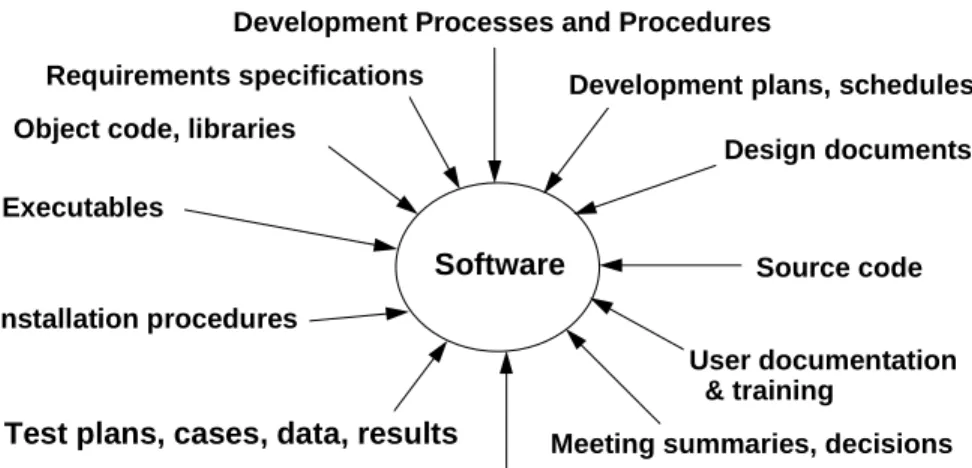
A second important aspect of establishing the core is determining which software materials are needed, and then seeing that all core functions deal appropriately with them. As used here, software refers to code plus some or all of the associated materials listed in Figure 6.
What is Software?
Software
Requirements specifications
Development Processes and Procedures
Executables
Installation procedures
Test plans, cases, data, results
Operational data; template files, data files, screens, schemas User documentation & training
Source code Design documents Development plans, schedules
Meeting summaries, decisions Object code, libraries
Figure 6 Materials That Constitute Software
The test function within the core finds and fixes software defects. Determining what forms of testing to use, and the points within the process at which tests are used, is a third important aspect of establishing the core of software engineering [9].
Finally, defects, as they are identified, form a basis for the work of defect prevention. Root cause analysis relates defects to the function in which they originated and, when possible, to the cause that produced them. The final step is to adjust the process in a way that prevents, or at least reduces, the injection of such defects in the future. Integrating this activity into core functions is the fourth aspect of establishing the core.
2. Core Extensions. This second category is not additional functions, but rather business settings
in which the core of software engineering must operate. Following are examples of such settings:
• New development (from scratch) of products, systems, and/or software
• Product evolution and enhancement, sustaining engineering
• Software re-engineering and reuse
• Software maintenance and customization (defect repair and adding specials)
Each setting requires a form and sequencing of the core functions that are tailored to the needs of that setting. Versions of the core functions are implemented as a process for as many of these settings as are relevant to your business.
3. Support Functions. These functions are integral to the software process, but outside the
software engineering core described above. Their purpose is to handle all software in a manner that:
• Allows only appropriate access
• Keeps an audit trail as changes are applied
• Assures that quality standards are met
• Builds and transfers to customers configurations of the software
Here, each of three support functions is simply named, and a list of representative responsibilities indicates its scope.
• Problem reporting and change control
− Custodian of all problem reports and the work of resolving them
− Defect correction
− Product enhancement and customization
− Priority setting, task scheduling/tracking/reporting
− Change control board administration
− Root-cause-of-problems analysis
• Configuration management and release control
− Custodian of all software that is under formal access and distribution procedures
− Internal distribution and control of software modules during development
− Product-build and signoff on software releases
− External distribution and control of software releases
− Exact reproduction of particular software releases
• Objective verification and validation of products and process
− Product testing
− Peer review coordination
− Validation of process use
− Project debriefings (lessons learned, postmortems)
Each function involves specialized skills, methods, and tools. Implementing any of the three involves decisions related to tool selection, staff selection and training, and procedures. Staffing will be on a part-time basis in some cases, full-time in others.
4. Improvement Functions. These functions, like the support functions, are an integral part of the
software process, but outside its core. They provide the leadership, experience, and drive needed to guide and sustain an SPI initiative. The functions can be implemented in any of various forms, but are essential to improving software quality. They ensure that quality improves in a manner
function below are representative responsibilities [10], including the CMM KPAs for which the function is responsible.
• Vision for Software, Focus on Process, Assure/Manage Continuous Improvement
− Software engineering process leader (chief change agent)
− Key function: KPA 7, Organization Process Focus
− Management Steering Committee for Software Improvement (includes sponsor)
• Policy and Procedures Working Group
− Key functions: KPA 8, Organization Process Definition KPA 10, Integrated Software Management KPA 18, Process Change Management
− Additional functions: risk management plus the following KPA 1, Requirements Management
KPA 2, Software Project Planning
KPA 3, Software Project Tracking and Oversight KPA 4, Software Subcontract Management KPA 12, Intergroup Coordination
• Training and Staff Development Working Group
− Key function: KPA 9, Training Program
− Additional functions: position descriptions with training requirements
• Tools and Methods Working Group
− Key function: KPA 17—Technology Change Management
− Additional functions:
KPA 5, Software Quality Assurance
KPA 6, Software Configuration Management KPA 11, Software Product Engineering KPA 13, Peer Reviews
• Metrics and Database Working Group
− Key functions: KPA 14, Quantitative Process Management KPA 15, Software Quality Management KPA 16, Defect Prevention
− Additional functions: management of the data repository
Most organizations charter their software engineers to spend a specified percentage of time on these working groups. In larger organizations, one or more full-time staff are required to provide the leadership and experience needed to improve software quality.
5. Organizational Context. Maturity within a software process is not possible without a
matching level of maturity in the various organizational functions that frequently interact with the software staff. This category includes four areas of organizational activity that directly impact software quality. Here again, each area is labeled, and representative responsibilities are listed to indicate the scope.
• Organization Management (senior manager responsible for software operations)
− Policy statements and communication
− Business plans, goals, and strategies
− Resource allocations and priorities
− Process management
− Compensation, rewards, incentives, recognition
− Authorizations for staff training
• Product and System Engineering (engineering and manufacturing management)
− System design with allocation of functions to software
− Coordination of the various engineering disciplines
− Mechanical and electrical engineering
− Product problem resolution and resource sharing
• Interactions with customers (marketing, sales, field support, senior management)
− Product requirements and schedules
− Definition of quality and defects
− Product acceptance and support
− Product performance and problem reporting
− Determination of customer satisfaction
• Interactions with suppliers (purchasing, senior management, finance, legal)
− Dealing with contract software engineers
− Making and managing subcontracts for software
− Acquiring software for use within products
− Acquiring tools and equipment for software engineering
Clearly, senior management has a role in the activities listed above. An organization that does not handle such interactions with maturity cannot grow, cannot mature, and will not be competitive.
3.5 Recap and Preview
This section lists organizational functions that “put maturity into a software process.” Maturity means that the process produces software that is high in quality and low in defects. It also periodically produces objective quality-indicators, and a steady flow of changes to the process that, over time, cause the indicators to show that quality is increasing. Functions that do that “ensure quality in the software produced.”
The material also answers two of the three questions raised at the outset:
• It lists the kinds of outcomes that characterize a mature software process.
• It describes the CMM for Software, a gauge for rating process maturity and a guide for continuously improving software quality.
This section concludes by answering the third question: Can one prescribe a mature software process—not hypothetical, but one that fits a particular organization and situation?
The answer is “No;” each organization must develop its own process. Ready-made, easy-to-use, one-size-fits-all software processes planted within an organization do not work. Even a
custom-made process cannot be defined for you by an outside party. The only way to establish a mature software process within an organization is for that organization itself to author it, first by examining and establishing its current process, and then maturing that “as-is” process by
enhancing the effectiveness of existing functions and/or incorporating new functions as the need for them arises.
That is the challenge each organization producing software faces, and Section 4 is an aid for meeting that challenge.
Section 5 completes this document with information about ways to
• Reduce the risk of failure
• Increase the incentive for change
• Speed up the pace at which changes are made
4 USE “PROCESS” TO IMPROVE SOFTWARE QUALITY
A company’s success in the semiconductor industry does not depend on what the company knows or can do at any given moment. It rests, instead, on an ability to learn, change, and mature those capabilities that most impact the company’s business. Bluntly put, no one today stays competitive long-term without being intentional about how they learn, change, and mature as an organization—and without being very effective at working the approach to change that they use [11].
Meeting this industry’s software quality challenge (Section 2) requires a company to learn, change, and mature how it produces software. Section 3 describes the mechanism needed: a mature software process that is complete and effective. If your organization’s software process is already mature, or at least well down that road, keep at it. If you, like many of your colleagues, have some distance to go or have not yet started, this section charts a way to produce high quality software, beginning from wherever you are. So, please read on.
A mature software process can improve quality only if quality is clearly defined. Customers define quality, but proactive suppliers will prompt them to identify the attributes with highest priority. The policy presented in Section 2 (from SEMATECH member companies) puts highest priority on “reliability,” and the general purpose path to high quality defined in this section uses “reliability” as the quality attribute to improve. If you have customers with other priorities, you will need additional quality indicators, and it might also change other aspects of your company’s improvement initiative.
A definition from Table 3 bears repeating:
A process consists of “...actions systematically directed toward a particular result or end.” Once quality (the target) is defined (as reliability or some other attribute), the first step to
improving quality is to establish your process—don’t try to implement new functions, simply establish a process—and aim it as best you can at your target, as you best understand the target. That simple act turns chaos into systematic, results-oriented action. Clarify who participates in the process and, for each participant, what they do, when they do it, and why.
Establishing such a base process makes each subsequent addition, adjustment, and change to the process easier to do, and more likely to succeed. The following paragraphs sketch a sequence of moves that bootstrap an organization up the maturity scale—from Level 1 to Level 5. Ideally, each stage will be completed before continuing on to the next. While that is not mandatory, it is highly recommended because work not completed at a stage increases the risk of failure for work at the later stages.
4.1 Stage 1: Complying with the Policy
This first stage literally puts an organization on the road to high quality software. The actions required are not difficult, but the motives, insights, and determination of the people taking the actions are critical. There must be:
• Conviction about the need, and the benefits
• Insight into methods, and the need for persistence in applying the methods The CMM labels this starting point Level 1—Initial.
Many organizations are painfully aware that their “as-is” approach to software is not really a process at all. Their people work ad hoc and unmanaged, and in the worst cases software
activities are chaotic and out of control. Management has little insight into projects, and budgets and schedules are always changing. But, moved by their customers’ need for very reliable, high-quality, on-time software, and inspired by their own vision for software and its role in the success of their business, the organization commits to putting its software house in order. Four steps, all responsive to the Software Quality Improvement Policy, launch an organization’s ongoing SPI initiative:
• Step 1: (on a best-efforts basis) At regular intervals, provide the 4-ups data defined by the metrics in the Software Quality Improvement Policy, Item 7 (see Figure 2).
• Step 2: (on a best-efforts basis) Discipline your “as is” software activity into a process so you can begin to analyze, evaluate, and revise it.
− Study the flow and balance of your core functions (requirements through installations)
− Consider what materials are produced in addition to code
− Settle on a definition of quality, with metrics and indicators for level of quality
− Identify the business settings in which software is produced (e.g., new development, maintenance, evolutionary development, acquisition)
• Step 4: Declare your organization’s commitment to improving software quality to your staff and customers, and also to the SPI Project at SEMATECH.
Completing these four actions prepares an organization for Stage 2.
4.2 Stage 2: Software Process 101
After the launch, this second stage attends to the basics: staffing, support, and orientation to the work at hand. Again, the actions are quite simple, but the capabilities of those selected and the priority put on completing the actions are critically important. The CMM label Level 1—Initial still applies for Stage 2.
Frequently, an organization launches an improvement initiative, then lets it die. It is only when senior management takes ownership of the issue, puts it on the organization’s agenda, and gives it priority that you move into Stage 2. The other essential ingredient is having a recognized leader of the initiative—a chief change agent who has a vision and passion for software that motivates the entire organization. With capable people in these two roles, the CMM as a resource, and open channels of communication with customers and the SPI Project at SEMATECH, an organization is in position to improve software.
Five steps follow up the launch and give the SPI initiative focus and substance:
• Step 1: Designate a senior manager as the SPI sponsor and reaffirm the organization’s commitment to improve software quality. This step is essential; continuing without a committed sponsor puts the undertaking at high risk of failure.
• Step 2: Name the chief change agent and equip the person selected with a charter, time allocation and budget, and training if needed. This step, also essential, provides the leadership so critical to any effort that implements change.
• Step 3: Understand the three goals of the CMM KPA #7 (Organization Process Focus) and have a strategy (enough for now) for reaching those goals.
− Goal 1: Software process development and improvement activities are coordinated across the organization.
− Goal 2: The strengths and weaknesses of the software process are identified relative to a process standard (initially it is SSQA, later the CMM).
− Goal 3: Organization-level process development and improvement activities are planned.
• Step 4: Define the organization’s norms for software “projects” and for “business settings” that produce software.
• Step 5: Identify specific projects as candidates for improvement activities. Completing these five actions prepares an organization for Stage 3.
4.3 Stage 3: Addressing the “Big 6” Issues
After committing resources to SPI, this third stage ensures some quick benefits. By concentrating in areas that customers have identified as troublesome, improvements will be visible and well received. The CMM label Level 1—Initial still applies for Stage 3.
A poll of SEMATECH member company representatives identified two areas of major concern about supplier performance—configuration management and testing. Four other areas identified are defect tracking, peer reviews, requirements, and project planning/tracking. Improved
performance in any of these area has customer visibility and importance, strengthens
customer/supplier interactions, and begins the move toward Level 2 maturity, the objective of the next stage. Findings from the SSQA assessment (see Stage 1) can inform the plans for change in each of the six areas, and influence priorities that order the work. Each change made must be evaluated in terms of its potential for improving product quality, as reflected by the quality indicators being used.
Improving software quality is a strategic initiative, but success over the long term consists of a progression of short-term successes that individually fuel everyone’s motivation to continue, and that cumulatively have greater significance than the sum of their individual benefits.
Four steps begin the work of improving software quality and building an infrastructure to support the ongoing effort:
• Step 1: Apply the findings from the SSQA assessment (see Stage 1, Step 1, 4-Ups Metrics) to ensure that they cover the current conditions and capabilities in each of the “Big 6” areas:
− Configuration management, version, and release control
− Product and software testing
− Defect tracking, e.g., the Failure Reporting, Analysis, and Corrective Action System (FRACAS) method
− Peer technical reviews and inspections
− Requirements management
− Project planning and tracking
• Step 2: Define your organization’s norm for coordinating work on software with other aspects of product production and delivery (reflect this norm in the “as is” process)
• Step 3: Develop plans for and priorities on improvements in each of the “Big 6” areas
• Step 4: Complete first-step improvements in at least four of the “Big 6” areas Completing these steps prepares an organization for Stage 4.
4.4 Stage 4: Gaining Basic Management Control
This stage makes the transition from “getting underway” (the first three stages) to gaining effective management control of all software production (the work performed in software projects). The CMM label for this level of maturity is Level 2—Repeatable.
When an organization’s maturity qualifies as Level 2, its software process is repeatable and under basic management control. This means that project managers are able consistently to make
reasonable estimates and plans, and to track and control project performance via these plans. The organization’s best software practices are accumulating at the project level, and there is an easy to recognize difference in the style of work, compared to the earlier stages. Successful projects—in terms of cost, schedule, and requirements—are the norm. The disciplines in place track cost, schedule, and functionality, and allow new projects to draw on earlier, similar projects in ways
Maturity at this level and beyond is implemented within the norms the organization established for software projects and business settings (in Stage 2) and for relating its software work to all other aspects of product production (in Stage 3).
Representative accomplishments at this level of maturity include the following:
• Policies for managing projects and procedures that implement the policies are established.
• Planning and managing new projects is based on experience with similar projects.
• Successful practices developed on earlier projects are reused on subsequent projects.
• Project commitments are realistic, based on results from previous projects and requirements of the current project.
• Software project managers track software costs, schedules, and functionality.
• Problems in meeting commitments are identified when they arise.
• Software requirements and the work products developed to satisfy them are baselined, and their integrity is controlled.
• Software project standards are defined, and the organization ensures they are faithfully followed.
• The software project establishes strong customer-supplier relationships with subcontractors.
• The project process is institutionalized, meaning it is practiced consistently, documented, trained, and measured, and is able to improve.
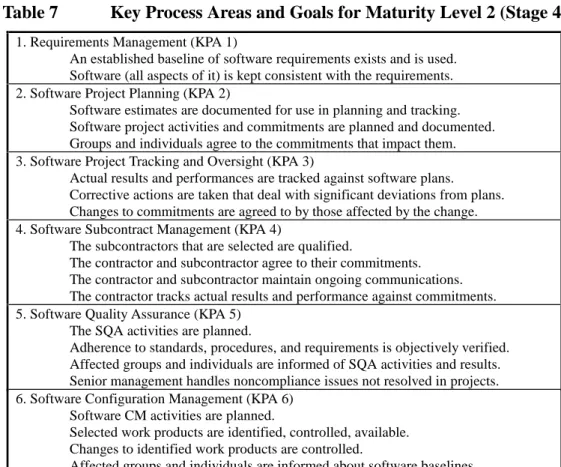
For a software process to be rated at this level of maturity, it must be producing results that satisfy the 20 goals (in six Key Process Areas) listed in Table 7.
Table 7 Key Process Areas and Goals for Maturity Level 2 (Stage 4) 1. Requirements Management (KPA 1)
An established baseline of software requirements exists and is used. Software (all aspects of it) is kept consistent with the requirements. 2. Software Project Planning (KPA 2)
Software estimates are documented for use in planning and tracking. Software project activities and commitments are planned and documented. Groups and individuals agree to the commitments that impact them. 3. Software Project Tracking and Oversight (KPA 3)
Actual results and performances are tracked against software plans.
Corrective actions are taken that deal with significant deviations from plans. Changes to commitments are agreed to by those affected by the change. 4. Software Subcontract Management (KPA 4)
The subcontractors that are selected are qualified.
The contractor and subcontractor agree to their commitments. The contractor and subcontractor maintain ongoing communications. The contractor tracks actual results and performance against commitments. 5. Software Quality Assurance (KPA 5)
The SQA activities are planned.
Adherence to standards, procedures, and requirements is objectively verified. Affected groups and individuals are informed of SQA activities and results. Senior management handles noncompliance issues not resolved in projects. 6. Software Configuration Management (KPA 6)
Software CM activities are planned.
Selected work products are identified, controlled, available. Changes to identified work products are controlled.
4.5 Stage 5: Establishing Your Process
This stage, building on prior accomplishments, establishes a well-defined, consistently-used, organization-wide software process. The CMM label for this maturity level is Level 3—Defined. At maturity Level 3, the best practices from projects have been generalized for use by the organization as a whole. That means the organization has found a systematic way to share best practices, namely codifying them as the organization’s standard software process. Both
management and engineering activities that develop or maintain software are documented, generalized, and integrated into a standard process for the organization.
The organization’s defined process does not restrict projects, because there is also a systematic way to adapt the accumulated process knowledge to the needs of each new software project that comes along. That means each software project follows an approved, tailored version of the standard process.
Representative accomplishments at this level of maturity include the following:
• There is an organization-wide understanding of the roles and responsibilities for all participants in the software process.
• An organization-wide training program is implemented for managers and technical staff, ensuring they have the knowledge and skills their roles require.
• Projects tailor the organization’s standard software process to develop their own defined software process.
• The software process is defined in terms of readiness criteria, required inputs, standards and procedures for performing the work, verification mechanisms (such as peer reviews), expected outputs, and completion criteria.
• Management has good insight into technical progress on all projects.
• Within established product lines, cost, schedule, and functionality are controlled, and software quality is tracked.
For a software process to be rated at this level of maturity, it must be producing results which satisfy the 17 goals (in seven Key Process Areas) listed in Table 8.
Table 8 Key Process Areas and Goals for Maturity Level 3 (Stage 5) 7. Organization Process Focus (KPA 7)
Process development and improvement is coordinated across the organization. Strengths/weaknesses of the software process are identified by a process standard. Organization-level process development/improvement activities are planned. 8. Organization Process Definition (KPA 8)
A standard software process for the organization exists and is maintained. Information about process use by projects is collected, reviewed, maintained. 9. Training Program (KPA 9)
Training activities are planned.
Training is provided for both management and technical staff.
Individuals involved with software receive the training they need in their roles. 10. Integrated Software Management (KPA 10)
Each project’s defined process is tailored from the organization’s process. Each project is planned and managed according to the project’s defined process. 11. Software Product Engineering (KPA 11)
Software engineering tasks are defined, integrated, and consistently performed. Software work products are kept consistent with each other.
12. Intergroup Coordination (KPA 12)
The customer’s requirements are agreed to by all affected groups.
Commitments between the engineering groups are agreed to by affected groups. The engineering groups identify, track, resolve intergroup issues.
13. Peer Reviews (KPA 13)
Peer review activities are planned.
Defects in the software work products are identified and removed.
4.6 Stage 6: Mastering Process Measurement
Based on consistent, organization-wide use of a software process, this stage masters the use of metrics to measure product quality and process maturity. The CMM label for this level of maturity is Level 4—Managed.
At Level 2, the best practices tend to be in projects. By Level 3, the organization has mastered the technique of spreading the best practices across the organization in the form of a standard
process. Now, at Level 4, all the process assets accumulated from Level 2 and Level 3 practices are used by the Level 4 organization to support projects with a quantitatively understood, stable process. Detailed measures of the software process and product quality are collected and used in managing the projects.
Representative accomplishments at this level of maturity are as follows:
• The organization sets quantitative quality goals for both software products and processes.
• Productivity and quality are measured for important activities across all projects as part of an organization-wide measurement program.
• Both the software process and its products are quantitatively understood and controlled.
• An organization-wide database is used to collect and analyze data reflecting uses of the defined software process within projects.