wind turbines
in denmark
Contents
Foreword Page 3
Wind power – one of the solutions to the challenges of energy policy Page 4 the challenges of energy and climate policy
energy policy objectives eu energy and climate policy wind power – a challenging solution
The history of Danish wind power Page 6
How a wind turbine is constructed wind turbine electricity production the development of danish wind turbines Public involvement
Wind turbines and their surroundings Page 9
environmental features of wind turbines impact on the immediate surroundings noise
Onshore wind turbines Page 12
Political framework conditions for the development of wind turbines municipal planning and regulations on eias
regulations for siting onshore wind turbines technical certification of wind turbines
Household wind turbines and small wind turbines
Offshore wind turbines Page 18
offshore wind turbines in denmark
the danish energy agency as a one-stop shop mapping of future sites for offshore wind farms tendering out of offshore wind farms
implementation of an offshore wind turbine project
New schemes in the Danish Promotion of Renewable Energy Act Page 22 a comprehensive act on renewable energy
the loss-of-value scheme the option-to-purchase scheme the green scheme
the guarantee scheme energinet.dk’s Front office
Tariffs for electricity produced by wind turbines Page 26 the need for financial support for wind turbine electricity
Price supplements for onshore wind turbines Price supplements for offshore wind turbines
Incorporation of wind power into the electricity system Page 27 Varying electricity production of wind turbines
research into an intelligent energy system 2 w i n d t u r b i n e s i n d e n m a r k
Foreword
this booklet, Wind Turbines in Denmark, aims to provide a general introduction to wind turbines in denmark. it is directed at municipalities, wind turbine players and other interested parties, who will gain insight into relevant topics relating to wind turbines. the descriptions of the individual topics are intended to answer and elaborate on questions that are frequently asked about wind turbines.
in 2007 the danish Government’s Planning Committee for onshore wind turbines published a report containing, among other things, a recom-mendation that there should be an increase in government information and advice on wind power for the municipalities and the public in gen-eral. this booklet is a response to that recommen-dation.
Further information on wind turbines can be found on the websites of the danish energy agency (www.ens.dk), the agency for spatial and environmental Planning (www.blst.dk), the danish environmental Protection agency (www.mst.dk), and Caa-denmark (www.slv.dk). references to other relevant websites can be found elsewhere in the booklet.
section 1 (“wind power – one of the solutions to the challenges of energy policy”) gives an intro-duction to the evolution of renewable energy, the goals of energy policy, and the challenges pre-sented by wind power. section 2 (“the history of danish wind power”) provides facts about wind turbines and their development up to the present day. section 3 (“wind turbines and their sur-roundings”) describes the environmental features of wind turbines, highlighting shadow and noise as local challenges of wind turbines.
section 4 (“onshore wind turbines”) covers the general regulations for erecting onshore turbines and the special regulations that apply for household wind turbines and small wind turbines. section 5 (“offshore wind turbines”) describes offshore wind turbines and the administrative ‘one-stop shop’ set-up.
section 6 (“new schemes in the danish Promotion of renewable energy act”) discusses the four schemes that were agreed politically in the Energy Policy Agreement of 21 February 2008 and incorporated into the Danish Promotion of Renewable Energy Act: namely, the loss-of-value scheme, the option-to-purchase scheme, the green scheme, and the guarantee scheme. section 7 (“tariffs for electricity produced by wind turbines”) presents the price supplements that are paid for wind turbine electricity. Finally, section 8 (“incorporation of wind power into the electricity system”) examines wind power production in the context of the overall european electricity system.
sections 3, 4 and 6 are aimed in particular at the municipalities and the planning that they under-take with regard to the erection of onshore wind turbines.
this booklet has also been published in danish.
Pho to : w ind turbine secr etaria t
4 w i n d t u r b i n e s i n d e n m a r k
1. wind Power – one oF tHe solutions
to tHe CHallenGes oF enerGy PoliCy
Factbox
WIND TurbINes INThe EnERgy Policy AgREEmEnt as part of the efforts to secure the target of a 20% wind power share in 2011, the Energy Policy Agreement of 21 February 2008 introduc-es a number of improvements in the conditions for erecting wind turbines:
• The supplement to the market price for new onshore wind turbines is increased to dkk 0.25 per kwh for 22,000 full-load hours. dkk 0.023 per kwh as compensation for balancing costs, etc., is retained
• The scrapping scheme is amended to give an additional price supplement of dkk 0.08 per kwh for 12,000 full-load hours. the deadlines for connecting new wind turbines to the grid under the scrapping scheme are extended • The municipalities are required to plan for 75
mw wind turbines in each of the years 2010 and 2011
• A number of schemes are introduced to pro -mote local acceptance of new onshore wind turbines: 1) a loss-of-value scheme gives neighbours the right to claim compensation for loss of value on their property if the loss is assessed to be at least 1% of the property’s value; 2) an option-to-purchase scheme gives the local population the right to purchase at least 20% of new projects involving wind turbines with a total height of more than 25 metres; 3) a guarantee fund of dkk 10 million helps local wind turbine owners’ associations to finance preliminary investigations, etc.; 4) a green scheme offers subsidies for municipal projects that enhance scenic values in local areas where new wind turbines are erected • A total of 400 MW offshore wind turbine ca
-pacity is being tendered out and is expected to be put into operation in 2012 (the anholt project)
• The Offshore Wind Turbine Action Plan of September 2008 is being updated, and earlier site development is being considered. Clearer guidelines are being set out for the establishment of new offshore wind turbine projects via an “open-door” procedure
1.a. The challeNges OF eNergy aND clImaTe pOlIcy
since the first oil crisis in 1973 denmark has transformed its energy supply and developed its own production of oil, natural gas and renewable energy. at the same time, energy has been greatly optimised so that, in spite of considerable economic growth during this peri-od, there has only been a marginal increase in energy consumption. denmark is therefore bet-ter prepared for inbet-ternational energy crises than most other countries, regardless of whether the challenges relate to supply or price. Furthermore, danish emissions of the greenhouse gases covered by the kyoto Protocol were reduced by around 8% in the period 1990-2008.
in spite of these results, danish society is still facing major challenges in its energy and climate policies. denmark is expected, with its existing fields and finds, to be a net exporter of oil and natural gas for about 10 more years, although technological advances and any new finds may bring further production and extend this period. but there is a need to build up alternative sus-tainable energy production while there is still time. in A visionary Danish energy policy 2025 the danish Government presented a vision for the long-term phasing-out of fossil fuels such as coal, oil and gas, and appointed the Climate Commission to set out specific directions for how this can be done. a phasing-out of fossil fuels will strengthen long-term supply reliability and contribute to a reduction in Co2 emissions. 1.b. eNergy pOlIcy ObjecTIves A visionary Danish energy policy 2025 was published in January 2007. it was followed by the Energy Policy Agreement of 21 February 2008 between the danish Government and all of the parliamentary parties with the exception of the red-Green alliance. this agreement sets out ambitious goals for the development of renewable energy and for energy savings. a specific goal is that, compared to 2006, gross energy consumption should be reduced by 2% by 2011 and by 4% by 2020. Furthermore, renewable energy should cover at least 20% of denmark’s gross energy consumption in 2011.
in order to achieve these goals, the Energy Policy Agreement of 21 February 2008 contains a number of resolutions on, among other things, improving the feed-in tariff for electricity from new wind turbines, biomass incineration, biomass gasification, and biogas. Funding was allocated to promote the introduction to the market of newly developed renewable energy technologies such as solar cells, thermal gasifi-cation of biomass, and wave power, and gov-ernment support for the research, development and demonstration of energy technologies will be increased to dkk 1 billion in 2010. the agreement also contains a range of initia-tives aimed at promoting local acceptance of and commitment to new onshore wind turbine projects. neighbours will be entitled to seek com-pensation for loss of property value due to the erection of wind turbines. a local option to pur-chase has been introduced for new wind turbine projects. local wind turbine owners’ associations can apply for a guarantee covering their financing of essential preliminary investigations. and municipalities where new wind turbine projects are established will have access to subsidies from a green scheme for new wind turbine projects. the agreement of 21 February 2008 also includes initiatives to further promote the devel-opment of wind power. a follow-up to the 2004 scrapping scheme for old wind turbines was agreed. and it was also decided that the danish minister for the environment should conclude an agreement on behalf of the danish Government with local Government denmark with a view to facilitating local wind turbine planning. in april 2008 the minister duly signed just such an agreement with local Government denmark setting out the goals for local planning of onshore wind turbines. in connection with this, the danish ministry of the environment’s wind turbine secretariat was established to assist the municipalities with their planning.
Finally, the supporting parliamentary parties agreed that 400 mw of new offshore wind tur-bine capacity should be established and opera-tional by the end of 2012.
1.c. eu eNergy aND clImaTe pOlIcy the aims of the eu as a whole are for emis-sions of greenhouse gases to be reduced by 20% compared to the 1990 level, for renewa-ble energy to constitute at least 20% of energy consumption (and at least 10% in the transport sector), and for energy efficiency to be improved by at least 20%, all by 2020: the so-called “20-20-20 in 2020”.
the obligations to develop renewable energy are spread throughout the 27 member states according to a range of criteria. denmark must improve its development of renewable energy so that it can cover 30% of energy consump-tion in 2020. it is a matter for the member states themselves to choose the renewable energy technologies that best suit their local energy resources and energy systems. in denmark, biomass (including waste) and wind power are expected to be the chief renewable energy sources leading up to 2020.
1.D. WIND pOWer
– a challeNgINg sOluTION the danish climate makes wind power one of the most obvious renewable energy sources because the wind conditions are more favoura-ble for electricity production than in most other european countries. added to this, since the end of the 1970s denmark has been building up a strong technological and research compe-tence within wind power, and wind turbines have undergone such considerable technologi-cal advances that wind has become one of the most competitive renewable energy sources. in 2008 the combined global market share of the two largest danish wind turbine manufacturers was just over 27%.
However, although wind turbines can thus be regarded as an important part of the solution to denmark’s obligations, wind power is also a technology that presents certain social chal-lenges. even though wind turbines have under-gone considerable technological advances, it is still more costly to produce electricity with wind turbines than with conventional thermal power plants, especially all the while that the external environmental costs of conventional
electricity production are not fully incorporated into the market price. in accordance with the applicable regulations, the additional costs of producing electricity with wind turbines are paid for by the electricity consumers as a pub-lic service obligation (Pso) that is collected through their electricity bills.
in comparison with fuel-fired power plants, electricity production from wind turbines is also more unstable because wind turbines do not produce electricity at low wind speeds (less than 4 metres per second) or high wind speeds (more than 25 metres per second). under aver-age wind conditions, an onshore wind turbine can produce electricity for 6,000-7,000 hours a year, corresponding to 70-80% of the total hours in the year. but the production fluctuates with the wind speed. this presents special chal-lenges for the electricity system in incorporating the varying electricity production, and it is nec-essary for the system to operate with a reserve capacity in the form of power plants or cross-border connections in order to be able to cover the danish electricity requirement in periods when the wind turbines are idle. Furthermore, work is being carried out to improve the incor-poration of wind power, among other forms, by making the individual turbines easier to regu-late. and the possibilities of using intelligent electricity meters, electric cars and heat pumps are being investigated.
wind turbines erected onshore are often highly visible in the landscape. this is particularly true of the latest mw wind turbines, which have rotating blades that reach more than 125 metres high. although new wind turbines have been designed to minimise noise nuisance, the turbines can still be both seen and heard in the immediate surroundings, which means that restrictions on distance to neighbours are imposed and the municipalities are obliged to consider the landscape in the planning that underpins the siting of new wind turbines. as a result of the ambitious objective for renewable energy, the danish Government is seeking to promote the erection of new, more efficient wind turbines both offshore and onshore. l
FIGURE 1.1. PRODUCTION OF RENEWABLE ENERGY PJ 0 20 40 60 80 100 120 140 ‘05 ‘00 ‘95 ‘90 ‘85 80 Wood Biogas Waste, biodegradable Heat pumps, etc.
Straw Wind
Source: Danish Energy Agency Source: Danish Energy Agency
The production of renewable energy in 2008 was calculated at 121.5 PJ, which was 1.4 PJ less than the year before. In 2008, the production of wind power fell by 0.9 PJ to 24.9 PJ due to poor wind conditions. Under the Energy Policy Agreement of 2008, renewable energy should cover at least 20% of gross energy consumption in 2011. Pho to : w ind turbine secr etaria t
6 w i n d t u r b i n e s i n d e n m a r k
2.a. hOW a WIND TurbINe Is cONsTrucTeD
a wind turbine is a machine that converts the kinetic energy of wind into electricity. the idea of taking energy from wind has been known and exploited for centuries in many countries. in denmark, wind power has historically been used to produce mechanical energy for, among other things, grinding corn.
the size of a wind turbine can be stated in sev-eral ways. it can be the wind turbine’s maxi-mum electrical output, its height from the ground to the top of the blade tip, the blade’s diameter, or the area that the rotor’s three blades cover in one revolution. by way of example, we might have a wind turbine of 1 mw (1,000 kw), a total height of 77 metres, a swept area (rotor diameter) of 54 metres, and a rotor area of 2,300 square metres.
a modern wind turbine consists of a rotor (the danish design has three blades) that drives a generator that produces electricity. the rotor and generator are installed at the top of a tower, which stands on a foundation in the ground or in the seabed. the turbine cap (nacelle) and the blades are controlled based
on measurements of the wind direction and speed. in order to ensure the best possible incorporation of the wind turbine’s production into the electricity system, new wind turbines are fitted with advanced control electronics, and a modern wind turbine consists of up to 10,000 different components.
2.b. WIND TurbINe elecTrIcITy prODucTION
in simple terms, a wind turbine not only utilis-es the wind’s prutilis-essure on an obliquely posi-tioned blade, but also utilises the fact that the air current around the blade creates a negative pressure on the rear of the blade in relation to the wind. the force from this negative pressure produces a draught that causes the blades to rotate.
the electricity production of a wind turbine depends on wind conditions. obviously the wind does not blow constantly, and wind speed varies greatly from place to place and over time. on average, the wind blows more at sea than on land. in denmark, it blows most along the western and southern facing coasts and least inland. a turbine on the west coast of Jutland generally therefore produces twice as
2. tHe History oF
danisH wind Power
20 m 40 m 60 m 80 m 100 m 120 m 140 m 160 m ill us tr at io n: V es ta s w in d sy st em s a/ s FIgure 2.1
TechNIcal specIFIcaTIONs OF a v90 Nacelle
WIND TurbINe sIZes
tall forest trees
Height 33 m village church and free-standing trees Church 16 m trees 19 m
Treelined farmyard, grain silo and cattle house Farmhouse 6.5 m Cattle house 12 m Grain silo 24 m 1985 wind turbine 225 kw Hub height 30 m total height 45 m High-voltage mast 132 kV (elkraft) Height 30 m High-voltage mast 400 kV (elkraft) Height 42 m
much as a turbine of the same size located on an unwindy point inland. Future wind turbines will generally be of megawatt scale. and as future turbines will be far more efficient, sig-nificantly fewer turbines will be needed for electricity production.
the electrical output of a wind turbine is meas-ured in kw or mw (1,000 kw), while the pro-duction volume is measured in kwh or mwh. the maximum output that a wind turbine can produce is referred to as the rated output or, in popular terms, the turbine size. a wind turbine of 2 mw can thus produce a maximum output of 2 mw, typically at wind speeds of 15-25 metres per second. at maximum production, the turbine produces 2 mwh (2,000 kwh) in one hour, equivalent to half of an average danish family’s annual electricity consumption. or, to put it another way, a 2 mw wind turbine can produce electricity for around 1,000 electric kettles with an output of 2 kw switched on at the same time.
the majority of wind turbines are designed so that they start producing electricity at a wind speed of 4 metres per second and reach their maximum production volume at wind speeds
of 12-15 metres per second. For safety reasons, the wind turbines stop running if the wind speed exceeds 25 metres per second. the wind meter on the individual turbine informs the turbine’s control system when the wind speed is sufficient to make electricity production worthwhile (4 metres per second) or when the wind becomes too strong. in the latter case, when the wind drops so that it is safe to start producing again, the control system is informed so that the turbine can be restarted. For safety reasons, a wind turbine is fitted with two independent braking systems, at least one of which must be aerodynamic.
a new large onshore wind turbine sited where there are good wind conditions will typically produce at maximum output for around 2,500 hours a year. in an average wind year, this type of wind turbine will be able to produce around 5,000 mwh, equivalent to the annual electricity consumption of 1,250 single-family homes with an electricity consumption of 4,000 kwh. an offshore wind turbine will typically be able to produce 3,000-4,000 hours a year at maxi-mum output; most for locations in the north sea, less in the baltic region and internal danish waters. 0 500 1000 1500 2000 2500 3000 3500 ‘05 ‘00 ‘95 ‘90 ‘85 1980 FIGURE 2.2
WIND CAPACITY AND SHARE OF ELECTRICITY SUPPLY MW 2 0 4 6 8 10 12 14 16 18 20
Offshore wind turbines Onshore wind turbines
Source: Danish Energy Agency The use of wind power increased greatly in the second half of the 1990s, reaching around 15% of the overall electricity sup-ply in 2000. Since then, the share of wind power has further increased to around 19%. The total wind power output, which exceeds 3,000 MW, is produced by just over 5,000 wind tur-bines. High-voltage mast 400 kV (elkraft) Height 42 m 1995 wind turbine 660 kw Hub height 40 m total height 63 m 2000 wind turbine 1,750 kw Hub height 60 m total height 93 m 2004 wind turbine 2.3 mw Hub height 80 m total height 126 m 2007 wind turbine 3.6 mw Hub height 90 m total height 143.5 m
8 v i n d mø l l e r i d a n m a r k
2.c. The DevelOpmeNT OF DaNIsh WIND TurbINes the first batch-produced danish wind turbines from the late-1970s had an output of 22 kw, and the wind turbines were gradually scaled up to 55, 75 and 95 kw through the course of the 1980s. alongside this commercial production, a government-funded development programme was undertaken by the electricity companies to test considerably larger pilot wind turbines. since the 1980s, the wind turbine industry’s commercial products have become increasingly larger-scale, and the largest commercial wind turbines produced by danish manufacturers today are 3 mw (Vestas) and 3.6 mw (siemens wind Power) respectively.
the 3.6 mw wind turbine has a rotor diameter of 107 metres, a swept area of 9,000 square metres, and a hub height of 80-100 metres depending on the conditions at the erection site. the 3.6 mw wind turbine can thus reach a total height of more than 150 metres and a weight of around 465 tons.
the number of wind turbines in denmark peak-ed in 2000 at more than 6,200, of which more than half were older wind turbines with an electrical output of less than 500 kw. since then, the number of wind turbines has de- creased by around 1,000, while the total in- stalled output has grown from just under 2,400 mw in 2000 to just under 3,400 mw end of 2009. in the same year, smaller wind turbines with an output of less than 500 kw accounted for around 11% of the total installed output. the wind power share of the domestic electric-ity supply has been growing steadily since
1980. in 1990, the share was 1.9%, and since then it has increased sharply. in 1999 the fig-ure topped 10%, and in 2008 it reached 19.1% of the electricity supply. in A visionary Danish energy policy 2025 from 2007 the danish Government formulated an objective of more wind power through strategic planning of wind turbine development. this includes a good framework for danish wind capacity and the promotion of onshore and offshore demonstra-tion and pilot sites as well as the drafting of an infrastructure plan for offshore wind turbines. in 2008, the wind turbine industry’s danish production sites had a gross turnover of dkk 53 billion, and overall exports reached dkk 42 bil-lion, equivalent to 7.2% of total danish exports. the wind turbine sector had 28,400 employees at the end of 2008.
2.D. publIc INvOlvemeNT
the development of wind power in denmark has been characterised by strong public involvement. it was small machinery manufac-turers that created the established wind tur-bine industry, and only after the consolidation of the industry through the 1990s did it become dominated by large, partly internation-ally owned and listed companies. similarly, on the customer side numerous joint-owned wind turbines were established in the period 1984-94. around two thousand of the 5,200 danish wind turbines are still owned by local wind tur-bine owners’ associations. these are mostly older, smaller wind turbines because the majority of wind turbines erected since 1995 are owned by individuals, energy companies and other commercial wind power companies. the progression towards fewer joint-owned and relatively large wind turbines has made it diffi-cult to maintain local support for new wind power projects. but to ensure continued devel-opment of wind power, it is essential to have backing in the local community. the Energy Policy Agreement of 21 February 2008 therefore stipulated that a range of new initiatives should be undertaken to promote local acceptance and option to purchase wind turbines shares of new wind power projects. the regulations are exam-ined in more detail in section 6. l
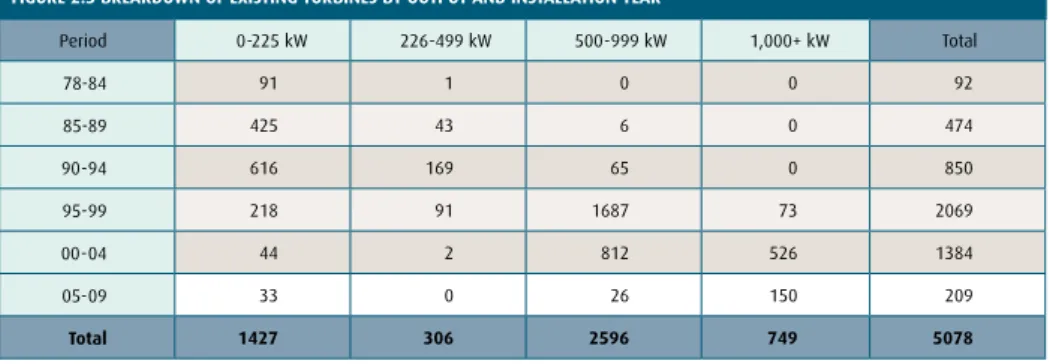
FIgure 2.3 breaKDOWN OF eXIsTINg TurbINes by OuTpuT aND INsTallaTION year
Period 0-225 kw 226-499 kw 500-999 kw 1,000+ kw total 78-84 91 1 0 0 92 85-89 425 43 6 0 474 90-94 616 169 65 0 850 95-99 218 91 1687 73 2069 00-04 44 2 812 526 1384 05-09 33 0 26 150 209 Total 1427 306 2596 749 5078
Source: Danish Energy Agency
Danish wind turbines have undergone considerable upscaling. Up to the mid-1990s, the majority of wind turbines that were erected had an output of 225 kW or less, and a large propor-tion of these have since been replaced by fewer, larger wind turbines under the “scrapping schemes”. Most of the wind tur-bines erected in the last decade have had an output above 500 kW. The largest new Danish wind turbines have an output of 3.0-3.6 MW.
FIGURE 2.3 BREAKDOWN OF EXISTING TURBINES BY OUTPUT AND INSTALLATION YEAR
NUMBER
0-225 226-499 500-999
1,000+ Source: Danish Energy Agency
0 500 1000 1500 2000 2500 2005 00-04 95-99 90-94 85-89 78-84
3. wind turbines
and tHeir surroundinGs
3.a. eNvIrONmeNTal FeaTures OF WIND TurbINes clImaTe aND aIr pOlluTION
wind power is regarded as an environmentally renewable energy source because producing electricity with wind turbines does not entail the use of fossil fuels such as oil, natural gas and coal. in terms of energy supply, wind power is advantageous because the source of the electricity production, i.e. wind, is renewa-ble and the electricity from wind turbines is not therefore conditional on the import of fuels or the use of limited resources. in terms of the environment and climate, wind power has major benefits because it is not associated with atmospheric emissions of Co2, so2, nox and particles, as is the case to a greater or lesser extent with power plants that use fossil fuels.
emissions of so2, nox and particles pollute the regional and local environment around the power plants, while emissions of Co2 from electricity production are regarded as the larg-est global contributor to the greenhouse effect, which is considered by the un’s intergovermen-tal Panel on Climate Change (iPCC) to be a seri-ous threat to the climate. “Greenhseri-ouse effect” is a term that denotes the changed balance between incoming solar radiation and heat radiated out into space, which arises due to human-created discharges of greenhouse gases such as Co2, methane and nitrous oxide. eNergy balaNce
the energy balance of wind turbines over their lifetime is analysed using a life cycle assess-ment (lCa) that covers energy consumption and other effects of production, erection, ongo-ing operation, and scrappongo-ing when the wind turbine no longer can or needs to produce electricity. in this assessment, raw materials for the wind turbine’s components as well as ener-gy consumption for production, transport, oper-ation and disposal are incorporated as a nega-tive impact on the environment. the posinega-tive side includes the wind turbine’s overall electric-ity production and any recyclable materials. assessed over the wind turbine’s normal life-time of 20-25 years, the negative
environmen-tal impact is minimal compared with the aver-age european electricity production. over 20-25 years the wind turbine will typically produce more than 35 times the energy production involved in its manufacture, operation, etc. a modern mw wind turbine will take around seven months to produce the amount of ener-gy used in its manufacture, erection, operation and disposal.
3.b. ImpacT ON The
ImmeDIaTe surrOuNDINgs the planning and environmental legislation sets out requirements to ensure that a wind turbine project will not cause major damage or nuisance to its surroundings, including noise and spacing requirements. it is also assumed that as a rule an environmental impact assess-ment (eia) will be carried out as part of the detailed planning for specific projects. as well as describing the environmental impacts, this ensures, among other things, that the legisla-tive requirements are observed. the overall impact of wind turbines on their immediate environment includes visual impact, noise, shadow, the effects of lighting, impacts on nature, etc. the nature of these impacts depends on how the wind turbine is positioned in the landscape, the type of landscape, the wind turbine’s size, and proximity to the wind turbine. in order to minimise the overall impact, when planning the siting of wind tur-bines the municipalities should seek to limit these nuisances, including ensuring that noise and spacing requirements are observed. similarly, wind turbine manufacturers are con-tinuously working to optimise turbine design so that they not only produce optimally but also reduce the impact on their surroundings as much as possible.
shaDOW
a wind turbine casts shadows when the sun is shining. in windy, sunny weather, an area of the turbine’s surroundings will be affected by rotating shadows from the blades. in denmark the area lying to the south of the wind turbine will never be affected by shadow from the blades. nuisance from shadow, which takes the form of a rapid change between direct light and short “flickers” of shadow, depends on
Pho to : w ind turbine secr etaria t
IllIllustration: Odense Environment Centre, based on calcula-tions from CUBE Engineering
FIgure 3.1.
shaDOW charT IN The eIa
In new wind turbine projects, the project developer must pro-vide information in an Environmental Impact Assessment (EIA) on the shadow cast by wind turbines. The chart shows the area of calculated shadow for “real case” (weather-dependent) in relation to Danish neighbours in an alternative project involv-ing 5 x 3 MW wind turbines at Rens Hovedgaard Plantage in Aabenraa Municipality. Number of hours per year.
1 0 w i n d t u r b i n e s i n d e n m a r k
Factbox
shaDOW
shadows cast by rotating turbine blades are ex-perienced by neighbours as a nuisance, with the shadows passing across their homes for a short duration but at a high frequency. the applicable spacing requirements ensure that neighbours are mainly subjected to shadows in the early morning and late evening. shadow is normally calculated as “real case”, i.e. taking into consid-eration the normal distribution of sunshine hours and wind. Possible remedial measures include switching off the wind turbines at critical times.
where the wind turbine is standing from the perspective of the neighbour, the distance between the wind turbine and the neighbour, the wind turbine’s hub height, and the length of the blades.
the critical times for shadow occur mainly in the early morning and late evening, with long shadows at a greater distance from the wind turbines than the neighbour distance require-ment of four times the total height of the wind turbine. the impact of shadow is calculated as the total number of hours annually that a neighbour is subjected to shadow and will vary with seasonal changes in the weather. the assessment of the anticipated number of annu-al hours of shadow is therefore cannu-alculated based on the anticipated normal distribution of operating hours and sunshine hours during the course of the year.
it is recommended that the calculated normal distribution of shadow hours for neighbours not exceeds 10 hours a year. by taking these issues into consideration in the planning of wind tur-bine sitings, the periods during which shadow actually occurs can be limited. if a full assess-ment shows that the most suitable siting entails that the recommended maximum of 10 hours’ shadow cannot be observed, the owner of the wind turbine may alternatively be re- quired to shut down the wind turbine in critical periods. the wind turbines can be fitted with meters so that the operation can be halted if the sun shines during critical periods; this can reduce operating losses.
reFlecTION
as wind turbine blades must have a smooth surface to be able to produce optimally and repel dirt, the blades can produce reflective flashes. as part of the type-approval of wind turbines, the reflective qualities of the blades are stated. typically, the reflective effect of the blades will be halved during the wind turbine’s first year of operation, and in their planning the municipalities can set requirements for anti-reflective treatment of the blades. normally, the blades from the manufacturer will be surface-coated to obtain a low gloss.
usually the gloss value will be less than 30, which is regarded as sufficiently low for reflec-tions from the wind turbine not to be a prob-lem.
marKINg OF WIND TurbINes IN relaTION TO aIr TraFFIc
in order that installations should not compromise the safety of air traffic, any obstacles – including wind turbines – with a total height of more than 100 metres must be approved by Civil aviation administration-denmark (Caa-denmark). around state-approved airports and airfields, aircraft are protected against obstructions using the ap- proved obstacle limitation surfaces. the approach plan’s height restrictions are registered with easements or notified in the municipal plans. all wind turbines with a total height of mini-mum 150 metres must be provided with high-intensity, white flashing lights. the exact regu-lations are set out in the BL 3-10 Regulations for Civil Aviation based on applicable interna-tional standards and recommendations. the basis for the regulations is a desire for obstruc-tions to air traffic to be visible at a suitable dis-tance so that the pilot can take the necessary operational actions in time. in the case of wind turbines of 100-150 metres in height, which will typically be pertinent in connection with projects under the scrapping scheme and new onshore wind turbines, Caa-denmark will carry out a specific assessment of the need for mark-ing, including taking into consideration danish defence’s assessments of military flights in the area. under normal circumstances, the marking of the wind turbines with low-intensity fixed red obstruction lights on the nacelle plus paint-ing the wind turbine white will be sufficient. where special air safety factors apply, marking with medium-intensity flashing obstruction lights will be necessary in addition to painting the wind turbine white. it would be appropri-ate for requirements for air traffic marking to be clarified with Caa-denmark before an eia, where one is required, is drawn up.
Previous attempts to counteract light nuisance from tV-station transmitting masts have shown that it is not possible to effectively shield
sur-Pho to : w ind turbine secr etaria t Pho to : w ind turbine secr etaria t
rounding houses against obstruction lights. any shielding must be carried out taking into con-sideration that obstruction lights must be observable by the pilot from all directions in the horizontal plane.
3.c. NOIse
wind turbines emit a relatively weak but char-acteristic noise. the noise emanates from the operation of the turbine’s gear and generator as well as from the movement of the blades through the air. in relation to generated out-put, modern wind turbines emit considerably less noise than the earliest wind turbines from the 1970s and 1980s. in particular, the mechanical noise from the turbine’s gear and generator are significantly reduced in compari-son with earlier models. in modern wind tur-bines, the machine house is soundproofed, the generator and gear are suspended in rubber elements, and the nacelle’s cabin is tight-clos-ing and fitted with sound locks that dampen airborne noise. blade design has developed so that the noise from the movement of the blades through the air is minimised. in order for a wind turbine to be certified for erection in denmark, it must satisfy a number of requirements set out in the Danish Ministry of the Environment Order on noise from wind turbines (no. 1518 of 14 december 2006). among other things, a noise survey must be carried out and the noise level calculated at the premises of immediate neighbours. sound is measured in decibels (db). the human ear can just detect a change in sound intensity of 1-2 db. if the sound intensity increases by 6-10 db, it will be heard as a dou-bling of the sound intensity. similarly, a reduc-tion of 6-10 db will be heard as a halving of the sound intensity. the intensity of the sound is generally measured using a method that mimics the ear’s sensitivity and is stated by the measuring unit decibel-a, db(a).
in accordance with the danish ministry of the environment’s order, the noise in the open land immediately outside the neighbour’s house and in open spaces up to 15 metres from the house
may not exceed 44 db(a) at a wind speed of 8 metres per second. this corresponds roughly to the noise of soft speech. in more densely built-up areas, summer home areas and noise-sensi-tive recreational areas, the noise may not exceed 39 db(a). the limits are lower for lower wind speeds. the municipalities monitor compli-ance with these noise limits.
the relatively weak noise from wind turbines also includes some low-frequency noise, i.e. deep sound with a low frequency. low-frequency noise is where a significant propor-tion of the sound energy is found in the fre-quency range below around 160 Hertz (Hz). Hertz is a designation for the number of oscil-lations per second. none of the noise surveys that have been carried out suggest that there are special problems with low-frequency noise from wind turbines. in the assessment of the danish environmental Protection agency, wind turbines that observe the limits for ordinary noise do not give low-frequency noise higher than the recommended limit. in order to shed further light on the issues of low-frequency noise, thereby giving municipalities and players in the wind power industry a more reliable basis for evaluating new wind turbine projects, delta – danish electronics, light and acoustics – has headed up a research project that has been mapping the issues of low-frequency noise from modern wind turbines since 2006. the project is expected to be completed in spring 2010. infrasound is sound with a frequency lower than 20 Hz and thus constitutes the “deepest” part of the low-frequency range. Previously it was thought that infrasound could not be detected by the human ear, but infrasound can actually be heard if it is strong enough, and even weak infrasound is regarded as a nuisance. the threshold for hearing infrasound has been well researched, and the danish environmental Protection agency recommends a limit that is 10 db lower than the hearing threshold. the infrasound emitted by modern wind turbines is of no consequence for the surroundings and is much weaker than the danish environmental Protection agency’s recommended limit. l
dB(A)
Limits Examples of noise
150 100 50 0 Jet aircraft at 25 m Jet aircraft at 100 m Pain threshold Rock concert Loud radio Industrial noise Traffic noise Children playing Ordinary speech Soft speech Home peace Whispering Quiet bedroom Rustling leaves Hearing threshold Railway noise, recommended
Road noise, recommended Wind turbines, statutory
Illustration: Factsheet from the Danish Wind Turbine Owners’ Association
Illustration: Odense Environment Centre, based on calculations from EMD International
FIgure 3.2
charT OF calculaTeD NOIse ZONes IN The eNvIrONmeNTal ImpacT assessmeNT (eIa)
The two charts from the EIA for the wind turbine project at Rens Hovedgaard Plantage show the calculated noise zones for Danish neighbours from 5 x 1.8 MW wind turbines. The chart on the left shows noise zones at a wind speed of 6 metres per second, while the chart on the right shows the same noise zones for a wind speed of 8 metres per second. The noise level is stated in dB(A). The colours indicate the noise level: the darker the colour, the higher the noise level.
1 2 w i n d t u r b i n e s i n d e n m a r k
4.a. pOlITIcal FrameWOrK cONDITIONs FOr The DevelOpmeNT OF WIND TurbINes
the political framework conditions for the erec-tion of onshore wind turbines have been agreed in part in the Energy Policy Agreement of 21 February 2008 and subsequently imple-mented in the Danish Promotion of Renewable Energy Act, which was adopted by the danish Parliament in december 2008 and entered into force on 1 January 2009. the municipalities are responsible for securing the necessary planning basis for wind turbines with a total height of up to 150 metres in the form of designated wind turbine areas with associated guidelines in the municipal plan as well as supplements to the municipal plans with associated eias and local plans for the specific wind turbine projects under application. in the case of wind turbines over 150 metres, the environment Centres within the danish ministry of the environment are the planning authority. the environment Centres are also tasked with monitoring that the municipalities plan for wind turbines in accordance with government interests. as part of the objective for renewable energy to constitute 20% of gross energy consumption in 2011, the danish Government entered into an agreement with local Government denmark that the municipalities, through their planning,
should reserve areas that can accommodate onshore wind turbines with a total output of 150 mw; 75 mw in each of the years 2010 and 2011.
it was also agreed that the danish ministry of the environment should strengthen its follow-up on the municipalities’ work of implement-ing the scrappimplement-ing scheme adopted as part of the Energy Policy Agreement of 29 March 2004 on wind energy and decentralised com-bined heat and power.
4.b. muNIcIpal plaNNINg aND regulaTIONs ON eIas Following the local Government reform, the planning authority for onshore wind turbines up to 150 metres has passed to the municipal-ities. the regulations for municipal planning ensure that citizens, associations, authorities and other stakeholders are continuously involved in the process. in order to be able to assist the municipalities in this work, the danish ministry of the environment has set up the wind turbine secretariat under the agency for spatial and environmental Planning. in order to allow enough time for drafting vari-ous materials, citizen involvement, etc., both the municipal designation of wind turbine areas and the municipality’s subsequent
4. onsHore wind turbines
Factbox
WIND TurbINe plaNNINg phases
a typical planning process passes through the following steps:
Designation of wind turbine areas • Consideration of potential areas, process and
political aims in the municipality • Idea phase and scoping
• Invitation to submit ideas and proposals • Consultation with relevant authorities • Citizen meeting, where required
• Processing of any comments and consultation responses received
• Drafting of proposed municipal plan, includ -ing acceptance and rejection of alternatives, based among other things on a general environmental assessment of the plan and political aims
• Drafting of an environmental report summa -rising the general environmental assessment of the plan
• Public phase
• Announcement of proposed municipal plan and environmental report
• Citizen meeting, where required • Processing of objections and comments
received
• Any necessary revision, plus consultation period and any new public phase • Final adoption of the plan • Period for complaints
planning for a specific wind turbine project • Application for a specific project by a project
sponsor in the designated wind turbine area • Decision on whether an EIA is required • Idea phase and scoping
• Invitation to submit ideas and proposals • Consultation with relevant authorities • Citizen meeting, where required
72
Opstillingsmønstre for store vindmøller
Oplevelsen af orden er en grundlæggende
æste-tisk forudsætning. Ved placering af møllegrupper
indikerer dette væsentligheden af, at møllerne
op-leves som en klar sammenhængende enhed, det
vil sige i geometriske, oftest lineære formationer,
som danner kontrast til landskabet.
En letopfattelig orden kræver som udgangspunkt,
at alle møller i en opstilling er ens i forhold til
mo-del, størrelse og udseende.
Udover princippet om at vindmøller som
udgangs-punkt bør opstilles i geometriske, let opfattelige
formationer og være af ens karakter, har man
tid-ligere også anbefalet, at mølleopstillingen så vidt
som muligt bør tilpasses landskabets træk, for
ek-sempel ved at lade en række vindmøller følge
ryg-gen af en bakke eller læhegnenes hovedretning.
Vindmøller på op til 150 meter må nødvendigvis
stå med så stor indbyrdes afstand, at opstillinger
med flere møller kun vanskeligt lader sig tilpasse
landskabets træk. Derfor vil principperne om den
geometrisk let opfattelige opstilling ofte stå
ale-ne.
Lønborg Hede (Visualisering: Birk Nielsen)
The perception of order is a basic aesthetic precondition. It is therefore recommended that wind turbines should be erected in geometric (usually linear) formations that create a contrast with the landscape. The photo shows the visualisation for Lønborg Hede.
Pho to : b irk n ielsen
73
Indbyrdes afstand
Ved opstilling af flere vindmøller i gruppe opstår forskellige krav til den indbyrdes placering og af-stand mellem de enkelte vindmøller.
Af hensyn til den optimale udnyttelse af vindener-gien placeres møller med en vis indbyrdes afstand, så de ikke skaber læ for hinanden. På tværs af den fremherskende vindretning anbefales afstanden som minimum 3 x rotordiameteren, mens den langs vindretningen anbefales som minimum 5 x rotordiameteren, da de forreste møller her i højere grad vil skabe vindskygge (Siemens Wind Power). I praksis betyder afstandskrav til naboer og lods-ejerforhold dog oftest, at man kan acceptere min-dre indbyrdes afstande, ligesom lokaliteter med særlige vindforhold og/eller opstillingsretninger ligeledes kan være et argument for kortere ind-byrdes afstand.
Derudover risikerer møller med en tæt indbyrdes afstand at skabe turbulens for hinanden, som kan være en sikkerhedsmæssig belastning for kon-struktionen. For afstande under 3 x rotordiameter må man tage særlige forbehold for dette (Siemens Wind Power).
De gennemførte undersøgelser af egenæstetikken viser, at en indbyrdes afstand mellem vindmøller-ne på 3 - 4 x rotordiameteren virker mest harmo-nisk, og dette forhold gælder, hvad enten der er tale om få eller mange vindmøller på række. Ved en afstand på over 5 x rotordiameteren fremstår møllerne ikke længere som en klart sammenhæn-gende enhed, da den indbyrdes afstand i forhold til møllernes størrelse virker stor.
2 x rotordiameter
3 x rotordiameter
4 x rotordiameter
5 x rotordiameter
Illustrationer: Birk Nielsen
73
Indbyrdes afstand
Ved opstilling af flere vindmøller i gruppe opstår forskellige krav til den indbyrdes placering og af-stand mellem de enkelte vindmøller.
Af hensyn til den optimale udnyttelse af vindener-gien placeres møller med en vis indbyrdes afstand, så de ikke skaber læ for hinanden. På tværs af den fremherskende vindretning anbefales afstanden som minimum 3 x rotordiameteren, mens den langs vindretningen anbefales som minimum 5 x rotordiameteren, da de forreste møller her i højere grad vil skabe vindskygge (Siemens Wind Power). I praksis betyder afstandskrav til naboer og lods-ejerforhold dog oftest, at man kan acceptere min-dre indbyrdes afstande, ligesom lokaliteter med særlige vindforhold og/eller opstillingsretninger ligeledes kan være et argument for kortere ind-byrdes afstand.
Derudover risikerer møller med en tæt indbyrdes afstand at skabe turbulens for hinanden, som kan være en sikkerhedsmæssig belastning for kon-struktionen. For afstande under 3 x rotordiameter må man tage særlige forbehold for dette (Siemens Wind Power).
De gennemførte undersøgelser af egenæstetikken viser, at en indbyrdes afstand mellem vindmøller-ne på 3 - 4 x rotordiameteren virker mest harmo-nisk, og dette forhold gælder, hvad enten der er tale om få eller mange vindmøller på række. Ved en afstand på over 5 x rotordiameteren fremstår møllerne ikke længere som en klart sammenhæn-gende enhed, da den indbyrdes afstand i forhold til møllernes størrelse virker stor.
2 x rotordiameter
3 x rotordiameter
4 x rotordiameter
5 x rotordiameter
Illustrationer: Birk Nielsen
73
Indbyrdes afstand
Ved opstilling af flere vindmøller i gruppe opstår forskellige krav til den indbyrdes placering og af-stand mellem de enkelte vindmøller.
Af hensyn til den optimale udnyttelse af vindener-gien placeres møller med en vis indbyrdes afstand, så de ikke skaber læ for hinanden. På tværs af den fremherskende vindretning anbefales afstanden som minimum 3 x rotordiameteren, mens den langs vindretningen anbefales som minimum 5 x rotordiameteren, da de forreste møller her i højere grad vil skabe vindskygge (Siemens Wind Power). I praksis betyder afstandskrav til naboer og lods-ejerforhold dog oftest, at man kan acceptere min-dre indbyrdes afstande, ligesom lokaliteter med særlige vindforhold og/eller opstillingsretninger ligeledes kan være et argument for kortere ind-byrdes afstand.
Derudover risikerer møller med en tæt indbyrdes afstand at skabe turbulens for hinanden, som kan være en sikkerhedsmæssig belastning for kon-struktionen. For afstande under 3 x rotordiameter må man tage særlige forbehold for dette (Siemens Wind Power).
De gennemførte undersøgelser af egenæstetikken viser, at en indbyrdes afstand mellem vindmøller-ne på 3 - 4 x rotordiameteren virker mest harmo-nisk, og dette forhold gælder, hvad enten der er tale om få eller mange vindmøller på række. Ved en afstand på over 5 x rotordiameteren fremstår møllerne ikke længere som en klart sammenhæn-gende enhed, da den indbyrdes afstand i forhold til møllernes størrelse virker stor.
2 x rotordiameter
3 x rotordiameter
4 x rotordiameter
5 x rotordiameter
Illustrationer: Birk Nielsen
73 Indbyrdes afstand
Ved opstilling af flere vindmøller i gruppe opstår forskellige krav til den indbyrdes placering og af-stand mellem de enkelte vindmøller.
Af hensyn til den optimale udnyttelse af vindener-gien placeres møller med en vis indbyrdes afstand, så de ikke skaber læ for hinanden. På tværs af den fremherskende vindretning anbefales afstanden som minimum 3 x rotordiameteren, mens den langs vindretningen anbefales som minimum 5 x rotordiameteren, da de forreste møller her i højere grad vil skabe vindskygge (Siemens Wind Power). I praksis betyder afstandskrav til naboer og lods-ejerforhold dog oftest, at man kan acceptere min-dre indbyrdes afstande, ligesom lokaliteter med særlige vindforhold og/eller opstillingsretninger ligeledes kan være et argument for kortere ind-byrdes afstand.
Derudover risikerer møller med en tæt indbyrdes afstand at skabe turbulens for hinanden, som kan være en sikkerhedsmæssig belastning for kon-struktionen. For afstande under 3 x rotordiameter må man tage særlige forbehold for dette (Siemens Wind Power).
De gennemførte undersøgelser af egenæstetikken viser, at en indbyrdes afstand mellem vindmøller-ne på 3 - 4 x rotordiameteren virker mest harmo-nisk, og dette forhold gælder, hvad enten der er tale om få eller mange vindmøller på række. Ved en afstand på over 5 x rotordiameteren fremstår møllerne ikke længere som en klart sammenhæn-gende enhed, da den indbyrdes afstand i forhold til møllernes størrelse virker stor.
2 x rotordiameter
3 x rotordiameter
4 x rotordiameter
5 x rotordiameter
Illustrationer: Birk Nielsen
• Processing of any comments and consultation responses received
• Drafting of supplement to municipal plan and local plan, including adjustment of the project based on a general environmental assessment of the plan
• Drafting of an EIA for the project • Public phase
• Announcement of the proposed plans, incl. eia for the project
• Citizen meeting, where required • Processing of any objections and comments
received
• Any revision, plus consultation period and any new public phase
• Final adoption of the plans and issuing of EIA approval
• Period for complaints processing of a specific project normally take at
least a year.
apart from household and small turbines, wind turbines may only be erected in areas desig-nated through reservations and guidelines in the municipal plan. the municipality must therefore assess which areas are suitable for erecting wind turbines.
the local council must ensure in its planning that it gives full consideration to neighbouring residences, nature, the landscape, culturo-his-torical values, agricultural interests, and the possibility of exploiting the wind resource. the municipal plan must include guidelines and a framework, and must be accompanied by a statement on the assumptions underlying the local council’s proposed plan. the guidelines for designated wind turbine areas must include regulations on the anticipated maximum number and size of the turbines as well as the spacing between the turbines.
the further planning of specific projects then awaits the initiative of a project sponsor, a wind turbine owners’ association or others wishing to use the designated area to erect wind turbines.
a project sponsor wishing to establish a wind turbine project must notify the project to the municipality. the planning process for projects requiring an eia begins with an idea phase in which the municipality drafts a discussion paper inviting proposals from citizens on the content of the eia and the supplement to the municipal plan. this idea phase, which is also called the pre-public phase, must last at least two weeks.
the planning must also satisfy the require-ments for environmental assessment of plans and programmes, which include consultation with the relevant authorities, including neigh-bouring municipalities, the region and national bodies that have to grant environmental approvals to allow implementation of the physical planning, as well as any local and
regional supply companies whose installations may be affected by the project.
taking into consideration the feedback that it receives, the municipality draws up guidelines on the further local planning in a supplement to the municipal plan and determines the scope of the eia, which the project owner and the municipality often prepare jointly. this material is sent for public consultation lasting at least eight weeks. in this public phase, pro-perty owners, neighbours, associations, author-ities, etc., may submit objections, comments and alternative proposals.
after this, the municipality can finally adopt the wind turbine project and give the project sponsor an eia approval. if a local plan also has to be drawn up for the project, the local coun-cil draws this up in parallel. the local plan for a wind turbine area must include regulations on the turbines’ exact siting, number, minimum and maximum total height, and appearance. in accordance with the Danish Planning Act, a supplement to the municipal plan for a wind turbine project involving turbines with a total height of more than 80 metres or a group of more than three turbines must be accompa-nied by an ela assessing the consequences of the project for the environment. other projects are screened by the local council, which decides whether a project has such major con-sequences for the environment that an eia should be drawn up or whether only a rural zone permit should be issued. Order no. 1335 of 6 December 2006 on the assessment of cer-tain public and private installations’ impact on the environment contains regulations on eias.
the eia must assess how the wind turbine project will affect neighbouring residences in terms of, among other things, noise and shad-ow, nature, the landscape, culturo-historical val-ues, and agricultural interests, as well as giving information on local wind conditions. this nor-mally requires the project owner to draw up a visualisation of the project so that citizens can more easily form a realistic impression of the implications of the wind turbine project.
Illustrations: Birk Nielsen With regard to both turbulence and aesthetics, it is recom-mended that in projects involving multiple wind turbines their spacing should be three to four times the rotor diameter. The illustrations from Birk Nielsen show examples of wind turbines spaced at intervals of two times the rotor diameter (top), three times the rotor diameter, four times the rotor diameter, and five times the rotor diameter (bottom) respectively. FIgure 4.1
1 4 w i n d t u r b i n e s i n d e n m a r k
Factbox
all eIas, including those for wind turbine projects, must include:
• A description of the project.
• A summary of major alternatives to the execution of the proposed project that the project sponsor has investigated (minimum the zero alternative, i.e. the situation if the project is not implemented).
• A description of the impact of the project on people, fauna, flora, soil, water, air, climate, landscape, tangible property, and the dan-ish cultural heritage.
• A description of the project’s short-term and long-term, direct and indirect, derived and cumulative impacts on the environment. • A description of environment-improving measures, including preventive measures. • A non-technical summary of the assess
-ment.
in the case of wind turbine projects that do not require an eia, the rural zone regulations of the Danish Planning Act set out requirements for informing neighbours about the project. Generally, there is no requirement for the information to include a visualisation, but energinet.dk (the danish transmission system operator) may require this if it would be a pre-condition for neighbours being able to realisti-cally assess whether the project will entail a loss of value on their properties, cf. 6.b. decisions of the local council concerning wind turbine projects may be contested with the nature Protection board of appeal.
the danish ministry of the environment’s wind turbine secretariat is a type of “flying squad” that provides the municipalities with guidance and practical help in wind turbine planning – such as identifying the sites that are most suit-able in respect of neighbours and nature pro-tection interests, formulating idea proposals, decision-making documentation and proposals for wind turbine plans, or arranging citizen meetings, etc.
most of denmark’s municipalities are in dia-logue with the wind turbine secretariat, either to get answers to specific questions or to obtain formal assistance with the planning process. the wind turbine secretariat has a danish website, www.vind.mim.dk, via the agency for spatial and environmental Planning. Here you can find answers to frequently asked ques-tions as well as tools for use in municipal wind turbine planning, including:
• A summary of essential siting considera -tions.
• A process line with a model of the planning process and a timeframe.
• Links, including to applicable regulations and the agency for spatial and environmental Planning’s spacing map.
4.c. regulaTIONs FOr sITINg ONshOre WIND TurbINes
the siting of new wind turbines is carried out on the basis of an overall balancing of various factors such as wind speed, distance to nearest
neighbours, noise and shadow, other technical installations, and regard for the landscape and nature. this balancing is brought about through the municipal wind turbine planning, which directly involves affected citizens, organisa-tions, authorities, etc. the key principles for erecting wind turbines are wind conditions, distance to neighbours, and regard for specific affected interests, e.g. nature protection areas and areas of culturo-historical interest. the regulations for siting are set out in the Danish Planning Act and implemented in Wind Turbine Circular no. 9295 of 22 May 2009. the aim of the Circular is to ensure regard for land-scape, neighbours, etc. Generally, new wind turbines must as a minimum be sited at a dis-tance from the nearest neighbours of at least four times the wind turbine’s total height. special consideration must be given to the coastal zone, which is defined in the Danish Planning Act as a three-kilometre zone along the coast throughout the country that is gene-rally to be kept free of buildings and installa-tions. if a municipality wants to erect wind tur-bines in the coastal zone, this requires special planning or functional justification, for example that there are especially favourable wind con-ditions along the municipality’s coasts, as is the case in the west Jutland municipalities. Visualisation is an excellent method for illus-trating the implications of new wind turbines for landscape and nature. landscapes that in the past have been dominated by large techni-cal installations will often be suitable for erect-ing large wind turbines because the turbines will not significantly increase the impact on the landscape. these technical installations might be CHP plants, waste incineration plants, high-voltage masts, industrial activities with tall chimneys, harbour areas with large cranes, etc. these installations are already highly visible in the landscape.
large and uniform landscapes will also usually be suitable for erecting large wind turbines. the reason for this is that the landscape matches the large dimensions because it is often characterised by flat or evenly sloping
FIgure 4.2 WIND TurbINe IN a TechNIcal laNDscape Birk Nielsen’s sketch shows the siting of MW wind turbines at Esbjerg Power Station.
Wind turbine 2.3 mW Hub height 80 m total height 126 m
esbjerg power station building height 106 m Chimney 250 m
Wind turbine 3.6 mW Hub height 90 m total height 143.5 m
terrain with large units of area and “landscape space”.
small-scale landscapes will often be less suita-ble for erecting large wind turbines. these landscapes are characterised by small hills or gentle slopes with less “landscape space”, where large wind turbines would contrast starkly with the nature of the landscape. a more exhaustive description of the impact of large wind turbines on different types of land-scape can be found in the report Store vind-møller i det åbne land – en vurdering af de landskabelige konsekvenser (Large wind tur-bines in the open countryside – an assessment of implications for the landscape), which can be downloaded (in danish only) from www. blst.dk.
the oldest wind turbines were often erected spread out in the landscape, which meant that they impacted a very large area in relation to their installed electrical output. as a starting point, the aim is to site new wind turbines in groups wherever possible so as to achieve a high installed electrical output with impact on a relatively small area. Furthermore, the munici-pality can require wind turbines in a group to be uniform and arranged in a simple geometric pattern, for example in a single row, so that the wind turbines create a calmer impression. it is also important that wind turbines erected as a group should appear harmonious and uni-form in design. a wind turbine is regarded as harmonious if there is a balance between tower height and rotor diameter. Generally, experience suggests that the most harmonious rotor/tower ratio for larger wind turbines is 0.9–1.35, depending on the total height. as an example, a wind turbine with a tower height of 80 metres and a rotor diameter of 100 metres, giving a total height of 130 metres, has a rotor/tower ratio of 1.25.
4.D. TechNIcal cerTIFIcaTION OF WIND TurbINes
in order to help ensure that new wind turbines are safe and can be incorporated into the elec-tricity system, a secretariat for the danish wind
turbine Certification scheme has been set up and located at risø dtu (national laboratory for sustainable energy at the technical university of denmark). the specific regulations are described in Danish Energy Agency’s Order no. 651 of 26 June 2008 on the technical cer-tification scheme for the design, manufacture, installation, maintenance and servicing of wind turbines. the secretariat has a website at www.vindmoellegodkendelse.dk. the tech-nical prescriptions for the connection of wind turbines to the electricity grid can be found at www.energinet.dk.
4.e. hOusehOlD WIND TurbINes aND small WIND TurbINes a household wind turbine is normally under-stood to be a smaller, stand-alone turbine with a total height of less than 25 metres that is erected directly connected to existing housing in the open countryside, usually in a rural zone. small wind turbines are normally understood to be stand-alone turbines with a rotor area of up to 1 m2 (“micro turbines”) or 1-5 m2 (“mini
tur-bines”). the turbine may be installed on a building.
For all turbine types the Danish Ministry of the Environment Order on noise from wind turbines must be respected when erecting and operat-ing the turbines. turbine types with a rotor area in excess of 1 m2 are subject to the danish Energy Agency’s Order no. 651 of 26 June 2008 on the technical certification scheme for the design, manufacture, installation, maintenance and servicing of wind turbines. in the case of turbines with rotor area 1-5 m2, however, only
a registration notification is required. wind turbine projects must as a minimum be screened in accordance with the regulations of the EIA Order. Household and small turbines will not normally require an eia, supplement to the municipal plan and eia.
erecTION OF WIND TurbINes IN rural ZONes
it is the task of the municipalities, as the rural zone authority, to issue rural zone permits. in this regard, the municipality must carry out
70
Harmoniforhold
Det størrelsesmæssige forhold mellem vindmøl-lens tårn og vinger har betydning for dens ege-næstetik.
Når vindmøllerne vokser i størrelse, virker forhol-det mellem tårn og rotor mest harmonisk, når ro-torens diameter øges yderligere i forhold til tårnet.
Det hænger sammen med, at nye, store mølletyper har en mere slank karakter end ældre modeller og derfor bedre kan bære lange ’arme’.
Vurderingen for 150 m høje møller peger mod, at forholdet tårn/ rotordiameter har det mest
har-moniske udtryk omkring 1:1,1 eller 1:1,2, altså at rotordiameteren er 10-20% større end tårnets høj-de. Et forhold under 1:1 forekommer uharmonisk, fordi vingerne synes for små, mens forhold større end 1:1,3 kan få vingerne til at virke overdimen-sioneret.
1: 0,91:0.9 1: 1,2 1: 1,5
70
Harmoniforhold
Det størrelsesmæssige forhold mellem vindmøl-lens tårn og vinger har betydning for dens ege-næstetik.
Når vindmøllerne vokser i størrelse, virker forhol-det mellem tårn og rotor mest harmonisk, når ro-torens diameter øges yderligere i forhold til tårnet.
Det hænger sammen med, at nye, store mølletyper har en mere slank karakter end ældre modeller og derfor bedre kan bære lange ’arme’.
Vurderingen for 150 m høje møller peger mod, at forholdet tårn/ rotordiameter har det mest
har-moniske udtryk omkring 1:1,1 eller 1:1,2, altså at rotordiameteren er 10-20% større end tårnets høj-de. Et forhold under 1:1 forekommer uharmonisk, fordi vingerne synes for små, mens forhold større end 1:1,3 kan få vingerne til at virke overdimen-sioneret.
1: 0,9 1: 1,21:1.2 1: 1,5
70
Harmoniforhold
Det størrelsesmæssige forhold mellem vindmøl-lens tårn og vinger har betydning for dens ege-næstetik.
Når vindmøllerne vokser i størrelse, virker forhol-det mellem tårn og rotor mest harmonisk, når ro-torens diameter øges yderligere i forhold til tårnet.
Det hænger sammen med, at nye, store mølletyper har en mere slank karakter end ældre modeller og derfor bedre kan bære lange ’arme’.
Vurderingen for 150 m høje møller peger mod, at forholdet tårn/ rotordiameter har det mest
har-moniske udtryk omkring 1:1,1 eller 1:1,2, altså at rotordiameteren er 10-20% større end tårnets høj-de. Et forhold under 1:1 forekommer uharmonisk, fordi vingerne synes for små, mens forhold større end 1:1,3 kan få vingerne til at virke overdimen-sioneret.
1: 0,9 1: 1,2 1:1.51: 1,5
Illustrations: Birk Nielsen FIgure 4.3
TOWer/blaDe raTIOs
The ratio between a wind turbine’s tower and blades (the “har-mony ratio”) is important for the turbine’s own aesthetics. New types of large turbine have a more slender design than older models, and the tower can therefore better support long blades with a large rotor area and production capacity. The rec-ommended harmony ratio thus depends on the size of the wind turbine. For wind turbines with a total height of less than 100 metres, the recommended rotor diameter is -/+ 10% in relation to the tower height, while for larger wind turbines with a total height of up to 150 metres, the recommended rotor diameter is between +10% and +35% in relation to the tower height.
1 6 w i n d t u r b i n e s i n d e n m a r k
planning appraisals in respect of ongoing plan-ning. Furthermore, landscape considerations and any building lines as per the Danish Nature Protection Act as well as any supplementary considerations regarding neighbours (view, reflection, etc.) must also be taken care of. in the case of household and small turbines, the Wind Turbine Circular does not set out fixed requirements for the distance to neighbouring homes, etc., in relation to the turbine’s total height.
the municipalities must carry out individual assessments of cases/applications. However, the fact that the decision must always be taken on the basis of a specific assessment does not preclude the municipality from clarify-ing in its municipal plannclarify-ing guidelines other protection interests and considerations that
receive particular attention in its case-handling, including of course any guidelines for erecting smaller wind turbines. l
Pho to : w ind turbine secr etaria t
In addition to large wind turbines, the Samsø Renewable Energy Island project has also estab-lished household wind turbines, one of which (shown below) can be seen in front of the solar-panelled roof of Samsø Energy Academy.
Pho to : s amsø ener gy a cadem y
WIND resOurce aTlas FOr DeNmarK: in 1998, with funding from the danish energy agency, risø dtu’s wind energy division teamed up with the danish software and consultancy firm emd international to compile the wind re-source atlas for denmark, which can be seen on page 17. areas with the highest average wind speeds are shown in red and yellow, while areas with less wind are shown in green and blue.
WIND resOurce map FOr
100 m abOve grOuND – DeNmarK
1 8 w i n d t u r b i n e s i n d e n m a r k
5. oFFsHore wind turbines
5.a. OFFshOre WIND TurbINes IN DeNmarK
in 1991 denmark became the first country in the world to take wind turbines out to sea with 11 x 450 kw turbines in the Vindeby offshore wind farm. this was followed by a number of smaller demonstrat