8-2017
Security for 5G Mobile Wireless Networks
Dongfeng Fang
University of Nebraska-Lincoln, [email protected]
Yi Qian
University of Nebraska-Lincoln, [email protected]
Rose Qingyang Hu
Utah State University, [email protected]
Follow this and additional works at:
https://digitalcommons.unl.edu/electricalengineeringfacpub
Part of the
Computer Engineering Commons
, and the
Electrical and Computer Engineering
Commons
This Article is brought to you for free and open access by the Electrical & Computer Engineering, Department of at DigitalCommons@University of Nebraska - Lincoln. It has been accepted for inclusion in Faculty Publications from the Department of Electrical and Computer Engineering by an authorized administrator of DigitalCommons@University of Nebraska - Lincoln.
Fang, Dongfeng; Qian, Yi; and Qingyang Hu, Rose, "Security for 5G Mobile Wireless Networks" (2017).Faculty Publications from the Department of Electrical and Computer Engineering. 472.
Security for 5G Mobile Wireless Networks
Dongfeng Fang, Yi Qian, and Rose Qingyang HuAbstract—The advanced features of 5G mobile wireless
net-work systems yield new security requirements and challenges. This paper presents a comprehensive survey on security of 5G wireless network systems compared to the traditional cellular networks. The paper starts with a review on 5G wireless networks particularities as well as on the new requirements and motiva-tions of 5G wireless security. The potential attacks and security services with the consideration of new service requirements and new use cases in 5G wireless networks are then summarized. The recent development and the existing schemes for the 5G wireless security are presented based on the corresponding security ser-vices including authentication, availability, data confidentiality, key management and privacy. The paper further discusses the new security features involving different technologies applied to 5G such as heterogeneous networks, device-to-device com-munications, massive multiple-input multiple-output, software defined networks and Internet of Things. Motivated by these security research and development activities, we propose a new 5G wireless security architecture, based on which the analysis of identity management and flexible authentication is provided. As a case study, we explore a handover procedure as well as a signaling load scheme to show the advantage of the proposed security architecture. The challenges and future directions of 5G wireless security are finally summarized.
Index Terms—5G wireless network systems, security,
authen-tication, availability, confidentiality, key management, privacy, heterogenous networks, device-to-device communications, mas-sive multiple-input multiple-output, software defined networks, Internet of Things, 5G wireless security architecture.
I. INTRODUCTION
5
TH generation wireless systems, or 5G, are the nextgen-eration mobile wireless telecommunications beyond the current 4G/International Mobile Telecommunications (IMT)-Advanced Systems [1]. 5G wireless system is not only an evolution of the legacy 4G cellular networks, but also a system with many new service capabilities [2]. 5G research and devel-opment aim at various advanced characteristics, such as higher capacity than current 4G, higher density of mobile broadband users, and supporting device-to-device (D2D) communications and massive machine-type communications [3]. 5G planning also aims at lower latency and lower energy consumption, for better implementation of Internet of Things (IoT) [4]. More specifically, there are eight advanced features of 5G wireless systems, 1-10 Gbps connections to end points in the field, 1 millisecond latency, 1000x bandwidth per unit area, 10-100x number of connected devices, 99.999% availability, 100% coverage, 90% reduction of network energy usage and
This work was supported by the National Science Foundation under the grants ECCS-1307580, ECCS-1308006, EARS-1547312, and EARS-1547330. D. Fang, and Y. Qian are with the Department of Electrical and Computer Engineering, University of Nebraska-Lincoln, Omaha, NE 68182. E-mail: [email protected]; [email protected].
R. Q. Hu is with the Department of Electrical and Computer Engineering, Utah State University, Logan, UT 84321. E-mail: [email protected].
up to ten years battery life for low power devices [5]. To achieve these performance requirements, various technologies [6] are applied to 5G systems, such as heterogenous net-works (HetNet), massive multiple-input multiple-output (MI-MO), millimeter wave (mmWave) [7], D2D communications [8], software defined network (SDN) [9], network functions visualization (NFV) [10] and networking slicing [11]. The standardization process for 5G wireless systems is just at the very beginning. Fig. 1 illustrates a generic architecture of 5G wireless systems. 5G wireless systems can provide not only traditional voice and data communications, but also many new use cases, new industry applications, and a multitude of devices and applications to connect society at large [12]. Different 5G use cases are specified such as vehicle-to-vehicle and vehicle-to-infrastructure communications, industrial au-tomation, health services, smart cities, smart homes and so on [13]. It is believed that 5G wireless systems can enhance mobile broadband with critical services and massive IoT [14]. The new architecture, new technologies, and new use cases in 5G wireless systems will bring new challenges to security and privacy protection [15].
Due to the broadcast nature and the limited bandwidth of wireless communications, it is possible but difficult to provide security features such as authentication, integrity and confi-dentiality. There are various security issues in current cellular networks at media access control layer (MAC) and physical layer (PHY) in terms of possible attacks, vulnerabilities and privacy concerns [16]. The security protections of voice and data are provided based on traditional security architectures with security features as user identity management, mutual authentications between the network and user equipment (UE), securing communication channel and so on. In the legacy cellular networks - Long Term Evolution (LTE), a high level of security and trustworthiness for users and network operators are provided [12]. Besides encryption of user traffic, mutual authentication is achieved between a UE and a base station. In addition, the security of the access and the mobility manage-ment of LTE are ensured by a key hierarchy and handover key management mechanism [17]. There are also research work on security related to the technologies applied to LTE [18] [19]. However, new security requirements are needed to support a variety of new use cases and the new networking paradigms [20]. The security mechanisms are needed to comply with the overall 5G advanced features such as low latency and high energy efficiency (EE) [20]. The Next Generation Mobile Net-works (NGMN) Alliance highlights the security requirements of 5G wireless networks shown in Table. I. Moreover, unlike the legacy cellular networks, 5G wireless networks are going to be service-oriented which has a special emphasis on security and privacy requirements from the perspective of services [15]. Fig. 2 illustrates the main drives for 5G wireless security.
Vehicular Networks Backbone Link Wireless Connection Cloud High Speed Mobile Networks Smart Communities Smart Building mmWave Macrocell MIMO D2D Communications Industry M2M Communications Healthcare Networks
Fig. 1: A generic architecture for 5G wireless systems TABLE I: Security requirements for 5G wireless networks [21]
Requirements respect to 4G
Improve resilience and availability of the network against signaling based threats including overload caused maliciously or unexpectedly
Specific security design for use cases which require extremely low latency Comply with security requirements defined in 4G 3GPP standards. Need to apply especially to a virtualized implementation of the network Provide Public Safety and Mission Critical Communications (resilience and high availability)
Requirements
from radio access perspective Improve system robustness against smart jamming attacksImprove security for 5G small cell nodes
Supreme Built-in-Security
Flexible Security Mechanisms
Automation
New use cases New technologies New networking paradigms
New threats New trust models
Changing ecosystem Growing need for dependability
Fig. 2: Major drives for 5G wireless security
The new use cases can have a variety of specific requirements such as ultra-low latency in the user communications. New technologies not only yield advanced service capabilities but also open door to vulnerabilities and thus impose new security requirements in 5G [22][23]. In HetNet, different access tech-nologies may have different security requirements, and multi-network environment may need high frequent authentications with stringent delay constraints [24]. Massive MIMO has been deemed an important 5G technique to achieve higher
User Network Server User Service Network Services Trust Trust 4G Network 5G Network
Fig. 3: Trust model of 4G and 5G wireless networks
spectral efficient and energy efficiency. It is also considered as a valuable technique against passive eavesdropping [25]. Furthermore, SDN and NFV in 5G will support new service delivery models and thus require new security aspects [26] [27]. With the advent of 5G networking paradigms, new security architecture is needed [28]. To address these issues, security must be considered as an integral part of the overall architecture and should be integrated into the system design at the very beginning. To support various use cases and new trust models in an optimal way, flexible security mechanisms are needed. The trust models of the legacy cellular networks and 5G wireless networks are presented in Fig. 3 [15]. Authenti-cations are required not only between subscribers and the two
operators (the home and serving networks) but also among ser-vice parties in 5G wireless networks. Moreover, for the vertical industries use case, the security demands can be significantly different among different applications. For instance, mobile devices require lightweight security mechanisms as its power resource constraint, while high-speed services require efficient security services with low latency. Therefore, the general flex-ibility for 5G security mechanisms is another key requirement [29]. The authentication management in 5G is more complex due to various types of and a massive number of devices connected. For different applications, different authentication models can be implemented. In Fig. 3, user authentication can be done by the network provider, or by the service provider, or by both. Besides the flexibility requirement of 5G security, se-curity automation is also a key element. It combines automated holistic security management with automated and intelligent security controls [20]. Since more personal information is used in various applications such as surveillance applied over 5G wireless networks, privacy concerns escalate. Moreover, various services in 5G can be tied closer than before. As an example, the fixed telephone line, internet access, and TV service can be terminated simultaneously due to the outage of a major network [15]. Therefore, security automation is needed to make the 5G system robust against various security attacks.
Security attacks can be classified into two types, namely, passive attacks and active attacks [30]. For a passive attack, attackers attempt to learn or make use of the information from the legitimate users but do not intend to attack the communication itself. The popular passive attacks in a cel-lular network are two kinds, i.e., eavesdropping and traffic analysis. Passive attacks aim to violate data confidentiality and user privacy. Unlike passive attacks, active attacks can involve modification of the data or interruption of legitimate communications. Typical active attacks include man-in-the-middle attack (MITM), replay attack, denial of service (DoS) attack, and distributed denial of service (DDoS) attack.
The mechanisms used to tackle security attacks can be mainly divided into two categories: cryptographic approaches with new networking protocols and physical layer security (PLS) approaches. The cryptographic techniques are the most commonly used security mechanisms, which are normally deployed at the upper layers of the 5G wireless networks with new networking protocols. The modern cryptography consists of symmetric-key cryptography and public-key cryptography. Symmetric-key cryptography refers to the encryption methods in which a secret key is shared between a sender and a receiver. Public-key cryptography or asymmetric cryptography uses two different keys, one is used as the public key for encryption and the other one is used as the secret key for decryption. The performance of a security service depends on the key length and computational complexity of the algorithms. The management and distribution of the symmetric keys are well protected in the traditional cellular networks. Due to more complex protocols and heterogeneous network architectures in 5G, the management and distribution of symmetric keys may encounter new challenges [31].
Due to the limited progress on practical wiretap codes and
Edge Cloud Central Cloud Security negotiation;
Key hierarchy; Enhanced control plane;
Robustness; Enhance subscriber privacy
NFV/SDN security; Network slicing
security Authentication/authorization; Key agreement
Crypto algorithms; Physical layer
security; Jamming protection
Security management and orchestration; Security assurance for NFV
environments; Self-adaptive, intelligent
security controls Server
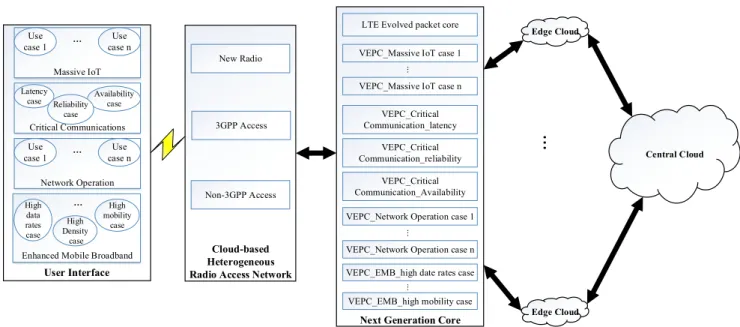
Fig. 4: Elements in a 5G security architecture [20] on strictly positive secrecy capacity in the 1970s and 1980s, the application of PLS has been hampered. At that time, most contemporary security schemes adopted the public-key cryptography [32]. The interest on using PLS quickly mounted after [33] proved that it is still possible for a legitimate user with a worse channel than the eavesdropper to generate a secret key over an insecure public channel. There have been extensive PLS research done recently in 5G wireless systems. Unlike conventional approaches that provide security mainly through cryptographic techniques, PLS is identified as a promising security strategy to provide secure wireless transmissions by exploiting the unique wireless physical layer medium features [34]. Compared to cryptography, PLS demonstrates advantages in two aspects, namely, low computational complexity and high scalability, which make PLS an ideal candidate technique for cryptographic key distribution in 5G wireless networks. In [31], authors summarized the existing PLS techniques and grouped them into five major categories based on their theoretical security capacity, power, code, channel, and signal approaches.
Besides PLS and cryptographic techniques, there have been some research work on security architecture [35], vulnerability assessment mechanisms [36], and intrusion detection mecha-nisms based on data analysis [37]. These security mechamecha-nisms need to comply with the 5G performance requirements such as extremely low latency and high degree of EE. The 5G security requirements thus need to consider the legacy security features, new use cases, and new networking paradigms altogether. Fig. 4 presents the typical elements in a 5G security architecture. Edge cloud is applied to improve the network performance by reducing the communication delay. Central cloud is used to connect the edge clouds for data sharing and centralized control.
The main contributions of this paper are summarized as follows. We first discuss various attacks as well as the state-of-the-art solutions in 5G wireless networks based on security ser-vices. The new security concerns on the technologies applied to 5G wireless network systems are then presented. Motivated by these security research and development activities, we further propose a new 5G wireless security architecture, based on which the analysis of identity management and flexible
authentication is provided. As a case study, we examine a handover procedure as well as a signaling load scheme to show the advantage of the proposed security architecture. The challenges and future directions of 5G wireless network security are finally summarized.
The rest of this paper is organized as follows. The attacks and security services in 5G wireless networks are introduced in section II. In section III, recent development and current solutions in 5G wireless security are discussed. In section IV, security issues for different technologies applied to 5G are elaborated. In section V, we propose a 5G wireless security architecture. The analysis of identity management and flexible authentication based on the new security architecture is presented. A handover procedure and signaling load analysis are studied to show the advantage of the proposed security architecture. In section VI, challenges and future directions for 5G wireless security are introduced. In section VII, conclusion is presented.
II. ATTACKS ANDSECURITYSERVICES IN5G WIRELESS
NETWORKS
Due to the broadcast nature of the wireless medium, wire-less information transmission is vulnerable to various mali-cious threats. In this section, we discuss four types of attacks, i.e., eavesdropping and traffic analysis, jamming, DoS and DDoS, and MITM, in 5G wireless networks. We also introduce four security services including authentication, confidentiality, availability, and integrity.
A. Attacks in 5G Wireless Networks
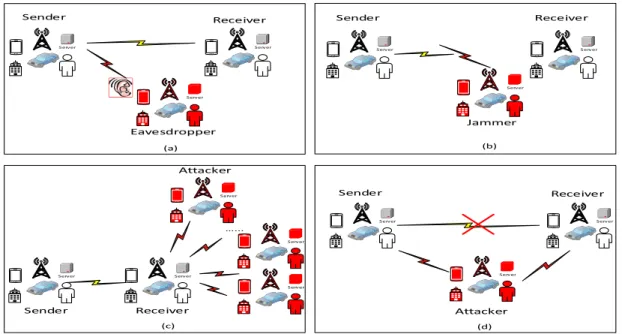
Fig. 5 illustrates all four attacks, each of which is individu-ally discussed in the following three aspects, type of the attack (passive or active), security services provided to fight against this attack, and the corresponding methods applied to avoid or prevent this attack. We focus on security attacks at the PHY layer and MAC layer, where the key difference on security between wireless and wire-line networks occur.
1) Eavesdropping and Traffic Analysis: Eavesdropping is
an attack that is used by an unintended receiver to intercept a message from others. Eavesdropping is a passive attack as the normal communication is not affected by eavesdropping, as shown in Fig. 5a. Due to the passive nature, eavesdropping is hard to detect. Encryption of the signals over the radio link is most commonly applied to fight against the eavesdropping attack. The eavesdropper can not intercept the received signal directly due to the encryption. Traffic analysis is another passive attack that an unintended receiver uses to intercept in-formation such as location and identity of the communication parties by analyzing the traffic of the received signal without understanding the content of the signal itself. In other word, even the signal is encrypted, traffic analysis can still be used to reveal the patterns of the communication parties. Traffic analysis attack does not impact the legitimate communications either.
Encryption method used to prevent eavesdropping is heavily dependent on the strength of the encryption algorithm and also on the computing capability of the eavesdropper. Due
to the quick escalation of computing power and booming of advanced data analysis technologies, eavesdropper can take the advantage of the new technologies in theirs attacks. The existing mechanisms to tackle eavesdropping face a big chal-lenge as many of them assume a small number of simultaneous eavesdroppers with low computing capability and low data analysis capability. Moreover, some technologies applied to 5G wireless networks such as HetNet may further increase the difficulty to fight against eavesdroppers. In general the new characteristics of 5G wireless networks lead to many more complicated scenarios to cope with eavesdroppers, for example, in [38], eavesdroppers with multiple antennas are considered. As cryptographic methods to tackle eavesdropping have been extensively investigated in the past and are con-sidered rather mature, most recently, PLS research to tackle eavesdropping has been paid more and more attentions.
2) Jamming: Unlike eavesdropping and traffic analysis,
jamming can completely disrupt the communications between legitimate users. Fig. 5b is an example for jamming attack. The malicious node can generate intentional interference that can disrupt the data communications between legitimate users. Jamming can also prevent authorized users from accessing radio resources. The solutions for active attacks are normally detection based.
Spread spectrum techniques such as direct sequence spread spectrum (DSSS) and frequency hopping spread spectrum (FHSS) are widely used as a secure communication method to fight against jamming at the PHY layer by spreading the signals over a wider spectral bandwidth. However, DSSS and FHSS based anti-jamming schemes may not fit into some applications in 5G wireless networks. In [39], a pseudorandom time hopping anti-jamming scheme is proposed for cognitive users to improve the performance compared to FHSS. Due to the characteristics of jamming, detection is possible. In [40], a resource allocation strategy is proposed between a fusion center and a jammer. Resource allocation is applied to improve the detection to achieve a better error rate performance.
3) DoS and DDoS: DoS attacks can exhaust the network
resources by an adversary. DoS is a security attack violation of the availability of the networks. Jamming can be used to launch a DoS attack. DDoS can be formed when more than one distributed adversary exists. Fig.5c shows a DDoS model. DoS and DDoS are both active attacks that can be applied at different layers. Currently, detection is mostly used to recognize DoS and DDoS attacks. With a high penetration of massive devices in 5G wireless networks, DoS and DDoS will likely become a serious threat for operators [21]. DoS and DDoS attacks in 5G wireless networks can attack the access network via a very large number of connected devices. Based on the attacking target, a DoS attack can be identified either as a network infrastructure DoS attack or a device/user DoS attack [21]. A DoS attack against the network infrastruc-ture can strike the signaling plane, user plane, management plane, support systems, radio resources, logical and physical resources [21]. A DoS attack against device/user can target on battery, memory, disk, CPU, radio, actuator and sensors [21].
4) MITM: In MITM attack, the attacker secretly takes
par-Receiver Eavesdropper Server Sender Server Server (a) Jammer Server Sender Server Receiver Server (b) Sender Attacker ... Server Server Server Server Server Receiver (c) Attacker Server Sender Server Receiver Server (d) Receiver
Fig. 5: Attacks in 5G wireless networks (a). Eavesdropping; (b). Jamming; (c). DDoS; (d). MITM ties. The MITM attacker can intercept, modify, and replace the
communication messages between the two legitimate parties. Fig. 5d shows a MITM attack model. MITM is an active attack that can be launched in different layers. In particular, MITM attacks aim to compromise data confidentiality, integrity, and availability. Based on the Verizon’s data investigation report [41], MITM attack is one of the most common security attacks. In the legacy cellular network, false base station based MITM is an attack that the attacker forces a legitimate user to create a connection with a fake base transceiver station [42]. Mutual authentication between the mobile device and the base station is normally used to prevent the false base station based MITM.
B. Security Services in 5G Wireless Networks
The new architecture, new technologies, and use cases in 5G wireless networks bring in new features and requirements of security services. In this section, we primarily introduce four types of security services: authentication (entity authentication, message authentication), confidentiality (data confidentiality, privacy), availability, and integrity.
1) Authentication: There are two kinds of authentications,
namely, entity authentication and message authentication. Both entity authentication and message authentication are important in 5G wireless networks to tackle the previous mentioned attacks. Entity authentication is used to ensure the communi-cating entity is the one that it claims to be. In the legacy cel-lular networks, mutual authentication between user equipment (UE) and mobility management entity (MME) is implemented before the two parties communicating to each other. The mutual authentications between UE and MME is the most important security feature in the traditional cellular security framework. The authentication and key agreement (AKA) in 4G LTE cellular networks is symmetric-key based. However, 5G requires authentication not only between UE and MME but also between other third parties such as service providers.
Since the trust model differs from that used in the traditional cellular networks, hybrid and flexible authentication manage-ment is needed in 5G. The hybrid and flexible authentication of UE can be implemented in three different ways: authentication by network only, authentication by service provider only, and authentication by both network and service provider [15]. Due to the very high speed data rate and extremely low latency requirement in 5G wireless networks, authentication in 5G is expected to be much faster than ever. Moreover, the multi-tier architecture of the 5G may encounter very frequent handovers and authentications between different tiers in 5G. In [43], to overcome the difficulties of key management in HetNets and to reduce the unnecessary latency caused by frequent handovers and authentications between different tiers, a SDN enabled fast authentication scheme using weighted secure-context-information transfer is proposed to improve the efficiency of authentication during handovers and to meet 5G latency requirement. To provide more security services in 5G wireless networks, in [44][45], a public-key based AKA is proposed.
With the various new applications in 5G wireless net-works, message authentication becomes increasingly impor-tant. Moreover, with the more strict requirements on latency, spectrum efficiency (SE), and EE in 5G, message authenti-cation is facing new challenges. In [46] an efficient Cyclic Redundancy Check (CRC) based message authentication for 5G is proposed to enable the detection of both random and malicious error without increasing bandwidth.
2) Confidentiality: Confidentiality consists of two aspects,
i.e., data confidentiality and privacy. Data confidentiality pro-tects data transmission from passive attacks by limiting the data access to intended users only and preventing the access from or disclosure to unauthorized users. Privacy prevents controlling and influencing the information related to legiti-mate users, for example, privacy protects traffic flows from
any analysis of an attacker. The traffic patterns can be used to diagnose sensitive information, such as senders/receivers location, etc. With various applications in 5G, there exist massive data related to user privacy, e.g., vehicle routing data, health monitoring data, and so on.
Data encryption has been widely used to secure the data confidentiality by preventing unauthorized users from extract-ing any useful information from the broadcast information. Symmetric key encryption technique can be applied to encrypt and decrypt data with one private key shared between the sender and the receiver. To share a key between the sender and the receiver, a secure key distribution method is required. Conventional cryptography method is designed based on the assumption that attackers have limited computing capabilities. Thus it is hard to fight against attackers who are equipped with powerful computing capabilities. Rather than relying solely upon generic higher-layer cryptographic mechanisms, PLS can support confidentiality service [47] against jamming and eavesdropping attacks. Besides the data services of 5G, users start to realize the importance of privacy protection service. Privacy service in 5G deserves much more attention than in the legacy cellular networks due to the massive data connections [12]. Anonymity service is a basic security requirement in many user cases. In many cases, privacy leakage can cause serious consequences. For examples, health monitoring data reveals the sensitive personal health information [45]; vehicle routing data can expose the location privacy [44]. 5G wireless networks raise serious concerns on privacy leakage. In Het-Nets, due to the high density of small cells, the association algorithm can reveal the location privacy of users. In [48], a differential private algorithm is proposed to protect the location privacy. In [49], the privacy in group communications is secured by the proposed protocol. In [44], cryptographic mechanisms and schemes are proposed to provide secure and privacy-aware real-time video reporting service in vehicular networks.
3) Availability: Availability is defined as the degree to
which a service is accessible and usable to any legitimate users whenever and wherever it is requested. Availability evaluates how robust the system is when facing various attacks and it is a key performance metric in 5G. Availability attack is a typical active attack. One of the major attacks on availability is DoS attack, which can cause service access denial to legitimate users. Jamming or interference can disrupt the communication links between legitimate users by interfering the radio signals. With massive unsecured IoT nodes, 5G wireless networks face a big challenge on preventing jamming and DDoS attacks to ensure the availability service.
For the availability at PHY, DSSS and FHSS are two classical PLS solutions. DSSS was first applied to the military in 1940s. A pseudo noise spreading code is multiplied with the spectrum of the original data signal in DSSS. Without knowl-edge on the pseudo noise spreading code, a jammer needs a much higher power to disrupt the legitimate transmission. For FHSS, a signal is transmitted by rapidly switching among many frequency channels using a pseudorandom sequence generated by a key shared between transmitter and receiver. Dynamic spectrum is applied to D2D communications and
cognitive radio paradigm to improve the SE in 5G. In [39], the authors pointed out that FHSS can cause bad performance with the jamming attack. A pseudorandom time hopping spread spectrum is proposed to improve the performance on jam-ming probability, switching probability, and error probability. Resource allocation is adopted to improve the detection of the availability violation [40].
4) Integrity: Although message authentication provides the
corroboration of the source of the message, there is no pro-tection provided against the duplication or modification of the message. 5G aims to provide connectivity anytime, anywhere, and anyhow, and to support applications closely related to human being daily life such as metering for the quality of the drinking water and scheduling of the transportation. The integrity of data is one of the key security requirements in certain applications.
Integrity prevents information from being modified or al-tered by active attacks from unauthorized entities. Data integri-ty can be violated by insider malicious attacks such as message injection or data modification. Since the insider attackers have valid identities, it is difficult to detect these attacks. In use cases such as smart meters in smart grid [50], data integrity service needs to be provided against manipulation. Compared to voice communications, data can be more easily attacked and modified [51]. Integrity services can be provided by using mutual authentication, which can generate an integrity key. The integrity service of personal health information is required [45]. Message integrity can be provided in the authentication schemes [44].
III. STATE-OF-THE-ART IN5G WIRELESSSECURITY
In this section, we summarize the state-of-the-arts including recent development and current solutions for security in 5G wireless network systems. As indicated in the previous section, cryptography and PLS are two major security solutions.
Many new PHY technologies in 5G wireless networks launched considerable research work in PLS. Most PLS research work are based on resource allocation. In [52] a security-oriented resource allocation scheme is considered in ultra-dense networks (UDNs). The authors presented several resource dimensions with the influence of security transmis-sion. The main resource dimensions mentioned are power al-location, relay selection, frequency alal-location, time alal-location, and beamforming. The open issues and future directions in PLS are discussed, including interference management, substi-tute for dedicated jammer, security over mobility management, and handing the heterogeneity. A case study for cross layer cooperation scheme in HetNet is presented when considering multiple users and SBSs in UDNs. For better understanding the PLS, two metrics used to evaluate the security performance are introduced as secrecy capacity and secrecy outage probability. The secrecy capacityCs is defined as:
Cs=Cm Ce; (1)
where theCm is the main channel capacity of the legitimate user, and theCe is the channel capacity of the eavesdropper. The secrecy outage probability is defined as the instantaneous
secrecy capacity is less than a target secrecy rate Rt, where
Rt >0, and:
Pout(Rs) =P(Cs< Rt); (2) Besides these two metrics, with the consumed power, in [53], secrecy EE is defined as the ratio between the system achiev-able secrecy rate and the corresponding consumed power.
The new development and solutions in cryptography have mainly targeted at new applications. There have been develop-ment and proposed solutions on the security services including authentication, availability, confidentiality, and key manage-ment. Due to the escalated privacy concerns in 5G wireless networks, we further separate the confidentiality solutions into data confidentiality based and privacy based.
A. Authentication
Authentication is one of the most important security services in 5G wireless networks. In the legacy cellular networks, an authentication scheme is normally symmetric-key based. The implementation of the authentication scheme can deliver several security requirements. In the third generation (3G) cellular networks, the mutual authentication is implemented between a mobile station and the network. Following the authentication, a cipher key and an integrity key are generated to ensure both data confidentiality and integrity between the mobile station and the base station.
Due to the low latency requirement of 5G networks, au-thentication schemes are required to be more efficient in 5G than ever before. To leverage the advantages of SDN, in [43], a fast authentication scheme in SDN is proposed, which uses weighed secure-context-information (SCI) transfer as a non-cryptographic security technique to improve authentication efficiency during high frequent handovers in a HetNet in order to address the the latency requirement. Compared with the digital cryptographic authentication methods, the proposed method is hard to be totally compromised since it is based on the user-inherent physical layer attributes. There are more than one physical layer characteristics used in SCI to improve the authentication reliability for applications requiring a high level of security. The SDN enabled authentication model is shown in Fig. 6. The SDN controller implements an authentication mod-el to monitor and predict the user location in order to prepare the relevant cells before the user arrival. This helps achieve seamless handover authentication. Physical layer attributes are used to provide unique fingerprints of the user and to simplify authentication procedure. Three kinds of fingerprints are used as the user-specific physical layer attributes. The validated original attributes are obtained after a full authentication. The observations are collected through constantly sampling multiple physical layer attributes from the received packets at the SDN controller. Both the original file and observation results contain the mean value of the attributes and variance of the chosen attributes. Then the mean attribute offset can be cal-culated based on the validated original attributes and observed attributes. If the attribute offset is less than a pre-determined threshold, the user equipment is considered legitimate. The detection probability is presented in the paper. To evaluate the performance of the proposed method, a SDN network
SDN Controller AP Small cell AP Small cell BS Pico-cell BS Pico-cell 1. Full authentication
2. Secure context transfer
3. Fast authentication
Fig. 6: A SDN enabled authentication model [43] model using priority queuing is proposed. The arriving traffic is modeled as a Pareto distribution. Authentication delay is compared among different network utilization scenarios. The proposed fast authentication protocol includes full authenti-cation and weighted SCI transfer based fast authentiauthenti-cation. As shown in Fig. 6, after the first full authentication in one cell, it can be readily applied in other cells with MAC address verification, which only needs local processing. Moreover, full authentication can even be done without disrupting the user communication. A valid time duration parameter is used to flexibly adjust the secure level requirement. The simulation results compared the delay performance between the SDN enabled fast authentication and the conventional cryptographic authentication method. The SDN enabled fast authentication has a better delay performance owing to SDN flexibility and programmability in 5G networks.
To address the issues caused by the lack of a security infrastructure for D2D communications, in [54], a security-scoring based on continuous authenticity is developed to evaluate and improve the security of D2D wireless systems. The principle of legitimacy patterns is proposed to implement continuous authenticity, which enables attack detection and system security scoring measurement. For the legitimacy pat-tern, a redundant sequence of bits is inserted into a packet to enable the attack detection. The simulation results show the feasibility of implementing the proposed security scoring using legitimacy patterns. The authors pointed out that legit-imacy patterns considering technical perspectives and human behaviors could improve the performance.
Combining the high security and utmost efficiency in band-width utilization and energy consumption in 5G, in [46], the authors proposed a new cyclic redundancy check (CRC)-based message authentication which can detect any double-bit errors in a single message. The CRC codes based cryptographic hash functions are defined. A linear feedback shift register (LFSR) is used to efficiently implement the CRC encoding and decoding. The message authentication algorithm outputs an authentication tag based on a secret key and the message.
Sever: HFD, (𝐼𝐷𝑆, 𝐼𝐷𝑖[𝐾𝑖,𝑗𝑜𝑙𝑑, 𝐾𝑖,𝑗𝑛𝑒𝑤])
Reader: PNG Tag: PNG, HF, IDS, 𝐼𝐷𝑖,
(𝐾𝑖,1, … , 𝐾𝑖,𝑚) Initialization process: 𝑞, 𝑟1 𝐼𝐷𝑆, 𝑟2, 𝐻(𝐼𝐷𝑖||𝑟1||𝑟2), 𝐻(𝐾𝑖,𝑗||𝑟1||𝑟2), 𝐹 𝐼𝐷𝑆, 𝑟2, 𝐻(𝐼𝐷𝑖||𝑟1||𝑟2), 𝐻(𝐾𝑖,𝑗||𝑟1||𝑟2), 𝐹 Forward Forward 𝐻(𝐼𝐷𝑖||𝐾𝑖,𝑗||𝑟1||𝑟2)
i-th tag identity verified, session stop or revocation complete
𝐻(𝐼𝐷𝑖||𝐾𝑖,𝑗||𝑟1||𝑟2)
Fig. 7: The authentication process of the RFID secure appli-cation revoappli-cation scheme [55]
It is assumed that the adversary has the family of hash
functions but not the particular polynomial g(x) and the
pad s that are used to generate the authentication tag. The
generator polynomial is changed periodically at the beginning
of each session and pad sis changed for every message. The
new family of cryptographic hash functions based on CRC codes with generator polynomials in g(x) = (1 +x)p(x) are introduced, where p(x) is a primitive polynomial. The proposed CRC retains most of the implementation simplicity of cryptographically non-secure CRCs. However, the applied LFSR requires re-programmable connections.
Radio frequency identification (RFID) has been widely applied and a single RFID tag can integrate multiple appli-cations. Due to various limitations in low-cost RFID tags, the encryption algorithms and authentication mechanisms applied to RFID systems need to be very efficient. Thus simple and fast hash function are considered for the authentication mechanisms. Moreover, with multiple applications of single RFID, the revocation should be taken consideration into the authentication scheme. In [55], the authors proposed a revo-cation method in the RFID secure authentirevo-cation scheme in 5G use cases. A hash function and a random number are used to generate the corresponding module through a typical challenge-response mechanism. Fig. 7 shows the authentica-tion process of the RFID secure applicaauthentica-tion revocaauthentica-tion scheme. The reader contains a pseudo-random number generator (PNG) and the sever holds a hash function and a database (HFD). The server establishes a tag record for each legitimate tag as (IDS, IDi)and a group of corresponding application records as(Kold
i,j, Ki,jnow).qis the authentication request generated by
the reader. r1 is the first random number generated by the
PNG in reader. After receiving the authentication request, the
tag generates the second random number r2 and calculates
two hash authentication messagesM1,M2, and value of XOR
authentication information F = ELKi,j, where E is the
current value of the status flag information, which is used to determine whether to revoke or to certify the application. The security and complexity results are presented, which show that
Key generator center R S R R R R ... Network manager Medical service provider (Physician) Wireless body area
network client
Fig. 8: A m-health system model [45]
the proposed scheme has a higher level of security and the same level of complexity compared with existing ones.
Considering the open nature of D2D communications be-tween medical sensors and the high privacy requirements of the medical data, in [45], by utilizing certificate-less gener-alized signcryption (CLGSC) technique, the authors proposed a light-weight and robust security-aware (LRSA) D2D-assist data transmission protocol in a m-health system. The m-health system is modeled in Fig. 8, where S indicates the source node, and R represents the relay node. The anonymous and mutual authentication is implemented between the client and the physician in a wireless body area network to protect the privacy of both the data source and the intended destination.
The signcryption of the message µS and encryption of its
identityeS
Hare applied to the source client to authenticate the physician. A certificated-less signature algorithm is applied to the source client data before it is sent out. The source data identity can only be recovered by the intended physician who has the private key (xH, zH). The cipher text µS should be decrypted after the source identity is recovered with the right session key. Therefore, even the private key is leaked out, without the session key, the ciphertext is still safe. On the other hand, by verifying the signcryption µS, the physician can authenticate the source client. The relay nodes can verify the signature and then forward the data with their own sig-natures. The computational and communication overheads of the proposed CLGSC are compared with other four schemes. Simulation results show that the proposed CLGSC scheme has a lower computational overhead than the other four schemes. Compared to IEEE 802.11p and the legacy cellular net-works, 5G is a promising solution to provide real-time services for vehicular networks. However, the security and privacy need to be enhanced in order to ensure the safety of transportation. In [44], a reliable, secure, and privacy-aware 5G vehicular network supporting real-time video services is presented. The system architecture is shown in Fig. 9, which includes a mobile core network (MCN), a trusted authority (TA), a department of motor vehicles (DMV), and a law enforcement agency (LEA). D2D communications and mmWave techniques are adopted in the 5G vehicular communications. As shown in Fig. 9, HetNet is applied to expand network capacity and achieve high user data rates. The cloud platform provides massive s-torage and ubiquitous data access. The proposed cryptographic mechanisms include a pseudonymous authentication scheme, a public key encryption with keyword search, a ciphertext-policy attribute-based encryption, and threshold schemes based
Data centre Servers TA BS ` ` ` MCN D2D Link 5G mmWave DMV LEA Cloud Platform
Fig. 9: A 5G-enabled vehicular network [44] on secret sharing. The pseudonymous authentication scheme with strong privacy preservation [56] is applied to optimize the certification revocation list size, which is in a linear form with respect to the number of revoked vehicles so that certification verification overhead is the lowest. The authentication require-ments include vehicle authentication and message integrity, where vehicle authentication allows the LEA and official vehicles to check the sender authenticity. The authentication is achieved by using a public-key-based digital signature that binds an encrypted traffic accident video to a pseudonym and to the real identity of the sender. The pseudonymous authen-tication technique can achieve the conditional anonymity and privacy of the sender.
B. Availability
Availability is a key metric to ensure the ultra-reliable communications in 5G. However, by emitting wireless noise signals randomly, a jammer can degrade the performance of the mobile users significantly and can even block the avail-ability of services. Jamming is one of the typical mechanisms used by DoS attacks. Most of the anti-jamming schemes use the frequency-hopping technique, in which users hop over multiple channels to avoid the jamming attack and to ensure the availability of services.
In [57], the authors proposed a secret adaptive frequency hopping scheme as a possible 5G technique against DoS based on a software defined radio platform. The proposed bit error rate (BER) estimator based on physical layer information is applied to decide frequency blacklisting under DoS attack. Since the frequency hopping technique requires that users have access to multiple channels, it may not work efficiently for dynamic spectrum access users due to the high switching rate and high probability of jamming.
To reduce the switching rate and probability of jamming, in [39], a pseudorandom time hopping anti-jamming scheme is
Channel Assignment
Slot Assignment Channel
Channel Assignment Slot Assignment
Transmitter Side Receiver Side
Private Key Pre-shared Key
Fig. 10: A pseudorandom time hopping system block diagram [39]
proposed for cognitive users in 5G to countermeasure jamming attacks. The impact of spectrum dynamics on the performance of mobile cognitive users is modeled with the presence of a cognitive jammer with limited resources. The analytical solutions of jamming probability, switching rate, and error probability are presented. The jamming probability relates to delay performance and error probability. The jamming proba-bility is low when the jammer lacks the access opportunities. Switching probability of time-hopping system outperforms the frequency-hopping system. With the same average symbol energy per joule, time-hopping has a lower error probability than frequency-hopping, and the performance gain saturates at a certain symbol energy level. The authors pointed out that the proposed time-hopping technique is a strong candidate for D2D links in 5G wireless networks due to its good EE and SE performance as well as its capability in providing jamming resilience with a small communication overhead. However, a pre-shared key is required for the time-hopping anti-jamming technique. The pseudorandom time hopping system block diagram is shown in Fig. 10. Both frequency hopping and time hopping require a pre-shared key to determine the hopping sequence.
Considering the limited computational capabilities at certain nodes, in [40], a fusion center is used to defend these nodes from a malicious radio jamming attack over 5G wireless network. A noncooperative Colonel Blotto game is formulated between the jammer and the fusion center as an exercise in strategic resource distribution. Fig. 11 shows the resource allocation model between fusion center and the malicious jammer. The jammer aims to jeopardize the network without getting detected by distributing its power among the nodes intelligently. On the other hand, the fusion center as a defender aims to detect such an attack by a decentralized detection scheme at a certain set of nodes. The fusion center can allocate more bits to these nodes for reporting the measured inter-ference. A hierarchal degree is assigned to each node based on its betweenness centrality. Once the attack is detected, the fusion center will instruct the target node to increase its transmit power to maintain a proper SINR for normal communications. The simulation results show that error rate performance improves significantly with the fusion center having more bits to allocate among the nodes. The proposed resource allocation mechanism outperforms the mechanism that allocates the available bits in a random manner.
Server Fusion Center Server Jammer Bandwidth Allocation Detected feedback Interference
Fig. 11: The resource allocation model [40]
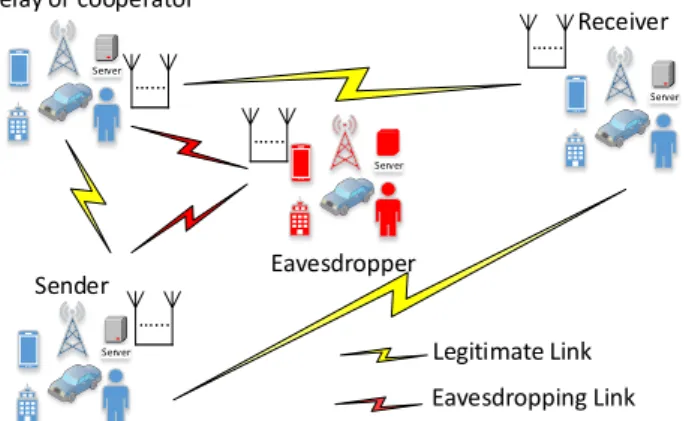
Server Relay or cooperator ... Server Receiver ... Eavesdropper Server ... Legitimate Link Eavesdropping Link Server Sender ...
Fig. 12: A general system model with eavesdropping attacks
C. Data Confidentiality
Data confidentiality service is commonly required to tack-le eavesdropping attacks. The general system model with eavesdropping attacks is shown in Fig.12. The specific sys-tem models can be different in the number of transmit-ter/receiver/eavesdropper antennas and in the number of eaves-droppers/relays/cooperators. The relays or cooperators are optional in the system. In this subsection, we discuss data confidentiality based on power control, relay, artificial noise, signal processing, and cryptographic methods.
1) Power Control: Power control for security aims to
con-trol the transmit power to ensure that the eavesdropper can not recover the signal. Based on the most simple eavesdropping attack model with a single eavesdropper armed with a single antenna, in [58], the authors proposed a distributed algorithm to secure D2D communications in 5G, which allows two legitimate senders to select whether to cooperate or not and to adapt their optimal power allocation based on the selected cooperation framework. Fig. 12 shows a general system model with eavesdropping attacks. In the system model in [58], the sender, relay or cooperator, receiver, and eavesdropper are named as Alice, John, Bob, and Eve, respectively. Each user has a single antenna. A shared bi-directional link is
applied between Alice and John. The problem is formulated to maximize the achievable secrecy rates for both Alice and John as follows [58]
Ca= max (Rajb Rae), (3)
s.t.Pj+PjbPJ; (4)
Cj= max (Rjab Rje), (5)
s.t.Pa+PabPA, (6)
whereCaandCjrepresent the secrecy rates of Alice and John respectively. Rajband Rjab are the achievable rates of Alice and John respectively with helping to relay data for each other.
Rae and Rje are the achievable rates of eavesdropper from
Alice and from John respectively. Eq. 4 and Eq. 6 represent the transmit power limitation of the two legitimate senders. Two cooperation scenarios are considered, namely cooperation with relay and cooperation without relay. In the cooperation with relay scenario, Alice and John can help relay data of each other using the shared bi-directional link. In cooperation without relay, Alice and John coordinate their respective trans-mission power to maximize the secrecy rate of the other one. The optimization problem of noncooperation scenario is also presented for comparison. The distance between the legitimate transmitter and the eavesdropper is given a constraint to avoid distance attacks as the eavesdropper may have a better received signal quality on the transmitted message than the legitimate receiver. Simulation results show that achievable secrecy rates of Alice and John are improved by relaying data for each other. With the increase of distance between the transmitter and the receiver, the benefit from cooperation decreases and at some point non-cooperation could become more beneficial to the legitimate transmitter.
With no relay or cooperation, based only on power control and channel access, in [59], the authors developed a Stack-elberg game framework for analyzing the achieved rate of cellular users and the secrecy rate of D2D users in 5G by using PLS. The system model includes one base station (BS), a number of cellular users, one D2D link, and one eavesdropper, as shown in Fig. 13. The utility function of cellular user achieved rates and D2D user secrecy rates are expressed as functions of channel information and transmission power [59]:
uc,i= log2(1 +SIN Rc,i) +↵ PDhdc, (7)
ud= [log2(1+SIN Rd) log2(1+SIN Re)] ↵PDhdc, (8) where↵is the price factor and is the scale factor. The first
term inuc,irepresents the data rate of theithcellular user, and the second term compensates the interference from the D2D link, wherePD is the transmit power of the D2D user andhdc is the channel gain from the D2D user to cellular users. The utility function of D2D user includes the secrecy data rate and the payment for the interference to cellular users. The game strategy of cellular users depends on the price factor ↵ and game strategy of D2D user depends on the transmission power
PD. The Stackelberg game is formed to maximize cellular
utility function at the first stage and then the utility function of D2D user at the second stage.
BS Cellular User Cellular User D2D User D2D User Eavesdropper Cellular link Interference D2D link Eavesdropping link Fig. 13: The system model with D2D link and an eavesdropper [59]
Power control is also one of the normally used mechanisms to improve the EE of the network. In [60], the authors studied the trade-off between PLS and EE of massive MIMO in an HetNet. An optimization model is presented to minimize the total power consumption of the network while satisfying the security level against eavesdroppers by assuming that the BS has imperfect channel knowledge on the eavesdroppers. The simulation results show that a highly dense network topology can be an effective solution to achieve high capacity, high cellular EE, and reliable and secure communication channels.
2) Relay: As shown in Fig.12, cooperation with relay can
be used to help the sender to secure the signal transmis-sion. In [61], two relay selection protocols, namely optimal relay selection (ORS) and partial relay selection (PRS), are proposed to secure an energy harvesting relay system in 5G wireless networks. The system model is shown in Fig. 12, which consists of multiple relay nodes and assumes there is no direct link between sender and receiver. The power beacon is armed with multiple antennas, which can be used to strengthen the energy harvested. The ORS chooses the aiding relay to maximize the secrecy capacity of the system by assuming the source has full knowledge of channel state information (CSI) on each link. The PRS selects the helping relay based on partial CSI. The system includes a power beacon with multiple antennas, several relays, a destination node and an eavesdropper with a single antenna. Two energy harvesting scenarios that aim to maximize energy harvesting for source and selected relay are investigated. The analytical and asymptotic expressions of secrecy outage probability for both relay selections protocols are presented. The numerical results show that ORS can significantly enhance the security of the proposed system model and can achieve full secrecy diversity order while PRS can only achieve unit secrecy diversity order regardless of the energy harvest strategies. PRS that maximizes energy harvesting for relay strategy has a better secrecy performance than the one based on the maximizing energy harvesting for source. Moreover, the results show that the secrecy performance of the considered system is impacted significantly by the duration of energy harvest process.
To tackle the complexity issue of relay selection in 5G large-scale secure two-way relay amplify-and-forward (TWR-AF) systems with massive relays and eavesdroppers, in [62], the authors proposed a distributed relay selection criterion that does not require the information of sources SNR, channel estimation, or the knowledge of relay eavesdropper links. The proposed relay selection is done based on the received power of relays and knowledge of the average channel information between the source and the eavesdropper. The system model includes two source nodes, a number of legitimate relay nodes and multiple passive eavesdroppers. Each node has a single antenna. The cooperation of eavesdroppers is considered. In TWR-AF, the received signals from the two sources at the eavesdropper in each time slot are overlapped, where one source’s signal acts as the jamming noise. The analytical results show that the number of eavesdroppers has a severe im-pact on the secrecy performance. The simulation results show that the performance of the proposed low-complexity criterion is very close to that of the optimal selection counterpart.
Considering eavesdroppers and relay with both single and multiple antennas, in [63], the transmission design for secure relay communications in 5G networks is studied by assuming no knowledge on the number or the locations of eavesdroppers. The locations of eavesdroppers form a homogeneous Poisson Point Process. A randomize-and-forward relay strategy is proposed to secure multi-hop communications. Secrecy outage probability of the two-hop transmission is derived. A secrecy rate maximization problem is formulated with a secrecy outage probability constraint. It gives the optimal power allocation and codeword rate. Simulation results show that the secrecy outage probability can be improved by equipping each relay with multiple antennas. The secrecy throughput is enhanced and secure coverage is extended by appropriately using relay-ing strategies.
3) Artificial Noise: Artificial noise can be introduced to
se-cure the intended signal transmission. With the artificial-noise-aided multi-antenna secure transmission under a stochastic ge-ometry framework, in [24], the authors proposed an association policy that uses an access threshold for each user to associate with the BS so that the truncated average received signal power beyond the threshold is maximized and it can tackle randomly located eavesdroppers in a heterogeneous cellular network. The tractable expression of connection probability and se-crecy probability for a randomly located legitimate user are investigated. Under the constraints of connection and secrecy probabilities, the network secrecy throughput and minimum secrecy throughput of each user are presented. Numerical results are presented to verify the analytical accuracy.
Assuming the sender is armed with multiple antennas, in [64], an artificial noise transmission strategy is proposed to secure the transmission against an eavesdropper with a single antenna in millimeter wave systems. Millimeter wave channel is modeled with a ray cluster based spatial channel model. The sender has partial CSI knowledge on the eavesdropper. The proposed transmission strategy depends on directions of the destination and the propagation paths of the eavesdropper. The secrecy outage probability is used to analyze the transmission scheme. An optimization problem based on minimizing the
secrecy outage probability with a secrecy rate constraint is presented. To solve the optimization problem, a closed-form optimal power allocation between the information signal and artificial noise is derived. The secrecy performance of the millimeter wave system is significantly influenced by the relationship between the propagation paths of destination and eavesdropper. The numerical results show that the secrecy outage is mostly occurred if the common paths are large or the eavesdropper is close to the transmitter.
To improve EE of the security method using artificial noise, in [53], an optimization problem is formulated to maximize the secrecy EE by assuming imperfect CSI of eavesdropper at transmitter. The system is modeled with one legitimate transmitter with multiple antennas, and one legitimate receiver and one eavesdropper, each with a single antenna. Artificial noise is used at the transmitter. Resource allocation algorithms are used to solve the optimization problem with correlation between transmit antennas. With the combination of fractional programming and sequential convex optimization, the first-order optimal solutions are computed with a polynomial complexity.
4) Signal Processing: Besides the three methods above to
provide data confidentiality, in [38], the authors proposed an original symbol phase rotated (OSPR) secure transmission scheme to defend against eavesdroppers armed with unlimited number of antennas in a single cell. Perfect CSI and perfect channel estimation are assumed. The BS randomly rotates the phase of original symbols before they are sent to legitimate user terminals. The eavesdropper can not intercept signals, only the legitimate users are able to infer the correct phase rotations recover the original symbols. Symbol error rate of the eavesdropper is studied, which proves that the eavesdropper can not intercept the signal properly as long as the base station is equipped with a sufficient number of antennas.
Considering multiple eavesdroppers in [65], the authors analyzed the secure performance on a large-scale downlink system using non-orthogonal multiple access (NOMA). The
system considered contains one BS, M NOMA users and
eavesdroppers randomly deployed in an finite zone. A pro-tected zone around the source node is adopted for enhancing the security of the random network. Channel statistics for legitimate receivers and eavesdroppers and secrecy outage probability are presented. User pair technique is adopted among the NOMA users. Analytical results show that the secrecy outage probability of NOMA pairs is determined by the NOMA users with poorer channel conditions. Simulation results show that secrecy outage probability decreases when the radius of the protected zone increases and secrecy outage probability can be improved by reducing the scope of the user zone as the path loss decreases.
In [66], the authors proposed a dynamic coordinated mul-tipoint transmission (CoMP) scheme for BS selection to en-hance secure coverage. Considering co-channel interference and eavesdroppers, analysis of the secure coverage probability is presented. Both analytical and simulation results show that utilizing CoMP with a proper BS selection threshold the secure coverage performance can be improved, while secure coverage probability decreases with the excessive cooperation.
The proposed CoMP scheme has a better performance to resist more eavesdroppers than the no-CoMP scheme.
In [25], massive MIMO is applied to HetNets to secure the data confidentiality in the presence of multiple eavesdroppers. The tractable upper bound expressions for the secrecy outage probability of HetNet users are derived, which show that mas-sive MIMO can significantly improve the secrecy performance. The relationship between the density of picocell base station and the secrecy outage probability of the HetNet users is discussed.
5) Cryptographic Methods: Besides the PLS solutions
in-troduced above, cryptographic methods are also used for implementing data confidentiality by encrypting data with secret keys. Asymmetric cryptography can be applied to key distributions. To reduce the cost of encryption, symmetric cryptography is adopted for data encryption.
In [44], a participating vehicle can send its random sym-metric key, which is encrypted using TA’s public key. The symmetric key is used to encrypt the message between TA, DMV, and participating vehicles. A one-time encryption key is also encrypted by a public key. The one-time encryption key is used to encrypt the video. In [45], an initial symmetric session key is negotiated between the client and a physician after they establish the client/server relationship. The symmetric key is then used for the data transmission between the client and the physician.
D. Key Management
Key management is the procedure or technique that supports the establishment and maintenance of keying relationships between authorized parties, where the keying relationship is the way common data is shared between communication entities. The common data can be public or secret keys, initialization values, and other non-secret parameters.
To provide flexible security, in [67], three novel key ex-change protocols, which have different levels of computational time, computational complexity, and security, for D2D com-munications are proposed based on the Diffie-Hellman (DH) scheme. Details of the key exchange schemes are shown in Fig. 14. The threat analysis of all three proposed protocols under common brute force and MITM attacks is presented. Performance study is provided for the proposed protocols to evaluate the confidentiality, integrity, authentication, and non-repudiation of security services based on theoretical analysis. The analysis proves that the proposed protocols are feasible with reasonable communication overhead and computational time.
For D2D group use cases, in [49], a group key management (GKM) mechanism to secure the exchanged D2D message during the discovery and communication phases is proposed. There are five security requirements in the proposed GKM, namely forward secrecy (users that have left the group should not have access to the future key), backward secrecy (new users joining the session should not have access to the old key), collusion freedom (fraudulent users could not deduce the current traffic encryption), key independence (keys in one group should not be able to discover keys in another
User 1 User 2 eNodeB 1 2 3 4 5 6 7 8
User 1 User 2 eNodeB 1 2 3 4 6 8 5 8
User 1 User 2 eNodeB 1 2 3 4 11 12 5 5 6 7 8 10 12 Public channel
Encrypted dedicated channel
Protocol 1 Protocol 2
Protocol 3 1. User 1 send its DH key k1, the received key by user 2 as k1'
2. User 1 send its DH public key k2, the received key by user 1 as k2' 3. ACK of DH key mutual exchange
4. Start to authentication Protocol 1
5. Random key K, check function Ck(k1',k2)
6. Forward the key K and Ck 7. Accept, if Ck(k1',k2)=Ck(k1,k2'), otherwise reject
8. Forward accept or reject
Protocol 3
5. Random key K, user 1 and user 2 generate K1 and K2 respectively
6. Check value HMAC(k1',k2,K) 7. Check value HMAC(k1,k2',K) 8. K2
9. If HMAC(k1,k2',K)=HMAC(k1',k2,K), send accept ACK to eNodeB
10. If accept ACK was send in 9, send K1 to user 2 11. If HMAC(k1',k2,K)=HMAC(k1,k2',K), send accept ACK to eNodeB
12. Accept ACK/reject ACK Protocol 2
5. Random key K, the received key by user 1 is K
6. Check value Ck(k1',k2), K 7. Check value Ck(k1,k2'), K 8. If K=K and
Ck(k1,k2)=Ck(k1,k2'), accept ACK, else refuse ACk
Fig. 14: Three key exchange schemes in [67] group), and trust relationship (do not reveal the keys to any
other part in the same domain or any part in a differen-t domain). ID-based crypdifferen-tography (IBC) scheme based on Elliptic Curve Cryptography (ECC) for securing multicast group communications is presented. The steps of the proposed protocol include secret key generation, elliptic curve digital signature algorithm, signature verification, group formation procedure, key generation, join process, and leave process. The master key and private key generations are based on IBC and ECC schemes. The overhead for communications, re-keying message, and key storage are assessed. The weakness of the IBC scheme and the ways of creating and using GKM are compared. The overall performance comparisons show that the proposed GKM has an enhancement in both the protocol complexity and security level compared with other works.
ECC is also adopted for the proposed LRSA protocol in [45]. The network manager generates a partially private and partially public key for the client and the physician after the registration. And once the client and the physician establish the client/server relationship, an initial systematic session key can be set up for the data transmission.
E. Privacy
As discussed in the previous sections, 5G wireless networks raise serious concerns on privacy leakage when supporting more and more vertical industries such as m-health care and smart transportation [15]. The data flows in 5G wireless networks carry extensive personal privacy information such as identity, position, and private contents. In some cases, privacy leakage may cause serious consequences. Depending on the privacy requirements of the applications, privacy protection is a big challenge in 5G wireless networks. There have already
been research work considering location privacy and identity privacy.
Regarding location privacy, in [48], to protect the location and preferences of users that can be revealed with associated algorithms in HetNets, a decentralized algorithm for access point selection is proposed based on a matching game frame-work, which is established to measure the preferences of mobile users and base stations with physical layer system parameters. Differentially private Gale-Shapley matching al-gorithm is developed based on differential privacy. Utilities of mobile users and access points are proposed based on packet success rate. Simulation results show that the differentially private algorithm can protect location privacy with a good quality of service based on utility of the mobile users. In [37], a location-aware mobile intrusion prevention system (mIPS) architecture with privacy enhancement is proposed. The authors presented the mIPS requirements, possible privacy leakage from managed security services.
In [45], contextual privacy is defined as the privacy of data source and destination. The identity of the source client is encrypted by a pseudo identity of the source client with the public key of the physician using certificateless encryption mode. Meanwhile, the identity of the intended physician is also encrypted with the public key of the network manager. Through these two encryption steps, the contextual privacy can be achieved. For the proposed reporting service in [44], privacy is an essential requirement to gain acceptance and participation of people. The identity and location information of a vehicle should be preserved against illegal tracing. Meanwhile, a reporting vehicle should be able to reveal its identity to the authorities for special circumstances. The pseudonymous authentication schemes are applied to achieve the conditional
![Fig. 1: A generic architecture for 5G wireless systems TABLE I: Security requirements for 5G wireless networks [21]](https://thumb-us.123doks.com/thumbv2/123dok_us/611318.2573254/3.892.138.748.144.450/generic-architecture-wireless-systems-security-requirements-wireless-networks.webp)
![Fig. 4: Elements in a 5G security architecture [20]](https://thumb-us.123doks.com/thumbv2/123dok_us/611318.2573254/4.892.461.825.96.362/fig-elements-g-security-architecture.webp)
![Fig. 6: A SDN enabled authentication model [43]](https://thumb-us.123doks.com/thumbv2/123dok_us/611318.2573254/8.892.468.823.91.410/fig-a-sdn-enabled-authentication-model.webp)
![Fig. 8: A m-health system model [45]](https://thumb-us.123doks.com/thumbv2/123dok_us/611318.2573254/9.892.83.444.129.393/fig-a-m-health-system-model.webp)
![Fig. 9: A 5G-enabled vehicular network [44]](https://thumb-us.123doks.com/thumbv2/123dok_us/611318.2573254/10.892.89.441.135.446/fig-a-g-enabled-vehicular-network.webp)
![Fig. 14: Three key exchange schemes in [67]](https://thumb-us.123doks.com/thumbv2/123dok_us/611318.2573254/14.892.139.730.115.520/fig-three-key-exchange-schemes-in.webp)
![TABLE III: New security issues that SDN networks are exposed to along with possible countermeasures [9]](https://thumb-us.123doks.com/thumbv2/123dok_us/611318.2573254/17.892.70.845.307.523/table-iii-security-issues-networks-exposed-possible-countermeasures.webp)