i
DEVELOPMENT AND VALIDATION OF A BILINGUAL LANGUAGE
BATTERY FOR LANGUAGE-BASED LEARNING DISABILITIES
XOLISILE INNOCENTIA MAZIBUKO
9508931
A thesis submitted in fulfilment of the requirements of the degree of Doctorate
in Speech- Language Pathology
To the School of Health Sciences,
University of KwaZulu-Natal
Supervisor
Dr Penelope Flack and Dr Jane. D. Kvalsvig
KwaZulu-Natal
ii
DEVELOPMENT AND VALIDATION OF A BILINGUAL LANGUAGE
BATTERY FOR LANGUAGE-BASED LEARNING DISABILITIES
2018
XOLISILE INNOCENTIA MAZIBUKO
9508931
A thesis submitted in fulfilment of the requirements of the degree of Doctorate
in Speech- Language Pathology, to the School of Health Sciences,
University of KwaZulu-Natal
Supervisor
Dr Penelope Flack and Dr Jane. D. Kvalsvig
KwaZulu-Natal
2018
This is complete thesis by Full dissertation.
This is to certify that this is the original work of Mrs. Xolisile Innocentia Mazibuko As the candidate’s supervisors we have approved this thesis for submission
Supervisors: Signed:
Dr P. Flack………. Dr J. Kvalsvig………. Date: ……….
iii
ABSTRACT
There are social, linguistic, cultural, and political dimensions that impact on health and education in South Africa. The evolving nature of these dimensions demand the use of language assessment tools that are developed and validated for the South African population. Speech-language assessment informs parents and educators of the nature of speech and language difficulties the learner may have and guides the intervention. IsiZulu is the most widely spoken African language in South Africa. Therefore, development of a tool to assess expressive, receptive, and written language skills of learners with language-based learning disorders in isiZulu, is imperative.
The aim of this study was to develop and validate a tool for language assessment of isiZulu-English speaking learners in grades 1, 2, and 3 who may have language-based learning disabilities. An assessment tool was designed to assess core language skills and identify early indicators of language-based learning disabilities that may result in academic difficulties. The tool development process aimed to construct an innovative test that is linguistically and culturally sensitive to bilingual or isiZulu-English speakers while the content is rich for identifying indicators of language-based learning disability. Elements in expressive and receptive language, phonological awareness, listening, reading, and mathematically-based language concepts were considered.
The conceptual tool development phase involved a systematic literature review, pretesting with two existing tools and consultation of a five member Delphi review panel for advice and reviews. Field trials contributed to the development of test items and procedures and tested the tool’s application in mainstream and remedial schools as well as rural and urban communities of learners in KwaZulu-Natal. A combination of qualitative and quantitative methods were used to collect and analyse data. The results indicated that the new tool was linguistically and culturally appropriate. The majority of the subtests provided good reliability and valid results. The study makes a worthy contribution to the body of knowledge in the field of speech-language therapy and basic education. The results and guidelines from this study set out the basic elements required for development of language assessment tools in other African languages. The development of the assessment tool will yield standardization of a bilingual language assessment tool in South Africa.
iv
DECLARATION –PLAGIARISM
I, Xolisile Innocentia Mazibuko Declare that:
1. The research reported in this thesis, except where otherwise indicated, is my original work.
2. The thesis has not been submitted for any degree or examination at another University. 3. This thesis does not contain other person’s data, pictures, graphs or other information,
unless specifically acknowledged as being sourced from other persons.
4. This thesis does not contain other person’s writing, unless specifically acknowledged as being sourced from other researchers. Where other resources have been quoted then:
a) Their words have been re-written but the general information attributed to them has been referenced.
b) Where their exact words have been used, then their writing has been placed in italics and inside quotation marks, and referenced.
5. This thesis does not contain texts, graphics or tables copied from the Internet, unless specifically acknowledged and the source being detailed in the thesis and in the references section.
A contribution to publications that form part or include research presented in this thesis is stated below.
v
DECLARATION- LIST OF PUBLICATIONS
CONFERENCES
1. Mazibuko X. Annual South African Speech-Language Hearing Association- ENT conference, 8-10 October, 2016. Johannesburg International Convention Centre, Gauteng.
Contribution:
Mazibuko X. Prepared the presentation and delivered it at the conference P. Flack: edited the presentation
vi
DEDICATION
This work is dedicated to the English additional language learners in South Africa.
This work is also dedicated to my children Vuyiswa, Andiswa and Andile who have always been my research subjects.
vii
ACKNOWLEDGEMENTS
I would like to offer my sincere gratitude to my supervisor Dr Penny Flack for her guidance and remarkable editorial contributions. I like to thank my supervisor Dr Jane Kvalsvig for her moral support, endless availability and sharing her life experiences as a field researcher with me.
My sincere gratitude to Dr S. A. Mazibuko for being my pillar of strength each and every day, every year.
My sincere thanks goes to Dr Penny Holding for her generous guidance in developing the tool.
The development of the tool would not have been completed without the contributions of the Delphi review team which included Dr Mellisa Borts, Dr Thandeka Mdlalo, Mrs Lana Loubser, Prof Makhoba and Mr. Edgar Jembere.
Thanks you to the speech and occupational therapy departments at Zululand Remedial Centre. I learnt a lot from you!
The translators Mrs. Matilda Ngcoya and her son for an awesome and professional job.
A big thank you to the research assistants Ms. Thandeka Mazibuko, Ms. Xoli Gumede, Ms. Faith Mtshali, Ms. Ntokozo Gumede and Ms. Zethu Gumede. Thank you for making this work seem easy.
To Edgar Jembere for your statistical guidance and training.
To my personal assistant Ms Zama Gumede, thank you for helping me with “my life”. To my editing team Mrs Carrin Smith and Mr. Sabelo Nkosi. Thank you is not
enough!
My appreciation goes to the UKZN scholarship fund for financing the data collection phase of the study. It really made completing this research project a reality.
Thank you to the school Principals, the foundation phase staff members and all the learners that participated in this study. Without your participation, there would be no results.
viii
TABLE OF CONTENTS
ABSTRACT ... iii
DECLARATION –PLAGIARISM ... iv
DECLARATION- LIST OF PUBLICATIONS ... v
DEDICATION ... vi
ACKNOWLEDGEMENTS ... vii
LIST OF TABLES ... xiii
LIST OF FIGURES ... xv
APPENDICES ... xvii
GLOSSARY ... xviii
LIST OF ABBREVIATIONS ... xxi
CHAPTER 1 ... 1
INTRODUCTION ... 1
1.1 Introduction ... 1
1.2 Background ... 1
1.3 Language and Literacy ... 2
1.4 Multilingualism and Language of Learning ... 4
1.5 Learning Disabilities in South Africa ... 6
1.6 Formal Language Assessment Tools... 8
1.7 Problem Statement ... 9
1.8 Research Question ... 10
1.9 Aim and Objectives ... 10
1.10 Study Type and Method ... 11
ix
1.12 Conclusion ... 12
CHAPTER 2 ... 13
LITERATURE REVIEW ... 13
2.1 Introduction ... 13
2.2 Global views of Language-based Learning Disability ... 13
2.3 Systems Approach to Early Prediction ... 22
2.4 Early Indicators of Language- based Learning Disabilities ... 24
2.5 Extrinsic Predictive Factors ... 31
2.6 The Education System ... 34
2.7 The Linguistic System ... 36
2.8 The System of Culture and Cultural Competency ... 41
2.9 Language Assessment Approach ... 44
2.10 Conclusion ... 48
CHAPTER 3 ... 49
THEORETICAL FRAMEWORK ... 49
3.1 Introduction ... 49
3.2 Ecological Approach to Theoretical Framework ... 49
3.3 Learning Theories ... 51
3.4 Theoretical Framework ... 57
3.5 Conclusion ... 59
CHAPTER 4 ... 60
RESEARCH DESIGN AND METHODS ... 60
4.1 Introduction ... 60
x
SECTION A: STUDY METHODOLOGY ... 62
4.3 Phase 1: Conceptual Development ... 62
4.4 Methodology Phase 2: Tool Design and Development ... 68
4.5 Phase 2: Data Analysis ... 78
4.6 Phase 3: Methodology ... 80
4.7 Pilot Study ... 85
4.8 Study Reliability and Validity ... 86
SECTION B: METHODOLOGY FOR TOOL DEVELOPMENT ... 88
4.9 Tool Design and Development ... 88
4.10 Ethics and Human Subjects Issues ... 103
4.11 Conclusion ... 106
CHAPTER 5 ... 107
RESULTS PHASE 1 ... 107
5.1 Introduction ... 107
5.2 Phase 1: Systematic Literature Review ... 107
5.3 Pre-Testing with Available Tools ... 110
5.4 Summary and Conclusion for Phase 1 ... 119
CHAPTER 6 ... 120
RESULTS PHASE 2 ... 120
6.1 Introduction ... 120
6.2 Research Assistants ... 120
6.3 The Pilot Study Results ... 120
6.4 The Development Process of Bilingual Language Tool ... 121
xi
6.6 Tool Trials ... 126
6.7 Tool Modification Process ... 135
6.8 Delphi Panel Results ... 138
6.9 Therapists Focus Group Discussion ... 141
6.10 Summary and Conclusion of Phase 2 ... 143
CHAPTER 7 ... 144
RESULTS PHASE 3 ... 144
7.1 Introduction ... 144
7.2 Comparative Analysis ... 144
7.3 Tool Reliability ... 151
7.4 Validation of the Tool ... 154
7.5 Summary and Conclusion Phase 3 ... 158
CHAPTER 8 ... 159
DISCUSSION ... 159
8.1 Introduction ... 159
8.2 Development of the language assessment tool ... 160
8.3 Parent and Teacher Questionnaires ... 162
8.4 Language of Testing ... 163
8.5 Qualitative evaluation of the developed tool... 165
8.6 Reliability and Validity ... 171
8.7. Implications for the L-B LD... 173
8.8. Cultural Implications ... 177
8.9 Implications for the Linguistic System ... 178
xii
8.11 Implications for Theory ... 181
8.12 Conclusion ... 183
CHAPTER 9 ... 184
CONCLUSION ... 184
9.1 Introduction ... 184
9.2 Research Summary ... 184
9.3 Summary of Key Findings ... 186
9.4 Study Contributions ... 187
9.5 Limitations of the Study ... 189
9.6 Recommendations for Future Research: ... 190
9.7 Conclusion ... 191
REFERENCES ... 193
xiii
LIST OF TABLES
Table 2. 1 IsiZulu Language Characteristics ... 39
Table 4. 1 Objectives and Methodology ... 61
Table 4. 2 Phase 1 Variables……….………...63
Table 4. 3 School Profiles ... 73
Table 4. 4 Phase 2 Variables ... 79
Table 4. 5 Phase 3 Variables ... 83
Table 4. 6 Guidelines for Differential Diagnosis ... 101
Table 4. 7 Ethical Issues ... 105
Table 6. 1 Tool Constructs and Purpose ... 121
Table 6. 2 Cultural Adaptations ... 125
Table 6. 3 Delphi Guidelines for Language, Culture and Tool Structure ... 138
Table 6. 4 Revised Working Memory Subtest ... 139
Table 6. 5 Focus Group Discussion Summary... 141
Table 7. 1 School A and C Multivariate Tests for Working Memory Subtests ... 150
Table 7. 2 School A and C Multivariate Tests for Numeracy Subtest ... 151
Table 7. 3 Internal Consistency of the BBL-BLD ... 152
xiv
xv
LIST OF FIGURES
Figure 2.1 Model Defining Language-based Learning Disability for South African Context 21
Figure 2.2 The Microsystems of Language-based LD... 23
Figure 2.3 Intrinsic Early Indicators of Language-Based Learning Disabilities ... 31
Figure 2.4 Extrinsic Indicators of Language-based Learning Disabilities ... 33
Figure 2.5 The Education System (Geldenhuys and Wever, 2013) ... 35
Figure 2.6 The Linguistic System for Language-Based Learning Disability………...37
Figure 2.7 Language-Based Learning Disability System ... 45
Figure 3. 1 The Ecological Systems of Language-based Learning Disability ... 50
Figure 3. 2 Theoretical Framework for Language-based Learning Disabilities ... 58
Figure 4. 1 Summary of Research Methodology and Flow ... 88
Figure 4. 2 Tool Development and Modification Process ... 90
Figure 4. 3 Illustration for Following Directions in isiZulu ... 96
Figure 4. 4 Illustrations for Phonemic Awareness Subtest ... 96
Figure 4. 5 Illustrations for Reading and Doing Subtest-Grade 3 Level ... 97
Figure 5. 1 Pilot Study Results- Concepts and Following Directions ... 115
Figure 5. 2 Pilot Study Results-Word Classes ... 116
xvi
Figure 5. 4 Pretesting Study Results - Formulating Sentences ... 118
Figure 6.1 School A Learner Performance by Grade ... 128
Figure 6.2 School B Learner Performance by Grade ... 130
Figure 6.3 School C Learner Performance by Grade ... 131
Figure 6.4 Schools D Learner Performance by Grade ... 133
Figure 7. 1 Profile Plots Following Directions in English ... 146
Figure 7. 2 Profile Plots Following Directions in isiZulu ... 146
Figure 7. 3 Profile Plots Story Comprehension Comparison ... 147
Figure 7. 4 Profile Plots Word Association Subtest ... 148
Figure 7. 5 Profile Plots Reading Test Comparisons ... 149
Figure 7.6 Profile Plots Phonological Awareness Tests ... 149
Figure 8. 1 Broad, Narrow and Subtest Link for the BBL-BLD ... 161
xvii
APPENDICES
APPENDIX A BBL-BLD Construct Definitions... 231
APPENDIX B Tool Constructs………..234
APPENDIX C Bilingual Battery for L-B LD Scoring and Interpretation ... 237
APPENDIX D Error Analysis Guideline ... 242
APPENDIX E Learner Behaviour Assessment ... 244
APPENDIX F Delphi Panel Evaluation of The Tool (Final Iteration) ... 245
APPENDIX G Cycle 1 Item Pool Modifications ... 253
APPENDIX H Cycle 2 Item Pool Modifications ... 253
APPENDIX I Cycle 3 Item Pool Modifications ... 256
APPENDIX J Permission To Conduct the Study In DOE Institutions ... 258
APPENDIX K Research Assistant Training Evaluation Form ... 259
xviii
GLOSSARY
Assessment A formal attempt to determine the learner’s status with respect to educational variables of interest.
Assessment tool
A variety of activities and procedures intended to ensure a comprehensive set of data for determining an individual's status and needs (National Joint Committee on Learning Disabilities, 1994).
Auditory Processing Disorder
A disorder that can cause difficulty in distinguishing the difference between similar sounds. It can occur without any hearing disorder rather they affect how the brain perceives and processes what it hears (National Center for Learning Disabilities, 2013, p. 4).
Bilingualism Ability to speak and understand two languages (Royal College of Speech and Language Therapists, 2007).
Bilingual Speaker
A person who is bilingual has the ability to communicate in more than one language and can be thought of as a continuum of language skills in which proficiency in any of the languages used may fluctuate over time and across social settings, conversational partners, and topics, among other variables (Gottardo & Grant, 2008, p. 1).
Clinical language assessment
A comprehensive assessment must include procedures to determine levels of performance in the following domains: motor, sensory, cognitive, communication, and behaviour. When a learning disability is suspected, the following areas should be assessed: listening, speaking, reading, writing, reasoning, mathematics, and social skills. However, the assessment must focus on the presenting problem(s) and possible correlate(s) (National Joint Committee on Learning Disabilities, 1994). Culture Culture is the learned, shared and transmitted knowledge of values, beliefs
and lifeways of a particular group that are generally transmitted inter-generationally and influence thinking, decisions and actions in the patterned or in certain ways (Battle, 2000, p. 2).
Cultural competency/ sensitivity
A stage of "acceptance and respect for difference, continuing self-assessment regarding culture, careful attention to the dynamics of difference, continuous expansion of cultural knowledge and resources and a variety of adaptations to service models" (Battle, 2000, p. 19)
xix
(National Center for learning disabilities, 2013, p. 2)
Dyslexia A language-based processing disorder that can hinder reading, writing, spelling and verbal communication (National Center for Learning Disabilities, 2013, p. 1).
Dysgraphia A learning disability that affects writing which requires a complex set of motor and information processing skills (National Center for Learning Disabilities, 2013, p. 2).
Indicators of LD
A range of environmental, biological, genetic, and perinatal conditions may be associated with adverse developmental outcomes (Shonkoff and Phillips, 2000, p. 124) and may be risk indicators (i.e. warning signs) for learning disabilities (American Speech-Language Hearing Association, 2007, p. 2).
Language Expressive and receptive communication skills including the ability to speak, listen, read and write.
Language-based learning disability
Langubased learning disabilities are defined as problems with age-appropriate reading, spelling, and writing. Language-based learning disabilities are a subgroup of LD that are rooted in deficiencies pertaining to the acquisition of spoken and written language. (American Speech-Language Hearing Association, 2015, p. 1).
Learning Learning involves acquiring and modifying knowledge, skills, strategies, beliefs, attitudes and behaviours (Schunk, 2012).
Learning disorder
Learning Disorder is history or current presentation of persistent difficulties in the acquisition of reading, writing, arithmetic or mathematical reasoning skills during the formal years of school (Montague & Cavandish, 2013, p. 3).
LLD indicators Early warning signs of the presence of language based Learning disabilities.
Linguistic competency/ sensitivity
Culture and linguistics refer to integrated patterns of human behaviour that include language, thoughts, communications, actions, customs, beliefs, values, and institutions of racial, ethnic, religious, or other groups (for example, gender, gender identity or gender expression, age, national origin, sexual orientation, disability). Cultural and linguistic competence is a set of congruent behaviours, attitudes, and policies that come together in
xx
a system, agency, or among professionals that enables effective work in cross-cultural situations (Battle, 2000, p. 20).
xxi
LIST OF ABBREVIATIONS
ADHD: Attention Deficit Hyper-activity Disorder ANA: Annual National Assessments
APA: American Psychiatry Association
ASHA: American Speech-Language Hearing Association
BBL-BLD: Bilingual Battery for Language-based Learning disability BN: Backward Naming
CAPS: Curriculum Assessment Policy Statements CELF: Clinical Evaluation of Language Fundamentals CHC: Cattell-Horn-Caroll
DBE: Department of Basic Education DoE: Department of Education ESL: English Second Language FE: Following directions in English FZ: Following directions in isiZulu ESL: English Second Language
IDEA: Individuals with Disability Education Act IQ: Intelligence Quotient
GHS General Household Survey
HPCSA: Health Professions Council of South Africa HOD: Head of Department
KZN: KwaZulu-Natal L1: First Language L2: Second Language
xxii LD: Learning Disability
LLD: Language Learning Disability LoLT: Language of learning and teaching
NJCLD: National Joint Committee on Learning Disabilities PA: Phonological Awareness
PANSLAB: Pan South African Language Board
PRAESA: Project for the study of Alternative Education in South Africa RAN: Rapid automated naming
RCSLT: Royal College of Speech and Language Therapists RL: Repeating Letters
RN: Repeating Numbers RW: Repeating Words
SAJCD: South African Journal of Communication Disorders SASHLA: South African Speech-Language Hearing Association SLD: Specific Learning Disorders
SLTs: Speech- language Therapists SSD: Speech Sound Disorders SZ: Story Comprehension isiZulu UK: United Kingdom
UNESCO: National Organisation for Education, Science and Culture USA: United States of America
WM: Working Memory WS: Word Association
1
CHAPTER 1
INTRODUCTION
1.1 Introduction
This chapter introduces the concepts of learning disability and language-based learning disabilities, emphasises the links between clinical and educational language assessment and, presents the problem statement, research aim and objectives. South Africa is a linguistically diverse country with eleven official languages. Historically, there were two official languages: English and Afrikaans, until democracy became a reality in 1994. Many South Africans speak more than one language (Statistics South Africa, 2011). However, education in urban areas and at tertiary education institutions continues to be conducted in two specific languages, English and Afrikaans. This means that most students receive their education and training in a language that is not their first language (Statistics South Africa, 2011). At tertiary institutions speech-language therapists (SLTs) are trained using language tools that are mainly developed in the United Kingdom (UK) and the United States of America (USA). Imported tools are used in practices, both in the private and public sectors. SLTs are required to participate in a year of community service on completion of their degrees, which takes place in public hospitals across the country. It is during this time that the importance of having access to culturally and linguistically relevant assessment tools becomes evident, as they work with children and adults who have compromised communication abilities and are not first language users of English. This highlights the need for a relevant, bilingual assessment tool for South African learners whose first language is an African language such as isiZulu. In the absence of such a tool, it is difficult to effectively identify language-based learning disability (L-b LD).
1.2 Background
During the years of apartheid (1948 to 1994) English and Afrikaans were the official languages in South Africa. African language speakers were obliged to learn these languages in order to work in the public sector and to study in tertiary institutions. Bilingualism and multilingualism naturally developed amongst speakers in mining and urban societies (Alexander, 2005, p. 2). The constitution adopted by the Constitutional Assembly in 1996
2
promoted the acceptance and development of all African languages used in South Africa. The establishment of the Pan South Africa Language Board (PANSLAB) further promoted the development and use of 12 official languages. Through the social evolution in the past 20 years, multilingualism has been growing in South Africa.
English is still the commonly used language in official documents, commercial communication and in public policies. However, it is statistically the 4th most spoken home language in South Africa (Statistics South Africa, September 2014). IsiZulu is the language of the Zulu people in South Africa with about 11.6 million speakers, the vast majority (over 78%) of whom live in KwaZulu-Natal (KZN) province (Statistics South Africa, September 2014). According to the Census 2011, isiZulu is the mother tongue of 22.7% of South Africa's population, followed by isiXhosa at 16%, Afrikaans at 13.5%, English at 9.6%, Setswana at 8% and Sesotho at 7.6% (Statistics South Africa, September 2014). The remaining official languages are spoken at home by less than 5% of the population for each language group. Although isiZulu is a regional language with most speakers in KwaZulu-Natal, more than 18% of isiZulu speakers are found in Gauteng and 7.6% in Mpumalanga. IsiZulu is also represented in other provinces. IsiZulu is the second most widely spoken language after Shona in Sub-Saharan Africa. It forms part of the Nguni language group and has similarities in terms of syntax and grammar to the other major languages in this group, namely isiXhosa, isiSwati and isiNdebele.
1.3 Language and Literacy
Literacy can simply be defined as the ability to read, write, speak, compute and solve problems at levels of proficiency necessary to function on the job and in society, to achieve one’s goals, to develop one’s knowledge and potential (American Speech-Language Hearing Association, 2002, p. 168). The South African Department of Basic Education defines literacy in a similar way in the Annual National Assessment guiding documents, adding that literacy is “the ability to read for knowledge, write logically, communicate verbally and think
critically about printed material” (Department of Basic Education, 2014, p. 1).
The Annual National Assessment (ANA) results for 2011 revealed that grade 3 learners achieved an average score of 35% in literacy. A similar figure (36%) was reported in 2007 indicating no improvement in the literacy levels and signalling a crisis for the public education system as reading and writing skills are foundational to all learning (Department of
3
Basic Education, 2014). There is a link established between low literacy scores obtained consistently in the ANA since 2011, and poor language skills in general as reflected in the Annual National Assessment 2014 report. In this report, a relationship is established between poor performance in math and level of the home or additional language skills. The report states that learners are “unfamiliar with the math terminology” and they “do not know how to
solve problems” suggesting that general language skills in the language of learning and teaching (English) are weak. Regarding home language scores, the report states the common problems are “learners struggle to respond to questions that require use of their own words”; “learners are unable to interpret a sentence or give an opinion when required”; and “learners lack the required editing skills when writing” (Department of Basic Education,
2014, p. 11). The poor performance in home language suggests that language skills are generally weak.
The nature of literacy includes spoken-written language relationships since reading and writing are acts of communication and tools of learning. Therefore, literacy learning depends on a strong foundation of verbal language skills (Walsh , 2009, p. 67). Low language ability results in high risks for literacy difficulties (Nelson, 2006, p. 4). Therefore, SLTs have a role to play in providing services that directly improve literacy, facilitate bilingual language learning and remediation when language-based learning disorders prevail. The Language in Education Policy referred to section 3(4) (M) of the National Education Policy Act of 1996 guides the national plan for use of official languages and promotes additive bilingualism in South Africa (Department of Education, 2008). The Language in Education Policy (1997) should be implemented by language professionals including SLTs and educators. Therefore, SLTs need to be aware that clinical knowledge alone is not adequate. They need to acknowledge the political influence and ideology in literacy policy and practice (Walsh, 2009, p. 69).
Such political controversy is highlighted by recent South African research that suggested that the underachievement in literacy is linked to instruction and assessment of learners in English (Jordaan, 2011, p. 79; Kallenbach, 2007). This research established that SLTs need to provide intervention programs for learners with L-b LD, provide clinical activities that facilitate literacy and assist ESL learners. It is supported by a general requirement that adequate data are necessary before any decision regarding language intervention can be taken (Walsh, 2010, p. 211). A lack of relevant data about L-b LD in South Africa and the rest of the continent is a
4
challenge in meeting this requirement. It appears that many research efforts in language development in the Sub-Saharan region have not been applicable to therapeutic settings due to their focus on linguistic theory (Alcock & Alibhai, 2013, p. 156). There is limited data regarding bilingualism and language differences in Southern Africa despite the global data that indicates the impact of using adequately adapted and culturally appropriate test instruments (Alcock & Alibhai, 2013, p. 156). Speech-language therapists have a responsibility to contribute towards collection of data relating to different learning disabilities (Kathard, et al., 2011, p. 67). Hence, the necessity of projects such as this one which address the development of culturally and linguistically appropriate language assessment tools for the South African population.
1.4 Multilingualism and Language of Learning
Language as a barrier to learning is a critical area of discussion and has been an interest of research in South Africa since racial integration of classes in 1992 (Uys, van der Walt, van der Berg, & Botha, 2007, p. 70). English became the preferred choice for first additional language by the majority of the learners in schools because English in South Africa is generally regarded as an international language and some regarded English as the “language
of liberation” whereas Afrikaans was considered the “language of oppression” (Broeder, Extra, & Maartens, 2002, p. 71). There has been consistent increase in the number of learners using English as a language of teaching and learning (LoLT) instead of their home language. The KwaZulu-Natal (KZN) Department of Basic Education’s Annual Report indicated that between 1996 and 2008 the number of isiZulu speaking learners enrolled in English medium public schools increased annually, while Afrikaans speaking learners diminished (Department of Education KwaZulu-Natal, 2008). According to the KZN Department of Basic Education Annual Report 2011-2012, English is most often used as a language of teaching and learning in South Africa (Department of Basic Education, 2012b). Research further indicates that lack of proficiency in the language of instruction and assessment undoubtedly contributes to poor performance of African children in the assessment of math and science (Zuma & Dempster, 2008, p. 32).
Speech-language therapists and educators have been concerned about the role of bilingualism in literacy and assumptions have been made about use of English as LOLT as the cause for poor performance and poor literacy in ESL learners (O'Connor & Geiger, 2009; Kathard
5
et.al, 2011). Many educators believe that multilingualism, has a negative impact on performance for learners who use English as a second language in South Africa (Navsaria, Pascoe, & Kathard, 2011, p. 96; Govender, 2009, p. 6). Henceforth, definition of the terms monolingual, bilingual and multilingualism needs to be clarified as they are key terms for language therapy in the South African context and in this research. A monolingual speaker is defined as an individual who uses one language and is proficient in many varieties of this language, using different registers and of switching between varieties and registers in the appropriate context (Kemp, 2009, p. 15). A bilingual speaker is described as a person who uses two languages but may not have equal levels of competency (Saville-Troike, 2006, p. 3). A multilingual speaker is a user of three or more languages however some definitions of multilingualism refer to a multilingual as a user of more than one language (Saville-Troike, 2006, p. 3). A multilingual speaker is then a person who has the ability to use three or more languages either separately or in various degrees of code mixing.
Literature has established that multilingualism impacts on the child’s cognitive development and information processing ability in a positive way (Bialystok, Luk, & Kwan, 2005, p. 61). It also has revealed that cognitive processing has been shown to affect reading and spelling development in a reciprocal manner (De Sousa, Greenop, & Fry, 2011, p. 517). Likewise, there are advantages in using the home language for learning and for reading. South African research has demonstrated that English Second Language (ESL) children who learn reading skills in their home language are able to transfer skills easily when learning to read in another language (Morrow, Jordaan, & Fridjhon, 2005, p. 169). Their study reflected that it is not just language proficiency in the first language (L1) or the second language (L2) that contributes to poor school performance but socio-economic issues and the quality of education which may also interact with language proficiency (Morrow et al., 2005, p.169). Therefore, a combination of social, linguistic and cultural factors influence the performance and progress of ESL learners in schools.
Additional or second language speakers of English are exposed to more than one other language at home or in their communities but are not necessarily fluent in these languages, failing to meet the strict use of the term multilingual speakers (Jordan & Levine, 2009, p. 79). This discrepancy challenges educators to decide which language to use for communication in the classroom, which one to treat as a first language in the classroom and which one to develop further or ignore. The South African SLTs are challenged by how to identify relevant
6
language abilities in school aged children who are ESL speakers who present with language-based learning disabilities (Naude', Louwe, & Weideman, 2007, p. 519). The SLTs are also challenged about the choice of language for intervention and therapy in order to impact on literacy if the student is not using their home language as LoLT (Naude', Louwe, & Weideman, 2007, p. 519).
The terms first and second language are used in this study and are represented by the abbreviations L1 and L2. This is also because the South African education system uses the terms: first, second or additional languages to indicate the order of languages used in schools. The learner’s primary language is referred to as a home language while the school’s elected language of education and teaching (LoLT) is often referred to as the first language. The first language is used in class by the teacher and in learning materials (Department of Basic Education, 2012). The second or additional language is often used to refer to the learner’s second language chosen as a subject (Department of Basic Education, 2012). The learner whose home language is isiZulu but uses English as LoLT is often referred to as English second language learner. Due to the varying degree of proficiency in both English and the home language, this study prefers the term IsiZulu-English speaking learner to refer to ESL whose home language is isiZulu; learners who may not be fully bilingual and to multilingual learners who may also be using isiZulu and English .
1.5 Learning Disabilities in South Africa
When an isiZulu-English speaking learner faces difficulties in the classroom, it is critical to distinguish which type of language impairment they could have. Firstly, it could be due to language differences which is differences expressed in semantic structure, speech sound production, vocabulary and pragmatics between the first and second languages (De Lamo White & Jin, 2011, p. 615). Secondly, it could be a specific language impairment which is a significant deficit in language ability, affecting first language, which cannot be attributed to hearing loss, low non-verbal intelligence or neurological damage (Leornard, 2014, p. 3). Thirdly, it could be a specific learning disability which is a group of disorders in listening, speaking, reading, writing and mathematics (American Speech-Language Hearing Association, 2015). This could be one of the scenarios where the learner is referred to SLTs for diagnostic differentiation. Thus, it is critical to evaluate the linguistic factors that contribute to poor academic performance, particularly in literacy. Despite this challenge, the
7
relevance of speech and language assessment is underestimated within the education sector in South Africa due to neglect of the connection between language processing and learning. Using a conceptually correct definition of language-based learning disability certainly assists in differential assessment between learners with barriers to learning or special needs and those with specific language-based learning disabilities.
There is an estimation that at least 8% of African students have learning difficulties (Abosi, 2007, p. 196). The compounding issues in Africa are poverty, health issues, overcrowded classrooms, shortage of experienced teachers, lack of teaching material and motivational issues. A study conducted in the Butere district of Kenya indicated that at least 24% of the grade 3 children in the study had learning disabilities (Wekesa, Poipoi, Wanyama, & Nyakwara, 2012, p. 390). The study found that the term learning disability is used as a catch all label for children who are not meeting the scholastic expectations. There is an observation indigenous Africans view learning disability as a western concept (Abosi, 2007). Furthermore communities, in general and parents specifically, do not understand learning disabilities and often treat these learners in negative ways due to religious, cultural beliefs and lack of knowledge about disabilities (Tederera & Hall, 2017). The nature and specificity of the learning difficulties observed and also merits further research in the African continent. The prevalence of L-b LD in South Africa is unknown as the country lacks a nationally accepted tool to measure the prevalence of disability (Nel & Grosser, 2016, p. 84). The report on the Profile of Persons with Disabilities provides statistics of non-specified physical and cognitive disabilities from which researchers make deductions about L-b LD (Statistics South Africa, September 2014). The questionnaire of the statistical report enquired about “children with cognitive difficulties including remembering and concentration” This was reported to be 4.2% (Statistics South Africa, September 2014).
The General Household Survey: Focus on Schooling Report, provides the most recent figures regarding the status of education and literacy among the children in South Africa (Statistics South Africa, 2011b). According to the GHS report, in the year 2011, 8% of the children who left school cited “unable to perform” as the reason for their leaving and 3.1% cited disability as the cause. Furthermore, 10% of all school-going children were repeating a grade in 2011, with the majority of them repeating a grade in high school, followed by grade one repeaters (Statistics South Africa, 2011b). Limitation in data regarding disabilities in the GHS Focus
8
on Schooling Report-2011 lead to an estimation of non-specific learning disabilities to be between 20 and 30 % of school going children (Statistics South Africa, 2011b). The combination of information from the literacy and disability statistics has been used to estimate L-b LD in South Africa. This leads to a conclusion that South Africa has a significant number of students who are performing below expected academic standards. 1.6 Formal Language Assessment Tools
Assessment of language, learning and reading abilities is important since it provides crucial information about the child’s cognitive development and capabilities (Pretorius, Hansen, Smit, Joubert, Mostert & Adinolfi, 2009, p. 52). Identification of language-based learning disabilities is often subjective affected by the perception of the educator, parents, or other team members. Clinical language assessment sets the standard for the child’s development and allows for comparability of results for one child among other children in a similar context. Formal language assessment contributes to the determination of the child’s reading potential, cognitive processes that underlie scholastic performance, and is often used as a measure of the child’s literacy development outcomes (Westerveld, 2011, p. 63). Spoken and written language skills must be assessed in order to gain a complete picture of children in the school going age and influence teaching methods. Therefore, clinical language assessment must be informed by learning theories (Westerveld, 2011).
The use of international formal assessment measures in clinical settings has been criticized for their lack of sensitivity, validity and cultural appropriateness (Solarsh & Alant, 2005; Bortz 2012; Jordaan, 2011). For clinical practice, irrelevant assessment results are the consequence of using culturally and linguistically inappropriate assessment tools (Maine, 2010). In culturally and linguistically diverse communities like South Africa, assessment procedures become more complex and require culturally competent clinicians (De Lamo White & Jin, 2011, p. 613). If the reliability and validity of the language test is questionable, it may result in misdiagnosis of bilingual children and irrelevant therapeutic practice. The influence of English on isiZulu goes beyond lexical borrowings but creates ethnolinguistic boundaries between people which also affects culture and lifestyle amongst isiZulu speaking households (Rudwick, 2008, p. 101). Thus suitable and language specific assessment tools must be developed and based on scientific research.
9
The number of language tools that have been adapted or developed in South Africa does not meet the demand for assessing different languages. Published tools include the Toets vir Mondelinge Taal Produksie (Vorster, 1980); Auditory comprehension of language (Leggo, 1992), the ZERLA (Bortz, 1995), the seSotho Adaptation of the Peabody Picture Vocabulary Test (Pakerndorf & Alant, 1997) and the Test of Ability to Explain-Zulu Culture (Solarsh & Alant, 2005). The need to develop clinical language tests in all 12 South African languages, including sign language, is overwhelming. The need for such tools is not just necessary for children with learning disabilities but for academic placement in higher education institutions, standardised literacy assessments for adults, workplace evaluations, South African sign language literacy assessments and for national language assessment purposes, to name a few (Koch, 2007; Jordaan, 2011).
Assessing learners in their first language enables extraction of the learners’ ability from the contextual issues that might be affecting the learner (Solarsh & Alant, 2005, p. 42). The best practice for SLTs suggests that the clinician should assess, in English and the home language (Royal College of Speech and Language Therapists, 2007). Assessment should measure the student’s responsiveness to a well-designed instrument and customise a remediation program in the student’s own language (Paradis, Schneider, & Duncan, 2013, p. 2). For isiZulu-English speakers, like other bilingual learners with or without typical language development, priority should be given to assessing both languages (Bedore & Peña, 2008). This addresses the challenge of interaction of different languages, limited relational experiences and dialectal features that could be inappropriately categorised as errors if examiners are not sensitive to the potential for bias (Bedore & Peña, 2008).
1.7 Problem Statement
There are inadequate methods and language tools for South African SLTs to assess learners with language-based learning disabilities. Available language assessment tools are inadequate for the language needs, diverse cultural contexts, and do not accommodate environmental and educational differences in rural and urban contexts. Furthermore, dialectal differences, socio-economic factors and literacy challenges have not been addressed by existing adapted tools. Compounding factors to the lack of assessment tools in South Africa are the shortage of relevant human and financial resources. Therefore, in order to address the demand for SLT services in schools, appropriate language assessment tools needs to be designed. The
10
language tool should address the realistic challenges that teachers are facing in bilingual classrooms and assist with differentiation of language difficulties.
1.8 Research Question
How can a linguistically and culturally appropriate language assessment tool be developed and validated to detect and evaluate early indicators of language-based learning disorders in grade 1, 2 and 3 isiZulu-English speaking learners?
1.9 Aim and Objectives
1.9.1 Research Aim
The aim of the study was to develop and validate a sensitive, linguistically and culturally appropriate assessment tool to detect and evaluate language learning disorders in grade 1, 2 and 3, isiZulu-English speaking learners.
1.9.2 Research Objectives
a) To identify the components of existing tools that could be culturally appropriate for isiZulu-English speaking learners by using systematic literature review;
b) To identify early indicators of L-b LD and evaluate their relevance and application to isiZulu-English speaking learners by conducting pre-pilot studies using existing tools; c) To develop culturally appropriate and linguistically competent test components
(items) using the Delphi procedure;
d) To develop a bilingual (isiZulu and English) language assessment tool that is linguistically, culturally and theoretically sensitive using cyclical testing of the tool in development ;
e) To evaluate the tool for cultural and linguistic appropriateness for children through field trials;
f) To validate the linguistic, administrative and content elements of the assessment tool; g) To determine the reliability of the diagnostic tool amongst learners in grade 1, 2 and 3
11 1.10 Study Type and Method
The study adopted a mixed methods approach using both quantitative and qualitative approaches. The study methods adopted were both descriptive and quasi experimental. Triangulation methods were used in the development of the assessment tool. The study occurred in three main phases namely: pre-testing and determination of L-b LD indicators in phase one; tool design and tool development in phase two and validation in phase three. The first phase of the study adopted a qualitative approach using descriptive strategy which allowed for profiling of L-b LD indicators. The second phase involved quasi-experiments through trials and modifications of the tool content, structure, language and cultural components. Quantitative analysis of the results for validity and reliability occurred in phase three.
1.11 Outline of Study
Chapter 1 introduces learning disability in the South African context and determines the rationale for the study.
Chapter 2 provides an extended overview of definitions and explanation of concepts related to language-based learning disability.
Chapter 3 offers a theoretical framework for tool development and the study.
Chapter 4 stipulates details of the research methodology. Sampling and data collection methods used in each phase are described. Ethical considerations and benefits of the study are clarified.
Chapter 5, 6 and 7 report on the qualitative and quantitative results of each phase of the study.
Chapter 8 discusses findings and provide evidence from available literature to support or challenge the current findings. The developed tool is evaluated and applied.
Chapter 9 summarizes the findings, highlights insights from the tool development process and concludes by raising the relevant problems. The challenges and recommendations for future studies are made.
12 1.12 Conclusion
Language assessment of isiZulu-English learners is critical for identification of language-based learning disabilities. There is a lack of appropriate language assessment tools for language-based learning disabilities. This study sought to develop a culturally and linguistically appropriate language tool for isiZulu-English learners in the foundation phase.
13
CHAPTER 2
LITERATURE REVIEW
2.1 Introduction
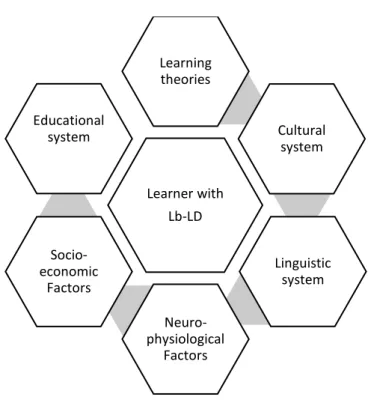
This chapter reviews literature relevant to specific learning disabilities using the preferred term language-based learning disability (L-b LD). Initially, a comparative analysis of clinical and educational perspectives to specific learning disability is made and a global review of relevant definitions is provided. In this review, the importance of conceptual and operational definitions are acknowledged. The position taken in this review is that the use of operational definitions by the departments of health and education in South Africa is not based on conceptual foundations and leads to confusion of the concept of learning disabilities. A systems approach is adopted in discussing variables that affect a bilingual isiZulu-English learner with L-b LD. Using this approach, microsystems such as neuro-psycho-social indicators, educational system, language, isiZulu culture and speech-language or communication pathology are discussed. Recent research on the early indicators of L-b LD is discussed and applied to formulate profiles of expectations for learners with L-b LD. Considerations for factors unique to isiZulu language and culture follows thereby laying the foundation for appropriate language assessment in this study.
2.2 Global views of Language-based Learning Disability
The challenge to intervention for learners with specific learning difficulties in inclusive schools begins with the inconsistent usage and definition of the generic term learning disability (LD). Often the terms specific LD, language LD, dyslexia and learning disabilities are used interchangeably by professionals and parents. The definitions and the concepts describing specific LD have also evolved over the years bearing philosophies from different schools of thought regarding theories of learning and intervention approaches. Learning disability refers to different conditions in different countries for example, the United States of America (USA) versus the United Kingdom (UK) and the Republic of South Africa (RSA) as well as for different professionals for example, psychologists versus speech-language therapists (SLTs).
14
The authoritative definition of learning disabilities adopted by the federal regulations prepared by the US Office of Education considers learning disability to mean “a disorder in one or more of the basic psychological processes involved in understanding or in using language, spoken, or written, which may manifest itself in an imperfect ability to listen, think, speak, read, write, spell or to do mathematical calculations” (United States Office of
Education, 1977). Although the understanding of the condition has changed over the past forty years, this definition has become the basis on which schools identify specific learning disabilities in the USA. It has become an operationally accepted definition and guides practice at school level to be in line with educational policies such as the Individual with Disabilities Education Act (IDEA) and No Child Left Behind programme (Harowitz, Rawe, & Wittaker, 2017). The term specific learning disabilities includes conditions such as perceptual handicaps, brain injury, minimal brain dysfunction, dyslexia and developmental aphasia. It does not include learning problems which are primarily a result of visual, hearing, motor, cognitive, emotional, environmental or economic disadvantage (Harowitz, Rawe, & Wittaker, 2017). Guatemala, Spain and Taiwan are among the countries that have adopted the same definition of LD and have also adopted the subsequent legislative mandates of the United States (Sideridis, 2007). The prevalence of L-b LD and attention in the USA is estimated to 1 in 5 children of school aged children and estimated 12.2% of the general student population (Harowitz, Rawe, & Wittaker, 2017).
In England, the term learning disability was introduced to replace the term mental handicap and reflects the presence of impaired intelligence and impaired social functioning. According to the British 2001 White Paper on Health and Social Care of People with Learning Disabilities, the term learning disability includes “the presence of a significantly reduced ability to understand new or complex information, to learn new skills, with a reduced ability to cope independently which started before adulthood with a lasting effect on development”
(Emerson & Heslop, 2010). The UK Department of Health makes reference to learners with primary or secondary special educational needs associated with mild, moderate, severe and profound learning disabilities (Emerson & Hatton, 2008). In the context of health services in the UK, learning disabilities refer to intellectual disability of varying degrees. However, in the education sector, learning difficulty is associated with people with specific learning difficulties who do not have a general impairment in intelligence (Emerson & Heslop, 2010) Thus, in the UK, children with reading and spelling difficulties such as dyslexia are not regarded as having a learning disability but a specific learning disability. It is important to
15
note that these terms are often used interchangeably in the education sector even though they mean different conditions. The prevalence of specific mathematical difficulties was estimated at 2.3% and reading disorders at 3.9% in the United Kingdom (UK). The total estimation of school age children with severe learning disabilities was 7.8% in the UK (Alborz, McNally, & Genniding, 2010, p. 351).
Tracing the definitions of LD in Australia reveals that the inconsistent use of terminology has also been a challenge resulting in the use of varying terms and meanings for the terms such as learning disability, learning difficulty and specific learning disabilities. The term learning disability is associated with impairment of intellectual functions with limitations in a range of daily activities and with restrictions in participation in various life areas (Australian Institute of Health and Welfare, 2004). Nevertheless, adoptions of different terms in different parts of the country continues to prevail. The Government of South Australia describes LD as experiencing difficulties with learning for learners with average and above average intelligence while the Western Australian Government referred to ongoing persistent learning difficulties including dyslexia, dyscalculia and ADHD (Lund, 2013). The Western Australian Government also utilises the term specific learning disability to refer to learners with a barrier to effective learning, sharing the same understanding as the USA. It uses specific learning disability to refer to learners who struggle to meet the academic expectations and include all learners and adults who have limitations in learning arising from constitutional impairments (Lund, 2013).
The Australian Taskforce on students with Learning Disabilities clarified that learners with specific learning disability do not have reduced cognitive capacity. Furthermore, the learning barrier is viewed as a component of the learner’s developmental delay or impairment, as such, intelligence quotients (IQ) testing are used to differentiate learners who have a specific learning disability (SLD) from those who do not. Thus, learners with SLD are expected to have at least an average IQ, show potential or excel in another academic area including sports and artistic achievement. Learners with SLD are then recommended for remediation or accommodated as they would have difficulty accessing the curriculum. The Taskforce on Students with Learning Disabilities concluded that learning difficulties are multi-faceted and multi-dimensional.
16
In the People’s Republic of China the term special learning disability is used and it includes dyslexia, a disorder of reading and spelling. The terms dyslexia and special LD are used interchangeably in China. The incidence of special learning disability is thought to be around 10% of the population of China (Chan, 2008:196; Yao & Wu, 2003:392). From a Chinese perspective, mild forms of dyslexia are often perceived as a maturational lag, lack of discipline and lack of motivation (Chan, 2008). Recent breakthroughs in addressing the issue of special learning disability in China has come as a result of improved understanding of the Chinese languages and the recognition that learning disability and dyslexia can occur in an orthographically different system such as Cantonese or Mandarin, which was previously disputed. What transpires from the research in China is that the orthography or the nature of written symbols of a language does not absolve it from learning disabilities (Chan, 2008). Learning disabilities are now perceived to have a common basis with the alphabet language system such as English (Chan, 2008). Recent policy changes in China have allowed for recognition of special learning disability as a disability which promotes educational inclusion for learners with the condition. The global view of the definition of specific LD reflects that many countries have adopted the NJCLD definition as a core guideline (Sideridis, 2007). However, countries like Botswana, South Korea and Israel have also come up with their own models of assessing and intervening for learners with specific LD. The different economic, cultural and linguistic characteristics within each country inhibit the creation of a standard criteria for detection of specific LD.
2.2.1 Learning Disabilities in South Africa
The South African Department of Education (DoE), in the policy document White Paper 6 on Special Needs Education, used the term “learners with special needs” to refer to learners in special schools and the term “learner who experiences barriers to learning” to refer to
learners with specific learning difficulties and developmental disabilities (Department of Education, 2001:18). The White Paper 6 definitions reflects a transition from the medical model to a socio-ecological model of health services in South Africa which occurred at a time of political transition in South Africa (Nel & Grosser, 2016).
Defining learning disabilities in South Africa is multidimensional as it incorporates intrinsic and extrinsic barriers to learning. The intrinsic barriers to learning and development further incorporates a wide range of disabilities including physical, visual, hearing and psychological barriers (Department of Education, 2005). Academic difficulties experienced due to various
17
extrinsic factors such as physical, environmental and contextual disadvantages are also referred to as barriers to learning (Department of Education, 2001:18). The terminology of barriers to learning reflects sensitivity towards people with disabilities, promotes inclusivity and an acknowledgement that specific LD is an academic disorder. On the contrary, such terminology is extremely broad and confusing as the term does not distinguish between specific LD and other disabilities associated with social, cognitive or contextual factors related to education and policies (Scanlon, 2013, p. 27).
In South Africa intrinsic and extrinsic factors interplay in the manifestation of specific learning disabilities (Nel & Grosser, 2016 p. 84). There is a strong evidence that cognitive and intellectual abilities also form part of the group of medical barriers that can affect learning, reasoning, problem solving and memory negatively (Jooste & Jooste, 2011). There is an equally strong sense that socio-economic factors such as poverty, illiterate parents, nutritional issues, crime amongst others have harmful effects on the physical and socio-emotional wellbeing of the child (Geldenhuys & Wever, 2013). Since the support structures are not functioning well yet in many schools, there is also discrepancy in assessment and rehabilitation of learners with L-b LD (Nel & Grosser, 2016, p. 87). The 2008 policy, the Screening Identification Assessment and Support, support programmes for students with L-b LD was designed in such a way that the learner gains full access to all learning activities and there must be collaboration between all role players. However, there is poor integration of services between schools and therapeutic services as teachers (and allied health workers) struggle to translate policies into practice (Engelbrecht, Nel, Nel & Tlale, 2015, p. 1).
Therefore, defining and conceptualising L-b LD in South Africa is complex. The definitions used in official government documents in the department of education differ from the conceptual definitions used by Speech–language Pathologists. Due to the flexibility in the use of terms and definitions amongst health and education professionals, there is uncertainty about the nature of L-b LD in South Africa. However, it is generally believed that learning difficulties arise from extrinsic factors while learning disabilities are a result of intrinsic factors and may persist despite ideal learning conditions and support (Dunbar-Krige & Merwe, 2010).
18
2.2.2 Conceptual Definitions
The challenge with defining specific LD is leaning on operational criteria rather than a conceptual definition (Scanlon, 2013, p. 27). The guidelines for a good definition state that it should represent an understanding of the entity it defines; it should lend a direction to future considerations of that entity, it should inform members in the field for examples about who to include in the research study; it should also serve as a model to determine the scopes of laws and policies (Scanlon, 2013, p. 28). Although the term “barriers to learning” does not meet the criteria of a good definition and may be viewed as inaccurate as a good definition should be, one can observe that the definitions utilised by the DoE are not diagnostic terms but merely operational and should only be used as guidelines for identification of learners who require further diagnostic assessment and intervention. To avoid confusion about what specific learning disabilities are, this study prefers the use of conceptual definitions which are regarded more neutral, direct and concise.
The American Psychiatry Association (APA)’s latest diagnostic criteria, the Diagnostic and Statistical Manual of Mental disorders, 5th Edition (DSM-V), states that specific LD is
“history or current presentation of persistent difficulties in the acquisition of reading, writing, arithmetic or mathematical reasoning skills during the formal years of school”
(Montague & Cavendish, 2012 p. 3). The clear identification of the academic manifestations is praised as it indicates that specific LD identification is based on academic skills despite the nature of a presumed underlying and unspecified central nervous system disorder. Moreover, the key academic manifestations of specific LD are associated with a conceptualisation of a LD that has to do with a language processing disorder (Scanlon, 2013).
While it is imperative to use conceptual definitions to explain specific LD, using a neutral, direct and concise definition does not necessarily simplify issues nor eliminate variety. (Flack, 2009) noted that there is risk of tunnelling one’s vision in accepting a purely medical interpretation of LD and suggested that the focus should not be on deficits noted in a child with specific LD. Practitioners should consider the learner holistically taking into consideration that learner’s needs, own experiences and the influence of his or her context (Flack, 2009). The current conceptual definitions imply that extrinsic or environmental factors impact but do not cause specific LD and relate to social, economic and cultural aspects as not relevant as constitutional influences in explaining brain or language
19
development (Fletcher, et al., 2005). On the contrary, South African research has demonstrated the significant role of linguistic factors such as bilingualism, socio-economic factors including poverty and child-headed homes, disparity in the quality of education services and psychological factors in the development of language competency and learning (Morrow, Jordaan & Fridjhon, 2005; Kallenbasch, 2007; Bangirana, John, Opoka, Byarugaba, Kurek & Boivin, 2009; Navsaria, Pascoe & Kathard, 2011).
This study elects to use the term Language-based learning disability (L-b LD) instead of specific LD for improved accuracy and clarity. Specific learning disability or language-based learning disability is defined as a brain based difficulties in reading, writing, math, organisation, focus, listening comprehension, social skills, motor skills or a combination of these (National Center for Learning Disabilities, 2013). Language-based learning disability (L-b LD) may manifest itself in imperfect ability to listen, think, speak, read, write, and spell or to do mathematical calculations and includes conditions such as perceptual disabilities, brain injury, minimal brain dysfunctions, dyslexia, and developmental aphasia (American Speech-Language Hearing Association, 2015). Furthermore, L-b LD does not include a learning problem that is primarily the result of visual, hearing or motor disabilities, intellectual disability, and emotional disturbance or of environmental, cultural or economic disadvantage (National Center for Learning Disabilities, 2013). The term also excludes learning difficulties due to use of more than one language in the home or school. Therefore, the term Language-based serves to put an emphasis on specific verbal as opposed to non-verbal factors that influence learning disability (Fuchs, Deshler, & Reschly, 2004).
Furthermore, the term language-based learning disability (L-b LD) is preferred because of the relationship between spoken and written language. Many children with reading problems have spoken language problems (Roseberry-McKibbin, 2008). Language-based learning disabilities manifests in multiple domains of academic functioning but primarily in the domain of literacy such as vocabulary acquisition, reading and writing (American Speech-Language Hearing Association, 2015). Documenting the learner’s sub-type of L-b LD, for example, reading or math, precludes the secondary sub-types and limits the condition. This may result in undercounting the incidence of non-specific learning disabilities (Scanlon, 2013). Consequently, for the purposes of this study, L-b LD refers to specific and non-specific LD. It includes dyslexia, dyscalculia and dysgraphia, considering that language proficiency is the underlying cause of the individual’s difficulty and not specific to a skill
20
(National Center for Learning Disabilities, 2013). For instance, an impairment in working memory, an underlying process, could result in a reading as a well as a math difficulty. Hence, the focus of speech–language pathology is treatment of the underlying language processing disorder not just the outcomes (American Speech-Language Hearing Association, 2015).
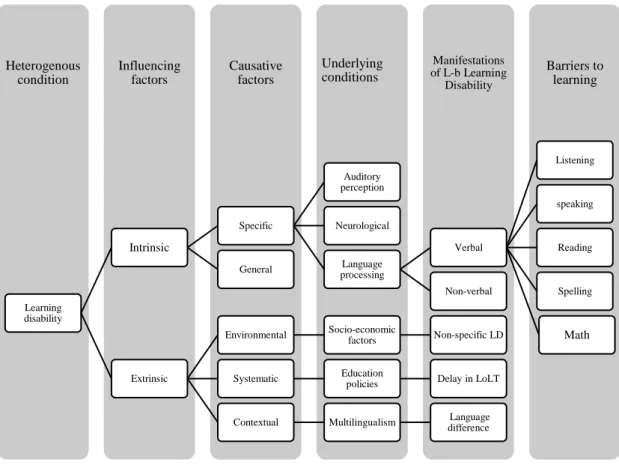
The following Figure 2.1 illustrates the meaning of the term L-b LD as understood in this research project. This research study acknowledges the existence of various barriers to learning observed in the classroom. This study elects to focus on causative underlying conditions that manifests as L-b LD which sh