Illinois State University
ISU ReD: Research and eData
Theses and Dissertations6-7-2018
Learning About And Becoming Aware Of Reading
Strategies And Metacognition In English By Adult
Second Language Learners
Aline Biazotto André
Illinois State University, [email protected]
Follow this and additional works at:https://ir.library.illinoisstate.edu/etd Part of theEducation Commons
This Thesis and Dissertation is brought to you for free and open access by ISU ReD: Research and eData. It has been accepted for inclusion in Theses and Dissertations by an authorized administrator of ISU ReD: Research and eData. For more information, please [email protected]. Recommended Citation
Biazotto André, Aline, "Learning About And Becoming Aware Of Reading Strategies And Metacognition In English By Adult Second Language Learners" (2018).Theses and Dissertations. 999.
LEARNING ABOUT AND BECOMING AWARE OF READING STRATEGIES AND METACOGNITION IN ENGLISH BY ADULT SECOND LANGUAGE LEARNERS
ALINE BIAZOTTO ANDRÉ
275 Pages
The purpose of the present study was to investigate the need to learn and/or become aware of reading strategies and metacognitive strategies by adult English language learners while making sense of English texts. A mixed method grounded theory (MMGT) in a sequential design (quantitative ® Qualitative) with a qualitative dominant status was employed to collect and analyze data. In the quantitative phase of this study, data were collected by administrating a background questionnaire and the Survey of Reading Strategies (SORS). Data collected by these tools were statistically analyzed with descriptive analysis and one-way Analysis of Variance. In the qualitative phase of this study, data were collected through retrospective miscue analysis (RMA) and semi-structured interviews. Data collected by these methods were coded in order to verify reading patterns among participants.
Quantitative results demonstrated that second language learners from different language backgrounds and English proficiency levels perceived the use of reading strategies differently. Qualitative results demonstrated that Saudi-Arabian second language learners tend to transfer their reading strategy in relying on small grain size units while reading in English. These results bring a new perspective to the second language reading field by demonstrating that second language learners from different language backgrounds apply
reading strategies differently based on their initial reading development in their first languages.
KEYWORDS: second language reading, psycholinguistic grain size theory, miscue analysis, retrospective miscue analysis
LEARNING ABOUT AND BECOMING AWARE OF READING STRATEGIES AND METACOGNITION IN ENGLISH BY ADULT SECOND LANGUAGE LEARNERS
ALINE BIAZOTTO ANDRÉ
A Dissertation Submitted in Partial Fulfillment of the Requirements
for the Degree of DOCTOR OF EDUCATION School of Teaching and Learning ILLINOIS STATE UNIVERSITY
LEARNING ABOUT AND BECOMING AWARE OF READING STRATEGIES AND METACOGNITION IN ENGLISH BY ADULT SECOND LANGUAGE LEARNERS
ALINE BIAZOTTO ANDRÉ
COMMITTEE MEMBERS: Lara J. Handsfield, Chair Erin Mikulec
Lydia Kyei-Blankson Alice Y. Lee
ACKNOWLEDGMENTS
A page would not be enough to thank all the people who have contributed to my development as a scholar and as a human being. I have started this journey a long, long time ago, and I carry all those who have been involved in my development in my heart with all my love. To my dearest friends from the teaching course (Normal school) who were the first to support me in this long journey of becoming a teacher, to my undergraduate friends,
especially Paula Peixoto and Priscila Rodrigues who have always been present to hear my frustrations and ideas regarding education. To Dale Graca who was my first English teacher in Canada. To my professors and friends from Columbus State University who encouraged me to keep studying and improving my knowledge.
I extend my thanks to my adviser, Lara Handsfield who has been with me throughout this painful process. She has always encouraged me and pushed me to think deeply and outside the box. She taught me more than being a scholar and a professor. She taught me to be brave while facing all the problems that life may bring, and always smile even in the most difficult situations.
I am also grateful to my committee members, who provided me with very thoughtful feedback to help me delve into my research. Without them, I would not be able to have the understanding of research procedures and reading in a second language that I have acquired throughout my doctoral program.
Last but not least, to my parents José Carlos Biazotto and Ana Luisa Brito Biazotto and brothers André Brito Biazotto and Alexandre Brito Biazotto who have always loved and protected me. I would also like to thank my extend husband’s family who has always been there for me regardless of what I needed.
I dedicate this dissertation to my best friend and loving husband, Mauro for his constant and persistent support and his belief in me even when I did not believe in myself.
And to my son Davi, who makes me smile with my whole soul with his sweetness and his curiosity in unveiling his surroundings.
CONTENTS Page ACKNOWLEDGMENTS i CONTENTS iii TABLES viii FIGURES x CHAPTER I: INTRODUCTION 1
Statement of the Problem 3
Research Questions 4
Conceptual and Theoretical Underpinnings 5
Reading Strategies 6
Reading Skill 7
Metacognitive Awareness 7
Metalinguistic Awareness 7
Theoretical Framework 7
Psycholinguistic Grain Size Theory 9
Psycholinguistic Theory of Reading 10
Sociocultural-Historical Theory 12
Retrospective Miscue Analysis 14
Summary 15
Outline of Subsequent Chapters 15
CHAPTER II: REVIEW OF LITERATURE 17
Reading Wars Debates 18
Psycholinguistic Grain Size Theory 19
Research with Arabic Speakers in English Reading 27 Miscue Analysis and Retrospective Miscue Analysis on L2 Reading 29
The Arabic Language 31
Summary 35
CHAPTER III: METHODOLOGY 37
Overview 37
Research Paradigm 38
Mixed Method Grounded Theory 41
Methods 44
Research Settings 44
Participants for Phase 1 46
Participants for Phase 2 48
Data Collection 53
Background Questionnaire and Survey of Reading
Strategies (SORS) 53
Retrospective Miscue Analysis 55
Semi-Structured Interviews 58
Data Analysis 61
Background Questionnaire and SORS for Phase 1 61
SORS for Phase 2 62
Miscue Analysis 63
Retrospective Miscue Analysis 67
Interviews 70
Data Analysis Integration 70
Subjectivity and Reflexivity 72
Ethical Considerations 73
Limitations 73
Summary 74
CHAPTER IV: QUANTITATIVE RESULTS AND ANALYSIS 76
Overview 76
Demographic Background of Participants 77
Research Question 1: What Are the Types of Reading Strategies That Adult English Learners from Spanish, Asian languages, Arabic, and Kazakh First Languages (L1) Perceive as the Most Frequently Used Reading Strategies While Reading English Text? And to What Extent Does the Frequency of Reading Strategies
Perceived Differ Significantly by Language Background? 83 Research Question 2: What Are the Reading Strategies That Adult
English Learners at Different English Proficiency Levels
(Beginning, Intermediate, and Advanced) Recognize as the Most Frequently Used While Reading English Text? And to What Extent Does the Frequency of Reading Strategies Perceived Differ
Significantly by Proficiency Levels? 91
Focus Group SORS 98
Summary 100
CHAPTER V: QUALITATIVE RESULTS AND ANALYSIS 103
Overview 103
Participants' Views as Readers and Participants' Views of the
Miscue Results 105 Substitution 115 Partial Omission 123 Omissions 124 Partial Insertions 125 Insertions 126 Substitution/Pronunciation 127 Mispronunciations 128 L1 Phonological Knowledge 131 L1 Phonotactic Knowledge 131 Overgeneralization 132
Syntactic and Semantic Acceptability 133
Self-Corrections 136 Azim 136 Casper 138 Haddad 139 Fadil 141 Emir 142 Repetitions 144
Retrospective Miscue Analysis and Interviews' Findings 145 Research Question 3: What Reading Strategies Do Adult English
Learners Have to Learn and/or Become Aware of in Order to Make Sense of English Texts? Of Those, Which Ones Are Most
Frequently Used? 153
Cross-Linguistic Knowledge 171 Difficult to Explain Miscue and Improving Reading 175 Research Question 4: How Do Adult English Learners Understand
Their Own Reading Strategies and Metacognitive Awareness? 183
Role as a Reader 183
L2 Reading Challenges 196
Summary 203
CHAPTER VI: CONCLUSION 207
Summary of Findings 208 Research Question 1 208 Research Question 2 210 Research Question 3 214 Research Question 4 217 Limitations 219
Implications for Practice 222
Implications for Research 223
Final Thoughts 225
REFERENCES 227
APPENDIX A: BACKGROUND QUESTIONNAIRE 256
APPENDIX B: SURVEY OF READING STRATEGIES 258
APPENDIX C: SEMI-STRUCTURED INTERVIEW 260
APPENDIX D: TEXT 1 261
APPENDIX E: TEXT 2 265
APPENDIX F: MISCUE 268
TABLES
Table Page
1. 2.1 Vowelled and Unvowelled Arabic 32
2. 3.1 Key Dimensions of Mixed Method Designs 44 3. 3.2 Focal Group Participants' Demographics 48
4. 3.3 Participants' Interviews and RMAs 60
5. 4.1 Descriptive Analysis Based on First Language 84 6. 4.2 Comparison of Reading Strategies by L1 Background 91 7. 4.3 Comparing Different Language Backgrounds (using Post Hoc Test) 91 8. 4.4 Descriptive Statistics Based on L2 Proficiency 93 9. 4.5 Comparison of Reading Strategies by Proficiency Level 98 10. 4.6 Descriptive Statistics – Focal Group 99
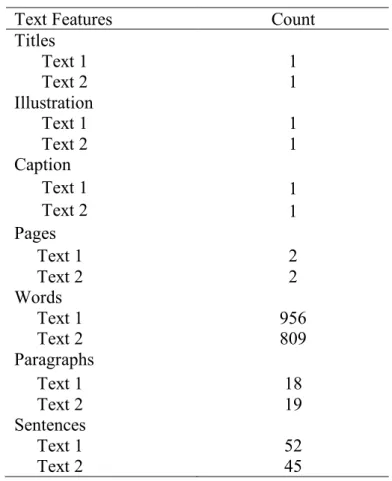
11. 5.1 Text Features 107
12. 5.2 Descriptive MA by Participants 108
13. 5.3 Miscues by Text 114
14. 5.4 Percentage of Miscues by Participants 135
15. 5.5 Azim's Self-Correction for Text 1 137
16. 5.6 Azim's Self-Correction for Text 2 138
17. 5.7 Casper's Self-Correction for Text 1 138 18. 5.8 Casper's Self-Correction for Text 2 139 19. 5.9 Haddad's Self-Correction for Text 1 140 20. 5.10 Haddad's Self-Correction for Text 2 140 21. 5.11 Fadil's Self-Correction for Text 1 141 22. 5.12 Fadil's Self-Correction for Text 2 142
24. 5.14 Emir's Self-Correction for Text 2 143
25. 5.15 Miscues/Text 145
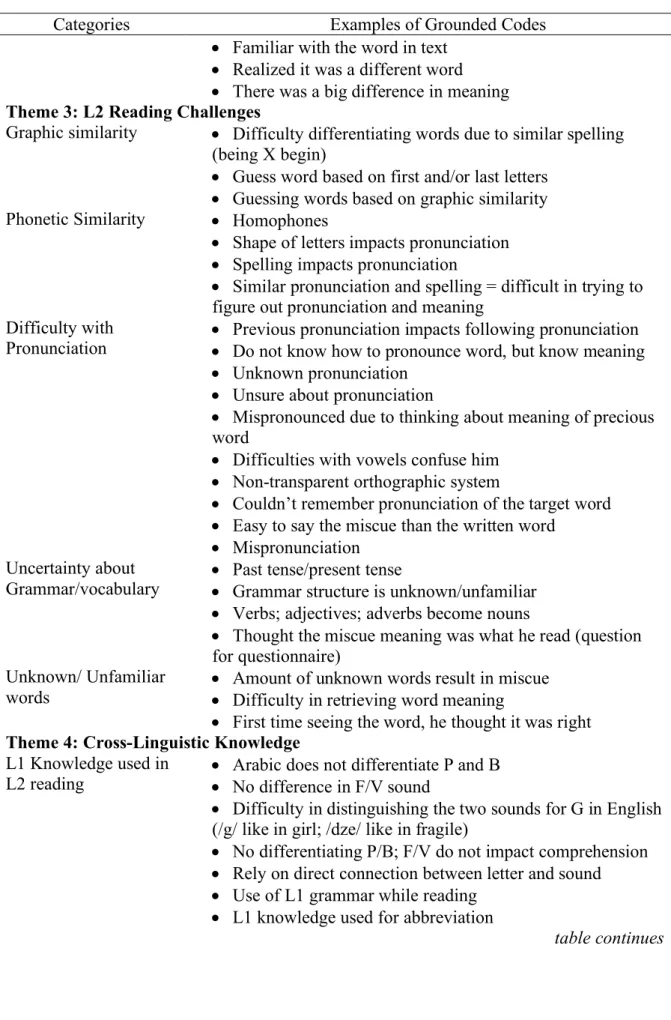
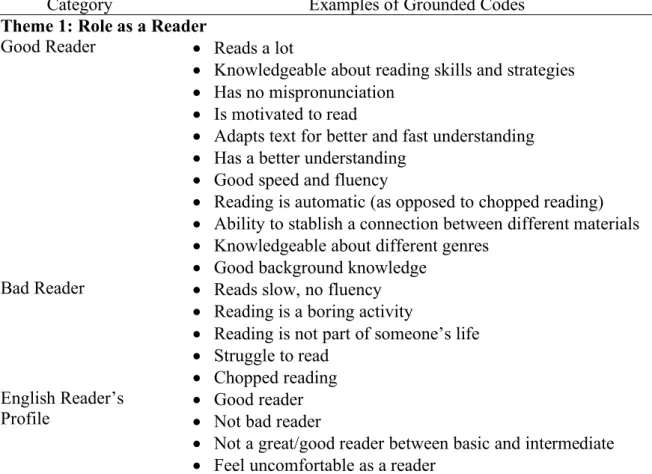
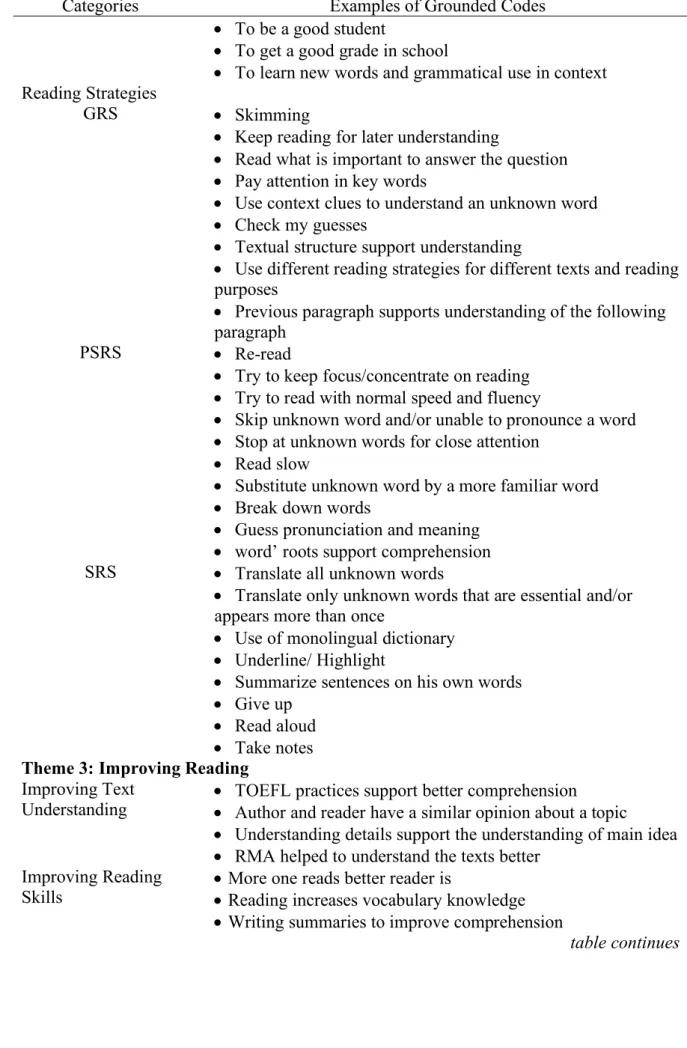
26. 5.16 RMA-Themes, Categories, and Grounded Codes 145 27. 5.17 Interview - Themes, Categories, and Grounded Codes 148
FIGURES
Figure Page
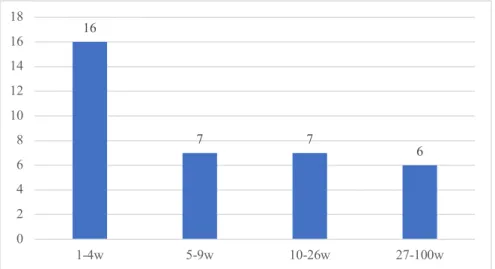
1. 4.1 Time in US in Weeks 78
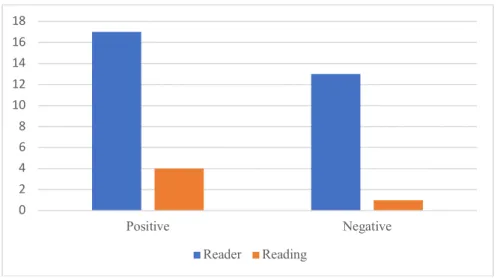
2. 4.2 Reader’s Perspective 79
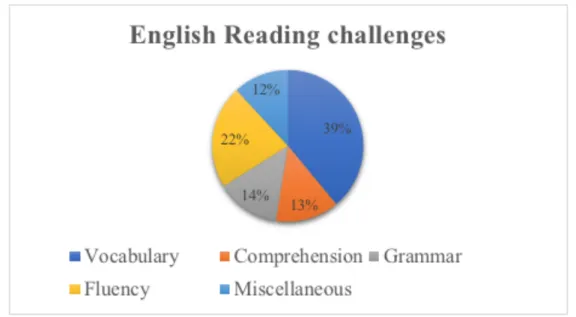
3. 4.3 English Reading Challenges 80
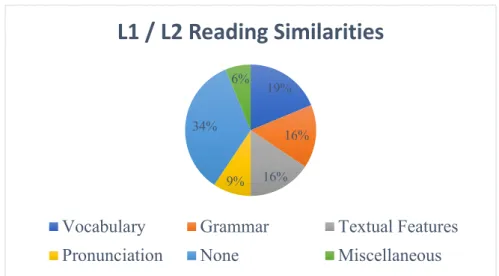
4. 4.4 L1/L2 Reading Similarities 81
5. 4.5 L1/L2 Reading Differences 81
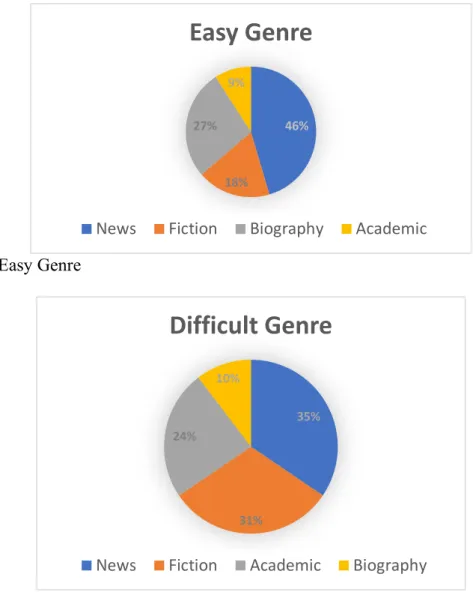
6. 4.6 Easy Genre 82
CHAPTER I: INTRODUCTION
As a child, I was always interested in language acquisition even though I was not aware of it. During my childhood, I was surrounded by different languages and cultures due to my multicultural background. In addition, Brazil has received many immigrants
throughout human history due to wars around the world. Thus, having contact with so many cultures and languages is part of Brazilians’ everyday life, either through hearing languages other than Portuguese or through experiencing culturally-related misunderstandings.
My personal interest in languages and cultures increased as I started studying other languages at the university level. This opportunity opened my eyes to how languages and cultures increase our understanding of the world as well as expanding our knowledge as human beings. This initial awareness of the power of language made me anxious. Like Faust1, I was thirsty for acquiring knowledge about different languages and cultures. This thirst motivated me to travel to other countries.
My travelling brought me to the United States. While my initial knowledge of the English language was sufficient to communicate on an everyday basis, it was still insufficient when I decided in 2010 to pursue an academic career. It was only when I started taking classes at doctoral level in 2013 that reading struck me as a very difficult task. This difficulty with reading pushes me to reflect on my reading process in languages other than Portuguese and English. By revaluating my own reading process in German, Spanish, and Italian, I realized that my textual understanding depended not only on the reading strategies that I was frequently using while reading Portuguese, but also on the acquisition of new reading
strategies. For instance, I had to learn that knowing the endings of each case in German would help me to understand the grammatical function of each word so that I could crack the
code and start making sense of German texts. In Spanish and Italian, I would have to be careful with grammatical structures, which send me warnings about sentences that “infringe” on my Portuguese grammatical knowledge. These red flags make me use reading strategies such as rereading sentences and/or adjusting my reading speed to assure comprehension. These strategies are not very common while reading in Portuguese.
Personal difficulties with English reading encouraged me to look closely to English reading as a second language. Many theories have been developed to explain the reading process, including psycholinguistic theory (K. Goodman, 2014), informational processing (Gough, 1972), the construction integration model (Kintsch, 1998), interactive model (Rumelhart, 1994), and social constructivist theory (Berger & Lukermann, 1966), among others.
I understand comprehension as a complex activity, which is influenced by several factors, including linguistic knowledge (word identification, grammar, pragmatics) (Bernhardt, 2011; Ellis, 2008; Goodman, 2014; Koda, 2005, 2007) psychological factors (attitude, motivation, and memory) (Dörnyei & Ryan, 2015; Gardner, 2010; Masgoret & Gardner, 2003; Noels, Pelletier, Clément, & Vallerand, 2003) and sociocultural knowledge (Vygotsky, 1978). Furthermore, comprehension is achieved through a transactional process in which the reader interacts with the text to construct meaning from the text (Rosemblatt, 1994). In this process of comprehending the text, a reader’s cognitive and social knowledge are equally important, and they occur simultaneously (Bernhardt, 2011).
Second language (L2) reading has initially been explored from a first language (L1) perspective. That is, L1 reading research studies have been initially used as a base to further knowledge about second L2 reading. By contrast, this study builds on cross-linguistic studies, which advocate the idea that each language imposes the need to learn specific reading
strategies in order for readers to achieve their ultimate goal, which is deep textual comprehension.
Statement of the Problem
Several researchers (Cummins, 2007; Goldenberg, 2011; Gunning, 2013; Jiménez, 1997; Koda, 2005, 2007; Nation, 2001; Zhang, 2010) have investigated the potential of reading strategies and metacognitive awareness to enhance reading comprehension among L1 and L2 learners. These studies have demonstrated that both reading strategies and
metacognitive awareness are essential for comprehension, while supporting language development. Regarding the use of reading strategies and metacognitive awareness, most of these studies, have assumed that: (i) L2 learners come to the L2 reading situation with a toolkit of reading strategies to draw on while reading, and (ii) L2 learners are aware of the use of such strategies to achieve reading comprehension.
As a language learner who has learned to read in different languages, I sought to find out if English language learners have to learn and/or become aware of reading strategies. This would support better comprehension of English texts given that all languages have their cultural and linguistic particularities, which may influence the development of reading strategies that are necessary to comprehend texts in English.
Cross-language research has also shown that there are variances in the consistency of how phonology is represented in orthography. For instance, Spanish and Italian have a transparent connection between the spoken language and the writing system (Ziegler & Goswami, 2005, 2006). As a result, learners may be able to rely more on the phonemes while reading in those languages (Goldenberg, Tolar, Reese, Francis, Ray Bazán, & Mejía-Arauz, 2014). Those languages are more transparent, and readers can rely on small grain size units. However, there are languages such as English and French in which the
and whole word recognition than on phonemes. These grainsize variances result in the development of different reading strategies by learners (Ziegler & Goswami, 2005, 2006).
There are several research studies examining the importance of reading strategies and metacognitive awareness in supporting L2 reading comprehension. However, these studies have not investigated whether or not adult English learners need to learn new reading strategies and/or become aware of additional reading strategies that are essential in
understanding English texts, but that are non-essential for reading in their L1. The purpose of this study is to investigate the strategies adult English learners have or need to learn in order to comprehend English texts and their level of awareness of these strategies. It is the
assumption of this study that adult L2 learners acquire a significant number of reading strategies in their educational process within their L1. As a result, they become independent readers who can successfully apply reading strategies to comprehend a text. Within this assumption, adult L2 learners already bring some reading strategies to the table while reading any text. However, it is not certain that these strategies are adequate to render English text meaningful.
Research Questions
In order to explore the complexities of second language reading comprehension among adults reading English as an additional language, I asked the following questions:
1. What are the types of reading strategies that adult English learners from Spanish, Asian languages, Arabic, and Kazakh first languages (L1) perceive as the most frequently used reading strategies while reading English text? And to what extent does the frequency of reading strategies perceived differ significantly by language background?
2. What are the reading strategies that adult English learners at different English proficiency levels (beginning, intermediate, and advanced) recognize as the most
frequently used while reading English text? And to what extent does the frequency of reading strategies perceived differ significantly by proficiency levels?
3. What reading strategies do adult English learners have to learn and/or become aware of in order to make sense of English texts? Of those, which ones are most frequently used?
4. How do adult English learners understand their own use of reading strategies and metacognitive awareness?
Gaining knowledge about factors such as reading strategies and metacognitive
awareness that might support or impede L2 comprehension is important for adult L2 learners who venture out in pursuing a higher degree in a language other than her/his own native language. It also influences L2 teachers who may or may not spend pedagogical time teaching strategies that are already well-known and used by adult L2 learners. College professors may also benefit from this research given the increased population of L2 learners at college level (Bernhardt, 2011; Koda, 2007). Knowing how to assist L2 learners might assist college professors to more successfully address their L2 learners’ strengths and needs in order to achieve a deep comprehension of academic texts. This study is also important for the field of L2 research because it may shed light on our understandings of L2 reading. As a result, more appropriate and nuanced L2 reading models may be proposed.
Conceptual and Theoretical Underpinnings
In order to avoid misconceptions, it is important to first define the understanding of our main topic. In this study, the concept of reading is understood as the ability to gain access “to meaning from printed symbols” (Ziegler et al., 2006, p. 429) and as a sociocultural activity that is influenced by time and context (Alexander & Fox, 2013; Bloome, 1985) and which “takes place in complex human relationships” (Bloome & King-Dail, 1997, p.610) that
are influenced by different ideologies (Freire, 2005). In this process, the reader adopts an active and sociopolitical role in constructing meaning from the text.
In this section, I clarify the terms reading strategy, reading skills, metalinguistic awareness and metacognitive awareness, as well as placing them in the context of second language acquisition research. This clarification is necessary due to the lack of consistency in the use of such terms in the field of literacy research (Afflerbach, Pearson & Paris, 2008a, 2008b), and in order to elucidate how such terms are operationalized in this research study. Reading Strategies
Reading strategies refers to the deliberate use of reading strategies to make sense of texts. In other words, expert readers are aware of the use of reading strategies when they apply them and the reason for applying them (Afflerbach et al., 2008a, 2008b). Some
examples of reading strategies include: reading slowly, rereading, breaking down compound words, inferencing, summarizing, identifying cognates, translating, among others (Ellis, 2008; Mokhtari & Perry, 2008; Mokhtari, Sheorey, & Reichard, 2008). Cognitive research has identified these strategies by investigating how knowledge is represented in our minds as well as how such representations enable the use of that knowledge (Rumelhart, 1980), and more specifically by examining how the reader’s mind works in order to understand a text. Nevertheless, it is important to remember that the use of reading strategies may not always be effective if not tailored to readers’ specific reading goals, sociopolitical context, and the linguistic elements of the languages involved. Thus, some readers may not apply useful reading strategies to achieve comprehension (Bernhardt, 2011). Also, not all readers will find the same strategies equally useful for the same text. This may happen due to lack of
knowledge of a more appropriate reading strategy to achieve comprehension and/or lack of prior knowledge of the content being read.
Reading Skills
Reading skills refer to the automatic application of reading strategies (Afflerbach et al., 2008a, 2008b). As a result of this automaticity, readers are not aware of their use. This unawareness may pose challenges to research given that it is difficult for the reader to verbalize when they are using such tacit reading strategies, and for the researcher to observe their use.
Metacognitive Awareness
Metacognitive awareness refers to the awareness of the use of reading strategies and the constant monitoring of comprehension by the reader to enhance their comprehension (Ellis, 2008; Handsfield, 2016; Ruddell & Unrau, 2013). In other words, readers are aware when meaning breaks down and when they need to use strategies in order to render the text meaningful. It also refers to the readers’ knowledge about themselves as readers as well as the reading process. Furthermore, the readers’ understanding that each task should be approached differently in order to achieve comprehension (Sheorey & Mokhtari, 2008). Metalinguistic Awareness
Metalinguistic awareness refers to the ability to manipulate and reflect on language (Homer, 2009; Koda & Zehler, 2008; Nagy & Scott, 2013). While reading, readers use their metalinguistic awareness to comprehend a text. In other words, successful readers know about the structural regularities of the language, social situations, and context. Differences across languages might influence L2 readers’ capabilities to comprehend a text given that readers’ metalinguistic awareness may be different or more or less sophisticated in different languages.
Theoretical Framework
A theoretical framework outlines the researcher’s assumptions regarding the phenomena under investigation and ideas about how those phenomena should be studied.
Merriam (2001) pointed out that “the theoretical framework is derived from the orientation or stance that you bring to your study” (p. 45). It is a roadmap that will guide the researcher through the study, and it is applied in order to understand a phenomenon (Anfara & Mertz, 2006). I characterize my theoretical framework broadly as sociocognitive (Atkinson, Churchill, Nishino & Okada, 2007; Bateson, 1972; Lemke, 1997). I draw on a range of theoretical perspectives that account for information processing, meaning construction, as well as sociocultural influences on reading comprehension. A sociocognitive framework assumes that “L2 development takes place through such articulated mind-body-world activity” (Atkinson, 2002, p. 69). More specifically, I understand language learning as
encompassing a cognitive process that takes place in a social environment. In this intertwined process, L2 learners are actively engaged in making sense of the world. More specific to reading, learners are actively engaged in making sense of the text. The cognitive and the social are not dichotomous, but rather they are integrated to form one circuit (Atkinson et al., 2007; Bateson, 1972; Lemke, 1997). In this framework, knowledge is seen as a continuous process, which changes depending on time, context, and participants who are active learners in constructing and shaping knowledge by using their cognition and the cultural tools available to them (Vygotsky, 1978).
In this section, I outline my theoretical framework for this study. Within a broad sociocognitive framework, more specific theories and theoretical commitments inform my methodology and interpretations. First, I summarize psycholinguistic grain size theory (Ziegler et al., 2006), which explains L1 reading based on the relationship between size and regularity of graphophonemic units of languages. Second, I discuss psycholinguistic theory (Goodman, 2014) and examine retrospective miscue analysis as both an assessment and research tool to further our understandings of L2 readers’ metacognition and strategy use. Finally, I argue that it is important to elicit and hear L2 readers’ voices regarding their
reading comprehension processes in order to develop a more comprehensive framework for strategic second language reading.
Psycholinguistic Grain Size Theory
While studying the development of reading acquisition across languages, Ziegler and Goswami (2005) noticed that children from different first languages apply different
phonological recoding processing depending on the phonology-orthography relationships in each language; that is, depending on the psycholinguistic grain size of each language. As a result, learners will apply different reading strategies to cope with the text. For instance, children learning Greek, German, Italian or Spanish rely on grapheme-phoneme strategies because their correspondences are consistent. In German the phoneme /aɪ/ will always be represented with the grapheme [ei] like in Eigelb /aɪɡɛlp/ (yolk) and Einblick /aɪnblik/ (insight). Whereas children learning English which has a less consistent grapheme-phoneme correspondence have to rely on large grain size units such as word families, letter patterns, and onsets and rimes (Ziegler et al., 2006).
Although psycholinguistic grain size theory may not look at all elements of the complex act of reading (e.g., syntax, lexical features), it elucidates how languages vary in the consistency in which phonology is represented orthographically (Ziegler et al., 2006). In other words, this theory offers a first glance at the differences of the
phonological-orthographic connections across languages and how these differences affect reading. This theory takes a further step in explaining the reading process outside of the English-centric view given that most information-processing theories do not attend to cross-linguistic differences and how they impact reading and reading instruction. Stated differently, grain size theory clarifies that the differences in the grain size of language result in “developmental differences in the grain size of lexical representation and accompanying differences in
from different L1s learn different reading strategies influenced by their languages. The development of reading strategies impact readers’ comprehension (Ellis, 2008; Koda, 2005, 2007; Jiménez 1997; Jiménez, Garcia & Person, 1995, 1996).
Understanding the problems that L1 readers may face while acquiring the written system is essential for teachers as they provide empirical foundations upon which to design instruction. While considering the learning process of L2 readers, it becomes clear that the psycholinguistic grain size theory may bring some insights to the field given that L2 learners may have to learn additional reading strategies imposed by the L2 or they may have to, at least, become aware of additional reading strategies to improve/raise their comprehension. While considering this hypothesis, it becomes evident how grain size theory must be taken into consideration while focusing on the teaching of L2 reading as well as L1 reading.
Therefore, it is important to be aware of phonological-orthographic grain sizes in different L1s and whether such differences impact the development of additional reading strategies needed to read in English or the need to become aware of reading strategies in English that may not be of great value in a reader’s L1.
Psycholinguistic Theory of Reading
This theory was proposed by Kenneth S. Goodman in an attempt to shift from the idea that reading was simply a process of accurate word recognition to a view of reading as a process of meaning construction in which the reader actively applies strategies to create meaning from the text (Bernhardt, 2011). Reading is seen as a selective process, “guessing game”, in which the reader uses language cues and prior understandings to construct meaning from printed text. In this guessing game, thought and language are intertwined in order to select efficient cues to “produce guesses which are right the first time” (K. Goodman, 2014, p. 104).
By analyzing miscues made during reading-aloud by students, “Goodman was discovering: that readers put their own meaning into the text while comprehending and that what they understand can alter what they “see” (printed words). The more readers are involved in comprehending, the higher the probability of increased miscues” (Bernhardt, 2011, p. 23). In other words, miscues are not random, but the result of a complex transaction between the reader and the text. In this transaction, readers use information available to them, such as graphophonic, syntactic, semantic, and pragmatic cues (K. Goodman & Y. Goodman, 2014; Y. Goodman, Watson & Burke, 1987).
Miscue analysis offers both teachers and researchers insights into an individual’s reading processes (K. Goodman et al., 1987). It is an assessment designed to analyze how students draw on language cueing systems to make sense of printed material (K. Goodman, 2014). According to Goodman (2014), miscue analysis is a window into the reading process because it offers “insights into the reader’s knowledge of language cueing systems and his or her proficiency in using reading strategies. Miscues also provide evidences that the readers make the text more accessible and meaningful to themselves” (Y. Goodman, 2014, p. 206).
Goodman et al. (1987) assert that miscue analysis has advantages over other
assessment instruments because it provides both a quantitative and a qualitative analysis. This is important because reading assessment tools that are only quantitative interpret all errors as having equal weight (i.e., strategies such as self-corrections and reread are seen as
problematic). However, a qualitative analysis looks at miscues as an opportunity to understand the strategies that the reader brings to the text while attempting to construct meaning from it. In this sense, miscue analysis is process oriented rather than product oriented. As Goodman et al. (1987) explained:
When diagnoses instrument results only in quantitative analysis, all errors have equal weight because exactness is the goal; deviations are considered random and irrational,
and the reader is expected to attack written material in a prescribed manner. Because quantitative analysis examines surface behavior, strategies such as self-correction and regressions, which are in fact necessary for proficient reading, are often treated as problematic instead, qualitative analysis, on the other hand, evaluates why miscues are made and assumes that they derive from the language and thought that the reader brings to the written material in the attempt to construct meaning from reading. Such analysis allows the teacher/researcher to interpret and understand what miscues reveal about the reading process (p. 4).
In other words, the quantitative portion of miscue analysis evaluates miscues using a quantitative scoring system by analyzing the ratio between a reader’s errors and accuracy rate. This analysis enables teachers/researchers to determine at what level a reader is comprehending a text which can be at the frustration level in which accuracy is less than 89%; the instructional level in which accuracy is between 90%-94%; and the independent level in which accuracy is higher than 95% (Gunning, 2013; Rasinski & Nageldinger, 2016). The qualitative portion of miscue analysis adds more information to this initial analysis regarding the reader’s uses of the cueing systems. In this process, different types of miscues may occur, such as substitution, (partial) omission, (partial) insertion; repetition,
mispronunciations, and self-corrections. These miscues indicate the reading strategies that the reader uses to make sense of the text while considering their semantic and syntactic
acceptability.
Sociocultural-Historical Theory
Other important aspects of reading that gained attention at the end of 20th century were the social and cultural aspects of reading. Researchers’ interests in the social aspects of reading converged into social-cultural historical theory (Handsfield, 2016; Rogoff, 1995, 2003). This theory builds on Vygotsky’s work, which assumes that human
development/learning takes place through social interaction and culturally- and historically-situated activity (Vygotsky, 1978). During social interactions novice learners are scaffolded by experts (more experienced peers, teachers) into particular communities. In a reading context, scaffolding through the use of language and other cultural tools (e.g. signs and symbols) mediates the construction of textual meaning. It also mediates peoples’ learning of how to be a reader in culturally and historically situated ways (Rogoff, 1998; Vygotsky, 1978). As Bloome (1985) pointed out, reading is a social process that involves people “establishing social groups, ways of interacting, gaining or maintaining status as social position as well as acquiring culturally appropriate ways of thinking, problem solving, valuing, and feeling” (p. 134, emphasis added). That said, it seems likely that any language impacts and is impacted by social context, so this is a two-way street (Street, 2003). Given that each language has its own ways to mold/shape thinking, reading constitutes “culturally-bound ways of thinking” (Bloome, 1985, p. 138).
This understanding of reading as a set of social and cultural practices is essential in the context of second language acquisition. The unexpected responses to the text (i.e. miscues), in that readers’ reading does not follow the linguistic norms of the language or render the text meaningful suggest the reader’s attempt to engage “in the expected social and cultural practices” (Bloome et al., 1997, p. 612). However, L2 learners’ more limited social and cultural knowledge of the target language and culture may result in “unexpected” reading responses because L2 learners may rely on social and cultural knowledge tied to their L1, which may be less effective in an L2 reading situation (Bloome et al., 1997). In light of this, language plays an important role in enabling cognitive development and intermediating learning (Tracey & Morrow, 2012; van der Veer, 2014) given that language is used to communicate and explore ideas (Smagorinsky, 2013).
Retrospective Miscue Analysis
Retrospective miscue analysis (henceforth RMA) expands miscue analysis by bringing the reader’s voice to the analysis. It follows the initial steps of miscue analysis in which the reader reads a text aloud while the teacher/researcher takes notes of the reader’s miscues. The reading is recorded for further analysis to determine patterns of miscues and the reader’s strategy use. These steps are followed by an interview with the reader in which s/he works together with the teacher/researcher to notice and explain his/her own miscues.
RMA was developed through the work of Chris Worsnop (1996), who was trying to share his work of Reading Miscue Inventory (henceforth RMI) with teachers in the 1970s (Y. Goodman et al., 2014; Worsnop, 1996). While working with teachers in workshops about miscue analysis, Worsnop noticed that teachers had gained insights into the reading process as well as shifting their attitudes towards learners’ miscues from correctors to encouragers. This shifting in teachers’ attitudes resulted in more pedagogical emphasis on meaning construction rather than surface level correctness (Worsnop, 1996).
These positive results with teachers encouraged Worsnop to work with students who could benefit from the analysis of their own miscues. His work with seventh, eighth and ninth graders had a significant impact on students’ attitudes towards reading, students’ positive identity as readers, and their overall reading comprehension (Worsnop, 1996). These initial procedures were the stepping stones for what came to be known later as 'retrospective miscue analysis, in which readers are involved in the analysis of their own reading processes
(Goodman et al., 2014).
RMA is a designed instructional strategy that engages readers in the process of analyzing and evaluating the quality of their own oral reading miscues. In this process, readers increase their awareness of the reading process while listening to the recording of their reading aloud, and being involved in the discussion of the probable reasons for their
own miscues (Goodman et al., 2014; Goodman & Market, 1996; Wurr, Theure & Kim, 2008).
Although RMA, like miscue analysis, embodies a cognitive constructivist approach, the social interaction animates aspects of sociocultural-historical theory, and the notions of self-assessment, self-awareness, agency, and voice. Therefore, the involvement of readers in the understanding of their own miscues takes place in a reading event that scaffolds novice readers in constructing meaning from printed text. This reading event involves readers on a cognitive activity as well as a socialcultural activity particularly when an RMA event requires cross-cultural communication.
Summary
Within this theoretical framework, second language reading is seen as a complex activity that involves cognitive and social factors. Within this view, it is necessary to pay special attention to the process of reading by the reader as well as the context in which reading is taking place. Therefore, in this study, I focus on exploring the different reading strategies and metacognitive strategies that adult English learners apply while making sense of English text by applying the Survey of Reading Strategies (SORS), conducting
retrospective miscue analysis (RMA), and interviewing adult English learners. Outline of Subsequent Chapters
In chapter two, I review the research literature on reading in a second language by focusing on five elements. First, I explain how research on grain size theory has
demonstrated the need to be informed by the range of perspectives offered by several reading theories while teaching to read. Second, I review research in the area of reading
comprehension in L2. Third, I briefly review research on RMA with L2 learners. Fourth, I present some information about how the Arabic language is similar to and differs from
English. Finally, I present the limitations of the existing literature and explain how my proposed study begins to fill these gaps.
In chapter three, I outline the research design and methodological frame I used to conduct the study. First, I summarize my research paradigm, explaining the ontological (what is true) and epistemological (methods of figuring out those truths) stances in which I
approach this study. Second, I explain the tools I used to collect data. I finish chapter three by presenting a discussion of how I analyzed the data.
In chapter four, I present my quantitative results by addressing the first and second research questions. The results are discussed in relation to the literature in the area of second language acquisition regarding the administration of the Survey of Reading Strategies (henceforth SORS).
In chapter five, I present the qualitative results by addressing the third and fourth research questions. This chapter then focuses on the reading strategies that six Saudi-Arabian male L2 learners were using and were aware of using while reading English texts.
Furthermore, it presents those reading strategies that Saudi-Arabian speakers were not aware of using while reading English texts, which may have impeded their comprehension on occasion.
In the final chapter, chapter six, I review and summarize the findings in relation to all of my research questions as well as the significance of this study for teaching and research in L2 reading. I finish the chapter by discussing the limitations as well as the implications of this study for the field of second language teaching and research on second language acquisition.
CHAPTER II: REVIEW OF LITERATURE
According to information processing models, reading is a complex activity that activates several parts of our brain due to its multisensorial character, and due to the need to activate several skills such as decoding and comprehension in order to make sense of the text (Dehaene, 2010; Ellis, 2008; Hruby & Goswami, 2013; Koda, 2007). Besides being a
complex brain activity, the complexity of reading is also influenced by other factors, such as its sociocultural and sociopolitical contexts (Lantolf, 2000), including the purpose of specific reading events, the manner or situation in which a person reads (silent or aloud reading; alone or with others), the level of difficulty of the text or the genre (Alexander & Fox, 2013;
Bloome, 1985).
This complex activity is intensified when reading in a second/foreign language (henceforth L2/FL) because there are more variables to take into consideration, such as the influence of L1 on L2 and vice-versa, the influence of L2 knowledge on L2 reading
(Bernhardt & Kamil, 1995; Bialystok, 2007; Cummins,1991; Ellis, 2015, 2008; Lanauze & Snow, 1989), and psychological factors such as motivation, self-confidence, learning and cognitive styles, creativity, anxiety, among others (Cui, 2008; Dörnyei, 2015; Guo & Roehrig, 2011; Koda, 2005; Nergis, 2013).
Research into L2 reading can also be very complex as it may be driven by many different factors. For instance, at the cognitive level, word recognition, syntax, prosody, metacognition, bilingualism, and multilingualism are all elements that have a direct impact on reading. At the social level, reading is impacted by motivation, positionality, agency, age, social class, among other factors. Hence, studies conducted from sociocultural and cognitive theoretical perspectives have informed our understanding of reading in a second language and moved the field forward. These studies have also presented incongruous findings.
In the following pages I review the research in three major areas: (1) how grain size theory elucidates our theoretical understandings regarding teaching reading; (2) L2 reading comprehension; and (3) RMA with L2 learners. Finally, I end this chapter by identifying gaps in the literature to further inquiry and propose research methodologies that might fill the gaps in the L2 reading literature
Reading Wars Debates
For decades, there have been debates about how reading is best taught. These multiple debates suggest the existence of the “Reading Wars”, in which theorists have fiercely argued between the benefits of using the phonics-based approach versus a whole language approach to reading instruction(Pearson, 2004). In these “battles”, theorists have articulated conflicting conceptualizations of the process of reading and of the role of the reader.
In the phonics approach, teaching reading is understood as a mechanical act in which readers start at the bottom of the reading process by learning the names and shapes of letters, the consonants sounds, followed by simple and then more complex vowel correspondence. A phonics approach makes intensive use of basal books to achieve its goal in teaching phonics. These series are organized to make the process of learning to read easier by breaking the complex task into component skills in order to develop vocabulary and reading skills in a determined sequence. In the phonics approach, readers have a more passive role in acquiring the knowledge of phonics taught by the teacher (Kantrowitz & Hammill, 1990) given that the emphasis is on the text and not on the reader’s prior knowledge and language abilities
(Gunning, 2013).
On the other side of the reading wars, there are those who believed that the best approach to teaching reading involves a whole language approach, whereby the meaning of words should be figured in relation to the context in which they appear (Pearson, 2004). Hence meaning is considered more important than word decoding. In this top-down
approach, the reader is in the center of the reading process because s/he brings meaning to the text by using her/his background knowledge and language abilities. Therefore, the whole language approach advocates the use of authentic materials which can be more appealing to readers (Kantrowitz et al., 1990). In this approach, phonics and phonemic awareness are taught in context. Consequently there is not an overemphasis on these skills through the use of decontextualized drills.
More recently, this battle has been seen as an “artificial dichotomy.” Increasingly, there is a consensus that it is important to have a balance between these two approaches (Kim, 2008). Furthermore, a balanced approach encompasses the importance of phonemic awareness, phonics, fluency, vocabulary, and comprehension (National Reading Panel, 2000).
Psycholinguistic Grain Size Theory
Ziegler’s and Goswami’s (2005) theory supports the idea that a balanced approach for teaching reading is important. Through a cross-language study, Ziegler and Goswami
demonstrated that depending on the grain size of each language, different instructional approaches need to be taken in consideration while teaching reading. Thus, students may use more adequate reading strategies to access the meaning of the text.
The orthographic depth theory has defined the relationship between the graphophonic system in a continuum between deep and shallow written language systems, in which a shallow orthographic system would be classified as having a high consistency and regularity between the letter-sound relationship. A deep orthographic system, on the other hand, would be classified as having a low consistency and regularity between the graphophonic system. English has a deep alphabetic orthographic system with complex syllable onsets (ex. street – CCCV:C; through CCCVV as opposed to Spanish CV); unclear syllables boundaries (ex. the syllabic structure of ea+ting) (Alvarez, Carreiras, & Taft, 2001; Gottardo & Mueller, 2009);
and morphological relationships between root words and derivatives (e.g., nation, national) at the cost of grapheme–phoneme correspondences (Seymour, Aro, and Erskine 2003). As a result, native English speakers pay close attention to onset-rime segments (DeCara & Goswami, 2003). These English language characteristics result in moderate availability and lower consistency in the graphophonic system (Gottardo et al., 2009).
Psycholinguistic grain size theory added to the orthographic depth theory by examining children at the early years of their learning reading process. It emerged from a massive study that looked at reading in different languages such as Greek, Finnish, German, Austrian German, Italian, Spanish, Swedish, Dutch, Icelandic, Norwegian, French,
Portuguese, Danish, and Scottish English (Goswami, 2010). By examining the different processes that children went through while learning to read, researchers have noticed that the differences in the consistence of the graphophonic system of each language poses a problem for reading development (Ziegler et al., 2006). In this daunting research study, scientists from 14 European countries examined how children at foundation years (children between 5-7 years old) would progress in their learning to read in the continuum of shallow-deep orthographic system by applying three sets of lists to measure letter knowledge, word
identification, and decoding of simple nonwords. Findings demonstrated that learning to read in a deep orthographic system produced a wider disparity in the rate of initial development than does learning to read in a shallow orthographic system (Seymour et al., 2003). As a result, children from different orthographic system would have to rely on different grain sizes to learn to read. Languages with a very inconsistent orthographic systems compel children to develop a multiple grain-size mapping in which they may rely on different strategies to learn to read such as phonemes, rhymes, onset-rimes segments, word families, among others. Consequently, greater development flexibility and extra cognitive architectures are needed (Abu-Rabia & Sanitsky, 2010; Goswami, Gombert, & Barrera, 1998).
Several studies have used psycholinguistic grain size theory to explain reading acquisition in other languages than the initial study that generates this theory (Éva & Réka, 2013; Haigh, Savage, Erdos & Genesse, 2011) as well as the phonological advantages of bilingual learners learning a third language (Abu-Rabia et al., 2010). However, there is a gap in the literature applying this theory to research on second language reading among adult learners. If children develop different reading strategies depending on the grain size of their first language, could this mean that adult learners would have to develop and/or become aware of different reading strategies to read in English?
Research on L2 Reading
Past research in the field of reading in a second language has focused its attention on factors that affect comprehension, such as phonemic awareness, vocabulary awareness, syntax awareness, metacognitive awareness, role of L1 in L2, and psychological factors such as motivation, self-determination and anxiety. Hypothesis such as The Linguistic
Interdependence Hypothesis (LIH) and The Linguistic Threshold Hypothesis (LTH) have been used as a good parameter to explain some of the research results. The LIH claims that L1 knowledge can be transferred to L2 situations regardless of the level of L2 knowledge. The LTH claims that L2 learners need to attain a certain level of L2 knowledge in order to transfer their L1 knowledge into L2 contexts (Cui, 2008; Gail, 2006).
These research studies have furthered our understandings of second language reading, but their findings have also contributed to contradictions in the field of English as a Second Language (ESL) reading. For instance, Gail (2006) investigated the influence of L1 and L2 grammar and reading skills on ESL reading comprehension in 55 adults, all native Spanish-speakers and English language learners. Four tests were applied to participants who were categorized as traditional readers (high linguistic academic development) and non-traditional readers (low linguistic academic development). The data analyses demonstrated that there
was a significant correlation between Spanish reading skills and English reading skills as well as English grammar and English reading. Nevertheless, the study did not find any direct correlation between Spanish grammar and English reading. These results suggested that L1 grammatical knowledge does not directly influence reading in L2. Although L1 grammatical knowledge may not directly influence L2 reading, the researcher noted that the awareness that L2 grammar differs from L1 grammar may facilitate comprehension. The participants’ metalinguistic awareness demonstrated that they may have already accommodated the
specific properties of English language and its writing system by understanding the structural regularities of the language, social situations, and context. An example of this would be understanding that adjectives and nouns in English and Spanish are ordered differently within a sentence. This knowledge could help Spanish L2 learners, and other L2 learners whose L1 follows the same grammatical rule, figure out the functions and meanings of words. The results of this study supported the LIH, which posits about the transferability of L1 reading knowledge to the L2 situation as well as the LTH, which posits about the importance of L2 skills, in this study grammar, impacting comprehension.
Guo and Roehrig’s (2011) study followed the same lines as Gail’s study. The researchers sought to investigate the role of general language knowledge (metacognitive awareness) and L2 knowledge (vocabulary awareness and syntactic awareness) on English L2 reading comprehension. Six different types of tests (two vocabulary tests; two syntactic awareness tests, and two comprehension tests) and two metacognitive awareness
questionnaires were applied with 278 Chinese college students. Participants were identified as less skilled readers and more skilled readers based on their TOEFL scores. Results demonstrated that L2 specific knowledge (syntactic awareness and vocabulary) was a stronger predictor for reading comprehension while comparing to metacognitive awareness. These findings support the LTH hypotheses, which posits the need of acquiring a certain
level of L2 knowledge to enable any L1 knowledge transference to a L2 situation (Bernhardt & Kamil, 1995). These results suggest that participants may not have yet reached the needed threshold in L2, otherwise they would be able to transfer their metacognitive awareness of reading to the L2 situation. Nevertheless, these results contradict other studies (Auerbach & Paxton, 1997; Jiménez, Garcia, & Pearson, 1996; Sheorey & Mokhtari, 2001), which have attested to metacognitive awareness as contributing to reading achievement among bilingual or L2 readers.
Regarding the L2 specific knowledge of Guo and Roehrig’s (2011) study, the results demonstrated that vocabulary knowledge had a stronger correlation with reading
comprehension when compared to syntactical knowledge. Nevertheless, these results should be interpreted with caution because tests are not always representative of reality, such as participants’ ability to use the target language in real situations. Therefore, it would be important to expand the study to evaluate participants’ language abilities in authentic situations as well as in different sociocultural environment. Moreover, to confirm these claims, it would be necessary to further investigate this issue given that several facts could have influenced such results. For instance, the syntax tests could have been at a much higher level of difficulty than the L2 learners’ (participants) levels at the time of the study. The results could also be influenced by the order in which the tests were applied. Considering that learners had to respond to six tests in one sitting, they could have been fatigued while taking the last tests. The results could also be influenced by researcher biases that seeped into the study design given that it is a common assumption that vocabulary knowledge plays an important role in reading.
Nergis (2013) also sought to investigate factors, such as depth of vocabulary knowledge, syntactic awareness, and metacognitive awareness, that influence L2 reading comprehension in English. Four tests (one for reading comprehension, one for depth of
vocabulary, one for syntactic awareness, and one for metacognitive reading strategies) were applied with 45 Turkish undergraduate students. The results demonstrated that depth of vocabulary was not a predictor for reading comprehension, whereas syntactic awareness and metacognition were valid predictors for reading comprehension. These results support Gail’s (2006) study regarding the importance of syntactic awareness in reading comprehension, but contradict Gail’s and Guo’s (2011) studies given that metacognitive awareness was
considered an important predictor for reading comprehension.
Studies such as those described above continue to produce different results. It is important to investigate whether the results are different because of (i) the different
populations that have been assessed, (ii) background language differences, (iii) measurement tools (tests), (iv) procedures, and/or (v) these studies have not considered specific
metacognitive and reading strategies needed to read in English given that each language has its own language set of specific rules (Koda, 2007). Furthermore, these studies seem to assume that all L2 learners share the same metacognitive and reading skills. This would contradict psycholinguistic grain size theory, which has demonstrated that children from different language backgrounds rely on different strategies in order to successfully learn to read in their L1.
These studies have focused on the same factors influencing L2 reading – vocabulary knowledge, syntax knowledge and metacognitive awareness, but with different population samples. All participants from these studies were at college level; however, each study involved participants that speak a different L1s - Gail’s study tested Spanish-speakers, Guo’s study tested Chinese speakers, and Nergis’s study tested Turkish speakers. These differences may have influenced the results because these languages may prompt different metacognitive and reading skills necessary to read in participants’ L1s, but that may not facilitate reading in L2/English. It is also necessary to take into consideration the fact that reading comprehension
will vary in relation to the task at hand (Koda, 1998), the genre of the text and the type of questions raised to check comprehension, all of which affect results. Another important factor to bear in mind is that readers bring their previous knowledge to the text in order to make sense of it (Anderson & Pearson, 1984; Koda, 2005, 2007) as well as the different purposes and stances (Rosenblatt, 1994).
In addition to the previous concerns, the amount of time that participants had contact with English may also have influenced the studies’ results. None of these studies described participants’ daily contact with English, the motivations that led participants to pursue learning English, and how motivated they were in developing or demonstrating their
knowledge. Although these studies mentioned the importance of speaking English, they did not describe the historical, cultural, and social contexts of the participants and their
environments with respect to speaking English, which are both crucial in students’ final outcomes regarding participants’ general language knowledge (metacognitive awareness) and L2 knowledge (vocabulary awareness and syntactic awareness).
Cui (2008) reviewed the literature regarding the LIH and the LTH and found that most of the research in this area advocated in favor of the LTH. In practice, this would mean that L2 teachers should first support the development of some L2 linguistic knowledge in order to achieve L2 reading proficiency instead of emphasizing the application of their L1 reading knowledge to a L2 situation. This study is important in that it provides an overview of the different types of research studies that have been conducted and their major findings. However, it is important to be cautious while interpreting the study’s findings even though it is just a review of literature in the English reading as a second language because the study only brings a summary of the literature regarding the use of these two hypotheses (the LTH or LIH while reading) without offering the perspective to look at the reading process in an L2 from a different lens and/or frame.
Cui’s (2008) study may illustrate that despite the focus on quantitative research, the creation of this dichotomy (LIH versus LTH) may have encouraged a scenario in which researchers seek to determine who is right and who is wrong, without considering the possibility that each theory may lead to different outcomes. Therefore, research may also be used as a mirror to what we may have been overlooking and, therefore, provide evidence to what we may need to deliberate further. It may be the case that these two hypotheses alone are not sufficient for understanding L2 reading comprehension.
Zhang’s (2010) study took a different direction than the previous studies. It applied a qualitative design, which gave voice to L2 learners. The study analyzed reading
comprehension in an L2 language situation from the learners’ perspectives. By interview 20 Chinese college students, Zhang was able to verify students’ perceptions about the factors that affected their reading comprehension in L2. His study also focused on L2 learners’ metacognition, which was framed as a dynamic system that supports the achievement of success. Interview analyses demonstrated that less successful L2 readers tended to focus on the importance of linguistic factors such as vocabulary and grammar knowledge in order to comprehend a text. More successful readers, however, pointed out that in order to
comprehend a text, it is also important to have some knowledge of different genres, and L2 culture embedded in the text. This revealed that L2 college learners who were successful readers were aware that texts reflect the culture of the target language, which is important to consider in order to achieve high levels of reading comprehension. It is also important to emphasize that Zhang was working with both novice and expert readers. The former seem to subscribe to a more bottom-up reading model while the latter subscribe to a more top-down reading and/or an interactive reading model.
Zhang’s (2010) findings are interesting in that they demonstrate the social aspects of reading, which do not feature in the previous studies mentioned in this review. By bringing
students’ voices to the issue, Zhang called attention to the fact that collecting data by only using tests may not be enough to understand the factors influencing L2 reading
comprehension. Moreover, Zhang’s study indicated that L2 learners may not be able to demonstrate their linguistic knowledge and/or metacognitive awareness in tests, but they may be able to convey their thinking during interviews. Nevertheless, it is important to stress that interviewing participants separately from the reading process or activity itself may also be insufficient given that students have to recall reading procedures such as reading strategies used in different reading events. RMA can help fill this gap given that students talk about their reading process while dealing with the task of trying to make sense of the text.
Research with Arabic Speakers in English Reading
Studies with Arabic speakers have also applied a quantitative design to identify which elements of English language may influence and/or challenge Arabic speakers. These studies have applied surveys and/or tests to evaluate participants’ English abilities. For instance, Malcolm’s (2009) study applied the SORS with 160 Arabic medical students to verify their perceived use of reading strategies. The results demonstrated that participants have a tendency to prefer problem-solving reading strategies (PSRS), which refer to localized strategies to solve comprehension breakdowns (ex. rereading, adjusting speed, guessing word meaning, etc), over support reading strategies (SRS), which refer to strategies to aid reader’s comprehension (ex. dictionary use, highlighting, take notes, etc), and global reading
strategies (GRS), which refer to metacognitive awareness (ex. previewing the text, use textual features to support comprehension, etc). The study also found that less proficient students use translation more often than more proficient students.
Alsheikh and Mokhtari’s (2011) study investigated the perceived use of reading strategies by Arabic speakers in English and in Arabic by applying the SORS with ninety Arabic speakers. Results demonstrated that Arabic speakers tend to use more PSRS and SRS
when reading in English than in Arabic although no statistical difference was reported between the use of reading strategies in English and Arabic. Furthermore, participants reported using more reading strategies in English than in Arabic. This result could be due to the fact that participants were more aware of their use of reading strategies in English than in Arabic given that the former may be more demanding, while the latter may be more
automatic knowledge (Kintsch, 1998). This result demonstrates that L2 learners are more aware of cognitive processes in an L2 situation (Hosenfeld, 1978). This result is also
consistent with the fact that learning a foreign/second language is “conscious and deliberate from the start” (Vygotsky, 1986, p. 206)
Alsheikh and Mokhtari’s (2011) study took a step further by incorporating a think-aloud (qualitative design) to understand the actual use of reading strategies by Arabic speakers when reading in English and Arabic. The results of this study demonstrated that differences between participants’ perceived use of reading strategies and the actual use of reading strategies. Results also demonstrated that participants used fewer reading strategies than they previously reported in the SORS.
Think-aloud protocols are very useful to collect data. However, they may force
participants to use strategies that are not part of their everyday reading given that they may be aware of the researcher’s goal in collecting a specific kind of data. A miscue approach may be better for collecting data regarding L2 learners’ use of reading strategies because
participants may be operating at the automatic level while reading aloud. As a result, more authentic data may be collected given that L2 learners may apply the most frequent reading strategies while reading English. An important aspect of Alsheikh’s et al. (2011) study is that it demonstrates the need for more mixed method studies, which triangulate data in order to contradict and/or support results, so that more accurate claims about reading in a second language can be made.
Miscue Analysis and Retrospective Miscue Analyses on L2 Reading While there is an extensive literature base on the use of MA and RMA with first language learners and children at a young age, only a few studies have been conducted with adult L2 learners. These studies have produced important findings about L2 reading. This is especially true with respect to adult L2 readers’ positive self-identities regarding reading in an L2, and their deep understanding of the reading process in both their L1 and L2.
Keh (2017) sought to investigate how miscues analysis made by eight adolescent English learners (AELs) between the age of 14 and 17 and attending public high school in the U.S support a better understanding of English learners’ reading process and inform teaching practice. The participants’ level of English language proficiency varied from beginning to advanced, and they came from different L1 backgrounds in which they were proficient speakers. Each participant read one narrative text of his/her choice, and then retold it. After reading, RMAs was conducted with each participant. Participants’ miscues revealed partial vocabulary knowledge, nonnative phonology, and developing grammar knowledge. Some miscues were influenced by attention and learning experiences. Findings demonstrated that AELs’ oral reading differences were not always miscues, but derivations from participants’ interlanguage; and as native speakers, AELs were also able to construct meaning despite miscues. Furthermore, partial word meaning understanding contributes to AELs’
comprehension.
Wang’s and Gilles’s (2017) study explored the reading process of two adult Mandarin-speaking English learners enrolled in undergraduate programs in the U.S. while reading two simplified Chinese texts (one fiction and one non-fiction) and two English texts (one fiction and one non-fiction). Findings demonstrated that RMA supported (i) the
(iii) the acquisition of agency; (iv) uncovered reading strategies; and (v) learning about the English language.
Mikulec (2015) sought to investigate what miscue analysis reveals about L1 and L2 reading by comparing reading in English (native language) and Spanish (second language) of two native English speakers and proficient Spanish speakers enrolled in a graduate program in applied linguistics. Findings from miscue analysis of the reading of two folktales (one in English and one in Spanish) demonstrated that miscues differed in each language, and miscue in L2 reading impacted readers’ comprehension.
Kim (2010) conducted a study to investigate the beliefs of five Korean L2 learners regarding the effects of Korean L2 learners’ reading beliefs while reading L1 (Korean) and L2 (English) as well as their evaluation of themselves as L1 and L2 readers; how
participants’ beliefs affect their reading process, and how their beliefs changed after participating in RMA sessions. Participants chose to read three texts which could be narratives or non-fiction for each language. Results showed that participation in RMA sessions contributed to participants’ changes in their beliefs about reading while gaining confidence in their reading skills.
Wurr, Theurer, and Kim (2009) conducted research that examined the benefits that proficient adult L2 readers would gain in becoming more aware of their reading processes by collecting data through RMA. Data analyses of three multilingual adult English L2 learners from different L1 (Korean, Spanish, and Italian) demonstrated that RMA sessions support the development of English reading by increasing awareness of universal reading processes (syntactic, semantic, graphophonic and pragmatic), confidence in participants’ L2 reading abilities, and metacognitive awareness and L1 knowledge.
These studies demonstrated that MA and RMA with adult L2 learners have supported learners’ improvement of their self-identities as L2 readers as well as the development of