• No results found

The Integration of Fuzzy Logic System for Obstacle Avoidance Behavior of Mobile Robot

N/A
N/A
Protected

Academic year: 2021

Share "The Integration of Fuzzy Logic System for Obstacle Avoidance Behavior of Mobile Robot"

Copied!
8
0
0

Loading.... (view fulltext now)

Full text

(1)

ISSN: 2600 - 7495 IJEEAS, Vol. 2, No. 1, April 2019

The Integration of Fuzzy Logic System for Obstacle Avoidance Behavior of Mobile Robot

31

ISSN: 2600-7495 IJEEAS Vol. 2, No. 1, April 2019

The Integration of Fuzzy Logic System for Obstacle Avoidance

Behavior of Mobile Robot

Nur Ilyana Anwar Apandi

*

, Aerun Martin

Centre for Robotics and Industrial Automation (CeRIA), Faculty of Electrical Engineering, Universiti Teknikal Malaysia Melaka, Hang Tuah Jaya, 76100 Durian Tunggal, Melaka, Malaysia

*corresponding authors: [email protected]

Abstract

A mobile robot has a capability of sensing its location under uncertain environment,

planning a real-time path as well as controlling its steering angle and speed to reach the target location. A robust controller is embedded in mobile robot whilst analyzing the input and output that help it to navigate without colliding with any obstacles. Meanwhile, Fuzzy Logic Controllers (FLC) is an intelligent technique that proves to be the one of the most reliable controllers that suits well for nonlinear system like robot due to the simple control based on user input without any prior knowledge to the mathematical model. In this paper, the Mamdani and Sugeno FLC are developed for a mobile robot. The smoothness and efficiency that generated from these FLC is analyzed based on simulation of Pioneer P3-DX robot in virtual robotic software for single and multirobot environments under static obstacles environment. Simulation results for the Pioneer P3-DX robot shows the Sugeno FLC able to produce smoother path and reach the goal faster than Mamdani FLC.

Keywords

:

Fuzzy Logic Controller, Mobile Robot

Article History

Received 17 August 2018

Received in revised form 5 September 2018 Accepted 7 September 2018

I.

Introduction

As an automatic machine, a mobile robot is able to understand the sensed information to receive the knowledge of its location. It is also able to plan a real-time path from a starting position to goal position with obstacle avoidance capability, as well as to control the robot steering angle and its speed to reach the target. Mobile robots could be utilized in different applications such as monitoring, transportation, and many other potential applications. The ability of a mobile robot to navigate autonomously has improved tremendously due to the improvement of various path planning and obstacle avoidance algorithms developed by recent researchers. A mobile robot needs a robust controller to adapt the fast integration between the input and output due to the navigation in an uncertain environment. Due to nonlinearity property of mobile robot, it is difficult to obtain an absolute mathematical model of a system for designing its controller [1]. Many mobile robots use a drive mechanism known as the differential drive where each wheel is independently driven by an actuator. Thus, the direction of a mobile robot can be controlled by

varying the linear velocity or angular velocity of left and right wheels. Since the control of angular velocity needs prior knowledge on a kinematic model of the robot [2] which consists of complex mathematical terms, the control of linear velocity provides an easy solution to control the direction of the robot as it does not require any mathematical modeling.

Meanwhile, the Fuzzy Logic Controller (FLC) offers a promising solution to handle vague and imprecise information. Amongst the various techniques available in this paradigm, Fuzzy based controller does not require a mathematical model of the system [3]. Recently, mobile robots design in [4] – [9] rely on intelligent control approaches such as Fuzzy Logic System (FLS). FLS is a powerful soft computing technique to control complex and non-linear systems based on human expert knowledge. FLS is a great tool to navigate mobile robots in a known or unknown environment without colliding with any static or dynamic obstacle. However, the type of FLS and the number of fuzzy rules is different among the authors due to a number of parameters used in the experiment and membership function considered or each parameter. The more the input, output, and membership

(2)

International Journal of Electrical Engineering and Applied SciencesInternational Journal of Electrical Engineering and Applied Sciences functions the more the fuzzy rules should be applied to

guide the robot in the safest path. The FLS can be designed for both obstacle avoidance behavior and target seeking behavior as in [4], but the kinematic of the robot should be studied and mathematical expression should be derived to find the range of parameters to control the angular velocity of the mobile robot to achieve the target seeking behavior of the mobile robot. To avoid such a problem, in [5] and [6], FLC has been designed only for the obstacle avoidance behavior by controlling linear velocity of wheels and achieve the target seeking behavior with various of other techniques such as using vision or ground sensors and formulas. Moreover, for better input data acquisition, the sensors should be more responsive and has the ability to detect short range obstacles. Because the sensor which unable to detect short range obstacles will response too soon to the obstacles and too late which may cause a collision with the obstacles. Proximity infrared sensors offer greater flexibility in detecting short range obstacles as in [7]. However, there is less contribution towards the comparison between these two controllers for obstacle avoidance behavior of a mobile robot.

Furthermore, the type of FLC in developing obstacle avoidance behavior of mobile robot is a crucial task which requires the controller functions as the brain of FLS. The FLS aim to process the input and give responsive output to move the robot in a safe path. Takagi-Sugeno [10] and Mamdani [11] are two types of FLC that offer a reliable obstacle avoidance capability. Note that the time taken by the robot and path generated by the robot differ due to the computational efficiency of each controller. In [8] and [9], Sugeno FLC offers faster response time than the Mamdani FLC due to computational efficiency of Sugeno FLC which produce constant output. In [8] the path generated by Mamdani is smoother than Sugeno FLC whereas, in [9], the path generated by Sugeno FLC is smoother than the Mamdani FLC. Since there are limited studies on the smoothness of path, more focus should be given on the comparison of path generated by Mamdani FLC and Sugeno FLC to validate the results obtained in [8] and [9].

The contributions of this paper are as follows. First, we emphasis on the development and comparison of Mamdani FLC and Sugeno FLC which takes input from proximity sensors that control the linear velocity on the left and right wheel of the mobile robot. Second, we propose to achieve the target seeking behavior of robot by using the distance and angle formula. Unlike in [5] – [7] where the only static obstacles are considered and there is no fixed path for the robot, we set the robot follows the line as it avoids the static and dynamic obstacles, other e-puck robots. Thirdly, we validate the developed Mamdani FLC and Sugeno FLC in a mobile robot using robot simulator. Finally, we compare the

smoothness and efficiency of Mamdani FLC and Sugeno FLC in various environment which is not included in [8] and [9].

II.

Problem Formulation

In this section, the implementation of FLS for obstacle avoidance behavior of mobile robot is explained. The designation of the robot is carried out to specify the input range and output range for the controller. Next, Mamdani FLC and Sugeno FLC is developed based on the input range and output range of the robot. For the comparison of the controller, the robot should have a specific target so that the path generated by both controllers can be compared. Thus, the target seeking behavior is developed based on the distance and angle of robot from the target.

A.Obstacle Avoidance behavior of Mobile Robot

In this paper, the key role for the robot is to move from the initial position to the target location in collision-free path. The mobile robot will move towards to the target location by using a goal seeking algorithm. Hence, for any presence of obstacles detected by the mobile robot proximity sensors, the FLCs used the value measured by sensors as an input to produce right and left velocity. Thus, navigate the robot to avoid obstacles in a parallel manner.

An input and output of the controller as well as range of each input and output is essential for developing a robust FLC. In this paper, both Mamdani and Sugeno FLC are developed based on Pioneer P3-DX robot as used in [12]. Pioneer P3-DX is a small lightweight differential drive robot equipped with two wheels where each wheel controlled by a motor. The robot comes with 16 proximity sensors, one battery, wheel encoders, a microcontroller with ARCOS firmware, and the Pioneer SDK advanced mobile robotics software development package. Its versatility, reliability and durability made them one of the most common platforms for advanced intelligent robotics.

The designation of the robot is completely done using Virtual Robotic Experimentation Platform, namely V-REP robotic simulator. V-V-REP is a robotic simulator used for simulations of developed algorithm, fast prototyping, robotics related education, remote monitoring and safety monitoring. Five proximity sensors equipped in the Pioneer robot are used to detect the distance between the robot and obstacles. We let the angle between each proximity ray is 45 degrees and the range of proximity sensor detection are 1m. The value of these five sensors is used as input. The output of the robot is the linear left and right wheel velocity in unit m/s. The input and output are depicted as in [12]. The maximum velocity of the wheel is 1m/s and minimum wheel velocity is - 0.5m/s. This robot is then equipped with Sick 300 Safety Laser

(3)

The Integration of Fuzzy Logic System for Obstacle Avoidance Behavior of Mobile Robot

The Integration of Fuzzy Logic System for Obstacle Avoidance Behavior of Mobile Robot

ISSN: 2600-7495 IJEEAS Vol. 2, No. 1, April 2019 Sensors to get the instantaneous position and orientation

of the robot which will be used to build the target seeking behavior.

B.Development of FLC

This section provides the design of Mamdani FLC and Sugeno FLC to navigate the robot from initial position to goal position without colliding with any obstacles. The input of both controllers is the distance between the obstacles and robot measured by five proximity sensors, while the output of the controllers is left and right wheel velocity of Pioneer P3-DX.

Let Si be the input variables for controller i. Distance information from the five sensors is described with the help of two fuzzy sets that is Detected and Non-detected, denoted as and respectively. The membership functions for any sensor can be written as

(1) and

(2) Five input variables, namely , , , and were considered for both controllers. Two output variables

denoted as and which

represent the left and right velocity wheel of the robot were considered for the Mamdani FLC. The proportion of these two output variables is represented as and

can be written as . The output of the

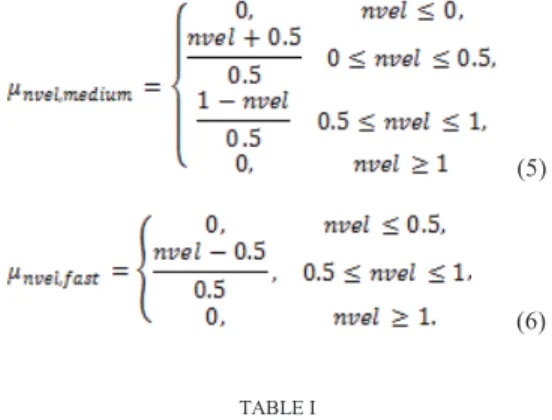
Mamdani FLC is define as four fuzzy sets namely,

, , and . Note that the

membership functions for each velocity can be written as in (3) to (6). (3) (4) (5) (6) TABLE I

MEMBERSHIP FUNCTION PARAMETERS FOR INPUT VARIABLES OF

MAMDANI FLC AND SUGENO FLC Membership Functions Parameter Input

Variables Detect (m) Non-detected (m) S1,S2,S3,S4,S5 [0 0 0.5 0.6] [0.5 0.6 1 1]

TABLE II

MEMBERSHIP FUNCTION PARAMETERS FOR OUTPUT VARIABLES OF

MAMDANI FLC AND SUGENO FLC

FLC Type Variable Output Manufacturer Part name/ Rating values Mamdani FLC Left & Right Velocity Reverse (m/s) [-0.5 -0.5 0] Stop (m/s) [-0.5 0 0.5] Medium (m/s) [0 0.5 1] Fast (m/s) [0.5 1 1] Sugeno FLC Left & Right Velocity Reverse (m/s) -0.5 Stop (m/s) 0 Medium (m/s) 0.5 Fast (m/s) 1 TABLE III

USER DEFINED FUZZY RULES FOR MAMDANI FLC AND SUGENO FLC Input Variables Variables Output

Rule No. S1 S2 S3 S4 S5 Le ft w heel ve lo city R ig ht w he el ve lo city 1 / o o o o medium stop 2 o / o o o medium stop 3 o o o / stop medium 4 o o o o / stop medium 5 o / / / / reverse fast 6 / / / / o fast reverse 7 o o o o o fast fast 8 / / o o o medium reverse 9 o / / o o fast reverse 10 o o / / o reverse fast

(4)

International Journal of Electrical Engineering and Applied SciencesInternational Journal of Electrical Engineering and Applied Sciences 11 o o o / / stop fast 12 o o / / / reverse fast 13 / / / o o fast reverse 14 o o / o o fast reverse 15 o / / / o fast reverse / Detect o No Detect The membership function parameter for input and output variables is summarize in Table I and II, respectively of the Mamdani FLC and the Sugeno FLC. After the constructing the membership functions for the input variables, a total of 15 rules is applied to the controller, so that the robot able to avoid obstacles as shown in the Table III. These rules were applied in a step-wise manner with a careful observation of the robot’s reaction in V-REP environments before the next rule proceeding.

The inference output from these rules is computed by Mamdani (max-min) operator for composition, minimum operation for implication, and center of area for defuzzification as shown in Fig. 1. Since each rule has a crisp output for Sugeno, the overall output is obtained via weighted average as shown in Fig. 2, thus avoiding the time-consuming process of defuzzification required in a Mamdani model. Upon the successful implementation of the controller, the results generated by both controllers are compared and analyzed in the next section.

Fig. 1. Block diagram of Mamdani FLC

Fig. 2. Block diagram of Sugeno FLC

C.Target Seeking Behavior

Target seeking behavior of Pioneer P3-DX robot is achieved using Sick 300 Safety Laser Sensors equipped on the robot. This sensor read the instantaneous coordinate in position and orientation of the robot relative to world coordinate. Later the data is sent to MATLAB using remote API configuration. Fig. 3 shows the angle between robot and -axis theta denoted by 𝜃𝜃,

the angle between robot and target is beta denoted by , the initial position of the robot and target position of the robot.

First, the robot can adjust its motion direction and moves towards the target since it know current position and find the target position. The distance, , between robot and its destination can be calculated as,

(7) The robot also needs to adjust its orientation when it reaches the goal point. We assume θ is the angle between robot and , β is the angle between robot and target in direction and γ is the must be changed angle given

by .

Fig. 3. The position and orientation of the robot relative to parent frame

III.

Design of FLC on V-REP Environment

This section contains the design of the V-REP environment for validation of FLCs. To implement the controllers in robot, we create a different environment by using the robotic simulator. For validation of FLC process, we also observe the path generated by robots. Since, the FLC and robotic environments are created in different software, application programming interphase (API) configuration is done to integrate the both software. Once the API configuration is success, the validation of controllers using robotic simulator is carried out.

A.V-REP Environment for validation of FLCs.

The V-REP simulator comes with integrated development environment that is based on a distributed control architecture. Each object or model can be individually controlled via an embedded script, a plugin,

(5)

The Integration of Fuzzy Logic System for Obstacle Avoidance Behavior of Mobile Robot

The Integration of Fuzzy Logic System for Obstacle Avoidance Behavior of Mobile Robot

ISSN: 2600-7495 IJEEAS Vol. 2, No. 1, April 2019 a ROS node, a remote API client or a custom solution.

Thus, V-REP is very versatile and ideal for multi-robot applications. We used MATLAB for coding the controllers. We consider square shape resizable floor is with measuring of 10m in both width and length. To avoid the robot exits from the testing environment, four cuboid shaped wall is designed and placed at the side of each edge of floor. Next, cylindrical with diameter of obstacle are designed which Pioneer P3- DX should avoid reaching the target.

B.Integration of MATLAB and V-REP

The procedure of integration using remote API configuration can be categorized into two phases, preparing V-REP file for integration and preparing MATLAB file for integration.

IV.

Results and Discussion

In this section we compare and evaluate the performance of both Mamdani and Sugeno FLC in term of the path travelled, the smoothness and the efficiency of the FLC for single and multi-robot. For integration of FLS for obstacle avoidance behavior of mobile robot, the simulation begins upon the successful remote application program interface (API configuration) between V-REP and MATLAB. If the distance from the target and robot position is more than 0.1m, the robot is far from the target location. So, the robot will start move towards the target with three conditions. The second condition is, if the angle is bigger than 0.1 radian the robot will rotate left whereas the third condition is if the angle is smaller than 0.1 radian the robot will rotate right. While executing these three conditions, if any of the proximity sensors of roots detects the obstacle, the FLC either Mamdani or Sugeno, will control the left velocity and right velocity of robot based on the 15 rules defined. This process will keep on repeating until the distance between the robot and target location is not more than 0.1m.

A.Single robot performance

In this section we evaluate the integration of FLS for single mobile robot. To test the obstacles avoidance behavior for single robot, we consider four different environments for each controller Mamdani FLC and Sugeno FLC. We used single Pioneer P3-DX in each environment. The number of obstacles in each environment are given as 0, 2, 4 and 8 obstacles. Due to page limitation we reserve the scatter plot path of Pioneer robot for the Mamdani FLC and the Sugeno FLC. Nevertheless, to navigate the robot in a safe path based on 15 fuzzy rules defined by the user, both FLC able to detect the obstacles and control the linear velocity of the left and right wheel in each environment. This indicates

both FLC able to integrate with proximity sensors to communicate with outside world.

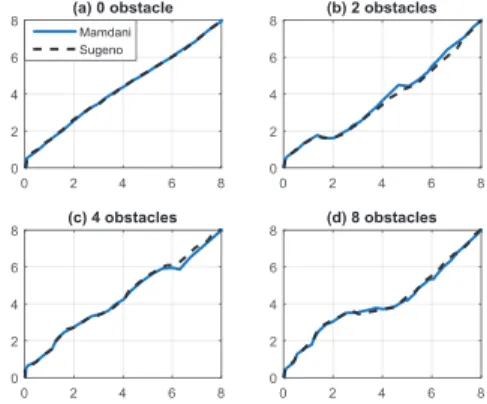
Fig. 4 compares the path travelled for the single robot environments from the initial position to the goal position by using the Mamdani FLC and the Sugeno FLC. Based on Fig. 4(a), there are no significant difference in path travelled by Pioneer using the Mamdani FLC and the Sugeno FLC. This indicates FLC does not initialized in no obstacle environment. However, in Fig. 4(a), (b) and (c), there are slight differences in the path travelled by the robot. This indicates that FLCs is initialized by proximity sensors once detects the obstacles. Moreover, the path travelled by Pioneer robot using the Sugeno FLC is more adequate than the path travelled by the Mamdani FLC. This indicates the capability of the Sugeno FLC to produce constant output and faster response time unlike the Mamdani FLC which is only capable of producing crisp output after defuzzification process as the output in the Fuzzy sets.

Fig. 4. Path travelled by single robot by using Mamdani and Sugeno FLC

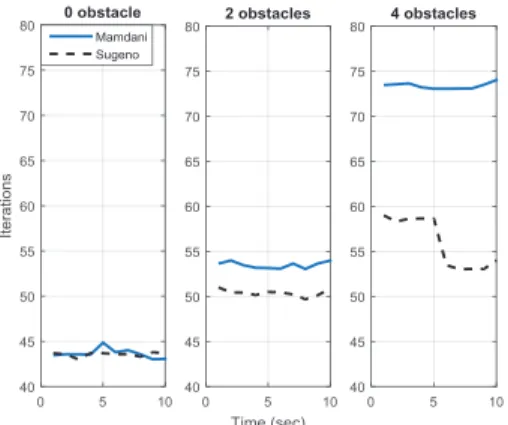
Next, the efficiency of the controller is tested. We set four different environments based on the number of obstacles in each environment by using a single Pioneer P3-Dx robot. The initial distance of the robot from the goal position is set at 11.31m. The distance between the robot and goal position are decreases as the robot move towards the goal. The efficiency of the controller is described as a time taken by the robot to reach the target. Fig. 5 shows the time taken by Pioneer robot to reach the target in four environments.

(6)

International Journal of Electrical Engineering and Applied SciencesInternational Journal of Electrical Engineering and Applied Sciences

Fig. 5. Time taken to reach the goal position by single robot by using the Mamdani FLC and Sugeno FLC

As the number of obstacles increases, the time taken by Pioneer robot to reach the target increases for both the Mamdani FLC and the Sugeno FLC. This is due to the behavior of robot which uses FLC to avoid the collision with obstacles when moving to the safest path. Both controllers recorded an exact time in the environment with the zero obstacles. However, the efficiency of the Mamdani FLC and the Sugeno FLC only differs in the environment with more than one obstacle. The performance of the average time taken can be seen in Fig. 6.

Fig. 6. Average time taken by single robot to reach goal position by using the Mamdani FLC and Sugeno FLC

B.Multi Robot performance

In this section, we compare the average time needed for multi robot in various environment in the Mamdani FLC and the Sugeno FLC. Next, we used the average time value in each environment to calculate the efficiency percentage for each FLC.

Fig. 7 shows the average time needed for two Pioneer P3-DX robots to reach the target in both the Mamdani

FLC and the Sugeno FLC. For the Mamdani FLC, average time recorded by two Pioneer robots to reach the goal position in environments with 0, 1 and 2 obstacles are 43.45, 53.65 and 73.46 seconds, respectively.

For the Sugeno FLC, an average time recorded by two Pioneer robots to reach the goal position in the environments with 0, 1 and 2 obstacles are 43.68, 50.99 and 160.80 seconds, respectively. The average time taken by robot increases as the obstacles increases.

This indicates the behavior of robot that used FLC to avoid the collision with obstacles in the environment with the zero obstacles. Both of the controllers recorded a same time which is about 43s seconds with various time in all other environments. This proves the efficiency of the Mamdani FLC and the Sugeno FLC that is only differs in the environment with obstacles.

Fig. 7. Time taken for multi robot by using the Mamdani FLC and Sugeno FLC

Based on Fig. 8, both system able to avoid obstacles and reach the target successfully in all the multi robot environments Overall results show that the efficient response time in multirobot environment for the Sugeno FLC is 12.06% faster than the Mamdani FLC. This indicates the Sugeno FLC computational efficiency that eliminates defuzzification process and ability to produce a constant output which is suitable in controlling the robot’s linear velocity.

The designed Mamdani FLC and Sugeno FLC able to navigate the robot from initial position to target position by avoiding obstacles along the path of robot in both single and multirobot environments. This validates the efficiency of developed controllers in processing input data to give a systematic output based on 15 Fuzzy rules given in Table III.

However, the path generated by the Sugeno FLC is smoother than path generated by the Mamdani FLC. Furthermore, the Sugeno FLC reach the target location faster than the Mamdani FLC. This is mainly because of the computational efficiency of the Sugeno FLC which

(7)

The Integration of Fuzzy Logic System for Obstacle Avoidance Behavior of Mobile Robot

The Integration of Fuzzy Logic System for Obstacle Avoidance Behavior of Mobile Robot

ISSN: 2600-7495 IJEEAS Vol. 2, No. 1, April 2019 can produce a constant output without any delay. The

Mamdani FLC does not able to produce such efficiency due to the delay during the defuzzification process to change the output variable in fuzzy sets to a single number. Thus, the Sugeno FLC offers an efficient and faster response for mobile robot.

Fig. 8. Average time performance for multi robot by using the Mamdani FLC and Sugeno FLC

V.

Conclusion

In this paper, two types of FLC namely, the Mamdani FLC and Sugeno FLC are developed based on the Pioneer-P3-DX robot. The obstacle avoidance behavior of mobile robot in single robot and multi robot environment consists of static obstacles using both FLC is investigated. Finally, the smoothness and efficiency of the Mamdani FLC and the Sugeno FLC are compared based on the path and time taken to reach the goal in different environment. Simulation results shows the Sugeno FLC able to produce smoother path and reach the goal faster than the Mamdani FLC. The computational efficiency of the Sugeno FLC also give more constant output which is suitable in controlling the robots.

Acknowledgement

The authors wish to acknowledge Faculty of Electrical Engineering, Universiti Teknikal Malaysia Melaka and Ministry of Education Malaysia for supporting this research financially (FRGS/1/2018/TK04/UTEM/03/28).

References

[1] U. Farooq, K. M. Hasan, M. U. Asad and S. O. Saleh, Fuzzy Logic Based Wall Tracking Controller for Mobile Robot Navigation, 7th IEEE Conference on Industrial Electronics and Applications (ICIEA), July 2002.

[2] T. T. Mac, C. Copot, R. D. Keyser, T. D. Tran and T. Vu, Control for Autonomous Mobile Robot, Journal of Automation and Control Engineering, vol. 4, no. 1, pp. 65-70, 2016.

[3] Neha Preet Kaur, Vikram Verma, Comparison Study of Mamdani Method and Sugeno Method, International Journal of Scientific Research Engineering & Technology (IJSRET), vol. 4, no. 3, pp. 166-169, 2015.

[4] T. Mac Thi, C. Copot, R. De Keyser, T. D. Tran and T, Vu, MIMO Fuzzy Control for Autonomous Mobile Robot, Journal of Automation and Control Engineering, Vol. 4, No. 1, February 2016, vol. 4, no. 1, pp. 65-70, 2016.

[5] A. Pandey, R. K. Sonkar, K. K. Pandey and D. R. Parhi, Path planning navigation of mobile robot with obstacles avoidance using fuzzy logic controller, IEEE 8th International Conference on Intelligent Systems and Control (ISCO) , 2014.

[6] M. I. Ibrahim, N. Sariff, J. Johari and N. Buniyamin, Mobile robot obstacle avoidance in various type of static environments using fuzzy logic approach, 2nd International Conference on Electrical, Electronics and System Engineering (ICEESE), 2014. [7] M. M. Almasri, K. M. Elleithy and A. M. Alajlan, Development of Efficient Obstacle Avoidance and Line Following Mobile Robot with the Integration of Fuzzy Logic System in Static and Dynamic, Long Island Systems, Applications and Technology Conference (LISAT), 2016.

[8] N. P. Kaur and V. Verma, Comparison Study of Mamdani Method and Sugeno Method in The Navigation System for Indoor Mobile Robot, Int. Journal of Scientific Research Engineering & Technology (IJSRET), vol. 4, no. 3, pp. 166-169, 2015. [9] U. Farooq, K. M. Hasan, G. Abbas and M. U. Asad, Comparative

Analysis of Zero Order Sugeno and Mamdani Fuzzy Logic Controllers for Obstacle Avoidance Behavior in Mobile Robot Navigation, Current Trends in Information Technology (CTIT), 2011 International Conference and Workshop, Dubai, United Arab Emirates, 2011.

[10] K. G. Sugeno M., Structure identification of fuzzy models, Fuzzy Sets and Systems, 1988.

[11] E. Mamdani, Applications of fuzzy algorithms for simple dynamic plant, Proc. of IEE, V121, 1974.

[12] Coppelia Robotics V-REP: Create. Compose. Simulate. Any Robot, Available: http://www.coppeliarobotics.com/.

(8)

Figure

TABLE II
Fig. 2. Block diagram of Sugeno FLC
Fig. 4 compares the path travelled for the single robot  environments from the initial position to the goal position  by using the Mamdani FLC and the Sugeno FLC
Fig. 5. Time taken to reach the goal position by single robot by using  the Mamdani FLC and Sugeno FLC
+2

References

Related documents