Dinamika Pendidikan
http://journal.unnes.ac.id/nju/index.php/dpThe Effectiveness of Problem Based Learning (PBL) on Intermediate
Financial Accounting Subject
Nunuk Suryanti
DOI: 10.15294/dp.v11i2.8939
Universitas Islam Riau, Indonesia
Abstract
This research aims to know the effectiveness of Problem Based Learning (PBL) Model comparing to Drill Model on Intermediate Financial Accounting subject. The research was a quasi-experimental research. Population was four classes of Accounting Education students in the year of 2014/2015 at Faculty of Educational Science and Teaching of Riau Islamic University (UIR). Sample was taken by using purposive sampling. Then, it used Problem Based Learning (PBL) at experimental class and Drill Model at controlled class. Data was collected by using interview, ob-servation, and tests (pre-test and post-test). Moreover, data were analyzed by using independent sample test. Findings show that there is no any difference of learning outcomes between students who taught by Problem Based Learning (PBL) Model and Drill Model on Intermediate Financial Accounting.
How to Cite
Suryanti, N. (2016). The Effectiveness of Problem Based Learning (PBL) on Inter-mediate Financial Accounting Subject. Dinamika Pendidikan, 11(2), 94-101.
© 2016 Universitas Negeri Semarang History Article
Received 3 October 2016 Approved 9 November 2016 Published 17 December 2016
Keywords
Problem Based Learning (PBL); Dril; Intermediate Financial Accounting
Correspondence Author:
Jl. Kaharudin Nasution No. 113, Kota Pekanbaru, Riau 28284 E-mail: [email protected]
p-ISSN 1907-3720 e-ISSN 2502-5074
cepts and practice counting. In fact, the gradua-tes will see differences or the gap between theory they obtain at school with the real practice in the professional world. The conventional learning system for accounting is started from secondary school level both at general and vocational school to college in which more likely to focus on coun-ting pratice in journal and financial reporcoun-ting rat-her than doing analysis. Thus, it makes the stu-dents’ ability to think critically and analyze the problems, and also to communicate becomes less. Ideally, the learning process shoud focus on trai-ning the students to think, analyze and to interact (Huang, 2011).
Therefore, conventional accounting edu-cation often produces graduates having knowled-ge for the accounting profession, but they have limited skills on doing analysis, giving opinions, having communication, and solving problem (Hsu, 2013). The American Accounting Associa-tion (AAA) in 1986 recommends that accounting education should make learners active and inde-pendent rather than merely make them become recipients of information. The Accounting Edu-cation Change Commission (AECC) also encou-rages students to embrace lifelong learning and the importance of learning by doing group lear-ning (Hsu, 2013).
The high competition at the work place requires learners having critical thinking and problem solving skills to solve existing problems. Thus, teachers of accounting, in particular, are expected to have knowledge and skills in desig-ning and implementing leardesig-ning strategies that can develop these abilities.
To make the students able to acquire cri-tical thinking and problem solving skills, teach-ers are expected to design learning programs in the curriculum which can offer opportunities for students to practice thinking critically and solve problems. Lately, many teachers have already made students engaged in the activities required critical thinking from the students (Tempelaar, 2006). However, in fact, students rarely use cri-tical thinking skills to solve complex problems (Bartlett, 2002; Rippin et al., 2002).
One of the factors that influence students’ skills in critical thinking in solving the problem is the dimension of the cognitive style of the learner. Accounting educators must consider the cognitive styles of students which will affect the process of analysis on certain cases through the given tasks and problems in accounting subjects, in particular Financial Accounting which is re-garded as one of the most difficult subjects and many students are failed in this course because
INTRODUCTION
Education is an essential element to deve-lop civilization. God will raise a good position for a man in the world and in the hereafter for those knowledgeable.
As contained in the Al-Mujadalah ,verse 11:
يَرْفَعِ اللهُ الَّذِينَ ءَامَنُوا مِنكُمْ وَالَّذِينَ أُوتُوا الْعِلْمَ دَرَجَاتٍ
It means: “Allah will exalt those believers among you and those who are given knowledge.” (QS. Al-Mujadalah:11)
Threfore, it is the time to strive diligently in search of and share knowledge. Because there is always goodness for those who have knowledge, so it is proper to pray that God will continue to add to our knowledge. As in Thoha, verse 114.
وَقُل رَّبِّ زِدْنِي عِلْمًا
It means: “And say (to you Muhammad),” O my Lord, add knowledge to me. “(Thoha, verse 114).
Education is a necessity because it makes people able to develop the ability and personali-ty. Factually, the education includes educational activities, teaching and training. These three ele-ments should be run simultaneously and integra-ted, sustainable and harmonious with the deve-lopment of students as well as the environment. So that it can achieve the purpose of learning (Hand, 2013).
Generally, in the learning process, students often passively participate in the classes. They can be active if there is an assignment or are asked by the lecturers. Therefore, to create active participa-tion from the students, there is a need appropriate method to apply in learning process. If nothing is done related to teaching and learning process, the students will remain passive and they will only in the level of memorizing so that when they are given a conceptual issue, they will not be able to finish it (Cahyaningdyah & Ismiyati, 2011).
Accounting Education Change Commis-sion (AECC) has encouraged higher education to create innovation on accounting curriculum so that the graduates will be expected to align their competence with the qualifications required in the workplace. Critical thinking skills are im-portant because the students who have the ability to think critically can easily solve the problems of the social, scientific and practical problems (Shakirova, 2007, in Snyder, Lisa & Mark, 2008). Thus, the students are trained to think critically so that the possibility to solve the problems effec-tively is higher (Snyder, Lisa & Mark, 2008).
IFRS focuses on the concepts of learning to draw conclusions and opinions rather than just technically makes the students memorize
con-they must have a higher level of thinking and requires an understanding of basic appropriate accounting material (Carrington, 2012; Eikner & Montondon 2006; Waples & Darayseh, 2011). Based on this, it is necessary to make the lear-ning outcomes for Intermediate Financial Ac-counting (AKM2) students better. This can make them able to manage their upcoming course to achieve satisfying GPA, or even with praise. Hen-ce, it is necessary to analyze the characteristics of Financial Accounting course, in order to take appropriate action.
Based on data from AKM 2 final exam results from four classes of FKIP students of se-cond semester of the 2014-2015 academic year, they have average score of 55 or D value. This fact suggests that there is a need to improve lear-ning outcomes of AKM 2, as it is an important subject.
Taking the subjects of Financial Accoun-ting, students should have some characteristics such as (1) have and are able to develop problem solving skill, (2) have level of higher cognitive, and (3) have a greater ability to gain any prior knowledge (Carrington 2012). Having seen these characteristics, it means that there is a need to de-velop problem solving skills using learning met-hods that is problem-based learning (PBL).
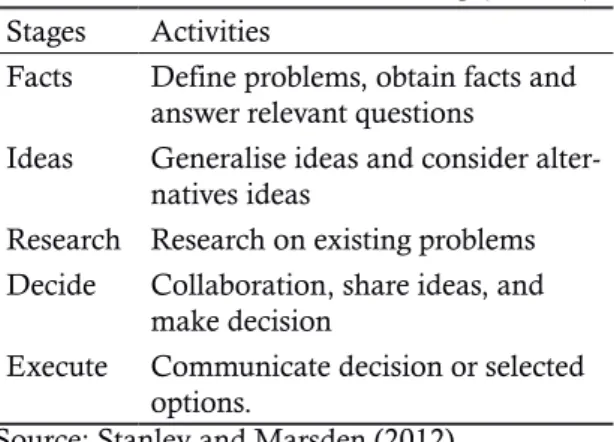
Originally, PBL is derived from the con-cept of learning in small groups addressed for business education and it becomes well-known around the 1920s. PBL should consider the abili-ty of teachers who are familiar with PBL models. Teachers should adjust and modify PBL as nee-ded depending on the goals to be achieved (Bar-rows, 1996). Duch (2001) divides four models, namely PBL for medical school model, the mo-del of floating facilitators, peer tutoring momo-dels, and models of large classes. Stanley and Marsden (2012) develop a model known as FIRDE (Facts, Ideas, Research, Decide, Execute) PBL consis-ting of 5 stages of problem solving methods that are easy to remember and implement. These five stages is presented in Table 1.
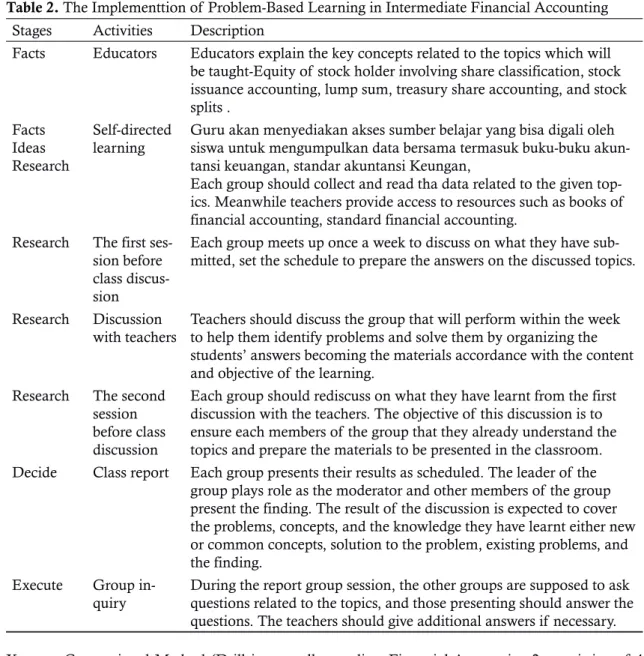
Then, the stages at experiment class is il-lustrated in Table 2. Based on the characteristics of accounting which requires the ability to think critically in analyzing the financial transactions, the following hypotheses can be derived: H1: There is a difference in learning outcomes for in-termediate financial accounting 2 if method of Based Problem Solving is applied compared to the conventional method (method drill in small groups).
Table 1. Method for Problem Solving (FIRDE) Stages Activities
Facts Define problems, obtain facts and answer relevant questions
Ideas Generalise ideas and consider alter-natives ideas
Research Research on existing problems Decide Collaboration, share ideas, and
make decision
Execute Communicate decision or selected options.
Source: Stanley and Marsden (2012)
There are three main characteristics of problem-based learning. First, this learning re-quires students not to only listen, take notes, and then memorize the subject matter, but they have to perform actively assisted by the teachers by giving them access to think, communicate, and process the data, and to finally conclude. Second, learning activities are meant to solve problems and the problems provided are the keywords in the learning process. Third, thinking using scien-tific thinking approach is used. Scienscien-tific thinking method is a process of deductive and inductive thinking (Yuniarti and Hadi, 2015). In the pro-cess of learning, critical thinking skills become important for students because it leads them to use their maximum potential to solve problems encountered in daily life. One of the models of student-centered learning which can improve stu-dents’ critical thinking skills is to implement the PBL model (Sulistyani & Harnanik, 2014).
METHODS
This research is a quasi-experimental type of study. The experimental group is given a treat-ment using Problem Based Learning method and the control group uses the drill in small groups. The research designs are two groups- pre-test and post-test as illustrated below:
Research Design Description : E1: Eksperiment Class E2: Control Class O1: Pre Test O2: Post Test
X1:Treatment using problem-based learning method
Table 2. The Implementtion of Problem-Based Learning in Intermediate Financial Accounting Stages Activities Description
Facts Educators Educators explain the key concepts related to the topics which will be taught-Equity of stock holder involving share classification, stock issuance accounting, lump sum, treasury share accounting, and stock splits . Facts Ideas Research Self-directed learning
Guru akan menyediakan akses sumber belajar yang bisa digali oleh siswa untuk mengumpulkan data bersama termasuk buku-buku akun-tansi keuangan, standar akunakun-tansi Keungan,
Each group should collect and read tha data related to the given top-ics. Meanwhile teachers provide access to resources such as books of financial accounting, standard financial accounting.
Research The first ses-sion before class discus-sion
Each group meets up once a week to discuss on what they have sub-mitted, set the schedule to prepare the answers on the discussed topics.
Research Discussion with teachers
Teachers should discuss the group that will perform within the week to help them identify problems and solve them by organizing the students’ answers becoming the materials accordance with the content and objective of the learning.
Research The second session before class discussion
Each group should rediscuss on what they have learnt from the first discussion with the teachers. The objective of this discussion is to ensure each members of the group that they already understand the topics and prepare the materials to be presented in the classroom. Decide Class report Each group presents their results as scheduled. The leader of the
group plays role as the moderator and other members of the group present the finding. The result of the discussion is expected to cover the problems, concepts, and the knowledge they have learnt either new or common concepts, solution to the problem, existing problems, and the finding.
Execute Group in-quiry
During the report group session, the other groups are supposed to ask questions related to the topics, and those presenting should answer the questions. The teachers should give additional answers if necessary. X2 :Conventional Method (Drill in a small
group)
The instrument of the research is a test given for students in the pre-test and post-test in which its items have been validated. Data are analyzed using independent sample t-test in or-der to compare the average of two groups that are not paired or not related. Not paired means that the research is carried out for two different sub-ject samples. This test is meant to see the different variation of the two groups of data. Hence, prior to the tests, the variance should be first known whether they are the same or different variances. Before performing the t-test, the pre-condition test is conducted namely normality and homoge-neity test. Kolmogorov-Smirnov test is used for normality by using t-test and homogeneity test, while Levene’s test is for equality of variances.
The population of this study is all students of the 2014/2015 at four semester having
Inter-mediate Financial Accounting 2, consisting of 4 classes, namely class 4A, 4B, 4C, and class 4D. The sampling technique used is purposive samp-ling by taking into account the academic ability and those who have mostly equal characteristics. Then, the homogenity test is conducted and is randomized so that the experimental class can be determined. Finally, the class 4C and 4D are se-lected as the experimental ones.
RESULTS AND DISCUSSION
This research is conducted for one semes-ter and the second semessemes-ter 2015/2016. The pre-test is conducted while taking a midterm test where both the control and the experimental classes still use the conventional method-the drill one in a small group. Then, the post-test is taken from final exams with learning topic on holders of equity capital in which this topic is used for
experimental classes which are treated by imple-menting problem based learning method.
The results of the pre-test between the control group and the experimental group show that the average score of the experimental class is 53.81, and the control one is 45.94. There is 7.87 margin point. Then, the results of post-test between the control group and the experimen-tal group reveal that an average of experimenexperimen-tal class is 41.43 and the control one is 43.31 points in which higher to 1.88 difference in grade cont-rol.
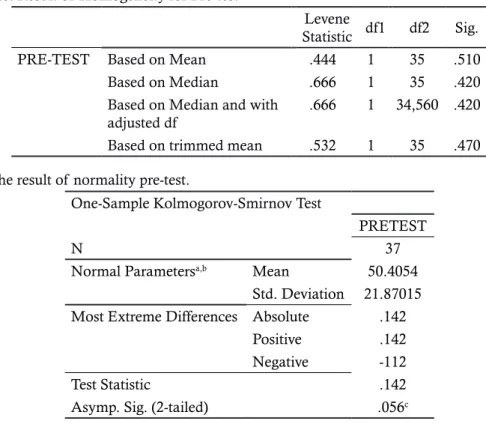
The test results of homogeneity and nor-mality of pre-test and post-test are in Table 3. Results of homogeneity for pre-test and post-test. Based on the result of homogeneity test for the pre-test, it shows that the pre-test data are alrea-dy homogeneous. This can be seen from the data analysis using SPSS 23 as in Table 3.
Table 1 indicates that the data based on Mean is 0.510 which is greater than the alpha (α) of 5% (0.05), thus the value of sig. is 0.510> 0.05. This can be said that the data of pre-test experi-mental and control class is homogeneous. The Result of Normality Pre-Test
The result of normality pre-test is
illustra-ted in Table 4. The analysis shows that the value of Asymp. Sig. (2-tailed)> α, where 0.056> 0.05 indicates that the data of pre-test has normal dis-tribution.
Homogeneity Post-test.
The result of homogeneity for post-test is illustrated in Table 5. Table 5 shows that the Based on Mean data is 0.206 which is greater than the alpha (α) of 5% (0,05), thus the sig. 0.206> 0.05 which means that the post-test data between a control class and experimental class is homogeneous.
Normality Test on Post-Test.
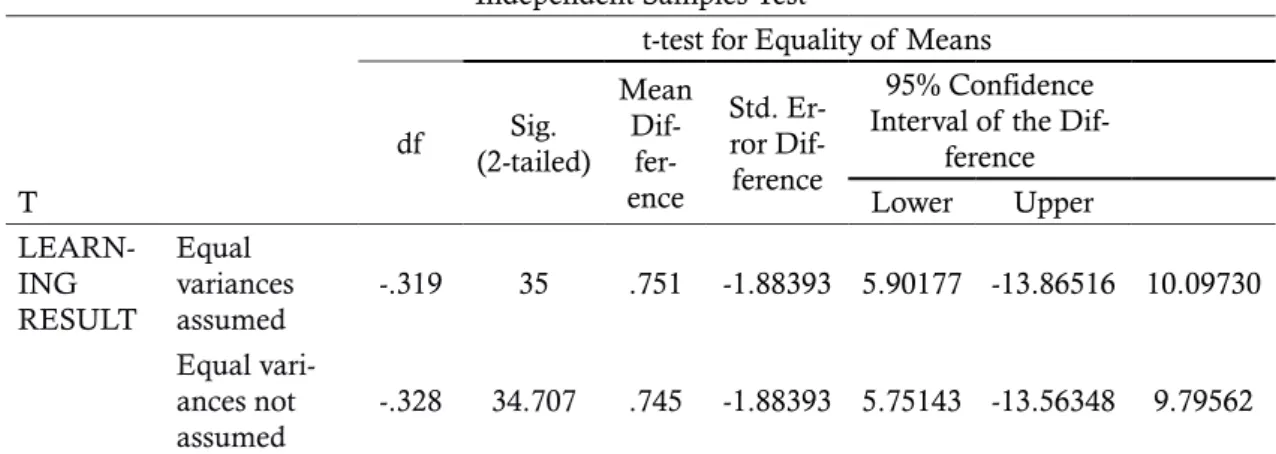
The test result for normality test is illustra-ted in Table 6. The results of data analysis using the Kolmogorov-Smirnov test shows that the Sig. 0.200> 0.05 meaning that both the experi-mental and control classes have normal distribu-tion. Then, based on the results of normality and homogeneity test show that the data is normal and homogeneous. Further, the next step is to test the hypothesis of the study using the analy-sis of Independent Sample t-test and the results are shown in Table 7. Table 7 shows that the Sig. (2-tailed)> alpha, i.e 0.745> 0.05 indicating that Table 3. Test Result of Homogeneity for Pre-test
Levene
Statistic df1 df2 Sig.
PRE-TEST Based on Mean .444 1 35 .510
Based on Median .666 1 35 .420
Based on Median and with adjusted df
.666 1 34,560 .420
Based on trimmed mean .532 1 35 .470
Tabel 4. The result of normality pre-test.
One-Sample Kolmogorov-Smirnov Test
PRETEST
N 37
Normal Parametersa,b Mean 50.4054
Std. Deviation 21.87015 Most Extreme Differences Absolute .142
Positive .142
Negative -112
Test Statistic .142
Asymp. Sig. (2-tailed) .056c
a. Test distribution is Normal. b. Calculated from data.
Ho is accepted and Ha is rejected. Thus, it can be concluded that there is no difference between the method of snowball throwing and talking stick in improving students’ learning outcomes.
The results of the data analysis show that the pre-test between the control group and the ex-perimental group illustrate the average score of the experimental class is 53.18, and control class is 45.94. It means that experimental class has 7.87 point which is higher than the control one. Then, the results of post-test show that the experi-mental group shows an average of 41.43 and it is 43.31 for control group meaning that the control group has 1.88 score higher. It means that there is no significant difference on learning outcomes for intermediate financial accounting 2 on share-holder equity topic.
Next, both classes use conventional
met-hod- drill method with small groups of pre-test showing that the experimental class has 7.87 points higher than the control class. However, after the problem-based learning is implemented, the post-test experimental class has lower point than the control class. It means that the applicati-on of problem-based learning is found to be less effective than the drill methods in small groups on the material of shareholder equity. Although in both classes the decrease is equal as shown in gain score, it illustrates that students experiencing the down grade in experimental class which is more than that of the control one. In experiment class, there are 12 students having lower grade to 50 points. For the control class, there are 8 stu-dents or 50% ,while the percentage of the experi-mental class reaches 57%.
Based on the statement of Schmidt & Table 5. The result of homogeneity for post-test.
Test of Homogeneity of Variance
Levene Statistic df1 df2 Sig.
POS TEST Based on Mean 1.659 1 35 .206
Based on Median 1.416 1 35 .242
Based on Median and with ad-justed df
1.416 1 34.817 .242
Based on trimmed mean 1.652 1 35 .207
Table 6. The Result for Normality Test for Post-Test Tests of Normality METODE_BELAJAR Kolmogorov-Smirnov
a Shapiro-Wilk
Statistic Df Sig. Statistic Df Sig. POS
TEST
PBL .154 21 .200* .937 21 .194
KONVENSIONAL .112 16 .200* .953 16 .541
*. This is a lower bound of the true significance. a. Lilliefors Significance Correction
Table 7. The Result of Independent Samples Test
Independent Samples Test
T
t-test for Equality of Means
df Sig. (2-tailed) Mean Dif- fer-ence Std. Er-ror Dif-ference 95% Confidence Interval of the
Dif-ference Lower Upper LEARN-ING RESULT Equal variances assumed -.319 35 .751 -1.88393 5.90177 -13.86516 10.09730 Equal vari-ances not assumed -.328 34.707 .745 -1.88393 5.75143 -13.56348 9.79562
Moust (1995); Sage, S., & Torp, L. (2002), stu-dents should have and implement self-manage-ment and the spirit to seeking knowledge and learning through group collaboration because it makes them possible to contemplate the problems from different perspectives. Through sharing and exchanging knowledge and opinions, learners can create a meaningful system knowledge.
Apparently, based on observations during the learning process of PBL, the students are found to have lack of curiosity which can be seen from a few people who are actively involved in the process of discussion with the lecturers befo-re pbefo-resenting the befo-results. Further, the process of group discussion is less optimum because materi-als on shareholders’ equity is a new material for the students. Therefore, the group members have limited knowledge prior to the discussion making the discussion does not run well. Besides, stu-dents have lack of curiosity and creativtiy. This can be seen from the lack of initiative to obtain materials from other sources.
Weaknesses found in this study is that the-re is difficulty in designing a case for materials related to stock based on the student’s perspective and students’ background knowledge on stock. Apparently, the students themselves have limited knowledge about the stock shares. In fact, PBL is a model based on the teaching and learning process in which requires teachers should select the curriculum design based on the perspective of the students and is based on what is known, used, and organized from a variety of sources in their daily lives through guided participation. In the end, students can develop the ability to solve complex problems they encounter in eve-ryday life. Duch (2001) argues that the core and the learning objectives are related to the existing problem and eventually challenge the students to develop higher level of critical thinking such as analysis, synthesis, evaluation.
Having those weaknesses, it means that there is no significant difference between drill techniques in a small group compared to PBL. This means the result of the research is not in line with the research of Hsu C, Yen S, and Lai W in 2013 entitled the effectiveness of PBL in accoun-ting course. Their study finds that PBL is proven to improve learning outcomes in accounting te-aching and learning compared to traditional met-hods.
CONCLUSION
Based on the results of research, it can be concluded that there is no significant differences between implementing the method of problem-based learning and drill in small groups in impro-ving learning outcomes for intermediate financial accounting 2. The limitation of the study is that the characteristics of PBL does not adjust the stu-dents’ knowledge. Hence, further study should consider the students’ knowledge so that the dis-cussion can run well. Besides, the selection of the material should be accordance with the previous knowledge that the students already have and it should not be the basic material.
REFERENCES
Barrows, H. S. (1996). Problem‐based learning in med-icine and beyond: A brief overview. New direc-tions for teaching and learning, 1996(68), 3-12. Bartlett, J. E. (2002). Analysis of Motivational
Orien-tation and Learning Strategies of High School Business Students. Business Education Forum, 56(4), 18-23.
Cahyaningdyah, D., & Ismiyati. (2011). Peningka-tan Kualitas Pembelajaran Auditing Melalui Metode Problem Based Learning. Dinamika Pendidikan, 2(2).
Carrington, L. G. (2012). Ready For Intermediate Ac-counting? Factors Affecting Student Preparation. Paper presented in International Academic Conference. Orlando, Florida, USA. coopera-tion in the classroom and school, Alexandria, VA: Association for Supervision and Curricu-lum Development.
Duch, B. J., Groh, S. E., & Allen, D. E. (2001). The power of problem-based learning: a practical” how to” for teaching undergraduate courses in any disci-pline. LLC: Stylus Publishing.
Eikner, A. E., & Montondon, L. (2006). Evidence on factors associated with success in intermediate accounting I. The Accounting Educators’ Journal,
13.
Handayani, S. (2013). Efektivitas Metode Pembelaja-ran Latihan (Drill) dengan Sistem Penilaian Portofolio pada Hasil Belajar Mengelola Sistem Kearsipan Kelas XI Administrasi Perkantoran SMK Negeri 1 Salatiga. Economic Education Analysis Journal, 2(1).
Hong, R. J. (2001). PBL Teaching Startegies. Quartely Journal of Technological and Vocational Education, 61, 10-12
Hsu, C., Yen, S., & Lai, W. (2013). Effectiveness of Problem-Based Learning in the Accounting Course.
Huang, S. W. (2011). Ability to Rely on the Profes-sional Judgment of Accounting Education,
Ac-counting Research Monthly, 307, 29
Rippin, A., Booth, C., Bowie, S., & Jordan, J. (2002). A complex case: Using the case study method to explore uncertainty and ambiguity in under-graduate business education. Teaching in Higher Education, 7(4), 429-441.
Sage, S., & Torp, L. (2002). Problem As Possibilities: Problem-Based Learning for K-16 Education.
Alexandria, VA, USA: Association for Supervision and Curriculum Development.
Schmidt, H. G., & Moust, J. H. (1995). What makes a tutor effective? A structural-equations model-ing approach to learnmodel-ing in problem-based cur-ricula. Academic Medicine, 70(8), 708-14. Shakirova, D. M. (2007). Technology for the shaping
of college students’ and upper-grade students’ critical thinking. Russian Education & Society,
49(9), 42-52.
Snyder, Lisa, G., & Mark, J. S. (2008). Teaching critical thinking and problem solving skills. The Journal of Research in Business Education, 50(2), 90. Stanley, T., & Marsden, S. (2012). Problem-based
learning: Does accounting education need it?.
Journal of Accounting Education, 30(3), 267-289.
Sulistyani, I. R., & Harnanik. (2014). Peningkatan Berpikir Kritis dan Hasil Belajar Masalah Eko-nomi dengan Model Problem Based Learn-ing (PBL) SMA Negeri 1 Juwana (Studi pada Siswa Kelas X IIS 5 Tahun Ajaran 2014/2015).
Economic Education Analysis Journal, 3(3). Tempelaar, D. T. (2006). The Role of Metacognition in
Business Education. Industry and Higher Educa-tion, 20(5), 291-297.
Wang, G. S. (2012). PBL and critical thinking. In C. H. Yang (Eds), PBL Teachingpractice - in National Yilan University Experience and Reflection: 44-53. Yilan County: National Yilan University. Waples, E., & Darayseh, M. (2011). Determinants
of Students Performance in Intermediate Ac-counting. Journal of College Teaching & Learning (TLC), 2(12).
Yuniarti, T., & Hadi, S. (2015). Peningkatan Kemam-puan analisis Pokok Bahasan Masalah Ekono-mi dengan Model Pembelajaran Problem Based Learning (PBL) Siswa SMA Negeri 1 Bandon-gan Kabupaten Magelang. Dinamika Pendidi-kan, 10(1), 76-87.