University of Huddersfield Repository
Snowden, Michael, Davitt Jones, S. and Arnold, C. HEA Flexible Learning Practice Guide Original Citation Snowden, Michael, Davitt Jones, S. and Arnold, C. (2017) HEA Flexible Learning Practice Guide. Other. Higher Education Academy, York, UK. This version is available at http://eprints.hud.ac.uk/31354/ The University Repository is a digital collection of the research output of the University, available on Open Access. Copyright and Moral Rights for the items on this site are retained by the individual author and/or other copyright owners. Users may access full items free of charge; copies of full text items generally can be reproduced, displayed or performed and given to third parties in any format or medium for personal research or study, educational or notforprofit purposes without prior permission or charge, provided: • The authors, title and full bibliographic details is credited in any copy; • A hyperlink and/or URL is included for the original metadata page; and • The content is not changed in any way. For more information, including our policy and submission procedure, please contact the Repository Team at: [email protected]. http://eprints.hud.ac.uk/HEA Flexible Learning Practice
Guide
Contents
Section Page
Contents 2
1. Introduction 3
2. Defining flexible learning 4
3. Key principles of flexible learning 5
4. Relationship to the HEA Framework 5
5. What flexible learning embodies 6
6. What flexible learning is not 6
7. Considerations for staff 7
8. Strategic implications for institutions 7
9. Possible implications for students 8
10. Some questions for practitioners 8
11. In conclusion 9
1. Introduction
This Guide is designed to help practitioners develop flexible learning processes across a range of domains and levels and to aid subsequent implementation. It starts by providing practitioners with some contested definitions of flexible learning and argues a case for a particular approach; it articulates a set of overarching principles for flexible learning processes; covers the
parameters of flexible learning and outlines what falls outside of scope; it considers the implications for staff and institutions when operationalising flexible learning processes and possible impact on students; finally, it provides brief synopses of others' innovative approaches in this domain alongside further resources. The immediate intention is to build confidence in those seeking to use more inclusive, collaborative and flexible pedagogical processes in enhancing student success. A longer-term ambition is to develop an emerging network of
practitioners as part of our Flexible Learning Community of Practice who can use this Guide as a conduit for sharing further ideas and to use as a springboard for taking flexible learning to a new level. The Guide should be read in conjunction with the illustrative case studies and with the HEA Framework for Flexible Learning in higher education (2015) against which many of its key principles are aligned.
2. Defining flexible learning
The HEFCE (2011) definition of flexible learning states:
Universities and colleges must ensure that students have the information they need to make informed choices about what, where and how they want to study. We will aim to support a higher education sector with a diverse and flexible range of provision, embracing all academic disciplines and building further on the wide range of qualifications currently available through full- or part-time study and accelerated learning.
We contend that this definition does not represent some of the wider challenges of leading and creating a truly flexible process in what Johansen (2009) calls a 'VUCA' world; one characterised by volatility, uncertainty, complexity and ambiguity which will not be met in higher education by focusing solely on student choice. This is supported by Ryan and Tilbury (2013) who contend that an emphasis on delivering student choice can obfuscate the need to consider emerging pedagogies. This 'information-marketplace' approach fails to capture complex tensions identified by Barnett (2014) when constructing conditions of flexibility. Scearce and Fulton (2004: 2) provide an underpinning rationale for our approach when they note: asking ‘What if?’ in a disciplined way allows you to rehearse the possibilities of tomorrow and then to take action today empowered by those provocations and insights.
Hence, taking these contested aspects into account, our preferred definition of flexible learning comprises:
Flexible learning concerns institutions constructing and continually evaluating infrastructure, policies and practices that offer the widest possible opportunity for successful student engagement and belonging of all stakeholders in higher education.
3. Key principles of flexible learning
The following points are provided to help practitioners determine the key constituents of flexible learning processes. These principles are not exhaustive and they merely contribute to an
evolving body of practice.
As Barnett (2014) notes, the conceptualisation of flexible learning is diverse and needs to be recognised at four key levels comprising sector, institutional,
pedagogical and learner flexibility and it is acknowledged that there will be tensions in
the ways in which these levels interact with each other.
A key enabler concerns having the requisite institutional agility to be able to
proactively implement responsive infrastructure. This is an area of focus in the HEA
Framework for flexible learning in higher education (2015: 3) which requires institutional systems and structures to be designed for flexibility rather than homogeneity
Pedagogies that contribute to learner empowerment should be integrated into
everyday learning and teaching practice, such as co-design, crossing curriculum and
spatial boundaries and decolonising dominant Western-focused discourses. For more details concerning flexible pedagogies, see the work of Ryan and Tilbury (2013)
Inclusive, equitable, personalised and contextualised approaches should
underpin all flexible learning processes as promoted within the values section of the
HEA Framework for flexible learning in higher education (2015)
Higher education providers should recognise that influence on successful engagement
does not begin at HE entry but occurs much earlier as part of a lifelong learning
process and commitment
All higher education providers need to be mindful of the assertions of Engstrom and Tinto (2008: 50) that access without support is not opportunity
4. Relationship to the HEA Framework
This Guide has been designed to initiate thoughts about the evolution and application of the
HEA Framework to practice. The framework is both evidence-based and experience-informed and is aligned to the UK Professional Standards Framework. It can be adapted and applied to different disciplines, modes of study and institutional contexts by a wide range of users. The Framework recognises that successful flexible learning is student-centred and empowers
students to become independent and autonomous, fostering graduate attributes that will enable them to manage the complexities of 21st century life (p. 2).
5. What flexible learning embodies
There are several aspects to note, relating to the pragmatic underpinning of flexible learning when introducing it at all levels, including:
It requires the ability to embrace and lead disruptive thinking as a positive force
for change and this requires effective leadership to create confidence in this ability, otherwise organisations often remain static and inflexible in structure and approach
Within flexible systems there needs to be preservation of some existing
archetypes in which organisations successfully undergo processes that operate both
irregularly and with some discontinuous trends; this also comprises retaining some
recognisable archetypes amongst the discontinuity (for example: model items or patterns from which certain things of the same kind are copied and prevail). Otherwise - as noted by Stacey (1996) - there is danger of institutions tipping over the edge of complexity into chaos in which there is very little consensus about anything
As Ryan and Tilbury (2013) imply, a flexible learning ethos actively seeks out
ongoing dialogue about the purpose of higher education in an evolving context.
Organisations should embrace this dialogue as part of their normal everyday practices.
Flexible learning needs to be considered holistically: you cannot 'do' flexible learning
partially or add it on. The HEA Framework identifies 4 key areas for flexible learning,
comprising: institutional systems and structures; technology enhanced learning; pedagogical approaches; employability. None has sovereignty and all need to be viewed as part of an integrated flexible learning process
Flexible learning at its best combines many collaborative networks and
interconnectivities which can be multiple and, at times, overlapping
6. What flexible learning is not
Since the inception of flexible learning and related underpinning pedagogies, there has been some ambiguity between this emerging form of organisational development and other
mechanisms which heighten student choice. Beck and Beck-Gernsheim (2001) cite the concept of 'individualization' in which there is an assumption that, in a 21st century context, individuals have an overlapping array of non-linear tasks to complete that they are solely responsible for without support. This idea reflects the concept of students having to navigate their HE
experience through a plethora of choices: those with requisite amounts of social capital will thrive, whilst others can be blamed for unsuccessful navigation. The following section clarifies the differences for the practitioner.
Flexible learning is not an approach driven purely for student consumption underpinned by the sovereignty of individual choice and one's ability to navigate such choices as part of a successful HE experience
It is not a marketing charter based on a set of transactional relationships between higher education providers and students
It is not driven primarily by delivery convenience, in which technology enhanced learning (TEL) becomes the default position for flexible learning
It cannot be 'added on' to a prevailing system
7. Considerations for staff
Adopters of a flexible learning ethos need to be prepared for resistance. To develop flexible learning holistically staff will have to unlearn some of their thinking and practices in
order to become more effective facilitators of flexible learning in partnership with
students and – when relevant – with employers as co-creators of knowledge and insight; rather than acting solely as gatekeepers of expected behaviours and standards
Flexible learning inevitably involves working in different ways and this necessitates relinquishing of some aspects of power. This process might lead you to challenge your own perceptions of professional identity and underlying assumptions
Awareness of the core values underpinning flexible learning is pivotal. As stated in
the HEA Framework these include: inclusivity in which HE is available to all; equity
ensuring that HE is available to all who want to study, regardless of age, gender, race or circumstance; lifelong learning in which individuals learn and develop throughout their lives; social responsibility which recognises that people have a contribution to make to society; collaboration which identifies that humans are sociable beings who can achieve great things through interaction
There are many operational considerations and logistics involved in developing
flexible learning concerning how it is delivered by offering choices of studying
face-to-face, online, or through blended approaches; what is constructed in order to develop more personalised learning approaches that enable students to design programmes according to their needs and aspirations; when delivered by building programme structures that assist choice of when to study and how to integrate or assimilate when many students are juggling competing spheres of work and home life demands; choices about intensity of study, from full-time and/or accelerated, to part-time and at a slower pace, with opportunities for programmes to be constructed with considerable fluidity of pace and student status as required; where delivered so that opportunities are made available for studying in a choice of locations which are as interchangeable as possible
8. Strategic implications for institutions
Demonstrating a commitment to flexible learning and implementing new ways of
working require considerable courage to go beyond maintaining the status quo;
however, given the changing climate for higher education, institutions should evaluate the risks of doing nothing, too, as these are likely to outweigh taking concerted action. In supporting this process, Barnett (2014) has constructed a set of Conditions of flexibility in which institutions address fifteen core questions which should be met regardless of
approach
It requires transdisciplinary ways of thinking in which different bodies of knowledge and ways of working are used to transcend hierarchy. This involves finding authentic
working practices that refute destructive relationships built primarily on power; instead seeking collaborations and interconnectivity as productive forces for student success
Leadership for innovation in which a creative culture of managed risk-taking is
encouraged, especially when supporting flexible learning innovators from within the
institution
When building a flexible learning ethos institutionally, there will be challenges to a whole array of prevailing staff identities that need to be pre-empted by senior
leaders and shared with all key stakeholders
Institutional flexibility necessitates working with wider communities and
agencies in order to see the bigger context for any large-scale decision making in
alignment with the views of Scearce and Fulton (2004) about rehearsing future possibilities whilst taking action today
Projected expectations of post-capitalist economies should be factored-in to
longer-term scenario-planning concerning decision-making about future structures and
likely scenarios for higher education, along with considering possible impact on institutions
9. Possible implications for students
Students must be engaged fully from the outset in order to trust in the
development of flexible learning processes which should not be viewed as novel or
experimental. Above all, care should be taken to avoid the 'othering' of particular groups, implicitly or otherwise
Despite increasing flexibility, students need to be able to locate themselves within
the process in order to understand how and where they belong within emerging and
complex structures
The process of engaging all students requires developing an expansive
pedagogical repertoire in order to be truly inclusive
Articulating the flexible learning offer in a realistic manner is essential for
managing student expectations and building confidence
10. Some questions for practitioners
In this Guide we have advocated why adopting flexible learning processes can be part of a positive shift towards more student-centred learning. In considering the value of flexible learning at all levels, practitioners might wish to reflect on the following questions to aid decision-making:
Can you align your own practice to the values underpinning flexible learning and how might this be approached with others?
How inclusive is your style of teaching and how does this translate into facilitation of learning? For example, are you prepared to relinquish power to become more flexible?
Can you draw upon evidence-informed approaches so that you can use well-considered risk-taking as part of a predictive scenarios process? For example, have you considered who your future students are likely to be from demographic and socio-economic perspectives and how this analysis fits with the overall strategic direction?
How can you create the necessary Conditions of flexibility (Barnett, 2014) and the resultant types of relationship-building deemed essential for enhancing flexibility at all levels?
What are the challenges that might emerge when trying to reconcile conflict between practitioner and institutional aims for flexible learning?
What is your perceived identity and how might that change if practising more flexibly?
11. In conclusion
This Flexible Learning Practice Guide has outlined some of the key requirements and
considerations when introducing enhanced flexibility as part of an inclusive approach. When read in conjunction with the accompanying case studies, further practitioner synopses at the end of this Guide and the HEA Framework for flexible learning in higher education (2015) it should provide practitioners with the confidence to begin the process of designing their own flexible learning approaches. Although flexible learning is not a new phenomenon, it is not widely reported at present, and the authors of this Guide assume that it occurs at a much greater scale than is currently explicit. It is clear that well-designed flexible learning processes develop student engagement and belonging. If done in a holistic and integrated manner,
flexible learning is also characterised by a high degree of relevance that all stakeholders value. The authors hope that this Guide - and its ancillary materials - have provided a compelling rationale for those previously-undecided staff and for practitioners coming to this concept afresh whom might now feel in a position to introduce more flexibility at programme and institutional levels. It is only intended as a starting point for further evolution. Please consider the listed resources at the end of the Guide and consult the synopses detailing the work of other practitioners who have already developed some really interesting flexible learning approaches in the HE domain at a range of levels.
The authors are very happy to receive contact directly if practitioners would like to share ideas for furthering a flexible learning ethos across the sector.
Stella Jones-Devitt, Catherine Arnold and Mike Snowden
Author contact details
Stella Jones-Devitt, Sheffield Hallam University. Email: [email protected] Catherine Arnold, Sheffield Hallam University. Email: [email protected]
Mike Snowden, University of Huddersfield. Email: [email protected]
Flexible learning references and related resources
Barnett, R. (2014) Conditions of Flexibility: Securing a more responsive higher education system York: Higher Education Association.
Beck, U. and Beck-Gernsheim, E. (2001) Individualization: Institutionalized Individualism and its Social and Political Consequences London, Thousand Oaks and New Delhi: Sage Publications. Higher Education Academy (2015) Framework for Flexible Learning in Higher Education. Available from: https://www.heacademy.ac.uk/system/files/downloads/flexible-learning-in-HE.pdf
HEFCE (2011) Opportunity, Choice and Excellence in Higher Education. Report 22 Bristol: HEFCE.
Johansen, B. (2009) Leaders make the future: ten new leadership skills for an uncertain world. San Francisco: Berrett-Koehler Publishers.
Ryan, A. and Tilbury. D. (2013) Flexible Pedagogies: new pedagogical ideas York: Higher Education Association.
Scearce, D. and Fulton, K., (2004). What If? The Art of Scenario Thinking for Non-profits. Emeryville, California: Global Business Network.
Stacey, R. (1996) Strategic Management and Organizational Dynamics. (2nd Ed.) London: Pitman.
Engstrom, C. and Tinto, V. (2008) Access without support is not opportunity Change: The Magazine of Higher Learning 40 (1): 46-50.
12. Practitioner exemplars
The following practitioners have provided synopses of their work concerning a range of flexible learning approaches. Please contact them directly for more details.
Title: Using a student module management team to facilitate module planning and teaching
Contact: Earle Abrahamson, senior lecturer in Sports Therapy, University of East London.
Email: [email protected]
Description:
Module content and alignment with programme objectives is central to a successful student learning experience. Planning and developing module content and learning activities can be problematic often demanding change and innovation. Module size and teaching space may dictate the process for delivery. This could negatively impact engagement and student satisfaction. With the introduction of the Teaching Excellence Framework (TEF) there is a
greater drive to ensuring that teaching is aligned with student expectations. The metrics dictate the value of the module within the academic programme. Traditionally module content is
designed by academic staff, informed through feedback mechanisms, and measured against student success and attainment statistics. There is little student involvement in managing the module content. This synopsis reports the impact of using a student module management team
on a level 4 anatomy module in order to work as co-partners with module leaders to better inform module content, learning activities and engagement practices. The module management team enabled the development of new practices within the module, provided regular and
consistent formative feedback, and worked closely with students to listen, and then act upon, suggestions and recommendations for improvement. Through student representation within the module management, all students were able to raise concern and work towards resolution in a learner-centred environment.
Impact:
Module content better aligned with student expectations which resulted in modification of programme objectives
Real time problem resolution and active listening to the student voice meant that issues were promptly identified and managed
The module management team felt empowered to transform and shape the module content, specifically with on-line learning materials. This resulted in innovative practices which bore significance to the student learning population
The module management team were able, through collaboration, to develop a more inclusive curriculum which spoke individually and collectively to the module learning population
Further details:
For further information please contact: Earle Abrahamson [email protected]
Title: Flexible, modularised and microcredentialled professional development for university educators
Contact: Beth Beckmann PFHEA, the Australian National University
Email: [email protected]
Description:
Since 2013, the Academic Professional Development program at the Australian National
University has been designed around highly flexible modularised and micro-credentialled stand-alone modules (nominally of two hours each) that provide interactive, peer-focused, evidence-based and reflective thinking about teaching theory and practice. The distinctive flexibility of micro-credentialling allows staff commitment to be rewarded two hours at a time. The largely self-sufficient modules are either fully online and self-paced, flipped (segments of online
preparation for face to face modules) or blended (face to face modules with online post-module resources and reflections). The modules model diverse teaching techniques, show participants how to use their peers as a resource, and seek to inspire and enthuse as much as inform and guide. Reflective practice is integral, with participants encouraged and scaffolded towards online reflections on their learning. A continuous improvement cycle is inbuilt, such that each iteration of modules can be redesigned to remain up-to-date and engaging. Thematic groupings of ten modules (‘decamods’) provide both flexibility and cohort learning, with certification as an interim step to reward microcredentialling after each ten modules.
Impact:
The Academic Professional Development program tripled staff participation in professional development activities related to teaching in its first two years, and attracts more than 300 individual staff a year, many of whom complete 10 or more modules.
While the flexibility of individual modules and just a two-hour commitment attract many staff initially, there has been strong interest in cohort-based engagement. The ten-module decamod structure provide continuously progressive, individualised pathways for staff
seeking a more comprehensive development experience, as they can add module to module, decamod to decamod.
Fully aligned with the UK Professional Standards Framework, the APD is also a pathway to HEA fellowship.
Further details:
For further information please contact: Beth Beckmann [email protected]
Title: Academic conversations outside of the classroom
Contact: Chris Browne FHEA, the Australian National University
Email: [email protected]
Description:
The Vice-Chancellor's Courses at the Australian National University (ANU) are an
interdisciplinary suite of courses for inquiring students across all disciplines and at all stages of a degree. In these courses, students independently engage academics in conversations outside of the classroom. In the course Creating Knowledge - aimed at earlier year students - a key flexible learning activity is a Scavenger Hunt. Students are asked to engage with public events and learning communities around the University, take a 'selfie', and write a blog post about the nature of knowledge discussed at the event to share with their peers. In the two
Vice-Chancellor's courses aimed at later-year students - Unravelling Complexity and Mobilising Research - small groups of students identify and review a methodology or perspective
appropriate for solving complex research problems. A fundamental aspect of this task is for the students to initiate conversations with suitable academics about appropriate areas of expertise. The flexibility of perspectives, kinds of academics and the way the conversations are held are crucial in ensuring students acquire candid and highly informed insights into the nature of knowledge, research and complexity, breaking down barriers between academics and students. The students then share this knowledge with their peers in student-facilitated tutorials.
Impact:
These courses are empowering students to engage in diverse individual and collaborative interactions as they identify and investigate community, social and research issues that are of personal interest
By facilitating informal conversations with academics in the context of a cutting-edge complex research problem, the courses expose undergraduates to experiences usually reserved for research students
The teaching team focuses on linking individualised learning from outside class sessions to activities within those sessions, allowing for personal and unique learning journeys for students
The cross-institutional context is also engaging academics with coursework students in non-traditional ways
Further details:
For further information please contact: Chris Browne [email protected] and at:
http://vc-courses.anu.edu.au
Title: Students as Teachers through Online Videos
Contact: Chris Browne FHEA, the Australian National University
Email: [email protected]
Description:
Students in the systems engineering degree at the Australian National University (ANU) are active in their learning through teaching their peers. The lectures for the course were replaced with student-created modules in an Online Classroom (OC), created in groups of two to three students. These resources included a learning goal, overview, three-to-four minute video, short quiz with answers, and a transcript of the recording. A specific course content guide was
created, with detailed notes on each topic for students, including aspects to be considered in their resource and links to further reading on each topic. In each of the six tutorials, groups created thirty-six OC modules from the course content (- 200 resources in total) with each student contributing to three OC modules. Flexible learning was scaffolded towards the creation of the OC modules through the development of a draft plan, which was also peer-reviewed. After the videos were created, students ranked all the OC modules against a rubric. The two most popular OC modules on each topic were shortlisted and shared with the entire class. This became a valuable resource for self-directed study, and was considered by the students as more useful than attending regular lectures.
Impact:
Providing scaffolding for students to become active creators of content led to more creative and polished final products than many lecturer-created resources trying to achieve the same goal
Students developed immediate skills in creating learning resources, which will prove useful in their professional engineering careers when they need to explain concepts and ideas to colleagues and clients
The teaching team focused on assisting students to synthesise knowledge, rather than instructing students in traditional ways
In the short-term, the resources created by students will become the basis for future students. Future courses will be able to use these resources to improve the engagement in future years
Title: Accelerated Degree programmes
Contact: Andrea Cameron, Head of School of Social and Health Sciences, Abertay University.
Email: [email protected]
Description:
Abertay University committed to deliver, as a pilot, a suite of accelerated degree programmes at the outset of the 2014/15 academic session. Seven programmes, drawn from each of the Academic Schools, were involved in the pilot:
BA (Hons) Business Management
BA (Hons) Computer Arts
BSc (Hons) Computer Game Applications Development
BSc (Hons) Ethical Hacking
BSc (Hons) Food and Consumer Science
BA (Hons) Game Design & Production Management
BSc (Hons) Sports Development and Coaching
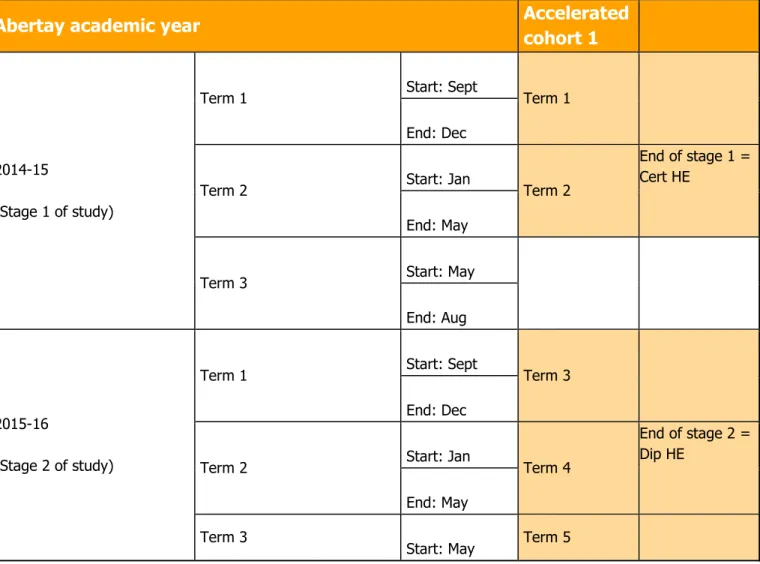
Revised programme structures were approved to enable the traditional Scottish four year degree to be delivered in three calendar years, such that a two term model of study was adopted in the first year of the student’s degree, but for the subsequent two years students enrolled for three 15-week terms (see Figure 1).
Figure 1. Accelerated degree structure mapped against academic years for first pilot cohort
Abertay academic year Accelerated
cohort 1
2014-15
(Stage 1 of study)
Term 1 Start: Sept Term 1
End: Dec
Term 2 Start: Jan Term 2
End of stage 1 = Cert HE
End: May
Term 3 Start: May
End: Aug
2015-16
(Stage 2 of study)
Term 1 Start: Sept Term 3
End: Dec
Term 2 Start: Jan Term 4
End of stage 2 = Dip HE
End: May Term 3
End: Aug
2016-17
Term 1 Start: Sept Term 6
End of stage 3 = BA/BSc
End: Dec
Term 2 Start: Jan Term 7
End: May
Term 3 Start: May Term 8
End of stage 4 = BA/BSc (Hons) End: Aug
2017-18
Term 1 Start: Sept
End: Dec
Term 2 Start: Jan
End: May
Term 3 Start: May
End: Aug
Students were also able to enrol directly into stage 2 of study if they had relevant A levels, Advanced Highers or Higher National Certificates. Market research had been conducted with prospective students prior to the pilot and the perception was that offering an accelerated route enhanced student choice, and had the potential for the student to accumulate less debt and enter the graduate employment market earlier. The pilot was designed to test the
attractiveness of this alternate and flexible mode of study.
Impact:
The first cohort has just completed stage 3 of study, early evaluation reveals: More appeal in specific subject disciplines, potentially influenced by the student demographic
Figure 2. Demographic comparison
Characteristic Accelerated cohort All Abertay UGs
Mean age 28 23.6
% direct enrolling into year 2 40 14
No differences in patterns of enrolment by protected characteristic or for those coming from postcodes aligned with the lower two quintiles of the Scottish Index of Multiple Deprivation.
Students enrolled because of the option for earlier completion of studies
Staff can pilot alternate modes of delivery e.g. block / blended teaching, enabling summer school enrolments and professional development opportunities for those in industry
Challenges exist in relation to the perception of parity of the student experience for some programmes; viable student numbers; and staff deployment
Further details:
For further information please contact: Andrea Cameron [email protected] Web links to information on Abertay accelerated degrees at:
http://www.abertay.ac.uk/discover/news/news-archive/2014/name,26674,en.html http://www.abertay.ac.uk/studying/accelerated-degrees/
http://www.abertay.ac.uk/studying/accelerated-degrees/accelerated-degrees-faq/
Title: A 'Big Green Gap Year' (BiGGY) for school leavers before taking up a university place
Contact: James Derounian BSc (Hons) MPhil MRTPI FHEA FILCM, Principal Lecturer in
Community Engagement and Local Governance, National Teaching Fellow, University of Gloucestershire.
Email: [email protected]
Description:
The 'Big Green Gap Year' (BiGGY) offers school leavers an opportunity to complete purposeful & socially beneficial work, before taking up a university place. Student input is rewarded with a living wage by a host employer (e.g. a Wildlife Trust, NHS provider).
James Derounian, University of Gloucestershire (UoG), conceived the idea around 2011, and has tested the initiative since then. BiGGY draws on the work of American educational reformer John Dewey. Of particular relevance are Dewey’s beliefs that all genuine education comes about through experience (1938: 25); culminating in the fact that (The school itself) shall be made a genuine form of active community life, instead of a place set apart in which to learn lessons (1900: 27). In 2015 BiGGY was piloted at the UoG by 6 school leavers. The project was supported by the NUS and Gloucestershire Students’ Union. Participants undertook an intensive planning period, followed by project based stints with Gloucestershire public and voluntary agencies. The 2015 BiGGY Pilot Evaluation notes: 100% of placement hosts stated that the BiGGY participants added value to their organisations; that they would recommend BiGGY to other organisations….the contributions participants made to Gloucestershire organisations supported them to become agents of positive change…whilst gaining employability skills and bridging the gap between school and university. This work is linked specifically to ‘Pedagogical Approaches’, which is in the bottom right quadrant of HEA Flexible Learning Wheel (see P. 2).
Impact:
Enables school leavers to make a smoother transition to independence and university life A means to address the democratic deficit – disaffected teenagers
Cross-generational work
Accelerates the ‘attack’ on climate change, improves community cohesion and social welfare Exchanges service for university fees / ‘working wage’
Provides purposeful ‘employment’ in time of recession
Further details:
Derounian, J. (2011) Green national service – an idea whose time has come? Guardian online, 9 June. Available at: https://www.theguardian.com/voluntary-sector-network/2011/jun/09/green-national-service-idea-come
Big Green Gap Year BiGGY is listed by NESTA 2015 as one of its 'New Radicals' at:
http://www.nesta.org.uk/news/new-radicals-2014/big-green-gap-year Evaluated very positively by student participants and hosting agencies:
http://sustainability.glos.ac.uk/wp-content/uploads/2016/04/BiGGY-Pilot-Evaluation-2015.pdf Video (5 minutes). Students speak about the BiGGY and its impact on them:
https://www.linkedin.com/pulse/inspiring-results-from-biggy-summer-placements-programme-megan-baker
Title: A flexible and gamified assessment package
Contact: Dr Neil Gordon, School of Engineering and Computer Science, University of Hull.
Email: [email protected]
Description:
Amongst the range of approaches that fall within flexible learning, is that of assessment. This exemplar outlines such an approach to flexible assessment. This approach utilises gamification and computer based assessment to allow students choice in when they are assessed, and how often. This approach uses a computer based quiz (encompassing multiple choice questions, matching and – in some cases – calculations or activities). The test is available for a prolonged period, encompassing the period when the assessed material is taught. Students can choose when to take the assessment within a wide window of availability. Allowing students to decide when they have achieved a satisfactory level of mastery (beyond the threshold) empowers them. Multiple attempts remove the cliff-edge of a single critical assessment and, by providing feedback (on what areas in which they have done badly) this affords a game-like response. The assessment is part of a portfolio of assessment, so that some is controlled (i.e. we validate the identity) whilst other elements (like other coursework) is available for students to choose when and where to take it.
Impact:
Students who are new to the material can repeatedly attempt it as they develop their knowledge and skills on the topic
Feedback from students is that they appreciate the opportunity to choose aspects of their assessment
Failure rates – and corresponding reassessment rates – have been reduced, though the spread of marks (to differentiate performance) remains broad
Further details:
For further information please contact: Dr Neil Gordon [email protected] Twitter @n_a_gordon
Related Publications:
Gordon, N., (2014) Flexible Pedagogies: technology-enhanced learning. From the report series Flexible Pedagogies: Preparing for the Future. York: The Higher Education Academy. Online at:
https://www.heacademy.ac.uk/flexible-pedagogies-technology-enhanced-learning
Gordon, N., Brayshaw, M. and Grey, S., (2013). Maximising gain for minimal pain: Utilising natural game mechanics. Innovation in Teaching and Learning in Information and Computer Sciences 12(1): 27-38. Online at:
http://www.tandfonline.com/doi/abs/10.11120/ital.2013.00004
Gordon, N. (2009) Enabling personalised learning through formative and summative
assessment, in Technology-supported Environments for Personalized Learning: Methods and Case Studies. Hershey: Information Science Publishing 268-283.
Title: A reduced attendance delivery model that utilises learning technologies
Contact: Jeff Lewis MSc FOTA SFHEA. Principal lecturer CPD & DL coordinator. Programme
Director, BSc (Hons) Dental Technology and MSc Dental Technology, Cardiff Metropolitan University.
Email: [email protected]
Description:
This practice utilised web-based video conferencing software (Adobe connect Pro) along with an e-portfolio (Mahara) within our Virtual Learning Environment (Moodle). Traditional
classrooms were replaced with virtual meetings, taught practical sessions were delegated out to the workplace, validation of practical work completed was introduced within the e-portfolio and lecture supervised practical sessions were supplemented by work-based mentors. During the enrolment process, applicants are supplied with the technical specifications for the devices they will be using to access lectures. There is a tripartite learning contract that must be returned with the application that is an agreement of responsibilities between the education provider, student and employer.
Impact:
Improved student recruitment: this has almost doubled and we now recruit from a much broader geographic area across the UK. This is as a direct result of the reduction of required visits to campus.
Improved student retention: this has risen from a typical 40% retention rate for our traditional PT attendance pattern to above 80% using this reduced attendance mode Improved student academic performance: students have overall lifted their scores to one grade higher and are outperforming the BSc (Hons) Fulltime students in shared programme modules.
Further details:
JISC TEL-WFD project
https://uwicjiscwfd.wordpress.com/dental-technology/ HEA Technology Enhanced Learning Plan: GWELLA
https://gwellauwic.wordpress.com/projects/project-10-dental-technology/
Related publications:
Nygaard C (Editor) (forthcoming) Handbook of Innovative Teaching and Learning In Higher Education, Chapter 27: A reduced attendance model of delivery that engages remote learners in the workplace. Faringdon: Libri Publishers.
Title: Adult Education Open Learning Programme
Contact: Tess Maginess, Queen’s University, Belfast
Email: [email protected]
Description:
I have worked with a wide range of ‘hard-to-reach’ adult learners for 20 years evolving models of flexible learning. Flexible learning means learning which valorises the learner; entering the learner zone; engaging in a developmental, dialogical process in which the teacher is a border-crosser, a facilitator. The starting point was to identify what topics or subjects were meaningful and relevant to communities rather than presenting a ‘set menu’ from the traditional
curriculum. Enacting a critical pedagogy meant tackling ‘hard’ subjects such as mental health, disability and gender. Working with groups to secure external funding enabled flexibility in terms of access and student support. Flexible learning was also achieved by partnering with external organisations to maximise the range of expertise available to groups (e.g. in
multimedia). Creative and arts based approaches to social issues allowed difficult subjects to be opened up imaginatively; students engaged more because the projects were enjoyable. The active learning workshops took place in community settings - the de-centred classroom - and the learners decided timetabling to suit them; for example, at nights, weekends. The
developmental model built from curriculum co-construction to co-research and co-teaching. Co-research created traction and empowered learners to create tangible legacies – film, drama, toolkit, website.
Impact:
Increased engagement with, and empowerment of, hard-to-reach learners to tackle social exclusion
Creation of funding partnerships directly benefiting communities
Creation of cross-institutional expertise, universities, statutory and arts sectors Development of active, flexible, participatory learning
Development of innovative critical pedagogy and learner ownership – construction, co-teaching and co-research
Embedding of hands-on and creative approaches which are enjoyable and more deeply engaging for learners
Evidence based research flowing from teaching, disseminating innovative practice Tangible legacies for communities
Further details:
For further information please contact: Tess Maginess [email protected]
Title: The FLEX initiative
Contact: Chrissi Nerantzi, Principal Lecturer in Academic CPD, Centre for Excellence in
Learning and Teaching (CELT) Manchester Metropolitan University. Email: [email protected]
Collaborators: Dr Stephen Powell and Mike Lowe.
Description:
FLEX is a practice-based openly-licensed academic CPD initiative offered since January 2014 within CELT at Manchester Metropolitan University (MMU). It is available to new and
experienced academics and other professionals who teach or support learning and was designed as a mechanism for recognising and enhancing the status of the wide variety of professional development activities. FLEX has formal and informal pathways and can lead to an annual FLEX Award to evidence engagement in CPD, academic credits at postgraduate level and can also support applications for professional recognition such as Fellowship of the Higher Education Academy. After registering for a FLEX module, colleagues identify CPD activities that are most beneficial to enhance their practice and are able to complete within one calendar year working towards flexible learning outcomes that can be personalised and contextualised. FLEX consists of a dynamic open offer of available CPD within MMU, which is continuously refreshed as well as open provision that has been developed and offered in collaboration with colleagues from other institutions and providers. In addition, colleagues can participate in existing formal and informal CPD offers of CELT, other opportunities within MMU and elsewhere. Monthly FLEX surgeries are offered to meet FLEX coordinators and colleagues to share experiences and research across the institution. An online FLEX community within Google plus as well as a FLEX mailing list have been set-up to keep in touch and connect all year round. Colleagues reflect on their CPD activities in a digital social media portfolio using a variety of genre. They are
supported by a FLEX coordinator and encouraged to further share their portfolio with colleagues and students to extend dialogue and opportunity for development through reflective dialogue.
Impact:
Feedback shows that learners' value freedom to select CPD activities, deemed most valuable for them, being able to enhance their practice through this process and the support they receive through the portfolio approach.
Reflective habits are developed which are helpful when developing use of similar approaches that integrate inquiry-based, collaborative, cross-boundary working with own students. Some have continued using their portfolio to capture professional reflections on their teaching and development and others have used FLEX as a vehicle to adopt a more scholarly approach to their practice and started engaging in pedagogical research disseminated through their portfolio, as well as conference contributions and academic journals.
Further details:
Related publications:
Nerantzi, C. (2015) In charge of our own renewal through practice-based CPD and reflection, in: Jackson, N. and Willis, J. (eds.) Exploring Reflection in the Social Age of Learning Lifewide Magazine March 2015. Issue 13: 52-56. Available at:
http://www.lifewidemagazine.co.uk/uploads/1/0/8/4/10842717/lifewide_magazine_issue_13.pdf Nerantzi, C. (2014) The FLEX scheme at Manchester Metropolitan University, case study
collection Flexible Delivery for the HEA, collected by Dr Alison LeCornu
Nerantzi, C. and Botham, K. (2016) FLEX to evidence good standing, in: Learning and Teaching in Action Journal 11 (2): 57-69. Manchester: CELT, MMU. Available at:
http://www.celt.mmu.ac.uk/ltia/Vol11Iss2/LTiA_Volume11_issue2.pdf
Title: Planning a New Venture
Contact: Dr Simon O'Leary, Faculty of Business & Management, Regent's University London.
Email: [email protected]
Description:
Planning a New Venture is a final-year elective module on the International Business and Events programmes and an option for international exchange students. Utilising the patchwork
assessment approach helps bring together this mixed group, and allows them to demonstrate both individual and team competences. The focus of the module is on developing an
entrepreneurial skillset, consists of a variety of small sections, and adopts a model of active and participatory engagements, including individual research into selected aspects of a potential new venture and the pooling of such research to develop a team plan. The learning takes place through a process of experience, reflection and application. The majority of the activity is outside the classroom in student-centred, personalised and real-world small tutorials with the tutor acting a guide. The assessment is not teacher-led and allows the students to select their own topics for the research and planning phases. Creating the group plan requires the creation of the product or service, understanding the dynamics of a competitive market, exploring the feasibility of the idea, and group management in working with others. It means that each student develops a self-awareness of their own competences, adaptability and behaviours.
Impact:
The students are highly energised and many undertake industry surveys, gather market opinions and complete field visits to gather relevant and contemporary information.
This is a very highly rated module in terms of student feedback and is always very popular, generally attracting around one hundred students.
The student output is excellent both at the individual and group levels and is regularly praised by the external examiner for its content and variety.
Many students cite it as one of their favourite modules, use it as an example in career planning and often maintain contact with the tutor.
Further details:
Student advocate experience at: http://www.regents.ac.uk/news/regents-alumna-launches-serbias-first-craft-brewery.aspx
Title: Education innovation in practice
Contact: Angela Scanlon, Head of Flexible and Continuing Education, PFHEA, Ulster University.
Email: [email protected]
Description:
JISC reported (2013) that students’ digital learning experiences are strongly dependent on the confidence and capabilities of their teachers. Flexible and Continuing Education at Ulster University have designed a suite of CPD modules for teaching practitioners within the area of educational innovation and digital practice, primarily for those supporting work based learners within higher education programmes. The flexible learning solution aims to provide support for educationalists to embed digital competencies into teaching and learning practice, enabling a responsive curriculum for students living, learning and working within the 21st Century.
Through the use of a blended learning model, postgraduate students are able to enhance their professional practice within education for work based learning. The access for students is flexible in relation to time, cost and engagement as the modules are individually certificated, with the option of a postgraduate certificate available upon completion of all modules,
consisting of:
Students as Partners
Designing and Developing Digital Solutions
Embracing Learning Spaces
Assessment for Learning and Impact
Impact:
The programme team noted that scaffolding the approach to curriculum design, beginning with learner needs, increased students confidence in the use of technology. This is evidenced in part by the following feedback:
...the learning has brought a sharp focus to me of what we can achieve through partnership, the great thing is that I have been given this scaffolding that allows me to develop it in a more planned and less chaotic fashion!
Before embarking on digital learning, considerable planning and effort needs to be afforded to how we engage and support the students to be part of the process
Further details:
For further information please contact: Angela Scanlon [email protected]
Title: Negotiated, work-based learning frameworks
Contact: Dr Tony Wall, Reader (Associate Professor) and Director, International Thriving at
Work Research Group, University of Chester. Email: [email protected]
Description:
Work Based & Integrative Studies (WBIS) is a set of academic frameworks which govern the design of undergraduate (BA Hons, BSc Hons, Professional Certificate, Certificate of HE, Diploma of HE, Graduate Certificate, Graduate Diploma) and postgraduate awards (PG
negotiate and approve a pathway of learning which is both relevant and coherent to an employment and personal development trajectory. These pathways can include workshop modules, workplace project modules, online modules, or modules assessed through the
Recognition of Prior Learning. While located in an academic department within a Faculty, which delivers / assesses most of the modules, learners are encouraged to access modules from other Faculties (as part of the integrative nature of the programme). Although all negotiated
pathways are approved by an academic department, WBIS is an institutional infrastructure to enable flexible higher education for people in workplaces in the UK and overseas, and so a pan-faculty panel, the WBIS Approval Panel, has oversight and responsibility for monitoring WBIS processes and approved pathways. This typically meets monthly and includes senior staff including a PVC and heads of quality and registry.
Impact:
Over 1,000 learners have engaged in workplace enhancement and change projects in the UK and overseas, and has led to, for example, healthcare commissioning changes in England and award winning transformational leadership projects in Wales.
A work-based programme involving 1400+ decision makers in the Department of Work & Pensions led to the design and implementation of new policies, processes, and raised the quality of decision-making of client claims nationally.
A collaboratively designed and delivered programme for The Forum of Mobility Centres has initiated the development of new professional standards for this occupational group in the UK and oversees.
Further details:
WBIS, at: http://www.chester.ac.uk/cwrs/courses
Example of WBIS in relation to the Department of Work and Pensions, at:
http://www.recordingachievement.ac.uk/employers-cpd/he5p/higher-education-324615/case-studies/item/download/21_fe77871fcd84d11b2531649cfe132711.html
Example of WBIS in relation to Higher Degree Apprenticeships, at:
https://www.researchgate.net/publication/309411319_The_Chartered_Manager_Degree_Appre nticeship_Trials_and_Tribulations
Title: Reciprocal pedagogies
Contact: Dr Tony Wall, Reader (Associate Professor) and Director, International Thriving at
Work Research Group, University of Chester. Email: [email protected]
Description:
Reciprocal pedagogies are those which position both the tutor and student as learners, whereby both engage in mutual or co-development. This is a fundamental extension to accommodating the needs of students (e.g. making presentations available online before a session) and
connecting to and integrating examples from personalised situations (e.g. activities which bring awareness to the particular circumstances of learners). Reciprocal pedagogies engage a way of facilitation which encourages personalised experiences of topics to be voiced in learning
settings, to be appreciated in that particular setting, and to be valued as a learning asset for all in the learning experience. In such contexts, learners (tutors and students) are expected and
stimulated to be radically flexible in appreciating the highly nuanced and contextual nature that knowledge, experience, and practice can take in different settings. Practices can include:
Tutors stating the value of alternative perspectives expressed by students, and encouraging discovery of the contextual nature of such perspectives
Activities that adopt open ended, coaching questions
Appreciative group work which captures and values the contextual nature of differences in relation to topics
Co-developing curriculum and / or learning resources, which emerge as a result of the learning interactions (e.g. collaborative wikis)
Impact:
Application in the context of teaching research methods has led to a significant
enhancement in completion, achievement, and satisfaction (see the further details section). An application in the context of core modules of a work based learning programme has contributed to significant increases in multiple elements of the National Student Survey. Empirical evidence has demonstrated that reciprocal pedagogies enable voice for
international learners, and that this influences their satisfaction with their learning and their overall learning achievement (see the further details section).
Further details:
Example in the context of teaching research methods, at:
https://www.researchgate.net/publication/260758834_Transforming_Research-Learning_Performance_With_Professional_Lifelong_Learners
Example in the context of work based learning, at:
https://www.researchgate.net/publication/311169856_Turning_practitioners_into_practitioner-researchers
Example in the context of transcultural learning, at:
https://www.researchgate.net/publication/305061158_A_transcultural_dance_Enriching_work-based_learning_facilitation
Contact us
+44 (0)1904 717500 [email protected]
Innovation Way, York Science Park, Heslington, York, YO10 5BR Twitter: @HEAcademy www.heacademy.ac.uk
© Higher Education Academy, 2017
Higher Education Academy (HEA) is the national body for learning and teaching in higher education. We work with universities and other higher education providers to bring about change in learning and teaching. We do this to improve the experience that students have while they are studying, and to support and develop those who teach them. Our activities focus on rewarding and recognising excellence in teaching, bringing together people and resources to research and share best practice, and by helping to influence, shape and implement policy - locally, nationally, and internationally.
HEA has knowledge, experience and expertise in higher education. Our service and product range is broader than any other competitor.
The views expressed in this publication are those of the author and not necessarily those of the Higher Education Academy. No part of this publication may be reproduced or transmitted in any form or
by any means, electronic or mechanical, including photocopying, recording, or any storage and retrieval system without the written permission of the Editor. Such permission will normally be granted
for educational purposes provided that due acknowledgement is given. To request copies of this report in large print or in a different format, please contact the communications office at the Higher Education Academy: 01904 717500 or [email protected]
Higher Education Academy is a company limited by guarantee registered in England and Wales no. 04931031. Registered as a charity in England and Wales no. 1101607. Registered as a charity in Scotland no. SC043946.
The words “Higher Education Academy” and logo should not be used without our permission.